The Ways 0f Conceptual Thinking Development in Adolescence
Abstract
Abstract
Abstract: The current article presents a program “I choose success!”. The purpose of this program is conceptual thinking development in middle school students. The program “I choose success!” is designed in accordance with the principle of systems differentiation & integration of logical-semantic and verbal-semantic cognitive structures, which are the substratum of conceptual thinking. The four stages of conceptual thinking development are discussed. The exercises aimed at developing various aspects of conceptual thinking are described in detail, as well as the criteria for evaluating the performance of these exercises. “I Choose Success classes” are held twice a week. A comparative formative experiment was carried out to test the developmental effect of the program “I Choose Success!”. Students aged 11-12 were involved in learning experiment. It should be emphasized that these students before the learning experiment had lower IQs and experienced great difficulty in highlighting the main idea of the text compared to the students of the control group. The study used Test of Structure of Intelligence (TSI) by Amthauer and the Klaschus’s conceptual thinking assessment tool. Qualitative analysis showed that, at the end of the learning experiment, the initially weaker students of the experimental sample were twice as successful compared to the students of the control sample. Thus, the data obtained showed that the purposeful formation of differentiated logical-semantic and verbal-semantic cognitive structures affected the accuracy of highlighting the main idea of the text and led to the intellectual development of students.
Introduction
1.1. The Reverse Flynn Effect
After many decades during which the average level of intelligence of the human population has steadily increased (Flynn, 1984; Neisser, 1997), this level has now begun to decline again. There has been increasing evidence of negative changes in intelligence test scores in Europe (Dutton, van der Linden, & Lynn, 2016). Similar declines in intelligence scores have been noted in developing countries, for example, in studies on elite samples of Brazil and Sudan (Dutton et. al., 2017). As explanatory reasons for the reverse Flynn effect, the following is usually noted:
(1) deterioration of the gene pool,
(2) unbalanced diet and sedentary lifestyle,
(3) thoughtless implementation of Artificial Intelligence technologies,
(4) learning does not follow the natural laws of mental development.
Cross-sectional data from a sample of adults (n=394378) over thirteen years (2006 to 2018) in the United States revealed a pattern consistent with the reverse Flynn effect. Matrix reasoning, letter and number series, as well as verbal reasoning scores showed decreased scores. It should be noted that the strongest declines were observed among respondents aged 18–22 years with a lower level of education (Dworak, Revelle, & Condon, 2023).
1.2. How to Reverse the Reverse Flynn Effect?
We believe that following the objective laws of mental development is perhaps the only safe way to construct educational programs. Just as an engineer, designing a complex technical device, relies on the laws of physics, so a teacher, designing an educational program, must follow the objective laws of mental development.
The search for general principles, psychological mechanisms, and driving forces of a child’s mental development for more than three centuries has been the main goal of the psychology of teaching and upbringing. J.A. Comenius (2016), G. W. F. Hegel, (2021), H. Spencer (1855), E. A. Claparède (1911), J. Piaget (2020), H. Werner (1957) considered the ways of developing a child’s cognition from the sensory, global to the differentiated and conceptual. L.S. Vygotsky (2019), L.V. Zankov (1975), P.Ya. Galperin (1969), V.V. Davydov (2000), M.A. Kholodnaya (2011, 2022), V.V. Volkova (2016), N.I. Chuprikova (1995, 2003) developed ideas about the relationship between language and thinking, developmental learning, and the formation of the foundations of conceptual thinking.
L.S. Vygotsky emphasized that the exclusive role of signs and words lies in the ability to highlight, distract, and abstract the features of objects. The word is a tool for the formation of concepts. Through words, a child comprehends all the achievements of conceptual thinking (Vygotsky, 1983, 2019).
L.V. Zankov’s curriculum of developmental primary education represents the process of differentiating educational material, isolating different elements from the whole, identifying differences in what is similar. The emphasis is on highlighting differences in similar objects and phenomena, as a special method of child development, ensuring the formation of a clear differentiation of the properties and relationships of objects, as well as differentiated and hierarchically ordered representative cognitive structures (Zankov, 1975).
P.Ya. Galperin argued the need for the formation of complete orientation activity in the learning process and the gradual formation of structurally ordered representations of objects and phenomena based on generalized operational schemes of thinking (Galperin, 1969).
V.V. Davydov’s curriculum of developmental education is aimed at developing systems thinking. It is based on the general law of mental development, i.e. from the general to the particular, consistent revealing of the sings of concepts as the basis for the conceptual thinking development (Davydov, 1986, 2000).
M.A. Kholodnaya substantiates the important role of the process of systems differentiation of representative cognitive structures as the basis of intelligence development. She points out that the substratum of intelligence are conceptual psychological structures in which knowledge is clearly differentiated and structured (Kholodnaya, 1983, 2011, 2022).
In this regard, it is of interest to study the relationship between differentiation and hierarchical ordering of everyday and scientific concepts “Disease”, “Soil”, “Substance” with the manifestation of creativity, intelligence, and field dependence/field independence in youth. Data obtained by M.A. Kholodnaya and E.V. Volkova convincingly proves that the higher the level of differentiation and hierarchy of cognitive representative structures are, the higher is the level of conceptual thinking, intelligence, creativity as well as field independence (Kholodnaya & Volkova, 2016).
Accelerated and effective development of the system of representative cognitive structures occurs in adolescence when studying the exact sciences. The neuroefficiency of the formation of cognitive representational structures depends on the age, heredity and diversity of the child’s life experiences (Volkova, 2016). Moreover, according to EEG data, the targeted formation of representative cognitive structures significantly increases the neuroefficiency of problem solving; a decrease in energy consumption and a clear localization of brain activity are diagnosed (Volkova & Talantov, 2019). It has been convincingly proven that the learning process, based on the principle of systems differentiation and integration, ensures a high level of quality of education and the successful development of conceptual thinking of adolescents in the zone of proximal development (Chuprikova, 1995, 2003, 2007; Klashchus, 2021; Lokalova, 2001; Volkova, 2013, 2015, 2016).
Summarizing the above, it can be assumed that curricula, built in accordance with the laws of mental development, can become a reliable tool for counteracting the reverse Flynn effect.
Modern science considers development from the standpoint of systemogenesis, namely, systems evolutionary processes of development are characterized by the direction of changes in the structure of objects, when in the process of development new qualities and properties appear and old, outdated ones disappear (Anokhin, 1968). The fundamental mechanisms of development of nature, society, and man are differentiation (analysis) and integration (synthesis) (Chuprikova, 2007; Hegel, 2021; Sechenov, 2001; Spencer, 1855; Soloviev, 1988). The development of cognition proceeds from the general to the particular, from the whole to the parts, from the global to the differentiated (Claparède, 1911; Comenius, 2016; Piaget, 2020; Vygotsky, 1983; Werner, 1957). The development of cognitive processes and functions is associated with changes in representative cognitive structures (Chuprikova, 1995 2003, 2007; Kholodnaya, 1983, 2011, 2022; Piaget, 2020; Volkova, 2013, 2015, 2016). This understanding of development has become the theoretical basis of developmental education. The DI-theory of development makes it possible to most fully reveal the role of language and speech communication in the development of cognitive abilities, in the formation of a sense of language, as a process of intuitive mastery of all linguistic means and forms. The theoretical foundation of this theory is a generalization of the scientific achievements of cognitive psychology, developmental psychology, educational psychology, and a number of other branches of science. DI- theory allows us to move from understanding development as a frozen catalog of abilities and personality traits at a certain age stage to understanding development processes, the relationship between the biological and the social, understanding the essence of causes and driving forces, that is, to managing mental development.
The goal of the study is to elaborate and verify a curriculum aimed at developing conceptual thinking in adolescents.
Method
2.1. Sample
The study involved 69 adolescents aged 14–15 years in the eighth grade of Municipal Educational Institution “Secondary School No. 6” in Saratov (experimental group) and 79 adolescents aged 14–15 years in the eighth grade of Municipal Educational Institution “Lyceum No. 42” in Ufa (control group). Among them are 64 boys and 85 girls.
The experimental group consisted of eighth-grade students with learning disabilities. These students studied twice a week according to the “I Choose Success!” curriculum since fifth grade. This curriculum is aimed at preventing school disadaptation in early adolescence (Klashchus, Kobzeva, 2017; Klashchus, 2021).
2.2. The ways 0f conceptual thinking development
The “I Choose Success!” curriculum is the way 0f conceptual thinking development. This curriculum consists of 36 lessons and implements the purposeful formation of conceptual structures that are the basis of conceptual thinking, in accordance with the DI-principle of development. The set of exercises promotes the development of both thinking and imagination, attention, internal action plan, and spatial concepts. Exercises for the development of cognitive abilities are mainly borrowed from N.P. Lokalova’s program (Lokalova, 2001). Other equally important areas of working with teenagers are developing communication skills and improving learning skills. It is important to ensure that all students complete assignments correctly, even if it takes more time than expected in the curriculum.
The formation of conceptual structures as the basis of conceptual thinking begins with work on the word. At the beginning of classes, students are given tasks to include one word in different statements, as a result of which the words become elements of a wide variety of conceptual structures.
Exercise 1. “Three Words”: students need to make as many sentences as possible that include these words.
Example: Make as many sentences as possible from the three words “desk, sky, apple”. You can change cases and add other words.
Exercise 2. “Make Words”: students need to abstract individual constituent elements in order to compose as many words as possible from the letters of a given word.
Example: Make as many words as possible from the letters in the given word “powerhouse”. The words formed must be nouns in the nominative singular case. You cannot add other letters.
Exercise 3. “Choose synonyms and antonyms”:
Example: For the words on the left in column A, select and write down words that have a similar meaning (synonyms).
For the words on the left in column B, select and write down words that have the opposite meaning (antonyms).
| А | B | ||
| Cold | _____ | Success | _____ |
| Artist | _____ | Arrival | _____ |
| Honest | Often | ||
Exercise 4. “Essential and non-essential features”.
Example: In each object or event, one can distinguish main and secondary, essential and non-essential features. You need to identify and write the essential and non-essential characteristics of objects and phenomena.
Clock
| Essential features | Non-essential features | ||
Exercise 5. “Explain phraseological units”.
Example: Write down the meaning of the following phraseological units: “As if dipped into water”; “Ends in the water”; “Like water off a duck’s back”; “How to drown in water”.
Exercise 6. “Choose proverbs”.
Example: Match the proverb on the left with a proverb on the right that would be close in meaning and express a similar main idea. In the empty column, write the number of the corresponding proverb on the left.
| 1. | Anyone who has fallen into the water has nothing to fear from the rain. | First the burden, then the rest | |
| 2. | Finished the matter, walk safely | Having taken off your head, don’t cry over your hair. | |
| 3. | Crooked wood, but it burns straight. | Clumsily tailored, but tightly sewn. |
Exercise 7. “How to say it in Russian?”
Example: Choose Russian analogues for proverbs and sayings of the peoples of other countries.
French proverb: He who walks slowly will surely achieve his goal.
English proverb: The greater the haste, the slower the speed.
Exercise 8. “Comparing concepts.” Students determine the relationships between concepts, when a narrow concept is completely included in a more general one, concepts intersect, coincide or are different (Figure 1).
Example: The psychologist discusses with the students and writes examples and diagrams on the board, and then the
students complete the exercise in their workbook, defining relationships and recording the diagram between concepts.
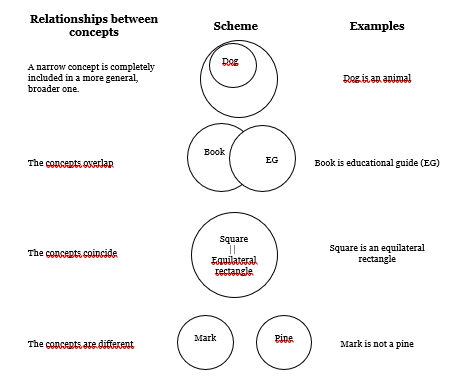
Figure 1. Comparing concepts
Exercise 9. Identifying the relations between opposite concepts, concepts that contradict each other in meaning, and concepts that relate to each other as part-whole or whole-part.
Example: See Figure 2.
Exercise 10. Distinguishing the relationship between the concepts of “generalization-concretization” and “whole-part”.
When we think, we make a transition from more particular (concrete) concepts to more general ones, that is, we carry out the process of generalization. When we
think in the opposite direction, that is, from more general concepts to more specific ones, we concretize a given concept.
Example: We refer to the concept of “cucumber” as a vegetable. “Cucumber” is a particular, concrete concept, and “vegetable” is a general, abstract concept. Let’s outline this generalization with a diagram.
If we go from the general concept of “furniture” to the more specific “chair”, we specify the concept, that is, we name a piece of furniture (Figure 3).
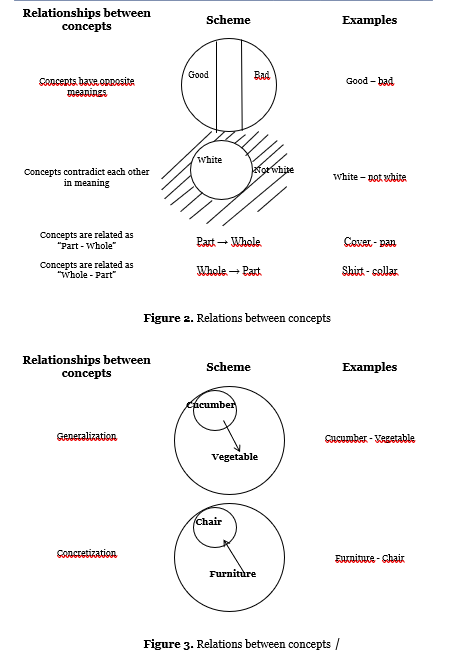
Exercise 10. “Generalization-concretization” and “part-whole”.
After students have completed the exercises and collectively analyzed each pair of words, they then perform a test that evaluates each student’s difficulties and mastery of new material.
Example: Determine the relations between concepts: generalization, concretization, part-whole or whole-part: house – wall, root – tree, rain – precipitation, child – boy, insect – bee, coal – fuel, shovel – handle.
This exercise ensures the integration of essential connections between words identified by analysis, the formation of a formal logical structure that reveals this internal connection.
Exercise 11. “Dividing concepts”.
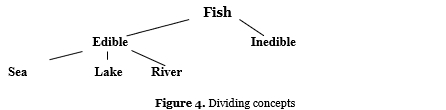
For mental development and understanding of the essence of phenomena, it is important to be able to correctly divide a general concept on various grounds, that is, within a general concept, highlight the various features of
particular concepts (concretization). The division of concepts is carried out correctly if it is carried out according to one characteristic (base) and preserves the completeness of the division (all components of the characteristic are indicated). The same concept can be divided into groups according to different criteria, but in each individual case the division should be made on only one basis.
Example: Determine whether the division of the concept of “fish” is correct.
Student answers: Fish are sea, river, lake, and edible.
The dividing of concepts was incorrect, since it was carried out according to two criteria at once: habitat and suitability for use. Drawing a diagram helps students visualize why a sentence is logically false (Figure 4).
The acquired skills allow students to move on to recognizing the type of judgment (general affirmative, general negative, partial affirmative, partial negative) (Figure 5).
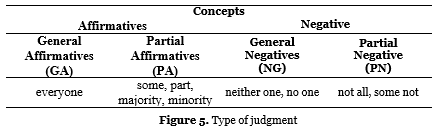
Example: Determine the type of judgment in the following sentences and underline the words indicating the type of judgment:
All Russians are Slavs. ___________
Some schoolchildren study French. __
Some lions are not trained. ________
Most lakes in deserts are brackish. __
Exercise 12. “Change the form without changing the content”. Each lesson discusses the rules for converting judgments. The psychologist guides students according to a certain algorithm, offering to determine the type of judgment, highlight concepts and connections between them.
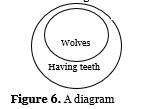
Example: “All wolves have teeth”.
What kind of judgment is this? (GA)
What are the concepts here? (Wolves have teeth).
What is the relationship between these concepts? (The small concept is fully included in the large one.) (Figure 6).
Students practice transforming judgments:
(1) general affirmative – into partial affirmative;
(2) partial affirmative – into general negative;
(3) partial negative – into partial affirmative;
(4) partial affirmative – into partial negative, etc.
Students come up with their own examples of transformations.
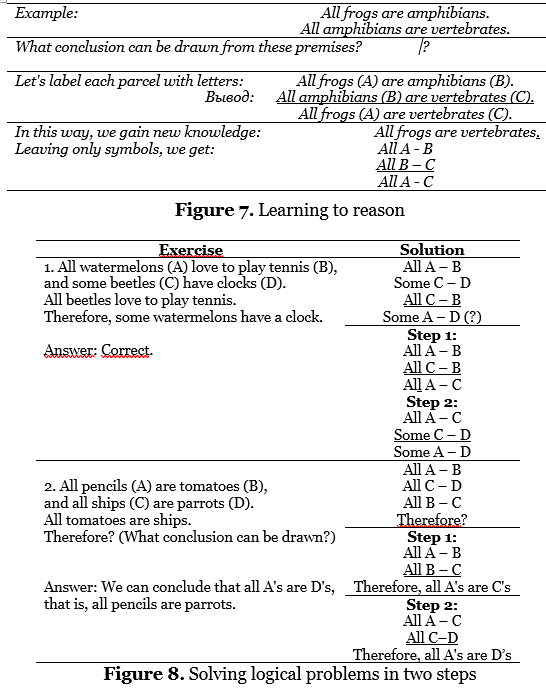
Exercise 13. “Learning to reason”. Students identify premises, conclusions and the purpose of reasoning, carrying out inductive and deductive reasoning available to them (Figure 7).
Exercise 14. “Solving logical problems with inequalities”.
Example: Anne is the same age as Nick, and Nick is the same age as Mary. Are Anne and Mary the same age?
Joni plays chess better than Ian. Nick plays chess worse than Ian. Therefore, Joni plays chess better than Nick. Is the conclusion correct?
Exercises 15. “Solving logical problems in two steps” (Figure 8).
2.3. Measures
- Test of Structure of Intelligence (TSI)
To assess the development of conceptual thinking, we used the Test of Structure of Intelligence (TSI) by R. Amthauer (Amthauer et al., 2001) modified on the Russian sample (Tunik, 2009). The Amthauer TSI contains 176 tasks. The total examination time is 90 minutes. This test consists of 9 subtests aimed at measuring various functions of intelligence. In all subtests closed-type tasks are used, excepting of IV – VI subtests.
Subtest 1 “Sentence Completion” (SC), aims to assess inductive reasoning and sense of language. The respondent is asked to complete the sentence with one of the suggested words. The number of tasks is 20.
Example: The rabbit is most similar to…? a) cat b) squirrel c) hare d) fox e) hedgehog.
Subtest 2 “Odd One Out Task” (OT) is intended to assess the ability to abstract and operate with verbal concepts. The tasks offer five words, four of which are united by a certain semantic connection, and one is superfluous. This word should be highlighted in the text. The number of tasks is 20.
Example: a) table b) chair c) bird d) wardrobe e) bed.
Subtest 3 “Verbal Analogies” (VA) evaluates combinatorial abilities, agility of thinking, understanding of relationships. The assignments offer three words; there is a certain connection between the first and second. For the third word, out of the five options attached to the task, you need to choose a word that would be associated with it in the same way as the first two. The number of tasks is 20.
Example: Forest: tree = meadow: …? a) grass b) hay c) forage d) greens e) pasture.
Subtest 4 “Verbal Similarities” (VS) assesses the ability to make judgments, the ability to abstract, to form concepts, and the ability to verbally express thoughts. The respondent is asked to think about what the two concepts have in common and call it in one word. The number of tasks is 16.
Example: rye – wheat: …?
Subtest 5 “Calculations” (CA) diagnoses the ability to do mental math and correctly construct simple numerical models of practical situations.
Example: A cyclist travels 15 km in 1 hour. How many kilometers will he/she travel in 4 hours?
Subtest 6 “Number Series” (NS) evaluates the development of inductive thinking, the ability to operate with numbers. It is necessary to establish the pattern of a number series and continue it.
Example 1: 2 4 6 8 10 12 14 ?
Example 2: 9 7 10 8 11 9 12 ?
The subtest “Number Series” reveals mathematical intuition, the ability to put forward and test mathematical hypotheses, to see patterns and order in a set of abstract signs. Therefore, with the help of this subtest, the possession of theoretical mathematical thinking is checked, which is necessary for constructing mathematical worlds and building abstract logical-mathematical models of the world.
Subtest 7 “Choice of figures” (choice of a geometric pattern) is aimed at studying spatial imagination, combinatorial abilities, and visual holistic thinking. The tasks contain geometric figures divided into parts. When choosing an answer, you should find a picture with a whole figure that corresponds to the figure divided into parts. The number of tasks is 20. This subtest reveals practical spatial intelligence, the ability to mentally rotate figures on a plane and combine them in order to obtain a given result. This ability is necessary in any practical activity related to the manipulation of real objects. Students who score high on this subtest have good coordination and good eye, their movements are precise and dexterous, they easily read drawings, quickly learn to draw and make good technical sketches, quickly master practical skills (sew, cook, plane, saw, etc.). They are observant and are good experimenters.
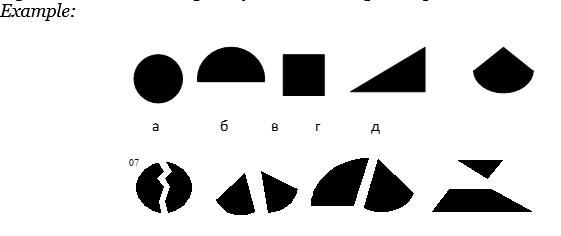
Subtest 8 “Cubes” evaluates the level of spatial imagination, combinatorial abilities in three-dimensional space. In each of the 20 tasks, a cube is given in a certain, changed in relation to a row of cubes designated by letters. It is necessary to identify the cube given in the task with one of the cubes designated by letters.
This subtest evaluates the ability to mentally rotate the image of a three-dimensional object while maintaining its integrity. This specific ability is necessary for displaying in the consciousness the deep, extremely abstract properties of the surrounding world that are not given directly in sensations. Students who possess this ability can think conceptually and apply the hypothetical-deductive method to study nature based on the construction of abstract logical-mathematical models.

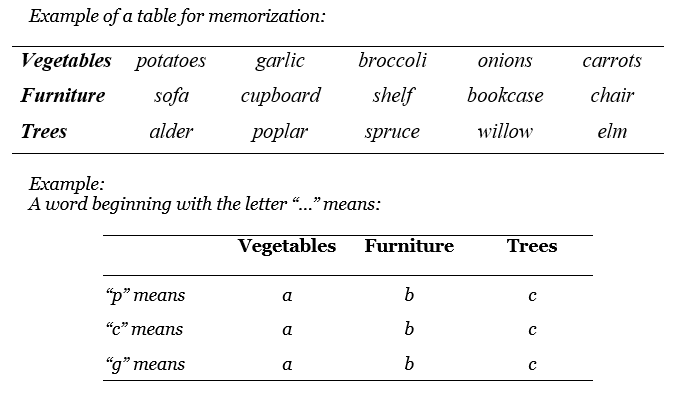
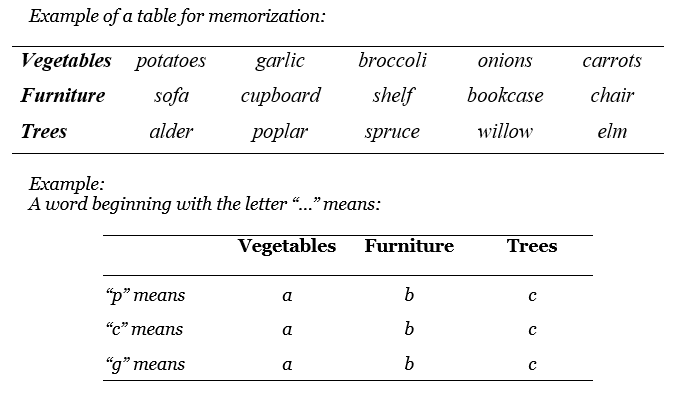
Subtest 10 “Logical operative memory” examines the ability to concentrate attention and retain in memory what has been learned. It is suggested to remember a number of words that are combined in a table by certain categories, and find them among others offered in the task. In total, you need to remember 25 words.
Operational logical memory ensures short-term retention and arbitrary use of information due to the operations of its “collapse” and “deployment”. When memorizing, the operation of semantic generalization “collapse” is used; information is organized multidimensionally, according to the principle of the “conceptual pyramid”, can be reproduced in the mind simultaneously and holistically, can be subjected to any transformations, and for further selective or complete reproduction, the operation of “deployment” is used (Kholodnaya & Volkova, 2016).
Subtests are combined into the following groups:
- verbal subtests evaluate a set of verbal abilities necessary for successful handling of information presented in verbal form;
- mathematical subtests assess a set of
abilities associated with quantitative modeling of phenomena based on handling mathematical symbols and numbers; - spatial subtests test the level of development of visual-figurative thinking, practical and theoretical constructive abilities, spatial imagination.
Group assessments of the three listed aspects of intelligence allow us to identify the strengths and weaknesses of a student’s intelligence. When interpreting the results, it is not so much the exact numerical data that is important, but their belonging to one of the three possible areas.
- Directed associative experiment
Students were asked to write as many adjectives as possible corresponding to the word “Substance” within three minutes.
Data processing included the assessment of the following indicators:
- Implicit chemical knowledge is the first reaction to the stimulus word “Substance”.
- Length of the associative series is the total number of reactions.
- The severity of sensory, emotional-evaluative, and spatio-temporal modalities of the concept “Substance” was assessed by the number of reactions corresponding to each modality.
- Chemical experience was evaluated by the number of “purely chemical” reactions.
- Dimensionality of mental experience is the number of formed dimensions (sour, bitter, sweet, salty; solid, liquid, gaseous; hot, cold; colored, colorless; soluble, insoluble, etc.).
- Potential for enriching mental experience was assessed by the total number of formed and unformed dimensions.
- Inadequate reactions are reactions that do not correspond to the word Substance.
2.4. Statistical Procedures
The statistical data were analyzed with
IBM SPSS Statistics 27. Statistical treatment included Descriptive Statistics (Mean, Standard Deviation, Skewness, Kurtosis), Pearson χ2 and Student’s t test.
Results
The adolescents in the control sample studied at one of the highly rated educational institutions in Ufa. The control sample included students with learning disabilities. They studied under the “I Choose Success” program from the fifth grade (Klashchus, Kobzeva, 2017), thanks to which the majority of adolescents achieved an above-average level of intelligence on the Amthauer test.
The results of a comparative analysis of intelligence in the control and experimental samples after three years of training are presented in Table 1. Adolescents in the experimental sample demonstrate significantly higher levels of verbal, theoretical, practical, and general intelligence compared to adolescents in the control group. No significant differences in mathematical and constructive intelligence were found between the experimental and control samples. The experimental sample adolescents began to cope with verbal analogies as successfully as the control sample adolescents. However, verbal memory and calculations are still lower than those of adolescents in the control sample.
The results obtained testify that the curriculum “I choose success!” really helps to develop intelligence. They also indicate the need to diversify exercises to develop the ability to draw verbal analogies and to count (Table 1).
Table 1. Means, Standard Deviation of Intelligence in the Samples of Ufa and Saratov
| Scores | Means | t | Sig. (2-tailed) | |
| Control sample, N=79 | Experimental sample, N=69 | |||
| Sentence Completion (SC) | 7.92 ± 2.11 | 11.12 ± 2.40 | – 8.548 | 0.000 |
| Odd One Out Task (OT) | 9.08 ± 2.82 | 9.45 ± 2.03 | – 0.932 | 0.353 |
| Verbal Analogies (VA) | 7.58 ± 2.95 | 9.57 ± 3.08 | – 3.988 | 0.000 |
| Verbal Similarities (VS) | 6.57 ± 3.30 | 8.71 ± 5.13 | – 2.960 | 0.004 |
| Calculations (CA) | 7.32 ± 4.19 | 5.23 ± 2.61 | 3.674 | 0.000 |
| Number Series (NS) | 7.81 ± 4.39 | 8.99 ± 3.60 | – 1.750 | 0.082 |
| Figure Selection (FS) | 8.38 ± 3.48 | 9.28 ± 2.67 | – 1.760 | 0.081 |
| Cubes (CU) | 8.79 ± 3.80 | 9.25 ± 2.87 | – 0.818 | 0.415 |
| Verbal Memory (VM) | 15.67 ± 4.65 | 12.41 ± 3.84 | 4.657 | 0.000 |
| Verbal Intelligence | 30.90 ± 8.30 | 38.84 ± 9.48 | – 5.388 | 0.000 |
| Mathematical Intelligence | 14.53 ± 7.89 | 14.22 ± 5.46 | 0.278 | 0.781 |
| Constructive Intelligence | 17.06 ± 6.05 | 18.52 ± 4.64 | – 1.650 | 0.101 |
| Theoretical Intelligence | 15.39 ± 5.25 | 18.16 ± 5.99 | – 2.967 | 0.004 |
| Practical Intelligence | 15.51 ± 4.14 | 20.68 ± 4.68 | – 7.079 | 0.000 |
| General Intelligence | 77.56 ± 20.93 | 83.99 ± 16.92 | – 2.065 | 0.041 |
Table 2. Means and Significance of Differences of Chemical Experience Indicators in the control and experimental samples
| Scores | Means | Sig. (2-tailed) | |
| Control sample, N=79 | Experimental sample, N=69 | ||
| Sensory modality | 4.01 | 4.55 | <0.05 |
| Emotional-evaluative modality | 0.90 | 1.52 | <0.05 |
| Spatio-temporal modality | 0.23 | 0.24 | >0.05 |
| Length of associative series | 7.14 | 9.86 | <0.01 |
| Dimensionality of mental experience | 0.90 | 1.93 | <0.01 |
| Potential for enrichment of mental experience | 2.75 | 4.28 | <0.01 |
| Volume of chemical experience | 1.04 | 3.20 | <0.001 |
| Number of inadequate reactions | 0.91 | 1.00 | >0.05 |
To test whether this curriculum can indeed improve learning outcomes in academic disciplines, we turn to the results presented in Table 2. Chemistry is rated by students and their parents as one of the most incomprehensible and difficult academic disciplines. Let’s compare the “chemical experience” acquired by students in chemistry lessons (Table 2). By the time of testing, eighth-graders had mastered ¾ of the 8th grade chemistry course curriculum. Most of the adolescents in the experimental sample achieved above-average levels of intellectual development, as measured by the Amthauer Intelligence Test. The control sample was distinguished by a wide range of intellectual capabilities, from very high to clearly below average.
A significant difference in implicit chemical knowledge was found in the experimental and control groups (Pearson χ2 = 183.00, p < 0.02). Most often, the signs of the state of aggregation (solid, liquid), composition (simple, complex) are actualized, and less often, the emotional-evaluative attitude towards the substance (strange, forbidden). The experimental sample adolescents extract the features of the aggregate state of the substance, liquid – solid, and the chemical composition of the compounds, simple – complex. The control group adolescents describe the substance as liquid, simple, solid, complex, strange, and colored. Both in the control sample and in the experimental sample, there were more sensory signs of the substance compared to emotional-evaluative and spatio-temporal ones.
Already in the eighth grade, in the conditions of a specially organized educational environment, a significant enrichment of chemical experience and a decrease in the representation of emotional-evaluative features of a substance are noted, 1.52 points against 3.20 in the experimental sample. A transition is made from sensory-perceived information about a substance to chemical thinking, operating with abstract chemical knowledge. Compared to adolescents in the control sample, adolescents in the experimental sample identified more different aspects of the substance and had a greater potential for enriching their understanding of the chemical substance. No significant differences in inadequate reactions and the severity of emotional-evaluative modality were found in the experimental and control samples.
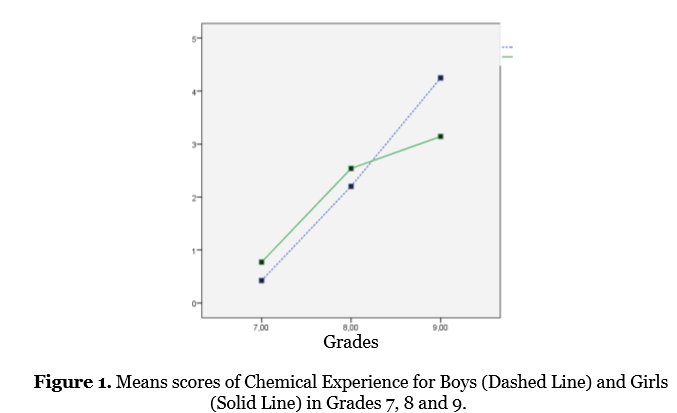
Approximately the same rate of enrichment of sensory experience is diagnosed in boys and girls in the 7th grade, but after the eighth grade, the rate of enrichment of sensory experience in boys slows down, and in girls, accelerated growth is noted. As for the chemical experience itself, a different pattern is observed here: in boys, an acceleration is diagnosed, and in girls, a slowdown in the rate of enrichment of chemical experience Figure 1).
Discussion
A comparative formative experiment was carried out to test the developmental effect of the program “I Choose Success!”. Students aged 11-12 were involved in learning experiment. It should be emphasized that before learning experiment the students of the experimental sample had lower IQs and experienced great difficulty in highlighting the main idea of the text compared to the students of the control group. The results testify that at the end of the learning experiment, the initially weaker students in the experimental sample were twice as successful as the students in the control sample. Thus, the data obtained showed that the targeted formation of differentiated logical-semantic and verbal-semantic cognitive structures affected the accuracy of identifying the main idea of the text and led to the intellectual development of students. As students mature and master chemistry, their sensory and emotional-evaluative experience is enriched, the dimensionality of mental space increases, chemical experience is enriched and its potential increases. Rich and well-organized chemical experience is the basis of chemical intelligence. It should be noted that the “I Choose Success!” curriculum provides students with more opportunities to enrich their chemistry experiences than the control curriculum. Thus, this curriculum does improve learning outcomes in academic subjects.
Conclusions
Author contributions: All persons entitled to authorship are listed. The contribution of both authors is roughly equal. The authors approved the final version and bear responsibility for all aspects of the work.
Competing interests: None
References
- Anokhin, P. K. (1968). Biology and neurophysiology of the conditioned reflex. [Anokhin, P. K. Biologiya i neyrofiziologiya uslovnogo refleksa. M., 1968].
- Amthauer, R., Brocke, B., Liepmann, D., & Beauducel, A. (2001). Intelligenz-StrukturTest 2000 R [Intelligence-Structure-Test 2000 R].
- Chuprikova, N. I. (1995). Mental development and learning (Psychological foundations of developmental education). M.: Publishing house “Century”. [Chuprikova, N. I. Umstvennoye razvitiye i obucheniye (Psikhologicheskiye osnovy razvivayushchego obucheniya). – M.: Izdatel’stvo “Stoletiye”, 1995].
- Chuprikova, N. I. (2003). Mental development and learning (towards the justification of the systems-structural approach).: Publishing house of the Moscow Psychological and Social Institute. [Chuprikova, N. I. Umstvennoye razvitiye i obucheniye (k obosnovaniyu sistemno-strukturnogo podkhoda). – M.: Izdatel’stvo Moskovskogo psikhologo-sotsial’nogo instituta, 2003].
- Chuprikova, N. I. (2007). Mental development: The principle of differentiation. Petersburg: Peter. [Chuprikova N.I. Umstvennoye razvitiye: Printsip differentsiatsii. – SPb.: Piter, 2007].
- Chuprikova, N. I. (2014). Differential-integration theory of development as the basis for solving the problem of the relationship between language and thinking. In Differentiation & integration theory of development. Book 2. Eds. N. I. Chuprikova, E. V. Volkova. M.: Publishing house “Languages of Slavic Culture”, P. 165 – 190. [Chuprikova, N. I. Differentsionno-integratsionnaya teoriya razvitiya kak osnova resheniya problemy sootnosheniya yazyka i myshleniya / Differentsionno-integratsionnaya teoriya razvitiya. Kn. 2 / Sost. i red. N.I. Chuprikova, Ye.V. Volkova. – M.: Izdatel’stvo “Yazyki slavyanskoy kul’tury”, 2014. S. 165 – 190].
- Chuprikova, N. I. (2016). Unknown Vygotsky: cultural-historical theory in the context of Pavlov’s theory of higher nervous activity and H. Werner’s differentiation theory of development. Cultural-historical psychology, 12(3), 239 – 246. [Chuprikova N.I. Neizvestnyy Vygotskiy: kul’turno-istoricheskaya teoriya v kontekste pavlovskoy teorii vysshey nervnoy deyatel’nosti i differentsionnoy teorii razvitiya KH. Vernera. // Kul’turno-istoricheskaya psikhologiya. T. 12, № 3. 2016. S. 239 – 246].
- Claparède, E. A. (1911). Experimental Pedagogy and the Psychology of the Child. Petersburg. [Klapared E. Psikhologiya rebenka i eksperimental’naya pedagogika. – SPb, 1911].
- Comenius, J. A. (2016). The great didactics.: RUGRAM. [Komenskiy, Ya. A. Velikaya didaktika. – M.: RUGRAM, 2016].
- Davydov, V. V. (2000). Types of generalization in teaching.: Pedagogical Society of Russia, 2000. [Davydov, V. V. Vidy obobshcheniya v obuchenii. – M.: Pedagogicheskoye obshchestvo Rossii, 2000].
- Davydov, V. V. (1986). Problems of developmental education. M.: Pedagogy. [Davydov, V. V. Problemy razvivayushchego obucheniya. – M.: Pedagogika, 1986].
- Dutton, E., Bakhiet, S. F., Ziada, K.E., Essa, Y.A.S., & Blahmar T.A.M. (2017). A Negative Flynn Effect in Khartoum, the Sudanese capital. Intelligence, Volume 63, 51-55. https://doi.org/10.1016/j.intell.2017.05.003.
- Dutton, E., van der Linden, D., & Lynn, R. (2016). The negative Flynn effect: A
systematic literature review. Intelligence, Volume 59, 163-169.
Dworak, E. M., Revelle, W., & Condon, D. M. (2023). Looking for Flynn effects in a recent online U.S. adult sample: Examining shifts within the SAPA Project. Intelligence, Volume 98, 101734, ISSN 0160-2896, https://doi.org/10.1016/j.intell.2023.101734.
- Flynn, J. R. (1984). The mean IQ of Americans: Massive gains 1932 to 1978. Psychological Bulletin, 95(1), 29–51. https://doi.org/10.1037/0033-2909.95.1.29
- Hegel, G. (2021). Phenomenology of the Spirit.: Publishing house “AST”. [Gegel’ G. Fenomenologiya dukha. – M.: Izdatel’stvo «AST», 2021].
- Galperin, P. Ya. (1969). Towards the study of the intellectual development of a child. Questions of psychology, No. 1, 15 – 25. [Gal’perin, P. Ya. K issledovaniyu intellektual’nogo razvitiya rebenka // Voprosy psikhologii. 1969. № 1, s. 15 – 25].
- Kholodnaya, M. A. (1983). Integral structures of conceptual thinking. [Kholodnaya M.A. Integral’nyye struktury ponyatiynogo myshleniya. – Tomsk, 1983].
- Kholodnaya, M. A. (2011). Structural-integrative methodology in the study of intelligence. In Differentiation & integration theory of development. Eds: N. I. Chuprikova, A. D. Koshelev. M.: Publishing house “Languages of Slavic Culture”, P. 469 – 477. [Kholodnaya, M. A. Strukturno-integrativnaya metodologiya v issledovanii intellekta. // Differentsionno-integratsionnaya teoriya razvitiya / Sost. N.I. Chuprikova, A.D. Koshelev. – M.: Yazyki slavyanskikh kul’tur, 2011. S. 469 – 477].
- Kholodnaya, M. A. & Volkova, E. V. (2016). Conceptual structures, conceptual abilities, and productivity of cognitive functioning: the ontological approach. Social and Behavioral Sciences, 217, 914 – 922.
- Kholodnaya, M. A. (2022). Intelligence as a Form of Organization of Mental Experience: Ontological Approach. Natural Systems of Mind, 2(3), 10 -21. doi: 10.38098/nsom_2022_02_03_02
- Klashchus, N.G. & Kobzeva, E. M. (2017). Program for the Prevention of School Disadaptation of Students of Younger Adolescence “I Choose Success!”. Moscow: Publishing house of Moscow socio-psychological university. [Klashchus, N. G., Kobzeva, Ye. M. Programma po profilaktike shkol’noy dezadaptatsii uchashchikhsya mladshego podrostkovogo vozrasta «YA vybirayu uspekh!». – M.: Izdatel’stvo Moskovskogo sotsial’no-psikhologicheskogo universiteta, 2017].
- Klashchus, N. G. (2021). Principle of Differentiation of Cognitive Structures as a Basis of Intellectual Development in Early Adolescence. Natural Systems of Mind, 1(2), 79-93. doi:10.38098/nsom_2021_01_04_06
- Lokalova, N. P. (2001). Lessons on mental development in secondary school (grades V-VI).: Publishing house “Os-89”, 2001. [Lokalova, N. P. Uroki psikhologicheskogo razvitiya v sredney shkole (V-VI klassy). – M.: Izdatel’stvo «Os’-89», 2001].
- Neisser, U. (1997). Rising Scores on Intelligence Tests. American Scientist, 85 (5), 440–47.
- Piaget, J. (2020). The language and thought of the child. M: AST Publishing House, 2020. [Piazhe ZH. Rech’ i myshleniye rebenka. – M: Izdatel’stvo AST, 2020].
- Sechenov, I. M. (2001). Elements of thought. Petersburg: Peter. [Sechenov, I. M. Elementy mysli. – SPb.: Piter, 2001].
- Soloviev, V. S. (1988). Philosophical principles of entire knowledge: In 2 volumes. M.: Publishing house “Thought”. [Solov’yev, V. S. Filosofskiye nachala tsel’nogo znaniya: V 2 t. – M.: Mysl’, 1988].
- Spencer, Herbert (1855). The Principles of Psychology. Longman, Brown, Green, and Longmans.
- Tunik, E. E. Amthauer Intelligence Test. Analysis and interpretation of data. Petersburg: Publishing house “Rech”, 2009. [Tunik, Ye.Ye. Test intellekta Amtkhauera. Analiz i interpretatsiya dannykh. – SPb.: Rech’, 2009].
- Volkova, E. V. (2013). Developmental Learning: Theoretical and Empirical Considerations. Social and Behavioral Sciences, 82, 81 – 86.
- Volkova, E. V. (2015). Cognitive learning technology: DI-approach. Social and Behavioral Sciences, 171, 1330 – 1339.
- Volkova, E. V. (2016). Technologies for developing mental resources. M.: Publishing house “Institute of Psychology RAS”. [Volkova, Ye. V. Tekhnologii razvitiya mental’nykh resursov. – M.: Izd-vo «Institut psikhologii RAN», 2016].
- Volkova, E. V. & Talantov, D. A. (2019). Bulletin of psychophysiology, 3, 23-38 [Volkova E.V., Talantov D.A. Vestnik psihofiziologii. 2019. № 3. S. 23-38].
- Vygotsky, L. S. (1983). History of the development of higher mental functions. Collected Works, Vol. 3. M.: Pedagogy. [Vygotskiy, L. S. Istoriya razvitiya vysshikh psikhicheskikh funktsiy. Sobr. Soch. T. 3. – M.: Pedagogika, 1983].
- Vygotsky, L. S. (2019). Thinking and speech: Psychological research. – M.: Publishing House “National Education”. [Vygotskiy, L. S. Myshleniye i rech’: Psikhologicheskiye issledovaniya. – M.: Izdatel’stvo «Natsional’noye obrazovaniye», 2019].
- Yasyukova, L. A. (2017). Forecast and prevention of learning problems, socialization and professional self-determination in youth / book 1. – St. Petersburg: IMATON. [Yasyukova, L .A. Prognoz i profilaktika problem obucheniya, sotsializatsiya i professional’noye samoopredeleniye starsheklassnikov / kniga 1. – SPb.: IMATON, 2017].
- Werner, H. (1957). Comparative psychology of mental development. N.Y.
- Zankov, V. (Ed.). (1975). Training and development. M.: Pedagogy. [Obucheniye i razvitiye / Pod red. L.V. Zankova. – M.: Pedagogika, 1975].
Comments (0)
Abstract: The current article presents a program “I choose success!”. The purpose of this program is conceptual thinking development in middle school students. The program “I choose success!” is designed in accordance with the principle of systems differentiation & integration of logical-semantic and verbal-semantic cognitive structures, which are the substratum of conceptual thinking. The four stages of conceptual thinking development are discussed. The exercises aimed at developing various aspects of conceptual thinking are described in detail, as well as the criteria for evaluating the performance of these exercises. “I Choose Success classes” are held twice a week. A comparative formative experiment was carried out to test the developmental effect of the program “I Choose Success!”. Students aged 11-12 were involved in learning experiment. It should be emphasized that these students before the learning experiment had lower IQs and experienced great difficulty in highlighting the main idea of the text compared to the students of the control group. The study used Test of Structure of Intelligence (TSI) by Amthauer and the Klaschus’s conceptual thinking assessment tool. Qualitative analysis showed that, at the end of the learning experiment, the initially weaker students of the experimental sample were twice as successful compared to the students of the control sample. Thus, the data obtained showed that the purposeful formation of differentiated logical-semantic and verbal-semantic cognitive structures affected the accuracy of highlighting the main idea of the text and led to the intellectual development of students.
1.1. The Reverse Flynn Effect
After many decades during which the average level of intelligence of the human population has steadily increased (Flynn, 1984; Neisser, 1997), this level has now begun to decline again. There has been increasing evidence of negative changes in intelligence test scores in Europe (Dutton, van der Linden, & Lynn, 2016). Similar declines in intelligence scores have been noted in developing countries, for example, in studies on elite samples of Brazil and Sudan (Dutton et. al., 2017). As explanatory reasons for the reverse Flynn effect, the following is usually noted:
(1) deterioration of the gene pool,
(2) unbalanced diet and sedentary lifestyle,
(3) thoughtless implementation of Artificial Intelligence technologies,
(4) learning does not follow the natural laws of mental development.
Cross-sectional data from a sample of adults (n=394378) over thirteen years (2006 to 2018) in the United States revealed a pattern consistent with the reverse Flynn effect. Matrix reasoning, letter and number series, as well as verbal reasoning scores showed decreased scores. It should be noted that the strongest declines were observed among respondents aged 18–22 years with a lower level of education (Dworak, Revelle, & Condon, 2023).
1.2. How to Reverse the Reverse Flynn Effect?
We believe that following the objective laws of mental development is perhaps the only safe way to construct educational programs. Just as an engineer, designing a complex technical device, relies on the laws of physics, so a teacher, designing an educational program, must follow the objective laws of mental development.
The search for general principles, psychological mechanisms, and driving forces of a child’s mental development for more than three centuries has been the main goal of the psychology of teaching and upbringing. J.A. Comenius (2016), G. W. F. Hegel, (2021), H. Spencer (1855), E. A. Claparède (1911), J. Piaget (2020), H. Werner (1957) considered the ways of developing a child’s cognition from the sensory, global to the differentiated and conceptual. L.S. Vygotsky (2019), L.V. Zankov (1975), P.Ya. Galperin (1969), V.V. Davydov (2000), M.A. Kholodnaya (2011, 2022), V.V. Volkova (2016), N.I. Chuprikova (1995, 2003) developed ideas about the relationship between language and thinking, developmental learning, and the formation of the foundations of conceptual thinking.
L.S. Vygotsky emphasized that the exclusive role of signs and words lies in the ability to highlight, distract, and abstract the features of objects. The word is a tool for the formation of concepts. Through words, a child comprehends all the achievements of conceptual thinking (Vygotsky, 1983, 2019).
L.V. Zankov’s curriculum of developmental primary education represents the process of differentiating educational material, isolating different elements from the whole, identifying differences in what is similar. The emphasis is on highlighting differences in similar objects and phenomena, as a special method of child development, ensuring the formation of a clear differentiation of the properties and relationships of objects, as well as differentiated and hierarchically ordered representative cognitive structures (Zankov, 1975).
P.Ya. Galperin argued the need for the formation of complete orientation activity in the learning process and the gradual formation of structurally ordered representations of objects and phenomena based on generalized operational schemes of thinking (Galperin, 1969).
V.V. Davydov’s curriculum of developmental education is aimed at developing systems thinking. It is based on the general law of mental development, i.e. from the general to the particular, consistent revealing of the sings of concepts as the basis for the conceptual thinking development (Davydov, 1986, 2000).
M.A. Kholodnaya substantiates the important role of the process of systems differentiation of representative cognitive structures as the basis of intelligence development. She points out that the substratum of intelligence are conceptual psychological structures in which knowledge is clearly differentiated and structured (Kholodnaya, 1983, 2011, 2022).
In this regard, it is of interest to study the relationship between differentiation and hierarchical ordering of everyday and scientific concepts “Disease”, “Soil”, “Substance” with the manifestation of creativity, intelligence, and field dependence/field independence in youth. Data obtained by M.A. Kholodnaya and E.V. Volkova convincingly proves that the higher the level of differentiation and hierarchy of cognitive representative structures are, the higher is the level of conceptual thinking, intelligence, creativity as well as field independence (Kholodnaya & Volkova, 2016).
Accelerated and effective development of the system of representative cognitive structures occurs in adolescence when studying the exact sciences. The neuroefficiency of the formation of cognitive representational structures depends on the age, heredity and diversity of the child’s life experiences (Volkova, 2016). Moreover, according to EEG data, the targeted formation of representative cognitive structures significantly increases the neuroefficiency of problem solving; a decrease in energy consumption and a clear localization of brain activity are diagnosed (Volkova & Talantov, 2019). It has been convincingly proven that the learning process, based on the principle of systems differentiation and integration, ensures a high level of quality of education and the successful development of conceptual thinking of adolescents in the zone of proximal development (Chuprikova, 1995, 2003, 2007; Klashchus, 2021; Lokalova, 2001; Volkova, 2013, 2015, 2016).
Summarizing the above, it can be assumed that curricula, built in accordance with the laws of mental development, can become a reliable tool for counteracting the reverse Flynn effect.
Modern science considers development from the standpoint of systemogenesis, namely, systems evolutionary processes of development are characterized by the direction of changes in the structure of objects, when in the process of development new qualities and properties appear and old, outdated ones disappear (Anokhin, 1968). The fundamental mechanisms of development of nature, society, and man are differentiation (analysis) and integration (synthesis) (Chuprikova, 2007; Hegel, 2021; Sechenov, 2001; Spencer, 1855; Soloviev, 1988). The development of cognition proceeds from the general to the particular, from the whole to the parts, from the global to the differentiated (Claparède, 1911; Comenius, 2016; Piaget, 2020; Vygotsky, 1983; Werner, 1957). The development of cognitive processes and functions is associated with changes in representative cognitive structures (Chuprikova, 1995 2003, 2007; Kholodnaya, 1983, 2011, 2022; Piaget, 2020; Volkova, 2013, 2015, 2016). This understanding of development has become the theoretical basis of developmental education. The DI-theory of development makes it possible to most fully reveal the role of language and speech communication in the development of cognitive abilities, in the formation of a sense of language, as a process of intuitive mastery of all linguistic means and forms. The theoretical foundation of this theory is a generalization of the scientific achievements of cognitive psychology, developmental psychology, educational psychology, and a number of other branches of science. DI- theory allows us to move from understanding development as a frozen catalog of abilities and personality traits at a certain age stage to understanding development processes, the relationship between the biological and the social, understanding the essence of causes and driving forces, that is, to managing mental development.
The goal of the study is to elaborate and verify a curriculum aimed at developing conceptual thinking in adolescents.
2.1. Sample
The study involved 69 adolescents aged 14–15 years in the eighth grade of Municipal Educational Institution “Secondary School No. 6” in Saratov (experimental group) and 79 adolescents aged 14–15 years in the eighth grade of Municipal Educational Institution “Lyceum No. 42” in Ufa (control group). Among them are 64 boys and 85 girls.
The experimental group consisted of eighth-grade students with learning disabilities. These students studied twice a week according to the “I Choose Success!” curriculum since fifth grade. This curriculum is aimed at preventing school disadaptation in early adolescence (Klashchus, Kobzeva, 2017; Klashchus, 2021).
2.2. The ways 0f conceptual thinking development
The “I Choose Success!” curriculum is the way 0f conceptual thinking development. This curriculum consists of 36 lessons and implements the purposeful formation of conceptual structures that are the basis of conceptual thinking, in accordance with the DI-principle of development. The set of exercises promotes the development of both thinking and imagination, attention, internal action plan, and spatial concepts. Exercises for the development of cognitive abilities are mainly borrowed from N.P. Lokalova’s program (Lokalova, 2001). Other equally important areas of working with teenagers are developing communication skills and improving learning skills. It is important to ensure that all students complete assignments correctly, even if it takes more time than expected in the curriculum.
The formation of conceptual structures as the basis of conceptual thinking begins with work on the word. At the beginning of classes, students are given tasks to include one word in different statements, as a result of which the words become elements of a wide variety of conceptual structures.
Exercise 1. “Three Words”: students need to make as many sentences as possible that include these words.
Example: Make as many sentences as possible from the three words “desk, sky, apple”. You can change cases and add other words.
Exercise 2. “Make Words”: students need to abstract individual constituent elements in order to compose as many words as possible from the letters of a given word.
Example: Make as many words as possible from the letters in the given word “powerhouse”. The words formed must be nouns in the nominative singular case. You cannot add other letters.
Exercise 3. “Choose synonyms and antonyms”:
Example: For the words on the left in column A, select and write down words that have a similar meaning (synonyms).
For the words on the left in column B, select and write down words that have the opposite meaning (antonyms).
| А | B | ||
| Cold | _____ | Success | _____ |
| Artist | _____ | Arrival | _____ |
| Honest | Often | ||
Exercise 4. “Essential and non-essential features”.
Example: In each object or event, one can distinguish main and secondary, essential and non-essential features. You need to identify and write the essential and non-essential characteristics of objects and phenomena.
Clock
| Essential features | Non-essential features | ||
Exercise 5. “Explain phraseological units”.
Example: Write down the meaning of the following phraseological units: “As if dipped into water”; “Ends in the water”; “Like water off a duck’s back”; “How to drown in water”.
Exercise 6. “Choose proverbs”.
Example: Match the proverb on the left with a proverb on the right that would be close in meaning and express a similar main idea. In the empty column, write the number of the corresponding proverb on the left.
| 1. | Anyone who has fallen into the water has nothing to fear from the rain. | First the burden, then the rest | |
| 2. | Finished the matter, walk safely | Having taken off your head, don’t cry over your hair. | |
| 3. | Crooked wood, but it burns straight. | Clumsily tailored, but tightly sewn. |
Exercise 7. “How to say it in Russian?”
Example: Choose Russian analogues for proverbs and sayings of the peoples of other countries.
French proverb: He who walks slowly will surely achieve his goal.
English proverb: The greater the haste, the slower the speed.
Exercise 8. “Comparing concepts.” Students determine the relationships between concepts, when a narrow concept is completely included in a more general one, concepts intersect, coincide or are different (Figure 1).
Example: The psychologist discusses with the students and writes examples and diagrams on the board, and then the
students complete the exercise in their workbook, defining relationships and recording the diagram between concepts.
Figure 1. Comparing concepts
Exercise 9. Identifying the relations between opposite concepts, concepts that contradict each other in meaning, and concepts that relate to each other as part-whole or whole-part.
Example: See Figure 2.
Exercise 10. Distinguishing the relationship between the concepts of “generalization-concretization” and “whole-part”.
When we think, we make a transition from more particular (concrete) concepts to more general ones, that is, we carry out the process of generalization. When we
think in the opposite direction, that is, from more general concepts to more specific ones, we concretize a given concept.
Example: We refer to the concept of “cucumber” as a vegetable. “Cucumber” is a particular, concrete concept, and “vegetable” is a general, abstract concept. Let’s outline this generalization with a diagram.
If we go from the general concept of “furniture” to the more specific “chair”, we specify the concept, that is, we name a piece of furniture (Figure 3).
Exercise 10. “Generalization-concretization” and “part-whole”.
After students have completed the exercises and collectively analyzed each pair of words, they then perform a test that evaluates each student’s difficulties and mastery of new material.
Example: Determine the relations between concepts: generalization, concretization, part-whole or whole-part: house – wall, root – tree, rain – precipitation, child – boy, insect – bee, coal – fuel, shovel – handle.
This exercise ensures the integration of essential connections between words identified by analysis, the formation of a formal logical structure that reveals this internal connection.
Exercise 11. “Dividing concepts”.
For mental development and understanding of the essence of phenomena, it is important to be able to correctly divide a general concept on various grounds, that is, within a general concept, highlight the various features of
particular concepts (concretization). The division of concepts is carried out correctly if it is carried out according to one characteristic (base) and preserves the completeness of the division (all components of the characteristic are indicated). The same concept can be divided into groups according to different criteria, but in each individual case the division should be made on only one basis.
Example: Determine whether the division of the concept of “fish” is correct.
Student answers: Fish are sea, river, lake, and edible.
The dividing of concepts was incorrect, since it was carried out according to two criteria at once: habitat and suitability for use. Drawing a diagram helps students visualize why a sentence is logically false (Figure 4).
The acquired skills allow students to move on to recognizing the type of judgment (general affirmative, general negative, partial affirmative, partial negative) (Figure 5).
Example: Determine the type of judgment in the following sentences and underline the words indicating the type of judgment:
All Russians are Slavs. ___________
Some schoolchildren study French. __
Some lions are not trained. ________
Most lakes in deserts are brackish. __
Exercise 12. “Change the form without changing the content”. Each lesson discusses the rules for converting judgments. The psychologist guides students according to a certain algorithm, offering to determine the type of judgment, highlight concepts and connections between them.
Example: “All wolves have teeth”.
What kind of judgment is this? (GA)
What are the concepts here? (Wolves have teeth).
What is the relationship between these concepts? (The small concept is fully included in the large one.) (Figure 6).
Students practice transforming judgments:
(1) general affirmative – into partial affirmative;
(2) partial affirmative – into general negative;
(3) partial negative – into partial affirmative;
(4) partial affirmative – into partial negative, etc.
Students come up with their own examples of transformations.
Exercise 13. “Learning to reason”. Students identify premises, conclusions and the purpose of reasoning, carrying out inductive and deductive reasoning available to them (Figure 7).
Exercise 14. “Solving logical problems with inequalities”.
Example: Anne is the same age as Nick, and Nick is the same age as Mary. Are Anne and Mary the same age?
Joni plays chess better than Ian. Nick plays chess worse than Ian. Therefore, Joni plays chess better than Nick. Is the conclusion correct?
Exercises 15. “Solving logical problems in two steps” (Figure 8).
2.3. Measures
- Test of Structure of Intelligence (TSI)
To assess the development of conceptual thinking, we used the Test of Structure of Intelligence (TSI) by R. Amthauer (Amthauer et al., 2001) modified on the Russian sample (Tunik, 2009). The Amthauer TSI contains 176 tasks. The total examination time is 90 minutes. This test consists of 9 subtests aimed at measuring various functions of intelligence. In all subtests closed-type tasks are used, excepting of IV – VI subtests.
Subtest 1 “Sentence Completion” (SC), aims to assess inductive reasoning and sense of language. The respondent is asked to complete the sentence with one of the suggested words. The number of tasks is 20.
Example: The rabbit is most similar to…? a) cat b) squirrel c) hare d) fox e) hedgehog.
Subtest 2 “Odd One Out Task” (OT) is intended to assess the ability to abstract and operate with verbal concepts. The tasks offer five words, four of which are united by a certain semantic connection, and one is superfluous. This word should be highlighted in the text. The number of tasks is 20.
Example: a) table b) chair c) bird d) wardrobe e) bed.
Subtest 3 “Verbal Analogies” (VA) evaluates combinatorial abilities, agility of thinking, understanding of relationships. The assignments offer three words; there is a certain connection between the first and second. For the third word, out of the five options attached to the task, you need to choose a word that would be associated with it in the same way as the first two. The number of tasks is 20.
Example: Forest: tree = meadow: …? a) grass b) hay c) forage d) greens e) pasture.
Subtest 4 “Verbal Similarities” (VS) assesses the ability to make judgments, the ability to abstract, to form concepts, and the ability to verbally express thoughts. The respondent is asked to think about what the two concepts have in common and call it in one word. The number of tasks is 16.
Example: rye – wheat: …?
Subtest 5 “Calculations” (CA) diagnoses the ability to do mental math and correctly construct simple numerical models of practical situations.
Example: A cyclist travels 15 km in 1 hour. How many kilometers will he/she travel in 4 hours?
Subtest 6 “Number Series” (NS) evaluates the development of inductive thinking, the ability to operate with numbers. It is necessary to establish the pattern of a number series and continue it.
Example 1: 2 4 6 8 10 12 14 ?
Example 2: 9 7 10 8 11 9 12 ?
The subtest “Number Series” reveals mathematical intuition, the ability to put forward and test mathematical hypotheses, to see patterns and order in a set of abstract signs. Therefore, with the help of this subtest, the possession of theoretical mathematical thinking is checked, which is necessary for constructing mathematical worlds and building abstract logical-mathematical models of the world.
Subtest 7 “Choice of figures” (choice of a geometric pattern) is aimed at studying spatial imagination, combinatorial abilities, and visual holistic thinking. The tasks contain geometric figures divided into parts. When choosing an answer, you should find a picture with a whole figure that corresponds to the figure divided into parts. The number of tasks is 20. This subtest reveals practical spatial intelligence, the ability to mentally rotate figures on a plane and combine them in order to obtain a given result. This ability is necessary in any practical activity related to the manipulation of real objects. Students who score high on this subtest have good coordination and good eye, their movements are precise and dexterous, they easily read drawings, quickly learn to draw and make good technical sketches, quickly master practical skills (sew, cook, plane, saw, etc.). They are observant and are good experimenters.
Subtest 8 “Cubes” evaluates the level of spatial imagination, combinatorial abilities in three-dimensional space. In each of the 20 tasks, a cube is given in a certain, changed in relation to a row of cubes designated by letters. It is necessary to identify the cube given in the task with one of the cubes designated by letters.
This subtest evaluates the ability to mentally rotate the image of a three-dimensional object while maintaining its integrity. This specific ability is necessary for displaying in the consciousness the deep, extremely abstract properties of the surrounding world that are not given directly in sensations. Students who possess this ability can think conceptually and apply the hypothetical-deductive method to study nature based on the construction of abstract logical-mathematical models.
Subtest 10 “Logical operative memory” examines the ability to concentrate attention and retain in memory what has been learned. It is suggested to remember a number of words that are combined in a table by certain categories, and find them among others offered in the task. In total, you need to remember 25 words.
Operational logical memory ensures short-term retention and arbitrary use of information due to the operations of its “collapse” and “deployment”. When memorizing, the operation of semantic generalization “collapse” is used; information is organized multidimensionally, according to the principle of the “conceptual pyramid”, can be reproduced in the mind simultaneously and holistically, can be subjected to any transformations, and for further selective or complete reproduction, the operation of “deployment” is used (Kholodnaya & Volkova, 2016).
Subtests are combined into the following groups:
- verbal subtests evaluate a set of verbal abilities necessary for successful handling of information presented in verbal form;
- mathematical subtests assess a set of
abilities associated with quantitative modeling of phenomena based on handling mathematical symbols and numbers; - spatial subtests test the level of development of visual-figurative thinking, practical and theoretical constructive abilities, spatial imagination.
Group assessments of the three listed aspects of intelligence allow us to identify the strengths and weaknesses of a student’s intelligence. When interpreting the results, it is not so much the exact numerical data that is important, but their belonging to one of the three possible areas.
- Directed associative experiment
Students were asked to write as many adjectives as possible corresponding to the word “Substance” within three minutes.
Data processing included the assessment of the following indicators:
- Implicit chemical knowledge is the first reaction to the stimulus word “Substance”.
- Length of the associative series is the total number of reactions.
- The severity of sensory, emotional-evaluative, and spatio-temporal modalities of the concept “Substance” was assessed by the number of reactions corresponding to each modality.
- Chemical experience was evaluated by the number of “purely chemical” reactions.
- Dimensionality of mental experience is the number of formed dimensions (sour, bitter, sweet, salty; solid, liquid, gaseous; hot, cold; colored, colorless; soluble, insoluble, etc.).
- Potential for enriching mental experience was assessed by the total number of formed and unformed dimensions.
- Inadequate reactions are reactions that do not correspond to the word Substance.
2.4. Statistical Procedures
The statistical data were analyzed with
IBM SPSS Statistics 27. Statistical treatment included Descriptive Statistics (Mean, Standard Deviation, Skewness, Kurtosis), Pearson χ2 and Student’s t test.
The adolescents in the control sample studied at one of the highly rated educational institutions in Ufa. The control sample included students with learning disabilities. They studied under the “I Choose Success” program from the fifth grade (Klashchus, Kobzeva, 2017), thanks to which the majority of adolescents achieved an above-average level of intelligence on the Amthauer test.
The results of a comparative analysis of intelligence in the control and experimental samples after three years of training are presented in Table 1. Adolescents in the experimental sample demonstrate significantly higher levels of verbal, theoretical, practical, and general intelligence compared to adolescents in the control group. No significant differences in mathematical and constructive intelligence were found between the experimental and control samples. The experimental sample adolescents began to cope with verbal analogies as successfully as the control sample adolescents. However, verbal memory and calculations are still lower than those of adolescents in the control sample.
The results obtained testify that the curriculum “I choose success!” really helps to develop intelligence. They also indicate the need to diversify exercises to develop the ability to draw verbal analogies and to count (Table 1).
Table 1. Means, Standard Deviation of Intelligence in the Samples of Ufa and Saratov
| Scores | Means | t | Sig. (2-tailed) | |
| Control sample, N=79 | Experimental sample, N=69 | |||
| Sentence Completion (SC) | 7.92 ± 2.11 | 11.12 ± 2.40 | – 8.548 | 0.000 |
| Odd One Out Task (OT) | 9.08 ± 2.82 | 9.45 ± 2.03 | – 0.932 | 0.353 |
| Verbal Analogies (VA) | 7.58 ± 2.95 | 9.57 ± 3.08 | – 3.988 | 0.000 |
| Verbal Similarities (VS) | 6.57 ± 3.30 | 8.71 ± 5.13 | – 2.960 | 0.004 |
| Calculations (CA) | 7.32 ± 4.19 | 5.23 ± 2.61 | 3.674 | 0.000 |
| Number Series (NS) | 7.81 ± 4.39 | 8.99 ± 3.60 | – 1.750 | 0.082 |
| Figure Selection (FS) | 8.38 ± 3.48 | 9.28 ± 2.67 | – 1.760 | 0.081 |
| Cubes (CU) | 8.79 ± 3.80 | 9.25 ± 2.87 | – 0.818 | 0.415 |
| Verbal Memory (VM) | 15.67 ± 4.65 | 12.41 ± 3.84 | 4.657 | 0.000 |
| Verbal Intelligence | 30.90 ± 8.30 | 38.84 ± 9.48 | – 5.388 | 0.000 |
| Mathematical Intelligence | 14.53 ± 7.89 | 14.22 ± 5.46 | 0.278 | 0.781 |
| Constructive Intelligence | 17.06 ± 6.05 | 18.52 ± 4.64 | – 1.650 | 0.101 |
| Theoretical Intelligence | 15.39 ± 5.25 | 18.16 ± 5.99 | – 2.967 | 0.004 |
| Practical Intelligence | 15.51 ± 4.14 | 20.68 ± 4.68 | – 7.079 | 0.000 |
| General Intelligence | 77.56 ± 20.93 | 83.99 ± 16.92 | – 2.065 | 0.041 |
Table 2. Means and Significance of Differences of Chemical Experience Indicators in the control and experimental samples
| Scores | Means | Sig. (2-tailed) | |
| Control sample, N=79 | Experimental sample, N=69 | ||
| Sensory modality | 4.01 | 4.55 | <0.05 |
| Emotional-evaluative modality | 0.90 | 1.52 | <0.05 |
| Spatio-temporal modality | 0.23 | 0.24 | >0.05 |
| Length of associative series | 7.14 | 9.86 | <0.01 |
| Dimensionality of mental experience | 0.90 | 1.93 | <0.01 |
| Potential for enrichment of mental experience | 2.75 | 4.28 | <0.01 |
| Volume of chemical experience | 1.04 | 3.20 | <0.001 |
| Number of inadequate reactions | 0.91 | 1.00 | >0.05 |
To test whether this curriculum can indeed improve learning outcomes in academic disciplines, we turn to the results presented in Table 2. Chemistry is rated by students and their parents as one of the most incomprehensible and difficult academic disciplines. Let’s compare the “chemical experience” acquired by students in chemistry lessons (Table 2). By the time of testing, eighth-graders had mastered ¾ of the 8th grade chemistry course curriculum. Most of the adolescents in the experimental sample achieved above-average levels of intellectual development, as measured by the Amthauer Intelligence Test. The control sample was distinguished by a wide range of intellectual capabilities, from very high to clearly below average.
A significant difference in implicit chemical knowledge was found in the experimental and control groups (Pearson χ2 = 183.00, p < 0.02). Most often, the signs of the state of aggregation (solid, liquid), composition (simple, complex) are actualized, and less often, the emotional-evaluative attitude towards the substance (strange, forbidden). The experimental sample adolescents extract the features of the aggregate state of the substance, liquid – solid, and the chemical composition of the compounds, simple – complex. The control group adolescents describe the substance as liquid, simple, solid, complex, strange, and colored. Both in the control sample and in the experimental sample, there were more sensory signs of the substance compared to emotional-evaluative and spatio-temporal ones.
Already in the eighth grade, in the conditions of a specially organized educational environment, a significant enrichment of chemical experience and a decrease in the representation of emotional-evaluative features of a substance are noted, 1.52 points against 3.20 in the experimental sample. A transition is made from sensory-perceived information about a substance to chemical thinking, operating with abstract chemical knowledge. Compared to adolescents in the control sample, adolescents in the experimental sample identified more different aspects of the substance and had a greater potential for enriching their understanding of the chemical substance. No significant differences in inadequate reactions and the severity of emotional-evaluative modality were found in the experimental and control samples.
Approximately the same rate of enrichment of sensory experience is diagnosed in boys and girls in the 7th grade, but after the eighth grade, the rate of enrichment of sensory experience in boys slows down, and in girls, accelerated growth is noted. As for the chemical experience itself, a different pattern is observed here: in boys, an acceleration is diagnosed, and in girls, a slowdown in the rate of enrichment of chemical experience Figure 1).
A comparative formative experiment was carried out to test the developmental effect of the program “I Choose Success!”. Students aged 11-12 were involved in learning experiment. It should be emphasized that before learning experiment the students of the experimental sample had lower IQs and experienced great difficulty in highlighting the main idea of the text compared to the students of the control group. The results testify that at the end of the learning experiment, the initially weaker students in the experimental sample were twice as successful as the students in the control sample. Thus, the data obtained showed that the targeted formation of differentiated logical-semantic and verbal-semantic cognitive structures affected the accuracy of identifying the main idea of the text and led to the intellectual development of students. As students mature and master chemistry, their sensory and emotional-evaluative experience is enriched, the dimensionality of mental space increases, chemical experience is enriched and its potential increases. Rich and well-organized chemical experience is the basis of chemical intelligence. It should be noted that the “I Choose Success!” curriculum provides students with more opportunities to enrich their chemistry experiences than the control curriculum. Thus, this curriculum does improve learning outcomes in academic subjects.
Author contributions: All persons entitled to authorship are listed. The contribution of both authors is roughly equal. The authors approved the final version and bear responsibility for all aspects of the work.
Competing interests: None
- Anokhin, P. K. (1968). Biology and neurophysiology of the conditioned reflex. [Anokhin, P. K. Biologiya i neyrofiziologiya uslovnogo refleksa. M., 1968].
- Amthauer, R., Brocke, B., Liepmann, D., & Beauducel, A. (2001). Intelligenz-StrukturTest 2000 R [Intelligence-Structure-Test 2000 R].
- Chuprikova, N. I. (1995). Mental development and learning (Psychological foundations of developmental education). M.: Publishing house “Century”. [Chuprikova, N. I. Umstvennoye razvitiye i obucheniye (Psikhologicheskiye osnovy razvivayushchego obucheniya). – M.: Izdatel’stvo “Stoletiye”, 1995].
- Chuprikova, N. I. (2003). Mental development and learning (towards the justification of the systems-structural approach).: Publishing house of the Moscow Psychological and Social Institute. [Chuprikova, N. I. Umstvennoye razvitiye i obucheniye (k obosnovaniyu sistemno-strukturnogo podkhoda). – M.: Izdatel’stvo Moskovskogo psikhologo-sotsial’nogo instituta, 2003].
- Chuprikova, N. I. (2007). Mental development: The principle of differentiation. Petersburg: Peter. [Chuprikova N.I. Umstvennoye razvitiye: Printsip differentsiatsii. – SPb.: Piter, 2007].
- Chuprikova, N. I. (2014). Differential-integration theory of development as the basis for solving the problem of the relationship between language and thinking. In Differentiation & integration theory of development. Book 2. Eds. N. I. Chuprikova, E. V. Volkova. M.: Publishing house “Languages of Slavic Culture”, P. 165 – 190. [Chuprikova, N. I. Differentsionno-integratsionnaya teoriya razvitiya kak osnova resheniya problemy sootnosheniya yazyka i myshleniya / Differentsionno-integratsionnaya teoriya razvitiya. Kn. 2 / Sost. i red. N.I. Chuprikova, Ye.V. Volkova. – M.: Izdatel’stvo “Yazyki slavyanskoy kul’tury”, 2014. S. 165 – 190].
- Chuprikova, N. I. (2016). Unknown Vygotsky: cultural-historical theory in the context of Pavlov’s theory of higher nervous activity and H. Werner’s differentiation theory of development. Cultural-historical psychology, 12(3), 239 – 246. [Chuprikova N.I. Neizvestnyy Vygotskiy: kul’turno-istoricheskaya teoriya v kontekste pavlovskoy teorii vysshey nervnoy deyatel’nosti i differentsionnoy teorii razvitiya KH. Vernera. // Kul’turno-istoricheskaya psikhologiya. T. 12, № 3. 2016. S. 239 – 246].
- Claparède, E. A. (1911). Experimental Pedagogy and the Psychology of the Child. Petersburg. [Klapared E. Psikhologiya rebenka i eksperimental’naya pedagogika. – SPb, 1911].
- Comenius, J. A. (2016). The great didactics.: RUGRAM. [Komenskiy, Ya. A. Velikaya didaktika. – M.: RUGRAM, 2016].
- Davydov, V. V. (2000). Types of generalization in teaching.: Pedagogical Society of Russia, 2000. [Davydov, V. V. Vidy obobshcheniya v obuchenii. – M.: Pedagogicheskoye obshchestvo Rossii, 2000].
- Davydov, V. V. (1986). Problems of developmental education. M.: Pedagogy. [Davydov, V. V. Problemy razvivayushchego obucheniya. – M.: Pedagogika, 1986].
- Dutton, E., Bakhiet, S. F., Ziada, K.E., Essa, Y.A.S., & Blahmar T.A.M. (2017). A Negative Flynn Effect in Khartoum, the Sudanese capital. Intelligence, Volume 63, 51-55. https://doi.org/10.1016/j.intell.2017.05.003.
- Dutton, E., van der Linden, D., & Lynn, R. (2016). The negative Flynn effect: A
systematic literature review. Intelligence, Volume 59, 163-169.
Dworak, E. M., Revelle, W., & Condon, D. M. (2023). Looking for Flynn effects in a recent online U.S. adult sample: Examining shifts within the SAPA Project. Intelligence, Volume 98, 101734, ISSN 0160-2896, https://doi.org/10.1016/j.intell.2023.101734.
- Flynn, J. R. (1984). The mean IQ of Americans: Massive gains 1932 to 1978. Psychological Bulletin, 95(1), 29–51. https://doi.org/10.1037/0033-2909.95.1.29
- Hegel, G. (2021). Phenomenology of the Spirit.: Publishing house “AST”. [Gegel’ G. Fenomenologiya dukha. – M.: Izdatel’stvo «AST», 2021].
- Galperin, P. Ya. (1969). Towards the study of the intellectual development of a child. Questions of psychology, No. 1, 15 – 25. [Gal’perin, P. Ya. K issledovaniyu intellektual’nogo razvitiya rebenka // Voprosy psikhologii. 1969. № 1, s. 15 – 25].
- Kholodnaya, M. A. (1983). Integral structures of conceptual thinking. [Kholodnaya M.A. Integral’nyye struktury ponyatiynogo myshleniya. – Tomsk, 1983].
- Kholodnaya, M. A. (2011). Structural-integrative methodology in the study of intelligence. In Differentiation & integration theory of development. Eds: N. I. Chuprikova, A. D. Koshelev. M.: Publishing house “Languages of Slavic Culture”, P. 469 – 477. [Kholodnaya, M. A. Strukturno-integrativnaya metodologiya v issledovanii intellekta. // Differentsionno-integratsionnaya teoriya razvitiya / Sost. N.I. Chuprikova, A.D. Koshelev. – M.: Yazyki slavyanskikh kul’tur, 2011. S. 469 – 477].
- Kholodnaya, M. A. & Volkova, E. V. (2016). Conceptual structures, conceptual abilities, and productivity of cognitive functioning: the ontological approach. Social and Behavioral Sciences, 217, 914 – 922.
- Kholodnaya, M. A. (2022). Intelligence as a Form of Organization of Mental Experience: Ontological Approach. Natural Systems of Mind, 2(3), 10 -21. doi: 10.38098/nsom_2022_02_03_02
- Klashchus, N.G. & Kobzeva, E. M. (2017). Program for the Prevention of School Disadaptation of Students of Younger Adolescence “I Choose Success!”. Moscow: Publishing house of Moscow socio-psychological university. [Klashchus, N. G., Kobzeva, Ye. M. Programma po profilaktike shkol’noy dezadaptatsii uchashchikhsya mladshego podrostkovogo vozrasta «YA vybirayu uspekh!». – M.: Izdatel’stvo Moskovskogo sotsial’no-psikhologicheskogo universiteta, 2017].
- Klashchus, N. G. (2021). Principle of Differentiation of Cognitive Structures as a Basis of Intellectual Development in Early Adolescence. Natural Systems of Mind, 1(2), 79-93. doi:10.38098/nsom_2021_01_04_06
- Lokalova, N. P. (2001). Lessons on mental development in secondary school (grades V-VI).: Publishing house “Os-89”, 2001. [Lokalova, N. P. Uroki psikhologicheskogo razvitiya v sredney shkole (V-VI klassy). – M.: Izdatel’stvo «Os’-89», 2001].
- Neisser, U. (1997). Rising Scores on Intelligence Tests. American Scientist, 85 (5), 440–47.
- Piaget, J. (2020). The language and thought of the child. M: AST Publishing House, 2020. [Piazhe ZH. Rech’ i myshleniye rebenka. – M: Izdatel’stvo AST, 2020].
- Sechenov, I. M. (2001). Elements of thought. Petersburg: Peter. [Sechenov, I. M. Elementy mysli. – SPb.: Piter, 2001].
- Soloviev, V. S. (1988). Philosophical principles of entire knowledge: In 2 volumes. M.: Publishing house “Thought”. [Solov’yev, V. S. Filosofskiye nachala tsel’nogo znaniya: V 2 t. – M.: Mysl’, 1988].
- Spencer, Herbert (1855). The Principles of Psychology. Longman, Brown, Green, and Longmans.
- Tunik, E. E. Amthauer Intelligence Test. Analysis and interpretation of data. Petersburg: Publishing house “Rech”, 2009. [Tunik, Ye.Ye. Test intellekta Amtkhauera. Analiz i interpretatsiya dannykh. – SPb.: Rech’, 2009].
- Volkova, E. V. (2013). Developmental Learning: Theoretical and Empirical Considerations. Social and Behavioral Sciences, 82, 81 – 86.
- Volkova, E. V. (2015). Cognitive learning technology: DI-approach. Social and Behavioral Sciences, 171, 1330 – 1339.
- Volkova, E. V. (2016). Technologies for developing mental resources. M.: Publishing house “Institute of Psychology RAS”. [Volkova, Ye. V. Tekhnologii razvitiya mental’nykh resursov. – M.: Izd-vo «Institut psikhologii RAN», 2016].
- Volkova, E. V. & Talantov, D. A. (2019). Bulletin of psychophysiology, 3, 23-38 [Volkova E.V., Talantov D.A. Vestnik psihofiziologii. 2019. № 3. S. 23-38].
- Vygotsky, L. S. (1983). History of the development of higher mental functions. Collected Works, Vol. 3. M.: Pedagogy. [Vygotskiy, L. S. Istoriya razvitiya vysshikh psikhicheskikh funktsiy. Sobr. Soch. T. 3. – M.: Pedagogika, 1983].
- Vygotsky, L. S. (2019). Thinking and speech: Psychological research. – M.: Publishing House “National Education”. [Vygotskiy, L. S. Myshleniye i rech’: Psikhologicheskiye issledovaniya. – M.: Izdatel’stvo «Natsional’noye obrazovaniye», 2019].
- Yasyukova, L. A. (2017). Forecast and prevention of learning problems, socialization and professional self-determination in youth / book 1. – St. Petersburg: IMATON. [Yasyukova, L .A. Prognoz i profilaktika problem obucheniya, sotsializatsiya i professional’noye samoopredeleniye starsheklassnikov / kniga 1. – SPb.: IMATON, 2017].
- Werner, H. (1957). Comparative psychology of mental development. N.Y.
- Zankov, V. (Ed.). (1975). Training and development. M.: Pedagogy. [Obucheniye i razvitiye / Pod red. L.V. Zankova. – M.: Pedagogika, 1975].
References