
A Test “5 Shots”: Psychometric Characteristics on the Russian Sample
Abstract
Abstract
Background and Problem. In an era dominated by screen-based narratives, the film director serves as a key cognitive architect of contemporary culture. Despite the cultural and economic significance of cinema, professional selection and training of directors rely almost exclusively on subjective expert intuition. The scientific community lacks any objective, standardized psychometric instrument capable of assessing the specific cognitive architecture that underpins film director’s success. This methodological void prevents systematic research into the ontogeny of director’s abilities and obstructs evidence-based selection procedures. Aim. This study aimed to develop and psychometrically validate the 5 SHOTS Test, the first objective diagnostic instrument designed to quantify the three core components of film directing thinking: Meaningful thinking (MT), Event-driven thinking (EDT), and Associative-imaginative thinking (AIT). Method. The study comprised 421 participants (169 males, 252 females) aged 12 to 52 years (M = 22.4, SD = 8.7), including film directing students, professional directors, and a control group of psychology students. The 5 SHOTS Test requires respondents to generate a narrative film concept of five shots based on one of three thematically neutral prompts. Each subscale was scored on a 0–3-point open scale. Validation measures included Raven’s Standard Progressive Matrices (RSPM), Torrance Tests of Creative Thinking (TTCT), expert evaluation, and a character trait questionnaire. Statistical analyses included Cronbach’s alpha, Spearman’s correlations, ANOVA, Kruskal–Wallis tests, and general linear modeling. Results. The 5 SHOTS Test demonstrated acceptable internal consistency for the total sample (α = 0.719) and for adult subgroups (α = 0.749–0.874). Convergent validity was supported by significant correlations with expert evaluation (rs = 0.221, p < 0.01) and with fluid intelligence (rs = 0.233, p < 0.05). Discriminant validity was confirmed by the absence of significant correlations with character traits. No significant sex differences were found. All subscales showed significant age-related increases from adolescence to maturity (all p < 0.001). Event-driven and Associative-imaginative thinking significantly predicted the hierarchical organization of the concept Director (p < 0.005), with MT predicting only differentiation (p = 0.025). No correlations were detected with general non-verbal creativity (Torrance Test), supporting the domain-specificity of directorial creative cognition. Conclusion. The 5 SHOTS Test represents a significant advance in the psychometric assessment of creative cognition, providing researchers and practitioners with a robust, theoretically grounded, and practically useful instrument for understanding and fostering the cognitive abilities that underpin cinematic narrative. The test can be used for talent identification in film schools, educational diagnostics, and research into the cognitive mechanisms underlying film directing expertise.
Тест “5 кадров”: Психометрические характеристики на российской выборке
Владимир Алексеевич Мосс
Институт современного искусства, Всероссийский государственный университет кинематографии им. С.А. Герасимова, Москва, Россия
Резюме. Актуальность и проблема. В эпоху доминирования экранных нарративов кинорежиссер выступает ключевым когнитивным архитектором современной культуры. Несмотря на культурную и экономическую значимость киноиндустрии, профессиональный отбор и обучение режиссеров опираются почти исключительно на субъективную экспертную интуицию. Научное сообщество не располагает объективным, стандартизированным психометрическим инструментом, способным оценить специфическую когнитивную архитектуру, лежащую в основе режиссерского успеха. Этот методологический вакуум препятствует систематическому изучению онтогенеза режиссерских способностей и затрудняет применение научно обоснованных процедур отбора. Цель. Настоящее исследование направлено на разработку и психометрическую валидизацию теста «5 КАДРОВ» — первого объективного диагностического инструмента для количественной оценки трех основных компонентов режиссерского мышления: смыслового (СМ), событийно-действенного (СД) и ассоциативно-образного (АО). Метод. В исследовании принял участие 421 респондент (169 мужчин, 252 женщины) в возрасте от 12 до 52 лет (M = 22.4, SD = 8.7), включая студентов режиссерских факультетов, профессиональных режиссеров и контрольную группу студентов-психологов. Тест «5 КАДРОВ» предлагает респондентам создать нарративную киноисторию из пяти кадров на основе одного из трех тематически нейтральных стимулов. Каждая субшкала оценивалась по открытой шкале от 0 до 3 баллов. Для валидизации использовались: Прогрессивные матрицы Равена (RSPM), Тест творческого мышления Торренса (TTCT), экспертная оценка и опросник черт характера. Статистический анализ включал альфа Кронбаха, корреляции Спирмена, ANOVA, критерий Краскела–Уоллиса и общее линейное моделирование. Результаты. Тест «5 КАДРОВ» продемонстрировал приемлемую внутреннюю согласованность для общей выборки (α = 0.719) и для взрослых подгрупп (α = 0.749–0.874). Конвергентная валидность подтверждена значимыми корреляциями с экспертной оценкой (rs = 0.221, p < 0.01) и с флюидным интеллектом (rs = 0.233, p < 0.05). Дискриминантная валидность подтверждена отсутствием значимых корреляций с чертами характера. Значимых половых различий не обнаружено. Все субшкалы показали значимый возрастной рост от подросткового возраста к зрелости (все p < 0.001). Событийно-действенное и ассоциативно-образное мышление значимо предсказывают иерархическую организацию концепта Режиссер (p < 0.005), при этом СМ предсказывает только дифференциацию (p = 0.025). Корреляций с общей невербальной креативностью (тест Торренса) не обнаружено, что подтверждает предметную специфичность режиссерского творческого мышления. Заключение. Тест «5 КАДРОВ» представляет исследователям и практикам надежный, теоретически обоснованный и практически полезный инструмент для понимания и развития когнитивных способностей, лежащих в основе способностей кинорежиссера. Тест может быть использован для выявления талантов в киношколах, педагогической диагностики и исследований когнитивных механизмов режиссерского мастерства.
Ключевые слова: Тест «5 КАДРОВ», смысловое мышление, событийно-действенное мышление, ассоциативно-образное мышление, режиссерский способности, кинорежиссер, надежность, валидность
Introduction
In an era defined by the dominance of screen-based narratives, the film director stands as one of the most influential cognitive architects of contemporary culture. Cinema does not merely entertain; it shapes worldviews, encodes collective memory, and mediates human experience. However, while the psychological impact of cinema on the viewer is extensively studied, the cognitive machinery that enables the director to construct these impactful realities remains a scientific terra incognita. The study of methods for diagnosing and developing thinking in general, and film directing thinking in particular, can contribute to deepening knowledge about the nature of director’s abilities and the age patterns of their formation, understanding the role of thinking in the professional activity of a film director.
The fundamental qualitative difference between thinking and sensory cognition lies in the insufficient differentiation of sensory cognition compared to the greater differentiation of thinking (Chuprikova, 2015; Rubinshtein, 2003). According to Plato, the lowest form of thinking is the simple recognition of an object, while the highest is the all-encompassing intuition of a person who sees all things as part of a system (quoted in Solso et al., 2014). I.M. Sechenov saw the essence of thought in its structure (form), independent of the content and type of thinking. The structure of thought, according to Sechenov, consists of three elements that form it: “(1) the separation of objects, (2) their comparison with each other, (3) the direction of these comparisons” (spatial and temporal contiguity, similarity, belonging, causal connection, etc.) (Sechenov, 1952, p. 301). Therefore, thought, in contrast to sensory cognition, reflects both isolated objects and the relationships between them. In conceptual thinking, the generic and specific properties of objects are presented at different levels, and only thinking makes it possible to single out individual processes, their characteristics and relationships, and the interconnection between them (Chuprikova, 2015; Kholodnaya, 2012; Rubinshtein, 2003; Sechenov, 2001; Vekker, 1976; Volkova, 2017b). N.I. Chuprikova emphasizes that “Thinking is the highest analytically discrete form of cognition” (Chuprikova, 2015, p. 424), which allows one to penetrate into the essence of things, to know the laws of their structural organization, and to reflect reality more deeply. Thinking is the ability to “dismember the cumulative effects of the interaction of various forces and processes, the subject and the object, and come to an unambiguous invariant definition of the object’s properties that depend only on themselves” (Chuprikova, 2015; Volkova, 2017b).
Cinematographic film directing thinking (thought-feeling) is understood as the highest analytically dissected form of systemic modeling of the film image through the process of translating conceptual content into sensory on-screen form, expressed by cinematic means in space and time in accordance with the director’s unique intent. The director’s cognitive thought map includes the following psychological characteristics of cinematographic film directing thinking: dialecticism (which has a dual, binary nature); conceptuality (presence of a unique film director’s conception); paradoxicality (the clash of incompatible judgments to generate unconventional meanings); integrativeness (syncretism, compilation, which unites the potentials of the primary arts); systematicity (a film is a whole, a system of systems, consisting of complementary and interdependent parts, hierarchically linked and bringing uniqueness to the whole); strategicity (has a project plan or stratagem for achieving a goal, a sense of purpose); synestheticity (stimulation of one sensory system leads to an involuntary response in another); concreteness (transformation of semantic information into visual, tangible, plastic, spatial, temporal, and auditory images); polyphony (simultaneous development of several interconnected thematic lines, multi-layeredness, horizontality, and a complex set of thought processes); cinematography (the filmmaker’s playing field is the visual-audio-dynamic space and time of the screen, the ability to convey movement and change of matter, and the ability to convey meaning in the language of cinema).
All the main stages of film director’s activity (perception, transformation, and impact) using various forms of encoding and decoding information, are based on a dismembered reflection of different aspects, properties and relations of reality as independent objects, their properties and relations independent of each other. All the fullness of the phenomena of the external and internal world of a person is transmitted to the viewer and is part of his sensory experience through film language in a dissected form that has a discrete character. The motion picture acts as an intermediary between the individuality of the film director and the viewer in the process of on-screen communication, transforming the meaning of the message from a discretely dissected form into a holistic sensory-emotional image.
Despite the cultural and economic significance of the film industry, professional selection and training of directors currently rely almost exclusively on subjective expert intuition, portfolio reviews, and holistic judgments of personal “talent.” This approach introduces a critical blind spot in talent identification and pedagogical intervention. The scientific community lacks any objective, standardized psychometric instrument capable of assessing the specific cognitive architecture that underpins film director’s success. This methodological void prevents systematic research into the ontogeny of film director’s abilities, obstructs evidence-based selection procedures, and undermines the development of targeted training programs. Thus, the central problem we address is the absence of a validated theoretical framework and corresponding measurement tool for the cognitive components unique to film directing.
- The Proposed Solution through Core Constructs
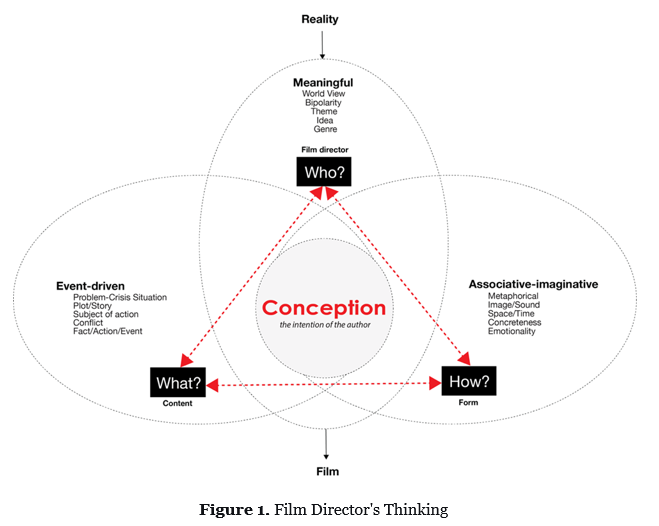
To bridge this gap, we propose that film directing thinking is not a monolithic, ineffable gift but a complex hierarchical system that can be operationalized into measurable cognitive constructs. Building on Sechenov’s triad of thought structure (separation, comparison, and direction) and the broader psychological theories of analytical cognition, we argue that the director’s mind operates across three fundamental, yet distinguishable, levels. These three types of thinking constitute the main components of cinematographic film directing thinking (Figure 1): Meaningful thinking, the nuclear formation of mental structures; Event-driven thinking, a way to deploy the meaning of the content; and Associative-imaginative thinking, an instrumental means of embodying meaning (Moss, 2022). All three types of thinking are interconnected and interdependent on each other. By isolating these constructs, we transform an abstract artistic faculty into a testable psychological reality, providing the first theoretical foundation for objective assessment.
1.2. Meaningful Thinking (MT)
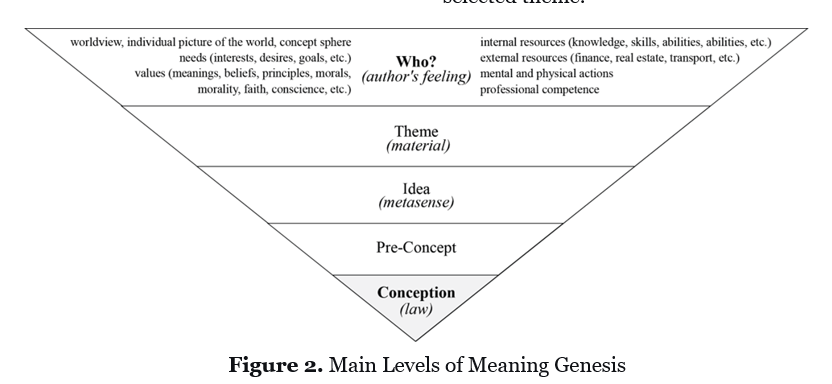
Meaningful thinking reflects the value-semantic sphere of the film director’s personality (Figure 2), his “golden reserve” (the feeling of the author). It addresses the question of “Who?” precisely that which carries out the process of meaning genesis, as far as the personality is spiritual (ethics and aesthetics) and is charged with a positive restructuring of the world. What values are we talking about? What is the range of phenomena and vital issues raised by the film director? What is important is an individual view of the world and an ideological position, a unique originality, depth, uniqueness of the director’s thinking, the presence of a relevant topic. First of all, it is necessary to pay attention to what themes the film director chooses for his artistic expression. Theme answers the question: “About what?”; this is the object (material) of research and a limited range of information about it. The theme should respond to the viewer, be meaningful and relevant. Art requires only uniquely subjective themes. When analyzing, it is necessary to answer the main axiological question about meaning: “For what?”; the very choice of topic becomes important, since each of them sets certain spiritual and philosophical, ideological and semantic, problematic and thematic, moral, genre, stylistic and aesthetic aspects, reveals the meaning sphere of the film director and the structure of his worldview, speaks about his individual preferences and features of the value navigation system. It becomes important how relevant, social and deep the content of the film is, did the director manage to formulate the idea and find an adequate intention for its expression? The idea (ancient Greek ἰδέα “view, form; prototype”) is the main thought of the film (generalization of meanings, metasense), a philosophical assessment, the subjective moral and ethical view of the author-director on the main theme. The film director’s conception (conceived, intended) is the author’s law that organizes artistic information into a screen optical-acoustic metaphor of the main struggle process (cinematic metaphor, figurative allegory, tropes) declared in the film. The theater director A.D. Dikiy noted that the director’s intention is “imaginative understanding of the idea of the work” (Dikiy, 1976, p. 6). The film director’s conception as the intention of the author, his main strategic goal (the expression of the author’s meaning as a revelation, where truth is expressed in a new way and the objective for the viewer becomes subjective), includes two components: internal (substantive) and external (formal), which are dialectically interconnected. It is also important to understand the rules by which the author-creator models the unique world of the film, that is, what kind of genre coloring (the author’s emotional attitude to the depicted material as a measure of conventionality) is chosen by the film director for implement the selected theme.
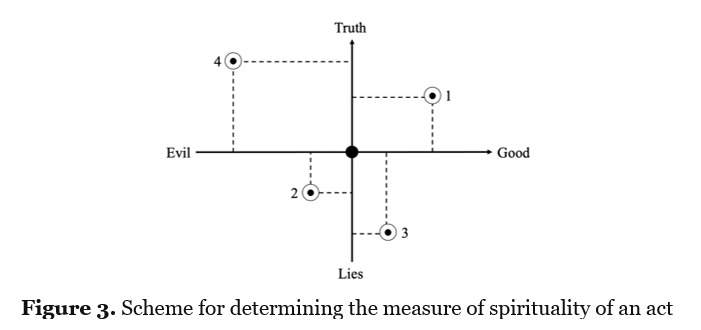
In connection with the features of meaningful thinking and the director’s worldview, the problem of the director’s own responsibility as an artist in relation to the cinematic space used becomes relevant. What does the film carry, what does the viewer call for? It is important not just to express oneself, to stun the viewer or to please him, but to strive through problems and losses to gain harmony and beauty. As a rule, the hero of the film, moving towards his goal from situation to situation, performs certain actions. For a moral assessment of the quality of an act, we use the concept of spirituality, which combines such qualities as goodness (sacrifice for the interests of others, sympathy), truth (justice, fairness) and “a dialectical mind, long distances,” otherwise known as wisdom (Grebenkin, 2007, p. 171). Truth and goodness in all religions are revered as the highest human values. Do not acquire the transient, but acquire truth and goodness, as the Holy Scripture teaches us. According to A.A. Tarkovsky: “The goal of art is always truth, verity. Everything that is not connected with the concept of truth, with the search for truth, is falsehood, conjuncture, a game of spillikins” (Tarkovsky, 1989, p. 5). Under the concept of spirituality, we understand “the unity of striving for truth and goodness, i.e. serving the interests of other people” (Grebenkin, 2007, p. 171) — the energy of the harmony of truth and goodness. To assess the degree of spirituality of an act in the living space of the film, we propose to use the method of A.V. Grebenkin (Grebenkin, 2007, p. 172). Figure 3 presents a scheme for determining the measure of spirituality of an act. There are “high” and “low” truths along the vertical: knowledge that does not distort reality is called truth and is arranged from zero upwards; down from zero is lies (knowledge that distorts reality; here truth and lies are considered as moral concepts, and not as true). The qualities of an act are arranged horizontally: good (altruism) increases to the right of zero, evil (egoism) increases to the left. Thus, by drawing perpendicular lines from the vertical and horizontal, we can determine at their intersection the location of the act in the living space of the film, knowing the degree of its altruism/egoism and truthfulness/falsehood.
The specificity of film director’s abilities, as a unique area for research, lies in the fact that a key component of film director’s thinking is a fundamentally new type of ability, namely generative ability (Kholodnaya & Khazova, 2017). This is the type of abilities where conceptualization, as a generative function, as the ability to generate new meanings (subsequently transformed in a specific optical-acoustic form), comes to the fore. Without this component, there is no need to talk about film director’s thinking. Conceptualization is the process of generating “new mental contents” (Kholodnaya, 2012, p. 256), new connections, “creating new kinds of being” (Epshtein, 2004, p. 65), the ultimate goal of which is to create an abstract, meaning unit, the conceptual film director’s intention (film concept). It is conceptualization that connects content (What?) and form (How?) in the most organic way. The procedural aspect of conceptualization is mental actions that provide a special form of understanding what is happening (a specific situation, event, person, etc.). M.A. Kholodnaya considers generalization, abstraction, idealization, modeling, interpretation, proof, justification, and the search for adequate verbal and non-verbal means to describe generated mental contents to the conceptualization procedures (Kholodnaya, 2012). The result of the conceptualization process is a conceptual model, as “an individual form of understanding the relevant subject area (its ‘mental picture’)” (Kholodnaya & Khazova, 2017, p. 7), which is subsequently transformed into a structured and detailed image of the film. The process of conceptualization is individualized, as it depends directly on the subject and the content of his mental experience, which fixes the past individual and human experience, which determines the probabilistic potential and scale of development of future experience (Kholodnaya & Khazova, 2017; Volkova, 2013).
1.3. Event-driven Thinking (EDT)
Event-driven thinking is a way of constructing and deploying the meaning of the content (it answers the question “What?” exactly undergoes the process of meaning genesis, embodying the sense of content) through the internal form. The specificity of a film director’s event-active thinking, the features of his problem-crisis modeling of the film’s content and its internal form, are assessed by the presence and formation of such concepts as conflict, situationality, factuality, effectiveness and eventfulness, expressed through the following basic components: problem-crisis situation (subject of struggle) and its resolution; actors (protagonist and antagonist, minor characters, etc.); and the structure of the film (beginning-middle-end) and its components (facts, actions, events, as well as a causal relationship representing the logic of the narrative).
The most important component of film director’s thinking, which determines the director’s professional suitability, is situational thinking, the ability to think in conflict situations, to identify problematic situations in life (script text), to compose and simulate dramatic situations on the screen. The content of human existence in the film is formed due to the diversity of situations as part of human existence. Situation (from the Latin situs, position, location) is “a set of circumstances, conditions that create certain relationships, environment or position” (Ushakov, 2008-2023). The concept of a situation includes a combination of the following key elements: (1) the subject of the action (who, what, where, how, etc.), (2) the object (what the subject sees, hears and feels, a system of circumstances: incentives, conditions and factors that create a certain environment of action, including epoch, country, time of year, time of day, locality, place of action, etc.) and (3) context (what meaning is attributed to the object by the subject, all the richness of interactions between them). Any situation has a volume, structure, level of eventfulness (low to high), degree of solvability (solvability to unsolvability) and boundaries that are not fixed and determined by the subject.
For a film director, it is important to have dialectical thinking, the ability to operate with contradictions, turn ordinary situations into crisis ones, and problematize them. Any theme requires a problem statement. What problem and its solution does the film director propose to implement the chosen theme? The leading need requiring satisfaction leads to the formulation of the problem. Some failures, inadequacies, deviations, surprises, extraordinary things, unfavorable facts, mismatches in the functioning of the protagonist start the process of transforming the activity situation into a problematic one, which ends with the acceptance of some problematicity for resolution (Kornilov, 2000). A problem (from the Greek πρόβλημα, barrier, difficulty, task) is a formulation of the contradiction between what is desired and what is available. “A problematic situation means that in the course of activity a person has come across, often quite unexpectedly, something incomprehensible, unknown, disturbing, etc.” (Brushlinsky, 1970, pp. 52-53). Rubinshtein writes that “a situation is problematic in which there is something implicitly included in it, assumed by it, but in it indefinite, unknown, not explicitly given (but only given through its relation to what is given in it)” (Rubinshtein, 1959, p. 353). A problem situation is the interaction of a subject with an object (Kornilov, 2000). D.N. Zavalishina characterizes problematization as a multi-layered, intellectual procedure that implements, “on the one hand, a subjective assessment of some objective situation as problematic, on the other hand, a preliminary understanding of the unknown (problem, question), forecasting the circumstances and factors involved in resolving the problem” (Zavalishina, 2005, p. 265). Important functions of problematization are, firstly, the introduction of certainty, formalization into the indefinite and contradictory; secondly, the structuring of reality, the organization of the essence of the identified problems (Abulkhanova-Slavskaya, 1994; Zavalishina, 2005).
Real cinema is problematic. To reveal the problem and answer the question: “What is the film about?” it is necessary to name the antagonistic sides, the opposing camps participating in the contradiction. A problem-crisis situation (non-stereotypical, extreme, paradoxical) is a subjectively insoluble contradiction, which is a vicious circle of “wrong” proposed circumstances that contradict the hero’s desire, and has the following features: hopelessness, search for a way out, fight against a threat. The author-director is a scientist-practitioner whose subject of research is the crisis and methods of its modeling. What has no alternative in life gets an alternative in the film. A professional film director purposefully looks for problems and crises. “The ability to see problems” (Rubinshtein, 2002, p. 397) subjectively depends on experience, knowledge of the object of film directing activity and the professional level of the film director. In the process of film directing activity, a specific mechanism for detecting and selecting problem-crisis situations is acquired. The ability to problem-crisis thinking (the ability to think in problematic life situations) helps the film director to create not just a new reality, but a reality associated with a crisis of values, with the possibility of reformatting the old system of values. A crisis is always a source of something new, it is a moment of creativity, because when a person makes a choice, he truly lives. It is the birth of a new order out of chaos. Crisis eras give impetus to the creative process.
The main driving force in the film is the conflict (the presence of opposing interests), as a measure of the scale (significance) of the problem situation and its depth, overcoming of which is emotionally and motivationally reinforced. The task of the film director is to turn everyday life into an emergency as much as possible, to be able to aggravate the proposed circumstances to the maximum in order to make the content of the conflict acute and expressive, to be able to develop the conflict through modeling crisis realities with its subsequent transformation into conflict opposition of the parties, i.e., struggle. “Struggle is the material of directing art” (Ershov, 1997, p. 281). Any story is an escalation of the conflict and the development of the struggle for a certain subject. The subject of the struggle is what the film clashes over. It is important to assess how much the director intensifies the conflict by leading the hero through different stages of conflict interaction (pre-conflict, incident, collisions, escalation-de-escalation, open forms of struggle, transition to positional struggle, the highest point of polarization, transformation of struggle, end of conflict, post-conflict) for greater involvement viewer. A conflict, as a manifestation of objective or subjective contradictions, expressed in a binary opposition, cannot be neutral. Of the mandatory signs of conflict, V.P. Zinchenko identifies: (1) bipolarity of views (the level of antagonism), (2) active overcoming of obstacles, and (3) subjectivity (presence of carriers) (Meshcheryakova & Zinchenko, 2009). For the film director, to find a deep conflict means to find the core of the content side of the director’s intention.
The center of the problem situation is the subject of the action (protagonist, hero, actant), as a concept of the author-director. The hero, as a paradoxical conflict formation, must have a special device that allows you to connect to the depth of the conflict, a paradox (mutually exclusive judgments), a combination of seemingly unconnected things (conflict unity). The level of the hero is a formulated goal (vector), to achieve which, overcoming a system of obstacles, specific actions are taken. The presence or absence in the film is important: (1) the hero (drives the action), a person, animal or object (endowed with anthropomorphic qualities), etc.; (2) the character of the hero (what? and how? does), his credibility, naturalness, brightness and maximum disclosure and development in action (beginning-middle-end); (3) the goal of the hero: “What does the hero want?”. It also evaluates whether there are other actors in the presence: an antagonist (counteraction), minor or episodic characters. The film director chooses actors for each side of the conflict, gives them the same chance to win, and then creates a problem-crisis situation in which both characters can win with equal probability, but something happens, some factors that give rise to options. Subjects must make a choice using chance or volitional effort. The stakes are high, the struggle can lead to both transformation and death.
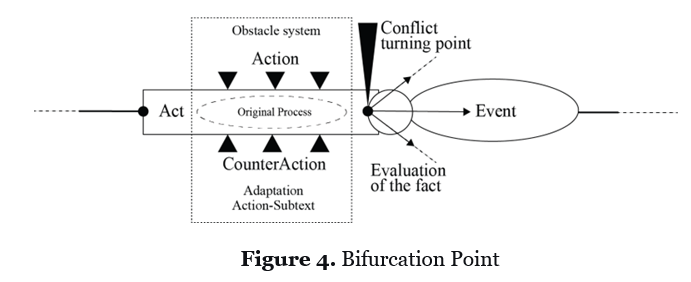
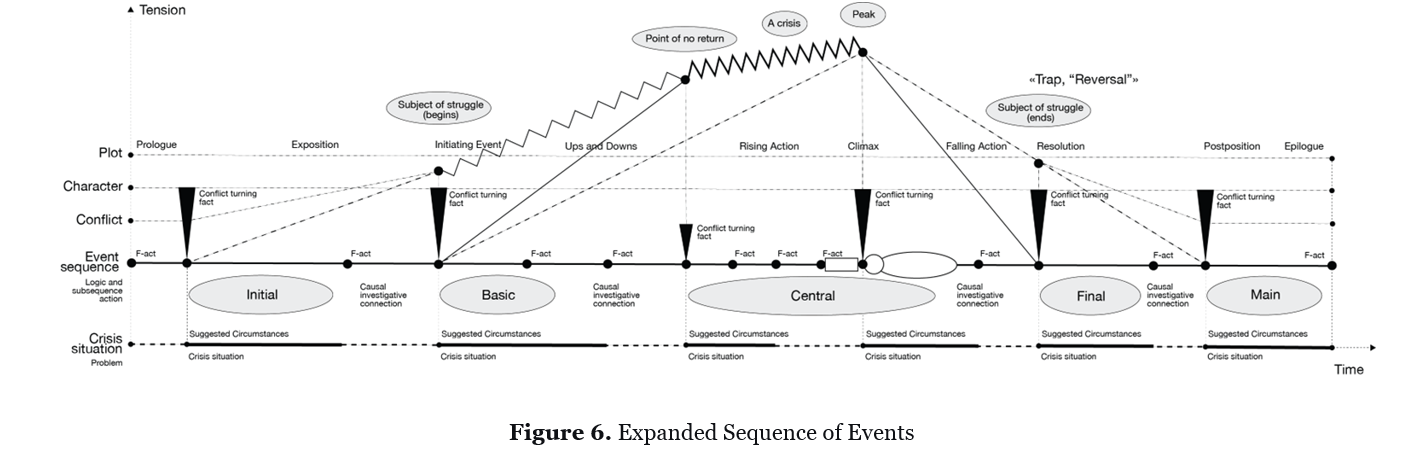
The presence of the unknown in a problem-crisis situation triggers the mental mechanisms of the hero associated with the advancement of hypothetical ways to solve it. Hypothesis analysis transforms the problem into a creative task, forces the subject of action to formulate it for further solution through the logic of actions (problem-task-action), i.e. perform specific actions to seize the object of struggle. It is very important how the film director is able to compose crisis points (points of choice, bifurcation points) through which the hero’s route to the goal runs (motive-action-goal achievement), i.e., conflict turning points, as elementary structural units that state the completion of one process (being) and the beginning of another (Figure 4). A conflicting fact (static, constant) is a real, concrete result, a point-node of irreversibility, which creates a turn in the development of the action and answers the question “What happened?”. The originality and place of the conflict fact in the film are evaluated. As soon as the action stumbles upon an unexpected obstacle in the form of a conflicting fact of great value, the hero needs to react to it and evaluate it. There is a moment of evaluation of the fact (bewilderment, immobility, stop) as an active process of perception, processing of new information and the emergence of a certain attitude towards it. The hero makes a choice and chooses one vector from the fan of possibilities, he begins to move along a new trajectory, the action passes into a new quality, the proposed circumstances (objective conditions) change and become aggravated, and a time period of a new being (co-existence) arises, i.e., an event (a plot/linguistic significant procedural change), as the moment of action of different levels of meanings, which answers the question “What is being done?”. Events are the basic category of film director’s thinking.
Event-driven thinking refers to the practical type of thinking. S.L. Rubinshtein notes that practical thinking is “thinking by actions” (Rubinshtein, 1935, p. 335). Action is a structural unit of activity (Rubinshtein, 2002; Leontiev, 1975). Making changes in the real world, transforming it, transferring an object from state “1” to state “2” is carried out by actions (Davydov, 1972). Practical action, according to S.L. Rubinshtein, “is an intellectual operation, because, not reflecting, but transforming reality, it, realizing its goal, is consistent with the objective conditions of the situation in which it is performed” (Rubinshtein, 1935, p. 303). “If the action carries out the plan, then it accumulates the correct, adequate knowledge of the situation of the action” (Rubinshtein, 1935, p. 334). Action, effectiveness plays a special role in the film director’s thinking. In the events of the film, the hero manifests itself through the logic of actions (purposeful movements). Actionable thinking of a film director is the ability to build an information-capacious, organic and expressive deal-process (verb), using for this the logic and sequence of physical, mental or verbal actions, adaptations (coloring of the action, external form), as well as the ability to translate feelings into the logic of simple actions, build a system of obstacles (counteractions) on the way to the goal, find the original process (fight against patterns) and subtext. From one verb to another, the boundaries of events are determined by facts.
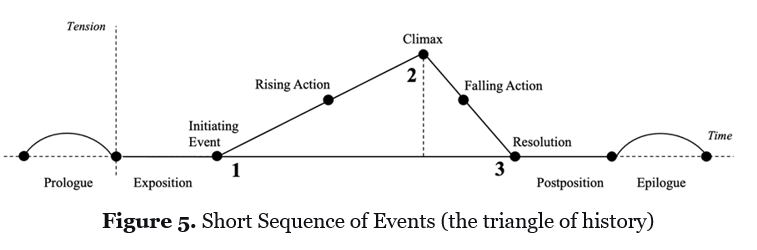
The film director, designing the structural logic of the development of the struggle in the film, subordinates the behavior of the subjects of action, facts, events and situations in the event sequence (causal set of events), finds a place for a paradoxical resolution (trap, shock, “reversal”) of history, organizes the emergence of natural surprises through a continuous causal relationship (continuity of meaning and feeling). One crisis situation replaces another, thus, an internally dynamic route for the movement of meaning arises, suggesting the dynamics of an explosion, and answering the question: “How did this happen?”. This formation, transformation and deployment of the conflict through the crisis is the strategic author-director’s plan for the realization of meaning. In assessing the sequence of events, we adhere to the following understanding, according to which the basic facts and events through which the line of development of the struggle for a certain object passes, form a triangle of history (Figure 5): (1) initiating event (start, the beginning, the origin of the conflict, the tying, the announcement of the subject of the struggle) or the source, (2) climax (midpoint, fracture, turn, peak, point of highest tension) or culmination and (3) resolution (ending, end of action of the subject of struggle, resolution of the problem) or conclusion. To comprehend the meaning content of what is happening, a causal relationship between facts and events and their place in history is revealed. The last event is the main meaning unit of the film, it is here that the idea of the work is clarified. The structure of the event sequence may contain additional (provocative, defiant, destructive, complicating, etc.) events (Figure 6) if they find their justification in solving the film director’s task for meaning, but the initiating and turning events (culmination) are mandatory in the event structure of the film.
1.4. Associative-Imaginative Thinking (AIT)
Developed associative-imaginative thinking, as an instrumental means of embodying meaning, is the ability to materialize and shape the sensual-emotional component of the film in a specific picture and sound. It answers the question “How?” (sense of form) is the process of meaning genesis carried out. This is the ability to express the film director’s conception through bright and original images (objects, heroes, facts, actions, events, etc.), the ability to associative, metaphorical and metaphysical generalization, the uniqueness and unexpectedness of associative connections (a breakthrough into novelty), the ability to unfold the image in cinematic space and time. Here, by form (information specificity), we mean an individual way of distributing content, as a result of expressing its inner meaning. “The deepest essence of art lies in the unity of the idea and its material embodiment” (Arnheim, 1999, p. 136).
Aristotle was the first to draw attention to the associative links between word and image. In “Poetics” he wrote about the important ability “… to use complex or rare words, but most importantly, figurative … to be skillful in metaphors … in fact, in order to transfer meanings well, you need to be able to notice similarities in objects” (Aristotle, 1983, p. 672). Much attention was paid to the issues of associative thinking by S.L. Rubinstein: “Therefore, we can think not only in abstract concepts, but also in images, as this especially clearly proves the existence of metaphors and artistic thinking in general” (Rubinstein, 2002, p. 393). “The artist is looking for an image in which the unique and initially non-imaginative (or super-imaginative) content of aesthetic experience is imagined” (Melik-Pashaev, 2014, p. 148). Metaphor is an understanding of “the foundations of thinking and the processes of creating not only a nationally specific vision of the world, but also its universal image” (Arutyunova, 1990, p. 5).
In our understanding, the image (“cutoff” of the stream) is built on the basis of the trinity of sensory perceptions of reality (truth-signs), the cinematic characteristics of the image: visual, auditory and kinesthetic, which stood out from the entire perception with the help of integration and were arranged at the level of a certain thought. According to V.D. Shadrikov, each thought has its own components: (a) content (“naked” information); (b) need or motivational component and (c) experience (emotional fuel) (Shadrikov, 2014). A mounted cluster of perceptions necessarily gives a feeling, an ideology is always an emotion as a result. The main empirical characteristics of sensory-perceptual images L.M. Vecker refers to such primary properties as spatio-temporal structure, modality and intensity, as well as such derived properties as constancy, objectivity, integrity, generalization (Vekker, 1974). The image performs a triune function: the picture of an object (percept, an individually specific image), a symbolic understanding of reality (an image, a generalized image) and the convention of a sign (Arnheim, 1999). In general, an integrated image is a kind of a holistic living organism with a center and peripheral sections, like any living creature.
The specificity of associative-imaginative (non-stereotypical, paradoxical) thinking is determined by the tendency to think in poetic tropes (epithets, comparisons, personifications, allegories, metonymies, metaphors, hyperbolas, etc.), i.e., the art of expressing allegorically. For this, such techniques of creative imagination as thickening, concentration, displacement, dramatization are used, the main of which is metaphorization, the ability to put into practice the figurative meanings of objects, using the mechanism of comparison (transfer of meaning from one phenomenon to another according to the principle of similarity/contrast) of features to convey meaning content through images, which consists in the poeticization of a word, phrase, object, action, event, person, situation, scene, struggle, etc., and not in literalness, information content, remoteness and mediation of association. “Everywhere behind the image we are looking for a generalized image of the phenomenon that we are filming” (Eisenstein, 1968, p. 424). This is the ability to think in screen images, which are born during the interaction of the image and the relationship to the depicted, “as an expression of the internal in the external” (Zhinkin, 1971, p. 247). Passing through himself, the film director uses constructions with a deepening of the figurative meaning of words, reveals what is hidden behind the words, puts his subtext into the text. S.M. Eisenstein writes about D. Joyce in this regard, in which each expression, each word “works as a whole column of plans, meanings, layers of associations” (Eisenstein, 2000, p. 363). He refers to a quote by S. Zweig, to whom this is reminiscent of “double thinking, triple thinking, through-each-other, direct-each-other, across-each-other, the sensation of all feelings” (Eisenstein, 2000, p. 363). “Depending on what expressive means the film director uses, ‘poor’ or ‘rich’, the development of the dramatic situation will be either primitive or metaphorically moveable” (Moss, 2022, p. 541).
A film director must have a developed polymodal cinematographic sensitivity of the sensory apparatus, the ability to quickly respond to the new and unexpected, to work with information in a differentiated way, creatively using the main modalities: (1) Visual modality, the ability to reveal the meaning visually, visually-effectively, plastically-imaginatively. The film is, first of all, a visual cinematographic imagery, where the film director’s vision plays a dominant role: a sense of image, spectacular thinking, visuality, obviousness. N.I. Zhinkin notes that “the specificity of the film lies in the fact that it is ‘speak’ with images or with the help of images. This is a pictographic language” (Zhinkin, 1971, p. 230). “Visually perceived symbols cannot be adequately studied without recourse to perceptual and pictorial factors” (Arnheim, 1999, p. 202). The visual directing strategy is a sense of cinematographic of film director’s concept, visibility, where the leading role is played by visual sensations, perceptions, attention, memory, representation, imagination, thinking. Visual operations are carried out with such cinematic characteristics of the image as movement, line, tone, contrast, light, color, depth, volume, space, brightness, texture, foreshortening, etc.; (2) Sound modality, the ability to express meaning acoustically, through sounding and audible, the skillful use of silence, pause, duration, timbre, pitch, loudness, noise, tempo and rhythm, etc., as meaning elements, high auditory differential sensitivity; (3) Kinesthetic modality, the ability to convey bodily sensations, smell, taste through image and sound, using tactile, olfactory, gustatory, haptic and visceral components. It also takes into account which kinds and types of associations dominate in the story, as this helps to determine which sensory representational system for the film director is the leading one.
The sound-visual cinematic image has a synthetic nature, it is a combination of the unique and the typical, it is the unity of the rational and the emotional, thought and feeling: it is unique, integral, inexhaustible and full of vitality. A real film director is a high degree of imaginative concentration, breadth of the associative process and depth of the imaginative sphere of the personality. The main characteristics of the film director’s associative-imaginative thinking include (1) breadth and (2) mobility of the associative-imaginative process of mastering the world, (3) depth of imaginative concentration, (4) sensory-emotional content, (5) unexpected and original causal investigative connections, (6) the ability to reveal the hidden properties of objects and create images that do not exist, (7) the ability to cover from different points of view, (8) integrity. Associative-figurative thinking is concrete. Concrete thinking operates with visual-figurative, pictorial content (Guilford, 1967; Cattell, 1971; Meili, 1972). Describing the mind of the commander B.M. Teplov emphasized: “… In military affairs, concreteness of thinking is a necessary condition for success. Genuine military genius is always both ‘genius of the whole’ and ‘genius of details'” (Teplov, 1961, p. 271).
The image is created only when the complex begins to emerge in the simple, when the significant appears in the insignificant. “In order to be meaningful, an artistic image must reflect the general, typical in an individual, single, in the image to reflect the conception, the idea” (Rubinshtein, 2002, p. 643). A film director who has a detailed level is capable of thinking in images. The highest form of imaginative thinking (poeticization) is considered not informational (“upper” history, memory), but imaginative, metaphysical form (“lower” history, myth, subconsciousness). The metamessage is more important than the message, which helps to achieve the main goal of the film director’s activity, not just “bread and circuses”, but the impact, changing the consciousness of the audience through the transfer of artistic meaning.
It should be noted that there is an inverse relationship between the content (What?) and imaginative (How?) aspects of the development of the struggle line in the film; the more the film director enhances the eventfulness and effectiveness, the less the associative-figurative component is revealed, and vice versa. Therefore, it is important to assess how the measure is observed in the ratio of these two aspects of thinking (Zhinkin, 1971). Event-driven thinking moves more from content to form, and associative-imaginative thinking, on the contrary, from form to content.
To date, there are no scientific works that study the theoretical, scientific, practical, and methodological aspects of the special abilities of a film director and ways of film director’s thinking. There is a complete lack of scientific elaboration and substantiation of the criteria for diagnosis, propaedeutics, and the development of special abilities of a film director from the point of view of the psychology of abilities and the development of mental resources. All this made us turn to our own research and development of a new original tool, the 5 SHOTS method.
The present study aims to develop and psychometrically validate the 5 SHOTS Test, the first objective diagnostic instrument designed to quantify the three core components of film directing thinking (Meaningful, Event-driven, and Associative-imaginative thinking), and to establish its reliability and validity across different age groups and professional levels.
Based on the theoretical framework and the existing literature, we formulated the following hypotheses:
(H1): The 5 SHOTS Test will demonstrate acceptable internal consistency (Cronbach’s alpha ≥ 0.70) for the total sample and for adult subgroups, confirming its reliability as a unified measure of film directing thinking.
(H2): Scores on the 5 SHOTS Test will show significant positive correlations with external criteria theoretically related to the construct: specifically, with expert assessment of directorial ability and with fluid intelligence (Raven’s Standard Progressive Matrices). However, given the domain-specificity of directorial creativity, we hypothesize that the test will not correlate significantly with general non-verbal creativity (Torrance Test of Creative Thinking).
(H3): The 5 SHOTS Test scores will not be significantly correlated with measures of basic character traits, confirming that the instrument measures specific cognitive abilities rather than general personality dimensions.
(H4). Indicators of meaningful, event-driven, associative-imaginative, and overall film directing thinking will significantly increase with age and with the acquisition of professional directing experience, reflecting the developmental trajectory of these cognitive competencies.
(H5): The gradations of meaningful, event-driven, and associative-imaginative thinking will significantly predict the measure of differentiation and the measure of hierarchy in the organization of the concept Director (the individual’s mental representation of a film director), with event-driven and associative-imaginative thinking demonstrating the strongest predictive effects.
Method
- Participants
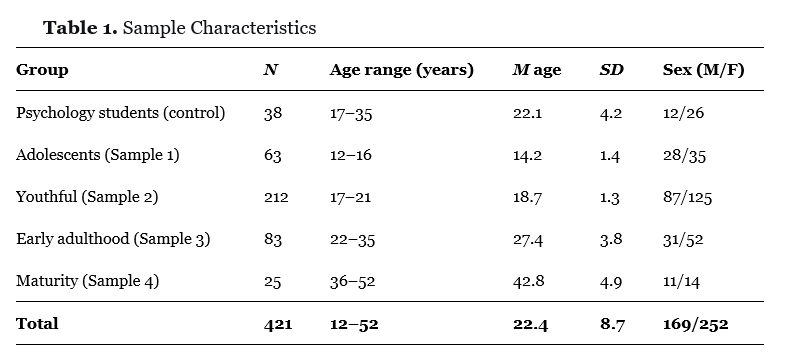
The study comprised 421 participants (169 males, 252 females) aged 12 to 52 years (M = 22.4, SD = 8.7). Participants were recruited from cinematographic faculties of Russian universities (All-Russian State University of Cinematography named after S.A. Gerasimov, Institute of Contemporary Art, Higher Courses for Scriptwriters and Film Directors named after G.N. Danelia), film schools in Moscow (UFM cinema school, Moscow School of New Cinema, Film School named after McGuffin), summer film camps (“Star” in Ryazan, “Your Camp” in Alushta, “Artek” in Gurzuf), and psychological faculties (Lomonosov Moscow State University, State Academic University for the Humanities). The sample was divided into four age groups reflecting the stages of professional development in film directing (Table 1): adolescents (12–16 years, N = 63), youthful (17–21 years, N = 212), early adulthood (22–35 years, N = 83), and maturity (36–52 years, N = 25). A control group of psychology students (N = 38, age range 17–35 years, M = 22.1, SD = 4.2) was included to assess the specificity of the instrument for directorial versus general psychological abilities. All participants provided informed consent (parental consent was obtained for minors) in accordance with the ethical standards of the institutional review board. The study was conducted in a group format, with volunteers completing paper-based test forms. The researcher answered questions in case of difficulties
. Procedure
Data collection was conducted in a group setting within educational institutions. Each participant received a printed A4 test sheet (see Table 2 for the response form) and a pen or pencil. The researcher read the following instruction aloud:
“Come up with a film of 5 shots on any of the 3 proposed themes: ‘Locked Up’, ‘Thunderstorm’, ‘Surprise’. Remember, based on your own life experience or fantasize. Describe in detail and visibly* the content of each shot (facts, actions, events, details, etc.). Shots need to be drawn, numbered and indicate the size of the shot”.
* Specific description in words for the eye and ear (to help see, hear and feel the shot).
The researcher then clarified any procedural questions without providing examples of responses, as prior exposure to sample answers reduces the uniqueness and originality of productions. Participants worked independently. The average time to complete the task was 30–60 minutes. After completion, the researcher collected the forms and verified that all sections were legible and complete. The answer forms were anonymized using participant-generated alphanumeric codes (with age and email recorded for verification purposes).
The 5 SHOTS Test
The 5 SHOTS Test is an original performance-based instrument designed to assess the three core components of film directing thinking: Meaningful thinking (MT), Event-driven thinking (EDT), and Associative-imaginative thinking (AIT). The test requires respondents to generate a narrative film concept of five shots based on one of three thematically neutral prompts. These prompts were selected for their universal accessibility and their capacity to elicit conflict-driven, semantically rich, and visually concrete responses across age groups.
Test Answer Sheet. The response form (Table 2) contains fields for participant identification (code, age, gender, occupation, email, and test date) and a structured grid for the five shots. Each row includes a column for the shot number, a blank square for a schematic drawing, a column for specifying the shot size (e.g., extreme close-up, close-up, medium shot, long shot, very long shot), and a large text area for the shot content description.

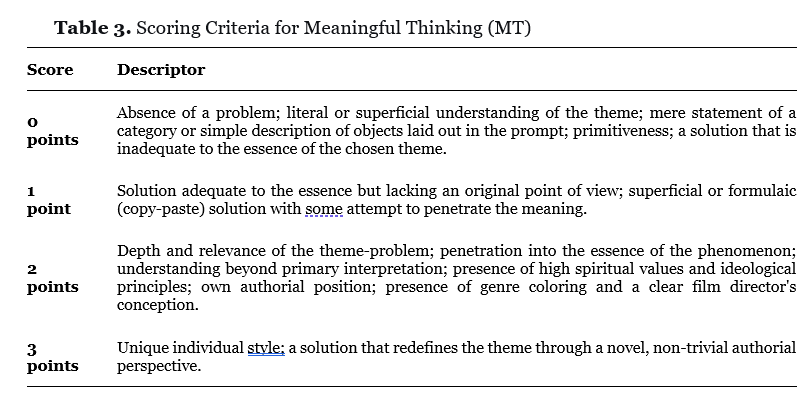
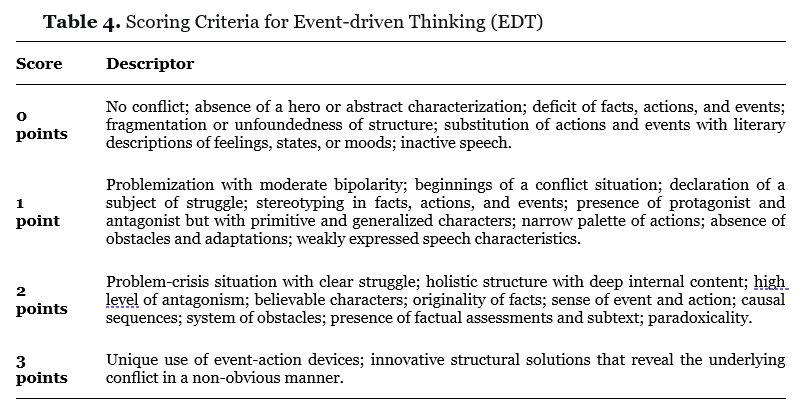
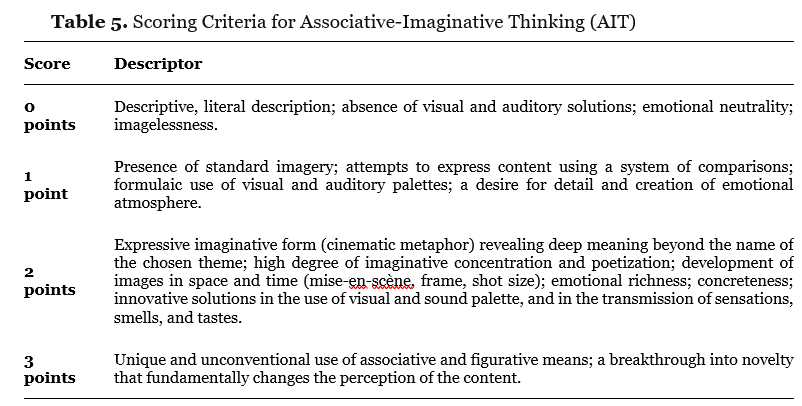
Scoring Criteria. Each subscale (MT, EDT, AIT) was scored on a 0–3-point open scale. Unique responses that exceed the standard qualitative range are assigned 3 points; this open-ended upper boundary allows differentiation between respondents with high conventional performance and those with genuinely exceptional, original productions. Two independent experts (practicing film directors with university teaching experience) scored a random subset of 50 protocols to establish inter-rater reliability. Intraclass correlation coefficients were high: MT = 0.91, EDT = 0.88, AIT = 0.89. Disagreements were resolved through consensus discussion. The complete scoring rubric is presented in Tables 3–5.
The scale of “meaningful thinking” (Who?) is aimed at assessing the ability to generate meaning and transmit ideological attitudes (strategic ideologization and aestheticization: what value guidelines does it preach), penetrating into the depth of meaning and generating a film director’s concept, which constitutes the originality of the film director (the author’s sense).
The “event-driven thinking” (What?) scale is designed to assess the ability to construct an internal screen form (a sense of content): problematic situations, conflicts and crises, “explosions”, facts, actions, events, characters (personalities), structural integrity.
The “associative-imaginative thinking” (How?) scale is designed to assess the ability to create an extraordinary, unique external screen form (sense of form).
Worked Examples
To illustrate the application of the scoring criteria, we present four representative responses from the sample with their assigned scores.
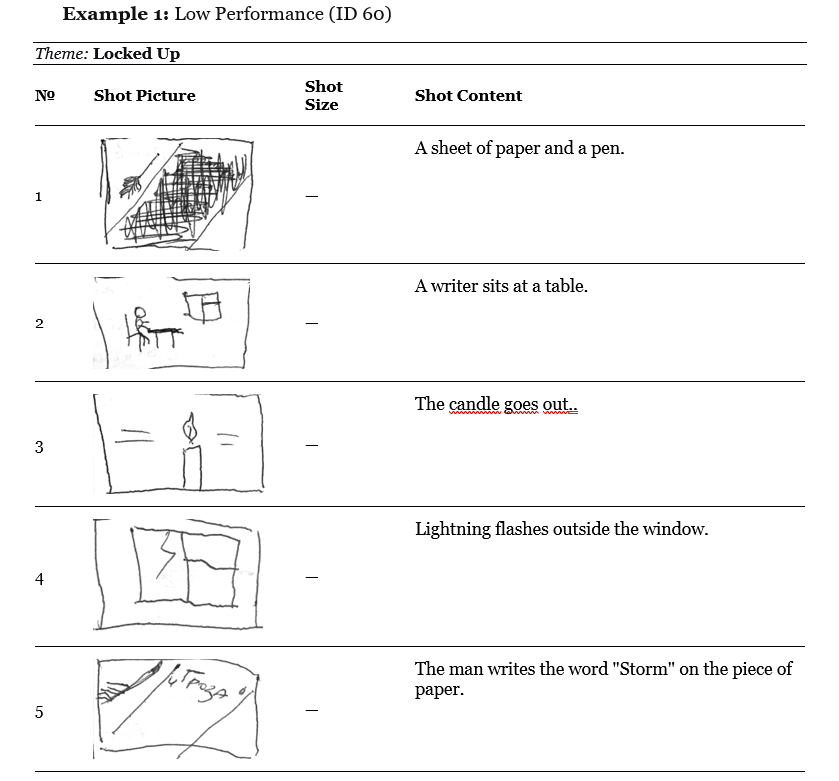
Scores: MT = 0, EDT = 0, AIT = 0.
Scoring rationale: 1. Meaningful Thinking (Who?). The author develops the theme through the writer’s internal state, creating a parallel between the external and internal storm. However, the allusion to Ostrovsky is a first-level template that merely demonstrates recognition but does not generate its own meaning. The work remains an illustration (“storm — writer — word”) and does not go beyond the theme. There is no authorial transformation: there is no unexpected perspective, paradox, or personal statement. There is no hidden meaning; we don’t understand who the character is, what they are experiencing, or why they write this particular word. There is no genre coloring or directorial intent. What could have enhanced the meaning: a change of word at the end (“Silence” → “Storm”) or an unexpected context (teacher, will, voting form).
- Event-Driven Thinking (What?). Event, conflict, and action are absent. All the shots are static: a sheet of paper and a pen, the writer sitting, the candle going out (with no consequences), lightning outside the window (the hero doesn’t react), he writes a word (but this isn’t the result of a struggle). The hero is abstract, lacking character and obstacles. There is no antagonist: the thunderstorm could become one, but it doesn’t. There are no cause-and-effect relationships between the shots. There is no system of obstacles. What would create the event: lightning extinguishing the light, the writer continuing to write in the dark by touch—and the final word is written unevenly, “blindly.”
- Associative-Imaginative thinking (How?). The imagery (candle, lightning, pen) is present, but it functions as an illustration, not a metaphor. Ostrovsky doesn’t reinforce the solution, as it is suggested by the theme. The chain of associations works (leaf → writer → candle → lightning → word), the candle creates a contrast between the dim light and the powerful element, but the metaphor is underdeveloped. Large scales are indicated, and there is an attempt to create atmosphere. What is missing: a sound score (thunder, crackling candle, scratching pen), sensations, intra-frame movement, and editing. What would have enhanced the form: a growing sound of thunder, a close-up of a trembling pen, a flash of lightning illuminating the writer’s face.
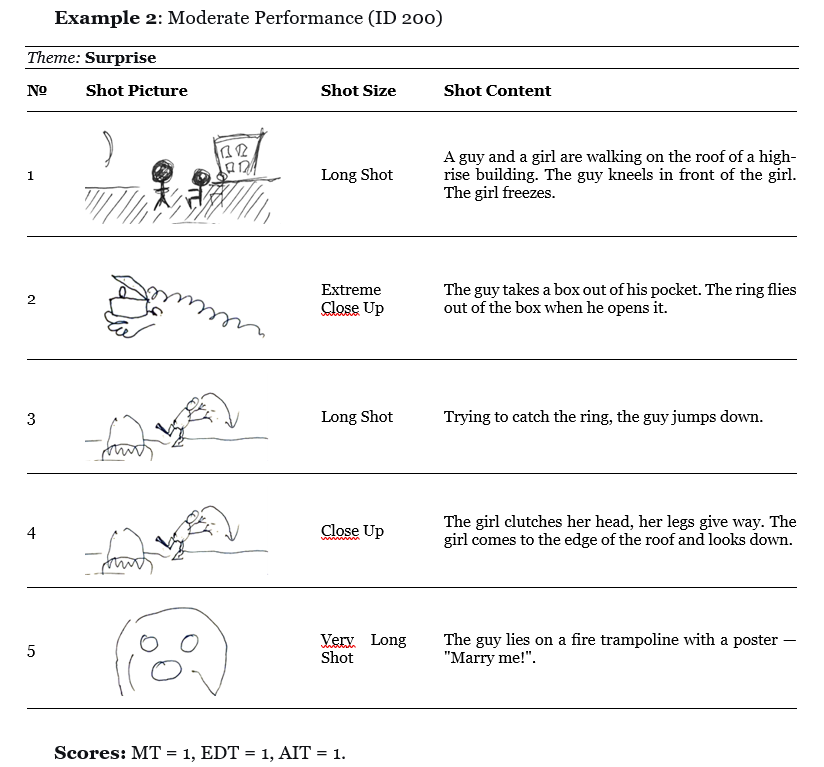
Scoring rationale: 1. Meaningful Thinking (Who?). The author offers a genre solution (romantic comedy) with a clear directorial intent: the surprise is that the risky fall turns out to be a staged performance. This solution is appropriate to the theme, moving beyond a literal “gift” to a playful prank. However, the depth of meaning is lacking; the story remains within the framework of entertaining, clip-based thinking, without raising questions about trust, fear, or the value of relationships. The author’s own position is weakly discernible; rather, a formulaic “prank” is used.
- Event-Driven Thinking (What?). There is a clear event structure: sentence (1), incident (2-3), reaction (4), denouement (5). There is a conflict situation (loss of a ring/a person’s fall), which evokes an emotional response in the heroine. However, the character’s logic is flawed: jumping from the roof, hoping to catch the hoop in mid-air, is physically impossible, meaning it’s either suicide (which doesn’t align with the final prank) or a pre-planned stunt with the trampoline (but how did the guy know the trampoline would end up at the bottom?). The characters are generic, and the cause-and-effect relationships are poorly developed.
- Associative-Imaginative thinking (How?). Despite only one topic being selected, the subject still ignores the key instruction: “Describe in detail and visually, using words for the eye and ear” and “indicate the zoom level.” The description remains at the level of action statements (kneeled down, took out the box, jumped). The following are missing: Visual solutions (light, color, angles, details); Sound score (wind on the roof, heartbeat, scream, music, the sound of hitting the trampoline); Indication of the zoom level. This makes the work inconsistent with the criteria of imaginative thinking—it represents a bare outline rather than a directorial development of shots. The response constructs a basic problem-crisis situation (danger of falling) with a surprising resolution (trampoline). However, the interpretation of the theme is formulaic, the characters are archetypal, and the visual solutions (trampoline, poster) are predictable rather than original.
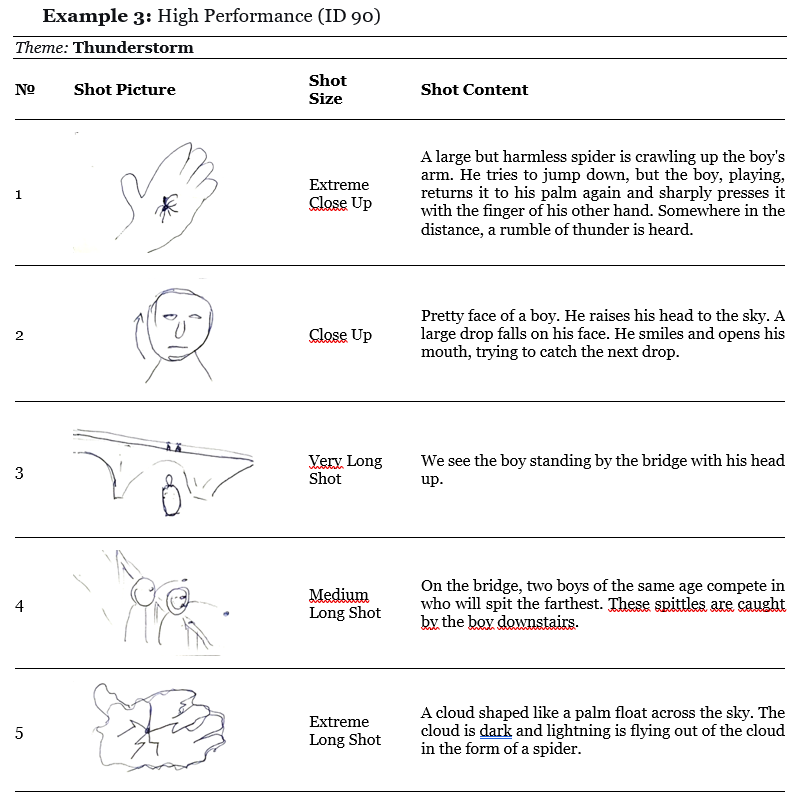
Scores: MT = 2, EDT = 2, AIT = 3.
Scoring rationale: 1. Meaningful Thinking (Who?). The author demonstrates a deep, original understanding of the theme of “Storm,” creating a multi-layered parable. Literal layer: thunderstorm as a natural phenomenon (claps of thunder, raindrops, lightning, dark cloud). Metaphorical layer: thunderstorm as retribution/highest justice. A boy brutally kills a spider (a defenseless creature), and the heavens “respond” to him by raindrops raining down on him from above, along with the spit of other boys. The ending (cloud-palm and lightning-spider) transforms the story into a parable about the boomerang, about the inevitability of punishment for cruelty. Value orientations: the author conveys the idea of responsibility for one’s actions, the connection between all living things, and heavenly justice. These are lofty spiritual values. Director’s intent and hidden meaning: the genius of the solution is that the final shot forces the viewer to rethink everything they’ve seen. The cloud in the shape of a palm (a reference to the boy’s hand) and the lightning in the shape of a spider are a cinematic metaphor for retribution. The director takes a clear moral stance. Why not 3 points? A unique, individual style suggests something completely unpredictable. Here, the style is recognizable (parable, magical realism), but not unique.
- Event-Driven Thinking (What?). The film’s structure is constructed as a dramatic trap for the viewer: Shot 1 (introduction): the event – the killing of the spider. This action defines the hero’s character. Shot 2 (development): the hero’s joy, the anticipation of rain – a contrast to the cruelty of the preceding action. Shot 3 (false narrative): We see the boy in context (under the bridge) – the question arises: what next? Shot 4 (climax/reversal): It turns out that other boys are spitting on him from above. This “explosive” event changes the meaning of the previous shots. The hero transforms from “hunter” to “victim.” Shot 5 (metaphoric denouement): A celestial sign completes the arc of meaning (spider – lightning, palm – cloud). Conflict: man vs. nature (he kills the spider) and man vs. man (he is humiliated by his peers), but the main conflict is moral, between the action and its consequences. Cause-and-effect relationships: hidden, indirect, but all the more powerful for it. No one says, “You killed the spider, now you get spat on.” The viewer completes the connection through the final image.
- Associative-Imaginative thinking (How?). This is a rare case where a work deserves the highest score on this scale. High-level cinematic metaphor: the final image (a cloud-like palm from which a bolt of lightning strikes in the shape of a spider) is not just a beautiful shot, but a semantic key to the entire film. It compels the viewer to mentally return to the first shot and relive the story, but with an understanding of its true meaning. Development of images in space and time: the shots are structured according to the “trompe l’oeil” principle: detail (hand, spider) → close-up (face) → long shot (context) → medium shot (revelation) → long shot (metaphor).
The viewer constantly changes their perspective on what is happening.
Innovation: Mixing scales – the micro-world (the spider) and the macro-world (the clouds, the lightning) are combined into a single semantic system. Paradoxical use of sound – in the first shot, thunder sounds like a harbinger, while in the last, lightning becomes the visual “sound” of retribution. Sensations and details: tactile (the spider crawling on the hand, the pressure of a finger, a drop on the face). Taste (the boy catches the drops with his mouth – the irony is that he then “catches” spit). The sound score is read between the lines: a clap of thunder, silence, the sound of falling drops, the sound of spitting (inducing disgust), a lightning strike.
Uniqueness of solution: this story cannot be retold otherwise, only through these five shots in this sequence.
Overall conclusion: the subject demonstrated a brilliant mastery of cinematic figurative language. This parable of cruelty and retribution unfolds through simple yet precise visual images that accumulate meaning and explode in a world-class metaphor at the end. The film demonstrates a mature directorial mindset, with an ability to think in terms of shots, editing, and subtext.
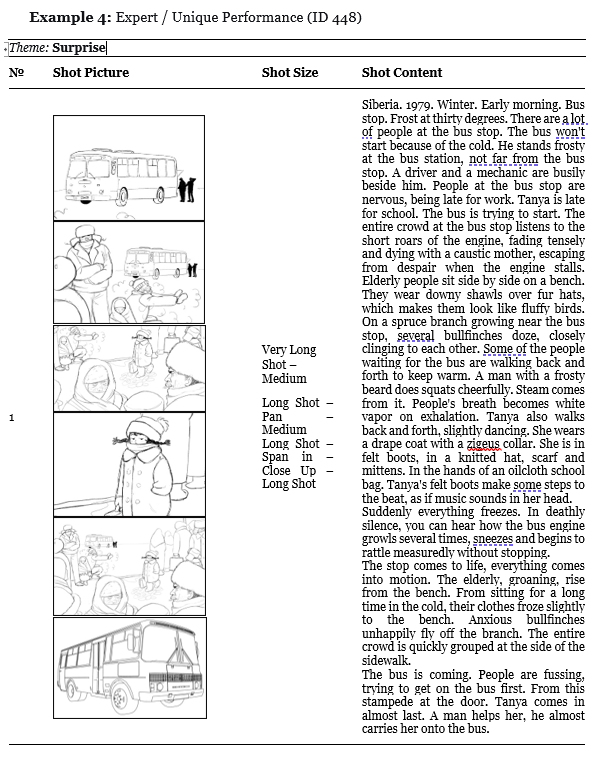
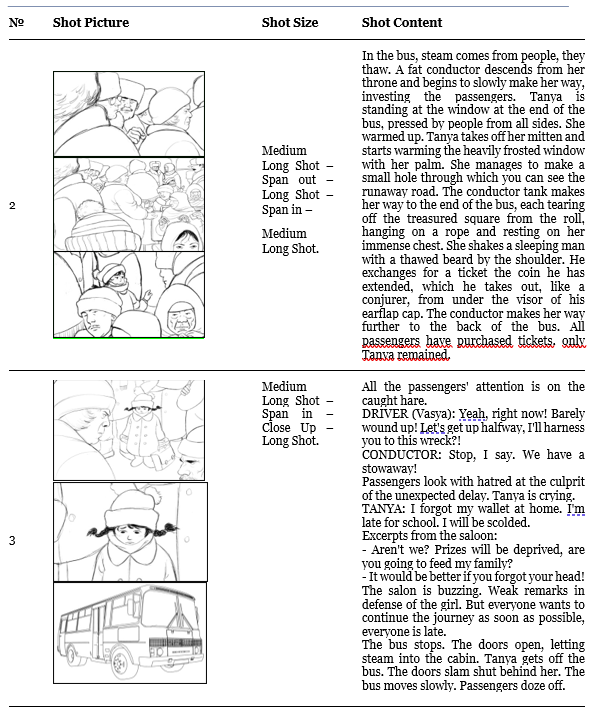
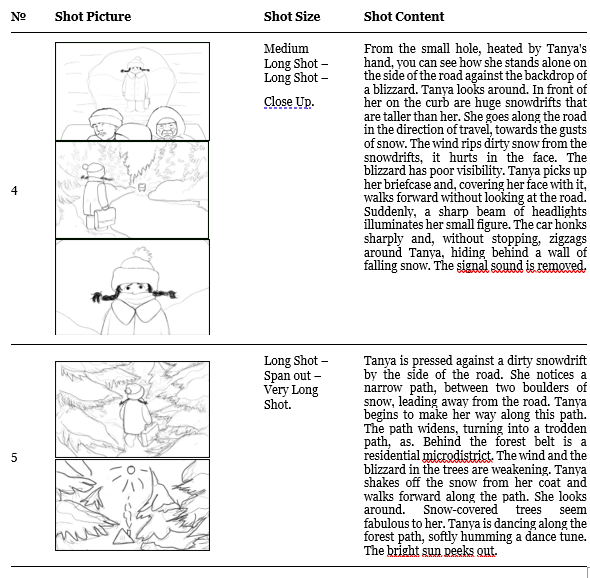
Scores: MT = 2, EDT = 3, AIT = 2.
Scoring rationale: 1. Meaningful thinking (Who?). The author creates a multi-layered work that goes beyond the literal theme. Metaphorical: confinement manifests itself in different guises – in the cold, while waiting, in a cramped bus, in social indifference, alone on the highway. Value guidelines: the story conveys the resilience of a little person, inner freedom (Tanya’s music, dancing felt boots) despite external circumstances. The director’s intention: the path from cold and confinement to light and liberation is clear. Genre coloring – social drama with elements of parable. Own position: the author’s obvious sympathy for the heroine, contrasting her living inner world with the deadening indifference of the crowd. Why not 3 points? A unique individual style involves innovative language or paradoxical thinking. Here there is a strong realistic school, but without the author’s breakthrough “tricks”.
Event-Driven thinking (What?). The author demonstrates a brilliant mastery of event structure, where each frame is not an illustration, but the engine of dramaturgy. In shot 1, the exposure is given through the action: the bus does not start – this is not just a background, but an event that creates a locked situation. The heroine is not passive: she dances to warm up – through this action her character is already declared (inner music, unbrokenness). Starting the engine becomes a micro-event that changes the state of the crowd: freezing – revival – pressure. And under this pressure, Tanya enters the bus last, almost carried by a man; this is an action that fixes her passive position in the social hierarchy. In shot 2, the action unfolds through the conductor, who “tank” her way to the end of the bus. This is not a description, but an event-process: each torn ticket is a step closer to Tanya. Tanya herself performs the action; he heats the hole in the window. This is not just a detail, but an eventful gesture: it creates a “peephole” into the world, which in frame 4 will become a point of view (we will see through her eyes). Causality: She is looking out the window because she is trapped in a stampede; she creates a hole because she wants to see the road. In shot 3, an eventful explosion occurs; a dialogue-conflict that turns into action: the conductor demands to stop the bus, the driver refuses (he has his own obstacles, he will stall), the passengers shout out lines. The key event is the landing of Tanya. It’s not just “she got kicked out”; this is an action that paradoxically changes the status of the heroine: from a “hare” she turns into an outcast, but at the same time into a free person (locked-in status is replaced by open space). The doors slam shut, an audible and visual event that cuts her off from the world. In shot 4, the sequence of events is built through obstacles: she is walking against the wind, snow is hitting her face, visibility is poor, she is covering herself with a briefcase. Suddenly there are headlights – a car honks, drives around, and disappears. This is not just a passing car, but a threatening event that could become the finale. She remains alive, and this is also an event, a moment of choice (she does not walk along the road, but clings to a snowdrift). In shot 5, the denouement is given through the opening action: she finds a path between the snowdrifts, walks along it, the wind subsides, the trees become fabulous. She dusts off her coat, a cleansing gesture. She dances – the return of the motive from the 1st frame, now as newfound freedom. The sun comes out – the final event, which not only “closes” the story, but affirms: the path has been passed, the imprisonment has been overcome.
The system of obstacles is built in increasing order: cold → crush → humiliation → disembarkation → blizzard → threat of a car. Each obstacle gives rise to an action-adaptation: dancing → heating the window → collecting things → covering it with a briefcase → searching for a path. The paradox of the event: getting off the bus turns out to be a mortal danger, but the path through the snowstorm turns out to be a way out to the light. The subtext works on all levels: the driver does not stop out of fear of stalling, not out of cruelty; passengers scream not out of anger, but out of fear of being late; The conductress follows the rules and does not pursue Tanya personally.
Associative-Imaginative thinking (How?). The subject fully followed the instructions, creating a detailed film score. Visual solutions: the dynamic of zoom levels is well thought out (from a wide shot of a bus stop to a close-up of a hole in the window). Expressive metaphors: elderly people as “ruffled birds”; bullfinches huddled together (parallel to people); a conductor walking like a “tank”; the hole in the window as a “peephole” into the world. Development of the image in space: from the bus stop → onto the bus → onto the highway → into the forest (from hell to heaven). Sound score: “the roar of the engine,” “dead silence,” “caustic swearing,” the conductor’s booming voice, the hum of the car, the horn of the car. Sensations: frost, steam from breath, frozen clothing, the pain of snow, thawing. Drawings: The presence of visualization of frames demonstrates that the subject thinks in terms of frame and composition. Why not a 3? A top score would require a completely unique visual language or an innovative sound solution that goes beyond the realist tradition. However, the work approaches the upper limit.
Overall conclusion: The subject demonstrated a high level of professional thinking. The event-action component is particularly strong: each frame is richly dramaturgical, obstacles and devices are structured into a system, and the sequence of events operates at all levels—from micro-actions (melting a window) to macro-events (landing and rescue). The work was completed in full compliance with the instructions, demonstrating a developed sense of form, content, and the author’s position. Achieving a unique style (3 points) requires either a great deal of paradoxical thinking or experimentation with form.
Validation Measures
To assess convergent and discriminant validity of the 5 SHOTS Test, the following instruments were administered to subsamples:
Raven’s Standard Progressive Matrices (RSPM; Raven, Court, & Raven, 1992). This non-verbal measure of fluid intelligence was administered to a subsample of 99 respondents. RSPM requires pattern completion and analogical reasoning and is widely used as a proxy for general intellectual ability.
Torrance Tests of Creative Thinking (TTCT; Torrance, 1966). The figural battery (non-verbal tasks, Forms A and B) was administered to a subsample of 109 respondents. TTCT assesses fluency, originality, elaboration, and resistance to premature closure and is a standard measure of creative potential.
Expert Score. A composite expert evaluation was obtained for 342 respondents. Experts (film directors, film teachers, film critics, and psychologists) assessed respondents’ productions on a 10-point scale for overall directorial promise, independent of the 5 SHOTS Test scoring.
Questionnaire of Character Traits (Rusalov, 2007). To assess discriminant validity, a subsample of 114 respondents completed this inventory of basic personality traits, which yields scores on dimensions including sociability, emotionality, and activity.
Assessment of the Concept Director. To evaluate predictive validity regarding conceptual organization, 12 independent experts (9 females, 3 males, including 2 D.Sc. and 5 Ph.D.) assessed a list of adjectives for their degree of correspondence to the concept Director. Adjectives that received ≥75% expert agreement were retained. For each respondent, two indices were derived: (1) a measure of differentiation (the number of distinct attributes used), and (2) a measure of hierarchy (the structural organization of these attributes). A full description is presented in Volkova and Moss (in print, 2023).
1.6. Statistical Analyses
Statistical analyses were conducted using SPSS Version 26.0 (IBM Corp., Armonk, NY, USA). All tests were two-tailed with a significance level set at α = 0.05. Normality was assessed using Kolmogorov–Smirnov tests; for non-normal distributions, non-parametric equivalents were employed.
Reliability. Internal consistency was estimated using Cronbach’s alpha for each subscale and for the total test score across the full sample and within each age group.
Correlational Analyses. Convergent and discriminant validity were assessed using Spearman’s rank-order correlations between the test subscales (MT, EDT, AIT) and the validation measures (RSPM, TTCT, Expert Score, Character Traits). Intercorrelations among subscales were also examined.
Group Comparisons. Sex differences were examined using independent-samples t-tests. Age differences across the four groups were analyzed using both one-way ANOVA (with post-hoc Tukey HSD) and the non-parametric Kruskal–Wallis H test when Levene’s test indicated heterogeneity of variance.
General Linear Modeling. To test the predictive relationship between the test subscales and the organization of the concept Director, a general linear model (GLM) with multivariate tests (Pillai’s trace) was conducted. Dependent variables were the measures of differentiation and hierarchy. Independent variables included the three subscale scores as fixed factors with all interaction terms. Box’s Test and Levene’s Test verified assumptions. Effect sizes were reported as partial eta-squared (η²p), with observed power calculated post-hoc.
Results
3.1. Descriptive Statistics and Reliability
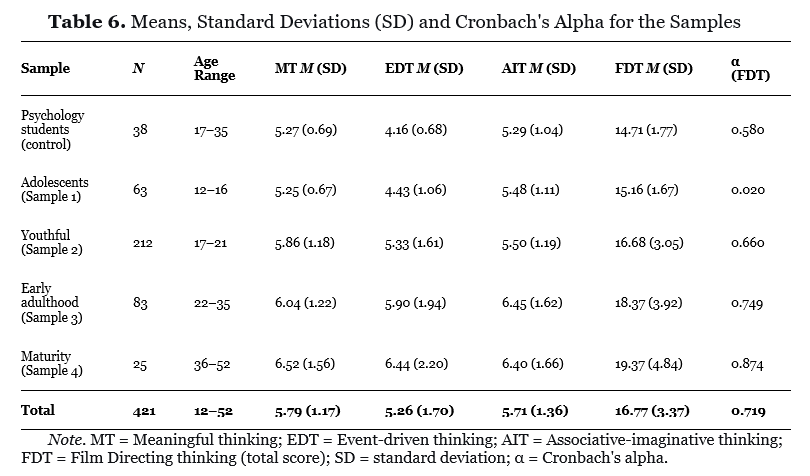
Descriptive statistics for the 5 SHOTS Test subscales across all samples are presented in Table 6. Test scores followed a normal distribution as assessed by Kolmogorov–Smirnov tests (p > 0.05 for all subscales). Cronbach’s alpha coefficients for the total scale were acceptable across all samples except the adolescent group (α = 0.020), which showed low internal consistency. For the total sample (N = 421), Cronbach’s alpha was 0.719, indicating acceptable reliability. For the early adulthood and maturity groups, alphas were 0.749 and 0.874, respectively.
Item-Total Correlations
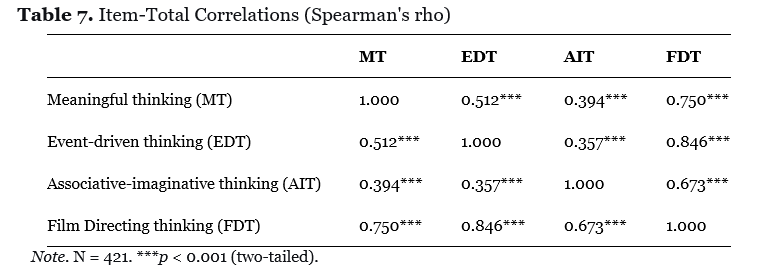
Spearman’s rank-order correlations between the three subscales and the total scale are presented in Table 7. All subscales were significantly and positively intercorrelated, with coefficients ranging from rs
= 0.357 (EDT–AIT) to rs = 0.512 (MT–EDT). The total score (FDT) correlated strongly with each subscale: MT (rs = 0.750), EDT (rs = 0.846), and AIT (rs = 0.673), all p < 0.001. These results confirm that the three subscales measure related but distinguishable components of a unified construct.
Construct Validity
3.3.1. Convergent Validity
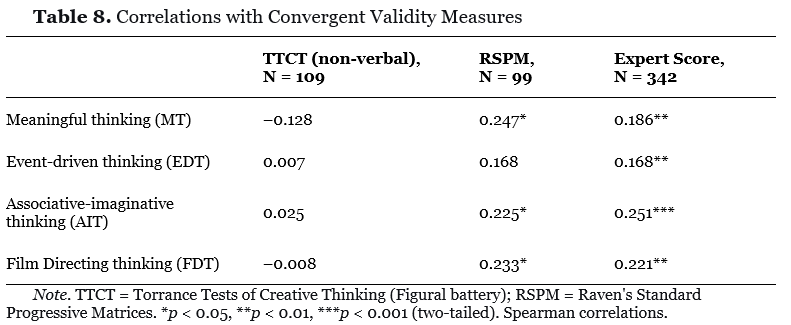
Correlations between the 5 SHOTS Test scales and external validation measures are presented in Table 8. As predicted, significant positive correlations were found between the test subscales and expert evaluation: MT (rs = 0.186, p < 0.01), EDT (rs = 0.168, p < 0.01), AIT (rs = 0.251, p < 0.001), and FDT (rs = 0.221, p < 0.01).
Significant correlations were also observed with Raven’s Standard Progressive Matrices (fluid intelligence) for MT (rs = 0.247, p < 0.05), AIT (rs = 0.225, p < 0.05), and FDT (rs = 0.233, p < 0.05). EDT showed a non-significant trend with RSPM (rs = 0.168, p = 0.096).
No significant correlations were found between any of the 5 SHOTS Test scales and the Torrance Tests of Creative Thinking (non-verbal figural battery). The coefficients ranged from rs = –0.128 (MT) to rs = 0.025 (AIT), all non-significant.
. Discriminant Validity
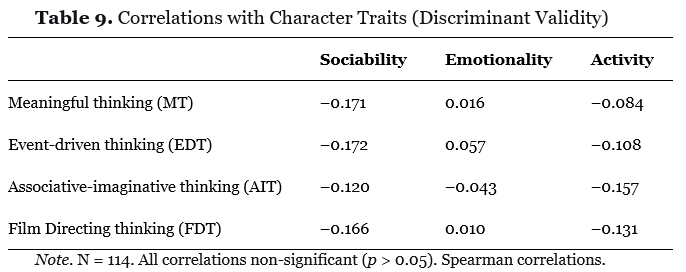
Correlations between the 5 SHOTS Test scales and character trait measures (Rusalov, 2007) are presented in Table 9. No significant correlations were found between any of the test subscales or the total score and any character trait dimension, including sociability, emotionality, and activity. Coefficients ranged from rs = –0.172 to rs = 0.057, all non-significant. These findings confirm the discriminant validity of the instrument, indicating that the 5 SHOTS Test measures specific cognitive abilities rather than general personality dimensions.
Sex Differences
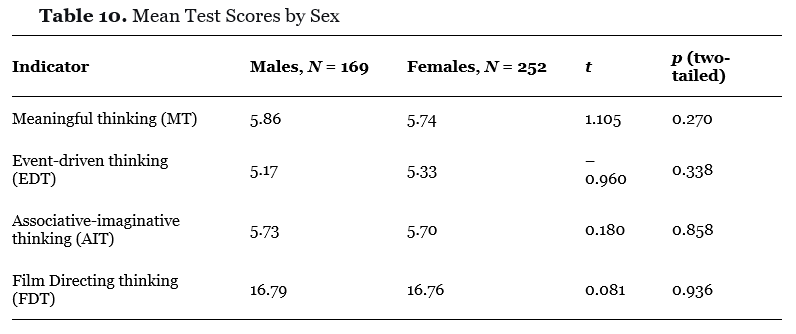
Independent-samples t-tests revealed no significant differences between males and females on any of the 5 SHOTS Test subscales (Table 10). MT: t(419) = 1.105, p = 0.270; EDT: t(419) = – 0.960, p = 0.338; AIT: t(419) = 0.180, p = 0.858; FDT: t(419) = 0.081, p = 0.936.
Age-Related Differences
Figures 11–14 illustrate the developmental trajectories of the three subscales and total score across age groups. Both parametric (ANOVA) and non-parametric (Kruskal–Wallis) analyses confirmed significant age-related increases (Table 11).
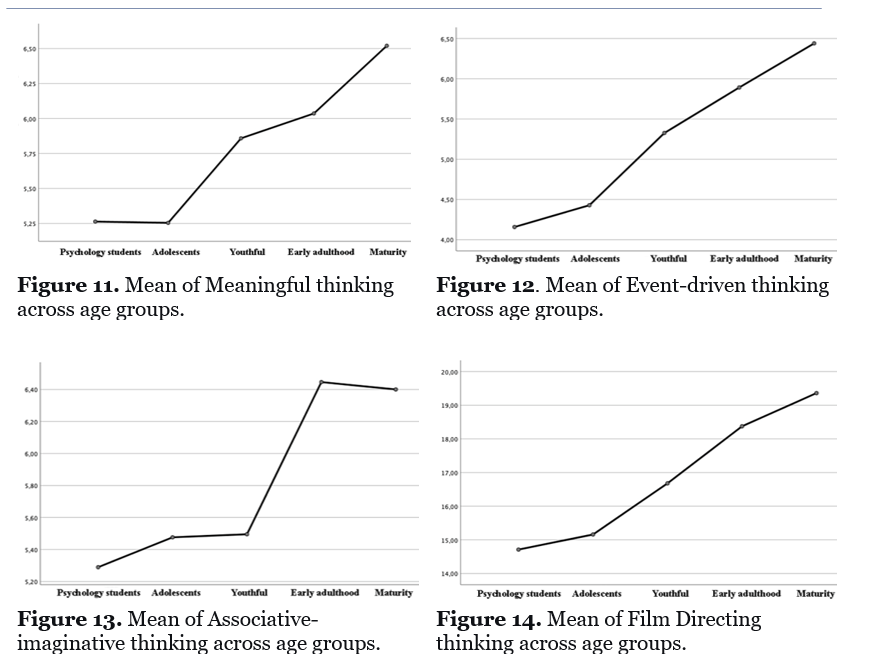
The control group (psychology students) showed the lowest scores (comparable to adolescents). Scores MT increased progressively from adolescence through maturity. ANOVA: F(4, 416) = 9.559, p < 0.001; Kruskal–Wallis H = 24.636, p < 0.001.
Scores EDT increased steadily from psychology students to the maturity group. ANOVA: F(4, 416) = 15.595, p < 0.001; Kruskal–Wallis H = 33.316, p < 0.001.
Scores AIT showed a modest increase from psychology students to youth, a sharp increase in early adulthood, and a slight (non-significant) decrease in maturity. ANOVA: F(4, 416) = 11.421, p < 0.001; Kruskal–Wallis H = 37.917, p < 0.001.
FDT scores increased progressively from psychology students (lowest) through to the maturity group. Notably, the psychology student control group scored lower than even the adolescent film group, confirming the test’s specificity for directorial abilities. ANOVA: F(4, 416) = 18.074, p < 0.001; Kruskal–Wallis H = 36.607, p < 0.001.

Predictive Validity: General Linear Modeling
To test the hypothesis that the 5 SHOTS Test subscales predict the organization of the concept Director, a general linear model (GLM) with multivariate tests was conducted. Dependent variables were the measure of differentiation and the measure of hierarchy of the concept Director. Independent variables included MT, EDT, and AIT scores as fixed factors, with all interaction terms.
Box’s Test of Equality of Covariance Matrices was non-significant (M = 37.230, F = 0.776, p = 0.838), and Levene’s Test confirmed homogeneity of error variances (all p > 0.05), validating the assumptions of multivariate analysis.
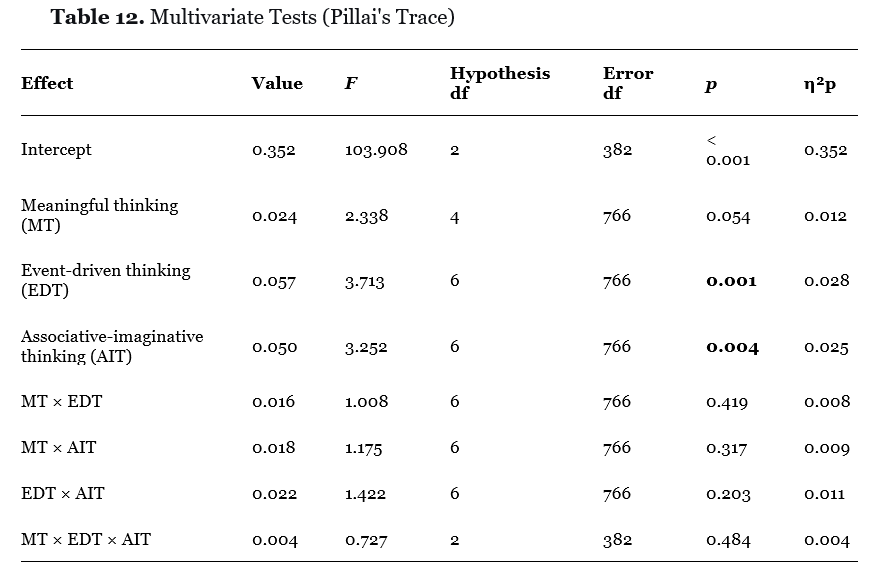
Multivariate Tests (Pillai’s Trace). The overall model was significant. The intercept showed a strong effect: Pillai’s Trace = 0.352, F(2, 382) = 103.908, p < 0.001, η²p = 0.352. EDT demonstrated a significant multivariate effect: Pillai’s Trace = 0.057, F(6, 766) = 3.713, p = 0.001, η²p = 0.028. AIT also showed a significant effect: Pillai’s Trace = 0.050, F(6, 766) = 3.252, p = 0.004, η²p = 0.025. MT showed only a trend-level effect: Pillai’s Trace = 0.024, F(4, 766) = 2.338, p = 0.054, η²p = 0.012. No significant interaction effects were detected (all p > 0.05).
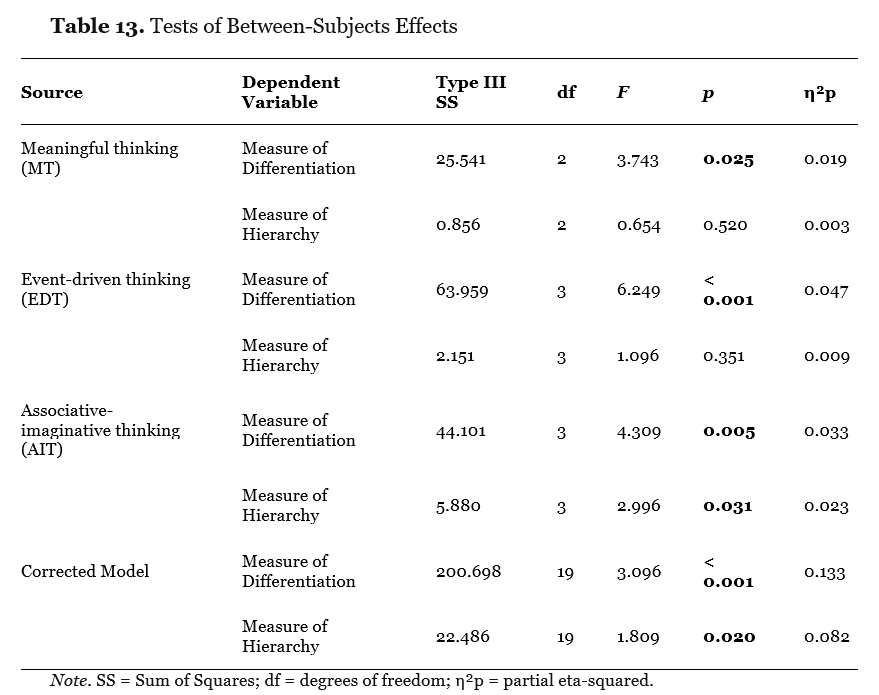
Tests of Between-Subjects Effects. MT significantly predicted the measure of differentiation: F(2, 383) = 3.743, p = 0.025, η²p = 0.019, but not the measure of hierarchy: F(2, 383) = 0.654, p = 0.520. EDT significantly predicted the measure of differentiation: F(3, 383) = 6.249, p < 0.001, η²p = 0.047, but not the measure of hierarchy: F(3, 383) = 1.096, p = 0.351. AIT significantly predicted both the measure of differentiation: F(3, 383) = 4.309, p = 0.005, η²p = 0.033, and the measure of hierarchy: F(3, 383) = 2.996, p = 0.031, η²p = 0.023.
Discussion
This study set out to develop and validate the 5 SHOTS Test, the first objective psychometric instrument designed to assess the three core components of film directing thinking: Meaningful thinking (MT), Event-driven thinking (EDT), and Associative-imaginative thinking (AIT). The results provide robust support for the reliability and validity of the instrument, with important theoretical and practical implications.
The 5 SHOTS Test demonstrated acceptable internal consistency (Cronbach’s α = 0.719 for the total sample), with reliability increasing with age and professional experience (α = 0.874 in the maturity group). The three subscales were significantly intercorrelated, confirming that they measure related but distinguishable facets of a unified cognitive construct. Convergent validity was supported by significant correlations with expert evaluation (MT, EDT, AIT, FDT) and with fluid intelligence (MT, AIT, FDT). Discriminant validity was confirmed by the absence of significant correlations with character traits. Notably, no significant correlations were found with non-verbal creativity as measured by the Torrance Test, a finding that warrants careful theoretical consideration. No sex differences were detected, while significant age-related increases in all subscales confirmed the developmental trajectory of directing thinking. Finally, the GLM demonstrated that EDT and AIT significantly predict both the measure of differentiation and the measure of hierarchy of the concept Director, with MT predicting only the measure of differentiation.
The present findings significantly advance the theoretical understanding of expert cognition in artistic domains. First, the factor structure of the 5 SHOTS Test empirically validates Sechenov’s foundational triad, separation, comparison, and direction of comparisons, as operationalized in directorial practice (Sechenov, 1952). Meaningful thinking corresponds to the capacity for conceptual separation and abstraction, event-driven thinking to the systematic comparison and causal ordering of narrative elements, and associative-imaginative thinking to the creative direction and recombination of these elements into novel configurations. This tripartite structure offers a comprehensive cognitive model that bridges general theories of analytical thinking (Chuprikova, 2015; Rubinshtein, 2003) with the specific demands of cinematic creativity.
Second, the study provides compelling evidence for the construct of generative or conceptualizing ability as central to film directing. As Kholodnaya and Khazova (2017) argued, the capacity for conceptualization, the generation of new mental contents and meanings, is a distinct type of ability. The 5 SHOTS Test captures this generative capacity at both the semantic level (MT) and the narrative-structural level (EDT and AIT). The finding that all three subscales, but particularly AIT and EDT, predict the structural organization of the concept Director (differentiation and hierarchy) suggests that directorial thinking involves not merely possessing content knowledge but actively restructuring mental representations of the director’s role in a hierarchical, differentiated manner. This aligns with the work of Kholodnaya (2012) on conceptual structures and their role in intellectual productivity.
Third, the null correlation with the Torrance Test of Creative Thinking requires careful interpretation. At first glance, this finding seems counterintuitive given the inherently creative nature of film directing. However, we interpret this result as evidence of domain-specific creative thinking abilities, consistent with the work of Hong and Milgram (2010) on domain generality versus specificity in creative cognition. The Torrance Test measures general figural creativity (fluency, originality, elaboration) in a decontextualized visual task. The 5 SHOTS Test, by contrast, assesses creativity embedded within a specific domain, narrative construction, visual-auditory imagination, and structural problem-solving. This suggests that creative potential is not a unitary trait but manifests differently across domains, requiring domain-specific measurement. Expert film directors may not score higher on general figural creativity; rather, their creativity operates within the specific constraints and affordances of cinematic narrative. This is consistent with observations in other expert domains, such as chemistry (Volkova, 2014), where domain-specific creative abilities did not correlate with general creativity tests.
Fourth, the age-related findings demonstrate that directorial thinking develops progressively with age and professional experience. The increase in all subscales from adolescence through maturity reflects the cumulative acquisition of narrative schemas, life experience, and professional expertise. The psychology student control group, despite being adults with comparable intellectual abilities, scored lower than even the adolescent film group. This is a critical finding that confirms the construct-specificity of the test: the 5 SHOTS Test does not measure general intelligence or academic ability but rather the specific cognitive competencies that develop through exposure to and engagement with cinematic craft. The sharp increase in AIT scores in early adulthood (22–35 years) may reflect the period when associative and metaphorical thinking fully matures, possibly linked to the consolidation of semantic networks and the accumulation of cultural knowledge (see also Melik-Pashaev, 2014).
The 5 SHOTS Test has significant practical applications in talent identification, educational assessment, and professional development. First, it offers film schools and training programs an objective, standardized tool for selecting candidates with high directorial potential, reducing reliance on subjective portfolio reviews. The open-scale scoring (0–3 points, with 3 reserved for unique responses) is particularly valuable for identifying truly exceptional individuals rather than merely high-average performers. Second, the test can be used for pedagogical diagnostics: instructors can identify which component of directorial thinking (MT, EDT, or AIT) is underdeveloped in a student and target interventions accordingly. Third, the age norms established in this study provide benchmarks for tracking developmental progress, enabling early identification of talent in adolescent populations.
Several limitations should be acknowledged. First, the internal consistency for the adolescent group was unacceptably low (α = 0.020). This likely reflects the heterogeneity of cognitive development during adolescence: at ages 12–16, the three components of directorial thinking may not yet be differentiated. Future research should examine whether a simplified version of the test or a modified scoring system is more appropriate for younger adolescents. Second, the study relied on expert scoring, which, while reliable in the present study (ICCs > 0.88), is time-intensive and requires trained raters. Future research should investigate the feasibility of automated scoring using natural language processing (NLP) or machine learning algorithms to increase scalability. Third, the sample was predominantly Russian; cross-cultural validation is necessary to establish the generalizability of the instrument across different cinematic traditions and educational systems. Fourth, the study did not include test-retest reliability assessment; future studies should examine the stability of scores over time. Fifth, the small sample size in the maturity group (n = 25) limits the statistical power of some comparisons; replication with larger samples is warranted. Sixth, while the test demonstrates convergent validity with expert evaluation and fluid intelligence, the absence of correlation with the Torrance Test, while theoretically interpretable, requires further investigation using other measures of domain-specific creativity.
Despite these limitations, the present study has several notable strengths. The sample was large (N = 421) and diverse across age groups and levels of professional experience. The test is ecologically valid: respondents produce authentic creative artifacts (film narratives) rather than responding to abstract or decontextualized stimuli. The scoring rubric is theoretically grounded and empirically validated. The open-scale design allows for the identification of truly exceptional responses. Finally, the convergence of psychometric evidence, reliability, convergent validity, discriminant validity, age-related developmental trends, and predictive validity for conceptual organization, provides strong confidence in the instrument’s utility.
Conclusions
This study presents the development and psychometric validation of the 5 SHOTS Test, the first standardized instrument for assessing the three core components of film directing thinking: Meaningful thinking, Event-driven thinking, and Associative-imaginative thinking. The findings demonstrate that the test possesses acceptable reliability, convergent and discriminant validity, and predictive validity for the organization of the concept Director. The three-component model, grounded in Sechenov’s theory of thought structure and contemporary cognitive psychology, offers a theoretically coherent and empirically supported framework for understanding expert cognition in cinematic creativity.
The 5 SHOTS Test fills a critical gap in the psychological assessment of artistic and creative domains, providing an objective, replicable, and theoretically grounded tool that can be used for talent identification, educational diagnostics, and research into the cognitive mechanisms underlying directorial expertise. The absence of correlation with general creativity tests underscores the domain-specificity of creative thinking in film directing, challenging unitary models of creativity and supporting the need for domain-specific assessment tools.
The age-related developmental trajectories identified in this study reveal that directorial thinking matures progressively, with each component, meaningful, event-driven, and associative-imaginative, showing distinct patterns of growth. This has implications for the timing and content of educational interventions in film schools and creative arts programs.
Future research should extend the validation of the 5 SHOTS Test to cross-cultural samples, investigate its predictive validity for real-world directorial success (e.g., awards, critical reception, box office performance), and explore its utility in other narrative-based creative domains such as screenwriting, theater directing, and novel writing. The development of automated scoring systems would enhance scalability and accessibility, enabling widespread use in educational and professional settings.
In conclusion, the 5 SHOTS Test represents a significant advance in the psychometric assessment of creative cognition, providing researchers and practitioners with a robust, theoretically grounded, and practically useful instrument for understanding and fostering the cognitive abilities that underpin cinematic storytelling.
Ethics Approval and Consent to Participate: The study was conducted in accordance with the ethical standards of the institutional review board and the 1964 Helsinki Declaration and its later amendments. All participants provided written informed consent prior to participation. For participants under 18 years of age, parental consent was obtained. Participants were informed of their right to withdraw at any time without penalty. All data were anonymized and de-identified prior to analysis.
Consent for Publication: All participants provided consent for the publication of anonymized data and representative responses (without identifying information) for scientific and educational purposes.
Data Availability: The datasets generated and analyzed during the current study are available from the corresponding author upon reasonable request.
Funding: This research received no specific grant from any funding agency in the public, commercial, or not-for-profit sectors.
Conflict of Interest: The author declares no conflict of interest.
Acknowledgments: The author expresses profound gratitude to Dr. E.V. Volkova for moral and intellectual support, wisdom, deep and fruitful discussion of the working material, and assistance in the final layout of the manuscript. Special thanks to the students of film directing faculties of Moscow: Yakov Yurovitsky, Anton Lomaka, Artem Bogoslavsky, Elena Baranova, Anna Moysey, Anastasia Kulishova, Ekaterina Migaleva, Anzhelika Kaplanova, and Andrey Andreykin for the design and preparation of text and graphic materials. Thanks to Maya Pipiya, Varvara Negry, and Roman Vasyanov for help, friendship, and support in preparing materials.
Author Contributions: V.A.M. conceived and designed the study, developed the 5 SHOTS Test, collected and analyzed the data, and wrote the manuscript. Author has read and approved the final manuscript.
References
- Abulkhanova-Slavskaya, K. A. (1994). Sotsial’noye myshleniye lichnosti: problemy i strategii issledovaniya [Social thinking of personality: Problems and strategies of research]. Psikhologicheskiy zhurnal, 15(4), 39–55.
- (1983). Poetika [Poetics]. In Sochineniya: V 4 t. T. 4[Works: In 4 vols. Vol. 4] (pp. 645–680). Mysl’.
- Arnheim, R. (1999). Novyye ocherki po psikhologii iskusstva [New essays on the psychology of art]. Prometey.
- Arutyunova, N. D. (1990). Metafora i diskurs [Metaphor and discourse]. In Teoriya metafory [Theory of metaphor] (pp. 5–32). Progress.
- Brushlinsky, A. V. (1970). Psikhologiya myshleniya i kibernetika [Psychology of thinking and cybernetics]. Mysl’.
- Chuprikova, N. I. (2015). Psikhika i psikhicheskiye protsessy (sistema ponyatiy obshchey psikhologii) [Mind and mental processes: System of concepts of general psychology]. Yazyki slavyanskoy kul’tury.
- Davydov, V. V. (1972). Vidy obobshcheniya v obuchenii [Types of generalization in teaching]. Pedagogika.
- Dikiy, A. D. (1976). Izbrannoye[Favorites]. VTO.
- Eisenstein, S.M. Selected Works: In 6 volumes / M.: Art, 1968. Vol. 5. 599 p.
- Eisenstein, S.M. Montage. – M.: Cinema Museum, 2000. – 592 p.
- Epshtein, M. N. (2004). Znak probela: O budushchem gumanitarnykh nauk [Space sign: On the future of the humanities]. Novoye literaturnoye obozreniye.
- Ershov, P. M. (1997). Iskusstvo tolkovaniya: Rezhissura kak prakticheskaya psikhologiya. Chast’ pervaya [The art of interpretation: Directing as practical psychology. Part 1]. Feniks.
- Grebenkin, A. V. (2007). Problema ponimaniya literaturnogo teksta v protsesse tvorcheskoy samorealizatsii teatral’nogo rezhissera [The problem of understanding a literary text in the process of creative self-realization of a theater director]. In Tvorcheskaya samorealizatsiya lichnosti kak antropotsentricheskiy etalon zdorov’ya v sovremennoy kul’ture [Creative self-realization of a person as an anthropocentric standard of health in modern culture] (pp. 167–198). IKhO RAO.
- Hong, E., & Milgram, R. M. (2010). Creative thinking ability: Domain generality and specificity. Creativity Research Journal, 22(3), 272– 287. https://doi.org/10.1080/10400419.2010.503535
- Kholodnaya, M. A. (2012). Psikhologiya ponyatiynogo myshleniya: Ot kontseptual’nykh struktur k ponyatiynym sposobnostyam [Psychology of conceptual thinking: From conceptual structures to conceptual abilities]. Institut psikhologii RAN.
- Kholodnaya, M. A., & Khazova, S. A. (2017). Fenomen kontseptualizatsii kak osnova produktivnosti intellektual’noy deyatel’nosti i sovladayushchego povedeniya [The phenomenon of conceptualization as a basis for the productivity of intellectual activity and coping behavior]. Psikhologicheskiy zhurnal, 38(5), 5–17.
- Kornilov, Yu. K. (2000). Psikhologiya prakticheskogo myshleniya [Psychology of practical thinking]. Yaroslavskiy gosudarstvennyy universitet.
- Leontiev, A. N. (1975). Deyatel’nost’, soznaniye, lichnost’ [Activity, consciousness, personality]. Politizdat.
- Melik-Pashaev, A. A. (2014). V poiskakh istoka tvorchestva [In search of the source of creativity]. In Differentsionno-integrationnaya teoriya razvitiya. Kniga 2 [Differential-integration theory of development. Book 2] (pp. 139–164). Yazyki slavyanskikh kul’tur.
- Meshcheryakova, B. G., & Zinchenko, V. P. (Eds.). (2009). Bol’shoy psikhologicheskiy slovar’ [Big psychological dictionary] (4th ed.). AST; Praym-Evroznak.
- Moss, V. A. (2022). Voprosy opredeleniya i izucheniya sposobnostey kinorezhissera [Issues of determining and studying the abilities of a film director]. In D. V. Ushakov, A. L. Zhuravlev, A. V. Makhnach, N. E. Kharlamenkova, A. V. Yurevich, & I. I. Vetrova (Eds.), Istoriya, sovremennost’ i perspektivy razvitiya psikhologii v sisteme Rossiyskoy akademii nauk: Materialy Mezhdunarodnoy yubileynoy nauchnoy konferentsii, posvyashchennoy 50-letiyu sozdaniya Instituta psikhologii RAN [History, modernity and prospects for the development of psychology in the system of the Russian Academy of Sciences: Proceedings of the International Anniversary Scientific Conference dedicated to the 50th anniversary of the Institute of Psychology of the Russian Academy of Sciences] (pp. 539–541). Institut psikhologii RAN.
- Moss, V. A., & Volkova, E. V. (2023). Vozrastnaya dinamika differentsirovannosti i iyerarkhichnosti kontsepta Rezhisser [Age dynamics of differentiation and hierarchy of the concept Director]. Vestnik Kostromskogo gosudarstvennogo universiteta. Seriya: Pedagogika. Psikhologiya. Sotsiokinetika, 29(4), 48–57.
- Moss, V. A., & Volkova, E. V. (2024). Vzaimosvyaz’ mery differentsirovannosti i mery iyerarkhichnosti so smyslovym, sobytiyno-deystvennym i assotsiativno-obraznym myshleniyem kinorezhissera [The relationship between the measure of differentiation and the measure of hierarchy with the meaningful, event-driven and associative-imaginative thinking of the film director]. Vestnik Kostromskogo gosudarstvennogo universiteta. Seriya: Pedagogika. Psikhologiya. Sotsiokinetika, 30(3), 50–60. https://doi.org/10.34216/2073-1426-2024-30-3-50-60
- Raven, J. C., Court, J. H., & Raven, J. (1992). Manual for Raven’s Progressive Matrices and vocabulary scales. Oxford Psychologists Press.
- Rubinstein, S. L. (1935). Osnovy psikhologii [Fundamentals of psychology]. Uchpedgiz.
- Rubinstein, S. L. (1959). Printsip determinizma i psikhologicheskaya teoriya myshleniya [The principle of determinism and the psychological theory of thinking]. In Psikhologicheskaya nauka v SSSR. T. 1 [Psychological science in the USSR. Vol. 1] (pp. 315–357). Akademiya pedagogicheskikh nauk.
- Rubinstein, S. L. (2002). Osnovy obshchey psikhologii [Fundamentals of general psychology]. Piter.
- Rubinstein, S. L. (2003). Bytiye i soznaniye. Chelovek i mir [Being and consciousness. Man and the world]. Piter.
- Rusalov, V. M., & Trofimova, I. N. (2007). The structure of temperament and its measurement. Psychological Services Press.
- Sechenov, I. M. (1952). Izbrannyye proizvedeniya v dvukh tomakh. T. 1: Fiziologiya i psikhologiya [Selected works in two volumes. Vol. 1: Physiology and psychology]. AN SSSR.
- Sechenov, I. M. (2001). Elementy mysli [Elements of thought]. Piter.
- Shadrikov, V. D. (2014). Mysl’ i poznaniye [Thought and knowledge]. Logos.
- Solso, R. L., MacLin, O. H., & MacLin, M. K. (2014). Cognitive psychology. Pearson Education.
- Stanislavsky, K. S. (1989). Sobraniye sochineniy: V 9 t. T. 2: Rabota aktera nad soboy. Chast’ 1: Rabota nad soboy v tvorcheskom protsesse perezhivaniya[Collected works: In 9 vols. Vol. 2: An actor’s work on himself. Part 1: Working on oneself in the creative process of experiencing].
- Tarkovsky, A. A. (1989). Lektsii po kinorezhissure [Lectures on film directing]. Lenfil’m.
- Teplov, B. M. (1961). Problemy individual’nykh razlichiy [Problems of individual differences]. Akademiya pedagogicheskikh nauk.
- Torrance, E. P. (1966). The Torrance Tests of Creative Thinking: Norms, technical manual (Research ed., Verbal and Figural Tests, Forms A and B). Prentice Hall.
- Ushakov, D. N. (2008–2023). Tolkovyy slovar’ russkogo yazyka [Explanatory dictionary of the Russian language]. https://ushakovdictionary.ru/word.php?wordid=69902
- Vekker, L. M. (1974). Psikhicheskiye protsessy. T. 1 [Mental processes. Vol. 1]. Leningradskiy universitet.
- Vekker, L. M. (1976). Psikhicheskiye protsessy. T. 3 [Mental processes. Vol. 3]. Leningradskiy universitet.
- Volkova, E. V. (2013). Triedinyy aspekt funktsional’noy organizatsii kontsepta: proshloye, nastoyashcheye i budushcheye [The triune aspect of the functional organization of the concept: Past, present and future]. Mir psikhologii, 2, 29–41.
- Volkova, E. V. (2014). The nature of creativity: Differential-integration approach. Humanities and Social Sciences Review, 3(2), 375–388.
- Volkova, E. V. (2017a). Vzaimosvyaz’ smysla i spetsial’nykh sposobnostey v roste samorealizatsii cheloveka [The relationship of meaning and special abilities in the growth of human self-realization]. Mir psikhologii, 3(91), 106–113.
- Volkova, E. V. (2017b). O khimicheskom myshlenii i metodakh yego issledovaniya [About chemical thinking and methods of its research]. In V. V. Lunin & N. E. Kuz’menko (Eds.), Estestvenno-nauchnoye obrazovaniye: novyye gorizonty [Natural science education: New horizons] (pp. 44–58). Izdatel’stvo Moskovskogo universiteta.
- Volkova, E. V., & Moss, V. A. (2023). Osobennosti organizatsii kontsepta Rezhisser na raznykh stadiyakh vozrastnogo razvitiya [Features of the organization of the concept Director at different stages of age development]. Vestnik Kostromskogo gosudarstvennogo universiteta. Seriya: Pedagogika. Psikhologiya. Sotsiokinetika, 29(2), 50–58. https://doi.org/10.34216/2073-1426-2023-29-2-50-58
- Zavalishina, D. N. (2005). Prakticheskoye myshleniye: spetsifika i problemy razvitiya [Practical thinking: Specificity and problems of development]. Institut psikhologii RAN.
- Zhinkin, N. I. (1971). Psikhologiya kinovospriyatiya [Psychology of film perception]. In Kinematograf segodnya. Vypusk 2 [Cinematography Issue 2] (pp. 214–254). Iskusstvo.
Comments (0)
Background and Problem. In an era dominated by screen-based narratives, the film director serves as a key cognitive architect of contemporary culture. Despite the cultural and economic significance of cinema, professional selection and training of directors rely almost exclusively on subjective expert intuition. The scientific community lacks any objective, standardized psychometric instrument capable of assessing the specific cognitive architecture that underpins film director’s success. This methodological void prevents systematic research into the ontogeny of director’s abilities and obstructs evidence-based selection procedures. Aim. This study aimed to develop and psychometrically validate the 5 SHOTS Test, the first objective diagnostic instrument designed to quantify the three core components of film directing thinking: Meaningful thinking (MT), Event-driven thinking (EDT), and Associative-imaginative thinking (AIT). Method. The study comprised 421 participants (169 males, 252 females) aged 12 to 52 years (M = 22.4, SD = 8.7), including film directing students, professional directors, and a control group of psychology students. The 5 SHOTS Test requires respondents to generate a narrative film concept of five shots based on one of three thematically neutral prompts. Each subscale was scored on a 0–3-point open scale. Validation measures included Raven’s Standard Progressive Matrices (RSPM), Torrance Tests of Creative Thinking (TTCT), expert evaluation, and a character trait questionnaire. Statistical analyses included Cronbach’s alpha, Spearman’s correlations, ANOVA, Kruskal–Wallis tests, and general linear modeling. Results. The 5 SHOTS Test demonstrated acceptable internal consistency for the total sample (α = 0.719) and for adult subgroups (α = 0.749–0.874). Convergent validity was supported by significant correlations with expert evaluation (rs = 0.221, p < 0.01) and with fluid intelligence (rs = 0.233, p < 0.05). Discriminant validity was confirmed by the absence of significant correlations with character traits. No significant sex differences were found. All subscales showed significant age-related increases from adolescence to maturity (all p < 0.001). Event-driven and Associative-imaginative thinking significantly predicted the hierarchical organization of the concept Director (p < 0.005), with MT predicting only differentiation (p = 0.025). No correlations were detected with general non-verbal creativity (Torrance Test), supporting the domain-specificity of directorial creative cognition. Conclusion. The 5 SHOTS Test represents a significant advance in the psychometric assessment of creative cognition, providing researchers and practitioners with a robust, theoretically grounded, and practically useful instrument for understanding and fostering the cognitive abilities that underpin cinematic narrative. The test can be used for talent identification in film schools, educational diagnostics, and research into the cognitive mechanisms underlying film directing expertise.
Тест “5 кадров”: Психометрические характеристики на российской выборке
Владимир Алексеевич Мосс
Институт современного искусства, Всероссийский государственный университет кинематографии им. С.А. Герасимова, Москва, Россия
Резюме. Актуальность и проблема. В эпоху доминирования экранных нарративов кинорежиссер выступает ключевым когнитивным архитектором современной культуры. Несмотря на культурную и экономическую значимость киноиндустрии, профессиональный отбор и обучение режиссеров опираются почти исключительно на субъективную экспертную интуицию. Научное сообщество не располагает объективным, стандартизированным психометрическим инструментом, способным оценить специфическую когнитивную архитектуру, лежащую в основе режиссерского успеха. Этот методологический вакуум препятствует систематическому изучению онтогенеза режиссерских способностей и затрудняет применение научно обоснованных процедур отбора. Цель. Настоящее исследование направлено на разработку и психометрическую валидизацию теста «5 КАДРОВ» — первого объективного диагностического инструмента для количественной оценки трех основных компонентов режиссерского мышления: смыслового (СМ), событийно-действенного (СД) и ассоциативно-образного (АО). Метод. В исследовании принял участие 421 респондент (169 мужчин, 252 женщины) в возрасте от 12 до 52 лет (M = 22.4, SD = 8.7), включая студентов режиссерских факультетов, профессиональных режиссеров и контрольную группу студентов-психологов. Тест «5 КАДРОВ» предлагает респондентам создать нарративную киноисторию из пяти кадров на основе одного из трех тематически нейтральных стимулов. Каждая субшкала оценивалась по открытой шкале от 0 до 3 баллов. Для валидизации использовались: Прогрессивные матрицы Равена (RSPM), Тест творческого мышления Торренса (TTCT), экспертная оценка и опросник черт характера. Статистический анализ включал альфа Кронбаха, корреляции Спирмена, ANOVA, критерий Краскела–Уоллиса и общее линейное моделирование. Результаты. Тест «5 КАДРОВ» продемонстрировал приемлемую внутреннюю согласованность для общей выборки (α = 0.719) и для взрослых подгрупп (α = 0.749–0.874). Конвергентная валидность подтверждена значимыми корреляциями с экспертной оценкой (rs = 0.221, p < 0.01) и с флюидным интеллектом (rs = 0.233, p < 0.05). Дискриминантная валидность подтверждена отсутствием значимых корреляций с чертами характера. Значимых половых различий не обнаружено. Все субшкалы показали значимый возрастной рост от подросткового возраста к зрелости (все p < 0.001). Событийно-действенное и ассоциативно-образное мышление значимо предсказывают иерархическую организацию концепта Режиссер (p < 0.005), при этом СМ предсказывает только дифференциацию (p = 0.025). Корреляций с общей невербальной креативностью (тест Торренса) не обнаружено, что подтверждает предметную специфичность режиссерского творческого мышления. Заключение. Тест «5 КАДРОВ» представляет исследователям и практикам надежный, теоретически обоснованный и практически полезный инструмент для понимания и развития когнитивных способностей, лежащих в основе способностей кинорежиссера. Тест может быть использован для выявления талантов в киношколах, педагогической диагностики и исследований когнитивных механизмов режиссерского мастерства.
Ключевые слова: Тест «5 КАДРОВ», смысловое мышление, событийно-действенное мышление, ассоциативно-образное мышление, режиссерский способности, кинорежиссер, надежность, валидность
In an era defined by the dominance of screen-based narratives, the film director stands as one of the most influential cognitive architects of contemporary culture. Cinema does not merely entertain; it shapes worldviews, encodes collective memory, and mediates human experience. However, while the psychological impact of cinema on the viewer is extensively studied, the cognitive machinery that enables the director to construct these impactful realities remains a scientific terra incognita. The study of methods for diagnosing and developing thinking in general, and film directing thinking in particular, can contribute to deepening knowledge about the nature of director’s abilities and the age patterns of their formation, understanding the role of thinking in the professional activity of a film director.
The fundamental qualitative difference between thinking and sensory cognition lies in the insufficient differentiation of sensory cognition compared to the greater differentiation of thinking (Chuprikova, 2015; Rubinshtein, 2003). According to Plato, the lowest form of thinking is the simple recognition of an object, while the highest is the all-encompassing intuition of a person who sees all things as part of a system (quoted in Solso et al., 2014). I.M. Sechenov saw the essence of thought in its structure (form), independent of the content and type of thinking. The structure of thought, according to Sechenov, consists of three elements that form it: “(1) the separation of objects, (2) their comparison with each other, (3) the direction of these comparisons” (spatial and temporal contiguity, similarity, belonging, causal connection, etc.) (Sechenov, 1952, p. 301). Therefore, thought, in contrast to sensory cognition, reflects both isolated objects and the relationships between them. In conceptual thinking, the generic and specific properties of objects are presented at different levels, and only thinking makes it possible to single out individual processes, their characteristics and relationships, and the interconnection between them (Chuprikova, 2015; Kholodnaya, 2012; Rubinshtein, 2003; Sechenov, 2001; Vekker, 1976; Volkova, 2017b). N.I. Chuprikova emphasizes that “Thinking is the highest analytically discrete form of cognition” (Chuprikova, 2015, p. 424), which allows one to penetrate into the essence of things, to know the laws of their structural organization, and to reflect reality more deeply. Thinking is the ability to “dismember the cumulative effects of the interaction of various forces and processes, the subject and the object, and come to an unambiguous invariant definition of the object’s properties that depend only on themselves” (Chuprikova, 2015; Volkova, 2017b).
Cinematographic film directing thinking (thought-feeling) is understood as the highest analytically dissected form of systemic modeling of the film image through the process of translating conceptual content into sensory on-screen form, expressed by cinematic means in space and time in accordance with the director’s unique intent. The director’s cognitive thought map includes the following psychological characteristics of cinematographic film directing thinking: dialecticism (which has a dual, binary nature); conceptuality (presence of a unique film director’s conception); paradoxicality (the clash of incompatible judgments to generate unconventional meanings); integrativeness (syncretism, compilation, which unites the potentials of the primary arts); systematicity (a film is a whole, a system of systems, consisting of complementary and interdependent parts, hierarchically linked and bringing uniqueness to the whole); strategicity (has a project plan or stratagem for achieving a goal, a sense of purpose); synestheticity (stimulation of one sensory system leads to an involuntary response in another); concreteness (transformation of semantic information into visual, tangible, plastic, spatial, temporal, and auditory images); polyphony (simultaneous development of several interconnected thematic lines, multi-layeredness, horizontality, and a complex set of thought processes); cinematography (the filmmaker’s playing field is the visual-audio-dynamic space and time of the screen, the ability to convey movement and change of matter, and the ability to convey meaning in the language of cinema).
All the main stages of film director’s activity (perception, transformation, and impact) using various forms of encoding and decoding information, are based on a dismembered reflection of different aspects, properties and relations of reality as independent objects, their properties and relations independent of each other. All the fullness of the phenomena of the external and internal world of a person is transmitted to the viewer and is part of his sensory experience through film language in a dissected form that has a discrete character. The motion picture acts as an intermediary between the individuality of the film director and the viewer in the process of on-screen communication, transforming the meaning of the message from a discretely dissected form into a holistic sensory-emotional image.
Despite the cultural and economic significance of the film industry, professional selection and training of directors currently rely almost exclusively on subjective expert intuition, portfolio reviews, and holistic judgments of personal “talent.” This approach introduces a critical blind spot in talent identification and pedagogical intervention. The scientific community lacks any objective, standardized psychometric instrument capable of assessing the specific cognitive architecture that underpins film director’s success. This methodological void prevents systematic research into the ontogeny of film director’s abilities, obstructs evidence-based selection procedures, and undermines the development of targeted training programs. Thus, the central problem we address is the absence of a validated theoretical framework and corresponding measurement tool for the cognitive components unique to film directing.
- The Proposed Solution through Core Constructs
To bridge this gap, we propose that film directing thinking is not a monolithic, ineffable gift but a complex hierarchical system that can be operationalized into measurable cognitive constructs. Building on Sechenov’s triad of thought structure (separation, comparison, and direction) and the broader psychological theories of analytical cognition, we argue that the director’s mind operates across three fundamental, yet distinguishable, levels. These three types of thinking constitute the main components of cinematographic film directing thinking (Figure 1): Meaningful thinking, the nuclear formation of mental structures; Event-driven thinking, a way to deploy the meaning of the content; and Associative-imaginative thinking, an instrumental means of embodying meaning (Moss, 2022). All three types of thinking are interconnected and interdependent on each other. By isolating these constructs, we transform an abstract artistic faculty into a testable psychological reality, providing the first theoretical foundation for objective assessment.
1.2. Meaningful Thinking (MT)
Meaningful thinking reflects the value-semantic sphere of the film director’s personality (Figure 2), his “golden reserve” (the feeling of the author). It addresses the question of “Who?” precisely that which carries out the process of meaning genesis, as far as the personality is spiritual (ethics and aesthetics) and is charged with a positive restructuring of the world. What values are we talking about? What is the range of phenomena and vital issues raised by the film director? What is important is an individual view of the world and an ideological position, a unique originality, depth, uniqueness of the director’s thinking, the presence of a relevant topic. First of all, it is necessary to pay attention to what themes the film director chooses for his artistic expression. Theme answers the question: “About what?”; this is the object (material) of research and a limited range of information about it. The theme should respond to the viewer, be meaningful and relevant. Art requires only uniquely subjective themes. When analyzing, it is necessary to answer the main axiological question about meaning: “For what?”; the very choice of topic becomes important, since each of them sets certain spiritual and philosophical, ideological and semantic, problematic and thematic, moral, genre, stylistic and aesthetic aspects, reveals the meaning sphere of the film director and the structure of his worldview, speaks about his individual preferences and features of the value navigation system. It becomes important how relevant, social and deep the content of the film is, did the director manage to formulate the idea and find an adequate intention for its expression? The idea (ancient Greek ἰδέα “view, form; prototype”) is the main thought of the film (generalization of meanings, metasense), a philosophical assessment, the subjective moral and ethical view of the author-director on the main theme. The film director’s conception (conceived, intended) is the author’s law that organizes artistic information into a screen optical-acoustic metaphor of the main struggle process (cinematic metaphor, figurative allegory, tropes) declared in the film. The theater director A.D. Dikiy noted that the director’s intention is “imaginative understanding of the idea of the work” (Dikiy, 1976, p. 6). The film director’s conception as the intention of the author, his main strategic goal (the expression of the author’s meaning as a revelation, where truth is expressed in a new way and the objective for the viewer becomes subjective), includes two components: internal (substantive) and external (formal), which are dialectically interconnected. It is also important to understand the rules by which the author-creator models the unique world of the film, that is, what kind of genre coloring (the author’s emotional attitude to the depicted material as a measure of conventionality) is chosen by the film director for implement the selected theme.
In connection with the features of meaningful thinking and the director’s worldview, the problem of the director’s own responsibility as an artist in relation to the cinematic space used becomes relevant. What does the film carry, what does the viewer call for? It is important not just to express oneself, to stun the viewer or to please him, but to strive through problems and losses to gain harmony and beauty. As a rule, the hero of the film, moving towards his goal from situation to situation, performs certain actions. For a moral assessment of the quality of an act, we use the concept of spirituality, which combines such qualities as goodness (sacrifice for the interests of others, sympathy), truth (justice, fairness) and “a dialectical mind, long distances,” otherwise known as wisdom (Grebenkin, 2007, p. 171). Truth and goodness in all religions are revered as the highest human values. Do not acquire the transient, but acquire truth and goodness, as the Holy Scripture teaches us. According to A.A. Tarkovsky: “The goal of art is always truth, verity. Everything that is not connected with the concept of truth, with the search for truth, is falsehood, conjuncture, a game of spillikins” (Tarkovsky, 1989, p. 5). Under the concept of spirituality, we understand “the unity of striving for truth and goodness, i.e. serving the interests of other people” (Grebenkin, 2007, p. 171) — the energy of the harmony of truth and goodness. To assess the degree of spirituality of an act in the living space of the film, we propose to use the method of A.V. Grebenkin (Grebenkin, 2007, p. 172). Figure 3 presents a scheme for determining the measure of spirituality of an act. There are “high” and “low” truths along the vertical: knowledge that does not distort reality is called truth and is arranged from zero upwards; down from zero is lies (knowledge that distorts reality; here truth and lies are considered as moral concepts, and not as true). The qualities of an act are arranged horizontally: good (altruism) increases to the right of zero, evil (egoism) increases to the left. Thus, by drawing perpendicular lines from the vertical and horizontal, we can determine at their intersection the location of the act in the living space of the film, knowing the degree of its altruism/egoism and truthfulness/falsehood.
The specificity of film director’s abilities, as a unique area for research, lies in the fact that a key component of film director’s thinking is a fundamentally new type of ability, namely generative ability (Kholodnaya & Khazova, 2017). This is the type of abilities where conceptualization, as a generative function, as the ability to generate new meanings (subsequently transformed in a specific optical-acoustic form), comes to the fore. Without this component, there is no need to talk about film director’s thinking. Conceptualization is the process of generating “new mental contents” (Kholodnaya, 2012, p. 256), new connections, “creating new kinds of being” (Epshtein, 2004, p. 65), the ultimate goal of which is to create an abstract, meaning unit, the conceptual film director’s intention (film concept). It is conceptualization that connects content (What?) and form (How?) in the most organic way. The procedural aspect of conceptualization is mental actions that provide a special form of understanding what is happening (a specific situation, event, person, etc.). M.A. Kholodnaya considers generalization, abstraction, idealization, modeling, interpretation, proof, justification, and the search for adequate verbal and non-verbal means to describe generated mental contents to the conceptualization procedures (Kholodnaya, 2012). The result of the conceptualization process is a conceptual model, as “an individual form of understanding the relevant subject area (its ‘mental picture’)” (Kholodnaya & Khazova, 2017, p. 7), which is subsequently transformed into a structured and detailed image of the film. The process of conceptualization is individualized, as it depends directly on the subject and the content of his mental experience, which fixes the past individual and human experience, which determines the probabilistic potential and scale of development of future experience (Kholodnaya & Khazova, 2017; Volkova, 2013).
1.3. Event-driven Thinking (EDT)
Event-driven thinking is a way of constructing and deploying the meaning of the content (it answers the question “What?” exactly undergoes the process of meaning genesis, embodying the sense of content) through the internal form. The specificity of a film director’s event-active thinking, the features of his problem-crisis modeling of the film’s content and its internal form, are assessed by the presence and formation of such concepts as conflict, situationality, factuality, effectiveness and eventfulness, expressed through the following basic components: problem-crisis situation (subject of struggle) and its resolution; actors (protagonist and antagonist, minor characters, etc.); and the structure of the film (beginning-middle-end) and its components (facts, actions, events, as well as a causal relationship representing the logic of the narrative).
The most important component of film director’s thinking, which determines the director’s professional suitability, is situational thinking, the ability to think in conflict situations, to identify problematic situations in life (script text), to compose and simulate dramatic situations on the screen. The content of human existence in the film is formed due to the diversity of situations as part of human existence. Situation (from the Latin situs, position, location) is “a set of circumstances, conditions that create certain relationships, environment or position” (Ushakov, 2008-2023). The concept of a situation includes a combination of the following key elements: (1) the subject of the action (who, what, where, how, etc.), (2) the object (what the subject sees, hears and feels, a system of circumstances: incentives, conditions and factors that create a certain environment of action, including epoch, country, time of year, time of day, locality, place of action, etc.) and (3) context (what meaning is attributed to the object by the subject, all the richness of interactions between them). Any situation has a volume, structure, level of eventfulness (low to high), degree of solvability (solvability to unsolvability) and boundaries that are not fixed and determined by the subject.
For a film director, it is important to have dialectical thinking, the ability to operate with contradictions, turn ordinary situations into crisis ones, and problematize them. Any theme requires a problem statement. What problem and its solution does the film director propose to implement the chosen theme? The leading need requiring satisfaction leads to the formulation of the problem. Some failures, inadequacies, deviations, surprises, extraordinary things, unfavorable facts, mismatches in the functioning of the protagonist start the process of transforming the activity situation into a problematic one, which ends with the acceptance of some problematicity for resolution (Kornilov, 2000). A problem (from the Greek πρόβλημα, barrier, difficulty, task) is a formulation of the contradiction between what is desired and what is available. “A problematic situation means that in the course of activity a person has come across, often quite unexpectedly, something incomprehensible, unknown, disturbing, etc.” (Brushlinsky, 1970, pp. 52-53). Rubinshtein writes that “a situation is problematic in which there is something implicitly included in it, assumed by it, but in it indefinite, unknown, not explicitly given (but only given through its relation to what is given in it)” (Rubinshtein, 1959, p. 353). A problem situation is the interaction of a subject with an object (Kornilov, 2000). D.N. Zavalishina characterizes problematization as a multi-layered, intellectual procedure that implements, “on the one hand, a subjective assessment of some objective situation as problematic, on the other hand, a preliminary understanding of the unknown (problem, question), forecasting the circumstances and factors involved in resolving the problem” (Zavalishina, 2005, p. 265). Important functions of problematization are, firstly, the introduction of certainty, formalization into the indefinite and contradictory; secondly, the structuring of reality, the organization of the essence of the identified problems (Abulkhanova-Slavskaya, 1994; Zavalishina, 2005).
Real cinema is problematic. To reveal the problem and answer the question: “What is the film about?” it is necessary to name the antagonistic sides, the opposing camps participating in the contradiction. A problem-crisis situation (non-stereotypical, extreme, paradoxical) is a subjectively insoluble contradiction, which is a vicious circle of “wrong” proposed circumstances that contradict the hero’s desire, and has the following features: hopelessness, search for a way out, fight against a threat. The author-director is a scientist-practitioner whose subject of research is the crisis and methods of its modeling. What has no alternative in life gets an alternative in the film. A professional film director purposefully looks for problems and crises. “The ability to see problems” (Rubinshtein, 2002, p. 397) subjectively depends on experience, knowledge of the object of film directing activity and the professional level of the film director. In the process of film directing activity, a specific mechanism for detecting and selecting problem-crisis situations is acquired. The ability to problem-crisis thinking (the ability to think in problematic life situations) helps the film director to create not just a new reality, but a reality associated with a crisis of values, with the possibility of reformatting the old system of values. A crisis is always a source of something new, it is a moment of creativity, because when a person makes a choice, he truly lives. It is the birth of a new order out of chaos. Crisis eras give impetus to the creative process.
The main driving force in the film is the conflict (the presence of opposing interests), as a measure of the scale (significance) of the problem situation and its depth, overcoming of which is emotionally and motivationally reinforced. The task of the film director is to turn everyday life into an emergency as much as possible, to be able to aggravate the proposed circumstances to the maximum in order to make the content of the conflict acute and expressive, to be able to develop the conflict through modeling crisis realities with its subsequent transformation into conflict opposition of the parties, i.e., struggle. “Struggle is the material of directing art” (Ershov, 1997, p. 281). Any story is an escalation of the conflict and the development of the struggle for a certain subject. The subject of the struggle is what the film clashes over. It is important to assess how much the director intensifies the conflict by leading the hero through different stages of conflict interaction (pre-conflict, incident, collisions, escalation-de-escalation, open forms of struggle, transition to positional struggle, the highest point of polarization, transformation of struggle, end of conflict, post-conflict) for greater involvement viewer. A conflict, as a manifestation of objective or subjective contradictions, expressed in a binary opposition, cannot be neutral. Of the mandatory signs of conflict, V.P. Zinchenko identifies: (1) bipolarity of views (the level of antagonism), (2) active overcoming of obstacles, and (3) subjectivity (presence of carriers) (Meshcheryakova & Zinchenko, 2009). For the film director, to find a deep conflict means to find the core of the content side of the director’s intention.
The center of the problem situation is the subject of the action (protagonist, hero, actant), as a concept of the author-director. The hero, as a paradoxical conflict formation, must have a special device that allows you to connect to the depth of the conflict, a paradox (mutually exclusive judgments), a combination of seemingly unconnected things (conflict unity). The level of the hero is a formulated goal (vector), to achieve which, overcoming a system of obstacles, specific actions are taken. The presence or absence in the film is important: (1) the hero (drives the action), a person, animal or object (endowed with anthropomorphic qualities), etc.; (2) the character of the hero (what? and how? does), his credibility, naturalness, brightness and maximum disclosure and development in action (beginning-middle-end); (3) the goal of the hero: “What does the hero want?”. It also evaluates whether there are other actors in the presence: an antagonist (counteraction), minor or episodic characters. The film director chooses actors for each side of the conflict, gives them the same chance to win, and then creates a problem-crisis situation in which both characters can win with equal probability, but something happens, some factors that give rise to options. Subjects must make a choice using chance or volitional effort. The stakes are high, the struggle can lead to both transformation and death.
The presence of the unknown in a problem-crisis situation triggers the mental mechanisms of the hero associated with the advancement of hypothetical ways to solve it. Hypothesis analysis transforms the problem into a creative task, forces the subject of action to formulate it for further solution through the logic of actions (problem-task-action), i.e. perform specific actions to seize the object of struggle. It is very important how the film director is able to compose crisis points (points of choice, bifurcation points) through which the hero’s route to the goal runs (motive-action-goal achievement), i.e., conflict turning points, as elementary structural units that state the completion of one process (being) and the beginning of another (Figure 4). A conflicting fact (static, constant) is a real, concrete result, a point-node of irreversibility, which creates a turn in the development of the action and answers the question “What happened?”. The originality and place of the conflict fact in the film are evaluated. As soon as the action stumbles upon an unexpected obstacle in the form of a conflicting fact of great value, the hero needs to react to it and evaluate it. There is a moment of evaluation of the fact (bewilderment, immobility, stop) as an active process of perception, processing of new information and the emergence of a certain attitude towards it. The hero makes a choice and chooses one vector from the fan of possibilities, he begins to move along a new trajectory, the action passes into a new quality, the proposed circumstances (objective conditions) change and become aggravated, and a time period of a new being (co-existence) arises, i.e., an event (a plot/linguistic significant procedural change), as the moment of action of different levels of meanings, which answers the question “What is being done?”. Events are the basic category of film director’s thinking.
Event-driven thinking refers to the practical type of thinking. S.L. Rubinshtein notes that practical thinking is “thinking by actions” (Rubinshtein, 1935, p. 335). Action is a structural unit of activity (Rubinshtein, 2002; Leontiev, 1975). Making changes in the real world, transforming it, transferring an object from state “1” to state “2” is carried out by actions (Davydov, 1972). Practical action, according to S.L. Rubinshtein, “is an intellectual operation, because, not reflecting, but transforming reality, it, realizing its goal, is consistent with the objective conditions of the situation in which it is performed” (Rubinshtein, 1935, p. 303). “If the action carries out the plan, then it accumulates the correct, adequate knowledge of the situation of the action” (Rubinshtein, 1935, p. 334). Action, effectiveness plays a special role in the film director’s thinking. In the events of the film, the hero manifests itself through the logic of actions (purposeful movements). Actionable thinking of a film director is the ability to build an information-capacious, organic and expressive deal-process (verb), using for this the logic and sequence of physical, mental or verbal actions, adaptations (coloring of the action, external form), as well as the ability to translate feelings into the logic of simple actions, build a system of obstacles (counteractions) on the way to the goal, find the original process (fight against patterns) and subtext. From one verb to another, the boundaries of events are determined by facts.
The film director, designing the structural logic of the development of the struggle in the film, subordinates the behavior of the subjects of action, facts, events and situations in the event sequence (causal set of events), finds a place for a paradoxical resolution (trap, shock, “reversal”) of history, organizes the emergence of natural surprises through a continuous causal relationship (continuity of meaning and feeling). One crisis situation replaces another, thus, an internally dynamic route for the movement of meaning arises, suggesting the dynamics of an explosion, and answering the question: “How did this happen?”. This formation, transformation and deployment of the conflict through the crisis is the strategic author-director’s plan for the realization of meaning. In assessing the sequence of events, we adhere to the following understanding, according to which the basic facts and events through which the line of development of the struggle for a certain object passes, form a triangle of history (Figure 5): (1) initiating event (start, the beginning, the origin of the conflict, the tying, the announcement of the subject of the struggle) or the source, (2) climax (midpoint, fracture, turn, peak, point of highest tension) or culmination and (3) resolution (ending, end of action of the subject of struggle, resolution of the problem) or conclusion. To comprehend the meaning content of what is happening, a causal relationship between facts and events and their place in history is revealed. The last event is the main meaning unit of the film, it is here that the idea of the work is clarified. The structure of the event sequence may contain additional (provocative, defiant, destructive, complicating, etc.) events (Figure 6) if they find their justification in solving the film director’s task for meaning, but the initiating and turning events (culmination) are mandatory in the event structure of the film.
1.4. Associative-Imaginative Thinking (AIT)
Developed associative-imaginative thinking, as an instrumental means of embodying meaning, is the ability to materialize and shape the sensual-emotional component of the film in a specific picture and sound. It answers the question “How?” (sense of form) is the process of meaning genesis carried out. This is the ability to express the film director’s conception through bright and original images (objects, heroes, facts, actions, events, etc.), the ability to associative, metaphorical and metaphysical generalization, the uniqueness and unexpectedness of associative connections (a breakthrough into novelty), the ability to unfold the image in cinematic space and time. Here, by form (information specificity), we mean an individual way of distributing content, as a result of expressing its inner meaning. “The deepest essence of art lies in the unity of the idea and its material embodiment” (Arnheim, 1999, p. 136).
Aristotle was the first to draw attention to the associative links between word and image. In “Poetics” he wrote about the important ability “… to use complex or rare words, but most importantly, figurative … to be skillful in metaphors … in fact, in order to transfer meanings well, you need to be able to notice similarities in objects” (Aristotle, 1983, p. 672). Much attention was paid to the issues of associative thinking by S.L. Rubinstein: “Therefore, we can think not only in abstract concepts, but also in images, as this especially clearly proves the existence of metaphors and artistic thinking in general” (Rubinstein, 2002, p. 393). “The artist is looking for an image in which the unique and initially non-imaginative (or super-imaginative) content of aesthetic experience is imagined” (Melik-Pashaev, 2014, p. 148). Metaphor is an understanding of “the foundations of thinking and the processes of creating not only a nationally specific vision of the world, but also its universal image” (Arutyunova, 1990, p. 5).
In our understanding, the image (“cutoff” of the stream) is built on the basis of the trinity of sensory perceptions of reality (truth-signs), the cinematic characteristics of the image: visual, auditory and kinesthetic, which stood out from the entire perception with the help of integration and were arranged at the level of a certain thought. According to V.D. Shadrikov, each thought has its own components: (a) content (“naked” information); (b) need or motivational component and (c) experience (emotional fuel) (Shadrikov, 2014). A mounted cluster of perceptions necessarily gives a feeling, an ideology is always an emotion as a result. The main empirical characteristics of sensory-perceptual images L.M. Vecker refers to such primary properties as spatio-temporal structure, modality and intensity, as well as such derived properties as constancy, objectivity, integrity, generalization (Vekker, 1974). The image performs a triune function: the picture of an object (percept, an individually specific image), a symbolic understanding of reality (an image, a generalized image) and the convention of a sign (Arnheim, 1999). In general, an integrated image is a kind of a holistic living organism with a center and peripheral sections, like any living creature.
The specificity of associative-imaginative (non-stereotypical, paradoxical) thinking is determined by the tendency to think in poetic tropes (epithets, comparisons, personifications, allegories, metonymies, metaphors, hyperbolas, etc.), i.e., the art of expressing allegorically. For this, such techniques of creative imagination as thickening, concentration, displacement, dramatization are used, the main of which is metaphorization, the ability to put into practice the figurative meanings of objects, using the mechanism of comparison (transfer of meaning from one phenomenon to another according to the principle of similarity/contrast) of features to convey meaning content through images, which consists in the poeticization of a word, phrase, object, action, event, person, situation, scene, struggle, etc., and not in literalness, information content, remoteness and mediation of association. “Everywhere behind the image we are looking for a generalized image of the phenomenon that we are filming” (Eisenstein, 1968, p. 424). This is the ability to think in screen images, which are born during the interaction of the image and the relationship to the depicted, “as an expression of the internal in the external” (Zhinkin, 1971, p. 247). Passing through himself, the film director uses constructions with a deepening of the figurative meaning of words, reveals what is hidden behind the words, puts his subtext into the text. S.M. Eisenstein writes about D. Joyce in this regard, in which each expression, each word “works as a whole column of plans, meanings, layers of associations” (Eisenstein, 2000, p. 363). He refers to a quote by S. Zweig, to whom this is reminiscent of “double thinking, triple thinking, through-each-other, direct-each-other, across-each-other, the sensation of all feelings” (Eisenstein, 2000, p. 363). “Depending on what expressive means the film director uses, ‘poor’ or ‘rich’, the development of the dramatic situation will be either primitive or metaphorically moveable” (Moss, 2022, p. 541).
A film director must have a developed polymodal cinematographic sensitivity of the sensory apparatus, the ability to quickly respond to the new and unexpected, to work with information in a differentiated way, creatively using the main modalities: (1) Visual modality, the ability to reveal the meaning visually, visually-effectively, plastically-imaginatively. The film is, first of all, a visual cinematographic imagery, where the film director’s vision plays a dominant role: a sense of image, spectacular thinking, visuality, obviousness. N.I. Zhinkin notes that “the specificity of the film lies in the fact that it is ‘speak’ with images or with the help of images. This is a pictographic language” (Zhinkin, 1971, p. 230). “Visually perceived symbols cannot be adequately studied without recourse to perceptual and pictorial factors” (Arnheim, 1999, p. 202). The visual directing strategy is a sense of cinematographic of film director’s concept, visibility, where the leading role is played by visual sensations, perceptions, attention, memory, representation, imagination, thinking. Visual operations are carried out with such cinematic characteristics of the image as movement, line, tone, contrast, light, color, depth, volume, space, brightness, texture, foreshortening, etc.; (2) Sound modality, the ability to express meaning acoustically, through sounding and audible, the skillful use of silence, pause, duration, timbre, pitch, loudness, noise, tempo and rhythm, etc., as meaning elements, high auditory differential sensitivity; (3) Kinesthetic modality, the ability to convey bodily sensations, smell, taste through image and sound, using tactile, olfactory, gustatory, haptic and visceral components. It also takes into account which kinds and types of associations dominate in the story, as this helps to determine which sensory representational system for the film director is the leading one.
The sound-visual cinematic image has a synthetic nature, it is a combination of the unique and the typical, it is the unity of the rational and the emotional, thought and feeling: it is unique, integral, inexhaustible and full of vitality. A real film director is a high degree of imaginative concentration, breadth of the associative process and depth of the imaginative sphere of the personality. The main characteristics of the film director’s associative-imaginative thinking include (1) breadth and (2) mobility of the associative-imaginative process of mastering the world, (3) depth of imaginative concentration, (4) sensory-emotional content, (5) unexpected and original causal investigative connections, (6) the ability to reveal the hidden properties of objects and create images that do not exist, (7) the ability to cover from different points of view, (8) integrity. Associative-figurative thinking is concrete. Concrete thinking operates with visual-figurative, pictorial content (Guilford, 1967; Cattell, 1971; Meili, 1972). Describing the mind of the commander B.M. Teplov emphasized: “… In military affairs, concreteness of thinking is a necessary condition for success. Genuine military genius is always both ‘genius of the whole’ and ‘genius of details'” (Teplov, 1961, p. 271).
The image is created only when the complex begins to emerge in the simple, when the significant appears in the insignificant. “In order to be meaningful, an artistic image must reflect the general, typical in an individual, single, in the image to reflect the conception, the idea” (Rubinshtein, 2002, p. 643). A film director who has a detailed level is capable of thinking in images. The highest form of imaginative thinking (poeticization) is considered not informational (“upper” history, memory), but imaginative, metaphysical form (“lower” history, myth, subconsciousness). The metamessage is more important than the message, which helps to achieve the main goal of the film director’s activity, not just “bread and circuses”, but the impact, changing the consciousness of the audience through the transfer of artistic meaning.
It should be noted that there is an inverse relationship between the content (What?) and imaginative (How?) aspects of the development of the struggle line in the film; the more the film director enhances the eventfulness and effectiveness, the less the associative-figurative component is revealed, and vice versa. Therefore, it is important to assess how the measure is observed in the ratio of these two aspects of thinking (Zhinkin, 1971). Event-driven thinking moves more from content to form, and associative-imaginative thinking, on the contrary, from form to content.
To date, there are no scientific works that study the theoretical, scientific, practical, and methodological aspects of the special abilities of a film director and ways of film director’s thinking. There is a complete lack of scientific elaboration and substantiation of the criteria for diagnosis, propaedeutics, and the development of special abilities of a film director from the point of view of the psychology of abilities and the development of mental resources. All this made us turn to our own research and development of a new original tool, the 5 SHOTS method.
The present study aims to develop and psychometrically validate the 5 SHOTS Test, the first objective diagnostic instrument designed to quantify the three core components of film directing thinking (Meaningful, Event-driven, and Associative-imaginative thinking), and to establish its reliability and validity across different age groups and professional levels.
Based on the theoretical framework and the existing literature, we formulated the following hypotheses:
(H1): The 5 SHOTS Test will demonstrate acceptable internal consistency (Cronbach’s alpha ≥ 0.70) for the total sample and for adult subgroups, confirming its reliability as a unified measure of film directing thinking.
(H2): Scores on the 5 SHOTS Test will show significant positive correlations with external criteria theoretically related to the construct: specifically, with expert assessment of directorial ability and with fluid intelligence (Raven’s Standard Progressive Matrices). However, given the domain-specificity of directorial creativity, we hypothesize that the test will not correlate significantly with general non-verbal creativity (Torrance Test of Creative Thinking).
(H3): The 5 SHOTS Test scores will not be significantly correlated with measures of basic character traits, confirming that the instrument measures specific cognitive abilities rather than general personality dimensions.
(H4). Indicators of meaningful, event-driven, associative-imaginative, and overall film directing thinking will significantly increase with age and with the acquisition of professional directing experience, reflecting the developmental trajectory of these cognitive competencies.
(H5): The gradations of meaningful, event-driven, and associative-imaginative thinking will significantly predict the measure of differentiation and the measure of hierarchy in the organization of the concept Director (the individual’s mental representation of a film director), with event-driven and associative-imaginative thinking demonstrating the strongest predictive effects.
- Participants
The study comprised 421 participants (169 males, 252 females) aged 12 to 52 years (M = 22.4, SD = 8.7). Participants were recruited from cinematographic faculties of Russian universities (All-Russian State University of Cinematography named after S.A. Gerasimov, Institute of Contemporary Art, Higher Courses for Scriptwriters and Film Directors named after G.N. Danelia), film schools in Moscow (UFM cinema school, Moscow School of New Cinema, Film School named after McGuffin), summer film camps (“Star” in Ryazan, “Your Camp” in Alushta, “Artek” in Gurzuf), and psychological faculties (Lomonosov Moscow State University, State Academic University for the Humanities). The sample was divided into four age groups reflecting the stages of professional development in film directing (Table 1): adolescents (12–16 years, N = 63), youthful (17–21 years, N = 212), early adulthood (22–35 years, N = 83), and maturity (36–52 years, N = 25). A control group of psychology students (N = 38, age range 17–35 years, M = 22.1, SD = 4.2) was included to assess the specificity of the instrument for directorial versus general psychological abilities. All participants provided informed consent (parental consent was obtained for minors) in accordance with the ethical standards of the institutional review board. The study was conducted in a group format, with volunteers completing paper-based test forms. The researcher answered questions in case of difficulties
. Procedure
Data collection was conducted in a group setting within educational institutions. Each participant received a printed A4 test sheet (see Table 2 for the response form) and a pen or pencil. The researcher read the following instruction aloud:
“Come up with a film of 5 shots on any of the 3 proposed themes: ‘Locked Up’, ‘Thunderstorm’, ‘Surprise’. Remember, based on your own life experience or fantasize. Describe in detail and visibly* the content of each shot (facts, actions, events, details, etc.). Shots need to be drawn, numbered and indicate the size of the shot”.
* Specific description in words for the eye and ear (to help see, hear and feel the shot).
The researcher then clarified any procedural questions without providing examples of responses, as prior exposure to sample answers reduces the uniqueness and originality of productions. Participants worked independently. The average time to complete the task was 30–60 minutes. After completion, the researcher collected the forms and verified that all sections were legible and complete. The answer forms were anonymized using participant-generated alphanumeric codes (with age and email recorded for verification purposes).
The 5 SHOTS Test
The 5 SHOTS Test is an original performance-based instrument designed to assess the three core components of film directing thinking: Meaningful thinking (MT), Event-driven thinking (EDT), and Associative-imaginative thinking (AIT). The test requires respondents to generate a narrative film concept of five shots based on one of three thematically neutral prompts. These prompts were selected for their universal accessibility and their capacity to elicit conflict-driven, semantically rich, and visually concrete responses across age groups.
Test Answer Sheet. The response form (Table 2) contains fields for participant identification (code, age, gender, occupation, email, and test date) and a structured grid for the five shots. Each row includes a column for the shot number, a blank square for a schematic drawing, a column for specifying the shot size (e.g., extreme close-up, close-up, medium shot, long shot, very long shot), and a large text area for the shot content description.
Scoring Criteria. Each subscale (MT, EDT, AIT) was scored on a 0–3-point open scale. Unique responses that exceed the standard qualitative range are assigned 3 points; this open-ended upper boundary allows differentiation between respondents with high conventional performance and those with genuinely exceptional, original productions. Two independent experts (practicing film directors with university teaching experience) scored a random subset of 50 protocols to establish inter-rater reliability. Intraclass correlation coefficients were high: MT = 0.91, EDT = 0.88, AIT = 0.89. Disagreements were resolved through consensus discussion. The complete scoring rubric is presented in Tables 3–5.
The scale of “meaningful thinking” (Who?) is aimed at assessing the ability to generate meaning and transmit ideological attitudes (strategic ideologization and aestheticization: what value guidelines does it preach), penetrating into the depth of meaning and generating a film director’s concept, which constitutes the originality of the film director (the author’s sense).
The “event-driven thinking” (What?) scale is designed to assess the ability to construct an internal screen form (a sense of content): problematic situations, conflicts and crises, “explosions”, facts, actions, events, characters (personalities), structural integrity.
The “associative-imaginative thinking” (How?) scale is designed to assess the ability to create an extraordinary, unique external screen form (sense of form).
Worked Examples
To illustrate the application of the scoring criteria, we present four representative responses from the sample with their assigned scores.
Scores: MT = 0, EDT = 0, AIT = 0.
Scoring rationale: 1. Meaningful Thinking (Who?). The author develops the theme through the writer’s internal state, creating a parallel between the external and internal storm. However, the allusion to Ostrovsky is a first-level template that merely demonstrates recognition but does not generate its own meaning. The work remains an illustration (“storm — writer — word”) and does not go beyond the theme. There is no authorial transformation: there is no unexpected perspective, paradox, or personal statement. There is no hidden meaning; we don’t understand who the character is, what they are experiencing, or why they write this particular word. There is no genre coloring or directorial intent. What could have enhanced the meaning: a change of word at the end (“Silence” → “Storm”) or an unexpected context (teacher, will, voting form).
- Event-Driven Thinking (What?). Event, conflict, and action are absent. All the shots are static: a sheet of paper and a pen, the writer sitting, the candle going out (with no consequences), lightning outside the window (the hero doesn’t react), he writes a word (but this isn’t the result of a struggle). The hero is abstract, lacking character and obstacles. There is no antagonist: the thunderstorm could become one, but it doesn’t. There are no cause-and-effect relationships between the shots. There is no system of obstacles. What would create the event: lightning extinguishing the light, the writer continuing to write in the dark by touch—and the final word is written unevenly, “blindly.”
- Associative-Imaginative thinking (How?). The imagery (candle, lightning, pen) is present, but it functions as an illustration, not a metaphor. Ostrovsky doesn’t reinforce the solution, as it is suggested by the theme. The chain of associations works (leaf → writer → candle → lightning → word), the candle creates a contrast between the dim light and the powerful element, but the metaphor is underdeveloped. Large scales are indicated, and there is an attempt to create atmosphere. What is missing: a sound score (thunder, crackling candle, scratching pen), sensations, intra-frame movement, and editing. What would have enhanced the form: a growing sound of thunder, a close-up of a trembling pen, a flash of lightning illuminating the writer’s face.
Scoring rationale: 1. Meaningful Thinking (Who?). The author offers a genre solution (romantic comedy) with a clear directorial intent: the surprise is that the risky fall turns out to be a staged performance. This solution is appropriate to the theme, moving beyond a literal “gift” to a playful prank. However, the depth of meaning is lacking; the story remains within the framework of entertaining, clip-based thinking, without raising questions about trust, fear, or the value of relationships. The author’s own position is weakly discernible; rather, a formulaic “prank” is used.
- Event-Driven Thinking (What?). There is a clear event structure: sentence (1), incident (2-3), reaction (4), denouement (5). There is a conflict situation (loss of a ring/a person’s fall), which evokes an emotional response in the heroine. However, the character’s logic is flawed: jumping from the roof, hoping to catch the hoop in mid-air, is physically impossible, meaning it’s either suicide (which doesn’t align with the final prank) or a pre-planned stunt with the trampoline (but how did the guy know the trampoline would end up at the bottom?). The characters are generic, and the cause-and-effect relationships are poorly developed.
- Associative-Imaginative thinking (How?). Despite only one topic being selected, the subject still ignores the key instruction: “Describe in detail and visually, using words for the eye and ear” and “indicate the zoom level.” The description remains at the level of action statements (kneeled down, took out the box, jumped). The following are missing: Visual solutions (light, color, angles, details); Sound score (wind on the roof, heartbeat, scream, music, the sound of hitting the trampoline); Indication of the zoom level. This makes the work inconsistent with the criteria of imaginative thinking—it represents a bare outline rather than a directorial development of shots. The response constructs a basic problem-crisis situation (danger of falling) with a surprising resolution (trampoline). However, the interpretation of the theme is formulaic, the characters are archetypal, and the visual solutions (trampoline, poster) are predictable rather than original.
Scores: MT = 2, EDT = 2, AIT = 3.
Scoring rationale: 1. Meaningful Thinking (Who?). The author demonstrates a deep, original understanding of the theme of “Storm,” creating a multi-layered parable. Literal layer: thunderstorm as a natural phenomenon (claps of thunder, raindrops, lightning, dark cloud). Metaphorical layer: thunderstorm as retribution/highest justice. A boy brutally kills a spider (a defenseless creature), and the heavens “respond” to him by raindrops raining down on him from above, along with the spit of other boys. The ending (cloud-palm and lightning-spider) transforms the story into a parable about the boomerang, about the inevitability of punishment for cruelty. Value orientations: the author conveys the idea of responsibility for one’s actions, the connection between all living things, and heavenly justice. These are lofty spiritual values. Director’s intent and hidden meaning: the genius of the solution is that the final shot forces the viewer to rethink everything they’ve seen. The cloud in the shape of a palm (a reference to the boy’s hand) and the lightning in the shape of a spider are a cinematic metaphor for retribution. The director takes a clear moral stance. Why not 3 points? A unique, individual style suggests something completely unpredictable. Here, the style is recognizable (parable, magical realism), but not unique.
- Event-Driven Thinking (What?). The film’s structure is constructed as a dramatic trap for the viewer: Shot 1 (introduction): the event – the killing of the spider. This action defines the hero’s character. Shot 2 (development): the hero’s joy, the anticipation of rain – a contrast to the cruelty of the preceding action. Shot 3 (false narrative): We see the boy in context (under the bridge) – the question arises: what next? Shot 4 (climax/reversal): It turns out that other boys are spitting on him from above. This “explosive” event changes the meaning of the previous shots. The hero transforms from “hunter” to “victim.” Shot 5 (metaphoric denouement): A celestial sign completes the arc of meaning (spider – lightning, palm – cloud). Conflict: man vs. nature (he kills the spider) and man vs. man (he is humiliated by his peers), but the main conflict is moral, between the action and its consequences. Cause-and-effect relationships: hidden, indirect, but all the more powerful for it. No one says, “You killed the spider, now you get spat on.” The viewer completes the connection through the final image.
- Associative-Imaginative thinking (How?). This is a rare case where a work deserves the highest score on this scale. High-level cinematic metaphor: the final image (a cloud-like palm from which a bolt of lightning strikes in the shape of a spider) is not just a beautiful shot, but a semantic key to the entire film. It compels the viewer to mentally return to the first shot and relive the story, but with an understanding of its true meaning. Development of images in space and time: the shots are structured according to the “trompe l’oeil” principle: detail (hand, spider) → close-up (face) → long shot (context) → medium shot (revelation) → long shot (metaphor).
The viewer constantly changes their perspective on what is happening.
Innovation: Mixing scales – the micro-world (the spider) and the macro-world (the clouds, the lightning) are combined into a single semantic system. Paradoxical use of sound – in the first shot, thunder sounds like a harbinger, while in the last, lightning becomes the visual “sound” of retribution. Sensations and details: tactile (the spider crawling on the hand, the pressure of a finger, a drop on the face). Taste (the boy catches the drops with his mouth – the irony is that he then “catches” spit). The sound score is read between the lines: a clap of thunder, silence, the sound of falling drops, the sound of spitting (inducing disgust), a lightning strike.
Uniqueness of solution: this story cannot be retold otherwise, only through these five shots in this sequence.
Overall conclusion: the subject demonstrated a brilliant mastery of cinematic figurative language. This parable of cruelty and retribution unfolds through simple yet precise visual images that accumulate meaning and explode in a world-class metaphor at the end. The film demonstrates a mature directorial mindset, with an ability to think in terms of shots, editing, and subtext.
Scores: MT = 2, EDT = 3, AIT = 2.
Scoring rationale: 1. Meaningful thinking (Who?). The author creates a multi-layered work that goes beyond the literal theme. Metaphorical: confinement manifests itself in different guises – in the cold, while waiting, in a cramped bus, in social indifference, alone on the highway. Value guidelines: the story conveys the resilience of a little person, inner freedom (Tanya’s music, dancing felt boots) despite external circumstances. The director’s intention: the path from cold and confinement to light and liberation is clear. Genre coloring – social drama with elements of parable. Own position: the author’s obvious sympathy for the heroine, contrasting her living inner world with the deadening indifference of the crowd. Why not 3 points? A unique individual style involves innovative language or paradoxical thinking. Here there is a strong realistic school, but without the author’s breakthrough “tricks”.
Event-Driven thinking (What?). The author demonstrates a brilliant mastery of event structure, where each frame is not an illustration, but the engine of dramaturgy. In shot 1, the exposure is given through the action: the bus does not start – this is not just a background, but an event that creates a locked situation. The heroine is not passive: she dances to warm up – through this action her character is already declared (inner music, unbrokenness). Starting the engine becomes a micro-event that changes the state of the crowd: freezing – revival – pressure. And under this pressure, Tanya enters the bus last, almost carried by a man; this is an action that fixes her passive position in the social hierarchy. In shot 2, the action unfolds through the conductor, who “tank” her way to the end of the bus. This is not a description, but an event-process: each torn ticket is a step closer to Tanya. Tanya herself performs the action; he heats the hole in the window. This is not just a detail, but an eventful gesture: it creates a “peephole” into the world, which in frame 4 will become a point of view (we will see through her eyes). Causality: She is looking out the window because she is trapped in a stampede; she creates a hole because she wants to see the road. In shot 3, an eventful explosion occurs; a dialogue-conflict that turns into action: the conductor demands to stop the bus, the driver refuses (he has his own obstacles, he will stall), the passengers shout out lines. The key event is the landing of Tanya. It’s not just “she got kicked out”; this is an action that paradoxically changes the status of the heroine: from a “hare” she turns into an outcast, but at the same time into a free person (locked-in status is replaced by open space). The doors slam shut, an audible and visual event that cuts her off from the world. In shot 4, the sequence of events is built through obstacles: she is walking against the wind, snow is hitting her face, visibility is poor, she is covering herself with a briefcase. Suddenly there are headlights – a car honks, drives around, and disappears. This is not just a passing car, but a threatening event that could become the finale. She remains alive, and this is also an event, a moment of choice (she does not walk along the road, but clings to a snowdrift). In shot 5, the denouement is given through the opening action: she finds a path between the snowdrifts, walks along it, the wind subsides, the trees become fabulous. She dusts off her coat, a cleansing gesture. She dances – the return of the motive from the 1st frame, now as newfound freedom. The sun comes out – the final event, which not only “closes” the story, but affirms: the path has been passed, the imprisonment has been overcome.
The system of obstacles is built in increasing order: cold → crush → humiliation → disembarkation → blizzard → threat of a car. Each obstacle gives rise to an action-adaptation: dancing → heating the window → collecting things → covering it with a briefcase → searching for a path. The paradox of the event: getting off the bus turns out to be a mortal danger, but the path through the snowstorm turns out to be a way out to the light. The subtext works on all levels: the driver does not stop out of fear of stalling, not out of cruelty; passengers scream not out of anger, but out of fear of being late; The conductress follows the rules and does not pursue Tanya personally.
Associative-Imaginative thinking (How?). The subject fully followed the instructions, creating a detailed film score. Visual solutions: the dynamic of zoom levels is well thought out (from a wide shot of a bus stop to a close-up of a hole in the window). Expressive metaphors: elderly people as “ruffled birds”; bullfinches huddled together (parallel to people); a conductor walking like a “tank”; the hole in the window as a “peephole” into the world. Development of the image in space: from the bus stop → onto the bus → onto the highway → into the forest (from hell to heaven). Sound score: “the roar of the engine,” “dead silence,” “caustic swearing,” the conductor’s booming voice, the hum of the car, the horn of the car. Sensations: frost, steam from breath, frozen clothing, the pain of snow, thawing. Drawings: The presence of visualization of frames demonstrates that the subject thinks in terms of frame and composition. Why not a 3? A top score would require a completely unique visual language or an innovative sound solution that goes beyond the realist tradition. However, the work approaches the upper limit.
Overall conclusion: The subject demonstrated a high level of professional thinking. The event-action component is particularly strong: each frame is richly dramaturgical, obstacles and devices are structured into a system, and the sequence of events operates at all levels—from micro-actions (melting a window) to macro-events (landing and rescue). The work was completed in full compliance with the instructions, demonstrating a developed sense of form, content, and the author’s position. Achieving a unique style (3 points) requires either a great deal of paradoxical thinking or experimentation with form.
Validation Measures
To assess convergent and discriminant validity of the 5 SHOTS Test, the following instruments were administered to subsamples:
Raven’s Standard Progressive Matrices (RSPM; Raven, Court, & Raven, 1992). This non-verbal measure of fluid intelligence was administered to a subsample of 99 respondents. RSPM requires pattern completion and analogical reasoning and is widely used as a proxy for general intellectual ability.
Torrance Tests of Creative Thinking (TTCT; Torrance, 1966). The figural battery (non-verbal tasks, Forms A and B) was administered to a subsample of 109 respondents. TTCT assesses fluency, originality, elaboration, and resistance to premature closure and is a standard measure of creative potential.
Expert Score. A composite expert evaluation was obtained for 342 respondents. Experts (film directors, film teachers, film critics, and psychologists) assessed respondents’ productions on a 10-point scale for overall directorial promise, independent of the 5 SHOTS Test scoring.
Questionnaire of Character Traits (Rusalov, 2007). To assess discriminant validity, a subsample of 114 respondents completed this inventory of basic personality traits, which yields scores on dimensions including sociability, emotionality, and activity.
Assessment of the Concept Director. To evaluate predictive validity regarding conceptual organization, 12 independent experts (9 females, 3 males, including 2 D.Sc. and 5 Ph.D.) assessed a list of adjectives for their degree of correspondence to the concept Director. Adjectives that received ≥75% expert agreement were retained. For each respondent, two indices were derived: (1) a measure of differentiation (the number of distinct attributes used), and (2) a measure of hierarchy (the structural organization of these attributes). A full description is presented in Volkova and Moss (in print, 2023).
1.6. Statistical Analyses
Statistical analyses were conducted using SPSS Version 26.0 (IBM Corp., Armonk, NY, USA). All tests were two-tailed with a significance level set at α = 0.05. Normality was assessed using Kolmogorov–Smirnov tests; for non-normal distributions, non-parametric equivalents were employed.
Reliability. Internal consistency was estimated using Cronbach’s alpha for each subscale and for the total test score across the full sample and within each age group.
Correlational Analyses. Convergent and discriminant validity were assessed using Spearman’s rank-order correlations between the test subscales (MT, EDT, AIT) and the validation measures (RSPM, TTCT, Expert Score, Character Traits). Intercorrelations among subscales were also examined.
Group Comparisons. Sex differences were examined using independent-samples t-tests. Age differences across the four groups were analyzed using both one-way ANOVA (with post-hoc Tukey HSD) and the non-parametric Kruskal–Wallis H test when Levene’s test indicated heterogeneity of variance.
General Linear Modeling. To test the predictive relationship between the test subscales and the organization of the concept Director, a general linear model (GLM) with multivariate tests (Pillai’s trace) was conducted. Dependent variables were the measures of differentiation and hierarchy. Independent variables included the three subscale scores as fixed factors with all interaction terms. Box’s Test and Levene’s Test verified assumptions. Effect sizes were reported as partial eta-squared (η²p), with observed power calculated post-hoc.
3.1. Descriptive Statistics and Reliability
Descriptive statistics for the 5 SHOTS Test subscales across all samples are presented in Table 6. Test scores followed a normal distribution as assessed by Kolmogorov–Smirnov tests (p > 0.05 for all subscales). Cronbach’s alpha coefficients for the total scale were acceptable across all samples except the adolescent group (α = 0.020), which showed low internal consistency. For the total sample (N = 421), Cronbach’s alpha was 0.719, indicating acceptable reliability. For the early adulthood and maturity groups, alphas were 0.749 and 0.874, respectively.
Item-Total Correlations
Spearman’s rank-order correlations between the three subscales and the total scale are presented in Table 7. All subscales were significantly and positively intercorrelated, with coefficients ranging from rs
= 0.357 (EDT–AIT) to rs = 0.512 (MT–EDT). The total score (FDT) correlated strongly with each subscale: MT (rs = 0.750), EDT (rs = 0.846), and AIT (rs = 0.673), all p < 0.001. These results confirm that the three subscales measure related but distinguishable components of a unified construct.
Construct Validity
3.3.1. Convergent Validity
Correlations between the 5 SHOTS Test scales and external validation measures are presented in Table 8. As predicted, significant positive correlations were found between the test subscales and expert evaluation: MT (rs = 0.186, p < 0.01), EDT (rs = 0.168, p < 0.01), AIT (rs = 0.251, p < 0.001), and FDT (rs = 0.221, p < 0.01).
Significant correlations were also observed with Raven’s Standard Progressive Matrices (fluid intelligence) for MT (rs = 0.247, p < 0.05), AIT (rs = 0.225, p < 0.05), and FDT (rs = 0.233, p < 0.05). EDT showed a non-significant trend with RSPM (rs = 0.168, p = 0.096).
No significant correlations were found between any of the 5 SHOTS Test scales and the Torrance Tests of Creative Thinking (non-verbal figural battery). The coefficients ranged from rs = –0.128 (MT) to rs = 0.025 (AIT), all non-significant.
. Discriminant Validity
Correlations between the 5 SHOTS Test scales and character trait measures (Rusalov, 2007) are presented in Table 9. No significant correlations were found between any of the test subscales or the total score and any character trait dimension, including sociability, emotionality, and activity. Coefficients ranged from rs = –0.172 to rs = 0.057, all non-significant. These findings confirm the discriminant validity of the instrument, indicating that the 5 SHOTS Test measures specific cognitive abilities rather than general personality dimensions.
Sex Differences
Independent-samples t-tests revealed no significant differences between males and females on any of the 5 SHOTS Test subscales (Table 10). MT: t(419) = 1.105, p = 0.270; EDT: t(419) = – 0.960, p = 0.338; AIT: t(419) = 0.180, p = 0.858; FDT: t(419) = 0.081, p = 0.936.
Age-Related Differences
Figures 11–14 illustrate the developmental trajectories of the three subscales and total score across age groups. Both parametric (ANOVA) and non-parametric (Kruskal–Wallis) analyses confirmed significant age-related increases (Table 11).
The control group (psychology students) showed the lowest scores (comparable to adolescents). Scores MT increased progressively from adolescence through maturity. ANOVA: F(4, 416) = 9.559, p < 0.001; Kruskal–Wallis H = 24.636, p < 0.001.
Scores EDT increased steadily from psychology students to the maturity group. ANOVA: F(4, 416) = 15.595, p < 0.001; Kruskal–Wallis H = 33.316, p < 0.001.
Scores AIT showed a modest increase from psychology students to youth, a sharp increase in early adulthood, and a slight (non-significant) decrease in maturity. ANOVA: F(4, 416) = 11.421, p < 0.001; Kruskal–Wallis H = 37.917, p < 0.001.
FDT scores increased progressively from psychology students (lowest) through to the maturity group. Notably, the psychology student control group scored lower than even the adolescent film group, confirming the test’s specificity for directorial abilities. ANOVA: F(4, 416) = 18.074, p < 0.001; Kruskal–Wallis H = 36.607, p < 0.001.
Predictive Validity: General Linear Modeling
To test the hypothesis that the 5 SHOTS Test subscales predict the organization of the concept Director, a general linear model (GLM) with multivariate tests was conducted. Dependent variables were the measure of differentiation and the measure of hierarchy of the concept Director. Independent variables included MT, EDT, and AIT scores as fixed factors, with all interaction terms.
Box’s Test of Equality of Covariance Matrices was non-significant (M = 37.230, F = 0.776, p = 0.838), and Levene’s Test confirmed homogeneity of error variances (all p > 0.05), validating the assumptions of multivariate analysis.
Multivariate Tests (Pillai’s Trace). The overall model was significant. The intercept showed a strong effect: Pillai’s Trace = 0.352, F(2, 382) = 103.908, p < 0.001, η²p = 0.352. EDT demonstrated a significant multivariate effect: Pillai’s Trace = 0.057, F(6, 766) = 3.713, p = 0.001, η²p = 0.028. AIT also showed a significant effect: Pillai’s Trace = 0.050, F(6, 766) = 3.252, p = 0.004, η²p = 0.025. MT showed only a trend-level effect: Pillai’s Trace = 0.024, F(4, 766) = 2.338, p = 0.054, η²p = 0.012. No significant interaction effects were detected (all p > 0.05).
Tests of Between-Subjects Effects. MT significantly predicted the measure of differentiation: F(2, 383) = 3.743, p = 0.025, η²p = 0.019, but not the measure of hierarchy: F(2, 383) = 0.654, p = 0.520. EDT significantly predicted the measure of differentiation: F(3, 383) = 6.249, p < 0.001, η²p = 0.047, but not the measure of hierarchy: F(3, 383) = 1.096, p = 0.351. AIT significantly predicted both the measure of differentiation: F(3, 383) = 4.309, p = 0.005, η²p = 0.033, and the measure of hierarchy: F(3, 383) = 2.996, p = 0.031, η²p = 0.023.
This study set out to develop and validate the 5 SHOTS Test, the first objective psychometric instrument designed to assess the three core components of film directing thinking: Meaningful thinking (MT), Event-driven thinking (EDT), and Associative-imaginative thinking (AIT). The results provide robust support for the reliability and validity of the instrument, with important theoretical and practical implications.
The 5 SHOTS Test demonstrated acceptable internal consistency (Cronbach’s α = 0.719 for the total sample), with reliability increasing with age and professional experience (α = 0.874 in the maturity group). The three subscales were significantly intercorrelated, confirming that they measure related but distinguishable facets of a unified cognitive construct. Convergent validity was supported by significant correlations with expert evaluation (MT, EDT, AIT, FDT) and with fluid intelligence (MT, AIT, FDT). Discriminant validity was confirmed by the absence of significant correlations with character traits. Notably, no significant correlations were found with non-verbal creativity as measured by the Torrance Test, a finding that warrants careful theoretical consideration. No sex differences were detected, while significant age-related increases in all subscales confirmed the developmental trajectory of directing thinking. Finally, the GLM demonstrated that EDT and AIT significantly predict both the measure of differentiation and the measure of hierarchy of the concept Director, with MT predicting only the measure of differentiation.
The present findings significantly advance the theoretical understanding of expert cognition in artistic domains. First, the factor structure of the 5 SHOTS Test empirically validates Sechenov’s foundational triad, separation, comparison, and direction of comparisons, as operationalized in directorial practice (Sechenov, 1952). Meaningful thinking corresponds to the capacity for conceptual separation and abstraction, event-driven thinking to the systematic comparison and causal ordering of narrative elements, and associative-imaginative thinking to the creative direction and recombination of these elements into novel configurations. This tripartite structure offers a comprehensive cognitive model that bridges general theories of analytical thinking (Chuprikova, 2015; Rubinshtein, 2003) with the specific demands of cinematic creativity.
Second, the study provides compelling evidence for the construct of generative or conceptualizing ability as central to film directing. As Kholodnaya and Khazova (2017) argued, the capacity for conceptualization, the generation of new mental contents and meanings, is a distinct type of ability. The 5 SHOTS Test captures this generative capacity at both the semantic level (MT) and the narrative-structural level (EDT and AIT). The finding that all three subscales, but particularly AIT and EDT, predict the structural organization of the concept Director (differentiation and hierarchy) suggests that directorial thinking involves not merely possessing content knowledge but actively restructuring mental representations of the director’s role in a hierarchical, differentiated manner. This aligns with the work of Kholodnaya (2012) on conceptual structures and their role in intellectual productivity.
Third, the null correlation with the Torrance Test of Creative Thinking requires careful interpretation. At first glance, this finding seems counterintuitive given the inherently creative nature of film directing. However, we interpret this result as evidence of domain-specific creative thinking abilities, consistent with the work of Hong and Milgram (2010) on domain generality versus specificity in creative cognition. The Torrance Test measures general figural creativity (fluency, originality, elaboration) in a decontextualized visual task. The 5 SHOTS Test, by contrast, assesses creativity embedded within a specific domain, narrative construction, visual-auditory imagination, and structural problem-solving. This suggests that creative potential is not a unitary trait but manifests differently across domains, requiring domain-specific measurement. Expert film directors may not score higher on general figural creativity; rather, their creativity operates within the specific constraints and affordances of cinematic narrative. This is consistent with observations in other expert domains, such as chemistry (Volkova, 2014), where domain-specific creative abilities did not correlate with general creativity tests.
Fourth, the age-related findings demonstrate that directorial thinking develops progressively with age and professional experience. The increase in all subscales from adolescence through maturity reflects the cumulative acquisition of narrative schemas, life experience, and professional expertise. The psychology student control group, despite being adults with comparable intellectual abilities, scored lower than even the adolescent film group. This is a critical finding that confirms the construct-specificity of the test: the 5 SHOTS Test does not measure general intelligence or academic ability but rather the specific cognitive competencies that develop through exposure to and engagement with cinematic craft. The sharp increase in AIT scores in early adulthood (22–35 years) may reflect the period when associative and metaphorical thinking fully matures, possibly linked to the consolidation of semantic networks and the accumulation of cultural knowledge (see also Melik-Pashaev, 2014).
The 5 SHOTS Test has significant practical applications in talent identification, educational assessment, and professional development. First, it offers film schools and training programs an objective, standardized tool for selecting candidates with high directorial potential, reducing reliance on subjective portfolio reviews. The open-scale scoring (0–3 points, with 3 reserved for unique responses) is particularly valuable for identifying truly exceptional individuals rather than merely high-average performers. Second, the test can be used for pedagogical diagnostics: instructors can identify which component of directorial thinking (MT, EDT, or AIT) is underdeveloped in a student and target interventions accordingly. Third, the age norms established in this study provide benchmarks for tracking developmental progress, enabling early identification of talent in adolescent populations.
Several limitations should be acknowledged. First, the internal consistency for the adolescent group was unacceptably low (α = 0.020). This likely reflects the heterogeneity of cognitive development during adolescence: at ages 12–16, the three components of directorial thinking may not yet be differentiated. Future research should examine whether a simplified version of the test or a modified scoring system is more appropriate for younger adolescents. Second, the study relied on expert scoring, which, while reliable in the present study (ICCs > 0.88), is time-intensive and requires trained raters. Future research should investigate the feasibility of automated scoring using natural language processing (NLP) or machine learning algorithms to increase scalability. Third, the sample was predominantly Russian; cross-cultural validation is necessary to establish the generalizability of the instrument across different cinematic traditions and educational systems. Fourth, the study did not include test-retest reliability assessment; future studies should examine the stability of scores over time. Fifth, the small sample size in the maturity group (n = 25) limits the statistical power of some comparisons; replication with larger samples is warranted. Sixth, while the test demonstrates convergent validity with expert evaluation and fluid intelligence, the absence of correlation with the Torrance Test, while theoretically interpretable, requires further investigation using other measures of domain-specific creativity.
Despite these limitations, the present study has several notable strengths. The sample was large (N = 421) and diverse across age groups and levels of professional experience. The test is ecologically valid: respondents produce authentic creative artifacts (film narratives) rather than responding to abstract or decontextualized stimuli. The scoring rubric is theoretically grounded and empirically validated. The open-scale design allows for the identification of truly exceptional responses. Finally, the convergence of psychometric evidence, reliability, convergent validity, discriminant validity, age-related developmental trends, and predictive validity for conceptual organization, provides strong confidence in the instrument’s utility.
This study presents the development and psychometric validation of the 5 SHOTS Test, the first standardized instrument for assessing the three core components of film directing thinking: Meaningful thinking, Event-driven thinking, and Associative-imaginative thinking. The findings demonstrate that the test possesses acceptable reliability, convergent and discriminant validity, and predictive validity for the organization of the concept Director. The three-component model, grounded in Sechenov’s theory of thought structure and contemporary cognitive psychology, offers a theoretically coherent and empirically supported framework for understanding expert cognition in cinematic creativity.
The 5 SHOTS Test fills a critical gap in the psychological assessment of artistic and creative domains, providing an objective, replicable, and theoretically grounded tool that can be used for talent identification, educational diagnostics, and research into the cognitive mechanisms underlying directorial expertise. The absence of correlation with general creativity tests underscores the domain-specificity of creative thinking in film directing, challenging unitary models of creativity and supporting the need for domain-specific assessment tools.
The age-related developmental trajectories identified in this study reveal that directorial thinking matures progressively, with each component, meaningful, event-driven, and associative-imaginative, showing distinct patterns of growth. This has implications for the timing and content of educational interventions in film schools and creative arts programs.
Future research should extend the validation of the 5 SHOTS Test to cross-cultural samples, investigate its predictive validity for real-world directorial success (e.g., awards, critical reception, box office performance), and explore its utility in other narrative-based creative domains such as screenwriting, theater directing, and novel writing. The development of automated scoring systems would enhance scalability and accessibility, enabling widespread use in educational and professional settings.
In conclusion, the 5 SHOTS Test represents a significant advance in the psychometric assessment of creative cognition, providing researchers and practitioners with a robust, theoretically grounded, and practically useful instrument for understanding and fostering the cognitive abilities that underpin cinematic storytelling.
Ethics Approval and Consent to Participate: The study was conducted in accordance with the ethical standards of the institutional review board and the 1964 Helsinki Declaration and its later amendments. All participants provided written informed consent prior to participation. For participants under 18 years of age, parental consent was obtained. Participants were informed of their right to withdraw at any time without penalty. All data were anonymized and de-identified prior to analysis.
Consent for Publication: All participants provided consent for the publication of anonymized data and representative responses (without identifying information) for scientific and educational purposes.
Data Availability: The datasets generated and analyzed during the current study are available from the corresponding author upon reasonable request.
Funding: This research received no specific grant from any funding agency in the public, commercial, or not-for-profit sectors.
Conflict of Interest: The author declares no conflict of interest.
Acknowledgments: The author expresses profound gratitude to Dr. E.V. Volkova for moral and intellectual support, wisdom, deep and fruitful discussion of the working material, and assistance in the final layout of the manuscript. Special thanks to the students of film directing faculties of Moscow: Yakov Yurovitsky, Anton Lomaka, Artem Bogoslavsky, Elena Baranova, Anna Moysey, Anastasia Kulishova, Ekaterina Migaleva, Anzhelika Kaplanova, and Andrey Andreykin for the design and preparation of text and graphic materials. Thanks to Maya Pipiya, Varvara Negry, and Roman Vasyanov for help, friendship, and support in preparing materials.
Author Contributions: V.A.M. conceived and designed the study, developed the 5 SHOTS Test, collected and analyzed the data, and wrote the manuscript. Author has read and approved the final manuscript.
- Abulkhanova-Slavskaya, K. A. (1994). Sotsial’noye myshleniye lichnosti: problemy i strategii issledovaniya [Social thinking of personality: Problems and strategies of research]. Psikhologicheskiy zhurnal, 15(4), 39–55.
- (1983). Poetika [Poetics]. In Sochineniya: V 4 t. T. 4[Works: In 4 vols. Vol. 4] (pp. 645–680). Mysl’.
- Arnheim, R. (1999). Novyye ocherki po psikhologii iskusstva [New essays on the psychology of art]. Prometey.
- Arutyunova, N. D. (1990). Metafora i diskurs [Metaphor and discourse]. In Teoriya metafory [Theory of metaphor] (pp. 5–32). Progress.
- Brushlinsky, A. V. (1970). Psikhologiya myshleniya i kibernetika [Psychology of thinking and cybernetics]. Mysl’.
- Chuprikova, N. I. (2015). Psikhika i psikhicheskiye protsessy (sistema ponyatiy obshchey psikhologii) [Mind and mental processes: System of concepts of general psychology]. Yazyki slavyanskoy kul’tury.
- Davydov, V. V. (1972). Vidy obobshcheniya v obuchenii [Types of generalization in teaching]. Pedagogika.
- Dikiy, A. D. (1976). Izbrannoye[Favorites]. VTO.
- Eisenstein, S.M. Selected Works: In 6 volumes / M.: Art, 1968. Vol. 5. 599 p.
- Eisenstein, S.M. Montage. – M.: Cinema Museum, 2000. – 592 p.
- Epshtein, M. N. (2004). Znak probela: O budushchem gumanitarnykh nauk [Space sign: On the future of the humanities]. Novoye literaturnoye obozreniye.
- Ershov, P. M. (1997). Iskusstvo tolkovaniya: Rezhissura kak prakticheskaya psikhologiya. Chast’ pervaya [The art of interpretation: Directing as practical psychology. Part 1]. Feniks.
- Grebenkin, A. V. (2007). Problema ponimaniya literaturnogo teksta v protsesse tvorcheskoy samorealizatsii teatral’nogo rezhissera [The problem of understanding a literary text in the process of creative self-realization of a theater director]. In Tvorcheskaya samorealizatsiya lichnosti kak antropotsentricheskiy etalon zdorov’ya v sovremennoy kul’ture [Creative self-realization of a person as an anthropocentric standard of health in modern culture] (pp. 167–198). IKhO RAO.
- Hong, E., & Milgram, R. M. (2010). Creative thinking ability: Domain generality and specificity. Creativity Research Journal, 22(3), 272– 287. https://doi.org/10.1080/10400419.2010.503535
- Kholodnaya, M. A. (2012). Psikhologiya ponyatiynogo myshleniya: Ot kontseptual’nykh struktur k ponyatiynym sposobnostyam [Psychology of conceptual thinking: From conceptual structures to conceptual abilities]. Institut psikhologii RAN.
- Kholodnaya, M. A., & Khazova, S. A. (2017). Fenomen kontseptualizatsii kak osnova produktivnosti intellektual’noy deyatel’nosti i sovladayushchego povedeniya [The phenomenon of conceptualization as a basis for the productivity of intellectual activity and coping behavior]. Psikhologicheskiy zhurnal, 38(5), 5–17.
- Kornilov, Yu. K. (2000). Psikhologiya prakticheskogo myshleniya [Psychology of practical thinking]. Yaroslavskiy gosudarstvennyy universitet.
- Leontiev, A. N. (1975). Deyatel’nost’, soznaniye, lichnost’ [Activity, consciousness, personality]. Politizdat.
- Melik-Pashaev, A. A. (2014). V poiskakh istoka tvorchestva [In search of the source of creativity]. In Differentsionno-integrationnaya teoriya razvitiya. Kniga 2 [Differential-integration theory of development. Book 2] (pp. 139–164). Yazyki slavyanskikh kul’tur.
- Meshcheryakova, B. G., & Zinchenko, V. P. (Eds.). (2009). Bol’shoy psikhologicheskiy slovar’ [Big psychological dictionary] (4th ed.). AST; Praym-Evroznak.
- Moss, V. A. (2022). Voprosy opredeleniya i izucheniya sposobnostey kinorezhissera [Issues of determining and studying the abilities of a film director]. In D. V. Ushakov, A. L. Zhuravlev, A. V. Makhnach, N. E. Kharlamenkova, A. V. Yurevich, & I. I. Vetrova (Eds.), Istoriya, sovremennost’ i perspektivy razvitiya psikhologii v sisteme Rossiyskoy akademii nauk: Materialy Mezhdunarodnoy yubileynoy nauchnoy konferentsii, posvyashchennoy 50-letiyu sozdaniya Instituta psikhologii RAN [History, modernity and prospects for the development of psychology in the system of the Russian Academy of Sciences: Proceedings of the International Anniversary Scientific Conference dedicated to the 50th anniversary of the Institute of Psychology of the Russian Academy of Sciences] (pp. 539–541). Institut psikhologii RAN.
- Moss, V. A., & Volkova, E. V. (2023). Vozrastnaya dinamika differentsirovannosti i iyerarkhichnosti kontsepta Rezhisser [Age dynamics of differentiation and hierarchy of the concept Director]. Vestnik Kostromskogo gosudarstvennogo universiteta. Seriya: Pedagogika. Psikhologiya. Sotsiokinetika, 29(4), 48–57.
- Moss, V. A., & Volkova, E. V. (2024). Vzaimosvyaz’ mery differentsirovannosti i mery iyerarkhichnosti so smyslovym, sobytiyno-deystvennym i assotsiativno-obraznym myshleniyem kinorezhissera [The relationship between the measure of differentiation and the measure of hierarchy with the meaningful, event-driven and associative-imaginative thinking of the film director]. Vestnik Kostromskogo gosudarstvennogo universiteta. Seriya: Pedagogika. Psikhologiya. Sotsiokinetika, 30(3), 50–60. https://doi.org/10.34216/2073-1426-2024-30-3-50-60
- Raven, J. C., Court, J. H., & Raven, J. (1992). Manual for Raven’s Progressive Matrices and vocabulary scales. Oxford Psychologists Press.
- Rubinstein, S. L. (1935). Osnovy psikhologii [Fundamentals of psychology]. Uchpedgiz.
- Rubinstein, S. L. (1959). Printsip determinizma i psikhologicheskaya teoriya myshleniya [The principle of determinism and the psychological theory of thinking]. In Psikhologicheskaya nauka v SSSR. T. 1 [Psychological science in the USSR. Vol. 1] (pp. 315–357). Akademiya pedagogicheskikh nauk.
- Rubinstein, S. L. (2002). Osnovy obshchey psikhologii [Fundamentals of general psychology]. Piter.
- Rubinstein, S. L. (2003). Bytiye i soznaniye. Chelovek i mir [Being and consciousness. Man and the world]. Piter.
- Rusalov, V. M., & Trofimova, I. N. (2007). The structure of temperament and its measurement. Psychological Services Press.
- Sechenov, I. M. (1952). Izbrannyye proizvedeniya v dvukh tomakh. T. 1: Fiziologiya i psikhologiya [Selected works in two volumes. Vol. 1: Physiology and psychology]. AN SSSR.
- Sechenov, I. M. (2001). Elementy mysli [Elements of thought]. Piter.
- Shadrikov, V. D. (2014). Mysl’ i poznaniye [Thought and knowledge]. Logos.
- Solso, R. L., MacLin, O. H., & MacLin, M. K. (2014). Cognitive psychology. Pearson Education.
- Stanislavsky, K. S. (1989). Sobraniye sochineniy: V 9 t. T. 2: Rabota aktera nad soboy. Chast’ 1: Rabota nad soboy v tvorcheskom protsesse perezhivaniya[Collected works: In 9 vols. Vol. 2: An actor’s work on himself. Part 1: Working on oneself in the creative process of experiencing].
- Tarkovsky, A. A. (1989). Lektsii po kinorezhissure [Lectures on film directing]. Lenfil’m.
- Teplov, B. M. (1961). Problemy individual’nykh razlichiy [Problems of individual differences]. Akademiya pedagogicheskikh nauk.
- Torrance, E. P. (1966). The Torrance Tests of Creative Thinking: Norms, technical manual (Research ed., Verbal and Figural Tests, Forms A and B). Prentice Hall.
- Ushakov, D. N. (2008–2023). Tolkovyy slovar’ russkogo yazyka [Explanatory dictionary of the Russian language]. https://ushakovdictionary.ru/word.php?wordid=69902
- Vekker, L. M. (1974). Psikhicheskiye protsessy. T. 1 [Mental processes. Vol. 1]. Leningradskiy universitet.
- Vekker, L. M. (1976). Psikhicheskiye protsessy. T. 3 [Mental processes. Vol. 3]. Leningradskiy universitet.
- Volkova, E. V. (2013). Triedinyy aspekt funktsional’noy organizatsii kontsepta: proshloye, nastoyashcheye i budushcheye [The triune aspect of the functional organization of the concept: Past, present and future]. Mir psikhologii, 2, 29–41.
- Volkova, E. V. (2014). The nature of creativity: Differential-integration approach. Humanities and Social Sciences Review, 3(2), 375–388.
- Volkova, E. V. (2017a). Vzaimosvyaz’ smysla i spetsial’nykh sposobnostey v roste samorealizatsii cheloveka [The relationship of meaning and special abilities in the growth of human self-realization]. Mir psikhologii, 3(91), 106–113.
- Volkova, E. V. (2017b). O khimicheskom myshlenii i metodakh yego issledovaniya [About chemical thinking and methods of its research]. In V. V. Lunin & N. E. Kuz’menko (Eds.), Estestvenno-nauchnoye obrazovaniye: novyye gorizonty [Natural science education: New horizons] (pp. 44–58). Izdatel’stvo Moskovskogo universiteta.
- Volkova, E. V., & Moss, V. A. (2023). Osobennosti organizatsii kontsepta Rezhisser na raznykh stadiyakh vozrastnogo razvitiya [Features of the organization of the concept Director at different stages of age development]. Vestnik Kostromskogo gosudarstvennogo universiteta. Seriya: Pedagogika. Psikhologiya. Sotsiokinetika, 29(2), 50–58. https://doi.org/10.34216/2073-1426-2023-29-2-50-58
- Zavalishina, D. N. (2005). Prakticheskoye myshleniye: spetsifika i problemy razvitiya [Practical thinking: Specificity and problems of development]. Institut psikhologii RAN.
- Zhinkin, N. I. (1971). Psikhologiya kinovospriyatiya [Psychology of film perception]. In Kinematograf segodnya. Vypusk 2 [Cinematography Issue 2] (pp. 214–254). Iskusstvo.
References