
Intelligence and Cognitive Styles: Implicit Approach
Abstract
Abstract
The article presents the results of theoretical analysis and empirical research of intelligence and cognitive styles in the paradigm of implicit psychology. The purpose of the study is to discover relationships between implicit (implicit, latent) intelligence, diagnosed using the “Multiple Intelligences Test” by G. Gardner, and implicit cognitive styles, tested using the “Cognitive-Personal Styles” (CPS-Q) technique by V.M. Rusalov and E.V. Volkova. Three clusters were identified: implicit intelligence and two clusters containing opposite poles of cognitive styles, which is consistent with the theory of metastyles by V.A. Kolga. It has been established that 5 out of 7 intelligences are significantly correlated with certain poles of cognitive styles.
Introduction
In modern cognitive psychology and cognitive psychology of education, much attention is paid to the interdependence of explicit and implicit processes. The concept “implicit” means latent, hidden, directly uncontrolled by consciousness; “explicit”, on the contrary, is obvious and realized. According to G.V. Tokareva and L.Y. Dorfman (Tokareva & Dorfman, 2014), J.S. Bruner and R. Tagiuri (Bruner & Tagiuri, 1954) first approached the research of implicit processes in the context of the theory of implicit personality; then D.M. Wegner and R.R. Vallacher (Wegner & Vallacher, 1977) proposed the term “implicit psychology”.
Research on implicit intelligence by C. S. Dweck (Dweck, 2006) and implicit memory by E. Tulving (Tulving, 1989) is widely known.
Thus, according to the theory of implicit intelligence of C. S. Dweck, people with fixed (static) intelligence, wishing to look smart, avoid problems and do not make proper efforts, so they easily give up and settle for little. On the contrary, people with growth intelligence (build-up intelligence) tend to solve problems, considering difficulties as conditions for achieving academic and professional success, learn from their own negative experience and the experience of others, which undoubtedly contributes to their self-actualization (Dweck, 2006; Lobanov, Maron, & Saprovskaya, 2021). E. Tulving differentiated the concepts of implicit (episodic, procedural memory, or memory for actions) and explicit (declarative) memory (Tulving, 1989).
In our research, in order to distinguish the poles of the implicit-explicit construct, we will follow the general approach used by P. Graf and D.L. Schacter (Graf & Schacter, 1985), defining the concepts of implicit and explicit memory. If the solution of a task requires conscious recall, we are talking about explicit memory; if its solution is facilitated by the absence of conscious recall, we are talking about implicit memory.
Method
Our study involved 73 respondents, future specialists of helping professions. The research was conducted directly in the educational process (at seminars and practical work sessions). Out of the total number of the research participants, 39 people performed both methods: “Multiple intelligences test” by G. Gardner, adapted on a sample of Russians by A.K. Mynbaeva and colleagues (Mynbaeva et al., 2013), and “Cognitive-Personal Styles” (CPS-Q) by E.V. Volkova, V.M. Rusalov, & T.A. Dudnikova (Volkova, Rusalov, & Dudnikova, 2022). The choice of diagnostic tools is due to the fact that they are personality questionnaires, and therefore allow us to assess intelligence and cognitive styles in the context of the implicit approach.
Results
Descriptive statistics
According to the students’ self-assessments of cognitive styles (Table), their preliminary average portrait may look as follows: they are rather field-dependent (19.15), have a narrow range of equivalence (18.55), reflexive (18.15), rigid (16.79), inclined to abstract conceptualization (19.34), and tolerant of uncertainty (19.72). The differences between the poles of styles indirectly indicate the preferred personality traits in their binary characteristics. The highest difference scores occur between Tolerance of Uncertainty (openness to the new) and Intolerance of Unrealistic Experiences, as well as Field-Independence and Field-Dependence (d=7.13; d=6.53, respectively). The differences are least pronounced when assessing the dyad Concrete/Abstract Conceptualization (d=-0.80).
Table. 1 Means, Standard Deviations (SD)
| Variable | Means | Median | Min | Max | SD |
| Linguistic-Verbal Intelligence (LV) | 30.17 | 31 | 20 | 40 | 4.32 |
| Logical-Mathematical Intelligence (LM) | 27.82 | 28 | 20 | 37 | 3.98 |
| Musical Intelligence (Mu) | 29.58 | 30 | 19 | 39 | 3.95 |
| Bodily-Kinesthetic Intelligence (BK) | 27.63 | 27 | 21 | 39 | 3.95 |
| Visual-Spatial Intelligence (VS) | 27.48 | 27 | 18 | 35 | 4.37 |
| Interpersonal Intelligence (IP) | 29.40 | 30 | 19 | 38 | 4.41 |
| Intrapersonal Intelligence (InP) | 30.95 | 31 | 23 | 39 | 3.39 |
| Field Dependence (FD) | 12.62 | 13 | 7 | 19 | 2.58 |
| Field Independence (FI) | 19.15 | 19 | 12 | 25 | 3.20 |
| Narrow Range of Equivalence (NRE) | 18.55 | 18 | 12 | 24 | 2.89 |
| Wide Range of Equivalence (WRE) | 12.91 | 13 | 7 | 19 | 2.60 |
| Flexibility of Cognitive Control (FСС) | 16.79 | 17 | 11 | 23 | 3.20 |
| Rigidity of Cognitive Control (RСС) | 12.43 | 12 | 5 | 22 | 3.68 |
| Impulsivity (IMP) | 11.62 | 11 | 5 | 18 | 3.05 |
| Reflectivity (REF) | 18.15 | 19 | 9 | 25 | 3.75 |
| Concrete Conceptualization (CC) | 18.55 | 18 | 7 | 25 | 3.84 |
| Abstract Conceptualization (AC) | 19.34 | 19 | 13 | 24 | 2.82 |
| Tolerance of Uncertainty (TUE) | 19.72 | 20 | 12 | 25 | 2.98 |
| Intolerance of Unrealistic Experience (IUE) | 12.55 | 12 | 7 | 17 | 2.93 |
In the structure of G. Gardner’s intelligences, the first three ranks (in descending order of values) belong to Intrapersonal Intelligence (30.95), Linguistic-Verbal Intelligence (30.17), and Musical Intelligence (29.58); the last three ranks belong to Logical-Mathematical Intelligence (27.82), Bodily-Kinesthetic Intelligence (27.63), and Visual-Spatial Intelligence (27.48). This result is a consequence of the general interest of modern students in their person and a sufficiently high level of development of their communicative abilities.
In general, students of higher education pedagogical institution evaluate their non-academic (Intra- and Interpersonal) intelligences more highly compared to academic intelligences. On the one hand, this indicates their right choice of their future profession, but, on the other hand, the apparent underestimation of the intelligences that ensure the success of their academic achievements
Cluster analysis
Cluster analysis using the Complete Linkage method revealed 3 clusters: implicit intelligence (as one would expect) and two clusters containing the poles of cognitive styles (which is a certain surprise). However, the clusters of cognitive styles unite their opposite poles and, thus, do not contradict V. A. Kolga’s theory of metastyles (Kolga, 1976). The exception is the cognitive style Concrete/ Abstract Conceptualization, both poles of which are included in the structure of the one cluster (Figure1).
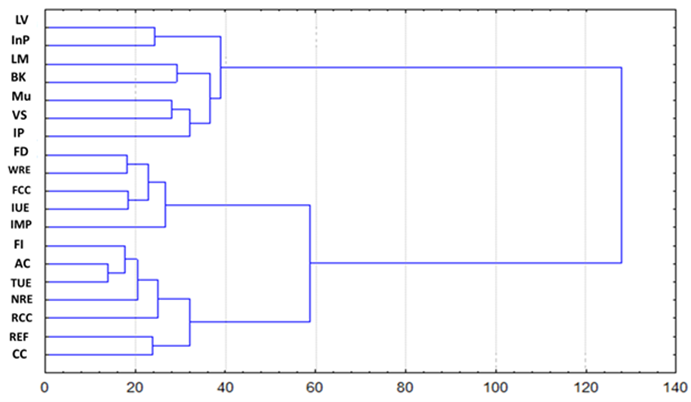
Figure 1. Tree dendrogram for 19 variables with complete linkage Euclidean distance
The implicit intelligence cluster does have an implicit configuration. The hierarchy is based on a pair of variables: Musical and Visual-Spatial Intelligence, which are then joined by Interpersonal Intelligence. Apparently, the assessment of fellow students’ intelligence is largely determined by their musical awareness, country background and performer recognition. Further, we talk about two dyads that combine Logical-Mathematical and Bodily-Kinesthetic Intelligence and Intrapersonal and Linguistic Intelligence. It can be assumed that the solution of tasks requiring logic and mathematical calculations in students is directly related to the ability to manipulate objects. Such is the latent non-logical logicality of student intelligence.
In the second cluster (or the first subcluster of cognitive styles) two pairs of variables are of equal importance for respondents: Field Dependence and a Wide Range of Equivalence and Flexibility and Intolerance to Unrealistic Experiences. In other words, syntheticity is organically combined with an inability to overcome the situational organization of the environment, and their flexibility of cognitive control is limited by the red lines of existing life experience. On the face of it, a practice-oriented consciousness limited to specific narratives set out in case-studies.
The third cluster (or the second subcluster of cognitive styles) looks more optimistic, being in fact the second balancing cup of mental scales. Its structure has a qualitative foundation – Abstract Conceptualization and Tolerance of Uncertainty. Students, guided by common sense, realize that new discoveries require, like a space rocket, getting rid of the spent stage. Only abstract thinking makes it possible to overcome the pull of the day-to-day repetition of everyday life. The practical significance of an innovation loses its relevance as soon as it is introduced. It lives as long as it spreads outwards, to new organizations and new adherents. The proverbial law of negation of negations.
People who are abstractly thinking and receptive to novelty behave in a semi-independent manner (good people with a bad character), possess analytical abilities and defend their subjectivity (and uniqueness) with a certain degree of rigidity. At the same time, the dyad of Reflectivity and Concrete Conceptualization is a spoon of tar in the honey barrel of such a “correct” but out-of-focus understanding of strategies for constructing one’s environment. The reflectivity, which a priori implies a tendency to abstract from direct attachment to the world of objects, is realized in students at the object-functional level, at the level of common sense.
And yet, somewhere their implicit intelligence and implicit cognitive styles intersect like Lobachevsky’s parallel lines. To substantiate this position let us turn to the results of correlation analysis using Spearman’s method.
Correlation analysis
It was found that 5 out of 7 intelligences correlate with certain poles of cognitive styles. Thus, Intrapersonal Intelligence is correlated with Rigid Cognitive Control (rs=0.49; p=0.002), Tolerance of Uncertainty (rs=0.46; p=0.003) and Narrow Range of Equivalence (rs=0.44; p=0.005), as well as with Abstract Conceptualization (rs=0.36; p=0.03), Field Dependence and Reflectivity (rs=0.32; p=0.05). Of interest is the correlation of Rigidity of Cognitive Control with such dynamic style characteristics as Tolerance of Uncertainty, Field Independence, and Reflectivity. This phenomenon can be explained in terms of A.N. Pevneva’s general concept of constructive and destructive sides of rigidity (aPevneva, 2023; bPevneva, 2023). It is practically impossible to be a personality without having a certain intrapersonal stability. A personality with developed Linguistic Intelligence simultaneously demonstrates a correlation with both Flexibility of Cognitive Control (rs=-0.48; p=0.002) and Rigidity of Cognitive Control (rs=0.32; p=0.05).
Linguistic-Verbal Intelligence, Logical-Mathematical Intelligence, and Visual-Spatial Intelligence in students are negatively correlated with Flexibility of Cognitive Control (rs=-0.48, p=0.002; rs=-0.41, p=0.01; rs=-0.32, p=0.05 respectively). In addition, Logical-Mathematical Intelligence and Visual-Spatial Intelligence were inversely correlated with Intolerance of Unrealistic Experience (-rs=0.40, p=0.01 and rs=-0.35, p=0.03); Linguistic-Verbal Intelligence and Visual-Spatial Intelligence with Field Dependence (rs=-0.32; p=0.05); Visual-Spatial Intelligence and Musical Intelligence with a Wide Range of Equivalence (rs=-0.32, p=0.05; rs=-0.43, p=0.007).
Conclusions
The results of an empirical study confirm the connection between implicit intelligence and implicit cognitive styles in students of helping professions who have implicit (latent) awareness. The findings of the study are consistent with the theory of procedural knowledge and cognitive skills. We believe that the results of the study are of both theoretical interest from the point of view of integration and differentiation of explicit and implicit knowledge, and purely practical interest consisting in optimizing learning in a student-centered learning paradigm.
Competing interests: The author declare that the research was conducted in the absence of any commercial or financial relationships that could be construed as a potential conflict of interest.
References
- Tokareva G.V. & Dorfman L.Y. (2014). Implicit processes and their research in Western psychology. Psychophysiology, 7(1), 17-27. [Tokareva G.V., Dorfman L. YU. (2014) Neyavnyye protsessy i ikh issledovaniye v zapadnoy psikhologii. Psikhologiya. Psikhofiziologiya, 7(1), 17-27].
- Bruner J.S. & Tagiuri, R. (1954). The perception of people. In G. Lindzey (Ed.), Handbook of social psychology, 2, 634-654, Reading, MA: Addison-Wesley.
- Wegner D.M. & Vallacher R.R. (1977). Implicit psychology, NY: Oxford.
- Dweck C.S. (2006). Mindset: the new psychology of success, NY: Random House.
- Tulving E. (1989). Memory: performance, knowledge, and experience. European Journal 0f cognitive psychology, 1, 3-26.
- Lobanov A.P., Maron V.A., Saprovskaya M.G. (2021). Comparative analysis of explicit and implicit learning ability of adolescents, Adukatsiya
and vykhavanne, 5. Р. 3-10. [Lobanov A.P., Maron V.A., Saprovskaya M.G. (2021). Sravnitel`ny`j analiz e`kspliczitnoj i impliczitnoj obuchaemosti podrostkov. Adukaczy`ya i` vy`khavanne, 5, 3–10]. - Graf P., & Schacter D.L. (1985). Implicit and explicit memory for new associations in normal and amnesic subjects. Journal of experimental psychology. Learning, memory, and cognition, 11(3), 501–518. https://doi.org/10.1037//0278-7393.11.3.501.
- Tests to assess the intelligence and cognitive processes of undergraduate and graduate students / authored by A.K. Mynbaeva, A. V. Vishnevskaya. – Almaty: Kazak University, 2013. – 120 р. [Testy` po oczenke intellekta i poznavatel`ny`kh proczessov studentov i magistrantov (2013),-sost. A.K. My`nbaeva, A. V. Vishnevskaya, Almaty`: Қazaқ universiteti`, 120].
- Volkova, E.V. & Rusalov V. M. Cognitive styles, and personality (2016). Personality and Individual differences, Vol. 99, 266–271.
- Volkova E.V., Rusalov V.M., & Dudnikova, T. A. (2022). Cognitive and Personal Styles Questionnaire: Validity and Reliability of the CPS-Q Based on a Russian Sample. Natural Systems of Mind, 2(4). doi: 10.38098/nsom_2022_02_04_03
- KolgaA. (1976). Differential-psychological studies of cognitive styles and learnability: autoref. dissertation … candidate of psychol. Sciences. М. [Kolga V.A. (1976) Differenczial`no-psikhologicheskie issledovaniya kognitivny`kh stilej i obuchaemosti: avtoref. diss… kand. psikhol. nauk. M.].
- Pevneva A.N. (2023). The construct of rigidity in the concept of cognitive-personal development. Journal of the Belarusian State University. Philosophy. Psychology, 2, 84-92. [Pevneva A. N. Konstrukt rigidnosti v konczepczii kognitivno-lichnostnogo razvitiya, Zhurnal Belorusskogo gosudarstvennogo universiteta. Filosofiya. Psikhologiya, 2, 84–92].
- Pevneva A.N. Rigidity in the structure of personality: the history of the question and the problem of research . Journal of the Higher School of Economics, 20(2), 320-337. [Pevneva A.N. (2023). Rigidnost` v strukture lichnosti: istoriya voprosa i problema issledovaniya. Psikhologiya. Zhurnal vy`sshej shkoly` e`konomiki. 20 (2), 320–337].
Comments (0)
The article presents the results of theoretical analysis and empirical research of intelligence and cognitive styles in the paradigm of implicit psychology. The purpose of the study is to discover relationships between implicit (implicit, latent) intelligence, diagnosed using the “Multiple Intelligences Test” by G. Gardner, and implicit cognitive styles, tested using the “Cognitive-Personal Styles” (CPS-Q) technique by V.M. Rusalov and E.V. Volkova. Three clusters were identified: implicit intelligence and two clusters containing opposite poles of cognitive styles, which is consistent with the theory of metastyles by V.A. Kolga. It has been established that 5 out of 7 intelligences are significantly correlated with certain poles of cognitive styles.
In modern cognitive psychology and cognitive psychology of education, much attention is paid to the interdependence of explicit and implicit processes. The concept “implicit” means latent, hidden, directly uncontrolled by consciousness; “explicit”, on the contrary, is obvious and realized. According to G.V. Tokareva and L.Y. Dorfman (Tokareva & Dorfman, 2014), J.S. Bruner and R. Tagiuri (Bruner & Tagiuri, 1954) first approached the research of implicit processes in the context of the theory of implicit personality; then D.M. Wegner and R.R. Vallacher (Wegner & Vallacher, 1977) proposed the term “implicit psychology”.
Research on implicit intelligence by C. S. Dweck (Dweck, 2006) and implicit memory by E. Tulving (Tulving, 1989) is widely known.
Thus, according to the theory of implicit intelligence of C. S. Dweck, people with fixed (static) intelligence, wishing to look smart, avoid problems and do not make proper efforts, so they easily give up and settle for little. On the contrary, people with growth intelligence (build-up intelligence) tend to solve problems, considering difficulties as conditions for achieving academic and professional success, learn from their own negative experience and the experience of others, which undoubtedly contributes to their self-actualization (Dweck, 2006; Lobanov, Maron, & Saprovskaya, 2021). E. Tulving differentiated the concepts of implicit (episodic, procedural memory, or memory for actions) and explicit (declarative) memory (Tulving, 1989).
In our research, in order to distinguish the poles of the implicit-explicit construct, we will follow the general approach used by P. Graf and D.L. Schacter (Graf & Schacter, 1985), defining the concepts of implicit and explicit memory. If the solution of a task requires conscious recall, we are talking about explicit memory; if its solution is facilitated by the absence of conscious recall, we are talking about implicit memory.
Our study involved 73 respondents, future specialists of helping professions. The research was conducted directly in the educational process (at seminars and practical work sessions). Out of the total number of the research participants, 39 people performed both methods: “Multiple intelligences test” by G. Gardner, adapted on a sample of Russians by A.K. Mynbaeva and colleagues (Mynbaeva et al., 2013), and “Cognitive-Personal Styles” (CPS-Q) by E.V. Volkova, V.M. Rusalov, & T.A. Dudnikova (Volkova, Rusalov, & Dudnikova, 2022). The choice of diagnostic tools is due to the fact that they are personality questionnaires, and therefore allow us to assess intelligence and cognitive styles in the context of the implicit approach.
Descriptive statistics
According to the students’ self-assessments of cognitive styles (Table), their preliminary average portrait may look as follows: they are rather field-dependent (19.15), have a narrow range of equivalence (18.55), reflexive (18.15), rigid (16.79), inclined to abstract conceptualization (19.34), and tolerant of uncertainty (19.72). The differences between the poles of styles indirectly indicate the preferred personality traits in their binary characteristics. The highest difference scores occur between Tolerance of Uncertainty (openness to the new) and Intolerance of Unrealistic Experiences, as well as Field-Independence and Field-Dependence (d=7.13; d=6.53, respectively). The differences are least pronounced when assessing the dyad Concrete/Abstract Conceptualization (d=-0.80).
Table. 1 Means, Standard Deviations (SD)
| Variable | Means | Median | Min | Max | SD |
| Linguistic-Verbal Intelligence (LV) | 30.17 | 31 | 20 | 40 | 4.32 |
| Logical-Mathematical Intelligence (LM) | 27.82 | 28 | 20 | 37 | 3.98 |
| Musical Intelligence (Mu) | 29.58 | 30 | 19 | 39 | 3.95 |
| Bodily-Kinesthetic Intelligence (BK) | 27.63 | 27 | 21 | 39 | 3.95 |
| Visual-Spatial Intelligence (VS) | 27.48 | 27 | 18 | 35 | 4.37 |
| Interpersonal Intelligence (IP) | 29.40 | 30 | 19 | 38 | 4.41 |
| Intrapersonal Intelligence (InP) | 30.95 | 31 | 23 | 39 | 3.39 |
| Field Dependence (FD) | 12.62 | 13 | 7 | 19 | 2.58 |
| Field Independence (FI) | 19.15 | 19 | 12 | 25 | 3.20 |
| Narrow Range of Equivalence (NRE) | 18.55 | 18 | 12 | 24 | 2.89 |
| Wide Range of Equivalence (WRE) | 12.91 | 13 | 7 | 19 | 2.60 |
| Flexibility of Cognitive Control (FСС) | 16.79 | 17 | 11 | 23 | 3.20 |
| Rigidity of Cognitive Control (RСС) | 12.43 | 12 | 5 | 22 | 3.68 |
| Impulsivity (IMP) | 11.62 | 11 | 5 | 18 | 3.05 |
| Reflectivity (REF) | 18.15 | 19 | 9 | 25 | 3.75 |
| Concrete Conceptualization (CC) | 18.55 | 18 | 7 | 25 | 3.84 |
| Abstract Conceptualization (AC) | 19.34 | 19 | 13 | 24 | 2.82 |
| Tolerance of Uncertainty (TUE) | 19.72 | 20 | 12 | 25 | 2.98 |
| Intolerance of Unrealistic Experience (IUE) | 12.55 | 12 | 7 | 17 | 2.93 |
In the structure of G. Gardner’s intelligences, the first three ranks (in descending order of values) belong to Intrapersonal Intelligence (30.95), Linguistic-Verbal Intelligence (30.17), and Musical Intelligence (29.58); the last three ranks belong to Logical-Mathematical Intelligence (27.82), Bodily-Kinesthetic Intelligence (27.63), and Visual-Spatial Intelligence (27.48). This result is a consequence of the general interest of modern students in their person and a sufficiently high level of development of their communicative abilities.
In general, students of higher education pedagogical institution evaluate their non-academic (Intra- and Interpersonal) intelligences more highly compared to academic intelligences. On the one hand, this indicates their right choice of their future profession, but, on the other hand, the apparent underestimation of the intelligences that ensure the success of their academic achievements
Cluster analysis
Cluster analysis using the Complete Linkage method revealed 3 clusters: implicit intelligence (as one would expect) and two clusters containing the poles of cognitive styles (which is a certain surprise). However, the clusters of cognitive styles unite their opposite poles and, thus, do not contradict V. A. Kolga’s theory of metastyles (Kolga, 1976). The exception is the cognitive style Concrete/ Abstract Conceptualization, both poles of which are included in the structure of the one cluster (Figure1).
Figure 1. Tree dendrogram for 19 variables with complete linkage Euclidean distance
The implicit intelligence cluster does have an implicit configuration. The hierarchy is based on a pair of variables: Musical and Visual-Spatial Intelligence, which are then joined by Interpersonal Intelligence. Apparently, the assessment of fellow students’ intelligence is largely determined by their musical awareness, country background and performer recognition. Further, we talk about two dyads that combine Logical-Mathematical and Bodily-Kinesthetic Intelligence and Intrapersonal and Linguistic Intelligence. It can be assumed that the solution of tasks requiring logic and mathematical calculations in students is directly related to the ability to manipulate objects. Such is the latent non-logical logicality of student intelligence.
In the second cluster (or the first subcluster of cognitive styles) two pairs of variables are of equal importance for respondents: Field Dependence and a Wide Range of Equivalence and Flexibility and Intolerance to Unrealistic Experiences. In other words, syntheticity is organically combined with an inability to overcome the situational organization of the environment, and their flexibility of cognitive control is limited by the red lines of existing life experience. On the face of it, a practice-oriented consciousness limited to specific narratives set out in case-studies.
The third cluster (or the second subcluster of cognitive styles) looks more optimistic, being in fact the second balancing cup of mental scales. Its structure has a qualitative foundation – Abstract Conceptualization and Tolerance of Uncertainty. Students, guided by common sense, realize that new discoveries require, like a space rocket, getting rid of the spent stage. Only abstract thinking makes it possible to overcome the pull of the day-to-day repetition of everyday life. The practical significance of an innovation loses its relevance as soon as it is introduced. It lives as long as it spreads outwards, to new organizations and new adherents. The proverbial law of negation of negations.
People who are abstractly thinking and receptive to novelty behave in a semi-independent manner (good people with a bad character), possess analytical abilities and defend their subjectivity (and uniqueness) with a certain degree of rigidity. At the same time, the dyad of Reflectivity and Concrete Conceptualization is a spoon of tar in the honey barrel of such a “correct” but out-of-focus understanding of strategies for constructing one’s environment. The reflectivity, which a priori implies a tendency to abstract from direct attachment to the world of objects, is realized in students at the object-functional level, at the level of common sense.
And yet, somewhere their implicit intelligence and implicit cognitive styles intersect like Lobachevsky’s parallel lines. To substantiate this position let us turn to the results of correlation analysis using Spearman’s method.
Correlation analysis
It was found that 5 out of 7 intelligences correlate with certain poles of cognitive styles. Thus, Intrapersonal Intelligence is correlated with Rigid Cognitive Control (rs=0.49; p=0.002), Tolerance of Uncertainty (rs=0.46; p=0.003) and Narrow Range of Equivalence (rs=0.44; p=0.005), as well as with Abstract Conceptualization (rs=0.36; p=0.03), Field Dependence and Reflectivity (rs=0.32; p=0.05). Of interest is the correlation of Rigidity of Cognitive Control with such dynamic style characteristics as Tolerance of Uncertainty, Field Independence, and Reflectivity. This phenomenon can be explained in terms of A.N. Pevneva’s general concept of constructive and destructive sides of rigidity (aPevneva, 2023; bPevneva, 2023). It is practically impossible to be a personality without having a certain intrapersonal stability. A personality with developed Linguistic Intelligence simultaneously demonstrates a correlation with both Flexibility of Cognitive Control (rs=-0.48; p=0.002) and Rigidity of Cognitive Control (rs=0.32; p=0.05).
Linguistic-Verbal Intelligence, Logical-Mathematical Intelligence, and Visual-Spatial Intelligence in students are negatively correlated with Flexibility of Cognitive Control (rs=-0.48, p=0.002; rs=-0.41, p=0.01; rs=-0.32, p=0.05 respectively). In addition, Logical-Mathematical Intelligence and Visual-Spatial Intelligence were inversely correlated with Intolerance of Unrealistic Experience (-rs=0.40, p=0.01 and rs=-0.35, p=0.03); Linguistic-Verbal Intelligence and Visual-Spatial Intelligence with Field Dependence (rs=-0.32; p=0.05); Visual-Spatial Intelligence and Musical Intelligence with a Wide Range of Equivalence (rs=-0.32, p=0.05; rs=-0.43, p=0.007).
The results of an empirical study confirm the connection between implicit intelligence and implicit cognitive styles in students of helping professions who have implicit (latent) awareness. The findings of the study are consistent with the theory of procedural knowledge and cognitive skills. We believe that the results of the study are of both theoretical interest from the point of view of integration and differentiation of explicit and implicit knowledge, and purely practical interest consisting in optimizing learning in a student-centered learning paradigm.
Competing interests: The author declare that the research was conducted in the absence of any commercial or financial relationships that could be construed as a potential conflict of interest.
- Tokareva G.V. & Dorfman L.Y. (2014). Implicit processes and their research in Western psychology. Psychophysiology, 7(1), 17-27. [Tokareva G.V., Dorfman L. YU. (2014) Neyavnyye protsessy i ikh issledovaniye v zapadnoy psikhologii. Psikhologiya. Psikhofiziologiya, 7(1), 17-27].
- Bruner J.S. & Tagiuri, R. (1954). The perception of people. In G. Lindzey (Ed.), Handbook of social psychology, 2, 634-654, Reading, MA: Addison-Wesley.
- Wegner D.M. & Vallacher R.R. (1977). Implicit psychology, NY: Oxford.
- Dweck C.S. (2006). Mindset: the new psychology of success, NY: Random House.
- Tulving E. (1989). Memory: performance, knowledge, and experience. European Journal 0f cognitive psychology, 1, 3-26.
- Lobanov A.P., Maron V.A., Saprovskaya M.G. (2021). Comparative analysis of explicit and implicit learning ability of adolescents, Adukatsiya
and vykhavanne, 5. Р. 3-10. [Lobanov A.P., Maron V.A., Saprovskaya M.G. (2021). Sravnitel`ny`j analiz e`kspliczitnoj i impliczitnoj obuchaemosti podrostkov. Adukaczy`ya i` vy`khavanne, 5, 3–10]. - Graf P., & Schacter D.L. (1985). Implicit and explicit memory for new associations in normal and amnesic subjects. Journal of experimental psychology. Learning, memory, and cognition, 11(3), 501–518. https://doi.org/10.1037//0278-7393.11.3.501.
- Tests to assess the intelligence and cognitive processes of undergraduate and graduate students / authored by A.K. Mynbaeva, A. V. Vishnevskaya. – Almaty: Kazak University, 2013. – 120 р. [Testy` po oczenke intellekta i poznavatel`ny`kh proczessov studentov i magistrantov (2013),-sost. A.K. My`nbaeva, A. V. Vishnevskaya, Almaty`: Қazaқ universiteti`, 120].
- Volkova, E.V. & Rusalov V. M. Cognitive styles, and personality (2016). Personality and Individual differences, Vol. 99, 266–271.
- Volkova E.V., Rusalov V.M., & Dudnikova, T. A. (2022). Cognitive and Personal Styles Questionnaire: Validity and Reliability of the CPS-Q Based on a Russian Sample. Natural Systems of Mind, 2(4). doi: 10.38098/nsom_2022_02_04_03
- KolgaA. (1976). Differential-psychological studies of cognitive styles and learnability: autoref. dissertation … candidate of psychol. Sciences. М. [Kolga V.A. (1976) Differenczial`no-psikhologicheskie issledovaniya kognitivny`kh stilej i obuchaemosti: avtoref. diss… kand. psikhol. nauk. M.].
- Pevneva A.N. (2023). The construct of rigidity in the concept of cognitive-personal development. Journal of the Belarusian State University. Philosophy. Psychology, 2, 84-92. [Pevneva A. N. Konstrukt rigidnosti v konczepczii kognitivno-lichnostnogo razvitiya, Zhurnal Belorusskogo gosudarstvennogo universiteta. Filosofiya. Psikhologiya, 2, 84–92].
- Pevneva A.N. Rigidity in the structure of personality: the history of the question and the problem of research . Journal of the Higher School of Economics, 20(2), 320-337. [Pevneva A.N. (2023). Rigidnost` v strukture lichnosti: istoriya voprosa i problema issledovaniya. Psikhologiya. Zhurnal vy`sshej shkoly` e`konomiki. 20 (2), 320–337].
References