Attitudes Towards New Technologies in Adults with Low, Average, and High IQ Levels
Abstract
Abstract
The objective of the study is to examine the attitudes of adults with low, average, and high levels of intelligence towards new technologies. The study hypothesizes that attitudes towards new technologies (technophobia, technophilia, techno-rationalism, and techno-pessimism) vary significantly depending on the IQ levels, sex, and age. Research methods: The attitude to new technologies questionnaire (Soldatova, Nestik, Rasskazova, Dorokhov; 2021) and J. Raven’s Standard Progressive Matrices test. The results of the study showed that : 1) men of 21-35 years old with a high level of IQ are characterised by more pronounced technophilia, and women of 21-35 years old with a high level of IQ are characterised by more pronounced technorationality; 2) for both men and women of 21-35 years old with the growth of intelligence there is an increase in technophilia, while for 36-54 years old men and women there is a decrease in technophilia, 3) as intelligence increases, there is a decline in technopessimism among men aged 21 to 55, a rise in technorationality among women aged 21 to 55 and men aged 21 to 35, but a decrease in technorationality among men aged 36 to 54.
Отношение к новым технологиям у взрослых с низким, средним и высоким уровнем IQ
Волкова Н.Э.*
* Институт психологии РАН, Москва, Российская Федерация, ORCID iD: 0000-0001-6225-6288
Абстракт: Целью исследования является изучение отношения взрослых людей с низким, средним и высоким уровнем интеллекта к новым технологиям. В исследовании выдвинута гипотеза, что отношение к новым технологиям (технофобия, технофилия, технорационализм и технопессимизм) существенно различается в зависимости от уровня IQ, пола и возраста. Методы исследования: Опросник отношения к новым технологиям (Солдатова, Нестик, Рассказова, Дорохов; 2021) и тест СПМ Дж. Равена. Результаты исследования показали, что: 1) мужчины 21-35 лет с высоким уровнем IQ характеризуются более выраженной технофилией, а женщины 21-35 лет с высоким уровнем IQ характеризуются более выраженной технорациональностью; 2) как у мужчин, так и у женщин 21-35 лет с ростом интеллекта наблюдается рост технофилии, тогда как у мужчин и женщин 36-54 лет наблюдается снижение технофилии, 3) с ростом интеллекта наблюдается снижение технопессимизма у мужчин 21-55 лет, рост технорациональности у женщин 21-55 лет и мужчин 21-35 лет, но снижение технорациональности у мужчин 36-54 лет.
Introduction
Innovation is a fundamental property of human nature, driven by our pursuit of comfort and improvement in life on Earth. This drive is vividly demonstrated through the rapid advancements in technologies such as Artificial Intelligence, which are reshaping countless aspects of our existence and triggering significant transformations in industries, economies, and everyday activities. As AI evolves, society must confront the challenge of adapting to these changes, calling for a reassessment of education, workforce dynamics, ethical considerations, and personal relationships to ensure that technological progress serves the broader interests of humanity.
McRobbie offer a detailed overview of technology by outlining key dimensions: the human dimension highlights the inventors’ role and creativity; the social dimension addresses how technology is utilized and incorporated into societal frameworks; the process dimension focuses on the methods employed in working with materials; the situated dimension explores how technology operates within specific social relations; and the artefact dimension charts the evolution and production of technological objects. This comprehensive framework illustrates that technology encompasses more than just tools, as it is deeply intertwined with human innovation, societal requirements, procedural practices, relational dynamics, and the artifacts that emerge from technological advancement (McRobbie et al., 2000).
New technologies are integrated into the individual psychological relationship system (Poznyakov, 2012) and into the social perception system (Emelyanova, Drobysheva, 2013; Nestik, 2020). Kupreichenko hypothesises that attitudes towards new technologies may be similar to attitudes towards people, reflecting different levels of trust. This suggests that, just as individuals may act with trust or scepticism in their interactions with others, they also judge technological innovations on the basis of perceived reliability, security, and emotional resonance, which shape their willingness to adopt and use them in their daily lives (Kupreichenko, 2012).
Craig Cormick’s paper highlights the shift in public attitudes toward new technologies in a post-truth, post-trust, and post-expert world, where acceptance of these technologies is increasingly influenced by their alignment with personal values rather than their technical specifications. He argues that for technology developers, it is essential to effectively frame their innovations in terms of how well they address societal concerns such as equity, health, and safety, recognizing that public trust now hinges on perceived relevance and alignment with individual beliefs about truth and expertise (Cormick, 2019).
A.A. Oboznov and A. Akimova identifies that trust in technology is largely determined by its perceived reliability, stability, and accuracy, as well as the user’s confidence in their capability to effectively use these technologies. E.A. Ryzhova identifies technophobia as a key predictor of socio-psychological vulnerability for individuals in socionomic professions, highlighting that the rise of new technologies can be seen as a threat to established norms, resulting in negative emotions, anxiety, and fear. At a psychodynamic level, this ambivalence is reflected in the coexistence of technophilia (an attachment to technology) and technophobia (a rejection of technology), representing two opposing extremes in the dynamics between humans and technology, as well as the broader societal relationship with technology (Oboznov & Akimova, 2016).
T.A. Nestik’s comprehensive study examines the attitudes of 1,600 Russians toward new technologies and finds that a positive attitude correlates with values that promote openness to change, and negatively correlates with conservative values. The research clarifies the interplay of cognitive, affective, and behavioral components in forming attitudes, identifying various socio-psychological types in technology assessment, such as “indifferent”, “selective”, “pragmatists”, and “safety-oriented” individuals, alongside personal attitudes like “technophiles”, “anxious supporters”, ‘technophobes”, and those “indifferent to technology”. “Technophiles” value openness to change, self-overcoming, and self-affirmation, prioritizing benefit, security, and trust in developers when evaluating new technologies. In contrast, “technophobes” are less open and self-affirming, focusing more on preservation and safety, reflecting a more cautious approach to technology. The study also uncovers socio-psychological predictors of techno-optimism and technophobia, concluding that technophilia and technophobia should be viewed as distinct phenomena connected in their relationship rather than opposite ends of a continuum (Nestik, 2020).
Though technophobia and computer anxiety are related, they differ in their scope and implications. Specifically, computer anxiety is defined as the emotional discomfort experienced by individuals who feel ill-equipped to use computers and the Internet effectively (Osiceanu, 2015; Thatcher et al., 2008). In contrast, technophobia is a broader concept that encompasses a range of behavioral, affective, and cognitive responses to modern technology and complex technical devices, reflecting more profound apprehensions about technological engagement (Beckers et al., 2003; Gilbert, Lee-Kelley, & Barton, 2003; Tekinarslan, 2008; Venkatesh & Davis, 2000). Technophobia is regarded by many researchers as a complex phenomenon comprising several dimensions: 1) the development of negative perceptions regarding new technologies and their societal effects; 2) anxiety pertaining to both current and anticipated interactions with technology; and 3) self-reproach experienced during technology use. A study conducted by S. Thorpe and M. Brosnan in 2007 found that people with clinical technophobia often experience symptoms similar to those of arachnophobia. These symptoms include intense reactions when exposed to technology, similar to the fear response experienced when encountering spiders. A study by Christopher Bader and his colleagues at Chapman University found that fear of new technologies is the second most intense fear, just after fear of natural disasters. This suggests that individuals tend to experience the highest levels of anxiety regarding technologies they rely on yet feel they cannot control, highlighting a significant psychological response to the perceived risks associated with technological advancements (Bader et al., 2020).
A study by Glyniss M. Breakwell and colleagues at the University of Surrey examined attitudes towards new technologies among 247 women and 287 men and found significant differences in perceptions based on gender. Males generally anticipated greater benefits from new technology (adjusted means of 31.40 for males and 33.65 for females), indicating that females tend to hold less optimistic views at a general level regarding technology and automation. However, the study found no significant gender or academic faculty differences concerning the acceptance of new technology’s inevitability, suggesting that beliefs about the necessity of mastering these technologies do not correlate with attitudes about their costs and benefits or with the respondents’ gender and academic affiliations (Breakwell et al., 1986).
A study by Jason Bennett Thatcher and colleagues involved 115 students in three departments of a senior-level Management Information Systems course at a large public university in the southeastern United States. The study focused on computer-related anxiety. The study examined the sources of Internet anxiety by assessing general personality traits including computer anxiety, self-efficacy, and personal innovativeness toward technology, as well as beliefs about the work environment and social support from leaders and peers. Over a 16-week period with participants from virtual teams, the results indicated that Internet anxiety is significantly influenced by both individual traits and contextual beliefs, emphasizing that adequate resources, trust in technology, and social support are crucial in mitigating anxiety related to Internet use (Thatcher et al., 2007).
The study by L.M. Anthony, M.C. Clarke, and S.J. Anderson investigated technophobia and its relationship with personality subtypes among 176 first-year university students in South Africa, focusing on those enrolled in computing and psychology courses. Using Rosen and Weil’s technophobia measurement instruments, the study found that technophobia, defined as a negative psychological reaction to technology, was positively correlated with the personality trait neuroticism and inversely correlated with openness, one of the five dimensions assessed by the NEO-Five Factor Inventory. Additionally, technophobia was negatively related to computer experience and showed a weak correlation with age; no significant association was found with gender (Anthony et al., 2000).
The study of 3,392 first-year university students across 23 countries revealed weak correlations between technophobia and both age and gender, while indicating a negative correlation between technophobia and experience with computers and technology. Additionally, it found that in half of the countries surveyed, male students had more experience with technology compared to female students (Weil et al., 1995), underscoring notable gender disparities in technological familiarity.
Odai Khasawneh highlighted that although organizational climate did not significantly correlate with emotional intelligence or technophobia, there were meaningful correlations between technology acceptance and both emotional intelligence and technophobia. This indicates that emotional intelligence is a vital factor in influencing how individuals embrace technology, suggesting that personal emotional competencies may hold greater significance than the overall organizational environment when it comes to attitudes toward technological adoption (Khasawneh, 2018).
It is a commonly held view that elderly people have a negative perception of the benefits of modern technologies, are resistant to change and reluctant to adopt new technologies. However, it was discovered that while older adults (65 and over) commonly own and use mobile phones, their engagement with computers and the Internet is limited. It is interesting to note that the majority of older respondents did not perceive themselves to be too advanced in age to embrace new technologies and did not self-identify as technophobes, suggesting a more positive inclination towards technology than is often assumed. Although older adults seem eager to adopt new technologies, there are many challenges they face. One of the main reasons is a lack of functional literacy in information and communication technology (Yusif et al., 2016).
Research by Neves and Amaro indicates that the level of education has a significant impact on the rate of adoption of new technologies by the elderly. Stereotypes that portray older adults as technologically incompetent contribute to their reluctance to use digital tools. Many older people fear that using these tools will only reinforce negative perceptions about their age group. This hesitation highlights the importance of educational programs and resources that aim to boost the self-assurance of older people in their technological skills (Neves & Amaro, 2012).
Despite extensive research on the correlation between attitudes towards new technologies and various psychological characteristics, there is a notable gap in studies specifically investigating how an individual’s general cognitive abilities influence their attitudes on new technologies, particularly in terms of categorizing these attitudes as technooptimism or technopessimism. This lack of exploration suggests an opportunity for further research to better understand how cognitive factors may shape perceptions and beliefs about emerging new technologies in society. This investigation could help illuminate how cognitive capacities shape perceptions and beliefs about technological advancements, which is particularly relevant as society continues to integrate new technologies into daily life.
The objective of the study is to examine the attitudes of adult respondents with low, medium, and high levels of intelligence towards new technologies.
Method
2.1. Samples
The research design comprised a sample of 254 adults from Moscow and Ekaterinburg, categorized into two distinct age groups to facilitate comparative analysis. Group 1 consisted of participants aged 21 to 35, encompassing 58 men and 65 women, while Group 2 included individuals aged 36 to 55, comprising 60 men and 71 women. This structured approach allowed for the examination of potential age-related differences in responses across the two groups, thereby enhancing the study’s insights into demographic influences on the research variables.
2.2. Measures
The research utilized a dual-method approach, employing the “Questionnaire of Attitudes towards Technology for Adolescents and Parents” (Soldatova et al., 2021) to assess perceptions and attitudes towards technology among both adolescents and their parents. Additionally, the study incorporated the “Standard Progressive Matrices” (SPM) developed by J. Raven to evaluate cognitive abilities, providing a comprehensive understanding of how cognitive skills may influence attitudes toward technology adoption across different age groups.
The dual-method approach enables age-specific insights. For instance, findings can reveal how cognitive abilities correlate with attitudes new toward technology differently across the studied age groups. This perspective can shed light on whether younger individuals, who may have greater exposure to technology, show distinct cognitive-technology interaction patterns compared to older generations who might be navigating technology from a more traditional viewpoint.
Understanding how cognitive skills such as problem-solving, reasoning, and adaptability impact individuals’ readiness to accept and engage with new technologies adds an essential dimension. This element can help explain variability in attitudes among individuals with similar demographic characteristics, focusing on the cognitive capabilities that may underlie different levels of technophilia or technophobia.
2.3. Procedures
Data collection was conducted individually in a specially equipped room, ensuring a controlled environment for each participant. Before the testing began, respondents were thoroughly informed about the study’s objectives and methodologies, which helped establish a transparent context for their participation. Each participant received a personalized test booklet containing the diagnostic
complex and materials to elicit their responses. Informed voluntary consent was obtained through a signed form, emphasizing the participants’ willingness to contribute to scientific research. Importantly, the testing process was designed to be anonymous, preserving the confidentiality of the respondents’ identities throughout the study.
2.4. Statistical data processing
The statistical data processing methods employed in the study included descriptive analysis to summarize the data, focusing on metrics such as mean, standard deviation, asymmetry, and kurtosis to provide insights into the distribution characteristics of the scores. The raw scores were then transformed into the s-scale through percentile standardization, enabling a more interpretable representation of the data. GLM were applied, utilizing Pillai’s Trace for multivariate analysis, alongside F-tests to assess between-group effects. Comprehensive checks for assumptions were conducted, including Sidak correction for multiple comparisons, as well as Box’s test and Levene’s test for assessing homogeneity of variances, ensuring the robustness of the statistical conclusions drawn from the analysis.
The indicators of intelligence, gender, and age are considered as independent variables, while the dependent variables are attitudes towards new technologies. These attitudes can be classified into four categories: technophobia, technophilia, techno-rationalism, and techno-pessimism. The dependent variables are metric variables, while the independent variables are nominal variables with three gradations: low (1-3 stens), average (4-7 stens), and high (8-10 stens) levels of intelligence.
The following hypothesis is proposed: attitudes towards new technologies (technophobia, technophilia, techno-rationalism, and techno-pessimism) vary significantly depending on the IQ levels, sex, and age.
Results
Table 1 illustrates the multivariate effects of intelligence, gender, and age on attitudes toward new technologies, including technophobia, technophilia, techno-rationalism, and technopessimism, with partial eta-squared (ηp2) values ranging from 0.042 to 0.053, indicating small effect sizes. The results show a statistically significant difference in attitudes by gender, suggesting that men and women perceive new technologies differently. Furthermore, the interaction effects between intelligence, gender, and age on attitudes toward new technologies trended toward statistical significance, implying a complex relationship that deserves further study to fully understand how these variables converge to shape individual views on technology.
Table 2 provides a detailed analysis using a General Linear Model (GLM) with a one-dimensional approach to examine how varying levels of intelligence, sex, and age affect attitudes towards new technologies, including technophobia, technophilia, techno-rationalism, and techno-pessimism. This analysis highlights the specific contributions of each variable to the attitudes measured, offering insight into how different intelligence gradations relate to these attitudes and whether gender and age serve as moderators. By employing a one-dimensional framework, the analysis aims to isolate the effects of each independent variable on the dependent attitudes towards technology, facilitating a clearer understanding of the dynamics at play in shaping individuals’ perceptions of and responses to new technologies. As indicated by the findings of the study, the variable “age” has a significant impact on the variable “technophilia”. Similarly, the variable “gender” has a substantial effect on both the variables “technophilia” and “technophobia”. Furthermore, the interaction between the variables “intelligence level” and “age” has a notable influence on the variable “technophobia”. The interaction of the indicators “IQ level” and “age” has an effect on the indicator “techno-rationalism”. The interaction of the indicators “IQ level”, “age” and “sex” has an effect on the indicator “technophobia”. The data obtained are consistent with a large-scale cross-cultural study of German and Chinese scientists, where a significant relationship was found between a positive attitude towards Artificial Intelligence and sex (Sindermann et al., 2022).
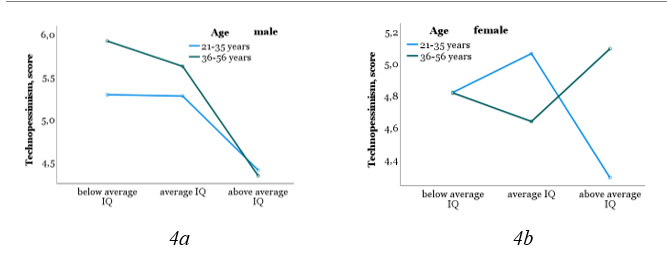
The results of this study show that the trend in technopessimism is decreasing among male participants. Achieving increased technoratinormality among female participants (Fig. 3b and 4a) and male participants between the ages of 21 and 35 years. Conversely, a decrease in technopessimism is observed in men aged 36-54 years (Fig. 3a and 4a).
Table 1. Multivariate effects of intelligence level, gender, and age on attitudes towards new technologies
| Factors | Vs (Pillai’s Trace | F | Hypothesis df | Error df | Sig. | ηp2 |
| IQ | 0.033 | 1.013 | 8.000 | 480.000 | 0.425 | 0.017 |
| Age | 0.042 | 2.626 | 4.000 | 239.000 | 0.035 | 0.042 |
| Sex | 0.053 | 3.352 | 4.000 | 239.000 | 0.011 | 0.053 |
| IQ * Age | 0.048 | 1.468 | 8.000 | 480.000 | 0.166 | 0.024 |
| IQ * Sex | 0.044 | 1.354 | 8.000 | 480.000 | 0.214 | 0.022 |
| Age * Sex | 0.008 | .452 | 4.000 | 239.000 | 0.771 | 0.008 |
| IQ * Age * Sex | 0.056 | 1.733 | 8.000 | 480.000 | 0.088 | 0.028 |
Table 2. One-dimensional effects of IQ level, sex, and age on attitudes towards new technologies
| Factors | Technophilia | Technophobia | Technorationalism | Technopessimism | ||||||||
| F | p | ηp2 | F | p | ηp2 | F | p | ηp2 | F | p | ηp2 | |
| IQ level | .060 | .942 | .000 | .822 | .441 | .007 | 1.522 | .220 | .012 | 1.824 | .164 | .015 |
| Age | 9.219 | .003 | .037 | 2.894 | .090 | .012 | .522 | .471 | .002 | .496 | .482 | .002 |
| Sex | 4.296 | .039 | .017 | 4.440 | .036 | .018 | .204 | .652 | .001 | 1.334 | .249 | .005 |
| IQ * Age | 1.516 | .222 | .012 | .207 | .813 | .002 | 5.179 | .006 | .041 | .238 | .788 | .002 |
| IQ * Sex | .267 | .766 | .002 | .751 | .473 | .006 | 3.356 | .037 | .027 | 1.083 | .340 | .009 |
| Age * Sex | .000 | .989 | .000 | 1.467 | .227 | .006 | .216 | .642 | .001 | .086 | .770 | .000 |
| IQ * Age * Sex | .243 | .784 | .002 | 3.825 | .023 | .031 | 1.994 | .138 | .016 | .732 | .482 | .006 |
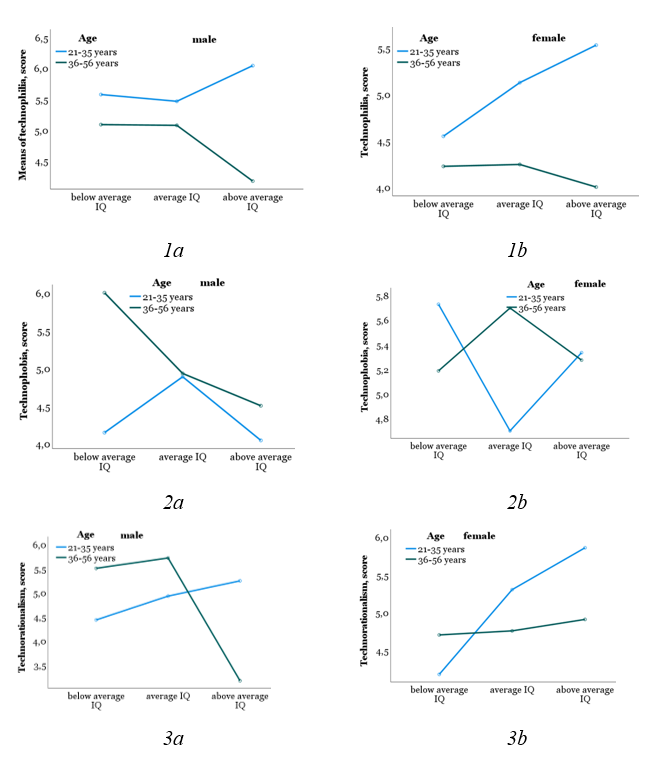
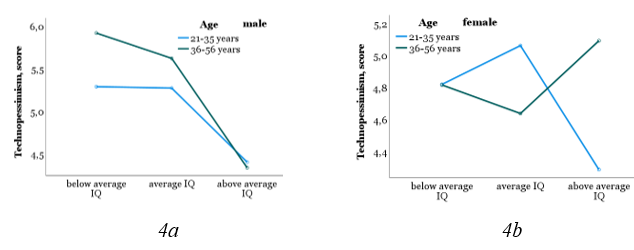
The U- and Ո-shaped dependence of technophilia and technopessimism on the IQ level is particularly interesting (Fig. 2b and 4b), which require further enquiry. It can be hypothesised that the increased technophobia in women aged 36-54 years with an average IQ may be related to the difficulty in mastering the new technologies. These trends highlight evolving perspectives on technology across gender and age.
Discussion
The research indicates that intelligence and gender significantly influence attitudes to new technologies among young adults aged 21 to 35 and middle-aged people.
The findings indicate that men compared to women, 21–35-year-old participants compared to 36–54-year-olds are characterized by more pronounced technophilia (p=0.039, p=0.003) and lower technophobia (p=0.036, p=0.09). Furthermore, among men aged 36-54, those with a low IQ exhibit heightened technophobia and technopessimism, highlighting a distinct relationship between age, gender, IQ, and attitudes toward technology (Fig. 2a and 4a). The findings indicate that men aged 36-54 with high IQs generally maintain a neutral attitude towards technology, showing low levels of technophilia, technophobia, technorationality, and technopessimism (Figs. 1a, 2a, 3a, 4a). In contrast, younger men (21-35) with high IQs display a clearer inclination towards technophilia, while younger women with the same intellect show heightened technophobia.
In people aged 21-35, there is a positive correlation between intelligence and technophilia. However, in the age group 36-54, we see a decrease in technophilia as intelligence increases (Figures 1a and 1b). This reflects significant differences in attitudes towards technology based on age, gender, and intelligence.
These results are partially consistent with the study by A.Yu. Saenko, which emphasizes a stronger expression of technophilia in men compared to women, and also notes age shifts in technophilia and technophobia among adolescents and middle-aged people. Individuals aged 38 to 51 show lower levels of technophilia and technophobia (Saenko, 2024). The data obtained is consistent with the research of T.A. Nestik and A.L. Zhuravlev, who found that men and women with higher education and an average age of 42.4 years tend to have high techno-optimism, moderate technophilia, and low technophobic attitudes. This suggests that both age and education play a positive role in shaping a more positive attitude towards technology.
Conclusions
The research findings provide a detailed examination of the relationships between intelligence, gender, and age in shaping attitudes towards new technology, particularly among young adults (ages 21–35) and middle-aged individuals (ages 36–54).
The study reveals that young men exhibit higher levels of technophilia and lower levels of technophobia compared to women. This finding reflects long-standing patterns in society, where men have historically enjoyed greater access to and support for technology. Therefore, it suggests that societal norms and expectations continue to shape the technological landscape.
The results suggest that there is a positive correlation between intelligence and technophilia among young men. This indicates that people with a greater understanding of technology tend to be more likely to embrace it. However, the correlation decreases for middle-aged individuals, where individuals with high IQs exhibit a more neutral attitude towards technology. This may mean that, as technology continues to evolve, social adaptation will become increasingly important, highlighting the significance of not only intelligence but also age-related factors.
Older men (36-54 years old) who have a low IQ demonstrate an increased fear and pessimism about technology, indicating difficulty adapting to rapid changes in technology. This can lead to a generational gap in technology adoption, as older people may struggle to reconcile their experiences with the constantly changing digital landscape.
The correlation between intelligence and technology use among young men suggests that cognitive abilities may play a role in their adoption of technology. However, the trend towards a more neutral attitude among middle-aged men suggests that being intelligent alone does not guarantee a consistent positive relationship with technology. This shift may be due to a shift in context, as older people may face the rapid pace of technological change, which can seem overwhelming.
The study supports the existing literature that shows that highly educated individuals, regardless of gender, are more likely to be techno-optimistic and moderate in their technophilia/technophobia. This further confirms that education plays a significant role in shaping attitudes towards technology, and complicates the process of integrating technology across different age and gender groups.
Although the study provides insight into gender and age-related trends, it has the risk of being generalized. It is important to note that not all men exhibit technophilia and not all women exhibit technophobia. Socio-economic status, personal interests, and educational level significantly influence these attitudes, and should be considered in any detailed analysis.
The rapid evolution of technology demands adaptability that cannot be predicted solely based on intelligence or age. As technology advances, attitudes change and are shaped by real-world experiences with technology, such as issues related to data privacy, misinformation, and the social implications of using technology.
While the study provides insight into how education affects technological attitudes, it would benefit from explicitly considering age differences in educational opportunities. For example, if older individuals did not have the same access to technical education as younger generations, their negative attitudes towards technology may be due to a lack of knowledge rather than an inherent belief system.
The results of the study emphasize the dynamic interaction between gender, age, and intelligence in shaping attitudes towards technology, revealing significant patterns that require further investigation. However, it is crucial to recognize the dangers of overgeneralization and the significance of contextual understanding, as these factors can contribute to the creation of age and gender stereotypes. Future discussions and research should focus on in-depth exploration of the intricacies of people’s interactions with technology within these demographic categories in order to achieve a more holistic understanding.
In conclusion, there are three key areas that can be explored for further research into human attitudes towards new technologies:
- The cognitive aspect, which focuses on how people form ideas about the capabilities and limitations of new technologies.
- The emotional-evaluative aspect, which aims to understand how individuals assess the significance and impact of these technologies.
- The behavioral aspect, which investigates the willingness of individuals to accept and utilize new technologies in various contexts.
Competing interests: The author state that the study was conducted in the absence of any commercial or financial relationships that could be interpreted as a potential conflict of interest.
Acknowledgments: The author thanks the volunteers for their free participation in the experiment for the benefit of the development of science.
References
- Akimova, A., Oboznov, A. (2016). Man’s trust and distrust to technical equipment. Psikhologicheskii zhurnal, 37(6), 56-69 doi: 10.31857/s20000392-8-1 [Akimova A.Yu., Oboznov A.A. Doveriye i nedoveriye cheloveka tekhnike//Psikhologicheskiy zhurnal, 2016. T. 37. № 6. s. 56-69].
- Anthony, L.M., Clarke, M.C., & Anderson, S.J. (2000). Technophobia and personality subtypes in a sample of South African university students. Computers in Human Behavior, 16(1), 31–44. doi:10.1016/s0747-5632(99)00050-3
- Bader, C.D., Baker, J.O., Day, L.E., & Gordon, A. (2020). Fear Itself: The Causes and Consequences of Fear in America. New York University Press.
- Beckers, J.J., & Schmidt, H.G. (2003). Computer experience and computer anxiety. Computers in Human Behavior, 19(6), 785-797.
- Breakwell, G.M., Fife-Schaw, C., Lee, T. & Spencer, J. (1986). Attitudes to new technology in relation to social beliefs and group memberships: a preliminary investigation. Current Psychology, 5, 34–47. https://doi.org/10.1007/BF02686595
- Cormick, C. (2019). Public attitudes toward new technologies: Our post-truth, post-trust, post-expert world demands a deeper understanding of the factors that drive public attitudes. Science Progress, 102(2), 161-170. doi: 10.1177/0036850419851350.
- Emelyanova, T.P. & Drobysheva T.V. (2014). Is Poverty a Social Problem for Russians: An Analysis of Mass Media Publications and Polls Results. Ponimanie. Umenie, 2, 51–60. [Emel’ianova, T.P., & Drobysheva, T.V. (2014). Iavliaetsia li bednost’ social’noj problemoj dlia rossiian: analiz materialov SMI i rezul’tatov massovyh oprosov naseleniia // Znanie. Ponimanie. Umenie, (2), 51-60].
- Gilbert, D., Lee-Kelley, L., & Barton, M. (2003). Technophobia, gender influence and consumer decision-making for technology-related products. European Journal of Innovation Management, 6, 253-263. https://doi.org/10.1108/14601060310500968
- Khasawneh, O.Y. (2018). Technophobia without boarders: The influence of technophobia and emotional intelligence on technology acceptance and the moderating influence of organizational climate. Computers in Human Behavior, 88, 210–218. doi:10.1016/j.chb.2018.07.007
- Kupreychenko, A.B. (2012) Trust and distrust to the technique and socio-technical systems: statement of the problem and the study approach justification. Actual problems of labor psychology, engineering psychology and ergonomics. Issue 4. In V.A. Bodrov, A.L. Zhuravlev (eds.). Moscow: Izd-vo “Institut psikhologii RAN”. 2012. pp. 331—350. [Doveriye i nedoveriye tekhnike i sotsio-tekhnicheskim sistemam: postanovka problemy i obosnovaniye podkhoda k issledovaniyu // Aktual’nye problemy psikhologii truda, inzhenernoi psikhologii i ergonomiki, Vypusk 4. In V.A. Bodrov, A.L. Zhuravlev (eds.). Moscow: Izd-vo «Institut psikhologii RAN». 2012. pp. 331—350].
- Nestik, T.A. (2020). Attitudes toward new technologies and individual values of Russians. Institute of Psychology of the Russian Academy of Sciences. Organizational Psychology and Psychology of Labor, 5 (4), 54-82. doi: https://doi.org/10.38098/ipran.opwp.2020.17.4.003. [Otnoshenie k novym tehnologijam i cennostnye orientacii rossijan // Institut Psikhologii Rossiyskoy Akademii Nauk. Organizatsionnaya Psikhologiya i Psikhologiya Truda. 5 (4), pp.54-82.].
- Neves, B.B. & Amaro, F. (2012). Too old for technology? How the elderly of Lisbon use and perceive ICT’, The Journal of Community Informatics, 8 (1).
- McRobbie, C.J., Ginns, I.S., & Stein, S.J. (2000). Preservice Primary Teachers’ Thinking About Technology and Technology Education. International Journal of Technology and Design Education 10, 81–101 https://doi.org/10.1023/A:1008941520152
- Osiceanu, M.E. (2015). Psychological Implications of Modern Technologies: “Technofobia” versus “Technophilia”. Procedia — Social and Behavioral Sciences, 180, 1137—1144.
- Pozniakov, V. (2012). Psychological relations of individual and group subjects of joint life activity. Psikhologicheskii zhurnal, 33(5), 5-15. [Psihologicheskie otnosheniia individualnyh i gruppovyh sub’ektov sovmestnoj zhiznedeiatel’nosti. Psikhologicheskii zhurnal. vol. 33, no. 5, pp.5-15].
- Raven, J.C., Court, J.H., & Raven, J. (1992). Manual for Raven’s Progressive Matrices and vocabulary scales. Oxford: Oxford psychologists press LTD.
- Saenko, A.Y. (2024). The relationship of technophobia and technophilia with intrasubjective factors in representatives of different age groups: Research Result. Pedagogy and Psychology of Education, 10 (3), 144-160, DOI: 10.18413/2313-8971-2024-10-3-1-0. [Vzaimosviaz’ tehnofobii i tehnofilii s intrasub’ektivnymi faktorami u predstavitelej raznovozrastnyh grupp // Nauchnyj rezul’tat. Pedagogika i psihologiia obrazovaniia. 2024. T.10. №3. pp. 144-160. DOI: 10.18413/2313-8971-2024-10-3-1-0].
- Soldatova, G.U., Nestik, T.A., Rasskazova, E.I.,
& Dorokhov, E.A. (2021). Psychodiagnostics of technophobia and technophilia: development and testing a questionnaire of attitudes towards technology for adolescents and parents. Social Psychology and Society, 12(4), 170–188. doi:10.17759/sps.2021120410. [Psihodiagnostika tehnofobii i tehnofilii: razrabotka i aprobaciia oprosnika otnosheniia k tehnologiiam dlia podrostkov i roditelej // Social’naia psihologiia i obschestvo. 2021. Vol. 12 № 4. pp. 170—188. doi:10.17759/sps.2021120410]. - Thatcher, J.B., Loughry, M.L., Lim, J., & McKnight, D.H. (2007). Internet anxiety: an empirical study of the effects of personality, beliefs, and social support. Information & Management, 44(4), 353–363. doi:10.1016/j.im.2006.11.007
- Thatcher, A., Wretschko, G., & Fridjhon, P. (2008). Online flow experiences, problematic Internet use and Internet procrastination. Computers in Human Behavior, 24, 2236-2254.
- Thorpe, S. & Brosnan, M. (2007). Does computer anxiety reach levels which conform to DSM IV criteria for specific phobia? Computers in Human Behavior, 23, 1258-1272. 10.1016/j.chb.2004.12.006.
- Tekinarslan, E. (2008) Computer Anxiety: a cross-cultural comparative study of Dutch and Turkish university students. Computers in Human Behavior, 24 (4), 1572–1584.
- Venkatesh, V. & Davis, F.D. (2000). A theoretical extension of the technology acceptance model: four longitudinal field studies. Management Science, 46, 186-204. https://doi.org/10.1287/mnsc.46.2.186.11926
- Weil, M.M. & Rosen, L.D. (1995). The psychological impact of technology from a global perspective: a study of sophistication and technophobia in university student from twenty-three countries. Computers in Human Behavior, 11(1), 95-133.
- Yusif, S., Soar, J., & Hafeez-Baig, A. (2016). Older people, assistive technologies, and the barriers to adoption: A systematic review. International Journal of Medical Informatics, 94, 112-6. doi: 10.1016/j.ijmedinf.2016.07.004.
Comments (0)
The objective of the study is to examine the attitudes of adults with low, average, and high levels of intelligence towards new technologies. The study hypothesizes that attitudes towards new technologies (technophobia, technophilia, techno-rationalism, and techno-pessimism) vary significantly depending on the IQ levels, sex, and age. Research methods: The attitude to new technologies questionnaire (Soldatova, Nestik, Rasskazova, Dorokhov; 2021) and J. Raven’s Standard Progressive Matrices test. The results of the study showed that : 1) men of 21-35 years old with a high level of IQ are characterised by more pronounced technophilia, and women of 21-35 years old with a high level of IQ are characterised by more pronounced technorationality; 2) for both men and women of 21-35 years old with the growth of intelligence there is an increase in technophilia, while for 36-54 years old men and women there is a decrease in technophilia, 3) as intelligence increases, there is a decline in technopessimism among men aged 21 to 55, a rise in technorationality among women aged 21 to 55 and men aged 21 to 35, but a decrease in technorationality among men aged 36 to 54.
Отношение к новым технологиям у взрослых с низким, средним и высоким уровнем IQ
Волкова Н.Э.*
* Институт психологии РАН, Москва, Российская Федерация, ORCID iD: 0000-0001-6225-6288
Абстракт: Целью исследования является изучение отношения взрослых людей с низким, средним и высоким уровнем интеллекта к новым технологиям. В исследовании выдвинута гипотеза, что отношение к новым технологиям (технофобия, технофилия, технорационализм и технопессимизм) существенно различается в зависимости от уровня IQ, пола и возраста. Методы исследования: Опросник отношения к новым технологиям (Солдатова, Нестик, Рассказова, Дорохов; 2021) и тест СПМ Дж. Равена. Результаты исследования показали, что: 1) мужчины 21-35 лет с высоким уровнем IQ характеризуются более выраженной технофилией, а женщины 21-35 лет с высоким уровнем IQ характеризуются более выраженной технорациональностью; 2) как у мужчин, так и у женщин 21-35 лет с ростом интеллекта наблюдается рост технофилии, тогда как у мужчин и женщин 36-54 лет наблюдается снижение технофилии, 3) с ростом интеллекта наблюдается снижение технопессимизма у мужчин 21-55 лет, рост технорациональности у женщин 21-55 лет и мужчин 21-35 лет, но снижение технорациональности у мужчин 36-54 лет.
Innovation is a fundamental property of human nature, driven by our pursuit of comfort and improvement in life on Earth. This drive is vividly demonstrated through the rapid advancements in technologies such as Artificial Intelligence, which are reshaping countless aspects of our existence and triggering significant transformations in industries, economies, and everyday activities. As AI evolves, society must confront the challenge of adapting to these changes, calling for a reassessment of education, workforce dynamics, ethical considerations, and personal relationships to ensure that technological progress serves the broader interests of humanity.
McRobbie offer a detailed overview of technology by outlining key dimensions: the human dimension highlights the inventors’ role and creativity; the social dimension addresses how technology is utilized and incorporated into societal frameworks; the process dimension focuses on the methods employed in working with materials; the situated dimension explores how technology operates within specific social relations; and the artefact dimension charts the evolution and production of technological objects. This comprehensive framework illustrates that technology encompasses more than just tools, as it is deeply intertwined with human innovation, societal requirements, procedural practices, relational dynamics, and the artifacts that emerge from technological advancement (McRobbie et al., 2000).
New technologies are integrated into the individual psychological relationship system (Poznyakov, 2012) and into the social perception system (Emelyanova, Drobysheva, 2013; Nestik, 2020). Kupreichenko hypothesises that attitudes towards new technologies may be similar to attitudes towards people, reflecting different levels of trust. This suggests that, just as individuals may act with trust or scepticism in their interactions with others, they also judge technological innovations on the basis of perceived reliability, security, and emotional resonance, which shape their willingness to adopt and use them in their daily lives (Kupreichenko, 2012).
Craig Cormick’s paper highlights the shift in public attitudes toward new technologies in a post-truth, post-trust, and post-expert world, where acceptance of these technologies is increasingly influenced by their alignment with personal values rather than their technical specifications. He argues that for technology developers, it is essential to effectively frame their innovations in terms of how well they address societal concerns such as equity, health, and safety, recognizing that public trust now hinges on perceived relevance and alignment with individual beliefs about truth and expertise (Cormick, 2019).
A.A. Oboznov and A. Akimova identifies that trust in technology is largely determined by its perceived reliability, stability, and accuracy, as well as the user’s confidence in their capability to effectively use these technologies. E.A. Ryzhova identifies technophobia as a key predictor of socio-psychological vulnerability for individuals in socionomic professions, highlighting that the rise of new technologies can be seen as a threat to established norms, resulting in negative emotions, anxiety, and fear. At a psychodynamic level, this ambivalence is reflected in the coexistence of technophilia (an attachment to technology) and technophobia (a rejection of technology), representing two opposing extremes in the dynamics between humans and technology, as well as the broader societal relationship with technology (Oboznov & Akimova, 2016).
T.A. Nestik’s comprehensive study examines the attitudes of 1,600 Russians toward new technologies and finds that a positive attitude correlates with values that promote openness to change, and negatively correlates with conservative values. The research clarifies the interplay of cognitive, affective, and behavioral components in forming attitudes, identifying various socio-psychological types in technology assessment, such as “indifferent”, “selective”, “pragmatists”, and “safety-oriented” individuals, alongside personal attitudes like “technophiles”, “anxious supporters”, ‘technophobes”, and those “indifferent to technology”. “Technophiles” value openness to change, self-overcoming, and self-affirmation, prioritizing benefit, security, and trust in developers when evaluating new technologies. In contrast, “technophobes” are less open and self-affirming, focusing more on preservation and safety, reflecting a more cautious approach to technology. The study also uncovers socio-psychological predictors of techno-optimism and technophobia, concluding that technophilia and technophobia should be viewed as distinct phenomena connected in their relationship rather than opposite ends of a continuum (Nestik, 2020).
Though technophobia and computer anxiety are related, they differ in their scope and implications. Specifically, computer anxiety is defined as the emotional discomfort experienced by individuals who feel ill-equipped to use computers and the Internet effectively (Osiceanu, 2015; Thatcher et al., 2008). In contrast, technophobia is a broader concept that encompasses a range of behavioral, affective, and cognitive responses to modern technology and complex technical devices, reflecting more profound apprehensions about technological engagement (Beckers et al., 2003; Gilbert, Lee-Kelley, & Barton, 2003; Tekinarslan, 2008; Venkatesh & Davis, 2000). Technophobia is regarded by many researchers as a complex phenomenon comprising several dimensions: 1) the development of negative perceptions regarding new technologies and their societal effects; 2) anxiety pertaining to both current and anticipated interactions with technology; and 3) self-reproach experienced during technology use. A study conducted by S. Thorpe and M. Brosnan in 2007 found that people with clinical technophobia often experience symptoms similar to those of arachnophobia. These symptoms include intense reactions when exposed to technology, similar to the fear response experienced when encountering spiders. A study by Christopher Bader and his colleagues at Chapman University found that fear of new technologies is the second most intense fear, just after fear of natural disasters. This suggests that individuals tend to experience the highest levels of anxiety regarding technologies they rely on yet feel they cannot control, highlighting a significant psychological response to the perceived risks associated with technological advancements (Bader et al., 2020).
A study by Glyniss M. Breakwell and colleagues at the University of Surrey examined attitudes towards new technologies among 247 women and 287 men and found significant differences in perceptions based on gender. Males generally anticipated greater benefits from new technology (adjusted means of 31.40 for males and 33.65 for females), indicating that females tend to hold less optimistic views at a general level regarding technology and automation. However, the study found no significant gender or academic faculty differences concerning the acceptance of new technology’s inevitability, suggesting that beliefs about the necessity of mastering these technologies do not correlate with attitudes about their costs and benefits or with the respondents’ gender and academic affiliations (Breakwell et al., 1986).
A study by Jason Bennett Thatcher and colleagues involved 115 students in three departments of a senior-level Management Information Systems course at a large public university in the southeastern United States. The study focused on computer-related anxiety. The study examined the sources of Internet anxiety by assessing general personality traits including computer anxiety, self-efficacy, and personal innovativeness toward technology, as well as beliefs about the work environment and social support from leaders and peers. Over a 16-week period with participants from virtual teams, the results indicated that Internet anxiety is significantly influenced by both individual traits and contextual beliefs, emphasizing that adequate resources, trust in technology, and social support are crucial in mitigating anxiety related to Internet use (Thatcher et al., 2007).
The study by L.M. Anthony, M.C. Clarke, and S.J. Anderson investigated technophobia and its relationship with personality subtypes among 176 first-year university students in South Africa, focusing on those enrolled in computing and psychology courses. Using Rosen and Weil’s technophobia measurement instruments, the study found that technophobia, defined as a negative psychological reaction to technology, was positively correlated with the personality trait neuroticism and inversely correlated with openness, one of the five dimensions assessed by the NEO-Five Factor Inventory. Additionally, technophobia was negatively related to computer experience and showed a weak correlation with age; no significant association was found with gender (Anthony et al., 2000).
The study of 3,392 first-year university students across 23 countries revealed weak correlations between technophobia and both age and gender, while indicating a negative correlation between technophobia and experience with computers and technology. Additionally, it found that in half of the countries surveyed, male students had more experience with technology compared to female students (Weil et al., 1995), underscoring notable gender disparities in technological familiarity.
Odai Khasawneh highlighted that although organizational climate did not significantly correlate with emotional intelligence or technophobia, there were meaningful correlations between technology acceptance and both emotional intelligence and technophobia. This indicates that emotional intelligence is a vital factor in influencing how individuals embrace technology, suggesting that personal emotional competencies may hold greater significance than the overall organizational environment when it comes to attitudes toward technological adoption (Khasawneh, 2018).
It is a commonly held view that elderly people have a negative perception of the benefits of modern technologies, are resistant to change and reluctant to adopt new technologies. However, it was discovered that while older adults (65 and over) commonly own and use mobile phones, their engagement with computers and the Internet is limited. It is interesting to note that the majority of older respondents did not perceive themselves to be too advanced in age to embrace new technologies and did not self-identify as technophobes, suggesting a more positive inclination towards technology than is often assumed. Although older adults seem eager to adopt new technologies, there are many challenges they face. One of the main reasons is a lack of functional literacy in information and communication technology (Yusif et al., 2016).
Research by Neves and Amaro indicates that the level of education has a significant impact on the rate of adoption of new technologies by the elderly. Stereotypes that portray older adults as technologically incompetent contribute to their reluctance to use digital tools. Many older people fear that using these tools will only reinforce negative perceptions about their age group. This hesitation highlights the importance of educational programs and resources that aim to boost the self-assurance of older people in their technological skills (Neves & Amaro, 2012).
Despite extensive research on the correlation between attitudes towards new technologies and various psychological characteristics, there is a notable gap in studies specifically investigating how an individual’s general cognitive abilities influence their attitudes on new technologies, particularly in terms of categorizing these attitudes as technooptimism or technopessimism. This lack of exploration suggests an opportunity for further research to better understand how cognitive factors may shape perceptions and beliefs about emerging new technologies in society. This investigation could help illuminate how cognitive capacities shape perceptions and beliefs about technological advancements, which is particularly relevant as society continues to integrate new technologies into daily life.
The objective of the study is to examine the attitudes of adult respondents with low, medium, and high levels of intelligence towards new technologies.
2.1. Samples
The research design comprised a sample of 254 adults from Moscow and Ekaterinburg, categorized into two distinct age groups to facilitate comparative analysis. Group 1 consisted of participants aged 21 to 35, encompassing 58 men and 65 women, while Group 2 included individuals aged 36 to 55, comprising 60 men and 71 women. This structured approach allowed for the examination of potential age-related differences in responses across the two groups, thereby enhancing the study’s insights into demographic influences on the research variables.
2.2. Measures
The research utilized a dual-method approach, employing the “Questionnaire of Attitudes towards Technology for Adolescents and Parents” (Soldatova et al., 2021) to assess perceptions and attitudes towards technology among both adolescents and their parents. Additionally, the study incorporated the “Standard Progressive Matrices” (SPM) developed by J. Raven to evaluate cognitive abilities, providing a comprehensive understanding of how cognitive skills may influence attitudes toward technology adoption across different age groups.
The dual-method approach enables age-specific insights. For instance, findings can reveal how cognitive abilities correlate with attitudes new toward technology differently across the studied age groups. This perspective can shed light on whether younger individuals, who may have greater exposure to technology, show distinct cognitive-technology interaction patterns compared to older generations who might be navigating technology from a more traditional viewpoint.
Understanding how cognitive skills such as problem-solving, reasoning, and adaptability impact individuals’ readiness to accept and engage with new technologies adds an essential dimension. This element can help explain variability in attitudes among individuals with similar demographic characteristics, focusing on the cognitive capabilities that may underlie different levels of technophilia or technophobia.
2.3. Procedures
Data collection was conducted individually in a specially equipped room, ensuring a controlled environment for each participant. Before the testing began, respondents were thoroughly informed about the study’s objectives and methodologies, which helped establish a transparent context for their participation. Each participant received a personalized test booklet containing the diagnostic
complex and materials to elicit their responses. Informed voluntary consent was obtained through a signed form, emphasizing the participants’ willingness to contribute to scientific research. Importantly, the testing process was designed to be anonymous, preserving the confidentiality of the respondents’ identities throughout the study.
2.4. Statistical data processing
The statistical data processing methods employed in the study included descriptive analysis to summarize the data, focusing on metrics such as mean, standard deviation, asymmetry, and kurtosis to provide insights into the distribution characteristics of the scores. The raw scores were then transformed into the s-scale through percentile standardization, enabling a more interpretable representation of the data. GLM were applied, utilizing Pillai’s Trace for multivariate analysis, alongside F-tests to assess between-group effects. Comprehensive checks for assumptions were conducted, including Sidak correction for multiple comparisons, as well as Box’s test and Levene’s test for assessing homogeneity of variances, ensuring the robustness of the statistical conclusions drawn from the analysis.
The indicators of intelligence, gender, and age are considered as independent variables, while the dependent variables are attitudes towards new technologies. These attitudes can be classified into four categories: technophobia, technophilia, techno-rationalism, and techno-pessimism. The dependent variables are metric variables, while the independent variables are nominal variables with three gradations: low (1-3 stens), average (4-7 stens), and high (8-10 stens) levels of intelligence.
The following hypothesis is proposed: attitudes towards new technologies (technophobia, technophilia, techno-rationalism, and techno-pessimism) vary significantly depending on the IQ levels, sex, and age.
Table 1 illustrates the multivariate effects of intelligence, gender, and age on attitudes toward new technologies, including technophobia, technophilia, techno-rationalism, and technopessimism, with partial eta-squared (ηp2) values ranging from 0.042 to 0.053, indicating small effect sizes. The results show a statistically significant difference in attitudes by gender, suggesting that men and women perceive new technologies differently. Furthermore, the interaction effects between intelligence, gender, and age on attitudes toward new technologies trended toward statistical significance, implying a complex relationship that deserves further study to fully understand how these variables converge to shape individual views on technology.
Table 2 provides a detailed analysis using a General Linear Model (GLM) with a one-dimensional approach to examine how varying levels of intelligence, sex, and age affect attitudes towards new technologies, including technophobia, technophilia, techno-rationalism, and techno-pessimism. This analysis highlights the specific contributions of each variable to the attitudes measured, offering insight into how different intelligence gradations relate to these attitudes and whether gender and age serve as moderators. By employing a one-dimensional framework, the analysis aims to isolate the effects of each independent variable on the dependent attitudes towards technology, facilitating a clearer understanding of the dynamics at play in shaping individuals’ perceptions of and responses to new technologies. As indicated by the findings of the study, the variable “age” has a significant impact on the variable “technophilia”. Similarly, the variable “gender” has a substantial effect on both the variables “technophilia” and “technophobia”. Furthermore, the interaction between the variables “intelligence level” and “age” has a notable influence on the variable “technophobia”. The interaction of the indicators “IQ level” and “age” has an effect on the indicator “techno-rationalism”. The interaction of the indicators “IQ level”, “age” and “sex” has an effect on the indicator “technophobia”. The data obtained are consistent with a large-scale cross-cultural study of German and Chinese scientists, where a significant relationship was found between a positive attitude towards Artificial Intelligence and sex (Sindermann et al., 2022).
The results of this study show that the trend in technopessimism is decreasing among male participants. Achieving increased technoratinormality among female participants (Fig. 3b and 4a) and male participants between the ages of 21 and 35 years. Conversely, a decrease in technopessimism is observed in men aged 36-54 years (Fig. 3a and 4a).
Table 1. Multivariate effects of intelligence level, gender, and age on attitudes towards new technologies
| Factors | Vs (Pillai’s Trace | F | Hypothesis df | Error df | Sig. | ηp2 |
| IQ | 0.033 | 1.013 | 8.000 | 480.000 | 0.425 | 0.017 |
| Age | 0.042 | 2.626 | 4.000 | 239.000 | 0.035 | 0.042 |
| Sex | 0.053 | 3.352 | 4.000 | 239.000 | 0.011 | 0.053 |
| IQ * Age | 0.048 | 1.468 | 8.000 | 480.000 | 0.166 | 0.024 |
| IQ * Sex | 0.044 | 1.354 | 8.000 | 480.000 | 0.214 | 0.022 |
| Age * Sex | 0.008 | .452 | 4.000 | 239.000 | 0.771 | 0.008 |
| IQ * Age * Sex | 0.056 | 1.733 | 8.000 | 480.000 | 0.088 | 0.028 |
Table 2. One-dimensional effects of IQ level, sex, and age on attitudes towards new technologies
| Factors | Technophilia | Technophobia | Technorationalism | Technopessimism | ||||||||
| F | p | ηp2 | F | p | ηp2 | F | p | ηp2 | F | p | ηp2 | |
| IQ level | .060 | .942 | .000 | .822 | .441 | .007 | 1.522 | .220 | .012 | 1.824 | .164 | .015 |
| Age | 9.219 | .003 | .037 | 2.894 | .090 | .012 | .522 | .471 | .002 | .496 | .482 | .002 |
| Sex | 4.296 | .039 | .017 | 4.440 | .036 | .018 | .204 | .652 | .001 | 1.334 | .249 | .005 |
| IQ * Age | 1.516 | .222 | .012 | .207 | .813 | .002 | 5.179 | .006 | .041 | .238 | .788 | .002 |
| IQ * Sex | .267 | .766 | .002 | .751 | .473 | .006 | 3.356 | .037 | .027 | 1.083 | .340 | .009 |
| Age * Sex | .000 | .989 | .000 | 1.467 | .227 | .006 | .216 | .642 | .001 | .086 | .770 | .000 |
| IQ * Age * Sex | .243 | .784 | .002 | 3.825 | .023 | .031 | 1.994 | .138 | .016 | .732 | .482 | .006 |
The U- and Ո-shaped dependence of technophilia and technopessimism on the IQ level is particularly interesting (Fig. 2b and 4b), which require further enquiry. It can be hypothesised that the increased technophobia in women aged 36-54 years with an average IQ may be related to the difficulty in mastering the new technologies. These trends highlight evolving perspectives on technology across gender and age.
The research indicates that intelligence and gender significantly influence attitudes to new technologies among young adults aged 21 to 35 and middle-aged people.
The findings indicate that men compared to women, 21–35-year-old participants compared to 36–54-year-olds are characterized by more pronounced technophilia (p=0.039, p=0.003) and lower technophobia (p=0.036, p=0.09). Furthermore, among men aged 36-54, those with a low IQ exhibit heightened technophobia and technopessimism, highlighting a distinct relationship between age, gender, IQ, and attitudes toward technology (Fig. 2a and 4a). The findings indicate that men aged 36-54 with high IQs generally maintain a neutral attitude towards technology, showing low levels of technophilia, technophobia, technorationality, and technopessimism (Figs. 1a, 2a, 3a, 4a). In contrast, younger men (21-35) with high IQs display a clearer inclination towards technophilia, while younger women with the same intellect show heightened technophobia.
In people aged 21-35, there is a positive correlation between intelligence and technophilia. However, in the age group 36-54, we see a decrease in technophilia as intelligence increases (Figures 1a and 1b). This reflects significant differences in attitudes towards technology based on age, gender, and intelligence.
These results are partially consistent with the study by A.Yu. Saenko, which emphasizes a stronger expression of technophilia in men compared to women, and also notes age shifts in technophilia and technophobia among adolescents and middle-aged people. Individuals aged 38 to 51 show lower levels of technophilia and technophobia (Saenko, 2024). The data obtained is consistent with the research of T.A. Nestik and A.L. Zhuravlev, who found that men and women with higher education and an average age of 42.4 years tend to have high techno-optimism, moderate technophilia, and low technophobic attitudes. This suggests that both age and education play a positive role in shaping a more positive attitude towards technology.
The research findings provide a detailed examination of the relationships between intelligence, gender, and age in shaping attitudes towards new technology, particularly among young adults (ages 21–35) and middle-aged individuals (ages 36–54).
The study reveals that young men exhibit higher levels of technophilia and lower levels of technophobia compared to women. This finding reflects long-standing patterns in society, where men have historically enjoyed greater access to and support for technology. Therefore, it suggests that societal norms and expectations continue to shape the technological landscape.
The results suggest that there is a positive correlation between intelligence and technophilia among young men. This indicates that people with a greater understanding of technology tend to be more likely to embrace it. However, the correlation decreases for middle-aged individuals, where individuals with high IQs exhibit a more neutral attitude towards technology. This may mean that, as technology continues to evolve, social adaptation will become increasingly important, highlighting the significance of not only intelligence but also age-related factors.
Older men (36-54 years old) who have a low IQ demonstrate an increased fear and pessimism about technology, indicating difficulty adapting to rapid changes in technology. This can lead to a generational gap in technology adoption, as older people may struggle to reconcile their experiences with the constantly changing digital landscape.
The correlation between intelligence and technology use among young men suggests that cognitive abilities may play a role in their adoption of technology. However, the trend towards a more neutral attitude among middle-aged men suggests that being intelligent alone does not guarantee a consistent positive relationship with technology. This shift may be due to a shift in context, as older people may face the rapid pace of technological change, which can seem overwhelming.
The study supports the existing literature that shows that highly educated individuals, regardless of gender, are more likely to be techno-optimistic and moderate in their technophilia/technophobia. This further confirms that education plays a significant role in shaping attitudes towards technology, and complicates the process of integrating technology across different age and gender groups.
Although the study provides insight into gender and age-related trends, it has the risk of being generalized. It is important to note that not all men exhibit technophilia and not all women exhibit technophobia. Socio-economic status, personal interests, and educational level significantly influence these attitudes, and should be considered in any detailed analysis.
The rapid evolution of technology demands adaptability that cannot be predicted solely based on intelligence or age. As technology advances, attitudes change and are shaped by real-world experiences with technology, such as issues related to data privacy, misinformation, and the social implications of using technology.
While the study provides insight into how education affects technological attitudes, it would benefit from explicitly considering age differences in educational opportunities. For example, if older individuals did not have the same access to technical education as younger generations, their negative attitudes towards technology may be due to a lack of knowledge rather than an inherent belief system.
The results of the study emphasize the dynamic interaction between gender, age, and intelligence in shaping attitudes towards technology, revealing significant patterns that require further investigation. However, it is crucial to recognize the dangers of overgeneralization and the significance of contextual understanding, as these factors can contribute to the creation of age and gender stereotypes. Future discussions and research should focus on in-depth exploration of the intricacies of people’s interactions with technology within these demographic categories in order to achieve a more holistic understanding.
In conclusion, there are three key areas that can be explored for further research into human attitudes towards new technologies:
- The cognitive aspect, which focuses on how people form ideas about the capabilities and limitations of new technologies.
- The emotional-evaluative aspect, which aims to understand how individuals assess the significance and impact of these technologies.
- The behavioral aspect, which investigates the willingness of individuals to accept and utilize new technologies in various contexts.
Competing interests: The author state that the study was conducted in the absence of any commercial or financial relationships that could be interpreted as a potential conflict of interest.
Acknowledgments: The author thanks the volunteers for their free participation in the experiment for the benefit of the development of science.
- Akimova, A., Oboznov, A. (2016). Man’s trust and distrust to technical equipment. Psikhologicheskii zhurnal, 37(6), 56-69 doi: 10.31857/s20000392-8-1 [Akimova A.Yu., Oboznov A.A. Doveriye i nedoveriye cheloveka tekhnike//Psikhologicheskiy zhurnal, 2016. T. 37. № 6. s. 56-69].
- Anthony, L.M., Clarke, M.C., & Anderson, S.J. (2000). Technophobia and personality subtypes in a sample of South African university students. Computers in Human Behavior, 16(1), 31–44. doi:10.1016/s0747-5632(99)00050-3
- Bader, C.D., Baker, J.O., Day, L.E., & Gordon, A. (2020). Fear Itself: The Causes and Consequences of Fear in America. New York University Press.
- Beckers, J.J., & Schmidt, H.G. (2003). Computer experience and computer anxiety. Computers in Human Behavior, 19(6), 785-797.
- Breakwell, G.M., Fife-Schaw, C., Lee, T. & Spencer, J. (1986). Attitudes to new technology in relation to social beliefs and group memberships: a preliminary investigation. Current Psychology, 5, 34–47. https://doi.org/10.1007/BF02686595
- Cormick, C. (2019). Public attitudes toward new technologies: Our post-truth, post-trust, post-expert world demands a deeper understanding of the factors that drive public attitudes. Science Progress, 102(2), 161-170. doi: 10.1177/0036850419851350.
- Emelyanova, T.P. & Drobysheva T.V. (2014). Is Poverty a Social Problem for Russians: An Analysis of Mass Media Publications and Polls Results. Ponimanie. Umenie, 2, 51–60. [Emel’ianova, T.P., & Drobysheva, T.V. (2014). Iavliaetsia li bednost’ social’noj problemoj dlia rossiian: analiz materialov SMI i rezul’tatov massovyh oprosov naseleniia // Znanie. Ponimanie. Umenie, (2), 51-60].
- Gilbert, D., Lee-Kelley, L., & Barton, M. (2003). Technophobia, gender influence and consumer decision-making for technology-related products. European Journal of Innovation Management, 6, 253-263. https://doi.org/10.1108/14601060310500968
- Khasawneh, O.Y. (2018). Technophobia without boarders: The influence of technophobia and emotional intelligence on technology acceptance and the moderating influence of organizational climate. Computers in Human Behavior, 88, 210–218. doi:10.1016/j.chb.2018.07.007
- Kupreychenko, A.B. (2012) Trust and distrust to the technique and socio-technical systems: statement of the problem and the study approach justification. Actual problems of labor psychology, engineering psychology and ergonomics. Issue 4. In V.A. Bodrov, A.L. Zhuravlev (eds.). Moscow: Izd-vo “Institut psikhologii RAN”. 2012. pp. 331—350. [Doveriye i nedoveriye tekhnike i sotsio-tekhnicheskim sistemam: postanovka problemy i obosnovaniye podkhoda k issledovaniyu // Aktual’nye problemy psikhologii truda, inzhenernoi psikhologii i ergonomiki, Vypusk 4. In V.A. Bodrov, A.L. Zhuravlev (eds.). Moscow: Izd-vo «Institut psikhologii RAN». 2012. pp. 331—350].
- Nestik, T.A. (2020). Attitudes toward new technologies and individual values of Russians. Institute of Psychology of the Russian Academy of Sciences. Organizational Psychology and Psychology of Labor, 5 (4), 54-82. doi: https://doi.org/10.38098/ipran.opwp.2020.17.4.003. [Otnoshenie k novym tehnologijam i cennostnye orientacii rossijan // Institut Psikhologii Rossiyskoy Akademii Nauk. Organizatsionnaya Psikhologiya i Psikhologiya Truda. 5 (4), pp.54-82.].
- Neves, B.B. & Amaro, F. (2012). Too old for technology? How the elderly of Lisbon use and perceive ICT’, The Journal of Community Informatics, 8 (1).
- McRobbie, C.J., Ginns, I.S., & Stein, S.J. (2000). Preservice Primary Teachers’ Thinking About Technology and Technology Education. International Journal of Technology and Design Education 10, 81–101 https://doi.org/10.1023/A:1008941520152
- Osiceanu, M.E. (2015). Psychological Implications of Modern Technologies: “Technofobia” versus “Technophilia”. Procedia — Social and Behavioral Sciences, 180, 1137—1144.
- Pozniakov, V. (2012). Psychological relations of individual and group subjects of joint life activity. Psikhologicheskii zhurnal, 33(5), 5-15. [Psihologicheskie otnosheniia individualnyh i gruppovyh sub’ektov sovmestnoj zhiznedeiatel’nosti. Psikhologicheskii zhurnal. vol. 33, no. 5, pp.5-15].
- Raven, J.C., Court, J.H., & Raven, J. (1992). Manual for Raven’s Progressive Matrices and vocabulary scales. Oxford: Oxford psychologists press LTD.
- Saenko, A.Y. (2024). The relationship of technophobia and technophilia with intrasubjective factors in representatives of different age groups: Research Result. Pedagogy and Psychology of Education, 10 (3), 144-160, DOI: 10.18413/2313-8971-2024-10-3-1-0. [Vzaimosviaz’ tehnofobii i tehnofilii s intrasub’ektivnymi faktorami u predstavitelej raznovozrastnyh grupp // Nauchnyj rezul’tat. Pedagogika i psihologiia obrazovaniia. 2024. T.10. №3. pp. 144-160. DOI: 10.18413/2313-8971-2024-10-3-1-0].
- Soldatova, G.U., Nestik, T.A., Rasskazova, E.I.,
& Dorokhov, E.A. (2021). Psychodiagnostics of technophobia and technophilia: development and testing a questionnaire of attitudes towards technology for adolescents and parents. Social Psychology and Society, 12(4), 170–188. doi:10.17759/sps.2021120410. [Psihodiagnostika tehnofobii i tehnofilii: razrabotka i aprobaciia oprosnika otnosheniia k tehnologiiam dlia podrostkov i roditelej // Social’naia psihologiia i obschestvo. 2021. Vol. 12 № 4. pp. 170—188. doi:10.17759/sps.2021120410]. - Thatcher, J.B., Loughry, M.L., Lim, J., & McKnight, D.H. (2007). Internet anxiety: an empirical study of the effects of personality, beliefs, and social support. Information & Management, 44(4), 353–363. doi:10.1016/j.im.2006.11.007
- Thatcher, A., Wretschko, G., & Fridjhon, P. (2008). Online flow experiences, problematic Internet use and Internet procrastination. Computers in Human Behavior, 24, 2236-2254.
- Thorpe, S. & Brosnan, M. (2007). Does computer anxiety reach levels which conform to DSM IV criteria for specific phobia? Computers in Human Behavior, 23, 1258-1272. 10.1016/j.chb.2004.12.006.
- Tekinarslan, E. (2008) Computer Anxiety: a cross-cultural comparative study of Dutch and Turkish university students. Computers in Human Behavior, 24 (4), 1572–1584.
- Venkatesh, V. & Davis, F.D. (2000). A theoretical extension of the technology acceptance model: four longitudinal field studies. Management Science, 46, 186-204. https://doi.org/10.1287/mnsc.46.2.186.11926
- Weil, M.M. & Rosen, L.D. (1995). The psychological impact of technology from a global perspective: a study of sophistication and technophobia in university student from twenty-three countries. Computers in Human Behavior, 11(1), 95-133.
- Yusif, S., Soar, J., & Hafeez-Baig, A. (2016). Older people, assistive technologies, and the barriers to adoption: A systematic review. International Journal of Medical Informatics, 94, 112-6. doi: 10.1016/j.ijmedinf.2016.07.004.
Abstract