Distortions in Human Body Size Mental Representation during Repeated Immersions in VR with Different Active Tasks
Abstract
Abstract
The study examines changes in mental representation distortions (MRD) of body size during repeated virtual reality (VR) immersions with different active tasks. Objective: To identify the characteristics of mental representation changes for body size across three sequential VR immersions (2-day intervals) while performing different motor tasks. Methods: The study included 69 participants (age 18–23 years) divided into two series: hand-movement game (n=32, Beat Saber VR) and leg-movement game (n=37, Feet Saber VR). Mental representation distortions were assessed using the “M. Feldenkrais Measurements” technique by I.A. Solovyeva. Analysis included linear trend construction (R² ≥ 0.80 criterion) and general linear models (GLM) with repeated measures. Results: Directional changes in MRD were observed, depending on functional significance of body parts. During active hand movements, perceived hand sizes approached realistic values (slope −8 to −14.9°), while perceived leg sizes progressively decreased (slope −16.5 to −23.6°). During leg movements, leg sizes showed compensatory reduction (slope −15 to −23.1°). Torso dimensions (width, length) consistently decreased in both conditions, indicating universal adaptation mechanisms. Conclusions: Findings confirm the adaptive and selective nature of body size MRD during VR immersions. Adaptation is mediated by two mechanisms: selective (function-dependent) for actively used body parts and universal (function-independent) for other parts. Results are significant for understanding body image plasticity and developing VR-based interventions for correcting body perception disturbances. Key findings: Selective adaptation of mental representation; compensatory mechanisms for visual information deficit; functional load significance for body parts; reproducibility of effects across repeated immersions; differential patterns between active upper and lower limb tasks.
Искажения ментальной репрезентации размеров собственного тела человека при повторяющихся погружениях в VR с различным активным заданием
А.В. Варламов
Рязанский государственный медицинский университет имени академика И.П. Павлова, Рязань, Россия
Резюме. Исследование посвящено изучению изменений искажений ментальной репрезентации (ИМР) размеров собственного тела при повторяющихся погружениях в виртуальную реальность (VR) с различными типами активных заданий. Цель: выявить особенности динамики изменения ИМР размеров собственного тела при трёх последовательных VR-погружениях (с интервалом 2 дня) во время выполнения различных двигательных задач. Метод. В исследовании участвовали 69 респондентов (возраст 18–23 года), разделённые на две серии: игра руками (n=32, Beat Saber VR) и игра ногами (n=37, Feet Saber VR). Для диагностики ИМР использовалась методика «Промеры по М. Фельденкрайзу» И.А. Соловьевой. Анализ включал построение линейных трендов (критерий R² ≥ 0.80) и общие линейные модели (ОЛМ) с повторными измерениями. Результаты: обнаружены направленные изменения ИМР, зависящие от функциональной значимости части тела. При активной игре руками воспринимаемые размеры рук приближаются к реальным (уклон от −8 до−14.9°), а размеры ног прогрессивно преуменьшаются (уклон от−16.5 до −23.6°). При активной игре ногами размеры ног демонстрируют компенсаторное уменьшение (уклон от −15 до−23.1°). Размеры корпуса (Ширина, Длина) стабильно уменьшаются в обоих условиях, что свидетельствует об универсальных механизмах адаптации. Выводы: полученные данные подтверждают адаптивный и селективный характер искажений ИМР при VR-погружениях. Адаптация опосредована двумя механизмами: селективным (функционально-зависимым) для активно используемых частей тела и универсальным (функционально-независимым) для остальных частей. Результаты имеют значение для понимания пластичности образа собственного тела и разработки VR-интервенций для коррекции нарушений телесного восприятия. Ключевые находки: селективность адаптации ментальной репрезентации; компенсаторные механизмы при дефиците визуальной информации; значимость функциональной нагрузки на части тела; воспроизводимость эффектов при повторных погружениях.
Ключевые слова: виртуальная реальность (VR), ментальная репрезентация, образ тела, искажения восприятия размеров тела, адаптация
Introduction
With the growing availability of high-performance graphics and computing hardware, as well as VR headsets, immersion in computer virtual realities is becoming an almost everyday occurrence. The demonstration of three-dimensional digital images from a first-person perspective provides great potential for visualization and interactivity, which is actively used in both professional and leisure activities (Lanier, 2017). Analysis of current scientometric databases (Varlamov, 2022) demonstrates a steady increase in researchers’ interest in the applied use of VR technologies in medicine (Senkowski & Heinz, 2016), psychotherapy (Wiebe et al., 2022; Irvine et al., 2020), and education (Selivanov, 2015). It has been experimentally proven that the inclusion of VR exposures in the process of subject-based learning for schoolchildren and students has a positive effect on knowledge acquisition (Selivanov, 2021). Immersions in “higher” virtual realities have an effective influence on both the cognitive processes of recipients (Pobokin & Selivanov, 2022) and their affective well-being (Khoze, 2021).
At the same time, the experience of immersion in computer virtual reality, mediated by the use of head-mounted displays and other elements of VR headsets, obviously has a number of subtle differences from the usual human interaction with the material world and surrounding space. In particular, these discrepancies concern the perception of one’s own body, since during immersion its visual image is either inaccessible to perception or presented with limitations (Garcia et al., 2019). In this work, we investigate the construct of mental representation of one’s own body size and its distortions during a person’s immersion in virtual reality.
Mental representation of one’s own body size is a complex psychological construct that integrates structural, content-related, and procedural components of a person’s perception and representation of their own physical appearance (Khvatov, 2009). In contemporary cognitive psychology, mental representation is understood as an organized system of knowledge and representations stored in long-term memory and activated in working memory when solving current tasks (Alishev, 2014). With regard to body image, this construct makes it possible to describe the specifics of how a person perceives, encodes, and reproduces information about the sizes of various parts of their body, relying on both sensory information and accumulated experience.
Research on mental representation is based on the concept of the structural organization of mental experience, according to which mental representations exist simultaneously at several levels of organization: as highly systematized structures of long-term memory containing generalized invariant experience, and as dynamic structures of working memory reflecting the specificity of the current situation and psychological state of a person (Chuprikova, 2007, 2015; Kholodnaya, 2002). This approach makes it possible to consider the basic distortions of bodily perception that a person operates with in everyday life and to differentiate them from induced distortions arising as a result of interaction with unusual environmental conditions (Bhargava et al., 2023; Normand et al., 2011). Thus, mental representation of one’s own body size is not a static formation, but represents a flexible system that adapts to the characteristics of the external environment while simultaneously maintaining stable individual characteristics.
The impact of virtual reality on the mental representation of one’s own body is due to the specificity of VR immersion, during which a gap occurs between visual and proprioceptive information about the body (Day, 2019). The deficit of visual feedback about one’s own body during VR immersion forces a person to rely predominantly on proprioceptive signals, which leads to the formation of specific distortions in the mental representation (MRD) of the sizes of various body parts, aimed at ensuring functional adequacy of behavior in the virtual environment. The study of these distortions through the construct of mental representation and through the prism of their variability during repeated immersions makes it possible to identify patterns of human adaptation to unusual conditions of interaction with space and to understand the mechanisms of plasticity of body image.
- Objective and tasks
2.1. Objective
The objective of the study is to identify the characteristics of changes in mental representation distortions of respondents’ own body sizes that occur after immersions in VR environments during repeated immersions with the performance of various active tasks.
2.2. Tasks
- To conduct series of repeated VR immersions (3 consecutive immersions with a 2-day interval) with different types of active tasks: predominantly with hand movements (Beat Saber VR) and predominantly with leg movements (Feet Saber VR).
- To diagnose mental representation distortions (MRD) of one’s own body size before and after each VR immersion, using the “M. Feldenkrais Measurements” technique to track the dynamics of changes in the perception of sizes of various body parts.
- To identify the direction and intensity of changes in mental representation distortions during repeated immersions through the analysis of linear trends and assessment of the impact of the number of repeated immersions using the GLM method with repeated measures.
Method
3.1. Sample
The study involved 69 respondents (63 females and 6 males) aged 18 to 23 years. Respondents were selected from among students of the Ryazan State Medical University named after Academician I.P. Pavlov of the Ministry of Health of Russia. Respondents were organized into 2 subsamples to participate in two series of repeated VR immersions with different active tasks predominantly with hand movements (1) and predominantly with leg movements (2). All respondents participated in the study of their own free will. Before the beginning of the series of experimental immersions, they were instructed about possible difficulties associated with VR immersion, after which voluntary informed consents to participate in the experiment were signed.
The following equipment was used when organizing experimental VR immersions: Intel NUCxi7HNK (2018) nettop PC – Quad core Intel Kaby Lake-H CPU paired with HTC Vive (2018) VR Headset with complete Steam VR Base Stations and HTC Vive Sticks hand controllers. When organizing immersions within the second experimental series (predominantly with leg movements), 3 Vive Tracker 2.0 motion trackers were additionally used, 2 of which were attached to the respondents’ feet and 1 on the belt in the navel area using special mounts.
3.2. Immersion Series 1
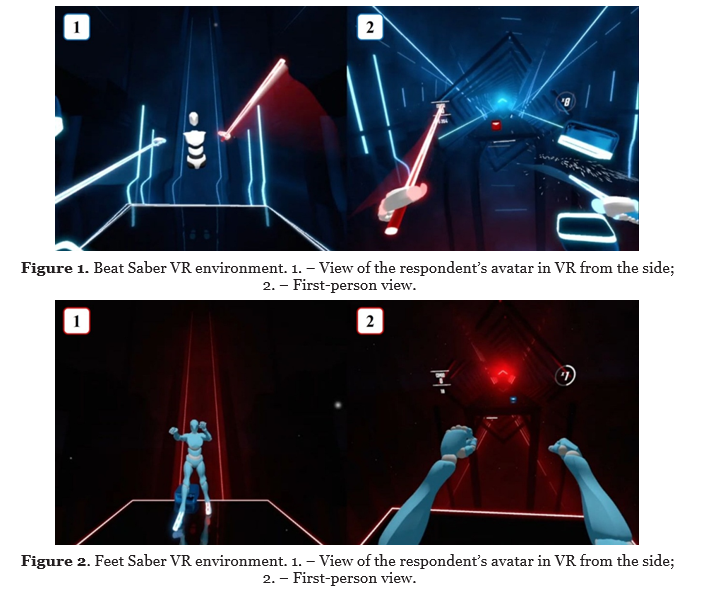
A series of repeated VR immersions predominantly with active hand movements. VR environment of the Beat Saber VR application, hand game task, interval between immersions 2 days (N participants = 32, M = 0, F = 32, mean age 19.15 ± 0.68 years, body mass index BMI = 21.16 ± 3.31). Figure 1 presents the gameplay during immersion in the Beat Saber VR environment.
 .
.
3.3. Immersion Series 2
A series of repeated VR immersions predominantly with active leg movements. VR environment of the Feet Saber VR application, leg game task, interval between immersions 2 days (N participants = 37; M = 6, F = 31, mean age 19.39 ± 1.11, BMI = 20.87 ± 3.56). As can be seen from the description, respondents selected to participate in both series of immersions are relatively homogeneous in terms of mean age and body mass index. Figure 2 presents the gameplay during immersion in the Feet Saber VR environment.
The “M. Feldenkrais Measurements” technique by I.A. Solovyeva in the author’s adaptation was used to diagnose mental representation distortions (MRD) of one’s own body size (Solovyeva, 2021; Varlamov, 2023). The technique is based on the method of diagnosing proprioceptive drift by recording the distance subjectively corresponding to the sizes of various body parts of the respondent, which they indicate with their hands with their eyes closed. For clarity of the obtained data, a procedure of psychometric verification of the technique and its standardization was previously undertaken; more details can be found in the corresponding study (Varlamov, 2023).
Mathematical processing of the obtained data was performed using MS Excel 21 and IBM SPSS Statistics 26 software. The nonparametric Wilcoxon W-test for related samples was used to establish the significance of differences in MRD of respondents’ own body sizes before and after each immersion. Analysis of the direction of change in MRD values before and after VR immersions was performed by constructing approximation lines of their averaged values (trend lines) in MS Excel 21. To conclude about the influence of the number of repeated immersions on MRD changes between immersions, general linear models (GLM) with repeated measures were constructed in IBM SPSS Statistics 26.
Results
4.1. Trend Line Analysis
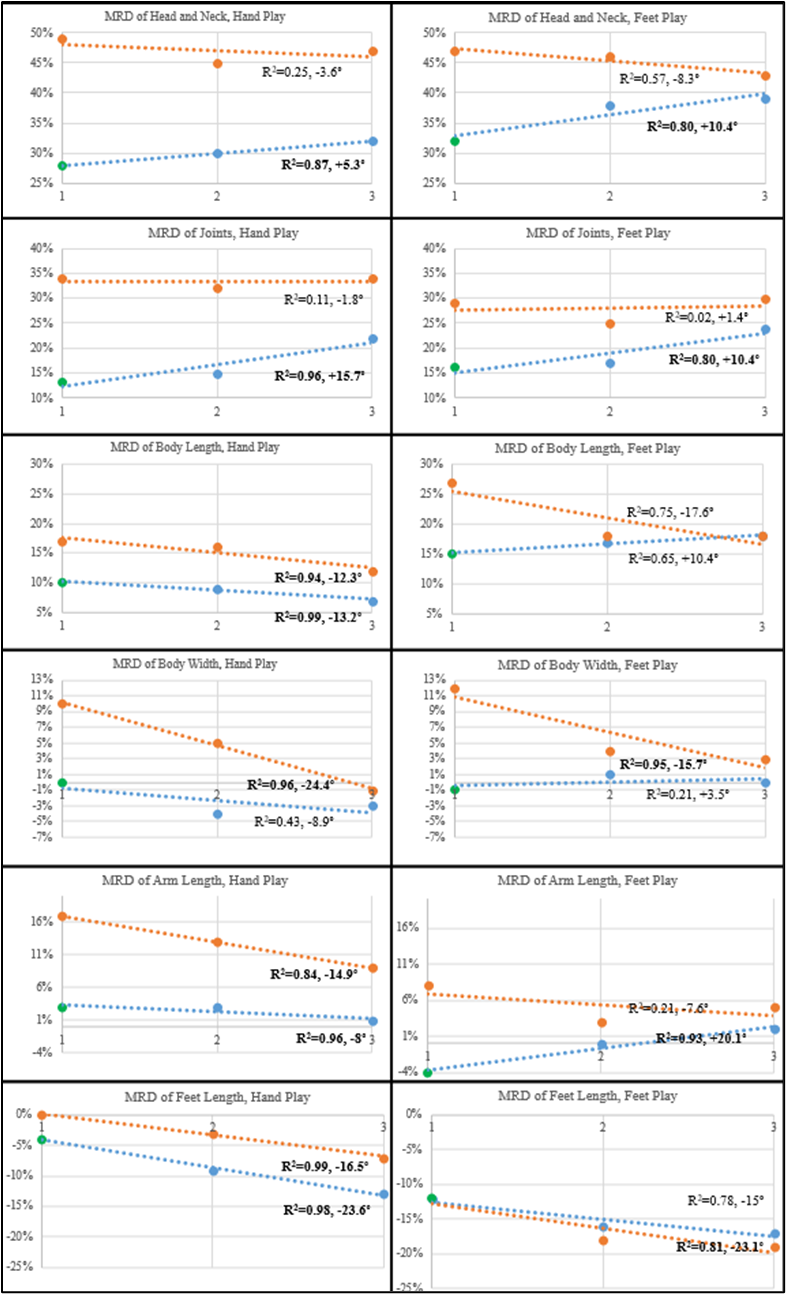
Figure 3 presents linear graphs approximating the mean values of mental representation distortion of respondents’ body sizes before (blue color) and after (orange color) each of the 3 immersions. Since during the first immersion the initial MRD measurement of respondents is taken using the “M. Feldenkrais Measurements” technique, we consider the first value of the blue line to be the habitual distortion for respondents or “baseline distortion”. This point is marked in green on the graphs. Orange “after immersion” points reflect “actual MRD” values, as they are based on MRD data obtained immediately after immersion (the respondent removes the VR headset but does not open their eyes until the end of the measurement). Blue “before immersion” points, except for the first one, may reflect “delayed MRD”, since there was a previous VR immersion before the corresponding measurement (2 days prior). When interpreting the data, we must take into account that these indicators may be influenced by previous measurement and VR immersion experience during the experiment. The approximation criterion R² ≥ 0.80 was adopted for inclusion in the analysis
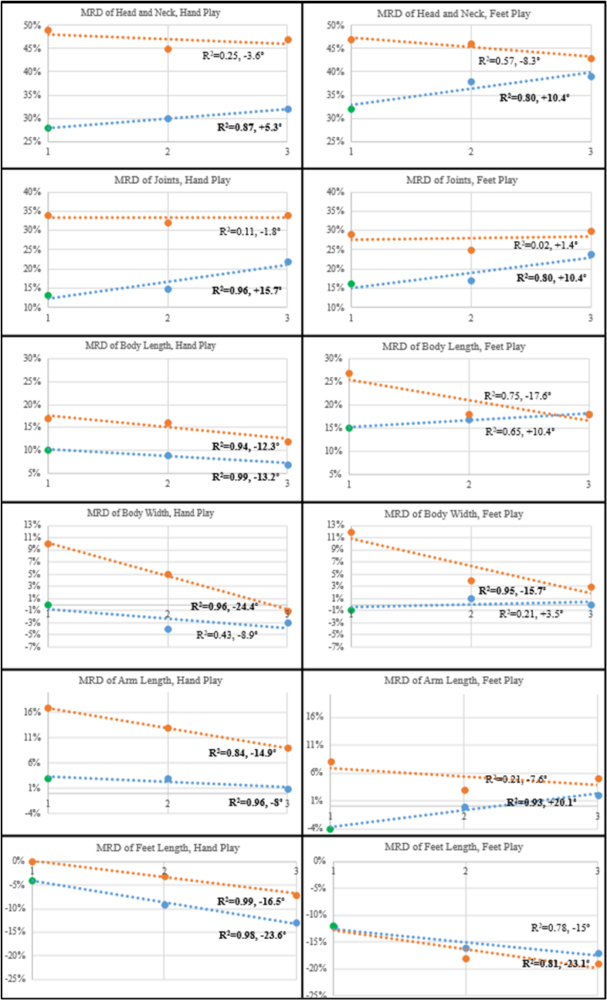
Figure 3. Comparison of linear trends in the change in the IMR of the respondents’ own body sizes during 3 repeated immersions in VR in both series – with playing with hands (left) and with playing with feet (right)
Table 1. Description of linear trends in the change in the IMR of the respondents’ own body sizes during 3 repeated immersions in VR in both series – with playing with hands (left) and with playing with legs (right)
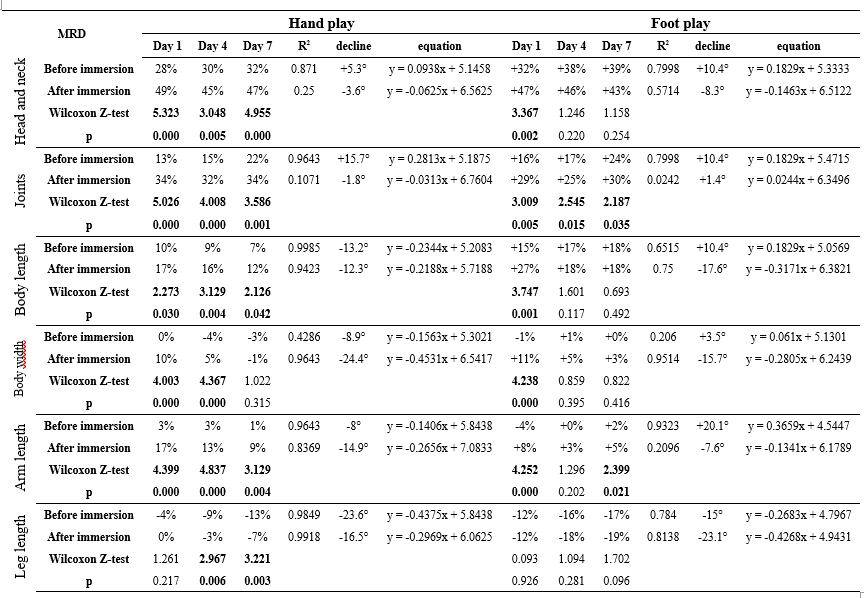
Table 1 presents data clarifying the visualization shown in Figure 3. When analyzing them, significant approximation trends of MRD changes in own body sizes were discovered.
4.2. GLM (Repeated Measures Method)
To assess the significance of the contribution of the number of repeated immersions to changes in MRD of respondents’ body sizes in both immersion series, general linear models GLM (repeated measures method) were constructed for all measurements recorded in both series of experimental immersions (Table 2).
Table 2. Results of constructing the GLM (repeated measures method) for both series of dives. Estimation of differences (F, p), effect size (partial η2), sphericity of covariance matrices (Mauchly criterion)

Statistically significant and reliable models were identified. In the series of immersions with active hand game, these are changes in MRD of the “Torso Length” (Pillai’s Trace = 0.18, p = 0.05) and “Leg Length” (Pillai’s Trace = 0.25, p = 0.01) parameters in the “Before immersion” measurement, as well as the “Torso Width” parameter (Pillai’s Trace = 0.27, p = 0.01) in the “After immersion” measurement. In the series of immersions with active leg game, significant and reliable models were constructed for changes in MRD of the “Torso Length” (Pillai’s Trace = 0.30, p = 0.00), “Torso Width” (Pillai’s Trace = 0.15, p = 0.04), “Arm Length” (Pillai’s Trace = 0.16, p = 0.03), and “Leg Length” (Pillai’s Trace = 0.29, p = 0.00) parameters in the “After immersion” measurement.
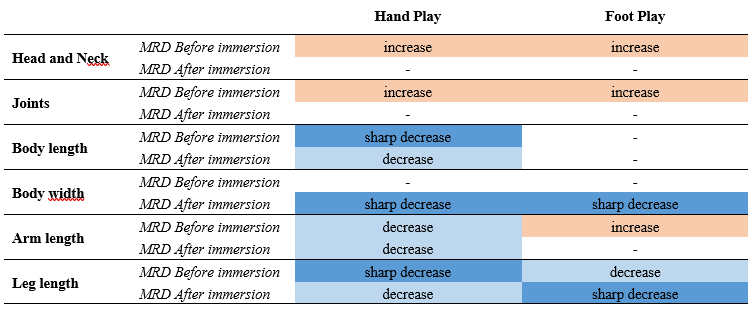
The significance of the model indicates the intensity and direction of MRD changes in the sizes of the corresponding body parameter of respondents between immersions. The correspondence of a significant GLM (repeated measures method) and a trend with a high level of approximation (as, for example, for the “Leg Length” parameter in the “After immersion” measurement during immersions with active leg game) indicates that the decrease in the numerical value of this parameter in 29% of cases (partial η² indicator) is due to the repetition of exposure. That is, it is the repeated immersions in the corresponding VR that are the factor that determines the specificity of MRD changes in leg sizes immediately after VR immersion in this analysis.
Patterns of increase in MRD of the “Head and Neck” and “Joints” parameters in the “Before immersion” measurement were found in both series of experimental immersions. The identified patterns of MRD changes of the “Torso Length” parameter during immersions with active hand game are not reproduced during immersions with active leg game, whereas a gradual decrease in MRD of the “Torso Width” parameter in the “After immersion” measurement is characteristic of both series of experimental immersions.
Differences in the patterns of MRD changes of the “Arm Length” and “Leg Length” parameters were identified. In each of the immersions in both series of the study, MRD of “Arm Length” after immersion has a higher numerical value than MRD of “Arm Length” before immersion, however, during immersions with active hand game, this exaggeration decreases with the repetition of immersions, as a result of which in both measurements the mental representation of “Arm Length” approaches their adequate sizes. In the series of immersions with active leg game, a gradual increase in the MRD value of “Arm Length” in the “Before immersion” measurement is characteristic, however, due to the initial “underestimation” of this parameter by respondents, the pattern can also be explained as an approximation of the perceived arm size to the real one.
The change in MRD of the “Leg Length” parameter in both immersion series is characterized by a gradual decrease in value both “Before immersion” and “After immersion”. The values gradually deviate from “adequate” perception – that is, in the mental representation of respondents, legs become shorter with each subsequent immersion. Whereas in the series of immersions with active hand game, MRD sizes “After immersion” have a higher value than MRD sizes “Before immersion” (i.e., respondents each time slightly “exaggerate” already underestimated legs in perception), in the series of immersions with active leg game, on the contrary, starting from the second immersion, MRD values of “Leg Length” in the “After immersion” measurement are registered lower than in the “Before immersion” measurement (i.e., respondents each time slightly “underestimate” already underestimated legs in perception).
A generalized comparative analysis of the indicated patterns is provided in Table 3.
Discussion
The data obtained in the study confirm the existence of directional mental representation distortions of a person’s own body size arising during repeated VR immersions and depending on the type of physical activity performed during immersion. The identified patterns indicate that MRD of one’s own body in VR have an adaptive character and are conditioned by the peculiarities of the organization of perceptual information in virtual environment conditions.
Analysis of the dynamics of mental representation of body sizes during repeated immersions showed that the process of adaptation to VR proceeds heterogeneously for different body parts. In particular, arm sizes under conditions of a game task with active upper limb movements gradually approach real values in the measurement conducted immediately after immersion, whereas leg sizes demonstrate the opposite tendency, characterized by progressive underestimation. This phenomenon can be interpreted in the context of selective adaptation, in which the mental representation of sizes of body parts involved in the process of performing an active task undergoes modification in a direction ensuring functional control over the peripersonal space of the virtual environment.
An important finding is that MRD of “Torso Width” demonstrate a stable tendency to decrease in both experimental conditions. This pattern is explained by respondents’ habituation to VR immersion conditions and a decrease in the intensity of the initial discrepancy between visual and proprioceptive information about the body. However, the peculiarity identified for the “Leg Length” parameter under conditions of a game with leg movements indicates that adaptive changes in mental representation are not reduced to simple habituation, but are related to the functional significance of a particular body part for carrying out activity in the virtual environment.
Differences in the trajectories of changes in mental representation of arm sizes between the two experimental series (decreasing tendency during active hand game and increasing during active leg game) indicate that adaptation of mental representation of one’s own body in VR has a selective character and is determined by both the peculiarities of current motor activity and the load on the proprioceptive system. If respondents do not see a certain body part (for example, arms during walking), its perceived size increases compensatorily, which may serve as a mechanism for maintaining body schema under conditions of sensory deficit.
The obtained results are consistent with the hypothesis that MRD of one’s own body sizes during VR immersions have a functional orientation and contribute to achieving a sense of stability and control over virtual peripersonal space. At the same time, multiple repetition of VR experience leads to gradual consolidation and modulation of these functionally significant distortions, which is reflected in the identified directional trends of changes in mental representation of sizes of various body parts.
Conclusions
The study demonstrated the reproducibility of mental representation distortions of one’s own body size during repeated VR environment immersions on a single sample of respondents, which confirms their adaptive character and connection with the peculiarities of VR experience organization.
The identified directional trends of changes in mental representation of sizes of various body parts in series of repeated immersions depend on the type of active task performed in VR: game tasks with hand movements are accompanied by approximation of perceived arm sizes to real ones, whereas game tasks with leg movements lead to progressive underestimation of perceived leg sizes.
The discovered MRD of torso sizes, demonstrating decrease in both experimental conditions, indicate the presence of general mechanisms of habituation to VR immersion conditions, associated with a decrease in the initial discrepancy between visual and proprioceptive information about the body.
The selective character of adaptation of mental representation of different body parts indicates that changes in perception of one’s own body sizes have a functional orientation, ensuring a sense of control and stability during the performance of activity in the virtual environment.
The obtained results expand understanding of the mechanisms of plasticity of body image and can be used in further research of adaptive processes under conditions of unusual sensory environments, as well as in the development of programs for correcting body perception disorders using VR technologies.
Competing interests: The author declare that the research was conducted in the absence of any commercial or financial relationships that could be construed as a potential conflict of interest.
Ethics statement: The study was reviewed and approved by the local ethics committee of the Federal State Budgetary Educational Institution of Higher Education Ryazan State Medical University of the Ministry of Health of the Russian Federation (report No. 12 dated 25/05/2021).
Acknowledgments: The authors thank the study participants for their unpaid participation in the study to promote scientific advancement.
References
- Alishev, B. S. (2014). Ponyatiye predstavleniye v sovremennoy psikhologii [The concept of representation in contemporary psychology]. Uchenye zapiski Kazanskogo universiteta. Seriya: Gumanitarnye nauki, 156(6), 141–154.
- Bhargava, A., Venkatakrishnan, R., Lucaites, K., & et al. (2023). Can I squeeze through? Effects of self-avatars and calibration in a person-plus-virtual-object system on perceived lateral passability in VR. IEEE Transactions on Visualization and Computer Graphics,29(5), 2348–2357. https://doi.org/10.1109/TVCG.2023.3247067
- Chuprikova, N. I. (2007). Umstvennoye razvitiye: printsip differentsiatsii [Mental development: The principle of differentiation]. Moscow: Piter.
- Chuprikova, N. I. (2015). Psikhika i psikhicheskiye protsessy: sistema ponyatiy obshchey psikhologii [Mind and mental processes: A system of concepts in general psychology]. Moscow: YaSK.
- Day, B., Ebrahimi, E., Hartman, L. S., Pagano, C. C., Robb, A. C., & Babu, S. V. (2019). Examining the effects of altered avatars on perception-action in virtual reality. Journal of Experimental Psychology: Applied, 25(1), 1–24. https://doi.org/10.1037/xap0000192
- Garcia, B. P., Garcia, M. F., Olszewska, A., Yilmaz, L., Ibañez, C. G., Blanes, M. G., Gültekin, G., Troncoso, E. S., & Maldonado, J. G. (2019). Is this my own body? Changing the perceptual and affective body image experience among college students using a new virtual reality embodiment-based technique. Journal of Clinical Medicine, 8(7), 925. https://doi.org/10.3390/jcm8070925
- Irvine, K. R., Irvine, A. R., Maalin, N., & et al. (2020). Using immersive virtual reality to modify body image. Body Image, 33, 232–243. https://doi.org/10.1016/j.bodyim.2020.03.007
- Kholodnaya, M. A. (2002). Psikhologiya intellekta: Paradoksy issledovaniya [Psychology of intelligence: Paradoxes of research] (2nd rev. ed.). Saint Petersburg: Piter. ISBN 5-318-00301-X.
- Khoze, E. G. (2021). Virtual reality and education. Sovremennaya zarubezhnaya psikhologiya = Journal of Modern Foreign Psychology, 10(3), 68–78. https://doi.org/10.17759/jmfp.2021100307
- Khvatov, I. A. (2009). “Obraz Ya” i “Ya-kontseptsiya” cheloveka v kontekste evolyutsii psikhicheskogo otrazheniya [“Self-image” and “self-concept” of the person in the context of the evolution of mental reflection]. Mir psikhologii, 4(60), 164–173.
- Lanier, J. (2017). Dawn of the new everything: Encounters with reality and virtual reality. Henry Holt and Company.
- Normand, J. M., Giannopoulos, M., Spanlang, B., & Slater, M. (2011). Multisensory stimulation can induce an illusion of larger belly size in immersive virtual reality. PLOS ONE, 6(1), https://doi.org/10.1371/journal.pone.0016128
- Pobokin, P. A., & Selivanov, V. V. (2022). The role of virtual reality in the formation of mathematical knowledge and reflection of schoolchildren. Eksperimental’naya psikhologiya = Experimental Psychology (Russia),15(2), 37–48. https://doi.org/10.17759/exppsy.2022150203
- Selivanov, V. V. (2021). Mental states of a personality in a didactic VR environment. Eksperimental’naya psikhologiya = Experimental Psychology (Russia), 14(1), 20–28. https://doi.org/10.17759/exppsy.2021000002
- Selivanov, V. V., & Selivanova, L. N. (2015). Effektivnost’ ispol’zovaniya virtual’noy real’nosti pri obuchenii v yunosheskom i vzroslom vozraste [Effectiveness of virtual reality use in teaching in adolescence and adulthood]. Nepreryvnoe obrazovanie: XXI vek, 1(9), 133–152.
- Senkowski, D., & Heinz, A. (2016). Chronic pain and distorted body image: Implications for multisensory feedback interventions. Neuroscience & Biobehavioral Reviews,69, 252–259. https://doi.org/10.1016/j.neubiorev.2016.08.009
- Solov’yeva, I. A. (2021). Kto my na samom dele? O bessonatel’nom obraze tela [Who are we really? On the unconscious body image]. Moscow: Izdatel’ Bazenkov I.L. ISBN 978-5-91160-090-7.
- Varlamov, A. V. (2022). Body mental representation in VR: Systematic review. Natural Systems of Mind, 2(4), 4–27. https://doi.org/10.38098/nsom_2022_02_04_01
- Varlamov, A. V. (2023). A test “M. Feldenkrais’ measurements”: Psychometric characteristics on the Russian sample. Natural Systems of Mind, 3(4). Retrieved from https://natural-systems-of-mind.com/2023/12/a-test-m-feldenkrais-measurments-psychometric-characteristics-on-the-russian-sample/
- Wiebe, A., Kannen, K., Selaskowski, B., & et al. (2022). Virtual reality in the diagnostic and therapy for mental disorders: A systematic review.
Comments (0)
The study examines changes in mental representation distortions (MRD) of body size during repeated virtual reality (VR) immersions with different active tasks. Objective: To identify the characteristics of mental representation changes for body size across three sequential VR immersions (2-day intervals) while performing different motor tasks. Methods: The study included 69 participants (age 18–23 years) divided into two series: hand-movement game (n=32, Beat Saber VR) and leg-movement game (n=37, Feet Saber VR). Mental representation distortions were assessed using the “M. Feldenkrais Measurements” technique by I.A. Solovyeva. Analysis included linear trend construction (R² ≥ 0.80 criterion) and general linear models (GLM) with repeated measures. Results: Directional changes in MRD were observed, depending on functional significance of body parts. During active hand movements, perceived hand sizes approached realistic values (slope −8 to −14.9°), while perceived leg sizes progressively decreased (slope −16.5 to −23.6°). During leg movements, leg sizes showed compensatory reduction (slope −15 to −23.1°). Torso dimensions (width, length) consistently decreased in both conditions, indicating universal adaptation mechanisms. Conclusions: Findings confirm the adaptive and selective nature of body size MRD during VR immersions. Adaptation is mediated by two mechanisms: selective (function-dependent) for actively used body parts and universal (function-independent) for other parts. Results are significant for understanding body image plasticity and developing VR-based interventions for correcting body perception disturbances. Key findings: Selective adaptation of mental representation; compensatory mechanisms for visual information deficit; functional load significance for body parts; reproducibility of effects across repeated immersions; differential patterns between active upper and lower limb tasks.
Искажения ментальной репрезентации размеров собственного тела человека при повторяющихся погружениях в VR с различным активным заданием
А.В. Варламов
Рязанский государственный медицинский университет имени академика И.П. Павлова, Рязань, Россия
Резюме. Исследование посвящено изучению изменений искажений ментальной репрезентации (ИМР) размеров собственного тела при повторяющихся погружениях в виртуальную реальность (VR) с различными типами активных заданий. Цель: выявить особенности динамики изменения ИМР размеров собственного тела при трёх последовательных VR-погружениях (с интервалом 2 дня) во время выполнения различных двигательных задач. Метод. В исследовании участвовали 69 респондентов (возраст 18–23 года), разделённые на две серии: игра руками (n=32, Beat Saber VR) и игра ногами (n=37, Feet Saber VR). Для диагностики ИМР использовалась методика «Промеры по М. Фельденкрайзу» И.А. Соловьевой. Анализ включал построение линейных трендов (критерий R² ≥ 0.80) и общие линейные модели (ОЛМ) с повторными измерениями. Результаты: обнаружены направленные изменения ИМР, зависящие от функциональной значимости части тела. При активной игре руками воспринимаемые размеры рук приближаются к реальным (уклон от −8 до−14.9°), а размеры ног прогрессивно преуменьшаются (уклон от−16.5 до −23.6°). При активной игре ногами размеры ног демонстрируют компенсаторное уменьшение (уклон от −15 до−23.1°). Размеры корпуса (Ширина, Длина) стабильно уменьшаются в обоих условиях, что свидетельствует об универсальных механизмах адаптации. Выводы: полученные данные подтверждают адаптивный и селективный характер искажений ИМР при VR-погружениях. Адаптация опосредована двумя механизмами: селективным (функционально-зависимым) для активно используемых частей тела и универсальным (функционально-независимым) для остальных частей. Результаты имеют значение для понимания пластичности образа собственного тела и разработки VR-интервенций для коррекции нарушений телесного восприятия. Ключевые находки: селективность адаптации ментальной репрезентации; компенсаторные механизмы при дефиците визуальной информации; значимость функциональной нагрузки на части тела; воспроизводимость эффектов при повторных погружениях.
Ключевые слова: виртуальная реальность (VR), ментальная репрезентация, образ тела, искажения восприятия размеров тела, адаптация
With the growing availability of high-performance graphics and computing hardware, as well as VR headsets, immersion in computer virtual realities is becoming an almost everyday occurrence. The demonstration of three-dimensional digital images from a first-person perspective provides great potential for visualization and interactivity, which is actively used in both professional and leisure activities (Lanier, 2017). Analysis of current scientometric databases (Varlamov, 2022) demonstrates a steady increase in researchers’ interest in the applied use of VR technologies in medicine (Senkowski & Heinz, 2016), psychotherapy (Wiebe et al., 2022; Irvine et al., 2020), and education (Selivanov, 2015). It has been experimentally proven that the inclusion of VR exposures in the process of subject-based learning for schoolchildren and students has a positive effect on knowledge acquisition (Selivanov, 2021). Immersions in “higher” virtual realities have an effective influence on both the cognitive processes of recipients (Pobokin & Selivanov, 2022) and their affective well-being (Khoze, 2021).
At the same time, the experience of immersion in computer virtual reality, mediated by the use of head-mounted displays and other elements of VR headsets, obviously has a number of subtle differences from the usual human interaction with the material world and surrounding space. In particular, these discrepancies concern the perception of one’s own body, since during immersion its visual image is either inaccessible to perception or presented with limitations (Garcia et al., 2019). In this work, we investigate the construct of mental representation of one’s own body size and its distortions during a person’s immersion in virtual reality.
Mental representation of one’s own body size is a complex psychological construct that integrates structural, content-related, and procedural components of a person’s perception and representation of their own physical appearance (Khvatov, 2009). In contemporary cognitive psychology, mental representation is understood as an organized system of knowledge and representations stored in long-term memory and activated in working memory when solving current tasks (Alishev, 2014). With regard to body image, this construct makes it possible to describe the specifics of how a person perceives, encodes, and reproduces information about the sizes of various parts of their body, relying on both sensory information and accumulated experience.
Research on mental representation is based on the concept of the structural organization of mental experience, according to which mental representations exist simultaneously at several levels of organization: as highly systematized structures of long-term memory containing generalized invariant experience, and as dynamic structures of working memory reflecting the specificity of the current situation and psychological state of a person (Chuprikova, 2007, 2015; Kholodnaya, 2002). This approach makes it possible to consider the basic distortions of bodily perception that a person operates with in everyday life and to differentiate them from induced distortions arising as a result of interaction with unusual environmental conditions (Bhargava et al., 2023; Normand et al., 2011). Thus, mental representation of one’s own body size is not a static formation, but represents a flexible system that adapts to the characteristics of the external environment while simultaneously maintaining stable individual characteristics.
The impact of virtual reality on the mental representation of one’s own body is due to the specificity of VR immersion, during which a gap occurs between visual and proprioceptive information about the body (Day, 2019). The deficit of visual feedback about one’s own body during VR immersion forces a person to rely predominantly on proprioceptive signals, which leads to the formation of specific distortions in the mental representation (MRD) of the sizes of various body parts, aimed at ensuring functional adequacy of behavior in the virtual environment. The study of these distortions through the construct of mental representation and through the prism of their variability during repeated immersions makes it possible to identify patterns of human adaptation to unusual conditions of interaction with space and to understand the mechanisms of plasticity of body image.
- Objective and tasks
2.1. Objective
The objective of the study is to identify the characteristics of changes in mental representation distortions of respondents’ own body sizes that occur after immersions in VR environments during repeated immersions with the performance of various active tasks.
2.2. Tasks
- To conduct series of repeated VR immersions (3 consecutive immersions with a 2-day interval) with different types of active tasks: predominantly with hand movements (Beat Saber VR) and predominantly with leg movements (Feet Saber VR).
- To diagnose mental representation distortions (MRD) of one’s own body size before and after each VR immersion, using the “M. Feldenkrais Measurements” technique to track the dynamics of changes in the perception of sizes of various body parts.
- To identify the direction and intensity of changes in mental representation distortions during repeated immersions through the analysis of linear trends and assessment of the impact of the number of repeated immersions using the GLM method with repeated measures.
3.1. Sample
The study involved 69 respondents (63 females and 6 males) aged 18 to 23 years. Respondents were selected from among students of the Ryazan State Medical University named after Academician I.P. Pavlov of the Ministry of Health of Russia. Respondents were organized into 2 subsamples to participate in two series of repeated VR immersions with different active tasks predominantly with hand movements (1) and predominantly with leg movements (2). All respondents participated in the study of their own free will. Before the beginning of the series of experimental immersions, they were instructed about possible difficulties associated with VR immersion, after which voluntary informed consents to participate in the experiment were signed.
The following equipment was used when organizing experimental VR immersions: Intel NUCxi7HNK (2018) nettop PC – Quad core Intel Kaby Lake-H CPU paired with HTC Vive (2018) VR Headset with complete Steam VR Base Stations and HTC Vive Sticks hand controllers. When organizing immersions within the second experimental series (predominantly with leg movements), 3 Vive Tracker 2.0 motion trackers were additionally used, 2 of which were attached to the respondents’ feet and 1 on the belt in the navel area using special mounts.
3.2. Immersion Series 1
A series of repeated VR immersions predominantly with active hand movements. VR environment of the Beat Saber VR application, hand game task, interval between immersions 2 days (N participants = 32, M = 0, F = 32, mean age 19.15 ± 0.68 years, body mass index BMI = 21.16 ± 3.31). Figure 1 presents the gameplay during immersion in the Beat Saber VR environment.
.
3.3. Immersion Series 2
A series of repeated VR immersions predominantly with active leg movements. VR environment of the Feet Saber VR application, leg game task, interval between immersions 2 days (N participants = 37; M = 6, F = 31, mean age 19.39 ± 1.11, BMI = 20.87 ± 3.56). As can be seen from the description, respondents selected to participate in both series of immersions are relatively homogeneous in terms of mean age and body mass index. Figure 2 presents the gameplay during immersion in the Feet Saber VR environment.
The “M. Feldenkrais Measurements” technique by I.A. Solovyeva in the author’s adaptation was used to diagnose mental representation distortions (MRD) of one’s own body size (Solovyeva, 2021; Varlamov, 2023). The technique is based on the method of diagnosing proprioceptive drift by recording the distance subjectively corresponding to the sizes of various body parts of the respondent, which they indicate with their hands with their eyes closed. For clarity of the obtained data, a procedure of psychometric verification of the technique and its standardization was previously undertaken; more details can be found in the corresponding study (Varlamov, 2023).
Mathematical processing of the obtained data was performed using MS Excel 21 and IBM SPSS Statistics 26 software. The nonparametric Wilcoxon W-test for related samples was used to establish the significance of differences in MRD of respondents’ own body sizes before and after each immersion. Analysis of the direction of change in MRD values before and after VR immersions was performed by constructing approximation lines of their averaged values (trend lines) in MS Excel 21. To conclude about the influence of the number of repeated immersions on MRD changes between immersions, general linear models (GLM) with repeated measures were constructed in IBM SPSS Statistics 26.
4.1. Trend Line Analysis
Figure 3 presents linear graphs approximating the mean values of mental representation distortion of respondents’ body sizes before (blue color) and after (orange color) each of the 3 immersions. Since during the first immersion the initial MRD measurement of respondents is taken using the “M. Feldenkrais Measurements” technique, we consider the first value of the blue line to be the habitual distortion for respondents or “baseline distortion”. This point is marked in green on the graphs. Orange “after immersion” points reflect “actual MRD” values, as they are based on MRD data obtained immediately after immersion (the respondent removes the VR headset but does not open their eyes until the end of the measurement). Blue “before immersion” points, except for the first one, may reflect “delayed MRD”, since there was a previous VR immersion before the corresponding measurement (2 days prior). When interpreting the data, we must take into account that these indicators may be influenced by previous measurement and VR immersion experience during the experiment. The approximation criterion R² ≥ 0.80 was adopted for inclusion in the analysis
Figure 3. Comparison of linear trends in the change in the IMR of the respondents’ own body sizes during 3 repeated immersions in VR in both series – with playing with hands (left) and with playing with feet (right)
Table 1. Description of linear trends in the change in the IMR of the respondents’ own body sizes during 3 repeated immersions in VR in both series – with playing with hands (left) and with playing with legs (right)
Table 1 presents data clarifying the visualization shown in Figure 3. When analyzing them, significant approximation trends of MRD changes in own body sizes were discovered.
4.2. GLM (Repeated Measures Method)
To assess the significance of the contribution of the number of repeated immersions to changes in MRD of respondents’ body sizes in both immersion series, general linear models GLM (repeated measures method) were constructed for all measurements recorded in both series of experimental immersions (Table 2).
Table 2. Results of constructing the GLM (repeated measures method) for both series of dives. Estimation of differences (F, p), effect size (partial η2), sphericity of covariance matrices (Mauchly criterion)
Statistically significant and reliable models were identified. In the series of immersions with active hand game, these are changes in MRD of the “Torso Length” (Pillai’s Trace = 0.18, p = 0.05) and “Leg Length” (Pillai’s Trace = 0.25, p = 0.01) parameters in the “Before immersion” measurement, as well as the “Torso Width” parameter (Pillai’s Trace = 0.27, p = 0.01) in the “After immersion” measurement. In the series of immersions with active leg game, significant and reliable models were constructed for changes in MRD of the “Torso Length” (Pillai’s Trace = 0.30, p = 0.00), “Torso Width” (Pillai’s Trace = 0.15, p = 0.04), “Arm Length” (Pillai’s Trace = 0.16, p = 0.03), and “Leg Length” (Pillai’s Trace = 0.29, p = 0.00) parameters in the “After immersion” measurement.
The significance of the model indicates the intensity and direction of MRD changes in the sizes of the corresponding body parameter of respondents between immersions. The correspondence of a significant GLM (repeated measures method) and a trend with a high level of approximation (as, for example, for the “Leg Length” parameter in the “After immersion” measurement during immersions with active leg game) indicates that the decrease in the numerical value of this parameter in 29% of cases (partial η² indicator) is due to the repetition of exposure. That is, it is the repeated immersions in the corresponding VR that are the factor that determines the specificity of MRD changes in leg sizes immediately after VR immersion in this analysis.
Patterns of increase in MRD of the “Head and Neck” and “Joints” parameters in the “Before immersion” measurement were found in both series of experimental immersions. The identified patterns of MRD changes of the “Torso Length” parameter during immersions with active hand game are not reproduced during immersions with active leg game, whereas a gradual decrease in MRD of the “Torso Width” parameter in the “After immersion” measurement is characteristic of both series of experimental immersions.
Differences in the patterns of MRD changes of the “Arm Length” and “Leg Length” parameters were identified. In each of the immersions in both series of the study, MRD of “Arm Length” after immersion has a higher numerical value than MRD of “Arm Length” before immersion, however, during immersions with active hand game, this exaggeration decreases with the repetition of immersions, as a result of which in both measurements the mental representation of “Arm Length” approaches their adequate sizes. In the series of immersions with active leg game, a gradual increase in the MRD value of “Arm Length” in the “Before immersion” measurement is characteristic, however, due to the initial “underestimation” of this parameter by respondents, the pattern can also be explained as an approximation of the perceived arm size to the real one.
The change in MRD of the “Leg Length” parameter in both immersion series is characterized by a gradual decrease in value both “Before immersion” and “After immersion”. The values gradually deviate from “adequate” perception – that is, in the mental representation of respondents, legs become shorter with each subsequent immersion. Whereas in the series of immersions with active hand game, MRD sizes “After immersion” have a higher value than MRD sizes “Before immersion” (i.e., respondents each time slightly “exaggerate” already underestimated legs in perception), in the series of immersions with active leg game, on the contrary, starting from the second immersion, MRD values of “Leg Length” in the “After immersion” measurement are registered lower than in the “Before immersion” measurement (i.e., respondents each time slightly “underestimate” already underestimated legs in perception).
A generalized comparative analysis of the indicated patterns is provided in Table 3.
The data obtained in the study confirm the existence of directional mental representation distortions of a person’s own body size arising during repeated VR immersions and depending on the type of physical activity performed during immersion. The identified patterns indicate that MRD of one’s own body in VR have an adaptive character and are conditioned by the peculiarities of the organization of perceptual information in virtual environment conditions.
Analysis of the dynamics of mental representation of body sizes during repeated immersions showed that the process of adaptation to VR proceeds heterogeneously for different body parts. In particular, arm sizes under conditions of a game task with active upper limb movements gradually approach real values in the measurement conducted immediately after immersion, whereas leg sizes demonstrate the opposite tendency, characterized by progressive underestimation. This phenomenon can be interpreted in the context of selective adaptation, in which the mental representation of sizes of body parts involved in the process of performing an active task undergoes modification in a direction ensuring functional control over the peripersonal space of the virtual environment.
An important finding is that MRD of “Torso Width” demonstrate a stable tendency to decrease in both experimental conditions. This pattern is explained by respondents’ habituation to VR immersion conditions and a decrease in the intensity of the initial discrepancy between visual and proprioceptive information about the body. However, the peculiarity identified for the “Leg Length” parameter under conditions of a game with leg movements indicates that adaptive changes in mental representation are not reduced to simple habituation, but are related to the functional significance of a particular body part for carrying out activity in the virtual environment.
Differences in the trajectories of changes in mental representation of arm sizes between the two experimental series (decreasing tendency during active hand game and increasing during active leg game) indicate that adaptation of mental representation of one’s own body in VR has a selective character and is determined by both the peculiarities of current motor activity and the load on the proprioceptive system. If respondents do not see a certain body part (for example, arms during walking), its perceived size increases compensatorily, which may serve as a mechanism for maintaining body schema under conditions of sensory deficit.
The obtained results are consistent with the hypothesis that MRD of one’s own body sizes during VR immersions have a functional orientation and contribute to achieving a sense of stability and control over virtual peripersonal space. At the same time, multiple repetition of VR experience leads to gradual consolidation and modulation of these functionally significant distortions, which is reflected in the identified directional trends of changes in mental representation of sizes of various body parts.
The study demonstrated the reproducibility of mental representation distortions of one’s own body size during repeated VR environment immersions on a single sample of respondents, which confirms their adaptive character and connection with the peculiarities of VR experience organization.
The identified directional trends of changes in mental representation of sizes of various body parts in series of repeated immersions depend on the type of active task performed in VR: game tasks with hand movements are accompanied by approximation of perceived arm sizes to real ones, whereas game tasks with leg movements lead to progressive underestimation of perceived leg sizes.
The discovered MRD of torso sizes, demonstrating decrease in both experimental conditions, indicate the presence of general mechanisms of habituation to VR immersion conditions, associated with a decrease in the initial discrepancy between visual and proprioceptive information about the body.
The selective character of adaptation of mental representation of different body parts indicates that changes in perception of one’s own body sizes have a functional orientation, ensuring a sense of control and stability during the performance of activity in the virtual environment.
The obtained results expand understanding of the mechanisms of plasticity of body image and can be used in further research of adaptive processes under conditions of unusual sensory environments, as well as in the development of programs for correcting body perception disorders using VR technologies.
Competing interests: The author declare that the research was conducted in the absence of any commercial or financial relationships that could be construed as a potential conflict of interest.
Ethics statement: The study was reviewed and approved by the local ethics committee of the Federal State Budgetary Educational Institution of Higher Education Ryazan State Medical University of the Ministry of Health of the Russian Federation (report No. 12 dated 25/05/2021).
Acknowledgments: The authors thank the study participants for their unpaid participation in the study to promote scientific advancement.
- Alishev, B. S. (2014). Ponyatiye predstavleniye v sovremennoy psikhologii [The concept of representation in contemporary psychology]. Uchenye zapiski Kazanskogo universiteta. Seriya: Gumanitarnye nauki, 156(6), 141–154.
- Bhargava, A., Venkatakrishnan, R., Lucaites, K., & et al. (2023). Can I squeeze through? Effects of self-avatars and calibration in a person-plus-virtual-object system on perceived lateral passability in VR. IEEE Transactions on Visualization and Computer Graphics,29(5), 2348–2357. https://doi.org/10.1109/TVCG.2023.3247067
- Chuprikova, N. I. (2007). Umstvennoye razvitiye: printsip differentsiatsii [Mental development: The principle of differentiation]. Moscow: Piter.
- Chuprikova, N. I. (2015). Psikhika i psikhicheskiye protsessy: sistema ponyatiy obshchey psikhologii [Mind and mental processes: A system of concepts in general psychology]. Moscow: YaSK.
- Day, B., Ebrahimi, E., Hartman, L. S., Pagano, C. C., Robb, A. C., & Babu, S. V. (2019). Examining the effects of altered avatars on perception-action in virtual reality. Journal of Experimental Psychology: Applied, 25(1), 1–24. https://doi.org/10.1037/xap0000192
- Garcia, B. P., Garcia, M. F., Olszewska, A., Yilmaz, L., Ibañez, C. G., Blanes, M. G., Gültekin, G., Troncoso, E. S., & Maldonado, J. G. (2019). Is this my own body? Changing the perceptual and affective body image experience among college students using a new virtual reality embodiment-based technique. Journal of Clinical Medicine, 8(7), 925. https://doi.org/10.3390/jcm8070925
- Irvine, K. R., Irvine, A. R., Maalin, N., & et al. (2020). Using immersive virtual reality to modify body image. Body Image, 33, 232–243. https://doi.org/10.1016/j.bodyim.2020.03.007
- Kholodnaya, M. A. (2002). Psikhologiya intellekta: Paradoksy issledovaniya [Psychology of intelligence: Paradoxes of research] (2nd rev. ed.). Saint Petersburg: Piter. ISBN 5-318-00301-X.
- Khoze, E. G. (2021). Virtual reality and education. Sovremennaya zarubezhnaya psikhologiya = Journal of Modern Foreign Psychology, 10(3), 68–78. https://doi.org/10.17759/jmfp.2021100307
- Khvatov, I. A. (2009). “Obraz Ya” i “Ya-kontseptsiya” cheloveka v kontekste evolyutsii psikhicheskogo otrazheniya [“Self-image” and “self-concept” of the person in the context of the evolution of mental reflection]. Mir psikhologii, 4(60), 164–173.
- Lanier, J. (2017). Dawn of the new everything: Encounters with reality and virtual reality. Henry Holt and Company.
- Normand, J. M., Giannopoulos, M., Spanlang, B., & Slater, M. (2011). Multisensory stimulation can induce an illusion of larger belly size in immersive virtual reality. PLOS ONE, 6(1), https://doi.org/10.1371/journal.pone.0016128
- Pobokin, P. A., & Selivanov, V. V. (2022). The role of virtual reality in the formation of mathematical knowledge and reflection of schoolchildren. Eksperimental’naya psikhologiya = Experimental Psychology (Russia),15(2), 37–48. https://doi.org/10.17759/exppsy.2022150203
- Selivanov, V. V. (2021). Mental states of a personality in a didactic VR environment. Eksperimental’naya psikhologiya = Experimental Psychology (Russia), 14(1), 20–28. https://doi.org/10.17759/exppsy.2021000002
- Selivanov, V. V., & Selivanova, L. N. (2015). Effektivnost’ ispol’zovaniya virtual’noy real’nosti pri obuchenii v yunosheskom i vzroslom vozraste [Effectiveness of virtual reality use in teaching in adolescence and adulthood]. Nepreryvnoe obrazovanie: XXI vek, 1(9), 133–152.
- Senkowski, D., & Heinz, A. (2016). Chronic pain and distorted body image: Implications for multisensory feedback interventions. Neuroscience & Biobehavioral Reviews,69, 252–259. https://doi.org/10.1016/j.neubiorev.2016.08.009
- Solov’yeva, I. A. (2021). Kto my na samom dele? O bessonatel’nom obraze tela [Who are we really? On the unconscious body image]. Moscow: Izdatel’ Bazenkov I.L. ISBN 978-5-91160-090-7.
- Varlamov, A. V. (2022). Body mental representation in VR: Systematic review. Natural Systems of Mind, 2(4), 4–27. https://doi.org/10.38098/nsom_2022_02_04_01
- Varlamov, A. V. (2023). A test “M. Feldenkrais’ measurements”: Psychometric characteristics on the Russian sample. Natural Systems of Mind, 3(4). Retrieved from https://natural-systems-of-mind.com/2023/12/a-test-m-feldenkrais-measurments-psychometric-characteristics-on-the-russian-sample/
- Wiebe, A., Kannen, K., Selaskowski, B., & et al. (2022). Virtual reality in the diagnostic and therapy for mental disorders: A systematic review.
References