The Need for Psychological Knowledge Among Economically Inactive Social Groups
Abstract
Abstract
Relevance and Background. In an era of profound social transformation and the proliferation of pseudoscientific psychological content, understanding the genuine demand for scientific psychological knowledge has become a critical societal imperative. While public interest in psychology is growing, it is paradoxically accompanied by the widespread acceptance of simplified, often unscientific, conceptions of the mind, leaving scientifically grounded knowledge inaccessible to a large portion of the population. This disconnect necessitates a systematic investigation into the need for psychological knowledge, conceptualized as a multidimensional socio-psychological phenomenon encompassing cognitive, motivational, value-based, and reflexive components. Addressing this gap is essential for developing evidence-based educational interventions and counteracting the dissemination of non-scientific psychological narratives. Objective. This study aims to identify the individual and socio‑psychological determinants of the need for psychological knowledge among economically inactive social groups (students and retirees), with a focus on regional, gender, and age‑specific variations. Methods. A mixed‑methods approach was used, combining digital trace data and survey responses. The empirical base included over 2.2 million Yandex search queries, automated content analysis of 1694 posts from the VKontakte social network (2019–2025), and a survey of 522 respondents from three Russian regions (Irkutsk region, Karachay‑Cherkess Republic, and Moscow). Analytical techniques comprised digital footprint analysis, correlation and factor analyses, ANOVA, and comparative group analysis. Validated instruments (e.g., adapted MSCEIT, ZTPI, SJO) were used to assess personality characteristics. Results. Interest in psychological knowledge proved to be widespread (popularity index 101%) yet markedly heterogeneous across regions, peaking in the Far Eastern (115%), Siberian (112%), and Southern (108%) federal districts. Counter to common assumptions, personal characteristics correlated only weakly with interest (r ≈ 0.25). Age emerged as the strongest predictor: students (18–25 years) reported high interest (mean 7.8/10) oriented toward self‑development and career, whereas retirees (60+ years) showed moderate interest (mean 5.2/10) focused on health and interpersonal relationships. Gender differences were qualitative rather than quantitative: women’s interest was linked to internal harmony and relational well‑being (r = 0.58), while men’s interest centered on external effectiveness and social influence (r = 0.62). Discourse analysis revealed that online discussions about psychology were dominated by commercialized (28.4% of variance) and politicized (21.7%) content, highlighting a critical challenge for science communication. Conclusion. The need for psychological knowledge is a dynamic, context‑sensitive phenomenon shaped primarily by age‑related developmental tasks, gender‑specific orientations, and regional access to educational resources—not by stable personality dispositions. The distinct profiles of students and retirees underscore the urgency of developing targeted educational programs and public outreach strategies that bridge the divide between scientific psychology and public demand. The findings also sound a cautionary note: without systematic intervention, the public’s legitimate interest in psychology risks being captured by commercial and pseudoscientific actors.
Потребность в психологических знаниях у экономически неактивных социальных групп
Д.А. Китова 1, А.Л. Журавлев 1, Н.Р. Апреликова 2
1 Институт психологии Российской академии наук, Москва, Россия
2 Российский университет спорта, Москва, Россия
Резюме. Актуальность и обоснование. В эпоху глубоких социальных трансформаций и распространения псевдонаучного психологического контента понимание реального запроса на научное психологическое знание становится важной социальной задачей. При том что интерес общества к психологии растет, он парадоксальным образом сопровождается широким принятием упрощенных, часто ненаучных представлений о психике, тогда как подлинно научное знание остается недоступным для значительной части населения. Данное противоречие требует систематического изучения потребности в психологических знаниях, понимаемой как многомерное социально-психологическое явление, интегрирующее когнитивные, мотивационные, ценностные и рефлексивные компоненты. Решение этой проблемы необходимо для разработки научно обоснованных образовательных интервенций и противодействия распространению ненаучных психологических нарративов. Цель. Исследование направлено на выявление индивидуальных и социально-психологических детерминант потребности в психологических знаниях у экономически неактивных социальных групп (студентов и пенсионеров) с учетом региональных, гендерных и возрастных особенностей. Методы. Использован смешанный дизайн, объединяющий анализ цифровых следов и данные опроса. Эмпирическую базу составили более 2,2 млн поисковых запросов в Яндекс, автоматизированный контент-анализ 1694 сообщений в социальной сети ВКонтакте (2019–2025 гг.), а также опрос 522 респондентов из трех регионов России (Карачаево-Черкесская Республика, Иркутская область, Москва). Аналитические методы включали анализ цифровых следов, корреляционный и факторный анализ, дисперсионный анализ (ANOVA) и сравнительный анализ групп. Для оценки личностных характеристик использовались валидизированные инструменты (например, адаптированные MSCEIT, ZTPI, SJO). Результаты. Интерес к психологическим знаниям носит массовый характер (индекс популярности 101%), однако существенно различается по регионам, достигая максимума в Дальневосточном (115%), Сибирском (112%) и Южном (108%) федеральных округах. Вопреки распространенным предположениям, личностные характеристики слабо коррелируют с уровнем интереса (r ≈ 0.25). Наиболее сильным предиктором выступил возраст: студенты (18–25 лет) демонстрируют высокий интерес (средний балл 7,8 из 10), ориентированный на саморазвитие и карьеру, тогда как пенсионеры (60+ лет) проявляют умеренный интерес (средний балл 5,2), сосредоточенный на темах здоровья и межличностных отношений. Гендерные различия носят качественный, а не количественный характер: интерес женщин связан с внутренней гармонией и благополучием в отношениях (r = 0.58), тогда как интерес мужчин сконцентрирован на внешней эффективности и социальном влиянии (r = 0.62). Дискурс-анализ показал, что в онлайн-обсуждениях психологии доминирует коммерциализированный (28.4% дисперсии) и политизированный (21.7%) контент, что создает серьезный вызов для научной коммуникации. Заключение. Потребность в психологических знаниях представляет собой динамичный, контекстно-зависимый феномен, формируемый преимущественно возрастными задачами развития, гендерными ориентациями и региональной доступностью образовательных ресурсов, а не устойчивыми личностными диспозициями. Выявленные различия в профилях студентов и пенсионеров указывают на необходимость разработки адресных образовательных программ и стратегий просвещения, которые преодолевают разрыв между научной психологией и общественным запросом. Полученные данные также служат предостережением: без систематических вмешательств закономерный интерес общества к психологии рискует быть захваченным коммерческими и псевдонаучными акторами.
Ключевые слова: потребность в знаниях, психологическое знание, экономически неактивные группы, студенты, пенсионеры, социальная психология, цифровое поведение, поисковые запросы, гендерные различия, возрастная психология.
Introduction
Contemporary society is undergoing profound transformations that permeate all spheres of social life, from interpersonal relationships to global communications. In this context, knowledge about the mechanisms of social cognition, motivation, group dynamics, and psychological regulation of behavior acquires particular significance (Aprelikova, Kitova, 2019, 2020; Zhuravlev, Kitova, 2025; Kitova, 2019). Psychology, especially its social dimension, serves not only as a science of human beings in society but also as a resource for the sustainable development of personality and social institutions.
However, alongside a growing interest in psychological knowledge, a paradoxical deformation is observed in society: simplified, often pseudoscientific notions of the mind are becoming widespread, while genuinely scientific understanding remains inaccessible to a significant portion of the population (Kitova, Aprelikova, 2019a, b). This situation necessitates addressing a fundamental problem: the need for psychological knowledge, understood as a multidimensional socio-psychological phenomenon integrating cognitive, motivational, value-based, and reflective components.
A central theoretical issue thus arises: how do scientific and everyday forms of psychological knowledge relate, and what cognitive, emotional, and social mechanisms underpin the need to acquire them? This question resonates with the interdisciplinary integration and transformation of scientific knowledge (Ananyev, 2001; Bratus, 1988; Zhuravlev, 1988; Leontiev, 2005; Rubinshtein, 2002; Sechenov, 2019), where psychology occupies a central yet contradictory position—aspiring to scientific rigor while being deeply incorporated into everyday consciousness, often in distorted forms.
From a methodological standpoint, the problem of studying the need for psychological knowledge remains underdeveloped in both Russian (e.g., Aprelikova, Kitova, 2019; Zhuravlev, Kitova, 2025) and international literature (Baltes & Baltes, 1990; Deci & Ryan, 2000; Erikson, 1968; Ryff, 1989; Triandis, 1995). Existing approaches often fail to account for the reflexive, personally meaningful, and ethically charged nature of psychological knowledge specifically. Furthermore, there is a lack of specialized, validated instruments for its measurement, forcing researchers to rely on borrowed scales, unvalidated author questionnaires, or fragmented qualitative data, which complicates comparative and quantitative research.
In Western psychology, the concept of “need for cognition,” which refers to an intrinsic motivation to engage in thinking and derive pleasure from intellectual work (Shepeleva et al., 2018)—offers a relevant parallel. This characteristic, sensitive to age and positively related to academic performance, aligns with our understanding of interest in psychology as a manifested cognitive need.
Importantly, need for cognition is positively correlated with a promotion focus (orientation toward achievements and self-development) and negatively with a prevention focus (orientation toward safety and risk minimization) (Oiknine et al., 2021). Within the framework of Self-Determination Theory, basic psychological needs for autonomy, competence, and relatedness play a key role in motivational regulation (Ryan & Deci, 2017; Kermavnar et al., 2024). Thus, age, gender, and status differences in interest in psychology may be mediated not only by cognitive motivation but also by the degree of satisfaction of these basic needs. In Russian psychology, the concept of “subjectness” (subjektnost’)—the individual’s capacity for self-identification, life strategy construction, and responsibility for one’s actions—is closely related (Dyachkov, Gordeeva, 2022). Cognitive subjectness can be viewed as an integrative quality shaped by the need for cognition and the fulfillment of basic psychological needs, linking variations in psychological interest to deeper motivational and personal foundations.
The practical urgency of this problem is underscored by the growing demand for psychological knowledge in education, the need to enhance psychological literacy among the general population (including counteracting pseudopsychology), its relevance in interdisciplinary fields (management, medicine), and the challenges of digitalization, which creates an illusion of understanding widely available psychological content without deep comprehension. A particularly noteworthy factor among youth is the romanticization of mental disorders in literature, cinema, and media (cited by 80.6% of students in one study), alongside the demand for self-education (87.1%) and cohesion in small groups (96.8%) (Bedina, 2022). These factors must be accounted for in designing educational programs aligned with genuine motives.
This study specifically examines the need for psychological knowledge among economically inactive social groups—students and pensioners (Kitova & Aprelikova, 2019). Due to their lack full economic engagement, these population categories often “fall out” of the focus of social psychologists as “active subjects of life,” a trend inconsistent with the traditions of the Russian psychological school, which views the individual as an active subject of labor, cognition, and communication (Rubinstein, Leontiev, Ananyev). Understanding their specific needs is therefore both theoretically and practically essential.
A key methodological innovation of this research is the move from studying declared (self‑reported) needs to their manifested forms—interest as observable action. Interest, understood within the Russian psychological tradition (Rubinstein, Leontiev) as the subject’s activity arising in response to cognitive imbalance, serves as a reliable indicator of genuine, enacted need. This approach enables the use of objective behavioral data from real and digital spaces, bypassing systematic biases (social desirability, cognitive distortions, intention‑action gaps) inherent in traditional self‑report methods.
Thus, addressing this problem has systemic importance: it contributes to the development of psychology as a science and helps shape a critically thinking, emotionally competent “subject of modernity”—one capable of consciously perceiving, analyzing, and applying psychological knowledge in a changing world. This study is guided by the hypothesis that the need for psychological knowledge among students and pensioners has a specific structure determined by age-related developmental tasks, social status, regional context, and personality and personal traits. The aim of this research is to identify the individual-personal and socio-psychological factors underlying the need for psychological knowledge among these economically inactive groups, considering regional, gender, and age-specific characteristics.
Method
2.1. Sample
The study’s empirical base comprised three main components:
- Digital Trace Data:Over 2.2 million Yandex search queries containing the word “psychology” (or its Russian equivalent), collected from users across Russia.
- Social Media Content:1,694 unique messages from the Russian social network VKontakte, posted between 2019 and 2025.
- Survey Respondents:A total of 522 respondents from three Russian regions: Moscow (n=272, with 129 economically inactive and 143 economically active), Irkutsk (n=123), and Karachayevsk (n=127). Respondents’ ages ranged from 18 to 80 years. The gender distribution was balanced (259 males, 263 females). The sample included students, pensioners, and, as a “background” group, economically active individuals (mid-level specialists, workers, managers, homemakers, and the unemployed)
2.2. Instruments and Procedure
The study employed a mixed-methods design integrating quantitative and qualitative analyses of digital and survey data.
Digital Behavior Analysis:
- Search Query Analysis:Frequency and thematic analysis of Yandex search queries was conducted to assess the popularity and regional variation of interest in psychology.
- Automated Content Analysis:Texts from VKontakte were analyzed using an automated system for text extraction and analysis, which included data cleaning, tokenization, morphological analysis, and frequency analysis.
- Manual Coding and Thematic Analysis:Primary immersive study of the text corpus, open coding, grouping of primary codes, and selective coding were performed to identify thematic structures and emotional tones within the discourse.
2. Survey and Psychometric Assessment: Respondents completed a battery of validated instruments:
- Need for Psychological Knowledge:Assessed via a self-report scale (1-10) and open-ended questions about topics of interest, motivations, and sources of knowledge.
- Emotional Intelligence: Adapted version of the MSCEIT (30 items, 5-point Likert scale) measuring understanding of one’s own emotions, managing emotions, empathy, and influencing others.
- Time Perspective:Zimbardo Time Perspective Inventory (ZTPI), adapted by A. Syrtsova (56 items, 5 scales: Past-Negative, Past-Positive, Present-Fatalistic, Present-Hedonistic, Future).
- Meaning in Life:Test of Life-Sense Orientations (SJO), an adaptation of the Purpose in Life Test (20 paired statements, 5 scales).
- Sensation Seeking:Adapted Sensation Seeking Scale (13 paired statements).
Conformity:Adapted version of A. Mehrabian’s scale (15 items).Statistical Analysis
2.3. Statistical AnalysisData were analyzed using SPSS 26.0. Statistical methods included:
- Descriptive statistics.
- Pearson and Spearman correlation analyses to assess relationships between interest in psychology and personal characteristics.
- ANOVA with post-hoc Tukey tests to compare mean interest scores across groups (age, gender, region, economic activity status).
- Student’s t-test for independent samples to analyze gender differences.
- Factor analysis (principal component analysis with Varimax rotation) to identify latent determinants within the social media discourse.
- Correlation analysis of concepts based on co-occurrence (Spearman correlation, Chi-square (χ²) test).
Results
3.1. Digital Behavior Analysis: Regional and Thematic Interest
Analysis of Yandex search queries revealed a high overall interest in psychology (popularity index 101%), but with significant regional variation (Aprelikova & Kitova, 2019; Kitova et al., 2022). The highest interest was in the Far Eastern (115%), Siberian (112%), and Southern (108%) federal districts, while lower interest was observed in the Central and Northwestern (96%) and Crimean (91%) districts (Chi-square test, p˂0.05).
Thematic analysis of queries and social media texts (N=694) identified key areas of interest: applied, personally significant domains (42.7%, e.g., personality, social psychology, relationships); academic/educational topics (15.1%); developmental and pedagogical psychology (14.2%); research and general psychology (~8-9%); methodology and practical psychology (7.3%); and clinical psychology (1.7%).
3.2. Discourse Analysis: Determinants and Polarization
Factor analysis of the social media discourse identified six key determinants: Commercialization (explaining 28.4% of variance), Politicization (21.7%), Gender Polarization (17.3%), Scientific Legitimacy (14.2%), Therapeutic Effectiveness (11.8%), and Esotericization (6.6%).
Gender analysis showed significant differences: male-authored texts were more likely to contain criticism of psychology (r=0.62, p<0.01), particularly its political use, while female-authored texts focused on relationships (r=0.58, p<0.01) and self-help (r=0.41, p<0.05).
The overall emotional tone of the discourse was mixed, with 37.4% negative, 26.4% positive, and 36.2% neutral evaluations.
3.3. Survey Results: Personality, Demographics, and Group Comparisons
Correlation analysis between personality characteristics (emotional intelligence, time perspective, meaning in life, sensation seeking, conformity) and self-reported interest in psychology revealed a weak, non-significant positive correlation (r<0.25, p>0.05), suggesting that personality traits are not predictors of interest in psychology.
Age was the strongest predictor (Table 1). Interest was highest among respondents aged 18-25 (mean 7.8-8.4) and decreased significantly with age (ANOVA, p˂0.05), with respondents over 55 reporting lower interest (mean 4.3-5.1).
Table 1. Age-Related Features of the Need for Psychological Knowledge
| No. | Age Group | Mean Need Score (1-10) | Characteristics of Responses |
| 1. | 18-25 years | 7.2 | High interest in self-development, relationships, emotion management |
| 2. | 26-40 years | 6.8 | Emphasis on professional psychology, personnel management |
| 3. | 41-60 years | 5.9 | Interest in family psychology, crises, health |
| 4. | 60+ years | 4.7 | Lower interest, focus on interpersonal relationships |
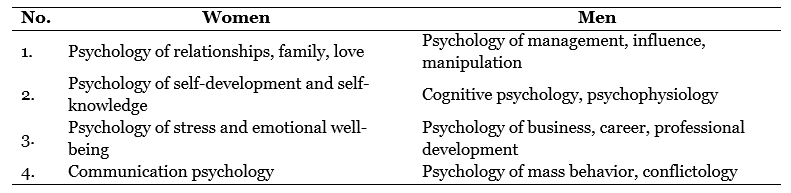
Gender differences (Table 2) were qualitative rather than quantitative. Women showed a slightly higher mean interest (Student’s T-test, 6.9 vs. 6.4, p ˂ o.05 ÷0.001) and focused on internal goals (self-understanding, harmonizing relationships), while men focused on external/instrumental goals (managing others, career effectiveness, social influence).
Table 2. Gender-Related Features of the Need for Psychological Knowledge
| No. | Women | Men |
| 1. | Psychology of relationships, family, love | Psychology of management, influence, manipulation |
| 2. | Psychology of self-development and self-knowledge | Cognitive psychology, psychophysiology |
| 3. | Psychology of stress and emotional well-being | Psychology of business, career, professional development |
| 4. | Communication psychology | Psychology of mass behavior, conflictology |
A comparative analysis of economically inactive groups (students and pensioners) revealed distinct patterns (ANOVA, p˂0.05). Students (mean interest 7.8) prioritized self-development, career, and influence, viewing psychology as a tool for professional growth (see: Aprelikova & Kitova, 2018). Pensioners (mean interest 5.2) focused on health, family, and passing on experience, seeing psychology as a source of life wisdom. The economically active “background” group showed an intermediate interest level (mean 6.4) with a focus on professional application (Table 3).
Table 3. Comparative Analysis: Economically Active vs. Inactive Respondents
| Parameter | Students (Inactive) | Working (Active) | Pensioners (Inactive) |
| Mean Interest Score | 7.8 | 6.4 | 5.1 |
| Top-1 Topic | Self-development (68%) | Personnel management (52%) | Family relationships (61%) |
| Motive “Earnings” | 34% | 18% | 3% |
| Motive “Helping Others” | 41% | 37% | 58% |
| Source: Internet | 72% | 43% | 12% |
| Source: Professional Literature | 28% | 61% | 9% |
| Image of Psychologist | “Helper”, “Mentor” | “Expert”, “Tool” | “Healer of the soul”, “Wise person” |
Discussion
The empirical findings yield several important insights into the nature of the need for psychological knowledge among economically inactive social groups. The core finding—a weak correlation between personality traits and interest in psychology (r ≈ .25)—challenges a purely dispositional account of this need. Instead, it underscores its dynamic, context‑dependent character as a response to life challenges. Interest in psychology appears to intensify when individuals face demands to understand themselves and others and when resources for such understanding are accessible. This aligns with the concept of age‑related developmental tasks (Erikson, 1968; Levinson, 2015), whereby young adults are engaged in forming intimate relationships and professional identity, whereas older adults confront tasks of ego integrity and generativity. Importantly, longitudinal research has demonstrated that the very construct of need for cognition (NFC) remains invariant across adult life stages: its internal structure, reliability, and pattern of external correlates (with cognitive abilities, personality traits, and activity engagement) are stable from age 18 to 99 (Soubelet & Salthouse, 2017). This implies that the lower interest in psychology observed among older adults reflects genuine age‑related changes in the strength of that interest rather than a shift in its meaning, thereby justifying cross‑age comparisons.
At the same time, in more homogeneous samples (psychology students), stronger associations were revealed between specific personality‑regulatory characteristics and interest in psychology (Bedina, 2022). Among students with high interest in psychology, medium and high levels of reflexivity (58.1% and 19.4%, respectively) and self‑regulation (54.8% and 38.7%) predominate; they also exhibit a pronounced self‑orientation (58%) and endorse values of independence (87%), security (72%), and achievement (71%). This highlights the importance of fine‑grained measurement of cognitive‑regulatory and value variables, which may be obscured when only broad personality inventories are used.
Age emerged as the strongest predictor of interest in psychology. Young people (18–25 years) showed consistently high interest (7.2–8.4 on a 10‑point scale), whereas older adults (60+ years) reported substantially lower interest (4.3–5.1). This trend is consistent with longitudinal data on the ontogenetic trajectory of need for cognition: levels of need for cognition are highest in young adulthood (up to age 24) and steadily decline after age 50 (Bruinsma & Crutzen, 2018). However, the decline among pensioners should not be interpreted as a lack of need; rather, it reflects a shift in how that need is expressed. Their interest moves from formal knowledge acquisition toward applying life experience in the domains of health, family, and interpersonal relationships, consistent with the concept of practical wisdom (Ryff, 1989). This interpretation is supported by their strong prosocial motivation (“helping others,” 58%). Moreover, despite the overall decline, the structure of relations between need for cognition and other variables remains unchanged across age groups: openness to experience consistently emerges as the strongest predictor of NFC (Soubelet & Salthouse, 2017). Hence, the diminished interest among pensioners may be partially attributable to age‑related declines in openness rather than solely to a decrease in cognitive motivation. According to Oiknine et al. (2021), need for cognition is negatively associated with prevention focus (an orientation toward safety). Because prevention motivation may increase with age, the decrease in interest among pensioners is likely attributable not only to reduced cognitive motivation but also to a shift in regulatory focus.
Interest in psychology among students is dynamic: according to Bedina (2022), it is highest among first‑ and second‑year students (8.1 points) and declines to 6.7 points by the fourth and fifth years, a pattern the author links to professional burnout and disillusionment with the practical utility of the discipline. This “first‑year effect” calls for deliberate efforts to sustain motivation in the later stages of training. Additional detail on the determinants of interest among youth is provided by the same study: internal factors include the desire to unite small groups (96.8%), self‑education (87.1%), the need to help others (64.5%), family conflicts (61.3%), and relationship difficulties (61.3%); external factors include the romanticization of mental disorders in the media (80.6%), mentions of psychology in the mass media (74.2%), demand for psychologists (74.2%), and the rise in mental health issues among young people (77.4%). The romanticization of disorders, a factor weakly captured by macro‑analysis of search queries but significant for the younger generation, deserves particular attention.
Gender differences were qualitative rather than quantitative, reflecting socially constructed roles and expectations. Women oriented toward harmonizing their inner world and interpersonal relationships (r = .58), whereas men focused on enhancing effectiveness in external activities and social influence (r = .62). This suggests that psychological knowledge is sought as a tool for navigating culturally prescribed life domains, consistent with the individualism‑collectivism framework (Triandis, 1995), in which different cultural and gender roles emphasize distinct aspects of the self.
The analysis of economically inactive groups (students and pensioners) reveals a critical gap in psychological research. As noted above, these groups often fall outside psychologists’ purview as “active subjects of life.” Yet our data show that they are actively engaged in acquiring psychological knowledge, albeit for different reasons and through different channels. Students use psychology as a “lift” for career and personal development, whereas pensioners use it as a resource for meaning‑making and prosocial connection. This heterogeneity calls for targeted educational and outreach programs. The experimental evidence on NFC malleability further suggests that such programs for pensioners should leverage engaging, cognitively stimulating activities that are perceived as enjoyable rather than as “learning,” thereby fostering interest in psychological knowledge through accessible and intrinsically motivating formats (Chen et al., 2024).
A factor that promotes resistance to pseudopsychology is need for cognition: individuals with high NFC are more critical of simplistic explanations (Oiknine et al., 2021). Educational initiatives should consider not only the content of knowledge but also the regulatory focus of the audience: for individuals with a prevention focus (more common in older groups), emphasizing the reliability of scientific approaches is important; for those with a promotion focus, opportunities for self‑development should be highlighted. In addition, individuals with high NFC tend to have higher cognitive abilities and greater openness to experience, and they demonstrate a more critical stance toward oversimplified accounts (Soubelet & Salthouse, 2017). Therefore, building resilience against pseudopsychology may require not merely providing correct answers but also cultivating critical thinking and stimulating cognitive motivation, especially in at‑risk groups such as older adults, whose overall interest in psychology—and likely their need for cognition—tends to be lower.
Our study did not directly assess need for cognition—a motivational trait characterized by a propensity for effortful thinking and enjoyment of complex intellectual tasks. This construct, measured with a validated instrument (Shepeleva et al., 2018), might have shown stronger associations with interest in psychological knowledge, especially among the younger subsample. A promising direction is the combination of macro‑analysis of digital traces with in‑depth psychometric examination of cognitive‑regulatory and value predictors. Data from Bedina (2022) indicate that reflexivity, self‑regulation, personality orientation, and values are significantly related to interest in psychology, whereas these relationships may be masked when only broad personality questionnaires are used. Integrating behavioral data with targeted psychological testing would enable more precise models of the need for psychological knowledge. Moreover, the present findings contribute to the ongoing discussion on the age invariance of motivational constructs. In line with Soubelet and Salthouse (2017), they suggest that age differences in interest reflect genuine developmental dynamics linked to shifts in social roles, life tasks, and possibly personality traits such as openness, rather than mere measurement artifacts.
Several limitations should be acknowledged. First, the digital trace data, though extensive, are restricted to users of specific platforms (Yandex, VKontakte) and may not fully represent the general population, particularly individuals with low digital literacy. Second, the survey component, despite its multi‑regional scope, used a cross‑sectional design, precluding causal inferences. Third, the use of self‑report to measure interest levels is subject to social desirability bias, although this limitation is partially mitigated by the integration of behavioral digital data.
Future research should prioritize longitudinal tracking of the need for psychological knowledge across the lifespan and in response to significant life events. Developing and validating a comprehensive instrument to assess both explicit and implicit components of this need, including cognitive, emotional, and motivational dimensions, is a critical next step. Cross‑cultural comparisons would further help disentangle universal psychological needs from culturally specific expressions of interest. Investigating the mechanisms underlying the 28.4% of discourse variance explained by the commercialization factor is essential for devising effective strategies to counter pseudopsychology and enhance scientific literacy in the population.
Conclusions
This study provides a comprehensive empirical analysis of the need for psychological knowledge among economically inactive social groups in Russia. The findings demonstrate that this need is widespread but shaped by a complex interplay of social-contextual factors, including age-related developmental tasks, gender-role expectations, regional context, and economic activity status. Critically, personality characteristics were found to be weak predictors, highlighting the primacy of situational and social factors. The distinct patterns observed among students (psychology as a tool for professional and personal ascent) and pensioners (psychology as a source of wisdom and prosocial support) underscore the necessity of targeted approaches. These groups, often marginalized in psychological research as “subjects of life,” actively utilize psychological knowledge to navigate their specific life stages. The practical implications are significant: developing age-appropriate and gender-sensitive educational programs, creating trusted resources for psychological knowledge to counter pseudoscience, and integrating psychological literacy initiatives into policies for youth and older adults. By addressing these needs, psychology can fulfill its potential as a resource for individual and societal well-being across the entire lifespan.
Ethics Statement: This study was conducted in accordance with the ethical principles of the Russian Psychological Society, including informed consent, confidentiality, and voluntary participation.
CRediT Author Statement: The authors have read and approved the final version of the manuscript. Kitova D. A.: methodology, formal analysis, writing—original draft; Zhuravlev A. L.: conceptualization, writing—review and editing; Aprelikova N. R.: investigation, formal analysis.
Funding: This research was carried out within the framework of the state assignment of the Ministry of Science and Higher Education of the Russian Federation (Project No. 0138-2026-0016, “Intellectual Systems and Human Abilities”).
Conflict of Interest: The author declares no competing interests.
References
- Ananyev, B. G. (2001). Man as an object of knowledge [Chelovek kak predmet poznaniya]. SPb: Piter.
- Aprelikova, N. R., & Kitova, D. A. (2018). The structure of students’ needs for knowledge in psychology. Institute of Psychology of the Russian Academy of Sciences. Social and economic psychology, 3(2), 110–133. [Struktura potrebnostey studencheskoy molodezhi v znaniyakh po psikhologii. Institut Psikhologii Rossiyskoy Akademii Nauk. Sotsial’naya i Ekonomicheskaya Psikhologiya].
- Aprelikova, N. R., & Kitova, D. A. (2019). The needs of Russian internet users for knowledge about psychology (based on Yandex search queries). In Methodology, theory, history of personality psychology, pp. 501–510. Publishing House “Institute of Psychology of the Russian Academy of Sciences”. [Potrebnosti rossiyskikh internet-pol’zovateley v znaniyakh o psikhologii (na primere poiskovykh zaprosov v Yandekse). InMetodologiya, teoriya, istoriya psikhologii lichnosti. Institut Psikhologii RAN].
- Aprelikova, N. R., & Kitova, D. A. (2020). The need for psychological knowledge and social education of personality. In Psychology and pedagogy of social education, 64–69. Publishing House “Kostroma State University”. [Potrebnosti v znaniyakh po psikhologii i sotsial’noye vospitaniye lichnosti. In Psikhologiya i pedagogika sotsial’nogo vospitaniya. Kostromskoy Gosudarstvennyy Universitet].
- Baltes, P. B., & Baltes, M. M. (1990). Psychological perspectives on successful aging: The model of selective optimization with compensation. In P. B. Baltes & M. M. Baltes (Eds.), Successful aging: Perspectives from the behavioral sciences(pp. 1–34). Cambridge University Press.
- Bedina, V. Yu. (2022). Social and psychological determinants of interest in psychology among young people. Psychological-pedagogical journal Gaudeamus, 21(1), 88–94. https://doi.org/10.20310/1810-231X-2022-21-1-88-94
- Bratus’, B. S. (1988). Anomalii lichnosti[Personality anomalies]. Mysl’.
- Bruinsma, J., & Crutzen, R. (2018). A longitudinal study on the stability of the need for cognition. Personality and Individual Differences, 127, 151–161. https://doi.org/10.1016/j.paid.2018.02.001
- Chen, Y., Chen, T., Wang, Y., & Jiang, X. (2024). The effect of cognitive leisure activities on cognitive reasoning among the elderly individuals: The mediating role of need for cognition. Current Psychology, 43, 36450–36459. https://doi.org/10.1007/s12144-024-07106-x
- Deci, E. L., & Ryan, R. M. (2000). The “what” and “why” of goal pursuits: Human needs and the self-determination of behavior. Psychological Inquiry, 11(4), 227–268.
- Dyachkov, A. A., & Gordeeva, P. A. (2022). The problem of cognition of subjectness and psychological knowledge. Bulletin of the Minsk University, 10(3), Article 16. [Problema poznaniya sub”ektnosti i psikhologicheskoye znaniye. Vestnik Mininskogo Universiteta, 10(3), Article 16].https://doi.org/10.26795/2307-1281-2022-10-3-16
- Erikson, E. H. (1968). Identity: Youth and crisis. Norton.
- Kermavnar, T., Avsec, A., Huang, S., & Desmet, P. M. A. (2024). Assessing basic/fundamental psychological need fulfillment: Systematic mapping and review of existing scales to foster cumulative science. Frontiers in Psychology, 15, Article 1427478. https://doi.org/10.3389/fpsyg.2024.1427478
- Kitova, D. A. (2019). The needs of internet users for psychological knowledge as a pedagogical resource of society. In Opportunities and risks of the digital environment, 84–88. Publishing House “Moscow State Psychological and Pedagogical University”. [Potrebnosti internet-pol’zovateley v znaniyakh po psikhologii kak pedagogicheskiy resurs obshchestva. In Vozmozhnosti i riski tsifrovoy sredy, pp. 84–88. Moskovskiy Gosudarstvennyy Psikhologo-Pedagogicheskiy Universitet].
- Kitova, D. A., & Aprelikova, N. R. (2019a). Attitudes of social network users toward psychological knowledge. Institute of Psychology of the Russian Academy of Sciences. Social and economic psychology, 4(2), 99–128. [Otnosheniye pol’zovateley sotsial’nykh setey k znaniyam po psikhologii. Institut Psikhologii Rossiyskoy Akademii Nauk. Sotsial’naya i Ekonomicheskaya Psikhologiya, 4(2), 99–128].
- Kitova, D. A., & Aprelikova, N. R. (2019b). The needs of Yandex users for psychological knowledge. RUDN Journal of Psychology and Pedagogics, 16(4), 618–633. https://doi.org/10.22363/2313-1683-2019-16-4-618-633
- Kitova, D. A., Aprelikova, N. R., & Kitov, M. A. (2022). Internet user needs in knowledge in psychology as a business resource. In Business psychology in international perspective: Theory and practice. Publishing House “National Research University Higher School of Economics”. https://doi.org/10.17323/978-5-7598-2571-5
- Leont’ev, A. N. (2005). Activity, consciousness, personality. Publishing House “Smysl”. [Deyatel’nost’. Soznaniye. Lichnost’. Smysl].
- Levinson, D. J. (2015). The seasons of a man’s life. Ballantine Books.
- Oiknine, A. H., Pollard, K. A., Khooshabeh, P., & Files, B. T. (2021). Need for cognition is positively related to promotion focus and negatively related to prevention focus. Frontiers in Psychology, 12, Article 606847. https://doi.org/10.3389/fpsyg.2021.606847
- Rubinshteyn, S. L. (2002). Foundations of general psychology. SPb: Piter. [Osnovy obshchey psikhologii, 2002. SPb: Piter].
- Ryan, R. M., & Deci, E. L. (2017). Self-determination theory: Basic psychological needs in motivation, development, and wellness. Guilford Press.
- Ryff, C. D. (1989). Happiness is everything, or is it? Explorations on the meaning of psychological well-being. Journal of Personality and Social Psychology, 57(6), 1069–1081.
- Sechenov, I. M. (2019). Brain reflexes. : AST. [Refleksy golovnogo mozga, 2019. M.: AST].
- Shepeleva, E. A., Valueva, E. A., & Lapteva, E. M. (2018). Need for Cognition: the comparative analysis of different researches and psycho-diagnostic approaches. Journal of Modern Foreign Psychology, 7(3), 115–125. https://doi.org/10.17759/jmfp.2018070311
- Soubelet, A., & Salthouse, T. A. (2017). Does need for cognition have the same meaning at different ages? Assessment, 24(8), 987–998. https://doi.org/10.1177/1073191116636449
- Triandis, H. C. (1995). Individualism and collectivism. Westview Press.
- Zhuravlev, A. L. (1988). Joint activity as an object of socio-psychological research. In Joint activity: Methodology, theory, practice, 19–36. Publishing House “Nauka”. [Sovmestnaya deyatel’nost’ kak ob”yekt sotsial’no-psikhologicheskogo issledovaniya. InSovmestnaya deyatel’nost’: metodologiya, teoriya, praktika, pp. 19–36. Nauka].
- Zhuravlev, A. L., & Kitova, D. A. (2025). Economic-psychological factors in the context of demographic processes. In In Economic psychology of human and societal activity: Conceptual frameworks and empirical findings, 246–269. [Ekonomiko-psikhologicheskiye faktory v kontekste razvitiya demograficheskikh protsessov. Ekonomicheskaya psikhologiya zhiznedeyatel’nosti cheloveka i obshchestva: kontseptual’nyye predstavleniya i empiricheskiye rezul’taty,pp. 246–269. Institut Psikhologii RAN].
Comments (0)
Relevance and Background. In an era of profound social transformation and the proliferation of pseudoscientific psychological content, understanding the genuine demand for scientific psychological knowledge has become a critical societal imperative. While public interest in psychology is growing, it is paradoxically accompanied by the widespread acceptance of simplified, often unscientific, conceptions of the mind, leaving scientifically grounded knowledge inaccessible to a large portion of the population. This disconnect necessitates a systematic investigation into the need for psychological knowledge, conceptualized as a multidimensional socio-psychological phenomenon encompassing cognitive, motivational, value-based, and reflexive components. Addressing this gap is essential for developing evidence-based educational interventions and counteracting the dissemination of non-scientific psychological narratives. Objective. This study aims to identify the individual and socio‑psychological determinants of the need for psychological knowledge among economically inactive social groups (students and retirees), with a focus on regional, gender, and age‑specific variations. Methods. A mixed‑methods approach was used, combining digital trace data and survey responses. The empirical base included over 2.2 million Yandex search queries, automated content analysis of 1694 posts from the VKontakte social network (2019–2025), and a survey of 522 respondents from three Russian regions (Irkutsk region, Karachay‑Cherkess Republic, and Moscow). Analytical techniques comprised digital footprint analysis, correlation and factor analyses, ANOVA, and comparative group analysis. Validated instruments (e.g., adapted MSCEIT, ZTPI, SJO) were used to assess personality characteristics. Results. Interest in psychological knowledge proved to be widespread (popularity index 101%) yet markedly heterogeneous across regions, peaking in the Far Eastern (115%), Siberian (112%), and Southern (108%) federal districts. Counter to common assumptions, personal characteristics correlated only weakly with interest (r ≈ 0.25). Age emerged as the strongest predictor: students (18–25 years) reported high interest (mean 7.8/10) oriented toward self‑development and career, whereas retirees (60+ years) showed moderate interest (mean 5.2/10) focused on health and interpersonal relationships. Gender differences were qualitative rather than quantitative: women’s interest was linked to internal harmony and relational well‑being (r = 0.58), while men’s interest centered on external effectiveness and social influence (r = 0.62). Discourse analysis revealed that online discussions about psychology were dominated by commercialized (28.4% of variance) and politicized (21.7%) content, highlighting a critical challenge for science communication. Conclusion. The need for psychological knowledge is a dynamic, context‑sensitive phenomenon shaped primarily by age‑related developmental tasks, gender‑specific orientations, and regional access to educational resources—not by stable personality dispositions. The distinct profiles of students and retirees underscore the urgency of developing targeted educational programs and public outreach strategies that bridge the divide between scientific psychology and public demand. The findings also sound a cautionary note: without systematic intervention, the public’s legitimate interest in psychology risks being captured by commercial and pseudoscientific actors.
Потребность в психологических знаниях у экономически неактивных социальных групп
Д.А. Китова 1, А.Л. Журавлев 1, Н.Р. Апреликова 2
1 Институт психологии Российской академии наук, Москва, Россия
2 Российский университет спорта, Москва, Россия
Резюме. Актуальность и обоснование. В эпоху глубоких социальных трансформаций и распространения псевдонаучного психологического контента понимание реального запроса на научное психологическое знание становится важной социальной задачей. При том что интерес общества к психологии растет, он парадоксальным образом сопровождается широким принятием упрощенных, часто ненаучных представлений о психике, тогда как подлинно научное знание остается недоступным для значительной части населения. Данное противоречие требует систематического изучения потребности в психологических знаниях, понимаемой как многомерное социально-психологическое явление, интегрирующее когнитивные, мотивационные, ценностные и рефлексивные компоненты. Решение этой проблемы необходимо для разработки научно обоснованных образовательных интервенций и противодействия распространению ненаучных психологических нарративов. Цель. Исследование направлено на выявление индивидуальных и социально-психологических детерминант потребности в психологических знаниях у экономически неактивных социальных групп (студентов и пенсионеров) с учетом региональных, гендерных и возрастных особенностей. Методы. Использован смешанный дизайн, объединяющий анализ цифровых следов и данные опроса. Эмпирическую базу составили более 2,2 млн поисковых запросов в Яндекс, автоматизированный контент-анализ 1694 сообщений в социальной сети ВКонтакте (2019–2025 гг.), а также опрос 522 респондентов из трех регионов России (Карачаево-Черкесская Республика, Иркутская область, Москва). Аналитические методы включали анализ цифровых следов, корреляционный и факторный анализ, дисперсионный анализ (ANOVA) и сравнительный анализ групп. Для оценки личностных характеристик использовались валидизированные инструменты (например, адаптированные MSCEIT, ZTPI, SJO). Результаты. Интерес к психологическим знаниям носит массовый характер (индекс популярности 101%), однако существенно различается по регионам, достигая максимума в Дальневосточном (115%), Сибирском (112%) и Южном (108%) федеральных округах. Вопреки распространенным предположениям, личностные характеристики слабо коррелируют с уровнем интереса (r ≈ 0.25). Наиболее сильным предиктором выступил возраст: студенты (18–25 лет) демонстрируют высокий интерес (средний балл 7,8 из 10), ориентированный на саморазвитие и карьеру, тогда как пенсионеры (60+ лет) проявляют умеренный интерес (средний балл 5,2), сосредоточенный на темах здоровья и межличностных отношений. Гендерные различия носят качественный, а не количественный характер: интерес женщин связан с внутренней гармонией и благополучием в отношениях (r = 0.58), тогда как интерес мужчин сконцентрирован на внешней эффективности и социальном влиянии (r = 0.62). Дискурс-анализ показал, что в онлайн-обсуждениях психологии доминирует коммерциализированный (28.4% дисперсии) и политизированный (21.7%) контент, что создает серьезный вызов для научной коммуникации. Заключение. Потребность в психологических знаниях представляет собой динамичный, контекстно-зависимый феномен, формируемый преимущественно возрастными задачами развития, гендерными ориентациями и региональной доступностью образовательных ресурсов, а не устойчивыми личностными диспозициями. Выявленные различия в профилях студентов и пенсионеров указывают на необходимость разработки адресных образовательных программ и стратегий просвещения, которые преодолевают разрыв между научной психологией и общественным запросом. Полученные данные также служат предостережением: без систематических вмешательств закономерный интерес общества к психологии рискует быть захваченным коммерческими и псевдонаучными акторами.
Ключевые слова: потребность в знаниях, психологическое знание, экономически неактивные группы, студенты, пенсионеры, социальная психология, цифровое поведение, поисковые запросы, гендерные различия, возрастная психология.
Contemporary society is undergoing profound transformations that permeate all spheres of social life, from interpersonal relationships to global communications. In this context, knowledge about the mechanisms of social cognition, motivation, group dynamics, and psychological regulation of behavior acquires particular significance (Aprelikova, Kitova, 2019, 2020; Zhuravlev, Kitova, 2025; Kitova, 2019). Psychology, especially its social dimension, serves not only as a science of human beings in society but also as a resource for the sustainable development of personality and social institutions.
However, alongside a growing interest in psychological knowledge, a paradoxical deformation is observed in society: simplified, often pseudoscientific notions of the mind are becoming widespread, while genuinely scientific understanding remains inaccessible to a significant portion of the population (Kitova, Aprelikova, 2019a, b). This situation necessitates addressing a fundamental problem: the need for psychological knowledge, understood as a multidimensional socio-psychological phenomenon integrating cognitive, motivational, value-based, and reflective components.
A central theoretical issue thus arises: how do scientific and everyday forms of psychological knowledge relate, and what cognitive, emotional, and social mechanisms underpin the need to acquire them? This question resonates with the interdisciplinary integration and transformation of scientific knowledge (Ananyev, 2001; Bratus, 1988; Zhuravlev, 1988; Leontiev, 2005; Rubinshtein, 2002; Sechenov, 2019), where psychology occupies a central yet contradictory position—aspiring to scientific rigor while being deeply incorporated into everyday consciousness, often in distorted forms.
From a methodological standpoint, the problem of studying the need for psychological knowledge remains underdeveloped in both Russian (e.g., Aprelikova, Kitova, 2019; Zhuravlev, Kitova, 2025) and international literature (Baltes & Baltes, 1990; Deci & Ryan, 2000; Erikson, 1968; Ryff, 1989; Triandis, 1995). Existing approaches often fail to account for the reflexive, personally meaningful, and ethically charged nature of psychological knowledge specifically. Furthermore, there is a lack of specialized, validated instruments for its measurement, forcing researchers to rely on borrowed scales, unvalidated author questionnaires, or fragmented qualitative data, which complicates comparative and quantitative research.
In Western psychology, the concept of “need for cognition,” which refers to an intrinsic motivation to engage in thinking and derive pleasure from intellectual work (Shepeleva et al., 2018)—offers a relevant parallel. This characteristic, sensitive to age and positively related to academic performance, aligns with our understanding of interest in psychology as a manifested cognitive need.
Importantly, need for cognition is positively correlated with a promotion focus (orientation toward achievements and self-development) and negatively with a prevention focus (orientation toward safety and risk minimization) (Oiknine et al., 2021). Within the framework of Self-Determination Theory, basic psychological needs for autonomy, competence, and relatedness play a key role in motivational regulation (Ryan & Deci, 2017; Kermavnar et al., 2024). Thus, age, gender, and status differences in interest in psychology may be mediated not only by cognitive motivation but also by the degree of satisfaction of these basic needs. In Russian psychology, the concept of “subjectness” (subjektnost’)—the individual’s capacity for self-identification, life strategy construction, and responsibility for one’s actions—is closely related (Dyachkov, Gordeeva, 2022). Cognitive subjectness can be viewed as an integrative quality shaped by the need for cognition and the fulfillment of basic psychological needs, linking variations in psychological interest to deeper motivational and personal foundations.
The practical urgency of this problem is underscored by the growing demand for psychological knowledge in education, the need to enhance psychological literacy among the general population (including counteracting pseudopsychology), its relevance in interdisciplinary fields (management, medicine), and the challenges of digitalization, which creates an illusion of understanding widely available psychological content without deep comprehension. A particularly noteworthy factor among youth is the romanticization of mental disorders in literature, cinema, and media (cited by 80.6% of students in one study), alongside the demand for self-education (87.1%) and cohesion in small groups (96.8%) (Bedina, 2022). These factors must be accounted for in designing educational programs aligned with genuine motives.
This study specifically examines the need for psychological knowledge among economically inactive social groups—students and pensioners (Kitova & Aprelikova, 2019). Due to their lack full economic engagement, these population categories often “fall out” of the focus of social psychologists as “active subjects of life,” a trend inconsistent with the traditions of the Russian psychological school, which views the individual as an active subject of labor, cognition, and communication (Rubinstein, Leontiev, Ananyev). Understanding their specific needs is therefore both theoretically and practically essential.
A key methodological innovation of this research is the move from studying declared (self‑reported) needs to their manifested forms—interest as observable action. Interest, understood within the Russian psychological tradition (Rubinstein, Leontiev) as the subject’s activity arising in response to cognitive imbalance, serves as a reliable indicator of genuine, enacted need. This approach enables the use of objective behavioral data from real and digital spaces, bypassing systematic biases (social desirability, cognitive distortions, intention‑action gaps) inherent in traditional self‑report methods.
Thus, addressing this problem has systemic importance: it contributes to the development of psychology as a science and helps shape a critically thinking, emotionally competent “subject of modernity”—one capable of consciously perceiving, analyzing, and applying psychological knowledge in a changing world. This study is guided by the hypothesis that the need for psychological knowledge among students and pensioners has a specific structure determined by age-related developmental tasks, social status, regional context, and personality and personal traits. The aim of this research is to identify the individual-personal and socio-psychological factors underlying the need for psychological knowledge among these economically inactive groups, considering regional, gender, and age-specific characteristics.
2.1. Sample
The study’s empirical base comprised three main components:
- Digital Trace Data:Over 2.2 million Yandex search queries containing the word “psychology” (or its Russian equivalent), collected from users across Russia.
- Social Media Content:1,694 unique messages from the Russian social network VKontakte, posted between 2019 and 2025.
- Survey Respondents:A total of 522 respondents from three Russian regions: Moscow (n=272, with 129 economically inactive and 143 economically active), Irkutsk (n=123), and Karachayevsk (n=127). Respondents’ ages ranged from 18 to 80 years. The gender distribution was balanced (259 males, 263 females). The sample included students, pensioners, and, as a “background” group, economically active individuals (mid-level specialists, workers, managers, homemakers, and the unemployed)
2.2. Instruments and Procedure
The study employed a mixed-methods design integrating quantitative and qualitative analyses of digital and survey data.
Digital Behavior Analysis:
- Search Query Analysis:Frequency and thematic analysis of Yandex search queries was conducted to assess the popularity and regional variation of interest in psychology.
- Automated Content Analysis:Texts from VKontakte were analyzed using an automated system for text extraction and analysis, which included data cleaning, tokenization, morphological analysis, and frequency analysis.
- Manual Coding and Thematic Analysis:Primary immersive study of the text corpus, open coding, grouping of primary codes, and selective coding were performed to identify thematic structures and emotional tones within the discourse.
2. Survey and Psychometric Assessment: Respondents completed a battery of validated instruments:
- Need for Psychological Knowledge:Assessed via a self-report scale (1-10) and open-ended questions about topics of interest, motivations, and sources of knowledge.
- Emotional Intelligence: Adapted version of the MSCEIT (30 items, 5-point Likert scale) measuring understanding of one’s own emotions, managing emotions, empathy, and influencing others.
- Time Perspective:Zimbardo Time Perspective Inventory (ZTPI), adapted by A. Syrtsova (56 items, 5 scales: Past-Negative, Past-Positive, Present-Fatalistic, Present-Hedonistic, Future).
- Meaning in Life:Test of Life-Sense Orientations (SJO), an adaptation of the Purpose in Life Test (20 paired statements, 5 scales).
- Sensation Seeking:Adapted Sensation Seeking Scale (13 paired statements).
Conformity:Adapted version of A. Mehrabian’s scale (15 items).Statistical Analysis
2.3. Statistical AnalysisData were analyzed using SPSS 26.0. Statistical methods included:
- Descriptive statistics.
- Pearson and Spearman correlation analyses to assess relationships between interest in psychology and personal characteristics.
- ANOVA with post-hoc Tukey tests to compare mean interest scores across groups (age, gender, region, economic activity status).
- Student’s t-test for independent samples to analyze gender differences.
- Factor analysis (principal component analysis with Varimax rotation) to identify latent determinants within the social media discourse.
- Correlation analysis of concepts based on co-occurrence (Spearman correlation, Chi-square (χ²) test).
3.1. Digital Behavior Analysis: Regional and Thematic Interest
Analysis of Yandex search queries revealed a high overall interest in psychology (popularity index 101%), but with significant regional variation (Aprelikova & Kitova, 2019; Kitova et al., 2022). The highest interest was in the Far Eastern (115%), Siberian (112%), and Southern (108%) federal districts, while lower interest was observed in the Central and Northwestern (96%) and Crimean (91%) districts (Chi-square test, p˂0.05).
Thematic analysis of queries and social media texts (N=694) identified key areas of interest: applied, personally significant domains (42.7%, e.g., personality, social psychology, relationships); academic/educational topics (15.1%); developmental and pedagogical psychology (14.2%); research and general psychology (~8-9%); methodology and practical psychology (7.3%); and clinical psychology (1.7%).
3.2. Discourse Analysis: Determinants and Polarization
Factor analysis of the social media discourse identified six key determinants: Commercialization (explaining 28.4% of variance), Politicization (21.7%), Gender Polarization (17.3%), Scientific Legitimacy (14.2%), Therapeutic Effectiveness (11.8%), and Esotericization (6.6%).
Gender analysis showed significant differences: male-authored texts were more likely to contain criticism of psychology (r=0.62, p<0.01), particularly its political use, while female-authored texts focused on relationships (r=0.58, p<0.01) and self-help (r=0.41, p<0.05).
The overall emotional tone of the discourse was mixed, with 37.4% negative, 26.4% positive, and 36.2% neutral evaluations.
3.3. Survey Results: Personality, Demographics, and Group Comparisons
Correlation analysis between personality characteristics (emotional intelligence, time perspective, meaning in life, sensation seeking, conformity) and self-reported interest in psychology revealed a weak, non-significant positive correlation (r<0.25, p>0.05), suggesting that personality traits are not predictors of interest in psychology.
Age was the strongest predictor (Table 1). Interest was highest among respondents aged 18-25 (mean 7.8-8.4) and decreased significantly with age (ANOVA, p˂0.05), with respondents over 55 reporting lower interest (mean 4.3-5.1).
Table 1. Age-Related Features of the Need for Psychological Knowledge
| No. | Age Group | Mean Need Score (1-10) | Characteristics of Responses |
| 1. | 18-25 years | 7.2 | High interest in self-development, relationships, emotion management |
| 2. | 26-40 years | 6.8 | Emphasis on professional psychology, personnel management |
| 3. | 41-60 years | 5.9 | Interest in family psychology, crises, health |
| 4. | 60+ years | 4.7 | Lower interest, focus on interpersonal relationships |
Gender differences (Table 2) were qualitative rather than quantitative. Women showed a slightly higher mean interest (Student’s T-test, 6.9 vs. 6.4, p ˂ o.05 ÷0.001) and focused on internal goals (self-understanding, harmonizing relationships), while men focused on external/instrumental goals (managing others, career effectiveness, social influence).
Table 2. Gender-Related Features of the Need for Psychological Knowledge
| No. | Women | Men |
| 1. | Psychology of relationships, family, love | Psychology of management, influence, manipulation |
| 2. | Psychology of self-development and self-knowledge | Cognitive psychology, psychophysiology |
| 3. | Psychology of stress and emotional well-being | Psychology of business, career, professional development |
| 4. | Communication psychology | Psychology of mass behavior, conflictology |
A comparative analysis of economically inactive groups (students and pensioners) revealed distinct patterns (ANOVA, p˂0.05). Students (mean interest 7.8) prioritized self-development, career, and influence, viewing psychology as a tool for professional growth (see: Aprelikova & Kitova, 2018). Pensioners (mean interest 5.2) focused on health, family, and passing on experience, seeing psychology as a source of life wisdom. The economically active “background” group showed an intermediate interest level (mean 6.4) with a focus on professional application (Table 3).
Table 3. Comparative Analysis: Economically Active vs. Inactive Respondents
| Parameter | Students (Inactive) | Working (Active) | Pensioners (Inactive) |
| Mean Interest Score | 7.8 | 6.4 | 5.1 |
| Top-1 Topic | Self-development (68%) | Personnel management (52%) | Family relationships (61%) |
| Motive “Earnings” | 34% | 18% | 3% |
| Motive “Helping Others” | 41% | 37% | 58% |
| Source: Internet | 72% | 43% | 12% |
| Source: Professional Literature | 28% | 61% | 9% |
| Image of Psychologist | “Helper”, “Mentor” | “Expert”, “Tool” | “Healer of the soul”, “Wise person” |
The empirical findings yield several important insights into the nature of the need for psychological knowledge among economically inactive social groups. The core finding—a weak correlation between personality traits and interest in psychology (r ≈ .25)—challenges a purely dispositional account of this need. Instead, it underscores its dynamic, context‑dependent character as a response to life challenges. Interest in psychology appears to intensify when individuals face demands to understand themselves and others and when resources for such understanding are accessible. This aligns with the concept of age‑related developmental tasks (Erikson, 1968; Levinson, 2015), whereby young adults are engaged in forming intimate relationships and professional identity, whereas older adults confront tasks of ego integrity and generativity. Importantly, longitudinal research has demonstrated that the very construct of need for cognition (NFC) remains invariant across adult life stages: its internal structure, reliability, and pattern of external correlates (with cognitive abilities, personality traits, and activity engagement) are stable from age 18 to 99 (Soubelet & Salthouse, 2017). This implies that the lower interest in psychology observed among older adults reflects genuine age‑related changes in the strength of that interest rather than a shift in its meaning, thereby justifying cross‑age comparisons.
At the same time, in more homogeneous samples (psychology students), stronger associations were revealed between specific personality‑regulatory characteristics and interest in psychology (Bedina, 2022). Among students with high interest in psychology, medium and high levels of reflexivity (58.1% and 19.4%, respectively) and self‑regulation (54.8% and 38.7%) predominate; they also exhibit a pronounced self‑orientation (58%) and endorse values of independence (87%), security (72%), and achievement (71%). This highlights the importance of fine‑grained measurement of cognitive‑regulatory and value variables, which may be obscured when only broad personality inventories are used.
Age emerged as the strongest predictor of interest in psychology. Young people (18–25 years) showed consistently high interest (7.2–8.4 on a 10‑point scale), whereas older adults (60+ years) reported substantially lower interest (4.3–5.1). This trend is consistent with longitudinal data on the ontogenetic trajectory of need for cognition: levels of need for cognition are highest in young adulthood (up to age 24) and steadily decline after age 50 (Bruinsma & Crutzen, 2018). However, the decline among pensioners should not be interpreted as a lack of need; rather, it reflects a shift in how that need is expressed. Their interest moves from formal knowledge acquisition toward applying life experience in the domains of health, family, and interpersonal relationships, consistent with the concept of practical wisdom (Ryff, 1989). This interpretation is supported by their strong prosocial motivation (“helping others,” 58%). Moreover, despite the overall decline, the structure of relations between need for cognition and other variables remains unchanged across age groups: openness to experience consistently emerges as the strongest predictor of NFC (Soubelet & Salthouse, 2017). Hence, the diminished interest among pensioners may be partially attributable to age‑related declines in openness rather than solely to a decrease in cognitive motivation. According to Oiknine et al. (2021), need for cognition is negatively associated with prevention focus (an orientation toward safety). Because prevention motivation may increase with age, the decrease in interest among pensioners is likely attributable not only to reduced cognitive motivation but also to a shift in regulatory focus.
Interest in psychology among students is dynamic: according to Bedina (2022), it is highest among first‑ and second‑year students (8.1 points) and declines to 6.7 points by the fourth and fifth years, a pattern the author links to professional burnout and disillusionment with the practical utility of the discipline. This “first‑year effect” calls for deliberate efforts to sustain motivation in the later stages of training. Additional detail on the determinants of interest among youth is provided by the same study: internal factors include the desire to unite small groups (96.8%), self‑education (87.1%), the need to help others (64.5%), family conflicts (61.3%), and relationship difficulties (61.3%); external factors include the romanticization of mental disorders in the media (80.6%), mentions of psychology in the mass media (74.2%), demand for psychologists (74.2%), and the rise in mental health issues among young people (77.4%). The romanticization of disorders, a factor weakly captured by macro‑analysis of search queries but significant for the younger generation, deserves particular attention.
Gender differences were qualitative rather than quantitative, reflecting socially constructed roles and expectations. Women oriented toward harmonizing their inner world and interpersonal relationships (r = .58), whereas men focused on enhancing effectiveness in external activities and social influence (r = .62). This suggests that psychological knowledge is sought as a tool for navigating culturally prescribed life domains, consistent with the individualism‑collectivism framework (Triandis, 1995), in which different cultural and gender roles emphasize distinct aspects of the self.
The analysis of economically inactive groups (students and pensioners) reveals a critical gap in psychological research. As noted above, these groups often fall outside psychologists’ purview as “active subjects of life.” Yet our data show that they are actively engaged in acquiring psychological knowledge, albeit for different reasons and through different channels. Students use psychology as a “lift” for career and personal development, whereas pensioners use it as a resource for meaning‑making and prosocial connection. This heterogeneity calls for targeted educational and outreach programs. The experimental evidence on NFC malleability further suggests that such programs for pensioners should leverage engaging, cognitively stimulating activities that are perceived as enjoyable rather than as “learning,” thereby fostering interest in psychological knowledge through accessible and intrinsically motivating formats (Chen et al., 2024).
A factor that promotes resistance to pseudopsychology is need for cognition: individuals with high NFC are more critical of simplistic explanations (Oiknine et al., 2021). Educational initiatives should consider not only the content of knowledge but also the regulatory focus of the audience: for individuals with a prevention focus (more common in older groups), emphasizing the reliability of scientific approaches is important; for those with a promotion focus, opportunities for self‑development should be highlighted. In addition, individuals with high NFC tend to have higher cognitive abilities and greater openness to experience, and they demonstrate a more critical stance toward oversimplified accounts (Soubelet & Salthouse, 2017). Therefore, building resilience against pseudopsychology may require not merely providing correct answers but also cultivating critical thinking and stimulating cognitive motivation, especially in at‑risk groups such as older adults, whose overall interest in psychology—and likely their need for cognition—tends to be lower.
Our study did not directly assess need for cognition—a motivational trait characterized by a propensity for effortful thinking and enjoyment of complex intellectual tasks. This construct, measured with a validated instrument (Shepeleva et al., 2018), might have shown stronger associations with interest in psychological knowledge, especially among the younger subsample. A promising direction is the combination of macro‑analysis of digital traces with in‑depth psychometric examination of cognitive‑regulatory and value predictors. Data from Bedina (2022) indicate that reflexivity, self‑regulation, personality orientation, and values are significantly related to interest in psychology, whereas these relationships may be masked when only broad personality questionnaires are used. Integrating behavioral data with targeted psychological testing would enable more precise models of the need for psychological knowledge. Moreover, the present findings contribute to the ongoing discussion on the age invariance of motivational constructs. In line with Soubelet and Salthouse (2017), they suggest that age differences in interest reflect genuine developmental dynamics linked to shifts in social roles, life tasks, and possibly personality traits such as openness, rather than mere measurement artifacts.
Several limitations should be acknowledged. First, the digital trace data, though extensive, are restricted to users of specific platforms (Yandex, VKontakte) and may not fully represent the general population, particularly individuals with low digital literacy. Second, the survey component, despite its multi‑regional scope, used a cross‑sectional design, precluding causal inferences. Third, the use of self‑report to measure interest levels is subject to social desirability bias, although this limitation is partially mitigated by the integration of behavioral digital data.
Future research should prioritize longitudinal tracking of the need for psychological knowledge across the lifespan and in response to significant life events. Developing and validating a comprehensive instrument to assess both explicit and implicit components of this need, including cognitive, emotional, and motivational dimensions, is a critical next step. Cross‑cultural comparisons would further help disentangle universal psychological needs from culturally specific expressions of interest. Investigating the mechanisms underlying the 28.4% of discourse variance explained by the commercialization factor is essential for devising effective strategies to counter pseudopsychology and enhance scientific literacy in the population.
This study provides a comprehensive empirical analysis of the need for psychological knowledge among economically inactive social groups in Russia. The findings demonstrate that this need is widespread but shaped by a complex interplay of social-contextual factors, including age-related developmental tasks, gender-role expectations, regional context, and economic activity status. Critically, personality characteristics were found to be weak predictors, highlighting the primacy of situational and social factors. The distinct patterns observed among students (psychology as a tool for professional and personal ascent) and pensioners (psychology as a source of wisdom and prosocial support) underscore the necessity of targeted approaches. These groups, often marginalized in psychological research as “subjects of life,” actively utilize psychological knowledge to navigate their specific life stages. The practical implications are significant: developing age-appropriate and gender-sensitive educational programs, creating trusted resources for psychological knowledge to counter pseudoscience, and integrating psychological literacy initiatives into policies for youth and older adults. By addressing these needs, psychology can fulfill its potential as a resource for individual and societal well-being across the entire lifespan.
Ethics Statement: This study was conducted in accordance with the ethical principles of the Russian Psychological Society, including informed consent, confidentiality, and voluntary participation.
CRediT Author Statement: The authors have read and approved the final version of the manuscript. Kitova D. A.: methodology, formal analysis, writing—original draft; Zhuravlev A. L.: conceptualization, writing—review and editing; Aprelikova N. R.: investigation, formal analysis.
Funding: This research was carried out within the framework of the state assignment of the Ministry of Science and Higher Education of the Russian Federation (Project No. 0138-2026-0016, “Intellectual Systems and Human Abilities”).
Conflict of Interest: The author declares no competing interests.
- Ananyev, B. G. (2001). Man as an object of knowledge [Chelovek kak predmet poznaniya]. SPb: Piter.
- Aprelikova, N. R., & Kitova, D. A. (2018). The structure of students’ needs for knowledge in psychology. Institute of Psychology of the Russian Academy of Sciences. Social and economic psychology, 3(2), 110–133. [Struktura potrebnostey studencheskoy molodezhi v znaniyakh po psikhologii. Institut Psikhologii Rossiyskoy Akademii Nauk. Sotsial’naya i Ekonomicheskaya Psikhologiya].
- Aprelikova, N. R., & Kitova, D. A. (2019). The needs of Russian internet users for knowledge about psychology (based on Yandex search queries). In Methodology, theory, history of personality psychology, pp. 501–510. Publishing House “Institute of Psychology of the Russian Academy of Sciences”. [Potrebnosti rossiyskikh internet-pol’zovateley v znaniyakh o psikhologii (na primere poiskovykh zaprosov v Yandekse). InMetodologiya, teoriya, istoriya psikhologii lichnosti. Institut Psikhologii RAN].
- Aprelikova, N. R., & Kitova, D. A. (2020). The need for psychological knowledge and social education of personality. In Psychology and pedagogy of social education, 64–69. Publishing House “Kostroma State University”. [Potrebnosti v znaniyakh po psikhologii i sotsial’noye vospitaniye lichnosti. In Psikhologiya i pedagogika sotsial’nogo vospitaniya. Kostromskoy Gosudarstvennyy Universitet].
- Baltes, P. B., & Baltes, M. M. (1990). Psychological perspectives on successful aging: The model of selective optimization with compensation. In P. B. Baltes & M. M. Baltes (Eds.), Successful aging: Perspectives from the behavioral sciences(pp. 1–34). Cambridge University Press.
- Bedina, V. Yu. (2022). Social and psychological determinants of interest in psychology among young people. Psychological-pedagogical journal Gaudeamus, 21(1), 88–94. https://doi.org/10.20310/1810-231X-2022-21-1-88-94
- Bratus’, B. S. (1988). Anomalii lichnosti[Personality anomalies]. Mysl’.
- Bruinsma, J., & Crutzen, R. (2018). A longitudinal study on the stability of the need for cognition. Personality and Individual Differences, 127, 151–161. https://doi.org/10.1016/j.paid.2018.02.001
- Chen, Y., Chen, T., Wang, Y., & Jiang, X. (2024). The effect of cognitive leisure activities on cognitive reasoning among the elderly individuals: The mediating role of need for cognition. Current Psychology, 43, 36450–36459. https://doi.org/10.1007/s12144-024-07106-x
- Deci, E. L., & Ryan, R. M. (2000). The “what” and “why” of goal pursuits: Human needs and the self-determination of behavior. Psychological Inquiry, 11(4), 227–268.
- Dyachkov, A. A., & Gordeeva, P. A. (2022). The problem of cognition of subjectness and psychological knowledge. Bulletin of the Minsk University, 10(3), Article 16. [Problema poznaniya sub”ektnosti i psikhologicheskoye znaniye. Vestnik Mininskogo Universiteta, 10(3), Article 16].https://doi.org/10.26795/2307-1281-2022-10-3-16
- Erikson, E. H. (1968). Identity: Youth and crisis. Norton.
- Kermavnar, T., Avsec, A., Huang, S., & Desmet, P. M. A. (2024). Assessing basic/fundamental psychological need fulfillment: Systematic mapping and review of existing scales to foster cumulative science. Frontiers in Psychology, 15, Article 1427478. https://doi.org/10.3389/fpsyg.2024.1427478
- Kitova, D. A. (2019). The needs of internet users for psychological knowledge as a pedagogical resource of society. In Opportunities and risks of the digital environment, 84–88. Publishing House “Moscow State Psychological and Pedagogical University”. [Potrebnosti internet-pol’zovateley v znaniyakh po psikhologii kak pedagogicheskiy resurs obshchestva. In Vozmozhnosti i riski tsifrovoy sredy, pp. 84–88. Moskovskiy Gosudarstvennyy Psikhologo-Pedagogicheskiy Universitet].
- Kitova, D. A., & Aprelikova, N. R. (2019a). Attitudes of social network users toward psychological knowledge. Institute of Psychology of the Russian Academy of Sciences. Social and economic psychology, 4(2), 99–128. [Otnosheniye pol’zovateley sotsial’nykh setey k znaniyam po psikhologii. Institut Psikhologii Rossiyskoy Akademii Nauk. Sotsial’naya i Ekonomicheskaya Psikhologiya, 4(2), 99–128].
- Kitova, D. A., & Aprelikova, N. R. (2019b). The needs of Yandex users for psychological knowledge. RUDN Journal of Psychology and Pedagogics, 16(4), 618–633. https://doi.org/10.22363/2313-1683-2019-16-4-618-633
- Kitova, D. A., Aprelikova, N. R., & Kitov, M. A. (2022). Internet user needs in knowledge in psychology as a business resource. In Business psychology in international perspective: Theory and practice. Publishing House “National Research University Higher School of Economics”. https://doi.org/10.17323/978-5-7598-2571-5
- Leont’ev, A. N. (2005). Activity, consciousness, personality. Publishing House “Smysl”. [Deyatel’nost’. Soznaniye. Lichnost’. Smysl].
- Levinson, D. J. (2015). The seasons of a man’s life. Ballantine Books.
- Oiknine, A. H., Pollard, K. A., Khooshabeh, P., & Files, B. T. (2021). Need for cognition is positively related to promotion focus and negatively related to prevention focus. Frontiers in Psychology, 12, Article 606847. https://doi.org/10.3389/fpsyg.2021.606847
- Rubinshteyn, S. L. (2002). Foundations of general psychology. SPb: Piter. [Osnovy obshchey psikhologii, 2002. SPb: Piter].
- Ryan, R. M., & Deci, E. L. (2017). Self-determination theory: Basic psychological needs in motivation, development, and wellness. Guilford Press.
- Ryff, C. D. (1989). Happiness is everything, or is it? Explorations on the meaning of psychological well-being. Journal of Personality and Social Psychology, 57(6), 1069–1081.
- Sechenov, I. M. (2019). Brain reflexes. : AST. [Refleksy golovnogo mozga, 2019. M.: AST].
- Shepeleva, E. A., Valueva, E. A., & Lapteva, E. M. (2018). Need for Cognition: the comparative analysis of different researches and psycho-diagnostic approaches. Journal of Modern Foreign Psychology, 7(3), 115–125. https://doi.org/10.17759/jmfp.2018070311
- Soubelet, A., & Salthouse, T. A. (2017). Does need for cognition have the same meaning at different ages? Assessment, 24(8), 987–998. https://doi.org/10.1177/1073191116636449
- Triandis, H. C. (1995). Individualism and collectivism. Westview Press.
- Zhuravlev, A. L. (1988). Joint activity as an object of socio-psychological research. In Joint activity: Methodology, theory, practice, 19–36. Publishing House “Nauka”. [Sovmestnaya deyatel’nost’ kak ob”yekt sotsial’no-psikhologicheskogo issledovaniya. InSovmestnaya deyatel’nost’: metodologiya, teoriya, praktika, pp. 19–36. Nauka].
- Zhuravlev, A. L., & Kitova, D. A. (2025). Economic-psychological factors in the context of demographic processes. In In Economic psychology of human and societal activity: Conceptual frameworks and empirical findings, 246–269. [Ekonomiko-psikhologicheskiye faktory v kontekste razvitiya demograficheskikh protsessov. Ekonomicheskaya psikhologiya zhiznedeyatel’nosti cheloveka i obshchestva: kontseptual’nyye predstavleniya i empiricheskiye rezul’taty,pp. 246–269. Institut Psikhologii RAN].
Results