
The Relationship Between Performance Anxiety and Individual Performer Characteristics
Abstract
Abstract
Background and relevance. Performance anxiety (music performance anxiety, MPA) is a common psychophysiological state among musicians that can either facilitate or disrupt public performance, with reported prevalence ranging from 16.5% to 60% (Fernholz et al., 2019). Despite decades of research, the relative contribution of demographic versus individual psychological factors remains debated, and existing evidence is contradictory regarding the role of gender, education, instrument type, and career length. Moreover, most studies have focused on clinical or student populations, leaving a gap in understanding how stable personality traits interact with performance experience in professional musicians. The present study addresses this gap by examining a sample of active performing musicians. Objectives. This study aimed to determine whether formal demographic characteristics (gender, education, instrument type, performance experience) or stable personality traits better predict MPA severity. Methods. A sample of 60 professional musicians from Moscow and St. Petersburg (44 women, 16 men; age 19-49 years; performance experience 5-45 years) completed validated Russian-language questionnaires: M‑MPAS (performance anxiety intensity), Leonhard-Schmishek accentuation inventory, TIPI‑RU (Big Five), Vein autonomic symptom scale (Vein, 2003, 2010), and Crandall Social Interest Scale. Non‑parametric statistics (Mann-Whitney U, Spearman correlations) were used. Results. No significant differences in MPA level were found by gender, education (college vs. conservatory), or instrument type. However, greater performance experience was associated with transformation of anxiety from a disorganizing to a more manageable, often mobilizing state. Neuroticism showed a significant positive correlation with MPA (r = 0.42, p < 0.01), while emotional stability and extraversion were protective. Anxious, emotive, and exalted character accentuations (Leonhard, 1981) amplified the cognitive component of anxiety. Social interest reduced the subjective salience of external evaluation. Conclusions. Formal demographic characteristics do not determine MPA severity. Instead, stable individual traits, particularly neuroticism, emotional stability, character accentuations, and social interest, are core predictors. Performance experience transforms but does not eliminate anxiety. Following the depathologizing framework of Herman and Clark (2023), the authors conceptualize performance anxiety as a normal adaptive reaction rather than a disorder. Interventions should target psychological flexibility, reappraisal of somatic signals, and flow‑promoting skills rather than symptom elimination.
Связь сценического волнения с индивидуальными особенностями исполнителя
М. Б. Позинаa, М. И. Вороноваb
aУниверситет «Синергия», Москва, Россия
b «ARHCE ORCHTSTRA», Санкт-Петербург, Россия
Резюме. Актуальность и обоснование. Сценическое волнение (музыкальное сценическое волнение, МСВ) – распространённое психофизиологическое состояние музыкантов, которое может как усиливать, так и нарушать качество публичного выступления. По данным систематических обзоров, распространённость клинически выраженных форм достигает 16,5–60% (Fernholz и др., 2019). Несмотря на многолетние исследования, вопрос о соотношении демографических и собственно личностных факторов остаётся дискуссионным; имеющиеся данные противоречивы в отношении роли пола, образования, типа инструмента и исполнительского стажа. Большинство работ выполнено на клинических или студенческих выборках, что оставляет пробел в понимании того, как устойчивые черты личности взаимодействуют с профессиональным опытом у действующих музыкантов. Настоящее исследование восполняет этот пробел. Цель. Выявить, что в большей степени определяет выраженность сценического волнения: формально-демографические характеристики (пол, образование, тип инструмента, стаж) или устойчивые личностные особенности. Методы. В исследовании приняли участие 60 профессиональных музыкантов из Москвы и Санкт-Петербурга (44 женщины, 16 мужчин; возраст 19–49 лет; исполнительский стаж 5–45 лет). Использовались валидированные русскоязычные методики: шкала тревожности при исполнении музыки Маззароло (M‑MPAS), опросник акцентуаций Леонгарда-Шмишека, краткий опросник Большой пятёрки TIPI‑RU, опросник вегетативных нарушений А. М. Вейна (Вейн, 2003, 2010) и шкала социального интереса Кренделла. Статистическая обработка выполнена непараметрическими методами (U-критерий Манна-Уитни, корреляция Спирмена). Результаты. Статистически значимых различий в уровне сценического волнения по полу, образованию (училище vs консерватория) и типу инструмента не обнаружено. Вместе с тем больший исполнительский стаж оказался связан с трансформацией волнения: дезорганизующая форма сменяется более управляемым, часто мобилизующим состоянием. Нейротизм показал значимую положительную корреляцию с уровнем МСВ (r = 0.42, p < 0.01), тогда как эмоциональная стабильность и экстраверсия выступали защитными факторами. Тревожная, эмотивная и экзальтированная акцентуации характера (Леонгард, 1981) усиливали когнитивный компонент тревоги. Социальный интерес снижал субъективную значимость внешней оценки. Выводы. Формально-демографические показатели не определяют выраженность сценического волнения. Ключевую роль играют устойчивые индивидуальные черты: нейротизм, эмоциональная стабильность, акцентуации характера и социальный интерес. Исполнительский опыт трансформирует, но не устраняет волнение полностью. Следуя депатологизирующему подходу Хермана и Кларка (Herman & Clark, 2023), авторы рассматривают сценическое волнение как нормальную адаптивную реакцию, а не расстройство. Психологическая помощь должна быть направлена на развитие гибкости, переоценку телесных сигналов и формирование навыков потокового состояния (flow), а не на простое устранение симптомов.
Ключевые слова: сценическое волнение, музыкальное сценическое волнение, исполнительская тревога, личностные черты, нейротизм, акцентуации характера, социальный интерес, исполнительский стаж, потоковое состояние, депатологизирующий подход, музыканты
Introduction
Performance anxiety is a complex psychophysiological state that arises in situations of public performance. As Korneev (2020) emphasises, the state of creative arousal originates in the individual psychological makeup of the performer, and its intensity is determined not so much by external conditions as by the musician’s volitional qualities, self‑esteem, and emotional stability. This is why performance anxiety can become either a “creative facilitator” or a source of uncontrollable fear. The public performance situation (concert, competition, examination) generates a state of heightened psychophysiological tension in most performers, often independent of the level of professional training, technical mastery, performance experience, or even the number of times a piece has been rehearsed (Kalinichenko et al., 2016; Korneev, 2020).
Kalinichenko et al. (2016) distinguish five sequential stages of performance anxiety: a prolonged pre‑concert phase (emerging from the moment the concert is announced), an immediate pre‑concert phase (which can take the form of excited uplift, panic, or apathy), entering the stage, the onset of performance, and the post‑concert phase. Each of these stages is characterised by its own psychophysiological “cost”, reflecting the degree of strain on the body’s regulatory systems. From a psychoacoustic perspective, Ivanina and Pashinina (2022) demonstrate that these physiological changes directly impair sound quality: tremor disrupts intonation accuracy, irregularities in breathing and heartbeat destabilise rhythm, and muscular tension impoverishes the spectral composition of the sound, depriving the timbre of brightness and projection.
Performance anxiety (also termed “music performance anxiety” or “stage phobia”) is a multicomponent stressor that, when reaching high intensity, leads to deterioration of performance quality and reduces the performer’s subjective well‑being. If a moderate level of psycho‑emotional tension increases energy, exceeding the individual threshold of tolerance to this stressor transforms performance activity into a maladaptive form and, evolving into fear of public performance, can lead to professional incapacity (Korneev, 2020; Kalinichenko et al., 2016).
Determinants of performance anxiety can be both external factors (social significance of the event, audience characteristics, degree of external evaluation) and individual psychological characteristics of the performer, such as temperament type, level of trait or state anxiety, specific patterns of psychophysiological reactivity to stressful stage conditions, and many others. In particular, the level of emotional intelligence, the capacity for emotional‑volitional self‑regulation, and the psychological readiness to mobilise personal, cognitive, and behavioural resources at the moment of performance are important (Ivanina & Pashinina, 2022; Korneev, 2020).
At the same time, an alternative, depathologising position has emerged in contemporary performance psychology. Herman and Clark (2023) propose that performance anxiety should be viewed not as a disorder or a set of symptoms, but as a normal, biologically adaptive reaction to an objectively stressful public performance situation, amplified by a competitive and unstable professional environment. The key factor determining the impact on performance quality is not the presence of physiological and cognitive manifestations per se, but their subjective interpretation and the performer’s response to them (Herman & Clark, 2023, p. 13). Such an approach shifts the focus from attempts to eliminate symptoms to developing the performer’s skills of acceptance and reappraisal of their own state.
In various research traditions, performance anxiety is considered as a form of anxiety, a type of stress, an emotional arousal, or a specific functional state of the personality arising under conditions of public performance. Performance anxiety exhibits all the characteristics of stress states, manifesting as the body’s response to strong and extremely strong external stimuli (Kalinichenko et al., 2016; Vein, 2003, 2010).
In the Russian tradition (Bochkaryov, Jakobson, Kogan, Tsagarelli), performance anxiety is viewed as a personality‑determined state that can have both facilitating and disorganising components. According to Uznadze’s theory of set, performance anxiety is ambivalent because it arises from a conflict between competing mental sets – one directed towards the musical content and the other towards external evaluation (Nazaykinsky, 1972, pp. 72–73). This ambivalence is clearly manifested in the self‑reports of major musicians. Luciano Pavarotti admitted being “paralysed by fear” before a major concert, while his colleague David Oistrakh spoke of “concentrated inner tension and extraordinary volitional composure” before going on stage (cited in Korneev, 2020, pp. 132–134). Thus, the same stressor can be experienced either as disorganising fear or as facilitating excitement. Western approaches (Spielberger, Hewitt, Csikszentmihalyi) focus on cognitive mechanisms such as irrational beliefs, perfectionism, and the concept of “flow” as an optimal state opposite to anxiety (Juslin, 2019; Thompson, 2020).
Despite active study of the phenomenon, data on the prevalence and predictors of performance anxiety are contradictory. A systematic review of 43 studies (Fernholz et al., 2019) showed that the frequency of clinically expressed music performance anxiety among professional musicians ranges from 16.5% to 60%. Most studies report higher anxiety in women and in musicians younger than 45-50 years, although some studies find no gender differences. The association of MPA with neuroticism and emotional instability is consistently reproduced, whereas formal demographic indicators alone are not reliable predictors. These data underscore the need to account for individual psychological characteristics, which determined the aim of the present study.
According to a systematic review by Bakhtiar et al. (2025), the most effective coping strategies for music performance anxiety are Acceptance and Commitment Therapy (ACT), cognitive‑behavioural therapy, mindfulness, as well as yoga and breathing practices. The key mechanism for reducing anxiety is psychological flexibility, the ability to accept anxiety without avoiding it. However, as the review’s authors emphasise, the effectiveness of these interventions largely depends on the individual psychological characteristics of the musician, which justifies the relevance of our research on personality determinants of performance anxiety.
Along with psychological and autonomic manifestations, performance anxiety has a pronounced sensorimotor component. In an experimental study, Furuya et al. (2021) found that professional pianists under stressful conditions demonstrated anomalous tempo slowing after an artificial delay in auditory feedback, whereas purely motor and perceptual abilities remained intact. This indicates a shift from predictive (feedforward) control to excessive dependence on feedback – a mechanism that may explain maladaptive forms of performance anxiety in musicians with high neuroticism and low psychological flexibility.
In the context of contemporary personality theories, Burov and Lapteva (2020) emphasise that performance anxiety naturally arises from the subjective representation of the concert situation, and the choice of coping strategies depends on individual psychological characteristics. The most promising alternative to maladaptive anxiety, according to these authors following Csikszentmihalyi, is the flow state, an optimal experience characterised by complete concentration, clarity of goals, and a sense of control.
Guyon et al. (2022) showed that general disposition to MPA reduces the sense of control, concentration, and enjoyment of playing regardless of audience presence; during public performance, highly anxious musicians additionally suffer from reduced clarity of feedback and loss of self-consciousness.
Moral Bofill et al. (2022) demonstrated in a quasi‑experiment with 62 musicians that a 12‑week online programme combining cognitive‑behavioural techniques, mindfulness, and emotion regulation significantly increased sense of control (d = 0.47) and loss of self‑consciousness (d = 0.70), reduced MPA (d = 0.24), and increased overall flow state levels.
Spahn et al. (2021), in a sample of 363 orchestral musicians assessed immediately after a concert, found that high pre‑concert self‑efficacy and functional coping with anxiety significantly predicted the experience of flow during performance, and that the flow state in turn enhanced post‑concert self‑efficacy and reduced MPA symptoms, closing a positive feedback loop.
Irie et al. (2023) demonstrated that mental symptoms of MPA peak before going on stage, physiological symptoms peak immediately before performance and persist on stage, and behavioural symptoms occur almost exclusively during playing. Coping strategies change accordingly: positive thinking and concentration dominate before the performance, deep breathing and light exercises before entering the stage, and specific performance techniques on stage. More experienced musicians perceive physiological reactions as a normal part of performing, which enhances the effectiveness of self‑regulation.
Sun et al. (2026), using structural equation modelling with 283 early‑ and mid‑career musicians, showed that dispositional mindfulness is associated with lower levels of performance anxiety, and this effect is mediated through two pathways: increased emotional intelligence and reduced perfectionism.
Finally, a large‑scale umbrella review by Singh et al. (2023), combining 97 systematic reviews with over 128,000 participants, showed that regular physical activity has a moderate effect in reducing anxiety (SMD = −0.42) and depression (SMD = −0.43) across diverse populations. This provides a rationale for considering physical activity as an accessible adjunctive component in managing performance anxiety.
Method
2.1. Sample
The study involved 60 professional performing musicians from Moscow and St. Petersburg (44 women, 16 men; age range 19–49 years). Of these, 19 were graduates of music colleges and 41 were graduates of conservatories (higher education institutions). Instrument specialisation: strings (n = 36), piano (n = 9), winds (n = 7), voice (n = 5), percussion (n = 1), folk instruments (n = 2). Performance experience ranged from 5 to 45 years.
The study was correlational and comparative in design. Data collection was conducted in 2025 using purposive sampling.
2.2. Measures A battery of instruments grouped into three clusters was used (Burlachuk,
2008; Korneev, 2020):
Subjective‑evaluative cluster: Mazzarolo Music Performance Anxiety Scale (M‑MPAS) to assess the intensity of performance anxiety, cognitive and behavioural strategies; Crandall Social Interest Scale (SIS) to assess orientation towards cooperation and empathy.
Typological properties cluster: Schmishek questionnaire (Leonhard‑Schmishek) for diagnosing character accentuations (Leonhard, 1981); TIPI‑RU (short Big Five inventory) for express assessment of five personality factors (extraversion, agreeableness, conscientiousness, emotional stability, openness to experience).
Psychophysiological states cluster: Vein questionnaire for identifying signs of autonomic changes to assess somatisation of anxiety (palpitations, tremor, respiratory disturbances) (Vein, 2003, 2010).
2.3. Data analysis
Data were processed using non‑parametric statistics due to non‑normal distribution: Mann‑Whitney U test for comparisons between independent groups (by gender, education, specialisation) and Spearman correlation analysis to examine relationships between anxiety level and personality characteristics.
Results
3.1. Demographic and professional comparisons
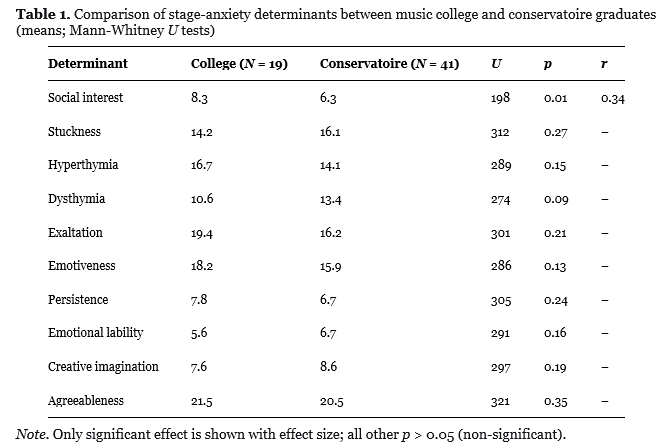
The sample consisted of 60 professional musicians (41 with higher education from conservatoire, 19 with secondary vocational education from music college). We tested for differences in stage anxiety and related personality traits across groups defined by career length (experience), educational level, gender, age, and instrument specialisation using Mann-Whitney U tests (independent groups) and Kruskal-Wallis tests (multiple groups). No statistically significant differences were found for the primary outcome variables (overall anxiety level, vegetative symptoms, and most accentuation traits) across any of these grouping variables (all p > 0.05, adjusted for multiple comparisons where applicable). The sole exception was the social interest subscale, which was higher in the college group (M = 8.3) than in the conservatoire group (M = 6.3), U = 198, p = 0.01, r = 0.34 (moderate effect).
For the remaining accentuation traits (stuckness, hyperthymia, dysthymia, exaltation, emotiveness) and the personality factors (persistence, emotional lability, creative imagination, agreeableness), pairwise comparisons yielded p-values > 0.05, with no consistent pattern across educational levels (Table 1). Likewise, no significant differences emerged on any subscale of the M MPAS (Mazzarolo Music Performance Anxiety Scale) between the two education groups (all p > 0.10).
Table 1. Comparison of stage‑anxiety determinants between music college and conservatoire graduates (means; Mann-Whitney U tests)
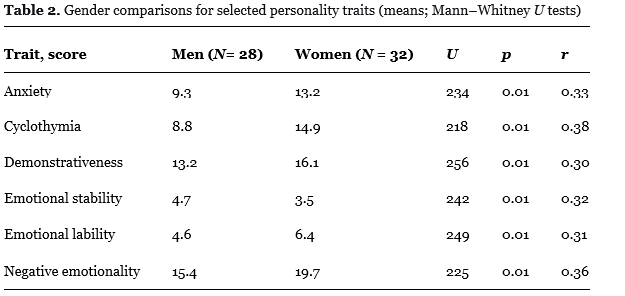
Gender differences were also non-significant for all M MPAS scales and most personality measures. However, inspection of individual protocols revealed a trend: women reported more positive subjective well-being on stage, whereas men showed a slightly higher tendency to avoid performances. The only statistically significant gender differences were found for trait anxiety, cyclothymia, demonstrativeness, emotional stability, emotional lability, and negative emotionality (Table 2), but these were not accompanied by differences in the core performance anxiety indices.
No differences in stage anxiety were found across instrument specialisation (string vs. other). String players, however, scored higher on emotional stability (M = 4.1 vs. 2.9, U = 178, p = 0.01, r = 0.35) and lower on exaltation (M = 16.0 vs. 18.4, U = 196, p = 0.01, r = 0.32).
The sample was heavily skewed toward experienced performers: only two participants had less than 10 years of performing experience. Therefore, formal group comparisons by career length were underpowered. Nevertheless, qualitative analysis and correlational trends indicated that with increasing experience, anxiety less frequently led to performance disruption, even though the absolute intensity of anxiety did not diminish. Among the more experienced musicians, self-reported anxiety was more often described as a controllable state rather than a disorganising reaction.
3.2. Correlational analyses
Spearman’s rank correlations were computed to examine relationships between individual characteristics and performance anxiety measures across the whole sample (N = 60). The primary hypothesis, that personality traits are associated with stage anxiety, was supported.
For the full sample, significant positive correlations were found between overall performance anxiety and both anxious (r = 0.36, p < 0.01) and pedantic (r = 0.43, p < 0.01) accentuation types. Conversely, positive subjective experience on stage correlated positively with hyperthymic (r = 0.41, p < 0.01) and emotive (r = 0.20, p < 0.01) traits.
When restricting to performers with less than 20 years of experience (N = 43), anxiety correlated positively with anxious (r = 0.48, p < 0.01), pedantic (r = 0.47, p < 0.01), emotive (r = 0.36, p < 0.01), and cyclothymic (r = 0.35, p < 0.01) traits. Positive performance perception correlated with hyperthymia (r = 0.34, p < 0.01) and negatively with cyclothymia (r = –0.30, p < 0.01). Avoidance behaviour (i.e., avoiding performances to reduce nervousness) was negatively associated with stuckness (r = –0.42, p < 0.01).
A moderate positive correlation emerged between vegetative reactivity (Vein questionnaire) and subjective loss of control during performance (r = 0.28, p < 0.01), indicating that higher autonomic arousal is linked to greater perceived loss of control.
In male subsample (N = 28), anxiety level correlated with age (r = 0.30, p < 0.01), and with cyclothymic (r = 0.55, p < 0.01), excitable (r = 0.49, p < 0.01), and anxious (r = 0.49, p < 0.01) accentuation types.
With respect to the Big Five factors, emotional instability (neuroticism) was strongly associated with both intensity (r = –0.51, p < 0.01) and frequency (r = –0.52, p < 0.01) of nervousness before performance, as well as with negative emotionality (r = 0.46, p < 0.01) and trait anxiety (r = 0.57, p < 0.01). Openness to experience (r = 0.32, p < 0.05) and extraversion (r = 0.26, p < 0.05) correlated positively with positive feeling during performance.
No significant correlations were found between performance experience (in years) and overall anxiety intensity, suggesting that the frequency and intensity of anxious feelings do not necessarily decrease with practice. However, the qualitative reports indicated that experienced performers perceived their anxiety as less disruptive.
Discussion
The study showed that formal demographic characteristics (gender, instrument type, level of education) are not by themselves determining factors for the level of performance anxiety. The crucial role is played by stable individual psychological characteristics of the personality, such as neuroticism, emotional stability, character accentuations, and social interest. Performance experience (career length) facilitates the transformation of the form of anxiety but does not eliminate it completely.
Our finding of transformation of performance anxiety with experience aligns with the conclusions of Irie et al. (2023), as cited in Bakhtiar et al. (2025): more experienced musicians perceive physiological reactions (tremor, rapid heartbeat) as a normal part of performing rather than as a threat. This allows them to use situation‑specific coping strategies such as positive thinking before going on stage, deep breathing before starting to play, and specific performance techniques during the performance.
However, our correlational design does not allow us to establish whether experience causes the acquisition of such strategies, or whether initially low neuroticism promotes both greater stress tolerance and a longer career. Longitudinal studies, as recommended by Bakhtiar et al. (2025), could answer this question.
Guided by the depathologising framework of Herman and Clark (2023), we consider it necessary to distinguish between a normal adaptive reaction to stage stress and a maladaptive state that impedes performance. This implies a shift from strategies aimed at eliminating “symptoms” to the development of skills for acceptance and reappraisal of the stressful situation, thereby opening the way to more effective psychological preparation of performers.
This is consistent with Korneev’s (2020) position, who emphasises that gaining performance experience does not eliminate anxiety but allows it to be channelled into creative self‑expression. The task of psychological preparation, therefore, is to help the performer develop an individual strategy for transforming anxiety into “creative arousal” that brings aesthetic pleasure and ensures genuine contact with the audience.
Specific methods for such work have been proposed by Burov and Lapteva (2020): psychosynthesis techniques (“Meeting the Inner Saboteur”), neuro‑linguistic programming techniques (reframing, “Alphabet” and “Rainbow” games for training concert attention), and a system of flow checklists for gradually preparing a piece to reach a state of creative verve. These tools help the musician move from fighting symptoms to developing stable on‑stage comfort.
Practical recommendations for wind players, also relevant for performers of other specialisations, have been formulated by Pronin (2025). The author emphasises the importance of multiple complete run‑throughs of the programme (at least twice in a row) in the presence of a teacher, and training run‑throughs under deliberately challenging conditions – with artificially created distractions (conversations, phone calls, door slamming) which builds “immunity” to stage surprises. Harmonic analysis of the performed piece and the use of “anchors”, pre‑designated places from which one can resume playing without error if memory fails, are also recommended as additional psychological safeguards. During the performance itself, the trombonist (and any instrumentalist) is advised to focus on the artistic image, avoid excessive muscular tension, and not allow excessive mouthpiece pressure, a purely physical technique that reduces the somatic component of anxiety.
In turn, Ivanina and Pashinina (2022), drawing on Stanislavsky’s system, propose the “creative circle” method: at the moment of performance, the musician consciously shifts attention from thoughts about themselves and the audience’s evaluation to the musical image. Creating “public solitude” through detailed preliminary work on the dramaturgy and context of the piece allows destructive anxiety to be transformed into creative excitement, restoring control over sound and artistic conception.
Special attention, as noted by Kalinichenko et al. (2016), should be given to performers with a combination of high neuroticism and introversion: for them, the most difficult task is “opening up” to the audience, and the pre‑concert period is accompanied by excessive tension of regulatory systems. Timely diagnosis of the level of psychophysiological “cost” and implementation of preventive programmes that account for the individual typological characteristics of the musician can prevent the exhaustion of adaptive mechanisms and reduce the risk of developing a stable fear of the stage.
Limitations. The present study, while possessing scientific and practical value, is based on a relatively small sample (60 musicians) with a notable predominance of women and covers only two major Russian cities, which does not yet allow confident generalisation of the findings to other professional communities and regions. The cross‑sectional correlational design and exclusive reliance on self‑report measures naturally do not allow causal inferences and could be supplemented by objective measurements. Also, quantitative relationships between anxiety and social interest are not fully elaborated in the text, and no correction for multiple comparisons was applied, leaving room for further refinement of the results.
Future Directions. The obtained results open several promising avenues. Future studies could include larger and more balanced samples with respect to gender, age, specialisation, and professional level, which would increase the reliability of generalisations. A shift to longitudinal and experimental designs, as well as the combination of questionnaires with psychophysiological indicators and expert performance evaluations, would help deepen understanding of the mechanisms of performance anxiety. Particularly promising is the testing of models in which personality traits (neuroticism, accentuations) interact with the development of mindfulness, flow state, emotional intelligence, and perfectionism, as well as examining how different public performance situations moderate or amplify individual vulnerability. Such steps will not only refine theoretical understanding but also enable the development of targeted psychological preparation programmes for performers.
Conclusions
Ethical Compliance: The study was conducted in accordance with the principles of the Declaration of Helsinki (World Medical Association, 1964, as amended) and the ethical standards adopted in the Russian Federation. The research protocol was approved by the Ethics Committee of Synergy University (Protocol No. 14, March 15, 2025). All participants provided written informed consent to participate in the study and to have their personal data processed for scientific purposes. Participants were informed of their right to withdraw from the study at any stage without providing a reason.
Conflict of Interest: The authors declare no actual or potential conflicts of interest with respect to the publication of this article. The study received no sponsorship from any organization or individual that could have influenced the design, data collection, analysis, interpretation, manuscript writing, or decision to publish.
Funding: This work received no external funding. All costs associated with the study (organization of data collection, purchase of supplies, data processing) were covered by the authors’ personal resources.
Author Contributions: M. B. Pozina – conceptualization of the study, study design, data collection, statistical analysis, drafting of the manuscript, final editing. M. I. Voronova – organization of data collection within the creative ensemble, consulting on music pedagogy, participation in data analysis and interpretation, critical revision of the manuscript. Both authors reviewed the final version of the manuscript and are responsible for the accuracy of the presented data.
Acknowledgements: The authors express their gratitude to all musicians who voluntarily participated in the study for their honest responses and interest in the issue of stage fright. Special thanks are extended to the management and administrative staff of the musical ensembles in Moscow and St. Petersburg for their assistance in organizing data collection.
Data Availability: The datasets generated during the study (anonymized participant responses) are available from the corresponding author upon reasonable request. The data are not deposited in public repositories due to confidentiality requirements, but can be made available to reviewers and interested researchers after signing a non‑disclosure agreement.
References
- Bakhtiar, P., Nikamajad, N., & Ghasemi Shayan, R. (2025). Recent developments in coping strategies focusing on music performance anxiety: A systematic review. Frontiers in Psychology, 16, Article 1507229. https://doi.org/10.3389/fpsyg.2025.1507229
- Burlachuk, L. F. (2008). Slovar’-spravochnik po psikhodiagnostike [Psychodiagnostics: Dictionary-reference book] (3rd ed.). Piter.
- Burov, Y. B., & Lapteva, A. Y. (2020). Stsenicheskoe volnenie muzykanta-ispolnitelia v kontekste sovremennykh teorii lichnosti [Stage anxiety of a performing musician in the context of modern personality theories]. Innovative development of vocational education, (2), 41–48.
- Fernholz, I., Mumm, J. L. M., Plag, J., Noeres, K., Rotter, G., Willich, S. N., Ströhle, A., Berghöfer, A., & Schmidt, A. (2019). Performance anxiety in professional musicians: A systematic review on prevalence, risk factors and clinical treatment effects. Psychological Medicine, 49(14), 2287–2306. https://doi.org/10.1017/S0033291719001910
- Furuya, S., Ishimaru, R., Oku, T., & Nagata, N. (2021). Back to feedback: Aberrant sensorimotor control in music performance under pressure. Communications Biology, 4, Article 1367. https://doi.org/10.1038/s42003-021-02879-4
- Guyon, A. J. A. A., Hildebrandt, H., Güsewell, A., Horsch, A., Nater, U. M., & Gomez, P. (2022). How audience and general music performance anxiety affect classical music students’ flow experience: A close look at its dimensions. Frontiers in Psychology, 13, Article 959190. https://doi.org/10.3389/fpsyg.2022.959190
- Herman, R., & Clark, T. (2023). It’s not a virus! Reconceptualizing and de-pathologizing music performance anxiety. Frontiers in Psychology, 14, Article 1194873. https://doi.org/10.3389/fpsyg.2023.1194873
- Irie, N., Morijiri, Y., & Yoshie, M. (2023). Symptoms of and coping strategies for music performance anxiety through different time periods. Frontiers in Psychology, 14, Article 1138922. https://doi.org/10.3389/fpsyg.2023.1138922
- Ivanina, R. V., & Pashinina, O. V. (2022). Metodika preodoleniia stsenicheskogo volneniia muzykantov v svete psikhoakustiki [Methods for overcoming stage anxiety in musicians in the light of psychoacoustics]. Mir nauki, kul’tury, obrazovaniya [The world of science, culture and education], (2), 184–186.
- Juslin, P. N. (2019). Musical emotions explained: Unlocking the secrets of musical affect. Oxford University Press.
- Kalinichenko, I. A., Zaikina, A. L., & Latina, A. A. (2016). Psychophysiological aspects of stage anxiety in musician-teachers during concert performance. East European Scientific Journal, (7), 176–180.
- Korneev, N. K. (2020). Stage anxiety as an individual psychological state of a vocalist]. Vestnik of Saint-Petersburg State University of Culture, (3), 131–134. https://doi.org/10.30725/2619-0303-2020-3-131-134
- Leonhard, K. (1981). Aktsentuirovannye lichnosti [Accentuated personalities] (V. M. Leshchenko, Trans.). Vishcha shkola. (Original work published 1976)
- Moral Bofill, L., López de la Llave, A., Pérez Llantada, M. C., & Holgado Tello, F. P. (2022). Development of flow state self-regulation skills and coping with musical performance anxiety: Design and evaluation of an electronically implemented psychological program. Frontiers in Psychology, 13, Article 899621. https://doi.org/10.3389/fpsyg.2022.899621
- Morozov, S. A. (2023). Muzykal’naia psikhologiia i psikhologiia muzykal’nogo obrazovaniya [Music psychology and psychology of music education] (2nd ed.). Yurait.
- Nazaykinsky, E. V. (1972). O psikhologii muzykal’nogo vospriyatiya [On the psychology of musical perception]. Muzyka.
- Neigauz, G. G. (1999). Ob iskusstve fortepiannoi igry: Zapiski pedagoga [On the art of piano playing: Notes of a teacher] (5th ed.). Klassika-XXI.
- Petrushin, V. I. (1997). Muzykal’naia psikhologiia [Music psychology]. VLADOS.
- Pronin, B. A. (2025). Methods for overcoming stage anxiety in trombonists. The world of science, culture and education, (4), 211–214. https://doi.org/10.24412/1991-5497-2025-4113-211-214
- Singh, B., Olds, T., Curtis, R., Dumuid, D., Virgara, R., Watson, A., … & Maher, C. (2023). Effectiveness of physical activity interventions for improving depression, anxiety and distress: An overview of systematic reviews. British Journal of Sports Medicine, 57(18), 1203–1209. https://doi.org/10.1136/bjsports-2022-106195
- Spahn, C., Krampe, F., & Nusseck, M. (2021). Live music performance: The relationship between flow and music performance anxiety. Frontiers in Psychology, 12, Article 725569. https://doi.org/10.3389/fpsyg.2021.725569
- Sun, H., Xu, Z., & Wang, H. (2026). Mindfulness and music performance anxiety among early- and mid-career musicians in transition: The mediating roles of emotional intelligence and perfectionism. Frontiers in Psychology, 17, Article 1769609. https://doi.org/10.3389/fpsyg.2026.1769609
- Thompson, W. F. (2020). Music, thought,and feeling: Understanding the psychology of music (2nd ed.). Oxford University Press.
- Tsagarelli, Y. A. (2008). Psikhologiia muzykal’no-ispolnitel’skoi deiatel’nosti [Psychology of musical performance activity] (2nd ed.). Kompozitor.
- Vein, A. M. (2003). Vegetativnye rasstroistva: Klinika, diagnostika, lechenie [Autonomic disorders: Clinical presentation, diagnosis, treatment]. Meditsinskoe informatsionnoe agentstvo.
- Vein, A. M. (2010). Zabolevaniia vegetativnoi nervnoi sistemy [Diseases of the autonomic nervous system]. Meditsinskoe informatsionnoe agentstvo.
Comments (0)
Background and relevance. Performance anxiety (music performance anxiety, MPA) is a common psychophysiological state among musicians that can either facilitate or disrupt public performance, with reported prevalence ranging from 16.5% to 60% (Fernholz et al., 2019). Despite decades of research, the relative contribution of demographic versus individual psychological factors remains debated, and existing evidence is contradictory regarding the role of gender, education, instrument type, and career length. Moreover, most studies have focused on clinical or student populations, leaving a gap in understanding how stable personality traits interact with performance experience in professional musicians. The present study addresses this gap by examining a sample of active performing musicians. Objectives. This study aimed to determine whether formal demographic characteristics (gender, education, instrument type, performance experience) or stable personality traits better predict MPA severity. Methods. A sample of 60 professional musicians from Moscow and St. Petersburg (44 women, 16 men; age 19-49 years; performance experience 5-45 years) completed validated Russian-language questionnaires: M‑MPAS (performance anxiety intensity), Leonhard-Schmishek accentuation inventory, TIPI‑RU (Big Five), Vein autonomic symptom scale (Vein, 2003, 2010), and Crandall Social Interest Scale. Non‑parametric statistics (Mann-Whitney U, Spearman correlations) were used. Results. No significant differences in MPA level were found by gender, education (college vs. conservatory), or instrument type. However, greater performance experience was associated with transformation of anxiety from a disorganizing to a more manageable, often mobilizing state. Neuroticism showed a significant positive correlation with MPA (r = 0.42, p < 0.01), while emotional stability and extraversion were protective. Anxious, emotive, and exalted character accentuations (Leonhard, 1981) amplified the cognitive component of anxiety. Social interest reduced the subjective salience of external evaluation. Conclusions. Formal demographic characteristics do not determine MPA severity. Instead, stable individual traits, particularly neuroticism, emotional stability, character accentuations, and social interest, are core predictors. Performance experience transforms but does not eliminate anxiety. Following the depathologizing framework of Herman and Clark (2023), the authors conceptualize performance anxiety as a normal adaptive reaction rather than a disorder. Interventions should target psychological flexibility, reappraisal of somatic signals, and flow‑promoting skills rather than symptom elimination.
Связь сценического волнения с индивидуальными особенностями исполнителя
М. Б. Позинаa, М. И. Вороноваb
aУниверситет «Синергия», Москва, Россия
b «ARHCE ORCHTSTRA», Санкт-Петербург, Россия
Резюме. Актуальность и обоснование. Сценическое волнение (музыкальное сценическое волнение, МСВ) – распространённое психофизиологическое состояние музыкантов, которое может как усиливать, так и нарушать качество публичного выступления. По данным систематических обзоров, распространённость клинически выраженных форм достигает 16,5–60% (Fernholz и др., 2019). Несмотря на многолетние исследования, вопрос о соотношении демографических и собственно личностных факторов остаётся дискуссионным; имеющиеся данные противоречивы в отношении роли пола, образования, типа инструмента и исполнительского стажа. Большинство работ выполнено на клинических или студенческих выборках, что оставляет пробел в понимании того, как устойчивые черты личности взаимодействуют с профессиональным опытом у действующих музыкантов. Настоящее исследование восполняет этот пробел. Цель. Выявить, что в большей степени определяет выраженность сценического волнения: формально-демографические характеристики (пол, образование, тип инструмента, стаж) или устойчивые личностные особенности. Методы. В исследовании приняли участие 60 профессиональных музыкантов из Москвы и Санкт-Петербурга (44 женщины, 16 мужчин; возраст 19–49 лет; исполнительский стаж 5–45 лет). Использовались валидированные русскоязычные методики: шкала тревожности при исполнении музыки Маззароло (M‑MPAS), опросник акцентуаций Леонгарда-Шмишека, краткий опросник Большой пятёрки TIPI‑RU, опросник вегетативных нарушений А. М. Вейна (Вейн, 2003, 2010) и шкала социального интереса Кренделла. Статистическая обработка выполнена непараметрическими методами (U-критерий Манна-Уитни, корреляция Спирмена). Результаты. Статистически значимых различий в уровне сценического волнения по полу, образованию (училище vs консерватория) и типу инструмента не обнаружено. Вместе с тем больший исполнительский стаж оказался связан с трансформацией волнения: дезорганизующая форма сменяется более управляемым, часто мобилизующим состоянием. Нейротизм показал значимую положительную корреляцию с уровнем МСВ (r = 0.42, p < 0.01), тогда как эмоциональная стабильность и экстраверсия выступали защитными факторами. Тревожная, эмотивная и экзальтированная акцентуации характера (Леонгард, 1981) усиливали когнитивный компонент тревоги. Социальный интерес снижал субъективную значимость внешней оценки. Выводы. Формально-демографические показатели не определяют выраженность сценического волнения. Ключевую роль играют устойчивые индивидуальные черты: нейротизм, эмоциональная стабильность, акцентуации характера и социальный интерес. Исполнительский опыт трансформирует, но не устраняет волнение полностью. Следуя депатологизирующему подходу Хермана и Кларка (Herman & Clark, 2023), авторы рассматривают сценическое волнение как нормальную адаптивную реакцию, а не расстройство. Психологическая помощь должна быть направлена на развитие гибкости, переоценку телесных сигналов и формирование навыков потокового состояния (flow), а не на простое устранение симптомов.
Ключевые слова: сценическое волнение, музыкальное сценическое волнение, исполнительская тревога, личностные черты, нейротизм, акцентуации характера, социальный интерес, исполнительский стаж, потоковое состояние, депатологизирующий подход, музыканты
Performance anxiety is a complex psychophysiological state that arises in situations of public performance. As Korneev (2020) emphasises, the state of creative arousal originates in the individual psychological makeup of the performer, and its intensity is determined not so much by external conditions as by the musician’s volitional qualities, self‑esteem, and emotional stability. This is why performance anxiety can become either a “creative facilitator” or a source of uncontrollable fear. The public performance situation (concert, competition, examination) generates a state of heightened psychophysiological tension in most performers, often independent of the level of professional training, technical mastery, performance experience, or even the number of times a piece has been rehearsed (Kalinichenko et al., 2016; Korneev, 2020).
Kalinichenko et al. (2016) distinguish five sequential stages of performance anxiety: a prolonged pre‑concert phase (emerging from the moment the concert is announced), an immediate pre‑concert phase (which can take the form of excited uplift, panic, or apathy), entering the stage, the onset of performance, and the post‑concert phase. Each of these stages is characterised by its own psychophysiological “cost”, reflecting the degree of strain on the body’s regulatory systems. From a psychoacoustic perspective, Ivanina and Pashinina (2022) demonstrate that these physiological changes directly impair sound quality: tremor disrupts intonation accuracy, irregularities in breathing and heartbeat destabilise rhythm, and muscular tension impoverishes the spectral composition of the sound, depriving the timbre of brightness and projection.
Performance anxiety (also termed “music performance anxiety” or “stage phobia”) is a multicomponent stressor that, when reaching high intensity, leads to deterioration of performance quality and reduces the performer’s subjective well‑being. If a moderate level of psycho‑emotional tension increases energy, exceeding the individual threshold of tolerance to this stressor transforms performance activity into a maladaptive form and, evolving into fear of public performance, can lead to professional incapacity (Korneev, 2020; Kalinichenko et al., 2016).
Determinants of performance anxiety can be both external factors (social significance of the event, audience characteristics, degree of external evaluation) and individual psychological characteristics of the performer, such as temperament type, level of trait or state anxiety, specific patterns of psychophysiological reactivity to stressful stage conditions, and many others. In particular, the level of emotional intelligence, the capacity for emotional‑volitional self‑regulation, and the psychological readiness to mobilise personal, cognitive, and behavioural resources at the moment of performance are important (Ivanina & Pashinina, 2022; Korneev, 2020).
At the same time, an alternative, depathologising position has emerged in contemporary performance psychology. Herman and Clark (2023) propose that performance anxiety should be viewed not as a disorder or a set of symptoms, but as a normal, biologically adaptive reaction to an objectively stressful public performance situation, amplified by a competitive and unstable professional environment. The key factor determining the impact on performance quality is not the presence of physiological and cognitive manifestations per se, but their subjective interpretation and the performer’s response to them (Herman & Clark, 2023, p. 13). Such an approach shifts the focus from attempts to eliminate symptoms to developing the performer’s skills of acceptance and reappraisal of their own state.
In various research traditions, performance anxiety is considered as a form of anxiety, a type of stress, an emotional arousal, or a specific functional state of the personality arising under conditions of public performance. Performance anxiety exhibits all the characteristics of stress states, manifesting as the body’s response to strong and extremely strong external stimuli (Kalinichenko et al., 2016; Vein, 2003, 2010).
In the Russian tradition (Bochkaryov, Jakobson, Kogan, Tsagarelli), performance anxiety is viewed as a personality‑determined state that can have both facilitating and disorganising components. According to Uznadze’s theory of set, performance anxiety is ambivalent because it arises from a conflict between competing mental sets – one directed towards the musical content and the other towards external evaluation (Nazaykinsky, 1972, pp. 72–73). This ambivalence is clearly manifested in the self‑reports of major musicians. Luciano Pavarotti admitted being “paralysed by fear” before a major concert, while his colleague David Oistrakh spoke of “concentrated inner tension and extraordinary volitional composure” before going on stage (cited in Korneev, 2020, pp. 132–134). Thus, the same stressor can be experienced either as disorganising fear or as facilitating excitement. Western approaches (Spielberger, Hewitt, Csikszentmihalyi) focus on cognitive mechanisms such as irrational beliefs, perfectionism, and the concept of “flow” as an optimal state opposite to anxiety (Juslin, 2019; Thompson, 2020).
Despite active study of the phenomenon, data on the prevalence and predictors of performance anxiety are contradictory. A systematic review of 43 studies (Fernholz et al., 2019) showed that the frequency of clinically expressed music performance anxiety among professional musicians ranges from 16.5% to 60%. Most studies report higher anxiety in women and in musicians younger than 45-50 years, although some studies find no gender differences. The association of MPA with neuroticism and emotional instability is consistently reproduced, whereas formal demographic indicators alone are not reliable predictors. These data underscore the need to account for individual psychological characteristics, which determined the aim of the present study.
According to a systematic review by Bakhtiar et al. (2025), the most effective coping strategies for music performance anxiety are Acceptance and Commitment Therapy (ACT), cognitive‑behavioural therapy, mindfulness, as well as yoga and breathing practices. The key mechanism for reducing anxiety is psychological flexibility, the ability to accept anxiety without avoiding it. However, as the review’s authors emphasise, the effectiveness of these interventions largely depends on the individual psychological characteristics of the musician, which justifies the relevance of our research on personality determinants of performance anxiety.
Along with psychological and autonomic manifestations, performance anxiety has a pronounced sensorimotor component. In an experimental study, Furuya et al. (2021) found that professional pianists under stressful conditions demonstrated anomalous tempo slowing after an artificial delay in auditory feedback, whereas purely motor and perceptual abilities remained intact. This indicates a shift from predictive (feedforward) control to excessive dependence on feedback – a mechanism that may explain maladaptive forms of performance anxiety in musicians with high neuroticism and low psychological flexibility.
In the context of contemporary personality theories, Burov and Lapteva (2020) emphasise that performance anxiety naturally arises from the subjective representation of the concert situation, and the choice of coping strategies depends on individual psychological characteristics. The most promising alternative to maladaptive anxiety, according to these authors following Csikszentmihalyi, is the flow state, an optimal experience characterised by complete concentration, clarity of goals, and a sense of control.
Guyon et al. (2022) showed that general disposition to MPA reduces the sense of control, concentration, and enjoyment of playing regardless of audience presence; during public performance, highly anxious musicians additionally suffer from reduced clarity of feedback and loss of self-consciousness.
Moral Bofill et al. (2022) demonstrated in a quasi‑experiment with 62 musicians that a 12‑week online programme combining cognitive‑behavioural techniques, mindfulness, and emotion regulation significantly increased sense of control (d = 0.47) and loss of self‑consciousness (d = 0.70), reduced MPA (d = 0.24), and increased overall flow state levels.
Spahn et al. (2021), in a sample of 363 orchestral musicians assessed immediately after a concert, found that high pre‑concert self‑efficacy and functional coping with anxiety significantly predicted the experience of flow during performance, and that the flow state in turn enhanced post‑concert self‑efficacy and reduced MPA symptoms, closing a positive feedback loop.
Irie et al. (2023) demonstrated that mental symptoms of MPA peak before going on stage, physiological symptoms peak immediately before performance and persist on stage, and behavioural symptoms occur almost exclusively during playing. Coping strategies change accordingly: positive thinking and concentration dominate before the performance, deep breathing and light exercises before entering the stage, and specific performance techniques on stage. More experienced musicians perceive physiological reactions as a normal part of performing, which enhances the effectiveness of self‑regulation.
Sun et al. (2026), using structural equation modelling with 283 early‑ and mid‑career musicians, showed that dispositional mindfulness is associated with lower levels of performance anxiety, and this effect is mediated through two pathways: increased emotional intelligence and reduced perfectionism.
Finally, a large‑scale umbrella review by Singh et al. (2023), combining 97 systematic reviews with over 128,000 participants, showed that regular physical activity has a moderate effect in reducing anxiety (SMD = −0.42) and depression (SMD = −0.43) across diverse populations. This provides a rationale for considering physical activity as an accessible adjunctive component in managing performance anxiety.
2.1. Sample
The study involved 60 professional performing musicians from Moscow and St. Petersburg (44 women, 16 men; age range 19–49 years). Of these, 19 were graduates of music colleges and 41 were graduates of conservatories (higher education institutions). Instrument specialisation: strings (n = 36), piano (n = 9), winds (n = 7), voice (n = 5), percussion (n = 1), folk instruments (n = 2). Performance experience ranged from 5 to 45 years.
The study was correlational and comparative in design. Data collection was conducted in 2025 using purposive sampling.
2.2. Measures A battery of instruments grouped into three clusters was used (Burlachuk,
2008; Korneev, 2020):
Subjective‑evaluative cluster: Mazzarolo Music Performance Anxiety Scale (M‑MPAS) to assess the intensity of performance anxiety, cognitive and behavioural strategies; Crandall Social Interest Scale (SIS) to assess orientation towards cooperation and empathy.
Typological properties cluster: Schmishek questionnaire (Leonhard‑Schmishek) for diagnosing character accentuations (Leonhard, 1981); TIPI‑RU (short Big Five inventory) for express assessment of five personality factors (extraversion, agreeableness, conscientiousness, emotional stability, openness to experience).
Psychophysiological states cluster: Vein questionnaire for identifying signs of autonomic changes to assess somatisation of anxiety (palpitations, tremor, respiratory disturbances) (Vein, 2003, 2010).
2.3. Data analysis
Data were processed using non‑parametric statistics due to non‑normal distribution: Mann‑Whitney U test for comparisons between independent groups (by gender, education, specialisation) and Spearman correlation analysis to examine relationships between anxiety level and personality characteristics.
3.1. Demographic and professional comparisons
The sample consisted of 60 professional musicians (41 with higher education from conservatoire, 19 with secondary vocational education from music college). We tested for differences in stage anxiety and related personality traits across groups defined by career length (experience), educational level, gender, age, and instrument specialisation using Mann-Whitney U tests (independent groups) and Kruskal-Wallis tests (multiple groups). No statistically significant differences were found for the primary outcome variables (overall anxiety level, vegetative symptoms, and most accentuation traits) across any of these grouping variables (all p > 0.05, adjusted for multiple comparisons where applicable). The sole exception was the social interest subscale, which was higher in the college group (M = 8.3) than in the conservatoire group (M = 6.3), U = 198, p = 0.01, r = 0.34 (moderate effect).
For the remaining accentuation traits (stuckness, hyperthymia, dysthymia, exaltation, emotiveness) and the personality factors (persistence, emotional lability, creative imagination, agreeableness), pairwise comparisons yielded p-values > 0.05, with no consistent pattern across educational levels (Table 1). Likewise, no significant differences emerged on any subscale of the M MPAS (Mazzarolo Music Performance Anxiety Scale) between the two education groups (all p > 0.10).
Table 1. Comparison of stage‑anxiety determinants between music college and conservatoire graduates (means; Mann-Whitney U tests)
Gender differences were also non-significant for all M MPAS scales and most personality measures. However, inspection of individual protocols revealed a trend: women reported more positive subjective well-being on stage, whereas men showed a slightly higher tendency to avoid performances. The only statistically significant gender differences were found for trait anxiety, cyclothymia, demonstrativeness, emotional stability, emotional lability, and negative emotionality (Table 2), but these were not accompanied by differences in the core performance anxiety indices.
No differences in stage anxiety were found across instrument specialisation (string vs. other). String players, however, scored higher on emotional stability (M = 4.1 vs. 2.9, U = 178, p = 0.01, r = 0.35) and lower on exaltation (M = 16.0 vs. 18.4, U = 196, p = 0.01, r = 0.32).
The sample was heavily skewed toward experienced performers: only two participants had less than 10 years of performing experience. Therefore, formal group comparisons by career length were underpowered. Nevertheless, qualitative analysis and correlational trends indicated that with increasing experience, anxiety less frequently led to performance disruption, even though the absolute intensity of anxiety did not diminish. Among the more experienced musicians, self-reported anxiety was more often described as a controllable state rather than a disorganising reaction.
3.2. Correlational analyses
Spearman’s rank correlations were computed to examine relationships between individual characteristics and performance anxiety measures across the whole sample (N = 60). The primary hypothesis, that personality traits are associated with stage anxiety, was supported.
For the full sample, significant positive correlations were found between overall performance anxiety and both anxious (r = 0.36, p < 0.01) and pedantic (r = 0.43, p < 0.01) accentuation types. Conversely, positive subjective experience on stage correlated positively with hyperthymic (r = 0.41, p < 0.01) and emotive (r = 0.20, p < 0.01) traits.
When restricting to performers with less than 20 years of experience (N = 43), anxiety correlated positively with anxious (r = 0.48, p < 0.01), pedantic (r = 0.47, p < 0.01), emotive (r = 0.36, p < 0.01), and cyclothymic (r = 0.35, p < 0.01) traits. Positive performance perception correlated with hyperthymia (r = 0.34, p < 0.01) and negatively with cyclothymia (r = –0.30, p < 0.01). Avoidance behaviour (i.e., avoiding performances to reduce nervousness) was negatively associated with stuckness (r = –0.42, p < 0.01).
A moderate positive correlation emerged between vegetative reactivity (Vein questionnaire) and subjective loss of control during performance (r = 0.28, p < 0.01), indicating that higher autonomic arousal is linked to greater perceived loss of control.
In male subsample (N = 28), anxiety level correlated with age (r = 0.30, p < 0.01), and with cyclothymic (r = 0.55, p < 0.01), excitable (r = 0.49, p < 0.01), and anxious (r = 0.49, p < 0.01) accentuation types.
With respect to the Big Five factors, emotional instability (neuroticism) was strongly associated with both intensity (r = –0.51, p < 0.01) and frequency (r = –0.52, p < 0.01) of nervousness before performance, as well as with negative emotionality (r = 0.46, p < 0.01) and trait anxiety (r = 0.57, p < 0.01). Openness to experience (r = 0.32, p < 0.05) and extraversion (r = 0.26, p < 0.05) correlated positively with positive feeling during performance.
No significant correlations were found between performance experience (in years) and overall anxiety intensity, suggesting that the frequency and intensity of anxious feelings do not necessarily decrease with practice. However, the qualitative reports indicated that experienced performers perceived their anxiety as less disruptive.
The study showed that formal demographic characteristics (gender, instrument type, level of education) are not by themselves determining factors for the level of performance anxiety. The crucial role is played by stable individual psychological characteristics of the personality, such as neuroticism, emotional stability, character accentuations, and social interest. Performance experience (career length) facilitates the transformation of the form of anxiety but does not eliminate it completely.
Our finding of transformation of performance anxiety with experience aligns with the conclusions of Irie et al. (2023), as cited in Bakhtiar et al. (2025): more experienced musicians perceive physiological reactions (tremor, rapid heartbeat) as a normal part of performing rather than as a threat. This allows them to use situation‑specific coping strategies such as positive thinking before going on stage, deep breathing before starting to play, and specific performance techniques during the performance.
However, our correlational design does not allow us to establish whether experience causes the acquisition of such strategies, or whether initially low neuroticism promotes both greater stress tolerance and a longer career. Longitudinal studies, as recommended by Bakhtiar et al. (2025), could answer this question.
Guided by the depathologising framework of Herman and Clark (2023), we consider it necessary to distinguish between a normal adaptive reaction to stage stress and a maladaptive state that impedes performance. This implies a shift from strategies aimed at eliminating “symptoms” to the development of skills for acceptance and reappraisal of the stressful situation, thereby opening the way to more effective psychological preparation of performers.
This is consistent with Korneev’s (2020) position, who emphasises that gaining performance experience does not eliminate anxiety but allows it to be channelled into creative self‑expression. The task of psychological preparation, therefore, is to help the performer develop an individual strategy for transforming anxiety into “creative arousal” that brings aesthetic pleasure and ensures genuine contact with the audience.
Specific methods for such work have been proposed by Burov and Lapteva (2020): psychosynthesis techniques (“Meeting the Inner Saboteur”), neuro‑linguistic programming techniques (reframing, “Alphabet” and “Rainbow” games for training concert attention), and a system of flow checklists for gradually preparing a piece to reach a state of creative verve. These tools help the musician move from fighting symptoms to developing stable on‑stage comfort.
Practical recommendations for wind players, also relevant for performers of other specialisations, have been formulated by Pronin (2025). The author emphasises the importance of multiple complete run‑throughs of the programme (at least twice in a row) in the presence of a teacher, and training run‑throughs under deliberately challenging conditions – with artificially created distractions (conversations, phone calls, door slamming) which builds “immunity” to stage surprises. Harmonic analysis of the performed piece and the use of “anchors”, pre‑designated places from which one can resume playing without error if memory fails, are also recommended as additional psychological safeguards. During the performance itself, the trombonist (and any instrumentalist) is advised to focus on the artistic image, avoid excessive muscular tension, and not allow excessive mouthpiece pressure, a purely physical technique that reduces the somatic component of anxiety.
In turn, Ivanina and Pashinina (2022), drawing on Stanislavsky’s system, propose the “creative circle” method: at the moment of performance, the musician consciously shifts attention from thoughts about themselves and the audience’s evaluation to the musical image. Creating “public solitude” through detailed preliminary work on the dramaturgy and context of the piece allows destructive anxiety to be transformed into creative excitement, restoring control over sound and artistic conception.
Special attention, as noted by Kalinichenko et al. (2016), should be given to performers with a combination of high neuroticism and introversion: for them, the most difficult task is “opening up” to the audience, and the pre‑concert period is accompanied by excessive tension of regulatory systems. Timely diagnosis of the level of psychophysiological “cost” and implementation of preventive programmes that account for the individual typological characteristics of the musician can prevent the exhaustion of adaptive mechanisms and reduce the risk of developing a stable fear of the stage.
Limitations. The present study, while possessing scientific and practical value, is based on a relatively small sample (60 musicians) with a notable predominance of women and covers only two major Russian cities, which does not yet allow confident generalisation of the findings to other professional communities and regions. The cross‑sectional correlational design and exclusive reliance on self‑report measures naturally do not allow causal inferences and could be supplemented by objective measurements. Also, quantitative relationships between anxiety and social interest are not fully elaborated in the text, and no correction for multiple comparisons was applied, leaving room for further refinement of the results.
Future Directions. The obtained results open several promising avenues. Future studies could include larger and more balanced samples with respect to gender, age, specialisation, and professional level, which would increase the reliability of generalisations. A shift to longitudinal and experimental designs, as well as the combination of questionnaires with psychophysiological indicators and expert performance evaluations, would help deepen understanding of the mechanisms of performance anxiety. Particularly promising is the testing of models in which personality traits (neuroticism, accentuations) interact with the development of mindfulness, flow state, emotional intelligence, and perfectionism, as well as examining how different public performance situations moderate or amplify individual vulnerability. Such steps will not only refine theoretical understanding but also enable the development of targeted psychological preparation programmes for performers.
Ethical Compliance: The study was conducted in accordance with the principles of the Declaration of Helsinki (World Medical Association, 1964, as amended) and the ethical standards adopted in the Russian Federation. The research protocol was approved by the Ethics Committee of Synergy University (Protocol No. 14, March 15, 2025). All participants provided written informed consent to participate in the study and to have their personal data processed for scientific purposes. Participants were informed of their right to withdraw from the study at any stage without providing a reason.
Conflict of Interest: The authors declare no actual or potential conflicts of interest with respect to the publication of this article. The study received no sponsorship from any organization or individual that could have influenced the design, data collection, analysis, interpretation, manuscript writing, or decision to publish.
Funding: This work received no external funding. All costs associated with the study (organization of data collection, purchase of supplies, data processing) were covered by the authors’ personal resources.
Author Contributions: M. B. Pozina – conceptualization of the study, study design, data collection, statistical analysis, drafting of the manuscript, final editing. M. I. Voronova – organization of data collection within the creative ensemble, consulting on music pedagogy, participation in data analysis and interpretation, critical revision of the manuscript. Both authors reviewed the final version of the manuscript and are responsible for the accuracy of the presented data.
Acknowledgements: The authors express their gratitude to all musicians who voluntarily participated in the study for their honest responses and interest in the issue of stage fright. Special thanks are extended to the management and administrative staff of the musical ensembles in Moscow and St. Petersburg for their assistance in organizing data collection.
Data Availability: The datasets generated during the study (anonymized participant responses) are available from the corresponding author upon reasonable request. The data are not deposited in public repositories due to confidentiality requirements, but can be made available to reviewers and interested researchers after signing a non‑disclosure agreement.
- Bakhtiar, P., Nikamajad, N., & Ghasemi Shayan, R. (2025). Recent developments in coping strategies focusing on music performance anxiety: A systematic review. Frontiers in Psychology, 16, Article 1507229. https://doi.org/10.3389/fpsyg.2025.1507229
- Burlachuk, L. F. (2008). Slovar’-spravochnik po psikhodiagnostike [Psychodiagnostics: Dictionary-reference book] (3rd ed.). Piter.
- Burov, Y. B., & Lapteva, A. Y. (2020). Stsenicheskoe volnenie muzykanta-ispolnitelia v kontekste sovremennykh teorii lichnosti [Stage anxiety of a performing musician in the context of modern personality theories]. Innovative development of vocational education, (2), 41–48.
- Fernholz, I., Mumm, J. L. M., Plag, J., Noeres, K., Rotter, G., Willich, S. N., Ströhle, A., Berghöfer, A., & Schmidt, A. (2019). Performance anxiety in professional musicians: A systematic review on prevalence, risk factors and clinical treatment effects. Psychological Medicine, 49(14), 2287–2306. https://doi.org/10.1017/S0033291719001910
- Furuya, S., Ishimaru, R., Oku, T., & Nagata, N. (2021). Back to feedback: Aberrant sensorimotor control in music performance under pressure. Communications Biology, 4, Article 1367. https://doi.org/10.1038/s42003-021-02879-4
- Guyon, A. J. A. A., Hildebrandt, H., Güsewell, A., Horsch, A., Nater, U. M., & Gomez, P. (2022). How audience and general music performance anxiety affect classical music students’ flow experience: A close look at its dimensions. Frontiers in Psychology, 13, Article 959190. https://doi.org/10.3389/fpsyg.2022.959190
- Herman, R., & Clark, T. (2023). It’s not a virus! Reconceptualizing and de-pathologizing music performance anxiety. Frontiers in Psychology, 14, Article 1194873. https://doi.org/10.3389/fpsyg.2023.1194873
- Irie, N., Morijiri, Y., & Yoshie, M. (2023). Symptoms of and coping strategies for music performance anxiety through different time periods. Frontiers in Psychology, 14, Article 1138922. https://doi.org/10.3389/fpsyg.2023.1138922
- Ivanina, R. V., & Pashinina, O. V. (2022). Metodika preodoleniia stsenicheskogo volneniia muzykantov v svete psikhoakustiki [Methods for overcoming stage anxiety in musicians in the light of psychoacoustics]. Mir nauki, kul’tury, obrazovaniya [The world of science, culture and education], (2), 184–186.
- Juslin, P. N. (2019). Musical emotions explained: Unlocking the secrets of musical affect. Oxford University Press.
- Kalinichenko, I. A., Zaikina, A. L., & Latina, A. A. (2016). Psychophysiological aspects of stage anxiety in musician-teachers during concert performance. East European Scientific Journal, (7), 176–180.
- Korneev, N. K. (2020). Stage anxiety as an individual psychological state of a vocalist]. Vestnik of Saint-Petersburg State University of Culture, (3), 131–134. https://doi.org/10.30725/2619-0303-2020-3-131-134
- Leonhard, K. (1981). Aktsentuirovannye lichnosti [Accentuated personalities] (V. M. Leshchenko, Trans.). Vishcha shkola. (Original work published 1976)
- Moral Bofill, L., López de la Llave, A., Pérez Llantada, M. C., & Holgado Tello, F. P. (2022). Development of flow state self-regulation skills and coping with musical performance anxiety: Design and evaluation of an electronically implemented psychological program. Frontiers in Psychology, 13, Article 899621. https://doi.org/10.3389/fpsyg.2022.899621
- Morozov, S. A. (2023). Muzykal’naia psikhologiia i psikhologiia muzykal’nogo obrazovaniya [Music psychology and psychology of music education] (2nd ed.). Yurait.
- Nazaykinsky, E. V. (1972). O psikhologii muzykal’nogo vospriyatiya [On the psychology of musical perception]. Muzyka.
- Neigauz, G. G. (1999). Ob iskusstve fortepiannoi igry: Zapiski pedagoga [On the art of piano playing: Notes of a teacher] (5th ed.). Klassika-XXI.
- Petrushin, V. I. (1997). Muzykal’naia psikhologiia [Music psychology]. VLADOS.
- Pronin, B. A. (2025). Methods for overcoming stage anxiety in trombonists. The world of science, culture and education, (4), 211–214. https://doi.org/10.24412/1991-5497-2025-4113-211-214
- Singh, B., Olds, T., Curtis, R., Dumuid, D., Virgara, R., Watson, A., … & Maher, C. (2023). Effectiveness of physical activity interventions for improving depression, anxiety and distress: An overview of systematic reviews. British Journal of Sports Medicine, 57(18), 1203–1209. https://doi.org/10.1136/bjsports-2022-106195
- Spahn, C., Krampe, F., & Nusseck, M. (2021). Live music performance: The relationship between flow and music performance anxiety. Frontiers in Psychology, 12, Article 725569. https://doi.org/10.3389/fpsyg.2021.725569
- Sun, H., Xu, Z., & Wang, H. (2026). Mindfulness and music performance anxiety among early- and mid-career musicians in transition: The mediating roles of emotional intelligence and perfectionism. Frontiers in Psychology, 17, Article 1769609. https://doi.org/10.3389/fpsyg.2026.1769609
- Thompson, W. F. (2020). Music, thought,and feeling: Understanding the psychology of music (2nd ed.). Oxford University Press.
- Tsagarelli, Y. A. (2008). Psikhologiia muzykal’no-ispolnitel’skoi deiatel’nosti [Psychology of musical performance activity] (2nd ed.). Kompozitor.
- Vein, A. M. (2003). Vegetativnye rasstroistva: Klinika, diagnostika, lechenie [Autonomic disorders: Clinical presentation, diagnosis, treatment]. Meditsinskoe informatsionnoe agentstvo.
- Vein, A. M. (2010). Zabolevaniia vegetativnoi nervnoi sistemy [Diseases of the autonomic nervous system]. Meditsinskoe informatsionnoe agentstvo.
References