
Principle of Differentiation of Cognitive Structures as a Basis of Intellectual Development in Early Adolescence
Abstract
Abstract
The current article presents a program “I choose success!”. The purpose of this program is conceptual thinking development in middle school students. The program “I choose success!” is designed in accordance with the principle of systems differentiation & integration of logical-semantic and verbal-semantic cognitive structures, which are the substratum of conceptual thinking. The four stages of conceptual thinking development are discussed. The exercises aimed at developing various aspects of conceptual thinking are described in detail, as well as the criteria for evaluating the performance of these exercises. “I Choose Success classes” are held twice a week.
A comparative formative experiment was carried out to test the developmental effect of the program “I Choose Success!”. Students aged 11-12 were involved in learning experiment. It should be emphasized that the students of the experimental sample had lower IQs and experienced great difficulty in highlighting the main idea of the text compared to the students of the control group. The study used J. Vann ‘s group intelligence test and the author’s conceptual thinking assessment tool.
Qualitative analysis showed that, at the end of the learning experiment, the initially weaker students of the experimental sample were twice as successful compared to the students of the control sample. Thus, the data obtained showed that the purposeful formation of differentiated logical-semantic and verbal-semantic cognitive structures affected the accuracy of highlighting the main idea of the text and led to the intellectual development of students.
Introduction
Issue of intellectual development of students is a current problem of modern education. Requirements to cognitive activity considerably increase when child enters to the first-grade.
In cognitive psychology the intellectual development is understood as purposeful formation at the child in the course of training of cognitive representative structures. The concept “representation” means “image”, “display of one in another”. In the context considered by us it is about formation of the internal psychological structures containing ideas of the outside world, of world “picture”. These internal psychological structures are formed in the course of life and training in the mind of the person.
Solso notes that our ideas of the world are not necessarily identical to its valid essence. Of course, representation of information is connected with those its incentives which are received by our sensory device, but it is also exposed to significant changes. These changes or modifications are connected with our past experience of which the rich and complex network of our knowledge was the result. Thus, the arriving information abstracts (and it is to some extent distorted) and is stored then in the system of memory of the person. From this it follows that our internal representation of reality has some similarity to reality external, but when we abstract and we will transform information, we do it in the light of our previous experience [22].
The concept of cognitive representation is identical to a concept of the anticipating scheme in a certain way organizing and structuring the perceived material. According to U. Neisser [15], the anticipating schemes are cognitive structures which prepare the individual for adoption of information of a certain aspect and thus operate its current informative activity.
According to N.I. Chuprikova [23], cognitive representative structures contain the systematized various knowledge and ideas of ways of performance of different cogitative actions and ability of their practical application. They become means of cognitive activity of the child subsequently.
In practical psychology there is an idea of development of thinking of students “from above”. It is connected with assimilation by school students of a system of scientific knowledge of whom ordered cognitive structures are result. All sum of knowledge acquired by students from concrete to abstract generalized is stored in these structures, at the same time cognitive structures begin to act as the instrument of knowledge and self-knowledge. Development of thinking of students “from above” represents assimilation of knowledge from the general to the particular. The hierarchy of cognitive structures is the course of process of intellectual development of the person in general [23].
Intelligent “instruments” of ordering, systematization and structuring knowledge allow the child most to pack the structured and interconnected system of knowledge in the head.
Zh. Piaget’s theory is one of the most noticeable milestones in development of cognitive psychology. According to Piaget, in development of intelligence of the person it is possible to allocate four main periods of development conditionally: a stage of sensor-motor intelligence (from the birth up to 2 years); preoperational stage (from 2 to 7 years); stage of concrete operations (from 7 to 11 years) and stage of formal operations (from 11 to 15 years) [17].
The period from 7 to 11 years is followed by reduction of centration and egocentrism of thinking, development of ability of understanding of maintaining quantity, weight, volume, formation of a concept of time and space, growth of a possibility of classification and a seriation and many other things that is important to start school training. At this age at the child the ability to deductive conclusions, but with restrictions of a stage of concrete operations is formed. So, children are already capable to solve a syllogism, but only at visual presentation of its conditions. Or, for example, in a task on establishment of balance on a yoke of scales where it is required to consider two parameters (weight of cargoes and length of a shoulder), the child at a stage of concrete operations is limited by manipulation of only one system at present – either distance or its weight.
Upon transition to high school the demand of full and high-quality implementation of cogitative, analytical-synthetic activity as the complexity and volume of the studied disciplines grow increases. Changes of educational requirements and the nature of a training material can promote to a degree formation of abstract and logical forms of thinking at students. However, this process is spontaneous and unstable.
Researches of psychologists obviously show that transition from younger school age to teenage qualitatively changes thinking of the child: evident and figurative and initial forms of verbal thinking will be transformed to the hypothetic-arguing thinking which is under construction on the basis of high degree of generality and abstractness.
There were engaged in studying of this problem by L.S. Vygotsky [4], A.B. Zaporozhets [9], D. B. Elkonin [26], V.V. Davydov [8]. D.B. Elkonin noted that “at the beginning of teenage age children are sensitive to transition in educational activity to the new, higher level while for the teenager the sense of educational activity as activities for self-education and self-improvement” is revealed [26]. V.V. Davydov emphasized that “characteristics of this new type of the relation to the activity make … important psychological growths of this age, define reserves of its development” [7].
Already in middle forms of school the educational activity places more and more great demands on the level of development of abstract forms of thinking. Abstract and logical forms begin to be formed spontaneously due to the need to acquire a training material. Thus, the teenage age is the sensitive period for development of abstract and logical forms of thinking.
In modern cognitive psychology the idea of intelligence includes ability to isolate from a flow of information significant signs and properties of objects including abstract and also ability to operate with essential properties and the relations, separating them from insignificant properties and the relations. Therefore, the intelligence is the created representative and cognitive structures providing processing of all current information. And IQ of subjects is higher, while cognitive structures are internally more differentiated, hierarchically ordered and accurately dismembered [25].
N.I. Chuprikova understands the internal steady psychological systems of representation of knowledge as a result of extraction and the analysis of information as cognitive structures [24]. These are peculiar matrixes of all knowledge of the person of the world. The person takes information from the world around, imprints and puts it in storages of the memory in the form of the cognitive structures which developed at it. Cognitive structures develop in the course of human life as the system of intellectual processes of the analysis inherent in it and synthesis, abstraction and generalization.
The analysis of ontogenetic development of the informative sphere of the person showed that during intellectual development a universal principle of development of all organic systems is decisive. It is the law of development from the general to the particular, from whole to parts, from global, complete to dismembered and differentiated. It is the principle of system differentiation [23].
Extent of development of differentiation of cognitive structures directly corresponds to the level of intellectual development, mental capacities and I.Q. The intelligence represents ability to allocate and operate with essential abstract signs and properties of objects, their relations. At the heart of intelligence there is an ability of the person to form internally differentiated, well dismembered and hierarchically ordered representative cognitive structures. The level of their hierarchical orderliness is higher, the processing of the current information is carried out more precisely. Therefore, the level of intellectual development of the person is defined by the level of formation of representative and cognitive structures.
The essence of the principle of differentiation is that the simple, badly dismembered, indistinct, global structures are gradually differentiated in highly dismembered, complex developed and hierarchically ordered cognitive structures. This process is carried out repeatedly and provides the wide and deep, flexible and many-sided analysis and synthesis of reality. Development of cognitive structures can metaphorically be presented in the tree form with more and more branching crown: the cognitive internal psychological structures are more hierarchically dismembered, the crown is more magnificent, the I.Q. of the person is higher.
The idea of the principle of differentiation is studied in philosophy, psychology and physiology long ago. It is the defining, leading principle of development in a number of theories. Its action is visually shown in the most various spheres of intellectual development. In G. Hegel’s theories [5], theories of I.M. Sechenov [21], A.A. Potebnya [19], Zh. Piaget [17] and some other the central place is allocated to the principle of differentiation. In modern cognitive psychology the authors assign a leading role to the principle of differentiation in development of intelligence (E. Gibson [27], K. Nelson [28], V.I. Beltyukov [1], H. Witkin [29] and a number of other authors).
The research object is to study conditions of formation of logical-semantic and verbal and semantic cognitive structures at the studying middle school.
Research hypothesis: to show a role of formation of the differentiated logical-semantic and verbal and semantic cognitive structures as the factor influencing understanding of texts.
According to the purpose and the hypothesis of the research the problem of an experiment was defined: to study influence of the organization of the necessary psychological conditions promoting formation of the differentiated logical-semantic and verbal and semantic structures, defining understanding of the text by students of middle school.
Method
- Participants
47 students of the 5th classes of 11-12 years, from them 19 boys and 28 girls participated in the study.
Definition of groups of participants of a research was carried out by the results of group diagnostics at the end of the 4th class. The Group intellectual test of J. Vann (GIT) [20] was offered students. Application of GIT allows to determine the level of formation of verbal and logical thinking.
The students of the fifth class having low indicators of the level of development of mental abilities were defined in experimental group (23 people), students of a strong 5th class – in control group (24 people).
In addition at the beginning and at the end of the 5th class the students of EK and KK wrote statement in K.D. Ushinsky’s text “Two plows” and defined the main thought of the text.
- Procedure
Within academic year training classes were held with the students of EK classes 2 times a week. The studies were given in the program by N.G. Klashchus, E.M. Kobzeva “I Choose Success! ” on prevention of school desadaptation of students of younger teenage [10]. The program consists of 36 classes and in practice realizes the principle of system differentiation which represents the fundamental mechanism of development of mentality, according to N.I. Chuprikova [24].
Main objective of training in the program “I Choose Success!” is purposeful formation of the verbal and logical cognitive structures which are carrying out irregular shapes of intellectual activity and, first of all, abstract, abstract thinking.
The system of the exercises presented in the program contributes to the development as thinking (its separate processes and qualities), and other psychological processes – imagination, attention, the internal plan of action, spatial representations. Exercises on development of the informative sphere are generally borrowed from N.P. Lokalova’s program [14].
Other not less important areas of work with teenagers according to the program “I Choose Success!” are development of the communicative sphere and increase in efficiency of methods of educational activity, their improvement.
The main principle in holding psychological classes is the correct performance of tasks by all students, working off of each exercise. It is important to achieve the correct performance of tasks by all students even if more time will be required for it more than it is provided by this program. For this purpose the program included tasks for self-dependent work of school students which are checked by the psychologist and further they are discussed at the next psychological classes.
Formation of the differentiated logical-semantic and verbal and semantic cognitive structures in students according to the program “I choose success!” begins with the work on a word. At the beginning of the classes, tasks for inclusion of any one word in different statements are offered students. These therefore words become elements of various semantic structures. In exercise “Three words” school students need to make as much as possible offers including these words.
Example: Make as much as possible offers of three words. It is possible to change cases and to add other words.
SCHOOL DESK, SKY, APPLE
In the Make Words task the word is a complete structure in which it is necessary to allocate separate components – to make as many as possible words of letters of this word.
Example: Make as much as possible words of the letters entering the set word. The made words have to be nouns in the Nominative case of singular. It is impossible to add other letters.
POWER PLANT
Work with anagrams in exercise “Guess the words” permits understanding about integrity of external structure of a word and change of elements can result words in its distortion.
Example: Decipher the offered words and write down them.
TREMASINT, KURINOS, UPECHAH
In exercise “Explain the Greek words” students define value of the Greek roots, suffixes and prefixes and call from them derivative words. A problem of exercise is in awareness of structure of a word, differentiation of structural and semantic characteristics.
Example: Below the Greek roots of words and a prefix are given. Define their value and write derivative words with the same combinations of letters.
PHONE – …, HYPER – …, AVI – …
In further work with words synonyms and words antonyms the differentiated dismemberment of external and internal forms of a word is made. And, at first students choose synonyms and antonyms from two columns of ready concepts (exercise “Choose synonyms and antonyms”), and further – select them self-dependently (exercise “Pick up synonyms and antonyms”).
Example: To words at the left in a column A self-dependently select and write down a number of words having similar value (synonyms).
To words at the left in a column of B self-dependently select and write down a number of words having opposite value (antonyms).
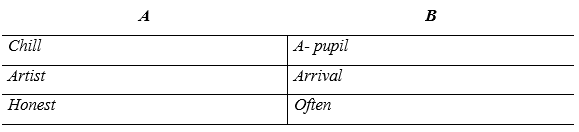
The following direction is the work with an internal form of a word. It begins with exercise on differentiation of essential and insignificant signs of concepts (exercise “Essential and insignificant signs”).
Example: In each subject or an event it is possible to mark out the main and minor, essential and insignificant signs. You need to define and write essential and insignificant signs of objects.

Later tasks are held for understanding of phraseological units and proverbs (exercises “Explain phraseological units”, “Pick up proverbs”). They are fulfilled to develop processes of the semantic analysis. Tasks for selection of the proverbs perform the same sense, but different subject contents promote understanding and differentiation of deep meaning of statements and its concrete verbal expression.
Example of exercise “Explain phraseological units”:
Write down value of the following phraseological units: Crestfallen; And none will be the wiser; Like water off a duck’s back; To Disappear into thin air.
Example of exercise “Pick up proverbs”:
Pick up to the proverb located at the left such proverb from the right part which would be close to it on sense expressed a similar main thought. In an empty column write figure of the corresponding proverb at the left.
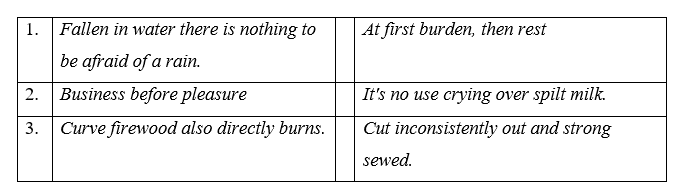
At the end of the program the students are offered to pick up the Russian analogs to proverbs and sayings of the people of other countries in exercise “What is it in Russian?”.
Example: Pick up the Russian analogs to proverbs and sayings of the people of other countries.
French proverb: Who goes slowly, that will precisely reach. English proverb: It is more than haste; it is less than the speed.
Some tasks demand to express in different ways the same thought, the same subject contents in the “Put Different into Words” task.
Example: Transform offers, using other words so that the initial sense remained.
PUSHKIN IS MY FAVOURITE POET
Further throughout four classes the school students carry out exercises “We compare concepts” during which they define the relations between concepts when the narrow concept completely enters more general, concepts intersect, coincide or are various, opposite, contradict each other on sense or correspond as a part – whole or whole – a part. In conclusion of this thematic block children practice in distinction of the relations between the concepts “generalization-a specification” and “whole – a part”.
Example: On the previous classes we divided concepts into groups, today we will compare them among themselves, to define in what relations they are. Let’s use for descriptive reasons schemes in the form of circles.
The psychologist sorts together with students and writes down examples and schemes (fig. 1) on a board, and then students carry out exercise in a workbook, defining the relations and fixing the scheme between concepts.
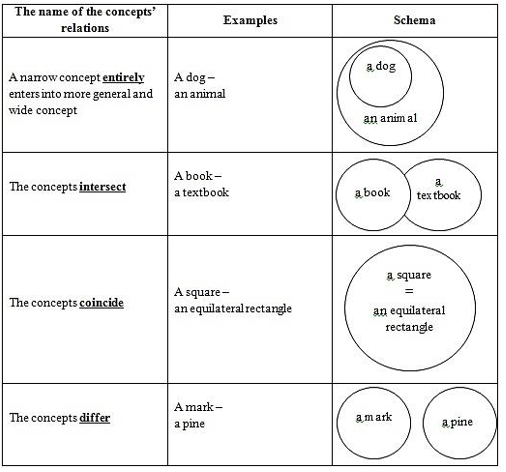
Fig. 1. Example of the exercise “Compare concepts”
Define the relations between the following concepts:
the enemy – the enemy, positive numbers – integers, an ant – an insect, addition – an insect, a riddle – a puzzle, J. Rodari is the author of Cipollino, a seal – a mammal.
After students performed a task and collectively on a chain sorted each couple of words, further they perform self-dependent work which shows difficulties and extent of understanding, digestion of new material at each pupil. Self-dependent work is checked by the psychologist and on the next class analyzes.
Special complexity in a series of tasks for comparison of concepts the generalization specification and a part – whole causes definition of the relations. In this regard we entered the additional class fulfilling differentiation of these communications.
Example: Define the relations between concepts: generalization, a specification, a part – whole or whole – a part: the house – a wall, a root – a tree, a rain – precipitation, the child – the boy, an insect – a bee, coal – fuel, a shovel – a shank.
Integration of the significant communications allocated with the analysis between words, formation of the formal and logical structure revealing this internal communication results.
On the basis of the worked over material the students pass to definition of a type of judgment (all-affirmative, all-negative, partially-affirmative, partially-negative) (fig. 2).
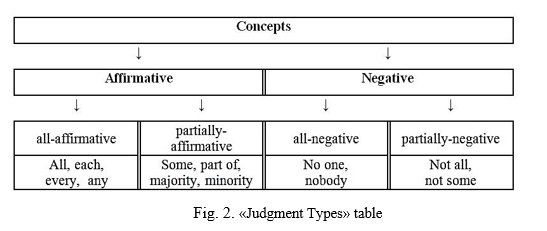
Example: Define a type of judgments of the following offers and emphasize the words indicating a type of judgment:
- All Russians are the Slavs. _______________
- Some school students learn French. _______________
- Some lions are not trained. ____________
- The majority of lakes in deserts are salty. ______________
Throughout five next classes the students carry out formal transformations of judgments in exercises “Change a form, without changing contents”. On each class rules of transformation of judgments are considered when the psychologist conducts students on a certain algorithm, suggesting them to define self-dependently a type of judgment, to allocate concepts and the attitude (fig. 3) between them.
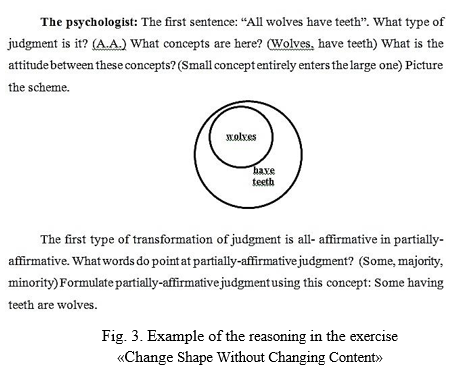
Thus, on classes there is a work on transformation of judgments: all-affirmative is in partially-affirmative, all-affirmative is in all-affirmative, partially-affirmative is in all-negative, partially-negative is in partially-affirmative, partially-affirmative is in partially-negative, etc. At the end of each task the students surely perform self-dependent work. They think out the examples of transformations.
At final lessons the students carry out conclusions, being based only on their formal and sign features in the tasks “We Learn to Reason”. For this purpose they allocate premises, conclusions and the purpose of a reasoning, carrying out various inductive and deductive conclusions available to them.
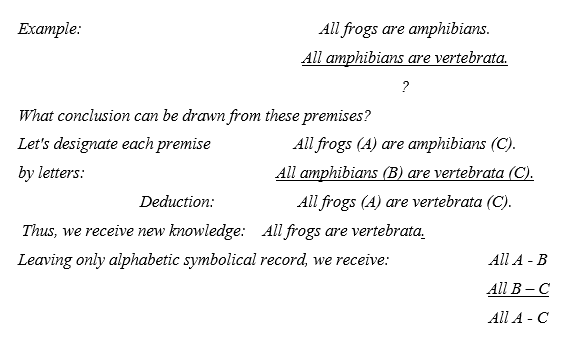
Deduction:
All frogs (A) are amphibians (C).
All amphibians (B) are vertebrata (C).
All frogs (A) are vertebrata (C).
Thus, we receive new knowledge: All frogs are vertebrata.Leaving only alphabetic symbolical record, we receive:
All A – В
All В – С
All А – С
Further it is offered to students, using record in a symbolical form, to solve logical problems with inequalities.
Example: Ann is as old as Kolya. Kolya is as old as Tanya. Are Ann and Tanya of the same age?
Volodya plays chess better, than Seryozha. Kolya plays chess worse, than Seryozha. Therefore Volodya plays chess better, than Kolya. Is a conclusion correct?
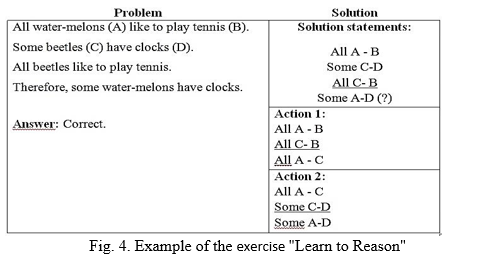
Throughout the next two classes the students define correctness of conclusions, solving a problem in several actions (fig. 4).
Example:
- Methods
For the purpose of determination of level of formation of verbal and logical thinking the Group intellectual test was applied [20]. GIT was developed by the Slovak psychologist of J. Vann. It is also adapted in laboratory of psychological diagnostics and correction of Psychological Institute of Russia joint stock company for Russian-speaking sample by group of authors: M.K. Akimova, E.M. Borisova, V.T. Kozlova and G.P. Loginova. The GIT test reveals how the pupil seized the words and terms offered in test questions and also abilities to perform some logical operations. All this characterizes the level of intellectual development of the pupil.
GIT is the reliable, valid, well proved in practice of school test. The test is developed in two forms (A and B) which are checked for interchangeability. Strictly limited time is allowed for implementation of each subtest. For estimation of individual results the concept of empirically marked out age norm is used. GIT is intended for students of the 4-6th classes.
The test consists of six subtests and 160 tasks.
The first subtest “Execution of Instructions” (20 tasks) is directed to identification of speed of understanding of simple instructions and their implementation, defines formal dynamic characteristics of course of verbal thought processes. The effectiveness of implementation of this subtest depends on high-speed opportunities of intellectual activity, i.e. lability of nervous system.
Example: Cross out the biggest of the following numbers: 2 4 8 6 also draw two circles between the following two names: Shura ____ Yura. Read attentively following words: fruit mushrooms tree morning. Cross out a penultimate letter in the fourth word and the second letter in a penultimate word.
The second subtest “Arithmetic Tasks” (20 tasks) diagnoses formation of mathematical knowledge and actions which are acquired in the course of training. It reveals ability to be guided in statements of the problem, ability to the mathematical analysis and synthesis, logical conclusion and mathematical generalization that does not allow to consider this subtest only an achievement quotient to mathematical skills. It is confirmed also by numerous results of diagnostics by the lowest level of performance of tasks according to all test. A peculiar “failure” of performance of tasks according to subtests, and almost independent of a parallel and type of school (at specialized mathematical schools the level of implementation of the subtest though above, than at usual schools, however below, than other subtests).
Example: How many students are in the city having 20 schools. Each school has 10 classes. Each class consists of 25 students?
How many balls can be bought for 16 rubles if 3 balls cost 4 rubles?
In two herds there are only 35 cows. A big herd has 7 cows more, than a small one. How many cows are in small herd?
The third subtest – “Addition of sentences” (20 tasks), estimates understanding of meaning of separate sentences, development of language skills, ability to operate with grammatical structures. It depends on a lexicon of students.
The analysis of this subtest shows level of proficiency in the speech as thinking tool. As for the correct reconstruction of the deformed sentence it is necessary not only to understand what it is about, but also it is necessary to write correct words or phrases and to use the necessary terminations, cases, pretexts. The high level of development demonstrates the competent use of necessary words or phrases.
Example: The child can be _______ a boy, or ____________________.
__________ the _________________ is good tomorrow, I will go to bathe.
Tasks of the fourth subtest “Determination of Similarity and Distinction of Concepts” (40 tasks) define abilities to analyze concepts, to compare them on the basis of allocation of essential features; formation of operation of comparison and awareness in concepts of different contents.
Example: internal – external; mean – honest; belongings – property; to allow – to forbid; similar – various
The fifth subtest “Numerical Ranks” (20 tasks) reveals ability to find logical regularities of creation of mathematical information, analytical-synthetic mathematical abilities, practically without involvement in process of the solution of verbal structures.
Example:

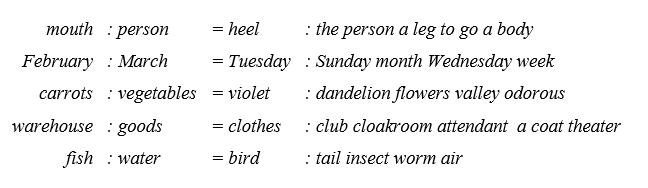
The sixth subtest “Establishment of Analogies” (40 tasks) diagnoses ability to think by analogy. It defines the level of development of operation of generalization and the analysis of the logical relations, the level of development of verbal thinking, shows potential opportunities of the pupil, dynamics of age changes.
Example:
The intellectual test was carried out by students at the end of the 4th class for the purpose of definition of control and experimental group, and at the end of the 5th class to determine dynamics of development of verbal and logical structures.
For the purpose of determination of level of determination of level of allocation of the main thought we used the story by K.D. Ushinsky “Two plows”. It is small on volume and finished according to the contents (see below).
At the beginning of a year the teacher at first read to students the text orally. Then the text was distributed to everyone for performance of analyses: phonetic, morphemic, morphological, syntactic, punctuation and lexical. In lexical analysis according to the explanatory dictionary examined the words “merchant” and “plow”. After performance of analyses the students handed over the text.
Further on a board wrote down the plan of the text made collectively, and fifth-graders wrote down the main idea of the text.
Then the teacher read the text the second time, and after that children wrote statement.
In the end of the year, during the repeated work with the text, the teacher read the story, made and wrote the plan of statement, wrote down the main idea of the text and worked on statement.
TWO PLOUGHS (According to K.D. Ushinsky)
Two plows were made of the same piece of iron in the same workshop. One of them fell into hands of the farmer and immediately went to work. Another one long and absolutely useless laid around in a shop of the merchant.
It happened so that in several years both fellow countrymen met again. The plow of the farmer shone as silver. It was even even better than when it just left a workshop. And the plow which lay without any matter in a shop darkened and became covered with rust.
— Tell, please, why you shine so much? — asked the rusted plow the old acquaintance.
That answered:
— From work, my the friend. And you rusted because all this time lay on one side and did nothing.
Results
For the purpose of determination of the relevant level of development of mental abilities the students of experimental and control classes carried out the Group intellectual test of J. Vann.
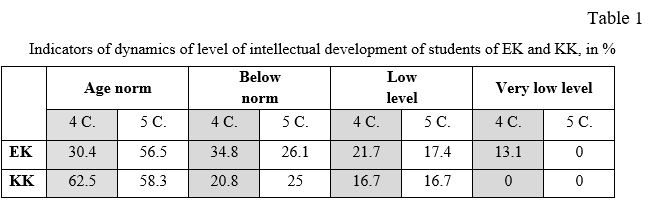
By results of diagnostics which is carried out at the end of the 4th class school students of experimental and control group were defined. Repeated diagnostics was carried out at the end of the 5th class for the purpose of tracking dynamics of level of intellectual development. Data of entrance and repeated diagnostics are presented in tab. 1.
When writing by students of the main idea of the story by K.D. Ushinsky “Two plows” the ability to formulate the main thought of the text was determined.
In the research of Lokalovy N.P. [13] conducted with students of elementary school 8 stages of development of the verbal and semantic analysis were allocated: “there is no answer”, “echolaliy”, “heading – without interpretation / with interpretation”, “syncret”, “plot”, “the beginning of differentiation of sense”, “full differentiation of sense”.
In our research at students of the 5th classes it was not selected types of statements of the main idea on the three first stages (“there is no answer”, ” echolaliy ” and “heading”) and also “plot”. However instead of “plot” we allocated a stage “a transitional stage”
Further examples of answers of students on the revealed stages of development of the verbal and semantic analysis are given.
Syncret is incorrectly understood separate phrase, or the wrong retelling with introduction of own contents: “If you work, then you will be beautiful, hardworking and if you lie on one side, you will not notice how there will pass time”, “If the thing is unused, it becomes unnecessary and rusty. The same and with the person. If he works hard, his body looks good, and if not, then it will rust”, “If you do not work, you will get soon to a hole of which you will hardly be able to get out”.
“Plot” as more or less full statement of contents of the work is not revealed in our research. A part of statements of the main thought of students do not approach under this category. They are intermediate, kind of pass from the syncret to the beginning of differentiation of sense. The main thought is included in contents, it is expressed not generally, specifically, but has analysis rudiments. It is possible to carry the following statements to “a transitional stage”: “You will lie – you will rust and if you do something, you will not rust”, “If you work, then you will shine and if you are lazy – you will appear” in dirt, “If you are unused or shirk work, it is possible to achieve nothing and to remain to rust”.
“The beginning of differentiation of sense” is a short retelling of the text or a part of the text and the generalizing statement of the main idea: “One plow worked. Another one didn’t work so the second plow rusted and the first plow began to shine. The author wanted to tell that it is always necessary to work”, “The lazy person will lie, he will achieve nothing. And if the person works, he will achieve everything”, “If the person is engaged in some business, he will become interested and will receive result. And if the result is good, then the person will “shine” with joy. Also it happened to one of plows”.
“Full differentiation” – the main thought is formulated correctly and generally: “Without effort you will not catch also a small fish from a pond”, “Work decorates the person, and the laziness spoils”, “If you work, then you will improve yourself and it you shirk you will ruin yourself”.
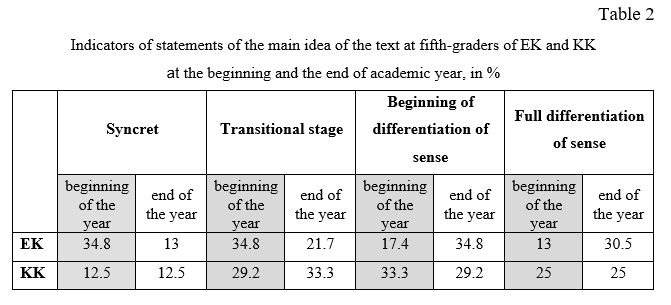
Quantitative processing of the received results was carried out on a number of statements (in %) in an experimental class and control at the beginning and at the end of academic year. These researches are presented in table 2.
Discussion
Apparently from the table 1 “Indicators of Dynamics of Level of Intellectual Development of Students of EK and KK”, in the 4th experimental class 30.4% of the students meeting age standard of intellectual development were defined; in the 4th control class – 62.5%. After training in experimental group the percent of students with age norm increased almost twice, to 56.5, and in a control class – decreased a little, to 58.3%.
Rates below norm in an experimental 4th class were 34.8%, in the control class rates were 20.8%. In the 5th experimental class the percent of school students with the level of intellectual development below norm decreased by 1.3 times, to 26.1%, and in the 5th control class the level increased a little, up to 25%.
The low level of development of intelligence in the 4th experimental class was 21.7%, in control it was 16.7%. After work on the program “I Choose Success!” in an experimental class the number of school students with the low level of development decreased to 17.4%. In a control class indicators were without changes.
Students with very low level of intellectual development of 4 class were only in experimental group and made 13.1%. In the 5th class there were no school students with very low I.Q. neither in control, nor in experimental group.
Indicators of dynamics of intellectual development of school students (tab. 1) demonstrate that the purposeful, systematic, specially organized cognitive development which is carried out on the basis of the law of system differentiation provides increase in level of intellectual development of students almost twice.
According to the table 2 “Indicators of a Statement of the Main Idea of the Text at Fifth-graders of EK and KK at the Beginning and the End of Academic Year” it is visible that at the beginning of a year of the statements relating to a stage syncret, it was defined in an experimental class of 34.8%, in a control class it was 12.5%. At the end of the academic year in EK the number of syncretic statements decreased by 2.5 times and made 13%, and in KK 12.5% remained at the same level.
The statements relating to a stage of a transitional stage in an experimental class at the beginning of a year made 34.8%, and in the end of the year their quantity decreased by 1.5 times, to 21.7%. In a control class the small increase from 29.2% to 33.3% is observed.
Stage indicators “The beginning of differentiation of sense” at school students of an experimental class increased twice, from 17.4% to 34.8%, and in a control class the small decrease from 33.3% to 29.2% is observed.
At the beginning of a year indicators of the statements corresponding to a stage “Full differentiation of sense” at school students the experimental group was twice less (13%), than at students of control group (25%). On completion of the forming experiment the percent of students of EK increased by 2.5 times and made 30.5%. At students of KK – remained at the same level, 25%.
Dynamics of the received results (tab. 2) shows positive changes at students of EK in development of a system of the verbal and semantic analysis. They not only caught up with students of a control class, but also surpassed them.
The data provided by us allow to reveal conditions of formation and dynamics of development of the differentiated logical-semantic verbal and semantic cognitive structures influencing understanding of texts by fifth-graders.
Conclusions
During purposeful and systematic cognitive influence the students have a formation of a system of the thought processes promoting assimilation, ordering and systematization of knowledge.
Feature of our experiment is that classes were organized with the weakest class in a parallel. The correctional developing work was carried out 2 times a week out of a schedule grid with all class. Frequency of classes, integrity of collective of a class, performance by school students of self-dependent tasks and a certain operation algorithm of the psychologist with students when performing tasks on formation of logical-semantic and verbal and semantic cognitive structures are necessary psychological conditions of carrying out the correctional developing influence.
Data of the presented experiment unambiguously demonstrate that the purposeful cognitive influences organized in a certain way contribute to the intellectual development of students, form bases of complete system thinking, provide the best understanding of the text and allocation of the main idea of the text. If not to make specially organized cognitive impacts, then there is a partial decrease in the beginning of differentiation of sense and increase in a transitional stage.
Thus, our research confirmed a hypothesis that the main condition leading to the best understanding of texts is the general intellectual development of students, formation at them the differentiated grids of the logical-semantic relations of concepts in which their knowledge of the world is presented.
According to N.I. Chuprikova [24], purposeful development of processes of the analysis and synthesis leads to increase of selectivity at implementation of cognitive activity and to increase in level of intellectual development in general.
The author expresses gratitude of N.I. Chuprikova for consultation; E.V. Volkova for editing the manuscript; V.G. Gorobets for the help with a translation of article.
References
- Beltyukov, V.I. (1984). About regularities of speech function development in ontogenesis. Issues of Psychology, No. 1, p. 141-146. [ Bel’tyukov V.I. O zakonomernostyakh razvitiya rechevoy funktsii v ontogeneze // Voprosy psikhologii. 1984. № 1, s. 141-146.]
- Volkova, E.V. (2016). Technologies of mental resources development.: Publishing house “Institute of Psychology of the Russian Academy of Sciences”, 2016.Volkova, E.V. (2016). Technologies of development of mental resources. – M.: Institute of Psychology of RAS publishing house. [Volkova Ye.V. Tekhnologii razvitiya mental’nykh resursov. M.: Izd-vo «Institut psikhologii RAN», 2016.].
- Vygotsky, L.S. (1984). Child psychology. Collected works. V.4. Moscow: Pedagogics. [Vygotskiy L.S. Detskaya psikhologiya. Sobr. Soch. T.4. M.: Pedagogika, 1984].
- Vygotsky, L.S. (1984). The history of the development of the higher mental functions. Collected works. V.3. Moscow: Pedagogics. [Vygotskiy, L.S. (1984). Istoriya razvitiya vysshikh psikhicheskikh funktsiy. Sobr. soch. T.3. M.: Pedagogika].
- Hegel, G. (2020). Science of logic. V. 2. M.: Eksmo. [ Gegel’ G. (2020). Nauka logiki. T. 2. M.: Eksmo].
- Granik, G.G., Bondarenko, S.M., Kontsevaya, L.A. (1991). When the book teaches. 2nd ed., add. M.: Pedagogy. [ Granik, G.G., Bondarenko, S.M., Kontsevaya, L.A. Kogda kniga uchit. 2-ye izd., dop. M.: Pedagogika, 1991].
- Davydov, V.V. (1986). The problem of developmental learning: The experience of theoretical and experimental research. Moscow: Pedagogics. [Davydov V.V. (1986). Problema razvivayushchego obucheniya: Opyt teoreticheskogo i eksperimental’nogo issledovaniya. M.: Pedagogika.].
- Davydov, V.V., Markova, A.K. (1992). Development of thinking at school age. Age and pedagogical psychology: Texts. Comp. and comment. Shuare Martha O. M.: Publishing House of Moscow university. [Davydov, V.V., Markova, A.K. (1992). Razvitiye myshleniya v shkol’nom vozraste // Vozrastnaya i pedagogicheskaya psikhologiya: Teksty / Sost. i komment. Shuare Marta O. M.: Izd-vo Mosk. un-ta.]. Davydov V.V., Markova A.K. Development of thinking at school age//Age and pedagogical psychology: Texts / Comp. and comment. O. Shuare Mart – M.: Msc. publishing house. un-that, 1992.
- Zaporozhets, A.V. (1986). Selected psychological works: In 2 vols. Volume 1. The mental development of a child. Moscow: Pedagogics. [Zaporozhets, A.V. (1986). Izbrannyye psikhologicheskiye trudy: V 2-kh tomakh. Tom 1. Psikhicheskoye razvitiye rebenka. M.: Pedagogika].
- Klashchus, N.G., Kobzeva, E.M. (2017). The program for prevention of school disadaptation in early adolescence “I choose success!”. M.: Publishing house of the Moscow social and psychological university. [Klashchus, N.G., Kobzeva, Ye.M. (2017). Programma po profilaktike shkol’noy dezadaptatsii uchashchikhsya mladshego podrostkovogo vozrasta «YA vybirayu uspekh!». M.: Izdatel’stvo Moskovskogo sotsial’no-psikhologicheskogo universiteta].
- Druzhinin, V.N. Ushakov, D.V. (ed.) (2002). Cognitive psychology. A textbook for universities. M.: LANE of SE. [Druzhinin, V.N. Ushakov, D.V. (red.) (2002). Kognitivnaya psikhologiya. Uchebnik dlya vuzov. M.: PER SE.].
- Lokalova, N.P. (2000). Organization of the verbal-semantic cognitive structure. Issues of Psychology, 5, 72 – 86. [Lokalova, N.P. (2000). Organizatsiya verbal’no-smyslovoy kognitivnoy struktury. Voprosy psikhologii, № 5, 72 – 86.].
- Lokalova, N.P. (1996). The development of verbal-semantic analysis in elementary school age. Issues of Psychology, 2, 113 – 129. [Lokalova, N.P. (1996). Razvitiye verbal’no-smyslovogo analiza v mladshem shkol’nom vozraste. Voprosy psikhologii, 2, 113 – 129.].
- Lokalova, N.P. (2001). Psychological development lessons in secondary school (grades V-VI).: Publishing house “Os-89”. [Lokalova, N.P. (2001). Uroki psikhologicheskogo razvitiya v sredney shkole (V-VI klassy). M.: Izdatel’stvo «Os’-89»].
- Neisser, U. (1981). Knowledge and reality. Sense and principles of cognitive psychology. M.: Progress. [Naysser, U. (1981). Poznaniye i real’nost’. Smysl i printsipy kognitivnoy psikhologii. M.: Progress].
- Dubrovina, I.V., Kruglov, B.S. (eds.). (1988). Features of learning and mental development in middle adolescence. Moscow: Pedagogics. [Dubrovina, I.V., Kruglov, B.S.(red.). (1988). Osobennosti obucheniya i psikhicheskogo razvitiya shkol’nikov 13-17 let. M.: Pedagogika].
- Lektorsky, V. A., Sadovsky, V. N., Yudin, E. G. (introductory article) (1994). Piaget J. Selected Psychological Works: Translation from English and French. Moscow: International Pedagogical Academy. [Lektorskiy, V. A., Sadovskiy, V. N., Yudin E. G. (vstupitel’naya stat’ya) (1994). Piazhe ZH. Izbrannyye psikhologicheskiye trudy: Per. s angl. i fr. M.: Mezhdunarodnaya pedagogicheskaya akademiya].
- Pospelov, N.N., Pospelov, I.N. (1989). Formation of cogitative operations in senior students. Moscow: Pedagogics [Pospelov, N.N., Pospelov, I.N. (1989). Formirovaniye myslitel’nykh operatsiy u starsheklassnikov. M.: Pedagogika].
- Potebnya, A.A. (1999). Thought and language. Moscow: Labyrinth. [Potebnya, A.A. (1999). Mysl’ i yazyk. M.: Labirint].
- A manual to the use of a group intelligence test for early adolescents. (1993). Obninsk: Printer. [Rukovodstvo k primeneniyu gruppovogo intellektual’nogo testa dlya mladshikh shkol’nikov. (1993). Obninsk: Printer].
- Sechenov, I.M. (2001). Elements of thought. SPb.: Peter. [Sechenov, I.M. (2001). Elementy mysli. SPb.: Piter].
- Solso, R. (2002). Cognitive psychology. SPb.: Peter. [Solso, R. (2002). Kognitivnaya psikhologiya. SPb.: Piter].
- Chuprikova N.I. (2003) Intellectual development and training (to justification of system and structural approach). – M.: Publishing house of the Moscow Psychologo – Social Institute, 2003. [Chuprikova N.I. Umstvennoe razvitie i obuchenie (k obosnovaniyu sistemno-strukturnogo podkhoda). – M.: Izdatelstvo Moskovskogo psikhologo-sotsialnogo instituta, 2003.]
- Chuprikova N.I. (2007) Intellectual development: Principle of differentiation. SPb.: St. Petersburg, 2007. [Chuprikova N.I. Umstvennoe razvitie: Printsip differentsiatsii. – SPb.: Piter, 2007.]
- Chuprikova N.I., Klashchus N.G. (2014). Differentiation of logical-semantic and conceptual structures of the subject as condition of understanding of meaning of proverbs / Differential-integration theory of development. Prince 2 / Compil. and editors N.I. Chuprikova, E.V. Volkova. – M.: Languages of Slavic culture: Sign, Page 411 – 434. [Chuprikova N.I., Klashchus N.G. Differentsirovannost logiko-semanticheskikh i ponyatijnykh struktur sub”ekta kak uslovie ponimaniya smysla poslovits / Differentsionno-integratsionnaya teoriya razvitiya. Kn. 2 / Sost. i red. N.I. Chuprikova, E.V. Volkova. – M.: Yazyki slavyanskoj kultury: Znak, 2014. 411 – 434.]
- Elkonin, D.B. (1989). Age and specific features of younger teenagers. In D.B. Elkonin. Selected psychological works. M.: Pedagogics. [Elkonin D.B. Vozrastnye i individualnye osobennosti mladshikh podrostkov // Elkonin D.B. Izbrannye psikhologicheskie trudy. – M.: Pedagogika, 1989.]
- Gibson, E.J. (1969). Principles of perceptual learning and development. N.Y.: Appeeton Century Grofts.
- Nelson, K. (1983). The conceptual basis for language. Concept development and the development of word meaning, 173-188.
- Witkin, H.A., Goodenough, D., Oltman, Ph. (1977). Psychological differentiation: current status. N.Y.
Comments (0)
The current article presents a program “I choose success!”. The purpose of this program is conceptual thinking development in middle school students. The program “I choose success!” is designed in accordance with the principle of systems differentiation & integration of logical-semantic and verbal-semantic cognitive structures, which are the substratum of conceptual thinking. The four stages of conceptual thinking development are discussed. The exercises aimed at developing various aspects of conceptual thinking are described in detail, as well as the criteria for evaluating the performance of these exercises. “I Choose Success classes” are held twice a week.
A comparative formative experiment was carried out to test the developmental effect of the program “I Choose Success!”. Students aged 11-12 were involved in learning experiment. It should be emphasized that the students of the experimental sample had lower IQs and experienced great difficulty in highlighting the main idea of the text compared to the students of the control group. The study used J. Vann ‘s group intelligence test and the author’s conceptual thinking assessment tool.
Qualitative analysis showed that, at the end of the learning experiment, the initially weaker students of the experimental sample were twice as successful compared to the students of the control sample. Thus, the data obtained showed that the purposeful formation of differentiated logical-semantic and verbal-semantic cognitive structures affected the accuracy of highlighting the main idea of the text and led to the intellectual development of students.
Issue of intellectual development of students is a current problem of modern education. Requirements to cognitive activity considerably increase when child enters to the first-grade.
In cognitive psychology the intellectual development is understood as purposeful formation at the child in the course of training of cognitive representative structures. The concept “representation” means “image”, “display of one in another”. In the context considered by us it is about formation of the internal psychological structures containing ideas of the outside world, of world “picture”. These internal psychological structures are formed in the course of life and training in the mind of the person.
Solso notes that our ideas of the world are not necessarily identical to its valid essence. Of course, representation of information is connected with those its incentives which are received by our sensory device, but it is also exposed to significant changes. These changes or modifications are connected with our past experience of which the rich and complex network of our knowledge was the result. Thus, the arriving information abstracts (and it is to some extent distorted) and is stored then in the system of memory of the person. From this it follows that our internal representation of reality has some similarity to reality external, but when we abstract and we will transform information, we do it in the light of our previous experience [22].
The concept of cognitive representation is identical to a concept of the anticipating scheme in a certain way organizing and structuring the perceived material. According to U. Neisser [15], the anticipating schemes are cognitive structures which prepare the individual for adoption of information of a certain aspect and thus operate its current informative activity.
According to N.I. Chuprikova [23], cognitive representative structures contain the systematized various knowledge and ideas of ways of performance of different cogitative actions and ability of their practical application. They become means of cognitive activity of the child subsequently.
In practical psychology there is an idea of development of thinking of students “from above”. It is connected with assimilation by school students of a system of scientific knowledge of whom ordered cognitive structures are result. All sum of knowledge acquired by students from concrete to abstract generalized is stored in these structures, at the same time cognitive structures begin to act as the instrument of knowledge and self-knowledge. Development of thinking of students “from above” represents assimilation of knowledge from the general to the particular. The hierarchy of cognitive structures is the course of process of intellectual development of the person in general [23].
Intelligent “instruments” of ordering, systematization and structuring knowledge allow the child most to pack the structured and interconnected system of knowledge in the head.
Zh. Piaget’s theory is one of the most noticeable milestones in development of cognitive psychology. According to Piaget, in development of intelligence of the person it is possible to allocate four main periods of development conditionally: a stage of sensor-motor intelligence (from the birth up to 2 years); preoperational stage (from 2 to 7 years); stage of concrete operations (from 7 to 11 years) and stage of formal operations (from 11 to 15 years) [17].
The period from 7 to 11 years is followed by reduction of centration and egocentrism of thinking, development of ability of understanding of maintaining quantity, weight, volume, formation of a concept of time and space, growth of a possibility of classification and a seriation and many other things that is important to start school training. At this age at the child the ability to deductive conclusions, but with restrictions of a stage of concrete operations is formed. So, children are already capable to solve a syllogism, but only at visual presentation of its conditions. Or, for example, in a task on establishment of balance on a yoke of scales where it is required to consider two parameters (weight of cargoes and length of a shoulder), the child at a stage of concrete operations is limited by manipulation of only one system at present – either distance or its weight.
Upon transition to high school the demand of full and high-quality implementation of cogitative, analytical-synthetic activity as the complexity and volume of the studied disciplines grow increases. Changes of educational requirements and the nature of a training material can promote to a degree formation of abstract and logical forms of thinking at students. However, this process is spontaneous and unstable.
Researches of psychologists obviously show that transition from younger school age to teenage qualitatively changes thinking of the child: evident and figurative and initial forms of verbal thinking will be transformed to the hypothetic-arguing thinking which is under construction on the basis of high degree of generality and abstractness.
There were engaged in studying of this problem by L.S. Vygotsky [4], A.B. Zaporozhets [9], D. B. Elkonin [26], V.V. Davydov [8]. D.B. Elkonin noted that “at the beginning of teenage age children are sensitive to transition in educational activity to the new, higher level while for the teenager the sense of educational activity as activities for self-education and self-improvement” is revealed [26]. V.V. Davydov emphasized that “characteristics of this new type of the relation to the activity make … important psychological growths of this age, define reserves of its development” [7].
Already in middle forms of school the educational activity places more and more great demands on the level of development of abstract forms of thinking. Abstract and logical forms begin to be formed spontaneously due to the need to acquire a training material. Thus, the teenage age is the sensitive period for development of abstract and logical forms of thinking.
In modern cognitive psychology the idea of intelligence includes ability to isolate from a flow of information significant signs and properties of objects including abstract and also ability to operate with essential properties and the relations, separating them from insignificant properties and the relations. Therefore, the intelligence is the created representative and cognitive structures providing processing of all current information. And IQ of subjects is higher, while cognitive structures are internally more differentiated, hierarchically ordered and accurately dismembered [25].
N.I. Chuprikova understands the internal steady psychological systems of representation of knowledge as a result of extraction and the analysis of information as cognitive structures [24]. These are peculiar matrixes of all knowledge of the person of the world. The person takes information from the world around, imprints and puts it in storages of the memory in the form of the cognitive structures which developed at it. Cognitive structures develop in the course of human life as the system of intellectual processes of the analysis inherent in it and synthesis, abstraction and generalization.
The analysis of ontogenetic development of the informative sphere of the person showed that during intellectual development a universal principle of development of all organic systems is decisive. It is the law of development from the general to the particular, from whole to parts, from global, complete to dismembered and differentiated. It is the principle of system differentiation [23].
Extent of development of differentiation of cognitive structures directly corresponds to the level of intellectual development, mental capacities and I.Q. The intelligence represents ability to allocate and operate with essential abstract signs and properties of objects, their relations. At the heart of intelligence there is an ability of the person to form internally differentiated, well dismembered and hierarchically ordered representative cognitive structures. The level of their hierarchical orderliness is higher, the processing of the current information is carried out more precisely. Therefore, the level of intellectual development of the person is defined by the level of formation of representative and cognitive structures.
The essence of the principle of differentiation is that the simple, badly dismembered, indistinct, global structures are gradually differentiated in highly dismembered, complex developed and hierarchically ordered cognitive structures. This process is carried out repeatedly and provides the wide and deep, flexible and many-sided analysis and synthesis of reality. Development of cognitive structures can metaphorically be presented in the tree form with more and more branching crown: the cognitive internal psychological structures are more hierarchically dismembered, the crown is more magnificent, the I.Q. of the person is higher.
The idea of the principle of differentiation is studied in philosophy, psychology and physiology long ago. It is the defining, leading principle of development in a number of theories. Its action is visually shown in the most various spheres of intellectual development. In G. Hegel’s theories [5], theories of I.M. Sechenov [21], A.A. Potebnya [19], Zh. Piaget [17] and some other the central place is allocated to the principle of differentiation. In modern cognitive psychology the authors assign a leading role to the principle of differentiation in development of intelligence (E. Gibson [27], K. Nelson [28], V.I. Beltyukov [1], H. Witkin [29] and a number of other authors).
The research object is to study conditions of formation of logical-semantic and verbal and semantic cognitive structures at the studying middle school.
Research hypothesis: to show a role of formation of the differentiated logical-semantic and verbal and semantic cognitive structures as the factor influencing understanding of texts.
According to the purpose and the hypothesis of the research the problem of an experiment was defined: to study influence of the organization of the necessary psychological conditions promoting formation of the differentiated logical-semantic and verbal and semantic structures, defining understanding of the text by students of middle school.
- Participants
47 students of the 5th classes of 11-12 years, from them 19 boys and 28 girls participated in the study.
Definition of groups of participants of a research was carried out by the results of group diagnostics at the end of the 4th class. The Group intellectual test of J. Vann (GIT) [20] was offered students. Application of GIT allows to determine the level of formation of verbal and logical thinking.
The students of the fifth class having low indicators of the level of development of mental abilities were defined in experimental group (23 people), students of a strong 5th class – in control group (24 people).
In addition at the beginning and at the end of the 5th class the students of EK and KK wrote statement in K.D. Ushinsky’s text “Two plows” and defined the main thought of the text.
- Procedure
Within academic year training classes were held with the students of EK classes 2 times a week. The studies were given in the program by N.G. Klashchus, E.M. Kobzeva “I Choose Success! ” on prevention of school desadaptation of students of younger teenage [10]. The program consists of 36 classes and in practice realizes the principle of system differentiation which represents the fundamental mechanism of development of mentality, according to N.I. Chuprikova [24].
Main objective of training in the program “I Choose Success!” is purposeful formation of the verbal and logical cognitive structures which are carrying out irregular shapes of intellectual activity and, first of all, abstract, abstract thinking.
The system of the exercises presented in the program contributes to the development as thinking (its separate processes and qualities), and other psychological processes – imagination, attention, the internal plan of action, spatial representations. Exercises on development of the informative sphere are generally borrowed from N.P. Lokalova’s program [14].
Other not less important areas of work with teenagers according to the program “I Choose Success!” are development of the communicative sphere and increase in efficiency of methods of educational activity, their improvement.
The main principle in holding psychological classes is the correct performance of tasks by all students, working off of each exercise. It is important to achieve the correct performance of tasks by all students even if more time will be required for it more than it is provided by this program. For this purpose the program included tasks for self-dependent work of school students which are checked by the psychologist and further they are discussed at the next psychological classes.
Formation of the differentiated logical-semantic and verbal and semantic cognitive structures in students according to the program “I choose success!” begins with the work on a word. At the beginning of the classes, tasks for inclusion of any one word in different statements are offered students. These therefore words become elements of various semantic structures. In exercise “Three words” school students need to make as much as possible offers including these words.
Example: Make as much as possible offers of three words. It is possible to change cases and to add other words.
SCHOOL DESK, SKY, APPLE
In the Make Words task the word is a complete structure in which it is necessary to allocate separate components – to make as many as possible words of letters of this word.
Example: Make as much as possible words of the letters entering the set word. The made words have to be nouns in the Nominative case of singular. It is impossible to add other letters.
POWER PLANT
Work with anagrams in exercise “Guess the words” permits understanding about integrity of external structure of a word and change of elements can result words in its distortion.
Example: Decipher the offered words and write down them.
TREMASINT, KURINOS, UPECHAH
In exercise “Explain the Greek words” students define value of the Greek roots, suffixes and prefixes and call from them derivative words. A problem of exercise is in awareness of structure of a word, differentiation of structural and semantic characteristics.
Example: Below the Greek roots of words and a prefix are given. Define their value and write derivative words with the same combinations of letters.
PHONE – …, HYPER – …, AVI – …
In further work with words synonyms and words antonyms the differentiated dismemberment of external and internal forms of a word is made. And, at first students choose synonyms and antonyms from two columns of ready concepts (exercise “Choose synonyms and antonyms”), and further – select them self-dependently (exercise “Pick up synonyms and antonyms”).
Example: To words at the left in a column A self-dependently select and write down a number of words having similar value (synonyms).
To words at the left in a column of B self-dependently select and write down a number of words having opposite value (antonyms).
The following direction is the work with an internal form of a word. It begins with exercise on differentiation of essential and insignificant signs of concepts (exercise “Essential and insignificant signs”).
Example: In each subject or an event it is possible to mark out the main and minor, essential and insignificant signs. You need to define and write essential and insignificant signs of objects.
Later tasks are held for understanding of phraseological units and proverbs (exercises “Explain phraseological units”, “Pick up proverbs”). They are fulfilled to develop processes of the semantic analysis. Tasks for selection of the proverbs perform the same sense, but different subject contents promote understanding and differentiation of deep meaning of statements and its concrete verbal expression.
Example of exercise “Explain phraseological units”:
Write down value of the following phraseological units: Crestfallen; And none will be the wiser; Like water off a duck’s back; To Disappear into thin air.
Example of exercise “Pick up proverbs”:
Pick up to the proverb located at the left such proverb from the right part which would be close to it on sense expressed a similar main thought. In an empty column write figure of the corresponding proverb at the left.
At the end of the program the students are offered to pick up the Russian analogs to proverbs and sayings of the people of other countries in exercise “What is it in Russian?”.
Example: Pick up the Russian analogs to proverbs and sayings of the people of other countries.
French proverb: Who goes slowly, that will precisely reach. English proverb: It is more than haste; it is less than the speed.
Some tasks demand to express in different ways the same thought, the same subject contents in the “Put Different into Words” task.
Example: Transform offers, using other words so that the initial sense remained.
PUSHKIN IS MY FAVOURITE POET
Further throughout four classes the school students carry out exercises “We compare concepts” during which they define the relations between concepts when the narrow concept completely enters more general, concepts intersect, coincide or are various, opposite, contradict each other on sense or correspond as a part – whole or whole – a part. In conclusion of this thematic block children practice in distinction of the relations between the concepts “generalization-a specification” and “whole – a part”.
Example: On the previous classes we divided concepts into groups, today we will compare them among themselves, to define in what relations they are. Let’s use for descriptive reasons schemes in the form of circles.
The psychologist sorts together with students and writes down examples and schemes (fig. 1) on a board, and then students carry out exercise in a workbook, defining the relations and fixing the scheme between concepts.
Fig. 1. Example of the exercise “Compare concepts”
Define the relations between the following concepts:
the enemy – the enemy, positive numbers – integers, an ant – an insect, addition – an insect, a riddle – a puzzle, J. Rodari is the author of Cipollino, a seal – a mammal.
After students performed a task and collectively on a chain sorted each couple of words, further they perform self-dependent work which shows difficulties and extent of understanding, digestion of new material at each pupil. Self-dependent work is checked by the psychologist and on the next class analyzes.
Special complexity in a series of tasks for comparison of concepts the generalization specification and a part – whole causes definition of the relations. In this regard we entered the additional class fulfilling differentiation of these communications.
Example: Define the relations between concepts: generalization, a specification, a part – whole or whole – a part: the house – a wall, a root – a tree, a rain – precipitation, the child – the boy, an insect – a bee, coal – fuel, a shovel – a shank.
Integration of the significant communications allocated with the analysis between words, formation of the formal and logical structure revealing this internal communication results.
On the basis of the worked over material the students pass to definition of a type of judgment (all-affirmative, all-negative, partially-affirmative, partially-negative) (fig. 2).
Example: Define a type of judgments of the following offers and emphasize the words indicating a type of judgment:
- All Russians are the Slavs. _______________
- Some school students learn French. _______________
- Some lions are not trained. ____________
- The majority of lakes in deserts are salty. ______________
Throughout five next classes the students carry out formal transformations of judgments in exercises “Change a form, without changing contents”. On each class rules of transformation of judgments are considered when the psychologist conducts students on a certain algorithm, suggesting them to define self-dependently a type of judgment, to allocate concepts and the attitude (fig. 3) between them.
Thus, on classes there is a work on transformation of judgments: all-affirmative is in partially-affirmative, all-affirmative is in all-affirmative, partially-affirmative is in all-negative, partially-negative is in partially-affirmative, partially-affirmative is in partially-negative, etc. At the end of each task the students surely perform self-dependent work. They think out the examples of transformations.
At final lessons the students carry out conclusions, being based only on their formal and sign features in the tasks “We Learn to Reason”. For this purpose they allocate premises, conclusions and the purpose of a reasoning, carrying out various inductive and deductive conclusions available to them.
Deduction:
All frogs (A) are amphibians (C).
All amphibians (B) are vertebrata (C).
All frogs (A) are vertebrata (C).
Thus, we receive new knowledge: All frogs are vertebrata.Leaving only alphabetic symbolical record, we receive:
All A – В
All В – С
All А – С
Further it is offered to students, using record in a symbolical form, to solve logical problems with inequalities.
Example: Ann is as old as Kolya. Kolya is as old as Tanya. Are Ann and Tanya of the same age?
Volodya plays chess better, than Seryozha. Kolya plays chess worse, than Seryozha. Therefore Volodya plays chess better, than Kolya. Is a conclusion correct?
Throughout the next two classes the students define correctness of conclusions, solving a problem in several actions (fig. 4).
Example:
- Methods
For the purpose of determination of level of formation of verbal and logical thinking the Group intellectual test was applied [20]. GIT was developed by the Slovak psychologist of J. Vann. It is also adapted in laboratory of psychological diagnostics and correction of Psychological Institute of Russia joint stock company for Russian-speaking sample by group of authors: M.K. Akimova, E.M. Borisova, V.T. Kozlova and G.P. Loginova. The GIT test reveals how the pupil seized the words and terms offered in test questions and also abilities to perform some logical operations. All this characterizes the level of intellectual development of the pupil.
GIT is the reliable, valid, well proved in practice of school test. The test is developed in two forms (A and B) which are checked for interchangeability. Strictly limited time is allowed for implementation of each subtest. For estimation of individual results the concept of empirically marked out age norm is used. GIT is intended for students of the 4-6th classes.
The test consists of six subtests and 160 tasks.
The first subtest “Execution of Instructions” (20 tasks) is directed to identification of speed of understanding of simple instructions and their implementation, defines formal dynamic characteristics of course of verbal thought processes. The effectiveness of implementation of this subtest depends on high-speed opportunities of intellectual activity, i.e. lability of nervous system.
Example: Cross out the biggest of the following numbers: 2 4 8 6 also draw two circles between the following two names: Shura ____ Yura. Read attentively following words: fruit mushrooms tree morning. Cross out a penultimate letter in the fourth word and the second letter in a penultimate word.
The second subtest “Arithmetic Tasks” (20 tasks) diagnoses formation of mathematical knowledge and actions which are acquired in the course of training. It reveals ability to be guided in statements of the problem, ability to the mathematical analysis and synthesis, logical conclusion and mathematical generalization that does not allow to consider this subtest only an achievement quotient to mathematical skills. It is confirmed also by numerous results of diagnostics by the lowest level of performance of tasks according to all test. A peculiar “failure” of performance of tasks according to subtests, and almost independent of a parallel and type of school (at specialized mathematical schools the level of implementation of the subtest though above, than at usual schools, however below, than other subtests).
Example: How many students are in the city having 20 schools. Each school has 10 classes. Each class consists of 25 students?
How many balls can be bought for 16 rubles if 3 balls cost 4 rubles?
In two herds there are only 35 cows. A big herd has 7 cows more, than a small one. How many cows are in small herd?
The third subtest – “Addition of sentences” (20 tasks), estimates understanding of meaning of separate sentences, development of language skills, ability to operate with grammatical structures. It depends on a lexicon of students.
The analysis of this subtest shows level of proficiency in the speech as thinking tool. As for the correct reconstruction of the deformed sentence it is necessary not only to understand what it is about, but also it is necessary to write correct words or phrases and to use the necessary terminations, cases, pretexts. The high level of development demonstrates the competent use of necessary words or phrases.
Example: The child can be _______ a boy, or ____________________.
__________ the _________________ is good tomorrow, I will go to bathe.
Tasks of the fourth subtest “Determination of Similarity and Distinction of Concepts” (40 tasks) define abilities to analyze concepts, to compare them on the basis of allocation of essential features; formation of operation of comparison and awareness in concepts of different contents.
Example: internal – external; mean – honest; belongings – property; to allow – to forbid; similar – various
The fifth subtest “Numerical Ranks” (20 tasks) reveals ability to find logical regularities of creation of mathematical information, analytical-synthetic mathematical abilities, practically without involvement in process of the solution of verbal structures.
Example:
The sixth subtest “Establishment of Analogies” (40 tasks) diagnoses ability to think by analogy. It defines the level of development of operation of generalization and the analysis of the logical relations, the level of development of verbal thinking, shows potential opportunities of the pupil, dynamics of age changes.
Example:
The intellectual test was carried out by students at the end of the 4th class for the purpose of definition of control and experimental group, and at the end of the 5th class to determine dynamics of development of verbal and logical structures.
For the purpose of determination of level of determination of level of allocation of the main thought we used the story by K.D. Ushinsky “Two plows”. It is small on volume and finished according to the contents (see below).
At the beginning of a year the teacher at first read to students the text orally. Then the text was distributed to everyone for performance of analyses: phonetic, morphemic, morphological, syntactic, punctuation and lexical. In lexical analysis according to the explanatory dictionary examined the words “merchant” and “plow”. After performance of analyses the students handed over the text.
Further on a board wrote down the plan of the text made collectively, and fifth-graders wrote down the main idea of the text.
Then the teacher read the text the second time, and after that children wrote statement.
In the end of the year, during the repeated work with the text, the teacher read the story, made and wrote the plan of statement, wrote down the main idea of the text and worked on statement.
TWO PLOUGHS (According to K.D. Ushinsky)
Two plows were made of the same piece of iron in the same workshop. One of them fell into hands of the farmer and immediately went to work. Another one long and absolutely useless laid around in a shop of the merchant.
It happened so that in several years both fellow countrymen met again. The plow of the farmer shone as silver. It was even even better than when it just left a workshop. And the plow which lay without any matter in a shop darkened and became covered with rust.
— Tell, please, why you shine so much? — asked the rusted plow the old acquaintance.
That answered:
— From work, my the friend. And you rusted because all this time lay on one side and did nothing.
For the purpose of determination of the relevant level of development of mental abilities the students of experimental and control classes carried out the Group intellectual test of J. Vann.
By results of diagnostics which is carried out at the end of the 4th class school students of experimental and control group were defined. Repeated diagnostics was carried out at the end of the 5th class for the purpose of tracking dynamics of level of intellectual development. Data of entrance and repeated diagnostics are presented in tab. 1.
When writing by students of the main idea of the story by K.D. Ushinsky “Two plows” the ability to formulate the main thought of the text was determined.
In the research of Lokalovy N.P. [13] conducted with students of elementary school 8 stages of development of the verbal and semantic analysis were allocated: “there is no answer”, “echolaliy”, “heading – without interpretation / with interpretation”, “syncret”, “plot”, “the beginning of differentiation of sense”, “full differentiation of sense”.
In our research at students of the 5th classes it was not selected types of statements of the main idea on the three first stages (“there is no answer”, ” echolaliy ” and “heading”) and also “plot”. However instead of “plot” we allocated a stage “a transitional stage”
Further examples of answers of students on the revealed stages of development of the verbal and semantic analysis are given.
Syncret is incorrectly understood separate phrase, or the wrong retelling with introduction of own contents: “If you work, then you will be beautiful, hardworking and if you lie on one side, you will not notice how there will pass time”, “If the thing is unused, it becomes unnecessary and rusty. The same and with the person. If he works hard, his body looks good, and if not, then it will rust”, “If you do not work, you will get soon to a hole of which you will hardly be able to get out”.
“Plot” as more or less full statement of contents of the work is not revealed in our research. A part of statements of the main thought of students do not approach under this category. They are intermediate, kind of pass from the syncret to the beginning of differentiation of sense. The main thought is included in contents, it is expressed not generally, specifically, but has analysis rudiments. It is possible to carry the following statements to “a transitional stage”: “You will lie – you will rust and if you do something, you will not rust”, “If you work, then you will shine and if you are lazy – you will appear” in dirt, “If you are unused or shirk work, it is possible to achieve nothing and to remain to rust”.
“The beginning of differentiation of sense” is a short retelling of the text or a part of the text and the generalizing statement of the main idea: “One plow worked. Another one didn’t work so the second plow rusted and the first plow began to shine. The author wanted to tell that it is always necessary to work”, “The lazy person will lie, he will achieve nothing. And if the person works, he will achieve everything”, “If the person is engaged in some business, he will become interested and will receive result. And if the result is good, then the person will “shine” with joy. Also it happened to one of plows”.
“Full differentiation” – the main thought is formulated correctly and generally: “Without effort you will not catch also a small fish from a pond”, “Work decorates the person, and the laziness spoils”, “If you work, then you will improve yourself and it you shirk you will ruin yourself”.
Quantitative processing of the received results was carried out on a number of statements (in %) in an experimental class and control at the beginning and at the end of academic year. These researches are presented in table 2.
Apparently from the table 1 “Indicators of Dynamics of Level of Intellectual Development of Students of EK and KK”, in the 4th experimental class 30.4% of the students meeting age standard of intellectual development were defined; in the 4th control class – 62.5%. After training in experimental group the percent of students with age norm increased almost twice, to 56.5, and in a control class – decreased a little, to 58.3%.
Rates below norm in an experimental 4th class were 34.8%, in the control class rates were 20.8%. In the 5th experimental class the percent of school students with the level of intellectual development below norm decreased by 1.3 times, to 26.1%, and in the 5th control class the level increased a little, up to 25%.
The low level of development of intelligence in the 4th experimental class was 21.7%, in control it was 16.7%. After work on the program “I Choose Success!” in an experimental class the number of school students with the low level of development decreased to 17.4%. In a control class indicators were without changes.
Students with very low level of intellectual development of 4 class were only in experimental group and made 13.1%. In the 5th class there were no school students with very low I.Q. neither in control, nor in experimental group.
Indicators of dynamics of intellectual development of school students (tab. 1) demonstrate that the purposeful, systematic, specially organized cognitive development which is carried out on the basis of the law of system differentiation provides increase in level of intellectual development of students almost twice.
According to the table 2 “Indicators of a Statement of the Main Idea of the Text at Fifth-graders of EK and KK at the Beginning and the End of Academic Year” it is visible that at the beginning of a year of the statements relating to a stage syncret, it was defined in an experimental class of 34.8%, in a control class it was 12.5%. At the end of the academic year in EK the number of syncretic statements decreased by 2.5 times and made 13%, and in KK 12.5% remained at the same level.
The statements relating to a stage of a transitional stage in an experimental class at the beginning of a year made 34.8%, and in the end of the year their quantity decreased by 1.5 times, to 21.7%. In a control class the small increase from 29.2% to 33.3% is observed.
Stage indicators “The beginning of differentiation of sense” at school students of an experimental class increased twice, from 17.4% to 34.8%, and in a control class the small decrease from 33.3% to 29.2% is observed.
At the beginning of a year indicators of the statements corresponding to a stage “Full differentiation of sense” at school students the experimental group was twice less (13%), than at students of control group (25%). On completion of the forming experiment the percent of students of EK increased by 2.5 times and made 30.5%. At students of KK – remained at the same level, 25%.
Dynamics of the received results (tab. 2) shows positive changes at students of EK in development of a system of the verbal and semantic analysis. They not only caught up with students of a control class, but also surpassed them.
The data provided by us allow to reveal conditions of formation and dynamics of development of the differentiated logical-semantic verbal and semantic cognitive structures influencing understanding of texts by fifth-graders.
During purposeful and systematic cognitive influence the students have a formation of a system of the thought processes promoting assimilation, ordering and systematization of knowledge.
Feature of our experiment is that classes were organized with the weakest class in a parallel. The correctional developing work was carried out 2 times a week out of a schedule grid with all class. Frequency of classes, integrity of collective of a class, performance by school students of self-dependent tasks and a certain operation algorithm of the psychologist with students when performing tasks on formation of logical-semantic and verbal and semantic cognitive structures are necessary psychological conditions of carrying out the correctional developing influence.
Data of the presented experiment unambiguously demonstrate that the purposeful cognitive influences organized in a certain way contribute to the intellectual development of students, form bases of complete system thinking, provide the best understanding of the text and allocation of the main idea of the text. If not to make specially organized cognitive impacts, then there is a partial decrease in the beginning of differentiation of sense and increase in a transitional stage.
Thus, our research confirmed a hypothesis that the main condition leading to the best understanding of texts is the general intellectual development of students, formation at them the differentiated grids of the logical-semantic relations of concepts in which their knowledge of the world is presented.
According to N.I. Chuprikova [24], purposeful development of processes of the analysis and synthesis leads to increase of selectivity at implementation of cognitive activity and to increase in level of intellectual development in general.
The author expresses gratitude of N.I. Chuprikova for consultation; E.V. Volkova for editing the manuscript; V.G. Gorobets for the help with a translation of article.
- Beltyukov, V.I. (1984). About regularities of speech function development in ontogenesis. Issues of Psychology, No. 1, p. 141-146. [ Bel’tyukov V.I. O zakonomernostyakh razvitiya rechevoy funktsii v ontogeneze // Voprosy psikhologii. 1984. № 1, s. 141-146.]
- Volkova, E.V. (2016). Technologies of mental resources development.: Publishing house “Institute of Psychology of the Russian Academy of Sciences”, 2016.Volkova, E.V. (2016). Technologies of development of mental resources. – M.: Institute of Psychology of RAS publishing house. [Volkova Ye.V. Tekhnologii razvitiya mental’nykh resursov. M.: Izd-vo «Institut psikhologii RAN», 2016.].
- Vygotsky, L.S. (1984). Child psychology. Collected works. V.4. Moscow: Pedagogics. [Vygotskiy L.S. Detskaya psikhologiya. Sobr. Soch. T.4. M.: Pedagogika, 1984].
- Vygotsky, L.S. (1984). The history of the development of the higher mental functions. Collected works. V.3. Moscow: Pedagogics. [Vygotskiy, L.S. (1984). Istoriya razvitiya vysshikh psikhicheskikh funktsiy. Sobr. soch. T.3. M.: Pedagogika].
- Hegel, G. (2020). Science of logic. V. 2. M.: Eksmo. [ Gegel’ G. (2020). Nauka logiki. T. 2. M.: Eksmo].
- Granik, G.G., Bondarenko, S.M., Kontsevaya, L.A. (1991). When the book teaches. 2nd ed., add. M.: Pedagogy. [ Granik, G.G., Bondarenko, S.M., Kontsevaya, L.A. Kogda kniga uchit. 2-ye izd., dop. M.: Pedagogika, 1991].
- Davydov, V.V. (1986). The problem of developmental learning: The experience of theoretical and experimental research. Moscow: Pedagogics. [Davydov V.V. (1986). Problema razvivayushchego obucheniya: Opyt teoreticheskogo i eksperimental’nogo issledovaniya. M.: Pedagogika.].
- Davydov, V.V., Markova, A.K. (1992). Development of thinking at school age. Age and pedagogical psychology: Texts. Comp. and comment. Shuare Martha O. M.: Publishing House of Moscow university. [Davydov, V.V., Markova, A.K. (1992). Razvitiye myshleniya v shkol’nom vozraste // Vozrastnaya i pedagogicheskaya psikhologiya: Teksty / Sost. i komment. Shuare Marta O. M.: Izd-vo Mosk. un-ta.]. Davydov V.V., Markova A.K. Development of thinking at school age//Age and pedagogical psychology: Texts / Comp. and comment. O. Shuare Mart – M.: Msc. publishing house. un-that, 1992.
- Zaporozhets, A.V. (1986). Selected psychological works: In 2 vols. Volume 1. The mental development of a child. Moscow: Pedagogics. [Zaporozhets, A.V. (1986). Izbrannyye psikhologicheskiye trudy: V 2-kh tomakh. Tom 1. Psikhicheskoye razvitiye rebenka. M.: Pedagogika].
- Klashchus, N.G., Kobzeva, E.M. (2017). The program for prevention of school disadaptation in early adolescence “I choose success!”. M.: Publishing house of the Moscow social and psychological university. [Klashchus, N.G., Kobzeva, Ye.M. (2017). Programma po profilaktike shkol’noy dezadaptatsii uchashchikhsya mladshego podrostkovogo vozrasta «YA vybirayu uspekh!». M.: Izdatel’stvo Moskovskogo sotsial’no-psikhologicheskogo universiteta].
- Druzhinin, V.N. Ushakov, D.V. (ed.) (2002). Cognitive psychology. A textbook for universities. M.: LANE of SE. [Druzhinin, V.N. Ushakov, D.V. (red.) (2002). Kognitivnaya psikhologiya. Uchebnik dlya vuzov. M.: PER SE.].
- Lokalova, N.P. (2000). Organization of the verbal-semantic cognitive structure. Issues of Psychology, 5, 72 – 86. [Lokalova, N.P. (2000). Organizatsiya verbal’no-smyslovoy kognitivnoy struktury. Voprosy psikhologii, № 5, 72 – 86.].
- Lokalova, N.P. (1996). The development of verbal-semantic analysis in elementary school age. Issues of Psychology, 2, 113 – 129. [Lokalova, N.P. (1996). Razvitiye verbal’no-smyslovogo analiza v mladshem shkol’nom vozraste. Voprosy psikhologii, 2, 113 – 129.].
- Lokalova, N.P. (2001). Psychological development lessons in secondary school (grades V-VI).: Publishing house “Os-89”. [Lokalova, N.P. (2001). Uroki psikhologicheskogo razvitiya v sredney shkole (V-VI klassy). M.: Izdatel’stvo «Os’-89»].
- Neisser, U. (1981). Knowledge and reality. Sense and principles of cognitive psychology. M.: Progress. [Naysser, U. (1981). Poznaniye i real’nost’. Smysl i printsipy kognitivnoy psikhologii. M.: Progress].
- Dubrovina, I.V., Kruglov, B.S. (eds.). (1988). Features of learning and mental development in middle adolescence. Moscow: Pedagogics. [Dubrovina, I.V., Kruglov, B.S.(red.). (1988). Osobennosti obucheniya i psikhicheskogo razvitiya shkol’nikov 13-17 let. M.: Pedagogika].
- Lektorsky, V. A., Sadovsky, V. N., Yudin, E. G. (introductory article) (1994). Piaget J. Selected Psychological Works: Translation from English and French. Moscow: International Pedagogical Academy. [Lektorskiy, V. A., Sadovskiy, V. N., Yudin E. G. (vstupitel’naya stat’ya) (1994). Piazhe ZH. Izbrannyye psikhologicheskiye trudy: Per. s angl. i fr. M.: Mezhdunarodnaya pedagogicheskaya akademiya].
- Pospelov, N.N., Pospelov, I.N. (1989). Formation of cogitative operations in senior students. Moscow: Pedagogics [Pospelov, N.N., Pospelov, I.N. (1989). Formirovaniye myslitel’nykh operatsiy u starsheklassnikov. M.: Pedagogika].
- Potebnya, A.A. (1999). Thought and language. Moscow: Labyrinth. [Potebnya, A.A. (1999). Mysl’ i yazyk. M.: Labirint].
- A manual to the use of a group intelligence test for early adolescents. (1993). Obninsk: Printer. [Rukovodstvo k primeneniyu gruppovogo intellektual’nogo testa dlya mladshikh shkol’nikov. (1993). Obninsk: Printer].
- Sechenov, I.M. (2001). Elements of thought. SPb.: Peter. [Sechenov, I.M. (2001). Elementy mysli. SPb.: Piter].
- Solso, R. (2002). Cognitive psychology. SPb.: Peter. [Solso, R. (2002). Kognitivnaya psikhologiya. SPb.: Piter].
- Chuprikova N.I. (2003) Intellectual development and training (to justification of system and structural approach). – M.: Publishing house of the Moscow Psychologo – Social Institute, 2003. [Chuprikova N.I. Umstvennoe razvitie i obuchenie (k obosnovaniyu sistemno-strukturnogo podkhoda). – M.: Izdatelstvo Moskovskogo psikhologo-sotsialnogo instituta, 2003.]
- Chuprikova N.I. (2007) Intellectual development: Principle of differentiation. SPb.: St. Petersburg, 2007. [Chuprikova N.I. Umstvennoe razvitie: Printsip differentsiatsii. – SPb.: Piter, 2007.]
- Chuprikova N.I., Klashchus N.G. (2014). Differentiation of logical-semantic and conceptual structures of the subject as condition of understanding of meaning of proverbs / Differential-integration theory of development. Prince 2 / Compil. and editors N.I. Chuprikova, E.V. Volkova. – M.: Languages of Slavic culture: Sign, Page 411 – 434. [Chuprikova N.I., Klashchus N.G. Differentsirovannost logiko-semanticheskikh i ponyatijnykh struktur sub”ekta kak uslovie ponimaniya smysla poslovits / Differentsionno-integratsionnaya teoriya razvitiya. Kn. 2 / Sost. i red. N.I. Chuprikova, E.V. Volkova. – M.: Yazyki slavyanskoj kultury: Znak, 2014. 411 – 434.]
- Elkonin, D.B. (1989). Age and specific features of younger teenagers. In D.B. Elkonin. Selected psychological works. M.: Pedagogics. [Elkonin D.B. Vozrastnye i individualnye osobennosti mladshikh podrostkov // Elkonin D.B. Izbrannye psikhologicheskie trudy. – M.: Pedagogika, 1989.]
- Gibson, E.J. (1969). Principles of perceptual learning and development. N.Y.: Appeeton Century Grofts.
- Nelson, K. (1983). The conceptual basis for language. Concept development and the development of word meaning, 173-188.
- Witkin, H.A., Goodenough, D., Oltman, Ph. (1977). Psychological differentiation: current status. N.Y.