
Spatial Representation of Concepts and Processes in Psychology by the Spots Model
Abstract
Abstract
This paper continues consideration of the application of a new mathematical model and mathematical apparatus of spots for representing various cognitive mental phenomena, processes and properties. It is shown that the spot model is adequate for representing such properties of mental imagery as their spatial properties and multi-dimensionality, as well as their multi-levelness and multi-modality. The mechanisms of differentiation and integration of mental imagery, as well as the creation of abstract-generalized imagery by modelling them based on the spots model are considered. In particular, such a model makes it possible to explain N. N. Lange’s law, which characterizes the stages of development of the micro-genesis of perception from initially generalized to clearly differentiated perception.
Пространственное представление понятий и процессов в психологии с помощью модели пятен
Симонов Н.А.*
Физико-технический институт Валиева РАН, Москва, Российская Федерация, ORCID iD: 0000-0001-8609-2281
Аннотация: Данная статья продолжает рассмотрение применения новой математической модели и математического аппарата пятен для представления различных когнитивных психических явлений, процессов и свойств. Показано, что модель пятна адекватна для представления таких свойств мысленных образов, как их пространственные свойства и многомерность, а также их многоуровневость и многомодальность. Рассмотрены механизмы дифференциации и интеграции мысленных образов, а также создания абстрактно-обобщенных образов путем их представления на основе модели пятен. В частности, такая модель позволяет объяснить закон Н. Н. Ланге, характеризующий этапы развития микрогенеза восприятия от первоначально генерализованного к четко дифференцированному восприятию.
Ключевые слова: математическое моделирование, мысленные образы, образная сфера, восприятие, когнитивное моделирование, искусственный интеллект.
Introduction
The experience of using deep neural networks in area of artificial intelligence (AI) for model such cognitive processes as learning, reasoning, pattern recognition, etc., demonstrates big issues, the main of which is the occurrence of unexpected, unconditional and inexplicable errors, which are especially unacceptable in sensitive applications related to human safety and health (Keaten et al., 2021.). Many authors see the main reason for such errors in the fact that neural networks do not understand the «meaning» input and processed information presented in numerical. Indeed, used numbers are not directly related to meaning and do not determine the semantic content of information. According to the author, the use of numerical methods is, in principle, inadequate to describe the nature of human thinking, which is based on imaginative representation and logical-imaginative processing of information. To solve the problem of flexibility and reliability of AI, it is necessary to use methods of representing information and thinking that are characteristic of humans. This corresponds to the task of creating intelligent systems capable of representing information in imaginary form and carrying out imaginative thinking.
Although intensive research of the brain is currently being conducted at the level of neurophysiology, and some authors even consider the brain as an object of organic hybrid nanoelectronics (Abramov, 2022), in this work the modelling of brain activity processes is considered at the psychological level. Namely, we are exploring the possibility of mathematical modelling of secondary (or mental) imagery (Gostev, 2022) and on this basis we propose a cognitive model of mental processes. Because of the cognitive modelling is the emulation of human intelligence, it is an approach to achieve strong AI (Butz, 2021).
The importance of mental imagery had already been discussed by early Greek philosophers such as Socrates and Aristotle, who stated that thought is impossible without imagery. At the beginning of the 18th century, Bishop Berkeley, in his theory of idealism, assumed that our entire perception of the external world consists only of mental imagery. However, in 1913, the founder of behaviorism, John B. Watson, denied the existence of mental imagery and claimed that the study of imagery was useless (Watson, 1913). This general negative attitude toward imagery research did not change until the birth of cognitive psychology in the 1950s and 60s. Mental imagery are now believed to play a critical role not only in perception, but also in memory, emotion, language, desire, and performance action (Nanay, 2021). They are viewed as the building blocks of thinking that are critical for mental processes such as categorization, inference, memory, learning, and decision making (Pitt, 2021).
The author proposed a fundamentally new mathematical model of spots (Simonov, 2020, 2021, 2023) that can be applied for modeling mental imagery and creating a new generation of AI algorithms and neural networks. The spots correspond to abstract vague spatial objects with elementary spatial relations between them, which are applicable to represent imagery using some geometric analogies.
As shown in article (Simonov & Rusalova, 2023), the model and apparatus of spots are adequate for representing human mental imagery (Shepard, 1978; Solso, 2004; Gostev, 2008, 2022). First, spots have elementary spatial properties that are also inherent in mental imagery. Secondly, this model allows the construction of multi-dimensional, multi-level and multi-modal representations of mental imagery and the imaginative sphere (Gostev, 2022). Thirdly, with the help of spots it is possible to represent imagery with varying degrees of detail or generalization (abstraction) (Chuprikova, 2022). Fourthly, the principles on which the theory of spots is built are similar to the «universal law of development» of imaginative representation, which determines the transition from an initially poorly defined integrity to forms that are increasingly internally differentiated and hierarchically ordered (Chuprikova, 2022). Therefore, using the apparatus of spots, it is possible to adequately represent semantic information and mental operations in the form of imagery. This allows us to set the task of creating intelligent systems capable of not only encode semantic information, but also modeling thinking in the imaginative form.
This paper examines the possibility of using the spot model and apparatus to model various mental cognitive phenomena, processes and properties, including sensations, perception, imagination and thinking. A model under consideration is used for the representation and interpretation, in particular, of Lange’s law (Lange, 1893), analysis and synthesis of imagery, attention, apperception and the discriminative ability of the brain (Chuprikova, 2022).
Method
1.1. Operations on spots that are associated with mental processes
As shown in (Simonov & Rusalova, 2023), the mathematical apparatus of spots allows one to represent mental imagery, taking into account their spatial properties, as well as their multi-dimensionality, multi-levelness and multi-modality. The separated and ordered spots structures form different spots spaces, which can represent different cognitive psychological spaces. In what follows, representations of mental imagery (or simply imagery) using spots will be called spatial representations of imagery.
It should be noted that the basic concepts of the spot model were defined based on geometric analogy and relying on intuitive representations of the spatial properties of mental imagery. Therefore, these concepts are applicable and important both for the development of the theory of spots and for the description of mental properties and processes.
In this work, we consider the possibility of a spatial interpretation of Lange’s law (Chuprikova, 2022), as well as spatial modelling of such important properties of the mind and cognitive processes as differentiation and integration of imagery of perception, attention, discriminative ability and the property of concentration of the brain, imagination, construction of abstract-generalized imagery and thinking. It seems surprising, but such a wide range of mental phenomena, processes and properties, as will be shown, can be described by introduction of a relatively small number of elementary spatial relations (ESR) between spots and operations on them. The main ESRs are separateness, intersection, inclusion and indiscernibility.
The introduced relations for spots are obviously can also be used as relations between imagery. Indeed, they answer simple questions: do two imageries have something in common or are they completely different, is one imagery a generalization of another imagery, etc.? We also assume that brain neurons are capable of carrying out some elementary comparisons of imagery and, as will be shown below, this property of neurons is sufficient to describe cognitive mental processes on the base of mental imagery.
Imaginative information is stored and processed by neurons, and ordered structures of imagery form cognitive spaces in the imaginative sphere (Gostev, 2022). We also believe that in the dissection process of holistic imagery, creating abstract-generalized imageries, can form separate imaginative spaces. Differentiation of imaginative spaces allows us to consider ESR inclusion between space and subspaces to describe the imaginative sphere (Gostev, 2022). Hence, one can consider a hierarchy (taxonomy) of different levels of generality, using the language of ESR for imagery and imaginative spaces. Obviously, such a taxonomy has a very complex structure. We assume that new imageries are constructed by mental mechanisms of its comparison with the basis of already formed imagery stored in long-term memory.
Let us consider the basic ideas and concepts of the model and apparatus of spots, which we can apply to describe mental imagery and processes. We remind the definitions of the concepts of spots, which are described in detail in my previous articles (Simonov, 2023, Simonov & Rusalova, 2023). Spots are a mathematical object with elementary spatial properties, for which their inner area, outer area (environment) and logical connections between them are defined for any spots. For example, they can be thought of as vaguely defined spatial objects located in a vaguely defined spatial environment. On the other hand, crisp geometric figures are considered as a special and limiting case of spots.
All information about spots is extracted from their ESR with other spots or spot structures – spot basises. The basis is the structure of spots, that is, a set of spots with given ESRs between them. The structure of spots is also a structural spot, and it can be considered as a space of spots. ESR is encoded using logical L4 numbers. For spots and their environment , we defined L4 number as the following 2×2 logical table (Simonov, 2023):
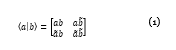
where ,  … denote the logical connections. Since there are four elements in the table (1) and each element can take two values (0 and 1), then totally the L4 number can have values.
Table 1 shows all possible values of the L4 number, for which the corresponding ESRs are also given.
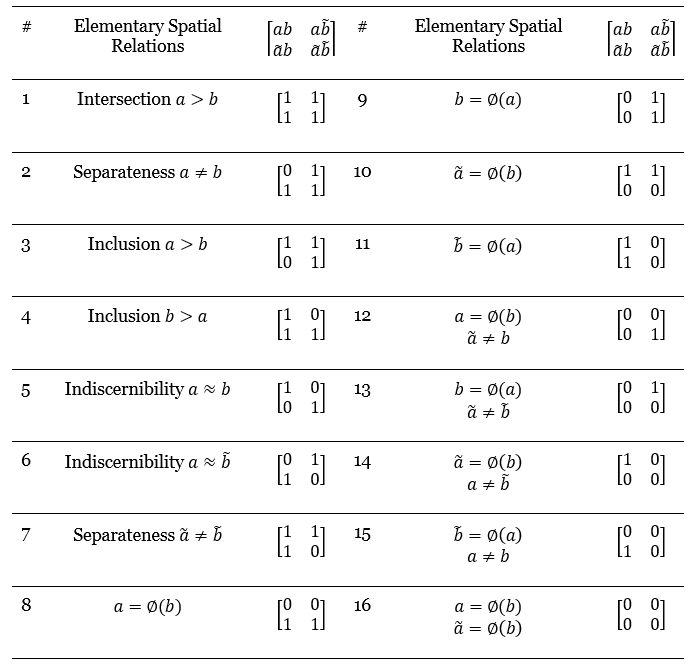
Figure 1 shows Euler-Venn diagrams that illustrate ESR from 1 to 4 in Table 1 that can be represented as relations between plane figures. Note that it is more difficult or impossible to make geometric representation for other relations, but them may well be applicable for description of mental imagery. In Table 1, ESR from 8 to 16 contain the expressions , , , etc., which denote zero spots in relation to the spots indicated in brackets. For example, the expression means that spot is zero with respect to spot . Mathematically this corresponds to the definition:
a=∅(b)⇋(ab=0,ab ̃=0) (2)
The ESRs in Table 1, which contain symbol ∅ can also be determined by this expression after appropriate replacing variables in (2), taking into account that the environments are also spots. ESRs from 8 to 16 do not seem to be suitable for illustration using geometric figures, but we consider these relations to be helpful for imaginative representation.
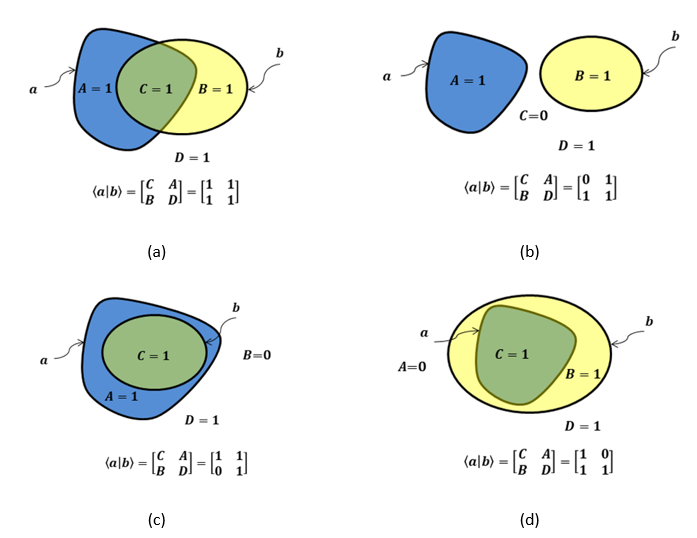
Figure 1. Euler-Venn diagram illustrates the meaning of definition of L4 numbers for ER between two spots: (a) Intersection of a and b; (b) Separation of a and b; (c) Inclusion b in a; (d) inclusion a in b.
The spatial relation of a spot with certain basis can be expressed using L4 vector, elements of which are L4 numbers (Simonov, 2023). For example, the spatial relation of the spot with the basis X, represented by the L4 vector
a_X≡[⟨a│x_1 ⟩;⟨a│x_2 ⟩;…;⟨a│x_n ⟩] (3)
We call a_X the mapping of the spot a on the basis X (Simonov, 2023), which we also regard as a projection on the basis X. The relation between certain basises (Simonov, 2023), which we also regard as a projection a on the basis X. The relation between certain basises X and Y is represented in the form of an L4 matrix ⟨Y│X⟩, which elements are also L4 numbers:
⟨Y│X⟩≡[⟨y_j│x_i ⟩]=[(y_1 )_X;(y_2 )_X;…;(y_n )_X ] (4)
The work (Simonov, 2023) defines the operation of multiplying an L4 matrix and a vector:
a_Y=⟨Y│X⟩ a_X (5)
which allows you to recalculate mappings of spot a from basis X to basis Y.
The mapping of spots has an analogy with the geometric concept of projection (Figure 2). Figure 2a is a diagram of the projection of a plane figure onto the X and Y axes, which are one dimensional space, and Figure 2b shows an example of the projections of a tree-dimensional figure onto the XY and YZ coordinate planes, which are two-dimensional spaces. In the spot model, such projections correspond to the concept of mapping spots onto basises. As will be shown below, these diagrams are also an illustration of the geometric representation of such psychological concepts as the dissection of a holistic image and the extraction of individual properties.

Figure 2. Euler-Wenn diagrams for projections of spot-imagery modelling the selection of various modalities or attributes of imagery. (a) Two-dimensional case. (b) Three-dimensional case.
Figure 3 illustrates the projection for spots, which also models the dissection of holistic imagery and the selection of attribute X and attribute Y, which is differentiated.

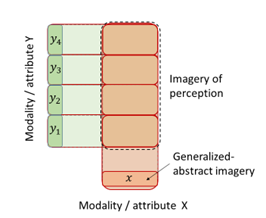
Figure 3. Euler-Wenn diagrams for spot-image projections, illustrating the concept of spot projection.
The basis spots can intersect or be separate. Separate spots are called orthogonal, and the basis of such spots is also called orthogonal. The limiting case of an orthogonal basis is an atomic basis, the spots of which do not intersect any other spots. Atomic spots are analogues of points, pixels or voxels. An example of an orthogonal basis is the basis of spots-intersections U of spots of a non-orthogonal basis X (Figure 4). Since the «sizes» of intersection spots are always smaller than the “sizes” of the original spots, the image of mapping on such a basis will have greater clarity (greater «resolution») compared to the image on the original basis of spots.

Figure 4. Euler-Wenn diagrams illustrating the differentiation of a non-orthogonal basis by forming an orthogonal basis from intersections of spots of basis .
Figure 5 shows a two-dimensional basis of spots-intersections W and introduces one-dimensional coordinate basises U and V, with the help of which spots of the basis W can be represented. The coordinates for each spot-intersection wk are determined using its projections onto the basises U and V. Conversely, any spot wk can be determined by its projections ui and vj, if we construct the image-mapping of the spot ui on the basis V (yellow stripe-spot) and the image-mapping of the spot vj on the basis U (blue stripe-spot). Then the spot wk will be the intersection of these two stripe-images.
Figure 5. Euler-Wen diagrams for the construction of a two-dimensional basis from the intersections of spots of the basis . and are one-dimensional orthogonal basises, which are projections of spots of the basis.
An important concept in the model under consideration is the indiscernibility of two or more spots according to data of their mapping on selected basis. We call spots indiscernible if all their ESRs with spots of this basis coincide. Otherwise, the spots are said to be distinguishable on this basis. Therefore, the reason for the indiscernibility of spots can be the lack of data on their ESR with other spots. Obviously, when additional ESR data can be obtained, previously indiscernible spots may become distinguishable. Conversely, if you ignore some ESR data of distinguishable spots with basis spots, previously distinguishable spots may become indiscernible.
Examples of indiscernible spots are shown in Figure 5, where spots w_k, having spot-coordinate u_5, are indiscernible by this information only (yellow stripe), since their projections onto the basis U are the same. Namely, ESR with spot u5 – indiscernibility, and the relations with all other spots ui – separateness. Similarly, spots wk in the blue stripe are indiscernible according to their projection v5. When applied to psychology, the spot wk with «coordinates» (u5,v5 ) can be interpreted as imagery that has the properties u5 and v5.
“Coordinate basises” U and V can be considered differentiated imagery (compare with Figure 4) that correspond to certain modalities or attributes. Mappings of integral imagery (gestalts) onto the basises U and V visualize the concepts of generalization (abstraction) or dissection of imagery (Chuprikova, 2022), when characteristic features are extracted from gestalts, and other features are ignored. This forms new abstract imagery and spaces with a system of «new perceptual planes or axes» (Chuprikova, 2022), which can be represented as basises for projections of imagery that have common features (Figure 6).
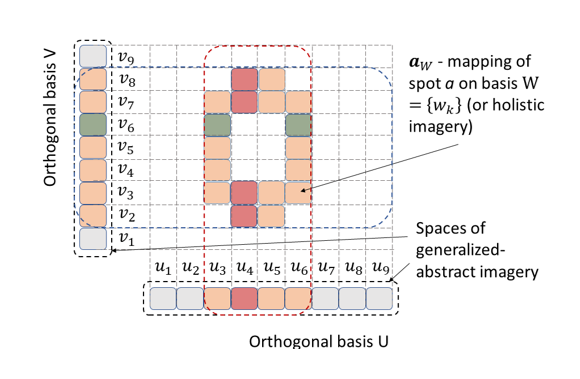
Figure 6. Euler-Wen diagrams for a spot (integral imagery) mapped on the basis , and its projections onto differentiated basises (imagery spaces) and .
Using equations (11) and (12) from (Simonov, 2023), we obtain formulas that allow us to find, for example, the projection of the structural spot in Figure 6 onto the basis U. If we denote this spot by a, then its mappings on the basises W and U will be described by L4 vectors aW and aU, respectively. By changing the notation in the new variables for the indicated equations, we obtain the following formulas for calculating the projection aU:
aU=⟨U│W⟩ aW=[⟨a│ui ⟩] (6)
where

Similar equations are easy to obtain for calculating the projection aV.
2.2. Reconstruction of spots from their projections
Let us consider the possibility of reconstructing/constructing an integral-holistic spot-imagery mapped on the basis , based on data on its projections onto basises (spaces) and of a higher level of generalization (Figure 7). Obviously, this problem is the inverse to the previous problem described by formulas (6) and (7). From Figure 6 it is clear that using only the spots of the full projection onto the basises and allows us to obtain only approximate image construction on the basis . On the other hand, it is possible to obtain an exact solution to this problem, for example, if you combine data of the sections (strips) of for all spots on the basis (Figure 5). However, the exact reconstruction of imagery not possible in the general case and can be approximate only. Note that imagination helps compensate the lack of such information to a certain extent in cognitive processes.
In general, to reconstruct the desired image (Figure 7), you can use the method and algorithm presented in (Simonov, 2023). There, this algorithm is used to reconstruct an image of a plane figure basing on its ESR data with some known figures located in the same area. In current consideration, we will use ESR data for spot and scanning spot , which is determined by its projection on the basises and . We consider all spots positions as a basis and the scanning period determines the «sizes» of spots collect ESR data in the form of L4 numbers . For the reconstruction image , we can use formulas (15, 16) in article (Simonov, 2023) with current variables. If, for example, (symbol ∩ denotes the intersection of spots), then

where the symbol denotes ESR separation, and the symbol denotes ESR inclusion.

Figure 7. Euler-Wen diagram illustrating the possibility of constructing/reconstructing a structural spot a (or an integral image) from its projection on the coordinate basises U and V.
It should be noted that the smaller the scanning period of spot x, the smaller spots wk and the clearer the image aW. In other words, the larger the number of spots xi, the clearer the image can be obtained.
2.3. Perception modelling
Above, a hypothesis was put forward about the ability of brain neurons to carry out elementary comparisons of imagery that can be expressed using ESR in the form of L4 numbers. We believe that this property of neurons is sufficient for the spot apparatus to be used for the spatial representation of imagery structures and processes in psychology. Indeed, mathematical apparatus described above can be applied for imagery modelling. For example, the basis W={wk } of intersections of spots of the basis X={xi } (Figure 5) allows one to obtain more differentiated imagery compared to mapping the same image onto X. The concept of projection (Figure 6, formulas (6) and (7)) is a spatial representation of the generalization (abstraction) concept of mental imagery. The algorithm for an image reconstruction (Figure 7, formulas (8) and (9)), allows us to simulate the construction of a holistic perception image on the basis of imagery of sensations.
Let us consider in more detail the mechanism of construction of a holistic perception image on the basis of imagery of sensation and perception stored in long-term memory. Figure 7 demonstrates schematically the example of two modalities of sensation, which correspond to the basises U and V, and a two-dimensional space of perception W. The new perception imagery is represented by the structural spot aW, and it is constructed by comparison it with the imagery of perception xW, which have projection-sensations xU and xV. The combination of ESRs of spot aW with all spots xW, corresponded to perception imagery stored in memory, is encoded by the L4 vector. Although the mapping of the perception image aW on the basis {xW} directly forms a «blurred» image of it, however, the recalculation of this image onto the basis {wk} of intersections of all imagery xW allows us to increase the clarity of the perception image. The possibility of such recalculation is demonstrated by formulas (8) and (9), but the question about real information processing algorithms in the brain remains open.
As noted above, the clarity of the image aW directly depends on the number of intersecting imageries xW: the larger this number, the greater the clarity of the representation of aW. Such a dependence is easy to explain by the fact that as the number of spots x_W increases, the «sizes» of their intersections decrease and hence the clarity of the imagery increases (see Figure 8). Note that the noted property is also an illustration of the general idea of the process of development of perception towards greater detail in its content (Chuprikova, 2022).

Figure 8. Reconstruction of a five-pointed star using mapping on a basis of intersections of circles, periodically located in the region of the star. The diameter of the star is 5 (abstract units), the diameter of the basis circles is 3. (a) The number of basis circles is 49. (b) The number of basis circles is 144. (c) The number of basis circles is 324. (d) The number of basis circles is 1225.
It should be noted that the basises of perception imagery W and imagery U and V, corresponding to two attributes or modalities, are differentiated since they are formed at the intersections of integral imagery of perception or their projections. We consider that the indicated intersections of imagery create different imagery structures (or spaces), stored in long-term memory. As far as the ultimate clarity of the imagery depends on the «sizes» of the spots ui, vj and wk, then it depends on the number of perception imagery stored in memory in a holistic or generalized form. Note that the role of spots ui, vj and wk, on which imagery are constructed, is similar to the role of pixels in digital devices.
2.4. Lange’s law
The above-described scheme for constructing a perception image is in good agreement with the law of perception, which was formulated and experimentally proven by N.N. Lange at the end of the 19th century (Lange, 1893). The important fact is the biological universality of this law. Lange’s law states that «the process of any perception consists of an extremely rapid change of a number of moments or stages, with each previous stage representing a mental state of a less specific, more general
nature, and each subsequent one more specific and differentiated» (Chuprikova, 2022).
Figure 8 demonstrates the dependence of the image clarity of a figure shape on the number of figures (circles) for comparison and illustrates the same dependence of the detail of the perception image on the number of basic imageries. Consequently, the proposed model allows us to interpret Lange’s law as a procedure of constructing a perception imagery, which consists of a sequence of comparisons of the sensation image with an increasing in time number of stored imagery of sensations and perception, as well as processing of corresponding ESR data (see algorithm (8) and (9)). Obviously, such formation of perception takes a certain time (usually, fractions of a second), and the detail of the new imagery constantly improves as the number of comparisons with the perceptual image increases.
Note that the considered dependence of the clarity of the perception imagery on the number of imageries formed earlier and stored in memory is associated in psychology with such concepts as apperception and attention. The connection of these concepts with the considered model is described in more detail in the next section.
2.5. Apperception, attention and the discriminative ability of the brain
The proposed scheme for constructing new perception imagery on the basis of imagery stored in memory is in good agreement with the concept of apperception in psychology. Apperception is defined as the dependence of perception on past experience and, more broadly, on the entire general content of the human psyche, on his personality and activity. Thus, any new perception is formed on the basis of past experience and is influenced by the already accumulated stock of ideas (Chuprikova, 2022; Vekker, 1998). For example, N.I. Chuprikova writes: «The completeness and accuracy of perception is influenced by a person’s knowledge and experience. Thanks to them, perceptions become richer, more multifaceted, more meaningful. A knowledgeable person sees much more in the surrounding reality than a layman. This is easily seen in the example of the professional perception of an archaeologist, investigator, and teacher. A professional, no matter what field of activity we are talking about, notices much more details in objects and distinguishes different properties in them much better than a non-professional» (Chuprikova, 2022).
Figure 8 illustrates that the apperception concept is in good agreement with the considered above property of the dependence of the detail of the perception image on the number of comparisons with already accumulated imagery. And as noted in previous chapter, the maximum clarity of imagery representation depends on the «sizes» of spots u_i, v_j and w_k, which are determined by the number of perception imagery formed on the basis of past experience and stored in memory, possibly in a generalized form.
The fact that the detail of an imagery directly depends on the number of basis imagery has an analogy with other concepts of psychology, for example, with the discriminative ability of the brain and attention. The attention, according to Chuprikova, can manifest itself at different levels of the subject’s cognitive structures: at the level of primary sensory projections or at the levels of perceptual-imaginative and conceptual-semantic structures (Chuprikova, 2022). The discriminative ability of the brain is determined by the individual abilities of people with high intelligence, who are able to carry out a large concentration of nervous processes. This ability allows them to process data of the comparison with a large number of imageries, as well as to carry out such comparison operations in a shorter time than people with normal abilities (Chuprikova, 2022). As a result, the high discriminative ability of the brain allows the formation of imagery of a higher degree of detail.
Both of mentioned concepts are associated with the concentration of nervous processes, which can be explained as an increase in the number of imageries that are involved for comparisons with the imagery under consideration. Indeed, this increase is associated with a large number of neurons involved in constructing the imagery, which causes a greater concentration of excitation foci. Therefore, the emergence of attention causes an increase in the differentiation of imagery due to the use of a larger number of imageries for comparison.
A number of authors have experimentally studied the mechanism of perception of visual imagery, which was called the «attention window». Such a structure selects a region of the «visual buffer» and sends the pattern of activation in it to other areas for further processing. The attention window can be covertly shifted, and allows one to scan over entire imagery in the visual buffer without moving one’s eyes (Kosslyn, 2005). The considered mechanism allows you to reconstruct the visual image in parts with higher detail.
2.6. Abstract-generalized imagery and thinking
An important property of the psyche is the ability to generalize and form generalized (or abstract) imagery. In psychology, the existence of systems corresponding to two imaginative levels is considered: imagery with complete preservation of all details of perception and abstract-generalized imagery. In modern psychology this corresponds to the ideas of multi-dimensional and multi-level ordered cognitive psychological spaces and abstract-generalized cognitive representations of reality (Gostev, 2022), (Chuprikova, 2022), (Vekker, 1998). The existence of abstract-generalized imagery allows knowledge to be stored in long-term memory in a more compact form. Such abstract imageries turn out to be suitable for their analysis and synthesis of other imagery for a huge number of different objects and events.
Chuprikova writes about the existence of abstract-generalized memory structures, on the basis of which an actual representation of events occurring at any given moment is built. Understanding the perceived phenomena of reality, identifying the main and secondary in it, understanding how to most optimally behave and act in the current circumstances depend on them (Chuprikova, 2022). In the terminology of this work, the above judgment corresponds to the statement that the semantics of perception imagery is determined by their mapping on the basis of abstract-generalized imagery.
The mechanism of generalization of imagery can be represented using the concept of projection of holistic imagery onto the basises of such abstract imagery that correspond to specific mentalities or properties (Figure 6, formulas (6) and (7)). As noted above, the «coordinate» spaces of generalized imagery U and V are differentiated because they are formed with help of the intersections of integral perception imageries. In general, such basises can be considered as separate spaces of generalized imagery that are created on the basis W of a lower-level imagery.
In psychology, the identification of separated «coordinate» basises of spots is described using the concept of dissection of imagery, which corresponds to the extraction of its generalized representations from a holistic imagery. The most obvious example of the use and formation of abstract imagery is thinking that is considered as a cognitive activity that produces a mental division of perceived reality into separate fractional elements and builds on this basis their new syntheses, leading to the construction of generalizations and knowledge of the laws of the world. In the theory of L. M. Vekker (Vekker, 1998), the fundamental difference between thinking and sensory cognition is the structural division of thought, when the generic and specific properties of objects are separated at different levels. Obviously, generic properties are a generalization of species properties and require a smaller number of attributes. The diagram in Figure 6 provides a spatial representation of this relationship. If, for example, we consider separately U and V as basises for generic characteristics, then the set of basises (U,V) will describe the specific characteristics.
Note that the proposed mechanism of imagery generalization in the spot model is universal, that is, in principle, applicable to imagery of any level. In addition, we hypothesized that brain neurons are capable of performing elementary imagery comparisons. Therefore, generalization is possible at any level of abstraction, including the levels of sensations, perception or at the level of conceptual-semantic imagery. Indeed, as the research (Sholomiy et al., 1989) has shown, abstraction and generalization are characteristics not only of mental activity, but they were also found, for example, in an experiment aimed at studying the formation of the ability to recognize the drawing styles of different artists.
Discussion
As it was demonstrated above, the spatial model of imagery, schematically described in this work, provides a clear illustration of cognitive mental processes and allows for a deeper understanding of them. The suggested mathematical apparatus of spots is universal for describing imagery structures and cognitive processes at different levels and potentially makes it possible to create a more detailed their description. However, this will require further theoretical and experimental research in psychology and, possibly, in neurophysiology.
It was shown that the proposed approach is in good agreement with existing ideas and concepts in psychology. For example, ESRs such as separateness, intersection, and indiscernibility also make sense and applicable to relations between mental imagery. In addition, as noted above, we assume that brain neurons are capable of making such elementary comparisons of imagery, which is a basis property for the possibility of spatial representation of mental imagery in psychology using the spot apparatus.
This consideration allows us to propose a spatial model that explains the nature of the processes of formation of generalized phonemic categories in children, which is interpreted by the «magnetic effect» model of P.K. Kuhl (Kuhl, et al., 2008). In Kuhl’s model, initially all the verbal stimuli perceived by the child are located evenly in some perceptual space, and the child hears differences within one phoneme category of the native language, depending on many specific varying features of their pronunciation. Subsequently, children lose this ability, and they develop generalized phonemic categories. These phonemic categories begin to «attract» similar sounds to themselves, that is, it becomes like a magnet (Chuprikova, 2022).
The diagram in Figure 9 is an illustration giving a spatial interpretation of the effect associated with the Kuhl’s model. This diagram shows phonemic imagery that are initially distinguished by children, since these phonemes have different properties in the spaces «Pronunciation features #1» and «Pronunciation features #2» (Figure 9). Subsequently, in the process of accumulating perceptual experience, children form phonemic categories (generalized imagery), which in Figure 9 are located in the space of «Pronunciation features #1». The effect of «attracting» similar sounds to themselves corresponds to the projections of these sounds onto these phonemic categories, as a result of which they are perceived as indiscernible. Consequently, the accumulation of experience and the formation of phonemic categories in children leads to the fact that speech phonemic recognition occurs in the space of generalized phonemic imagery, and not in the original space of phonemic perception.
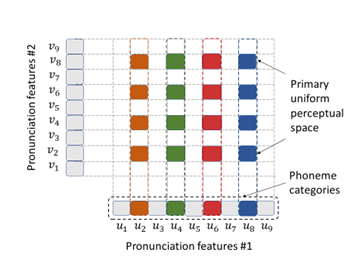
Figure 9. Euler-Wen diagram illustrating the mechanism of Kuhl ‘s «magnetic effect» model.
Conclusions
This article presents the use of the mathematical apparatus of spots to create a cognitive model of various psychological concepts and processes, such as differentiation and generalization of imagery, Lange’s law, attention, apperception and the discriminating ability of the brain. The spot model provides a convenient and visual spatial representation of mental imagery, displaying their properties of multi-dimensionality, multi-levelness and multi-modality.
Like any new theory, the spatial cognitive model under consideration requires experimental evaluations, which can be carried out both in the field of psychology and in the field of neurophysiology. It will also help clarify the considered concepts and their application in cognitive modelling and further developing the mathematical model of spots for better representation the properties and processes of the human psyche. The development of this mathematical theory allows us to describe the imaginative sphere and processes of psychology in more detail. In addition, the considered mathematical apparatus allows us to formulate a new paradigm of strong AI, capable of representing information and modelling reasoning in imaginative form.
Funding: The investigation was supported by the Program no. FFNN-2022-0019 of the Ministry of Science and Higher Education of Russia for Valiev Institute of Physics and Technology of RAS.
CRediT author statement:
The author declares no conflict of interest.
Acknowledgments: The author express deep appreciation to Lukichev V.F., Rudenko K.V. and Volkova E.V., for the support and fruitful discussions of this work.
References
1. Abramov, I. I. (2022). Artificial intelligence will never completely replace humans. Russian Microelectronics, 51(6), 376–386.
2. Butz, M. V. (2021). Towards strong AI. KI-Künstliche Intelligenz, 35(1), 91–101.
3. Chuprikova, N. I. (2022). Mind and mental processes. The system of concepts of general psychology. Moscow: Liters. [Chuprikova, N. I. (2022). Psikhika i psikhicheskiye protsessy. Sistema ponyatiy obschey psikhologii. Moskva: Liters].
4. Gostev, A. A. (2008). Psychology and metaphysics of the imaginative sphere of man. Moscow: Genesis. [Gostev, A. A. (2008). Psikhologiya i metafisika obraznoy sfery cheloveka. Moscow: Genesis].
5. Gostev, A. A. (2022). Psychology of the secondary imagery. Moscow: Liters. [Gostev, A. A. (2022). Psikhologiya vtorichnogo obraza. Moscow: Liters].
6. Keaten, J. and O’Brien, M. (2021). UN urges moratorium on use of AI that imperils human rights, AP News, Sep. 15.
7. Kosslyn, St. M. (2005). Mental imagery and the Brain. Cognitive Neuropsychology, 22(3-4), 333–347.
Kuhl, P. K., Conboy, B. T., Coffey-Corina, S., Padden, D., Rivera-Gaxiola, M., & Nelson, T. (2008). Phonetic learning as a pathway to language: new data and native language magnet theory expanded (NLM-e). Philosophical Transactions of the Royal Society B: Biological Sciences, 363(1493), 979–1000.
8. Lange, N. N. (1893). Psychological research. Odessa: Novoros. University. [Lange N.N. (1893) Psychologicheskie issledovaniya. Odessa: Novoros. Universitet].
9. Nanay, B. (2021). Mental Imagery. In E.N. Zalta (Ed.), The Stanford Encyclopedia of Philosophy. URL = <https://plato.stanford.edu/archives/win2021/entries/mental-imagery/>.
10. Pitt, D. (2021). Mental Representation. In E.N. Zalta (ed.), The Stanford Encyclopedia of Philosophy. URL = <https://plato.stanford.edu/archives/win2021/entries/mental-representation/>.
11. Sholomiy, K. M., Chupepkova, N. I., Zakharova, S. A. (1989) Work of memory in the formation of «natural» concepts. Psychological Journal, 10(2), 99–109. [Sholomiy K.M., Chupepkova N.I., Zakharova S.A. (1989) Rabota pamyati pri formirovanii «yestestvennykh» ponyatiy. Psikhologicheskiy zhurnal, 10(2), 99–109].
12. Shepard, R. N. (1978). The mental image. American Psychologist, 33(2), 125–137.
13. Simonov, N. A. (2020). Spots concept for problems of artificial intelligence and algorithms of neuromorphic systems. Russian Microelectronics, 49, 431–444. https://doi.org/10.1134/S106373972005008X
14. Simonov, N. (2021). The spot model for
representation and processing of qualitative data and semantic information. In Proceedings of the Selected Contributions to the Russian Advances in Artificial Intelligence Track at RCAI 2021, Taganrog, Russia, 11–16 October 2021, CEUR-WS, US, 55–69.
15. Simonov, N. A. (2023). Application of the Model of Spots for Inverse Problems. Sensors, 23(3), 1247. https://doi.org/10.3390/s23031247
16. Simonov, N. A. & Rusalova, M. N. (2023). Mental imagery representation by model of spots in psychology. Natural Systems of Mind, 3(1), 4–23.
17. Solso, R. L. (2004). Cognitive Psychology. Anaheim: Allyn & Bacon.
18. Vekker, L. M. (1998). Psyche and reality: a unified theory of mental processes. Moscow: Sense. [Vekker, L. M. (1998). Psikhika I real’nost’: edinaya teoriya psikhicheskikh protsessov. Moskva: Smysl].
19. Watson, J. B., (1913). Psychology as the behaviorist views it. Psychological review, 20(2), 158–177.
Comments (0)
This paper continues consideration of the application of a new mathematical model and mathematical apparatus of spots for representing various cognitive mental phenomena, processes and properties. It is shown that the spot model is adequate for representing such properties of mental imagery as their spatial properties and multi-dimensionality, as well as their multi-levelness and multi-modality. The mechanisms of differentiation and integration of mental imagery, as well as the creation of abstract-generalized imagery by modelling them based on the spots model are considered. In particular, such a model makes it possible to explain N. N. Lange’s law, which characterizes the stages of development of the micro-genesis of perception from initially generalized to clearly differentiated perception.
Пространственное представление понятий и процессов в психологии с помощью модели пятен
Симонов Н.А.*
Физико-технический институт Валиева РАН, Москва, Российская Федерация, ORCID iD: 0000-0001-8609-2281
Аннотация: Данная статья продолжает рассмотрение применения новой математической модели и математического аппарата пятен для представления различных когнитивных психических явлений, процессов и свойств. Показано, что модель пятна адекватна для представления таких свойств мысленных образов, как их пространственные свойства и многомерность, а также их многоуровневость и многомодальность. Рассмотрены механизмы дифференциации и интеграции мысленных образов, а также создания абстрактно-обобщенных образов путем их представления на основе модели пятен. В частности, такая модель позволяет объяснить закон Н. Н. Ланге, характеризующий этапы развития микрогенеза восприятия от первоначально генерализованного к четко дифференцированному восприятию.
Ключевые слова: математическое моделирование, мысленные образы, образная сфера, восприятие, когнитивное моделирование, искусственный интеллект.
The experience of using deep neural networks in area of artificial intelligence (AI) for model such cognitive processes as learning, reasoning, pattern recognition, etc., demonstrates big issues, the main of which is the occurrence of unexpected, unconditional and inexplicable errors, which are especially unacceptable in sensitive applications related to human safety and health (Keaten et al., 2021.). Many authors see the main reason for such errors in the fact that neural networks do not understand the «meaning» input and processed information presented in numerical. Indeed, used numbers are not directly related to meaning and do not determine the semantic content of information. According to the author, the use of numerical methods is, in principle, inadequate to describe the nature of human thinking, which is based on imaginative representation and logical-imaginative processing of information. To solve the problem of flexibility and reliability of AI, it is necessary to use methods of representing information and thinking that are characteristic of humans. This corresponds to the task of creating intelligent systems capable of representing information in imaginary form and carrying out imaginative thinking.
Although intensive research of the brain is currently being conducted at the level of neurophysiology, and some authors even consider the brain as an object of organic hybrid nanoelectronics (Abramov, 2022), in this work the modelling of brain activity processes is considered at the psychological level. Namely, we are exploring the possibility of mathematical modelling of secondary (or mental) imagery (Gostev, 2022) and on this basis we propose a cognitive model of mental processes. Because of the cognitive modelling is the emulation of human intelligence, it is an approach to achieve strong AI (Butz, 2021).
The importance of mental imagery had already been discussed by early Greek philosophers such as Socrates and Aristotle, who stated that thought is impossible without imagery. At the beginning of the 18th century, Bishop Berkeley, in his theory of idealism, assumed that our entire perception of the external world consists only of mental imagery. However, in 1913, the founder of behaviorism, John B. Watson, denied the existence of mental imagery and claimed that the study of imagery was useless (Watson, 1913). This general negative attitude toward imagery research did not change until the birth of cognitive psychology in the 1950s and 60s. Mental imagery are now believed to play a critical role not only in perception, but also in memory, emotion, language, desire, and performance action (Nanay, 2021). They are viewed as the building blocks of thinking that are critical for mental processes such as categorization, inference, memory, learning, and decision making (Pitt, 2021).
The author proposed a fundamentally new mathematical model of spots (Simonov, 2020, 2021, 2023) that can be applied for modeling mental imagery and creating a new generation of AI algorithms and neural networks. The spots correspond to abstract vague spatial objects with elementary spatial relations between them, which are applicable to represent imagery using some geometric analogies.
As shown in article (Simonov & Rusalova, 2023), the model and apparatus of spots are adequate for representing human mental imagery (Shepard, 1978; Solso, 2004; Gostev, 2008, 2022). First, spots have elementary spatial properties that are also inherent in mental imagery. Secondly, this model allows the construction of multi-dimensional, multi-level and multi-modal representations of mental imagery and the imaginative sphere (Gostev, 2022). Thirdly, with the help of spots it is possible to represent imagery with varying degrees of detail or generalization (abstraction) (Chuprikova, 2022). Fourthly, the principles on which the theory of spots is built are similar to the «universal law of development» of imaginative representation, which determines the transition from an initially poorly defined integrity to forms that are increasingly internally differentiated and hierarchically ordered (Chuprikova, 2022). Therefore, using the apparatus of spots, it is possible to adequately represent semantic information and mental operations in the form of imagery. This allows us to set the task of creating intelligent systems capable of not only encode semantic information, but also modeling thinking in the imaginative form.
This paper examines the possibility of using the spot model and apparatus to model various mental cognitive phenomena, processes and properties, including sensations, perception, imagination and thinking. A model under consideration is used for the representation and interpretation, in particular, of Lange’s law (Lange, 1893), analysis and synthesis of imagery, attention, apperception and the discriminative ability of the brain (Chuprikova, 2022).
1.1. Operations on spots that are associated with mental processes
As shown in (Simonov & Rusalova, 2023), the mathematical apparatus of spots allows one to represent mental imagery, taking into account their spatial properties, as well as their multi-dimensionality, multi-levelness and multi-modality. The separated and ordered spots structures form different spots spaces, which can represent different cognitive psychological spaces. In what follows, representations of mental imagery (or simply imagery) using spots will be called spatial representations of imagery.
It should be noted that the basic concepts of the spot model were defined based on geometric analogy and relying on intuitive representations of the spatial properties of mental imagery. Therefore, these concepts are applicable and important both for the development of the theory of spots and for the description of mental properties and processes.
In this work, we consider the possibility of a spatial interpretation of Lange’s law (Chuprikova, 2022), as well as spatial modelling of such important properties of the mind and cognitive processes as differentiation and integration of imagery of perception, attention, discriminative ability and the property of concentration of the brain, imagination, construction of abstract-generalized imagery and thinking. It seems surprising, but such a wide range of mental phenomena, processes and properties, as will be shown, can be described by introduction of a relatively small number of elementary spatial relations (ESR) between spots and operations on them. The main ESRs are separateness, intersection, inclusion and indiscernibility.
The introduced relations for spots are obviously can also be used as relations between imagery. Indeed, they answer simple questions: do two imageries have something in common or are they completely different, is one imagery a generalization of another imagery, etc.? We also assume that brain neurons are capable of carrying out some elementary comparisons of imagery and, as will be shown below, this property of neurons is sufficient to describe cognitive mental processes on the base of mental imagery.
Imaginative information is stored and processed by neurons, and ordered structures of imagery form cognitive spaces in the imaginative sphere (Gostev, 2022). We also believe that in the dissection process of holistic imagery, creating abstract-generalized imageries, can form separate imaginative spaces. Differentiation of imaginative spaces allows us to consider ESR inclusion between space and subspaces to describe the imaginative sphere (Gostev, 2022). Hence, one can consider a hierarchy (taxonomy) of different levels of generality, using the language of ESR for imagery and imaginative spaces. Obviously, such a taxonomy has a very complex structure. We assume that new imageries are constructed by mental mechanisms of its comparison with the basis of already formed imagery stored in long-term memory.
Let us consider the basic ideas and concepts of the model and apparatus of spots, which we can apply to describe mental imagery and processes. We remind the definitions of the concepts of spots, which are described in detail in my previous articles (Simonov, 2023, Simonov & Rusalova, 2023). Spots are a mathematical object with elementary spatial properties, for which their inner area, outer area (environment) and logical connections between them are defined for any spots. For example, they can be thought of as vaguely defined spatial objects located in a vaguely defined spatial environment. On the other hand, crisp geometric figures are considered as a special and limiting case of spots.
All information about spots is extracted from their ESR with other spots or spot structures – spot basises. The basis is the structure of spots, that is, a set of spots with given ESRs between them. The structure of spots is also a structural spot, and it can be considered as a space of spots. ESR is encoded using logical L4 numbers. For spots and their environment , we defined L4 number as the following 2×2 logical table (Simonov, 2023):
where , … denote the logical connections. Since there are four elements in the table (1) and each element can take two values (0 and 1), then totally the L4 number can have values.
Table 1 shows all possible values of the L4 number, for which the corresponding ESRs are also given.
Figure 1 shows Euler-Venn diagrams that illustrate ESR from 1 to 4 in Table 1 that can be represented as relations between plane figures. Note that it is more difficult or impossible to make geometric representation for other relations, but them may well be applicable for description of mental imagery. In Table 1, ESR from 8 to 16 contain the expressions , , , etc., which denote zero spots in relation to the spots indicated in brackets. For example, the expression means that spot is zero with respect to spot . Mathematically this corresponds to the definition:
a=∅(b)⇋(ab=0,ab ̃=0) (2)
The ESRs in Table 1, which contain symbol ∅ can also be determined by this expression after appropriate replacing variables in (2), taking into account that the environments are also spots. ESRs from 8 to 16 do not seem to be suitable for illustration using geometric figures, but we consider these relations to be helpful for imaginative representation.
Figure 1. Euler-Venn diagram illustrates the meaning of definition of L4 numbers for ER between two spots: (a) Intersection of a and b; (b) Separation of a and b; (c) Inclusion b in a; (d) inclusion a in b.
The spatial relation of a spot with certain basis can be expressed using L4 vector, elements of which are L4 numbers (Simonov, 2023). For example, the spatial relation of the spot with the basis X, represented by the L4 vector
a_X≡[⟨a│x_1 ⟩;⟨a│x_2 ⟩;…;⟨a│x_n ⟩] (3)
We call a_X the mapping of the spot a on the basis X (Simonov, 2023), which we also regard as a projection on the basis X. The relation between certain basises (Simonov, 2023), which we also regard as a projection a on the basis X. The relation between certain basises X and Y is represented in the form of an L4 matrix ⟨Y│X⟩, which elements are also L4 numbers:
⟨Y│X⟩≡[⟨y_j│x_i ⟩]=[(y_1 )_X;(y_2 )_X;…;(y_n )_X ] (4)
The work (Simonov, 2023) defines the operation of multiplying an L4 matrix and a vector:
a_Y=⟨Y│X⟩ a_X (5)
which allows you to recalculate mappings of spot a from basis X to basis Y.
The mapping of spots has an analogy with the geometric concept of projection (Figure 2). Figure 2a is a diagram of the projection of a plane figure onto the X and Y axes, which are one dimensional space, and Figure 2b shows an example of the projections of a tree-dimensional figure onto the XY and YZ coordinate planes, which are two-dimensional spaces. In the spot model, such projections correspond to the concept of mapping spots onto basises. As will be shown below, these diagrams are also an illustration of the geometric representation of such psychological concepts as the dissection of a holistic image and the extraction of individual properties.
Figure 2. Euler-Wenn diagrams for projections of spot-imagery modelling the selection of various modalities or attributes of imagery. (a) Two-dimensional case. (b) Three-dimensional case.
Figure 3 illustrates the projection for spots, which also models the dissection of holistic imagery and the selection of attribute X and attribute Y, which is differentiated.
Figure 3. Euler-Wenn diagrams for spot-image projections, illustrating the concept of spot projection.
The basis spots can intersect or be separate. Separate spots are called orthogonal, and the basis of such spots is also called orthogonal. The limiting case of an orthogonal basis is an atomic basis, the spots of which do not intersect any other spots. Atomic spots are analogues of points, pixels or voxels. An example of an orthogonal basis is the basis of spots-intersections U of spots of a non-orthogonal basis X (Figure 4). Since the «sizes» of intersection spots are always smaller than the “sizes” of the original spots, the image of mapping on such a basis will have greater clarity (greater «resolution») compared to the image on the original basis of spots.
Figure 4. Euler-Wenn diagrams illustrating the differentiation of a non-orthogonal basis by forming an orthogonal basis from intersections of spots of basis .
Figure 5 shows a two-dimensional basis of spots-intersections W and introduces one-dimensional coordinate basises U and V, with the help of which spots of the basis W can be represented. The coordinates for each spot-intersection wk are determined using its projections onto the basises U and V. Conversely, any spot wk can be determined by its projections ui and vj, if we construct the image-mapping of the spot ui on the basis V (yellow stripe-spot) and the image-mapping of the spot vj on the basis U (blue stripe-spot). Then the spot wk will be the intersection of these two stripe-images.
Figure 5. Euler-Wen diagrams for the construction of a two-dimensional basis from the intersections of spots of the basis . and are one-dimensional orthogonal basises, which are projections of spots of the basis.
An important concept in the model under consideration is the indiscernibility of two or more spots according to data of their mapping on selected basis. We call spots indiscernible if all their ESRs with spots of this basis coincide. Otherwise, the spots are said to be distinguishable on this basis. Therefore, the reason for the indiscernibility of spots can be the lack of data on their ESR with other spots. Obviously, when additional ESR data can be obtained, previously indiscernible spots may become distinguishable. Conversely, if you ignore some ESR data of distinguishable spots with basis spots, previously distinguishable spots may become indiscernible.
Examples of indiscernible spots are shown in Figure 5, where spots w_k, having spot-coordinate u_5, are indiscernible by this information only (yellow stripe), since their projections onto the basis U are the same. Namely, ESR with spot u5 – indiscernibility, and the relations with all other spots ui – separateness. Similarly, spots wk in the blue stripe are indiscernible according to their projection v5. When applied to psychology, the spot wk with «coordinates» (u5,v5 ) can be interpreted as imagery that has the properties u5 and v5.
“Coordinate basises” U and V can be considered differentiated imagery (compare with Figure 4) that correspond to certain modalities or attributes. Mappings of integral imagery (gestalts) onto the basises U and V visualize the concepts of generalization (abstraction) or dissection of imagery (Chuprikova, 2022), when characteristic features are extracted from gestalts, and other features are ignored. This forms new abstract imagery and spaces with a system of «new perceptual planes or axes» (Chuprikova, 2022), which can be represented as basises for projections of imagery that have common features (Figure 6).
Figure 6. Euler-Wen diagrams for a spot (integral imagery) mapped on the basis , and its projections onto differentiated basises (imagery spaces) and .
Using equations (11) and (12) from (Simonov, 2023), we obtain formulas that allow us to find, for example, the projection of the structural spot in Figure 6 onto the basis U. If we denote this spot by a, then its mappings on the basises W and U will be described by L4 vectors aW and aU, respectively. By changing the notation in the new variables for the indicated equations, we obtain the following formulas for calculating the projection aU:
aU=⟨U│W⟩ aW=[⟨a│ui ⟩] (6)
where
Similar equations are easy to obtain for calculating the projection aV.
2.2. Reconstruction of spots from their projections
Let us consider the possibility of reconstructing/constructing an integral-holistic spot-imagery mapped on the basis , based on data on its projections onto basises (spaces) and of a higher level of generalization (Figure 7). Obviously, this problem is the inverse to the previous problem described by formulas (6) and (7). From Figure 6 it is clear that using only the spots of the full projection onto the basises and allows us to obtain only approximate image construction on the basis . On the other hand, it is possible to obtain an exact solution to this problem, for example, if you combine data of the sections (strips) of for all spots on the basis (Figure 5). However, the exact reconstruction of imagery not possible in the general case and can be approximate only. Note that imagination helps compensate the lack of such information to a certain extent in cognitive processes.
In general, to reconstruct the desired image (Figure 7), you can use the method and algorithm presented in (Simonov, 2023). There, this algorithm is used to reconstruct an image of a plane figure basing on its ESR data with some known figures located in the same area. In current consideration, we will use ESR data for spot and scanning spot , which is determined by its projection on the basises and . We consider all spots positions as a basis and the scanning period determines the «sizes» of spots collect ESR data in the form of L4 numbers . For the reconstruction image , we can use formulas (15, 16) in article (Simonov, 2023) with current variables. If, for example, (symbol ∩ denotes the intersection of spots), then
where the symbol denotes ESR separation, and the symbol denotes ESR inclusion.
Figure 7. Euler-Wen diagram illustrating the possibility of constructing/reconstructing a structural spot a (or an integral image) from its projection on the coordinate basises U and V.
It should be noted that the smaller the scanning period of spot x, the smaller spots wk and the clearer the image aW. In other words, the larger the number of spots xi, the clearer the image can be obtained.
2.3. Perception modelling
Above, a hypothesis was put forward about the ability of brain neurons to carry out elementary comparisons of imagery that can be expressed using ESR in the form of L4 numbers. We believe that this property of neurons is sufficient for the spot apparatus to be used for the spatial representation of imagery structures and processes in psychology. Indeed, mathematical apparatus described above can be applied for imagery modelling. For example, the basis W={wk } of intersections of spots of the basis X={xi } (Figure 5) allows one to obtain more differentiated imagery compared to mapping the same image onto X. The concept of projection (Figure 6, formulas (6) and (7)) is a spatial representation of the generalization (abstraction) concept of mental imagery. The algorithm for an image reconstruction (Figure 7, formulas (8) and (9)), allows us to simulate the construction of a holistic perception image on the basis of imagery of sensations.
Let us consider in more detail the mechanism of construction of a holistic perception image on the basis of imagery of sensation and perception stored in long-term memory. Figure 7 demonstrates schematically the example of two modalities of sensation, which correspond to the basises U and V, and a two-dimensional space of perception W. The new perception imagery is represented by the structural spot aW, and it is constructed by comparison it with the imagery of perception xW, which have projection-sensations xU and xV. The combination of ESRs of spot aW with all spots xW, corresponded to perception imagery stored in memory, is encoded by the L4 vector. Although the mapping of the perception image aW on the basis {xW} directly forms a «blurred» image of it, however, the recalculation of this image onto the basis {wk} of intersections of all imagery xW allows us to increase the clarity of the perception image. The possibility of such recalculation is demonstrated by formulas (8) and (9), but the question about real information processing algorithms in the brain remains open.
As noted above, the clarity of the image aW directly depends on the number of intersecting imageries xW: the larger this number, the greater the clarity of the representation of aW. Such a dependence is easy to explain by the fact that as the number of spots x_W increases, the «sizes» of their intersections decrease and hence the clarity of the imagery increases (see Figure 8). Note that the noted property is also an illustration of the general idea of the process of development of perception towards greater detail in its content (Chuprikova, 2022).
Figure 8. Reconstruction of a five-pointed star using mapping on a basis of intersections of circles, periodically located in the region of the star. The diameter of the star is 5 (abstract units), the diameter of the basis circles is 3. (a) The number of basis circles is 49. (b) The number of basis circles is 144. (c) The number of basis circles is 324. (d) The number of basis circles is 1225.
It should be noted that the basises of perception imagery W and imagery U and V, corresponding to two attributes or modalities, are differentiated since they are formed at the intersections of integral imagery of perception or their projections. We consider that the indicated intersections of imagery create different imagery structures (or spaces), stored in long-term memory. As far as the ultimate clarity of the imagery depends on the «sizes» of the spots ui, vj and wk, then it depends on the number of perception imagery stored in memory in a holistic or generalized form. Note that the role of spots ui, vj and wk, on which imagery are constructed, is similar to the role of pixels in digital devices.
2.4. Lange’s law
The above-described scheme for constructing a perception image is in good agreement with the law of perception, which was formulated and experimentally proven by N.N. Lange at the end of the 19th century (Lange, 1893). The important fact is the biological universality of this law. Lange’s law states that «the process of any perception consists of an extremely rapid change of a number of moments or stages, with each previous stage representing a mental state of a less specific, more general
nature, and each subsequent one more specific and differentiated» (Chuprikova, 2022).
Figure 8 demonstrates the dependence of the image clarity of a figure shape on the number of figures (circles) for comparison and illustrates the same dependence of the detail of the perception image on the number of basic imageries. Consequently, the proposed model allows us to interpret Lange’s law as a procedure of constructing a perception imagery, which consists of a sequence of comparisons of the sensation image with an increasing in time number of stored imagery of sensations and perception, as well as processing of corresponding ESR data (see algorithm (8) and (9)). Obviously, such formation of perception takes a certain time (usually, fractions of a second), and the detail of the new imagery constantly improves as the number of comparisons with the perceptual image increases.
Note that the considered dependence of the clarity of the perception imagery on the number of imageries formed earlier and stored in memory is associated in psychology with such concepts as apperception and attention. The connection of these concepts with the considered model is described in more detail in the next section.
2.5. Apperception, attention and the discriminative ability of the brain
The proposed scheme for constructing new perception imagery on the basis of imagery stored in memory is in good agreement with the concept of apperception in psychology. Apperception is defined as the dependence of perception on past experience and, more broadly, on the entire general content of the human psyche, on his personality and activity. Thus, any new perception is formed on the basis of past experience and is influenced by the already accumulated stock of ideas (Chuprikova, 2022; Vekker, 1998). For example, N.I. Chuprikova writes: «The completeness and accuracy of perception is influenced by a person’s knowledge and experience. Thanks to them, perceptions become richer, more multifaceted, more meaningful. A knowledgeable person sees much more in the surrounding reality than a layman. This is easily seen in the example of the professional perception of an archaeologist, investigator, and teacher. A professional, no matter what field of activity we are talking about, notices much more details in objects and distinguishes different properties in them much better than a non-professional» (Chuprikova, 2022).
Figure 8 illustrates that the apperception concept is in good agreement with the considered above property of the dependence of the detail of the perception image on the number of comparisons with already accumulated imagery. And as noted in previous chapter, the maximum clarity of imagery representation depends on the «sizes» of spots u_i, v_j and w_k, which are determined by the number of perception imagery formed on the basis of past experience and stored in memory, possibly in a generalized form.
The fact that the detail of an imagery directly depends on the number of basis imagery has an analogy with other concepts of psychology, for example, with the discriminative ability of the brain and attention. The attention, according to Chuprikova, can manifest itself at different levels of the subject’s cognitive structures: at the level of primary sensory projections or at the levels of perceptual-imaginative and conceptual-semantic structures (Chuprikova, 2022). The discriminative ability of the brain is determined by the individual abilities of people with high intelligence, who are able to carry out a large concentration of nervous processes. This ability allows them to process data of the comparison with a large number of imageries, as well as to carry out such comparison operations in a shorter time than people with normal abilities (Chuprikova, 2022). As a result, the high discriminative ability of the brain allows the formation of imagery of a higher degree of detail.
Both of mentioned concepts are associated with the concentration of nervous processes, which can be explained as an increase in the number of imageries that are involved for comparisons with the imagery under consideration. Indeed, this increase is associated with a large number of neurons involved in constructing the imagery, which causes a greater concentration of excitation foci. Therefore, the emergence of attention causes an increase in the differentiation of imagery due to the use of a larger number of imageries for comparison.
A number of authors have experimentally studied the mechanism of perception of visual imagery, which was called the «attention window». Such a structure selects a region of the «visual buffer» and sends the pattern of activation in it to other areas for further processing. The attention window can be covertly shifted, and allows one to scan over entire imagery in the visual buffer without moving one’s eyes (Kosslyn, 2005). The considered mechanism allows you to reconstruct the visual image in parts with higher detail.
2.6. Abstract-generalized imagery and thinking
An important property of the psyche is the ability to generalize and form generalized (or abstract) imagery. In psychology, the existence of systems corresponding to two imaginative levels is considered: imagery with complete preservation of all details of perception and abstract-generalized imagery. In modern psychology this corresponds to the ideas of multi-dimensional and multi-level ordered cognitive psychological spaces and abstract-generalized cognitive representations of reality (Gostev, 2022), (Chuprikova, 2022), (Vekker, 1998). The existence of abstract-generalized imagery allows knowledge to be stored in long-term memory in a more compact form. Such abstract imageries turn out to be suitable for their analysis and synthesis of other imagery for a huge number of different objects and events.
Chuprikova writes about the existence of abstract-generalized memory structures, on the basis of which an actual representation of events occurring at any given moment is built. Understanding the perceived phenomena of reality, identifying the main and secondary in it, understanding how to most optimally behave and act in the current circumstances depend on them (Chuprikova, 2022). In the terminology of this work, the above judgment corresponds to the statement that the semantics of perception imagery is determined by their mapping on the basis of abstract-generalized imagery.
The mechanism of generalization of imagery can be represented using the concept of projection of holistic imagery onto the basises of such abstract imagery that correspond to specific mentalities or properties (Figure 6, formulas (6) and (7)). As noted above, the «coordinate» spaces of generalized imagery U and V are differentiated because they are formed with help of the intersections of integral perception imageries. In general, such basises can be considered as separate spaces of generalized imagery that are created on the basis W of a lower-level imagery.
In psychology, the identification of separated «coordinate» basises of spots is described using the concept of dissection of imagery, which corresponds to the extraction of its generalized representations from a holistic imagery. The most obvious example of the use and formation of abstract imagery is thinking that is considered as a cognitive activity that produces a mental division of perceived reality into separate fractional elements and builds on this basis their new syntheses, leading to the construction of generalizations and knowledge of the laws of the world. In the theory of L. M. Vekker (Vekker, 1998), the fundamental difference between thinking and sensory cognition is the structural division of thought, when the generic and specific properties of objects are separated at different levels. Obviously, generic properties are a generalization of species properties and require a smaller number of attributes. The diagram in Figure 6 provides a spatial representation of this relationship. If, for example, we consider separately U and V as basises for generic characteristics, then the set of basises (U,V) will describe the specific characteristics.
Note that the proposed mechanism of imagery generalization in the spot model is universal, that is, in principle, applicable to imagery of any level. In addition, we hypothesized that brain neurons are capable of performing elementary imagery comparisons. Therefore, generalization is possible at any level of abstraction, including the levels of sensations, perception or at the level of conceptual-semantic imagery. Indeed, as the research (Sholomiy et al., 1989) has shown, abstraction and generalization are characteristics not only of mental activity, but they were also found, for example, in an experiment aimed at studying the formation of the ability to recognize the drawing styles of different artists.
As it was demonstrated above, the spatial model of imagery, schematically described in this work, provides a clear illustration of cognitive mental processes and allows for a deeper understanding of them. The suggested mathematical apparatus of spots is universal for describing imagery structures and cognitive processes at different levels and potentially makes it possible to create a more detailed their description. However, this will require further theoretical and experimental research in psychology and, possibly, in neurophysiology.
It was shown that the proposed approach is in good agreement with existing ideas and concepts in psychology. For example, ESRs such as separateness, intersection, and indiscernibility also make sense and applicable to relations between mental imagery. In addition, as noted above, we assume that brain neurons are capable of making such elementary comparisons of imagery, which is a basis property for the possibility of spatial representation of mental imagery in psychology using the spot apparatus.
This consideration allows us to propose a spatial model that explains the nature of the processes of formation of generalized phonemic categories in children, which is interpreted by the «magnetic effect» model of P.K. Kuhl (Kuhl, et al., 2008). In Kuhl’s model, initially all the verbal stimuli perceived by the child are located evenly in some perceptual space, and the child hears differences within one phoneme category of the native language, depending on many specific varying features of their pronunciation. Subsequently, children lose this ability, and they develop generalized phonemic categories. These phonemic categories begin to «attract» similar sounds to themselves, that is, it becomes like a magnet (Chuprikova, 2022).
The diagram in Figure 9 is an illustration giving a spatial interpretation of the effect associated with the Kuhl’s model. This diagram shows phonemic imagery that are initially distinguished by children, since these phonemes have different properties in the spaces «Pronunciation features #1» and «Pronunciation features #2» (Figure 9). Subsequently, in the process of accumulating perceptual experience, children form phonemic categories (generalized imagery), which in Figure 9 are located in the space of «Pronunciation features #1». The effect of «attracting» similar sounds to themselves corresponds to the projections of these sounds onto these phonemic categories, as a result of which they are perceived as indiscernible. Consequently, the accumulation of experience and the formation of phonemic categories in children leads to the fact that speech phonemic recognition occurs in the space of generalized phonemic imagery, and not in the original space of phonemic perception.
Figure 9. Euler-Wen diagram illustrating the mechanism of Kuhl ‘s «magnetic effect» model.
This article presents the use of the mathematical apparatus of spots to create a cognitive model of various psychological concepts and processes, such as differentiation and generalization of imagery, Lange’s law, attention, apperception and the discriminating ability of the brain. The spot model provides a convenient and visual spatial representation of mental imagery, displaying their properties of multi-dimensionality, multi-levelness and multi-modality.
Like any new theory, the spatial cognitive model under consideration requires experimental evaluations, which can be carried out both in the field of psychology and in the field of neurophysiology. It will also help clarify the considered concepts and their application in cognitive modelling and further developing the mathematical model of spots for better representation the properties and processes of the human psyche. The development of this mathematical theory allows us to describe the imaginative sphere and processes of psychology in more detail. In addition, the considered mathematical apparatus allows us to formulate a new paradigm of strong AI, capable of representing information and modelling reasoning in imaginative form.
Funding: The investigation was supported by the Program no. FFNN-2022-0019 of the Ministry of Science and Higher Education of Russia for Valiev Institute of Physics and Technology of RAS.
CRediT author statement:
The author declares no conflict of interest.
Acknowledgments: The author express deep appreciation to Lukichev V.F., Rudenko K.V. and Volkova E.V., for the support and fruitful discussions of this work.
1. Abramov, I. I. (2022). Artificial intelligence will never completely replace humans. Russian Microelectronics, 51(6), 376–386.
2. Butz, M. V. (2021). Towards strong AI. KI-Künstliche Intelligenz, 35(1), 91–101.
3. Chuprikova, N. I. (2022). Mind and mental processes. The system of concepts of general psychology. Moscow: Liters. [Chuprikova, N. I. (2022). Psikhika i psikhicheskiye protsessy. Sistema ponyatiy obschey psikhologii. Moskva: Liters].
4. Gostev, A. A. (2008). Psychology and metaphysics of the imaginative sphere of man. Moscow: Genesis. [Gostev, A. A. (2008). Psikhologiya i metafisika obraznoy sfery cheloveka. Moscow: Genesis].
5. Gostev, A. A. (2022). Psychology of the secondary imagery. Moscow: Liters. [Gostev, A. A. (2022). Psikhologiya vtorichnogo obraza. Moscow: Liters].
6. Keaten, J. and O’Brien, M. (2021). UN urges moratorium on use of AI that imperils human rights, AP News, Sep. 15.
7. Kosslyn, St. M. (2005). Mental imagery and the Brain. Cognitive Neuropsychology, 22(3-4), 333–347.
Kuhl, P. K., Conboy, B. T., Coffey-Corina, S., Padden, D., Rivera-Gaxiola, M., & Nelson, T. (2008). Phonetic learning as a pathway to language: new data and native language magnet theory expanded (NLM-e). Philosophical Transactions of the Royal Society B: Biological Sciences, 363(1493), 979–1000.
8. Lange, N. N. (1893). Psychological research. Odessa: Novoros. University. [Lange N.N. (1893) Psychologicheskie issledovaniya. Odessa: Novoros. Universitet].
9. Nanay, B. (2021). Mental Imagery. In E.N. Zalta (Ed.), The Stanford Encyclopedia of Philosophy. URL = <https://plato.stanford.edu/archives/win2021/entries/mental-imagery/>.
10. Pitt, D. (2021). Mental Representation. In E.N. Zalta (ed.), The Stanford Encyclopedia of Philosophy. URL = <https://plato.stanford.edu/archives/win2021/entries/mental-representation/>.
11. Sholomiy, K. M., Chupepkova, N. I., Zakharova, S. A. (1989) Work of memory in the formation of «natural» concepts. Psychological Journal, 10(2), 99–109. [Sholomiy K.M., Chupepkova N.I., Zakharova S.A. (1989) Rabota pamyati pri formirovanii «yestestvennykh» ponyatiy. Psikhologicheskiy zhurnal, 10(2), 99–109].
12. Shepard, R. N. (1978). The mental image. American Psychologist, 33(2), 125–137.
13. Simonov, N. A. (2020). Spots concept for problems of artificial intelligence and algorithms of neuromorphic systems. Russian Microelectronics, 49, 431–444. https://doi.org/10.1134/S106373972005008X
14. Simonov, N. (2021). The spot model for
representation and processing of qualitative data and semantic information. In Proceedings of the Selected Contributions to the Russian Advances in Artificial Intelligence Track at RCAI 2021, Taganrog, Russia, 11–16 October 2021, CEUR-WS, US, 55–69.
15. Simonov, N. A. (2023). Application of the Model of Spots for Inverse Problems. Sensors, 23(3), 1247. https://doi.org/10.3390/s23031247
16. Simonov, N. A. & Rusalova, M. N. (2023). Mental imagery representation by model of spots in psychology. Natural Systems of Mind, 3(1), 4–23.
17. Solso, R. L. (2004). Cognitive Psychology. Anaheim: Allyn & Bacon.
18. Vekker, L. M. (1998). Psyche and reality: a unified theory of mental processes. Moscow: Sense. [Vekker, L. M. (1998). Psikhika I real’nost’: edinaya teoriya psikhicheskikh protsessov. Moskva: Smysl].
19. Watson, J. B., (1913). Psychology as the behaviorist views it. Psychological review, 20(2), 158–177.
References