
Medical Discourse as a Domain for Representing Rational and Irrational Worldviews: A Comparative Linguistic Study
Abstract
Abstract
Relevance and problem. The opposition between rational and irrational modes of cognition is a foundational dichotomy in philosophy and cognitive science. However, its specific linguistic manifestations in institutional communication, particularly in healthcare, remain insufficiently explored. Given that medical encounters often involve diverse epistemological frameworks, understanding how these worldviews are encoded in language is critical for improving cross‑epistemological communication. Previous research has examined rational and irrational worldviews separately in various disciplines, but systematic comparative analysis of their linguistic realisations within the same discursive domain – medical discourse – is lacking. This gap hinders our ability to identify and address communicative breakdowns that may arise from worldview‑based differences in information encoding and interpretation. Objective. This study aims to identify and describe the linguistic and discursive features that distinguish the expression of rational versus irrational worldviews in Russian‑language medical discourse, focusing on two typical communicative situations: product description and consultant‑client interaction. Method. The study employs a qualitative comparative discourse‑analytic approach. Data include (1) official product descriptions of a conventional pharmaceutical (Paracetamol) and a traditional Tibetan remedy (Rinchen Radna Sampel), and (2) transcripts of authentic consultant‑client dialogues in a Tibetan medicine clinic. Analytical procedures involved lexicographic definition analysis, componential semantic analysis, and systematic comparison of discourse features across multiple linguistic levels (lexical, syntactic, and pragmatic‑discursive). Results. Systematic differences were found across all levels. The rational worldview discourse is characterised by precision in dosage, explicit specification of pharmacological mechanisms, systematic inclusion of standardised informational categories (pharmacokinetics, contraindications, drug interactions), and reliance on empirical authority (WHO). In contrast, the irrational worldview discourse exhibits pervasive ‘communicative indeterminacy’: (a) extensive use of lexemes with vague referential semantics and strong connotative load; (b) systematic omission of obligatory informational blocks; (c) universalised and generalised claims of efficacy; (d) stylistic eclecticism mixing scientific terminology with religious‑magical elements; and (e) appeals to non‑empirical authority (spiritual tradition, personal experience, auspicious timing). Conclusion. The findings support the notion of ‘linguistic insufficiency’ – the inability of standard rational language to fully encode non‑rational content. This leads to a distinct discursive profile marked by indeterminacy and reliance on metaphor, symbol, and context‑dependent interpretation. The study contributes to discourse theory by operationalising worldview differences at the linguistic level and offers practical insights for healthcare communication across epistemological divides.
Медицинский дискурс как сфера репрезентации рациональной и иррациональной картин мира: сравнительное лингвистическое исследование
Игорь И. Саженин
Новосибирский государственный педагогический университет, Новосибирск, Россия
Резюме. Актуальность и проблема. Противопоставление рационального и иррационального способов познания является фундаментальной дихотомией в философии и когнитивной науке. Однако его конкретные языковые проявления в институциональной коммуникации, особенно в здравоохранении, остаются недостаточно изученными. Поскольку медицинские взаимодействия часто вовлекают различные эпистемологические рамки, понимание того, как эти картины мира кодируются в языке, критически важно для улучшения кросс‑эпистемологической коммуникации. Предыдущие исследования рассматривали рациональную и иррациональную картины мира по отдельности в разных дисциплинах, но систематический сравнительный анализ их языковых реализаций в рамках одного дискурсивного домена – медицинского дискурса – отсутствует. Этот пробел препятствует выявлению и устранению коммуникативных сбоев, которые могут возникать из‑за различия в кодировании и интерпретации информации, обусловленных картиной мира. Цель. Настоящее исследование направлено на выявление и описание лингвистических и дискурсивных признаков, отличающих выражение рациональной и иррациональной картин мира в русскоязычном медицинском дискурсе, с фокусом на двух типичных коммуникативных ситуациях: описание продукта и взаимодействие консультанта с клиентом. Метод. Исследование выполнено в качественном сравнительном дискурс‑аналитическом ключе. Материал включает (1) официальные описания продуктов – обычного фармацевтического препарата (парацетамол) и традиционного тибетского средства (Ринчен Радна Сампэл) – и (2) расшифровки аутентичных диалогов консультанта с клиентами в клинике тибетской медицины. Аналитические процедуры включали лексикографический дефиниционный анализ, компонентный семантический анализ и систематическое сравнение дискурсивных характеристик на нескольких языковых уровнях (лексическом, синтаксическом и прагматико‑дискурсивном). Результаты. Обнаружены систематические различия на всех уровнях. Дискурс рациональной картины мира характеризуется точностью дозировки, эксплицитным указанием фармакологических механизмов, систематическим включением стандартизированных информационных категорий (фармакокинетика, противопоказания, лекарственное взаимодействие) и опорой на эмпирический авторитет (ВОЗ). Напротив, дискурс иррациональной картины мира демонстрирует повсеместную «коммуникативную неопределённость»: (а) широкое использование лексем с размытой референциальной семантикой и сильным коннотативным компонентом; (б) систематическое опущение обязательных информационных блоков; (в) универсализированные и генерализованные утверждения об эффективности; (г) стилистическую эклектику, смешивающую научную терминологию с религиозно‑магическими элементами; и (д) апелляцию к неэмпирическому авторитету (духовная традиция, личный опыт, благоприятное время). Заключение. Результаты подтверждают представление о «языковой недостаточности» – неспособности стандартного рационального языка полностью кодировать нерациональное содержание. Это приводит к формированию особого дискурсивного профиля, отмеченного неопределённостью и опорой на метафору, символ и контекстно‑зависимую интерпретацию. Исследование вносит вклад в теорию дискурса, операционализируя различия картин мира на языковом уровне, и предлагает практические рекомендации для медицинской коммуникации через эпистемологические разрывы.
Ключевые слова: дискурс, картина мира, рациональность, иррациональность, медицинский дискурс, языковая неопределённость, референциальная семантика, традиционная медицина
Introduction
The rational and irrational worldviews represent two fundamentally different modes of perceiving, interpreting, and explaining reality. The rational approach is grounded in logic, empirical evidence, and causal determinism, whereas the irrational worldview draws upon intuition, faith, emotional experience, mysticism, and symbolic thinking. This dichotomy has been extensively studied in philosophy (e.g., Lévy‑Bruhl, 1910; Cassirer, 1944), anthropology (e.g., Horton, 1967), psychology (e.g., Epstein, 1994), and sociology (e.g., Weber, 1922). However, its linguistic manifestations have received comparatively less attention, particularly within the domain of institutional discourse.
Since language is the primary medium for encoding, storing, and transmitting knowledge, the opposition between rational and irrational cognition should be reflected in systematic differences in communicative behaviour. This premise aligns with the Sapir‑Whorf hypothesis of linguistic relativity (Whorf, 1956) and with more recent work on linguistic construal of reality (Langacker, 1987; Talmy, 2000). In healthcare contexts, where accurate transmission of medical information is crucial, the clash between these worldviews can lead to miscommunication, non‑adherence, and dissatisfaction (Kleinman, 1980; Helman, 2007). Liao (2024) further notes that physicians often misunderstand or dismiss patient perspectives as irrational, particularly in pluralistic societies where cultural worldviews diverge significantly. This cultural gap underscores the need for systematic investigation of how different epistemological frameworks are encoded in language. Therefore, identifying the specific linguistic markers of each worldview is both theoretically and practically important.
Medical discourse, defined as institutional communication between healthcare professionals and patients (Shuravina, 2013), provides an ideal site for such investigation. Within this broad category, pharmaceutical discourse – the language of medication description and counselling – is particularly revealing because it condenses key information about diagnosis, treatment, and prognosis into standardised formats (Burova, 2008; Nosova, 2012; Fedosova & Koroleva, 2018). Comparing descriptions of conventional (evidence‑based) remedies with those of traditional (e.g., Tibetan) medicines can illuminate how different epistemological frameworks shape not only what is said but also what is left unsaid. Recent research by Wei and Mao (2023) demonstrates that in Traditional Chinese Medicine consultations, even seemingly peripheral discourse elements such as “small talk” play a significant role in constructing therapeutic relationships and managing uncertainty. This finding resonates with the present study’s focus on how non‑rational elements permeate medical communication.
Despite the growing interest in medical discourse analysis (e.g., Gotti, 2013; Candlin & Candlin, 2002; Skelton & Hobbs, 2010), few studies have systematically compared the linguistic encoding of rational versus irrational worldviews within the same discursive domain. Existing work tends to focus either on the rhetoric of evidence‑based medicine (e.g., Daly, 1999) or on the discourse of alternative medicine (e.g., Kaptchuk & Eisenberg, 1998; Broom, 2008), but rarely juxtaposes them using a consistent analytical framework. Moreover, while scholars have noted that alternative medicine discourse often employs vague, metaphorical language (e.g., Siahpush, 2000), the precise linguistic mechanisms – lexical, syntactic, and pragmatic – remain underexplored.
Bosco (2021) critically examines public discourses about science and health, arguing that simplistic interpretations pitting the rational against the irrational obscure the ambivalences that have always surrounded scientific representation. This perspective reinforces the need for more nuanced analytical approaches that can capture the full complexity of medical discourse without reducing it to binary oppositions. Furthermore, Cox et al. (2025) demonstrate that patients generally prefer greater communication of diagnostic uncertainty, even when such communication generates worry. This finding challenges the assumption that rational medical communication should minimise uncertainty and instead suggests that strategic use of indeterminacy may serve important communicative functions – a possibility that aligns with the concept of ‘communicative indeterminacy’ proposed in the present study.
The present study addresses this gap by asking the following research questions:
RQ1: What are the systematic linguistic differences between rational and irrational worldview expressions in the two typical communicative situations of (a) product description and (b) consultant‑client interaction?
RQ2: How do these differences manifest at lexical, syntactic, and pragmatic‑discursive levels?
RQ3: Can the concept of ‘communicative indeterminacy’ serve as a unifying framework for describing the linguistic profile of irrational‑worldview discourse in medical contexts?
The aim of this study is to identify and describe the linguistic and discursive features that distinguish rational from irrational worldviews in Russian‑language medical discourse. The specific objectives are: (1) to compare product descriptions of a conventional pharmaceutical and a traditional Tibetan remedy; (2) to analyse authentic dialogues between consultants and clients in a Tibetan medicine clinic; (3) to synthesise the findings into a coherent typology of linguistic markers; and (4) to propose the concept of ‘communicative indeterminacy’ as an explanatory framework.
Method
2.1. Research Design
This study employs a qualitative comparative discourse‑analytic approach, following the principles of discourse analysis as outlined by Fairclough (1992) and Gee (2014), combined with systematic lexicographic and componential semantic analysis. The design is cross‑sectional and comparative, with two units of analysis: (a) product descriptions and (b) consultant‑client dialogues.
2.2. Material
The material consisted of two data sets:
Data Set 1 (product descriptions):
- Official package insert of Paracetamol (registration number LSR‑000062, 200 mg tablets), sourced from the Russian State Register of Medicines.
- Promotional description of Rinchen Radna Sampel (‘Precious Wish‑fulfilling Jewel’), a poly‑component Tibetan medicinal pill, as provided by the Tibetan Medical and Astrological Institute (Men Tsee Khang, Dharamsala, India). The text was officially translated into Russian and distributed to clients.
Data Set 2 (consultant‑client interactions):
- Recorded and transcribed dialogues (3 interactions, total duration approx. 25 minutes) between a receptionist (consultant) and prospective clients at a Tibetan medicine centre in a Russian city. The dialogues were naturally occurring and were transcribed verbatim using the conventions of conversation analysis (Jefferson, 2004).
2.3. Analytical Procedure
The analysis proceeded in three stages:
Stage 1: Lexicographic and componential analysis. Key lexical units (e.g., лекарство ‘medicine’, противоядие ‘antidote’, драгоценный ‘precious’, уникальный ‘unique’) were examined using the 4‑volume Dictionary of the Russian Language (Evgenieva, 1981‑1984) to identify their denotative and connotative components.
Stage 2: Structural comparison of product descriptions. Both texts were segmented into the standard informational categories typical of pharmaceutical discourse (active ingredient, dosage form, pharmacological action, pharmacokinetics, indications, contraindications, etc.). The presence/absence and the content quality of each category were recorded in a comparison matrix (see Table 1, Results).
Stage 3: Discourse‑pragmatic analysis of dialogues. The transcribed dialogues were coded for:
- Referential specificity (e.g., precise vs. vague expressions)
- Use of evaluative and emotionally charged lexis
- Type of authority invoked (empirical, traditional, personal)
- Presence of standard procedural information (e.g., required documents, preparation instructions)
- Stylistic hybridity (mixing of scientific and religious‑magical registers)
Two independent coders (the author and a trained research assistant) performed the coding, with inter‑coder agreement of 87%; disagreements were resolved through discussion.
2.4. Operational Definitions
For the purpose of this study, rational worldview discourse is defined as communication that (i) explicitly invokes empirical evidence and cause‑and‑effect reasoning, (ii) provides specific, quantifiable information (dosage, time, percentages), (iii) includes standardised contraindications and safety warnings, and (iv) refers to verifiable sources (WHO, clinical trials).
Irrational worldview discourse is defined as communication that (i) relies on non‑empirical authority (tradition, spiritual teachers, personal intuition), (ii) uses vague, generalised, and metaphorical expressions, (iii) omits or obscures standard safety and efficacy information, and (iv) incorporates elements of religious or magical thinking.
These definitions were applied consistently across both data sets.
Results
3.1. Comparative Analysis of Product Descriptions
Table 1 summarises the presence/absence and quality of standard informational categories in the Paracetamol and Rinchen Radna Sampel descriptions.
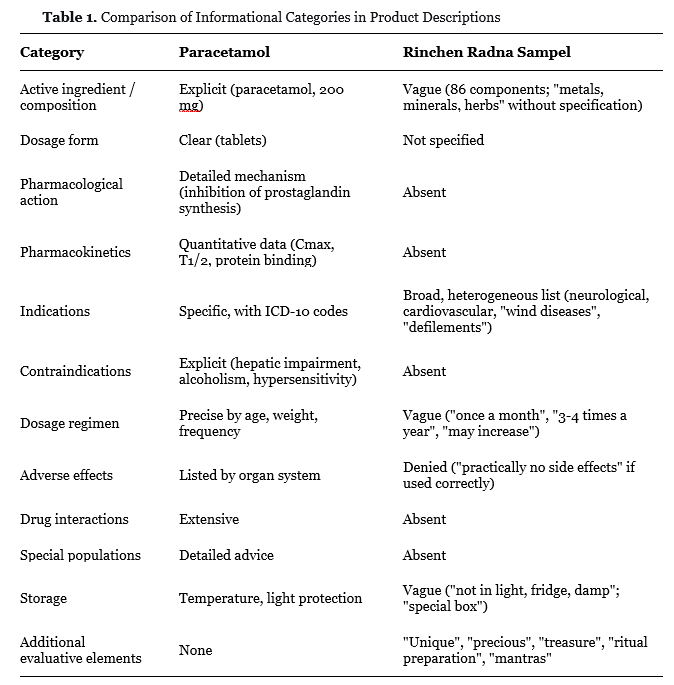
As Table 1 shows, the Paracetamol description conforms to the standard template of evidence‑based pharmaceutical discourse, with all obligatory categories present and quantified. In contrast, the Rinchen Radna Sampel description lacks most of these categories; where information is provided, it is often generalised and lacks precise referents. Moreover, the latter includes elements that are alien to standard pharmaceutical discourse, such as ritual instructions (taking the pill on auspicious lunar days, chanting mantras) and strong evaluative language (“greatest treasure”).
Further analysis of the indication lists:
The Paracetamol indications map directly onto the pharmacological action (analgesic, antipyretic). The Rinchen Radna Sampel
indications, however, are extremely broad: they cover conditions ranging from neurological disorders (parkinsonism, multiple sclerosis) to malignant neoplasms (“early stages of cancer”), and include categories that resist medical classification, such as “diseases caused by evil spirits”, “battles of blood and wind”, and “stupidity”. This breadth and lack of specificity make the remedy seemingly applicable to almost any condition, a rhetorical strategy that increases its perceived utility without empirical grounding. This pattern of universalised claims is consistent with findings by Markelova and Novikova (2021), who demonstrate that the conceptual sphere of “health–disease” varies significantly across cultural contexts and is shaped by culturally specific value systems.
3.2. Analysis of Consultant‑Client Dialogues
The analysis of the three transcribed dialogues revealed the following recurrent features, which were systematically absent in standard evidence‑based consultations:
Indeterminacy in diagnostic description: The consultant frequently used hedging and vague expressions when explaining the practitioner’s methods: “He does pulse diagnostics… well, I find it hard to say exactly…”, “so that they can feel you” (instead of a precise physical examination description).
Vagueness about costs and duration: Costs were presented as ranges with multiple qualifiers: “approximately, roughly speaking, about four‑five thousand”; “it depends on the number of pills”. This allows flexibility in pricing but undermines transparency.
Authority based on personal trust rather than evidence:Reassurances relied on the practitioner’s reputation and personal experience: “He wouldn’t prescribe anything harmful, that’s certain”; “I had a feeling that I was assembled from small pieces”. No mention was made of clinical trials, certifications, or empirical outcomes.
Absence of standard procedural information: When clients asked about necessary documents (passport, medical insurance) or specific preparations, the responses were evasive: “No, nothing is needed”; “If they put you on needles, you might bring a sheet… but we don’t know”. The consultant did not proactively provide a checklist of what to bring, what to wear, or whether to come fasting, which is standard practice in conventional clinics.
Stylistic eclecticism: The discourse mixed scientific terms (leukemia, thrombosis) with mystical concepts (defilements, evil spirits, auspicious signs). This blend creates a hybrid register that is neither purely medical nor purely religious, but leverages the authority of both domains. This stylistic hybridity echoes observations by Skelton, Murray and Hobbs (2022), who found that doctors and patients often use key terms ambiguously, allowing both parties to maintain different interpretations while preserving the appearance of shared understanding.
Promotion of immediate feedback: The consultant emphasised the availability of the practitioner via WhatsApp for any post‑consultation issues, which, while reassuring, also suggests that the treatment may generate unpredictable side effects that require rapid intervention – a point not mentioned in the product description.
3.3. Summary of Linguistic Markers
Based on the two analyses, we propose a typology of linguistic markers for each worldview, organised by level:
Lexical level:
- Rational: precise terms with denotative stability (e.g., парацетамол, 200 мг, ингибирование синтеза простагландинов).
- Irrational: vague, metaphorical, and evaluative lexis (e.g., борьба крови и ветра, сокровище, волшебный, слишком, практически).
Syntactic level:
- Rational: conditional and cause‑effect structures (if X, then Y); quantified nouns (10‑60 min, 500 mg).
- Irrational: generalised and universal statements (neutralises all types of poisons, helps with all head diseases); modal hedges (approximately, usually, can).
Pragmatic‑discursive level:
- Rational: systematic inclusion of standard information categories; explicit contraindications; reference to WHO or clinical data.
- Irrational: omission of categories; appeals to tradition, personal testimony, and spiritual authority; inclusion of ritual instructions; stylistic hybridity.
Discussion
The most striking finding is that the irrational‑worldview discourse is consistently marked by what we term communicative indeterminacy. This is not merely a stylistic choice but appears to be a systematic response to a fundamental problem: the content to be conveyed – beliefs in spiritual forces, energy imbalances, karmic causality – resists encoding in the standard rational linguistic repertoire. The language, which is inherently designed to represent objective, intersubjectively verifiable states of affairs, proves inadequate for expressing subjective, mystical, and context‑dependent experiences. This leads to a reliance on vague referential expressions (e.g., too hot/cold, practically none), evaluative overlays (e.g., precious, unique), and metaphorical extensions (wind as a disease agent).
This observation extends earlier work on referential indeterminacy by Paducheva (1985), who showed that many Russian expressions have fuzzy boundaries. In our data, indeterminacy operates not only at the level of individual referents but also at the level of entire informational categories: the absence of pharmacokinetic data, for example, is not accidental but reflects the epistemological premise that such mechanistic explanations are irrelevant or even misleading.
Cox et al. (2025) provide complementary evidence from a different perspective: their empirical ethics study shows that patients often prefer greater communication of diagnostic uncertainty, challenging the assumption that medical communication should strive for maximum certainty. This finding suggests that indeterminacy in medical discourse may serve important functions beyond merely reflecting an irrational worldview – it can also be a strategic resource for managing complex clinical situations and patient expectations.
We adopt the term linguistic insufficiency (inspired by the earlier work on untranslatability in anthropology, e.g., Leach, 1976) to describe the situation where the conventional linguistic system lacks the resources to adequately represent the speaker’s worldview. As a result, speakers must resort to:
- Metaphor and analogy: e.g., ‘battle of blood and wind’to describe hypertension.
- Symbolic actions:g., reciting mantras, which are included as part of the ‘instructions’, though they have no pharmacological function.
- Contextual and pragmatic clues: the meaning of vague terms is negotiated anew in each interaction, relying on the client’s willingness to accept the practitioner’s authority.
This insufficiency is not a deficit but a creative adaptation: it allows the speaker to construct a coherent discourse that is internally consistent from the perspective of the irrational worldview, even though it would appear scientifically inadequate to an external observer. Wei and Mao (2023) similarly demonstrate that in Traditional Chinese Medicine consultations, seemingly peripheral discursive elements such as small talk serve important functions in building therapeutic relationships and managing the inherent uncertainties of clinical practice. This parallels the present study’s finding that communicative indeterminacy is not merely a symptom of linguistic failure but can be a functional adaptation to the constraints of cross‑worldview communication.
Our findings resonate with studies on alternative medicine discourse, such as Siahpush (2000), who noted that complementary medicine practitioners often use holistic and individualised language to differentiate themselves from ‘reductionist’ biomedicine. However, we extend this by providing a granular linguistic analysis that pinpoints specific markers (e.g., lexical vagueness, omission categories) and links them to the cognitive/epistemological level.
Moreover, our study contributes to the broader literature on institutional discourse (Drew & Heritage, 1992) by showing that even within a single institution (healthcare), different sub‑discourses can be governed by radically different epistemic principles, and these are systematically encoded in language. Liao (2024) reinforces this point by demonstrating that the cultural gap between physicians and patients in pluralistic societies often leads physicians to dismiss patient perspectives as irrational, when in fact these perspectives are rational within different cultural worldviews. This finding underscores the importance of recognising that what appears as “irrational” discourse may be perfectly coherent within its own epistemological framework.
The concept of communicative indeterminacy has potential applications beyond medical discourse. It may be relevant to legal discourse (where ambiguous laws are interpreted), political discourse (where vague promises are made), and even everyday conversation (where speakers strategically use vagueness to avoid commitment). Our study suggests that indeterminacy is not a failure of communication but a functional strategy for managing knowledge asymmetries and epistemic differences.
Furthermore, the findings support the idea that language is not a neutral tool but actively shapes the way we conceptualise and experience health and illness (Lakoff & Johnson, 1980). The use of metaphors in traditional medicine (e.g., wind, heat, cold) creates a coherent, albeit non‑literal, model of the body that can be therapeutic in its own right (Kirmayer, 1996). Markelova and Novikova (2021) provide additional support for this view, demonstrating that the conceptual sphere of “health–disease” is culturally coded and varies significantly across linguistic and cultural contexts. This cultural variability reinforces the need for analytical frameworks that can accommodate different ways of conceptualising health and illness.
In clinical settings where patients hold traditional beliefs, healthcare providers need to be aware that their evidence‑based explanations may be encoded in a very different linguistic framework. Misunderstandings can arise not only from vocabulary differences but from whole categories of expected information being absent or differently weighted. For example, a patient who asks about the ‘dosage’ may expect a specific number, but a traditional practitioner might respond with a ritual time (lunar day) instead. Recognising such mismatches can improve patient‑centred communication.
Bosco (2021) argues that moving beyond simplistic oppositions between rationality and irrationality in health discourse requires attention to the multiple dimensions involved in science communication. This perspective aligns with the practical implications of our study: effective healthcare communication requires not just translation between languages but between entire epistemological frameworks. Cox et al. (2025) further suggest that doctors should err on the side of greater diagnostic uncertainty communication, as withholding such information may deprive patients of information they value and exacerbate inequalities. This recommendation, while focused on diagnostic uncertainty, resonates with our argument that communicative indeterminacy can serve legitimate functions in medical discourse.
This study has several limitations. First, the data are limited to Russian‑language interactions and two specific types of products; generalisation to other languages and medical traditions requires further research. Second, the dialogues were recorded in a single clinic; variation across practitioners and settings may exist. Third, the analysis is qualitative and descriptive; future quantitative studies could measure the frequency of indeterminacy markers and correlate them with patient outcomes.
Future research should also examine how patients with different worldviews respond to each type of discourse, and whether the linguistic patterns we identified are also present in written health information (e.g., websites, pamphlets) beyond the product insert. Longitudinal studies could investigate whether exposure to rational discourse can shift a patient’s linguistic habits or vice versa. The growing body of research on diagnostic uncertainty communication (Cox et al., 2025) and cultural gaps in medical encounters (Liao, 2024) suggests that this is a fertile area for further investigation.
Conclusions
This study has demonstrated that medical discourse is a fertile ground for observing the linguistic expression of rational and irrational worldviews. Through systematic comparison of product descriptions and consultant‑client interactions, we identified a constellation of features that characterize each worldview: precision, quantification, and empirical grounding for the rational; vagueness, evaluative lexis, omission of standard categories, and incorporation of ritual elements for the irrational.
We proposed the concept of communicative indeterminacy as a unifying framework, arguing that it arises from the inherent insufficiency of rational language to encode non‑rational content. This insight deepens our understanding of how language interacts with cognition and culture, and it has practical applications for improving healthcare communication across epistemological divides.
The study makes three main contributions:
- It operationalizes the rational‑irrational dichotomy at the linguistic level, providing a replicable analytical tool.
- It introduces the concept of linguistic insufficiency, which can be applied to other domains of institutional discourse.
- It offers practical guidance for healthcare professionals who encounter patients with different worldviews, highlighting the need for epistemic flexibility in communication.
Future work should extend this analysis to other languages and medical systems, and explore the dynamic aspects of worldview negotiation in real‑time interactions.
Conflict of Interest: The author declares no conflicts of interest.
Funding: This research received no external funding.
AI Usage: AI tools were used solely for auxiliary purposes (grammar checking, stylistic editing, translation). All scientific ideas, analysis, and conclusions are the author’s own.
Acknowledgements: The author thanks the informants, dialogue participants, and staff of the Tibetan medicine centre for their assistance in conducting this research.
References
- Bosco, N. (2021). Images of health: Public discourse, information, ignorance and co. In Routledge Handbook of Public Communication of Science and Technology(pp. 89‑104).
- Broom, A. (2008). The discursive constitution of alternative medicine. Health, 12(2), 197‑217.
- Burova, G. P. (2008). Farmatsevticheskiy diskurs kak kulturny kod[Pharmaceutical discourse as a cultural code] (Doctoral dissertation abstract). Stavropol State University.
- Candlin, C. N., & Candlin, S. (2002). Discourse, expertise and the management of risk in health care settings. Research on Language and Social Interaction, 35(2), 115‑137.
- Cassirer, E. (1944). An essay on man. Yale University Press.
- Cox, C., et al. (2025). To what extent should doctors communicate diagnostic uncertainty with their patients? An empirical ethics vignette study. Journal of Medical Ethics, 51(11), 754‑765.
- Daly, J. (1999). Evidence‑based medicine and the search for a science of clinical care. Journal of Evaluation in Clinical Practice, 5(2), 121‑126.
- Drew, P., & Heritage, J. (Eds.). (1992). Talk at work: Interaction in institutional settings. Cambridge University Press.
- Epstein, S. (1994). Integration of the cognitive and the psychodynamic unconscious. American Psychologist, 49(8), 709‑724.
- Evgenieva, A. P. (Ed.). (1981‑1984). Slovar russkogo yazyka[Dictionary of the Russian language] (4 vols., 2nd ed.). Russkiy yazyk.
- Fairclough, N. (1992). Discourse and social change. Polity Press.
- Fedosova, M. V., & Koroleva, D. B. (2018). Problema klassifikatsii farmatsevticheskogo diskursa [The problem of classification of pharmaceutical discourse]. In Filosofiya i nauka v kulturakh zapada i vostoka(pp. 44‑46). Tomsk State University.
- Gee, J. P. (2014). An introduction to discourse analysis: Theory and method(4th ed.).
- Golovanova, E. I. (2013). Professionalny diskurs, subdiskurs, zhanr professionalnoy kommunikatsii [Professional discourse, subdiscourse, genre]. Vestnik Chelyabinskogo gosudarstvennogo universiteta, 1(292), 32‑35.
- Gotti, M. (2013). Investigating specialised discourse. Peter Lang.
- Helman, C. (2007). Culture, health and illness(5th ed.). Hodder Arnold.
- Horton, R. (1967). African traditional thought and Western science. Africa, 37(1‑2), 50‑71, 155‑187.
- Jefferson, G. (2004). Glossary of transcript symbols. In G. H. Lerner (Ed.), Conversation analysis: Studies from the first generation(pp. 13‑31). John Benjamins.
- Kaptchuk, T. J., & Eisenberg, D. M. (1998). The persuasive appeal of alternative medicine. Annals of Internal Medicine, 129(12), 1061‑1065.
- Karasik, V. I. (2000). O tipakh diskursa [On types of discourse]. In Yazykovaya lichnost: institutsionalny i personalny diskurs(pp. 5‑20). Volgograd State University.
- Kirmayer, L. J. (1996). Confusion of the senses: Implications of ethnocultural variations in somatoform and dissociative disorders. Cultural Medical Psychiatry, 20(2), 149‑160.
- Kleinman, A. (1980). Patients and healers in the context of culture. University of California Press.
- Lakoff, G., & Johnson, M. (1980). Metaphors we live by. University of Chicago Press.
- Langacker, R. W. (1987). Foundations of cognitive grammar(Vol. 1). Stanford University Press.
- Leach, E. (1976). Culture and communication. Cambridge University Press.
- Lévy‑Bruhl, L. (1910). Les fonctions mentales dans les sociétés inférieures.
- Liao, L. (2024). The WEIRD Trio: The cultural gap between physicians, learners, and patients in pluralistic societies. Journal of Medicine and Philosophy, ahead of print.
- Markelova, T. V., & Novikova, M. L. (2021). «Health – disease» conceptual sphere: Cultural code. RUDN Journal of Language Studies, Semiotics and Semantics, 12(3), 848‑874.
- Nosova, L. N. (2012). O nekotorykh kommunikativnykh osobennostyakh lekarstvennogo diskursa [On some communicative features of medicinal discourse]. In III Mezhdunarodnaya nauchno‑prakticheskaya konferentsiya “Kommunikatsiya v sotsialno‑gumanitarnom znanii, ekonomike, obrazovanii”(pp. 94‑96).
- Paducheva, E. V. (1985). Vyskazyvanie i ego sootnesennost s deystvitelnostyu[Utterance and its correlation with reality]. (6th ed., 2010, LKI).
- Shuravina, L. S. (2013). Meditsinskiy diskurs kak tip institutsionalnogo diskursa [Medical discourse as a type of institutional discourse]. Vestnik Chelyabinskogo gosudarstvennogo universiteta, 37(328).
- Siahpush, M. (2000). A critical review of the sociology of alternative medicine: Research on users, practitioners and the medical profession. Health, 4(1), 105‑126.
- Skelton, J. R., Murray, J., & Hobbs, F. D. R. (2022). Imprecision in medical communication: Study of a doctor talking to patients with serious illness. Nuffield Department of Primary Care Health Sciences, University of Oxford.
- Talmy, L. (2000). Toward a cognitive semantics(Vols. 1‑2). MIT Press.
- Weber, M. (1922). Wirtschaft und Gesellschaft. Mohr Siebeck.
- Wei, S., & Mao, Y. (2023). Small talk is a big deal: A discursive analysis of online off‑topic doctor‑patient interaction in Traditional Chinese Medicine. Social Science & Medicine, 115632.
- Whorf, B. L. (1956). Language, thought, and reality. MIT Press.
Comments (0)
Relevance and problem. The opposition between rational and irrational modes of cognition is a foundational dichotomy in philosophy and cognitive science. However, its specific linguistic manifestations in institutional communication, particularly in healthcare, remain insufficiently explored. Given that medical encounters often involve diverse epistemological frameworks, understanding how these worldviews are encoded in language is critical for improving cross‑epistemological communication. Previous research has examined rational and irrational worldviews separately in various disciplines, but systematic comparative analysis of their linguistic realisations within the same discursive domain – medical discourse – is lacking. This gap hinders our ability to identify and address communicative breakdowns that may arise from worldview‑based differences in information encoding and interpretation. Objective. This study aims to identify and describe the linguistic and discursive features that distinguish the expression of rational versus irrational worldviews in Russian‑language medical discourse, focusing on two typical communicative situations: product description and consultant‑client interaction. Method. The study employs a qualitative comparative discourse‑analytic approach. Data include (1) official product descriptions of a conventional pharmaceutical (Paracetamol) and a traditional Tibetan remedy (Rinchen Radna Sampel), and (2) transcripts of authentic consultant‑client dialogues in a Tibetan medicine clinic. Analytical procedures involved lexicographic definition analysis, componential semantic analysis, and systematic comparison of discourse features across multiple linguistic levels (lexical, syntactic, and pragmatic‑discursive). Results. Systematic differences were found across all levels. The rational worldview discourse is characterised by precision in dosage, explicit specification of pharmacological mechanisms, systematic inclusion of standardised informational categories (pharmacokinetics, contraindications, drug interactions), and reliance on empirical authority (WHO). In contrast, the irrational worldview discourse exhibits pervasive ‘communicative indeterminacy’: (a) extensive use of lexemes with vague referential semantics and strong connotative load; (b) systematic omission of obligatory informational blocks; (c) universalised and generalised claims of efficacy; (d) stylistic eclecticism mixing scientific terminology with religious‑magical elements; and (e) appeals to non‑empirical authority (spiritual tradition, personal experience, auspicious timing). Conclusion. The findings support the notion of ‘linguistic insufficiency’ – the inability of standard rational language to fully encode non‑rational content. This leads to a distinct discursive profile marked by indeterminacy and reliance on metaphor, symbol, and context‑dependent interpretation. The study contributes to discourse theory by operationalising worldview differences at the linguistic level and offers practical insights for healthcare communication across epistemological divides.
Медицинский дискурс как сфера репрезентации рациональной и иррациональной картин мира: сравнительное лингвистическое исследование
Игорь И. Саженин
Новосибирский государственный педагогический университет, Новосибирск, Россия
Резюме. Актуальность и проблема. Противопоставление рационального и иррационального способов познания является фундаментальной дихотомией в философии и когнитивной науке. Однако его конкретные языковые проявления в институциональной коммуникации, особенно в здравоохранении, остаются недостаточно изученными. Поскольку медицинские взаимодействия часто вовлекают различные эпистемологические рамки, понимание того, как эти картины мира кодируются в языке, критически важно для улучшения кросс‑эпистемологической коммуникации. Предыдущие исследования рассматривали рациональную и иррациональную картины мира по отдельности в разных дисциплинах, но систематический сравнительный анализ их языковых реализаций в рамках одного дискурсивного домена – медицинского дискурса – отсутствует. Этот пробел препятствует выявлению и устранению коммуникативных сбоев, которые могут возникать из‑за различия в кодировании и интерпретации информации, обусловленных картиной мира. Цель. Настоящее исследование направлено на выявление и описание лингвистических и дискурсивных признаков, отличающих выражение рациональной и иррациональной картин мира в русскоязычном медицинском дискурсе, с фокусом на двух типичных коммуникативных ситуациях: описание продукта и взаимодействие консультанта с клиентом. Метод. Исследование выполнено в качественном сравнительном дискурс‑аналитическом ключе. Материал включает (1) официальные описания продуктов – обычного фармацевтического препарата (парацетамол) и традиционного тибетского средства (Ринчен Радна Сампэл) – и (2) расшифровки аутентичных диалогов консультанта с клиентами в клинике тибетской медицины. Аналитические процедуры включали лексикографический дефиниционный анализ, компонентный семантический анализ и систематическое сравнение дискурсивных характеристик на нескольких языковых уровнях (лексическом, синтаксическом и прагматико‑дискурсивном). Результаты. Обнаружены систематические различия на всех уровнях. Дискурс рациональной картины мира характеризуется точностью дозировки, эксплицитным указанием фармакологических механизмов, систематическим включением стандартизированных информационных категорий (фармакокинетика, противопоказания, лекарственное взаимодействие) и опорой на эмпирический авторитет (ВОЗ). Напротив, дискурс иррациональной картины мира демонстрирует повсеместную «коммуникативную неопределённость»: (а) широкое использование лексем с размытой референциальной семантикой и сильным коннотативным компонентом; (б) систематическое опущение обязательных информационных блоков; (в) универсализированные и генерализованные утверждения об эффективности; (г) стилистическую эклектику, смешивающую научную терминологию с религиозно‑магическими элементами; и (д) апелляцию к неэмпирическому авторитету (духовная традиция, личный опыт, благоприятное время). Заключение. Результаты подтверждают представление о «языковой недостаточности» – неспособности стандартного рационального языка полностью кодировать нерациональное содержание. Это приводит к формированию особого дискурсивного профиля, отмеченного неопределённостью и опорой на метафору, символ и контекстно‑зависимую интерпретацию. Исследование вносит вклад в теорию дискурса, операционализируя различия картин мира на языковом уровне, и предлагает практические рекомендации для медицинской коммуникации через эпистемологические разрывы.
Ключевые слова: дискурс, картина мира, рациональность, иррациональность, медицинский дискурс, языковая неопределённость, референциальная семантика, традиционная медицина
The rational and irrational worldviews represent two fundamentally different modes of perceiving, interpreting, and explaining reality. The rational approach is grounded in logic, empirical evidence, and causal determinism, whereas the irrational worldview draws upon intuition, faith, emotional experience, mysticism, and symbolic thinking. This dichotomy has been extensively studied in philosophy (e.g., Lévy‑Bruhl, 1910; Cassirer, 1944), anthropology (e.g., Horton, 1967), psychology (e.g., Epstein, 1994), and sociology (e.g., Weber, 1922). However, its linguistic manifestations have received comparatively less attention, particularly within the domain of institutional discourse.
Since language is the primary medium for encoding, storing, and transmitting knowledge, the opposition between rational and irrational cognition should be reflected in systematic differences in communicative behaviour. This premise aligns with the Sapir‑Whorf hypothesis of linguistic relativity (Whorf, 1956) and with more recent work on linguistic construal of reality (Langacker, 1987; Talmy, 2000). In healthcare contexts, where accurate transmission of medical information is crucial, the clash between these worldviews can lead to miscommunication, non‑adherence, and dissatisfaction (Kleinman, 1980; Helman, 2007). Liao (2024) further notes that physicians often misunderstand or dismiss patient perspectives as irrational, particularly in pluralistic societies where cultural worldviews diverge significantly. This cultural gap underscores the need for systematic investigation of how different epistemological frameworks are encoded in language. Therefore, identifying the specific linguistic markers of each worldview is both theoretically and practically important.
Medical discourse, defined as institutional communication between healthcare professionals and patients (Shuravina, 2013), provides an ideal site for such investigation. Within this broad category, pharmaceutical discourse – the language of medication description and counselling – is particularly revealing because it condenses key information about diagnosis, treatment, and prognosis into standardised formats (Burova, 2008; Nosova, 2012; Fedosova & Koroleva, 2018). Comparing descriptions of conventional (evidence‑based) remedies with those of traditional (e.g., Tibetan) medicines can illuminate how different epistemological frameworks shape not only what is said but also what is left unsaid. Recent research by Wei and Mao (2023) demonstrates that in Traditional Chinese Medicine consultations, even seemingly peripheral discourse elements such as “small talk” play a significant role in constructing therapeutic relationships and managing uncertainty. This finding resonates with the present study’s focus on how non‑rational elements permeate medical communication.
Despite the growing interest in medical discourse analysis (e.g., Gotti, 2013; Candlin & Candlin, 2002; Skelton & Hobbs, 2010), few studies have systematically compared the linguistic encoding of rational versus irrational worldviews within the same discursive domain. Existing work tends to focus either on the rhetoric of evidence‑based medicine (e.g., Daly, 1999) or on the discourse of alternative medicine (e.g., Kaptchuk & Eisenberg, 1998; Broom, 2008), but rarely juxtaposes them using a consistent analytical framework. Moreover, while scholars have noted that alternative medicine discourse often employs vague, metaphorical language (e.g., Siahpush, 2000), the precise linguistic mechanisms – lexical, syntactic, and pragmatic – remain underexplored.
Bosco (2021) critically examines public discourses about science and health, arguing that simplistic interpretations pitting the rational against the irrational obscure the ambivalences that have always surrounded scientific representation. This perspective reinforces the need for more nuanced analytical approaches that can capture the full complexity of medical discourse without reducing it to binary oppositions. Furthermore, Cox et al. (2025) demonstrate that patients generally prefer greater communication of diagnostic uncertainty, even when such communication generates worry. This finding challenges the assumption that rational medical communication should minimise uncertainty and instead suggests that strategic use of indeterminacy may serve important communicative functions – a possibility that aligns with the concept of ‘communicative indeterminacy’ proposed in the present study.
The present study addresses this gap by asking the following research questions:
RQ1: What are the systematic linguistic differences between rational and irrational worldview expressions in the two typical communicative situations of (a) product description and (b) consultant‑client interaction?
RQ2: How do these differences manifest at lexical, syntactic, and pragmatic‑discursive levels?
RQ3: Can the concept of ‘communicative indeterminacy’ serve as a unifying framework for describing the linguistic profile of irrational‑worldview discourse in medical contexts?
The aim of this study is to identify and describe the linguistic and discursive features that distinguish rational from irrational worldviews in Russian‑language medical discourse. The specific objectives are: (1) to compare product descriptions of a conventional pharmaceutical and a traditional Tibetan remedy; (2) to analyse authentic dialogues between consultants and clients in a Tibetan medicine clinic; (3) to synthesise the findings into a coherent typology of linguistic markers; and (4) to propose the concept of ‘communicative indeterminacy’ as an explanatory framework.
2.1. Research Design
This study employs a qualitative comparative discourse‑analytic approach, following the principles of discourse analysis as outlined by Fairclough (1992) and Gee (2014), combined with systematic lexicographic and componential semantic analysis. The design is cross‑sectional and comparative, with two units of analysis: (a) product descriptions and (b) consultant‑client dialogues.
2.2. Material
The material consisted of two data sets:
Data Set 1 (product descriptions):
- Official package insert of Paracetamol (registration number LSR‑000062, 200 mg tablets), sourced from the Russian State Register of Medicines.
- Promotional description of Rinchen Radna Sampel (‘Precious Wish‑fulfilling Jewel’), a poly‑component Tibetan medicinal pill, as provided by the Tibetan Medical and Astrological Institute (Men Tsee Khang, Dharamsala, India). The text was officially translated into Russian and distributed to clients.
Data Set 2 (consultant‑client interactions):
- Recorded and transcribed dialogues (3 interactions, total duration approx. 25 minutes) between a receptionist (consultant) and prospective clients at a Tibetan medicine centre in a Russian city. The dialogues were naturally occurring and were transcribed verbatim using the conventions of conversation analysis (Jefferson, 2004).
2.3. Analytical Procedure
The analysis proceeded in three stages:
Stage 1: Lexicographic and componential analysis. Key lexical units (e.g., лекарство ‘medicine’, противоядие ‘antidote’, драгоценный ‘precious’, уникальный ‘unique’) were examined using the 4‑volume Dictionary of the Russian Language (Evgenieva, 1981‑1984) to identify their denotative and connotative components.
Stage 2: Structural comparison of product descriptions. Both texts were segmented into the standard informational categories typical of pharmaceutical discourse (active ingredient, dosage form, pharmacological action, pharmacokinetics, indications, contraindications, etc.). The presence/absence and the content quality of each category were recorded in a comparison matrix (see Table 1, Results).
Stage 3: Discourse‑pragmatic analysis of dialogues. The transcribed dialogues were coded for:
- Referential specificity (e.g., precise vs. vague expressions)
- Use of evaluative and emotionally charged lexis
- Type of authority invoked (empirical, traditional, personal)
- Presence of standard procedural information (e.g., required documents, preparation instructions)
- Stylistic hybridity (mixing of scientific and religious‑magical registers)
Two independent coders (the author and a trained research assistant) performed the coding, with inter‑coder agreement of 87%; disagreements were resolved through discussion.
2.4. Operational Definitions
For the purpose of this study, rational worldview discourse is defined as communication that (i) explicitly invokes empirical evidence and cause‑and‑effect reasoning, (ii) provides specific, quantifiable information (dosage, time, percentages), (iii) includes standardised contraindications and safety warnings, and (iv) refers to verifiable sources (WHO, clinical trials).
Irrational worldview discourse is defined as communication that (i) relies on non‑empirical authority (tradition, spiritual teachers, personal intuition), (ii) uses vague, generalised, and metaphorical expressions, (iii) omits or obscures standard safety and efficacy information, and (iv) incorporates elements of religious or magical thinking.
These definitions were applied consistently across both data sets.
3.1. Comparative Analysis of Product Descriptions
Table 1 summarises the presence/absence and quality of standard informational categories in the Paracetamol and Rinchen Radna Sampel descriptions.
As Table 1 shows, the Paracetamol description conforms to the standard template of evidence‑based pharmaceutical discourse, with all obligatory categories present and quantified. In contrast, the Rinchen Radna Sampel description lacks most of these categories; where information is provided, it is often generalised and lacks precise referents. Moreover, the latter includes elements that are alien to standard pharmaceutical discourse, such as ritual instructions (taking the pill on auspicious lunar days, chanting mantras) and strong evaluative language (“greatest treasure”).
Further analysis of the indication lists:
The Paracetamol indications map directly onto the pharmacological action (analgesic, antipyretic). The Rinchen Radna Sampel
indications, however, are extremely broad: they cover conditions ranging from neurological disorders (parkinsonism, multiple sclerosis) to malignant neoplasms (“early stages of cancer”), and include categories that resist medical classification, such as “diseases caused by evil spirits”, “battles of blood and wind”, and “stupidity”. This breadth and lack of specificity make the remedy seemingly applicable to almost any condition, a rhetorical strategy that increases its perceived utility without empirical grounding. This pattern of universalised claims is consistent with findings by Markelova and Novikova (2021), who demonstrate that the conceptual sphere of “health–disease” varies significantly across cultural contexts and is shaped by culturally specific value systems.
3.2. Analysis of Consultant‑Client Dialogues
The analysis of the three transcribed dialogues revealed the following recurrent features, which were systematically absent in standard evidence‑based consultations:
Indeterminacy in diagnostic description: The consultant frequently used hedging and vague expressions when explaining the practitioner’s methods: “He does pulse diagnostics… well, I find it hard to say exactly…”, “so that they can feel you” (instead of a precise physical examination description).
Vagueness about costs and duration: Costs were presented as ranges with multiple qualifiers: “approximately, roughly speaking, about four‑five thousand”; “it depends on the number of pills”. This allows flexibility in pricing but undermines transparency.
Authority based on personal trust rather than evidence:Reassurances relied on the practitioner’s reputation and personal experience: “He wouldn’t prescribe anything harmful, that’s certain”; “I had a feeling that I was assembled from small pieces”. No mention was made of clinical trials, certifications, or empirical outcomes.
Absence of standard procedural information: When clients asked about necessary documents (passport, medical insurance) or specific preparations, the responses were evasive: “No, nothing is needed”; “If they put you on needles, you might bring a sheet… but we don’t know”. The consultant did not proactively provide a checklist of what to bring, what to wear, or whether to come fasting, which is standard practice in conventional clinics.
Stylistic eclecticism: The discourse mixed scientific terms (leukemia, thrombosis) with mystical concepts (defilements, evil spirits, auspicious signs). This blend creates a hybrid register that is neither purely medical nor purely religious, but leverages the authority of both domains. This stylistic hybridity echoes observations by Skelton, Murray and Hobbs (2022), who found that doctors and patients often use key terms ambiguously, allowing both parties to maintain different interpretations while preserving the appearance of shared understanding.
Promotion of immediate feedback: The consultant emphasised the availability of the practitioner via WhatsApp for any post‑consultation issues, which, while reassuring, also suggests that the treatment may generate unpredictable side effects that require rapid intervention – a point not mentioned in the product description.
3.3. Summary of Linguistic Markers
Based on the two analyses, we propose a typology of linguistic markers for each worldview, organised by level:
Lexical level:
- Rational: precise terms with denotative stability (e.g., парацетамол, 200 мг, ингибирование синтеза простагландинов).
- Irrational: vague, metaphorical, and evaluative lexis (e.g., борьба крови и ветра, сокровище, волшебный, слишком, практически).
Syntactic level:
- Rational: conditional and cause‑effect structures (if X, then Y); quantified nouns (10‑60 min, 500 mg).
- Irrational: generalised and universal statements (neutralises all types of poisons, helps with all head diseases); modal hedges (approximately, usually, can).
Pragmatic‑discursive level:
- Rational: systematic inclusion of standard information categories; explicit contraindications; reference to WHO or clinical data.
- Irrational: omission of categories; appeals to tradition, personal testimony, and spiritual authority; inclusion of ritual instructions; stylistic hybridity.
The most striking finding is that the irrational‑worldview discourse is consistently marked by what we term communicative indeterminacy. This is not merely a stylistic choice but appears to be a systematic response to a fundamental problem: the content to be conveyed – beliefs in spiritual forces, energy imbalances, karmic causality – resists encoding in the standard rational linguistic repertoire. The language, which is inherently designed to represent objective, intersubjectively verifiable states of affairs, proves inadequate for expressing subjective, mystical, and context‑dependent experiences. This leads to a reliance on vague referential expressions (e.g., too hot/cold, practically none), evaluative overlays (e.g., precious, unique), and metaphorical extensions (wind as a disease agent).
This observation extends earlier work on referential indeterminacy by Paducheva (1985), who showed that many Russian expressions have fuzzy boundaries. In our data, indeterminacy operates not only at the level of individual referents but also at the level of entire informational categories: the absence of pharmacokinetic data, for example, is not accidental but reflects the epistemological premise that such mechanistic explanations are irrelevant or even misleading.
Cox et al. (2025) provide complementary evidence from a different perspective: their empirical ethics study shows that patients often prefer greater communication of diagnostic uncertainty, challenging the assumption that medical communication should strive for maximum certainty. This finding suggests that indeterminacy in medical discourse may serve important functions beyond merely reflecting an irrational worldview – it can also be a strategic resource for managing complex clinical situations and patient expectations.
We adopt the term linguistic insufficiency (inspired by the earlier work on untranslatability in anthropology, e.g., Leach, 1976) to describe the situation where the conventional linguistic system lacks the resources to adequately represent the speaker’s worldview. As a result, speakers must resort to:
- Metaphor and analogy: e.g., ‘battle of blood and wind’to describe hypertension.
- Symbolic actions:g., reciting mantras, which are included as part of the ‘instructions’, though they have no pharmacological function.
- Contextual and pragmatic clues: the meaning of vague terms is negotiated anew in each interaction, relying on the client’s willingness to accept the practitioner’s authority.
This insufficiency is not a deficit but a creative adaptation: it allows the speaker to construct a coherent discourse that is internally consistent from the perspective of the irrational worldview, even though it would appear scientifically inadequate to an external observer. Wei and Mao (2023) similarly demonstrate that in Traditional Chinese Medicine consultations, seemingly peripheral discursive elements such as small talk serve important functions in building therapeutic relationships and managing the inherent uncertainties of clinical practice. This parallels the present study’s finding that communicative indeterminacy is not merely a symptom of linguistic failure but can be a functional adaptation to the constraints of cross‑worldview communication.
Our findings resonate with studies on alternative medicine discourse, such as Siahpush (2000), who noted that complementary medicine practitioners often use holistic and individualised language to differentiate themselves from ‘reductionist’ biomedicine. However, we extend this by providing a granular linguistic analysis that pinpoints specific markers (e.g., lexical vagueness, omission categories) and links them to the cognitive/epistemological level.
Moreover, our study contributes to the broader literature on institutional discourse (Drew & Heritage, 1992) by showing that even within a single institution (healthcare), different sub‑discourses can be governed by radically different epistemic principles, and these are systematically encoded in language. Liao (2024) reinforces this point by demonstrating that the cultural gap between physicians and patients in pluralistic societies often leads physicians to dismiss patient perspectives as irrational, when in fact these perspectives are rational within different cultural worldviews. This finding underscores the importance of recognising that what appears as “irrational” discourse may be perfectly coherent within its own epistemological framework.
The concept of communicative indeterminacy has potential applications beyond medical discourse. It may be relevant to legal discourse (where ambiguous laws are interpreted), political discourse (where vague promises are made), and even everyday conversation (where speakers strategically use vagueness to avoid commitment). Our study suggests that indeterminacy is not a failure of communication but a functional strategy for managing knowledge asymmetries and epistemic differences.
Furthermore, the findings support the idea that language is not a neutral tool but actively shapes the way we conceptualise and experience health and illness (Lakoff & Johnson, 1980). The use of metaphors in traditional medicine (e.g., wind, heat, cold) creates a coherent, albeit non‑literal, model of the body that can be therapeutic in its own right (Kirmayer, 1996). Markelova and Novikova (2021) provide additional support for this view, demonstrating that the conceptual sphere of “health–disease” is culturally coded and varies significantly across linguistic and cultural contexts. This cultural variability reinforces the need for analytical frameworks that can accommodate different ways of conceptualising health and illness.
In clinical settings where patients hold traditional beliefs, healthcare providers need to be aware that their evidence‑based explanations may be encoded in a very different linguistic framework. Misunderstandings can arise not only from vocabulary differences but from whole categories of expected information being absent or differently weighted. For example, a patient who asks about the ‘dosage’ may expect a specific number, but a traditional practitioner might respond with a ritual time (lunar day) instead. Recognising such mismatches can improve patient‑centred communication.
Bosco (2021) argues that moving beyond simplistic oppositions between rationality and irrationality in health discourse requires attention to the multiple dimensions involved in science communication. This perspective aligns with the practical implications of our study: effective healthcare communication requires not just translation between languages but between entire epistemological frameworks. Cox et al. (2025) further suggest that doctors should err on the side of greater diagnostic uncertainty communication, as withholding such information may deprive patients of information they value and exacerbate inequalities. This recommendation, while focused on diagnostic uncertainty, resonates with our argument that communicative indeterminacy can serve legitimate functions in medical discourse.
This study has several limitations. First, the data are limited to Russian‑language interactions and two specific types of products; generalisation to other languages and medical traditions requires further research. Second, the dialogues were recorded in a single clinic; variation across practitioners and settings may exist. Third, the analysis is qualitative and descriptive; future quantitative studies could measure the frequency of indeterminacy markers and correlate them with patient outcomes.
Future research should also examine how patients with different worldviews respond to each type of discourse, and whether the linguistic patterns we identified are also present in written health information (e.g., websites, pamphlets) beyond the product insert. Longitudinal studies could investigate whether exposure to rational discourse can shift a patient’s linguistic habits or vice versa. The growing body of research on diagnostic uncertainty communication (Cox et al., 2025) and cultural gaps in medical encounters (Liao, 2024) suggests that this is a fertile area for further investigation.
This study has demonstrated that medical discourse is a fertile ground for observing the linguistic expression of rational and irrational worldviews. Through systematic comparison of product descriptions and consultant‑client interactions, we identified a constellation of features that characterize each worldview: precision, quantification, and empirical grounding for the rational; vagueness, evaluative lexis, omission of standard categories, and incorporation of ritual elements for the irrational.
We proposed the concept of communicative indeterminacy as a unifying framework, arguing that it arises from the inherent insufficiency of rational language to encode non‑rational content. This insight deepens our understanding of how language interacts with cognition and culture, and it has practical applications for improving healthcare communication across epistemological divides.
The study makes three main contributions:
- It operationalizes the rational‑irrational dichotomy at the linguistic level, providing a replicable analytical tool.
- It introduces the concept of linguistic insufficiency, which can be applied to other domains of institutional discourse.
- It offers practical guidance for healthcare professionals who encounter patients with different worldviews, highlighting the need for epistemic flexibility in communication.
Future work should extend this analysis to other languages and medical systems, and explore the dynamic aspects of worldview negotiation in real‑time interactions.
Conflict of Interest: The author declares no conflicts of interest.
Funding: This research received no external funding.
AI Usage: AI tools were used solely for auxiliary purposes (grammar checking, stylistic editing, translation). All scientific ideas, analysis, and conclusions are the author’s own.
Acknowledgements: The author thanks the informants, dialogue participants, and staff of the Tibetan medicine centre for their assistance in conducting this research.
- Bosco, N. (2021). Images of health: Public discourse, information, ignorance and co. In Routledge Handbook of Public Communication of Science and Technology(pp. 89‑104).
- Broom, A. (2008). The discursive constitution of alternative medicine. Health, 12(2), 197‑217.
- Burova, G. P. (2008). Farmatsevticheskiy diskurs kak kulturny kod[Pharmaceutical discourse as a cultural code] (Doctoral dissertation abstract). Stavropol State University.
- Candlin, C. N., & Candlin, S. (2002). Discourse, expertise and the management of risk in health care settings. Research on Language and Social Interaction, 35(2), 115‑137.
- Cassirer, E. (1944). An essay on man. Yale University Press.
- Cox, C., et al. (2025). To what extent should doctors communicate diagnostic uncertainty with their patients? An empirical ethics vignette study. Journal of Medical Ethics, 51(11), 754‑765.
- Daly, J. (1999). Evidence‑based medicine and the search for a science of clinical care. Journal of Evaluation in Clinical Practice, 5(2), 121‑126.
- Drew, P., & Heritage, J. (Eds.). (1992). Talk at work: Interaction in institutional settings. Cambridge University Press.
- Epstein, S. (1994). Integration of the cognitive and the psychodynamic unconscious. American Psychologist, 49(8), 709‑724.
- Evgenieva, A. P. (Ed.). (1981‑1984). Slovar russkogo yazyka[Dictionary of the Russian language] (4 vols., 2nd ed.). Russkiy yazyk.
- Fairclough, N. (1992). Discourse and social change. Polity Press.
- Fedosova, M. V., & Koroleva, D. B. (2018). Problema klassifikatsii farmatsevticheskogo diskursa [The problem of classification of pharmaceutical discourse]. In Filosofiya i nauka v kulturakh zapada i vostoka(pp. 44‑46). Tomsk State University.
- Gee, J. P. (2014). An introduction to discourse analysis: Theory and method(4th ed.).
- Golovanova, E. I. (2013). Professionalny diskurs, subdiskurs, zhanr professionalnoy kommunikatsii [Professional discourse, subdiscourse, genre]. Vestnik Chelyabinskogo gosudarstvennogo universiteta, 1(292), 32‑35.
- Gotti, M. (2013). Investigating specialised discourse. Peter Lang.
- Helman, C. (2007). Culture, health and illness(5th ed.). Hodder Arnold.
- Horton, R. (1967). African traditional thought and Western science. Africa, 37(1‑2), 50‑71, 155‑187.
- Jefferson, G. (2004). Glossary of transcript symbols. In G. H. Lerner (Ed.), Conversation analysis: Studies from the first generation(pp. 13‑31). John Benjamins.
- Kaptchuk, T. J., & Eisenberg, D. M. (1998). The persuasive appeal of alternative medicine. Annals of Internal Medicine, 129(12), 1061‑1065.
- Karasik, V. I. (2000). O tipakh diskursa [On types of discourse]. In Yazykovaya lichnost: institutsionalny i personalny diskurs(pp. 5‑20). Volgograd State University.
- Kirmayer, L. J. (1996). Confusion of the senses: Implications of ethnocultural variations in somatoform and dissociative disorders. Cultural Medical Psychiatry, 20(2), 149‑160.
- Kleinman, A. (1980). Patients and healers in the context of culture. University of California Press.
- Lakoff, G., & Johnson, M. (1980). Metaphors we live by. University of Chicago Press.
- Langacker, R. W. (1987). Foundations of cognitive grammar(Vol. 1). Stanford University Press.
- Leach, E. (1976). Culture and communication. Cambridge University Press.
- Lévy‑Bruhl, L. (1910). Les fonctions mentales dans les sociétés inférieures.
- Liao, L. (2024). The WEIRD Trio: The cultural gap between physicians, learners, and patients in pluralistic societies. Journal of Medicine and Philosophy, ahead of print.
- Markelova, T. V., & Novikova, M. L. (2021). «Health – disease» conceptual sphere: Cultural code. RUDN Journal of Language Studies, Semiotics and Semantics, 12(3), 848‑874.
- Nosova, L. N. (2012). O nekotorykh kommunikativnykh osobennostyakh lekarstvennogo diskursa [On some communicative features of medicinal discourse]. In III Mezhdunarodnaya nauchno‑prakticheskaya konferentsiya “Kommunikatsiya v sotsialno‑gumanitarnom znanii, ekonomike, obrazovanii”(pp. 94‑96).
- Paducheva, E. V. (1985). Vyskazyvanie i ego sootnesennost s deystvitelnostyu[Utterance and its correlation with reality]. (6th ed., 2010, LKI).
- Shuravina, L. S. (2013). Meditsinskiy diskurs kak tip institutsionalnogo diskursa [Medical discourse as a type of institutional discourse]. Vestnik Chelyabinskogo gosudarstvennogo universiteta, 37(328).
- Siahpush, M. (2000). A critical review of the sociology of alternative medicine: Research on users, practitioners and the medical profession. Health, 4(1), 105‑126.
- Skelton, J. R., Murray, J., & Hobbs, F. D. R. (2022). Imprecision in medical communication: Study of a doctor talking to patients with serious illness. Nuffield Department of Primary Care Health Sciences, University of Oxford.
- Talmy, L. (2000). Toward a cognitive semantics(Vols. 1‑2). MIT Press.
- Weber, M. (1922). Wirtschaft und Gesellschaft. Mohr Siebeck.
- Wei, S., & Mao, Y. (2023). Small talk is a big deal: A discursive analysis of online off‑topic doctor‑patient interaction in Traditional Chinese Medicine. Social Science & Medicine, 115632.
- Whorf, B. L. (1956). Language, thought, and reality. MIT Press.
References