
Actual trends in the psychology of abilities: bibliometric analysis
Abstract
Abstract
Around 24 000 WoS records in the field of psychology containing the search word abilities and dated from 1975 onwards were analysed to reveal actual trends by the means of formal analysis based on citation count: citation index, co-citation, bibliographic coupling: and analysis of content based on words co-occurrences count: thematic mapping and topic modeling. The main increased trendlines found are developmental deficits in executive functions related to individual differences; personality traits models in relation to professional success and satisfaction; knowledge acquisition, especially math learning and language, in the childhood; methodological issues: metaanalysis, data processing and modeling methods. Topics revealed as downward trends are general intelligence, achievement goals, psychometric tools of personnel selection, spacial abilities in relation to sexual differences, cognitive ageing. Individual differences and performance remain the two stable characteristics determining the domain of abilites while the third characteristic coined by B.M.Teplov seems more elusive: abilites foster knowledge and skills aqcisition while irreducible to them.
Introduction
Aim of the study was to reveal actual and emerging perspectives of the psychology of abilities on the literature review basis. Since the topic publications volume measures by thousands, bibliometric approach was applied, using bibliometrix [1], tm [5], topicmodels [7] and ldatuning[10] packages of R statistical software [11].
Method
Data
Database used was the Clarivate’s Web of Science Core Collection, from which I extracted approximately 24 thousands records of articles and proceedings published since 1975 in the field of psychology and containing the term “abilities” in Title, Abstract, Author Keywords and Keywords Plus (keywords automatically generated from reference list by an WoS algorithm).
Results
Analyses
Annual number of publications displayed on Figure 1 varies between 92 and 135 till 1990, then demonstrates virtually linear rise to 1264 in 2019 and afterwards level off again (apparently because of not all of the recent publications being yet recorded in the database). Figure 1 also reveals some causes of that takeoff by demonstrating how different search fields contributes to the amount of records found when added sequentially to the query, starting from the Title.

The number of titles mentioning abilities levels up quite moderately from around 200 in 2004-2007 and attaining the 500 milestone only in 2021. Author Keywords and Keywords Plus, when included in the query, both result in adding equally huge amounts of records starting from 1991 while the Abstract’s contribution is insignificant. The secret of the pivotal 1991 is that it was the moment all 3 fields were included in the database.
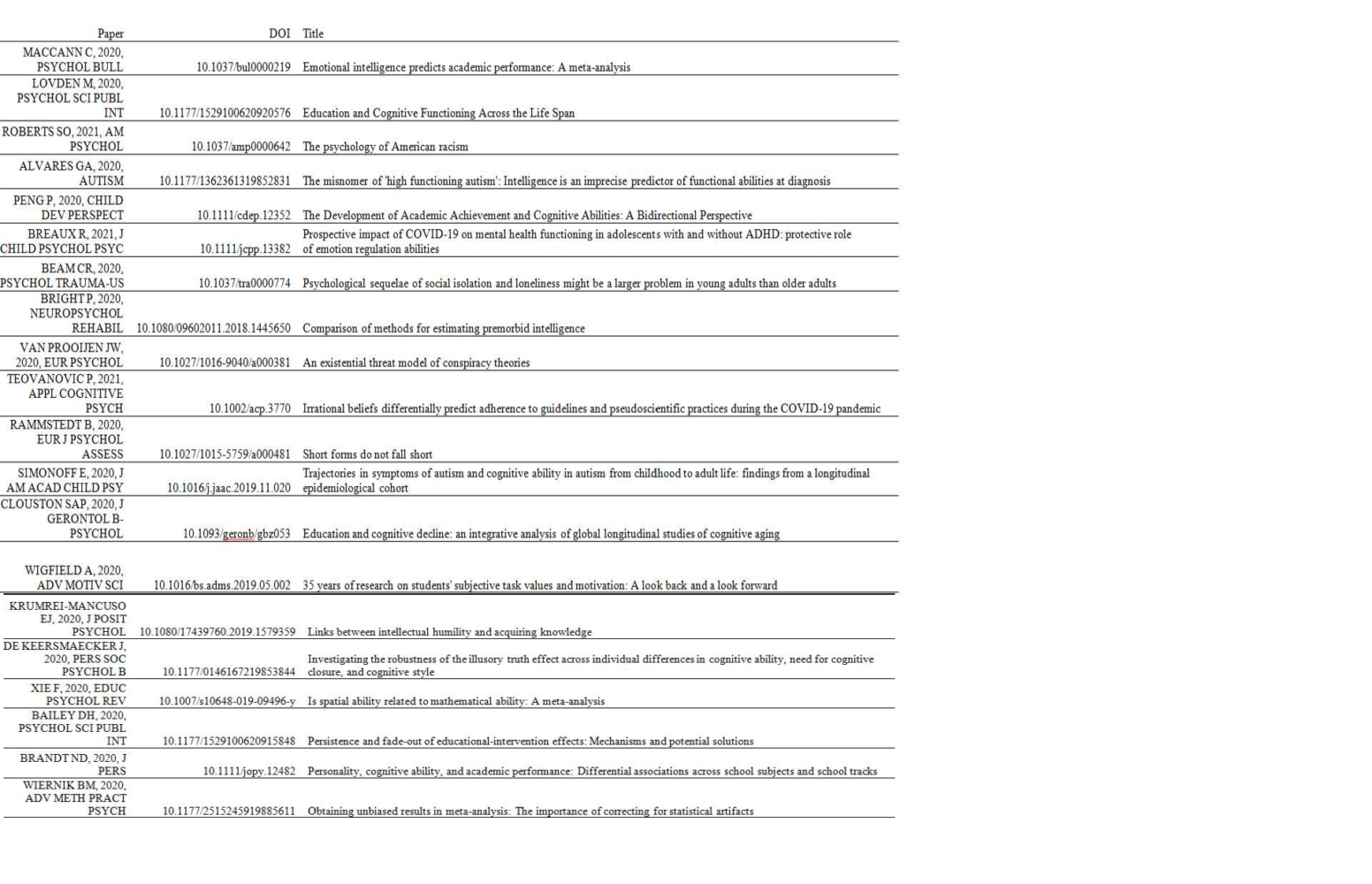
The top-20 most cited texts date from 1984−2011 with citation index 1123-3759, in the large part focusing on such topics as implicit theories of abilities, self-effectiveness, executive functions, achievement motivation, data analysis methods. Similar publication list 2016−2019 happens to contain texts with citation index of 139−339 on general and emotional intelligence, mathematical abilities, gender bias in STEM education, professional adaptation, interrelationship of cognitive development’s genetic and environmental factors. The top cited 2020-2022 texts tap into COVID-19 pandemic psychological issues, irrational beliefs and conspiracy theories, cognitive ageing, cognitive abilities in autism and ADHD, interrelationship of cognitive abilities with personality and academic performance (see Table 1).
Being simple, clear and easy understandable, citation index, proposed in the pioneering work of E.Garfield [6] is popular as biblio- and scientometric measure but has few known drawbacks: it suffer from some temporal lag due to (uneven) time a record takes to appear in the database and, more importantly, citation index on its own doesn’t catch publications relationship thus being unsuitable for citation network modeling. To surpass these limitations of the citation index a series of more elaborated analyses were carried out.
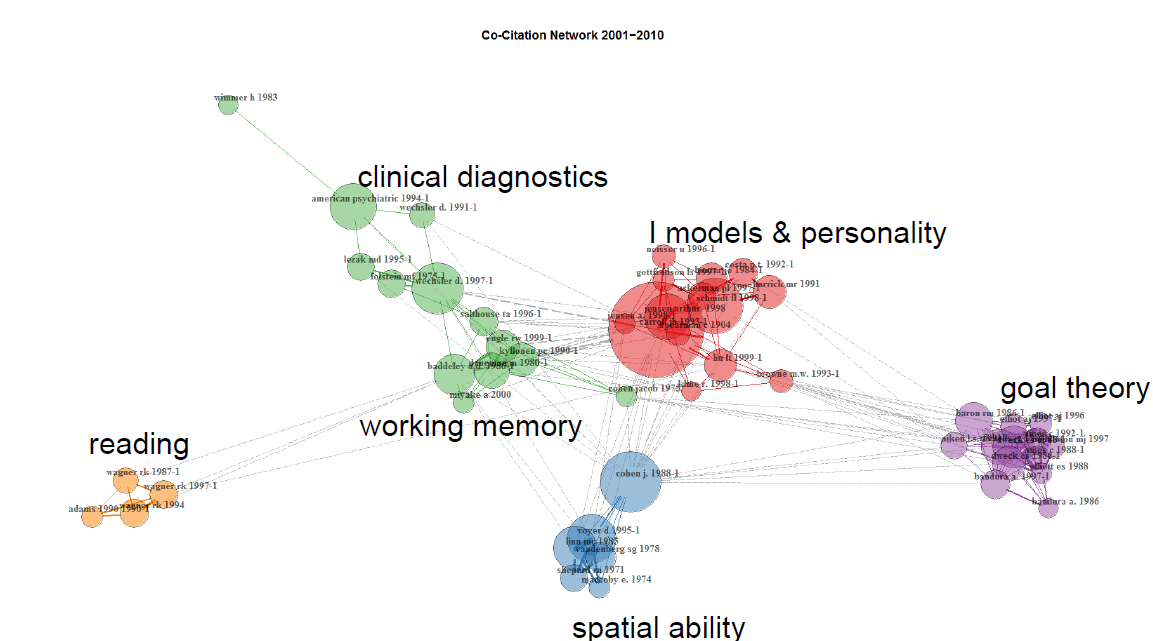
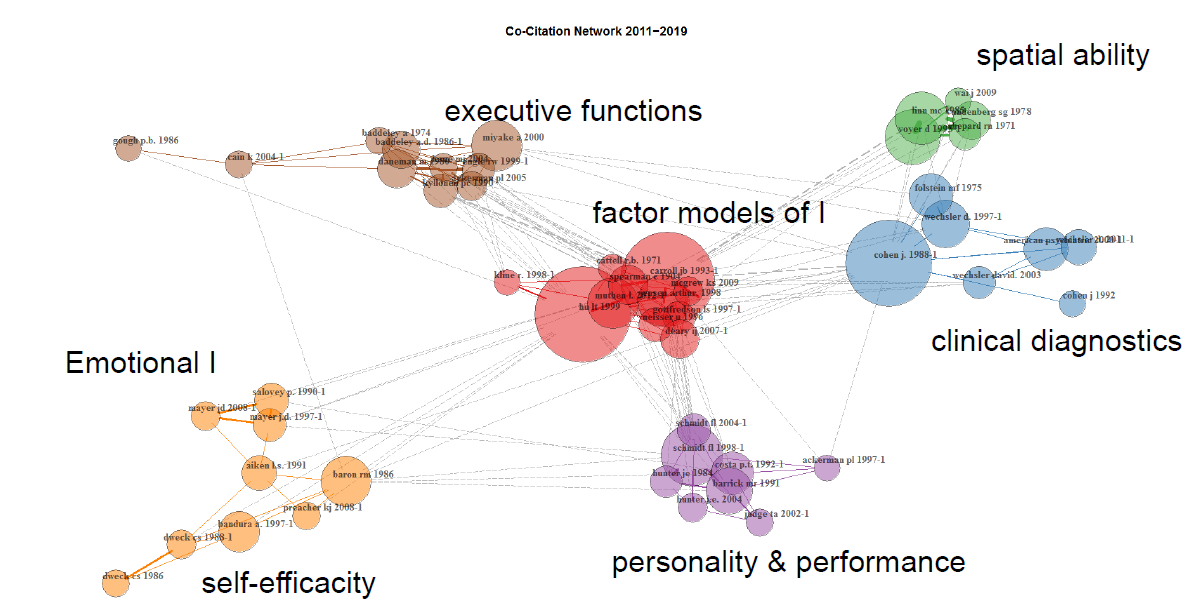
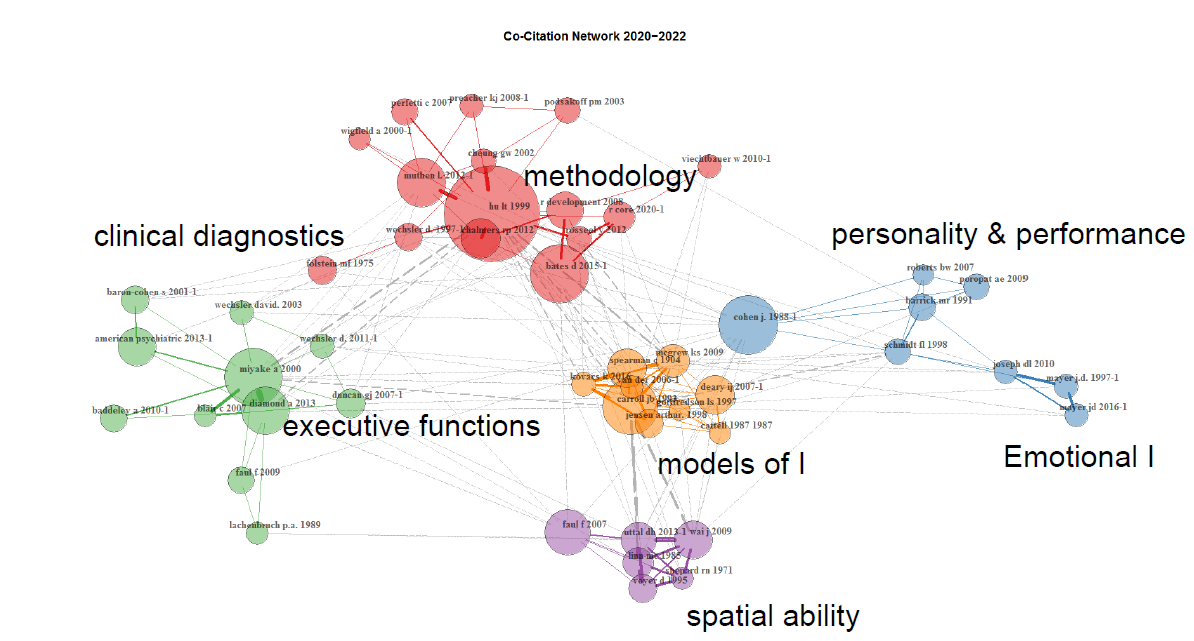
Co-citation analysis is build upon numerical indices reflecting co-occurrence of two source texts in the same reference list thus allowing to model a network of simultaneously cited publications [12]. Comparison of those networks of publications from different decades on Figures 2-5 revealed a stand-alone cluster of Clinical diagnostic methods, with which the Executive functions cluster merge in 2022-2022. Those in turn appear in the last decade on the basis of Working memory cluster; in the same time disappears the stand-alone Reading skills development, and in the Spatial ability cluster vanishes the sexual differences agenda. Meanwhile Personal traits and performance separates from Intelligence models, and Methodology individualize in 2020-2022, whose agenda were until then allocated to other clusters.

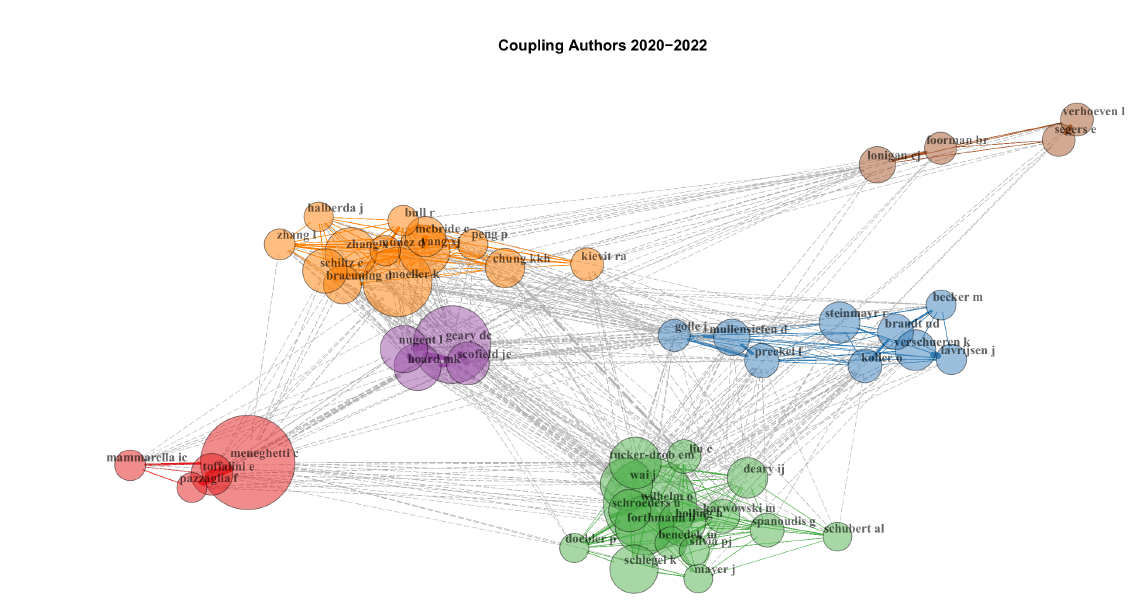
According to some authors bibliographic coupling coined by M.Kessler [8] appears to be more accurate [3], and to capture more unique information than either direct or co-citation analyses [9]. In our study bibliographic coupling revealed rather social aspect of knowledge structure in the field: for example in the 2020-2022 network some clusters consist mainly of authors originating from the same culture, judging by their names (see Figure 6).
Along with citation analysis, methods based on formal analysis of publication content data are also useful to reveal the actual trends. Thus the keywords co-occurrences were analysed by the means of thematic mapping on two dimensions: Centrality (relevance degree, integration in the research field) on the horizontal axis, and Density (development degree, internal coherence) on the vertical one [4]. Clusters in the upper-right quadrant of the map (the values on both dimensions are high) are interpreted as motor, or mainstream themes; those in the upper-left (low relevance, high development degree) as niche; those in the lower-left (values on both dimensions are low) as emerging or declining, and those in the lower-right (high relevance, low development degree) as basic, transversal, or bandwagon themes.
Keywords Plus were selected for the analysis: they apparently are at least as effective as Author Keywords in exploring the knowledge structure of scientific domains thus commonly employed in bibliometric studies to grasp research trends [14]. After the removal of the search words “abilities” and “psychology” three clusters of terms were identified in 2011-2019 publications (Figure 7): two of them tend to motor: the first one, interpreted as Learning and language is highly interconnected with other themes and medium developed, i.e. semi-basic; the second, Intelligence, personality and performance is semi-niche (well developed and medium relevant), while the third, Executive functions, is clearly “emerging or declining”.

Four clusters of terms were identified similarly in 2020-2022 (Figure 8): Executive functions cluster remains in place while Learning and language moved to pure motor while Intelligence and performance lost personality and became rather “emerging or declining”. Personality enter the new motor thematic cluster, Cognitive ability and personality models.

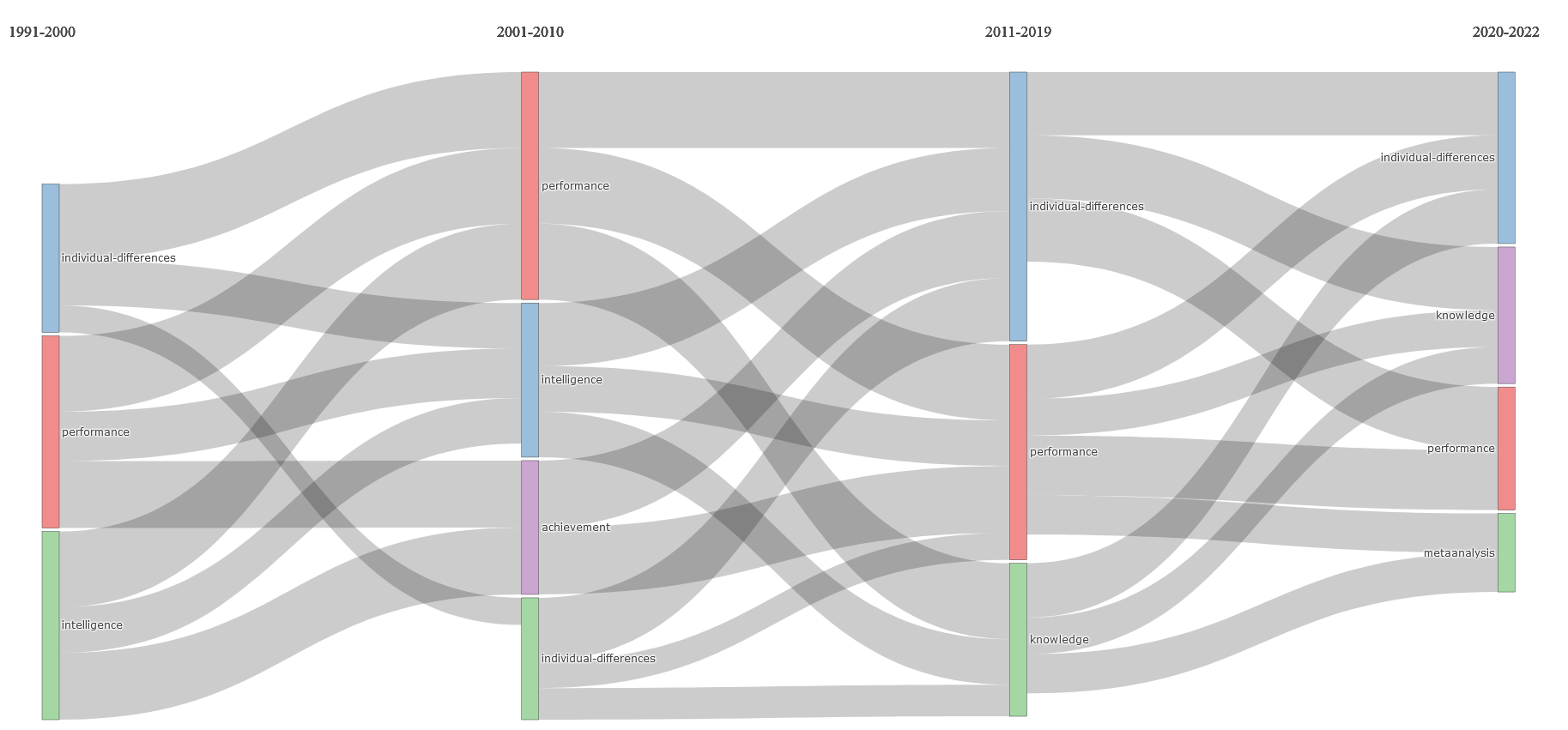
The changes in the clusters’ content over larger time-span are additionally visualized on the interactive map of thematic evolution (Figure 9). Keywords individual differences and performance although intertwined keep forming stand-alone clusters all the time, while intelligence blended into others in 2011-2019, in the same time knowledge emerged, and metaanalysis did so only recently.
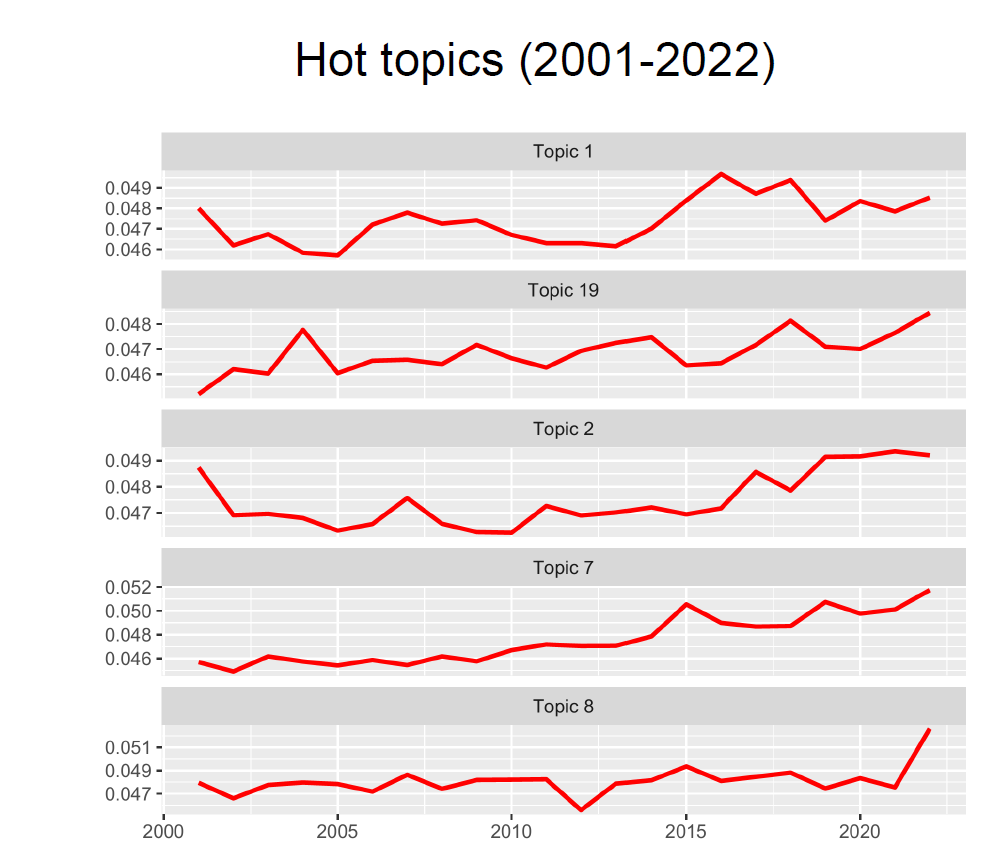
To provide more flexible analysis units instead of clusters, the latent topic grouping keywords, topic modeling was applied using the Dirichlet latent allocation technique (LDA) [2]. In contrast to clustering, the method allows a keyword to belong to more than one topic at the same time, thus making the resulting model more realistic. To determine the number of topics to model, four different fit metrics was calculated. According to their scree plots (Figure 10) 38 topics were identified as a result of Keywords Plus analysis, five of which demonstrated visible rise during the last two decades;

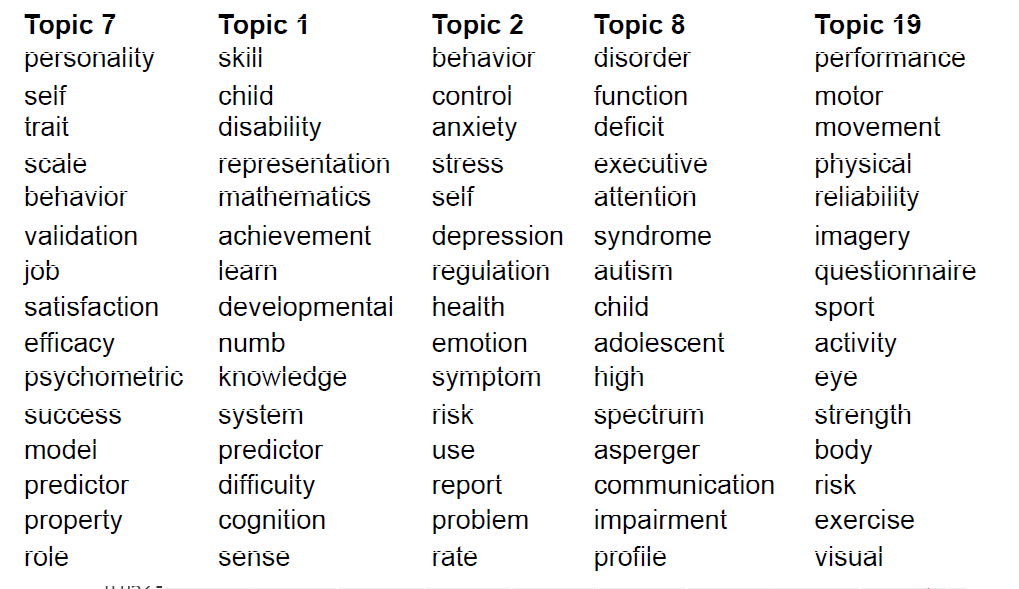
Topic 1. Developmental disability and math learning;
Topic 2. Emotional health problems and self regulation;
Topic 7. Personality traits models, efficacy and job satisfaction;
Topic 8. Autism and ADHD in adolescents;
Topic 19. Body performance and imagery (see Figure 11 and Table 2 for more detailed lists of terms forming each topic).
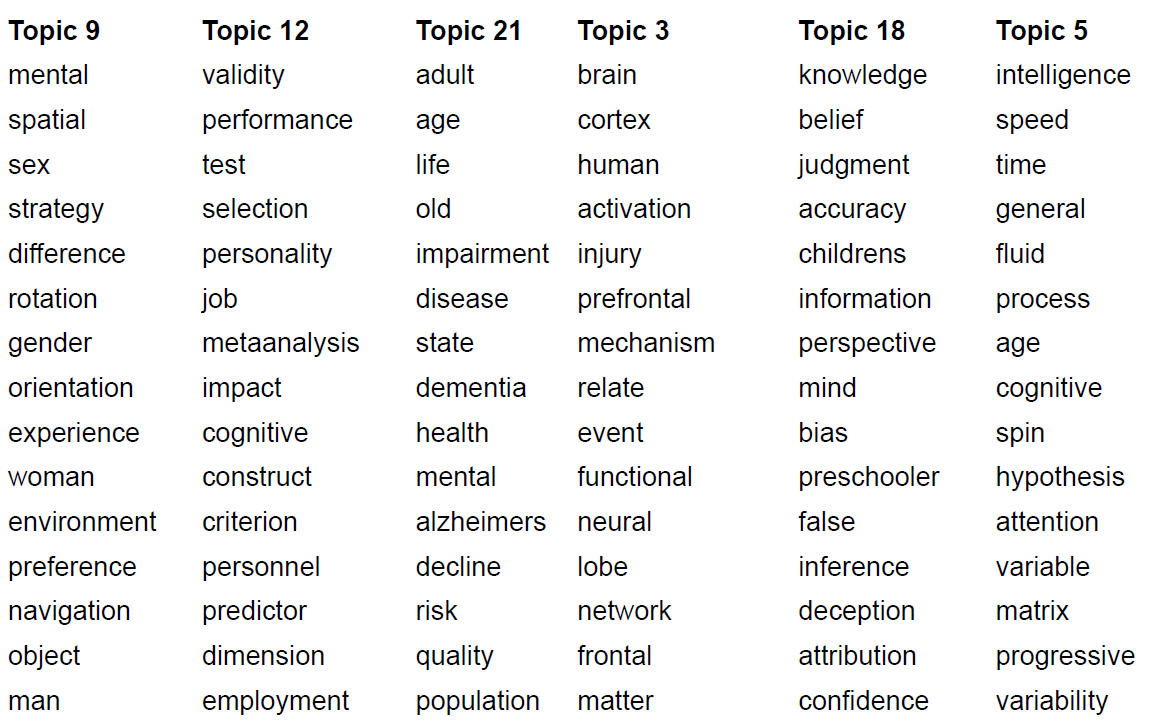
In contrast, the following six topics have declined in popularity:
Topic 3. Neuropsychology and brain;
Topic 5. General intelligence, progressive matrices and cognitive speed;
Topic 9. Spatial ability and gender differences;
Topic 12. Personnel selection, test validity and job performance;
Topic 18. Information accuracy, beliefs and deception in children;
Topic 21. Mental impairment and quality of life in old age (see Figure 12 and Table 3 for details).

Conclusions
As we can see, actual trends in the domain of psychology of abilities are manifested in growing amount of mentioning and interlinked individual differences and developmental deficits in executive functions; personality traits models in relation to professional success and satisfaction; knowledge acquisition in the childhood, especially math learning and language; marked distinct interest in methodological issues such as metaanalysis and other data processing and modeling methods.
The opposite tendency of being lessen mentioned revealed in the field of general intelligence, achievement goals, psychometric tools of personnel selection, spacial abilities in relation to sexual differences. The decline of cognitive ageing agenda as shown by topic modeling is apparently inconsistent with the initial citation index findings, but it may be explained by its partial absorption by neuroscience.
The decline of neuropsychological topic seems in turn surprising and contrasting the flourishing neuroscientific studies, but it may be due to the the fact of flourishing: neuroscience have appropriated the agenda while its methodology focuses primarily on general cues than on differential psychological features.
At the same time the two of main pillars in the domain of psychology of abilities — individual differences and performance — remain in place. It is worth mentioning the third one by simply remaindering the classical definition of abilities by B.M. Teplov: they are individual-psychological features conditioning performance and not to be reduced to present skills or knowledge but fostering their acquisition [13]. The results obtained via different analytic methods appear to be quite consistent, making the key findings more valid and comprehensive.
References
Aria, M., & Cuccurullo, C. (2017). bibliometrix: An R-tool for comprehensive science mapping analysis. Journal of Informetrics, 11(4), 959–975. https://doi.org/10.1016/j.joi.2017.08.007
Blei, D. M., Ng, A. Y., & Jordan, M. I. (2003). Latent Dirichlet Allocation. Journal of Machine Learning Research, 3, 993–1022.
Boyack, K. W., & Klavans, R. (2010). Co-citation analysis, bibliographic coupling, and direct citation: Which citation approach represents the research front most accurately? Journal of the American Society for Information Science and Technology, 61(12), 2389–2404. https://doi.org/10.1002/asi.21419
Cobo, M. J., López-Herrera, A. G., Herrera-Viedma, E., & Herrera, F. (2011). An approach for detecting, quantifying, and visualizing the evolution of a research field: A practical application to the Fuzzy Sets Theory field. Journal of Informetrics, 5(1), 146–166.
Feinerer, I., Hornik, K., & Meyer, D. (2008). Text mining infrastructure in R. Journal of Statistical Software, 25, 1–54. https://doi.org/10.18637/jss.v025.i05
Garfield, E. (1955). Citation indexes for science: A new dimension in documentation through association of ideas. Science, 122(3159), 108–111.
Grün, B., & Hornik, K. (2011). topicmodels: An R package for fitting topic models. Journal of Statistical Software, 40, 1–30. https://doi.org/10.18637/jss.v040.i13
Kessler, M. M. (1963). Bibliographic coupling between scientific papers. American Documentation, 14(1), 10–25.
Kleminski, R., Kazienko, P., & Kajdanowicz, T. (2022). Analysis of direct citation, co-citation and bibliographic coupling in scientific topic identification. Journal of Information Science, 48(3), 349–373. https://doi.org/10.1177/0165551520962775
Murzintcev, N., & Chaney, N. (2020). ldatuning: Tuning of the latent dirichlet allocation models parameters (1.0.2). https://CRAN.R-project.org/package=ldatuning
R Core Team. (2022). R: a language and environment for statistical computing (4.13) [En]. R Foundation for Statistical Computing. https://www.R-project.org/
Small, H. (1973). Co-citation in the scientific literature: A new measure of the relationship between two documents. Journal of the American Society for Information Science, 24(4), 265–269.
Teplov, B. M. (1941). Sposobnosti i odaryonnost [Abilities and giftedness]. Uchenye Zapiski GNIIP, 2, 3–56.
Zhang, J., Yu, Q., Zheng, F., Long, C., Lu, Z., & Duan, Z. (2016). Comparing keywords plus of WOS and author keywords: A case study of patient adherence research. Journal of the Association for Information Science and Technology, 67(4), 967–972. https://doi.org/10.1002/asi.23437
Comments (0)
Around 24 000 WoS records in the field of psychology containing the search word abilities and dated from 1975 onwards were analysed to reveal actual trends by the means of formal analysis based on citation count: citation index, co-citation, bibliographic coupling: and analysis of content based on words co-occurrences count: thematic mapping and topic modeling. The main increased trendlines found are developmental deficits in executive functions related to individual differences; personality traits models in relation to professional success and satisfaction; knowledge acquisition, especially math learning and language, in the childhood; methodological issues: metaanalysis, data processing and modeling methods. Topics revealed as downward trends are general intelligence, achievement goals, psychometric tools of personnel selection, spacial abilities in relation to sexual differences, cognitive ageing. Individual differences and performance remain the two stable characteristics determining the domain of abilites while the third characteristic coined by B.M.Teplov seems more elusive: abilites foster knowledge and skills aqcisition while irreducible to them.
Aim of the study was to reveal actual and emerging perspectives of the psychology of abilities on the literature review basis. Since the topic publications volume measures by thousands, bibliometric approach was applied, using bibliometrix [1], tm [5], topicmodels [7] and ldatuning[10] packages of R statistical software [11].
Data
Database used was the Clarivate’s Web of Science Core Collection, from which I extracted approximately 24 thousands records of articles and proceedings published since 1975 in the field of psychology and containing the term “abilities” in Title, Abstract, Author Keywords and Keywords Plus (keywords automatically generated from reference list by an WoS algorithm).
Analyses
Annual number of publications displayed on Figure 1 varies between 92 and 135 till 1990, then demonstrates virtually linear rise to 1264 in 2019 and afterwards level off again (apparently because of not all of the recent publications being yet recorded in the database). Figure 1 also reveals some causes of that takeoff by demonstrating how different search fields contributes to the amount of records found when added sequentially to the query, starting from the Title.
The number of titles mentioning abilities levels up quite moderately from around 200 in 2004-2007 and attaining the 500 milestone only in 2021. Author Keywords and Keywords Plus, when included in the query, both result in adding equally huge amounts of records starting from 1991 while the Abstract’s contribution is insignificant. The secret of the pivotal 1991 is that it was the moment all 3 fields were included in the database.
The top-20 most cited texts date from 1984−2011 with citation index 1123-3759, in the large part focusing on such topics as implicit theories of abilities, self-effectiveness, executive functions, achievement motivation, data analysis methods. Similar publication list 2016−2019 happens to contain texts with citation index of 139−339 on general and emotional intelligence, mathematical abilities, gender bias in STEM education, professional adaptation, interrelationship of cognitive development’s genetic and environmental factors. The top cited 2020-2022 texts tap into COVID-19 pandemic psychological issues, irrational beliefs and conspiracy theories, cognitive ageing, cognitive abilities in autism and ADHD, interrelationship of cognitive abilities with personality and academic performance (see Table 1).
Being simple, clear and easy understandable, citation index, proposed in the pioneering work of E.Garfield [6] is popular as biblio- and scientometric measure but has few known drawbacks: it suffer from some temporal lag due to (uneven) time a record takes to appear in the database and, more importantly, citation index on its own doesn’t catch publications relationship thus being unsuitable for citation network modeling. To surpass these limitations of the citation index a series of more elaborated analyses were carried out.
Co-citation analysis is build upon numerical indices reflecting co-occurrence of two source texts in the same reference list thus allowing to model a network of simultaneously cited publications [12]. Comparison of those networks of publications from different decades on Figures 2-5 revealed a stand-alone cluster of Clinical diagnostic methods, with which the Executive functions cluster merge in 2022-2022. Those in turn appear in the last decade on the basis of Working memory cluster; in the same time disappears the stand-alone Reading skills development, and in the Spatial ability cluster vanishes the sexual differences agenda. Meanwhile Personal traits and performance separates from Intelligence models, and Methodology individualize in 2020-2022, whose agenda were until then allocated to other clusters.
According to some authors bibliographic coupling coined by M.Kessler [8] appears to be more accurate [3], and to capture more unique information than either direct or co-citation analyses [9]. In our study bibliographic coupling revealed rather social aspect of knowledge structure in the field: for example in the 2020-2022 network some clusters consist mainly of authors originating from the same culture, judging by their names (see Figure 6).
Along with citation analysis, methods based on formal analysis of publication content data are also useful to reveal the actual trends. Thus the keywords co-occurrences were analysed by the means of thematic mapping on two dimensions: Centrality (relevance degree, integration in the research field) on the horizontal axis, and Density (development degree, internal coherence) on the vertical one [4]. Clusters in the upper-right quadrant of the map (the values on both dimensions are high) are interpreted as motor, or mainstream themes; those in the upper-left (low relevance, high development degree) as niche; those in the lower-left (values on both dimensions are low) as emerging or declining, and those in the lower-right (high relevance, low development degree) as basic, transversal, or bandwagon themes.
Keywords Plus were selected for the analysis: they apparently are at least as effective as Author Keywords in exploring the knowledge structure of scientific domains thus commonly employed in bibliometric studies to grasp research trends [14]. After the removal of the search words “abilities” and “psychology” three clusters of terms were identified in 2011-2019 publications (Figure 7): two of them tend to motor: the first one, interpreted as Learning and language is highly interconnected with other themes and medium developed, i.e. semi-basic; the second, Intelligence, personality and performance is semi-niche (well developed and medium relevant), while the third, Executive functions, is clearly “emerging or declining”.
Four clusters of terms were identified similarly in 2020-2022 (Figure 8): Executive functions cluster remains in place while Learning and language moved to pure motor while Intelligence and performance lost personality and became rather “emerging or declining”. Personality enter the new motor thematic cluster, Cognitive ability and personality models.
The changes in the clusters’ content over larger time-span are additionally visualized on the interactive map of thematic evolution (Figure 9). Keywords individual differences and performance although intertwined keep forming stand-alone clusters all the time, while intelligence blended into others in 2011-2019, in the same time knowledge emerged, and metaanalysis did so only recently.
To provide more flexible analysis units instead of clusters, the latent topic grouping keywords, topic modeling was applied using the Dirichlet latent allocation technique (LDA) [2]. In contrast to clustering, the method allows a keyword to belong to more than one topic at the same time, thus making the resulting model more realistic. To determine the number of topics to model, four different fit metrics was calculated. According to their scree plots (Figure 10) 38 topics were identified as a result of Keywords Plus analysis, five of which demonstrated visible rise during the last two decades;
Topic 1. Developmental disability and math learning;
Topic 2. Emotional health problems and self regulation;
Topic 7. Personality traits models, efficacy and job satisfaction;
Topic 8. Autism and ADHD in adolescents;
Topic 19. Body performance and imagery (see Figure 11 and Table 2 for more detailed lists of terms forming each topic).
In contrast, the following six topics have declined in popularity:
Topic 3. Neuropsychology and brain;
Topic 5. General intelligence, progressive matrices and cognitive speed;
Topic 9. Spatial ability and gender differences;
Topic 12. Personnel selection, test validity and job performance;
Topic 18. Information accuracy, beliefs and deception in children;
Topic 21. Mental impairment and quality of life in old age (see Figure 12 and Table 3 for details).
As we can see, actual trends in the domain of psychology of abilities are manifested in growing amount of mentioning and interlinked individual differences and developmental deficits in executive functions; personality traits models in relation to professional success and satisfaction; knowledge acquisition in the childhood, especially math learning and language; marked distinct interest in methodological issues such as metaanalysis and other data processing and modeling methods.
The opposite tendency of being lessen mentioned revealed in the field of general intelligence, achievement goals, psychometric tools of personnel selection, spacial abilities in relation to sexual differences. The decline of cognitive ageing agenda as shown by topic modeling is apparently inconsistent with the initial citation index findings, but it may be explained by its partial absorption by neuroscience.
The decline of neuropsychological topic seems in turn surprising and contrasting the flourishing neuroscientific studies, but it may be due to the the fact of flourishing: neuroscience have appropriated the agenda while its methodology focuses primarily on general cues than on differential psychological features.
At the same time the two of main pillars in the domain of psychology of abilities — individual differences and performance — remain in place. It is worth mentioning the third one by simply remaindering the classical definition of abilities by B.M. Teplov: they are individual-psychological features conditioning performance and not to be reduced to present skills or knowledge but fostering their acquisition [13]. The results obtained via different analytic methods appear to be quite consistent, making the key findings more valid and comprehensive.
Aria, M., & Cuccurullo, C. (2017). bibliometrix: An R-tool for comprehensive science mapping analysis. Journal of Informetrics, 11(4), 959–975. https://doi.org/10.1016/j.joi.2017.08.007
Blei, D. M., Ng, A. Y., & Jordan, M. I. (2003). Latent Dirichlet Allocation. Journal of Machine Learning Research, 3, 993–1022.
Boyack, K. W., & Klavans, R. (2010). Co-citation analysis, bibliographic coupling, and direct citation: Which citation approach represents the research front most accurately? Journal of the American Society for Information Science and Technology, 61(12), 2389–2404. https://doi.org/10.1002/asi.21419
Cobo, M. J., López-Herrera, A. G., Herrera-Viedma, E., & Herrera, F. (2011). An approach for detecting, quantifying, and visualizing the evolution of a research field: A practical application to the Fuzzy Sets Theory field. Journal of Informetrics, 5(1), 146–166.
Feinerer, I., Hornik, K., & Meyer, D. (2008). Text mining infrastructure in R. Journal of Statistical Software, 25, 1–54. https://doi.org/10.18637/jss.v025.i05
Garfield, E. (1955). Citation indexes for science: A new dimension in documentation through association of ideas. Science, 122(3159), 108–111.
Grün, B., & Hornik, K. (2011). topicmodels: An R package for fitting topic models. Journal of Statistical Software, 40, 1–30. https://doi.org/10.18637/jss.v040.i13
Kessler, M. M. (1963). Bibliographic coupling between scientific papers. American Documentation, 14(1), 10–25.
Kleminski, R., Kazienko, P., & Kajdanowicz, T. (2022). Analysis of direct citation, co-citation and bibliographic coupling in scientific topic identification. Journal of Information Science, 48(3), 349–373. https://doi.org/10.1177/0165551520962775
Murzintcev, N., & Chaney, N. (2020). ldatuning: Tuning of the latent dirichlet allocation models parameters (1.0.2). https://CRAN.R-project.org/package=ldatuning
R Core Team. (2022). R: a language and environment for statistical computing (4.13) [En]. R Foundation for Statistical Computing. https://www.R-project.org/
Small, H. (1973). Co-citation in the scientific literature: A new measure of the relationship between two documents. Journal of the American Society for Information Science, 24(4), 265–269.
Teplov, B. M. (1941). Sposobnosti i odaryonnost [Abilities and giftedness]. Uchenye Zapiski GNIIP, 2, 3–56.
Zhang, J., Yu, Q., Zheng, F., Long, C., Lu, Z., & Duan, Z. (2016). Comparing keywords plus of WOS and author keywords: A case study of patient adherence research. Journal of the Association for Information Science and Technology, 67(4), 967–972. https://doi.org/10.1002/asi.23437