
Personality Traits, Attitudes to Life and Patterns of Behavior
Abstract
Abstract
The present paper is devoted to the study of structure and type of the relationships of personality traits, attitudes towards life and human behavior patterns. To identify these relationships, the study involved 2583 volunteers aged 18 to 40 years. The diagnostic complex included 81 scales. In the first part of the study Principal Component Analysis was used to reveal three generalized personality traits, which we called Wisdom, Emotionality, and Activity. Based on these generalized features, three clusters of respondents with similar psychological profiles were identified in the second part of the study. Psychological profiles of the clusters were significantly different (MANOVA). The first cluster included people with pronounced psychotic traits (N=985), low indexes of value-meaning attitude towards life, the subjects of this cluster preferred to ignore to face the problem or turned to social actions in a difficult life situation. The second cluster (N=707), united respondents with high indicators of activity and extraversion, higher indexes of value-meaning attitude to life. They were readily able to implement a wide range of copings and productive cognitive styles. The third cluster (N=987) included persons with pronounced emotional and neurotic traits. They were characterized by lower activity, hardiness and preferred to blame themselves in difficult life situations. The identified generalized personality features, as was established, make the greatest contribution to the differentiation of clusters. The data obtained are useful for understanding the holistic nature and the sources of human individual differences.
Introduction
Challenges of our time (pandemics, digitalization, globalization, migration of peoples, etc.) make us look more deeply into the problem of personality and individual differences. This problem is widely discussed in various investigations. There are many studies devoted to the relationships between personality and cognitive styles (Glicksohn, Naftuliev, & Golan-Smooha, 2007; Rawlings, 1984; Sternberg, 1990, 1994; Volkova & Rusalov, 2016, and others), personality and coping (Connor-Smith & Flachsbart, 2007; Greene, Cowan, & McAdams, 2020; Magnano, Paolillo, Platania, & Santisi, 2017), personality and value orientations (Anglim, Knowles, Dunlop, & Marty, 2017; Fetvadjiev & He, 2019; Parks-Leduc, Feldman, & Bardi, 2014), etc. However, all these studies are concentrated on separated aspects of personality, forming a faceted view of human behavior. The split approach does not allow us to catch the holistic nature of man. We believe that the solution to this problem is only possible by searching for basic generalized personality traits, the combinations of which would underlie a wide range of individual differences. Some scientists consider personality as a manifestation of biological properties in a person (Clarke, 2010; Eysenck, 1990; Pavlov, 1941). According to Pavlov’s theory of conditioned reflex, the strength or weakness of nervous activity, the ratio of an excitatory and an inhibitory processes can determine individual differences in behavior patterns (Pavlov, 1941). H. Eysenck (1944), comparing the results of a factor study of 39 character traits in 700 neurotic soldiers with the experimental and animal studies, with the theoretical analysis of the temperamental traits given by Jung, Pavlov, and others, came to the conclusion about the two prevailing forms of personality traits generalization. The first principle or generalized trait H. Eysenck called integration as opposed to disintegration or neuroticism. H. Eysenck emphasized that the principle of “integration” appears to be similar to Pavlov’s concept of “strength of nervous functioning”. The second principle or generalized trait H. Eysenck named dysthymia: affective disorder, desurgency, introversion, repression. This principle seems to be identical to Pavlov’s concept of “inhibition”. H. Eysenck suggested that these generalized traits are associated with heredity or the working capabilities of the endocrine systems. At the present time, there is enough evidence that that Psychoticism, Extraversion, and Neuroticism are genetically determined (Eaves, Eysenck, & Martin, 1989; Eysenck, 1990). As H. Eysenck noticed, these personality traits are universal and inherent in all the representatives of Homo sapiens. Other researchers consider personality as a set of biological and social qualities of a person (McAdams, 2006; McCrae & Costa, 2008; Merlin, 1986; Rusalov, 2012,). In this case, the highest social manifestations of a person are referred to personality. V.M. Rusalov maintains that the complex multi-level structure of personality is a manifestation of the interactions of genetic and environmental factors mediated by social activities of man. Neurophysiological foundation of human mind and behavior are the temperament. Every personality trait is formed under the influence of society as an amplification (continuation) of temperament properties or as their compensation. Temperament has a biological determination and describes human behavior in terms of Activity (Ergonicity, Tempo, Plasticity) and Emotionality. This scholar considers Activity broadly as an externally observable manifestation of brain activation, underlying dynamic features of human behavior. Plasticity characterizes the ease of the process of switching from one behavior program to another. Emotionality reflects the threshold of sensitivity to the discrepancy between the real result of an action and the “acceptor of the result of an action”. As shown in numerous studies by V.M. Rusalov, these properties of temperament can manifest themselves in different ways in the psychomotor, intellectual or communicative spheres of activities (Rusalov, 2012). V.M. Rusalov and E.V. Volkova revealed that these formal-dynamic properties of individuality are associated with the manifestation of certain personality traits and cognitive styles (Rusalov & Volkova, 2015).
Despite the difference in the approaches of H. Eysenck and V.M. Rusalov to the understanding of temperament, the similarity is obvious if we based ourself on the ideas of I.P. Pavlov on the strength of the nervous system and the processes of inhibition. Then theoretical analysis indicates that the two core personality characteristics can underlie the manifestation of a variety of individual differences. These properties of the nervous system are inherent in both humans and animals. However, it should be emphasized that the fundamental uniqueness of human mental processes consists in the verbal-meaningful control of behavior and activity. As N.I. Chuprikova showed in a series of experimental studies that an excitatory and an inhibitory processes change under the influence of verbal instructions. For example, the activity of the nervous system to strong stimuli can decrease, while to weak stimuli can increase. Thanks to the word (concept), the outer world with a certain approximation is built into a person’s inner world, connecting the past, the present and the future. The people continuously exchange the results of their mental activity with each other, accumulating the results of the reflective activity of the brain of other individuals. Therefore, human consciousness, without losing its individual form, also becomes a cultural-group phenomenon, objectifying itself in the language, objects of material and spiritual culture. Thus, perception, evaluation, understanding of life situations and the choice of behavior strategies are determined not only by the peculiarity of the human nervous system, but also by individual and social experience. Obviously, in addition to such generalized traits as integration (activity, in Rusalov’s terms; strength of nervous system, in Pavlov’s terms) and dysthymia (emotionality, in Rusalov’s terms; the ratio of an excitatory and an inhibitory processes, in Pavlov’s terms), inherent in both humans and animals, there should also be specifically human generalized personality features, verbalized in value-meaningful attitudes to life. From the evolutionary point of view, personality is as a microcosm which possesses the properties of all stages of the development of matter, from chemical to socio-historical ones. Each of these properties have both something typical for groups of people and something unique for each individual. Each level (biochemical, somatic, neurodynamic, psychodynamic, personal, socio-psychological, and socio-historical) is formed and functions according to its own laws (Merlin, 1980). Flexible and changeable relationships between levels ensure adequate adaptation. We believe, that generalized personality features would determine the stability and relative constancy of behavioral manifestations. The objective of the present research is twofold: 1) to reveal the structure and types of generalized personality features, 2) to establish psychological profiles of types of individuals and their connections with life attitudes and behavior patterns.
Method
2.1. Procedure and Participants.
The focus was to cover the widest possible population of modern Russia. The study involved 2583 respondents (46% male and 54% female), aged 18 to 40 (M = 22.2, SD = 4.5) from different cities of Russia and of various specialties. As is known, the majority personality traits in this age range are relatively stable (Cobb-Clark & Schurer, 2012; Rantanen, Metsäpelto, Feldt, Pulkkinen, & Kokko, 2007; et al.).
The gathering of empirical data was organized in accordance with generally accepted ethical standards. Testing was anonymous. Volunteers filled out test books in a comfortable environment. The average test time was about 120 minutes. Researchers helped participants if the questions arose.
2.2. Measures
- B. Cattell noted we should identify the human personality through multiple dimensions (Cattell, 1978). The diagnostic complex included internationally acknowledged and adapted on the Russian sample tools for assessing (a) personality traits, (b) attitudes to life, and (c) patterns of behavior and cognition. Most of the tools have a common theoretical basis (Rusalov special theory of individuality), while the other tools have demonstrated their good agreement with this theory.
The diagnostic complex covered 81 Scales. Cronbach’s Alpha varied from 0.58 to 0.92 for most of them. The Scales with lower Cronbach Alpha values were not used in data interpretation. The used shortened version Scales had significant correlations with their full-version Scales (Volkova, Rusalov, & Nilopets, 2017). Bellow, we give a short description of these Scales and examples of items.
(a) Personality traits:
Temperament Properties were measured with the shortened version of the Structure Temperament Questionnaire (STQ-Short) (Rusalov & Trofimova, 2007). STQ-S contains 26 items with maximum values (2 items in each scale):
(1) Motor Ergonicity – physical strength, muscle performance, the need for movement, the desire for physical labor.
– I am capable of doing physical work for a long time without tiring.
(2) Intellectual Ergonicity – intellectual capabilities, learning ability, the desire for intensive mental activity.
– I do not get tired of prolonged mental work.
(3) Social Ergonicity – need for communication, a wide range of contacts, craving for people, striving for leadership.
– I talk easily in large social gatherings.
(4) Motor Plasticity – flexibility when switching from one form of motor activity to another, high desire for a variety of ways of physical activity, smoothness of movements.
– I successfully carry out tasks requiring subtle and fine movements.
(5) Intellectual Plasticity – flexibility of thinking, easy transition from one form of thinking to another, the desire for various of forms of intellectual activity, a creative approach to solving problems.
– I find it easy to switch from one mental operation to another.
(6) Social Plasticity – easiness of entering into new social contacts, easiness of switching in the process of communication, a wide range of communicative programs.
– It is easy for me to make new acquaintances.
(7) Motor Tempo – rate of psychomotor behavior, speed in various types of motor activity.
– I prefer to do my physical work at a fast pace.
(8) Intellectual Tempo – speed of thought processes.
– I am able to make intellectual decisions quickly in any situation.
(9) Social Tempo – easiness and fluency of speech, speed of verbalization.
– I like to speak quickly.
(10) Motor Emotionality – sensitivity to the discrepancy between the expected and the real result of manual labor, a feeling of incompleteness of the product of physical work.
– I worry if I can’t master a handicraft.
(11) Intellectual Emotionality – sensitivity to discrepancies between the expected and the actual results of mental work, anxiety about the work associated with mental tension.
– When I start solving even a simple intellectual problem, I feel insecure.
(12) Social Emotionality – sensitivity in case of communication failures, a feeling of anxiety in the process of social interaction; insecurity in communication situations.
– I am very worried when I have to sort things out with my friends.
The Fundamental Personality Dimensions were evaluated with Russian modified, validated, and shortened version of Eysenck PEN-questionnaire (Slobodskaya et al., 2006):
(13) Extraversion/Introversion (EXTR) – extraverts are sociable, joyful, and lively. They like being in big companies. They are the life of the party. On the other hand, Extraverts are often unreliable. They frequently change friends and sexual partners. They are bored with uninteresting and hard work. Introverts are opposite to extraverts (7 items).
– I am a talkative person.
(14) Neuroticism/Emotional Stability (NEUR) – neurotics are emotionally unstable. They have such traits as low self-esteem, depression, anxiety, and guilt feeling (7 items).
– It is easy to offend me.
(15) Psychoticism/Soft-heartedness (PSYCO) – psychotics have such behavioral attributes as aggressiveness, stubbornness, goal-directedness, manipulation, sensation seeking, dogmatism, and masculinity (7 items).
– I respond to rudeness with the same.
Character Traits were scored with shortened version of the questionnaire (Rusalov, 2012). This questionnaire contains 20 items with maximum values from the full-version questionnaire (2 items on each scale):
(16) Hyperthymicity characterizes optimistic, initiative, sociable person with a stable positive mood.
– I charge people with optimism.
(17) Stuckness describes a person with a high sensitivity to any criticism, is a vindictive and uncompromising individual.
– I hardly forget minor grievances towards me.
(18) Emotivity expresses a person with a high sense of compassion and sensitivity to other people.
– Tragic films can move me to tears.
(19) Pedanticity reflects such Character Trait as accuracy, conscientiousness, and punctuality in business and relationships.
– I am striving to bring order always and everywhere.
(20) Anxiety indicates anxiety, vulnerability and difficulty with decision-making in uncertain situations.
– I am a scared person.
(21) Cyclothymicity reflects sociability and intellectual activity during the period of mental elation, and isolation, passivity during the period of mood decline.
– Sometimes, I have unreasonable mood swings.
(22) Demonstrativeness characterizes people who strive to being in the spotlight, they are artistic and know how to get along with others.
– I like to be constantly in the spotlight.
(23) Excitability means stormy emotional reactions to minor events.
– I am ready for striking a person when I am insulted.
(24) Dystimicity describes a person who is focused on the dark and sad sides of his/her own life.
– I can be sad for a long time.
(25) Exalitveness characterizes a person with high emotional instability and violent reaction to various life situations, is sometimes delighted with joyful events and then falling again into sadness.
– I am subject to frequent mood swings from happiness to deep sadness.
Achievement Motivation, Accessibility Motivation, and Value Motivation were estimated with Motivation Questionnaire (Rusalov, 2012). The motivation questionnaire contains 48 items (24, 12, and 12 items in the Scales, respectively).
(26) Achievement Motivation characterizes the subjects who focus their activity on high performance.
– I try to achieve excellence in my work.
(27) Value Motivation reflects high social value of profession activity and its significance for my personal growth.
– I have always dreamed of mastering my profession.
(28) Accessibility Motivation describes personal assessment of accessibility of gaining future profession.
– Mastering my future profession does not require much efforts.
(29) IQ level was evaluated by speed and precision of solving simple logical problems (Rusalov, Volkova, 2021). The special study showed that there is significant correlation between this test (ELO-test) and the Raven’s Standard Progressive Matrices (SPM). As well known, SPM is a well-validated test of fluid intelligence (gF) (Carpenter, Just, & Shell, 1990). The ELO-test has 24 statements. The respondents were offered to compare the ratio among the values (segments) of A, B, and C and to draw a conclusion from the analysis of this ratios. The test time is limited to four minutes.
– If A is equal to B and B is equal to C then “C is equal to A”. This conclusion is true. And the conclusion “C is not equal to A” under the given conditions is false.
(b) Attitudes to life:
Meaning in Life was evaluated with the Russian modified, validated version of Purpose-in-Life Test (Crumbaugh & Maholick, 1969) by D.A. Leontiev (Leontiev, 2000):
(30) Purpose in Life means the existence of goals in my life that give my life meaning (6 items).
– “My personal existence is utterly meaningless, without purpose” 3 2 1 0 1 2 3 “My personal existence is purposeful and meaningful”.
(31) Life Process means that the process of life itself is perceived as something interesting and filled with meaning (6 items).
– “My life seems to me completely routine” 3 2 1 0 1 2 3 “My life seems to me always exciting”.
(32) Life Performance means how productive and meaningful my life is (5 items).
– “In achieving life goals, I have made no progress what so ever” 3 2 1 0 1 2 3 “In achieving life goals, I have progressed to complete fulfilment of most of them”.
(33) Locus of Control “Self” means that I have a self-image of a strong and a free person capable of building his/her life in accordance with his/her goals (4 items).
– “I am usually bored” 3 2 1 0 1 2 3 “I am usually enthusiastic”.
(34) Locus of Control “Life” means that I belief that I am a person who controls over his/her own life (6 items).
– “If I could choose, I would prefer to have never been born” 3 2 1 0 1 2 3 “If I could choose, I would live my life again as I live now”.
Axiological Orientations were studied by the Axiological Orientation Survey (Kaptsov, 2011), namely, a person’s orientations towards such values as Collectivity, Spiritual Satisfaction, Creativity, Life, Achievement, Tradition, Material Well-being, Individuality, Profession, Education, Family, Social Life, and Leisure:
(35) Collectivity describes significance of the surrounding people and society for an individual (5 items).
– The communality of the team’s goals I work is important for me.
(36) Spiritual Satisfaction means significance of the satisfaction from activities (5 items).
– It is important for me to get satisfaction from any activities.
(37) Creativity reflets significance of novelty in activities (5 items).
– It is important for me to create something new in my activities.
(38) Life means the importance of the very process of life, the acceptance of both sorrows and joys of life (5 items).
– Participation in any social events is significant for me.
(39) Achievement indicates significance of the achieved results (5 items).
– It is important for me to achieve the results I intended.
(40) Tradition shows the importance of rules, customs, rituals for the person, everything that society has accumulated so far (5 items).
– Compliance with the traditions adopted in our society is valuable for me.
(41) Material Well-being means the value of material things for the person (5 items).
– The high level of material well-being of my family is important for me.
(42) Individuality describes the values of uniqueness of human life and the importance of the interests of each individuality (5 items).
– It is important for me to maintain my individual style.
Spiritual Personality Traits were estimated with the Spiritual Personality Inventory (Husain & Anas, 2017). The Inventory was validated for the Russian sample by G. V. Ozhiganova (2019). Spiritual Personality Inventory consisted of 28 items which measure Spiritual Virtues, Positive Outlook in Life, Spiritual Discipline, Goodness, Spiritual Services, and Moral Rectitude:
(43) Spiritual Virtues describe a person who is fulfilling promises, is trustworthy, kind, purity and clean, truthful, and has good etiquettes and manners (6 items).
– I fulfil my promises.
(44) Positive Outlook on Life characterizes spiritual power, satisfaction with life, feeling of compassion, sense of sacredness, and steadfastness (5 items).
– I have spiritual strength.
(45) Spiritual Discipline means self-control, firmness and patience; humbleness and calmness in the face of adversities (4 items).
– I keep calm when facing adversities.
(46) Goodness reflects a person who is doing deeds of righteousness, is recognizing good things, is adopting the path that is straight and is enjoying what is right (4 items).
– I like what is fair.
(47) Spiritual Service means a person who is caring, treating and helping those people who are in need (4 items).
– I live not only for myself but also for others.
(48) Moral Rectitude describes a person who is focusing on high moral guidelines, is showing condescension, sincerity, generosity and forgiveness (4 items).
– I am capable of forgiving.
(c) Patterns of behavior and cognition:
The Cognitive Styles were estimated with the Cognitive Personality Styles Questionnaire (CPS-Q) (Volkova & Rusalov, 2016). The questionnaire contains 60 items (5 items on each scale):
(49) Dependence (FD) expresses person’s orientation to the external world when solving problems. The people of this type trust more in external impressions.
– I easily agree with my friends’ opinion.
(50) Field Independence (FI) reflects individual’s ability to rely on one’s own knowledge and experience, ignoring the other people’s opinion.
– My own experience is more important for me than the opinion of my friends.
(51) Narrow Range of Equivalence (NRE) characterizes an individual who orients him/herselves to the differences between objects of activity. These people are highly sensitive to details and nuances.
– When retelling the content of a movie, I like to describe it in details.
(52) Wide Range of Equivalence (WRE) reflects personal bent to find a general strategy, general evaluation of the objects of activity (black/white, good/bad), to classify objects based on certain generalized foundations.
– I easily divide people into good and bad.
(53) Flexibility of Cognitive Control (FCC) shows person’s easiness of passing from some cognitive functions to others (from abstract-verbal to imaginary ones), which ensures a high degree of automation of analysis of the complex environmental influences.
– I memorize equally well both pictures and texts.
(54) Rigidity of Cognitive Control (RCC) characterizes a degree of individual’s difficulty in changing the ways of information processing in situations of solving complex problems.
– It is difficult for me to pass from an image to an abstract word and vice versa.
(55) Impulsivity (IMP) points out a spontaneous and high tempo of decision making in complex and uncertain situations and orientation to emotionally meaningful attributes. Such persons quickly put forward a great number of hypotheses in choice situations and, as a rule, commit many erroneous solutions.
– I often make many decisions at first impression.
(56) Reflectivity (REF) indicates a person with slow decision-making tempo, his/her individual’s inclination to a careful systematic check-up of facts as well as the use of more elaborate and balanced solving problem strategies.
– I carefully check and recheck all the facts before making any decision.
(57) Concrete Conceptualization (CC) reflects a person’s preference for clear-cut instructions when performing complex tasks.
– I prefer performing tasks which have clear-cut instructions.
(58) Abstract Conceptualization (AC) expresses an individual’s tendency to cross the limits of the instruction. The persons of this type choose unusual ways of solving problems and easily establish various interrelationships between different objects of reality.
– I suggest many versions of solving problems in complex tasks.
(59) Tolerance of Unrealistic Experience (TUE) means the individual’s inclination to be open to new information. The person evaluates the environment primarily according to its factual characteristics, even if these characteristics contradict or do not correspond to the earlier acquired notions.
– I do not object to listening to other people’s ideas.
(60) Intolerance of Unrealistic Experience (IUE) expresses individual’s tendency to perceive information primarily in terms of the expected and the usual. Such persons, as a rule, block the unexpected and controversial elements of information.
– People who think differently upset me.
Ways of Coping were estimated with Ways of Coping Questionnaire (WCQ) (Folkman & Lazarus, 1988), validated for the Russian population by T. L. Kryukova (Kryukova, 2010):
(61) Seeking Social Support means person’s desire to share his/her concerns with others, and to get support, approval, and advice from others (5 items).
– I seek encouragement from others.
(62) Focus on Solving Problems describes a person who systematically thinks about the problem from different points of view (5 items).
– I use different ways of dealing with the problem.
(63) Working Hard and Achieve characterizes a person who is working hard and achieving high standard (5 items).
– I work hard and try to succeed.
(64) Worry reflects a person who worries about the future and about his/her personal happiness (5 items).
– I worry about what will happen to me.
(65) Invest in Close Friends means a person who is spending much time with close friends and in making new friends (5 items).
– I ring up a close friend every free time.
(66) Seek to Belong describes a person who is concerned with other people, thinks of them and does things to gain their approval (5 items).
– I try to make a good impression on others who matter to me.
(67) Wishful Thinking reflects a person who is hoping for the best, for the things that sort themselves out, for the miracles that will happen (5 items).
– I wish miracles would happen more often.
(68) Not Coping means a person who is not doing anything about the problem, who surrenders (5 items).
– I quit solving the challenge.
(69) Tension Reduction means a person who tries to feel better by “letting off steam”, blaming others, crying, screaming, drinking alcohol, smoking cigarettes or drugs (5 items).
– I always find a way to let off my steam: to cry, to scream, and etc.
(70) Social Action characterizes a person who organizes group actions to deal with social concerns (4 items).
– I organize actions and petitions regarding social problems.
(71) Ignore the Problem reflects a person who consciously blocks out the problem, who pretends the problems does not exist (4 items).
– I throw the problem out of my mind.
(72) Self-Blame characterizes a person who is critical of him/herself, who regards him/herself responsible for the problem (4 items).
– I often blame myself.
(73) Keep to Self describes a person who is concerned with his/herself and avoids other people (4 items).
– I keep my feelings to myself.
(74) Seek Spiritual Support shows a person who prays for help and guidance reading the holy books (4 items).
– I regularly read holy books.
(75) Focusing on the Positive indicates a person who looks on the bright side of things (4 items).
– I look on the bright side of things and think of all that is good.
(76) Seek Professional Help characterizes a person who seeks professional helps from highly qualified experts (4 items).
– I seek for professional help or counselling on my personal problems.
(77) Seek Relaxion Diversions means a person who takes his/her mind off the problem by finding ways to relax such as reading books, watching TV, going out, and having a good time with other people (3 items).
– I find a way to relax by listening to music, reading a book, playing a musical instrument, and watching TV.
(78) Physical Recreation shows a person who plays sports and keeps his/herself fit (3 items).
– I regularly go for a work-out at the gym.
Hardiness was measured with the Russian version of the Hardiness Survey (Maddi & Khoshaba, 2001) in adaptation by D.A. Leontiev and E.I. Rasskazova (Leontiev & Rasskazova, 2006):
(79) Commitment means involvement in what is happening and allows the person to enjoy his/her own activities (18 items).
– As rule, I am always involved in what is happening around.
(80) Control describes a person who is independently chooses his/her own life paths (17 items).
– I always control situations as much as it is necessary.
(81) Challenge indicates a person who is convinced that everything that happens contributes to the development of his/her personality (10 items).
– Any challenges give me interest in life.
2.3. Statistical Methods
All the raw scales were converted to the S-scales based on the percentile standardization. The criteria for normality are extremely sensitive in case of large samples. Therefore, distribution normality assessment was based on Skewness and Kurtosis (George & Mallery, 2016). The groups of respondents with a similar psychological profile were identified on the basis of Hierarchical Cluster Analysis (HCA). As is known, a large set of variables in cluster analysis leads to a blurring of content and noise accumulation (James, et al., 2013). One of the requirements for cluster analysis is the independence of indicators, but the scales of the questionnaires are often intercorrelated. This problem was solved by preliminary Factor Analysis (Extraction Method: Principal
Component Analysis. Rotation Method: Varimax with Kaiser Normalization).
Descriptive Statistics (KMO = 0.937; Bartlett sphericity values = 110316.7; df = 3240; p < 0.001) showed that we have sufficient grounds for applying Principal Component Analysis (Tabachnick & Fidell, 2013). The number of components which reflected the generalized personality traits was determined according to the Cattell’s scree test: the optimal number of components (factors) lies above the inflection point of the curve where the graph turns into a straight line (Cattell & Vogelman, 1977; Cattell, 1978). Absolute loadings of 0.40 or stronger were taken as significant.
Hierarchical Cluster Analysis (Ward’s method, Euclidean distances) was carried out on the reduced variables or the generalized personality traits. Then we revealed the number of clusters using the NbClust package which allowed us to determine the optimal number of clusters or the type of psychological profiles.
We used MANOVA and ANOVA to compare the psychological profiles of the clusters of people.
Significance of the generalized personality traits for differentiation of the clusters was evaluated by the Random Forest method. The entire sample was divided into training and test samples in the ratio 2 to 1. The test sample was used for cross-validation. The best model was used to assess the importance of predictors by the Mean Decrease Accuracy test.
The results are presented in the Supplementary materials (https://osf.io/7tdh6/).
Results
3.1. The results of the Principal Component Analysis
H1: Theoretically, we hypothesized that there are three Factors with common mental mechanisms of behavior regulation which are based on (a) activity (integration, in Eysenck’s terms; strength of nervous system, in Pavlov’s terms), (b) emotionality (dysthymia, in Eysenck’s terms; the ratio of an excitatory and an inhibitory processes, in Pavlov’s terms), and (c) value-meaningful attitudes to life (verbal-meaningful control of behavior and activity). These hypotheses are based on the analysis of numerous empirical data reflected in psychological literature (Bould, Joinson, Sterne, & Araya, 2013; Eaves, Eysenck, & Martin, 1989; Eysenck, 1944; Eysenck, 1990; Parks-Leduc, Feldman, & Bardi, 2015; Rusalov & Trofimova, 2007; Rusalov, 2012; Vollrath & Torgersen, 2002; Walker, Ammaturo, & Wright, 2017; et al.).
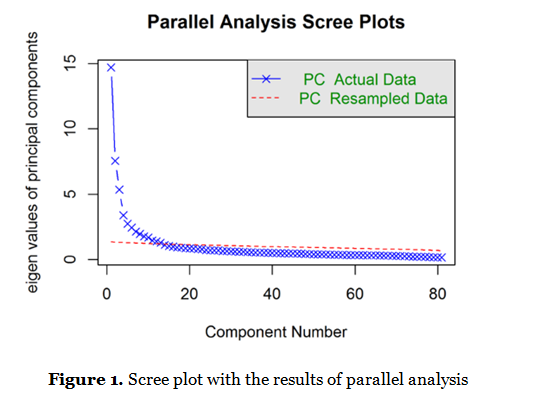
Principal Component Analysis allowed us to reduce 81 variables into three main components (Figure 1.), cumulatively explaining 34.04 % of the variance of the primary scales. Percentage of the explained variance for each factor was 13.38, 10.38, and 10.28, respectively.
The first significant factor covered:
- Values of Achievement (0.82), of Spiritual Satisfaction (0.82), of Life (0.77), of Collectivity (0.73), of Individuality (0.70), of Creativity (0.65), of Material Well-being (0.65), and of Tradition (0.64);
- Focus on Solving Problems (0.63) and Working Hard and Achieve (0.62);
- Spiritual Virtues (0.63), Moral Rectitude (0.59), Spiritual Service (0.56), Positive Outlook on Life (0.55), and Goodness (0.50).
- Locus of Control “Self” (0.50), Purpose in Life (0.49), Locus of Control “Life” (0.48), Life Performance (0.47), and Life Process (0.46);
- Psychoticism (-0.44); negative value is interpreted as Soft-heartedness.
This factor united the indicators reflecting the value-meaningful attitude to life which pronounced in persons with Soft-heartedness. We called this factor Wisdom (W).
The second factor included one fundamental personality trait Neuroticism (0.72) and several temperament properties such as Emotionality in Social (0.55), Intellectual (0.44), and Motor (0.39) Spheres as well as other characteristics:
- Not Coping (0.61), Self-Blame (0.61), Wishful thinking (0.59), Tension Reduction (0.56), Worry (0.48), and Ignore the Problem (044);
- Cyclothymicity (0.61), Exalitveness (0.60), Dystimicity (0.51), Anxiety (0.49), Emotivity (0.48), and Stuckness (0.47);
- Field Dependence (0.40);
- Purpose in Life (-0.41), Locus of Control “Self” (-0.42), Locus of Control “Life” (-0.43), Life Process (-0.45), and Life Performance (-0.47);
- Challenge (-0.53), Commitment (-0.61), and Control (-0.64).
Apparently, the second factor covered different aspect of human Emotionality. We named this generalized factor as Emotionality (E).
The third factor contained the fundamental personality trait Extraversion (0.72) and several temperament properties such as Social Plasticity (0.61), Tempo (0.58), and Ergonicity (0.55); Intellectual Tempo (0.57) and Plasticity (0.43); Motor Tempo (0.55) and Ergonicity (0.42) and other characteristics:
- Hyperthymicity (0.64) and Demonstrativeness (0.59);
- Achievement Motivation (0.54);
- Abstract Conceptualization (0.55), Flexibility of Cognitive Control (0.55), Impulsivity (0.51), Field independence (0.49), and Tolerance of Unrealistic Experience (0.46);
- Control (0.42) and Commitment (0.40).
Obviously, the third factor united the various attributes of human productive activity. We called this combination of variables as Activity (A).
Each respondent was assigned with individual normalized factor scores in accordance with these components (W, E, and A). The Skewness and Kurtosis of these new generalized variables had values close to zero (0.01 ÷ 0.26). Thus, hypothesis H.1 that there are three Factors with common mental mechanisms of behavior regulation based on activity (A), emotionality (E), and value-meaningful attitudes to life (W) can be accepted.
3.2. In the next part of our investigation we used Cluster analysis
The suggested hypotheses (H2) was: the combination of the three variables (W, A, and E) can describe eight possible variations in psychological profiles of our respondents. But in reality, Hierarchical Cluster Analysis identified only three groups of respondents who differed in the manifestations of the above-described generalized variables: W, E, and A (Figure 2 a). The optimal number of clusters, according to 30 criteria, testified three clusters (Dendrogram, Figure 2 a; NbClust package for R, Figure 2 b).
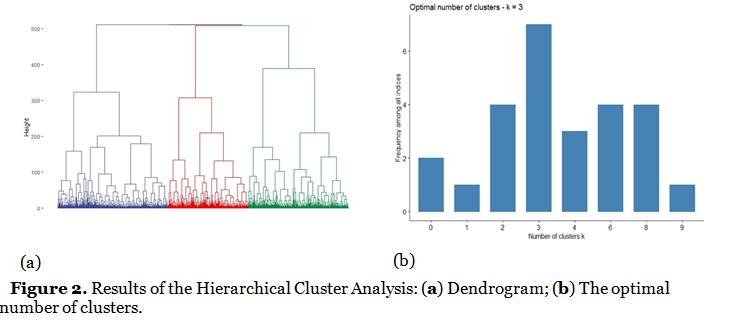
The first cluster included 985 people (60.5% males), the second – 707 (43.7% males), the third – 891 (31.8% males). Thus H2 can be partially accepted.
3.3. The further analysis was to compare the identified types of respondent’s psychological profiles of the
We assume that the used scales (Personality Traits, Attitudes to Life and Patterns of Behavior) are significantly different in the revealed groups of respondents (H3).
With this aim in views, we used MANOVA. The results of multivariate one-way analysis of variance were statistically significant (Table 1).
Table 1. The results of the multivariate ANOVA (Tukey’s post hoc test).
| Effect | Pillai’s trace | approx. F | p | η2 |
|---|---|---|---|---|
| Intercept | 1.00 | 10098.6 | <0.001 | 1.00 |
| Clusters | 1.06 | 20.3 | <0.001 | 0.53 |
The results of one-way ANOVA and multiple comparisons by Tukey’s test revealed significant differences among the respondents (Table S3).The first cluster includes people with pronounced psychotic features, high excitability and average values of activity and emotionality. The accessibility of professional activity is important for them. They possess by lower values of indicators of spirituality and value-meaning attitude to life. The findings suggest that these individuals in their behavior rely on “raw” estimation of people and events and, when faced with a difficult situation, they prefer to ignore the problem or address to social action. We conditionally called such a group of persons Psychoids.The second cluster unites respondents with higher indicators of activity, higher value of extraversion, hyperthymicity, demonstrativeness, pedanticity and average indicators of temperament emotionality. They are characterized by higher achievement motivation value and the higher value of professional activity. The core of these individualities is spirituality and value-meaning attitudes to life. These individuals use the wide range of cognitive-style regulation in their behavior. They are field independent, tolerant of uncertainty, and open to new experiences. They have a high flexibility in cognitive control. They are able to act not only quickly, but also accurately, carefully checking the facts. They are able to both follow instructions when solving complex problems, and go beyond the instructions, suggesting unusual ways in solving problems. When faced with difficult situations, they implement a wide range of copings. Apparently, such personality traits and value-meaning attitudes to life provide a higher hardiness of individuals. We called the cluster of persons as Social Adaptoids.The third cluster includes respondents with pronounced neurotic traits, higher emotionality and lower activity. They possess above average values of spirituality, value-meaningful attitudes to life and lower indicators of motivation. Cognitive-style regulation is not expressed in them. Their preferred coping is self-blame. Their low activity, pronounced emotionality and neurotic traits are associated with lower indicators of hardiness. We conditionally called such group of persons as Neuroids. Thus, the hypotheses H3 can also accepted.3.4. In the fourth part of our investigation we try to reveal the importance of each variable under study as a predictor of individuality typology. We assumed that (H4) the initial non-aggregated personality scales (n=81) predict with sufficient accuracy the same cluster structure which was obtained on the basis of generalized variables (W, E, and A). If this hypothesis is confirmed, this will be additional evidence in favor of identical generalized personality variables. The respondents were divided into training and test samples. The most optimal hyperparameter settings for the Random Forest Model were determined on the training sample. The highest level of accuracy was obtained by “growing” 1300 decision trees and selecting a subset of predictors for each partition equal to 5. The quality of classification was checked on the test sample. Cohen’s Kappa was 0.73 which indicates a good match (Lanz, 2019, p. 324). The accuracy of the classification was 0.82. A summary of Sensitivity, Specificity and Accuracy of predictions for different clusters are presented in Table 2. Thus, hypothesis H4 can be accepted. The importance of all predictors for distinguishing among three clusters of individuality are presented in Table S4.
Table 2. Characteristics of classification quality obtained on the test sample
| Cluster 1 | Cluster 2 | Cluster 3 | |
|---|---|---|---|
| Sensitivity | 0.81 | 0.85 | 0.81 |
| Precision | 0.87 | 0.81 | 0.77 |
| Balanced accuracy | 0.86 | 0.89 | 0.84 |
Discussion
The main idea of the present research was to embrace the holistic nature of human being. It is obviously that solving this problem requires the development of fundamentally new approaches through the integration of different areas and traditions in research policy on personality and individual differences. To start implementing this idea, we used three data sets on one sample: (a) personality traits, (b) verbal-meaningful attitude to life, and (c) patterns of behavior and cognition. Such a wide range of descriptions of multi-level personality traits (81 scales) allowed researchers to come closer to finding the mechanisms underlying human individual differences. The hypotheses which were put forward at the beginning of our research found full or partial support. Principal Component Analysis revealed three generalized personality variables which we called Wisdom (W), Activity (A), and Emotionality (H1). Based on these generalized variables, we assumed the existence of eight different personality profiles (types). However, the optimal number of clusters proved to be equal three (H2). The question of whether this is a manifestation of a general humankind pattern or is due to the specifics of the Russian sample requires further cross-cultural studies.
Indicators of Personality Traits, Attitudes to Life and Patterns of Behavior and cognition among revealed groups of respondents were significantly different (H3). The generalized variables of the psychological profiles of clusters are shown in Table 3 below. The results obtained testified that the basic fundamental patterns of human behavior are determined not only by the factors of the nervous system (A&E), and also by value-meaningful attitudes to life (W).
The respondents of the first cluster were characterized by low values of Wisdom and average values of Activity and Emotionality (Psychoids). The respondents of the second cluster were distinguished by high values of Wisdom and Activity and average values of Emotionality (Social Adaptoids). The respondents of the third cluster had high values of Wisdom, above average values of the Emotionality and low values of Activity (Neuroids).It should be noted that the clusters differ by sex composition: in the first cluster, which characterized psychopathic personalities, men were predominated (60.5%) whereas in the third cluster, which includes emotional and anxious people, the number of women were greater (68.2%). The second cluster contained about the same number men and women.Three personality types were also identified in others study, for examples of the study by P. T. Costa, et al. (Costa, et al., 2002).Assessment of the importance of predictors showed that not all indicators are equally responsible for distinguishing clusters. The biologically based properties (first of all, Extroversion, Tempo and social aspects of Plasticity and Ergonicity) as well as value orientations make the greatest contribution to the differentiation of clusters. Cognitive styles and Hardiness also play an important role. In general, clusters differ at all the level of personality traits, life attitudes and patterns of behavior and cognition.We do not know yet what mechanisms underlie the formation of these personality profiles. We dare to assume that namely different quantitative combinations of Wisdom, Activity, and Emotionality determines the whole variety of human individual differences. But this issue requires further research.It should be noted that our research has some limitations. In particular, the results obtained cannot be extrapolated to population beyond the 18-40 age range. The data were collected on the Russian sample, therefore, without additional research, we cannot maintain that the identified psychological profiles are present in other cultures.
Table 3. Summary characteristics of psychological profiles (in ten-point S-scales)
| Wisdom (W) | Emotionality (E) | Activity (A) | |
|---|---|---|---|
| Cluster 1 (N=985, 60.5% males) | 3.76 | 5.52 | 5.99 |
| Cluster 2 (N=707, 43.7% males) | 7.13 | 5.21 | 7.11 |
| Cluster 3 (N=891, 31.8% males) | 6.13 | 5.71 | 3.68 |
References
- Anglim, J., Knowles, E. R. V., Dunlop, P. D., & Marty, A. (2017). HEXACO personality and Schwartz’s personal values: A facet-level analysis. Journal of Research in Personality, 68, 23–31.
- https://doi.org/10.1016/j.jrp.2017.04.002
- Bould, H., Joinson, C., Sterne, J., & Araya, R. (2013). The Emotionality Activity Sociability Temperament Survey: Factor analysis and temporal stability in a longitudinal cohort. Personality and Individual Differences, 54(5), 628–633. doi:10.1016/j.paid.2012.11.010
- Carpenter, P. A., Just, M. A., & Shell, P. (1990). What one intelligence test measures: A theoretical account of the processing in the Raven Progressive Matrices Test. Psychological Review, 97(3), 404–431. https://doi.org/10.1037/0033-295X.97.3.404.
- Cattell, R. B. (1978). The scientific use of factor analysis in behavioral and life sciences. New York: Plenum Press.
- Cattell, R. B., & Vogelmann, S. (1977). A comprehensive trial of the scree and KG criteria for determining the number of factors. Multivariate Behavioral Research, 12(3), 289-325.
- https://doi.org/10.1207/s15327906mbr1203_2
- Chuprikova, N. I. (2019). Human reaction time: physiological mechanisms, verbal-semantic regulation, connection with intelligence and properties of the nervous system. Moscow: Publishing House LSC. (Reasonable behavior and language. Language and reasoning). (In Russian).
- Cobb-Clark, D. A., & Schurer, S. (2012). The stability of big-five personality traits. Economics Letters, 115(1), 11–15. doi:10.1016/j.econlet.2011.11.015
- Connor-Smith, J. K., & Flachsbart, C. (2007). Relations between personality and coping: A meta-analysis. Journal of Personality and Social Psychology, 93(6), 1080–1107. https://doi.org/10.1037/0022-3514.93.6.1080
- Costa, P. T., Herbst, J. H., McCrae, R. R., Samuels, J., & Ozer, D. J. (2002). The replicability and utility of three personality types. European Journal of Personality, 16(S1), S73–S87. doi:10.1002/per.448
- Crumbaugh, J. C., & Maholick, L. T. (1969). Manual of instructions for the Purpose-in-Life Test. Munster, Indiana: Psychometric Affiliates.
- Eaves, L. J., Eysenck, H. J., & Martin, N. G. (1989). Genes, culture and personality: An empirical approach. San Diego, CA: Academic Press.
- Eysenck, H. J. (1944). Types of Personality: A Factorial Study of Seven Hundred Neurotics. Journal of Mental Science, 90(381), 851-861. https://doi.org/10.1192/bjp.90.381.851
- Eysenck, H. J. (1990). Biological dimensions of personality. In L. A. Pervin (Ed.). Handbook of personality: Theory and research (pp. 244–276). New York: Guilford.
- Fetvadjiev, V. H., & He, J. (2019). The longitudinal links of personality traits, values, and well-being and self-esteem: A five-wave study of a nationally representative sample. Journal of Personality and Social Psychology, 117(2), 448–464. https://doi.org/10.1037/pspp0000212
- Folkman, S., & Lazarus R. S. (1988). Manual for the ways of coping questionnaire. Palo Alto, CA, USA: Consulting Psychologists Press.
- George, D., & Mallery, P. (2016). IBM SPSS Statistics 23 Step by Step: A Simple Guide and Reference. New York, NY: Routledge.
- Glicksohn, J., Naftuliev, Y., & Golan-Smooha, H. (2007). Extraversion, psychoticism, sensation seeking and field dependence–independence: Will the true relationship please reveal itself? Personality and Individual Differences, 42, 1175–1185. https://doi.org/10.1016/j.paid.2006.09.025
- Greene, R. E., Cowan, H. R., & McAdams, D. P. (2020). Personality and coping in life challenge narratives. Journal of Research in Personality, 86, 103960. https://doi.org/10.1016/j.jrp.2020.103960
- Husain, A., & Anas, M. (2017). Spiritual Personality Inventory – reviced. India.
- James, G., Witten, D., Hastie, T., & Tibshirani, R. (2013). An introduction to statistical learning. New York: Springer.
- Kaptsov, A. V. (2011). Psychological axiometry of the individual and group. Samara, Russia: SamLuxPrint. (In Russian).
- Kryukova, T. L. (2010). Methods for learning coping behavior: three coping scales. Kostroma, Russia: Kostroma State University. (In Russian).
- Lantz, B. (2019). Machine learning with R: expert techniques for predictive modeling. 3rd edn. Packt Publishing Ltd.
- Leontyev, D. A. (2000). Life-Meaning Orientation Test (LMOT). 2nd ed. Moscow, Russia: Meaning. (In Russian).
- Leontyev, D. A., & Rasskazova, E. I. (2006). Hardiness Survey. Moscow, Russia: Meaning. (In Russian).
- Maddi, S. R., & Khoshaba, D. M. (2001). Personal Views Survey III-R: Test development and internet instruction manual. Newport Beach, CA: Hardiness Institute.
- Magnano, P., Paolillo, A., Platania, S., & Santisi, G. (2017). Courage as a potential mediator between personality and coping. Personality and Individual Differences, 111, 13–18. https://doi.org/10.1016/j.paid.2017.01.047
- Merlin, V. S. (1980). Problems of integral research of human individuality. Psychological Journal, 1(1), 58-71. (In Russian).
- Ozhiganova, G. V. (2019). Adaptation of the questionnaire “Spiritual personality” in the Russian-speaking sample. Experimental psychology, 12 (4), 160-176. (In Russian).
- Parks-Leduc, L., Feldman, G., & Bardi, A. (2014). Personality Traits and Personal Values. Personality and Social Psychology Review, 19(1), 3–29. https://doi.org/10.1177/1088868314538548
- Pavlov, I. P. (1941). Conditioned reflex and psychiatry. London: Lowrence & Wishart.
- Rantanen, J., Metsäpelto, R.-L., Feldt, T., Pulkkinen, L. & Kokko, K. (2007). Long-term stability in the Big Five personality traits in adulthood. Scandinavian Journal of Psychology, 48, 511–518. doi:10.1111/j.1467-9450.2007.00609.x
- Robins, R. W., John, O. P., Caspi, A., Moffitt, T. E., & Stouthamer-Loeber, M. (1996). Resilient, overcontrolled, and undercontrolled boys: three replicable personality types. Journal of Personality and Social psychology, 70(1), 157.
- Rusalov, V. M. (2012). Temperament in the structure of human individuality: Differential psychophysiological and psychological research. Moscow, Russia: Institute of Psychology RAS. (In Russian).
- Rusalov, V. M., & Trofimova, I. N. (2007). The structure of temperament and its measurement. Toronto, Canada: Psychological Services Press.
- Rusalov, V. M., & Volkova, E. V. (2015). Personal cognitive styles and their correlation with person’s temperament and character in early youth. Psychological Journal, 36(5), 32–42. (In Russian).
- Rusalov V. M., Volkova N. E. (2021). A Test “Elementary Logical Operations”: Psychometric Characteristics on The Russian Sample. Natural Systems of Mind, 1(1), 48-58. doi: 10.38098/nsom_2021_01_03_05.
- Slobodskaya, H. R., Knyazev, G. G., & Safronova, M. V. (2006). Short form of Eysenck personality questionnaire and its use for assessing the risk of substance abuse. Psychological Journal, 3, 94–105. (In Russian).
- Tabachnick, B. G., & Fidel, L. S. (2013). Using Multivariate Statistics. 6th edn. Boston, MA: Pearson Education.
- Volkova, E.V., & Rusalov, V. M. (2016). Cognitive styles and personality. Personality and Individual Differences, 99, 266–271. https://doi.org/10.1016/j.paid.2016.04.097
- Volkova, E. V., Rusalov, V. M., Nilopets, M. N. (2017). An expert system for evaluation of human mental resources: Holistic and developmental approach. 2017 Intelligent Systems Conference, IntelliSys 2017, 2018, 2018-January, p. 527–530.
- Vollrath, M., & Torgersen, S. (2002). Who takes health risks? A probe into eight personality types. Personality and Individual Differences, 32(7), 1185–1197. doi:10.1016/s0191-8869(01)00080-0
- Walker, K. L., Ammaturo, D. A., & Wright, K. D. (2017). Are we assessing temperament appropriately? The Emotionality Activity Sociability and Impulsivity (EASI) Temperament Scale: A systematic psychometric review. Canadian Psychology/Psychologie canadienne, 58(4), 316–332. https://doi.org/10.1037/cap0000108
Supplemental material
Table S1. Descriptive statistics
| Indicators | Mean | Median | Mode | Standard deviation | Min | Max | Skewness | Kurtosis | Alpha |
|
Temperament Properties |
|||||||||
| Motor Ergonicity | 5.60 | 6 | 6 | 1.77 | 1 | 9 | -0.32 | 0.30 | |
| Intellectual Ergonicity | 5.40 | 5 | 5 | 1.76 | 2 | 10 | 0.31 | -0.19 | |
| Social Ergonicity | 5.39 | 5 | 4 | 1.88 | 1 | 9 | 0.16 | -0.29 | |
| Motor Plasticity | 5.41 | 5 | 5 | 2.14 | 1 | 9 | -0.07 | -0.76 | |
| Intellectual Plasticity | 5.65 | 6 | 5 | 1.92 | 1 | 10 | -0.02 | -0.12 | |
| Social Plasticity | 5.49 | 5 | 5 | 1.73 | 2 | 9 | 0.23 | -0.32 | |
| Motor Tempo | 5.59 | 6 | 6 | 2.00 | 2 | 9 | 0.01 | -0.74 | |
| Intellectual Tempo | 5.36 | 5 | 5 | 2.09 | 1 | 10 | 0.38 | -0.47 | |
| Social Tempo | 5.41 | 5 | 5 | 1.60 | 1 | 8 | -0.15 | -0.26 | |
| Motor Emotionality | 5.43 | 5 | 6 | 1.86 | 2 | 10 | 0.26 | -0.36 | |
| Intellectual Emotionality | 5.27 | 5 | 5 | 2.00 | 1 | 9 | -0.02 | -0.65 | |
| Social Emotionality | 5.45 | 5 | 5 | 2.06 | 1 | 9 | -0.16 | -0.63 | |
|
The Fundamental Personality Dimensions |
|||||||||
| Extraversion/Introversion | 5.54 | 6 | 5 | 1.98 | 1 | 10 | 0.01 | -0.43 | 0.87 |
| Neuroticism/Emotional stability | 5.46 | 5 | 5 | 2.03 | 1 | 10 | 0.00 | -0.44 | 0.71 |
| Psychoticism/Soft-heartedness | 5.51 | 6 | 5 | 2.05 | 1 | 10 | -0.09 | -0.31 | 0.71 |
|
Character Traits |
|||||||||
| Hyperthymicity | 5.32 | 5 | 4 | 1.84 | 1 | 9 | 0.16 | -0.17 | |
| Stuckness | 5.41 | 5 | 5 | 2.01 | 2 | 10 | 0.37 | -0.36 | |
| Emotivity | 5.35 | 6 | 6 | 2.00 | 1 | 9 | 0.03 | -0.31 | |
| Pedanticity | 5.48 | 5 | 5 | 1.88 | 2 | 9 | 0.26 | -0.47 | |
| Anxiety | 5.41 | 5 | 3 | 1.88 | 3 | 9 | 0.18 | -1.20 | |
| Cyclothymicity | 5.39 | 5 | 7 | 2.06 | 2 | 9 | 0.03 | -0.89 | |
| Demonstrativeness | 5.65 | 6 | 7 | 1.94 | 2 | 10 | -0.13 | -0.29 | |
| Excitability | 5.42 | 5 | 5 | 1.87 | 3 | 9 | 0.19 | -1.00 | |
| Dystimicity | 5.36 | 5 | 5 | 1.84 | 3 | 10 | 0.52 | -0.55 | |
| Exalitveness | 5.39 | 5 | 3 | 1.85 | 3 | 9 | 0.24 | -1.03 | |
|
Motivation |
|||||||||
| Achievement Motivation | 5.49 | 6 | 6 | 1.95 | 1 | 10 | 0.01 | -0.27 | 0.91 |
| Value Motivation | 5.47 | 5 | 6 | 1.99 | 1 | 10 | 0.01 | -0.32 | 0.92 |
| Accessibility Motivation | 5.45 | 5 | 5 | 1.98 | 1 | 10 | 0.12 | -0.36 | 0.63 |
|
The Cognitive Styles |
|||||||||
| Field Dependence | 5.51 | 5 | 5 | 2.03 | 1 | 10 | 0.04 | -0.25 | 0.68 |
| Field Independence | 5.59 | 6 | 5 | 1.95 | 1 | 10 | -0.08 | -0.30 | 0.69 |
| Narrow Range of Equivalence | 5.41 | 5 | 5 | 1.93 | 1 | 10 | -0.01 | -0.26 | 0.60 |
| Wide Range of Equivalence | 5.62 | 5 | 5 | 2.01 | 1 | 10 | -0.06 | -0.25 | 0.50 |
| Flexibility of Cognitive Control | 5.59 | 5 | 5 | 2.02 | 1 | 10 | 0.06 | -0.47 | 0.58 |
| Rigidity of Cognitive Control | 5.56 | 6 | 6 | 2.01 | 1 | 10 | -0.01 | -0.26 | 0.51 |
| Impulsivity | 5.52 | 6 | 6 | 1.94 | 1 | 10 | -0.04 | -0.22 | 0.58 |
| Reflectivity | 5.52 | 6 | 5 | 1.89 | 1 | 10 | -0.05 | -0.25 | 0.70 |
| Concrete Conceptualization | 5.52 | 6 | 5 | 1.94 | 1 | 10 | 0.08 | -0.21 | 0.62 |
| Abstract Conceptualization | 5.52 | 5 | 5 | 1.99 | 1 | 10 | 0.10 | -0.38 | 0.69 |
| Tolerance of Unrealistic Experience | 5.50 | 6 | 6 | 1.90 | 1 | 10 | 0.01 | -0.24 | 0.67 |
| Intolerance of Unrealistic Experience | 5.43 | 5 | 5 | 2.01 | 1 | 10 | 0.03 | -0.37 | 0.50 |
|
IQ level |
|||||||||
| Logical problems (LOGOP) | 5.37 | 6 | 7 | 1.59 | 1 | 7 | -0.78 | -0.22 | 0.90 |
|
Hardiness |
|||||||||
| Commitment | 5.44 | 5 | 5 | 1.95 | 1 | 10 | 0.05 | -0.25 | 0.82 |
| Control | 5.51 | 5 | 5 | 2.00 | 1 | 10 | 0.02 | -0.38 | 0.79 |
| Challenge | 5.52 | 6 | 6 | 1.96 | 1 | 10 | -0.03 | -0.27 | 0.70 |
|
Meaning in Life |
|||||||||
| Purpose in Life | 5.54 | 6 | 6 | 2.02 | 1 | 10 | 0.03 | -0.41 | 0.82 |
| Life Process | 5.46 | 5 | 5 | 1.99 | 1 | 10 | 0.03 | -0.35 | 0.75 |
| Life Performance | 5.48 | 5 | 4 | 2.00 | 1 | 10 | 0.01 | -0.42 | 0.74 |
| Locus of Control “Self” | 5.61 | 6 | 5 | 2.02 | 1 | 10 | -0.05 | -0.44 | 0.59 |
| Locus of Control “Life” | 5.46 | 5 | 5 | 1.99 | 1 | 10 | -0.06 | -0.50 | 0.74 |
|
Axiological Orientation |
|||||||||
| Collectivity | 5.46 | 5 | 5 | 1.98 | 1 | 10 | 0.09 | -0.32 | 0.73 |
| Spiritual Satisfaction | 5.50 | 5 | 5 | 2.03 | 1 | 10 | 0.09 | -0.40 | 0.81 |
| Creativity | 5.49 | 6 | 6 | 1.99 | 1 | 10 | 0.05 | -0.30 | 0.72 |
| Life | 5.43 | 5 | 6 | 1.94 | 1 | 10 | 0.11 | -0.14 | 0.71 |
| Achievement | 5.51 | 5 | 5 | 1.98 | 1 | 10 | 0.02 | -0.24 | 0.81 |
| Tradition | 5.46 | 5 | 4 | 2.00 | 1 | 10 | 0.10 | -0.45 | 0.62 |
| Material Well-being | 5.44 | 5 | 5 | 1.89 | 1 | 9 | -0.07 | -0.46 | 0.80 |
| Individuality | 5.60 | 6 | 6 | 2.08 | 1 | 10 | -0.02 | -0.59 | 0.73 |
|
Spiritual Personality Traits |
|||||||||
| Spiritual Virtues | 5.46 | 6 | 6 | 1.88 | 1 | 10 | -0.01 | -0.39 | 0.71 |
| Positive Outlook on Life | 5.52 | 6 | 6 | 1.88 | 1 | 10 | -0.04 | -0.15 | 0.72 |
| Spiritual Discipline | 5.60 | 5 | 5 | 2.01 | 1 | 10 | 0.05 | -0.32 | 0.68 |
| Goodness | 5.41 | 6 | 6 | 2.03 | 1 | 10 | 0.02 | -0.15 | 0.64 |
| Spiritual Service | 5.44 | 5 | 4 | 1.97 | 1 | 9 | -0.07 | -0.80 | 0.69 |
| Moral Rectitude | 5.51 | 5 | 4 | 1.93 | 1 | 9 | -0.07 | -0.78 | 0.62 |
|
Ways of Coping |
|||||||||
| Seeking Social Support | 5.52 | 6 | 6 | 1.95 | 1 | 10 | 0.00 | -0.35 | 0.74 |
| Focus on Solving Problems | 5.59 | 6 | 5 | 1.93 | 1 | 10 | -0.08 | -0.35 | 0.69 |
| Working Hard and Achieve | 5.42 | 5 | 5 | 1.97 | 1 | 10 | 0.08 | -0.51 | 0.59 |
| Worry | 5.43 | 6 | 6 | 1.99 | 1 | 10 | -0.09 | -0.51 | 0.71 |
| Invest in Close Friends | 5.48 | 5 | 5 | 1.93 | 1 | 10 | -0.02 | -0.38 | 0.61 |
| Seek to Belong | 5.55 | 6 | 6 | 2.02 | 1 | 10 | -0.09 | -0.41 | 0.59 |
| Wishful thinking | 5.57 | 6 | 5 | 1.92 | 1 | 10 | 0.03 | -0.20 | 0.71 |
| Not Coping | 5.42 | 5 | 5 | 1.97 | 1 | 10 | 0.00 | -0.45 | 0.68 |
| Tension Reduction | 5.37 | 5 | 6 | 1.96 | 1 | 10 | 0.23 | -0.45 | 0.65 |
| Social Action | 5.50 | 6 | 6 | 2.06 | 1 | 10 | -0.08 | -0.67 | 0.77 |
| Ignore the Problem | 5.54 | 6 | 6 | 2.00 | 1 | 10 | -0.24 | -0.25 | 0.70 |
| Self-Blame | 5.53 | 5 | 5 | 2.04 | 1 | 10 | 0.03 | -0.39 | 0.78 |
| Keep to Self | 5.52 | 5 | 5 | 1.93 | 1 | 10 | 0.02 | -0.16 | 0.66 |
| Seek Spiritual Support | 5.55 | 5 | 5 | 1.83 | 1 | 10 | 0.27 | -0.75 | 0.85 |
| Focusing on the Positive | 5.37 | 5 | 4 | 1.96 | 1 | 10 | 0.16 | -0.47 | 0.45 |
| Seek Professional Help | 5.51 | 5 | 5 | 2.05 | 1 | 10 | -0.06 | -0.31 | 0.70 |
| Distraction | 5.17 | 5 | 5 | 1.82 | 1 | 10 | 0.33 | -0.09 | 0.32 |
| Physical Recreation | 5.50 | 5 | 5 | 1.92 | 1 | 9 | -0.18 | -0.34 | 0.80 |
Table S2. The results of a Principal Component Analysis of the indicators
| Indicators | Component 1 | Component 2 | Component 3 |
| Temperament Properties | |||
| Motor Ergonicity | 0.06 | -0.16 | 0.42 |
| Intellectual Ergonicity | 0.11 | -0.15 | 0.39 |
| Social Ergonicity | 0.06 | 0.03 | 0.55 |
| Motor Plasticity | 0.17 | 0.02 | 0.25 |
| Intellectual Plasticity | 0.19 | -0.19 | 0.43 |
| Social Plasticity | 0.09 | -0.14 | 0.61 |
| Motor Tempo | 0.03 | -0.20 | 0.55 |
| Intellectual Tempo | 0.03 | -0.24 | 0.57 |
| Social Tempo | 0.14 | -0.11 | 0.58 |
| Motor Emotionality | -0.05 | 0.39 | 0.07 |
| Intellectual Emotionality | 0.18 | 0.44 | -0.04 |
| Social Emotionality | 0.19 | 0.55 | -0.01 |
|
The Fundamental Personality Dimensions |
|||
| Extraversion/Introversion | 0.10 | -0.06 | 0.72 |
| Neuroticism/Emotional stability | 0.07 | 0.72 | -0.02 |
| Psychoticism/Soft-heartedness | -0.44 | 0.17 | 0.21 |
|
Character Traits |
|||
| Hyperthymicity | 0.22 | -0.09 | 0.64 |
| Stuckness | -0.06 | 0.47 | 0.07 |
| Emotivity | 0.28 | 0.48 | -0.04 |
| Pedanticity | 0.21 | 0.10 | 0.24 |
| Anxiety | 0.12 | 0.49 | -0.11 |
| Cyclothymicity | 0.00 | 0.61 | -0.09 |
| Demonstrativeness | 0.06 | 0.02 | 0.59 |
| Excitability | -0.28 | 0.13 | 0.27 |
| Dystimicity | -0.18 | 0.51 | -0.22 |
| Exalitveness | -0.10 | 0.60 | -0.09 |
|
Motivation |
|||
| Achievement Motivation | 0.35 | 0.01 | 0.54 |
| Value Motivation | 0.31 | -0.06 | 0.37 |
| Accessibility Motivation | -0.21 | 0.23 | 0.38 |
|
The Cognitive Styles |
|||
| Field Dependence | -0.01 | 0.40 | 0.27 |
| Field Independence | 0.24 | -0.03 | 0.49 |
| Narrow Range of Equivalence | 0.26 | 0.28 | 0.39 |
| Wide Range of Equivalence | -0.16 | 0.18 | 0.39 |
| Flexibility of Cognitive Control | 0.24 | -0.09 | 0.55 |
| Rigidity of Cognitive Control | -0.16 | 0.39 | 0.17 |
| Impulsivity | -0.10 | 0.30 | 0.51 |
| Reflectivity | 0.29 | 0.13 | 0.31 |
| Concrete Conceptualization | 0.25 | 0.31 | 0.24 |
| Abstract Conceptualization | 0.30 | 0.00 | 0.55 |
| Tolerance of Unrealistic Experience | 0.39 | 0.04 | 0.46 |
| Intolerance of Unrealistic Experience | -0.16 | 0.34 | 0.30 |
| IQ level | |||
| Logical problems (LOGOP) | 0.15 | -0.14 | -0.04 |
|
Hardiness |
|||
| Commitment | 0.38 | -0.61 | 0.40 |
| Control | 0.27 | -0.64 | 0.42 |
| Challenge | 0.23 | -0.53 | 0.28 |
|
Meaning in Life |
|||
| Purpose in Life | 0.49 | -0.41 | 0.26 |
| Life Process | 0.46 | -0.45 | 0.33 |
| Life Performance | 0.47 | -0.47 | 0.30 |
| Locus of Control “Self” | 0.50 | -0.42 | 0.31 |
| Locus of Control “Life” | 0.48 | -0.43 | 0.22 |
|
Axiological Orientation |
|||
| Collectivity | 0.73 | -0.01 | 0.02 |
| Spiritual Satisfaction | 0.82 | 0.00 | 0.02 |
| Creativity | 0.65 | -0.06 | 0.10 |
| Life | 0.77 | -0.07 | 0.09 |
| Achievement | 0.82 | -0.03 | 0.07 |
| Tradition | 0.64 | -0.01 | 0.08 |
| Material Well-being | 0.65 | 0.05 | -0.03 |
| Individuality | 0.70 | 0.00 | 0.05 |
|
Spiritual Personality Traits |
|||
| Spiritual Virtues | 0.63 | -0.07 | 0.23 |
| Positive Outlook on Life | 0.55 | -0.08 | 0.32 |
| Spiritual Discipline | 0.36 | -0.25 | 0.23 |
| Goodness | 0.50 | -0.09 | 0.28 |
| Spiritual Service | 0.56 | 0.07 | 0.23 |
| Moral Rectitude | 0.59 | -0.04 | 0.20 |
|
Ways of Coping |
|||
| Seeking Social Support | 0.36 | 0.34 | 0.12 |
| Focus on Solving Problems | 0.63 | 0.03 | 0.13 |
| Working Hard and Achieve | 0.62 | -0.05 | 0.18 |
| Worry | 0.38 | 0.48 | 0.01 |
| Invest in Close Friends | 0.29 | 0.11 | 0.39 |
| Seek to Belong | 0.27 | 0.38 | 0.24 |
| Wishful thinking | 0.09 | 0.59 | 0.04 |
| Not Coping | -0.33 | 0.61 | -0.08 |
| Tension Reduction | -0.25 | 0.56 | 0.10 |
| Social Action | -0.23 | 0.18 | 0.32 |
| Ignore the Problem | -0.32 | 0.44 | 0.02 |
| Self-Blame | 0.06 | 0.61 | -0.13 |
| Keep to Self | -0.11 | 0.23 | -0.15 |
| Seek Spiritual Support | 0.01 | 0.24 | 0.18 |
| Focusing on the Positive | 0.39 | 0.05 | 0.27 |
| Seek Professional Help | -0.02 | 0.11 | 0.29 |
| Distraction | 0.26 | 0.18 | 0.16 |
| Physical Recreation | 0.18 | -0.20 | 0.36 |
|
Eigenvalue |
10.84 | 8.41 | 8.33 |
| Percentage of explained variance | 13.38 | 10.38 | 10.28 |
| Cumulative percentage of explained variance | 13.38 | 23.76 | 34.04 |
Table S3. Mean of indicators for each cluster, the results of one-way ANOVA and multiple comparisons by Tukey’s test
| Indicators | Mean | Tukey’s test | The results of one-way ANOVA | ||||
| Cluster 1 | Cluster 2 | Cluster 3 | 2-1 | 3-1 | 3-2 | ||
| Temperament Properties | |||||||
| Motor Ergonicity | 5.69 | 6.36 | 4.87 | *** | *** | *** | F(2, 2580) = 146.56; p < 0.001 |
| Intellectual Ergonicity | 5.38 | 6.03 | 4.9 | *** | *** | *** | F(2, 2580) = 106.2; p < 0.001 |
| Social Ergonicity | 5.51 | 6.29 | 4.45 | *** | *** | *** | F(2, 2580) = 236.7; p < 0.001 |
| Motor Plasticity | 5.28 | 6.07 | 5.05 | *** | – | *** | F(2, 2580) = 46.07; p < 0.001 |
| Intellectual Plasticity | 5.59 | 6.62 | 5.04 | *** | *** | *** | F(2, 2580) = 154.18; p < 0.001 |
| Social Plasticity | 5.63 | 6.52 | 4.56 | *** | *** | *** | F(2, 2580) = 313.35; p < 0.001 |
| Motor Tempo | 5.9 | 6.62 | 4.58 | *** | *** | *** | F(2, 2580) = 250.1; p < 0.001 |
| Intellectual Tempo | 5.62 | 6.4 | 4.23 | *** | *** | *** | F(2, 2580) = 269.5; p < 0.001 |
| Social Tempo | 5.44 | 6.4 | 4.57 | *** | *** | *** | F(2, 2580) = 303.94; p < 0.001 |
| Motor Emotionality | 5.5 | 5.34 | 5.34 | – | * | – | F(2, 2580) = 3.98; p < 0.02 |
| Intellectual Emotionality | 4.94 | 5.2 | 5.43 | * | *** | * | F(2, 2580) = 16.73; p < 0.001 |
| Social Emotionality | 5.05 | 5.43 | 5.71 | *** | *** | – | F(2, 2580) = 20.9; p < 0.001 |
| General activity | 5.68 | 7.09 | 4.19 | *** | *** | *** | F(2, 2580) = 591.85; p < 0.001 |
| General emotionality | 5.2 | 5.42 | 5.63 | – | *** | – | F(2, 2580) = 9.5; p < 0.001 |
| Motor activity | 5.7 | 6.69 | 4.52 | *** | *** | *** | F(2, 2580) = 264.41; p < 0.001 |
| Intellectual activity | 5.71 | 6.68 | 4.72 | *** | *** | *** | F(2, 2580) = 263.25; p < 0.001 |
| Communicative activity | 5.56 | 6.8 | 4.17 | *** | *** | *** | F(2, 2580) = 485.4; p < 0.001 |
| General adaptability | 5.81 | 6.94 | 4.32 | *** | *** | *** | F(2, 2580) = 472.55; p < 0.001 |
|
The Fundamental Personality Dimensions |
|||||||
| Extraversion/Introversion | 5.65 | 6.85 | 4.22 | *** | *** | *** | F(2, 2580) = 488.93; p < 0.001 |
| Neuroticism/Emotional stability | 5.3 | 5.3 | 5.66 | – | ** | ** | F(2, 2580) = 8.2; p < 0.001 |
| Psychoticism/Soft-heartedness | 6.3 | 5.04 | 4.92 | *** | *** | – | F(2, 2580) = 151.6; p < 0.001 |
|
Character Traits |
|||||||
| Hyperthymicity | 5.17 | 6.65 | 4.32 | *** | *** | *** | F(2, 2580) = 404.3; p < 0.001 |
| Stuckness | 5.57 | 5.25 | 5.33 | ** | * | – | F(2, 2580) = 5.99; p < 0.001 |
| Emotivity | 4.87 | 5.61 | 5.61 | *** | *** | – | F(2, 2580) = 40.05; p < 0.001 |
| Pedanticity | 5.27 | 6.03 | 5.22 | *** | – | *** | F(2, 2580) = 54.42; p < 0.001 |
| Anxiety | 5.18 | 5.22 | 5.76 | – | *** | *** | F(2, 2580) = 22.57; p < 0.001 |
| Cyclothymicity | 5.34 | 5.17 | 5.72 | – | ** | *** | F(2, 2580) = 14.02; p < 0.001 |
| Demonstrativeness | 5.78 | 6.7 | 4.58 | *** | *** | *** | F(2, 2580) = 282.03; p < 0.001 |
| Excitability | 6.02 | 5.39 | 4.85 | *** | *** | *** | F(2, 2580) = 101.2; p < 0.001 |
| Dystimicity | 5.48 | 4.69 | 5.85 | *** | * | *** | F(2, 2580) = 80.17; p < 0.001 |
| Exalitveness | 5.41 | 5 | 5.7 | *** | – | *** | F(2, 2580) = 23.73; p < 0.001 |
|
Motivation |
|||||||
| Achievement Motivation | 5.06 | 6.79 | 4.75 | *** | *** | *** | F(2, 2580) = 297.85; p < 0.001 |
| Value Motivation | 5.1 | 6.54 | 4.98 | *** | – | *** | F(2, 2580) = 173.61; p < 0.001 |
| Accessibility Motivation | 5.83 | 5.57 | 4.74 | ** | *** | *** | F(2, 2580) = 112.55; p < 0.001 |
|
The Cognitive Styles |
|||||||
| Field Dependence | 5.67 | 5.71 | 5.14 | – | *** | *** | F(2, 2580) = 19.52; p < 0.001 |
| Field Independence | 5.39 | 6.72 | 4.83 | *** | *** | *** | F(2, 2580) = 238.4; p < 0.001 |
| Narrow Range of Equivalence | 5.14 | 6.38 | 4.94 | *** | * | *** | F(2, 2580) = 127.46; p < 0.001 |
| Wide Range of Equivalence | 5.95 | 5.84 | 4.79 | – | *** | *** | F(2, 2580) = 102.27; p < 0.001 |
| Flexibility of Cognitive Control | 5.4 | 6.88 | 4.72 | *** | *** | *** | F(2, 2580) = 287.47; p < 0.001 |
| Rigidity of Cognitive Control | 5.85 | 5.29 | 5.24 | *** | *** | – | F(2, 2580) = 29.59; p < 0.001 |
| Impulsivity | 5.84 | 6.04 | 4.53 | * | *** | *** | F(2, 2580) = 184.31; p < 0.001 |
| Reflectivity | 5.18 | 6.39 | 5.19 | *** | – | *** | F(2, 2580) = 118.28; p < 0.001 |
| Concrete Conceptualization | 5.14 | 6.28 | 5.3 | *** | – | *** | F(2, 2580) = 76.9; p < 0.001 |
| Abstract Conceptualization | 5.22 | 6.93 | 4.69 | *** | *** | *** | F(2, 2580) = 324.05; p < 0.001 |
| Tolerance of Unrealistic Experience | 5.05 | 6.86 | 4.96 | *** | – | *** | F(2, 2580) = 300.81; p < 0.001 |
| Intolerance of Unrealistic Experience | 5.78 | 5.45 | 4.84 | ** | *** | *** | F(2, 2580) = 55.15; p < 0.001 |
|
IQ level |
|||||||
| Logical problems (LOGOP) | 5.18 | 5.52 | 5.49 | *** | *** | – | F(2, 2580) = 24.9; p < 0.001 |
|
Hardiness |
|||||||
| Commitment | 4.93 | 6.78 | 4.68 | *** | – | *** | F(2, 2580) = 308.19; p < 0.001 |
| Control | 5.21 | 6.79 | 4.66 | *** | *** | *** | F(2, 2580) = 258.85; p < 0.001 |
| Challenge | 5.12 | 6.45 | 4.9 | *** | – | *** | F(2, 2580) = 147.73; p < 0.001 |
| Hardiness | 5.05 | 6.86 | 4.66 | *** | ** | *** | F(2, 2580) = 307.15; p < 0.001 |
|
Meaning in Life |
|||||||
| Meaningfulness of life | 4.77 | 6.99 | 5.03 | *** | *** | *** | F(2, 2580) = 361.61; p < 0.001 |
| Purpose in Life | 4.83 | 6.88 | 5.17 | *** | *** | *** | F(2, 2580) = 255.82; p < 0.001 |
| Life Process | 4.89 | 6.87 | 4.9 | *** | – | *** | F(2, 2580) = 280.27; p < 0.001 |
| Life Performance | 4.88 | 6.91 | 4.99 | *** | ** | *** | F(2, 2580) = 293.31; p < 0.001 |
| Locus of Control “Self” | 4.95 | 7 | 5.13 | *** | *** | *** | F(2, 2580) = 308.44; p < 0.001 |
| Locus of Control “Life” | 4.74 | 6.76 | 5.24 | *** | *** | *** | F(2, 2580) = 256; p < 0.001 |
|
Axiological Orientation |
|||||||
| Collectivity | 4.21 | 6.59 | 5.8 | *** | *** | *** | F(2, 2580) = 452.7; p < 0.001 |
| Spiritual Satisfaction | 4 | 7.03 | 6.02 | *** | *** | *** | F(2, 2580) = 760.55; p < 0.001 |
| Creativity | 4.46 | 6.79 | 5.72 | *** | *** | *** | F(2, 2580) = 371.96; p < 0.001 |
| Life | 4.2 | 6.84 | 5.69 | *** | *** | *** | F(2, 2580) = 606.37; p < 0.001 |
| Achievement | 4.09 | 7.03 | 5.83 | *** | *** | *** | F(2, 2580) = 733.66; p < 0.001 |
| Tradition | 4.4 | 6.54 | 5.62 | *** | *** | *** | F(2, 2580) = 331.53; p < 0.001 |
| Material Well-being | 4.34 | 6.46 | 5.92 | *** | *** | *** | F(2, 2580) = 383.44; p < 0.001 |
| Individuality | 4.3 | 7.01 | 6.01 | *** | *** | *** | F(2, 2580) = 494.43; p < 0.001 |
| Profession | 4.14 | 6.99 | 5.88 | *** | *** | *** | F(2, 2580) = 680.88; p < 0.001 |
| Education | 4.32 | 6.85 | 5.87 | *** | *** | *** | F(2, 2580) = 554.83; p < 0.001 |
| Family | 4.05 | 6.6 | 5.87 | *** | *** | *** | F(2, 2580) = 590.26; p < 0.001 |
| Social life | 4.29 | 6.96 | 5.63 | *** | *** | *** | F(2, 2580) = 515.52; p < 0.001 |
| Leisure | 4.17 | 6.92 | 5.96 | *** | *** | *** | F(2, 2580) = 584.04; p < 0.001 |
|
Spiritual Personality Traits |
|||||||
| Spiritual Virtues | 4.53 | 6.77 | 5.39 | *** | *** | *** | F(2, 2580) = 357.45; p < 0.001 |
| Positive Outlook on Life | 4.8 | 6.77 | 5.15 | *** | *** | *** | F(2, 2580) = 290.14; p < 0.001 |
| Spiritual Discipline | 5.1 | 6.65 | 5.21 | *** | – | *** | F(2, 2580) = 145.54; p < 0.001 |
| Goodness | 4.65 | 6.62 | 5.1 | *** | *** | *** | F(2, 2580) = 230.51; p < 0.001 |
| Spiritual Service | 4.53 | 6.6 | 5.24 | *** | *** | *** | F(2, 2580) = 264.12; p < 0.001 |
| Moral Rectitude | 4.58 | 6.75 | 5.49 | *** | *** | *** | F(2, 2580) = 301.17; p < 0.001 |
|
Ways of Coping |
|||||||
| Seeking Social Support | 5.07 | 6.21 | 5.48 | *** | *** | *** | F(2, 2580) = 70.04; p < 0.001 |
| Focus on Solving Problems | 4.52 | 6.77 | 5.76 | *** | *** | *** | F(2, 2580) = 392.6; p < 0.001 |
| Working Hard and Achieve | 4.43 | 6.69 | 5.51 | *** | *** | *** | F(2, 2580) = 349.55; p < 0.001 |
| Worry | 4.83 | 5.96 | 5.78 | *** | *** | – | F(2, 2580) = 85.18; p < 0.001 |
| Invest in Close Friends | 5.29 | 6.62 | 4.95 | *** | ** | *** | F(2, 2580) = 172.74; p < 0.001 |
| Seek to Belong | 5.33 | 6.39 | 5.37 | *** | – | *** | F(2, 2580) = 75.97; p < 0.001 |
| Wishful thinking | 5.47 | 5.7 | 5.62 | – | – | – | F(2, 2580) = 3.04; p < 0.05 |
| Not Coping | 5.95 | 4.56 | 5.6 | *** | *** | *** | F(2, 2580) = 113.69; p < 0.001 |
| Tension Reduction | 5.88 | 5 | 5.2 | *** | *** | – | F(2, 2580) = 56.34; p < 0.001 |
| Social Action | 6.15 | 5.65 | 4.77 | *** | *** | *** | F(2, 2580) = 113.33; p < 0.001 |
| Ignore the Problem | 6.09 | 4.93 | 5.47 | *** | *** | *** | F(2, 2580) = 79.02; p < 0.001 |
| Self-Blame | 5.34 | 5.27 | 6.13 | – | *** | *** | F(2, 2580) = 36.76; p < 0.001 |
| Keep to Self | 5.62 | 5.12 | 5.9 | *** | ** | *** | F(2, 2580) = 34.87; p < 0.001 |
| Seek Spiritual Support | 5.67 | 5.63 | 5.12 | – | *** | *** | F(2, 2580) = 17.95; p < 0.001 |
| Focusing on the Positive | 4.97 | 6.57 | 4.94 | *** | – | *** | F(2, 2580) = 166.83; p < 0.001 |
| Seek Professional Help | 5.79 | 5.88 | 5.02 | – | *** | *** | F(2, 2580) = 45.2; p < 0.001 |
| Distraction | 4.86 | 5.99 | 5.1 | *** | * | *** | F(2, 2580) = 87.22; p < 0.001 |
| Physical Recreation | 5.49 | 6.5 | 4.9 | *** | *** | *** | F(2, 2580) = 128.93; p < 0.001 |
Note. * – p < 0.05, ** – p < 0.01, *** – p < 0.001

Figure S1. The process of learning a Random Forest Algorithm
Table S4. The importance of predictors based on a Random Forest Method
| Indicators | Importance |
| Extraversion/Introversion | 38.0 |
| Achievement | 33.9 |
| Spiritual Satisfaction | 33.7 |
| Hyperthymicity | 31.4 |
| Motor Tempo | 28.5 |
| Intellectual Tempo | 27.1 |
| Social Plasticity | 26.5 |
| Life | 26.3 |
| Collectivity | 26.1 |
| Individuality | 25.9 |
| Material Well–being | 25.8 |
| Social Tempo | 25.1 |
| Impulsivity | 24.7 |
| Social Ergonicity | 24.3 |
| Abstract Conceptualization | 23.7 |
| Focus on Solving Problems | 23.5 |
| Tolerance of Unrealistic Experience | 23.3 |
| Control | 23.2 |
| Achievement Motivation | 22.6 |
| Commitment | 22.6 |
| Demonstrativeness | 22.2 |
| Locus of Control “Self” | 22.1 |
| Flexibility of Cognitive Control | 21.9 |
| Tradition | 21.5 |
| Life Performance | 21.3 |
| Working Hard and Achieve | 21.1 |
| Field Independence | 19.9 |
| Spiritual Virtues | 19.8 |
| Life Process | 19.7 |
| Worry | 19.5 |
| Motor Ergonicity | 19.5 |
| Positive Outlook on Life | 18.7 |
| Moral Rectitude | 18.5 |
| Locus of Control “Life” | 18.4 |
| Creativity | 18.2 |
| Accessibility Motivation | 18.0 |
| Goodness | 16.8 |
| Wide Range of Equivalence | 16.4 |
| Purpose in Life | 16.3 |
| Spiritual Service | 16.1 |
| Psychoticism/Soft–heartedness | 16.1 |
| Invest in Close Friends | 16.1 |
| Social Action | 16.0 |
| Excitability | 15.8 |
| Reflectivity | 14.9 |
| Spiritual Discipline | 14.4 |
| Intellectual Plasticity | 14.1 |
| Physical Recreation | 13.7 |
| Value Motivation | 13.4 |
| Not Coping | 13.2 |
| Self-Blame | 13.2 |
| Narrow Range of Equivalence | 12.7 |
| Challenge | 12.4 |
| Seek to Belong | 12.0 |
| Distraction | 11.4 |
| Focusing on the Positive | 11.1 |
| Concrete Conceptualization | 10.9 |
| Ignore the Problem | 10.1 |
| Intolerance of Unrealistic Experience | 10.1 |
| Dystimicity | 9.4 |
| Seek Professional Help | 9.3 |
| Seeking Social Support | 9.3 |
| Intellectual Ergonicity | 9.0 |
| Anxiety | 8.9 |
| Emotivity | 8.8 |
| Tension Reduction | 8.0 |
| Wishful thinking | 7.3 |
| Neuroticism/Emotional stability | 6.7 |
| Social Emotionality | 6.6 |
| Cyclothymicity | 6.2 |
| Seek Spiritual Support | 6.2 |
| Field Dependence | 6.0 |
| Rigidity of Cognitive Control | 5.9 |
| Intellectual Emotionality | 5.7 |
| Exalitveness | 4.9 |
| Pedanticity | 4.2 |
| Stuckness | 3.6 |
| Motor Plasticity | 3.6 |
| Keep to Self | 3.6 |
| Logical problems (LOGOP) | 1.6 |
| Motor Emotionality | 1.2 |
Comments (0)
The present paper is devoted to the study of structure and type of the relationships of personality traits, attitudes towards life and human behavior patterns. To identify these relationships, the study involved 2583 volunteers aged 18 to 40 years. The diagnostic complex included 81 scales. In the first part of the study Principal Component Analysis was used to reveal three generalized personality traits, which we called Wisdom, Emotionality, and Activity. Based on these generalized features, three clusters of respondents with similar psychological profiles were identified in the second part of the study. Psychological profiles of the clusters were significantly different (MANOVA). The first cluster included people with pronounced psychotic traits (N=985), low indexes of value-meaning attitude towards life, the subjects of this cluster preferred to ignore to face the problem or turned to social actions in a difficult life situation. The second cluster (N=707), united respondents with high indicators of activity and extraversion, higher indexes of value-meaning attitude to life. They were readily able to implement a wide range of copings and productive cognitive styles. The third cluster (N=987) included persons with pronounced emotional and neurotic traits. They were characterized by lower activity, hardiness and preferred to blame themselves in difficult life situations. The identified generalized personality features, as was established, make the greatest contribution to the differentiation of clusters. The data obtained are useful for understanding the holistic nature and the sources of human individual differences.
Challenges of our time (pandemics, digitalization, globalization, migration of peoples, etc.) make us look more deeply into the problem of personality and individual differences. This problem is widely discussed in various investigations. There are many studies devoted to the relationships between personality and cognitive styles (Glicksohn, Naftuliev, & Golan-Smooha, 2007; Rawlings, 1984; Sternberg, 1990, 1994; Volkova & Rusalov, 2016, and others), personality and coping (Connor-Smith & Flachsbart, 2007; Greene, Cowan, & McAdams, 2020; Magnano, Paolillo, Platania, & Santisi, 2017), personality and value orientations (Anglim, Knowles, Dunlop, & Marty, 2017; Fetvadjiev & He, 2019; Parks-Leduc, Feldman, & Bardi, 2014), etc. However, all these studies are concentrated on separated aspects of personality, forming a faceted view of human behavior. The split approach does not allow us to catch the holistic nature of man. We believe that the solution to this problem is only possible by searching for basic generalized personality traits, the combinations of which would underlie a wide range of individual differences. Some scientists consider personality as a manifestation of biological properties in a person (Clarke, 2010; Eysenck, 1990; Pavlov, 1941). According to Pavlov’s theory of conditioned reflex, the strength or weakness of nervous activity, the ratio of an excitatory and an inhibitory processes can determine individual differences in behavior patterns (Pavlov, 1941). H. Eysenck (1944), comparing the results of a factor study of 39 character traits in 700 neurotic soldiers with the experimental and animal studies, with the theoretical analysis of the temperamental traits given by Jung, Pavlov, and others, came to the conclusion about the two prevailing forms of personality traits generalization. The first principle or generalized trait H. Eysenck called integration as opposed to disintegration or neuroticism. H. Eysenck emphasized that the principle of “integration” appears to be similar to Pavlov’s concept of “strength of nervous functioning”. The second principle or generalized trait H. Eysenck named dysthymia: affective disorder, desurgency, introversion, repression. This principle seems to be identical to Pavlov’s concept of “inhibition”. H. Eysenck suggested that these generalized traits are associated with heredity or the working capabilities of the endocrine systems. At the present time, there is enough evidence that that Psychoticism, Extraversion, and Neuroticism are genetically determined (Eaves, Eysenck, & Martin, 1989; Eysenck, 1990). As H. Eysenck noticed, these personality traits are universal and inherent in all the representatives of Homo sapiens. Other researchers consider personality as a set of biological and social qualities of a person (McAdams, 2006; McCrae & Costa, 2008; Merlin, 1986; Rusalov, 2012,). In this case, the highest social manifestations of a person are referred to personality. V.M. Rusalov maintains that the complex multi-level structure of personality is a manifestation of the interactions of genetic and environmental factors mediated by social activities of man. Neurophysiological foundation of human mind and behavior are the temperament. Every personality trait is formed under the influence of society as an amplification (continuation) of temperament properties or as their compensation. Temperament has a biological determination and describes human behavior in terms of Activity (Ergonicity, Tempo, Plasticity) and Emotionality. This scholar considers Activity broadly as an externally observable manifestation of brain activation, underlying dynamic features of human behavior. Plasticity characterizes the ease of the process of switching from one behavior program to another. Emotionality reflects the threshold of sensitivity to the discrepancy between the real result of an action and the “acceptor of the result of an action”. As shown in numerous studies by V.M. Rusalov, these properties of temperament can manifest themselves in different ways in the psychomotor, intellectual or communicative spheres of activities (Rusalov, 2012). V.M. Rusalov and E.V. Volkova revealed that these formal-dynamic properties of individuality are associated with the manifestation of certain personality traits and cognitive styles (Rusalov & Volkova, 2015).
Despite the difference in the approaches of H. Eysenck and V.M. Rusalov to the understanding of temperament, the similarity is obvious if we based ourself on the ideas of I.P. Pavlov on the strength of the nervous system and the processes of inhibition. Then theoretical analysis indicates that the two core personality characteristics can underlie the manifestation of a variety of individual differences. These properties of the nervous system are inherent in both humans and animals. However, it should be emphasized that the fundamental uniqueness of human mental processes consists in the verbal-meaningful control of behavior and activity. As N.I. Chuprikova showed in a series of experimental studies that an excitatory and an inhibitory processes change under the influence of verbal instructions. For example, the activity of the nervous system to strong stimuli can decrease, while to weak stimuli can increase. Thanks to the word (concept), the outer world with a certain approximation is built into a person’s inner world, connecting the past, the present and the future. The people continuously exchange the results of their mental activity with each other, accumulating the results of the reflective activity of the brain of other individuals. Therefore, human consciousness, without losing its individual form, also becomes a cultural-group phenomenon, objectifying itself in the language, objects of material and spiritual culture. Thus, perception, evaluation, understanding of life situations and the choice of behavior strategies are determined not only by the peculiarity of the human nervous system, but also by individual and social experience. Obviously, in addition to such generalized traits as integration (activity, in Rusalov’s terms; strength of nervous system, in Pavlov’s terms) and dysthymia (emotionality, in Rusalov’s terms; the ratio of an excitatory and an inhibitory processes, in Pavlov’s terms), inherent in both humans and animals, there should also be specifically human generalized personality features, verbalized in value-meaningful attitudes to life. From the evolutionary point of view, personality is as a microcosm which possesses the properties of all stages of the development of matter, from chemical to socio-historical ones. Each of these properties have both something typical for groups of people and something unique for each individual. Each level (biochemical, somatic, neurodynamic, psychodynamic, personal, socio-psychological, and socio-historical) is formed and functions according to its own laws (Merlin, 1980). Flexible and changeable relationships between levels ensure adequate adaptation. We believe, that generalized personality features would determine the stability and relative constancy of behavioral manifestations. The objective of the present research is twofold: 1) to reveal the structure and types of generalized personality features, 2) to establish psychological profiles of types of individuals and their connections with life attitudes and behavior patterns.
2.1. Procedure and Participants.
The focus was to cover the widest possible population of modern Russia. The study involved 2583 respondents (46% male and 54% female), aged 18 to 40 (M = 22.2, SD = 4.5) from different cities of Russia and of various specialties. As is known, the majority personality traits in this age range are relatively stable (Cobb-Clark & Schurer, 2012; Rantanen, Metsäpelto, Feldt, Pulkkinen, & Kokko, 2007; et al.).
The gathering of empirical data was organized in accordance with generally accepted ethical standards. Testing was anonymous. Volunteers filled out test books in a comfortable environment. The average test time was about 120 minutes. Researchers helped participants if the questions arose.
2.2. Measures
- B. Cattell noted we should identify the human personality through multiple dimensions (Cattell, 1978). The diagnostic complex included internationally acknowledged and adapted on the Russian sample tools for assessing (a) personality traits, (b) attitudes to life, and (c) patterns of behavior and cognition. Most of the tools have a common theoretical basis (Rusalov special theory of individuality), while the other tools have demonstrated their good agreement with this theory.
The diagnostic complex covered 81 Scales. Cronbach’s Alpha varied from 0.58 to 0.92 for most of them. The Scales with lower Cronbach Alpha values were not used in data interpretation. The used shortened version Scales had significant correlations with their full-version Scales (Volkova, Rusalov, & Nilopets, 2017). Bellow, we give a short description of these Scales and examples of items.
(a) Personality traits:
Temperament Properties were measured with the shortened version of the Structure Temperament Questionnaire (STQ-Short) (Rusalov & Trofimova, 2007). STQ-S contains 26 items with maximum values (2 items in each scale):
(1) Motor Ergonicity – physical strength, muscle performance, the need for movement, the desire for physical labor.
– I am capable of doing physical work for a long time without tiring.
(2) Intellectual Ergonicity – intellectual capabilities, learning ability, the desire for intensive mental activity.
– I do not get tired of prolonged mental work.
(3) Social Ergonicity – need for communication, a wide range of contacts, craving for people, striving for leadership.
– I talk easily in large social gatherings.
(4) Motor Plasticity – flexibility when switching from one form of motor activity to another, high desire for a variety of ways of physical activity, smoothness of movements.
– I successfully carry out tasks requiring subtle and fine movements.
(5) Intellectual Plasticity – flexibility of thinking, easy transition from one form of thinking to another, the desire for various of forms of intellectual activity, a creative approach to solving problems.
– I find it easy to switch from one mental operation to another.
(6) Social Plasticity – easiness of entering into new social contacts, easiness of switching in the process of communication, a wide range of communicative programs.
– It is easy for me to make new acquaintances.
(7) Motor Tempo – rate of psychomotor behavior, speed in various types of motor activity.
– I prefer to do my physical work at a fast pace.
(8) Intellectual Tempo – speed of thought processes.
– I am able to make intellectual decisions quickly in any situation.
(9) Social Tempo – easiness and fluency of speech, speed of verbalization.
– I like to speak quickly.
(10) Motor Emotionality – sensitivity to the discrepancy between the expected and the real result of manual labor, a feeling of incompleteness of the product of physical work.
– I worry if I can’t master a handicraft.
(11) Intellectual Emotionality – sensitivity to discrepancies between the expected and the actual results of mental work, anxiety about the work associated with mental tension.
– When I start solving even a simple intellectual problem, I feel insecure.
(12) Social Emotionality – sensitivity in case of communication failures, a feeling of anxiety in the process of social interaction; insecurity in communication situations.
– I am very worried when I have to sort things out with my friends.
The Fundamental Personality Dimensions were evaluated with Russian modified, validated, and shortened version of Eysenck PEN-questionnaire (Slobodskaya et al., 2006):
(13) Extraversion/Introversion (EXTR) – extraverts are sociable, joyful, and lively. They like being in big companies. They are the life of the party. On the other hand, Extraverts are often unreliable. They frequently change friends and sexual partners. They are bored with uninteresting and hard work. Introverts are opposite to extraverts (7 items).
– I am a talkative person.
(14) Neuroticism/Emotional Stability (NEUR) – neurotics are emotionally unstable. They have such traits as low self-esteem, depression, anxiety, and guilt feeling (7 items).
– It is easy to offend me.
(15) Psychoticism/Soft-heartedness (PSYCO) – psychotics have such behavioral attributes as aggressiveness, stubbornness, goal-directedness, manipulation, sensation seeking, dogmatism, and masculinity (7 items).
– I respond to rudeness with the same.
Character Traits were scored with shortened version of the questionnaire (Rusalov, 2012). This questionnaire contains 20 items with maximum values from the full-version questionnaire (2 items on each scale):
(16) Hyperthymicity characterizes optimistic, initiative, sociable person with a stable positive mood.
– I charge people with optimism.
(17) Stuckness describes a person with a high sensitivity to any criticism, is a vindictive and uncompromising individual.
– I hardly forget minor grievances towards me.
(18) Emotivity expresses a person with a high sense of compassion and sensitivity to other people.
– Tragic films can move me to tears.
(19) Pedanticity reflects such Character Trait as accuracy, conscientiousness, and punctuality in business and relationships.
– I am striving to bring order always and everywhere.
(20) Anxiety indicates anxiety, vulnerability and difficulty with decision-making in uncertain situations.
– I am a scared person.
(21) Cyclothymicity reflects sociability and intellectual activity during the period of mental elation, and isolation, passivity during the period of mood decline.
– Sometimes, I have unreasonable mood swings.
(22) Demonstrativeness characterizes people who strive to being in the spotlight, they are artistic and know how to get along with others.
– I like to be constantly in the spotlight.
(23) Excitability means stormy emotional reactions to minor events.
– I am ready for striking a person when I am insulted.
(24) Dystimicity describes a person who is focused on the dark and sad sides of his/her own life.
– I can be sad for a long time.
(25) Exalitveness characterizes a person with high emotional instability and violent reaction to various life situations, is sometimes delighted with joyful events and then falling again into sadness.
– I am subject to frequent mood swings from happiness to deep sadness.
Achievement Motivation, Accessibility Motivation, and Value Motivation were estimated with Motivation Questionnaire (Rusalov, 2012). The motivation questionnaire contains 48 items (24, 12, and 12 items in the Scales, respectively).
(26) Achievement Motivation characterizes the subjects who focus their activity on high performance.
– I try to achieve excellence in my work.
(27) Value Motivation reflects high social value of profession activity and its significance for my personal growth.
– I have always dreamed of mastering my profession.
(28) Accessibility Motivation describes personal assessment of accessibility of gaining future profession.
– Mastering my future profession does not require much efforts.
(29) IQ level was evaluated by speed and precision of solving simple logical problems (Rusalov, Volkova, 2021). The special study showed that there is significant correlation between this test (ELO-test) and the Raven’s Standard Progressive Matrices (SPM). As well known, SPM is a well-validated test of fluid intelligence (gF) (Carpenter, Just, & Shell, 1990). The ELO-test has 24 statements. The respondents were offered to compare the ratio among the values (segments) of A, B, and C and to draw a conclusion from the analysis of this ratios. The test time is limited to four minutes.
– If A is equal to B and B is equal to C then “C is equal to A”. This conclusion is true. And the conclusion “C is not equal to A” under the given conditions is false.
(b) Attitudes to life:
Meaning in Life was evaluated with the Russian modified, validated version of Purpose-in-Life Test (Crumbaugh & Maholick, 1969) by D.A. Leontiev (Leontiev, 2000):
(30) Purpose in Life means the existence of goals in my life that give my life meaning (6 items).
– “My personal existence is utterly meaningless, without purpose” 3 2 1 0 1 2 3 “My personal existence is purposeful and meaningful”.
(31) Life Process means that the process of life itself is perceived as something interesting and filled with meaning (6 items).
– “My life seems to me completely routine” 3 2 1 0 1 2 3 “My life seems to me always exciting”.
(32) Life Performance means how productive and meaningful my life is (5 items).
– “In achieving life goals, I have made no progress what so ever” 3 2 1 0 1 2 3 “In achieving life goals, I have progressed to complete fulfilment of most of them”.
(33) Locus of Control “Self” means that I have a self-image of a strong and a free person capable of building his/her life in accordance with his/her goals (4 items).
– “I am usually bored” 3 2 1 0 1 2 3 “I am usually enthusiastic”.
(34) Locus of Control “Life” means that I belief that I am a person who controls over his/her own life (6 items).
– “If I could choose, I would prefer to have never been born” 3 2 1 0 1 2 3 “If I could choose, I would live my life again as I live now”.
Axiological Orientations were studied by the Axiological Orientation Survey (Kaptsov, 2011), namely, a person’s orientations towards such values as Collectivity, Spiritual Satisfaction, Creativity, Life, Achievement, Tradition, Material Well-being, Individuality, Profession, Education, Family, Social Life, and Leisure:
(35) Collectivity describes significance of the surrounding people and society for an individual (5 items).
– The communality of the team’s goals I work is important for me.
(36) Spiritual Satisfaction means significance of the satisfaction from activities (5 items).
– It is important for me to get satisfaction from any activities.
(37) Creativity reflets significance of novelty in activities (5 items).
– It is important for me to create something new in my activities.
(38) Life means the importance of the very process of life, the acceptance of both sorrows and joys of life (5 items).
– Participation in any social events is significant for me.
(39) Achievement indicates significance of the achieved results (5 items).
– It is important for me to achieve the results I intended.
(40) Tradition shows the importance of rules, customs, rituals for the person, everything that society has accumulated so far (5 items).
– Compliance with the traditions adopted in our society is valuable for me.
(41) Material Well-being means the value of material things for the person (5 items).
– The high level of material well-being of my family is important for me.
(42) Individuality describes the values of uniqueness of human life and the importance of the interests of each individuality (5 items).
– It is important for me to maintain my individual style.
Spiritual Personality Traits were estimated with the Spiritual Personality Inventory (Husain & Anas, 2017). The Inventory was validated for the Russian sample by G. V. Ozhiganova (2019). Spiritual Personality Inventory consisted of 28 items which measure Spiritual Virtues, Positive Outlook in Life, Spiritual Discipline, Goodness, Spiritual Services, and Moral Rectitude:
(43) Spiritual Virtues describe a person who is fulfilling promises, is trustworthy, kind, purity and clean, truthful, and has good etiquettes and manners (6 items).
– I fulfil my promises.
(44) Positive Outlook on Life characterizes spiritual power, satisfaction with life, feeling of compassion, sense of sacredness, and steadfastness (5 items).
– I have spiritual strength.
(45) Spiritual Discipline means self-control, firmness and patience; humbleness and calmness in the face of adversities (4 items).
– I keep calm when facing adversities.
(46) Goodness reflects a person who is doing deeds of righteousness, is recognizing good things, is adopting the path that is straight and is enjoying what is right (4 items).
– I like what is fair.
(47) Spiritual Service means a person who is caring, treating and helping those people who are in need (4 items).
– I live not only for myself but also for others.
(48) Moral Rectitude describes a person who is focusing on high moral guidelines, is showing condescension, sincerity, generosity and forgiveness (4 items).
– I am capable of forgiving.
(c) Patterns of behavior and cognition:
The Cognitive Styles were estimated with the Cognitive Personality Styles Questionnaire (CPS-Q) (Volkova & Rusalov, 2016). The questionnaire contains 60 items (5 items on each scale):
(49) Dependence (FD) expresses person’s orientation to the external world when solving problems. The people of this type trust more in external impressions.
– I easily agree with my friends’ opinion.
(50) Field Independence (FI) reflects individual’s ability to rely on one’s own knowledge and experience, ignoring the other people’s opinion.
– My own experience is more important for me than the opinion of my friends.
(51) Narrow Range of Equivalence (NRE) characterizes an individual who orients him/herselves to the differences between objects of activity. These people are highly sensitive to details and nuances.
– When retelling the content of a movie, I like to describe it in details.
(52) Wide Range of Equivalence (WRE) reflects personal bent to find a general strategy, general evaluation of the objects of activity (black/white, good/bad), to classify objects based on certain generalized foundations.
– I easily divide people into good and bad.
(53) Flexibility of Cognitive Control (FCC) shows person’s easiness of passing from some cognitive functions to others (from abstract-verbal to imaginary ones), which ensures a high degree of automation of analysis of the complex environmental influences.
– I memorize equally well both pictures and texts.
(54) Rigidity of Cognitive Control (RCC) characterizes a degree of individual’s difficulty in changing the ways of information processing in situations of solving complex problems.
– It is difficult for me to pass from an image to an abstract word and vice versa.
(55) Impulsivity (IMP) points out a spontaneous and high tempo of decision making in complex and uncertain situations and orientation to emotionally meaningful attributes. Such persons quickly put forward a great number of hypotheses in choice situations and, as a rule, commit many erroneous solutions.
– I often make many decisions at first impression.
(56) Reflectivity (REF) indicates a person with slow decision-making tempo, his/her individual’s inclination to a careful systematic check-up of facts as well as the use of more elaborate and balanced solving problem strategies.
– I carefully check and recheck all the facts before making any decision.
(57) Concrete Conceptualization (CC) reflects a person’s preference for clear-cut instructions when performing complex tasks.
– I prefer performing tasks which have clear-cut instructions.
(58) Abstract Conceptualization (AC) expresses an individual’s tendency to cross the limits of the instruction. The persons of this type choose unusual ways of solving problems and easily establish various interrelationships between different objects of reality.
– I suggest many versions of solving problems in complex tasks.
(59) Tolerance of Unrealistic Experience (TUE) means the individual’s inclination to be open to new information. The person evaluates the environment primarily according to its factual characteristics, even if these characteristics contradict or do not correspond to the earlier acquired notions.
– I do not object to listening to other people’s ideas.
(60) Intolerance of Unrealistic Experience (IUE) expresses individual’s tendency to perceive information primarily in terms of the expected and the usual. Such persons, as a rule, block the unexpected and controversial elements of information.
– People who think differently upset me.
Ways of Coping were estimated with Ways of Coping Questionnaire (WCQ) (Folkman & Lazarus, 1988), validated for the Russian population by T. L. Kryukova (Kryukova, 2010):
(61) Seeking Social Support means person’s desire to share his/her concerns with others, and to get support, approval, and advice from others (5 items).
– I seek encouragement from others.
(62) Focus on Solving Problems describes a person who systematically thinks about the problem from different points of view (5 items).
– I use different ways of dealing with the problem.
(63) Working Hard and Achieve characterizes a person who is working hard and achieving high standard (5 items).
– I work hard and try to succeed.
(64) Worry reflects a person who worries about the future and about his/her personal happiness (5 items).
– I worry about what will happen to me.
(65) Invest in Close Friends means a person who is spending much time with close friends and in making new friends (5 items).
– I ring up a close friend every free time.
(66) Seek to Belong describes a person who is concerned with other people, thinks of them and does things to gain their approval (5 items).
– I try to make a good impression on others who matter to me.
(67) Wishful Thinking reflects a person who is hoping for the best, for the things that sort themselves out, for the miracles that will happen (5 items).
– I wish miracles would happen more often.
(68) Not Coping means a person who is not doing anything about the problem, who surrenders (5 items).
– I quit solving the challenge.
(69) Tension Reduction means a person who tries to feel better by “letting off steam”, blaming others, crying, screaming, drinking alcohol, smoking cigarettes or drugs (5 items).
– I always find a way to let off my steam: to cry, to scream, and etc.
(70) Social Action characterizes a person who organizes group actions to deal with social concerns (4 items).
– I organize actions and petitions regarding social problems.
(71) Ignore the Problem reflects a person who consciously blocks out the problem, who pretends the problems does not exist (4 items).
– I throw the problem out of my mind.
(72) Self-Blame characterizes a person who is critical of him/herself, who regards him/herself responsible for the problem (4 items).
– I often blame myself.
(73) Keep to Self describes a person who is concerned with his/herself and avoids other people (4 items).
– I keep my feelings to myself.
(74) Seek Spiritual Support shows a person who prays for help and guidance reading the holy books (4 items).
– I regularly read holy books.
(75) Focusing on the Positive indicates a person who looks on the bright side of things (4 items).
– I look on the bright side of things and think of all that is good.
(76) Seek Professional Help characterizes a person who seeks professional helps from highly qualified experts (4 items).
– I seek for professional help or counselling on my personal problems.
(77) Seek Relaxion Diversions means a person who takes his/her mind off the problem by finding ways to relax such as reading books, watching TV, going out, and having a good time with other people (3 items).
– I find a way to relax by listening to music, reading a book, playing a musical instrument, and watching TV.
(78) Physical Recreation shows a person who plays sports and keeps his/herself fit (3 items).
– I regularly go for a work-out at the gym.
Hardiness was measured with the Russian version of the Hardiness Survey (Maddi & Khoshaba, 2001) in adaptation by D.A. Leontiev and E.I. Rasskazova (Leontiev & Rasskazova, 2006):
(79) Commitment means involvement in what is happening and allows the person to enjoy his/her own activities (18 items).
– As rule, I am always involved in what is happening around.
(80) Control describes a person who is independently chooses his/her own life paths (17 items).
– I always control situations as much as it is necessary.
(81) Challenge indicates a person who is convinced that everything that happens contributes to the development of his/her personality (10 items).
– Any challenges give me interest in life.
2.3. Statistical Methods
All the raw scales were converted to the S-scales based on the percentile standardization. The criteria for normality are extremely sensitive in case of large samples. Therefore, distribution normality assessment was based on Skewness and Kurtosis (George & Mallery, 2016). The groups of respondents with a similar psychological profile were identified on the basis of Hierarchical Cluster Analysis (HCA). As is known, a large set of variables in cluster analysis leads to a blurring of content and noise accumulation (James, et al., 2013). One of the requirements for cluster analysis is the independence of indicators, but the scales of the questionnaires are often intercorrelated. This problem was solved by preliminary Factor Analysis (Extraction Method: Principal
Component Analysis. Rotation Method: Varimax with Kaiser Normalization).
Descriptive Statistics (KMO = 0.937; Bartlett sphericity values = 110316.7; df = 3240; p < 0.001) showed that we have sufficient grounds for applying Principal Component Analysis (Tabachnick & Fidell, 2013). The number of components which reflected the generalized personality traits was determined according to the Cattell’s scree test: the optimal number of components (factors) lies above the inflection point of the curve where the graph turns into a straight line (Cattell & Vogelman, 1977; Cattell, 1978). Absolute loadings of 0.40 or stronger were taken as significant.
Hierarchical Cluster Analysis (Ward’s method, Euclidean distances) was carried out on the reduced variables or the generalized personality traits. Then we revealed the number of clusters using the NbClust package which allowed us to determine the optimal number of clusters or the type of psychological profiles.
We used MANOVA and ANOVA to compare the psychological profiles of the clusters of people.
Significance of the generalized personality traits for differentiation of the clusters was evaluated by the Random Forest method. The entire sample was divided into training and test samples in the ratio 2 to 1. The test sample was used for cross-validation. The best model was used to assess the importance of predictors by the Mean Decrease Accuracy test.
The results are presented in the Supplementary materials (https://osf.io/7tdh6/).
3.1. The results of the Principal Component Analysis
H1: Theoretically, we hypothesized that there are three Factors with common mental mechanisms of behavior regulation which are based on (a) activity (integration, in Eysenck’s terms; strength of nervous system, in Pavlov’s terms), (b) emotionality (dysthymia, in Eysenck’s terms; the ratio of an excitatory and an inhibitory processes, in Pavlov’s terms), and (c) value-meaningful attitudes to life (verbal-meaningful control of behavior and activity). These hypotheses are based on the analysis of numerous empirical data reflected in psychological literature (Bould, Joinson, Sterne, & Araya, 2013; Eaves, Eysenck, & Martin, 1989; Eysenck, 1944; Eysenck, 1990; Parks-Leduc, Feldman, & Bardi, 2015; Rusalov & Trofimova, 2007; Rusalov, 2012; Vollrath & Torgersen, 2002; Walker, Ammaturo, & Wright, 2017; et al.).
Principal Component Analysis allowed us to reduce 81 variables into three main components (Figure 1.), cumulatively explaining 34.04 % of the variance of the primary scales. Percentage of the explained variance for each factor was 13.38, 10.38, and 10.28, respectively.
The first significant factor covered:
- Values of Achievement (0.82), of Spiritual Satisfaction (0.82), of Life (0.77), of Collectivity (0.73), of Individuality (0.70), of Creativity (0.65), of Material Well-being (0.65), and of Tradition (0.64);
- Focus on Solving Problems (0.63) and Working Hard and Achieve (0.62);
- Spiritual Virtues (0.63), Moral Rectitude (0.59), Spiritual Service (0.56), Positive Outlook on Life (0.55), and Goodness (0.50).
- Locus of Control “Self” (0.50), Purpose in Life (0.49), Locus of Control “Life” (0.48), Life Performance (0.47), and Life Process (0.46);
- Psychoticism (-0.44); negative value is interpreted as Soft-heartedness.
This factor united the indicators reflecting the value-meaningful attitude to life which pronounced in persons with Soft-heartedness. We called this factor Wisdom (W).
The second factor included one fundamental personality trait Neuroticism (0.72) and several temperament properties such as Emotionality in Social (0.55), Intellectual (0.44), and Motor (0.39) Spheres as well as other characteristics:
- Not Coping (0.61), Self-Blame (0.61), Wishful thinking (0.59), Tension Reduction (0.56), Worry (0.48), and Ignore the Problem (044);
- Cyclothymicity (0.61), Exalitveness (0.60), Dystimicity (0.51), Anxiety (0.49), Emotivity (0.48), and Stuckness (0.47);
- Field Dependence (0.40);
- Purpose in Life (-0.41), Locus of Control “Self” (-0.42), Locus of Control “Life” (-0.43), Life Process (-0.45), and Life Performance (-0.47);
- Challenge (-0.53), Commitment (-0.61), and Control (-0.64).
Apparently, the second factor covered different aspect of human Emotionality. We named this generalized factor as Emotionality (E).
The third factor contained the fundamental personality trait Extraversion (0.72) and several temperament properties such as Social Plasticity (0.61), Tempo (0.58), and Ergonicity (0.55); Intellectual Tempo (0.57) and Plasticity (0.43); Motor Tempo (0.55) and Ergonicity (0.42) and other characteristics:
- Hyperthymicity (0.64) and Demonstrativeness (0.59);
- Achievement Motivation (0.54);
- Abstract Conceptualization (0.55), Flexibility of Cognitive Control (0.55), Impulsivity (0.51), Field independence (0.49), and Tolerance of Unrealistic Experience (0.46);
- Control (0.42) and Commitment (0.40).
Obviously, the third factor united the various attributes of human productive activity. We called this combination of variables as Activity (A).
Each respondent was assigned with individual normalized factor scores in accordance with these components (W, E, and A). The Skewness and Kurtosis of these new generalized variables had values close to zero (0.01 ÷ 0.26). Thus, hypothesis H.1 that there are three Factors with common mental mechanisms of behavior regulation based on activity (A), emotionality (E), and value-meaningful attitudes to life (W) can be accepted.
3.2. In the next part of our investigation we used Cluster analysis
The suggested hypotheses (H2) was: the combination of the three variables (W, A, and E) can describe eight possible variations in psychological profiles of our respondents. But in reality, Hierarchical Cluster Analysis identified only three groups of respondents who differed in the manifestations of the above-described generalized variables: W, E, and A (Figure 2 a). The optimal number of clusters, according to 30 criteria, testified three clusters (Dendrogram, Figure 2 a; NbClust package for R, Figure 2 b).
The first cluster included 985 people (60.5% males), the second – 707 (43.7% males), the third – 891 (31.8% males). Thus H2 can be partially accepted.
3.3. The further analysis was to compare the identified types of respondent’s psychological profiles of the
We assume that the used scales (Personality Traits, Attitudes to Life and Patterns of Behavior) are significantly different in the revealed groups of respondents (H3).
With this aim in views, we used MANOVA. The results of multivariate one-way analysis of variance were statistically significant (Table 1).
Table 1. The results of the multivariate ANOVA (Tukey’s post hoc test).
| Effect | Pillai’s trace | approx. F | p | η2 |
|---|---|---|---|---|
| Intercept | 1.00 | 10098.6 | <0.001 | 1.00 |
| Clusters | 1.06 | 20.3 | <0.001 | 0.53 |
The results of one-way ANOVA and multiple comparisons by Tukey’s test revealed significant differences among the respondents (Table S3).The first cluster includes people with pronounced psychotic features, high excitability and average values of activity and emotionality. The accessibility of professional activity is important for them. They possess by lower values of indicators of spirituality and value-meaning attitude to life. The findings suggest that these individuals in their behavior rely on “raw” estimation of people and events and, when faced with a difficult situation, they prefer to ignore the problem or address to social action. We conditionally called such a group of persons Psychoids.The second cluster unites respondents with higher indicators of activity, higher value of extraversion, hyperthymicity, demonstrativeness, pedanticity and average indicators of temperament emotionality. They are characterized by higher achievement motivation value and the higher value of professional activity. The core of these individualities is spirituality and value-meaning attitudes to life. These individuals use the wide range of cognitive-style regulation in their behavior. They are field independent, tolerant of uncertainty, and open to new experiences. They have a high flexibility in cognitive control. They are able to act not only quickly, but also accurately, carefully checking the facts. They are able to both follow instructions when solving complex problems, and go beyond the instructions, suggesting unusual ways in solving problems. When faced with difficult situations, they implement a wide range of copings. Apparently, such personality traits and value-meaning attitudes to life provide a higher hardiness of individuals. We called the cluster of persons as Social Adaptoids.The third cluster includes respondents with pronounced neurotic traits, higher emotionality and lower activity. They possess above average values of spirituality, value-meaningful attitudes to life and lower indicators of motivation. Cognitive-style regulation is not expressed in them. Their preferred coping is self-blame. Their low activity, pronounced emotionality and neurotic traits are associated with lower indicators of hardiness. We conditionally called such group of persons as Neuroids. Thus, the hypotheses H3 can also accepted.3.4. In the fourth part of our investigation we try to reveal the importance of each variable under study as a predictor of individuality typology. We assumed that (H4) the initial non-aggregated personality scales (n=81) predict with sufficient accuracy the same cluster structure which was obtained on the basis of generalized variables (W, E, and A). If this hypothesis is confirmed, this will be additional evidence in favor of identical generalized personality variables. The respondents were divided into training and test samples. The most optimal hyperparameter settings for the Random Forest Model were determined on the training sample. The highest level of accuracy was obtained by “growing” 1300 decision trees and selecting a subset of predictors for each partition equal to 5. The quality of classification was checked on the test sample. Cohen’s Kappa was 0.73 which indicates a good match (Lanz, 2019, p. 324). The accuracy of the classification was 0.82. A summary of Sensitivity, Specificity and Accuracy of predictions for different clusters are presented in Table 2. Thus, hypothesis H4 can be accepted. The importance of all predictors for distinguishing among three clusters of individuality are presented in Table S4.
Table 2. Characteristics of classification quality obtained on the test sample
| Cluster 1 | Cluster 2 | Cluster 3 | |
|---|---|---|---|
| Sensitivity | 0.81 | 0.85 | 0.81 |
| Precision | 0.87 | 0.81 | 0.77 |
| Balanced accuracy | 0.86 | 0.89 | 0.84 |
The main idea of the present research was to embrace the holistic nature of human being. It is obviously that solving this problem requires the development of fundamentally new approaches through the integration of different areas and traditions in research policy on personality and individual differences. To start implementing this idea, we used three data sets on one sample: (a) personality traits, (b) verbal-meaningful attitude to life, and (c) patterns of behavior and cognition. Such a wide range of descriptions of multi-level personality traits (81 scales) allowed researchers to come closer to finding the mechanisms underlying human individual differences. The hypotheses which were put forward at the beginning of our research found full or partial support. Principal Component Analysis revealed three generalized personality variables which we called Wisdom (W), Activity (A), and Emotionality (H1). Based on these generalized variables, we assumed the existence of eight different personality profiles (types). However, the optimal number of clusters proved to be equal three (H2). The question of whether this is a manifestation of a general humankind pattern or is due to the specifics of the Russian sample requires further cross-cultural studies.
Indicators of Personality Traits, Attitudes to Life and Patterns of Behavior and cognition among revealed groups of respondents were significantly different (H3). The generalized variables of the psychological profiles of clusters are shown in Table 3 below. The results obtained testified that the basic fundamental patterns of human behavior are determined not only by the factors of the nervous system (A&E), and also by value-meaningful attitudes to life (W).
The respondents of the first cluster were characterized by low values of Wisdom and average values of Activity and Emotionality (Psychoids). The respondents of the second cluster were distinguished by high values of Wisdom and Activity and average values of Emotionality (Social Adaptoids). The respondents of the third cluster had high values of Wisdom, above average values of the Emotionality and low values of Activity (Neuroids).It should be noted that the clusters differ by sex composition: in the first cluster, which characterized psychopathic personalities, men were predominated (60.5%) whereas in the third cluster, which includes emotional and anxious people, the number of women were greater (68.2%). The second cluster contained about the same number men and women.Three personality types were also identified in others study, for examples of the study by P. T. Costa, et al. (Costa, et al., 2002).Assessment of the importance of predictors showed that not all indicators are equally responsible for distinguishing clusters. The biologically based properties (first of all, Extroversion, Tempo and social aspects of Plasticity and Ergonicity) as well as value orientations make the greatest contribution to the differentiation of clusters. Cognitive styles and Hardiness also play an important role. In general, clusters differ at all the level of personality traits, life attitudes and patterns of behavior and cognition.We do not know yet what mechanisms underlie the formation of these personality profiles. We dare to assume that namely different quantitative combinations of Wisdom, Activity, and Emotionality determines the whole variety of human individual differences. But this issue requires further research.It should be noted that our research has some limitations. In particular, the results obtained cannot be extrapolated to population beyond the 18-40 age range. The data were collected on the Russian sample, therefore, without additional research, we cannot maintain that the identified psychological profiles are present in other cultures.
Table 3. Summary characteristics of psychological profiles (in ten-point S-scales)
| Wisdom (W) | Emotionality (E) | Activity (A) | |
|---|---|---|---|
| Cluster 1 (N=985, 60.5% males) | 3.76 | 5.52 | 5.99 |
| Cluster 2 (N=707, 43.7% males) | 7.13 | 5.21 | 7.11 |
| Cluster 3 (N=891, 31.8% males) | 6.13 | 5.71 | 3.68 |
- Anglim, J., Knowles, E. R. V., Dunlop, P. D., & Marty, A. (2017). HEXACO personality and Schwartz’s personal values: A facet-level analysis. Journal of Research in Personality, 68, 23–31.
- https://doi.org/10.1016/j.jrp.2017.04.002
- Bould, H., Joinson, C., Sterne, J., & Araya, R. (2013). The Emotionality Activity Sociability Temperament Survey: Factor analysis and temporal stability in a longitudinal cohort. Personality and Individual Differences, 54(5), 628–633. doi:10.1016/j.paid.2012.11.010
- Carpenter, P. A., Just, M. A., & Shell, P. (1990). What one intelligence test measures: A theoretical account of the processing in the Raven Progressive Matrices Test. Psychological Review, 97(3), 404–431. https://doi.org/10.1037/0033-295X.97.3.404.
- Cattell, R. B. (1978). The scientific use of factor analysis in behavioral and life sciences. New York: Plenum Press.
- Cattell, R. B., & Vogelmann, S. (1977). A comprehensive trial of the scree and KG criteria for determining the number of factors. Multivariate Behavioral Research, 12(3), 289-325.
- https://doi.org/10.1207/s15327906mbr1203_2
- Chuprikova, N. I. (2019). Human reaction time: physiological mechanisms, verbal-semantic regulation, connection with intelligence and properties of the nervous system. Moscow: Publishing House LSC. (Reasonable behavior and language. Language and reasoning). (In Russian).
- Cobb-Clark, D. A., & Schurer, S. (2012). The stability of big-five personality traits. Economics Letters, 115(1), 11–15. doi:10.1016/j.econlet.2011.11.015
- Connor-Smith, J. K., & Flachsbart, C. (2007). Relations between personality and coping: A meta-analysis. Journal of Personality and Social Psychology, 93(6), 1080–1107. https://doi.org/10.1037/0022-3514.93.6.1080
- Costa, P. T., Herbst, J. H., McCrae, R. R., Samuels, J., & Ozer, D. J. (2002). The replicability and utility of three personality types. European Journal of Personality, 16(S1), S73–S87. doi:10.1002/per.448
- Crumbaugh, J. C., & Maholick, L. T. (1969). Manual of instructions for the Purpose-in-Life Test. Munster, Indiana: Psychometric Affiliates.
- Eaves, L. J., Eysenck, H. J., & Martin, N. G. (1989). Genes, culture and personality: An empirical approach. San Diego, CA: Academic Press.
- Eysenck, H. J. (1944). Types of Personality: A Factorial Study of Seven Hundred Neurotics. Journal of Mental Science, 90(381), 851-861. https://doi.org/10.1192/bjp.90.381.851
- Eysenck, H. J. (1990). Biological dimensions of personality. In L. A. Pervin (Ed.). Handbook of personality: Theory and research (pp. 244–276). New York: Guilford.
- Fetvadjiev, V. H., & He, J. (2019). The longitudinal links of personality traits, values, and well-being and self-esteem: A five-wave study of a nationally representative sample. Journal of Personality and Social Psychology, 117(2), 448–464. https://doi.org/10.1037/pspp0000212
- Folkman, S., & Lazarus R. S. (1988). Manual for the ways of coping questionnaire. Palo Alto, CA, USA: Consulting Psychologists Press.
- George, D., & Mallery, P. (2016). IBM SPSS Statistics 23 Step by Step: A Simple Guide and Reference. New York, NY: Routledge.
- Glicksohn, J., Naftuliev, Y., & Golan-Smooha, H. (2007). Extraversion, psychoticism, sensation seeking and field dependence–independence: Will the true relationship please reveal itself? Personality and Individual Differences, 42, 1175–1185. https://doi.org/10.1016/j.paid.2006.09.025
- Greene, R. E., Cowan, H. R., & McAdams, D. P. (2020). Personality and coping in life challenge narratives. Journal of Research in Personality, 86, 103960. https://doi.org/10.1016/j.jrp.2020.103960
- Husain, A., & Anas, M. (2017). Spiritual Personality Inventory – reviced. India.
- James, G., Witten, D., Hastie, T., & Tibshirani, R. (2013). An introduction to statistical learning. New York: Springer.
- Kaptsov, A. V. (2011). Psychological axiometry of the individual and group. Samara, Russia: SamLuxPrint. (In Russian).
- Kryukova, T. L. (2010). Methods for learning coping behavior: three coping scales. Kostroma, Russia: Kostroma State University. (In Russian).
- Lantz, B. (2019). Machine learning with R: expert techniques for predictive modeling. 3rd edn. Packt Publishing Ltd.
- Leontyev, D. A. (2000). Life-Meaning Orientation Test (LMOT). 2nd ed. Moscow, Russia: Meaning. (In Russian).
- Leontyev, D. A., & Rasskazova, E. I. (2006). Hardiness Survey. Moscow, Russia: Meaning. (In Russian).
- Maddi, S. R., & Khoshaba, D. M. (2001). Personal Views Survey III-R: Test development and internet instruction manual. Newport Beach, CA: Hardiness Institute.
- Magnano, P., Paolillo, A., Platania, S., & Santisi, G. (2017). Courage as a potential mediator between personality and coping. Personality and Individual Differences, 111, 13–18. https://doi.org/10.1016/j.paid.2017.01.047
- Merlin, V. S. (1980). Problems of integral research of human individuality. Psychological Journal, 1(1), 58-71. (In Russian).
- Ozhiganova, G. V. (2019). Adaptation of the questionnaire “Spiritual personality” in the Russian-speaking sample. Experimental psychology, 12 (4), 160-176. (In Russian).
- Parks-Leduc, L., Feldman, G., & Bardi, A. (2014). Personality Traits and Personal Values. Personality and Social Psychology Review, 19(1), 3–29. https://doi.org/10.1177/1088868314538548
- Pavlov, I. P. (1941). Conditioned reflex and psychiatry. London: Lowrence & Wishart.
- Rantanen, J., Metsäpelto, R.-L., Feldt, T., Pulkkinen, L. & Kokko, K. (2007). Long-term stability in the Big Five personality traits in adulthood. Scandinavian Journal of Psychology, 48, 511–518. doi:10.1111/j.1467-9450.2007.00609.x
- Robins, R. W., John, O. P., Caspi, A., Moffitt, T. E., & Stouthamer-Loeber, M. (1996). Resilient, overcontrolled, and undercontrolled boys: three replicable personality types. Journal of Personality and Social psychology, 70(1), 157.
- Rusalov, V. M. (2012). Temperament in the structure of human individuality: Differential psychophysiological and psychological research. Moscow, Russia: Institute of Psychology RAS. (In Russian).
- Rusalov, V. M., & Trofimova, I. N. (2007). The structure of temperament and its measurement. Toronto, Canada: Psychological Services Press.
- Rusalov, V. M., & Volkova, E. V. (2015). Personal cognitive styles and their correlation with person’s temperament and character in early youth. Psychological Journal, 36(5), 32–42. (In Russian).
- Rusalov V. M., Volkova N. E. (2021). A Test “Elementary Logical Operations”: Psychometric Characteristics on The Russian Sample. Natural Systems of Mind, 1(1), 48-58. doi: 10.38098/nsom_2021_01_03_05.
- Slobodskaya, H. R., Knyazev, G. G., & Safronova, M. V. (2006). Short form of Eysenck personality questionnaire and its use for assessing the risk of substance abuse. Psychological Journal, 3, 94–105. (In Russian).
- Tabachnick, B. G., & Fidel, L. S. (2013). Using Multivariate Statistics. 6th edn. Boston, MA: Pearson Education.
- Volkova, E.V., & Rusalov, V. M. (2016). Cognitive styles and personality. Personality and Individual Differences, 99, 266–271. https://doi.org/10.1016/j.paid.2016.04.097
- Volkova, E. V., Rusalov, V. M., Nilopets, M. N. (2017). An expert system for evaluation of human mental resources: Holistic and developmental approach. 2017 Intelligent Systems Conference, IntelliSys 2017, 2018, 2018-January, p. 527–530.
- Vollrath, M., & Torgersen, S. (2002). Who takes health risks? A probe into eight personality types. Personality and Individual Differences, 32(7), 1185–1197. doi:10.1016/s0191-8869(01)00080-0
- Walker, K. L., Ammaturo, D. A., & Wright, K. D. (2017). Are we assessing temperament appropriately? The Emotionality Activity Sociability and Impulsivity (EASI) Temperament Scale: A systematic psychometric review. Canadian Psychology/Psychologie canadienne, 58(4), 316–332. https://doi.org/10.1037/cap0000108
Table S1. Descriptive statistics
| Indicators | Mean | Median | Mode | Standard deviation | Min | Max | Skewness | Kurtosis | Alpha |
|
Temperament Properties |
|||||||||
| Motor Ergonicity | 5.60 | 6 | 6 | 1.77 | 1 | 9 | -0.32 | 0.30 | |
| Intellectual Ergonicity | 5.40 | 5 | 5 | 1.76 | 2 | 10 | 0.31 | -0.19 | |
| Social Ergonicity | 5.39 | 5 | 4 | 1.88 | 1 | 9 | 0.16 | -0.29 | |
| Motor Plasticity | 5.41 | 5 | 5 | 2.14 | 1 | 9 | -0.07 | -0.76 | |
| Intellectual Plasticity | 5.65 | 6 | 5 | 1.92 | 1 | 10 | -0.02 | -0.12 | |
| Social Plasticity | 5.49 | 5 | 5 | 1.73 | 2 | 9 | 0.23 | -0.32 | |
| Motor Tempo | 5.59 | 6 | 6 | 2.00 | 2 | 9 | 0.01 | -0.74 | |
| Intellectual Tempo | 5.36 | 5 | 5 | 2.09 | 1 | 10 | 0.38 | -0.47 | |
| Social Tempo | 5.41 | 5 | 5 | 1.60 | 1 | 8 | -0.15 | -0.26 | |
| Motor Emotionality | 5.43 | 5 | 6 | 1.86 | 2 | 10 | 0.26 | -0.36 | |
| Intellectual Emotionality | 5.27 | 5 | 5 | 2.00 | 1 | 9 | -0.02 | -0.65 | |
| Social Emotionality | 5.45 | 5 | 5 | 2.06 | 1 | 9 | -0.16 | -0.63 | |
|
The Fundamental Personality Dimensions |
|||||||||
| Extraversion/Introversion | 5.54 | 6 | 5 | 1.98 | 1 | 10 | 0.01 | -0.43 | 0.87 |
| Neuroticism/Emotional stability | 5.46 | 5 | 5 | 2.03 | 1 | 10 | 0.00 | -0.44 | 0.71 |
| Psychoticism/Soft-heartedness | 5.51 | 6 | 5 | 2.05 | 1 | 10 | -0.09 | -0.31 | 0.71 |
|
Character Traits |
|||||||||
| Hyperthymicity | 5.32 | 5 | 4 | 1.84 | 1 | 9 | 0.16 | -0.17 | |
| Stuckness | 5.41 | 5 | 5 | 2.01 | 2 | 10 | 0.37 | -0.36 | |
| Emotivity | 5.35 | 6 | 6 | 2.00 | 1 | 9 | 0.03 | -0.31 | |
| Pedanticity | 5.48 | 5 | 5 | 1.88 | 2 | 9 | 0.26 | -0.47 | |
| Anxiety | 5.41 | 5 | 3 | 1.88 | 3 | 9 | 0.18 | -1.20 | |
| Cyclothymicity | 5.39 | 5 | 7 | 2.06 | 2 | 9 | 0.03 | -0.89 | |
| Demonstrativeness | 5.65 | 6 | 7 | 1.94 | 2 | 10 | -0.13 | -0.29 | |
| Excitability | 5.42 | 5 | 5 | 1.87 | 3 | 9 | 0.19 | -1.00 | |
| Dystimicity | 5.36 | 5 | 5 | 1.84 | 3 | 10 | 0.52 | -0.55 | |
| Exalitveness | 5.39 | 5 | 3 | 1.85 | 3 | 9 | 0.24 | -1.03 | |
|
Motivation |
|||||||||
| Achievement Motivation | 5.49 | 6 | 6 | 1.95 | 1 | 10 | 0.01 | -0.27 | 0.91 |
| Value Motivation | 5.47 | 5 | 6 | 1.99 | 1 | 10 | 0.01 | -0.32 | 0.92 |
| Accessibility Motivation | 5.45 | 5 | 5 | 1.98 | 1 | 10 | 0.12 | -0.36 | 0.63 |
|
The Cognitive Styles |
|||||||||
| Field Dependence | 5.51 | 5 | 5 | 2.03 | 1 | 10 | 0.04 | -0.25 | 0.68 |
| Field Independence | 5.59 | 6 | 5 | 1.95 | 1 | 10 | -0.08 | -0.30 | 0.69 |
| Narrow Range of Equivalence | 5.41 | 5 | 5 | 1.93 | 1 | 10 | -0.01 | -0.26 | 0.60 |
| Wide Range of Equivalence | 5.62 | 5 | 5 | 2.01 | 1 | 10 | -0.06 | -0.25 | 0.50 |
| Flexibility of Cognitive Control | 5.59 | 5 | 5 | 2.02 | 1 | 10 | 0.06 | -0.47 | 0.58 |
| Rigidity of Cognitive Control | 5.56 | 6 | 6 | 2.01 | 1 | 10 | -0.01 | -0.26 | 0.51 |
| Impulsivity | 5.52 | 6 | 6 | 1.94 | 1 | 10 | -0.04 | -0.22 | 0.58 |
| Reflectivity | 5.52 | 6 | 5 | 1.89 | 1 | 10 | -0.05 | -0.25 | 0.70 |
| Concrete Conceptualization | 5.52 | 6 | 5 | 1.94 | 1 | 10 | 0.08 | -0.21 | 0.62 |
| Abstract Conceptualization | 5.52 | 5 | 5 | 1.99 | 1 | 10 | 0.10 | -0.38 | 0.69 |
| Tolerance of Unrealistic Experience | 5.50 | 6 | 6 | 1.90 | 1 | 10 | 0.01 | -0.24 | 0.67 |
| Intolerance of Unrealistic Experience | 5.43 | 5 | 5 | 2.01 | 1 | 10 | 0.03 | -0.37 | 0.50 |
|
IQ level |
|||||||||
| Logical problems (LOGOP) | 5.37 | 6 | 7 | 1.59 | 1 | 7 | -0.78 | -0.22 | 0.90 |
|
Hardiness |
|||||||||
| Commitment | 5.44 | 5 | 5 | 1.95 | 1 | 10 | 0.05 | -0.25 | 0.82 |
| Control | 5.51 | 5 | 5 | 2.00 | 1 | 10 | 0.02 | -0.38 | 0.79 |
| Challenge | 5.52 | 6 | 6 | 1.96 | 1 | 10 | -0.03 | -0.27 | 0.70 |
|
Meaning in Life |
|||||||||
| Purpose in Life | 5.54 | 6 | 6 | 2.02 | 1 | 10 | 0.03 | -0.41 | 0.82 |
| Life Process | 5.46 | 5 | 5 | 1.99 | 1 | 10 | 0.03 | -0.35 | 0.75 |
| Life Performance | 5.48 | 5 | 4 | 2.00 | 1 | 10 | 0.01 | -0.42 | 0.74 |
| Locus of Control “Self” | 5.61 | 6 | 5 | 2.02 | 1 | 10 | -0.05 | -0.44 | 0.59 |
| Locus of Control “Life” | 5.46 | 5 | 5 | 1.99 | 1 | 10 | -0.06 | -0.50 | 0.74 |
|
Axiological Orientation |
|||||||||
| Collectivity | 5.46 | 5 | 5 | 1.98 | 1 | 10 | 0.09 | -0.32 | 0.73 |
| Spiritual Satisfaction | 5.50 | 5 | 5 | 2.03 | 1 | 10 | 0.09 | -0.40 | 0.81 |
| Creativity | 5.49 | 6 | 6 | 1.99 | 1 | 10 | 0.05 | -0.30 | 0.72 |
| Life | 5.43 | 5 | 6 | 1.94 | 1 | 10 | 0.11 | -0.14 | 0.71 |
| Achievement | 5.51 | 5 | 5 | 1.98 | 1 | 10 | 0.02 | -0.24 | 0.81 |
| Tradition | 5.46 | 5 | 4 | 2.00 | 1 | 10 | 0.10 | -0.45 | 0.62 |
| Material Well-being | 5.44 | 5 | 5 | 1.89 | 1 | 9 | -0.07 | -0.46 | 0.80 |
| Individuality | 5.60 | 6 | 6 | 2.08 | 1 | 10 | -0.02 | -0.59 | 0.73 |
|
Spiritual Personality Traits |
|||||||||
| Spiritual Virtues | 5.46 | 6 | 6 | 1.88 | 1 | 10 | -0.01 | -0.39 | 0.71 |
| Positive Outlook on Life | 5.52 | 6 | 6 | 1.88 | 1 | 10 | -0.04 | -0.15 | 0.72 |
| Spiritual Discipline | 5.60 | 5 | 5 | 2.01 | 1 | 10 | 0.05 | -0.32 | 0.68 |
| Goodness | 5.41 | 6 | 6 | 2.03 | 1 | 10 | 0.02 | -0.15 | 0.64 |
| Spiritual Service | 5.44 | 5 | 4 | 1.97 | 1 | 9 | -0.07 | -0.80 | 0.69 |
| Moral Rectitude | 5.51 | 5 | 4 | 1.93 | 1 | 9 | -0.07 | -0.78 | 0.62 |
|
Ways of Coping |
|||||||||
| Seeking Social Support | 5.52 | 6 | 6 | 1.95 | 1 | 10 | 0.00 | -0.35 | 0.74 |
| Focus on Solving Problems | 5.59 | 6 | 5 | 1.93 | 1 | 10 | -0.08 | -0.35 | 0.69 |
| Working Hard and Achieve | 5.42 | 5 | 5 | 1.97 | 1 | 10 | 0.08 | -0.51 | 0.59 |
| Worry | 5.43 | 6 | 6 | 1.99 | 1 | 10 | -0.09 | -0.51 | 0.71 |
| Invest in Close Friends | 5.48 | 5 | 5 | 1.93 | 1 | 10 | -0.02 | -0.38 | 0.61 |
| Seek to Belong | 5.55 | 6 | 6 | 2.02 | 1 | 10 | -0.09 | -0.41 | 0.59 |
| Wishful thinking | 5.57 | 6 | 5 | 1.92 | 1 | 10 | 0.03 | -0.20 | 0.71 |
| Not Coping | 5.42 | 5 | 5 | 1.97 | 1 | 10 | 0.00 | -0.45 | 0.68 |
| Tension Reduction | 5.37 | 5 | 6 | 1.96 | 1 | 10 | 0.23 | -0.45 | 0.65 |
| Social Action | 5.50 | 6 | 6 | 2.06 | 1 | 10 | -0.08 | -0.67 | 0.77 |
| Ignore the Problem | 5.54 | 6 | 6 | 2.00 | 1 | 10 | -0.24 | -0.25 | 0.70 |
| Self-Blame | 5.53 | 5 | 5 | 2.04 | 1 | 10 | 0.03 | -0.39 | 0.78 |
| Keep to Self | 5.52 | 5 | 5 | 1.93 | 1 | 10 | 0.02 | -0.16 | 0.66 |
| Seek Spiritual Support | 5.55 | 5 | 5 | 1.83 | 1 | 10 | 0.27 | -0.75 | 0.85 |
| Focusing on the Positive | 5.37 | 5 | 4 | 1.96 | 1 | 10 | 0.16 | -0.47 | 0.45 |
| Seek Professional Help | 5.51 | 5 | 5 | 2.05 | 1 | 10 | -0.06 | -0.31 | 0.70 |
| Distraction | 5.17 | 5 | 5 | 1.82 | 1 | 10 | 0.33 | -0.09 | 0.32 |
| Physical Recreation | 5.50 | 5 | 5 | 1.92 | 1 | 9 | -0.18 | -0.34 | 0.80 |
Table S2. The results of a Principal Component Analysis of the indicators
| Indicators | Component 1 | Component 2 | Component 3 |
| Temperament Properties | |||
| Motor Ergonicity | 0.06 | -0.16 | 0.42 |
| Intellectual Ergonicity | 0.11 | -0.15 | 0.39 |
| Social Ergonicity | 0.06 | 0.03 | 0.55 |
| Motor Plasticity | 0.17 | 0.02 | 0.25 |
| Intellectual Plasticity | 0.19 | -0.19 | 0.43 |
| Social Plasticity | 0.09 | -0.14 | 0.61 |
| Motor Tempo | 0.03 | -0.20 | 0.55 |
| Intellectual Tempo | 0.03 | -0.24 | 0.57 |
| Social Tempo | 0.14 | -0.11 | 0.58 |
| Motor Emotionality | -0.05 | 0.39 | 0.07 |
| Intellectual Emotionality | 0.18 | 0.44 | -0.04 |
| Social Emotionality | 0.19 | 0.55 | -0.01 |
|
The Fundamental Personality Dimensions |
|||
| Extraversion/Introversion | 0.10 | -0.06 | 0.72 |
| Neuroticism/Emotional stability | 0.07 | 0.72 | -0.02 |
| Psychoticism/Soft-heartedness | -0.44 | 0.17 | 0.21 |
|
Character Traits |
|||
| Hyperthymicity | 0.22 | -0.09 | 0.64 |
| Stuckness | -0.06 | 0.47 | 0.07 |
| Emotivity | 0.28 | 0.48 | -0.04 |
| Pedanticity | 0.21 | 0.10 | 0.24 |
| Anxiety | 0.12 | 0.49 | -0.11 |
| Cyclothymicity | 0.00 | 0.61 | -0.09 |
| Demonstrativeness | 0.06 | 0.02 | 0.59 |
| Excitability | -0.28 | 0.13 | 0.27 |
| Dystimicity | -0.18 | 0.51 | -0.22 |
| Exalitveness | -0.10 | 0.60 | -0.09 |
|
Motivation |
|||
| Achievement Motivation | 0.35 | 0.01 | 0.54 |
| Value Motivation | 0.31 | -0.06 | 0.37 |
| Accessibility Motivation | -0.21 | 0.23 | 0.38 |
|
The Cognitive Styles |
|||
| Field Dependence | -0.01 | 0.40 | 0.27 |
| Field Independence | 0.24 | -0.03 | 0.49 |
| Narrow Range of Equivalence | 0.26 | 0.28 | 0.39 |
| Wide Range of Equivalence | -0.16 | 0.18 | 0.39 |
| Flexibility of Cognitive Control | 0.24 | -0.09 | 0.55 |
| Rigidity of Cognitive Control | -0.16 | 0.39 | 0.17 |
| Impulsivity | -0.10 | 0.30 | 0.51 |
| Reflectivity | 0.29 | 0.13 | 0.31 |
| Concrete Conceptualization | 0.25 | 0.31 | 0.24 |
| Abstract Conceptualization | 0.30 | 0.00 | 0.55 |
| Tolerance of Unrealistic Experience | 0.39 | 0.04 | 0.46 |
| Intolerance of Unrealistic Experience | -0.16 | 0.34 | 0.30 |
| IQ level | |||
| Logical problems (LOGOP) | 0.15 | -0.14 | -0.04 |
|
Hardiness |
|||
| Commitment | 0.38 | -0.61 | 0.40 |
| Control | 0.27 | -0.64 | 0.42 |
| Challenge | 0.23 | -0.53 | 0.28 |
|
Meaning in Life |
|||
| Purpose in Life | 0.49 | -0.41 | 0.26 |
| Life Process | 0.46 | -0.45 | 0.33 |
| Life Performance | 0.47 | -0.47 | 0.30 |
| Locus of Control “Self” | 0.50 | -0.42 | 0.31 |
| Locus of Control “Life” | 0.48 | -0.43 | 0.22 |
|
Axiological Orientation |
|||
| Collectivity | 0.73 | -0.01 | 0.02 |
| Spiritual Satisfaction | 0.82 | 0.00 | 0.02 |
| Creativity | 0.65 | -0.06 | 0.10 |
| Life | 0.77 | -0.07 | 0.09 |
| Achievement | 0.82 | -0.03 | 0.07 |
| Tradition | 0.64 | -0.01 | 0.08 |
| Material Well-being | 0.65 | 0.05 | -0.03 |
| Individuality | 0.70 | 0.00 | 0.05 |
|
Spiritual Personality Traits |
|||
| Spiritual Virtues | 0.63 | -0.07 | 0.23 |
| Positive Outlook on Life | 0.55 | -0.08 | 0.32 |
| Spiritual Discipline | 0.36 | -0.25 | 0.23 |
| Goodness | 0.50 | -0.09 | 0.28 |
| Spiritual Service | 0.56 | 0.07 | 0.23 |
| Moral Rectitude | 0.59 | -0.04 | 0.20 |
|
Ways of Coping |
|||
| Seeking Social Support | 0.36 | 0.34 | 0.12 |
| Focus on Solving Problems | 0.63 | 0.03 | 0.13 |
| Working Hard and Achieve | 0.62 | -0.05 | 0.18 |
| Worry | 0.38 | 0.48 | 0.01 |
| Invest in Close Friends | 0.29 | 0.11 | 0.39 |
| Seek to Belong | 0.27 | 0.38 | 0.24 |
| Wishful thinking | 0.09 | 0.59 | 0.04 |
| Not Coping | -0.33 | 0.61 | -0.08 |
| Tension Reduction | -0.25 | 0.56 | 0.10 |
| Social Action | -0.23 | 0.18 | 0.32 |
| Ignore the Problem | -0.32 | 0.44 | 0.02 |
| Self-Blame | 0.06 | 0.61 | -0.13 |
| Keep to Self | -0.11 | 0.23 | -0.15 |
| Seek Spiritual Support | 0.01 | 0.24 | 0.18 |
| Focusing on the Positive | 0.39 | 0.05 | 0.27 |
| Seek Professional Help | -0.02 | 0.11 | 0.29 |
| Distraction | 0.26 | 0.18 | 0.16 |
| Physical Recreation | 0.18 | -0.20 | 0.36 |
|
Eigenvalue |
10.84 | 8.41 | 8.33 |
| Percentage of explained variance | 13.38 | 10.38 | 10.28 |
| Cumulative percentage of explained variance | 13.38 | 23.76 | 34.04 |
Table S3. Mean of indicators for each cluster, the results of one-way ANOVA and multiple comparisons by Tukey’s test
| Indicators | Mean | Tukey’s test | The results of one-way ANOVA | ||||
| Cluster 1 | Cluster 2 | Cluster 3 | 2-1 | 3-1 | 3-2 | ||
| Temperament Properties | |||||||
| Motor Ergonicity | 5.69 | 6.36 | 4.87 | *** | *** | *** | F(2, 2580) = 146.56; p < 0.001 |
| Intellectual Ergonicity | 5.38 | 6.03 | 4.9 | *** | *** | *** | F(2, 2580) = 106.2; p < 0.001 |
| Social Ergonicity | 5.51 | 6.29 | 4.45 | *** | *** | *** | F(2, 2580) = 236.7; p < 0.001 |
| Motor Plasticity | 5.28 | 6.07 | 5.05 | *** | – | *** | F(2, 2580) = 46.07; p < 0.001 |
| Intellectual Plasticity | 5.59 | 6.62 | 5.04 | *** | *** | *** | F(2, 2580) = 154.18; p < 0.001 |
| Social Plasticity | 5.63 | 6.52 | 4.56 | *** | *** | *** | F(2, 2580) = 313.35; p < 0.001 |
| Motor Tempo | 5.9 | 6.62 | 4.58 | *** | *** | *** | F(2, 2580) = 250.1; p < 0.001 |
| Intellectual Tempo | 5.62 | 6.4 | 4.23 | *** | *** | *** | F(2, 2580) = 269.5; p < 0.001 |
| Social Tempo | 5.44 | 6.4 | 4.57 | *** | *** | *** | F(2, 2580) = 303.94; p < 0.001 |
| Motor Emotionality | 5.5 | 5.34 | 5.34 | – | * | – | F(2, 2580) = 3.98; p < 0.02 |
| Intellectual Emotionality | 4.94 | 5.2 | 5.43 | * | *** | * | F(2, 2580) = 16.73; p < 0.001 |
| Social Emotionality | 5.05 | 5.43 | 5.71 | *** | *** | – | F(2, 2580) = 20.9; p < 0.001 |
| General activity | 5.68 | 7.09 | 4.19 | *** | *** | *** | F(2, 2580) = 591.85; p < 0.001 |
| General emotionality | 5.2 | 5.42 | 5.63 | – | *** | – | F(2, 2580) = 9.5; p < 0.001 |
| Motor activity | 5.7 | 6.69 | 4.52 | *** | *** | *** | F(2, 2580) = 264.41; p < 0.001 |
| Intellectual activity | 5.71 | 6.68 | 4.72 | *** | *** | *** | F(2, 2580) = 263.25; p < 0.001 |
| Communicative activity | 5.56 | 6.8 | 4.17 | *** | *** | *** | F(2, 2580) = 485.4; p < 0.001 |
| General adaptability | 5.81 | 6.94 | 4.32 | *** | *** | *** | F(2, 2580) = 472.55; p < 0.001 |
|
The Fundamental Personality Dimensions |
|||||||
| Extraversion/Introversion | 5.65 | 6.85 | 4.22 | *** | *** | *** | F(2, 2580) = 488.93; p < 0.001 |
| Neuroticism/Emotional stability | 5.3 | 5.3 | 5.66 | – | ** | ** | F(2, 2580) = 8.2; p < 0.001 |
| Psychoticism/Soft-heartedness | 6.3 | 5.04 | 4.92 | *** | *** | – | F(2, 2580) = 151.6; p < 0.001 |
|
Character Traits |
|||||||
| Hyperthymicity | 5.17 | 6.65 | 4.32 | *** | *** | *** | F(2, 2580) = 404.3; p < 0.001 |
| Stuckness | 5.57 | 5.25 | 5.33 | ** | * | – | F(2, 2580) = 5.99; p < 0.001 |
| Emotivity | 4.87 | 5.61 | 5.61 | *** | *** | – | F(2, 2580) = 40.05; p < 0.001 |
| Pedanticity | 5.27 | 6.03 | 5.22 | *** | – | *** | F(2, 2580) = 54.42; p < 0.001 |
| Anxiety | 5.18 | 5.22 | 5.76 | – | *** | *** | F(2, 2580) = 22.57; p < 0.001 |
| Cyclothymicity | 5.34 | 5.17 | 5.72 | – | ** | *** | F(2, 2580) = 14.02; p < 0.001 |
| Demonstrativeness | 5.78 | 6.7 | 4.58 | *** | *** | *** | F(2, 2580) = 282.03; p < 0.001 |
| Excitability | 6.02 | 5.39 | 4.85 | *** | *** | *** | F(2, 2580) = 101.2; p < 0.001 |
| Dystimicity | 5.48 | 4.69 | 5.85 | *** | * | *** | F(2, 2580) = 80.17; p < 0.001 |
| Exalitveness | 5.41 | 5 | 5.7 | *** | – | *** | F(2, 2580) = 23.73; p < 0.001 |
|
Motivation |
|||||||
| Achievement Motivation | 5.06 | 6.79 | 4.75 | *** | *** | *** | F(2, 2580) = 297.85; p < 0.001 |
| Value Motivation | 5.1 | 6.54 | 4.98 | *** | – | *** | F(2, 2580) = 173.61; p < 0.001 |
| Accessibility Motivation | 5.83 | 5.57 | 4.74 | ** | *** | *** | F(2, 2580) = 112.55; p < 0.001 |
|
The Cognitive Styles |
|||||||
| Field Dependence | 5.67 | 5.71 | 5.14 | – | *** | *** | F(2, 2580) = 19.52; p < 0.001 |
| Field Independence | 5.39 | 6.72 | 4.83 | *** | *** | *** | F(2, 2580) = 238.4; p < 0.001 |
| Narrow Range of Equivalence | 5.14 | 6.38 | 4.94 | *** | * | *** | F(2, 2580) = 127.46; p < 0.001 |
| Wide Range of Equivalence | 5.95 | 5.84 | 4.79 | – | *** | *** | F(2, 2580) = 102.27; p < 0.001 |
| Flexibility of Cognitive Control | 5.4 | 6.88 | 4.72 | *** | *** | *** | F(2, 2580) = 287.47; p < 0.001 |
| Rigidity of Cognitive Control | 5.85 | 5.29 | 5.24 | *** | *** | – | F(2, 2580) = 29.59; p < 0.001 |
| Impulsivity | 5.84 | 6.04 | 4.53 | * | *** | *** | F(2, 2580) = 184.31; p < 0.001 |
| Reflectivity | 5.18 | 6.39 | 5.19 | *** | – | *** | F(2, 2580) = 118.28; p < 0.001 |
| Concrete Conceptualization | 5.14 | 6.28 | 5.3 | *** | – | *** | F(2, 2580) = 76.9; p < 0.001 |
| Abstract Conceptualization | 5.22 | 6.93 | 4.69 | *** | *** | *** | F(2, 2580) = 324.05; p < 0.001 |
| Tolerance of Unrealistic Experience | 5.05 | 6.86 | 4.96 | *** | – | *** | F(2, 2580) = 300.81; p < 0.001 |
| Intolerance of Unrealistic Experience | 5.78 | 5.45 | 4.84 | ** | *** | *** | F(2, 2580) = 55.15; p < 0.001 |
|
IQ level |
|||||||
| Logical problems (LOGOP) | 5.18 | 5.52 | 5.49 | *** | *** | – | F(2, 2580) = 24.9; p < 0.001 |
|
Hardiness |
|||||||
| Commitment | 4.93 | 6.78 | 4.68 | *** | – | *** | F(2, 2580) = 308.19; p < 0.001 |
| Control | 5.21 | 6.79 | 4.66 | *** | *** | *** | F(2, 2580) = 258.85; p < 0.001 |
| Challenge | 5.12 | 6.45 | 4.9 | *** | – | *** | F(2, 2580) = 147.73; p < 0.001 |
| Hardiness | 5.05 | 6.86 | 4.66 | *** | ** | *** | F(2, 2580) = 307.15; p < 0.001 |
|
Meaning in Life |
|||||||
| Meaningfulness of life | 4.77 | 6.99 | 5.03 | *** | *** | *** | F(2, 2580) = 361.61; p < 0.001 |
| Purpose in Life | 4.83 | 6.88 | 5.17 | *** | *** | *** | F(2, 2580) = 255.82; p < 0.001 |
| Life Process | 4.89 | 6.87 | 4.9 | *** | – | *** | F(2, 2580) = 280.27; p < 0.001 |
| Life Performance | 4.88 | 6.91 | 4.99 | *** | ** | *** | F(2, 2580) = 293.31; p < 0.001 |
| Locus of Control “Self” | 4.95 | 7 | 5.13 | *** | *** | *** | F(2, 2580) = 308.44; p < 0.001 |
| Locus of Control “Life” | 4.74 | 6.76 | 5.24 | *** | *** | *** | F(2, 2580) = 256; p < 0.001 |
|
Axiological Orientation |
|||||||
| Collectivity | 4.21 | 6.59 | 5.8 | *** | *** | *** | F(2, 2580) = 452.7; p < 0.001 |
| Spiritual Satisfaction | 4 | 7.03 | 6.02 | *** | *** | *** | F(2, 2580) = 760.55; p < 0.001 |
| Creativity | 4.46 | 6.79 | 5.72 | *** | *** | *** | F(2, 2580) = 371.96; p < 0.001 |
| Life | 4.2 | 6.84 | 5.69 | *** | *** | *** | F(2, 2580) = 606.37; p < 0.001 |
| Achievement | 4.09 | 7.03 | 5.83 | *** | *** | *** | F(2, 2580) = 733.66; p < 0.001 |
| Tradition | 4.4 | 6.54 | 5.62 | *** | *** | *** | F(2, 2580) = 331.53; p < 0.001 |
| Material Well-being | 4.34 | 6.46 | 5.92 | *** | *** | *** | F(2, 2580) = 383.44; p < 0.001 |
| Individuality | 4.3 | 7.01 | 6.01 | *** | *** | *** | F(2, 2580) = 494.43; p < 0.001 |
| Profession | 4.14 | 6.99 | 5.88 | *** | *** | *** | F(2, 2580) = 680.88; p < 0.001 |
| Education | 4.32 | 6.85 | 5.87 | *** | *** | *** | F(2, 2580) = 554.83; p < 0.001 |
| Family | 4.05 | 6.6 | 5.87 | *** | *** | *** | F(2, 2580) = 590.26; p < 0.001 |
| Social life | 4.29 | 6.96 | 5.63 | *** | *** | *** | F(2, 2580) = 515.52; p < 0.001 |
| Leisure | 4.17 | 6.92 | 5.96 | *** | *** | *** | F(2, 2580) = 584.04; p < 0.001 |
|
Spiritual Personality Traits |
|||||||
| Spiritual Virtues | 4.53 | 6.77 | 5.39 | *** | *** | *** | F(2, 2580) = 357.45; p < 0.001 |
| Positive Outlook on Life | 4.8 | 6.77 | 5.15 | *** | *** | *** | F(2, 2580) = 290.14; p < 0.001 |
| Spiritual Discipline | 5.1 | 6.65 | 5.21 | *** | – | *** | F(2, 2580) = 145.54; p < 0.001 |
| Goodness | 4.65 | 6.62 | 5.1 | *** | *** | *** | F(2, 2580) = 230.51; p < 0.001 |
| Spiritual Service | 4.53 | 6.6 | 5.24 | *** | *** | *** | F(2, 2580) = 264.12; p < 0.001 |
| Moral Rectitude | 4.58 | 6.75 | 5.49 | *** | *** | *** | F(2, 2580) = 301.17; p < 0.001 |
|
Ways of Coping |
|||||||
| Seeking Social Support | 5.07 | 6.21 | 5.48 | *** | *** | *** | F(2, 2580) = 70.04; p < 0.001 |
| Focus on Solving Problems | 4.52 | 6.77 | 5.76 | *** | *** | *** | F(2, 2580) = 392.6; p < 0.001 |
| Working Hard and Achieve | 4.43 | 6.69 | 5.51 | *** | *** | *** | F(2, 2580) = 349.55; p < 0.001 |
| Worry | 4.83 | 5.96 | 5.78 | *** | *** | – | F(2, 2580) = 85.18; p < 0.001 |
| Invest in Close Friends | 5.29 | 6.62 | 4.95 | *** | ** | *** | F(2, 2580) = 172.74; p < 0.001 |
| Seek to Belong | 5.33 | 6.39 | 5.37 | *** | – | *** | F(2, 2580) = 75.97; p < 0.001 |
| Wishful thinking | 5.47 | 5.7 | 5.62 | – | – | – | F(2, 2580) = 3.04; p < 0.05 |
| Not Coping | 5.95 | 4.56 | 5.6 | *** | *** | *** | F(2, 2580) = 113.69; p < 0.001 |
| Tension Reduction | 5.88 | 5 | 5.2 | *** | *** | – | F(2, 2580) = 56.34; p < 0.001 |
| Social Action | 6.15 | 5.65 | 4.77 | *** | *** | *** | F(2, 2580) = 113.33; p < 0.001 |
| Ignore the Problem | 6.09 | 4.93 | 5.47 | *** | *** | *** | F(2, 2580) = 79.02; p < 0.001 |
| Self-Blame | 5.34 | 5.27 | 6.13 | – | *** | *** | F(2, 2580) = 36.76; p < 0.001 |
| Keep to Self | 5.62 | 5.12 | 5.9 | *** | ** | *** | F(2, 2580) = 34.87; p < 0.001 |
| Seek Spiritual Support | 5.67 | 5.63 | 5.12 | – | *** | *** | F(2, 2580) = 17.95; p < 0.001 |
| Focusing on the Positive | 4.97 | 6.57 | 4.94 | *** | – | *** | F(2, 2580) = 166.83; p < 0.001 |
| Seek Professional Help | 5.79 | 5.88 | 5.02 | – | *** | *** | F(2, 2580) = 45.2; p < 0.001 |
| Distraction | 4.86 | 5.99 | 5.1 | *** | * | *** | F(2, 2580) = 87.22; p < 0.001 |
| Physical Recreation | 5.49 | 6.5 | 4.9 | *** | *** | *** | F(2, 2580) = 128.93; p < 0.001 |
Note. * – p < 0.05, ** – p < 0.01, *** – p < 0.001
Figure S1. The process of learning a Random Forest Algorithm
Table S4. The importance of predictors based on a Random Forest Method
| Indicators | Importance |
| Extraversion/Introversion | 38.0 |
| Achievement | 33.9 |
| Spiritual Satisfaction | 33.7 |
| Hyperthymicity | 31.4 |
| Motor Tempo | 28.5 |
| Intellectual Tempo | 27.1 |
| Social Plasticity | 26.5 |
| Life | 26.3 |
| Collectivity | 26.1 |
| Individuality | 25.9 |
| Material Well–being | 25.8 |
| Social Tempo | 25.1 |
| Impulsivity | 24.7 |
| Social Ergonicity | 24.3 |
| Abstract Conceptualization | 23.7 |
| Focus on Solving Problems | 23.5 |
| Tolerance of Unrealistic Experience | 23.3 |
| Control | 23.2 |
| Achievement Motivation | 22.6 |
| Commitment | 22.6 |
| Demonstrativeness | 22.2 |
| Locus of Control “Self” | 22.1 |
| Flexibility of Cognitive Control | 21.9 |
| Tradition | 21.5 |
| Life Performance | 21.3 |
| Working Hard and Achieve | 21.1 |
| Field Independence | 19.9 |
| Spiritual Virtues | 19.8 |
| Life Process | 19.7 |
| Worry | 19.5 |
| Motor Ergonicity | 19.5 |
| Positive Outlook on Life | 18.7 |
| Moral Rectitude | 18.5 |
| Locus of Control “Life” | 18.4 |
| Creativity | 18.2 |
| Accessibility Motivation | 18.0 |
| Goodness | 16.8 |
| Wide Range of Equivalence | 16.4 |
| Purpose in Life | 16.3 |
| Spiritual Service | 16.1 |
| Psychoticism/Soft–heartedness | 16.1 |
| Invest in Close Friends | 16.1 |
| Social Action | 16.0 |
| Excitability | 15.8 |
| Reflectivity | 14.9 |
| Spiritual Discipline | 14.4 |
| Intellectual Plasticity | 14.1 |
| Physical Recreation | 13.7 |
| Value Motivation | 13.4 |
| Not Coping | 13.2 |
| Self-Blame | 13.2 |
| Narrow Range of Equivalence | 12.7 |
| Challenge | 12.4 |
| Seek to Belong | 12.0 |
| Distraction | 11.4 |
| Focusing on the Positive | 11.1 |
| Concrete Conceptualization | 10.9 |
| Ignore the Problem | 10.1 |
| Intolerance of Unrealistic Experience | 10.1 |
| Dystimicity | 9.4 |
| Seek Professional Help | 9.3 |
| Seeking Social Support | 9.3 |
| Intellectual Ergonicity | 9.0 |
| Anxiety | 8.9 |
| Emotivity | 8.8 |
| Tension Reduction | 8.0 |
| Wishful thinking | 7.3 |
| Neuroticism/Emotional stability | 6.7 |
| Social Emotionality | 6.6 |
| Cyclothymicity | 6.2 |
| Seek Spiritual Support | 6.2 |
| Field Dependence | 6.0 |
| Rigidity of Cognitive Control | 5.9 |
| Intellectual Emotionality | 5.7 |
| Exalitveness | 4.9 |
| Pedanticity | 4.2 |
| Stuckness | 3.6 |
| Motor Plasticity | 3.6 |
| Keep to Self | 3.6 |
| Logical problems (LOGOP) | 1.6 |
| Motor Emotionality | 1.2 |