
Mental Imagery Representation by Model of Spots in Psychology
Abstract
Abstract
This paper considers in general the concept of a new mathematical model of spots with the apparatus and its possible application for the representation of mental imagery. The inherent spatial properties of imagery make it possible to represent them as spots, which are models of vague spatial objects. The proposed approach allows modeling mental operations also, in particular, nonmonotonic reasoning, when conclusions are drawn on the basis of existing knowledge, and obtaining new knowledge can change the conclusions. The paper proposes a new paradigm for creating intelligent systems capable not only for representing information in imagery form, but also modeling imaginative thinking.
Introduction
To solve the problem of flexibility and reliability of artificial intelligence (AI), it is necessary to use methods for presenting information and the results of mental activity, primarily reasoning, in a manner characteristic of a person. Undoubtedly, this corresponds to the task of creating intelligent systems capable not only to represent information in imagery form, but also modeling imaginative thinking.
However, the problem is that the study and mathematical modeling of imagery have not been sufficiently developed so far. A.A. Gostev wrote that “Despite the growing attention to the imagery problems of various areas of psychology and related sciences, we have to state a lag in the study of the imaginative sphere of a person compared to other mental processes. Modern scientific knowledge of the nature and functioning of secondary imagery is characterized by terminological ambiguity, incompleteness, “blurring”” (Gostev, 2022, p. 9).
1.1. Primary and secondary mental imagery
It should be noted that in Russian psychology the term “secondary imagery” is traditionally used, which is equivalent to the term “mental imagery” accepted in world science (Nanay, 2021). L.M. Vekker wrote that at the first sublevel of higher nervous activity, the signal function is carried out by imagery – primary and secondary (sensations, perceptions and representations), and at the second sublevel – by speech-thinking processes (Vekker, 1998). In this paper we will use the term imagery mAInly for secondary (or mental) imagery. In modern psychology, secondary imagery is defined for objects and phenomena in the absence of a prototype stimulus directly affecting them in the material world (Gostev, 2022). Note that the imagery is an abstract concept that allows describing the structure of semantic information stored in the brain. According to A.A. Gostev, the secondary imagery is the natural language of the mind associated with the pre-conceptual level of reflection (Gostev, 2022). It is known that the experimental study of the imagery is a difficult problem, as they appear before researchers, according to L.M. Vekker, elusive “volatile” structures, difficult to fix (Vekker, 1979). V.A. Barabanschikov argued that sensations, perceptions, representations act as imagery that reflect the world around a person and himself (Barabanschikov, 2000, p. 44). A special kind of imagery, described by N.A. Bernstein, are motor imagery of movements that are created and precede the actual performance of movements and actions (Chuprikova, 2022).
The concept of an imagery was also addressed by many specialists working in the field of AI. For example, D.A. Pospelov assumed that the basis of the human mechanism of cognition is an integrated system in which the imagery and symbolic-logical components are merged into one (Pospelov, 1989). B.A. Kobrinsky pointed out that the direction of actions of a highly qualified doctor is determined, in many respects, by the presence of an imagery representation of the disease. He emphasized that intuition, which is quite closely related to imaginative thinking, plays a significant role in the formation of primary hypotheses in poorly structured and humanitarian areas of knowledge (Kobrinsky, 1998). However, it can be noted here that intuition and imaginative thinking also play an important role in the exact sciences, such as mathematics (Hadamard, 1954). O.P. Kuznetsov wrote that for brain informatics, imagery are the main type of data and knowledge representation, a person thinks and stores his/her knowledge in the form of vague and blurry imagery, where thoughts and notions more often manifest themselves in the form of imagery than abstract concepts (Kuznetsov, 1995).
The Stanford Encyclopedia of Philosophy has devoted two articles to the concept of mental imagery. D. Pitt (Pitt, 2021) argues that the mental imagery is one of the models that is used for mental representations in the field of Computational Theory of Mind. Mental representations are construed as mental objects with semantic properties. B. Nanay (Nanay, 2021) states that mental imagery is far more pervasive in our mental life than just visualizing. They play a crucial role not just in perception, but also in memory, emotions, language, desires and action-execution.
Gostev claims that I. Hoffman talked about the possibility of representing an object with different levels of detail, containing visual-imaginative characteristics of objects or semantic representation. The ability to move from one form of representation to another is considered an important source of human creativity (Gostev, 2022).
According to Vekker, thinking is “obviously based on the information processing of primary and secondary imagery” (Vekker, 1998, p. 118). However, he emphasized that the structural unit or “molecule” of thought is judgment. There is also a distinction between analytical thinking (having conscious stages) and intuitive (minimally conscious, characterized by speed and lack of stages). The basis of imaginative thinking, which transforms a specific secondary image, is traditionally considered to be analysis-synthesis of the sensory level, elements of abstraction, generalization, comparison, evaluation.
1.2. Limitations of classical logic
Many researchers note the limitations of classical logic for modeling reasoning. For example, D.A. Pospelov wrote that “strict reliable reasoning that meets the most complete limitations of formal logical systems does not model all types of reasoning that a person operates in his activity. Many types of scientific knowledge are based on reasoning that is not rigorous, of a plausible nature, or on conclusions that use incomplete initial information” (Pospelov, 1989, p. 93). A.A. Gostev noted that logic is necessary, but not sufficient for understanding thinking. In the thought process there is always a certain “residue” that cannot be explained by logic (Gostev, 2022). A. Poincare wrote that formal logic always leads only to tautology, and syllogism cannot teach us anything essentially new (Poincare, 1905).
A number of non-classical, cognitive logics have been proposed that could be close to the logic of human reasoning. Tarasov noted that D.A. Pospelov conducted research in the field of knowledge representation and organization, modeling “common sense” reasoning (Tarasov, 2020). Yu.M. Arsky and V.K. Finn consider cognitive plausible reasoning (Arsky et al., 2008; Finn 1988, 2009). P. Wang wrote that first-order predicate logic faces many problems when used to explain or reproduce human cognition and intelligence, and he suggested using the Non-Axiomatic Reasoning System (NARS) model instead (Wang, 2004).
1.3. Spatial properties of imagery
One of especially important properties of the imagery and imaginative sphere of a person are their spatial properties. This fact made it possible to propose a special mathematical model, where the imagery is presented in the form of vague spatial objects – spots, and to use some geometric analogies (Simonov, 2020). The referred article noted that the spatial properties of the imagery are reflected in natural language, for example, when they talk about the edges and different sides of a concept or phenomenon, about points of view, about the proximity or connection of concepts, about their breadth or narrowness, about considering an issue in a certain plane, about the contours of a problem, about areas of knowledge, etc. A good geometric analogy of the relation between more general and specific concepts is the relation between a figure and its parts. The concept of context can be associated with the spatial arrangement of the imagery in the environment, which is a structure of other mental imageries.
- Beck writes that Kosslin and Shepard’s experiments showed that although mental imagery are not literally spatial, they nevertheless function as if they were located in space (Beck, 2018). Many authors have introduced the concept of imagery space as a system or structure of human imagery. For example, A.A. Gostev called this as the imaginative sphere of a person, which is understood as a multidimensional, multilevel dynamic subsystem of the mind, the “imageries-elements” of which perform specific functions in mental reflection-regulation in accordance with actual life circumstances (Gostev, 2022). He also writes about the existence of separate classes of secondary imageries, about the multidimensionality of mental phenomena and the need to consider them in different coordinate systems.
- Shepard represented a form of mental imagery as a set of points in a multidimensional space with non-Euclidean geometry (Shepard, 1978). Petrenko wrote that the development of complex and multidimensional models of the semantic space is required (Petrenko, 1988). B.A. Kobrinsky argued that holistic imagery is multidimensional or multi-meaning signs (Kobrinsky, 2009). Gostev points that B.F. Lomov spoke about the multidimensionality of mental phenomena and the need to consider them in different coordinate systems (Gostev, 2022). V.B. Tarasov (Tarasov, 1998) also defined the space of mental imagery and talked about multidimensional subjective spaces. He wrote that D.A. Pospelov believed that the fusion of algebraic and geometric approaches will make it possible to create complete intelligent systems with much greater capabilities than modern AI systems (Tarasov, 2020).
The proposed mathematical model of spots makes it possible to represent imagery as vague spatial objects in multidimensional spaces (Simonov, 2020, 2021, 2023). These works show the possibility of modeling reasoning based on nonmonotonic logic inherent in human thinking (Simonov, 2023). For the nonmonotonic logic, conclusions are made on the basis of existing knowledge, and the acquisition of new knowledge can change the conclusions. This issue will be discussed in more detail in Section 4.
2.1. Basic concepts of the spot model
- Hadamard shared his self-observations about what happens in the mind when he began to build or understand mathematical reasoning: “Now, personally, if I had to think of any syllogism, I should not think of it in terms of words – words would hardly allow me to see whether the syllogism would be right or wrong but with a representation analogous to Euler’s, only not using circles, but spots of an undefined form, no precise shape being necessary for me to think of spots lying inside or outside of each other” (Hadamard, 1954, p. 76).
First let us consider a qualitative description of the spot model, on the basis of which it is possible to represent mental imagery as spatial objects. A more rigorous mathematical description of the proposed apparatus will be considered in the next section. Although spots are mathematical objects for describing vague or blurry figures, we will also consider crisp geometric figures as a special, limiting case of spots. For spots, their internal parts and their environments are determined, and all information about their “shape”, internal structure and the structure of the environment is given using qualitative data on their elementary spatial relations (ER) with other spots, that is, the relations of separation, intersection, inclusion of one spot in others, etc. Therefore, in the general case, we do not have complete information about the spot, but we can refine our knowledge of it by obtaining additional data. The possibility of gradually “filling in with information” the spot is consistent with the process of imagery formation, which as L.M. Vekker wrote “begins with discrimination and then proceeds through recognition to the full and adequate perception of the given object” (Vekker, 1998, p. 11).
Let us call a basis of spots some of their structure onto which the considered spot can be represented using its ER with spots of this basis. Such a representation can be regarded as an imaging, mapping, projection, or section on the basis. Note that although the projections of certain spot-on different basises are different, they are characteristics of the same spot. Likewise, certain mental imagery can be represented with different modality or different levels of detail or generalization. It should be emphasized that, although the ER data are qualitative, it is possible to obtain a fairly clear “image” of a spot if to process its ER with a large number of basis spots. In the limit of an infinite amount of such data, it is possible to precisely reconstruct the image of a crisp figure. (Simonov, 2023).
The environment of the spot is a surrounding space near its location. When considering the semantic content of the text, the environment of the spot that models its semantic imagery corresponds to the context. The environment is also a spot, and its properties, such as continuity, dimension, curvature, are not predetermined. However, using data on the ER of the spot’s environment with basis spots, one can approximately estimate these properties. Note that with the help of ER data, it is possible to form homogeneous or inhomogeneous spot spaces with arbitrary properties. One can, for example, consider separated (non-intersecting) spaces of spots, which allow one to model different classes of secondary imagery or different levels of their representation, for example, “sensory (concrete) and conceptual (abstract)” (Gostev, 2022, p. 28). From what has been said, it follows that spots allow one to build a much more flexible spatial model for representing imagery and the imaginative sphere than the conventional crisp geometry.
2.2. Semantics of imagery
To model mental imagery, it is necessary to determine the spots corresponding to them and provide the ER between these spots, corresponding to the relations between the imagery. The spot model allows us to represent the “distribution” of imagery in the imaginative sphere in the form of certain structures, which make up their environmental structures and internal structures. We will call such a representation a spatial representation of imagery and define the imagery space.
Since the semantic of an imagery can be determined with the help of its relations with other imageries, its semantic is determined by a certain location in the imagery space. Therefore, the imaging of corresponding spot on the basis represents the semantics of the imagery or a judgment about it. The internal structure of the spot represents the degree of fragmentation of the imagery. Obviously, the spots model provides multidimensional spatial representation of mental imagery. Furthermore, suggested approach can be applied to the representation of semantic imagery and semantic space in the field of AI.
2.3. Structure and detail of imagery
Mental imagery is an abstract concept that allows to describe the structure of information stored in the brain. It is well known that imagery of the same object can be represented in different degrees of generalization (abstractness). Therefore, psychology considers such concepts as a hierarchy of different levels of generalization (Vekker, 1998) and a multilevel mental imagery (Lomov, 1984). The structure of imaginative sphere can be represented in form of different levels associated with the detail or generalization (abstractness) of imagery. For example, A.A. Gostev stated that the cognitive system includes sensory-perceptual, representational, and speech-thinking levels (Gostev, 2022). Using the spot apparatus, it is possible to model imagery with any degree of detail or generalization, from visual imagery to abstract conceptual ones. An important feature of suggested model is that it allows one to represent the same imagery with different levels of fragmentation or abstraction, mapping it on different basises.
Each level of generalization can be considered as a subspace of the imaginative sphere and it is possible to introduce specific basis of mental imagery in each of them. Obviously, the ER between the detailed and the corresponding generalized imageries is the relation of inclusion. Therefore, the level (or space) of generalized imagery must include levels (or subspaces) of detailed imagery. This has a geometric analogy of the inclusion of two-dimensional (2D) subspaces (planes and surfaces) in three-dimensional (3D) space. Obviously, a large number of detailed imageries can be associated with a single generalized imagery-concept that is similar to the taxonomy of species in biology. When modeling imagery with spots, all detailed imagery, corresponding to given generalized imagery, must have the same property. Namely, their mappings on the basis of generalized imageries are indiscernible (i.e., coincide) with each other and with the mapping of the given generalized imagery.
2.4. Formation of new imagery
A.A. Gostev (Gostev 2008) wrote that in psychology, imagination is traditionally understood as a mental process of creating new images based on the transformation of images-elements of experience. The creation of new images was very clearly described by Marvin Minsky: “What can we do when things are hard to describe? We start by sketching out the roughest shapes to serve as scaffolds for the rest; it doesn’t matter very much if some of those forms turn out partially wrong. Next, draw details to give these skeletons more lifelike flesh. Last, in the final filling-in, discard whichever first ideas no longer fit” (Minsky, 1988, p. 17).
A spatial analogy of the formation of a new imagery is the drawing or painting images that can be done on the basis of small material objects only. For example, these basis objects can be mosaic tiles, brush strokes in a painting, drawing strokes with pencil, charcoal, chalk or paint on paper, or stone in cave, and silver crystals as in a photograph. In the modern digital world, these are pixels in a photo, movies or monitors. Therefore, we can also assume that a new imagery is formed as a representation (or imaging) on a structure of existing imagery or on their intersections.
An example of such a basis is the model of geons as a set of elementary figures for the formation of Biederman’s primary visual imagery (Biederman, 1987). I. Biderman suggested and confirmed it experimentally that the primary visual images are formed as reflections on the basis of 36 elementary figures – geons, which, like the letters of the alphabet, form a certain system. According to Biderman, visual object recognition is carried out as a process in which the input visual image is segmented into simple geometric components such as blocks, cylinders, wedges, and cones, and then approximated by one of the possible sets of geons.
Considering the formation of new imagery as their reflection on the basis of existing imagery allows, in principle, by continuing this process, to create basis of new imagery and form new imagery on them. This property is reflected in the fact of the development of human culture and science. Therefore, although the imaginative sphere of a person is the result of a reflection of his experience, but this is not a “mirror reflection”, since there are elements of subjectivity and the results of creative processing of imagery in it. Such an understanding shows the inconsistency of the critical objections to the idea of the mind as a reflection of reality, about which N.I. Chuprikova wrote, for example, the alleged impossibility of explaining the existence of the concepts of ideal objects and the ability of human creativity (Chuprikova, 2022).
Such a general scheme of an imagery creation can be illustrated applying a representation of a generalized imagery of a horse by spots with a minimum level of detail. This can be visualized with the Euler-Venn diagram shown in Figure 1, which looks like a child’s drawing. In Figure 1a, parts of the horse’s body are presented as a set of separated spots and they do not give an understanding of the horse imagery. However, the same spots, combined into a structure with corresponding intersections, form the recognizable image of a horse (Figure 1b). Here we see that the structure that unites parts of imagery plays an important role. This example, in particular, illustrates the principle of Gestalt Psychology (Solso, 2004), accor
ding to which the semantics of the whole is not reduced to the sum of the semantics of its parts.


Figure 1. Euler-Ven diagrams showing the relationship between imagery of body parts and the whole imagery of a horse: (a) Spots represents imagery of body parts as a set of separate elements; (b) The imagery of a horse as a structure of spots – parts of its body, connected by ER between them.
Though it should be noted that the image in Figure 1 is quite abstract and can refer not only to a horse, but also to other animals, such as a cat, dog, sheep, but does not correspond to fish, crayfish, snakes or spiders. For unambiguous recognition of a horse, it is necessary to detail the structure of its image. However, too much details are not necessary for that, since the imagination can restore the missing elements. For example, images of a horse detailed enough for recognition are shown in Figure 2.

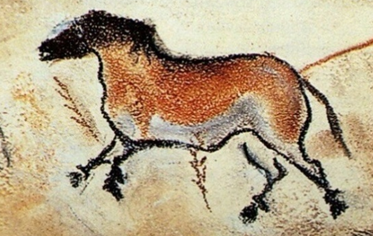
Figure 2. Pencil drawing and cave painting of a horse with sufficiently detailed imaging for recognition.
3.1. Definition of the spots
The mathematical apparatus of spots is described in detail in my previous article (Simonov, 2023), so now I will restrict myself to a brief description.
Spots are a mathematical object with elementary spatial properties, for which their inner area, outer area (environment) and logical connections between them are defined for any spots. The logical connection ab of two spots a, b is determined by two axioms:

The environments of the spots are also considered as spots; therefore, a logical connection is defined for them that satisfies axioms (1) and (2). We postulate that spots are not connected to their environment, i.e.

In general, the “shape” of spots and the properties of their environment, such as dimension, space curvature, etc., are not determined in advance, but can be estimated from qualitative information about their elementary relations (ER) with other spots. As it was mentioned before, ER are defined between spot, including separation, intersection, inclusion, indiscernibility, etc. Also, we consider crisp geometric figures as a particular, limiting case of spots.
It should be noted that the introduced concept of a basis of spots is considered as a structure of “known” spots with certain ERs between them, on which representation (mapping, projections or sections) of other spots can be made, using ERs with the basis spots (Simonov, 2020, 2023). Consequently, the basis plays the role of a coordinate system for spots. It should differ the abstract concepts of atomic spots, basis spots, and separated spots. The atomic spots are separated from each other and from other spots. Note that concept of atomic spots is similar to points, pixels, or voxels. The basis spots are also analogous to (numerical) basis functions, and separated spots are analogous to orthogonal basis functions. One example of an orthogonal basis is an atomic basis, and another example – is a basis of parts of intersection of basis spots, which are also separated. The last example can also be considered as an approximation of the atomic basis.
By analogy with geometric bodies, we defined the operations of union ∨ and intersection ∧ for spots that allow one to form new spots (Simonov, 2023). Note that in relation to imagery modeling, the union operation ∨ can be used to form a structural or generalized imagery, and the intersection operation ∧ can be used to increase the fragmentation and detail of the imagery. For example, the diagram in Figure 3 illustrates the division of spots a and b into the intersection parts A, B, C. These parts and their environment D can be expressed in terms of the intersection operation as follows:

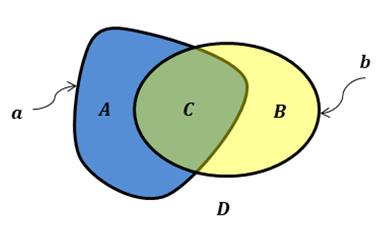
Figure 3. Euler-Venn diagram for the elementary relations between spots.
3.2. Definition of L4 numbers, vectors and matrices
Instead of real numbers, the spot model uses L4 numbers, which formalize the qualitative ERs between spots. Since the apparatus of L4 numbers is described in detail in my previous works (Simonov, 2020, 2021, 2023), we will briefly outline the main content and reveal the meanings of the concepts introduced there.
For spots a, b and their environment a ̃, b ̃ we defined L4 number ⟨a│b⟩ as the following logical table:

where , ab ab ̃,… denote the logical connections, and A, B, C and D denote a binary measure of the intersection parts of the spots a, b, and their environments (see Figure 3). Such L4 numbers, in general, make it possible to distinguish 16 different ERs between spots. Examples of ER and their correspondence with L4 numbers is illustrated in Figure 4 and listed in Table 1. We call these spatial relations “elementary” because they carry the lowest level of qualitative information about spots. However, a large amount of such qualitative data makes it possible to extract higher level information, including numerical.

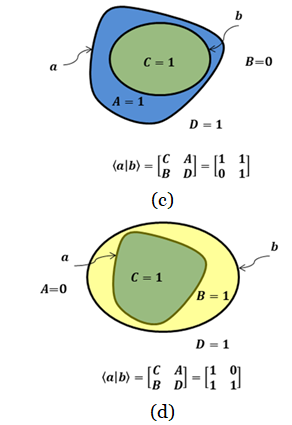
Figure 4. Euler-Venn diagram illustrates the meaning of definition of L4 numbers for ER between two spots: (a) Intersection of a and b; (b) Separation of a and b; (c) Inclusion b in a; (d) inclusion a in b.

The representation of a spot on any basis can be coded using an L4 vector, which is similar to a numerical vector, but its coordinates are L4 numbers of ER with spots of the basis (Simonov, 2020, 2021, 2023). For example, the L4 vector ax of the spot a, represented on a basis X={xi }, determines relation ⟨a│X⟩ and is defined as where is the number of spots in the basis X
. 
where is the number of spots in the basis X
The L4 matrix 〈Y|X〉 determines relation between the spots of two basises, X={xi } Y={yi } , and also formalizes the mapping from the X to the Y basises (Simonov, 2020, 2023):

Here (yj )X are L4 row vectors of spots , represented on the basis X The L4 matrix can be used to transform the mapping of the L4 vector from one basis to another, which can formally be written as the following multiplication of a matrix by a vector

Unfortunately, in general, there is no simple rule for calculating such a product, and we will consider this issue in detail below. However, there is a simple special case of the L4 indiscernibility matrix I (Simonov, 2023), the diagonal elements of which correspond to the ER of indiscernibility, and all other elements correspond to the ER of separation (Table 1):
a=I a
where a is an arbitrary L4 vector defined on the same basis as matrix I.
As mentioned above, the mapping of spots on the basis by L4 vector models some judgment or statement about the imagery, and hence the multiplication of the L4 matrix by this vector describes such an information processing as reasoning.
3.3. Multiplication rules for L4 matrices and L4 vectors
First let us consider the simplest case of an atomic basis A={ui} where the basis spots are orthogonal and do not intersect with other spots. Then we determined the ER ⟨a│b⟩A
between spots a and b with respect to the basis A according to the rule (Simonov, 2020, 2021, 2023)

where summation corresponds to the logical disjunction and the symbol “∙” denotes a logical conjunction. Then for an arbitrary basis B={bi} and an atomic basis A={ui}, the transformation of the spot representation from the basis A to the basis B is determined by the following multiplication rule:

where ⟨a│bi⟩A is the L4 number defined in (9).
More complicated case corresponds to arbitrary basises X={xi} and Y={yi}, in which the basis spots and can intersect. Paper (Simonov, 2023) contains approximate rules for calculation product (8). To do this, we first construct the following orthogonal basises: for intersections of spots , – for intersections of spots , and – for intersections of spots in basises and . Then the algorithm for the matrix product can be written in the following form (see 11).
Note that equation (11) should be considered as a series of transformations from one basis to another, namely: aU=〈U|X〉aX,aW=〈W|U〉aU, aV=〈V|W〉aW, aY=〈Y|V〉 aV. One can calculate the product aU=〈U|X〉 aX using the formulas (15) and (16) from (Simonov, 2023):

where the symbols <> and < denote the separation and inclusion relations, respectively (see Table 1). For the calculation vectors 〈V|W〉 aW and 〈Y|V〉aV formulas (9), (10) can be used, and for the vector 〈W|U〉aU – rule: if wk<ui →⟨a│wk ⟩=⟨a│ui ⟩.
In order to test the algorithms of the spot model presented above, the works (Simonov, 2021, 2023) demonstrated results of simulation the problem of reconstructing images of flat figures using qualitative data on their ER with sets of basis figures, which were circles or squares scanning with a small step in the plane of the figures. The reconstruction results showed good accuracy and noise reduction property for the developed algorithms.
- Modeling Reasoning and Learning
4.1. Modeling Nonmonotonic Reasoning
As it was mentioned before, L.M. Vekker stated that thinking is based on information processing of primary and secondary imagery, and the structural unit of thought is the judgment (Vekker, 1998). In the spot model, the L4 vector codes some judgment or statement about the imagery, and the multiplication of the L4 matrix by this vector models the information processing, i.e., reasoning. As a result of multiplication, a new L4 vector is obtained, which can be interpreted as the resulting conclusion. Therefore, when applied to imagery, L4 matrix models the corresponding knowledge about relations between two basises that is used in the process of reasoning. So, the L4 product of the matrix A and the L4 vector models the reasoning in the form of
b=A∙a
where a is the proposition and b is the conclusion. Hence, the conclusion is obtained on the basis of information (knowledge) contained in L4 matrix A.
a →A b
An important property of this type of reasoning is their proximity to the peculiarities of human thinking, namely:
– conclusions are made on the basis of existing knowledge,
– reasoning has the property of non-monotonic logic, when the acquisition of new knowledge can change the conclusions.
4.2. Modeling learning in AI
Within the framework of the spots model the learning process in AI can be identified with the task of finding an unknown L4 knowledge matrix A if we have a number of training examples {xi,yi } that correspond to the equality:
yi=A∙xi
Consider, for definiteness, the problem of learning image recognition (classification), where xi is an L4 vector for image represented on pixels, and yi is the corresponding L4 vector, represented on the basis of considered classes of the images.
Let us regard xi,yi as L4 vectors for spots xi and yi that form the basises X={xi} and Y={yi} of the training data. Then we can compose L4 matrix 〈Y|X〉 for representation the matrix A in (14) in the following form:

Here Bx and By are atomic basises, which represent L4 vectors xi and yi correspondingly. Obviously, for testing set the data matrix 〈Y|X〉 is equal to the indiscernibility matrix I. Note that equation (15) is a schematic interpretation of the learning process in AI (Goodfellow, 2016).
- Studies of imagery in neurophysiology – arbitrary regulation of mental imagery of the imagination
To illustrate the theoretical constructions described above, let us consider some experimental results of neurophysiological studies of emotional imagery and the extensive structure of relations between imagery in the imaginative sphere of a person.
Humans possess the ability to arbitrarily regulate images of both neutral content and their emotionally colored mental representation. It should be emphasized that a person is able to mentally reproduce not only the valency of emotions, but their intensity as well. In Russian psychophysiology, the use of mental representation of emotionally colored images to study the psychophysiology of emotions was first proposed by Academician P.V. Simonov (at that time a senior research fellow) (Simonov, 1981). This approach compensates for the difficulty of obtaining various human emotions in the laboratory. M.N. Rusalova, developing the P.V. Simonov’ ideas, performed a number of electroencephalographic studies of emotional states (Rusalova, 2004, 2021) based on the mental representation technique. Since people differ in their ability to produce emotionally colored images, volunteers with the most pronounced mental representation abilities were invited to participate in the experiment.
Method
5.1. Material and methods
The test subjects were in a soundproof dark room, sitting in an armchair, with their eyes closed. Brain biopotentials (EEG) were recorded from the head surface at 16 positions of EEG electrodes according to the international 10-20 system: Fp1, Fp2, F3, F4, F7, F8, C3, C4, R3, P4, T3, T4, T5, T6, O1, O2, which were further processed by the computer. A combined ear electrode was used as a reference. The EEG analysis epoch was 4 s, the sampling rate was 500 Hz, bandwidth 0.3–80 Hz. The recording of biopotentials was carried out on a setup consisting of PC and the 21-channel Computer Electroencephalograph Neuro-KM (Ltd. Scientific and medical Co. “Statokin”). EEG registration and processing were carried out using the “Software package for analysis and topographic mapping of electrical activity of the brain with the neurometric data bank “Brainsys”. As an indicator of brain activity in this study, we chose the alpha rhythm as the most frequently used in research. After registering a calm state, the subject was asked to mentally imagine himself in a state of sadness (lasting 40 seconds).
Figure 5 shows fragments of EEG, where (a) corresponds to calm wakefulness and (b) – to mental
reproduction of an emotional imagery. The scale on the left correspond to a conventional designation of EEG electrode placements of brain regions for international 10-20 system, from which biopotentials (EEG) are recorded.
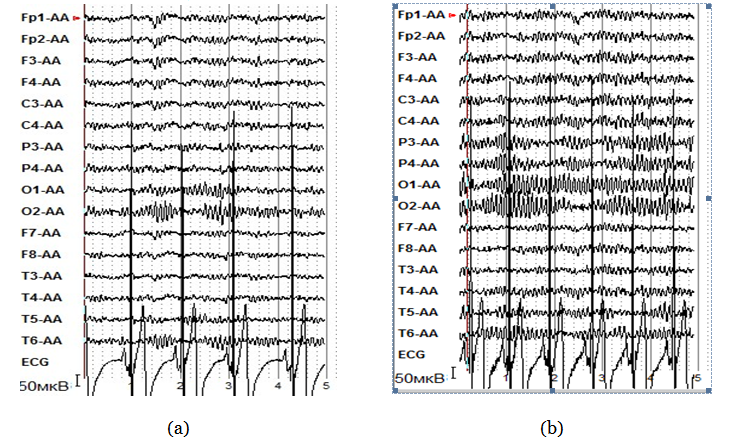
Figure 5. Fragments of brain biopotential (or EEG) records: (a) Calm wakefulness; (b) Mental reproduction of an emotional imagery.
 ‘
‘
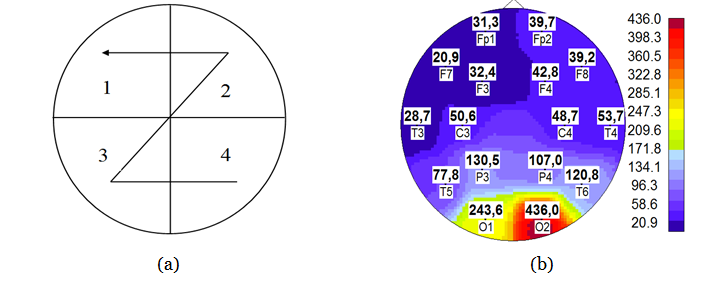
Figure 6. Diagram of the dependence of the localization of the focus of local activation on the level of general activation.
Figure 6 demonstrates a diagram of the connection between the general brain activation and an example of the levels of local activation in each of the 4 quadrants of the cortex, according to which the highest level of general activation can be observed in sector 1 when the focus of local activation is located in it (the left anterior region of the hemispheres), and the smallest – in sector 4 (right occipital region). It is known that with an increase in the total activation of the cerebral cortex, the amplitude of the alpha rhythm decreases and, conversely, an increase in the amplitude corresponds to a decrease in the activation of the general and local. As can be seen, the scheme presented in Figure 6a is reproduced in Figure 6b, which shows that the smallest amplitude of the alpha rhythm is recorded in the anterior sections of the left hemisphere, and the largest – in the occipital sections of the right hemisphere that corresponds to the scheme in Figure 6a. Indeed, if we compare the powers of alpha oscillations in Figure 6b, we get the following series for the items: , which reproduces the “” pattern in Figure 6a.
As can be seen from Figure 7a, there are no highly significant indicators of asymmetry in the state of calm wakefulness. Against the background of the mental representation of the emotional imagery (Figure 7b), there is a significant increase in EEG power (maximum ~568 ), and there is also a high level of interhemispheric asymmetry in favor of the right hemisphere. These facts indicate a more active participation of the right hemisphere in the process of mental representation of an emotional imagery.

Figure 7. Comparison of the powers of biopotentials in the alpha rhythm for different states: (a) Calm wakefulness; (b) Mental representation of an emotional image. Symbols designate the international 10-20 system regions of the brain, from which the EEG are recorded. The numbers correspond to the power in units of .
Figure 8 demonstrates example of intra- and extra-hemispheric coherent connections between regions of brain for the international 10-20 system, which reflect the synchronism of changes in bioelectrical activity of brain structures. On the brain maps, the coherent connections are shown as straight lines of links, which have different coherence levels, from 0 to 1. Here we use a threshold 0.4 of coherence factor. Apparently, this wide network of connections with different coherence levels reflects an extensive structure of relations and associative connections between imagery in the imaginative sphere of a person.

Figure 8. Demonstration of intra- and extra-hemispheric coherent connections of the brain. The threshold of coherence factor is 0.4.

Figure 9. Coherent connections between brain regions, corresponding to Figure 7: (a) Calm wakefulness; (b) Mental representation of an emotional imagery. The threshold of coherence factor is 0.75.
Figure 9 shows coherent connections in a state of calm wakefulness (Figure 9a) and with a mental representation of an emotional imagery of sadness (Figure 9b). Compared to Figure 8 we increased the threshold of coherence factor up to 0.75.
As can be seen from Figure 9a, in a calm state, coherent connections of various parts of the brain are observed that, apparently, is due to involuntary, spontaneously arising associations and images. At the same time, with an arbitrary mental reproduction of an emotional imagery of sadness, a focus of coherent connections is formed in the anterior part of the right hemisphere (Figure 9b). The results are consistent with the idea of the localization of negative experiences in the right hemisphere, as well as with the position of A.R. Luria on the leading role of the anterior parts of the brain in the organization of behavior (Luria, 2004).
In recent years, interest has increased in the arbitrary regulation of various mental processes with the help of their mental representation. Mental representations are increasingly used for practical purposes, in particular, when creating computer systems for biocontrol, for example, for people with paralyzed limbs who need special devices to implement movements. The reproduction of emotional events from memory is also widely used in psychiatric clinics in order to study the physiological mechanisms of emotions for patients in comparison with healthy ones, as well as in medical hypnosis. The problems of study the arbitrary regulation of emotions with the help of mental representation, the study of the cortical mechanisms of this phenomenon, as well as the ability to imagine in people of different temperaments, are actual and has important theoretical and practical significance.
Discussion
- Discussion
6.1. Representation of imagery at different levels of detail or generalization
It should be emphasized that the mathematical apparatus presented above makes it possible to represent the same spots in the form of mappings on different basises. This makes it possible to model imagery with different levels of detail or generalization, as discussed above. Thus, the proposed apparatus of spots allows one to describe imaginative sphere as a hierarchy of different levels of generalization (Vekker, 1998) and a multilevel mental imagery (Lomov, 1984).
Indeed, formula (9) describes the ER between two spots a and b, which are represented on the atomic basis A={ui} which determines the detail of these spots. Let us now consider a certain basis X={xk} of spots, which, like the spots a and b are represented on the same atomic basis A It is obvious that the mapping of spots on the basis X will correspond to the representation of images at a higher level of generalization (abstraction) compared to with a mapping on the basis A One can determine a mapping, for example, of a spot a on the basis X by replacing the spot b in formula (9) with any spot xk his basis and then finding the value ⟨a│xk ⟩A. Thus, we get an apparatus for recalculating representations with more detail to a higher level of generalization. It is easy to understand that formula (12) and conditions (13) allow modeling the process of fragmentation of imagery, that is, the transition to a level of greater detail of them. Indeed, (12) and (13) describe transform of a spot representation from the basis X={xk } to the basis U={ui} of the intersections of spots {xk } that provides to get more detailed imagery relatively to those on the basis X.
6.2. Geometric and topological analogies for mental imagery
We believe that the spatial representation of imagery potentially has an advantage over other approaches due to the fact that it more adequately reflects their inherent spatial properties, as mentioned above. Using the spatial analogy and the apparatus of spots, one can get a more understandable and meaningful representation of the structure of the imaginative sphere and gives a new approach to the study of mental imagery. For example, a spatial analogy of the different representations of some phenomenon or event on the imaginative spheres of different individuals are projections of a 3D body on planes located at different angles. Obviously, despite these projections are generally different, it does not follow from this fact that some of them are “correct” and others are “false”. Moreover, based on the different projections and sections, the shape of the 3D body can be reconstructed. Computed tomography is an example of such a 3D reconstruction of a body image from its X-ray projections at different angles. This analogy clear illustrates the well-known fact that the discussion and correct comparison of different points of view helps to create a more objective view of an event or problem. This is also the basis for the phenomenon of “collective intelligence”, which, in particular, is manifested in the development of science and culture.
Let us consider the question of the existence of a special type of secondary (mental) imagery representing “spiritual semantics ” in the “spiritual layers” of its imaginative sphere (Gostev 2022). They can be called mental “spiritual imagery”. There Gostev also states that “the main feature of secondary imagery is that the sensual-concrete and conceptual-abstract interpenetrate in them” (Gostev 2008, p. 104). However, we can formulate the peculiarity of spiritual imagery, separating them from conceptual imagery. Indeed, while the semantics of the latter is mainly determined by the conceptual component, for spiritual imagery the sensual component always plays an important role, and ignoring it significantly distorts or leads to the loss of the semantics of the spiritual imagery.
We can offer the following geometric interpretation of this property of the spiritual imagery. Let us consider a 3D body as an analogue of an imagery, where coordinates correspond to the conceptual component, and coordinate – to the sensual component. If the body has a simple form, then one can recognize its shape (that is, the semantics of the imagery) considering only its projection onto plane. However, if the body has a complex structure, then its projection onto X, Y plane does not convey the features of this structure. This example clearly explains the nature of possible semantics loss if to assume that the spiritual imagery has such a structure, in which conceptual and sensual components are intertwined in a complex way.
It should be noted an important aspect of the proposed mathematical apparatus of spots, namely, that it allows not only to model imagery and the imaginative sphere of a person, but also be applied beyond it. Namely, generalizing the concept of mental imagery, we can introduce semantic imagery and information imagery spaces to describe universal knowledge as an element of culture. This circumstance also makes it possible to apply the model under consideration for application in AI and for creating intelligent systems of a new type, which can not only represent information in an imagery form, but also model imaginative thinking.
To realize the potential advantage of the spatial representation of imagery, further development of the spot apparatus is necessary. In this regard, we will define some new concepts for the analysis of the spatial structures of spots, which are based on geometric and topological analogies. On the other hand, the introduction of such concepts should harmonize the spot model with the conventional crisp geometry in the limit.
Note that geometric and topological analogies can be introduced specifically for the structure of spots, and the spatial properties of these structures are determined locally, that is, for certain spots.
For example, continuity or discreteness for the structure of spots correspond to situations where spots are intersected or separated, respectively. The boundary of a spot is defined as the “minimal” structure of spots intersecting with this spot.
The spatial structure of spots is similar to a topological structure or a geometric body. By analogy with topology, we assume that the dimension of a spot without an internal structure is equal to zero, and the dimension of a spot inside the structure is equal to a number that exceeds the dimension of its boundary by one.
Using the definition of dimension given above, let us consider the spot structures in Figure 10. For the structure in Figure 10a, obviously, the local dimension for all internal spots is 1, that is, it is a line. Figure 10b demonstrates that the structure dimension is 2 for the central spot. Similarly, the structure in Figure 10c can be called a surface, since the dimension for all internal spots is also 2. One can introduce a measure for the structure of spots, defining it be equal to the number of spots included in this structure. Then the length of the line (Figure 10a) is equal to the number of spots in it. The straight line that connects two spots can only be defined using the “external geometry” of the surrounding structure of spots. Namely, the straight line is the shortest line between two spots. Namely, the straight line is the shortest line between two spots.

Figure 10. Some types of spot structures: (a) 1D structure – line; (b) Definition of the local 2D structure; (c) 2D structure – surface.
As we mentioned above, the basis of spots is similar to a coordinate system and L4 numbers – to coordinates. A continuous mapping in topology can be associated with a one-to-one mapping of the basis spots, which preserves their mutual relations. Isometry is similar to continuous spot mapping, which also preserves the distances between spots.
6.3. Analogy between spots and Minsky’s frames
The spot model has a certain analogy with the Minsky frame concept (Minsky, 1975). However, spots form a spatial model of imagery, and frames represents imagery as network structure of hierarchically ordered elements: subframes, frames, and superframes. We can note the following common properties of the spot and the frame.
- The spot and frame are not fully defined initially. For example, frames include different levels: the higher levels are defined, and the lower levels have many special terminal vertices or “cells”, which must be filled with specific examples or data. The spots are specified by their mappings on the basises of the spots that determines the structures of their inner parts and environments. Hence, using different basis, we can refine information about the spot.
- Combination of semantically similar frames into a frame system is similar to combination (inclusion) spots into united spot, representing a structural or more abstract imagery.
- The common terminals of different frames are similar to the common parts of the intersecting spots.
- Subframes are analogous to spots that are parts of the main spot, and superframes are analogous to the structure of spots.
It follows from item 1 that, similarly to the cells of the frame, internal part and the environment of a spot allows “filling” with additional information. However, unlike frames, a spot, in principle, allows an unlimited amount of information to be embedded. Figuratively speaking, upon closer examination, the spot may turn out to be a galaxy.
Conclusions
The spot model allows one to represent the structures of mental imagery, taking into account their spatial properties, including the multidimensionality and multilevel nature of the human imaginative sphere. The spatial representation of mental imagery allows to highlight and understand the peculiarity of spiritual imagery.
Generalizing the concept of mental imagery, the spot apparatus allows to model human knowledge as an element of culture in the form of semantic imagery and information imagery space. The spot apparatus also makes it possible to formulate a new paradigm for creating strong AI, namely the development of a new type of intelligent systems capable of not only representing information in an imagery form, but also modeling imaginative thinking.
It is necessary to further develop the spot model in the direction of developing a vague geometric theory, which will allow creating a more complete and detailed description of the imaginative sphere and imaginative thinking.
Funding: The investigation was supported by the Program no. FFNN-2022-0019 of the Ministry of Science and Higher Education of Russia for Valiev Institute of Physics and Technology of RAS.
CRediT author statement:
Simonov N.A.: Conceptualization, Description of Mathematical Model, Writing-Original Draft Preparation, and Visualization.
Rusalova M.N.: Electrophysiology, Writing-Original Draft Preparation, and Visualization.
The authors have read and approved the final version and bear responsibility for all aspects of the publication.
The authors declare no conflict of interest.
Acknowledgments: The authors express deep appreciation to Lukichev V.F., Rudenko K.V., Volkova E.V., and Gostev A.A. for the support and fruitful discussions of this work.
References
- Arsky, Yu.M. & Finn, W.K. (2008). Principles of designing intelligent systems. Information technologies and computing systems, 4, 4–37. [Arsky Yu.M. & Finn W.K. (2008). Principy konstruirovaniya intellektual’nykh sistems. Informatsionnyye technologii i vychislitel’nyye sistemy. 4, 4–37].
- Barabanschikov, V.A. (2000). Systemogenesis of sensory perception. Moscow: Institute of Practical Psychology. Voronezh: RPA MODEK. [Barabanschikov, V.A. (2000). Sistemogenez chuvstvennogo vospriyatiya. Moskva: Institut Prakticheskoy Psikhologii. Voronezh: NPO MODEK].
- Beck, J. (2018). Analog mental representation. Wiley Interdisciplinary Reviews: Cognitive Science, 9(6), e1479.
- Biederman, I. (1987). Recognition-by-components: a theory of human image understanding. Psychological review, 94(2), 115–147.
- Chuprikova, N.I. (2022). Mind and mental processes. The system of concepts in general psychology. Moscow: Liters. [Chuprikova, N.I. (2022). Psikhika i psikhicheskiye protsessy. Sistema ponyatiy obschey psikhologii. Moskva: Liters].
- Finn, V.K. (1988). Plausible conclusions and plausible reasoning. Results of Science and Technology: Probability Theory. Math statistics. Theoretical cybernetic, 28, 62–142. Moscow: VINITI. [Finn, V.K. (1988). Pravdopodobnyye vyvody i pravdopodobnyye rassuzhdeniya. Itogi Nauki i Tekhniki: Teoriya Veroyatnosti. Matematicheskaya Statistika. Teoreticheskaya Kibernetika, 28, 62–142. Moskva: VINITI].
- Finn, V.K. (2009). Timely remarks on the JSM-method of automatic generation of hypotheses. NTI, Ser. 2. [Finn, V.K. (2009). Svoyevremennyye zamechaniya o DSM metode avtomaticheskogo porozhdeniya gipotez. NTI, Ser. 2].
- Goodfellow, I., Bengio, Y., & Courville, A. (2016). Deep Learning. Cambridge, UK: MIT Press.
- Gostev, A.A. (2008). Psychology and metaphysics of the imaginative sphere of man. Moscow: Genesis. [Gostev, A.A. (2008). Psikhologiya i metafisika obraznoy sfery cheloveka. Moscow: Genesis].
- Gostev, A.A. (2022). Psychology of the secondary imagery. Moscow: Litres. [Gostev, A.A. (2022). Psikhologiya vtorichnogo obraza. Moscow: Litres].
- Hadamard, J. (1954). An essay on the psychology of invention in the mathematical field. Courier Corporation.
- Kobrinsky, B.A. (1998). To the question of the formal reflection of imaginative thinking and intuition of a specialist in a weakly structured subject area. News of artificial intelligence, 3, 64–76. [Kobrinsky, B.A. (1998). K voprosu o formal’nom otrazhenii obraznogo myshleniya i intuitsii spetsiallista v slabo struktuirovannoy predmetnoy oblasti. Novosti iskusstvennogo intellekta, 3, 64–76].
- Kobrinsky, B.A. (2009). Imagery in the intellectual system. Artificial intelligence and decision making, 2, 25–33. [Kobrinsky, B.A. (2009). Obraznyi ryad v intellektual’noy sisteme. Iskusstvennyi intellect i prinyatie reshenii, 2, 25–33].
- Kuznetsov, O.P. (1995). Non-classical paradigms in artificial intelligence. Theory and control systems, 5, 3–23. [Kuznetsov, O.P. (1995). Neklassicheskiye paradigmy v isskusstvennom intellekte. Teoriya i sistemy upravleniya, 5, 3–23].
- Lomov, B.F. (1984). Methodological and theoretical problems of psychology. Moscow: Science. [Lomov, B.F. (1984). Metodologicheskiye i teoreticheskiye problemy psihologii. Moskva: Nauka].
- Luria, A.R. (2004). Fundamentals of neuropsychology. Moscow: Academy. [Luria, A.R. (2004). Osnovy neiropsihologii. Moskva: Academiya].
- Minsky, M.L. (1975). A framework for representing knowledge. In P.H. Winston (Ed.), The psychology of computer vision. New York: McGraw-Hill Book.
- Minsky, M.L. (1988). The Society of Mind. New-York, London: Touchstone Book.
- Nanay, B. (2021). Mental Imagery. In E.N. Zalta (Ed.), The Stanford Encyclopedia of Philosophy. URL = <https://plato.stanford.edu/archives/win2021/entries/mental-imagery/>.
- Petrenko, V.F. (1988). Psychosemantics of consciousness. Moscow: MSU. [Petrenko, V.F. (1988). Psikhosemantika soznaniya. Moskva: Izdatel’stvo Moskovskogo Universiteta].
- Pitt, D. (2021). Mental Representation. In E.N. Zalta (ed.), The Stanford Encyclopedia of Philosophy. URL = <https://plato.stanford.edu/archives/win2021/entries/mental-representation/>.
- Poincare, H. (1905). Science and hypothesis (WJ Greenstreet, Trans.). New York: The Walter Scott Publishing Co.
- Pospelov, D.A. (1989). Reasoning Modeling. Experience in the analysis of mental acts. Moscow: Radio and Communication. [Pospelov, D.A. (1989). Modelirovaniye rassuzhdeniy. Opyt analiza myslitel’nykh aktov. Moskva: Radio i Svyaz’].
- Rusalova, M.N. (2004). Functional brain asymmetry: emotions and activation. Functional interhemispheric asymmetry. Reader (pp. 322-348). Moscow: Scientific World. [Rusalova, M.N. (2004). Funktsional’naya assimetriya mozga: emotsii i aktivatsiya. Funktsional’naya mezhpolusharnaya asimmetriya. Khrestomatiya (s. 322–348). Moskva: Nauchnyy Mir].
- Rusalova, M.N. (2021). The amplitude of the alpha rhythm as an indicator of the stability of the mental reproduction of emotional images from memory. Journal Asymmetry, 15(4), 4–17. [Rusalova, M.N. (2021). Amplituda al’fa-ritma kak pokazatel’ ustoichivosti myslennogo vosproizvedeniya emotsional’nyh obrazov po pamyati. Zhurnal Asimmetriya, 15(4), 4–17].
- Shepard, R.N. (1978). The mental image. American Pychologist, 33(2), 125–137.
- Simonov, P.V. (1981). Emotional brain. Physiology, neuroanatomy, psychology of emotions. Moscow: Science. [Simonov, P.V. (1981). Emotsional’nyy mozg. Fiziologiya, neiroanatomiya, psihologiya emotsiy. Moskva: Nauka].
- Simonov, N.A. (2020). Spots Concept for Problems of Artificial Intelligence and Algorithms of Neuromorphic Systems. Russian Microelectronics, 49, 431–444. https://doi.org/10.1134/S106373972005008X
- Simonov, N. (2021). The Spot Model for Representation and Processing of Qualitative Data and Semantic Information. In Proceedings of the Selected Contributions to the Russian Advances in Artificial Intelligence Track at RCAI 2021, Taganrog, Russia, 11–16 October 2021, CEUR-WS, US, 55–69.
- Simonov, N.A. (2023). Application of the Model of Spots for Inverse Problems. Sensors, 23(3), 1247. https://doi.org/10.3390/s23031247
- Solso, R.L. (2004). Cognitive Psychology. Anaheim: Allyn & Bacon.
- Vekker, L.M. (1974). Mental processes. Leningrad: LSU, Vol. 1. [Vekker L.M. (1974). Psikhicheskie processy. Leningrad: LGU, T. 1].
- Vekker, L.M. (1998). Mind and reality: a unified theory of mental processes. Moscow: Sense. [Vekker, L.M. (1998). Psikhika I real’nost’: edinaya teoriya psikhicheskikh protsessov. Moskva: Smysl].
- Wang, P. (2004). Cognitive logic versus mathematical logic. In Proceedings of the Third International Seminar on Logic and Cognition (pp. 1–10). China: Guangzhou.
Comments (0)
This paper considers in general the concept of a new mathematical model of spots with the apparatus and its possible application for the representation of mental imagery. The inherent spatial properties of imagery make it possible to represent them as spots, which are models of vague spatial objects. The proposed approach allows modeling mental operations also, in particular, nonmonotonic reasoning, when conclusions are drawn on the basis of existing knowledge, and obtaining new knowledge can change the conclusions. The paper proposes a new paradigm for creating intelligent systems capable not only for representing information in imagery form, but also modeling imaginative thinking.
To solve the problem of flexibility and reliability of artificial intelligence (AI), it is necessary to use methods for presenting information and the results of mental activity, primarily reasoning, in a manner characteristic of a person. Undoubtedly, this corresponds to the task of creating intelligent systems capable not only to represent information in imagery form, but also modeling imaginative thinking.
However, the problem is that the study and mathematical modeling of imagery have not been sufficiently developed so far. A.A. Gostev wrote that “Despite the growing attention to the imagery problems of various areas of psychology and related sciences, we have to state a lag in the study of the imaginative sphere of a person compared to other mental processes. Modern scientific knowledge of the nature and functioning of secondary imagery is characterized by terminological ambiguity, incompleteness, “blurring”” (Gostev, 2022, p. 9).
1.1. Primary and secondary mental imagery
It should be noted that in Russian psychology the term “secondary imagery” is traditionally used, which is equivalent to the term “mental imagery” accepted in world science (Nanay, 2021). L.M. Vekker wrote that at the first sublevel of higher nervous activity, the signal function is carried out by imagery – primary and secondary (sensations, perceptions and representations), and at the second sublevel – by speech-thinking processes (Vekker, 1998). In this paper we will use the term imagery mAInly for secondary (or mental) imagery. In modern psychology, secondary imagery is defined for objects and phenomena in the absence of a prototype stimulus directly affecting them in the material world (Gostev, 2022). Note that the imagery is an abstract concept that allows describing the structure of semantic information stored in the brain. According to A.A. Gostev, the secondary imagery is the natural language of the mind associated with the pre-conceptual level of reflection (Gostev, 2022). It is known that the experimental study of the imagery is a difficult problem, as they appear before researchers, according to L.M. Vekker, elusive “volatile” structures, difficult to fix (Vekker, 1979). V.A. Barabanschikov argued that sensations, perceptions, representations act as imagery that reflect the world around a person and himself (Barabanschikov, 2000, p. 44). A special kind of imagery, described by N.A. Bernstein, are motor imagery of movements that are created and precede the actual performance of movements and actions (Chuprikova, 2022).
The concept of an imagery was also addressed by many specialists working in the field of AI. For example, D.A. Pospelov assumed that the basis of the human mechanism of cognition is an integrated system in which the imagery and symbolic-logical components are merged into one (Pospelov, 1989). B.A. Kobrinsky pointed out that the direction of actions of a highly qualified doctor is determined, in many respects, by the presence of an imagery representation of the disease. He emphasized that intuition, which is quite closely related to imaginative thinking, plays a significant role in the formation of primary hypotheses in poorly structured and humanitarian areas of knowledge (Kobrinsky, 1998). However, it can be noted here that intuition and imaginative thinking also play an important role in the exact sciences, such as mathematics (Hadamard, 1954). O.P. Kuznetsov wrote that for brain informatics, imagery are the main type of data and knowledge representation, a person thinks and stores his/her knowledge in the form of vague and blurry imagery, where thoughts and notions more often manifest themselves in the form of imagery than abstract concepts (Kuznetsov, 1995).
The Stanford Encyclopedia of Philosophy has devoted two articles to the concept of mental imagery. D. Pitt (Pitt, 2021) argues that the mental imagery is one of the models that is used for mental representations in the field of Computational Theory of Mind. Mental representations are construed as mental objects with semantic properties. B. Nanay (Nanay, 2021) states that mental imagery is far more pervasive in our mental life than just visualizing. They play a crucial role not just in perception, but also in memory, emotions, language, desires and action-execution.
Gostev claims that I. Hoffman talked about the possibility of representing an object with different levels of detail, containing visual-imaginative characteristics of objects or semantic representation. The ability to move from one form of representation to another is considered an important source of human creativity (Gostev, 2022).
According to Vekker, thinking is “obviously based on the information processing of primary and secondary imagery” (Vekker, 1998, p. 118). However, he emphasized that the structural unit or “molecule” of thought is judgment. There is also a distinction between analytical thinking (having conscious stages) and intuitive (minimally conscious, characterized by speed and lack of stages). The basis of imaginative thinking, which transforms a specific secondary image, is traditionally considered to be analysis-synthesis of the sensory level, elements of abstraction, generalization, comparison, evaluation.
1.2. Limitations of classical logic
Many researchers note the limitations of classical logic for modeling reasoning. For example, D.A. Pospelov wrote that “strict reliable reasoning that meets the most complete limitations of formal logical systems does not model all types of reasoning that a person operates in his activity. Many types of scientific knowledge are based on reasoning that is not rigorous, of a plausible nature, or on conclusions that use incomplete initial information” (Pospelov, 1989, p. 93). A.A. Gostev noted that logic is necessary, but not sufficient for understanding thinking. In the thought process there is always a certain “residue” that cannot be explained by logic (Gostev, 2022). A. Poincare wrote that formal logic always leads only to tautology, and syllogism cannot teach us anything essentially new (Poincare, 1905).
A number of non-classical, cognitive logics have been proposed that could be close to the logic of human reasoning. Tarasov noted that D.A. Pospelov conducted research in the field of knowledge representation and organization, modeling “common sense” reasoning (Tarasov, 2020). Yu.M. Arsky and V.K. Finn consider cognitive plausible reasoning (Arsky et al., 2008; Finn 1988, 2009). P. Wang wrote that first-order predicate logic faces many problems when used to explain or reproduce human cognition and intelligence, and he suggested using the Non-Axiomatic Reasoning System (NARS) model instead (Wang, 2004).
1.3. Spatial properties of imagery
One of especially important properties of the imagery and imaginative sphere of a person are their spatial properties. This fact made it possible to propose a special mathematical model, where the imagery is presented in the form of vague spatial objects – spots, and to use some geometric analogies (Simonov, 2020). The referred article noted that the spatial properties of the imagery are reflected in natural language, for example, when they talk about the edges and different sides of a concept or phenomenon, about points of view, about the proximity or connection of concepts, about their breadth or narrowness, about considering an issue in a certain plane, about the contours of a problem, about areas of knowledge, etc. A good geometric analogy of the relation between more general and specific concepts is the relation between a figure and its parts. The concept of context can be associated with the spatial arrangement of the imagery in the environment, which is a structure of other mental imageries.
- Beck writes that Kosslin and Shepard’s experiments showed that although mental imagery are not literally spatial, they nevertheless function as if they were located in space (Beck, 2018). Many authors have introduced the concept of imagery space as a system or structure of human imagery. For example, A.A. Gostev called this as the imaginative sphere of a person, which is understood as a multidimensional, multilevel dynamic subsystem of the mind, the “imageries-elements” of which perform specific functions in mental reflection-regulation in accordance with actual life circumstances (Gostev, 2022). He also writes about the existence of separate classes of secondary imageries, about the multidimensionality of mental phenomena and the need to consider them in different coordinate systems.
- Shepard represented a form of mental imagery as a set of points in a multidimensional space with non-Euclidean geometry (Shepard, 1978). Petrenko wrote that the development of complex and multidimensional models of the semantic space is required (Petrenko, 1988). B.A. Kobrinsky argued that holistic imagery is multidimensional or multi-meaning signs (Kobrinsky, 2009). Gostev points that B.F. Lomov spoke about the multidimensionality of mental phenomena and the need to consider them in different coordinate systems (Gostev, 2022). V.B. Tarasov (Tarasov, 1998) also defined the space of mental imagery and talked about multidimensional subjective spaces. He wrote that D.A. Pospelov believed that the fusion of algebraic and geometric approaches will make it possible to create complete intelligent systems with much greater capabilities than modern AI systems (Tarasov, 2020).
The proposed mathematical model of spots makes it possible to represent imagery as vague spatial objects in multidimensional spaces (Simonov, 2020, 2021, 2023). These works show the possibility of modeling reasoning based on nonmonotonic logic inherent in human thinking (Simonov, 2023). For the nonmonotonic logic, conclusions are made on the basis of existing knowledge, and the acquisition of new knowledge can change the conclusions. This issue will be discussed in more detail in Section 4.
2.1. Basic concepts of the spot model
- Hadamard shared his self-observations about what happens in the mind when he began to build or understand mathematical reasoning: “Now, personally, if I had to think of any syllogism, I should not think of it in terms of words – words would hardly allow me to see whether the syllogism would be right or wrong but with a representation analogous to Euler’s, only not using circles, but spots of an undefined form, no precise shape being necessary for me to think of spots lying inside or outside of each other” (Hadamard, 1954, p. 76).
First let us consider a qualitative description of the spot model, on the basis of which it is possible to represent mental imagery as spatial objects. A more rigorous mathematical description of the proposed apparatus will be considered in the next section. Although spots are mathematical objects for describing vague or blurry figures, we will also consider crisp geometric figures as a special, limiting case of spots. For spots, their internal parts and their environments are determined, and all information about their “shape”, internal structure and the structure of the environment is given using qualitative data on their elementary spatial relations (ER) with other spots, that is, the relations of separation, intersection, inclusion of one spot in others, etc. Therefore, in the general case, we do not have complete information about the spot, but we can refine our knowledge of it by obtaining additional data. The possibility of gradually “filling in with information” the spot is consistent with the process of imagery formation, which as L.M. Vekker wrote “begins with discrimination and then proceeds through recognition to the full and adequate perception of the given object” (Vekker, 1998, p. 11).
Let us call a basis of spots some of their structure onto which the considered spot can be represented using its ER with spots of this basis. Such a representation can be regarded as an imaging, mapping, projection, or section on the basis. Note that although the projections of certain spot-on different basises are different, they are characteristics of the same spot. Likewise, certain mental imagery can be represented with different modality or different levels of detail or generalization. It should be emphasized that, although the ER data are qualitative, it is possible to obtain a fairly clear “image” of a spot if to process its ER with a large number of basis spots. In the limit of an infinite amount of such data, it is possible to precisely reconstruct the image of a crisp figure. (Simonov, 2023).
The environment of the spot is a surrounding space near its location. When considering the semantic content of the text, the environment of the spot that models its semantic imagery corresponds to the context. The environment is also a spot, and its properties, such as continuity, dimension, curvature, are not predetermined. However, using data on the ER of the spot’s environment with basis spots, one can approximately estimate these properties. Note that with the help of ER data, it is possible to form homogeneous or inhomogeneous spot spaces with arbitrary properties. One can, for example, consider separated (non-intersecting) spaces of spots, which allow one to model different classes of secondary imagery or different levels of their representation, for example, “sensory (concrete) and conceptual (abstract)” (Gostev, 2022, p. 28). From what has been said, it follows that spots allow one to build a much more flexible spatial model for representing imagery and the imaginative sphere than the conventional crisp geometry.
2.2. Semantics of imagery
To model mental imagery, it is necessary to determine the spots corresponding to them and provide the ER between these spots, corresponding to the relations between the imagery. The spot model allows us to represent the “distribution” of imagery in the imaginative sphere in the form of certain structures, which make up their environmental structures and internal structures. We will call such a representation a spatial representation of imagery and define the imagery space.
Since the semantic of an imagery can be determined with the help of its relations with other imageries, its semantic is determined by a certain location in the imagery space. Therefore, the imaging of corresponding spot on the basis represents the semantics of the imagery or a judgment about it. The internal structure of the spot represents the degree of fragmentation of the imagery. Obviously, the spots model provides multidimensional spatial representation of mental imagery. Furthermore, suggested approach can be applied to the representation of semantic imagery and semantic space in the field of AI.
2.3. Structure and detail of imagery
Mental imagery is an abstract concept that allows to describe the structure of information stored in the brain. It is well known that imagery of the same object can be represented in different degrees of generalization (abstractness). Therefore, psychology considers such concepts as a hierarchy of different levels of generalization (Vekker, 1998) and a multilevel mental imagery (Lomov, 1984). The structure of imaginative sphere can be represented in form of different levels associated with the detail or generalization (abstractness) of imagery. For example, A.A. Gostev stated that the cognitive system includes sensory-perceptual, representational, and speech-thinking levels (Gostev, 2022). Using the spot apparatus, it is possible to model imagery with any degree of detail or generalization, from visual imagery to abstract conceptual ones. An important feature of suggested model is that it allows one to represent the same imagery with different levels of fragmentation or abstraction, mapping it on different basises.
Each level of generalization can be considered as a subspace of the imaginative sphere and it is possible to introduce specific basis of mental imagery in each of them. Obviously, the ER between the detailed and the corresponding generalized imageries is the relation of inclusion. Therefore, the level (or space) of generalized imagery must include levels (or subspaces) of detailed imagery. This has a geometric analogy of the inclusion of two-dimensional (2D) subspaces (planes and surfaces) in three-dimensional (3D) space. Obviously, a large number of detailed imageries can be associated with a single generalized imagery-concept that is similar to the taxonomy of species in biology. When modeling imagery with spots, all detailed imagery, corresponding to given generalized imagery, must have the same property. Namely, their mappings on the basis of generalized imageries are indiscernible (i.e., coincide) with each other and with the mapping of the given generalized imagery.
2.4. Formation of new imagery
A.A. Gostev (Gostev 2008) wrote that in psychology, imagination is traditionally understood as a mental process of creating new images based on the transformation of images-elements of experience. The creation of new images was very clearly described by Marvin Minsky: “What can we do when things are hard to describe? We start by sketching out the roughest shapes to serve as scaffolds for the rest; it doesn’t matter very much if some of those forms turn out partially wrong. Next, draw details to give these skeletons more lifelike flesh. Last, in the final filling-in, discard whichever first ideas no longer fit” (Minsky, 1988, p. 17).
A spatial analogy of the formation of a new imagery is the drawing or painting images that can be done on the basis of small material objects only. For example, these basis objects can be mosaic tiles, brush strokes in a painting, drawing strokes with pencil, charcoal, chalk or paint on paper, or stone in cave, and silver crystals as in a photograph. In the modern digital world, these are pixels in a photo, movies or monitors. Therefore, we can also assume that a new imagery is formed as a representation (or imaging) on a structure of existing imagery or on their intersections.
An example of such a basis is the model of geons as a set of elementary figures for the formation of Biederman’s primary visual imagery (Biederman, 1987). I. Biderman suggested and confirmed it experimentally that the primary visual images are formed as reflections on the basis of 36 elementary figures – geons, which, like the letters of the alphabet, form a certain system. According to Biderman, visual object recognition is carried out as a process in which the input visual image is segmented into simple geometric components such as blocks, cylinders, wedges, and cones, and then approximated by one of the possible sets of geons.
Considering the formation of new imagery as their reflection on the basis of existing imagery allows, in principle, by continuing this process, to create basis of new imagery and form new imagery on them. This property is reflected in the fact of the development of human culture and science. Therefore, although the imaginative sphere of a person is the result of a reflection of his experience, but this is not a “mirror reflection”, since there are elements of subjectivity and the results of creative processing of imagery in it. Such an understanding shows the inconsistency of the critical objections to the idea of the mind as a reflection of reality, about which N.I. Chuprikova wrote, for example, the alleged impossibility of explaining the existence of the concepts of ideal objects and the ability of human creativity (Chuprikova, 2022).
Such a general scheme of an imagery creation can be illustrated applying a representation of a generalized imagery of a horse by spots with a minimum level of detail. This can be visualized with the Euler-Venn diagram shown in Figure 1, which looks like a child’s drawing. In Figure 1a, parts of the horse’s body are presented as a set of separated spots and they do not give an understanding of the horse imagery. However, the same spots, combined into a structure with corresponding intersections, form the recognizable image of a horse (Figure 1b). Here we see that the structure that unites parts of imagery plays an important role. This example, in particular, illustrates the principle of Gestalt Psychology (Solso, 2004), accor
ding to which the semantics of the whole is not reduced to the sum of the semantics of its parts.
Figure 1. Euler-Ven diagrams showing the relationship between imagery of body parts and the whole imagery of a horse: (a) Spots represents imagery of body parts as a set of separate elements; (b) The imagery of a horse as a structure of spots – parts of its body, connected by ER between them.
Though it should be noted that the image in Figure 1 is quite abstract and can refer not only to a horse, but also to other animals, such as a cat, dog, sheep, but does not correspond to fish, crayfish, snakes or spiders. For unambiguous recognition of a horse, it is necessary to detail the structure of its image. However, too much details are not necessary for that, since the imagination can restore the missing elements. For example, images of a horse detailed enough for recognition are shown in Figure 2.
Figure 2. Pencil drawing and cave painting of a horse with sufficiently detailed imaging for recognition.
3.1. Definition of the spots
The mathematical apparatus of spots is described in detail in my previous article (Simonov, 2023), so now I will restrict myself to a brief description.
Spots are a mathematical object with elementary spatial properties, for which their inner area, outer area (environment) and logical connections between them are defined for any spots. The logical connection ab of two spots a, b is determined by two axioms:
The environments of the spots are also considered as spots; therefore, a logical connection is defined for them that satisfies axioms (1) and (2). We postulate that spots are not connected to their environment, i.e.
In general, the “shape” of spots and the properties of their environment, such as dimension, space curvature, etc., are not determined in advance, but can be estimated from qualitative information about their elementary relations (ER) with other spots. As it was mentioned before, ER are defined between spot, including separation, intersection, inclusion, indiscernibility, etc. Also, we consider crisp geometric figures as a particular, limiting case of spots.
It should be noted that the introduced concept of a basis of spots is considered as a structure of “known” spots with certain ERs between them, on which representation (mapping, projections or sections) of other spots can be made, using ERs with the basis spots (Simonov, 2020, 2023). Consequently, the basis plays the role of a coordinate system for spots. It should differ the abstract concepts of atomic spots, basis spots, and separated spots. The atomic spots are separated from each other and from other spots. Note that concept of atomic spots is similar to points, pixels, or voxels. The basis spots are also analogous to (numerical) basis functions, and separated spots are analogous to orthogonal basis functions. One example of an orthogonal basis is an atomic basis, and another example – is a basis of parts of intersection of basis spots, which are also separated. The last example can also be considered as an approximation of the atomic basis.
By analogy with geometric bodies, we defined the operations of union ∨ and intersection ∧ for spots that allow one to form new spots (Simonov, 2023). Note that in relation to imagery modeling, the union operation ∨ can be used to form a structural or generalized imagery, and the intersection operation ∧ can be used to increase the fragmentation and detail of the imagery. For example, the diagram in Figure 3 illustrates the division of spots a and b into the intersection parts A, B, C. These parts and their environment D can be expressed in terms of the intersection operation as follows:
Figure 3. Euler-Venn diagram for the elementary relations between spots.
3.2. Definition of L4 numbers, vectors and matrices
Instead of real numbers, the spot model uses L4 numbers, which formalize the qualitative ERs between spots. Since the apparatus of L4 numbers is described in detail in my previous works (Simonov, 2020, 2021, 2023), we will briefly outline the main content and reveal the meanings of the concepts introduced there.
For spots a, b and their environment a ̃, b ̃ we defined L4 number ⟨a│b⟩ as the following logical table:
where , ab ab ̃,… denote the logical connections, and A, B, C and D denote a binary measure of the intersection parts of the spots a, b, and their environments (see Figure 3). Such L4 numbers, in general, make it possible to distinguish 16 different ERs between spots. Examples of ER and their correspondence with L4 numbers is illustrated in Figure 4 and listed in Table 1. We call these spatial relations “elementary” because they carry the lowest level of qualitative information about spots. However, a large amount of such qualitative data makes it possible to extract higher level information, including numerical.
Figure 4. Euler-Venn diagram illustrates the meaning of definition of L4 numbers for ER between two spots: (a) Intersection of a and b; (b) Separation of a and b; (c) Inclusion b in a; (d) inclusion a in b.
The representation of a spot on any basis can be coded using an L4 vector, which is similar to a numerical vector, but its coordinates are L4 numbers of ER with spots of the basis (Simonov, 2020, 2021, 2023). For example, the L4 vector ax of the spot a, represented on a basis X={xi }, determines relation ⟨a│X⟩ and is defined as where is the number of spots in the basis X
.
where is the number of spots in the basis X
The L4 matrix 〈Y|X〉 determines relation between the spots of two basises, X={xi } Y={yi } , and also formalizes the mapping from the X to the Y basises (Simonov, 2020, 2023):
Here (yj )X are L4 row vectors of spots , represented on the basis X The L4 matrix can be used to transform the mapping of the L4 vector from one basis to another, which can formally be written as the following multiplication of a matrix by a vector
Unfortunately, in general, there is no simple rule for calculating such a product, and we will consider this issue in detail below. However, there is a simple special case of the L4 indiscernibility matrix I (Simonov, 2023), the diagonal elements of which correspond to the ER of indiscernibility, and all other elements correspond to the ER of separation (Table 1):
a=I a
where a is an arbitrary L4 vector defined on the same basis as matrix I.
As mentioned above, the mapping of spots on the basis by L4 vector models some judgment or statement about the imagery, and hence the multiplication of the L4 matrix by this vector describes such an information processing as reasoning.
3.3. Multiplication rules for L4 matrices and L4 vectors
First let us consider the simplest case of an atomic basis A={ui} where the basis spots are orthogonal and do not intersect with other spots. Then we determined the ER ⟨a│b⟩A
between spots a and b with respect to the basis A according to the rule (Simonov, 2020, 2021, 2023)
where summation corresponds to the logical disjunction and the symbol “∙” denotes a logical conjunction. Then for an arbitrary basis B={bi} and an atomic basis A={ui}, the transformation of the spot representation from the basis A to the basis B is determined by the following multiplication rule:
where ⟨a│bi⟩A is the L4 number defined in (9).
More complicated case corresponds to arbitrary basises X={xi} and Y={yi}, in which the basis spots and can intersect. Paper (Simonov, 2023) contains approximate rules for calculation product (8). To do this, we first construct the following orthogonal basises: for intersections of spots , – for intersections of spots , and – for intersections of spots in basises and . Then the algorithm for the matrix product can be written in the following form (see 11).
Note that equation (11) should be considered as a series of transformations from one basis to another, namely: aU=〈U|X〉aX,aW=〈W|U〉aU, aV=〈V|W〉aW, aY=〈Y|V〉 aV. One can calculate the product aU=〈U|X〉 aX using the formulas (15) and (16) from (Simonov, 2023):
where the symbols <> and < denote the separation and inclusion relations, respectively (see Table 1). For the calculation vectors 〈V|W〉 aW and 〈Y|V〉aV formulas (9), (10) can be used, and for the vector 〈W|U〉aU – rule: if wk<ui →⟨a│wk ⟩=⟨a│ui ⟩.
In order to test the algorithms of the spot model presented above, the works (Simonov, 2021, 2023) demonstrated results of simulation the problem of reconstructing images of flat figures using qualitative data on their ER with sets of basis figures, which were circles or squares scanning with a small step in the plane of the figures. The reconstruction results showed good accuracy and noise reduction property for the developed algorithms.
- Modeling Reasoning and Learning
4.1. Modeling Nonmonotonic Reasoning
As it was mentioned before, L.M. Vekker stated that thinking is based on information processing of primary and secondary imagery, and the structural unit of thought is the judgment (Vekker, 1998). In the spot model, the L4 vector codes some judgment or statement about the imagery, and the multiplication of the L4 matrix by this vector models the information processing, i.e., reasoning. As a result of multiplication, a new L4 vector is obtained, which can be interpreted as the resulting conclusion. Therefore, when applied to imagery, L4 matrix models the corresponding knowledge about relations between two basises that is used in the process of reasoning. So, the L4 product of the matrix A and the L4 vector models the reasoning in the form of
b=A∙a
where a is the proposition and b is the conclusion. Hence, the conclusion is obtained on the basis of information (knowledge) contained in L4 matrix A.
a →A b
An important property of this type of reasoning is their proximity to the peculiarities of human thinking, namely:
– conclusions are made on the basis of existing knowledge,
– reasoning has the property of non-monotonic logic, when the acquisition of new knowledge can change the conclusions.
4.2. Modeling learning in AI
Within the framework of the spots model the learning process in AI can be identified with the task of finding an unknown L4 knowledge matrix A if we have a number of training examples {xi,yi } that correspond to the equality:
yi=A∙xi
Consider, for definiteness, the problem of learning image recognition (classification), where xi is an L4 vector for image represented on pixels, and yi is the corresponding L4 vector, represented on the basis of considered classes of the images.
Let us regard xi,yi as L4 vectors for spots xi and yi that form the basises X={xi} and Y={yi} of the training data. Then we can compose L4 matrix 〈Y|X〉 for representation the matrix A in (14) in the following form:
Here Bx and By are atomic basises, which represent L4 vectors xi and yi correspondingly. Obviously, for testing set the data matrix 〈Y|X〉 is equal to the indiscernibility matrix I. Note that equation (15) is a schematic interpretation of the learning process in AI (Goodfellow, 2016).
- Studies of imagery in neurophysiology – arbitrary regulation of mental imagery of the imagination
To illustrate the theoretical constructions described above, let us consider some experimental results of neurophysiological studies of emotional imagery and the extensive structure of relations between imagery in the imaginative sphere of a person.
Humans possess the ability to arbitrarily regulate images of both neutral content and their emotionally colored mental representation. It should be emphasized that a person is able to mentally reproduce not only the valency of emotions, but their intensity as well. In Russian psychophysiology, the use of mental representation of emotionally colored images to study the psychophysiology of emotions was first proposed by Academician P.V. Simonov (at that time a senior research fellow) (Simonov, 1981). This approach compensates for the difficulty of obtaining various human emotions in the laboratory. M.N. Rusalova, developing the P.V. Simonov’ ideas, performed a number of electroencephalographic studies of emotional states (Rusalova, 2004, 2021) based on the mental representation technique. Since people differ in their ability to produce emotionally colored images, volunteers with the most pronounced mental representation abilities were invited to participate in the experiment.
5.1. Material and methods
The test subjects were in a soundproof dark room, sitting in an armchair, with their eyes closed. Brain biopotentials (EEG) were recorded from the head surface at 16 positions of EEG electrodes according to the international 10-20 system: Fp1, Fp2, F3, F4, F7, F8, C3, C4, R3, P4, T3, T4, T5, T6, O1, O2, which were further processed by the computer. A combined ear electrode was used as a reference. The EEG analysis epoch was 4 s, the sampling rate was 500 Hz, bandwidth 0.3–80 Hz. The recording of biopotentials was carried out on a setup consisting of PC and the 21-channel Computer Electroencephalograph Neuro-KM (Ltd. Scientific and medical Co. “Statokin”). EEG registration and processing were carried out using the “Software package for analysis and topographic mapping of electrical activity of the brain with the neurometric data bank “Brainsys”. As an indicator of brain activity in this study, we chose the alpha rhythm as the most frequently used in research. After registering a calm state, the subject was asked to mentally imagine himself in a state of sadness (lasting 40 seconds).
Figure 5 shows fragments of EEG, where (a) corresponds to calm wakefulness and (b) – to mental
reproduction of an emotional imagery. The scale on the left correspond to a conventional designation of EEG electrode placements of brain regions for international 10-20 system, from which biopotentials (EEG) are recorded.
Figure 5. Fragments of brain biopotential (or EEG) records: (a) Calm wakefulness; (b) Mental reproduction of an emotional imagery.
‘
Figure 6. Diagram of the dependence of the localization of the focus of local activation on the level of general activation.
Figure 6 demonstrates a diagram of the connection between the general brain activation and an example of the levels of local activation in each of the 4 quadrants of the cortex, according to which the highest level of general activation can be observed in sector 1 when the focus of local activation is located in it (the left anterior region of the hemispheres), and the smallest – in sector 4 (right occipital region). It is known that with an increase in the total activation of the cerebral cortex, the amplitude of the alpha rhythm decreases and, conversely, an increase in the amplitude corresponds to a decrease in the activation of the general and local. As can be seen, the scheme presented in Figure 6a is reproduced in Figure 6b, which shows that the smallest amplitude of the alpha rhythm is recorded in the anterior sections of the left hemisphere, and the largest – in the occipital sections of the right hemisphere that corresponds to the scheme in Figure 6a. Indeed, if we compare the powers of alpha oscillations in Figure 6b, we get the following series for the items: , which reproduces the “” pattern in Figure 6a.
As can be seen from Figure 7a, there are no highly significant indicators of asymmetry in the state of calm wakefulness. Against the background of the mental representation of the emotional imagery (Figure 7b), there is a significant increase in EEG power (maximum ~568 ), and there is also a high level of interhemispheric asymmetry in favor of the right hemisphere. These facts indicate a more active participation of the right hemisphere in the process of mental representation of an emotional imagery.
Figure 7. Comparison of the powers of biopotentials in the alpha rhythm for different states: (a) Calm wakefulness; (b) Mental representation of an emotional image. Symbols designate the international 10-20 system regions of the brain, from which the EEG are recorded. The numbers correspond to the power in units of .
Figure 8 demonstrates example of intra- and extra-hemispheric coherent connections between regions of brain for the international 10-20 system, which reflect the synchronism of changes in bioelectrical activity of brain structures. On the brain maps, the coherent connections are shown as straight lines of links, which have different coherence levels, from 0 to 1. Here we use a threshold 0.4 of coherence factor. Apparently, this wide network of connections with different coherence levels reflects an extensive structure of relations and associative connections between imagery in the imaginative sphere of a person.
Figure 8. Demonstration of intra- and extra-hemispheric coherent connections of the brain. The threshold of coherence factor is 0.4.
Figure 9. Coherent connections between brain regions, corresponding to Figure 7: (a) Calm wakefulness; (b) Mental representation of an emotional imagery. The threshold of coherence factor is 0.75.
Figure 9 shows coherent connections in a state of calm wakefulness (Figure 9a) and with a mental representation of an emotional imagery of sadness (Figure 9b). Compared to Figure 8 we increased the threshold of coherence factor up to 0.75.
As can be seen from Figure 9a, in a calm state, coherent connections of various parts of the brain are observed that, apparently, is due to involuntary, spontaneously arising associations and images. At the same time, with an arbitrary mental reproduction of an emotional imagery of sadness, a focus of coherent connections is formed in the anterior part of the right hemisphere (Figure 9b). The results are consistent with the idea of the localization of negative experiences in the right hemisphere, as well as with the position of A.R. Luria on the leading role of the anterior parts of the brain in the organization of behavior (Luria, 2004).
In recent years, interest has increased in the arbitrary regulation of various mental processes with the help of their mental representation. Mental representations are increasingly used for practical purposes, in particular, when creating computer systems for biocontrol, for example, for people with paralyzed limbs who need special devices to implement movements. The reproduction of emotional events from memory is also widely used in psychiatric clinics in order to study the physiological mechanisms of emotions for patients in comparison with healthy ones, as well as in medical hypnosis. The problems of study the arbitrary regulation of emotions with the help of mental representation, the study of the cortical mechanisms of this phenomenon, as well as the ability to imagine in people of different temperaments, are actual and has important theoretical and practical significance.
- Discussion
6.1. Representation of imagery at different levels of detail or generalization
It should be emphasized that the mathematical apparatus presented above makes it possible to represent the same spots in the form of mappings on different basises. This makes it possible to model imagery with different levels of detail or generalization, as discussed above. Thus, the proposed apparatus of spots allows one to describe imaginative sphere as a hierarchy of different levels of generalization (Vekker, 1998) and a multilevel mental imagery (Lomov, 1984).
Indeed, formula (9) describes the ER between two spots a and b, which are represented on the atomic basis A={ui} which determines the detail of these spots. Let us now consider a certain basis X={xk} of spots, which, like the spots a and b are represented on the same atomic basis A It is obvious that the mapping of spots on the basis X will correspond to the representation of images at a higher level of generalization (abstraction) compared to with a mapping on the basis A One can determine a mapping, for example, of a spot a on the basis X by replacing the spot b in formula (9) with any spot xk his basis and then finding the value ⟨a│xk ⟩A. Thus, we get an apparatus for recalculating representations with more detail to a higher level of generalization. It is easy to understand that formula (12) and conditions (13) allow modeling the process of fragmentation of imagery, that is, the transition to a level of greater detail of them. Indeed, (12) and (13) describe transform of a spot representation from the basis X={xk } to the basis U={ui} of the intersections of spots {xk } that provides to get more detailed imagery relatively to those on the basis X.
6.2. Geometric and topological analogies for mental imagery
We believe that the spatial representation of imagery potentially has an advantage over other approaches due to the fact that it more adequately reflects their inherent spatial properties, as mentioned above. Using the spatial analogy and the apparatus of spots, one can get a more understandable and meaningful representation of the structure of the imaginative sphere and gives a new approach to the study of mental imagery. For example, a spatial analogy of the different representations of some phenomenon or event on the imaginative spheres of different individuals are projections of a 3D body on planes located at different angles. Obviously, despite these projections are generally different, it does not follow from this fact that some of them are “correct” and others are “false”. Moreover, based on the different projections and sections, the shape of the 3D body can be reconstructed. Computed tomography is an example of such a 3D reconstruction of a body image from its X-ray projections at different angles. This analogy clear illustrates the well-known fact that the discussion and correct comparison of different points of view helps to create a more objective view of an event or problem. This is also the basis for the phenomenon of “collective intelligence”, which, in particular, is manifested in the development of science and culture.
Let us consider the question of the existence of a special type of secondary (mental) imagery representing “spiritual semantics ” in the “spiritual layers” of its imaginative sphere (Gostev 2022). They can be called mental “spiritual imagery”. There Gostev also states that “the main feature of secondary imagery is that the sensual-concrete and conceptual-abstract interpenetrate in them” (Gostev 2008, p. 104). However, we can formulate the peculiarity of spiritual imagery, separating them from conceptual imagery. Indeed, while the semantics of the latter is mainly determined by the conceptual component, for spiritual imagery the sensual component always plays an important role, and ignoring it significantly distorts or leads to the loss of the semantics of the spiritual imagery.
We can offer the following geometric interpretation of this property of the spiritual imagery. Let us consider a 3D body as an analogue of an imagery, where coordinates correspond to the conceptual component, and coordinate – to the sensual component. If the body has a simple form, then one can recognize its shape (that is, the semantics of the imagery) considering only its projection onto plane. However, if the body has a complex structure, then its projection onto X, Y plane does not convey the features of this structure. This example clearly explains the nature of possible semantics loss if to assume that the spiritual imagery has such a structure, in which conceptual and sensual components are intertwined in a complex way.
It should be noted an important aspect of the proposed mathematical apparatus of spots, namely, that it allows not only to model imagery and the imaginative sphere of a person, but also be applied beyond it. Namely, generalizing the concept of mental imagery, we can introduce semantic imagery and information imagery spaces to describe universal knowledge as an element of culture. This circumstance also makes it possible to apply the model under consideration for application in AI and for creating intelligent systems of a new type, which can not only represent information in an imagery form, but also model imaginative thinking.
To realize the potential advantage of the spatial representation of imagery, further development of the spot apparatus is necessary. In this regard, we will define some new concepts for the analysis of the spatial structures of spots, which are based on geometric and topological analogies. On the other hand, the introduction of such concepts should harmonize the spot model with the conventional crisp geometry in the limit.
Note that geometric and topological analogies can be introduced specifically for the structure of spots, and the spatial properties of these structures are determined locally, that is, for certain spots.
For example, continuity or discreteness for the structure of spots correspond to situations where spots are intersected or separated, respectively. The boundary of a spot is defined as the “minimal” structure of spots intersecting with this spot.
The spatial structure of spots is similar to a topological structure or a geometric body. By analogy with topology, we assume that the dimension of a spot without an internal structure is equal to zero, and the dimension of a spot inside the structure is equal to a number that exceeds the dimension of its boundary by one.
Using the definition of dimension given above, let us consider the spot structures in Figure 10. For the structure in Figure 10a, obviously, the local dimension for all internal spots is 1, that is, it is a line. Figure 10b demonstrates that the structure dimension is 2 for the central spot. Similarly, the structure in Figure 10c can be called a surface, since the dimension for all internal spots is also 2. One can introduce a measure for the structure of spots, defining it be equal to the number of spots included in this structure. Then the length of the line (Figure 10a) is equal to the number of spots in it. The straight line that connects two spots can only be defined using the “external geometry” of the surrounding structure of spots. Namely, the straight line is the shortest line between two spots. Namely, the straight line is the shortest line between two spots.
Figure 10. Some types of spot structures: (a) 1D structure – line; (b) Definition of the local 2D structure; (c) 2D structure – surface.
As we mentioned above, the basis of spots is similar to a coordinate system and L4 numbers – to coordinates. A continuous mapping in topology can be associated with a one-to-one mapping of the basis spots, which preserves their mutual relations. Isometry is similar to continuous spot mapping, which also preserves the distances between spots.
6.3. Analogy between spots and Minsky’s frames
The spot model has a certain analogy with the Minsky frame concept (Minsky, 1975). However, spots form a spatial model of imagery, and frames represents imagery as network structure of hierarchically ordered elements: subframes, frames, and superframes. We can note the following common properties of the spot and the frame.
- The spot and frame are not fully defined initially. For example, frames include different levels: the higher levels are defined, and the lower levels have many special terminal vertices or “cells”, which must be filled with specific examples or data. The spots are specified by their mappings on the basises of the spots that determines the structures of their inner parts and environments. Hence, using different basis, we can refine information about the spot.
- Combination of semantically similar frames into a frame system is similar to combination (inclusion) spots into united spot, representing a structural or more abstract imagery.
- The common terminals of different frames are similar to the common parts of the intersecting spots.
- Subframes are analogous to spots that are parts of the main spot, and superframes are analogous to the structure of spots.
It follows from item 1 that, similarly to the cells of the frame, internal part and the environment of a spot allows “filling” with additional information. However, unlike frames, a spot, in principle, allows an unlimited amount of information to be embedded. Figuratively speaking, upon closer examination, the spot may turn out to be a galaxy.
The spot model allows one to represent the structures of mental imagery, taking into account their spatial properties, including the multidimensionality and multilevel nature of the human imaginative sphere. The spatial representation of mental imagery allows to highlight and understand the peculiarity of spiritual imagery.
Generalizing the concept of mental imagery, the spot apparatus allows to model human knowledge as an element of culture in the form of semantic imagery and information imagery space. The spot apparatus also makes it possible to formulate a new paradigm for creating strong AI, namely the development of a new type of intelligent systems capable of not only representing information in an imagery form, but also modeling imaginative thinking.
It is necessary to further develop the spot model in the direction of developing a vague geometric theory, which will allow creating a more complete and detailed description of the imaginative sphere and imaginative thinking.
Funding: The investigation was supported by the Program no. FFNN-2022-0019 of the Ministry of Science and Higher Education of Russia for Valiev Institute of Physics and Technology of RAS.
CRediT author statement:
Simonov N.A.: Conceptualization, Description of Mathematical Model, Writing-Original Draft Preparation, and Visualization.
Rusalova M.N.: Electrophysiology, Writing-Original Draft Preparation, and Visualization.
The authors have read and approved the final version and bear responsibility for all aspects of the publication.
The authors declare no conflict of interest.
Acknowledgments: The authors express deep appreciation to Lukichev V.F., Rudenko K.V., Volkova E.V., and Gostev A.A. for the support and fruitful discussions of this work.
- Arsky, Yu.M. & Finn, W.K. (2008). Principles of designing intelligent systems. Information technologies and computing systems, 4, 4–37. [Arsky Yu.M. & Finn W.K. (2008). Principy konstruirovaniya intellektual’nykh sistems. Informatsionnyye technologii i vychislitel’nyye sistemy. 4, 4–37].
- Barabanschikov, V.A. (2000). Systemogenesis of sensory perception. Moscow: Institute of Practical Psychology. Voronezh: RPA MODEK. [Barabanschikov, V.A. (2000). Sistemogenez chuvstvennogo vospriyatiya. Moskva: Institut Prakticheskoy Psikhologii. Voronezh: NPO MODEK].
- Beck, J. (2018). Analog mental representation. Wiley Interdisciplinary Reviews: Cognitive Science, 9(6), e1479.
- Biederman, I. (1987). Recognition-by-components: a theory of human image understanding. Psychological review, 94(2), 115–147.
- Chuprikova, N.I. (2022). Mind and mental processes. The system of concepts in general psychology. Moscow: Liters. [Chuprikova, N.I. (2022). Psikhika i psikhicheskiye protsessy. Sistema ponyatiy obschey psikhologii. Moskva: Liters].
- Finn, V.K. (1988). Plausible conclusions and plausible reasoning. Results of Science and Technology: Probability Theory. Math statistics. Theoretical cybernetic, 28, 62–142. Moscow: VINITI. [Finn, V.K. (1988). Pravdopodobnyye vyvody i pravdopodobnyye rassuzhdeniya. Itogi Nauki i Tekhniki: Teoriya Veroyatnosti. Matematicheskaya Statistika. Teoreticheskaya Kibernetika, 28, 62–142. Moskva: VINITI].
- Finn, V.K. (2009). Timely remarks on the JSM-method of automatic generation of hypotheses. NTI, Ser. 2. [Finn, V.K. (2009). Svoyevremennyye zamechaniya o DSM metode avtomaticheskogo porozhdeniya gipotez. NTI, Ser. 2].
- Goodfellow, I., Bengio, Y., & Courville, A. (2016). Deep Learning. Cambridge, UK: MIT Press.
- Gostev, A.A. (2008). Psychology and metaphysics of the imaginative sphere of man. Moscow: Genesis. [Gostev, A.A. (2008). Psikhologiya i metafisika obraznoy sfery cheloveka. Moscow: Genesis].
- Gostev, A.A. (2022). Psychology of the secondary imagery. Moscow: Litres. [Gostev, A.A. (2022). Psikhologiya vtorichnogo obraza. Moscow: Litres].
- Hadamard, J. (1954). An essay on the psychology of invention in the mathematical field. Courier Corporation.
- Kobrinsky, B.A. (1998). To the question of the formal reflection of imaginative thinking and intuition of a specialist in a weakly structured subject area. News of artificial intelligence, 3, 64–76. [Kobrinsky, B.A. (1998). K voprosu o formal’nom otrazhenii obraznogo myshleniya i intuitsii spetsiallista v slabo struktuirovannoy predmetnoy oblasti. Novosti iskusstvennogo intellekta, 3, 64–76].
- Kobrinsky, B.A. (2009). Imagery in the intellectual system. Artificial intelligence and decision making, 2, 25–33. [Kobrinsky, B.A. (2009). Obraznyi ryad v intellektual’noy sisteme. Iskusstvennyi intellect i prinyatie reshenii, 2, 25–33].
- Kuznetsov, O.P. (1995). Non-classical paradigms in artificial intelligence. Theory and control systems, 5, 3–23. [Kuznetsov, O.P. (1995). Neklassicheskiye paradigmy v isskusstvennom intellekte. Teoriya i sistemy upravleniya, 5, 3–23].
- Lomov, B.F. (1984). Methodological and theoretical problems of psychology. Moscow: Science. [Lomov, B.F. (1984). Metodologicheskiye i teoreticheskiye problemy psihologii. Moskva: Nauka].
- Luria, A.R. (2004). Fundamentals of neuropsychology. Moscow: Academy. [Luria, A.R. (2004). Osnovy neiropsihologii. Moskva: Academiya].
- Minsky, M.L. (1975). A framework for representing knowledge. In P.H. Winston (Ed.), The psychology of computer vision. New York: McGraw-Hill Book.
- Minsky, M.L. (1988). The Society of Mind. New-York, London: Touchstone Book.
- Nanay, B. (2021). Mental Imagery. In E.N. Zalta (Ed.), The Stanford Encyclopedia of Philosophy. URL = <https://plato.stanford.edu/archives/win2021/entries/mental-imagery/>.
- Petrenko, V.F. (1988). Psychosemantics of consciousness. Moscow: MSU. [Petrenko, V.F. (1988). Psikhosemantika soznaniya. Moskva: Izdatel’stvo Moskovskogo Universiteta].
- Pitt, D. (2021). Mental Representation. In E.N. Zalta (ed.), The Stanford Encyclopedia of Philosophy. URL = <https://plato.stanford.edu/archives/win2021/entries/mental-representation/>.
- Poincare, H. (1905). Science and hypothesis (WJ Greenstreet, Trans.). New York: The Walter Scott Publishing Co.
- Pospelov, D.A. (1989). Reasoning Modeling. Experience in the analysis of mental acts. Moscow: Radio and Communication. [Pospelov, D.A. (1989). Modelirovaniye rassuzhdeniy. Opyt analiza myslitel’nykh aktov. Moskva: Radio i Svyaz’].
- Rusalova, M.N. (2004). Functional brain asymmetry: emotions and activation. Functional interhemispheric asymmetry. Reader (pp. 322-348). Moscow: Scientific World. [Rusalova, M.N. (2004). Funktsional’naya assimetriya mozga: emotsii i aktivatsiya. Funktsional’naya mezhpolusharnaya asimmetriya. Khrestomatiya (s. 322–348). Moskva: Nauchnyy Mir].
- Rusalova, M.N. (2021). The amplitude of the alpha rhythm as an indicator of the stability of the mental reproduction of emotional images from memory. Journal Asymmetry, 15(4), 4–17. [Rusalova, M.N. (2021). Amplituda al’fa-ritma kak pokazatel’ ustoichivosti myslennogo vosproizvedeniya emotsional’nyh obrazov po pamyati. Zhurnal Asimmetriya, 15(4), 4–17].
- Shepard, R.N. (1978). The mental image. American Pychologist, 33(2), 125–137.
- Simonov, P.V. (1981). Emotional brain. Physiology, neuroanatomy, psychology of emotions. Moscow: Science. [Simonov, P.V. (1981). Emotsional’nyy mozg. Fiziologiya, neiroanatomiya, psihologiya emotsiy. Moskva: Nauka].
- Simonov, N.A. (2020). Spots Concept for Problems of Artificial Intelligence and Algorithms of Neuromorphic Systems. Russian Microelectronics, 49, 431–444. https://doi.org/10.1134/S106373972005008X
- Simonov, N. (2021). The Spot Model for Representation and Processing of Qualitative Data and Semantic Information. In Proceedings of the Selected Contributions to the Russian Advances in Artificial Intelligence Track at RCAI 2021, Taganrog, Russia, 11–16 October 2021, CEUR-WS, US, 55–69.
- Simonov, N.A. (2023). Application of the Model of Spots for Inverse Problems. Sensors, 23(3), 1247. https://doi.org/10.3390/s23031247
- Solso, R.L. (2004). Cognitive Psychology. Anaheim: Allyn & Bacon.
- Vekker, L.M. (1974). Mental processes. Leningrad: LSU, Vol. 1. [Vekker L.M. (1974). Psikhicheskie processy. Leningrad: LGU, T. 1].
- Vekker, L.M. (1998). Mind and reality: a unified theory of mental processes. Moscow: Sense. [Vekker, L.M. (1998). Psikhika I real’nost’: edinaya teoriya psikhicheskikh protsessov. Moskva: Smysl].
- Wang, P. (2004). Cognitive logic versus mathematical logic. In Proceedings of the Third International Seminar on Logic and Cognition (pp. 1–10). China: Guangzhou.