
The Method of Vector Modelling of Personality Development Environment
Abstract
Abstract
The paper highlights the general statements of various methodological concepts of the environment of personal development. The summary of different methodological approaches to the analysis of educational environments is presented and their disadvantages are discussed. Original method of vector modeling of the environment of personality development based on Janusz Korczak’s typology of “educating environments” is offered. The scales “Freedom – Dependence” and “Activity – Passivity” are distinguished. It is shown that “dogmatic” environment contributes to the formation of dependent and passive personality; “ideological” (creative) to the formation of free and active personality; “serene” to the formation of free, however, passive; “career” environment contributes to the formation of active, but dependent personality. Examples of several empirical and analytical studies based on the method of vector environment modeling are given. This method demonstrated the complementarity of different pedagogical and socio-psychological typologies.
Introduction
- Methodology of the
environmental studies
The educational philosophy traditionally considers the environment as one of the most important factors of personal development. All the heritage of the classical pedagogical scholars from J.M. Comenius, J. Locke, J.-J. Rousseau, and J.G. Pestalozzi to M. Montessori, J. Korchak, and A.S. Makarenko. Montessori, J. Korczak, and A.S. Makarenko is essentially dedicated to the description of the authors’ personal development environments.
A.A. Leontiev states that that the educational environment concept is one of the key psychological and educational concepts that is now being actively developed. Thus, it is possible to identify at least five significantly different methodological approaches to the study of the school environment.
- The collectivist approach includes numerous studies based on identifying and describing a wide range of “pedagogical conditions and factors. It is characterized by insufficient scientific rigor and completeness of the proposed structural and content models of various functional environments (from “information-educational” to “health-forming”) and empirical eclecticism. The methodological roots of this approach can be found in the works on environmental studies and pedology in the 1920s.
- The socio-psychological approach is the most widespread approach in the world, the research tasks are successfully solved within the frame-work of social and pedagogical psychology.
- The spatial-subjective approach was formed based on the methodology of scientific direction as behavioral geography (J. Gold). The studies are focused on the analysis of behavior as conditioned by the spatial features of the environment. M. Montessori’s researchers can be referred to this direction, which emphasizes the pedagogical organization of the subject learning environment.
- Y.S. Manuylova’s environmental approach to education is original that considers systematically the environment. This approach is a perspective methodology that can be used due to its pedagogical design (Manuilov, 1997). Nevertheless, the flipside of the originality of the conceptual apparatus is proven to be the difficulty of its “compatibility” with the traditional terminology of other researchers.
- The eco-personal approach to the analysis of the environment is based on psychological and pedagogical methodology (E. Brunswick, K. Levin, A. Maslow, R. Sommer, H. Ozmond, C. Pavlik, W. Bronfenbrenner, J. Gibson, etc.). The approach is systemic in nature and has a wide and successfully applied instrumental and methodological support, which makes it extremely popular with scientists and practitioners.
The comparative analysis of various methodological approaches to the study of the environment of personal development allows us to high-light several common complementary, non-contradictory standpoints (Yasvin, 2013):
- The developing personality is seen as an agent in the relationship with the environment.
- The environment is considered as a spatially and/or event-limited environment of the personality.
- The environment is conceptualized as a set of conditions, circumstances, events, factors, and influences on the developing personality, as well as personality-developing opportunities to which special pedagogical value is attributed.
- The environment becomes the environment for personal development through activities and/or communication aimed at this environment.
- The environment has the resource potential of personal development which can be implemented only by means of the activity of the person him/herself.
- The environment is of a dynamic nature.
- The environment structure includes spatial-subject, informational, organizational, technological, and social components. The social component of the environment is assigned the most significant role in the formation and development of the personality.
- In a certain type of environment, which has specific characteristics, a certain type of personality is formed.
- The educational environment can be described through the system of parameters characterizing various aspects of its organization and functioning.
Thus, the environment of personal development is seen as institutionally limited set of changing opportunities about its development, which emerge under the influence of organizational and technological and spatial-subject conditions, as well as multidirectional factors in the context of event interaction and activity of the individual as a member of the community.
1.2 Tools of personal development environment study
Insufficient support of the special criterial apparatus and diagnostic tools remains the problem of the personal development environment study, due to which environmental researchers are forced to adapt to their scientific tasks the methodological repertoire that was previously developed for solving other research problems, primarily socio psychological. The most popular of the methodological complex to study the educational environment used, in particular, by B. Fraser: Questionnaire on Teacher Interaction (QTI); Science Laboratory Environment Inventory (SLEI); Constructivist Learning Environment (SLEI); What Is Happening In This Class (WIHIC)? The QTI focuses on the nature of interpersonal relationships between teachers and students. The SLEI assesses the high school learning environment in terms of cohesiveness, openness, integration, clarity, and the quality of the material to be studied. The CLES questionnaire analyzes student engagement in conversations and discussions. The WIHIC questionnaire includes scales of student cohesion, teacher support in learning, class participation, etc. As can be seen from the content of these techniques, they are completely focused on the socio-psychological aspects of the educational process and do not even attempt a systematic study of the educational environment. Same can be said about R. Mohs’s Classroom Environment scale.
The International School-Age Care Environment Rating Scale (SACERS), developed by the Universities of North Carolina and Montreal (Harms, 1996), includes forty-nine indicators grouped under the headings: interior space and furnishings, health and safety, activities, interaction, curriculum, staff development, and special needs. As E.V. Ivanova, who is an active popularizer of the SACERS methodology, admits, “The authors of SACERS adopted ideas from numerous resources. Rather than offering a specific philosophy of peer review, the SACERS scale is based on criteria of the adequacy of the educational environment to the age features of children and the school curriculum” (Ivanova, 2016). This methodology leaves an impression of being eclectic, despite its undoubted practical utility.
The advantage of the method is the possibility to involve external experts as well as students themselves, teachers, and parents. SACERS test is a part of an expert complex created based on Early Childhood Environment Rating Scales (ECERS), which also includes Family Day Care Rating Scale (FDCRS) and Infant/Toddler
Environment Rating Scale (ITERS). The given complex of expert techniques is used in educational practice in the USA, Canada and in some European countries, which allows to conduct the comparative research.
- Manuilov (Manuilov, 1997) reflected the problem of expanding the criterion base for assessing the quality of school environments and the creation of appropriate pedagogical tools.
The monitoring model of the educational process implemented in the logic of the environmental approach characterizes the level of implementation of pedagogical technology from goal setting to the result, as well as the teachers’ skills.
The quality assessment model of educational services offered by E.V. Orlov includes three parameters: the environment of the educational process, its effectiveness, and customer satisfaction. The indicators of these parameters are based on regulatory requirements.
It is necessary to emphasize that all the presented developments are based on a synthesis of the collectivist, socio-psychological and spatial-subjective approaches and do not reflect a systemic view of the nature of personal development in a certain environment.
The purpose of the study is to develop an expert tool based on the ecological-psychological approach for the system analysis and organization of the environment of personal development and its validation.
Research hypothesis is the assumption that the following vector model of personal development environment, developed based on the typology of “nurturing environments” by J. Korczak. Korczak in the logic of the ecological-personal approach, is an effective expert-project tool capable of methodologically providing a systematic expert analysis of the pedagogical quality of environments, as well as pedagogical design of personally developing environments and monitoring their development.
Method
2.1. Expert Questionnaire
The work of Janusz Korczak “How to Love a Child” first published in 1919, characterizes four types of nurturing environments: dogmatic, ideological, serene consumption, and external gloss & career. Qualitative analysis showed that according to J. Korczak’s typology, dogmatic environment promotes the formation of a dependent and passive personality; ideological – formation of a free and active personality; serene consumption – formation of a free, however, passive personality; career environment – formation of an active, but dependent personality.
The developed method of vector modeling of personal development environment (Yasvin, 1997; Yasvin, 2000) provides construction of a coordinate system that consists of two axes: freedom-dependence and activity-passivity. It is necessary to answer six diagnostic questions based on the pedagogical analysis of this environment to build a vector corresponding to this or that type of environment in the coordinate system.
With the help of three questions, it is possible to determine whether given environment provides opportunities for the independent development of the personality and, accordingly, three questions provide opportunities for the development of personality’s activity. Each question can be answered by ticking one point on the corresponding scale (activity, passivity, independence, or dependence). Activity is defined as having such properties as pro-activity, aspiration to achieve something, persistence in this aspiration, the ability of a person to fight his/her interests, the ability of a person to defend his/her interests, etc.; respectively, Passivity can be considered as zero activity. Freedom is associated with independence of judgment and actions, right to choose. Dependence is understood as obedience, subordination, and adjustability.
Diagnostic questions and interpretation of answers:
The Freedom – Dependence dimension. Rate in terms of percentages.
- Whose interests and values are prioritized in this environment: a) the personality; b) society (group)?
The priority of personal interests and values over public can be considered as an opportunity for the free development of the personality, accordingly, a score on the “Freedom” scale is given; if the priority of public interests is chosen, a score on the “Dependence” scale is given.
- 2. Which person adjusts to whom in the process of interaction: a) an adult (senior) to the child; b) a child to an adult?
If it is noted that in the given environment, the tutor adjusts to the child prevail (or, at least, there is an aspiration of tutor to try to adjust), correspondingly, a score on the scale “Freedom” is given; if it is stated that the child is forced to adapt to his or her tutors, then a score on the scale “Dependence” is given.
- Which form of parenting is practiced in the given environment: a) individual; b) collective (group)?
Orientation of the environment to an individual form of upbringing is interpreted as the fact that the environment provides additional opportunities for the free development of an independent child, a score on the scale “Freedom” is given; if the environment prioritizes collective upbringing, a score on the scale “Dependence” is given.
For the Activity – Passivity dimension. Please estimate in percent-ages.
- Is punishment of the child practiced in this environment: a) yes; b) no?
The absence of punishment is considered as a factor that contributes to the development of personal activity, a score on the scale of “Activity” is given, if there is a system of punishment in the educational environment (used both directly and indirectly) a score on the scale of “Passivity” is given.
- Does the environment encourage a person to take any initiative: a) yes; b) no?
A score on the “Activity” scale is given if
positive reinforcement of the initiative (both conscious and unconscious) can be observed in the environment in question, i.e., it is regarded as an additional opportunity to develop the activity; however, a score on the “Passivity” scale is given if the initiative shown can typically result in various kinds of inconveniences.
- Does the environment provide any positive feedback on any of the creative manifestations of the personality: a) yes; b) no?
When the environment provides the conditions under which the creativity could be stimulated or could be evaluated, such an environment is conducive to the development of activity, a score on the scale “Activity” is given; if creative manifestations are ignored, as a rule, remain, unnoticed and unappreciated, then a score on the scale “Passivity” is given.
According to the assessment, the analyzed environment can be allocated to one of four basic types: Dogmatic environment, which promotes the development of passivity and dependency; Career environment, which promotes the development of activity, but also dependence; Serene environment that promotes free development, but also determines the formation of passivity; finally, the Creative environment, that promotes the free development of the active personality.
2.2. Analysis and graphical representation of the examination results
- It is necessary to fill in the table and calculate the sum of percentages received for each of the directions of dimensions (“Freedom”, “Dependence”, “Activity”, and “Passivity”). Each amount received should be divided by 3 (rounded to the whole). See example (Table 1).
Table 1. Representation of the examination results
|
Questions |
Scale “Freedom” |
Scale “Dependence” | ||
| Answers | Percentages | Answers | Percentages | |
| 1 | А | 20 | B | 80 |
| 2 | А | 30 | B | 70 |
| 3 | А | 40 | B | 60 |
| Total sum | 90 | 210 | ||
| Indicator | 30 | 70 | ||
| Scale “Activity” | Scale “Passivity” | |||
| Answers | Percentages | Answers | Percentages | |
| 4 | B | 70 | А | 30 |
| 5 | А | 60 | B | 40 |
| 6 | А | 70 | B | 30 |
| Total sum | 200 | 100 | ||
| Indicator | 67 | 33 | ||
2.
In order measure the percentage of the different types of environments, you should multiply the values of the corresponding dimensions, and divide the obtained result by one hundred.
Dogmatic environment (%) = “Dependence” values is to multiply by “Passivity” values and divide by 100 (rounded to integers).
Example: 70*33:100=23% .
Career Environment (%) = “Dependence” values should be multiplied by “Activity” values and divided by 100.
Example: 70*67:100=47%.
Creative Environment (%) = “Freedom”” values should be multiplied by “Activity” values and divided by 100.
Example: 30*67:100=20%.
Serene environment (%) = “Freedom” values should be multiplied by “Passivity” values and divided by 100.
Example: 30*33:100=10%.
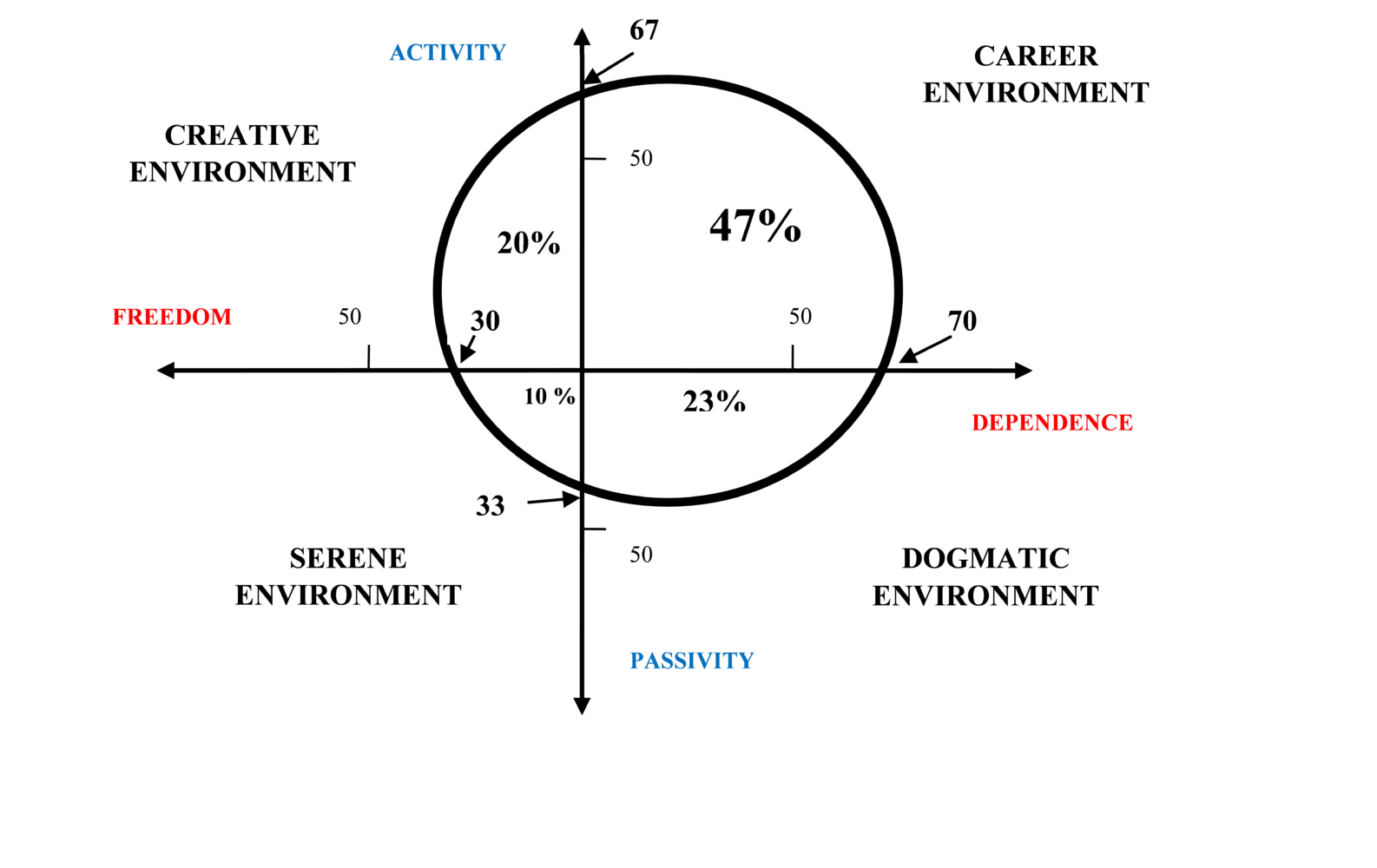
Figure 1. Graphically built ratio model of types of environments in the analyzed environment
- 3. Graphically built ratio model of types of environments in the analyzed environment (Figure 1.)
- The vector construction. According to the answers to the diagnostic questions, the corresponding vector is constructed in the coordinate system, which allows to additionally characterize the environment. The responses to diagnostic questions are considered with no percentage value, only “A”or “B”.
One of twelve theoretically vectors (three in each of the four sectors of the coordinate system), that models a certain type of personal development environment, can be obtained through a simple mathematical construction (Figure 2). For example, when analyzing any environment, we get three points on the “Dependence” scale and on the “Activity” scale, but zero points on the “Freedom” scale and on the “Passivity” scale. Such an environment can be called “Typical Career Environment” (Figure 3).
The other example shows that we have one point on the “Freedom” scale, two points on the “Dependence” scale, three points on the “Activity” scale, and zero points on the “Passivity” scale. As the scores obtained on the Freedom-Dependence dimension were distributed on different scales, it is necessary to obtain their sum, bearing in mind the character of each score (“+” or “-”): -1+2=+1, i.e., in the end one point on the “Dependence” scale should be taken into account.
Thus, such a vector forms a “career” environment, which stimulates high activity and involves a small degree of dependence. Such an environment can be referred to as the “career environment of dependent activity”.
Alternatively, it is possible to get zero points on the “Freedom” scale, three points on the “Dependence” scale, two points on the “Activity” scale and one point on the “Passivity” scale.
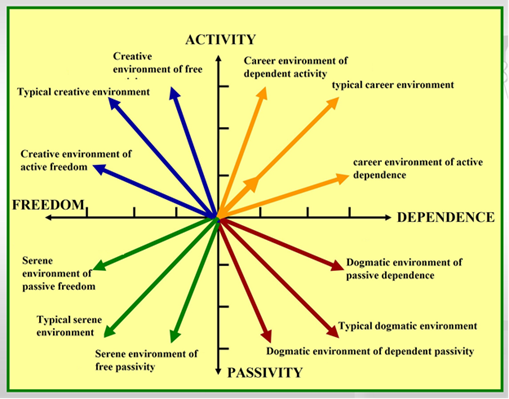
Figure 2. Total spectrum of environment types
Since the scores obtained on the Activity – Passivity dimensions were distributed on different scales, it is necessary to obtain their sum, taking into account the character of each score (“+” or “-”): +2-1=+1, i.e., as a result one point on the “Activity” scale is taken into account. After that, the corresponding vector models the “career” environment, which promotes the development of a high degree of dependence and a low degree of activity – “career environment of active dependence”. The similar picture of the possible modeling construction of vectors can be obtained in each sector of the system of coordinates.
Two points on the “Freedom” scale and one point on the “Dependence” scale can finally be obtained: +2-1=+1, and two points on the “Activity” scale and one point on the “Passivity” scale: +2-1=+1.
- “Social wind”.
It is it is clear that with the exception of rare cases of complete isolation of the personality from external social contacts (monastery, sect, village hinterland, etc.) the character of the personality’s development, besides the dominant educational environment of the family or educational institution, i.e. “structure functioning environment”, will be influenced either way through those or other interactions with other people, with society in general, i.e. “environment of living environment”. In a real-life situation, the development of the personality is influenced, as a rule, not only by one type of environment, but several, particularly, “the influence of the street” will inevitably have an impact.
It is possible to model the effect of such influence by including a vector of influence of the broad social environment, called the “social wind”, into the methodology. The social wind always “blows” in the direction of dependence and passivity and coincides in this respect with the vector that models the dogmatic environment.
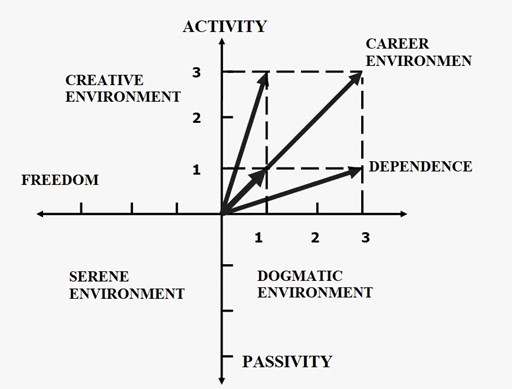
Figure 3. Example of the construction of educational environment vector models.
Thus, it is necessary to somehow indicate the extent to which the vector of social influence shifts the result of the basic educational environment in the specified direction. If we consider that as a result of the “Social wind” the formed personality can be referred as a type adjacent to its basic educational environment in the direction of the increasing levels of dependence and passivity, then the vector obtained by such shift is considered as a “vector of personality” developed in this environment (Figure 4). It is important to note that in the conditions of a typical dogmatic environment the directions of vectors of this environment and the “Social wind” coincide, reinforcing each other, it is possible to say, there is a “resonance effect”. Moreover, the direction of such a powerful influence “pushes” the personality to absolute passivity and absolute dependence, which is in “prison” conditions.
Results
3.1 The empirical studies of school environment perception
The conducted researches of school environment perception (Figure 5) during the period from 1993 to 2023 based on the method of vector modeling of environments which involved teachers and students of more than two thousand Russian schools, demonstrated that students (as well as qualified external experts) perceive the school environment mainly as “career” and “dogmatic”, i.e., connected with the dimension “Dependence” (85 %). School teachers’ answers to diagnostic questions are dominated by the attitudes that characterize the same school environment as “career” and “creative”, i.e., connected with the Activity dimension (95%).
According to the results of research, the percentage of “creative” environment in schools does not exceed 15%, and in most cases, it is about 5-7% (Yasvin, 2019).
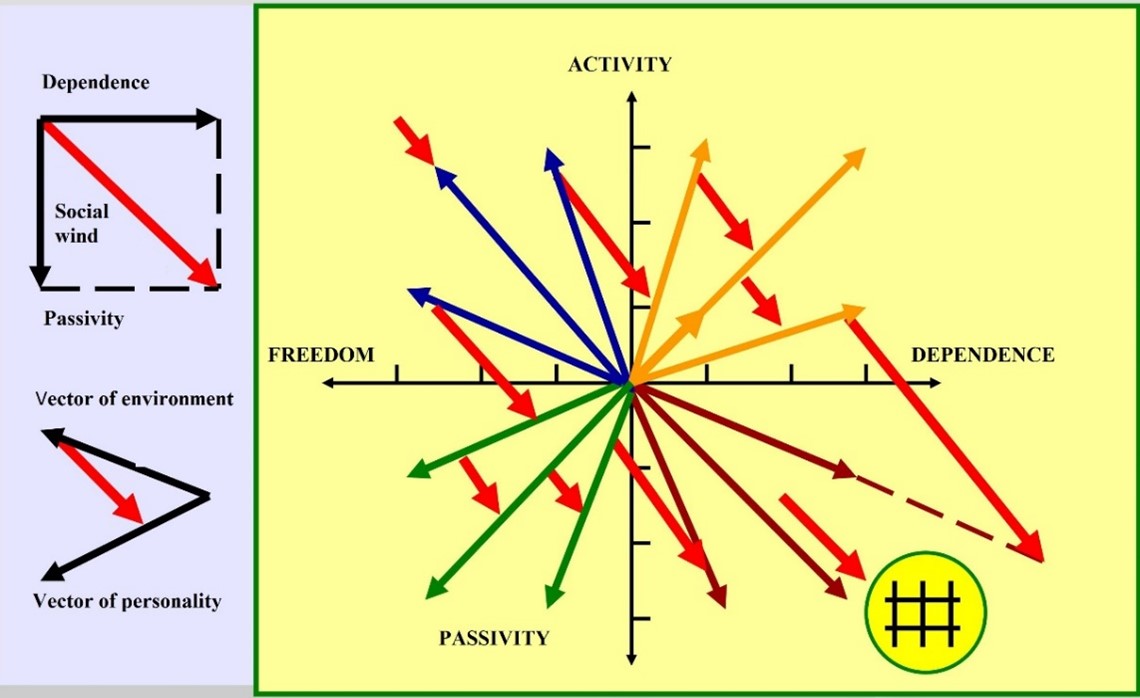
Figure 4. The nature of society’s influence on the personality developing in different types of environments
The teachers negatively deny the presence of any elements of a “serene” environment in their schools. It should be noted that a “serene” environment is the only environment in which a child can gain inspiration, dreams, and build his or her imaginative images of a desirable future. “Dogmatic” environment is also given a small place by the teachers in the evaluation of their educational practice. The teachers and students agree that the educational process at school takes about half of its course in a “career” type of environment. At that, what in the teachers’ minds is perceived as a “creative” environment (“free” and “active”), is evaluated by the students as “dogmatic” environment (“passive” and “dependent”) which is radically opposite. As mentioned above, qualified experts also evaluate the school environment as predominantly “career dogmatic.
3.2. Environment studies at different levels of education
The comparison of school educational environment research results with the results of the analysis of preschool environments, conducted by us together with Yu.Yu. Kondrashina (Yasvin, 2019), and universities (Kaptzov, 2003; Nagornova, 2005) allowed us to see its dynamics at different stages of the educational process (Figure 6).
From the point of view of the developmental potential of the environment the most adequate is the environment of preschool institutions (72% on dimension Activity). Subsequently, a drastic increase in the share of dogmatic environment (by three times), primarily due to a decrease in the share of the creative environment is noted in the general education school. Further increase in the share of dogmatic environment (which forms a dependent and passive personality) is typical for bachelor’s education (76%), in which students must memorize the basics of science, staying entirely in the environment, which forms a dependent type of personality (94%). The structure of the educational environment becomes more balanced, similar to the structure of the school environment, only during the senior year of higher education, during the master’s program. Nevertheless, the types of environments associated with the axis “Dependence” remain completely dominant (86%).
Thus, it is possible to conclude that, starting from general education school, students perform their educational activities in the “dogmatic” and “career” types of environments, fostering the formation of a dependent personality.
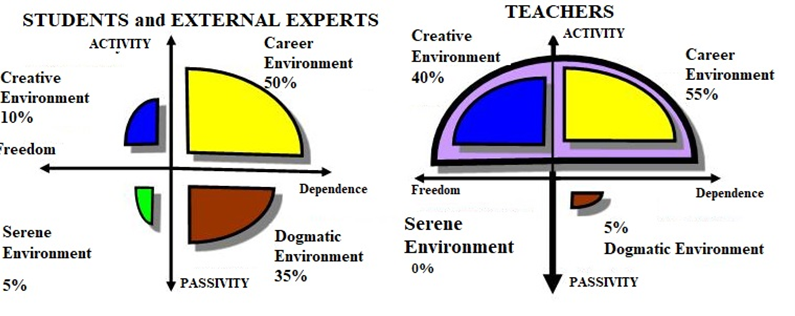
Figure 5. Evaluation of teachers’, students’, and external experts’ perceptions of the school environment
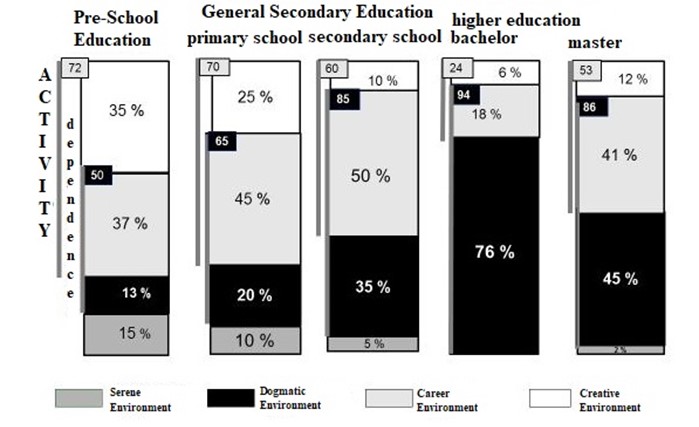
Figure 6. The pattern of educational environments at different stages of education
Discussion
It is necessary to emphasize that the classification of educational spaces based on the system of coordinates was proposed by R.E. Ponomarev (Ponomarev, 2003), who identified the educational space dimensions: External Organized – Internal not Organized, Conscious – Unconscious, and Individual – Group. Given classification includes the following educational spaces: free (unorganized conscious), manipulative (organized unconscious), natural (individual unorganized unconscious) and authoritarian (group organized conscious).
Based on the method of vector modeling, the classification of educational spaces by R.E. Ponomarev can be correlated with the typology of educational environments by J. Korchak: free space is an ideological (creative) environment, manipulative space is a career environment, natural space is a serene environment, authoritarian space is a dogmatic environment.
The method of vector modeling of educational environments also provided a comparative analysis of a number of pedagogical models and typologies and established complementarity between
them: the typology of the educational environment by J. Korchak (Korczak, 1990), school types of students P.F. Lesgaft (Lesgaft, 1991), the model of the “cultural-historical school” of V.V. Rubtsov (Rubtsov, 1996), the types of organizational cultures of pedagogical teams according to K. Cameron and R. Quinn (Cameron & Quinn, 2001), as well as to develop a typology of teachers’ “pedagogical positions” complementary to these pedagogical developments (Yasvin, 2019) (Table 2).
The developed method of educational environments vector modeling enables researchers to conduct the historical and pedagogical analysis of both educational systems implemented in practice and their projects (Figure 7).
The method of educational environment vector modeling for the analysis of classical educational systems (Yasvin, 2019) has been successfully used for 30 years in the process of teaching the course “History of Pedagogy” to organize practical work of students, the students build appropriate modeling vectors based on independent analysis of primary sources and further group historical and pedagogical discussion.
Table 2. Complementarity of various pedagogical models and typologies based on the vector modeling method.
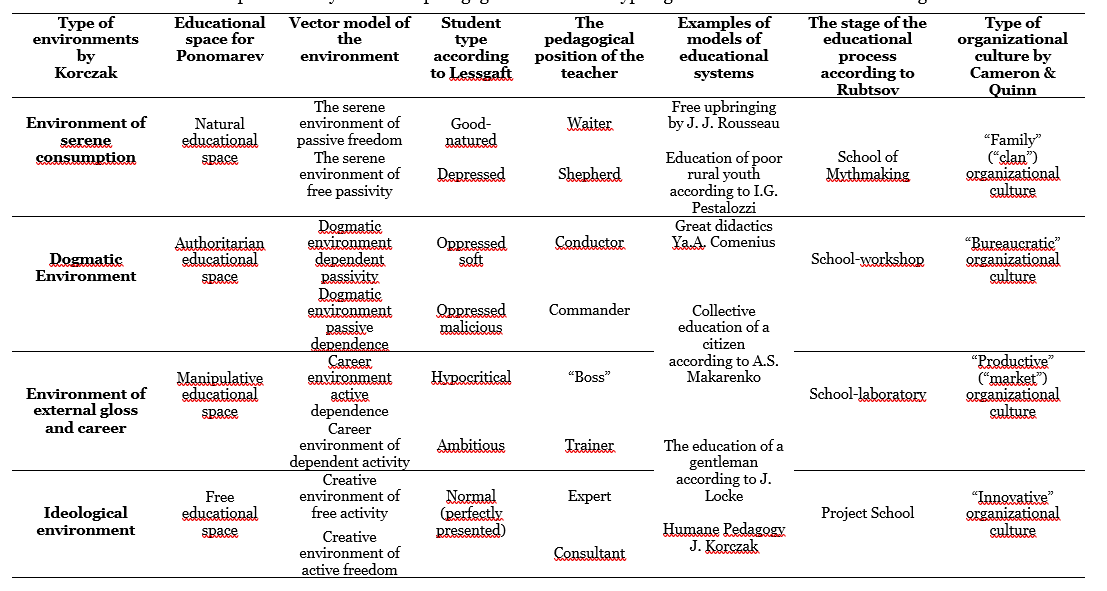
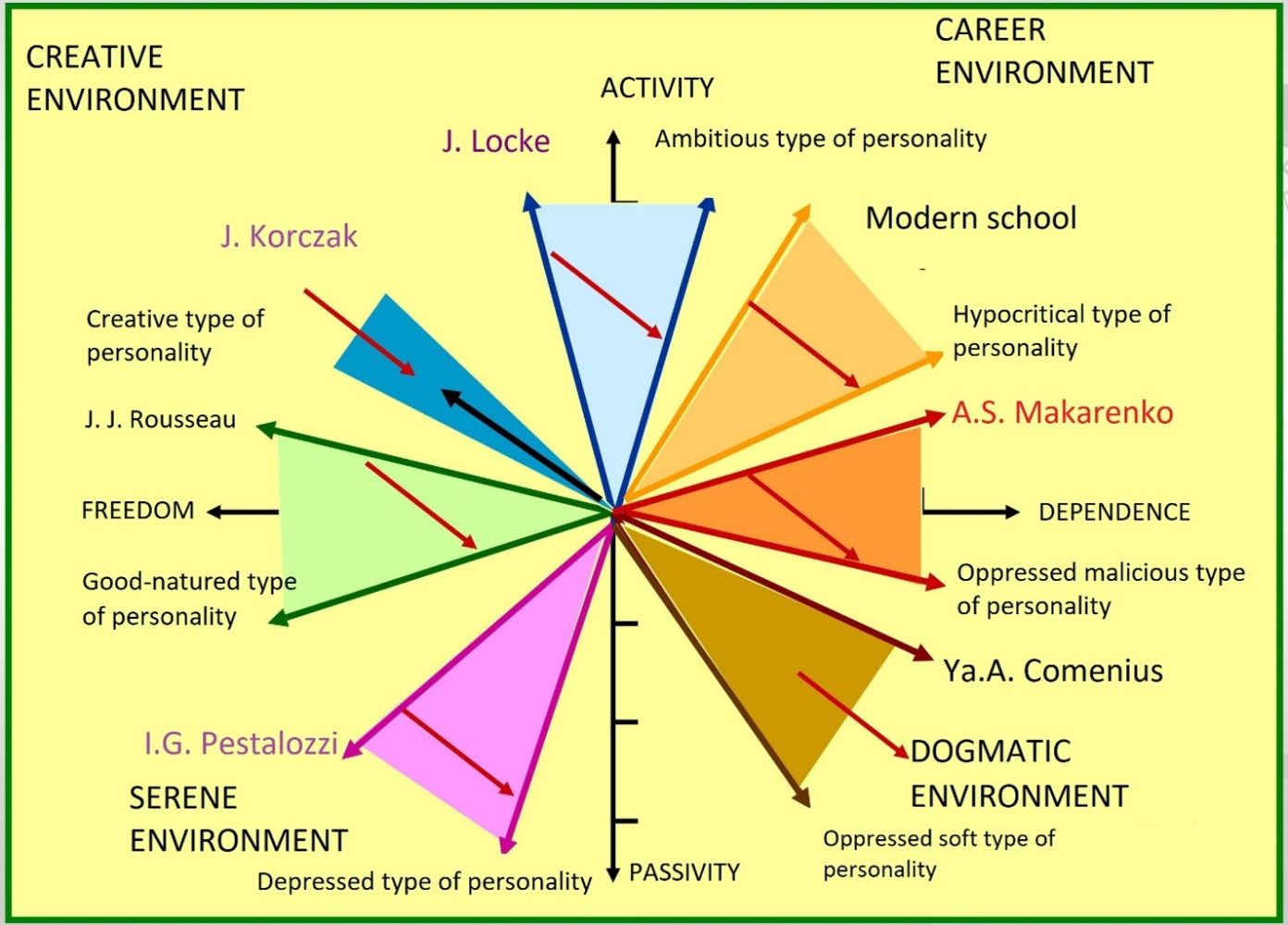
Figure 7. Comparative analysis of classical pedagogical concepts and modern school based on vector modeling of the personality development environment
Conclusions
Formation of a unified theory of environmental approach in pedagogy and educational psychology based on the environmental-personal concept of developing educational environment creates the preconditions for the formation of a field of research as environmental psychological pedagogy, the subject of which is the study of the influence of environmental conditions on personal development and teaching design environment as a set of opportunities for personal development. Research problems of environmental psychological pedagogy can be associated primarily with a structural and content analysis of the environment of personal development, the study of environmental factors in personal development, the study of psychological mechanisms of personal development in the educational environment, a comparative analysis of different educational environments, humanitarian assessment of educational environments, typology of educational environments, the study of perception of educational environments, study of subjective relations in the educational environment; design of innovative educational environments; pedagogical organization of effective educational environments, etc.
The method of vector modeling of the personal development environment based on the typology of “educating environments” by J. Korczak is universal and makes it possible to analyze the personal development potential of different local environments such as school, family, club, sports, volunteer, informal youth associations, neighborhood environment, etc., as well as environments developed by prominent teachers of the past and the present in the process of historical and pedagogical analysis of their educational systems.
References
- Cameron, K. (2001). Diagnosis and Change of Organizational Culture / K. Cameron, R. Quinn. St. Petersburg. 2001. [Kemeron, K. Diagnostika i izmeneniye organizatsionnoy kul’tury / K. Kemeron, R. Kuinn. Sankt-Peterburg, 2001].
- Harms, T., Jacobs, E.V., & White, D.R. (1996). School-age Care Environments Rating Scale. New York: Teachers College Press, 1996.
- Ivanova, E.V. (2016). Application of SACERS international scale in expert assessment of conditions for the implementation of the basic educational program at the stages of primary and basic general education. Methodist, 10, 6-8. [Ivanova, Ye.V. (2016). Primeneniye mezhdunarodnoy shkaly SACERS pri ekspertnoy otsenke usloviy realizatsii osnovnoy obrazovatel’noy programmy na urovnyakh nachal’nogo i osnovnogo obshchego obrazovaniya. Metodist. 2016. № 10. S. 6-8].
- Kaptzov, A.V. & Kichigin, V.I. (2003). Psycho-pedagogic support of multilevel higher education. Samara, 2003. [Kaptsov, A.V. Psikhologo-pedagogicheskoye soprovozhdeniye mnogourovnevogo vysshego obrazovaniya / A.V. Kaptsov, V.I. Kichigin. Samara, 2003.].
- Korczak, J. (1990). How to love a child. Pedagogical Legacy. Мoscow, pp. 19-174. [Korchak Dzh. Kak polyubit’ rebenka. Pedagogicheskoye naslediye. M., 1990. S. 19-174].
- Lesgaft, P.F. (1991). Family Education of the Child and its significance. Moscow [Lesgaft, P.F. Semeynoye vospitaniye rebenka i yego znacheniye. Moskva, 1991].
- Manuilov, Y.S. (1997). The environmental approach in education: Ph. D. in Ped. sciences: 13.00.01 – Moscow. [Manuylov Yu.S. Ekologicheskiy podkhod k obrazovaniyu: dis. … Doktor ped. nauk: 13.00.01 – Moskva, 1997].
- Model of monitoring the educational process in the logic of the environmental approach: Training and methodological handbook (2010). Nizhny Novgorod. [Model’ monitoringa obrazovatel’nogo protsessa v logike ekologicheskogo podkhoda: Uchebno-metodicheskoye posobiye. Nizhniy Novgorod, 2010].
- Nagornova, L.E. (2005). Students’ assessment of the university environment. Voprosy khitaristheskikh nauk, 3, 34-52. [Nagornova L.Ye. Otsenka studentami universitetskoy sredy. Problemy gumanitarnykh nauk, 2005, 3, 34–52].
- Orlov, E. V. (2011). Procedures for assessing the quality of educational services. Collection of the All-Russian Scientific-Practical Conference “Innovative technologies in education: subjectivity, resourcefulness, technology”, Moscow. [Orlov Ye. V. Protsedury otsenki kachestva obrazovatel’nykh uslug. Sbornik Vserossiyskoy nauchno-prakticheskoy konferentsii «Innovatsionnyye tekhnologii v obrazovanii: sub”yektnost’, izobretatel’nost’, tekhnologichnost’», Moskva, 2011].
- Ponomarev, E.R. (2003). Educational space as a fundamental concept of the educational theory. Pedagogical Education and Science, 1, 29-31. [Ponomarov, Ye.R. Obrazovatel’noye prostranstvo kak osnova kontseptual’nykh teoriy obrazovaniya. Pedagogicheskoye obrazovaniye i nauka. 2003. № 1. S. 29-31].
- Rubtsov, V.V. (1996). The Foundations of Socio-Genetic Psychology. Voronezh. [Rubtsov, V.V. Osnovy sotsiogeneticheskoy psikhologii. Voronezh, 1996].
- Yasvin, V.A. (1997). Modeling the educational environment. Moscow. [Yasvin, V.A. Modelirovaniye obrazovatel’noy sredy. Moskva, 1997].
- Yasvin, V.A. (2000). Psychological modeling of educational environments. Psychological Journal, 21(4), 79-88. [Yasvin, V.A. Psikhologicheskoye modelirovaniye obrazovatel’noy sredy. Psikhologicheskiy zhurnal. 2000. T. 21. № 4. S. 79-88].
- Yasvin, V.A. (2013). Ecological psychology of education as a discipline of psychological and pedagogical science. Vestnik of Moscow City Pedagogical University. Pedagogy and Psychology Series, 4 (26), 42-49. [Yasvin, V.A. (2013). Ekologicheskaya psikhologiya obrazovaniya kak napravleniye psikhologo-pedagogicheskoy nauki. Vestnik Moskovskogo gorodskogo pedagogicheskogo universiteta. Seriya «Pedagogika i psikhologiya». 2013. № 4 (26). str. 42-49].
- Yasvin, V.A. (2019). School environment as a subject of evaluation: expertise, design, management. Moscow. [Yasvin, V.A. Shkol’naya sreda kak predmet izmereniya: ekspertiza, proyektirovaniye, upravleniye. Moskva, 2019].
Comments (0)
The paper highlights the general statements of various methodological concepts of the environment of personal development. The summary of different methodological approaches to the analysis of educational environments is presented and their disadvantages are discussed. Original method of vector modeling of the environment of personality development based on Janusz Korczak’s typology of “educating environments” is offered. The scales “Freedom – Dependence” and “Activity – Passivity” are distinguished. It is shown that “dogmatic” environment contributes to the formation of dependent and passive personality; “ideological” (creative) to the formation of free and active personality; “serene” to the formation of free, however, passive; “career” environment contributes to the formation of active, but dependent personality. Examples of several empirical and analytical studies based on the method of vector environment modeling are given. This method demonstrated the complementarity of different pedagogical and socio-psychological typologies.
- Methodology of the
environmental studies
The educational philosophy traditionally considers the environment as one of the most important factors of personal development. All the heritage of the classical pedagogical scholars from J.M. Comenius, J. Locke, J.-J. Rousseau, and J.G. Pestalozzi to M. Montessori, J. Korchak, and A.S. Makarenko. Montessori, J. Korczak, and A.S. Makarenko is essentially dedicated to the description of the authors’ personal development environments.
A.A. Leontiev states that that the educational environment concept is one of the key psychological and educational concepts that is now being actively developed. Thus, it is possible to identify at least five significantly different methodological approaches to the study of the school environment.
- The collectivist approach includes numerous studies based on identifying and describing a wide range of “pedagogical conditions and factors. It is characterized by insufficient scientific rigor and completeness of the proposed structural and content models of various functional environments (from “information-educational” to “health-forming”) and empirical eclecticism. The methodological roots of this approach can be found in the works on environmental studies and pedology in the 1920s.
- The socio-psychological approach is the most widespread approach in the world, the research tasks are successfully solved within the frame-work of social and pedagogical psychology.
- The spatial-subjective approach was formed based on the methodology of scientific direction as behavioral geography (J. Gold). The studies are focused on the analysis of behavior as conditioned by the spatial features of the environment. M. Montessori’s researchers can be referred to this direction, which emphasizes the pedagogical organization of the subject learning environment.
- Y.S. Manuylova’s environmental approach to education is original that considers systematically the environment. This approach is a perspective methodology that can be used due to its pedagogical design (Manuilov, 1997). Nevertheless, the flipside of the originality of the conceptual apparatus is proven to be the difficulty of its “compatibility” with the traditional terminology of other researchers.
- The eco-personal approach to the analysis of the environment is based on psychological and pedagogical methodology (E. Brunswick, K. Levin, A. Maslow, R. Sommer, H. Ozmond, C. Pavlik, W. Bronfenbrenner, J. Gibson, etc.). The approach is systemic in nature and has a wide and successfully applied instrumental and methodological support, which makes it extremely popular with scientists and practitioners.
The comparative analysis of various methodological approaches to the study of the environment of personal development allows us to high-light several common complementary, non-contradictory standpoints (Yasvin, 2013):
- The developing personality is seen as an agent in the relationship with the environment.
- The environment is considered as a spatially and/or event-limited environment of the personality.
- The environment is conceptualized as a set of conditions, circumstances, events, factors, and influences on the developing personality, as well as personality-developing opportunities to which special pedagogical value is attributed.
- The environment becomes the environment for personal development through activities and/or communication aimed at this environment.
- The environment has the resource potential of personal development which can be implemented only by means of the activity of the person him/herself.
- The environment is of a dynamic nature.
- The environment structure includes spatial-subject, informational, organizational, technological, and social components. The social component of the environment is assigned the most significant role in the formation and development of the personality.
- In a certain type of environment, which has specific characteristics, a certain type of personality is formed.
- The educational environment can be described through the system of parameters characterizing various aspects of its organization and functioning.
Thus, the environment of personal development is seen as institutionally limited set of changing opportunities about its development, which emerge under the influence of organizational and technological and spatial-subject conditions, as well as multidirectional factors in the context of event interaction and activity of the individual as a member of the community.
1.2 Tools of personal development environment study
Insufficient support of the special criterial apparatus and diagnostic tools remains the problem of the personal development environment study, due to which environmental researchers are forced to adapt to their scientific tasks the methodological repertoire that was previously developed for solving other research problems, primarily socio psychological. The most popular of the methodological complex to study the educational environment used, in particular, by B. Fraser: Questionnaire on Teacher Interaction (QTI); Science Laboratory Environment Inventory (SLEI); Constructivist Learning Environment (SLEI); What Is Happening In This Class (WIHIC)? The QTI focuses on the nature of interpersonal relationships between teachers and students. The SLEI assesses the high school learning environment in terms of cohesiveness, openness, integration, clarity, and the quality of the material to be studied. The CLES questionnaire analyzes student engagement in conversations and discussions. The WIHIC questionnaire includes scales of student cohesion, teacher support in learning, class participation, etc. As can be seen from the content of these techniques, they are completely focused on the socio-psychological aspects of the educational process and do not even attempt a systematic study of the educational environment. Same can be said about R. Mohs’s Classroom Environment scale.
The International School-Age Care Environment Rating Scale (SACERS), developed by the Universities of North Carolina and Montreal (Harms, 1996), includes forty-nine indicators grouped under the headings: interior space and furnishings, health and safety, activities, interaction, curriculum, staff development, and special needs. As E.V. Ivanova, who is an active popularizer of the SACERS methodology, admits, “The authors of SACERS adopted ideas from numerous resources. Rather than offering a specific philosophy of peer review, the SACERS scale is based on criteria of the adequacy of the educational environment to the age features of children and the school curriculum” (Ivanova, 2016). This methodology leaves an impression of being eclectic, despite its undoubted practical utility.
The advantage of the method is the possibility to involve external experts as well as students themselves, teachers, and parents. SACERS test is a part of an expert complex created based on Early Childhood Environment Rating Scales (ECERS), which also includes Family Day Care Rating Scale (FDCRS) and Infant/Toddler
Environment Rating Scale (ITERS). The given complex of expert techniques is used in educational practice in the USA, Canada and in some European countries, which allows to conduct the comparative research.
- Manuilov (Manuilov, 1997) reflected the problem of expanding the criterion base for assessing the quality of school environments and the creation of appropriate pedagogical tools.
The monitoring model of the educational process implemented in the logic of the environmental approach characterizes the level of implementation of pedagogical technology from goal setting to the result, as well as the teachers’ skills.
The quality assessment model of educational services offered by E.V. Orlov includes three parameters: the environment of the educational process, its effectiveness, and customer satisfaction. The indicators of these parameters are based on regulatory requirements.
It is necessary to emphasize that all the presented developments are based on a synthesis of the collectivist, socio-psychological and spatial-subjective approaches and do not reflect a systemic view of the nature of personal development in a certain environment.
The purpose of the study is to develop an expert tool based on the ecological-psychological approach for the system analysis and organization of the environment of personal development and its validation.
Research hypothesis is the assumption that the following vector model of personal development environment, developed based on the typology of “nurturing environments” by J. Korczak. Korczak in the logic of the ecological-personal approach, is an effective expert-project tool capable of methodologically providing a systematic expert analysis of the pedagogical quality of environments, as well as pedagogical design of personally developing environments and monitoring their development.
2.1. Expert Questionnaire
The work of Janusz Korczak “How to Love a Child” first published in 1919, characterizes four types of nurturing environments: dogmatic, ideological, serene consumption, and external gloss & career. Qualitative analysis showed that according to J. Korczak’s typology, dogmatic environment promotes the formation of a dependent and passive personality; ideological – formation of a free and active personality; serene consumption – formation of a free, however, passive personality; career environment – formation of an active, but dependent personality.
The developed method of vector modeling of personal development environment (Yasvin, 1997; Yasvin, 2000) provides construction of a coordinate system that consists of two axes: freedom-dependence and activity-passivity. It is necessary to answer six diagnostic questions based on the pedagogical analysis of this environment to build a vector corresponding to this or that type of environment in the coordinate system.
With the help of three questions, it is possible to determine whether given environment provides opportunities for the independent development of the personality and, accordingly, three questions provide opportunities for the development of personality’s activity. Each question can be answered by ticking one point on the corresponding scale (activity, passivity, independence, or dependence). Activity is defined as having such properties as pro-activity, aspiration to achieve something, persistence in this aspiration, the ability of a person to fight his/her interests, the ability of a person to defend his/her interests, etc.; respectively, Passivity can be considered as zero activity. Freedom is associated with independence of judgment and actions, right to choose. Dependence is understood as obedience, subordination, and adjustability.
Diagnostic questions and interpretation of answers:
The Freedom – Dependence dimension. Rate in terms of percentages.
- Whose interests and values are prioritized in this environment: a) the personality; b) society (group)?
The priority of personal interests and values over public can be considered as an opportunity for the free development of the personality, accordingly, a score on the “Freedom” scale is given; if the priority of public interests is chosen, a score on the “Dependence” scale is given.
- 2. Which person adjusts to whom in the process of interaction: a) an adult (senior) to the child; b) a child to an adult?
If it is noted that in the given environment, the tutor adjusts to the child prevail (or, at least, there is an aspiration of tutor to try to adjust), correspondingly, a score on the scale “Freedom” is given; if it is stated that the child is forced to adapt to his or her tutors, then a score on the scale “Dependence” is given.
- Which form of parenting is practiced in the given environment: a) individual; b) collective (group)?
Orientation of the environment to an individual form of upbringing is interpreted as the fact that the environment provides additional opportunities for the free development of an independent child, a score on the scale “Freedom” is given; if the environment prioritizes collective upbringing, a score on the scale “Dependence” is given.
For the Activity – Passivity dimension. Please estimate in percent-ages.
- Is punishment of the child practiced in this environment: a) yes; b) no?
The absence of punishment is considered as a factor that contributes to the development of personal activity, a score on the scale of “Activity” is given, if there is a system of punishment in the educational environment (used both directly and indirectly) a score on the scale of “Passivity” is given.
- Does the environment encourage a person to take any initiative: a) yes; b) no?
A score on the “Activity” scale is given if
positive reinforcement of the initiative (both conscious and unconscious) can be observed in the environment in question, i.e., it is regarded as an additional opportunity to develop the activity; however, a score on the “Passivity” scale is given if the initiative shown can typically result in various kinds of inconveniences.
- Does the environment provide any positive feedback on any of the creative manifestations of the personality: a) yes; b) no?
When the environment provides the conditions under which the creativity could be stimulated or could be evaluated, such an environment is conducive to the development of activity, a score on the scale “Activity” is given; if creative manifestations are ignored, as a rule, remain, unnoticed and unappreciated, then a score on the scale “Passivity” is given.
According to the assessment, the analyzed environment can be allocated to one of four basic types: Dogmatic environment, which promotes the development of passivity and dependency; Career environment, which promotes the development of activity, but also dependence; Serene environment that promotes free development, but also determines the formation of passivity; finally, the Creative environment, that promotes the free development of the active personality.
2.2. Analysis and graphical representation of the examination results
- It is necessary to fill in the table and calculate the sum of percentages received for each of the directions of dimensions (“Freedom”, “Dependence”, “Activity”, and “Passivity”). Each amount received should be divided by 3 (rounded to the whole). See example (Table 1).
Table 1. Representation of the examination results
|
Questions |
Scale “Freedom” |
Scale “Dependence” | ||
| Answers | Percentages | Answers | Percentages | |
| 1 | А | 20 | B | 80 |
| 2 | А | 30 | B | 70 |
| 3 | А | 40 | B | 60 |
| Total sum | 90 | 210 | ||
| Indicator | 30 | 70 | ||
| Scale “Activity” | Scale “Passivity” | |||
| Answers | Percentages | Answers | Percentages | |
| 4 | B | 70 | А | 30 |
| 5 | А | 60 | B | 40 |
| 6 | А | 70 | B | 30 |
| Total sum | 200 | 100 | ||
| Indicator | 67 | 33 | ||
2.
In order measure the percentage of the different types of environments, you should multiply the values of the corresponding dimensions, and divide the obtained result by one hundred.
Dogmatic environment (%) = “Dependence” values is to multiply by “Passivity” values and divide by 100 (rounded to integers).
Example: 70*33:100=23% .
Career Environment (%) = “Dependence” values should be multiplied by “Activity” values and divided by 100.
Example: 70*67:100=47%.
Creative Environment (%) = “Freedom”” values should be multiplied by “Activity” values and divided by 100.
Example: 30*67:100=20%.
Serene environment (%) = “Freedom” values should be multiplied by “Passivity” values and divided by 100.
Example: 30*33:100=10%.
Figure 1. Graphically built ratio model of types of environments in the analyzed environment
- 3. Graphically built ratio model of types of environments in the analyzed environment (Figure 1.)
- The vector construction. According to the answers to the diagnostic questions, the corresponding vector is constructed in the coordinate system, which allows to additionally characterize the environment. The responses to diagnostic questions are considered with no percentage value, only “A”or “B”.
One of twelve theoretically vectors (three in each of the four sectors of the coordinate system), that models a certain type of personal development environment, can be obtained through a simple mathematical construction (Figure 2). For example, when analyzing any environment, we get three points on the “Dependence” scale and on the “Activity” scale, but zero points on the “Freedom” scale and on the “Passivity” scale. Such an environment can be called “Typical Career Environment” (Figure 3).
The other example shows that we have one point on the “Freedom” scale, two points on the “Dependence” scale, three points on the “Activity” scale, and zero points on the “Passivity” scale. As the scores obtained on the Freedom-Dependence dimension were distributed on different scales, it is necessary to obtain their sum, bearing in mind the character of each score (“+” or “-”): -1+2=+1, i.e., in the end one point on the “Dependence” scale should be taken into account.
Thus, such a vector forms a “career” environment, which stimulates high activity and involves a small degree of dependence. Such an environment can be referred to as the “career environment of dependent activity”.
Alternatively, it is possible to get zero points on the “Freedom” scale, three points on the “Dependence” scale, two points on the “Activity” scale and one point on the “Passivity” scale.
Figure 2. Total spectrum of environment types
Since the scores obtained on the Activity – Passivity dimensions were distributed on different scales, it is necessary to obtain their sum, taking into account the character of each score (“+” or “-”): +2-1=+1, i.e., as a result one point on the “Activity” scale is taken into account. After that, the corresponding vector models the “career” environment, which promotes the development of a high degree of dependence and a low degree of activity – “career environment of active dependence”. The similar picture of the possible modeling construction of vectors can be obtained in each sector of the system of coordinates.
Two points on the “Freedom” scale and one point on the “Dependence” scale can finally be obtained: +2-1=+1, and two points on the “Activity” scale and one point on the “Passivity” scale: +2-1=+1.
- “Social wind”.
It is it is clear that with the exception of rare cases of complete isolation of the personality from external social contacts (monastery, sect, village hinterland, etc.) the character of the personality’s development, besides the dominant educational environment of the family or educational institution, i.e. “structure functioning environment”, will be influenced either way through those or other interactions with other people, with society in general, i.e. “environment of living environment”. In a real-life situation, the development of the personality is influenced, as a rule, not only by one type of environment, but several, particularly, “the influence of the street” will inevitably have an impact.
It is possible to model the effect of such influence by including a vector of influence of the broad social environment, called the “social wind”, into the methodology. The social wind always “blows” in the direction of dependence and passivity and coincides in this respect with the vector that models the dogmatic environment.
Figure 3. Example of the construction of educational environment vector models.
Thus, it is necessary to somehow indicate the extent to which the vector of social influence shifts the result of the basic educational environment in the specified direction. If we consider that as a result of the “Social wind” the formed personality can be referred as a type adjacent to its basic educational environment in the direction of the increasing levels of dependence and passivity, then the vector obtained by such shift is considered as a “vector of personality” developed in this environment (Figure 4). It is important to note that in the conditions of a typical dogmatic environment the directions of vectors of this environment and the “Social wind” coincide, reinforcing each other, it is possible to say, there is a “resonance effect”. Moreover, the direction of such a powerful influence “pushes” the personality to absolute passivity and absolute dependence, which is in “prison” conditions.
3.1 The empirical studies of school environment perception
The conducted researches of school environment perception (Figure 5) during the period from 1993 to 2023 based on the method of vector modeling of environments which involved teachers and students of more than two thousand Russian schools, demonstrated that students (as well as qualified external experts) perceive the school environment mainly as “career” and “dogmatic”, i.e., connected with the dimension “Dependence” (85 %). School teachers’ answers to diagnostic questions are dominated by the attitudes that characterize the same school environment as “career” and “creative”, i.e., connected with the Activity dimension (95%).
According to the results of research, the percentage of “creative” environment in schools does not exceed 15%, and in most cases, it is about 5-7% (Yasvin, 2019).
Figure 4. The nature of society’s influence on the personality developing in different types of environments
The teachers negatively deny the presence of any elements of a “serene” environment in their schools. It should be noted that a “serene” environment is the only environment in which a child can gain inspiration, dreams, and build his or her imaginative images of a desirable future. “Dogmatic” environment is also given a small place by the teachers in the evaluation of their educational practice. The teachers and students agree that the educational process at school takes about half of its course in a “career” type of environment. At that, what in the teachers’ minds is perceived as a “creative” environment (“free” and “active”), is evaluated by the students as “dogmatic” environment (“passive” and “dependent”) which is radically opposite. As mentioned above, qualified experts also evaluate the school environment as predominantly “career dogmatic.
3.2. Environment studies at different levels of education
The comparison of school educational environment research results with the results of the analysis of preschool environments, conducted by us together with Yu.Yu. Kondrashina (Yasvin, 2019), and universities (Kaptzov, 2003; Nagornova, 2005) allowed us to see its dynamics at different stages of the educational process (Figure 6).
From the point of view of the developmental potential of the environment the most adequate is the environment of preschool institutions (72% on dimension Activity). Subsequently, a drastic increase in the share of dogmatic environment (by three times), primarily due to a decrease in the share of the creative environment is noted in the general education school. Further increase in the share of dogmatic environment (which forms a dependent and passive personality) is typical for bachelor’s education (76%), in which students must memorize the basics of science, staying entirely in the environment, which forms a dependent type of personality (94%). The structure of the educational environment becomes more balanced, similar to the structure of the school environment, only during the senior year of higher education, during the master’s program. Nevertheless, the types of environments associated with the axis “Dependence” remain completely dominant (86%).
Thus, it is possible to conclude that, starting from general education school, students perform their educational activities in the “dogmatic” and “career” types of environments, fostering the formation of a dependent personality.
Figure 5. Evaluation of teachers’, students’, and external experts’ perceptions of the school environment
Figure 6. The pattern of educational environments at different stages of education
It is necessary to emphasize that the classification of educational spaces based on the system of coordinates was proposed by R.E. Ponomarev (Ponomarev, 2003), who identified the educational space dimensions: External Organized – Internal not Organized, Conscious – Unconscious, and Individual – Group. Given classification includes the following educational spaces: free (unorganized conscious), manipulative (organized unconscious), natural (individual unorganized unconscious) and authoritarian (group organized conscious).
Based on the method of vector modeling, the classification of educational spaces by R.E. Ponomarev can be correlated with the typology of educational environments by J. Korchak: free space is an ideological (creative) environment, manipulative space is a career environment, natural space is a serene environment, authoritarian space is a dogmatic environment.
The method of vector modeling of educational environments also provided a comparative analysis of a number of pedagogical models and typologies and established complementarity between
them: the typology of the educational environment by J. Korchak (Korczak, 1990), school types of students P.F. Lesgaft (Lesgaft, 1991), the model of the “cultural-historical school” of V.V. Rubtsov (Rubtsov, 1996), the types of organizational cultures of pedagogical teams according to K. Cameron and R. Quinn (Cameron & Quinn, 2001), as well as to develop a typology of teachers’ “pedagogical positions” complementary to these pedagogical developments (Yasvin, 2019) (Table 2).
The developed method of educational environments vector modeling enables researchers to conduct the historical and pedagogical analysis of both educational systems implemented in practice and their projects (Figure 7).
The method of educational environment vector modeling for the analysis of classical educational systems (Yasvin, 2019) has been successfully used for 30 years in the process of teaching the course “History of Pedagogy” to organize practical work of students, the students build appropriate modeling vectors based on independent analysis of primary sources and further group historical and pedagogical discussion.
Table 2. Complementarity of various pedagogical models and typologies based on the vector modeling method.
Figure 7. Comparative analysis of classical pedagogical concepts and modern school based on vector modeling of the personality development environment
Formation of a unified theory of environmental approach in pedagogy and educational psychology based on the environmental-personal concept of developing educational environment creates the preconditions for the formation of a field of research as environmental psychological pedagogy, the subject of which is the study of the influence of environmental conditions on personal development and teaching design environment as a set of opportunities for personal development. Research problems of environmental psychological pedagogy can be associated primarily with a structural and content analysis of the environment of personal development, the study of environmental factors in personal development, the study of psychological mechanisms of personal development in the educational environment, a comparative analysis of different educational environments, humanitarian assessment of educational environments, typology of educational environments, the study of perception of educational environments, study of subjective relations in the educational environment; design of innovative educational environments; pedagogical organization of effective educational environments, etc.
The method of vector modeling of the personal development environment based on the typology of “educating environments” by J. Korczak is universal and makes it possible to analyze the personal development potential of different local environments such as school, family, club, sports, volunteer, informal youth associations, neighborhood environment, etc., as well as environments developed by prominent teachers of the past and the present in the process of historical and pedagogical analysis of their educational systems.
- Cameron, K. (2001). Diagnosis and Change of Organizational Culture / K. Cameron, R. Quinn. St. Petersburg. 2001. [Kemeron, K. Diagnostika i izmeneniye organizatsionnoy kul’tury / K. Kemeron, R. Kuinn. Sankt-Peterburg, 2001].
- Harms, T., Jacobs, E.V., & White, D.R. (1996). School-age Care Environments Rating Scale. New York: Teachers College Press, 1996.
- Ivanova, E.V. (2016). Application of SACERS international scale in expert assessment of conditions for the implementation of the basic educational program at the stages of primary and basic general education. Methodist, 10, 6-8. [Ivanova, Ye.V. (2016). Primeneniye mezhdunarodnoy shkaly SACERS pri ekspertnoy otsenke usloviy realizatsii osnovnoy obrazovatel’noy programmy na urovnyakh nachal’nogo i osnovnogo obshchego obrazovaniya. Metodist. 2016. № 10. S. 6-8].
- Kaptzov, A.V. & Kichigin, V.I. (2003). Psycho-pedagogic support of multilevel higher education. Samara, 2003. [Kaptsov, A.V. Psikhologo-pedagogicheskoye soprovozhdeniye mnogourovnevogo vysshego obrazovaniya / A.V. Kaptsov, V.I. Kichigin. Samara, 2003.].
- Korczak, J. (1990). How to love a child. Pedagogical Legacy. Мoscow, pp. 19-174. [Korchak Dzh. Kak polyubit’ rebenka. Pedagogicheskoye naslediye. M., 1990. S. 19-174].
- Lesgaft, P.F. (1991). Family Education of the Child and its significance. Moscow [Lesgaft, P.F. Semeynoye vospitaniye rebenka i yego znacheniye. Moskva, 1991].
- Manuilov, Y.S. (1997). The environmental approach in education: Ph. D. in Ped. sciences: 13.00.01 – Moscow. [Manuylov Yu.S. Ekologicheskiy podkhod k obrazovaniyu: dis. … Doktor ped. nauk: 13.00.01 – Moskva, 1997].
- Model of monitoring the educational process in the logic of the environmental approach: Training and methodological handbook (2010). Nizhny Novgorod. [Model’ monitoringa obrazovatel’nogo protsessa v logike ekologicheskogo podkhoda: Uchebno-metodicheskoye posobiye. Nizhniy Novgorod, 2010].
- Nagornova, L.E. (2005). Students’ assessment of the university environment. Voprosy khitaristheskikh nauk, 3, 34-52. [Nagornova L.Ye. Otsenka studentami universitetskoy sredy. Problemy gumanitarnykh nauk, 2005, 3, 34–52].
- Orlov, E. V. (2011). Procedures for assessing the quality of educational services. Collection of the All-Russian Scientific-Practical Conference “Innovative technologies in education: subjectivity, resourcefulness, technology”, Moscow. [Orlov Ye. V. Protsedury otsenki kachestva obrazovatel’nykh uslug. Sbornik Vserossiyskoy nauchno-prakticheskoy konferentsii «Innovatsionnyye tekhnologii v obrazovanii: sub”yektnost’, izobretatel’nost’, tekhnologichnost’», Moskva, 2011].
- Ponomarev, E.R. (2003). Educational space as a fundamental concept of the educational theory. Pedagogical Education and Science, 1, 29-31. [Ponomarov, Ye.R. Obrazovatel’noye prostranstvo kak osnova kontseptual’nykh teoriy obrazovaniya. Pedagogicheskoye obrazovaniye i nauka. 2003. № 1. S. 29-31].
- Rubtsov, V.V. (1996). The Foundations of Socio-Genetic Psychology. Voronezh. [Rubtsov, V.V. Osnovy sotsiogeneticheskoy psikhologii. Voronezh, 1996].
- Yasvin, V.A. (1997). Modeling the educational environment. Moscow. [Yasvin, V.A. Modelirovaniye obrazovatel’noy sredy. Moskva, 1997].
- Yasvin, V.A. (2000). Psychological modeling of educational environments. Psychological Journal, 21(4), 79-88. [Yasvin, V.A. Psikhologicheskoye modelirovaniye obrazovatel’noy sredy. Psikhologicheskiy zhurnal. 2000. T. 21. № 4. S. 79-88].
- Yasvin, V.A. (2013). Ecological psychology of education as a discipline of psychological and pedagogical science. Vestnik of Moscow City Pedagogical University. Pedagogy and Psychology Series, 4 (26), 42-49. [Yasvin, V.A. (2013). Ekologicheskaya psikhologiya obrazovaniya kak napravleniye psikhologo-pedagogicheskoy nauki. Vestnik Moskovskogo gorodskogo pedagogicheskogo universiteta. Seriya «Pedagogika i psikhologiya». 2013. № 4 (26). str. 42-49].
- Yasvin, V.A. (2019). School environment as a subject of evaluation: expertise, design, management. Moscow. [Yasvin, V.A. Shkol’naya sreda kak predmet izmereniya: ekspertiza, proyektirovaniye, upravleniye. Moskva, 2019].