Rating of Perceived Cognitive Load Scale: Psychometric Characteristics on the Russian Sample
Abstract
Abstract
Abstract. Relevance. In the context of digitalization and information overload, the problem of individual differences in the ability to withstand cognitive strain has acquired particular significance. Cognitive Load Theory (Sweller, 1988; Sweller et al., 2019) provides a conceptual framework for understanding working memory limitations; however, individual differences in cognitive load tolerance remain insufficiently investigated. Subjective rating scales, such as the Borg RPE (Rating of Perceived Exertion) scale, offer several important advantages: they are simple to administer, require no specialized equipment, provide an immediate integrated assessment of perceived effort during task performance, and enable direct inter-individual comparisons. In physical ergonomics and sports medicine, such scales have become the gold standard; however, for the cognitive domain, adapted and psychometrically validated instruments are virtually nonexistent. Our newly developed CogLTS scale, an adaptation of the Borg RPE scale for subjective cognitive load assessment, aims to fill this gap. The present study is devoted to the psychometric validation of CogLTS against a broad range of external criteria. Aim. Psychometric validation of the Cognitive Load Tolerance Scale (CogLTS) through analysis of its relationships with psychological, psychophysiological, and demographic indicators. Method. The study involved 300 participants (158 males, 142 females) aged 17 to 55 years (M = 29.8; SD = 6.9). The assessment battery included: the CogLTS scale, the Borg RPE scale for physical load (Borg, 1990), Leonova’s States Scale (Leonova & Kapitsa, 2003), Raven’s Standard Progressive Matrices (SPM), the Intellectual Activity (IA) scale from Rusalov’s Structure of Temperament Questionnaire (Rusalov, 1990), heart rate variability parameters (HRV: Mo, AMo), and demographic data (age, sex). Statistical analyses included Kendall’s tau correlation, one-way ANOVA with post-hoc comparisons (Tamhane’s T2 test), and General Linear Modeling (GLM). Results. Statistically significant correlations were found between CogLTS scores and the Borg RPE scale (τ = 0.111; p < 0.01), SPM (τ = −0.144; p < 0.01), IA (τ = −0.149; p < 0.001), age (τ = 0.140; p < 0.01), and HRV parameters: negative correlation with mode (Mo: τ = −0.093; p = 0.041) and positive correlation with mode amplitude (AMo: τ = 0.103; p = 0.023). GLM revealed a significant effect of age on CogLTS scores (F = 7.102; p = 0.001; η² = 0.046). ANOVA demonstrated significant differences between high, medium, and low CogLTS groups on SPM (p = 0.027), IA (p = 0.032), Borg RPE scale (p = 0.028), and AMo (p = 0.012). Discriminant validity was confirmed by the absence of significant correlation with the Subjective Comfort Index (SCI) (τ = −0.056; p = 0.186). Discussion. The findings are interpreted within the frameworks of Cognitive Load Theory (Sweller et al., 2019), evolutionary psychology (Geary, 2008; Bevilacqua, 2017), and the neurovisceral integration model (Thayer & Lane, 2009), incorporating contemporary evidence on anticipatory autonomic regulation (Archibasova et al., 2022), heart-brain interactions (Arakaki et al., 2023), and physical activity (Nikolaeva et al., 2024). The negative correlations between CogLTS and both intelligence and intellectual activity of temperament are interpreted as reflecting the expertise reversal effect and a “habituation” effect: individuals with higher cognitive abilities subjectively perceive load as lower. The cognitive load tolerance construct is demonstrated to be a distinct individual characteristic with age-specific features, linked to autonomic regulation but irreducible to general subjective comfort.
Рейтинговая шкала воспринимаемой когнитивной нагрузки: психометрические характеристики на российской выборке
Актуальность. В условиях цифровизации и информационной перегрузки проблема индивидуальных различий в способности выдерживать когнитивное напряжение приобретает особую значимость. Теория когнитивной нагрузки (Sweller, 1988; Sweller et al., 2019) предлагает концептуальный аппарат для понимания ограничений рабочей памяти, однако вопрос об индивидуальных различиях в переносимости когнитивной нагрузки остаётся недостаточно изученным. Субъективные рейтинговые шкалы, подобные шкале Borg RPE (Rating of Perceived Exertion), обладают рядом важных преимуществ: они просты в применении, не требуют сложного оборудования, позволяют оперативно получать интегральную оценку воспринимаемого усилия непосредственно в процессе деятельности и обеспечивают возможность прямых меж-индивидуальных сравнений. В физической эргономике и спортивной медицине такие шкалы стали золотым стандартом, однако для когнитивной сферы адаптированных и психометрически обоснованных инструментов практически не существует. Разработанная нами шкала CogLTS, представляющая собой адаптацию шкалы Borg RPE для оценки субъективной когнитивной нагрузки, призвана заполнить этот пробел. Настоящее исследование направлено на психометрическую валидизацию CogLTS с учётом широкого спектра внешних критериев. Цель. Психометрическая проверка валидности методики «Шкала переносимости когнитивных нагрузок» (CogLTS) посредством анализа связей с психологическими, психофизиологическими и демографическими показателями. Метод. В исследовании приняли участие 300 респондентов (158 мужчин, 142 женщины) в возрасте от 17 до 55 лет (M = 29.8; SD = 6.9). Использовались: шкала CogLTS, шкала Borg RPE для физической нагрузки (Borg, 1990), методика «Шкала состояний» А. Б. Леоновой (2003), тест интеллекта Равена (SPM), шкала темпераментальной интеллектуальной активности (IA) опросника ОФДСИ В. М. Русалова (1990), показатели вариабельности сердечного ритма (ВРС: Mo, AMo), демографические данные (возраст, пол). Статистическая обработка включала корреляционный анализ Кендалла, однофакторный дисперсионный анализ (ANOVA) с апостериорными сравнениями (критерий Тамхейна) и общее линейное моделирование (GLM). Результаты. Установлены статистически значимые корреляционные связи показателей шкалы CogLTS и шкалы Борга RPE (τ = 0.111; p < 0.01), SPM (τ = −0.144; p < 0.01), IA (τ = −0.149; p < 0.001), возрастом (τ = 0.140; p < 0.01), а также с показателями ВРС: отрицательная корреляция с модой (Mo: τ = −0,093; p = 0,041) и положительная с амплитудой моды (AMo: τ = 0.103; p = 0.023). GLM выявил значимое влияние возраста на изменение показателя CogLTS (F = 7,102; p = 0.001; η² = 0.046). ANOVA показала значимые различия между группами с высоким, средним и низким уровнями CogLTS по показателям SPM (p = 0.027), IA (p = 0.032), PLTS (p = 0.028) и AMo (p = 0.012). Дискриминантная валидность подтверждена отсутствием значимой корреляции с ИСК (τ = −0.056; p = 0.186). Обсуждение. Полученные результаты интерпретируются в рамках теории когнитивной нагрузки (Sweller et al., 2019), эволюционной психологии (Geary, 2008; Bevilacqua, 2017) и модели нейровисцеральной интеграции (Thayer & Lane, 2009) с привлечением современных данных о роли опережающей вегетативной регуляции (Арчибасова и др., 2022), сердечно-мозговых взаимодействий (Arakaki et al., 2023) и физической активности (Николаева и др., 2024). Отрицательная корреляция CogLTS с интеллектом и интеллектуальной активностью интерпретируется как эффект экспертизы (expertise reversal effect) и эффект «привыкания»: лица с более высокими когнитивными способностями субъективно оценивают нагрузку как более низкую. Показано, что конструкт «переносимость когнитивных нагрузок» является самостоятельной индивидуальной характеристикой, имеющей возрастную специфику и связанной с вегетативной регуляцией, но не сводимой к общему субъективному комфорту.
Ключевые слова: шкала CogLTS, переносимость когнитивной нагрузки, конвергентная валидность, дискриминантная валидность, критериальная валидность, вариабельность сердечного ритма, тест Равена, интеллектуальная активность темперамента, возрастные различия, субъективный комфорт
Introduction
In the context of educational digitalization, information overload, and ever-increasing demands on human cognitive resources, the problem of individual differences in the capacity to sustain intellectual strain has acquired particular significance. Cognitive Load Theory (CLT), developed by Sweller and colleagues (Sweller, 1988; Sweller et al., 1998, 2011, 2019), provides a comprehensive conceptual framework for understanding working memory limitations and their implications for learning effectiveness. According to this theory, cognitive load comprises three distinct types: intrinsic load, determined by the complexity of the material and the interactivity of its constituent elements; extraneous load, arising from suboptimal instructional design; and germane load, directed toward the construction and automation of cognitive schemas (Paas & van Merriënboer, 2020).
Recent investigations have underscored the critical distinction between passively experienced load and actively invested effort (Klepsch & Seufert, 2021). These authors demonstrate that the two dimensions exhibit differential associations with learning processes and necessitate separate measurement approaches. The CogLTS scale developed here is oriented toward the subjective assessment of experienced load, corresponding to the concept of “passive” load, whereas the evaluation of actively invested effort falls beyond the scope of the present investigation. Contemporary scholars advocate examining various types of cognitive load through a cost-benefit lens, wherein certain design decisions may increase extraneous load while simultaneously conferring benefits through enhanced motivation or depth of processing (Skulmowski & Xu, 2022). This perspective is particularly valuable for understanding why individuals with superior intellectual abilities may subjectively appraise load as lower; for them, the “costs” of information processing are diminished, while the efficiency of cognitive resource utilization is heightened.
According to Borg’s seminal work (Borg, 1982), perceived exertion constitutes an integrated index of physical strain, combining afferent signals from peripheral muscles and joints, central cardiovascular and respiratory functions, and the central nervous system. Borg emphasized that “perceived exertion is the single best indicator of the degree of physical strain” (Borg, 1982, p. 377). He subsequently developed the categorical RPE (Rating of Perceived Exertion) scale with values ranging from 6 to 20, constructed to increase linearly with exercise intensity and heart rate (Borg, 1982, p. 378). Later, to facilitate more precise inter-individual and cross-modal comparisons, Borg introduced the CR-10 (Category Ratio) scale, in which verbal descriptors are anchored to specific numerical values reflecting their quantitative magnitude (Borg, 1982, p. 380; Borg, 1990, p. 57). This psychophysical tradition constitutes the foundational basis of our adaptation of the Borg scale for subjective cognitive load assessment, the CogLTS.
Despite the extensive theoretical and empirical foundation of CLT, the question of individual differences in the capacity to tolerate cognitive load remains insufficiently addressed. The majority of research has concentrated on managing cognitive load through modifications of task characteristics (Sweller et al., 2019), with considerably less attention devoted to subject-level properties that determine resilience to intellectual strain (Paas & van Merriënboer, 2020). Following investigations highlighting the importance of considering learner characteristics (Klepsch & Seufert, 2021), we propose the construct of “cognitive load tolerance,” defined as the individual’s capacity to maintain performance effectiveness and subjective well-being under conditions of prolonged or intensive cognitive strain.
Of particular interest in the context of individual differences are age-related aspects and mechanisms of autonomic regulation in cognitive activity. According to the evolutionary approach to cognitive load theory (Paas & Sweller, 2012; Sweller, 2008), evolutionary processes have shaped the manner in which working memory processes different categories of information. Research indicates that with advancing age, experience in regulating cognitive states accumulates, and more effective coping strategies develop (Carstensen et al., 2011). Furthermore, stress constitutes a significant factor influencing both the perception and tolerance of cognitive load. Studies demonstrate that stress can substantially affect physiological indicators employed in cognitive load assessment (Conway et al., 2013; Setz et al., 2010). As noted by Archibasova and colleagues (2022), anticipatory mechanisms of autonomic nervous system regulation enable more effective adaptation to environmental influences through the formation of optimal response structures. The assessment of heart rate variability (HRV) parameters prior to an impending challenge represents a method for evaluating anticipatory autonomic responses, wherein regulatory mechanisms engage before actual changes in the regulated parameter occur (Archibasova et al., 2022).
Methods for measuring cognitive load are diverse, encompassing subjective rating scales (e.g., Paas’s scale, Paas, 1992), physiological indices (HRV, electrodermal activity, EEG), and behavioral indicators (Brünken et al., 2003; Sweller, 2018). Borg (1990) noted that categorical scales such as the RPE possess a significant advantage over purely ratio methods; they permit direct inter-individual comparisons, as respondents react to stimuli in a more “absolute” manner. However, he also cautioned that such scales are not strictly interval-level and that their metric properties are limited (Borg, 1982, p. 378). Nevertheless, it is precisely the simplicity and “added meaning” of verbal anchors (e.g., “light,” “heavy”) that render the RPE most applicable in clinical and ergonomic research (Borg, 1990, p. 56). In the present study, we employed the classic 15-point scale, adapting its verbal descriptors to intellectual activity. Subjective scales are widely utilized due to their simplicity and validity; however, their interpretation may be contingent upon respondent awareness and order effects (Krieglstein et al., 2025). As demonstrated by Kriklenko and Kovaleva (2024), when analyzing physiological state changes during continuous cognitive activity, integrative indices incorporating multiple physiological systems, particularly the indicator of “physiological cost of activity,” linking heart rate and respiratory rate changes, prove most informative. Notably, traditional HRV parameters (including spectral characteristics) do not consistently demonstrate statistically significant changes with variations in cognitive task complexity (Kriklenko & Kovaleva, 2024).
Within the context of the stress-inducing nature of academic activities, particular attention has been directed toward students’ emotional-volitional regulation. Golubeva and Feshchenko (2019) demonstrated that in knowledge assessment situations, students experience diminished positive emotions, deteriorated well-being, and reduced volitional self-control, consistent with evidence of elevated psycho-emotional tension during examination periods (Duryagina, 2019). Furthermore, the application of biofeedback methods has proven effective for correcting students’ psycho-emotional states, underscoring the significance of subjective and physiological indicators in stress resilience assessment (Gorelik et al., 2017). Pilot investigations of information-related mental workload among office workers reveal a direct association between integrated load indices and workplace comfort coefficients, indicating the necessity of considering environmental factors in cognitive load tolerance evaluation (Zuev et al., 2019).
An additional important consideration pertains to the influence of temperament on cognitive development and academic achievement. Chong and colleagues (2019) demonstrated that temperament dimensions, including persistence, reactivity, and sociability, measured at age 2–3 years, are significantly associated with cognitive abilities and academic performance at age 6–7, with persistence exhibiting the strongest associations with verbal abilities. These findings align with the results of Finkel and colleagues (2022), who showed that genetic influences on the dynamic relationship between temperament and general cognitive ability in childhood are modulated by family socioeconomic status. In turn, Ronat and colleagues (2024) demonstrated that temperament and character factors associated with psychiatric disorders predict neuropsychiatric symptoms and age-related cognitive decline over a 25-year period, underscoring the significance of personality traits for understanding mechanisms of cognitive aging.
The development of the CogLTS methodology is grounded in the following theoretical propositions. First, cognitive load comprises both objective (task complexity) and subjective (perceived difficulty, level of invested effort) components (Paas et al., 2003; Klepsch & Seufert, 2021). Second, the capacity for cognitive load tolerance is associated with the effectiveness of functional state regulation, reflected in heart rate variability parameters (Bodrov et al., 2018; Ayres et al., 2021) and subjective state assessments (Polikanova & Sergeev, 2014). According to the comprehensive review by Arakaki and colleagues (2023), heart rate variability serves as a proxy for autonomic nervous system activity and is associated with executive functions, decision-making, and emotional regulation. High HRV (elevated HF or RMSSD) correlates with superior executive function, more effective decision-making, and enhanced emotional regulation (Arakaki et al., 2023). Third, cognitive load tolerance may be linked to general intellectual abilities, as higher levels of cognitive schema development enable more efficient information structuring and processing (Sweller et al., 2019). Fourth, individual differences in temperamental characteristics, particularly in intellectual activity level (according to Rusalov), may influence subjective perception and tolerance of intellectual demands (Kuznetsova, Barabanshchikova, & Zlokazova, 2008). Fifth, as demonstrated by Nikolaeva and colleagues (2024), physical activity induces changes in autonomic nervous system response patterns during subsequent cognitive activity, with these changes exhibiting individual manifestations related to sympathetic nervous system reactivity. Individuals with high sympathetic reactivity maintain a tendency toward sympathetic activation even following physical exertion, whereas those with normal reactivity demonstrate increased parasympathetic activity (Nikolaeva et al., 2024). This suggests that individual differences in autonomic reactivity may moderate the relationship between cognitive load and subjective tolerance assessment.
Sex differences in cognitive information processing, shaped by evolutionary processes (Bevilacqua, 2017), may moderate the relationship between cognitive load tolerance and other variables. Archibasova and colleagues (2021) demonstrated that under cognitive load conditions, the regulatory circuit of HRV parameters shifts across gender groups: in males, parasympathetic influence predominates in HRV regulation following cognitive load, whereas females exhibit more pronounced correlational relationships between sympathetic and parasympathetic divisions both before and after load (Archibasova et al., 2021). According to Dadashova (2015), increasing age in essentially healthy men and women is associated with declining temporal HRV parameters, with men exhibiting higher sympathetic nervous system activity compared to women, while women of comparable age demonstrate more pronounced vagal influences on cardiac function. Dogadkina and colleagues (2022) showed that during cognitive load performance, mental arithmetic induces increased sympathetic influences on heart rhythm, whereas work on electronic devices results in reduced total spectral power density and increased low-to-high frequency ratio due to diminished parasympathetic activity. Nikolaeva and colleagues (2022) established that mental and physical loads elicit unidirectional HRV changes (sympathetic activation), though physical load of greater magnitude produces more pronounced regulatory system strain. These authors identified two types of autonomic adaptation to cognitive load: the first characterized by reduced total spectral power (TP) and enhanced sympathetic influences, the second by increased TP and elevated low-frequency oscillations (Dogadkina et al., 2022). These findings indicate the heterogeneity of autonomic responses to cognitive load and underscore the necessity of accounting for individual adaptation types.
The aim of the present study is the psychometric validation of the CogLTS, encompassing analysis of the relationships between cognitive load tolerance scores and a range of external criteria: subjective state assessments, psychophysiological indicators (heart rate variability), intellectual abilities, and temperamental characteristics, with consideration of age-related differences.
Based on the theoretical framework, the following hypotheses were formulated:
H1: The cognitive load tolerance score (CogLTS) will exhibit a positive correlation with the physical load tolerance score (PLTS), reflecting the existence of a general “load tolerance” construct as an individual characteristic.
H2: CogLTS will show a negative correlation with the Subjective Comfort Index (SCI), as higher cognitive load tolerance is presumed to entail greater resistance to discomfort states.
H3: CogLTS will be associated with heart rate variability parameters reflecting autonomic nervous system activity.
H4: CogLTS will demonstrate a negative correlation with Raven’s Standard Progressive Matrices (SPM) scores, as individuals with higher intellectual abilities may experience lower subjective load.
H5: CogLTS will exhibit a negative correlation with the level of Intellectual Activity (IA) according to Rusalov (the “habituation” effect).
H6: Age-related differences will be identified in CogLTS scores and in the structure of correlational relationships.
Method
- Study Design
The investigation employed a cross-sectional design incorporating a comprehensive battery of psychological and psychophysiological measures to evaluate the construct, convergent, and discriminant validity of the CogLTS scale.
- Procedure
The experimental protocol consisted of the following sequential components: resting-state HRV recording (5 minutes), administration of Raven’s Standard Progressive Matrices (SPM) with concurrent HRV registration (20 minutes), completion of a questionnaire battery (CogLTS, Borg RPE scale), States Scale, Structure of Temperament Questionnaire (STQ-26), and collection of demographic data. Total session duration was approximately 60 minutes. All participants provided written informed consent prior to enrollment. The study protocol received approval from the Local Ethics Committee of Ural State Medical University, Ministry of Health of the Russian Federation (Protocol No. 5, dated June 16, 2023). The ethics committee approval statement is available at https://ipran.ru/notice/ethic/.
- Sample
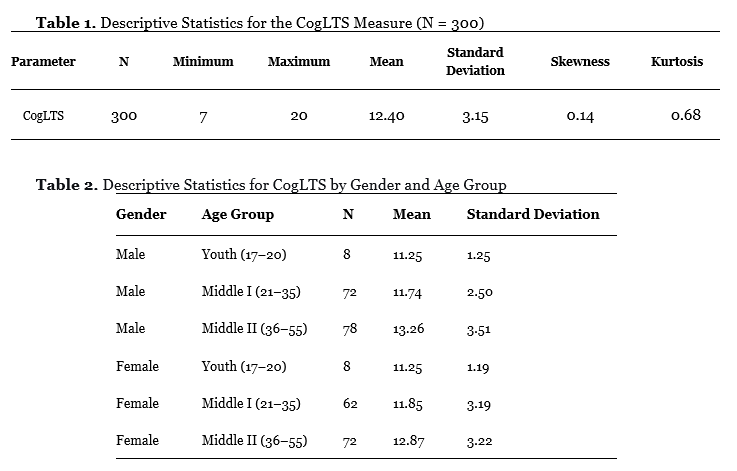
The study sample comprised 300 participants (158 males, 142 females) aged 17 to 55 years (M = 29.8 ± 6.9 years). Age group distribution was as follows: adolescence/young adulthood (17–20 years), N = 16; early middle adulthood (21–35 years), N = 134; and late middle adulthood (36–55 years), N = 150.
2.4. Measures
Cognitive Load Tolerance Scale (CogLTS)
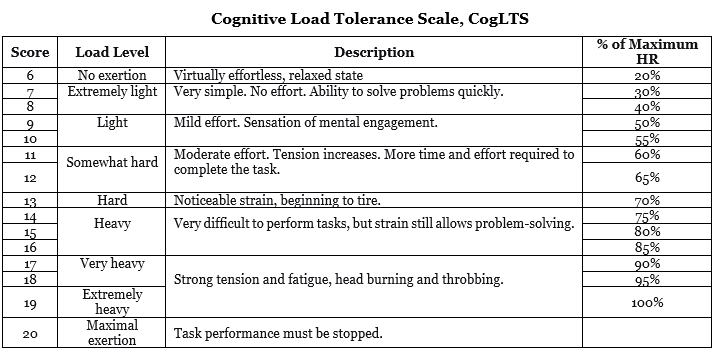
The CogLTS represents a direct adaptation of the original Borg RPE (Rating of Perceived Exertion) scale (Borg, 1982; Borg, 1990). In its original formulation, the 6–20 point scale was designed to correspond to the heart rate range of 60–200 beats per minute, facilitating clinical and coaching interpretation (Borg, 1982, p. 378). We retained this numerical range while replacing physical exertion descriptors (e.g., “very light,” “somewhat heavy”) with descriptions characterizing cognitive effort (e.g., attention focus, distractibility, frustration). This adaptation followed Borg’s principle that “numerical values should be anchored by verbal expressions understandable to most people, and these expressions should be positioned on the scale according to their quantitative meaning” (Borg, 1982, p. 380). Consequently, the CogLTS preserves the psychophysical logic of the original scale while extending its application to the cognitive domain.
Instructions: “Please evaluate the degree of intellectual effort you invested during task performance. Use the scale from 6 to 20, where 6 corresponds to a state of complete relaxation and absence of any intellectual effort, and 20 corresponds to maximal intellectual strain, at which point further task performance becomes impossible. Select the number that most accurately reflects your state.”
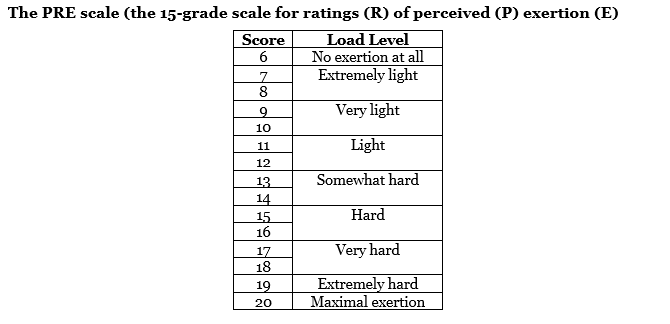
Borg Rating of Perceived Exertion scale
The Physical Load Tolerance Scale employs the Borg RPE (Rating of Perceived Exertion) scale (Borg, 1990) for assessing subjective tolerance of physical load. The classic version (6–20 points) was developed with consideration of heart rate correspondence: the numerical value multiplied by 10 approximately corresponded to heart rate for a given load level.
The States Scale (Leonova & Kapitsa, 2003) comprises 10 bipolar scales, each rated on a 7-point scale. The sum of scores across all 10 scales yields the Total Score (range: 10–70). The Subjective Comfort Index (SCI) represents a generalized indicator of subjective comfort, calculated using the following formula:
SCI = (Σ items 1, 2, 4, 5, 7, 9) − (Σ items 3, 6, 8, 10) + 28,
where items refer to individual questionnaire items, and 28 is a correction coefficient. SCI scores range from 10 to 70, directly corresponding to the degree of optimality of the individual’s current state, with higher scores indicating better overall subjective state. This instrument has been extensively employed in academic stress research to assess well-being dynamics under stressful conditions (Duryagina, 2019; Golubeva & Feshchenko, 2019; Odarushchenko, 2019).
Raven’s Standard Progressive Matrices (SPM)
Raven’s Standard Progressive Matrices (Raven, 2012) assess non-verbal intelligence, measuring analytical-synthetic ability and logical reasoning. The standard 20-minute timed administration procedure was employed.
Intellectual Activity of temperament (IAT)
The Intellectual Activity scale from Rusalov’s Structure of Temperament Questionnaire (STQ-26; Rusalov, 1990) assesses disposition toward intellectual activity and temperamental need for mental work. The scale includes items addressing preference for intellectual pursuits, speed, and ease of solving mental problems, and inclination toward cognitively demanding activities.
Heart Rate Variability (HRV)
HRV recording was conducted during resting state (5 minutes) and during performance of Raven’s SPM (20 minutes) using the electrocardiograph (Neurosoft, Ivanovo, Russia). The following parameters were recorded:
Mo (Mode): The most frequently occurring R–R interval value (in seconds). Heart rate (HR) = 60 / Mo (beats per minute), where Mo is expressed in seconds. Thus, mode directly determines heart rate.
AMo (Mode Amplitude): The proportion of
R–R intervals falling within the mode range, expressed as a percentage; reflects sympathetic nervous system activity.
SI (stress index) is an integral index reflecting the degree of centralization in cardiac rhythm regulation. It is calculated as SI = AMo / (2 × Mo × MxDMn).
MxDMn (variation range) is the difference between the maximum and minimum cardiac intervals (in seconds).
For subsequent correlational analyses with CogLTS scores, HRV data recorded during the 20-minute Raven’s SPM administration were utilized. Resting-state (baseline) HRV data were not analyzed in the present study.
Demographic Variables
Age and sex were recorded for all participants.
- Statistical Analysis
The CogLTS is a single-item scale based on the Borg scale format, precluding confirmatory factor analysis (CFA). Validation was therefore conducted through examination of convergent, discriminant, and criterion-related validity, consistent with established approaches to single-item scale validation (Robins et al., 2001; Allen et al., 2016).
Statistical procedures included descriptive statistics, one-way analysis of variance (ANOVA) with post-hoc comparisons (Tamhane’s T2 test), and Kendall’s tau (τ) correlation analysis. General Linear Modeling (GLM) with profile plots was employed to evaluate the combined effects of age and sex on CogLTS scores. For ANOVA-based validity analyses, listwise deletion was applied, including only cases with complete data across all variables in the model, ensuring group comparability and valid between-group comparisons. All statistical analyses were performed using SPSS (IBM Corp., Armonk, NY, USA).
Results
3.1. Descriptive Statistics
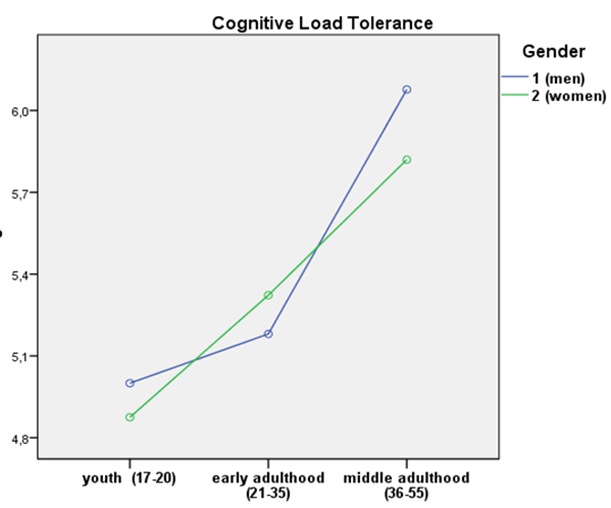
The distribution of the CogLTS scores across the total sample (N = 300) approximated normality. The mean score was 12.40 (SD = 3.15; Table 1). Analysis of the distribution by gender and age group (Table 2) revealed a tendency for CogLTS scores to increase with age in both males and females, with minimal gender differences within corresponding age groups.
3.2. Effects of Age and Gender on CogLTS
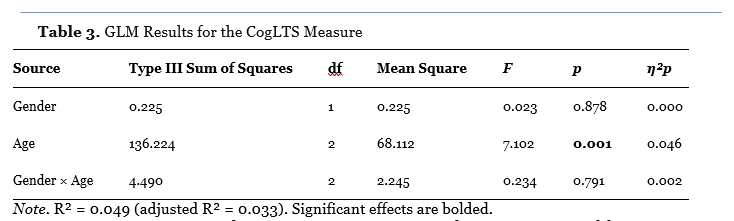
A general linear model (GLM) was conducted to assess the combined effects of age and gender on CogLTS scores. The results (Table 3) revealed a statistically significant main effect of age (F(2, 297) = 7.102, p = 0.001, η²p = 0.046). The main effect of gender (F(1, 297) = 0.023, p = 0.878, η²p = 0.000) and the gender × age interaction (F(2, 297) = 0.234, p = 0.791, η²p = 0.002) were not significant. The model accounted for 4.9% of the variance (adjusted R² = 0.033). Thus, tolerance of cognitive load significantly increases with age, and this pattern is consistent across genders (Figure 1).
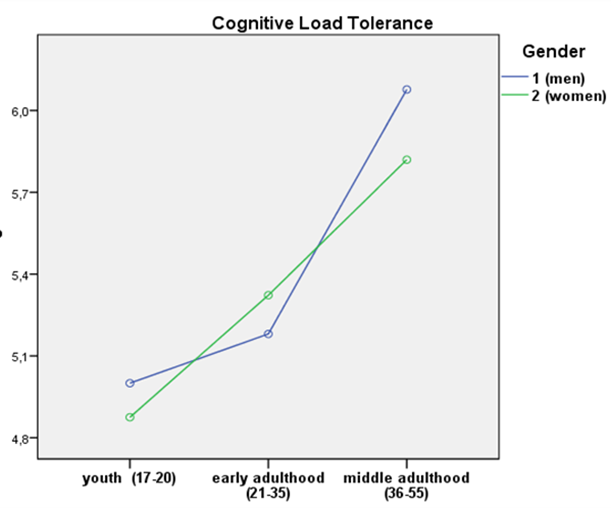
Figure 1. Profile plot of mean CogLTS scores by age group and gender
3.3. Group Formation Based on Stanine Scores
For subsequent analyses, 240 participants from the total sample (N = 300) with complete data on all relevant measures (CogLTS, SPM, IA, ERI, PLTS, ISC_int, Mo, AMo, SI) were retained. The remaining 60 participants were excluded due to missing data (refusals, technical artifacts in HRV recording, or questionnaire omissions).
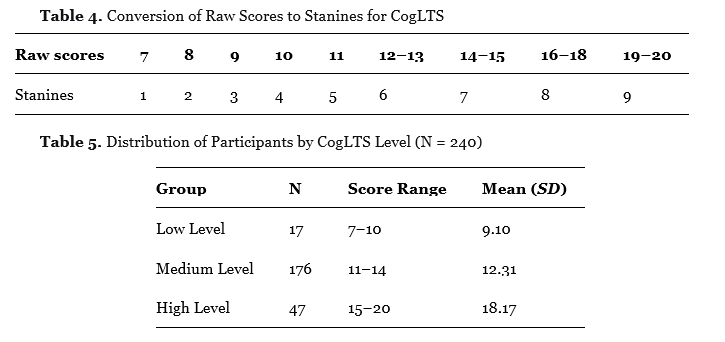
Based on stanine scores of the CogLTS, participants were divided into three groups (Tables 4 and 5):
- Low level(stanines 1-4; raw score range 7–10);
- Medium level(stanines 5–7; raw score range 11–15);
- High level(stanines 8-9; raw score range 16–20).
3.4. Comparison of CogLTS Groups on External Criteria (ANOVA)
A one-way analysis of variance (ANOVA) with post-hoc comparisons (Tamhane’s T2 test) was conducted to examine differences between the high, medium, and low CogLTS groups on other psychological and psychophysiological measures. Group sizes varied due to listwise deletion for each variable. Results are presented in Table 6.
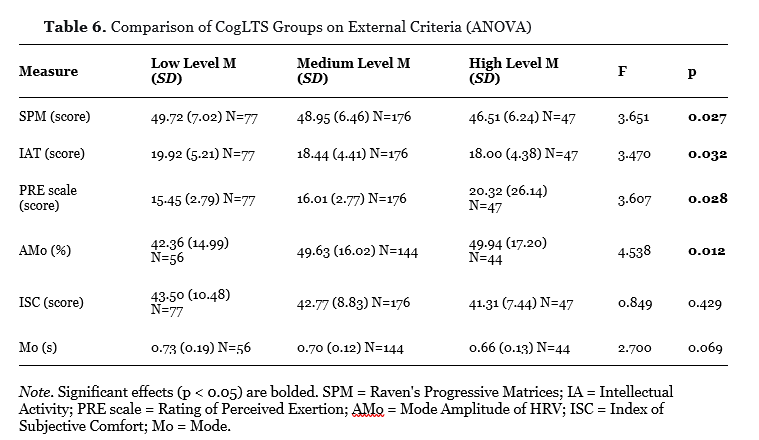
- SPM:Participants with low CogLTS scored significantly higher than those with high CogLTS (p = 0.027), consistent with the negative correlation between CogLTS and SPM and cognitive load theory (Sweller et al., 2019).
- IAT:The high CogLTS group scored significantly higher than the low group (p = 0.047), suggesting a link between cognitive load tolerance and intellectual activity.
- PRE scale:Significant differences were found among all three groups (p < 0.001 for all pairwise comparisons), supporting a general “load tolerance” construct (Hypothesis H1) and aligning with research on shared regulatory mechanisms (Leonova, 2007; Nikolaeva et al., 2022, 2024).
- AMo:A significant difference was found between the low and medium CogLTS groups (p = 0.010). Lower AMo in the low tolerance group may indicate parasympathetic predominance, potentially reflecting insufficient mobilization readiness for cognitive load (Thayer & Lane, 2009).
No significant differences were found for ISC, or Mo (all p > 0.05).
3.5. Convergent and Discriminant Validity (Correlational Analysis)
Kendall’s tau-b correlational analysis was conducted to examine the convergent and discriminant validity of the CogLTS measure. HRV parameters were averaged over the entire 20-minute Raven’s test period.
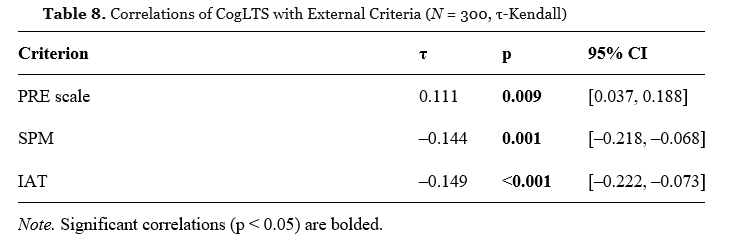
A significant positive correlation with PLTS (τ = 0.111, p = 0.009) supports the convergent validity of CogLTS as a measure of a general load tolerance construct. Significant negative correlations with SPM (τ = –0.144, p = 0.001) and IAT (τ = –0.149, p < 0.001) align with theoretical expectations.
To assess discriminant validity, CogLTS was correlated with HRV parameters and the ISC (Table 9). While significant weak correlations were found with Mo (τ = –0.093, p = 0.041) and AMo (τ = 0.103, p = 0.023). The non-significant correlation with ISC (τ = –0.056, p = 0.186) supports the discriminant validity of CogLTS, indicating that it is not merely a reflection of general subjective comfort.
Discussion
The primary aim of this study was the psychometric evaluation of a novel self-report measure of cognitive load tolerance – the CogLTS. Validation was conducted within the frameworks of Cognitive Load Theory (CLT; Sweller et al., 2019) and related self-regulation models, including the neurovisceral integration model (Thayer & Lane, 2009). Convergent validity was assessed through correlations with theoretically related constructs (physical load tolerance, intelligence, intellectual activity), discriminant validity via non-associations with general subjective comfort and integrative HRV indices, criterion validity by comparing groups differing in CogLTS levels, and construct validity – as the degree of adequacy of the method to the interpretation of experimental data within the theory, verified by the correct use of theoretical terms. The construct in question is perceived cognitive load, a central concept in CLT, operationalised through subjective tolerance ratings. Construct validity is confirmed by age sensitivity, gender invariance, and, crucially, associations with objective physiological indicators (Mo, AMo), as well as significant differences in these objective measures between groups with different CogLTS levels. The overall pattern of results supports the psychometric soundness of the measure, as discussed below.
Convergent Validity: Associations with Theoretically Related Constructs
Significant correlations between CogLTS and external criteria support convergent validity. The positive association with physical load tolerance (PRE scale: τ = 0.111, p = 0.009) is consistent with the hypothesis of a general “load tolerance” construct spanning different activity domains (Leonova, 2007; Paas & van Merriënboer, 2020). The modest magnitude of this correlation (τ = 0.111) indicates relative independence of the measured constructs, justifying the development of a separate cognitive-specific measure. This result also aligns with evidence of shared autonomic mechanisms underlying responses to physical and cognitive demands (Nikolaeva et al., 2022, 2024).
Negative correlations with Raven’s test (SPM: τ = –0.144, p = 0.001) and intellectual activity (IAT: τ = –0.149, p < 0.001) are interpreted within the expertise reversal effect (Kalyuga, 2007; Sweller et al., 2019). According to CLT, higher-ability individuals possess more efficient information-processing schemas, reducing subjective task difficulty and the perceived need for “tolerance.” Additionally, the negative association with IAT may reflect a habituation effect and heightened self-criticism among those consistently engaged in intellectual pursuits (Kuznetsova, Barabanshchikova, & Zlokazova, 2008; Schnaubert & Schneider, 2022). These correlations meet theoretical expectations and therefore support the convergent validity of CogLTS as a measure of subjective cognitive load appraisal.
Discriminant Validity: Specificity of the Construct
Discriminant validity is confirmed by the absence of significant correlations with theoretically unrelated or only indirectly related measures. This demonstrates that CogLTS captures a specific construct rather than serving as a proxy for general well-being, emotional state, or autonomic tone.
First, CogLTS showed no significant association with the Index of Subjective Comfort (ISC: τ = – .056, p = 0.186), indicating that it does not merely reflect general well-being or emotional state (Conway et al., 2013). This is a crucial finding, as it demonstrates that CogLTS captures a specific construct of intellectual work tolerance rather than global affective tone.
Second, correlations with integrative HRV parameters (SI: τ = 0.030, p = 0.504; MxDMn: τ = –0.062, p = 0.171; MxRMn: τ = –0.035, p = 0.439) were all non-significant. This suggests that CogLTS does not duplicate general autonomic strain indices such as the Stress Index, which reflects the integrative level of centralisation of cardiac rhythm regulation. Instead, CogLTS is related only to selected specific parameters (mode and mode amplitude), as discussed below. The absence of correlations with MxDMn and MxRMn further confirms that the measure is not an indicator of general autonomic activity.
Together, these results support the discriminant validity of CogLTS and its distinctiveness from related psychological (subjective comfort) and psychophysiological (integrative HRV indices) constructs.
Criterion Validity: Differentiation of Groups by CogLTS Level
A key evidence of validity is the measure’s ability to distinguish groups that theoretically differ on related characteristics (known-groups validity). One-way ANOVA revealed significant differences among low, medium, and high CogLTS groups on several external criteria.
On Raven’s test (SPM), the low CogLTS group scored significantly higher than the high CogLTS group (p = 0.027). This counter-intuitive yet theoretically expected difference (expertise effect) confirms the measure’s sensitivity to variations in intellectual competence, consistent with the construct of subjective load appraisal.
On physical load tolerance (PRE scale), differences were significant across all three groups (p < 0.001 for all pairwise comparisons), demonstrating graded discriminative ability and supporting a unitary load-tolerance construct.
On HRV mode amplitude (AMo), significant differences emerged between low and medium CogLTS groups (p = 0.010), linking subjective tolerance to autonomic profile (lower AMo in low tolerance, possibly reflecting parasympathetic predominance and reduced mobilisation readiness; Nikolaeva et al., 2024).
The lack of significant differences in ISC, SI, and Mo further underscores the specificity of CogLTS associations, reinforcing discriminant validity. Thus, the measure successfully differentiates groups in expected ways, supporting its criterion validity.
Construct Validity: Correspondence to the Theoretical Model
Construct validity is defined as the degree of adequacy of a method to the interpretation of experimental data within a theory, confirmed by the correct use of the theory’s terms (Cronbach & Meehl, 1955). In this study, the theoretical construct is perceived cognitive load – a central concept in Cognitive Load Theory (CLT; Sweller et al., 2019). CogLTS operationalises this construct through subjective ratings of tolerance to intellectual work. To confirm construct validity, it is necessary to demonstrate that the measure behaves in accordance with theoretical predictions: showing expected age and gender patterns, as well as associations with objective physiological indicators that should theoretically accompany perceived load.
Age dynamics. The significant age-related increase in CogLTS (τ = 0.140, p = 0.001; GLM: F(2, 297) = 7.102, p = 0.001) fully corresponds to theoretical expectations. According to the selective optimisation with compensation theory (Carstensen et al., 2011), individuals accumulate experience in regulating cognitive and emotional states with age, which should lead to increased subjective ratings of their ability to tolerate load. This result is also consistent with data on age-related HRV changes (Dadashova, 2015; Arakaki et al., 2023), showing that despite general HRV decline with age, the capacity for emotional and cognitive regulation may be preserved or even improved. Thus, the age dynamics of CogLTS correctly reflect the theoretical model of the construct.
Gender invariance. The absence of significant gender effects and gender-by-age interactions indicates gender invariance is a crucial psychometric property ensuring that the measure operates equivalently for males and females. This corresponds to the theoretical construct of “perceived cognitive load” as a universal characteristic independent of gender, consistent with Bevilacqua (2017), who noted that gender differences in cognitive processing may manifest at more fine-grained levels rather than at the level of global tolerance assessment.
Physiological correlates of the construct. The strongest evidence for construct validity is the confirmation of theoretical predictions regarding the relationship between subjective load ratings and objective physiological indicators. CLT posits that perceived cognitive load should correlate with physiological markers of autonomic nervous system activation (Paas & van Merriënboer, 2020).
In our study, CogLTS demonstrated significant associations with two HRV indices recorded during cognitive load (Raven’s test): a negative correlation with mode (Mo: τ = –0.093, p = 0.041) and a positive correlation with mode amplitude (AMo: τ = 0.103, p = 0.023). The negative Mo association (higher heart rate) and positive AMo association suggest sympathetic activation in individuals with higher subjective tolerance. This fully aligns with theoretical models according to which cognitive load increases sympathetic influences on cardiac rhythm (Dogadkina et al., 2022), and sympathetic activation reflects resource mobilisation during cognitive activity (Nikolaeva et al., 2022, 2024).
Crucially, objective physiological indicators (AMo and Mo) significantly differ between groups with different CogLTS levels. As shown in Table 7, post-hoc comparisons revealed:
- For AMo:significant differences between low and medium CogLTS groups (p = 0.010). The low CogLTS group is characterised by lower AMo values (42.36%), reflecting parasympathetic predominance, whereas medium and high CogLTS groups demonstrate higher AMo values (49.63% and 49.94%, respectively). This means that individuals with low subjective cognitive load tolerance are objectively characterised by a different autonomic profile – with parasympathetic predominance – which theoretically corresponds to reduced mobilisation readiness for intellectual activity.
- For Mo:although group differences did not reach statistical significance (p = 0.069), a clear trend is observed: the low CogLTS group has the highest Mo values (0.73 s), corresponding to lower heart rate, while medium and high CogLTS groups demonstrate lower Mo values (0.70 and 0.66 s, respectively). This trend is consistent with the negative correlation between CogLTS and Mo and further supports the link between subjective tolerance and autonomic regulation.
Thus, groups identified based on subjective tolerance ratings (CogLTS) objectively differ in physiological indicators, which constitutes one of the most compelling pieces of evidence for the construct validity of the measure. CogLTS measures not merely an introspective judgement but a construct with real physiological grounding.
The weakness of the correlations between CogLTS and HRV, while group differences in AMo are statistically significant, may be explained by methodological factors: substantial individual differences in autonomic adaptation types (Bodrov et al., 2018), HRV measurement conditions that may have limited sensitivity to reactive changes (Kriklenko & Kovaleva, 2024), the influence of stress that can distort physiological indicators (Conway et al., 2013; Setz et al., 2010), as well as the contribution of heart rate fragmentation (HRF) – independent of autonomic regulation (Costa et al., 2017, 2018; Hayano et al., 2020; Arakaki et al., 2023). Nevertheless, the very fact of significant group differences in objective physiological parameters is a strong argument that CogLTS measures the intended construct.
Taken together, the presented evidence such as age dynamics, gender invariance, correlations with HRV, and, especially, objective physiological differences between groups with different CogLTS levels confirms the construct validity of the measure, demonstrating its adequacy to the theoretical model of perceived cognitive load.
Thus, the present findings indicate that the CogLTS demonstrates satisfactory convergent, discriminant, criterion, and construct validity. The measure distinguishes groups as theoretically expected, is sensitive to age, is invariant across gender, is not reducible to general subjective comfort, and – most importantly – demonstrates associations with objective physiological indicators (AMo, Mo), confirming its construct validity.
Nevertheless, several limitations should be acknowledged. First, the cross-sectional design precludes causal inferences. Second, the sample comprised primarily healthy adults (17–55 years) without clinical diagnoses, limiting generalisation to clinical populations, children, and older adults. Third, HRV was recorded under conditions that may have limited sensitivity to cognitive load; future studies should employ dynamic load protocols. Finally, the lack of control for situational stress and current emotional state may have influenced subjective ratings.
Future research should supplement validation with reliability analyses (internal consistency, test–retest stability), and cross-validation in other populations (children, older adults, clinical groups). Additionally, investigating the relationship between CogLTS and EEG measures which, according to Friedman et al. (2019), are more sensitive to cognitive load than HRV, would help delineate the place of CogLTS among psychophysiological markers of cognitive load and expand its practical applications. Furthermore, examining the relationship between CogLTS and heart rate fragmentation (HRF) indices would clarify the contribution of non-autonomic mechanisms to subjective load ratings.
Conclusions
The present study provides robust evidence for the psychometric soundness of the Cognitive Load Tolerance Scale (CogLTS). The converging pattern of results—significant correlations with external criteria (PRE scale, SPM, IAT, age, and total state score) and heart rate variability (HRV) indices (Mo, AMo), coupled with established discriminant validity against the Subjective Comfort Index unequivocally confirms that CogLTS captures the construct of cognitive load tolerance rather than serving as a proxy for general subjective well-being or situational stress.
Age emerged as a significant predictor of CogLTS, whereas neither sex nor its interaction with age attained statistical significance. This finding, consistent with the selective optimization with compensation theory (Carstensen et al., 2011) and evidence on age-related maintenance of brain-heart interactions (Arakaki et al., 2023), suggests that load tolerance is not a rigidly determined neurobiological trait but rather reflects accumulated self-regulatory experience and adaptive resource allocation strategies. The observed inverse relationship between CogLTS and intellectual ability (SPM) and intellectual activity of temperament (IAT) warrants careful interpretation: it does not indicate diminished tolerance among more capable individuals, but rather a differential calibration of the subjective load scale, wherein high processing efficiency and fluency lead to lower perceived effort, a nuance of considerable practical diagnostic importance.
Conceptually, the most significant findings are the modest but discernible associations between CogLTS and autonomic indices (Mo and AMo), implicating sympathetic regulatory pathways. However, the absence of correlations with comprehensive stress indices (SI, MxDMn) and the documented influence of stress context (Conway et al., 2013; Setz et al., 2010) support the contention that CogLTS is not a direct physiological marker but rather an integrative psychophysiological construct, mediated by individual types of autonomic adaptation (Bodrov et al., 2018; Nikolaeva et al., 2024) and feedforward regulatory mechanisms (Archibasova et al., 2022). These results align with the contemporary view that resting-state HRV parameters are insufficiently sensitive to capture the dynamic facets of cognitive control, necessitating the use of integrative cardiorespiratory indices under active load conditions (Kriklenko & Kovaleva, 2024).
In sum, CogLTS qualifies as a valid, theoretically grounded, and practically applicable instrument for assessing individual cognitive load tolerance in educational and occupational settings. The implementation of age-normed interpretive frameworks will mitigate the risk of erroneous conclusions, particularly among young, high-ability respondents. Future research should prioritize longitudinal designs and experimental load manipulations, examining the association between CogLTS and real-time HRV dynamics while accounting for polymorphic autonomic response patterns and individual profiles of anticipatory regulation. Such endeavors will not only deepen the understanding of the psychophysiological mechanisms underlying cognitive endurance but also enable a transition from correlational evidence to predictive models of performance efficacy under conditions of high uncertainty.
Funding: The study was supported by the Russian Science Foundation, project number 23-18-00293, https://rscf.ru/project/23-18-00293/.
Ethics approval and consent to participate: The study was approved by the Local Ethics Committee of Ural State Medical University, Ministry of Health of the Russian Federation (Protocol No. 5, dated June 16, 2023). All participants provided written informed consent prior to enrollment.
Conflict of interest: The author declares no conflict of interest.
Acknowledgments: The author thanks all participants for their voluntary involvement and the research assistants for their help with data collection.
Use of artificial intelligence: No generative AI was used in the conception, analysis, or writing of this manuscript. AI‑assisted tools were used only for language polishing and formatting.
References
- Allen, M. S., Iliescu, D., & Greiff, S. (2016). Single item measures in psychological science: A call for validation. European Journal of Psychological Assessment, 32(1), 1–5. https://doi.org/10.1027/1015-5759/a000330
- Arakaki, X., Arechavala, R. J., Choy, E. H., Bautista, J., Bliss, B., Molloy, C., Wu, D.-A., Shimojo, S., Jiang, Y., Kleinman, M. T., & Kloner, R. A. (2023). The connection between heart rate variability (HRV), neurological health, and cognition: A literature review. Frontiers in Neuroscience, 17, Article 1055445. https://doi.org/10.3389/fnins.2023.1055445
- Archibasova, E. A., Kulikov, V. Yu., & Voevoda, M. I. (2021). Korrelyatsionnye osobennosti pokazatelei variabel’nosti ritma serdtsa pri razlichnykh variantakh kognitivnoi nagruzki u studentov [Correlational features of heart rate variability indices under different types of cognitive load in students]. Mezhdunarodnyi nauchno-issledovatel’skii zhurnal[International Research Journal], 114(12, Pt. 2), 149–154.
- Archibasova, E. A., Kulikov, V. Yu., & Voevoda, M. I. (2022). Znachenie operezhayushchei reaktsii vegetativnoi nervnoi sistemy v usloviyakh kognitivnoi nagruzki u uslovno zdorovykh studentov [The significance of the anticipatory reaction of the autonomic nervous system under cognitive load in conditionally healthy students]. Journal of Siberian Medical Sciences, 6(2), 18–27.
- Ayres, P., Lee, J. Y., Paas, F., & van Merriënboer, J. J. G. (2021). The validity of physiological measures to identify differences in intrinsic cognitive load. Frontiers in Psychology, 12, Article 702538. https://doi.org/10.3389/fpsyg.2021.702538
- Bevilacqua, A. (2017). Commentary: Should gender differences be included in the evolutionary upgrade to cognitive load theory? Educational Psychology Review, 29(1), 189–194. https://doi.org/10.1007/s10648-016-9386-y
- Bodrov, I. G., Shishelova, A. Yu., & Aliev, R. R. (2018). Tipologiya vegetativnoi adaptatsii k kognitivnoi nagruzke po dinamike variabel’nosti serdechnogo ritma [Typology of autonomic adaptation to cognitive load based on heart rate variability dynamics]. Eksperimental’naya psikhologiya[Experimental Psychology], 11(3), 78–93. https://doi.org/10.17759/exppsy.2018110306
- Borg, G. (1982). Psychophysical bases of perceived exertion. Medicine and Science in Sports and Exercise, 14(5), 377–381. https://doi.org/10.1249/00005768-198205000-00012
- Borg, G. (1990). Psychophysical scaling with applications in physical work and the perception of exertion. Scandinavian Journal of Work, Environment & Health, 16(Suppl. 1), 55–58. https://doi.org/10.5271/sjweh.1815
- Brünken, R., Plass, J. L., & Leutner, D. (2003). Direct measurement of cognitive load in multimedia learning. Educational Psychologist, 38(1), 53–61. https://doi.org/10.1207/S15326985EP3801_7
- Carstensen, L. L., Turan, B., Scheibe, S., Ram, N., Ersner-Hershfield, H., Samanez-Larkin, G. R., & Nesselroade, J. R. (2011). Emotional experience improves with age: Evidence based on over 10 years of experience sampling. Psychology and Aging, 26(1), 21–33. https://doi.org/10.1037/a0021285
- Chong, S. Y., Chittleborough, C. R., Gregory, T., Lynch, J., Mittinty, M., & Smithers, L. G. (2019). The controlled direct effect of temperament at 2‑3 years on cognitive and academic outcomes at 6‑7 years. PLoS ONE, 14(6), e0204189. https://doi.org/10.1371/journal.pone.0204189
- Conway, D., Dick, I., Li, Z., Wang, Y., & Chen, F. (2013). The effect of stress on cognitive load measurement. In Human‑Computer Interaction – INTERACT 2013(pp. 659–666). Springer. https://doi.org/10.1007/978-3-642-40498-6_53
- Costa, M. D., Davis, R. B., & Goldberg, A. L. (2017). Heart rate fragmentation: A new approach to the analysis of cardiac interbeat interval dynamics. Frontiers in Physiology, 8, Article 255. https://doi.org/10.3389/fphys.2017.00255
- Costa, M. D., Redline, S., Davis, R. B., Heckbert, S. R., Soliman, E. Z., & Goldberg, A. L. (2018). Heart rate fragmentation as a novel biomarker of adverse cardiovascular events: The multi‑ethnic study of atherosclerosis. Frontiers in Physiology, 9, Article 1117. https://doi.org/10.3389/fphys.2018.01117
- Cronbach, L. J., & Meehl, P. E. (1955). Construct validity in psychological tests. Psychological Bulletin, 52(4), 281–302. https://doi.org/10.1037/h0040957
- Dadashova, G. M. (2015). Gendernye i vozrastnye osobennosti variabel’nosti serdechnogo ritma u prakticheski zdorovykh lits [Gender and age characteristics of heart rate variability in practically healthy individuals]. Profilakticheskaya meditsina[Preventive Medicine], 18(2), 54–58.
- Dogadkina, S. B., Ermakova, I. V., Adamovskaya, O. N., Kmit’, G. V., Rubleva, L. V., & Sharapov, A. N. (2022). Variabel’nost’ serdechnogo ritma i uroven’ kortizola u detei shkol’nogo vozrasta pri raznoi kognitivnoi nagruzke [Heart rate variability and cortisol level in school‑age children under different cognitive loads]. Acta Biomedica Scientifica, 7(3), 169–179.
- Duryagina, E. G. (2019). Issledovanie sub”ektivnoi komfortnosti studentov v period ekzamenatsionnoi sessii [A study of subjective comfort of students during the examination session]. Perspektivy nauki i obrazovaniya[Prospects of Science and Education], 1(37), 290–300.
- Finkel, D., Davis, D. W., Giangranda, E. J., Womack, S., Turkheimer, E., & Beam, C. (2022). Socioeconomic status impacts genetic influences on the longitudinal dynamic relationship between temperament and general cognitive ability in childhood: The Louisville Twin Study. Child Development, 93(2), e135–e148. https://doi.org/10.1111/cdev.13713
- Friedman, N., Fekete, T., Gal, K., & Shriki, O. (2019). EEG‑based prediction of cognitive load in intelligence tests. Frontiers in Human Neuroscience, 13, Article 191. https://doi.org/10.3389/fnhum.2019.00191
- Geary, D. C. (2008). An evolutionarily informed education science. Educational Psychologist, 43(4), 179–195. https://doi.org/10.1080/00461520802392133
- Golubeva, G. F., & Feshchenko, E. M. (2019). Formirovanie emotsional’noi ustoichivosti i volevogo samokontrolya studentov v situatsii otsenivaniya znanii [Formation of emotional stability and volitional self‑control of students in the situation of knowledge assessment]. Problemy sovremennogo pedagogicheskogo obrazovaniya[Problems of Modern Pedagogical Education], 63‑2, 287–292.
- Gorelik, S. G., Kovaleva, O. L., Gavrilova, A. A., Milyutina, E. V., & Filipnichenko, T. S. (2017). Otsenka effektivnosti metodiki korrektsii psikhoemotsional’nogo sostoyaniya studentov meditsinskogo instituta [Evaluation of the effectiveness of a method for correcting the psychoemotional state of medical institute students]. Nauchnye vedomosti BelGU. Seriya: Meditsina. Farmatsiya[Belgorod State University Scientific Bulletin. Series: Medicine. Pharmacy], 30(3), 65–74.
- Hayano, J., Kisohara, M., Ueda, N., & Yuda, E. (2020). Impact of heart rate fragmentation on the assessment of heart rate variability. Applied Sciences, 10(9), 3314. https://doi.org/10.3390/app10093314
- Kalyuga, S. (2007). Expertise reversal effect and its implications for learner‑tailored instruction. Educational Psychology Review, 19(4), 509–539. https://doi.org/10.1007/s10648-007-9054-3
- Klepsch, M., & Seufert, T. (2021). Making an effort versus experiencing load. Frontiers in Education, 6, Article 645284. https://doi.org/10.3389/feduc.2021.645284
- Krieglstein, F., Beege, M., Wesenberg, L., Rey, G. D., & Schneider, S. (2025). The distorting influence of primacy effects on reporting cognitive load in learning materials of varying complexity. Educational Psychology Review, 37, Article 2. https://doi.org/10.1007/s10648-024-09980-0
- Kriklenko, E. A., & Kovaleva, A. V. (2024). Dinamika chastoty dykhaniya i variabel’nosti ritma serdtsa pri vypolnenii kognitivnoi zadachi dvukh urovnei slozhnosti [Dynamics of respiratory rate and heart rate variability during performance of a cognitive task of two difficulty levels]. Fiziologiya cheloveka[Human Physiology], 50(4), 91–103.
- Kuznetsova, A. S., Barabanshchikova, V. V., & Zlokazova, T. A. (2008). Effektivnost’ psikhologicheskikh sredstv proizvol’noi samoregulyatsii funktsional’nogo sostoyaniya [Effectiveness of psychological means of voluntary self‑regulation of functional state]. Eksperimental’naya psikhologiya[Experimental Psychology], 1(1), 101–127.
- Leonova, A. B., & Kapitsa, M. S. (2003). Metody sub”ektivnoi otsenki funktsional’nykh sostoyanii cheloveka [Methods of subjective assessment of human functional states]. In Yu. K. Strelkov (Ed.), Praktikum po inzhenernoi psikhologii i ergonomike[Workshop on engineering psychology and ergonomics] (pp. 136–167).
- Nikolaeva, T. M., Golubeva, E. K., Skorlupkin, D. A., & Yarchenkova, L. L. (2022). Variabel’nost’ serdechnogo ritma pri umstvennoi i fizicheskoi nagruzke u studentov [Heart rate variability during mental and physical load in students]. Siberian Journal of Life Sciences and Agriculture, 14(1), 336–350.
- Nikolaeva, T. M., Golubeva, E. K., & Yarchenkova, L. L. (2024). Vliyanie fizicheskoi nagruzki na variabel’nost’ serdechnogo ritma pri umstvennoi deyatel’nosti v zavisimosti ot reaktivnosti simpaticheskikh tsentrov u studentov [The effect of physical load on heart rate variability during mental activity depending on the reactivity of sympathetic centers in students]. Sovremennye voprosy biomeditsiny[Modern Issues of Biomedicine], 8(2).
- Odarushchenko, O. I. (2019). Emotsional’no‑lichnostnaya sfera patsientov s gastroezofageal’noi reflyuksnoi bolezn’yu [Emotional‑personality sphere of patients with gastroesophageal reflux disease]. Voprosy kurortologii, fizioterapii i lechebnoi fizicheskoi kul’tury[Problems of Balneology, Physiotherapy, and Therapeutic Physical Culture], 96(3), 25–30.
- Paas, F. G. W. C. (1992). Training strategies for attaining transfer of problem‑solving skill in statistics: A cognitive‑load approach. Journal of Educational Psychology, 84(4), 429–434. https://doi.org/10.1037/0022-0663.84.4.429
- Paas, F., Renkl, A., & Sweller, J. (2003). Cognitive load theory and instructional design: Recent developments. Educational Psychologist, 38(1), 1–4. https://doi.org/10.1207/S15326985EP3801_1
- Paas, F., & Sweller, J. (2012). An evolutionary upgrade of cognitive load theory: Using the human motor system and collaboration to support the learning of complex cognitive tasks. Educational Psychology Review, 24, 27–45. https://doi.org/10.1007/s10648-011-9179-x
- Paas, F., & van Merriënboer, J. J. G. (2020). Cognitive‑load theory: Methods to manage working memory load in the learning of complex tasks. Current Directions in Psychological Science, 29(4), 394–398. https://doi.org/10.1177/0963721420922183
- Polikanova, I. S., & Sergeev, A. V. (2014). Vliyanie dlitel’noi kognitivnoi nagruzki na parametry EEG [The influence of prolonged cognitive load on EEG parameters]. Natsional’nyi psikhologicheskii zhurnal[National Psychological Journal], 1(13), 86–94.
- Raven, J. C., Court, J. H., & Raven, J. (2012). Rukovodstvo k progressivnym matritsam Ravena i slovarnym Shkalam. Razdel 3. Obshchaya chast’ rukovodstva[Manual for Raven’s Progressive Matrices and Vocabulary Scales. Section 3. General overview]. Kogito‑Tsentr.
- Robins, R. W., Hendin, H. M., & Trzesniewski, K. H. (2001). Measuring global self-esteem: Construct validation of a single item measure and the Rosenberg Self Esteem Scale. Personality and Social Psychology Bulletin, 27(2), 151–161. https://doi.org/10.1177/0146167201272002
- Ronat, L., Ronlund, M., Adolfsson, R., Hanganu, A., & Pudas, S. (2024). Revised Temperament and Character Inventory factors predict neuropsychiatric symptoms and aging‑related cognitive decline across 25 years. Frontiers in Aging Neuroscience, 16, Article 1335336. https://doi.org/10.3389/fnagi.2024.1335336
- Rusalov, V. M. (1990). Oprosnik struktury temperamenta (OFDSI)[Questionnaire of temperament structure (OFDSI)].
- Setz, C., Arnrich, B., Schumm, J., La Marca, R., Tröster, G., & Ehlert, U. (2010). Discriminating stress from cognitive load using a wearable EDA device. IEEE Transactions on Information Technology in Biomedicine, 14(2), 410–417. https://doi.org/10.1109/TITB.2009.2036164
- SchneiderS. (2022). Analysing the relationship between mental load or mental effort and metacomprehension under different conditions of multimedia design. Front. Psychol.6, 159–177. https://doi.org/10.3389/feduc.2021.648319
- Skulmowski, A., & Xu, K. M. (2022). Understanding cognitive load in digital and online learning: A new perspective on extraneous cognitive load. Educational Psychology Review, 34(1), 171–196. https://doi.org/10.1007/s10648-021-09624-7
- Sweller, J. (1988). Cognitive load during problem solving: Effects on learning. Cognitive Science, 12(2), 257–285. https://doi.org/10.1016/0364-0213(88)90023-7
- Sweller, J. (2008). Instructional implications of David C. Geary’s evolutionary educational psychology. Educational Psychologist, 43(4), 214–216. https://doi.org/10.1080/00461520802392208
- Sweller, J. (2018). Measuring cognitive load. Perspectives on Medical Education, 7, 1–2. https://doi.org/10.1007/s40037-017-0395-4
- Sweller, J., Ayres, P., & Kalyuga, S. (2011). Cognitive Load Theory. Springer. https://doi.org/10.1007/978-1-4419-8126-4
- Sweller, J., van Merriënboer, J. J. G., & Paas, F. (1998). Cognitive architecture and instructional design. Educational Psychology Review, 10(3), 251–296. https://doi.org/10.1023/A:1022193728205
- Sweller, J., van Merriënboer, J. J. G., & Paas, F. (2019). Cognitive architecture and instructional design: 20 years later. Educational Psychology Review, 31(2), 261–292. https://doi.org/10.1007/s10648-019-09465-5
- Thayer, J. F., & Lane, R. D. (2009). Claude Bernard and the heart‑brain connection: Further elaboration of a model of neurovisceral integration. Neuroscience and Biobehavioral Reviews, 33(2), 81–88. https://doi.org/10.1016/j.neubiorev.2008.08.004
- Zuev, A. V., Nekrasova, M. M., & Vasil’eva, T. N. (2019). Pilotnoe issledovanie informatsionnoi umstvennoi nagruzki ofisnykh rabotnikov [A pilot study of informational mental load in office workers].
Comments (0)
Abstract. Relevance. In the context of digitalization and information overload, the problem of individual differences in the ability to withstand cognitive strain has acquired particular significance. Cognitive Load Theory (Sweller, 1988; Sweller et al., 2019) provides a conceptual framework for understanding working memory limitations; however, individual differences in cognitive load tolerance remain insufficiently investigated. Subjective rating scales, such as the Borg RPE (Rating of Perceived Exertion) scale, offer several important advantages: they are simple to administer, require no specialized equipment, provide an immediate integrated assessment of perceived effort during task performance, and enable direct inter-individual comparisons. In physical ergonomics and sports medicine, such scales have become the gold standard; however, for the cognitive domain, adapted and psychometrically validated instruments are virtually nonexistent. Our newly developed CogLTS scale, an adaptation of the Borg RPE scale for subjective cognitive load assessment, aims to fill this gap. The present study is devoted to the psychometric validation of CogLTS against a broad range of external criteria. Aim. Psychometric validation of the Cognitive Load Tolerance Scale (CogLTS) through analysis of its relationships with psychological, psychophysiological, and demographic indicators. Method. The study involved 300 participants (158 males, 142 females) aged 17 to 55 years (M = 29.8; SD = 6.9). The assessment battery included: the CogLTS scale, the Borg RPE scale for physical load (Borg, 1990), Leonova’s States Scale (Leonova & Kapitsa, 2003), Raven’s Standard Progressive Matrices (SPM), the Intellectual Activity (IA) scale from Rusalov’s Structure of Temperament Questionnaire (Rusalov, 1990), heart rate variability parameters (HRV: Mo, AMo), and demographic data (age, sex). Statistical analyses included Kendall’s tau correlation, one-way ANOVA with post-hoc comparisons (Tamhane’s T2 test), and General Linear Modeling (GLM). Results. Statistically significant correlations were found between CogLTS scores and the Borg RPE scale (τ = 0.111; p < 0.01), SPM (τ = −0.144; p < 0.01), IA (τ = −0.149; p < 0.001), age (τ = 0.140; p < 0.01), and HRV parameters: negative correlation with mode (Mo: τ = −0.093; p = 0.041) and positive correlation with mode amplitude (AMo: τ = 0.103; p = 0.023). GLM revealed a significant effect of age on CogLTS scores (F = 7.102; p = 0.001; η² = 0.046). ANOVA demonstrated significant differences between high, medium, and low CogLTS groups on SPM (p = 0.027), IA (p = 0.032), Borg RPE scale (p = 0.028), and AMo (p = 0.012). Discriminant validity was confirmed by the absence of significant correlation with the Subjective Comfort Index (SCI) (τ = −0.056; p = 0.186). Discussion. The findings are interpreted within the frameworks of Cognitive Load Theory (Sweller et al., 2019), evolutionary psychology (Geary, 2008; Bevilacqua, 2017), and the neurovisceral integration model (Thayer & Lane, 2009), incorporating contemporary evidence on anticipatory autonomic regulation (Archibasova et al., 2022), heart-brain interactions (Arakaki et al., 2023), and physical activity (Nikolaeva et al., 2024). The negative correlations between CogLTS and both intelligence and intellectual activity of temperament are interpreted as reflecting the expertise reversal effect and a “habituation” effect: individuals with higher cognitive abilities subjectively perceive load as lower. The cognitive load tolerance construct is demonstrated to be a distinct individual characteristic with age-specific features, linked to autonomic regulation but irreducible to general subjective comfort.
Рейтинговая шкала воспринимаемой когнитивной нагрузки: психометрические характеристики на российской выборке
Актуальность. В условиях цифровизации и информационной перегрузки проблема индивидуальных различий в способности выдерживать когнитивное напряжение приобретает особую значимость. Теория когнитивной нагрузки (Sweller, 1988; Sweller et al., 2019) предлагает концептуальный аппарат для понимания ограничений рабочей памяти, однако вопрос об индивидуальных различиях в переносимости когнитивной нагрузки остаётся недостаточно изученным. Субъективные рейтинговые шкалы, подобные шкале Borg RPE (Rating of Perceived Exertion), обладают рядом важных преимуществ: они просты в применении, не требуют сложного оборудования, позволяют оперативно получать интегральную оценку воспринимаемого усилия непосредственно в процессе деятельности и обеспечивают возможность прямых меж-индивидуальных сравнений. В физической эргономике и спортивной медицине такие шкалы стали золотым стандартом, однако для когнитивной сферы адаптированных и психометрически обоснованных инструментов практически не существует. Разработанная нами шкала CogLTS, представляющая собой адаптацию шкалы Borg RPE для оценки субъективной когнитивной нагрузки, призвана заполнить этот пробел. Настоящее исследование направлено на психометрическую валидизацию CogLTS с учётом широкого спектра внешних критериев. Цель. Психометрическая проверка валидности методики «Шкала переносимости когнитивных нагрузок» (CogLTS) посредством анализа связей с психологическими, психофизиологическими и демографическими показателями. Метод. В исследовании приняли участие 300 респондентов (158 мужчин, 142 женщины) в возрасте от 17 до 55 лет (M = 29.8; SD = 6.9). Использовались: шкала CogLTS, шкала Borg RPE для физической нагрузки (Borg, 1990), методика «Шкала состояний» А. Б. Леоновой (2003), тест интеллекта Равена (SPM), шкала темпераментальной интеллектуальной активности (IA) опросника ОФДСИ В. М. Русалова (1990), показатели вариабельности сердечного ритма (ВРС: Mo, AMo), демографические данные (возраст, пол). Статистическая обработка включала корреляционный анализ Кендалла, однофакторный дисперсионный анализ (ANOVA) с апостериорными сравнениями (критерий Тамхейна) и общее линейное моделирование (GLM). Результаты. Установлены статистически значимые корреляционные связи показателей шкалы CogLTS и шкалы Борга RPE (τ = 0.111; p < 0.01), SPM (τ = −0.144; p < 0.01), IA (τ = −0.149; p < 0.001), возрастом (τ = 0.140; p < 0.01), а также с показателями ВРС: отрицательная корреляция с модой (Mo: τ = −0,093; p = 0,041) и положительная с амплитудой моды (AMo: τ = 0.103; p = 0.023). GLM выявил значимое влияние возраста на изменение показателя CogLTS (F = 7,102; p = 0.001; η² = 0.046). ANOVA показала значимые различия между группами с высоким, средним и низким уровнями CogLTS по показателям SPM (p = 0.027), IA (p = 0.032), PLTS (p = 0.028) и AMo (p = 0.012). Дискриминантная валидность подтверждена отсутствием значимой корреляции с ИСК (τ = −0.056; p = 0.186). Обсуждение. Полученные результаты интерпретируются в рамках теории когнитивной нагрузки (Sweller et al., 2019), эволюционной психологии (Geary, 2008; Bevilacqua, 2017) и модели нейровисцеральной интеграции (Thayer & Lane, 2009) с привлечением современных данных о роли опережающей вегетативной регуляции (Арчибасова и др., 2022), сердечно-мозговых взаимодействий (Arakaki et al., 2023) и физической активности (Николаева и др., 2024). Отрицательная корреляция CogLTS с интеллектом и интеллектуальной активностью интерпретируется как эффект экспертизы (expertise reversal effect) и эффект «привыкания»: лица с более высокими когнитивными способностями субъективно оценивают нагрузку как более низкую. Показано, что конструкт «переносимость когнитивных нагрузок» является самостоятельной индивидуальной характеристикой, имеющей возрастную специфику и связанной с вегетативной регуляцией, но не сводимой к общему субъективному комфорту.
Ключевые слова: шкала CogLTS, переносимость когнитивной нагрузки, конвергентная валидность, дискриминантная валидность, критериальная валидность, вариабельность сердечного ритма, тест Равена, интеллектуальная активность темперамента, возрастные различия, субъективный комфорт
In the context of educational digitalization, information overload, and ever-increasing demands on human cognitive resources, the problem of individual differences in the capacity to sustain intellectual strain has acquired particular significance. Cognitive Load Theory (CLT), developed by Sweller and colleagues (Sweller, 1988; Sweller et al., 1998, 2011, 2019), provides a comprehensive conceptual framework for understanding working memory limitations and their implications for learning effectiveness. According to this theory, cognitive load comprises three distinct types: intrinsic load, determined by the complexity of the material and the interactivity of its constituent elements; extraneous load, arising from suboptimal instructional design; and germane load, directed toward the construction and automation of cognitive schemas (Paas & van Merriënboer, 2020).
Recent investigations have underscored the critical distinction between passively experienced load and actively invested effort (Klepsch & Seufert, 2021). These authors demonstrate that the two dimensions exhibit differential associations with learning processes and necessitate separate measurement approaches. The CogLTS scale developed here is oriented toward the subjective assessment of experienced load, corresponding to the concept of “passive” load, whereas the evaluation of actively invested effort falls beyond the scope of the present investigation. Contemporary scholars advocate examining various types of cognitive load through a cost-benefit lens, wherein certain design decisions may increase extraneous load while simultaneously conferring benefits through enhanced motivation or depth of processing (Skulmowski & Xu, 2022). This perspective is particularly valuable for understanding why individuals with superior intellectual abilities may subjectively appraise load as lower; for them, the “costs” of information processing are diminished, while the efficiency of cognitive resource utilization is heightened.
According to Borg’s seminal work (Borg, 1982), perceived exertion constitutes an integrated index of physical strain, combining afferent signals from peripheral muscles and joints, central cardiovascular and respiratory functions, and the central nervous system. Borg emphasized that “perceived exertion is the single best indicator of the degree of physical strain” (Borg, 1982, p. 377). He subsequently developed the categorical RPE (Rating of Perceived Exertion) scale with values ranging from 6 to 20, constructed to increase linearly with exercise intensity and heart rate (Borg, 1982, p. 378). Later, to facilitate more precise inter-individual and cross-modal comparisons, Borg introduced the CR-10 (Category Ratio) scale, in which verbal descriptors are anchored to specific numerical values reflecting their quantitative magnitude (Borg, 1982, p. 380; Borg, 1990, p. 57). This psychophysical tradition constitutes the foundational basis of our adaptation of the Borg scale for subjective cognitive load assessment, the CogLTS.
Despite the extensive theoretical and empirical foundation of CLT, the question of individual differences in the capacity to tolerate cognitive load remains insufficiently addressed. The majority of research has concentrated on managing cognitive load through modifications of task characteristics (Sweller et al., 2019), with considerably less attention devoted to subject-level properties that determine resilience to intellectual strain (Paas & van Merriënboer, 2020). Following investigations highlighting the importance of considering learner characteristics (Klepsch & Seufert, 2021), we propose the construct of “cognitive load tolerance,” defined as the individual’s capacity to maintain performance effectiveness and subjective well-being under conditions of prolonged or intensive cognitive strain.
Of particular interest in the context of individual differences are age-related aspects and mechanisms of autonomic regulation in cognitive activity. According to the evolutionary approach to cognitive load theory (Paas & Sweller, 2012; Sweller, 2008), evolutionary processes have shaped the manner in which working memory processes different categories of information. Research indicates that with advancing age, experience in regulating cognitive states accumulates, and more effective coping strategies develop (Carstensen et al., 2011). Furthermore, stress constitutes a significant factor influencing both the perception and tolerance of cognitive load. Studies demonstrate that stress can substantially affect physiological indicators employed in cognitive load assessment (Conway et al., 2013; Setz et al., 2010). As noted by Archibasova and colleagues (2022), anticipatory mechanisms of autonomic nervous system regulation enable more effective adaptation to environmental influences through the formation of optimal response structures. The assessment of heart rate variability (HRV) parameters prior to an impending challenge represents a method for evaluating anticipatory autonomic responses, wherein regulatory mechanisms engage before actual changes in the regulated parameter occur (Archibasova et al., 2022).
Methods for measuring cognitive load are diverse, encompassing subjective rating scales (e.g., Paas’s scale, Paas, 1992), physiological indices (HRV, electrodermal activity, EEG), and behavioral indicators (Brünken et al., 2003; Sweller, 2018). Borg (1990) noted that categorical scales such as the RPE possess a significant advantage over purely ratio methods; they permit direct inter-individual comparisons, as respondents react to stimuli in a more “absolute” manner. However, he also cautioned that such scales are not strictly interval-level and that their metric properties are limited (Borg, 1982, p. 378). Nevertheless, it is precisely the simplicity and “added meaning” of verbal anchors (e.g., “light,” “heavy”) that render the RPE most applicable in clinical and ergonomic research (Borg, 1990, p. 56). In the present study, we employed the classic 15-point scale, adapting its verbal descriptors to intellectual activity. Subjective scales are widely utilized due to their simplicity and validity; however, their interpretation may be contingent upon respondent awareness and order effects (Krieglstein et al., 2025). As demonstrated by Kriklenko and Kovaleva (2024), when analyzing physiological state changes during continuous cognitive activity, integrative indices incorporating multiple physiological systems, particularly the indicator of “physiological cost of activity,” linking heart rate and respiratory rate changes, prove most informative. Notably, traditional HRV parameters (including spectral characteristics) do not consistently demonstrate statistically significant changes with variations in cognitive task complexity (Kriklenko & Kovaleva, 2024).
Within the context of the stress-inducing nature of academic activities, particular attention has been directed toward students’ emotional-volitional regulation. Golubeva and Feshchenko (2019) demonstrated that in knowledge assessment situations, students experience diminished positive emotions, deteriorated well-being, and reduced volitional self-control, consistent with evidence of elevated psycho-emotional tension during examination periods (Duryagina, 2019). Furthermore, the application of biofeedback methods has proven effective for correcting students’ psycho-emotional states, underscoring the significance of subjective and physiological indicators in stress resilience assessment (Gorelik et al., 2017). Pilot investigations of information-related mental workload among office workers reveal a direct association between integrated load indices and workplace comfort coefficients, indicating the necessity of considering environmental factors in cognitive load tolerance evaluation (Zuev et al., 2019).
An additional important consideration pertains to the influence of temperament on cognitive development and academic achievement. Chong and colleagues (2019) demonstrated that temperament dimensions, including persistence, reactivity, and sociability, measured at age 2–3 years, are significantly associated with cognitive abilities and academic performance at age 6–7, with persistence exhibiting the strongest associations with verbal abilities. These findings align with the results of Finkel and colleagues (2022), who showed that genetic influences on the dynamic relationship between temperament and general cognitive ability in childhood are modulated by family socioeconomic status. In turn, Ronat and colleagues (2024) demonstrated that temperament and character factors associated with psychiatric disorders predict neuropsychiatric symptoms and age-related cognitive decline over a 25-year period, underscoring the significance of personality traits for understanding mechanisms of cognitive aging.
The development of the CogLTS methodology is grounded in the following theoretical propositions. First, cognitive load comprises both objective (task complexity) and subjective (perceived difficulty, level of invested effort) components (Paas et al., 2003; Klepsch & Seufert, 2021). Second, the capacity for cognitive load tolerance is associated with the effectiveness of functional state regulation, reflected in heart rate variability parameters (Bodrov et al., 2018; Ayres et al., 2021) and subjective state assessments (Polikanova & Sergeev, 2014). According to the comprehensive review by Arakaki and colleagues (2023), heart rate variability serves as a proxy for autonomic nervous system activity and is associated with executive functions, decision-making, and emotional regulation. High HRV (elevated HF or RMSSD) correlates with superior executive function, more effective decision-making, and enhanced emotional regulation (Arakaki et al., 2023). Third, cognitive load tolerance may be linked to general intellectual abilities, as higher levels of cognitive schema development enable more efficient information structuring and processing (Sweller et al., 2019). Fourth, individual differences in temperamental characteristics, particularly in intellectual activity level (according to Rusalov), may influence subjective perception and tolerance of intellectual demands (Kuznetsova, Barabanshchikova, & Zlokazova, 2008). Fifth, as demonstrated by Nikolaeva and colleagues (2024), physical activity induces changes in autonomic nervous system response patterns during subsequent cognitive activity, with these changes exhibiting individual manifestations related to sympathetic nervous system reactivity. Individuals with high sympathetic reactivity maintain a tendency toward sympathetic activation even following physical exertion, whereas those with normal reactivity demonstrate increased parasympathetic activity (Nikolaeva et al., 2024). This suggests that individual differences in autonomic reactivity may moderate the relationship between cognitive load and subjective tolerance assessment.
Sex differences in cognitive information processing, shaped by evolutionary processes (Bevilacqua, 2017), may moderate the relationship between cognitive load tolerance and other variables. Archibasova and colleagues (2021) demonstrated that under cognitive load conditions, the regulatory circuit of HRV parameters shifts across gender groups: in males, parasympathetic influence predominates in HRV regulation following cognitive load, whereas females exhibit more pronounced correlational relationships between sympathetic and parasympathetic divisions both before and after load (Archibasova et al., 2021). According to Dadashova (2015), increasing age in essentially healthy men and women is associated with declining temporal HRV parameters, with men exhibiting higher sympathetic nervous system activity compared to women, while women of comparable age demonstrate more pronounced vagal influences on cardiac function. Dogadkina and colleagues (2022) showed that during cognitive load performance, mental arithmetic induces increased sympathetic influences on heart rhythm, whereas work on electronic devices results in reduced total spectral power density and increased low-to-high frequency ratio due to diminished parasympathetic activity. Nikolaeva and colleagues (2022) established that mental and physical loads elicit unidirectional HRV changes (sympathetic activation), though physical load of greater magnitude produces more pronounced regulatory system strain. These authors identified two types of autonomic adaptation to cognitive load: the first characterized by reduced total spectral power (TP) and enhanced sympathetic influences, the second by increased TP and elevated low-frequency oscillations (Dogadkina et al., 2022). These findings indicate the heterogeneity of autonomic responses to cognitive load and underscore the necessity of accounting for individual adaptation types.
The aim of the present study is the psychometric validation of the CogLTS, encompassing analysis of the relationships between cognitive load tolerance scores and a range of external criteria: subjective state assessments, psychophysiological indicators (heart rate variability), intellectual abilities, and temperamental characteristics, with consideration of age-related differences.
Based on the theoretical framework, the following hypotheses were formulated:
H1: The cognitive load tolerance score (CogLTS) will exhibit a positive correlation with the physical load tolerance score (PLTS), reflecting the existence of a general “load tolerance” construct as an individual characteristic.
H2: CogLTS will show a negative correlation with the Subjective Comfort Index (SCI), as higher cognitive load tolerance is presumed to entail greater resistance to discomfort states.
H3: CogLTS will be associated with heart rate variability parameters reflecting autonomic nervous system activity.
H4: CogLTS will demonstrate a negative correlation with Raven’s Standard Progressive Matrices (SPM) scores, as individuals with higher intellectual abilities may experience lower subjective load.
H5: CogLTS will exhibit a negative correlation with the level of Intellectual Activity (IA) according to Rusalov (the “habituation” effect).
H6: Age-related differences will be identified in CogLTS scores and in the structure of correlational relationships.
- Study Design
The investigation employed a cross-sectional design incorporating a comprehensive battery of psychological and psychophysiological measures to evaluate the construct, convergent, and discriminant validity of the CogLTS scale.
- Procedure
The experimental protocol consisted of the following sequential components: resting-state HRV recording (5 minutes), administration of Raven’s Standard Progressive Matrices (SPM) with concurrent HRV registration (20 minutes), completion of a questionnaire battery (CogLTS, Borg RPE scale), States Scale, Structure of Temperament Questionnaire (STQ-26), and collection of demographic data. Total session duration was approximately 60 minutes. All participants provided written informed consent prior to enrollment. The study protocol received approval from the Local Ethics Committee of Ural State Medical University, Ministry of Health of the Russian Federation (Protocol No. 5, dated June 16, 2023). The ethics committee approval statement is available at https://ipran.ru/notice/ethic/.
- Sample
The study sample comprised 300 participants (158 males, 142 females) aged 17 to 55 years (M = 29.8 ± 6.9 years). Age group distribution was as follows: adolescence/young adulthood (17–20 years), N = 16; early middle adulthood (21–35 years), N = 134; and late middle adulthood (36–55 years), N = 150.
2.4. Measures
Cognitive Load Tolerance Scale (CogLTS)
The CogLTS represents a direct adaptation of the original Borg RPE (Rating of Perceived Exertion) scale (Borg, 1982; Borg, 1990). In its original formulation, the 6–20 point scale was designed to correspond to the heart rate range of 60–200 beats per minute, facilitating clinical and coaching interpretation (Borg, 1982, p. 378). We retained this numerical range while replacing physical exertion descriptors (e.g., “very light,” “somewhat heavy”) with descriptions characterizing cognitive effort (e.g., attention focus, distractibility, frustration). This adaptation followed Borg’s principle that “numerical values should be anchored by verbal expressions understandable to most people, and these expressions should be positioned on the scale according to their quantitative meaning” (Borg, 1982, p. 380). Consequently, the CogLTS preserves the psychophysical logic of the original scale while extending its application to the cognitive domain.
Instructions: “Please evaluate the degree of intellectual effort you invested during task performance. Use the scale from 6 to 20, where 6 corresponds to a state of complete relaxation and absence of any intellectual effort, and 20 corresponds to maximal intellectual strain, at which point further task performance becomes impossible. Select the number that most accurately reflects your state.”
Borg Rating of Perceived Exertion scale
The Physical Load Tolerance Scale employs the Borg RPE (Rating of Perceived Exertion) scale (Borg, 1990) for assessing subjective tolerance of physical load. The classic version (6–20 points) was developed with consideration of heart rate correspondence: the numerical value multiplied by 10 approximately corresponded to heart rate for a given load level.
The States Scale (Leonova & Kapitsa, 2003) comprises 10 bipolar scales, each rated on a 7-point scale. The sum of scores across all 10 scales yields the Total Score (range: 10–70). The Subjective Comfort Index (SCI) represents a generalized indicator of subjective comfort, calculated using the following formula:
SCI = (Σ items 1, 2, 4, 5, 7, 9) − (Σ items 3, 6, 8, 10) + 28,
where items refer to individual questionnaire items, and 28 is a correction coefficient. SCI scores range from 10 to 70, directly corresponding to the degree of optimality of the individual’s current state, with higher scores indicating better overall subjective state. This instrument has been extensively employed in academic stress research to assess well-being dynamics under stressful conditions (Duryagina, 2019; Golubeva & Feshchenko, 2019; Odarushchenko, 2019).
Raven’s Standard Progressive Matrices (SPM)
Raven’s Standard Progressive Matrices (Raven, 2012) assess non-verbal intelligence, measuring analytical-synthetic ability and logical reasoning. The standard 20-minute timed administration procedure was employed.
Intellectual Activity of temperament (IAT)
The Intellectual Activity scale from Rusalov’s Structure of Temperament Questionnaire (STQ-26; Rusalov, 1990) assesses disposition toward intellectual activity and temperamental need for mental work. The scale includes items addressing preference for intellectual pursuits, speed, and ease of solving mental problems, and inclination toward cognitively demanding activities.
Heart Rate Variability (HRV)
HRV recording was conducted during resting state (5 minutes) and during performance of Raven’s SPM (20 minutes) using the electrocardiograph (Neurosoft, Ivanovo, Russia). The following parameters were recorded:
Mo (Mode): The most frequently occurring R–R interval value (in seconds). Heart rate (HR) = 60 / Mo (beats per minute), where Mo is expressed in seconds. Thus, mode directly determines heart rate.
AMo (Mode Amplitude): The proportion of
R–R intervals falling within the mode range, expressed as a percentage; reflects sympathetic nervous system activity.
SI (stress index) is an integral index reflecting the degree of centralization in cardiac rhythm regulation. It is calculated as SI = AMo / (2 × Mo × MxDMn).
MxDMn (variation range) is the difference between the maximum and minimum cardiac intervals (in seconds).
For subsequent correlational analyses with CogLTS scores, HRV data recorded during the 20-minute Raven’s SPM administration were utilized. Resting-state (baseline) HRV data were not analyzed in the present study.
Demographic Variables
Age and sex were recorded for all participants.
- Statistical Analysis
The CogLTS is a single-item scale based on the Borg scale format, precluding confirmatory factor analysis (CFA). Validation was therefore conducted through examination of convergent, discriminant, and criterion-related validity, consistent with established approaches to single-item scale validation (Robins et al., 2001; Allen et al., 2016).
Statistical procedures included descriptive statistics, one-way analysis of variance (ANOVA) with post-hoc comparisons (Tamhane’s T2 test), and Kendall’s tau (τ) correlation analysis. General Linear Modeling (GLM) with profile plots was employed to evaluate the combined effects of age and sex on CogLTS scores. For ANOVA-based validity analyses, listwise deletion was applied, including only cases with complete data across all variables in the model, ensuring group comparability and valid between-group comparisons. All statistical analyses were performed using SPSS (IBM Corp., Armonk, NY, USA).
3.1. Descriptive Statistics
The distribution of the CogLTS scores across the total sample (N = 300) approximated normality. The mean score was 12.40 (SD = 3.15; Table 1). Analysis of the distribution by gender and age group (Table 2) revealed a tendency for CogLTS scores to increase with age in both males and females, with minimal gender differences within corresponding age groups.
3.2. Effects of Age and Gender on CogLTS
A general linear model (GLM) was conducted to assess the combined effects of age and gender on CogLTS scores. The results (Table 3) revealed a statistically significant main effect of age (F(2, 297) = 7.102, p = 0.001, η²p = 0.046). The main effect of gender (F(1, 297) = 0.023, p = 0.878, η²p = 0.000) and the gender × age interaction (F(2, 297) = 0.234, p = 0.791, η²p = 0.002) were not significant. The model accounted for 4.9% of the variance (adjusted R² = 0.033). Thus, tolerance of cognitive load significantly increases with age, and this pattern is consistent across genders (Figure 1).
Figure 1. Profile plot of mean CogLTS scores by age group and gender
3.3. Group Formation Based on Stanine Scores
For subsequent analyses, 240 participants from the total sample (N = 300) with complete data on all relevant measures (CogLTS, SPM, IA, ERI, PLTS, ISC_int, Mo, AMo, SI) were retained. The remaining 60 participants were excluded due to missing data (refusals, technical artifacts in HRV recording, or questionnaire omissions).
Based on stanine scores of the CogLTS, participants were divided into three groups (Tables 4 and 5):
- Low level(stanines 1-4; raw score range 7–10);
- Medium level(stanines 5–7; raw score range 11–15);
- High level(stanines 8-9; raw score range 16–20).
3.4. Comparison of CogLTS Groups on External Criteria (ANOVA)
A one-way analysis of variance (ANOVA) with post-hoc comparisons (Tamhane’s T2 test) was conducted to examine differences between the high, medium, and low CogLTS groups on other psychological and psychophysiological measures. Group sizes varied due to listwise deletion for each variable. Results are presented in Table 6.
- SPM:Participants with low CogLTS scored significantly higher than those with high CogLTS (p = 0.027), consistent with the negative correlation between CogLTS and SPM and cognitive load theory (Sweller et al., 2019).
- IAT:The high CogLTS group scored significantly higher than the low group (p = 0.047), suggesting a link between cognitive load tolerance and intellectual activity.
- PRE scale:Significant differences were found among all three groups (p < 0.001 for all pairwise comparisons), supporting a general “load tolerance” construct (Hypothesis H1) and aligning with research on shared regulatory mechanisms (Leonova, 2007; Nikolaeva et al., 2022, 2024).
- AMo:A significant difference was found between the low and medium CogLTS groups (p = 0.010). Lower AMo in the low tolerance group may indicate parasympathetic predominance, potentially reflecting insufficient mobilization readiness for cognitive load (Thayer & Lane, 2009).
No significant differences were found for ISC, or Mo (all p > 0.05).
3.5. Convergent and Discriminant Validity (Correlational Analysis)
Kendall’s tau-b correlational analysis was conducted to examine the convergent and discriminant validity of the CogLTS measure. HRV parameters were averaged over the entire 20-minute Raven’s test period.
A significant positive correlation with PLTS (τ = 0.111, p = 0.009) supports the convergent validity of CogLTS as a measure of a general load tolerance construct. Significant negative correlations with SPM (τ = –0.144, p = 0.001) and IAT (τ = –0.149, p < 0.001) align with theoretical expectations.
To assess discriminant validity, CogLTS was correlated with HRV parameters and the ISC (Table 9). While significant weak correlations were found with Mo (τ = –0.093, p = 0.041) and AMo (τ = 0.103, p = 0.023). The non-significant correlation with ISC (τ = –0.056, p = 0.186) supports the discriminant validity of CogLTS, indicating that it is not merely a reflection of general subjective comfort.
The primary aim of this study was the psychometric evaluation of a novel self-report measure of cognitive load tolerance – the CogLTS. Validation was conducted within the frameworks of Cognitive Load Theory (CLT; Sweller et al., 2019) and related self-regulation models, including the neurovisceral integration model (Thayer & Lane, 2009). Convergent validity was assessed through correlations with theoretically related constructs (physical load tolerance, intelligence, intellectual activity), discriminant validity via non-associations with general subjective comfort and integrative HRV indices, criterion validity by comparing groups differing in CogLTS levels, and construct validity – as the degree of adequacy of the method to the interpretation of experimental data within the theory, verified by the correct use of theoretical terms. The construct in question is perceived cognitive load, a central concept in CLT, operationalised through subjective tolerance ratings. Construct validity is confirmed by age sensitivity, gender invariance, and, crucially, associations with objective physiological indicators (Mo, AMo), as well as significant differences in these objective measures between groups with different CogLTS levels. The overall pattern of results supports the psychometric soundness of the measure, as discussed below.
Convergent Validity: Associations with Theoretically Related Constructs
Significant correlations between CogLTS and external criteria support convergent validity. The positive association with physical load tolerance (PRE scale: τ = 0.111, p = 0.009) is consistent with the hypothesis of a general “load tolerance” construct spanning different activity domains (Leonova, 2007; Paas & van Merriënboer, 2020). The modest magnitude of this correlation (τ = 0.111) indicates relative independence of the measured constructs, justifying the development of a separate cognitive-specific measure. This result also aligns with evidence of shared autonomic mechanisms underlying responses to physical and cognitive demands (Nikolaeva et al., 2022, 2024).
Negative correlations with Raven’s test (SPM: τ = –0.144, p = 0.001) and intellectual activity (IAT: τ = –0.149, p < 0.001) are interpreted within the expertise reversal effect (Kalyuga, 2007; Sweller et al., 2019). According to CLT, higher-ability individuals possess more efficient information-processing schemas, reducing subjective task difficulty and the perceived need for “tolerance.” Additionally, the negative association with IAT may reflect a habituation effect and heightened self-criticism among those consistently engaged in intellectual pursuits (Kuznetsova, Barabanshchikova, & Zlokazova, 2008; Schnaubert & Schneider, 2022). These correlations meet theoretical expectations and therefore support the convergent validity of CogLTS as a measure of subjective cognitive load appraisal.
Discriminant Validity: Specificity of the Construct
Discriminant validity is confirmed by the absence of significant correlations with theoretically unrelated or only indirectly related measures. This demonstrates that CogLTS captures a specific construct rather than serving as a proxy for general well-being, emotional state, or autonomic tone.
First, CogLTS showed no significant association with the Index of Subjective Comfort (ISC: τ = – .056, p = 0.186), indicating that it does not merely reflect general well-being or emotional state (Conway et al., 2013). This is a crucial finding, as it demonstrates that CogLTS captures a specific construct of intellectual work tolerance rather than global affective tone.
Second, correlations with integrative HRV parameters (SI: τ = 0.030, p = 0.504; MxDMn: τ = –0.062, p = 0.171; MxRMn: τ = –0.035, p = 0.439) were all non-significant. This suggests that CogLTS does not duplicate general autonomic strain indices such as the Stress Index, which reflects the integrative level of centralisation of cardiac rhythm regulation. Instead, CogLTS is related only to selected specific parameters (mode and mode amplitude), as discussed below. The absence of correlations with MxDMn and MxRMn further confirms that the measure is not an indicator of general autonomic activity.
Together, these results support the discriminant validity of CogLTS and its distinctiveness from related psychological (subjective comfort) and psychophysiological (integrative HRV indices) constructs.
Criterion Validity: Differentiation of Groups by CogLTS Level
A key evidence of validity is the measure’s ability to distinguish groups that theoretically differ on related characteristics (known-groups validity). One-way ANOVA revealed significant differences among low, medium, and high CogLTS groups on several external criteria.
On Raven’s test (SPM), the low CogLTS group scored significantly higher than the high CogLTS group (p = 0.027). This counter-intuitive yet theoretically expected difference (expertise effect) confirms the measure’s sensitivity to variations in intellectual competence, consistent with the construct of subjective load appraisal.
On physical load tolerance (PRE scale), differences were significant across all three groups (p < 0.001 for all pairwise comparisons), demonstrating graded discriminative ability and supporting a unitary load-tolerance construct.
On HRV mode amplitude (AMo), significant differences emerged between low and medium CogLTS groups (p = 0.010), linking subjective tolerance to autonomic profile (lower AMo in low tolerance, possibly reflecting parasympathetic predominance and reduced mobilisation readiness; Nikolaeva et al., 2024).
The lack of significant differences in ISC, SI, and Mo further underscores the specificity of CogLTS associations, reinforcing discriminant validity. Thus, the measure successfully differentiates groups in expected ways, supporting its criterion validity.
Construct Validity: Correspondence to the Theoretical Model
Construct validity is defined as the degree of adequacy of a method to the interpretation of experimental data within a theory, confirmed by the correct use of the theory’s terms (Cronbach & Meehl, 1955). In this study, the theoretical construct is perceived cognitive load – a central concept in Cognitive Load Theory (CLT; Sweller et al., 2019). CogLTS operationalises this construct through subjective ratings of tolerance to intellectual work. To confirm construct validity, it is necessary to demonstrate that the measure behaves in accordance with theoretical predictions: showing expected age and gender patterns, as well as associations with objective physiological indicators that should theoretically accompany perceived load.
Age dynamics. The significant age-related increase in CogLTS (τ = 0.140, p = 0.001; GLM: F(2, 297) = 7.102, p = 0.001) fully corresponds to theoretical expectations. According to the selective optimisation with compensation theory (Carstensen et al., 2011), individuals accumulate experience in regulating cognitive and emotional states with age, which should lead to increased subjective ratings of their ability to tolerate load. This result is also consistent with data on age-related HRV changes (Dadashova, 2015; Arakaki et al., 2023), showing that despite general HRV decline with age, the capacity for emotional and cognitive regulation may be preserved or even improved. Thus, the age dynamics of CogLTS correctly reflect the theoretical model of the construct.
Gender invariance. The absence of significant gender effects and gender-by-age interactions indicates gender invariance is a crucial psychometric property ensuring that the measure operates equivalently for males and females. This corresponds to the theoretical construct of “perceived cognitive load” as a universal characteristic independent of gender, consistent with Bevilacqua (2017), who noted that gender differences in cognitive processing may manifest at more fine-grained levels rather than at the level of global tolerance assessment.
Physiological correlates of the construct. The strongest evidence for construct validity is the confirmation of theoretical predictions regarding the relationship between subjective load ratings and objective physiological indicators. CLT posits that perceived cognitive load should correlate with physiological markers of autonomic nervous system activation (Paas & van Merriënboer, 2020).
In our study, CogLTS demonstrated significant associations with two HRV indices recorded during cognitive load (Raven’s test): a negative correlation with mode (Mo: τ = –0.093, p = 0.041) and a positive correlation with mode amplitude (AMo: τ = 0.103, p = 0.023). The negative Mo association (higher heart rate) and positive AMo association suggest sympathetic activation in individuals with higher subjective tolerance. This fully aligns with theoretical models according to which cognitive load increases sympathetic influences on cardiac rhythm (Dogadkina et al., 2022), and sympathetic activation reflects resource mobilisation during cognitive activity (Nikolaeva et al., 2022, 2024).
Crucially, objective physiological indicators (AMo and Mo) significantly differ between groups with different CogLTS levels. As shown in Table 7, post-hoc comparisons revealed:
- For AMo:significant differences between low and medium CogLTS groups (p = 0.010). The low CogLTS group is characterised by lower AMo values (42.36%), reflecting parasympathetic predominance, whereas medium and high CogLTS groups demonstrate higher AMo values (49.63% and 49.94%, respectively). This means that individuals with low subjective cognitive load tolerance are objectively characterised by a different autonomic profile – with parasympathetic predominance – which theoretically corresponds to reduced mobilisation readiness for intellectual activity.
- For Mo:although group differences did not reach statistical significance (p = 0.069), a clear trend is observed: the low CogLTS group has the highest Mo values (0.73 s), corresponding to lower heart rate, while medium and high CogLTS groups demonstrate lower Mo values (0.70 and 0.66 s, respectively). This trend is consistent with the negative correlation between CogLTS and Mo and further supports the link between subjective tolerance and autonomic regulation.
Thus, groups identified based on subjective tolerance ratings (CogLTS) objectively differ in physiological indicators, which constitutes one of the most compelling pieces of evidence for the construct validity of the measure. CogLTS measures not merely an introspective judgement but a construct with real physiological grounding.
The weakness of the correlations between CogLTS and HRV, while group differences in AMo are statistically significant, may be explained by methodological factors: substantial individual differences in autonomic adaptation types (Bodrov et al., 2018), HRV measurement conditions that may have limited sensitivity to reactive changes (Kriklenko & Kovaleva, 2024), the influence of stress that can distort physiological indicators (Conway et al., 2013; Setz et al., 2010), as well as the contribution of heart rate fragmentation (HRF) – independent of autonomic regulation (Costa et al., 2017, 2018; Hayano et al., 2020; Arakaki et al., 2023). Nevertheless, the very fact of significant group differences in objective physiological parameters is a strong argument that CogLTS measures the intended construct.
Taken together, the presented evidence such as age dynamics, gender invariance, correlations with HRV, and, especially, objective physiological differences between groups with different CogLTS levels confirms the construct validity of the measure, demonstrating its adequacy to the theoretical model of perceived cognitive load.
Thus, the present findings indicate that the CogLTS demonstrates satisfactory convergent, discriminant, criterion, and construct validity. The measure distinguishes groups as theoretically expected, is sensitive to age, is invariant across gender, is not reducible to general subjective comfort, and – most importantly – demonstrates associations with objective physiological indicators (AMo, Mo), confirming its construct validity.
Nevertheless, several limitations should be acknowledged. First, the cross-sectional design precludes causal inferences. Second, the sample comprised primarily healthy adults (17–55 years) without clinical diagnoses, limiting generalisation to clinical populations, children, and older adults. Third, HRV was recorded under conditions that may have limited sensitivity to cognitive load; future studies should employ dynamic load protocols. Finally, the lack of control for situational stress and current emotional state may have influenced subjective ratings.
Future research should supplement validation with reliability analyses (internal consistency, test–retest stability), and cross-validation in other populations (children, older adults, clinical groups). Additionally, investigating the relationship between CogLTS and EEG measures which, according to Friedman et al. (2019), are more sensitive to cognitive load than HRV, would help delineate the place of CogLTS among psychophysiological markers of cognitive load and expand its practical applications. Furthermore, examining the relationship between CogLTS and heart rate fragmentation (HRF) indices would clarify the contribution of non-autonomic mechanisms to subjective load ratings.
The present study provides robust evidence for the psychometric soundness of the Cognitive Load Tolerance Scale (CogLTS). The converging pattern of results—significant correlations with external criteria (PRE scale, SPM, IAT, age, and total state score) and heart rate variability (HRV) indices (Mo, AMo), coupled with established discriminant validity against the Subjective Comfort Index unequivocally confirms that CogLTS captures the construct of cognitive load tolerance rather than serving as a proxy for general subjective well-being or situational stress.
Age emerged as a significant predictor of CogLTS, whereas neither sex nor its interaction with age attained statistical significance. This finding, consistent with the selective optimization with compensation theory (Carstensen et al., 2011) and evidence on age-related maintenance of brain-heart interactions (Arakaki et al., 2023), suggests that load tolerance is not a rigidly determined neurobiological trait but rather reflects accumulated self-regulatory experience and adaptive resource allocation strategies. The observed inverse relationship between CogLTS and intellectual ability (SPM) and intellectual activity of temperament (IAT) warrants careful interpretation: it does not indicate diminished tolerance among more capable individuals, but rather a differential calibration of the subjective load scale, wherein high processing efficiency and fluency lead to lower perceived effort, a nuance of considerable practical diagnostic importance.
Conceptually, the most significant findings are the modest but discernible associations between CogLTS and autonomic indices (Mo and AMo), implicating sympathetic regulatory pathways. However, the absence of correlations with comprehensive stress indices (SI, MxDMn) and the documented influence of stress context (Conway et al., 2013; Setz et al., 2010) support the contention that CogLTS is not a direct physiological marker but rather an integrative psychophysiological construct, mediated by individual types of autonomic adaptation (Bodrov et al., 2018; Nikolaeva et al., 2024) and feedforward regulatory mechanisms (Archibasova et al., 2022). These results align with the contemporary view that resting-state HRV parameters are insufficiently sensitive to capture the dynamic facets of cognitive control, necessitating the use of integrative cardiorespiratory indices under active load conditions (Kriklenko & Kovaleva, 2024).
In sum, CogLTS qualifies as a valid, theoretically grounded, and practically applicable instrument for assessing individual cognitive load tolerance in educational and occupational settings. The implementation of age-normed interpretive frameworks will mitigate the risk of erroneous conclusions, particularly among young, high-ability respondents. Future research should prioritize longitudinal designs and experimental load manipulations, examining the association between CogLTS and real-time HRV dynamics while accounting for polymorphic autonomic response patterns and individual profiles of anticipatory regulation. Such endeavors will not only deepen the understanding of the psychophysiological mechanisms underlying cognitive endurance but also enable a transition from correlational evidence to predictive models of performance efficacy under conditions of high uncertainty.
Funding: The study was supported by the Russian Science Foundation, project number 23-18-00293, https://rscf.ru/project/23-18-00293/.
Ethics approval and consent to participate: The study was approved by the Local Ethics Committee of Ural State Medical University, Ministry of Health of the Russian Federation (Protocol No. 5, dated June 16, 2023). All participants provided written informed consent prior to enrollment.
Conflict of interest: The author declares no conflict of interest.
Acknowledgments: The author thanks all participants for their voluntary involvement and the research assistants for their help with data collection.
Use of artificial intelligence: No generative AI was used in the conception, analysis, or writing of this manuscript. AI‑assisted tools were used only for language polishing and formatting.
- Allen, M. S., Iliescu, D., & Greiff, S. (2016). Single item measures in psychological science: A call for validation. European Journal of Psychological Assessment, 32(1), 1–5. https://doi.org/10.1027/1015-5759/a000330
- Arakaki, X., Arechavala, R. J., Choy, E. H., Bautista, J., Bliss, B., Molloy, C., Wu, D.-A., Shimojo, S., Jiang, Y., Kleinman, M. T., & Kloner, R. A. (2023). The connection between heart rate variability (HRV), neurological health, and cognition: A literature review. Frontiers in Neuroscience, 17, Article 1055445. https://doi.org/10.3389/fnins.2023.1055445
- Archibasova, E. A., Kulikov, V. Yu., & Voevoda, M. I. (2021). Korrelyatsionnye osobennosti pokazatelei variabel’nosti ritma serdtsa pri razlichnykh variantakh kognitivnoi nagruzki u studentov [Correlational features of heart rate variability indices under different types of cognitive load in students]. Mezhdunarodnyi nauchno-issledovatel’skii zhurnal[International Research Journal], 114(12, Pt. 2), 149–154.
- Archibasova, E. A., Kulikov, V. Yu., & Voevoda, M. I. (2022). Znachenie operezhayushchei reaktsii vegetativnoi nervnoi sistemy v usloviyakh kognitivnoi nagruzki u uslovno zdorovykh studentov [The significance of the anticipatory reaction of the autonomic nervous system under cognitive load in conditionally healthy students]. Journal of Siberian Medical Sciences, 6(2), 18–27.
- Ayres, P., Lee, J. Y., Paas, F., & van Merriënboer, J. J. G. (2021). The validity of physiological measures to identify differences in intrinsic cognitive load. Frontiers in Psychology, 12, Article 702538. https://doi.org/10.3389/fpsyg.2021.702538
- Bevilacqua, A. (2017). Commentary: Should gender differences be included in the evolutionary upgrade to cognitive load theory? Educational Psychology Review, 29(1), 189–194. https://doi.org/10.1007/s10648-016-9386-y
- Bodrov, I. G., Shishelova, A. Yu., & Aliev, R. R. (2018). Tipologiya vegetativnoi adaptatsii k kognitivnoi nagruzke po dinamike variabel’nosti serdechnogo ritma [Typology of autonomic adaptation to cognitive load based on heart rate variability dynamics]. Eksperimental’naya psikhologiya[Experimental Psychology], 11(3), 78–93. https://doi.org/10.17759/exppsy.2018110306
- Borg, G. (1982). Psychophysical bases of perceived exertion. Medicine and Science in Sports and Exercise, 14(5), 377–381. https://doi.org/10.1249/00005768-198205000-00012
- Borg, G. (1990). Psychophysical scaling with applications in physical work and the perception of exertion. Scandinavian Journal of Work, Environment & Health, 16(Suppl. 1), 55–58. https://doi.org/10.5271/sjweh.1815
- Brünken, R., Plass, J. L., & Leutner, D. (2003). Direct measurement of cognitive load in multimedia learning. Educational Psychologist, 38(1), 53–61. https://doi.org/10.1207/S15326985EP3801_7
- Carstensen, L. L., Turan, B., Scheibe, S., Ram, N., Ersner-Hershfield, H., Samanez-Larkin, G. R., & Nesselroade, J. R. (2011). Emotional experience improves with age: Evidence based on over 10 years of experience sampling. Psychology and Aging, 26(1), 21–33. https://doi.org/10.1037/a0021285
- Chong, S. Y., Chittleborough, C. R., Gregory, T., Lynch, J., Mittinty, M., & Smithers, L. G. (2019). The controlled direct effect of temperament at 2‑3 years on cognitive and academic outcomes at 6‑7 years. PLoS ONE, 14(6), e0204189. https://doi.org/10.1371/journal.pone.0204189
- Conway, D., Dick, I., Li, Z., Wang, Y., & Chen, F. (2013). The effect of stress on cognitive load measurement. In Human‑Computer Interaction – INTERACT 2013(pp. 659–666). Springer. https://doi.org/10.1007/978-3-642-40498-6_53
- Costa, M. D., Davis, R. B., & Goldberg, A. L. (2017). Heart rate fragmentation: A new approach to the analysis of cardiac interbeat interval dynamics. Frontiers in Physiology, 8, Article 255. https://doi.org/10.3389/fphys.2017.00255
- Costa, M. D., Redline, S., Davis, R. B., Heckbert, S. R., Soliman, E. Z., & Goldberg, A. L. (2018). Heart rate fragmentation as a novel biomarker of adverse cardiovascular events: The multi‑ethnic study of atherosclerosis. Frontiers in Physiology, 9, Article 1117. https://doi.org/10.3389/fphys.2018.01117
- Cronbach, L. J., & Meehl, P. E. (1955). Construct validity in psychological tests. Psychological Bulletin, 52(4), 281–302. https://doi.org/10.1037/h0040957
- Dadashova, G. M. (2015). Gendernye i vozrastnye osobennosti variabel’nosti serdechnogo ritma u prakticheski zdorovykh lits [Gender and age characteristics of heart rate variability in practically healthy individuals]. Profilakticheskaya meditsina[Preventive Medicine], 18(2), 54–58.
- Dogadkina, S. B., Ermakova, I. V., Adamovskaya, O. N., Kmit’, G. V., Rubleva, L. V., & Sharapov, A. N. (2022). Variabel’nost’ serdechnogo ritma i uroven’ kortizola u detei shkol’nogo vozrasta pri raznoi kognitivnoi nagruzke [Heart rate variability and cortisol level in school‑age children under different cognitive loads]. Acta Biomedica Scientifica, 7(3), 169–179.
- Duryagina, E. G. (2019). Issledovanie sub”ektivnoi komfortnosti studentov v period ekzamenatsionnoi sessii [A study of subjective comfort of students during the examination session]. Perspektivy nauki i obrazovaniya[Prospects of Science and Education], 1(37), 290–300.
- Finkel, D., Davis, D. W., Giangranda, E. J., Womack, S., Turkheimer, E., & Beam, C. (2022). Socioeconomic status impacts genetic influences on the longitudinal dynamic relationship between temperament and general cognitive ability in childhood: The Louisville Twin Study. Child Development, 93(2), e135–e148. https://doi.org/10.1111/cdev.13713
- Friedman, N., Fekete, T., Gal, K., & Shriki, O. (2019). EEG‑based prediction of cognitive load in intelligence tests. Frontiers in Human Neuroscience, 13, Article 191. https://doi.org/10.3389/fnhum.2019.00191
- Geary, D. C. (2008). An evolutionarily informed education science. Educational Psychologist, 43(4), 179–195. https://doi.org/10.1080/00461520802392133
- Golubeva, G. F., & Feshchenko, E. M. (2019). Formirovanie emotsional’noi ustoichivosti i volevogo samokontrolya studentov v situatsii otsenivaniya znanii [Formation of emotional stability and volitional self‑control of students in the situation of knowledge assessment]. Problemy sovremennogo pedagogicheskogo obrazovaniya[Problems of Modern Pedagogical Education], 63‑2, 287–292.
- Gorelik, S. G., Kovaleva, O. L., Gavrilova, A. A., Milyutina, E. V., & Filipnichenko, T. S. (2017). Otsenka effektivnosti metodiki korrektsii psikhoemotsional’nogo sostoyaniya studentov meditsinskogo instituta [Evaluation of the effectiveness of a method for correcting the psychoemotional state of medical institute students]. Nauchnye vedomosti BelGU. Seriya: Meditsina. Farmatsiya[Belgorod State University Scientific Bulletin. Series: Medicine. Pharmacy], 30(3), 65–74.
- Hayano, J., Kisohara, M., Ueda, N., & Yuda, E. (2020). Impact of heart rate fragmentation on the assessment of heart rate variability. Applied Sciences, 10(9), 3314. https://doi.org/10.3390/app10093314
- Kalyuga, S. (2007). Expertise reversal effect and its implications for learner‑tailored instruction. Educational Psychology Review, 19(4), 509–539. https://doi.org/10.1007/s10648-007-9054-3
- Klepsch, M., & Seufert, T. (2021). Making an effort versus experiencing load. Frontiers in Education, 6, Article 645284. https://doi.org/10.3389/feduc.2021.645284
- Krieglstein, F., Beege, M., Wesenberg, L., Rey, G. D., & Schneider, S. (2025). The distorting influence of primacy effects on reporting cognitive load in learning materials of varying complexity. Educational Psychology Review, 37, Article 2. https://doi.org/10.1007/s10648-024-09980-0
- Kriklenko, E. A., & Kovaleva, A. V. (2024). Dinamika chastoty dykhaniya i variabel’nosti ritma serdtsa pri vypolnenii kognitivnoi zadachi dvukh urovnei slozhnosti [Dynamics of respiratory rate and heart rate variability during performance of a cognitive task of two difficulty levels]. Fiziologiya cheloveka[Human Physiology], 50(4), 91–103.
- Kuznetsova, A. S., Barabanshchikova, V. V., & Zlokazova, T. A. (2008). Effektivnost’ psikhologicheskikh sredstv proizvol’noi samoregulyatsii funktsional’nogo sostoyaniya [Effectiveness of psychological means of voluntary self‑regulation of functional state]. Eksperimental’naya psikhologiya[Experimental Psychology], 1(1), 101–127.
- Leonova, A. B., & Kapitsa, M. S. (2003). Metody sub”ektivnoi otsenki funktsional’nykh sostoyanii cheloveka [Methods of subjective assessment of human functional states]. In Yu. K. Strelkov (Ed.), Praktikum po inzhenernoi psikhologii i ergonomike[Workshop on engineering psychology and ergonomics] (pp. 136–167).
- Nikolaeva, T. M., Golubeva, E. K., Skorlupkin, D. A., & Yarchenkova, L. L. (2022). Variabel’nost’ serdechnogo ritma pri umstvennoi i fizicheskoi nagruzke u studentov [Heart rate variability during mental and physical load in students]. Siberian Journal of Life Sciences and Agriculture, 14(1), 336–350.
- Nikolaeva, T. M., Golubeva, E. K., & Yarchenkova, L. L. (2024). Vliyanie fizicheskoi nagruzki na variabel’nost’ serdechnogo ritma pri umstvennoi deyatel’nosti v zavisimosti ot reaktivnosti simpaticheskikh tsentrov u studentov [The effect of physical load on heart rate variability during mental activity depending on the reactivity of sympathetic centers in students]. Sovremennye voprosy biomeditsiny[Modern Issues of Biomedicine], 8(2).
- Odarushchenko, O. I. (2019). Emotsional’no‑lichnostnaya sfera patsientov s gastroezofageal’noi reflyuksnoi bolezn’yu [Emotional‑personality sphere of patients with gastroesophageal reflux disease]. Voprosy kurortologii, fizioterapii i lechebnoi fizicheskoi kul’tury[Problems of Balneology, Physiotherapy, and Therapeutic Physical Culture], 96(3), 25–30.
- Paas, F. G. W. C. (1992). Training strategies for attaining transfer of problem‑solving skill in statistics: A cognitive‑load approach. Journal of Educational Psychology, 84(4), 429–434. https://doi.org/10.1037/0022-0663.84.4.429
- Paas, F., Renkl, A., & Sweller, J. (2003). Cognitive load theory and instructional design: Recent developments. Educational Psychologist, 38(1), 1–4. https://doi.org/10.1207/S15326985EP3801_1
- Paas, F., & Sweller, J. (2012). An evolutionary upgrade of cognitive load theory: Using the human motor system and collaboration to support the learning of complex cognitive tasks. Educational Psychology Review, 24, 27–45. https://doi.org/10.1007/s10648-011-9179-x
- Paas, F., & van Merriënboer, J. J. G. (2020). Cognitive‑load theory: Methods to manage working memory load in the learning of complex tasks. Current Directions in Psychological Science, 29(4), 394–398. https://doi.org/10.1177/0963721420922183
- Polikanova, I. S., & Sergeev, A. V. (2014). Vliyanie dlitel’noi kognitivnoi nagruzki na parametry EEG [The influence of prolonged cognitive load on EEG parameters]. Natsional’nyi psikhologicheskii zhurnal[National Psychological Journal], 1(13), 86–94.
- Raven, J. C., Court, J. H., & Raven, J. (2012). Rukovodstvo k progressivnym matritsam Ravena i slovarnym Shkalam. Razdel 3. Obshchaya chast’ rukovodstva[Manual for Raven’s Progressive Matrices and Vocabulary Scales. Section 3. General overview]. Kogito‑Tsentr.
- Robins, R. W., Hendin, H. M., & Trzesniewski, K. H. (2001). Measuring global self-esteem: Construct validation of a single item measure and the Rosenberg Self Esteem Scale. Personality and Social Psychology Bulletin, 27(2), 151–161. https://doi.org/10.1177/0146167201272002
- Ronat, L., Ronlund, M., Adolfsson, R., Hanganu, A., & Pudas, S. (2024). Revised Temperament and Character Inventory factors predict neuropsychiatric symptoms and aging‑related cognitive decline across 25 years. Frontiers in Aging Neuroscience, 16, Article 1335336. https://doi.org/10.3389/fnagi.2024.1335336
- Rusalov, V. M. (1990). Oprosnik struktury temperamenta (OFDSI)[Questionnaire of temperament structure (OFDSI)].
- Setz, C., Arnrich, B., Schumm, J., La Marca, R., Tröster, G., & Ehlert, U. (2010). Discriminating stress from cognitive load using a wearable EDA device. IEEE Transactions on Information Technology in Biomedicine, 14(2), 410–417. https://doi.org/10.1109/TITB.2009.2036164
- SchneiderS. (2022). Analysing the relationship between mental load or mental effort and metacomprehension under different conditions of multimedia design. Front. Psychol.6, 159–177. https://doi.org/10.3389/feduc.2021.648319
- Skulmowski, A., & Xu, K. M. (2022). Understanding cognitive load in digital and online learning: A new perspective on extraneous cognitive load. Educational Psychology Review, 34(1), 171–196. https://doi.org/10.1007/s10648-021-09624-7
- Sweller, J. (1988). Cognitive load during problem solving: Effects on learning. Cognitive Science, 12(2), 257–285. https://doi.org/10.1016/0364-0213(88)90023-7
- Sweller, J. (2008). Instructional implications of David C. Geary’s evolutionary educational psychology. Educational Psychologist, 43(4), 214–216. https://doi.org/10.1080/00461520802392208
- Sweller, J. (2018). Measuring cognitive load. Perspectives on Medical Education, 7, 1–2. https://doi.org/10.1007/s40037-017-0395-4
- Sweller, J., Ayres, P., & Kalyuga, S. (2011). Cognitive Load Theory. Springer. https://doi.org/10.1007/978-1-4419-8126-4
- Sweller, J., van Merriënboer, J. J. G., & Paas, F. (1998). Cognitive architecture and instructional design. Educational Psychology Review, 10(3), 251–296. https://doi.org/10.1023/A:1022193728205
- Sweller, J., van Merriënboer, J. J. G., & Paas, F. (2019). Cognitive architecture and instructional design: 20 years later. Educational Psychology Review, 31(2), 261–292. https://doi.org/10.1007/s10648-019-09465-5
- Thayer, J. F., & Lane, R. D. (2009). Claude Bernard and the heart‑brain connection: Further elaboration of a model of neurovisceral integration. Neuroscience and Biobehavioral Reviews, 33(2), 81–88. https://doi.org/10.1016/j.neubiorev.2008.08.004
- Zuev, A. V., Nekrasova, M. M., & Vasil’eva, T. N. (2019). Pilotnoe issledovanie informatsionnoi umstvennoi nagruzki ofisnykh rabotnikov [A pilot study of informational mental load in office workers].
Discussion