Rating of Perceived Communicative Load Scale: Psychometric Characteristics on the Russian Sample
Abstract
Abstract
Background and Relevance. Digitalization and the intensification of professional activity have markedly increased communication load, particularly in “person-to-person” occupations, where excessive interpersonal demands contribute to emotional exhaustion and burnout. Despite extensive research on communication tolerance and stress, no validated instrument exists for the subjective assessment of communication load tolerance. Objective. This study aimed to develop and psychometrically validate the Rating of Perceived Communicative Load Scale (ComLTS), an adaptation of the Borg Rating of Perceived Exertion scale, and to evaluate its construct, convergent, and discriminant validity. Methods. A cross-sectional design was employed with 300 participants (158 males, 142 females; age range 17–55 years, M = 29.8 ± 6.9 years). Participants completed the ComLTS together with validated measures of subjective state, communicative activity of temperament, communicative emotionality, cooperation readiness, and Raven’s Standard Progressive Matrices. Heart rate variability (HRV) parameters were recorded during communicative tasks, and venous cortisol was measured before and after the experimental protocol. Statistical analyses included Kendall’s tau correlations, ANOVA with post-hoc comparisons, and General Linear Modeling. Results. ComLTS scores showed significant positive correlations with post-load cortisol (τ = .103, p = .012) and negative correlations with cortisol change (τ = –.097, p = .018), with communicative emotionality (τ = .124, p = .010), and with age (τ = .140, p < .01). Negative correlations were found with communicative activity of temperament (τ = –.165, p < .001), cooperation readiness (τ = –.187, p < .001), and subjective comfort (τ = –.058, p < .001). No significant associations emerged with Raven’s scores or HRV indices, supporting discriminant validity. ANOVA revealed significant group differences (low, medium, high ComLTS) in post-load cortisol (F = 3.241, p = .041), cortisol change (F = 3.681, p = .026), communicative activity of temperament (F = 5.895, p = .003), communicative emotionality (F = 3.316, p = .038), and cooperation readiness (F = 10.205, p < .001). GLM confirmed a significant age effect (F = 5.025, p = .007, η²p = .033), while gender and its interaction were non-significant. Conclusion. The ComLTS is a valid, brief instrument for assessing subjective tolerance of communication load, showing meaningful associations with hormonal stress reactivity (cortisol) and theoretically relevant psychological constructs, but not with autonomic indices or general intelligence. The scale holds promise for burnout screening and training evaluation in high-communication professions.
Рейтинговая шкала воспринимаемой коммуникативной нагрузки: психометрические характеристики на российской выборке
А. В. Варламова, Н. Э. Волковаб
аРязанский государственный медицинский университет имени академика И.П. Павлова, Рязань, Россия
бИнститут психологии Российской академии наук, Москва, Россия
Резюме. Актуальность и проблема. Цифровизация и интенсификация профессиональной деятельности значительно увеличили коммуникативную нагрузку, особенно в профессиях типа «человек–человек», где чрезмерные межличностные требования способствуют эмоциональному истощению и выгоранию. Несмотря на обилие исследований коммуникативной толерантности и стресса, в настоящее время не существует валидного инструмента оценки воспринимаемой коммуникативной нагрузки. Цель. Разработка и психометрическая проверка рейтинговой шкалы воспринимаемой коммуникативной нагрузки (ComLTS), адаптированной на основе шкалы Борга, с оценкой её конструктной, конвергентной и дискриминантной валидности. Метод. В кросс-секционном исследовании приняли участие 300 человек (158 мужчин, 142 женщины) в возрасте от 17 до 55 лет (M = 29.8 ± 6.9 года). Участники заполнили опросник ComLTS, а также валидизированные методики оценки субъективного состояния, коммуникативной активности темперамента, коммуникативной эмоциональности, готовности к сотрудничеству и тест СПМ Равена. Показатели вариабельности сердечного ритма (ВСР) регистрировались во время выполнения коммуникативных задач; забор венозной крови для определения уровня кортизола проводился до и после экспериментального протокола. Статистическая обработка включала корреляционный анализ по Кендаллу, дисперсионный анализ с пост-хок сравнениями и общее линейное моделирование. Результаты. Выявлены значимые положительные корреляции показателя ComLTS с уровнем кортизола после нагрузки (τ = 0.103; p = 0.012) и отрицательные — с динамикой кортизола (τ = –0.097; p = 0.018), с коммуникативной эмоциональностью (τ = 0.124; p = 0.010) и возрастом (τ = 0.140; p < 0.01). Отрицательные корреляции выявлены с коммуникативной активностью темперамента (τ = –0.165; p < 0.001), готовностью к сотрудничеству (τ = –0.187; p < 0.001) и субъективным комфортом (τ = –0.058; p < 0.001). Значимых связей с показателями теста СПМ Равена и ВСР не обнаружено, что подтверждает дискриминантную валидность. Дисперсионный анализ выявил значимые различия между группами (низкий, средний, высокий уровни ComLTS) по уровню кортизола после нагрузки (F = 3.241; p = 0.041), динамике кортизола (F = 3.681; p = 0.026), коммуникативной активности темперамента (F = 5.895; p = 0.003), коммуникативной эмоциональности (F = 3.316; p = 0.038) и готовности к сотрудничеству (F = 10.205; p < 0.001). Общее линейное моделирование подтвердило значимый эффект возраста (F = 5.025; p = 0.007; η²p = 0.033), тогда как эффект пола и взаимодействие пола и возраста оказались незначимыми. Заключение. Шкала ComLTS представляет собой валидный и краткий инструмент оценки воспринимаемой коммуникативной нагрузки, демонстрирующий значимые связи с гормональной реактивностью на стресс (кортизол) и теоретически релевантными психологическими конструктами, но не связанный с показателями вегетативной регуляции и общего интеллекта. Шкала может быть использована для скрининга профессионального выгорания и оценки эффективности тренингов в профессиях с высокой коммуникативной нагрузкой.
Introduction
The accelerating pace of digital transformation, professional intensification, and socioeconomic instability has sharply increased communication load – the intensity and complexity of interpersonal interactions that demand sustained emotional engagement, rapid decision‑making, and behavioural flexibility (Kaiser, 2017; Zuev et al., 2019). This challenge is especially pronounced in “person‑to‑person” professions such as educators, physicians, managers, service workers, and law enforcement personnel where communication quality directly determines both professional effectiveness and psychological well‑being (Kostina, 2022; Vasichkina, 2022). When communication demands exceed individual capacity, the consequences cascade: rising conflict, emotional exhaustion, declining professional efficacy, and ultimately burnout syndrome (Tu et al., 2021; Maslova, 2022). The urgency of this problem is underscored by evidence that communication modality matters critically: Tokumasu et al. (2023) found that only in‑person interaction, not online communication, buffered stress among medical students during the COVID‑19 pandemic, highlighting the unique burden of live interpersonal contact and the necessity of assessing how individuals subjectively experience and tolerate such demands.
Despite the centrality of communication load to occupational health, the field lacks a validated instrument for its subjective assessment that is, a measure of how much communicative effort individuals can sustain before experiencing distress. Existing constructs are related but insufficient. Communication tolerance, the disposition to tolerate unpleasant or unacceptable states and behaviours of interaction partners (Boyko, 1996; Esipov, 2017), captures attitudes toward others and predicts constructive conflict resolution (Novikova & Novikov, 2015; Belasheva & Petrova, 2016; Kostina, 2022), but it does not assess the perceived effort or strain of sustained interaction. Similarly, explicitness of communication, the clarity and openness with which individuals express emotional states, facilitates dyadic coping and perceived partner responsiveness (Pagani et al., 2019; Alves et al., 2024), but it addresses coping style rather than load tolerance. Temperamental characteristics offer additional insight: communicative activity of temperament, the dispositional need for communicative engagement, may habituate individuals to interpersonal demands, thereby reducing perceived load, whereas communicative emotionality, sensitivity to failures in communication and the tendency to emotionally experience discrepancies between intended interaction and actual outcomes, may amplify the subjective burden of social exchange. However, neither temperamental predisposition addresses the core question of how much communicative effort an individual can sustain, nor do they provide a scalable, direct measure of perceived communicative load.
Physiological research offers objective markers that could anchor subjective assessment. Heart rate variability (HRV), a sensitive index of autonomic regulation, consistently decreases under mental and communicative load, reflecting sympathetic activation (Hilgarter et al., 2021; Toyofuku et al., 2025; Nikolaeva et al., 2022; Dogadkina et al., 2022). Cortisol, the primary output of the hypothalamic‑pituitary‑adrenal (HPA) axis, rises in response to socially evaluative and communicative stressors (Studer et al., 2017; Choi et al., 2016; James et al., 2023). According to the neurovisceral integration model (Thayer & Lane, 2009), HRV indexes the organism’s capacity for self‑regulation under stress, while HPA reactivity reflects the magnitude of the stress response. However, no instrument currently bridges perceived communicative effort with these physiological stress markers, leaving the relationship between subjective experience and biological cost underspecified.
What is needed, then, is a brief, theoretically grounded scale that captures the subjective experience of communication load, the perceived effort, strain, and tolerance for sustained interpersonal engagement. The Borg Rating of Perceived Exertion (RPE) scale (Borg, 1982; Borg, 1990) provides a compelling template: it anchors subjective ratings of physical effort to a 6–20 numerical range corresponding to heart rate, enabling both clinical interpretation and self‑report. Extending this logic to the communicative domain, replacing physical descriptors with communicative anchors, offers a direct pathway to a valid, interpretable instrument. Critically, such an adaptation must also account for the distinction between passively experienced load and actively invested effort (Klepsch & Seufert, 2021), ensuring that the scale captures not merely the intensity of discomfort but also the conscious resources individuals mobilise to sustain communication.
The present study addresses this gap by developing and psychometrically validating the Communication Load Tolerance Scale (ComLTS), an adaptation of the Borg RPE scale for the communicative domain. Drawing on the neurovisceral integration model (Thayer & Lane, 2009), cognitive load theory (Sweller et al., 2019), and the systemic‑transactional model of dyadic coping (Bodenmann, 2005), we evaluate the scale’s construct, convergent, and discriminant validity against both psychological and physiological criteria. Specifically, we test four hypotheses:
Convergent validity hypothesis: ComLTS scores will correlate positively with post‑load cortisol (Cortisol2) as an objective marker of stress reactivity and with communicative emotionality (CE), and negatively with communicative activity of temperament (CAT), cooperation readiness, the Subjective Comfort Index (SCI), and cortisol change (Cortisol_d), reflecting habituation, expertise, and recovery effects. Additionally, we expect a positive correlation with the Borg RPE scale, indicating a general load tolerance construct spanning physical and communicative domains.
Discriminant validity hypothesis: ComLTS will not be significantly associated with HRV parameters (Mo, AMo, SI), Raven’s scores (general intelligence), or basal cortisol (Cortisol1), confirming the specificity of the construct to communication load tolerance rather than general autonomic tone, cognitive ability, or basal hormonal status.
Criterion‑related validity hypothesis: Groups with high, medium, and low ComLTS levels will differ significantly on objective (Cortisol2, Cortisol_d) and psychological (CAT, CE, cooperation readiness) measures.
Age‑related differences hypothesis: ComLTS scores will increase with age, reflecting age‑associated declines in cognitive processing speed, executive function, and autonomic flexibility (Salthouse, 1996; West, 1996; Dadashova, 2015), which render sustained communication more effortful for older adults. This age‑related increase in perceived load may, however, be moderated by accumulated self‑regulation experience (Carstensen et al., 2011) and HPA‑axis changes (James et al., 2023). Gender differences are expected to be non‑significant.
The validated ComLTS will fill a critical gap in occupational health assessment, enabling burnout screening, training evaluation, and individualised workload management in high‑communication professions.
Method
2.1. Study Design and Participants
The investigation employed a cross‑sectional design incorporating a comprehensive battery of psychological and psychophysiological measures to evaluate the construct, convergent, and discriminant validity of the Communication Load Tolerance Scale (ComLTS).
The study sample comprised 300 participants (158 males, 142 females) aged 17 to 55 years (M = 29.8, SD = 6.9). Age group distribution was as follows: adolescence/young adulthood (17–20 years), N = 16; early middle adulthood (21–35 years), N = 134; and late middle adulthood (36–55 years), N = 150. All participants were healthy volunteers without diagnosed psychiatric or neurological conditions. Participants were recruited through advertisements at local universities and community centres.
Written informed consent was obtained from all participants prior to enrolment. The study protocol received approval from the Local Ethics Committee of Ural State Medical University, Ministry of Health of the Russian Federation (Protocol No. 5, dated June 16, 2023). The ethics committee approval statement is available at https://ipran.ru/notice/ethic/.
2.2. Procedure
The experimental protocol was conducted under standardised conditions in a quiet, temperature‑controlled laboratory setting. Sessions were scheduled in the morning (08:00–12:00) to control for diurnal cortisol variation. Participants were instructed to refrain from food, caffeine, and alcohol consumption for at least 8 hours prior to the session and to avoid strenuous physical activity for 24 hours.
The protocol comprised the following sequential components:
- Resting‑state HRV recording 5 min
- Communicative tasks with concurrent HRV recording 20 min
- Venous blood sampling (pre‑ and post‑protocol) 2 × 5 min
- Questionnaire battery (ComLTS, Borg RPE, States Scale, STQ‑26, SPM) 45 min
- Demographic data collection 3 min
Total session duration was approximately 90 minutes.
Communicative Tasks
Participants performed a series of tasks designed to induce graded communicative load:
Reading aloud instructions and questionnaire items (including the Rosenzweig Picture‑Frustration Test; Yasyukova, 2001);
Reading aloud and retelling complex expository texts;
Discussing their health, lifestyle, and perceived strain in personal and professional life;
Reflecting on stress concepts and coping resources employed in difficult life situations.
The experimental protocol was designed so that tasks were diverse and varied in complexity, intensity, and duration, enabling perceived load assessment across a wide range of conditions (Kuvaeva & Volkova, 2025).
The Rosenzweig Picture‑Frustration Test as an Experimental Model
To model interpersonal conflict and frustration situations, we employed the Rosenzweig Picture‑Frustration Test (Rosenzweig & Adelman, 1955) in the adaptation of L.A. Yasyukova (2001). The test consists of 24 cards depicting frustrating interactions between two or more characters. Participants were instructed to formulate a verbal response for the frustrated character. The task required rapid verbal responding and strategy selection, thereby creating a standardised communicative load. Responses were scored for direction (extrapunitive, intrapunitive, impunitive) and type (obstacle‑dominant, ego‑defensive, need‑persistent) of reactions.
2.3. Measures
Measures are grouped below by their validation function: (A) primary outcome, (B) convergent validity criteria, (C) discriminant validity criteria, and (D) demographic variables.
- Primary Outcome: Communication Load Tolerance Scale (ComLTS)
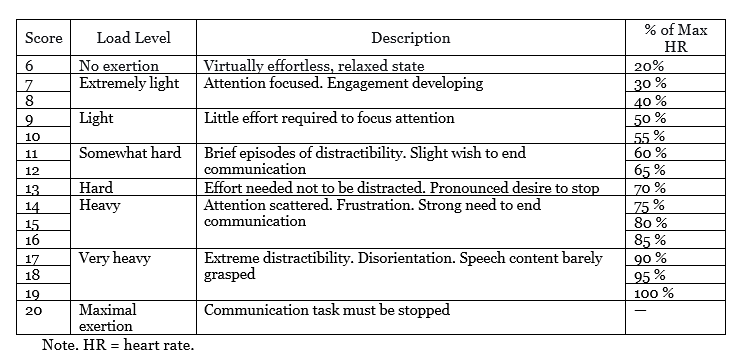
The ComLTS is a direct adaptation of the original Borg RPE scale (Borg, 1982; Borg, 1990). We retained the 6–20 numerical range while replacing physical exertion descriptors with descriptors characterising communicative effort (e.g., attention focus, distractibility, frustration). This adaptation followed Borg’s principle that “numerical values should be anchored by verbal expressions understandable to most people” (Borg, 1982, p. 380).
Instructions: “Please evaluate the degree of communicative effort you invested during task performance. Use the scale from 6 to 20, where 6 corresponds to a state of complete relaxation and absence of any intellectual effort, and 20 corresponds to maximal communicative strain. Select the number that most accurately reflects your state.”

- Convergent Validity Criteria
(a) Borg Rating of Perceived Exertion (RPE) Scale
The Borg RPE scale (Borg, 1990) was used to assess subjective tolerance of physical load. The 6–20 point version was developed with heart rate correspondence: the numerical value multiplied by 10 approximates heart rate for a given load level. This measure was included to examine the generalisability of load tolerance across physical and communicative domains. We expected a positive correlation between Borg RPE and ComLTS.
(b) Rusalov’s Structure of Temperament Questionnaire (STQ‑26)
The STQ‑26 (Rusalov, 1990) was administered to assess two scales:
Communicative Activity of Temperament (CAT): The dispositional need for communicative engagement, including preference for interpersonal interaction and ease of establishing social contact. We expected a negative correlation between CAT and ComLTS, as higher activity habituates individuals to communicative demands (habituation/expertise effect).
Communicative Emotionality (CE): Sensitivity to failures in communication; the tendency to emotionally experience discrepancies between intended interaction and actual outcomes. We expected a positive correlation between CE and ComLTS, as higher emotional sensitivity amplifies perceived strain.
(c) Cooperation Readiness as a Measure of Coping Intelligence
To assess behavioural readiness for joint resolution of stressful situations, we used the Cooperation Readiness scale, which is part of the Behaviorally Anchored Rating Scales of Coping Intelligence (Kuvaeva & Volkova, 2025). Coping intelligence is defined as a form of organising mental experience for overcoming stressful situations, enabling the individual to maintain health potential and enhance personal development capacity under unstable life conditions (Volkova & Kuvaeva, 2023). The Cooperation Readiness scale measures the individual’s orientation toward collaborative problem‑solving: the willingness to seek support, coordinate actions with interaction partners, and employ dyadic coping strategies. Higher scores reflect more adaptive coping strategies characterised by openness to cooperation and trust in others under stress. We expected a negative correlation between Cooperation Readiness and ComLTS, as better cooperation facilitates load sharing and reduces perceived communicative burden (Bodenmann, 2005).
(d) States Scale – Subjective Comfort Index (SCI)
The States Scale (Leonova & Kapitsa, 2003) comprises 10 bipolar scales, each rated on a 7‑point scale. The Subjective Comfort Index (SCI) is calculated as:
SCI = (Σ items 1, 2, 4, 5, 7, 9) − (Σ items 3, 6, 8, 10) + 28
SCI scores range from 10 to 70, with higher scores indicating better subjective state. This instrument has been extensively employed in academic stress research to assess well‑being dynamics under stressful conditions (Duryagina, 2019; Golubeva & Feshchenko, 2019; Odarushchenko, 2019). We expected a negative correlation between SCI and ComLTS: individuals experiencing greater comfort during interaction should report lower perceived communication load, as comfort reduces the effort required to sustain communication.
(e) Cortisol as a Physiological Marker of Stress Reactivity
Venous blood samples (5 mL) were collected from the antecubital vein before (Cortisol1) and immediately after (Cortisol2) the experimental protocol. Samples were centrifuged at 3000 rpm for 10 minutes, and serum was stored at −80°C until analysis. Cortisol levels were measured using a commercially available electrochemiluminescence immunoassay (Roche Diagnostics, Mannheim, Germany) according to the manufacturer’s instructions. The lower detection limit was 0.5 nmol/L. Cortisol change (Cortisol_d) was calculated as Cortisol1 − Cortisol2. We expected a positive correlation between ComLTS and Cortisol2 (higher load → higher post‑stress cortisol), and a negative correlation between ComLTS and Cortisol_d (higher load → less recovery/cortisol decrease).
- Discriminant Validity Criteria
(a) Raven’s Standard Progressive Matrices (SPM)
Raven’s SPM (Raven, 2012) assesses non‑verbal intelligence, measuring analytical‑synthetic ability and logical reasoning. The standard 20‑minute timed administration was employed. This measure was included to confirm that ComLTS is independent of general cognitive ability; we expected no significant correlation with ComLTS.
(b) Heart Rate Variability (HRV) Parameters
HRV recording was conducted during resting state (5 minutes) and during the 20‑minute communicative tasks (which included the Rosenzweig Picture‑Frustration Test, reading aloud, retelling, and discussion tasks) using an electrocardiograph (Neurosoft, Ivanovo, Russia) at a sampling rate of 1000 Hz. The following parameters were derived:
Mo (Mode): The most frequently occurring R–R interval value (in seconds). Heart rate = 60 / Mo.
AMo (Mode Amplitude): The proportion of R–R intervals falling within the mode range (%); reflects sympathetic activity.
MxDMn, MxRMn, SI (Stress Index): Standard HRV indices.
For correlational analyses with ComLTS scores, HRV data recorded during the 20‑minute communicative tasks were used. Resting‑state HRV data were not analysed. HRV measures were included to confirm that ComLTS does not duplicate autonomic tone indices; we expected no significant correlations between ComLTS and any HRV parameter.
(c) Basal Cortisol (Cortisol1)
Pre‑load cortisol was included as a discriminant validity criterion to confirm that ComLTS is specific to reactive stress response rather than basal hormonal status; we expected no significant correlation between ComLTS and Cortisol1.
- Demographic Variables
Age and sex were recorded for all participants.
2.4. Statistical Analysis
The ComLTS is a single‑item scale based on the Borg scale format, which precludes confirmatory factor analysis (CFA). Validation was therefore conducted through examination of convergent, discriminant, and criterion‑related validity, consistent with established approaches to single‑item scale validation (Robins et al., 2001; Allen et al., 2016).
First, descriptive statistics such as means, standard deviations, ranges, skewness, and kurtosis were computed to characterise the distribution of ComLTS scores and all criterion variables. To examine criterion‑related validity, participants were divided into three groups based on stanine scores of the ComLTS: low (stanines 1–4), medium (stanines 5–7), and high (stanines 8–10). One‑way analyses of variance (ANOVA) were conducted to compare these groups on criteria (cortisol, temperament scales, cooperation readiness, HRV parameters, and intelligence). Given the assumption of unequal variances across groups, Tamhane’s T2 post‑hoc tests were employed for pairwise comparisons.
For continuous variables, associations with ComLTS scores were examined using Kendall’s tau (τ) correlation coefficients. Kendall’s tau was selected because of the ordinal nature of the ComLTS and the non‑normal distribution of several criterion variables, making it a more robust alternative to Pearson’s correlation. General Linear Modeling (GLM) with profile plots was employed to evaluate the combined effects of age and sex on ComLTS scores, including the Age × Sex interaction term. For ANOVA‑based validity analyses, listwise deletion was applied, including only cases with complete data across all variables in the model to ensure group comparability and valid between‑group comparisons.
All statistical analyses were performed using SPSS version 26.0 (IBM Corp., Armonk, NY, USA). Statistical significance was set at p < .05 (two‑tailed). Effect sizes are reported as η² for ANOVA and as τ for Kendall’s tau correlation analyses.
Results
3.1. Descriptive Statistics
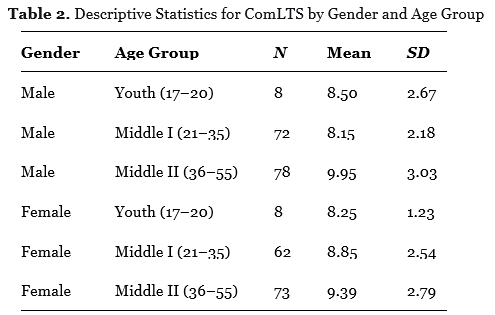
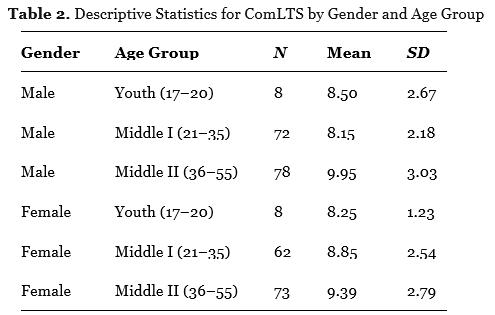
Descriptive statistics for the ComLTS are presented in Table 1. The mean ComLTS score was 9.163 (SD = 2.69), with scores ranging from 5 to 20, covering nearly the entire scale spectrum and indicating sufficient response variability. Positive skewness (0.92) indicates a distribution shift toward lower values, consistent with the relatively low intensity of the presented communicative load. Kurtosis (0.90) approximates normality, permitting parametric statistical analysis.

Table 2 presents descriptive statistics for ComLTS scores disaggregated by gender and age group. A consistent age‑related increase in ComLTS scores was observed in both males and females: males from 8.50 (17–20 years) to 9.95 (36–55 years); females from 8.25 to 9.39. Within each age group, gender differences were minimal: 0.25 points in the 17–20 group, 0.70 points in favour of females in the 21–35 group, and 0.56 points in favour of males in the 36–55 group. The largest standard deviation was observed in the male 36–55 group (SD = 3.03), indicating higher response heterogeneity in this subsample.
3.2. Effects of Age and Gender on ComLTS
A General Linear Model (GLM) was conducted to evaluate the main and interactive effects of age and gender on ComLTS scores. Figure 1 presents the profile plot of mean ComLTS scores across age groups for males and females. A unidirectional age trend was observed: scores increased with age in both sexes, with minimal within‑age gender differences
.
Figure 1. Profile plot of mean ComLTS scores across age groups (17–20, 21–35, 36–55 years) for males and females. Scores increase with age in both sexes, with minimal within‑age gender differences
As shown in Table 3, only the effect of age was statistically significant, F(2, 297) = 5.025, p = .007, η²p = .033. The effect of gender, F(1, 297) = .042, p = .838, and the Gender × Age interaction, F(2, 297) = .768, p =.465, did not reach significance. Thus, age emerged as a significant predictor of ComLTS scores, while gender and its interaction with age did not substantially contribute to variance explanation. The model explained only 4.0% of variance (adjusted R² = .024), suggesting that other unmeasured factors influence ComLTS scores.

2.3. Group Formation Based on Stanine Scores
For subsequent analyses, 240 participants from the total sample (N = 300) with complete data on all relevant measures were retained. The remaining 60 participants were excluded due to missing data (refusals, technical artefacts in HRV recording, or questionnaire omissions).
Based on stanine scores of the ComLTS, participants were divided into three groups (Table 4):
- Low level(stanines 1–4; raw score range 7–10);
- Medium level(stanines 5–7; raw score range 11–15);
- High level(stanines 8–10; raw score range 16–20).

2.4. Comparison of ComLTS Groups on External Criteria (ANOVA)
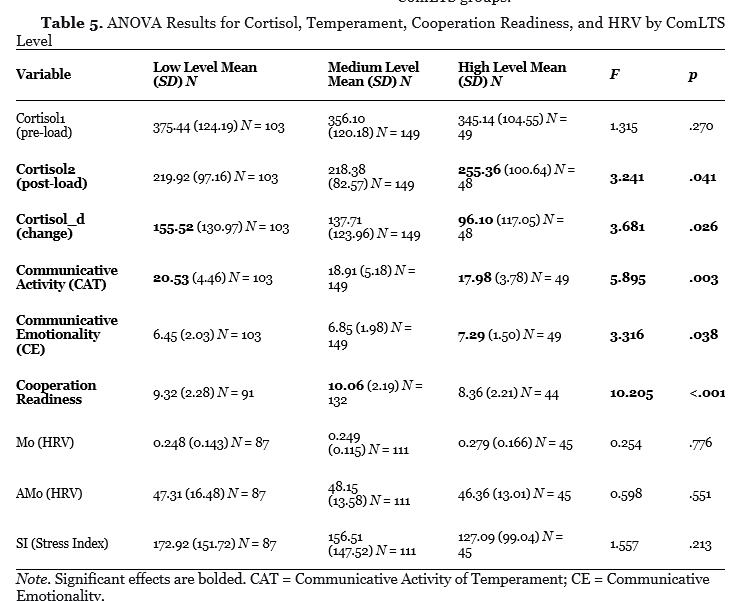
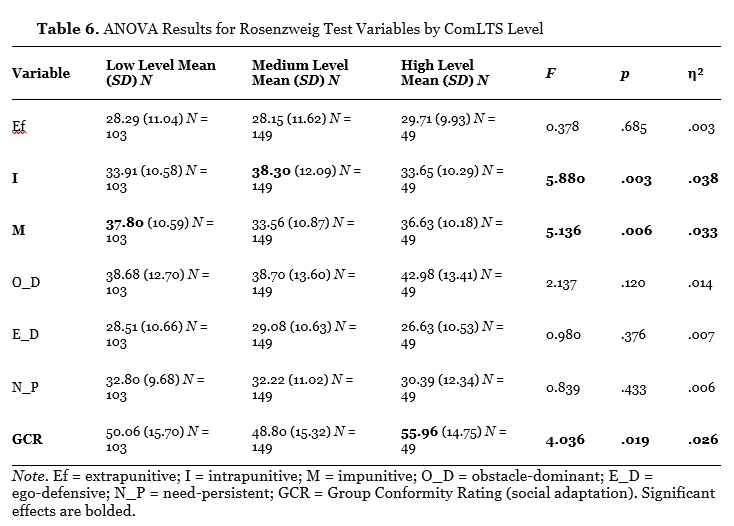
To examine criterion‑related validity, one‑way ANOVAs with Tamhane’s T2 post‑hoc comparisons (assuming unequal variances) were conducted. Tables 5 and 6 present means, standard deviations, sample sizes, F‑values, and significance levels for cortisol, temperament scales, cooperation readiness, HRV parameters, and Rosenzweig test variables across the three ComLTS groups.
Tamhane’s T2 post‑hoc comparisons revealed the following significant patterns:
The high ComLTS group showed significantly higher post‑load cortisol compared to both the low and medium groups (p < .05 for both pairs). Differences between low and medium groups were not significant.
The high ComLTS group showed significantly less cortisol decrease (or relative increase) compared to the low group (p < .05); differences from the medium group approached significance.
The low ComLTS group showed significantly higher communicative activity than the high group (p < .05); the medium group occupied an intermediate position.
The high ComLTS group showed significantly higher communicative emotionality compared to the low group (p < .05).
The medium group showed the highest values, significantly differing from both the low and high groups (p < .05 for both pairs), indicating a non‑linear (inverted‑U) relationship.
The medium ComLTS group demonstrated the highest level of intrapunitive reactions (38.30), significantly differing from both the low (33.91) and high (33.65) groups (p < .05).
The low ComLTS group showed the highest values of impunitive reactions (M) (37.80), significantly differing from both the medium (33.56) and high (36.63) groups (p < .05).
The high ComLTS group demonstrated better social adaptation (GCR= 55.96 scores) compared to both the low (50.06) and medium (48.80) groups (p < .05).
No significant group differences were found for any HRV parameter (Mo, AMo, MxDMn, MxRMn, SI), pre‑load cortisol (Cortisol1), or Rosenzweig variables Ef, O_D, E_D, and N_P (all p > .05). These findings support the discriminant validity of the ComLTS with respect to autonomic regulation, basal hormonal status, and frustration‑response patterns not directly related to communication load.
2.5. Correlation Analysis (Convergent and Discriminant Validity)
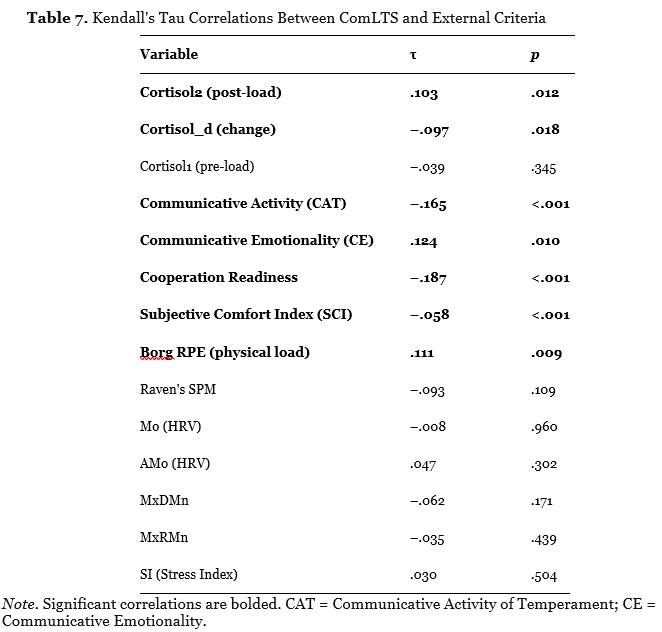
To examine associations between ComLTS scores and continuous external criteria, Kendall’s tau (τ) correlation coefficients were computed. Table 7 presents the correlations between ComLTS and all criterion variables.

Convergent validity was supported by the following significant correlations:
ComLTS correlated positively with post‑load cortisol (τ = .103, p = .012) and negatively with cortisol change (τ = –.097, p = .018), indicating that higher perceived communication load is associated with greater HPA‑axis reactivity and reduced recovery. The absence of correlation with pre‑load cortisol (τ = –.039, p = .345) confirms that the scale captures reactive stress response rather than basal hormonal status.
ComLTS correlated negatively with Communicative Activity of Temperament (τ = –.165, p < .001), supporting the habituation/expertise effect: individuals with a stronger dispositional need for communication perceive load as less burdensome. ComLTS correlated positively with Communicative Emotionality (τ = .124, p = .010), indicating that sensitivity to communication failures amplifies perceived strain.
A significant negative correlation was observed between ComLTS and Cooperation Readiness (τ = – .187, p < .001), supporting the hypothesis that greater readiness for joint coping reduces perceived communicative burden.
ComLTS correlated negatively with Subjective Comfort Index (τ = –.058, p < .001), indicating that higher subjective comfort during interaction is associated with lower perceived communication load.
A significant positive correlation was found between ComLTS and the Borg physical load scale (τ = .111, p = .009), suggesting a common “load tolerance” construct spanning physical and communicative domains.
Discriminant validity was supported by the absence of significant correlations between ComLTS and:
Raven’s SPM (τ = –.093, p = .109), confirming independence from general non‑verbal intelligence;
all HRV parameters (Mo, AMo, MxDMn, MxRMn, SI; all p > .10), confirming that ComLTS does not duplicate autonomic tone indices; pre‑load cortisol (τ = –.039, p = .345), confirming specificity to reactive stress response rather than basal hormonal status.
Discussion
The present study provides robust psychometric evidence for the Perceived Communicative Load Scale (ComLTS), a novel instrument adapted from the Borg Rating of Perceived Exertion scale for assessing subjective tolerance of communicative load. Our findings demonstrate that the ComLTS possesses sound construct, convergent, discriminant, and criterion‑related validity, with a distinctive physiological profile that differentiates it from general cognitive or autonomic measures.
The convergent validity of the ComLTS is supported by a coherent pattern of significant correlations with both psychological and physiological criteria. The negative correlation with Communicative Activity of Temperament (CAT; τ = –.165, p < .001) indicates that individuals with a stronger dispositional need for communicative engagement perceive communication load as less burdensome. This finding is interpretable within the framework of the expertise reversal effect (Kalyuga, 2007; Sweller et al., 2019): individuals regularly engaged in communicative activities develop more efficient cognitive schemas for processing interpersonal information, reducing the subjective difficulty of communication. This interpretation is further supported by habituation effects observed in populations with high communicative exposure (Kuznetsova et al., 2008). Conversely, the positive correlation with Communicative Emotionality (CE; τ = .124, p = .010) indicates that heightened sensitivity to communication failures amplifies perceived communicative strain. Individuals prone to emotionally experience discrepancies between intended and actual interaction outcomes find communication more effortful and distressing, aligning with theoretical models of emotional reactivity in social contexts (Rusalov, 1990).
The negative correlations with Cooperation Readiness (τ = –.187, p < .001) and the Subjective Comfort Index (SCI; τ = –.058, p < .001) further strengthen convergent validity. Individuals oriented toward collaborative problem‑solving and those experiencing greater comfort during interaction perceive communication load as less burdensome. This pattern is consistent with the systemic‑transactional model of dyadic coping (Bodenmann, 2005), which posits that cooperative coping strategies reduce the psychological cost of stress by distributing burden across interaction partners. The positive correlation with the Borg RPE scale (τ = .111, p = .009) indicates a general “load tolerance” construct spanning physical and communicative domains, supporting unified self‑regulation mechanisms (Leonova, 2007; Nikolaeva et al., 2022, 2024).
Discriminant validity is confirmed by the absence of significant correlations with Raven’s SPM (τ = – 093, p = .109), all HRV parameters (all p > .10), and basal cortisol (Cortisol1; τ = –.039, p = .345). This confirms that the ComLTS is not a proxy for general intelligence, autonomic tone, or basal hormonal status, but captures a specific construct related to subjective tolerance of communicative demands. The use of the Rosenzweig Picture‑Frustration Test provided additional validation: significant group differences on intrapunitive reactions (I), impunitive reactions (M), and Group Conformity Rating (GCR) indicate that subjective load tolerance is associated with unconscious patterns of frustration response. The high ComLTS group demonstrated better social adaptation (GCR), while the medium group showed the highest levels of intrapunitive reactions, patterns consistent with previous research linking frustration response types to tolerance for uncertainty and anxiety (Lvova et al., 2016; Vinogradova & Ryzhov, 2012).
The most important evidence for biological validity is the association with cortisol. ComLTS correlated positively with post‑load cortisol (Cortisol2; τ = .103, p = .012) and negatively with cortisol change (Cortisol_d; τ = –.097, p = .018). The high ComLTS group demonstrated significantly higher post‑load cortisol and significantly less cortisol recovery compared to low and medium groups. These findings align with research demonstrating that communicative stressors elicit significant cortisol elevations (Studer et al., 2017; Choi et al., 2016; James et al., 2023) and extend these findings by showing that subjective ratings correspond to the magnitude of the hormonal stress response. Crucially, the association was specific to reactive stress response rather than basal levels, consistent with the neurovisceral integration model (Thayer & Lane, 2009), which posits that reactive physiological changes are more informative for assessing adaptive capacity than baseline measures.
The absence of correlations with HRV parameters merits careful consideration. First, communicative tasks may induce a stress response mediated primarily through the HPA axis rather than autonomic pathways. While cognitive load tasks reliably elicit autonomic changes, communicative tasks involving interpersonal evaluation may preferentially activate the HPA axis (Studer et al., 2017; Choi et al., 2016). This is consistent with research showing that traditional HRV indices do not always demonstrate significant changes with variations in cognitive task complexity, particularly when the stress response is predominantly HPA‑mediated (Kriklenko & Kovaleva, 2024). Second, heart rate fragmentation, a phenomenon independent of autonomic regulation, may influence cardiac dynamics through pathways not captured by traditional HRV indices (Costa et al., 2017; Hayano et al., 2020). Third, individual variability in HRV responses may be substantial, with group‑level correlations not precluding meaningful individual differences. The contrast with the CogLTS, which showed associations with HRV and intelligence, underscores the theoretical and practical distinction between general cognitive load and communication load. Communication load involves interpersonal dynamics, emotional engagement, and social evaluation, factors that engage the HPA axis more prominently than autonomic pathways.
The significant age effect on ComLTS scores, F(2, 297) = 5.025, p = .007, η²p = .033, supports the hypothesis that perceived communication load increases with age. This is consistent with age‑associated declines in cognitive processing speed, executive function, and autonomic flexibility (Salthouse, 1996; West, 1996; Dadashova, 2015). However, the modest effect size (η²p = .033) and low model explanatory power (R² = .040) suggest age is only one of multiple factors influencing load tolerance. The age‑related increase may be moderated by accumulated self‑regulation experience (Carstensen et al., 2011) and HPA‑axis changes with age (James et al., 2023; Yiallouris et al., 2019). According to socioemotional selectivity theory (Carstensen et al., 2011), older adults may compensate for declining cognitive resources through enhanced emotional regulation strategies. The absence of significant gender effects and Gender × Age interaction supports gender invariance, an important psychometric property ensuring equivalent measurement for men and women, consistent with research on frustration reactions (Velikanov & Tolstykh, 2018).
Our findings complement research on explicit stress communication and dyadic coping (Pagani et al., 2019; Alves et al., 2024). The associations between ComLTS and communicative emotionality and cooperation readiness suggest that subjective load tolerance is related to the capacity for explicit communication of stress. Individuals with higher tolerance may be more inclined to articulate emotional states clearly, facilitating partner responsiveness and reducing psychological tension, consistent with the dyadic coping model (Bodenmann, 2005). Consistent with Lvova et al. (2016) on the link between frustration tolerance and tolerance for uncertainty, ComLTS scores may reflect individual differences in the capacity to tolerate the inherent uncertainty of interpersonal interactions—a hypothesis warranting further empirical testing.
Several limitations warrant consideration. The cross‑sectional design precludes causal inferences; longitudinal investigations are essential for establishing predictive validity. The sample consisted of healthy adults (17–55 years) without clinical diagnoses, limiting generalisability to clinical populations, children, and the elderly. Cross‑validation across diverse groups, including individuals with communication‑related disorders, high‑stress occupational samples, and clinical burnout populations, is a priority. HRV recording conditions may have constrained sensitivity to cognitive load; future studies should employ dynamic loading protocols and incorporate spectral analysis and nonlinear measures. The lack of control for situational stressors (fatigue, prior sleep quality) may have influenced subjective ratings and hormonal measures. The single‑item format, while consistent with Borg’s methodology and validated by prior psychometric work (Robins et al., 2001; Allen et al., 2016), precludes internal consistency assessment; future development of a multi‑item version with subscales for different aspects of communication load would enhance sensitivity and clinical utility (Klepsch & Seufert, 2021). Finally, the cultural specificity of the Russian sample necessitates caution when extrapolating to other cultural contexts, given documented cross‑cultural differences in communication tolerance (Novikova & Novikov, 2015).
Future research should focus on: longitudinal studies to test stability and predictive validity for occupational burnout; cross‑validation across professional groups and clinical populations; real‑time cortisol dynamics and other HPA‑axis markers; EEG correlates to clarify neurophysiological mechanisms; investigation of heart rate fragmentation as a complementary marker; development of normative tables for different age, professional, and cultural groups; and experimental manipulation of communication load to establish causal relationships.
Despite these limitations, the ComLTS offers practical value for occupational health assessment, training evaluation, and workload management. Its brief format and straightforward instructions facilitate administration in occupational screening contexts. The scale can be used for screening burnout risk in high‑communication professions; evaluating effectiveness of communication training programmes; individualised work schedule design based on personal tolerance levels; and prevention of stress‑related disorders. Given the age‑related increase in ComLTS scores, age‑specific normative frameworks are recommended for interpretation. The scale’s sensitivity to cortisol reactivity suggests it may be particularly useful for monitoring the efficacy of stress‑management interventions targeting HPA‑axis regulation.
Conclusions
This study provides compelling evidence for the psychometric soundness of the Communication Load Tolerance Scale (ComLTS). The convergent pattern of results, significant correlations with post‑load cortisol, cortisol change, Communicative Activity of Temperament, Communicative Emotionality, Cooperation Readiness, Subjective Comfort Index, age, and the Borg physical load scale, together with the absence of significant associations with Raven’s scores, HRV parameters, and basal cortisol, unequivocally confirms that the ComLTS measures communication load tolerance rather than serving as a proxy for general well‑being, autonomic tone, or intellectual ability.
The most important finding is the association with cortisol, an objective hormonal marker of stress. High ComLTS scores are associated with an elevated cortisol response to communication load, indicating a real physiological basis for subjective ratings. The absence of HRV correlations underscores the specificity of communication load as a stressor that primarily activates the HPA axis rather than the autonomic nervous system. This distinct physiological profile differentiates the ComLTS from generic cognitive load measures and supports its use in contexts where the interpersonal dimension of stress is central.
Age emerged as a significant predictor of ComLTS scores, with older adults reporting higher perceived load, while gender and its interaction with age did not reach significance. This age effect is consistent with declines in cognitive and autonomic resources, although the small effect size suggests other individual difference factors play substantial roles in load tolerance.
The ComLTS qualifies as a valid, theoretically grounded, and practically applicable instrument for assessing individual tolerance to communication load in educational and occupational settings. Implementation of age‑based normative frameworks will reduce the risk of erroneous conclusions. Future research should employ longitudinal designs and experimental load manipulations, examine real‑time cortisol dynamics, and explore the scale’s utility in predicting burnout trajectories and intervention outcomes. With continued validation and adaptation, the ComLTS has the potential to become a standard instrument for communication load assessment in occupational health psychology and related fields.
Author Contributions: Andrey V. Varlamov: Conceptualization, investigation, methodology, data curation, formal analysis, writing – original draft. Natalia E. Volkova: Conceptualization, data analysis, visualization of research results, writing – review & editing.
Conflict of Interest: The authors declare no conflicts of interest.
Use of Artificial Intelligence: Artificial intelligence tools were not used for data analysis, interpretation, or critical aspects of the research. AI-based language tools were used exclusively for manuscript preparation and grammatical editing, with all scientific content, interpretations, and conclusions remaining under the full responsibility of the authors.
Ethics Approval: The study protocol received approval from the Local Ethics Committee of Ural State Medical University, Ministry of Health of the Russian Federation (Protocol No. 5, dated June 16, 2023). The study was conducted in accordance with the Declaration of Helsinki. All participants provided written informed consent prior to enrolment.
Acknowledgements: The authors express their gratitude to all participants who volunteered for this study.
Author Responsibility: All authors have read and approved the final version of the manuscript. The authors confirm that they have critically reviewed the content, verified the accuracy of the data and analyses, and accept full responsibility for the integrity of the work as a whole.
Data Availability: The data that support the findings of this study are available from the corresponding author upon reasonable request.
Funding: The study was supported by the Russian Science Foundation, project number 23-18-00293, https://rscf.ru/project/23-18-00293/.
References
- Allen, M. S., Iliescu, D., & Greiff, S. (2016). Single item measures in psychological science: A call for validation. European Journal of Psychological Assessment, 32(1), 1–5. https://doi.org/10.1027/1015-5759/a000341
- Alves, S., Weitkamp, K., Breitenstein, C., & Bodenmann, G. (2024). From stress communication to depressive symptoms among couples facing vision impairment: The mediating role of dyadic coping. Social Science & Medicine, 357, 117171. https://doi.org/10.1016/j.socscimed.2024.117171
- Belasheva, I. V., & Petrova, N. F. (2016). Psychological stability of a personality and capability of tolerant interaction as diverse manifestations of tolerance. International Journal of Environmental and Science Education, 11(10), 3367–3384.
- Bodenmann, G. (2005). Dyadic coping and its significance for marital functioning. In T. A. Revenson, K. Kayser, & G. Bodenmann (Eds.), Couples coping with stress: Emerging perspectives on dyadic coping(pp. 33–49). American Psychological Association. https://doi.org/10.1037/11031-002
- Borg, G. (1982). Psychophysical bases of perceived exertion. Medicine & Science in Sports & Exercise, 14(5), 377–381. https://doi.org/10.1249/00005768-198205000-00012
- Borg, G. (1990). Psychophysical scaling with applications in physical work and the perception of exertion. Scandinavian Journal of Work, Environment & Health, 16(Suppl. 1), 55–58. https://doi.org/10.5271/sjweh.1815
- Boyko, V. V. (1996). Energiya emotsiy v obshchenii: vzglyad na sebya i na drugikh[Energy of emotions in communication: A view of oneself and others]. Informatsionno-izdatel’skiy dom “Filin”. (In Russian)
- Carstensen, L. L., Turan, B., Scheibe, S., Ram, N., Ersner-Hershfield, H., Samanez-Larkin, G. R., & Nesselroade, J. R. (2011). Emotional experience improves with age: Evidence based on over 10 years of experience sampling. Psychology and Aging, 26(1), 21–33. https://doi.org/10.1037/a0021285
- Choi, S., Hwang, Y., Shin, J., Yang, J.-S., & Jung, H.-I. (2016). Relationship analysis of speech communication between salivary cortisol levels and personal characteristics using the Smartphone Linked Stress Measurement (SLSM). BioChip Journal, 10(4), 261–268. https://doi.org/10.1007/s13206-016-1202-8
- Costa, M. D., Davis, R. B., & Goldberg, A. L. (2017). Heart rate fragmentation: A new approach to the analysis of cardiac interbeat interval dynamics. Frontiers in Physiology, 8, 255. https://doi.org/10.3389/fphys.2017.00255
- Dadashova, G. M. (2015). Gender- and age-related characteristics of heart rate variability in apparently healthy individuals. Profilakticheskaya Meditsina, 18(2), 54–58. https://doi.org/10.17116/profmed201518254-58
- Dogadkina, S. B., Ermakova, I. V., Adamovskaya, O. N., Kmit, G. V., Rubleva, L. V., & Sharapov, A. N. (2022). Heart rate variability and cortisol levels in school-age children with different cognitive tests. Acta Biomedica Scientifica, 7(3), 169–179.
- Duryagina, A. A. (2019). Dinamika sub”ektivnogo sostoyaniya studentov v usloviyakh ekzamenatsionnogo stressa [Dynamics of students’ subjective state during examination stress]. Bulletin of Kemerovo State University, 21(3), 654–662. (In Russian)
- Esipov, M. A. (2017). Soderzhanie i struktura fenomena kommunikativnoy tolerantnosti v otechestvennykh psikhologo-pedagogicheskikh issledovaniyakh [Content and structure of the phenomenon of communicative tolerance in Russian psychological and pedagogical research]. Internet-zhurnal «Mir nauki», 5(6), 1–10. (In Russian)
- Golubeva, E. A., & Feshchenko, V. M. (2019). Sub”ektivnoe blagopoluchie studentov v usloviyakh akademicheskogo stressa [Subjective well-being of students under academic stress]. Psikhologicheskaya nauka i obrazovanie, 24(1), 45–55. (In Russian)
- Hayano, J., Kisohara, M., Ueda, N., & Yuda, E. (2020). Impact of heart rate fragmentation on the assessment of heart rate variability. Applied Sciences, 10(9), 3314. https://doi.org/10.3390/app10093314
- Hilgarter, K., Schmid-Zalaudek, K., Csanady-Leitner, R., Mörtl, M., Rössler, A., & Lackner, H. K. (2021). Phasic heart rate variability and the association with cognitive performance: A cross-sectional study in a healthy population setting. PLoS ONE, 16(3), e0246968. https://doi.org/10.1371/journal.pone.0246968
- James, K. A., Stromin, J. I., Steenkamp, N., & Combrinck, M. I. (2023). Understanding the relationships between physiological and psychosocial stress, cortisol and cognition. Frontiers in Endocrinology, 14, 1089590. https://doi.org/10.3389/fendo.2023.1089590
- Kaiser, F. (2017). Understanding stress in communication management: How it limits the effectiveness at personal and organizational level. In Stress and Health. IntechOpen. https://doi.org/10.5772/intechopen.76527
- Kalyuga, S. (2007). Expertise reversal effect and its implications for learner-tailored instruction. Educational Psychology Review, 19(4), 509–539. https://doi.org/10.1007/s10648-007-9054-3
- Klepsch, M., & Seufert, T. (2021). Making an effort versus experiencing load. Frontiers in Education, 6, 645284. https://doi.org/10.3389/feduc.2021.645284
- Kostina, E. V. (2022). Evaluation of conflict behaviour strategies of communicative tolerance in the system of staff turnover prevention. Vestnik Kostromskogo gosudarstvennogo universiteta. Seriya: Pedagogika. Psikhologiya. Sotsiokinetika, 28(3), 100–107. https://doi.org/10.34216/2073-1426-2022-28-3-100-107[reference:10]
- Kriklenko, E. A., & Kovaleva, A. V. (2024). Dynamics of respiratory rate and heart rate variability when performing a cognitive task of two levels of complexity. Human Physiology, 50(4), 92–103.
- Kuvaeva, I. O., & Volkova, E. V. (2025). Behaviorally anchored rating scales of coping intelligence: Psychometric characteristics in a sample of men. Natural System of Mind, 5(4), in print.
- Kuznetsova, A. S., Barabanshchikova, V. V., & Zlokazova, T. A. (2008). Effektivnost’ psikhologicheskikh sredstv proizvol’noy samoregulyatsii funktsional’nogo sostoyaniya [Effectiveness of psychological means of voluntary self‑regulation of functional state]. Eksperimental’naya psikhologiya, 1(1), 101–127. (In Russian)
- Leonova, A. B. (2007). Struktura i funktsii sub”ektivnoy regulyatsii deyatel’nosti [The structure and functions of subjective regulation of activity]. Psikhologicheskiy zhurnal, 28(1), 34–45. (In Russian)
- Leonova, A. B., & Kapitsa, M. S. (2003). Metody sub”ektivnoy otsenki funktsional’nykh sostoyaniy cheloveka [Methods for assessing subjective states under stress]. In Yu. K. Strelkov (Ed.), Praktikum po inzhenernoy psikhologii i ergonomike(pp. 136–167). (In Russian)
- Logvinova, O. K., Egorova, U. G., & Berdieva, A. Sh. (2018). Osobennosti kommunikativnoy tolerantnosti studentov raznoy professional’noy napravlennosti [Features of communicative tolerance of students of different professional orientations]. Mir nauki, kul’tury, obrazovaniya, (1), 287–289. (In Russian)
- Lvova, E. N., Shlyagina, E. I., & Gusev, A. N. (2016). Using the Rosenzweig frustration picture test in the study of coping behaviour in the situation of uncertainty. National Psychological Journal, (1), 19–27.
- Maslova, T. M. (2022). Communicative tolerance of students as a socio-psychological characteristic. International Scientific Research Journal, (1-2), 156–160.
- Nikolaeva, T. M., Golubeva, E. K., Skorlupkin, D. A., & Yarchenkova, L. L. (2022). Heart rate variability during mental and physical load in students. Siberian Journal of Life Sciences and Agriculture, 14(1), 336–350.
- Novikova, I. A., & Novikov, A. L. (2015). Relation between communicative tolerance and intercultural adaptation in international students. Mediterranean Journal of Social Sciences, 6(2S2), 109–115. https://doi.org/10.5901/mjss.2015.v6n2s2p109
- Odarushchenko, O. I. (2019). Sub”ektivnaya otsenka samochuvstviya i rabotosposobnosti v usloviyakh akademicheskogo stressa [Subjective assessment of well-being and performance under academic stress]. Vestnik Rossiyskogo universiteta druzhby narodov, 16(3), 432–440. (In Russian)
- Pagani, A. F., Donato, S., Parise, M., Bertoni, A., Iafrate, R., & Schoebi, D. (2019). Explicit stress communication facilitates perceived responsiveness in dyadic coping. Frontiers in Psychology, 10, 401. https://doi.org/10.3389/fpsyg.2019.00401
- Raven, J. C., Court, J. H., & Raven, J. (2012). Rukovodstvo k progressivnym matritsama Ravena i slovarnym shkalam. Razdel 3. Obshchaya chast’ rukovodstva[Manual for Raven’s Progressive Matrices and Vocabulary Scales. Section 3: General overview]. Kogito-Tsentr. (In Russian)
- Robins, R. W., Hendin, H. M., & Trzesniewski, K. H. (2001). Measuring global self-esteem: Construct validation of a single‑item measure and the Rosenberg Self‑Esteem Scale. Personality and Social Psychology Bulletin, 27(2), 151–161. https://doi.org/10.1177/0146167201272002
- Rosenzweig, S., & Adelman, S. (1955). The Rosenzweig Picture-Frustration Test: A manual. Journal of Consulting Psychology, 19(6), 425–434.
- Rusalov, V. M. (1990). Oprosnik struktury temperamenta (OFDSI)[Structure of Temperament Questionnaire (STQ‑26)]. (In Russian)
- Salthouse, Timothy. (1996). The Processing-Speed Theory of Adult Age Differences in Cognition. Psychological review. 103. 403-28. 10.1037//0033-295X.103.3.403.
- Studer, R. K., Danuser, B., & Gomez, P. (2017). Physicians’ psychophysiological stress reaction in medical communication of bad news: A critical literature review. International Journal of Psychophysiology, 120, 14–22. https://doi.org/10.1016/j.ijpsycho.2017.06.006
- Sweller, J., van Merriënboer, J. J. G., & Paas, F. (2019). Cognitive architecture and instructional design: 20 years later. Educational Psychology Review, 31(2), 261–292. https://doi.org/10.1007/s10648-019-09465-5
- Thayer, J. F., & Lane, R. D. (2009). Claude Bernard and the heart‑brain connection: Further elaboration of a model of neurovisceral integration. Neuroscience and Biobehavioral Reviews, 33(2), 81–88. https://doi.org/10.1016/j.neubiorev.2008.08.004
- Tokumasu, K., Nishimura, Y., Sakamoto, Y., Obika, M., Kataoka, H., & Otsuka, F. (2023). Differences in stress perception of medical students depending on in‑person communication and online communication during the COVID‑19 pandemic: A Japanese cross‑sectional survey. International Journal of Environmental Research and Public Health, 20(2), 1579. https://doi.org/10.3390/ijerph20021579
- Toyofuku, A., Ehrler, M., Naef, N., Schmid, A. S., Kretschmar, O., Latal, B., & O’Gorman Tuura, R. (2025). Heart rate variability and cognitive functions in adolescents with complex congenital heart disease. Pediatric Research, 97, 1103–1113. https://doi.org/10.1038/s41390-024-03432-9
- Tu, Z., He, J., Zhou, N., & Shen, X. (2021). Driver‑passenger communicative stress and psychological distress among Chinese bus drivers: The mediating effect of job burnout. BMC Public Health, 21, 547. https://doi.org/10.1186/s12889-021-10618-x
- Vasichkina, O. N. (2022). Some aspects of the impact of the pandemic on the professional burnout among the teachers of higher educational institutions. International Scientific Research Journal, (1-2), 153–155.
- Velikanov, L. V., & Tolstykh, N. N. (2018). Modification of S. Rosenzweig test to study driver’s frustration reactions. Social Psychology and Society, 9(4), 134–152.
- West, R.L. (1996) An Application of Prefrontal Cortex Function Theory to Cognitive Aging. Psychological Bulletin, 120, 272-292.
https://doi.org/10.1037/0033-2909.120.2.272 - Vinogradova, M. G., & Ryzhov, A. L. (2012). Metod kachestvennogo analiza v rabote s testom risunochnoy frustratsii S. Rozentsveyga. II. Kontrol’ i kritichnost’, dinamika, instrumental’nyy aspekt [Method of qualitative analysis in work with Rosenzweig Picture‑Frustration Test. II. Control and criticality, dynamics, instrumental aspect]. Sibirskiy psikhologicheskiy zhurnal, (43), 92–106. (In Russian)
- Volkova, E. V., & Kuvaeva, I. O. (2023). Sovladayushchiy intellekt: differentsionno-integratsionnyy podkhod[Coping intelligence: A differential-integration approach]. Publishing House “Institute of Psychology RAS”. https://doi.org/10.38098/mng_23_0464
- Yasyukova, L. A. (2001). Test frustratsionnykh reaktsiy S. Rozentsveyga: metodicheskoe rukovodstvo[Rosenzweig Picture‑Frustration Test: Methodological guide]. (In Russian)
- Yiallouris, A., Tsioutis, C., Agapidaki, E., Zafeiri, M., Agouridis, A. P., Ntourakis, D., & Dalamaga, M. (2019). Adrenal aging and its implications on stress responsiveness in humans. Frontiers in Endocrinology, 10, 54. https://doi.org/10.3389/fendo.2019.00054
- Zuev, A. V., Nekrasova, M. M., & Vasilieva, T. N. (2019). Pilot study of office employee informational mental workload. Russian Journal of Occupational Health and Industrial Ecology, 59(10), 866–870.
Comments (0)
Background and Relevance. Digitalization and the intensification of professional activity have markedly increased communication load, particularly in “person-to-person” occupations, where excessive interpersonal demands contribute to emotional exhaustion and burnout. Despite extensive research on communication tolerance and stress, no validated instrument exists for the subjective assessment of communication load tolerance. Objective. This study aimed to develop and psychometrically validate the Rating of Perceived Communicative Load Scale (ComLTS), an adaptation of the Borg Rating of Perceived Exertion scale, and to evaluate its construct, convergent, and discriminant validity. Methods. A cross-sectional design was employed with 300 participants (158 males, 142 females; age range 17–55 years, M = 29.8 ± 6.9 years). Participants completed the ComLTS together with validated measures of subjective state, communicative activity of temperament, communicative emotionality, cooperation readiness, and Raven’s Standard Progressive Matrices. Heart rate variability (HRV) parameters were recorded during communicative tasks, and venous cortisol was measured before and after the experimental protocol. Statistical analyses included Kendall’s tau correlations, ANOVA with post-hoc comparisons, and General Linear Modeling. Results. ComLTS scores showed significant positive correlations with post-load cortisol (τ = .103, p = .012) and negative correlations with cortisol change (τ = –.097, p = .018), with communicative emotionality (τ = .124, p = .010), and with age (τ = .140, p < .01). Negative correlations were found with communicative activity of temperament (τ = –.165, p < .001), cooperation readiness (τ = –.187, p < .001), and subjective comfort (τ = –.058, p < .001). No significant associations emerged with Raven’s scores or HRV indices, supporting discriminant validity. ANOVA revealed significant group differences (low, medium, high ComLTS) in post-load cortisol (F = 3.241, p = .041), cortisol change (F = 3.681, p = .026), communicative activity of temperament (F = 5.895, p = .003), communicative emotionality (F = 3.316, p = .038), and cooperation readiness (F = 10.205, p < .001). GLM confirmed a significant age effect (F = 5.025, p = .007, η²p = .033), while gender and its interaction were non-significant. Conclusion. The ComLTS is a valid, brief instrument for assessing subjective tolerance of communication load, showing meaningful associations with hormonal stress reactivity (cortisol) and theoretically relevant psychological constructs, but not with autonomic indices or general intelligence. The scale holds promise for burnout screening and training evaluation in high-communication professions.
Рейтинговая шкала воспринимаемой коммуникативной нагрузки: психометрические характеристики на российской выборке
А. В. Варламова, Н. Э. Волковаб
аРязанский государственный медицинский университет имени академика И.П. Павлова, Рязань, Россия
бИнститут психологии Российской академии наук, Москва, Россия
Резюме. Актуальность и проблема. Цифровизация и интенсификация профессиональной деятельности значительно увеличили коммуникативную нагрузку, особенно в профессиях типа «человек–человек», где чрезмерные межличностные требования способствуют эмоциональному истощению и выгоранию. Несмотря на обилие исследований коммуникативной толерантности и стресса, в настоящее время не существует валидного инструмента оценки воспринимаемой коммуникативной нагрузки. Цель. Разработка и психометрическая проверка рейтинговой шкалы воспринимаемой коммуникативной нагрузки (ComLTS), адаптированной на основе шкалы Борга, с оценкой её конструктной, конвергентной и дискриминантной валидности. Метод. В кросс-секционном исследовании приняли участие 300 человек (158 мужчин, 142 женщины) в возрасте от 17 до 55 лет (M = 29.8 ± 6.9 года). Участники заполнили опросник ComLTS, а также валидизированные методики оценки субъективного состояния, коммуникативной активности темперамента, коммуникативной эмоциональности, готовности к сотрудничеству и тест СПМ Равена. Показатели вариабельности сердечного ритма (ВСР) регистрировались во время выполнения коммуникативных задач; забор венозной крови для определения уровня кортизола проводился до и после экспериментального протокола. Статистическая обработка включала корреляционный анализ по Кендаллу, дисперсионный анализ с пост-хок сравнениями и общее линейное моделирование. Результаты. Выявлены значимые положительные корреляции показателя ComLTS с уровнем кортизола после нагрузки (τ = 0.103; p = 0.012) и отрицательные — с динамикой кортизола (τ = –0.097; p = 0.018), с коммуникативной эмоциональностью (τ = 0.124; p = 0.010) и возрастом (τ = 0.140; p < 0.01). Отрицательные корреляции выявлены с коммуникативной активностью темперамента (τ = –0.165; p < 0.001), готовностью к сотрудничеству (τ = –0.187; p < 0.001) и субъективным комфортом (τ = –0.058; p < 0.001). Значимых связей с показателями теста СПМ Равена и ВСР не обнаружено, что подтверждает дискриминантную валидность. Дисперсионный анализ выявил значимые различия между группами (низкий, средний, высокий уровни ComLTS) по уровню кортизола после нагрузки (F = 3.241; p = 0.041), динамике кортизола (F = 3.681; p = 0.026), коммуникативной активности темперамента (F = 5.895; p = 0.003), коммуникативной эмоциональности (F = 3.316; p = 0.038) и готовности к сотрудничеству (F = 10.205; p < 0.001). Общее линейное моделирование подтвердило значимый эффект возраста (F = 5.025; p = 0.007; η²p = 0.033), тогда как эффект пола и взаимодействие пола и возраста оказались незначимыми. Заключение. Шкала ComLTS представляет собой валидный и краткий инструмент оценки воспринимаемой коммуникативной нагрузки, демонстрирующий значимые связи с гормональной реактивностью на стресс (кортизол) и теоретически релевантными психологическими конструктами, но не связанный с показателями вегетативной регуляции и общего интеллекта. Шкала может быть использована для скрининга профессионального выгорания и оценки эффективности тренингов в профессиях с высокой коммуникативной нагрузкой.
The accelerating pace of digital transformation, professional intensification, and socioeconomic instability has sharply increased communication load – the intensity and complexity of interpersonal interactions that demand sustained emotional engagement, rapid decision‑making, and behavioural flexibility (Kaiser, 2017; Zuev et al., 2019). This challenge is especially pronounced in “person‑to‑person” professions such as educators, physicians, managers, service workers, and law enforcement personnel where communication quality directly determines both professional effectiveness and psychological well‑being (Kostina, 2022; Vasichkina, 2022). When communication demands exceed individual capacity, the consequences cascade: rising conflict, emotional exhaustion, declining professional efficacy, and ultimately burnout syndrome (Tu et al., 2021; Maslova, 2022). The urgency of this problem is underscored by evidence that communication modality matters critically: Tokumasu et al. (2023) found that only in‑person interaction, not online communication, buffered stress among medical students during the COVID‑19 pandemic, highlighting the unique burden of live interpersonal contact and the necessity of assessing how individuals subjectively experience and tolerate such demands.
Despite the centrality of communication load to occupational health, the field lacks a validated instrument for its subjective assessment that is, a measure of how much communicative effort individuals can sustain before experiencing distress. Existing constructs are related but insufficient. Communication tolerance, the disposition to tolerate unpleasant or unacceptable states and behaviours of interaction partners (Boyko, 1996; Esipov, 2017), captures attitudes toward others and predicts constructive conflict resolution (Novikova & Novikov, 2015; Belasheva & Petrova, 2016; Kostina, 2022), but it does not assess the perceived effort or strain of sustained interaction. Similarly, explicitness of communication, the clarity and openness with which individuals express emotional states, facilitates dyadic coping and perceived partner responsiveness (Pagani et al., 2019; Alves et al., 2024), but it addresses coping style rather than load tolerance. Temperamental characteristics offer additional insight: communicative activity of temperament, the dispositional need for communicative engagement, may habituate individuals to interpersonal demands, thereby reducing perceived load, whereas communicative emotionality, sensitivity to failures in communication and the tendency to emotionally experience discrepancies between intended interaction and actual outcomes, may amplify the subjective burden of social exchange. However, neither temperamental predisposition addresses the core question of how much communicative effort an individual can sustain, nor do they provide a scalable, direct measure of perceived communicative load.
Physiological research offers objective markers that could anchor subjective assessment. Heart rate variability (HRV), a sensitive index of autonomic regulation, consistently decreases under mental and communicative load, reflecting sympathetic activation (Hilgarter et al., 2021; Toyofuku et al., 2025; Nikolaeva et al., 2022; Dogadkina et al., 2022). Cortisol, the primary output of the hypothalamic‑pituitary‑adrenal (HPA) axis, rises in response to socially evaluative and communicative stressors (Studer et al., 2017; Choi et al., 2016; James et al., 2023). According to the neurovisceral integration model (Thayer & Lane, 2009), HRV indexes the organism’s capacity for self‑regulation under stress, while HPA reactivity reflects the magnitude of the stress response. However, no instrument currently bridges perceived communicative effort with these physiological stress markers, leaving the relationship between subjective experience and biological cost underspecified.
What is needed, then, is a brief, theoretically grounded scale that captures the subjective experience of communication load, the perceived effort, strain, and tolerance for sustained interpersonal engagement. The Borg Rating of Perceived Exertion (RPE) scale (Borg, 1982; Borg, 1990) provides a compelling template: it anchors subjective ratings of physical effort to a 6–20 numerical range corresponding to heart rate, enabling both clinical interpretation and self‑report. Extending this logic to the communicative domain, replacing physical descriptors with communicative anchors, offers a direct pathway to a valid, interpretable instrument. Critically, such an adaptation must also account for the distinction between passively experienced load and actively invested effort (Klepsch & Seufert, 2021), ensuring that the scale captures not merely the intensity of discomfort but also the conscious resources individuals mobilise to sustain communication.
The present study addresses this gap by developing and psychometrically validating the Communication Load Tolerance Scale (ComLTS), an adaptation of the Borg RPE scale for the communicative domain. Drawing on the neurovisceral integration model (Thayer & Lane, 2009), cognitive load theory (Sweller et al., 2019), and the systemic‑transactional model of dyadic coping (Bodenmann, 2005), we evaluate the scale’s construct, convergent, and discriminant validity against both psychological and physiological criteria. Specifically, we test four hypotheses:
Convergent validity hypothesis: ComLTS scores will correlate positively with post‑load cortisol (Cortisol2) as an objective marker of stress reactivity and with communicative emotionality (CE), and negatively with communicative activity of temperament (CAT), cooperation readiness, the Subjective Comfort Index (SCI), and cortisol change (Cortisol_d), reflecting habituation, expertise, and recovery effects. Additionally, we expect a positive correlation with the Borg RPE scale, indicating a general load tolerance construct spanning physical and communicative domains.
Discriminant validity hypothesis: ComLTS will not be significantly associated with HRV parameters (Mo, AMo, SI), Raven’s scores (general intelligence), or basal cortisol (Cortisol1), confirming the specificity of the construct to communication load tolerance rather than general autonomic tone, cognitive ability, or basal hormonal status.
Criterion‑related validity hypothesis: Groups with high, medium, and low ComLTS levels will differ significantly on objective (Cortisol2, Cortisol_d) and psychological (CAT, CE, cooperation readiness) measures.
Age‑related differences hypothesis: ComLTS scores will increase with age, reflecting age‑associated declines in cognitive processing speed, executive function, and autonomic flexibility (Salthouse, 1996; West, 1996; Dadashova, 2015), which render sustained communication more effortful for older adults. This age‑related increase in perceived load may, however, be moderated by accumulated self‑regulation experience (Carstensen et al., 2011) and HPA‑axis changes (James et al., 2023). Gender differences are expected to be non‑significant.
The validated ComLTS will fill a critical gap in occupational health assessment, enabling burnout screening, training evaluation, and individualised workload management in high‑communication professions.
2.1. Study Design and Participants
The investigation employed a cross‑sectional design incorporating a comprehensive battery of psychological and psychophysiological measures to evaluate the construct, convergent, and discriminant validity of the Communication Load Tolerance Scale (ComLTS).
The study sample comprised 300 participants (158 males, 142 females) aged 17 to 55 years (M = 29.8, SD = 6.9). Age group distribution was as follows: adolescence/young adulthood (17–20 years), N = 16; early middle adulthood (21–35 years), N = 134; and late middle adulthood (36–55 years), N = 150. All participants were healthy volunteers without diagnosed psychiatric or neurological conditions. Participants were recruited through advertisements at local universities and community centres.
Written informed consent was obtained from all participants prior to enrolment. The study protocol received approval from the Local Ethics Committee of Ural State Medical University, Ministry of Health of the Russian Federation (Protocol No. 5, dated June 16, 2023). The ethics committee approval statement is available at https://ipran.ru/notice/ethic/.
2.2. Procedure
The experimental protocol was conducted under standardised conditions in a quiet, temperature‑controlled laboratory setting. Sessions were scheduled in the morning (08:00–12:00) to control for diurnal cortisol variation. Participants were instructed to refrain from food, caffeine, and alcohol consumption for at least 8 hours prior to the session and to avoid strenuous physical activity for 24 hours.
The protocol comprised the following sequential components:
- Resting‑state HRV recording 5 min
- Communicative tasks with concurrent HRV recording 20 min
- Venous blood sampling (pre‑ and post‑protocol) 2 × 5 min
- Questionnaire battery (ComLTS, Borg RPE, States Scale, STQ‑26, SPM) 45 min
- Demographic data collection 3 min
Total session duration was approximately 90 minutes.
Communicative Tasks
Participants performed a series of tasks designed to induce graded communicative load:
Reading aloud instructions and questionnaire items (including the Rosenzweig Picture‑Frustration Test; Yasyukova, 2001);
Reading aloud and retelling complex expository texts;
Discussing their health, lifestyle, and perceived strain in personal and professional life;
Reflecting on stress concepts and coping resources employed in difficult life situations.
The experimental protocol was designed so that tasks were diverse and varied in complexity, intensity, and duration, enabling perceived load assessment across a wide range of conditions (Kuvaeva & Volkova, 2025).
The Rosenzweig Picture‑Frustration Test as an Experimental Model
To model interpersonal conflict and frustration situations, we employed the Rosenzweig Picture‑Frustration Test (Rosenzweig & Adelman, 1955) in the adaptation of L.A. Yasyukova (2001). The test consists of 24 cards depicting frustrating interactions between two or more characters. Participants were instructed to formulate a verbal response for the frustrated character. The task required rapid verbal responding and strategy selection, thereby creating a standardised communicative load. Responses were scored for direction (extrapunitive, intrapunitive, impunitive) and type (obstacle‑dominant, ego‑defensive, need‑persistent) of reactions.
2.3. Measures
Measures are grouped below by their validation function: (A) primary outcome, (B) convergent validity criteria, (C) discriminant validity criteria, and (D) demographic variables.
- Primary Outcome: Communication Load Tolerance Scale (ComLTS)
The ComLTS is a direct adaptation of the original Borg RPE scale (Borg, 1982; Borg, 1990). We retained the 6–20 numerical range while replacing physical exertion descriptors with descriptors characterising communicative effort (e.g., attention focus, distractibility, frustration). This adaptation followed Borg’s principle that “numerical values should be anchored by verbal expressions understandable to most people” (Borg, 1982, p. 380).
Instructions: “Please evaluate the degree of communicative effort you invested during task performance. Use the scale from 6 to 20, where 6 corresponds to a state of complete relaxation and absence of any intellectual effort, and 20 corresponds to maximal communicative strain. Select the number that most accurately reflects your state.”
- Convergent Validity Criteria
(a) Borg Rating of Perceived Exertion (RPE) Scale
The Borg RPE scale (Borg, 1990) was used to assess subjective tolerance of physical load. The 6–20 point version was developed with heart rate correspondence: the numerical value multiplied by 10 approximates heart rate for a given load level. This measure was included to examine the generalisability of load tolerance across physical and communicative domains. We expected a positive correlation between Borg RPE and ComLTS.
(b) Rusalov’s Structure of Temperament Questionnaire (STQ‑26)
The STQ‑26 (Rusalov, 1990) was administered to assess two scales:
Communicative Activity of Temperament (CAT): The dispositional need for communicative engagement, including preference for interpersonal interaction and ease of establishing social contact. We expected a negative correlation between CAT and ComLTS, as higher activity habituates individuals to communicative demands (habituation/expertise effect).
Communicative Emotionality (CE): Sensitivity to failures in communication; the tendency to emotionally experience discrepancies between intended interaction and actual outcomes. We expected a positive correlation between CE and ComLTS, as higher emotional sensitivity amplifies perceived strain.
(c) Cooperation Readiness as a Measure of Coping Intelligence
To assess behavioural readiness for joint resolution of stressful situations, we used the Cooperation Readiness scale, which is part of the Behaviorally Anchored Rating Scales of Coping Intelligence (Kuvaeva & Volkova, 2025). Coping intelligence is defined as a form of organising mental experience for overcoming stressful situations, enabling the individual to maintain health potential and enhance personal development capacity under unstable life conditions (Volkova & Kuvaeva, 2023). The Cooperation Readiness scale measures the individual’s orientation toward collaborative problem‑solving: the willingness to seek support, coordinate actions with interaction partners, and employ dyadic coping strategies. Higher scores reflect more adaptive coping strategies characterised by openness to cooperation and trust in others under stress. We expected a negative correlation between Cooperation Readiness and ComLTS, as better cooperation facilitates load sharing and reduces perceived communicative burden (Bodenmann, 2005).
(d) States Scale – Subjective Comfort Index (SCI)
The States Scale (Leonova & Kapitsa, 2003) comprises 10 bipolar scales, each rated on a 7‑point scale. The Subjective Comfort Index (SCI) is calculated as:
SCI = (Σ items 1, 2, 4, 5, 7, 9) − (Σ items 3, 6, 8, 10) + 28
SCI scores range from 10 to 70, with higher scores indicating better subjective state. This instrument has been extensively employed in academic stress research to assess well‑being dynamics under stressful conditions (Duryagina, 2019; Golubeva & Feshchenko, 2019; Odarushchenko, 2019). We expected a negative correlation between SCI and ComLTS: individuals experiencing greater comfort during interaction should report lower perceived communication load, as comfort reduces the effort required to sustain communication.
(e) Cortisol as a Physiological Marker of Stress Reactivity
Venous blood samples (5 mL) were collected from the antecubital vein before (Cortisol1) and immediately after (Cortisol2) the experimental protocol. Samples were centrifuged at 3000 rpm for 10 minutes, and serum was stored at −80°C until analysis. Cortisol levels were measured using a commercially available electrochemiluminescence immunoassay (Roche Diagnostics, Mannheim, Germany) according to the manufacturer’s instructions. The lower detection limit was 0.5 nmol/L. Cortisol change (Cortisol_d) was calculated as Cortisol1 − Cortisol2. We expected a positive correlation between ComLTS and Cortisol2 (higher load → higher post‑stress cortisol), and a negative correlation between ComLTS and Cortisol_d (higher load → less recovery/cortisol decrease).
- Discriminant Validity Criteria
(a) Raven’s Standard Progressive Matrices (SPM)
Raven’s SPM (Raven, 2012) assesses non‑verbal intelligence, measuring analytical‑synthetic ability and logical reasoning. The standard 20‑minute timed administration was employed. This measure was included to confirm that ComLTS is independent of general cognitive ability; we expected no significant correlation with ComLTS.
(b) Heart Rate Variability (HRV) Parameters
HRV recording was conducted during resting state (5 minutes) and during the 20‑minute communicative tasks (which included the Rosenzweig Picture‑Frustration Test, reading aloud, retelling, and discussion tasks) using an electrocardiograph (Neurosoft, Ivanovo, Russia) at a sampling rate of 1000 Hz. The following parameters were derived:
Mo (Mode): The most frequently occurring R–R interval value (in seconds). Heart rate = 60 / Mo.
AMo (Mode Amplitude): The proportion of R–R intervals falling within the mode range (%); reflects sympathetic activity.
MxDMn, MxRMn, SI (Stress Index): Standard HRV indices.
For correlational analyses with ComLTS scores, HRV data recorded during the 20‑minute communicative tasks were used. Resting‑state HRV data were not analysed. HRV measures were included to confirm that ComLTS does not duplicate autonomic tone indices; we expected no significant correlations between ComLTS and any HRV parameter.
(c) Basal Cortisol (Cortisol1)
Pre‑load cortisol was included as a discriminant validity criterion to confirm that ComLTS is specific to reactive stress response rather than basal hormonal status; we expected no significant correlation between ComLTS and Cortisol1.
- Demographic Variables
Age and sex were recorded for all participants.
2.4. Statistical Analysis
The ComLTS is a single‑item scale based on the Borg scale format, which precludes confirmatory factor analysis (CFA). Validation was therefore conducted through examination of convergent, discriminant, and criterion‑related validity, consistent with established approaches to single‑item scale validation (Robins et al., 2001; Allen et al., 2016).
First, descriptive statistics such as means, standard deviations, ranges, skewness, and kurtosis were computed to characterise the distribution of ComLTS scores and all criterion variables. To examine criterion‑related validity, participants were divided into three groups based on stanine scores of the ComLTS: low (stanines 1–4), medium (stanines 5–7), and high (stanines 8–10). One‑way analyses of variance (ANOVA) were conducted to compare these groups on criteria (cortisol, temperament scales, cooperation readiness, HRV parameters, and intelligence). Given the assumption of unequal variances across groups, Tamhane’s T2 post‑hoc tests were employed for pairwise comparisons.
For continuous variables, associations with ComLTS scores were examined using Kendall’s tau (τ) correlation coefficients. Kendall’s tau was selected because of the ordinal nature of the ComLTS and the non‑normal distribution of several criterion variables, making it a more robust alternative to Pearson’s correlation. General Linear Modeling (GLM) with profile plots was employed to evaluate the combined effects of age and sex on ComLTS scores, including the Age × Sex interaction term. For ANOVA‑based validity analyses, listwise deletion was applied, including only cases with complete data across all variables in the model to ensure group comparability and valid between‑group comparisons.
All statistical analyses were performed using SPSS version 26.0 (IBM Corp., Armonk, NY, USA). Statistical significance was set at p < .05 (two‑tailed). Effect sizes are reported as η² for ANOVA and as τ for Kendall’s tau correlation analyses.
3.1. Descriptive Statistics
Descriptive statistics for the ComLTS are presented in Table 1. The mean ComLTS score was 9.163 (SD = 2.69), with scores ranging from 5 to 20, covering nearly the entire scale spectrum and indicating sufficient response variability. Positive skewness (0.92) indicates a distribution shift toward lower values, consistent with the relatively low intensity of the presented communicative load. Kurtosis (0.90) approximates normality, permitting parametric statistical analysis.
Table 2 presents descriptive statistics for ComLTS scores disaggregated by gender and age group. A consistent age‑related increase in ComLTS scores was observed in both males and females: males from 8.50 (17–20 years) to 9.95 (36–55 years); females from 8.25 to 9.39. Within each age group, gender differences were minimal: 0.25 points in the 17–20 group, 0.70 points in favour of females in the 21–35 group, and 0.56 points in favour of males in the 36–55 group. The largest standard deviation was observed in the male 36–55 group (SD = 3.03), indicating higher response heterogeneity in this subsample.
3.2. Effects of Age and Gender on ComLTS
A General Linear Model (GLM) was conducted to evaluate the main and interactive effects of age and gender on ComLTS scores. Figure 1 presents the profile plot of mean ComLTS scores across age groups for males and females. A unidirectional age trend was observed: scores increased with age in both sexes, with minimal within‑age gender differences
.
Figure 1. Profile plot of mean ComLTS scores across age groups (17–20, 21–35, 36–55 years) for males and females. Scores increase with age in both sexes, with minimal within‑age gender differences
As shown in Table 3, only the effect of age was statistically significant, F(2, 297) = 5.025, p = .007, η²p = .033. The effect of gender, F(1, 297) = .042, p = .838, and the Gender × Age interaction, F(2, 297) = .768, p =.465, did not reach significance. Thus, age emerged as a significant predictor of ComLTS scores, while gender and its interaction with age did not substantially contribute to variance explanation. The model explained only 4.0% of variance (adjusted R² = .024), suggesting that other unmeasured factors influence ComLTS scores.
2.3. Group Formation Based on Stanine Scores
For subsequent analyses, 240 participants from the total sample (N = 300) with complete data on all relevant measures were retained. The remaining 60 participants were excluded due to missing data (refusals, technical artefacts in HRV recording, or questionnaire omissions).
Based on stanine scores of the ComLTS, participants were divided into three groups (Table 4):
- Low level(stanines 1–4; raw score range 7–10);
- Medium level(stanines 5–7; raw score range 11–15);
- High level(stanines 8–10; raw score range 16–20).
2.4. Comparison of ComLTS Groups on External Criteria (ANOVA)
To examine criterion‑related validity, one‑way ANOVAs with Tamhane’s T2 post‑hoc comparisons (assuming unequal variances) were conducted. Tables 5 and 6 present means, standard deviations, sample sizes, F‑values, and significance levels for cortisol, temperament scales, cooperation readiness, HRV parameters, and Rosenzweig test variables across the three ComLTS groups.
Tamhane’s T2 post‑hoc comparisons revealed the following significant patterns:
The high ComLTS group showed significantly higher post‑load cortisol compared to both the low and medium groups (p < .05 for both pairs). Differences between low and medium groups were not significant.
The high ComLTS group showed significantly less cortisol decrease (or relative increase) compared to the low group (p < .05); differences from the medium group approached significance.
The low ComLTS group showed significantly higher communicative activity than the high group (p < .05); the medium group occupied an intermediate position.
The high ComLTS group showed significantly higher communicative emotionality compared to the low group (p < .05).
The medium group showed the highest values, significantly differing from both the low and high groups (p < .05 for both pairs), indicating a non‑linear (inverted‑U) relationship.
The medium ComLTS group demonstrated the highest level of intrapunitive reactions (38.30), significantly differing from both the low (33.91) and high (33.65) groups (p < .05).
The low ComLTS group showed the highest values of impunitive reactions (M) (37.80), significantly differing from both the medium (33.56) and high (36.63) groups (p < .05).
The high ComLTS group demonstrated better social adaptation (GCR= 55.96 scores) compared to both the low (50.06) and medium (48.80) groups (p < .05).
No significant group differences were found for any HRV parameter (Mo, AMo, MxDMn, MxRMn, SI), pre‑load cortisol (Cortisol1), or Rosenzweig variables Ef, O_D, E_D, and N_P (all p > .05). These findings support the discriminant validity of the ComLTS with respect to autonomic regulation, basal hormonal status, and frustration‑response patterns not directly related to communication load.
2.5. Correlation Analysis (Convergent and Discriminant Validity)
To examine associations between ComLTS scores and continuous external criteria, Kendall’s tau (τ) correlation coefficients were computed. Table 7 presents the correlations between ComLTS and all criterion variables.
Convergent validity was supported by the following significant correlations:
ComLTS correlated positively with post‑load cortisol (τ = .103, p = .012) and negatively with cortisol change (τ = –.097, p = .018), indicating that higher perceived communication load is associated with greater HPA‑axis reactivity and reduced recovery. The absence of correlation with pre‑load cortisol (τ = –.039, p = .345) confirms that the scale captures reactive stress response rather than basal hormonal status.
ComLTS correlated negatively with Communicative Activity of Temperament (τ = –.165, p < .001), supporting the habituation/expertise effect: individuals with a stronger dispositional need for communication perceive load as less burdensome. ComLTS correlated positively with Communicative Emotionality (τ = .124, p = .010), indicating that sensitivity to communication failures amplifies perceived strain.
A significant negative correlation was observed between ComLTS and Cooperation Readiness (τ = – .187, p < .001), supporting the hypothesis that greater readiness for joint coping reduces perceived communicative burden.
ComLTS correlated negatively with Subjective Comfort Index (τ = –.058, p < .001), indicating that higher subjective comfort during interaction is associated with lower perceived communication load.
A significant positive correlation was found between ComLTS and the Borg physical load scale (τ = .111, p = .009), suggesting a common “load tolerance” construct spanning physical and communicative domains.
Discriminant validity was supported by the absence of significant correlations between ComLTS and:
Raven’s SPM (τ = –.093, p = .109), confirming independence from general non‑verbal intelligence;
all HRV parameters (Mo, AMo, MxDMn, MxRMn, SI; all p > .10), confirming that ComLTS does not duplicate autonomic tone indices; pre‑load cortisol (τ = –.039, p = .345), confirming specificity to reactive stress response rather than basal hormonal status.
The present study provides robust psychometric evidence for the Perceived Communicative Load Scale (ComLTS), a novel instrument adapted from the Borg Rating of Perceived Exertion scale for assessing subjective tolerance of communicative load. Our findings demonstrate that the ComLTS possesses sound construct, convergent, discriminant, and criterion‑related validity, with a distinctive physiological profile that differentiates it from general cognitive or autonomic measures.
The convergent validity of the ComLTS is supported by a coherent pattern of significant correlations with both psychological and physiological criteria. The negative correlation with Communicative Activity of Temperament (CAT; τ = –.165, p < .001) indicates that individuals with a stronger dispositional need for communicative engagement perceive communication load as less burdensome. This finding is interpretable within the framework of the expertise reversal effect (Kalyuga, 2007; Sweller et al., 2019): individuals regularly engaged in communicative activities develop more efficient cognitive schemas for processing interpersonal information, reducing the subjective difficulty of communication. This interpretation is further supported by habituation effects observed in populations with high communicative exposure (Kuznetsova et al., 2008). Conversely, the positive correlation with Communicative Emotionality (CE; τ = .124, p = .010) indicates that heightened sensitivity to communication failures amplifies perceived communicative strain. Individuals prone to emotionally experience discrepancies between intended and actual interaction outcomes find communication more effortful and distressing, aligning with theoretical models of emotional reactivity in social contexts (Rusalov, 1990).
The negative correlations with Cooperation Readiness (τ = –.187, p < .001) and the Subjective Comfort Index (SCI; τ = –.058, p < .001) further strengthen convergent validity. Individuals oriented toward collaborative problem‑solving and those experiencing greater comfort during interaction perceive communication load as less burdensome. This pattern is consistent with the systemic‑transactional model of dyadic coping (Bodenmann, 2005), which posits that cooperative coping strategies reduce the psychological cost of stress by distributing burden across interaction partners. The positive correlation with the Borg RPE scale (τ = .111, p = .009) indicates a general “load tolerance” construct spanning physical and communicative domains, supporting unified self‑regulation mechanisms (Leonova, 2007; Nikolaeva et al., 2022, 2024).
Discriminant validity is confirmed by the absence of significant correlations with Raven’s SPM (τ = – 093, p = .109), all HRV parameters (all p > .10), and basal cortisol (Cortisol1; τ = –.039, p = .345). This confirms that the ComLTS is not a proxy for general intelligence, autonomic tone, or basal hormonal status, but captures a specific construct related to subjective tolerance of communicative demands. The use of the Rosenzweig Picture‑Frustration Test provided additional validation: significant group differences on intrapunitive reactions (I), impunitive reactions (M), and Group Conformity Rating (GCR) indicate that subjective load tolerance is associated with unconscious patterns of frustration response. The high ComLTS group demonstrated better social adaptation (GCR), while the medium group showed the highest levels of intrapunitive reactions, patterns consistent with previous research linking frustration response types to tolerance for uncertainty and anxiety (Lvova et al., 2016; Vinogradova & Ryzhov, 2012).
The most important evidence for biological validity is the association with cortisol. ComLTS correlated positively with post‑load cortisol (Cortisol2; τ = .103, p = .012) and negatively with cortisol change (Cortisol_d; τ = –.097, p = .018). The high ComLTS group demonstrated significantly higher post‑load cortisol and significantly less cortisol recovery compared to low and medium groups. These findings align with research demonstrating that communicative stressors elicit significant cortisol elevations (Studer et al., 2017; Choi et al., 2016; James et al., 2023) and extend these findings by showing that subjective ratings correspond to the magnitude of the hormonal stress response. Crucially, the association was specific to reactive stress response rather than basal levels, consistent with the neurovisceral integration model (Thayer & Lane, 2009), which posits that reactive physiological changes are more informative for assessing adaptive capacity than baseline measures.
The absence of correlations with HRV parameters merits careful consideration. First, communicative tasks may induce a stress response mediated primarily through the HPA axis rather than autonomic pathways. While cognitive load tasks reliably elicit autonomic changes, communicative tasks involving interpersonal evaluation may preferentially activate the HPA axis (Studer et al., 2017; Choi et al., 2016). This is consistent with research showing that traditional HRV indices do not always demonstrate significant changes with variations in cognitive task complexity, particularly when the stress response is predominantly HPA‑mediated (Kriklenko & Kovaleva, 2024). Second, heart rate fragmentation, a phenomenon independent of autonomic regulation, may influence cardiac dynamics through pathways not captured by traditional HRV indices (Costa et al., 2017; Hayano et al., 2020). Third, individual variability in HRV responses may be substantial, with group‑level correlations not precluding meaningful individual differences. The contrast with the CogLTS, which showed associations with HRV and intelligence, underscores the theoretical and practical distinction between general cognitive load and communication load. Communication load involves interpersonal dynamics, emotional engagement, and social evaluation, factors that engage the HPA axis more prominently than autonomic pathways.
The significant age effect on ComLTS scores, F(2, 297) = 5.025, p = .007, η²p = .033, supports the hypothesis that perceived communication load increases with age. This is consistent with age‑associated declines in cognitive processing speed, executive function, and autonomic flexibility (Salthouse, 1996; West, 1996; Dadashova, 2015). However, the modest effect size (η²p = .033) and low model explanatory power (R² = .040) suggest age is only one of multiple factors influencing load tolerance. The age‑related increase may be moderated by accumulated self‑regulation experience (Carstensen et al., 2011) and HPA‑axis changes with age (James et al., 2023; Yiallouris et al., 2019). According to socioemotional selectivity theory (Carstensen et al., 2011), older adults may compensate for declining cognitive resources through enhanced emotional regulation strategies. The absence of significant gender effects and Gender × Age interaction supports gender invariance, an important psychometric property ensuring equivalent measurement for men and women, consistent with research on frustration reactions (Velikanov & Tolstykh, 2018).
Our findings complement research on explicit stress communication and dyadic coping (Pagani et al., 2019; Alves et al., 2024). The associations between ComLTS and communicative emotionality and cooperation readiness suggest that subjective load tolerance is related to the capacity for explicit communication of stress. Individuals with higher tolerance may be more inclined to articulate emotional states clearly, facilitating partner responsiveness and reducing psychological tension, consistent with the dyadic coping model (Bodenmann, 2005). Consistent with Lvova et al. (2016) on the link between frustration tolerance and tolerance for uncertainty, ComLTS scores may reflect individual differences in the capacity to tolerate the inherent uncertainty of interpersonal interactions—a hypothesis warranting further empirical testing.
Several limitations warrant consideration. The cross‑sectional design precludes causal inferences; longitudinal investigations are essential for establishing predictive validity. The sample consisted of healthy adults (17–55 years) without clinical diagnoses, limiting generalisability to clinical populations, children, and the elderly. Cross‑validation across diverse groups, including individuals with communication‑related disorders, high‑stress occupational samples, and clinical burnout populations, is a priority. HRV recording conditions may have constrained sensitivity to cognitive load; future studies should employ dynamic loading protocols and incorporate spectral analysis and nonlinear measures. The lack of control for situational stressors (fatigue, prior sleep quality) may have influenced subjective ratings and hormonal measures. The single‑item format, while consistent with Borg’s methodology and validated by prior psychometric work (Robins et al., 2001; Allen et al., 2016), precludes internal consistency assessment; future development of a multi‑item version with subscales for different aspects of communication load would enhance sensitivity and clinical utility (Klepsch & Seufert, 2021). Finally, the cultural specificity of the Russian sample necessitates caution when extrapolating to other cultural contexts, given documented cross‑cultural differences in communication tolerance (Novikova & Novikov, 2015).
Future research should focus on: longitudinal studies to test stability and predictive validity for occupational burnout; cross‑validation across professional groups and clinical populations; real‑time cortisol dynamics and other HPA‑axis markers; EEG correlates to clarify neurophysiological mechanisms; investigation of heart rate fragmentation as a complementary marker; development of normative tables for different age, professional, and cultural groups; and experimental manipulation of communication load to establish causal relationships.
Despite these limitations, the ComLTS offers practical value for occupational health assessment, training evaluation, and workload management. Its brief format and straightforward instructions facilitate administration in occupational screening contexts. The scale can be used for screening burnout risk in high‑communication professions; evaluating effectiveness of communication training programmes; individualised work schedule design based on personal tolerance levels; and prevention of stress‑related disorders. Given the age‑related increase in ComLTS scores, age‑specific normative frameworks are recommended for interpretation. The scale’s sensitivity to cortisol reactivity suggests it may be particularly useful for monitoring the efficacy of stress‑management interventions targeting HPA‑axis regulation.
This study provides compelling evidence for the psychometric soundness of the Communication Load Tolerance Scale (ComLTS). The convergent pattern of results, significant correlations with post‑load cortisol, cortisol change, Communicative Activity of Temperament, Communicative Emotionality, Cooperation Readiness, Subjective Comfort Index, age, and the Borg physical load scale, together with the absence of significant associations with Raven’s scores, HRV parameters, and basal cortisol, unequivocally confirms that the ComLTS measures communication load tolerance rather than serving as a proxy for general well‑being, autonomic tone, or intellectual ability.
The most important finding is the association with cortisol, an objective hormonal marker of stress. High ComLTS scores are associated with an elevated cortisol response to communication load, indicating a real physiological basis for subjective ratings. The absence of HRV correlations underscores the specificity of communication load as a stressor that primarily activates the HPA axis rather than the autonomic nervous system. This distinct physiological profile differentiates the ComLTS from generic cognitive load measures and supports its use in contexts where the interpersonal dimension of stress is central.
Age emerged as a significant predictor of ComLTS scores, with older adults reporting higher perceived load, while gender and its interaction with age did not reach significance. This age effect is consistent with declines in cognitive and autonomic resources, although the small effect size suggests other individual difference factors play substantial roles in load tolerance.
The ComLTS qualifies as a valid, theoretically grounded, and practically applicable instrument for assessing individual tolerance to communication load in educational and occupational settings. Implementation of age‑based normative frameworks will reduce the risk of erroneous conclusions. Future research should employ longitudinal designs and experimental load manipulations, examine real‑time cortisol dynamics, and explore the scale’s utility in predicting burnout trajectories and intervention outcomes. With continued validation and adaptation, the ComLTS has the potential to become a standard instrument for communication load assessment in occupational health psychology and related fields.
Author Contributions: Andrey V. Varlamov: Conceptualization, investigation, methodology, data curation, formal analysis, writing – original draft. Natalia E. Volkova: Conceptualization, data analysis, visualization of research results, writing – review & editing.
Conflict of Interest: The authors declare no conflicts of interest.
Use of Artificial Intelligence: Artificial intelligence tools were not used for data analysis, interpretation, or critical aspects of the research. AI-based language tools were used exclusively for manuscript preparation and grammatical editing, with all scientific content, interpretations, and conclusions remaining under the full responsibility of the authors.
Ethics Approval: The study protocol received approval from the Local Ethics Committee of Ural State Medical University, Ministry of Health of the Russian Federation (Protocol No. 5, dated June 16, 2023). The study was conducted in accordance with the Declaration of Helsinki. All participants provided written informed consent prior to enrolment.
Acknowledgements: The authors express their gratitude to all participants who volunteered for this study.
Author Responsibility: All authors have read and approved the final version of the manuscript. The authors confirm that they have critically reviewed the content, verified the accuracy of the data and analyses, and accept full responsibility for the integrity of the work as a whole.
Data Availability: The data that support the findings of this study are available from the corresponding author upon reasonable request.
Funding: The study was supported by the Russian Science Foundation, project number 23-18-00293, https://rscf.ru/project/23-18-00293/.
- Allen, M. S., Iliescu, D., & Greiff, S. (2016). Single item measures in psychological science: A call for validation. European Journal of Psychological Assessment, 32(1), 1–5. https://doi.org/10.1027/1015-5759/a000341
- Alves, S., Weitkamp, K., Breitenstein, C., & Bodenmann, G. (2024). From stress communication to depressive symptoms among couples facing vision impairment: The mediating role of dyadic coping. Social Science & Medicine, 357, 117171. https://doi.org/10.1016/j.socscimed.2024.117171
- Belasheva, I. V., & Petrova, N. F. (2016). Psychological stability of a personality and capability of tolerant interaction as diverse manifestations of tolerance. International Journal of Environmental and Science Education, 11(10), 3367–3384.
- Bodenmann, G. (2005). Dyadic coping and its significance for marital functioning. In T. A. Revenson, K. Kayser, & G. Bodenmann (Eds.), Couples coping with stress: Emerging perspectives on dyadic coping(pp. 33–49). American Psychological Association. https://doi.org/10.1037/11031-002
- Borg, G. (1982). Psychophysical bases of perceived exertion. Medicine & Science in Sports & Exercise, 14(5), 377–381. https://doi.org/10.1249/00005768-198205000-00012
- Borg, G. (1990). Psychophysical scaling with applications in physical work and the perception of exertion. Scandinavian Journal of Work, Environment & Health, 16(Suppl. 1), 55–58. https://doi.org/10.5271/sjweh.1815
- Boyko, V. V. (1996). Energiya emotsiy v obshchenii: vzglyad na sebya i na drugikh[Energy of emotions in communication: A view of oneself and others]. Informatsionno-izdatel’skiy dom “Filin”. (In Russian)
- Carstensen, L. L., Turan, B., Scheibe, S., Ram, N., Ersner-Hershfield, H., Samanez-Larkin, G. R., & Nesselroade, J. R. (2011). Emotional experience improves with age: Evidence based on over 10 years of experience sampling. Psychology and Aging, 26(1), 21–33. https://doi.org/10.1037/a0021285
- Choi, S., Hwang, Y., Shin, J., Yang, J.-S., & Jung, H.-I. (2016). Relationship analysis of speech communication between salivary cortisol levels and personal characteristics using the Smartphone Linked Stress Measurement (SLSM). BioChip Journal, 10(4), 261–268. https://doi.org/10.1007/s13206-016-1202-8
- Costa, M. D., Davis, R. B., & Goldberg, A. L. (2017). Heart rate fragmentation: A new approach to the analysis of cardiac interbeat interval dynamics. Frontiers in Physiology, 8, 255. https://doi.org/10.3389/fphys.2017.00255
- Dadashova, G. M. (2015). Gender- and age-related characteristics of heart rate variability in apparently healthy individuals. Profilakticheskaya Meditsina, 18(2), 54–58. https://doi.org/10.17116/profmed201518254-58
- Dogadkina, S. B., Ermakova, I. V., Adamovskaya, O. N., Kmit, G. V., Rubleva, L. V., & Sharapov, A. N. (2022). Heart rate variability and cortisol levels in school-age children with different cognitive tests. Acta Biomedica Scientifica, 7(3), 169–179.
- Duryagina, A. A. (2019). Dinamika sub”ektivnogo sostoyaniya studentov v usloviyakh ekzamenatsionnogo stressa [Dynamics of students’ subjective state during examination stress]. Bulletin of Kemerovo State University, 21(3), 654–662. (In Russian)
- Esipov, M. A. (2017). Soderzhanie i struktura fenomena kommunikativnoy tolerantnosti v otechestvennykh psikhologo-pedagogicheskikh issledovaniyakh [Content and structure of the phenomenon of communicative tolerance in Russian psychological and pedagogical research]. Internet-zhurnal «Mir nauki», 5(6), 1–10. (In Russian)
- Golubeva, E. A., & Feshchenko, V. M. (2019). Sub”ektivnoe blagopoluchie studentov v usloviyakh akademicheskogo stressa [Subjective well-being of students under academic stress]. Psikhologicheskaya nauka i obrazovanie, 24(1), 45–55. (In Russian)
- Hayano, J., Kisohara, M., Ueda, N., & Yuda, E. (2020). Impact of heart rate fragmentation on the assessment of heart rate variability. Applied Sciences, 10(9), 3314. https://doi.org/10.3390/app10093314
- Hilgarter, K., Schmid-Zalaudek, K., Csanady-Leitner, R., Mörtl, M., Rössler, A., & Lackner, H. K. (2021). Phasic heart rate variability and the association with cognitive performance: A cross-sectional study in a healthy population setting. PLoS ONE, 16(3), e0246968. https://doi.org/10.1371/journal.pone.0246968
- James, K. A., Stromin, J. I., Steenkamp, N., & Combrinck, M. I. (2023). Understanding the relationships between physiological and psychosocial stress, cortisol and cognition. Frontiers in Endocrinology, 14, 1089590. https://doi.org/10.3389/fendo.2023.1089590
- Kaiser, F. (2017). Understanding stress in communication management: How it limits the effectiveness at personal and organizational level. In Stress and Health. IntechOpen. https://doi.org/10.5772/intechopen.76527
- Kalyuga, S. (2007). Expertise reversal effect and its implications for learner-tailored instruction. Educational Psychology Review, 19(4), 509–539. https://doi.org/10.1007/s10648-007-9054-3
- Klepsch, M., & Seufert, T. (2021). Making an effort versus experiencing load. Frontiers in Education, 6, 645284. https://doi.org/10.3389/feduc.2021.645284
- Kostina, E. V. (2022). Evaluation of conflict behaviour strategies of communicative tolerance in the system of staff turnover prevention. Vestnik Kostromskogo gosudarstvennogo universiteta. Seriya: Pedagogika. Psikhologiya. Sotsiokinetika, 28(3), 100–107. https://doi.org/10.34216/2073-1426-2022-28-3-100-107[reference:10]
- Kriklenko, E. A., & Kovaleva, A. V. (2024). Dynamics of respiratory rate and heart rate variability when performing a cognitive task of two levels of complexity. Human Physiology, 50(4), 92–103.
- Kuvaeva, I. O., & Volkova, E. V. (2025). Behaviorally anchored rating scales of coping intelligence: Psychometric characteristics in a sample of men. Natural System of Mind, 5(4), in print.
- Kuznetsova, A. S., Barabanshchikova, V. V., & Zlokazova, T. A. (2008). Effektivnost’ psikhologicheskikh sredstv proizvol’noy samoregulyatsii funktsional’nogo sostoyaniya [Effectiveness of psychological means of voluntary self‑regulation of functional state]. Eksperimental’naya psikhologiya, 1(1), 101–127. (In Russian)
- Leonova, A. B. (2007). Struktura i funktsii sub”ektivnoy regulyatsii deyatel’nosti [The structure and functions of subjective regulation of activity]. Psikhologicheskiy zhurnal, 28(1), 34–45. (In Russian)
- Leonova, A. B., & Kapitsa, M. S. (2003). Metody sub”ektivnoy otsenki funktsional’nykh sostoyaniy cheloveka [Methods for assessing subjective states under stress]. In Yu. K. Strelkov (Ed.), Praktikum po inzhenernoy psikhologii i ergonomike(pp. 136–167). (In Russian)
- Logvinova, O. K., Egorova, U. G., & Berdieva, A. Sh. (2018). Osobennosti kommunikativnoy tolerantnosti studentov raznoy professional’noy napravlennosti [Features of communicative tolerance of students of different professional orientations]. Mir nauki, kul’tury, obrazovaniya, (1), 287–289. (In Russian)
- Lvova, E. N., Shlyagina, E. I., & Gusev, A. N. (2016). Using the Rosenzweig frustration picture test in the study of coping behaviour in the situation of uncertainty. National Psychological Journal, (1), 19–27.
- Maslova, T. M. (2022). Communicative tolerance of students as a socio-psychological characteristic. International Scientific Research Journal, (1-2), 156–160.
- Nikolaeva, T. M., Golubeva, E. K., Skorlupkin, D. A., & Yarchenkova, L. L. (2022). Heart rate variability during mental and physical load in students. Siberian Journal of Life Sciences and Agriculture, 14(1), 336–350.
- Novikova, I. A., & Novikov, A. L. (2015). Relation between communicative tolerance and intercultural adaptation in international students. Mediterranean Journal of Social Sciences, 6(2S2), 109–115. https://doi.org/10.5901/mjss.2015.v6n2s2p109
- Odarushchenko, O. I. (2019). Sub”ektivnaya otsenka samochuvstviya i rabotosposobnosti v usloviyakh akademicheskogo stressa [Subjective assessment of well-being and performance under academic stress]. Vestnik Rossiyskogo universiteta druzhby narodov, 16(3), 432–440. (In Russian)
- Pagani, A. F., Donato, S., Parise, M., Bertoni, A., Iafrate, R., & Schoebi, D. (2019). Explicit stress communication facilitates perceived responsiveness in dyadic coping. Frontiers in Psychology, 10, 401. https://doi.org/10.3389/fpsyg.2019.00401
- Raven, J. C., Court, J. H., & Raven, J. (2012). Rukovodstvo k progressivnym matritsama Ravena i slovarnym shkalam. Razdel 3. Obshchaya chast’ rukovodstva[Manual for Raven’s Progressive Matrices and Vocabulary Scales. Section 3: General overview]. Kogito-Tsentr. (In Russian)
- Robins, R. W., Hendin, H. M., & Trzesniewski, K. H. (2001). Measuring global self-esteem: Construct validation of a single‑item measure and the Rosenberg Self‑Esteem Scale. Personality and Social Psychology Bulletin, 27(2), 151–161. https://doi.org/10.1177/0146167201272002
- Rosenzweig, S., & Adelman, S. (1955). The Rosenzweig Picture-Frustration Test: A manual. Journal of Consulting Psychology, 19(6), 425–434.
- Rusalov, V. M. (1990). Oprosnik struktury temperamenta (OFDSI)[Structure of Temperament Questionnaire (STQ‑26)]. (In Russian)
- Salthouse, Timothy. (1996). The Processing-Speed Theory of Adult Age Differences in Cognition. Psychological review. 103. 403-28. 10.1037//0033-295X.103.3.403.
- Studer, R. K., Danuser, B., & Gomez, P. (2017). Physicians’ psychophysiological stress reaction in medical communication of bad news: A critical literature review. International Journal of Psychophysiology, 120, 14–22. https://doi.org/10.1016/j.ijpsycho.2017.06.006
- Sweller, J., van Merriënboer, J. J. G., & Paas, F. (2019). Cognitive architecture and instructional design: 20 years later. Educational Psychology Review, 31(2), 261–292. https://doi.org/10.1007/s10648-019-09465-5
- Thayer, J. F., & Lane, R. D. (2009). Claude Bernard and the heart‑brain connection: Further elaboration of a model of neurovisceral integration. Neuroscience and Biobehavioral Reviews, 33(2), 81–88. https://doi.org/10.1016/j.neubiorev.2008.08.004
- Tokumasu, K., Nishimura, Y., Sakamoto, Y., Obika, M., Kataoka, H., & Otsuka, F. (2023). Differences in stress perception of medical students depending on in‑person communication and online communication during the COVID‑19 pandemic: A Japanese cross‑sectional survey. International Journal of Environmental Research and Public Health, 20(2), 1579. https://doi.org/10.3390/ijerph20021579
- Toyofuku, A., Ehrler, M., Naef, N., Schmid, A. S., Kretschmar, O., Latal, B., & O’Gorman Tuura, R. (2025). Heart rate variability and cognitive functions in adolescents with complex congenital heart disease. Pediatric Research, 97, 1103–1113. https://doi.org/10.1038/s41390-024-03432-9
- Tu, Z., He, J., Zhou, N., & Shen, X. (2021). Driver‑passenger communicative stress and psychological distress among Chinese bus drivers: The mediating effect of job burnout. BMC Public Health, 21, 547. https://doi.org/10.1186/s12889-021-10618-x
- Vasichkina, O. N. (2022). Some aspects of the impact of the pandemic on the professional burnout among the teachers of higher educational institutions. International Scientific Research Journal, (1-2), 153–155.
- Velikanov, L. V., & Tolstykh, N. N. (2018). Modification of S. Rosenzweig test to study driver’s frustration reactions. Social Psychology and Society, 9(4), 134–152.
- West, R.L. (1996) An Application of Prefrontal Cortex Function Theory to Cognitive Aging. Psychological Bulletin, 120, 272-292.
https://doi.org/10.1037/0033-2909.120.2.272 - Vinogradova, M. G., & Ryzhov, A. L. (2012). Metod kachestvennogo analiza v rabote s testom risunochnoy frustratsii S. Rozentsveyga. II. Kontrol’ i kritichnost’, dinamika, instrumental’nyy aspekt [Method of qualitative analysis in work with Rosenzweig Picture‑Frustration Test. II. Control and criticality, dynamics, instrumental aspect]. Sibirskiy psikhologicheskiy zhurnal, (43), 92–106. (In Russian)
- Volkova, E. V., & Kuvaeva, I. O. (2023). Sovladayushchiy intellekt: differentsionno-integratsionnyy podkhod[Coping intelligence: A differential-integration approach]. Publishing House “Institute of Psychology RAS”. https://doi.org/10.38098/mng_23_0464
- Yasyukova, L. A. (2001). Test frustratsionnykh reaktsiy S. Rozentsveyga: metodicheskoe rukovodstvo[Rosenzweig Picture‑Frustration Test: Methodological guide]. (In Russian)
- Yiallouris, A., Tsioutis, C., Agapidaki, E., Zafeiri, M., Agouridis, A. P., Ntourakis, D., & Dalamaga, M. (2019). Adrenal aging and its implications on stress responsiveness in humans. Frontiers in Endocrinology, 10, 54. https://doi.org/10.3389/fendo.2019.00054
- Zuev, A. V., Nekrasova, M. M., & Vasilieva, T. N. (2019). Pilot study of office employee informational mental workload. Russian Journal of Occupational Health and Industrial Ecology, 59(10), 866–870.
References