
The Concept of Motion in the Structure of General and Special Physical Abilities: A Cross‑Sectional Study of Russian High School
Abstract
Abstract
Background. Despite extensive research on general intellectual and special abilities, the psychological nature of physical abilities remains theoretically underdeveloped. Conceptual structures, integral cognitive formations that encode knowledge about objects and their interrelations, are hypothesized to underlie both general and special abilities; however, empirical evidence linking conceptual organization to the development of physical abilities remains scarce. Objective. This study examined (1) age‑related differences in the organization of the concept “motion” across high school physics education (grades 9–11), (2) the relationship between conceptual organization and physical thinking, and (3) the psychometric properties of a newly developed diagnostic battery for assessing these constructs. Methods. A cross‑sectional design was employed with 169 Russian high school students (M = 16.36, SD = 0.895, 52.1% male). The diagnostic battery comprised three blocks: (a) assessment of the concept “motion” (cognitive, figurative, and emotional components via associative experiment and pictographic methods); (b) assessment of physical thinking (categorical generalization, conceptual synthesis, and classification of physical concepts); and (c) self‑assessment of general and special physical abilities (MDSCGSA). Psychometric evaluation included Cronbach’s α, inter‑rater reliability (Kendall’s coefficient of concordance), and exploratory factor analysis (EFA). Group differences were tested using analysis of variance (ANOVA) with post‑hoc comparisons. Results. Internal consistency ranged from acceptable to excellent (α = 0.65–0.87). Inter‑rater reliability was high (Kendall’s W = 0.82–0.94). Hierarchical cluster analysis revealed systematic restructuring of the concept “motion”: from a syncretic two‑cluster structure in grade 9 to a differentiated three‑cluster structure with integrated content‑imagery modalities by grade 11. All physical thinking measures showed significant growth from grade 9 to 11 (F = 4.72–8.14, all p < .05). Exploratory factor analysis extracted three factors explaining 52.3% of the variance: Special Physical Abilities (23.8%), General Abilities (19.2%), and Conceptual Information Capacity (9.3%). The cognitive‑emotional composition of the concept loaded exclusively onto Factor 3, alongside categorical generalization and classification, confirming its specific association with physical thinking. Self‑assessed abilities paradoxically declined with grade level, consistent with the Dunning–Kruger effect. Conclusions. The concept “motion” undergoes substantial qualitative reorganization during late adolescence, tightly coupled with the development of physical thinking. The developed diagnostic battery demonstrates sound psychometric properties and offers a replicable tool for assessing the development of conceptual structures and special abilities in physics education. The findings support the differentiation‑integration theory of abilities and underscore the foundational role of conceptual structures in the formation of special abilities.
Актуальность исследования. Несмотря на обширные исследования общих интеллектуальных и специальных способностей, психологическая природа физических способностей остаётся теоретически недостаточно разработанной. Концептуальные структуры — интегральные когнитивные образования, кодирующие знания об объектах и их взаимосвязях, — предположительно лежат в основе как общих, так и специальных способностей, однако эмпирических данных, связывающих организацию концепта с развитием физических способностей, недостаточно. Цель исследования. Изучение (1) возрастных различий в организации концепта «движение» в процессе изучения физики в старших классах школы (9–11 классы), (2) взаимосвязи между организацией концепта и физическим мышлением, (3) психометрических свойств разработанного диагностического комплекса для оценки данных конструктов. Методы. В кросс-секционном исследовании приняли участие 169 российских старшеклассников (M = 16,36, SD = 0,895, 52,1% юношей). Диагностический комплекс включал три блока: (а) оценку концепта «движение» (когнитивный, образный и эмоциональный компоненты с использованием ассоциативного эксперимента и пиктографического методов); (б) оценку физического мышления (категориальное обобщение, понятийный синтез и классификация физических понятий); (в) самооценку общих и специальных физических способностей (МИКОСС). Психометрическая проверка включала вычисление α Кронбаха, межэкспертной согласованности (коэффициент конкордации Кендалла) и эксплораторный факторный анализ (EFA). Различия между группами оценивались с помощью дисперсионного анализа (ANOVA) с пост-хок сравнениями. Результаты. Внутренняя согласованность шкал варьировала от приемлемой до отличной (α = 0,65–0,87). Межэкспертная согласованность была высокой (коэффициент конкордации Кендалла W = 0,82–0,94). Иерархический кластерный анализ выявил системную перестройку концепта «движение»: от синкретической двухкластерной структуры в 9 классе к дифференцированной трёхкластерной структуре с интегрированными содержательно-образными модальностями к 11 классу. Все показатели физического мышления значимо возрастали от 9 к 11 классу (F = 4,72–8,14, все p < 0,05). Эксплораторный факторный анализ выделил три фактора, объясняющих 52,3% дисперсии: Специальные физические способности (23,8%), Общие способности (19,2%) и Информационная ёмкость концепта (9,3%). Когнитивно-эмоциональный состав концепта вошёл исключительно в Третий фактор, наряду с категориальным обобщением и классификацией, что подтверждает его специфическую связь с физическим мышлением. Самооценка способностей парадоксально снижалась с повышением класса, что согласуется с эффектом Даннинга–Крюгера. Выводы. Концепт «движение» претерпевает существенную качественную перестройку в старшем подростковом возрасте, тесно связанную с развитием физического мышления. Разработанный диагностический комплекс обладает удовлетворительными психометрическими свойствами и может служить воспроизводимым инструментом для оценки развития концептуальных структур и специальных способностей в процессе обучения физике. Полученные результаты поддерживают дифференционно-интеграционную теорию способностей и подчёркивают фундаментальную роль концептуальных структур в формировании специальных способностей.
Ключевые слова: концепт, движение, физические способности, концептуальные структуры, физическое мышление, когнитивное развитие, специальные способности, психометрическая валидизация, старшеклассники
Introduction
The nature of human abilities has been a perennial question in psychology. Within the Russian psychological tradition abilities are understood as individual psychological properties that determine the success and qualitative uniqueness activities. A core distinction is drawn between general abilities (e.g., intelligence, creativity, learning capacity) and special abilities (e.g., mathematical, musical, linguistic, chemical, and, relevant to this study, physical abilities). General abilities are presumed to operate across diverse domains (Druzhinin, 1994), special abilities are domain‑specific and emerge through the refinement of cognitive operations within a particular content area (Volkova, 2011).
However, the transition from general to special abilities remains theoretically opaque. What cognitive structures support this transition? How do domain‑specific concepts become organized and integrated into broader ability systems? Despite extensive research on mathematical, musical, and chemical abilities (Krutetskii, 1998; Teplov, 1985; Volkova, 2011), the psychological foundations of physical abilities have received surprisingly little empirical attention. There is no universally accepted definition of physical thinking, nor any validated diagnostic instrument to assess its components. This theoretical and methodological gap constrains both educational practice (e.g., identification of talented students) and basic research on cognitive development in science education. Volkova (2018) emphasized that the measurement of special abilities requires not only objective performance indicators but also subjective self‑evaluation, as abilities manifest as integrated properties of mental structures that are experienced and reflected upon by the individual.
Recent research has begun to address this gap. Wells, Henderson, Traxler, Miller, and Stewart (2020) explored the structure of misconceptions in the Force and Motion Conceptual Evaluation (FMCE) using modified module analysis with a large sample of 3,956 pretest and 3,719 post‑test responses, demonstrating that systematic analysis of student misconceptions can reveal the underlying structure of conceptual understanding in Newtonian mechanics. Similarly, Banda and Nzabahimana (2021) conducted a comprehensive review of 31 quasi‑experimental studies on the effect of PhET simulations on students’ conceptual understanding in physics, finding robust evidence that such simulations can significantly enhance conceptual understanding and can be integrated into active learning instructional environments. Rollinde, Decamp, and Derniaux (2021) explored the teaching of Galilean motion principles observed in different reference frames in an astronomical context with grade 10 students, demonstrating that embodied learning sessions had a significant and lasting effect on students’ understanding of the dependence of motions on reference frames. These findings underscore the importance of systematic, validated assessment approaches for understanding how students develop conceptual knowledge in physics.
Following Chuprikova (2007), Volkova (2011, 2014), and Kholodnaya (2012), we adopt a differentiation‑integration framework in which abilities are conceptualized as functional properties of mental structures, stable cognitive formations that represent knowledge, experience, and operational procedures. Chuprikova (2007) demonstrated that mental development proceeds through the principle of differentiation, that is, from global, undifferentiated representations to increasingly differentiated and integrated cognitive systems. Mental structures perform three essential functions: representation (encoding information about reality), selection (filtering relevant information), and transformation (reorganizing information into new forms). Abilities are emergent properties of these structures, manifesting as speed, depth, flexibility, and success in task performance (Volkova, 2011, 2014).
Central to this framework is the concept of conceptual structures (or simply concepts). Following Kholodnaya (2012), we define conceptual structures as integral cognitive formations that comprise multiple components: verbal‑semantic (linguistic representation), visual‑spatial (imagery), sensory‑emotional (affective and perceptual experience), operational‑logical (rules and operations), mnemonic (memory organization), and attentional (selective focus). These components are neither independent nor merely additive; they are organized hierarchically and selectively interconnected. The maturity of a conceptual structure can be assessed by several criteria derived from Werner (1957): progression from syncretic to discrete organization, from diffuse to articulated relations, from rigid to flexible application, and from labile to stable representation. Volkova (2013) proposed a triune model of the functional organization of the concept, integrating past experience, present representation, and future‑oriented anticipation. This model highlights that concepts are not static repositories of knowledge but dynamic formations that continuously integrate temporal dimensions of experience. Kholodnaya and Volkova (2016) demonstrated that the higher the level of conceptual structures, the higher the level of conceptual thinking, field independence, reflectivity, creativity, intelligence, competence, and successfulness in real professional activity. This finding provides a critical theoretical foundation for our investigation, as it establishes that conceptual structures are not merely descriptive categories but are ontologically real cognitive formations that determine the effectiveness of cognitive functioning.
Importantly, conceptual structures are not static repositories of knowledge; they undergo continuous reorganization during development and learning. Vygotsky (1972) demonstrated that true concept formation, characterized by the ability to abstract essential attributes and embed concepts in systematic networks, emerges only in adolescence, building on earlier sensory‑motor and image‑based thinking. This developmental timing is critical for understanding science education, as students encounter formal scientific concepts precisely during this sensitive period. The foundational work of Bogoyavlenskii and Menchinskaia (1959) on the psychology of knowledge acquisition in school established that the quality of concept formation depends on the organization of the conceptual system and the operations available to the learner.
In the domain of physics, the concept of motion holds a privileged position. Physics is fundamentally the science of matter, its properties, and its motion. The concept of motion organizes and integrates virtually all sub‑domains of physics: kinematics (description of motion), dynamics (causes of motion), thermodynamics (motion of molecules), electromagnetism (motion of charges), and wave phenomena (propagation of motion). Thus, the way in which a student organizes the concept of motion may reflect the overall quality of their physical conceptual system.
Despite its centrality, no empirical studies have systematically examined the psychological organization of the concept “motion” across physics education. However, recent work in physics education research has highlighted the importance of understanding how students develop conceptual understanding of motion‑related topics. Stern, Aprea, and Ebner (2017) developed and validated the Kinematics Concept Test (KCT), a 49‑item multiple‑choice test designed to evaluate high school students’ conceptual understanding of kinematics. Their structural analysis revealed a hierarchical organization of concepts: at the higher level, mathematical concepts group together and then split up into physics concepts at the lower level; furthermore, students who understand a concept in one representation often have difficulties transferring it to similar problems in another representation. This finding is particularly relevant to our study, as we examine how students organize the concept of motion across different representational modalities (verbal, figurative).
Merzel, Weissman, Katz, and Galili (2024) demonstrated that mathematical structures, specifically Dirac notation, facilitate both conceptual understanding and quantitative problem solving in quantum physics by enabling students to interpret and produce representations of physical states. Their finding that proficiency with such structures requires extensive practice and well‑structured teaching sequences aligns with our observation of progressive conceptual restructuring across grades 9–11. This work reinforces the importance of mathematical‑symbolic competence in physics thinking.
Physical thinking can be characterized as the ability to operate with physical models, that is, mental representations that combine physical objects, quantities, and laws into coherent explanatory frameworks (Lipkin, 2011). Unlike everyday thinking, physical thinking requires: (1) categorical generalization: abstracting common principles from diverse phenomena; (2) conceptual synthesis: integrating multiple concepts into a coherent explanation or prediction; and (3) classification: organizing phenomena into theoretically meaningful categories.
These operations are domain‑specific because they depend on the content and structure of physical knowledge. However, they also recruit general cognitive resources (e.g., working memory, reasoning). The interplay between general and domain‑specific components is precisely what makes the study of special abilities both challenging and theoretically important.
Recent research on mathematical sensemaking in physics has provided a valuable framework for understanding how students integrate conceptual and quantitative reasoning. Gifford and Finkelstein (2020) proposed a categorical framework for mathematical sense making in physics, identifying four basic modes of reasoning: using mathematical tools to understand mathematical objects, mathematical tools for physical objects, physical tools for mathematical objects, and physical tools for physical objects. They further identified three fundamental processes by which these modes may be combined: translation, chaining, and coordination. This framework is directly relevant to our study, as it explains how students integrate mathematical and physical knowledge, a process we observed as the integration of content and imagery modalities of the concept “motion” by grade 11. Our finding that the figurative component of the concept did not load on any factor aligns with the observation that physical sense‑making in high school becomes increasingly dominated by mathematical tools.
Kuo, Hull, Elby, and Gupta (2020) introduced an assessment paradigm of calculation‑concept crossover that operationalizes mathematical sense‑making in physics. They showed that the ability to use calculations on qualitative problems and conceptual arguments on quantitative problems is a key dimension of physics problem‑solving competence, rejecting the assumed dichotomy underlying the design of standard physics assessments. This reinforces the idea that conceptual organization and mathematical reasoning are deeply intertwined in physics expertise. Kozhevnikov, Motes, and Hegarty (2005) demonstrated that the development of expertise in physics involves a shift from reliance on visual‑spatial processing to symbolic‑logical processing, providing neurocognitive support for the transition from imagistic to abstract‑symbolic reasoning we observed.
Furthermore, Robertson, Goodhew, Scherr, and Heron (2021) identified six common conceptual resources for understanding forces based on analysis of 2,048 written student responses. They demonstrated that students’ intuitive formulations can serve as productive starting points for learning rather than merely as misconceptions to be overcome, framing student thinking as continuous with formal physics. This resources‑oriented approach aligns with our perspective that conceptual structures, even those that are not yet fully aligned with formal physics, represent valuable cognitive assets that undergo reorganization with education.
Klaschus and Volkova (2022) examined the ways of conceptual thinking development in adolescence, demonstrating that the transition from concrete to abstract thinking is not uniform but depends on the quality of conceptual structures formed through domain‑specific instruction. This finding provides further support for our investigation into how physics education shapes conceptual organization.
Despite the theoretical importance of conceptual structures for special abilities, no validated psychometric battery exists to assess the organization of core physics concepts in relation to physical thinking and abilities. Prior research has relied on qualitative case studies or teacher judgments. The absence of standardized, replicable instruments hinders both basic research and practical applications (e.g., talent identification, curriculum evaluation).
The present study addresses this gap by: (1) developing and psychometrically validating a diagnostic battery to assess the concept “motion” (cognitive, figurative, and emotional components), physical thinking operations, and self‑assessed abilities; (2) examining cross‑sectional differences in the organization of the concept “motion” across grades 9–11, to trace developmental trajectories; and (3) testing the structural relationship between conceptual organization, physical thinking, and general versus special abilities, using exploratory factor analysis.
Based on the theoretical framework and prior research, we formulated the following hypotheses:
(H1): The organization of the concept “motion” will show systematic qualitative changes across grades 9–11, moving from a syncretic, undifferentiated structure to a more differentiated, integrated, and hierarchical structure (consistent with Werner’s developmental criteria and Usova’s stage model).
(H2): Physical thinking operations (categorical generalization, conceptual synthesis, and classification) will show significant improvement across grades, with different developmental trajectories: classification and conceptual synthesis may show later acceleration than categorical generalization.
(H3): The cognitive‑emotional composition of the concept “motion” will be specifically associated with physical thinking operations, rather than with general abilities, providing evidence for domain‑specificity. By contrast, figurative components of the concept may show weaker or no association with either general or special abilities, due to the abstract nature of formal physics.
(H4): Self‑assessed special physical abilities will decline with grade level, reflecting increased metacognitive awareness of the complexity of physics (Dunning–Kruger effect), even as objective performance on physical thinking tasks improves.
Method
- Participants
Participants were 169 high school students recruited from two educational institutions in Russia: Moscow Multidisciplinary Technical Lyceum No. 1501 (a selective STEM‑focused school) and Tyumen State University Gymnasium (a general academic high school). The sample comprised 88 males (52.1%) and 81 females (47.9%), ranging in age from 15 to 18 years (M = 16.36, SD = 0.895). Students were distributed across three grade levels:
Grade 9: n = 38 (22 male, 16 female), M = 15.22 (SD = 0.42);
Grade 10: n = 71 (44 male, 27 female), M = 16.20 (SD = 0.47);
Grade 11: n = 60 (22 male, 38 female), M = 17.27 (SD = 0.47).
All participants had studied physics as a compulsory subject from grade 7 onward. Grade 9 students had completed approximately 2.5 years of physics; grade 10 students, 3.5 years; grade 11 students, 4.5 years. The curriculum was standardized across the two schools, covering mechanics (kinematics and dynamics), thermodynamics, electromagnetism, and wave/optical phenomena.
The study was conducted in accordance with the ethical standards of the institutional research committee and with the 1964 Helsinki Declaration and its later amendments. Informed consent was obtained from all participants and, for minors, from their parents or legal guardians. Participation was voluntary, and no compensation was provided.
- Procedure
Data collection was conducted from October 2015 to May 2017 during regular school hours. Participants completed the diagnostic battery in a single session lasting approximately 60 minutes, in the following fixed order:
- Cognitive composition of the concept “motion” (associative experiment) – 3 min;
- Figurative composition of the concept “motion” (pictographic task) – 2 min;
- Emotional composition of the concept “motion” (associative experiment) – 3 min;
- Categorical generalization – 5 min;
- Conceptual synthesis – 9 min;
- Classification of physical concepts – 5 min;
- Self‑assessment of abilities (MDSCGSA) – 15 min.
All tasks were administered in a classroom group setting. Verbal instructions were read aloud by a trained research assistant; written instructions were also provided on the response forms. For the pictographic task, participants were given unlined paper; for all other tasks, structured response sheets were used.
- Measures
The diagnostic battery comprised three blocks, developed specifically for this study based on the theoretical frameworks of Volkova (2011), Kholodnaya (2012), and Usova (1988). In the following sections, we describe each task in sufficient detail to permit independent replication.
Block 1: Assessment of the Concept “Motion”
This block assessed three interdependent components of the concept: cognitive (semantic associations), figurative (visual representation), and emotional (affective evaluation). The stimulus word throughout was “движение“ (Russian for “motion”).
- Cognitive Composition of the Concept (Directed Associative Experiment)
Task description. Participants were instructed: “Please write down as many adjectives as possible that, in your opinion, characterize the word motion. Work for the full 3 minutes. Write down every adjective that comes to mind, regardless of whether it seems trivial or unusual. Do not explain your choices; simply list the adjectives.” The instruction emphasized that only adjectives (qualifying words) should be written, not nouns or verbs. Response forms provided numbered lines (1 to 30).
Scoring and coding. After data collection, all responses were transcribed and reviewed for spelling variants. A coding scheme was developed based on semantic analysis of the entire corpus, resulting in nine a priori semantic categories (see Table 1). These categories were derived both from theoretical considerations (physics sub‑domains, dimensions of motion) and from the actual distribution of responses.
Two independent judges (trained graduate students in psychology) coded all responses into these categories. Inter‑rater agreement was high (Cohen’s κ = 0.87). Disagreements were resolved through discussion. For each participant, we computed the total number of associations (fluency) and the number of distinct categories represented (semantic diversity). A cognitive composition score was derived as the weighted sum of associations across categories (with rare categories given higher weight to capture conceptual breadth), but for the main analyses we used the category profile as input to cluster analysis.
Psychometric properties. Test‑retest reliability (n = 30, 2‑week interval) for total number of associations was r = 0.79. Inter‑coder reliability was κ = 0.87. Convergent validity was assessed by correlating the cognitive composition score with physics grade (r = 0.34, p < .01, n = 169), supporting the criterion validity of the measure.
- Figurative Composition of the Concept (Pictographic Method)
Task description. Participants were given a blank sheet of paper (A5 size) and instructed: “Please make a drawing that represents the concept motion. Try to depict its most important, essential characteristics. You have 2 minutes. Do not worry about artistic quality; we are interested in the content of your drawing, not its aesthetic merit.” No further guidance was provided, and participants were not told what “essential characteristics” might be, to avoid priming.
Scoring system. Each drawing was evaluated by three expert judges on three dimensions:
- Number of motion typesdepicted (e.g., translational, rotational, oscillatory, wave‑like) — raw count.
- Number of causes of motionindicated (e.g., force, gravity, friction, impetus) — raw count.

- scale (0 to 3) assessing the abstraction level of the representation, developed a priori based on the developmental criteria of Usova (1988) and Werner (1957):
0 points (Situational/Emotional). The drawing depicts specific, concrete objects or scenes without abstracting physical content. The stimulus is interpreted at the level of everyday experience or affective response.
1 point (Descriptive‑Object). The drawing shows a specific type of motion (e.g., a ball rolling down a hill) and identifies at least one cause (e.g., “gravity”). Physical meaning is beginning to emerge but remains tied to a single example.
2 points (Object‑Generalized). The drawing attempts to represent motion as a physical model, showing multiple causes and types of motion, but lacks integration of key elements or the model remains schematic and incomplete.
3 points (Generalized Abstract System). The drawing presents motion as an organized system reflecting all major components (types, causes, parameters) and their interrelations, often using abstract symbols or diagrams. The model shows high structure and cross‑domain integration (e.g., connecting mechanical, wave, and thermal aspects).
Example scoring with actual student drawings:
0 points: A student drew a smiling person running on a track, with clouds and a sun. No arrows, no forces, no indication of physical quantities. The drawing expresses the everyday concept of “moving” but not the physics concept.
1 point: A student drew a ball rolling down an inclined plane with an arrow labeled “gravity” and a wavy line for the trajectory. The drawing identifies one type of motion (translational) and one cause (gravity), but lacks integration with other types or parameters.
2 points: A student drew a diagram showing a car moving on a road, with arrows for velocity and acceleration, and a note “F = ma” alongside a curved path indicating turning. The drawing shows multiple types (translational, rotational from wheels) and causes (force, friction), but the model is still object‑based and not fully abstracted.
3 points: A student drew a complex schema with a central circle labeled “motion” connected by arrows to boxes labeled “translational,” “rotational,” “oscillatory,” “wave,” with sub‑boxes for “velocity,” “acceleration,” “force,” “energy,” and equations such as E = mv²/2 and ω = v/r. The drawing integrates multiple physics domains and shows a hierarchical, systematic representation of the concept.
Psychometric properties. Inter‑rater reliability for the three judges (doctoral‑level physicist, two senior physics teachers) was excellent: Kendall’s W = 0.91 for degree of generalization, W = 0.88 for number of motion types, and W = 0.84 for number of causes. Inter‑correlations among the three dimensions were moderate (r = 0.42–0.58), suggesting they tap related but distinct aspects of figurative representation.
1.3 Emotional Composition of the Concept (Affective Associative Experiment)
Task description. This task was procedurally identical to the cognitive association task, but participants were asked: “Write down the emotions, feelings, or moods that the word motion evokes in you. Again, work for 3 minutes and list as many as possible.” This was counterbalanced with the cognitive task to avoid priming effects. For the purpose of this study,
the emotional composition score was included as a supplementary indicator but is not a focus of the main analysis; however, it was included in cluster analyses of the concept structure.
Block 2: Assessment of Physical Thinking
This block comprised three tasks designed to assess core operations of physical thinking, adapted from Kholodnaya’s (2012) “Conceptual Abilities” battery but developed specifically on physical content.
2.1. Categorical Generalization
Task description. Ten triads of physical concepts were read aloud by the experimenter at a natural pace. For each triad, participants were instructed: “Think about what is common among these three concepts. Write your answer in the space provided, using one word if possible.” Time limit was 30 seconds per triad; total task duration 5 minutes. All triads are presented in Table 2.
Table 2. Stimulus Triads for Categorical Generalization with Scoring Rubric
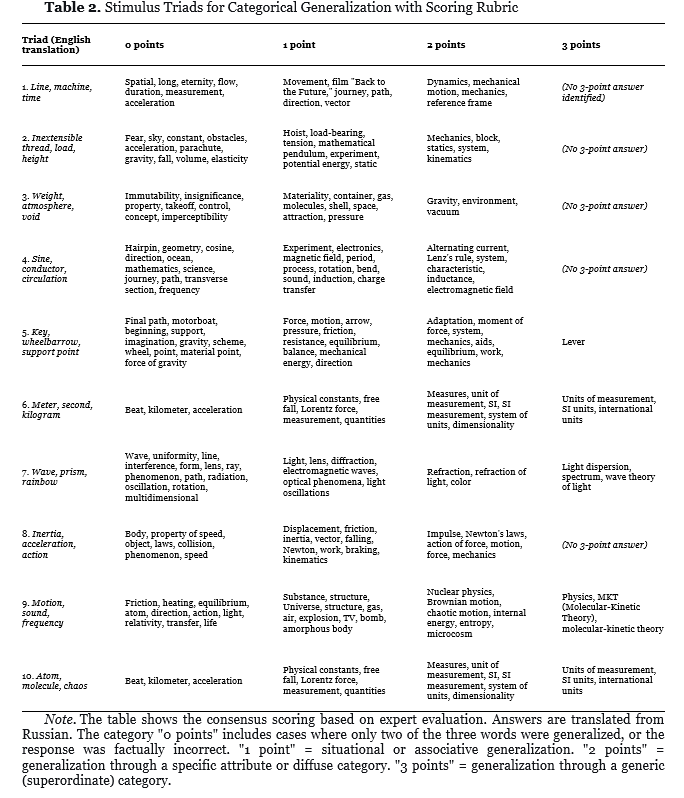
Scoring procedure. For each triad, responses were scored from 0 to 3 based on the rubric above. The total categorical generalization score was the sum across the 10 triads (range 0–30). To establish objective scoring criteria, three independent experts (two advanced physics teachers with ≥15 years of experience, and one doctoral‑level physicist) evaluated all responses from a pilot sample (n = 40). Experts were blind to student grade and identity. They assigned scores based on the rubric; disagreements were resolved by majority vote. The final scoring rules (Table 2) reflect the consensus.
Psychometric properties.
Internal consistency: Cronbach’s α for the 10‑item scale = 0.759, indicating acceptable reliability.
Inter‑rater reliability: For the full sample (n = 169), two independent trained scorers rated all responses. Kendall’s W across the three expert judges (on the pilot sample) ranged from 0.82 to 0.94 for individual triads, with mean W = 0.87, indicating high agreement. The two main scorers achieved an intraclass correlation (ICC[2,k]) of 0.91 for the total score.
Item discrimination: Item‑total correlations ranged from 0.34 to 0.61, all acceptable. Three triads (1, 5, and 8) had lower discrimination (r < 0.40) and may be candidates for revision in future studies.
2.2 Conceptual Synthesis
Task description. Three triads of words were presented orally. For each triad, participants were instructed: “Establish different variants of meaningful connections among these three words. For each variant, write one or two sentences that use all three words simultaneously. Try to find as many different connections as you can. You have 3 minutes per triad.” Total task time was 9 minutes. The triads were:
- Gorge – stopwatch – ammeter
- Fly – shoelaces – volume
- Tree – mirror – ruler
Scoring procedure. For each triad, each proposed sentence was scored from 0 to 3:
0 points: Only two of the three words were connected; or the sentence contained a factual physics error (e.g., “Ammeter measures voltage”); or the connection was purely non‑physical.
1 point: All three words are included but the connection is through simple enumeration or formal opposition (e.g., “The stopwatch and ammeter are both instruments, and the gorge is a place”); or the sentence is everyday/descriptive without physical content.
2 points: All three words are embedded in a specific physical situation that reflects the student’s physics experience; the connection is concrete but physically meaningful (e.g., “The ammeter and stopwatch were used to measure current and time in an experiment near the gorge”).
3 points: All three words are united through a generalized categorical foundation (e.g., analogy, causal chain, abstract physical model); the sentence expresses novel mental content by establishing non‑obvious connections (e.g., “Using an ammeter, ohmmeter, and stopwatch, we can determine the work done by an aircraft ascending from the gorge”).
For each triad, the total score was the sum of scores for all sentences produced, divided by the number of sentences (to control for verbosity), yielding a mean score per triad (range 0–3). The total conceptual synthesis score was the sum of the mean scores for the three triads (range 0–9).
Reliability. Inter‑rater reliability for conceptual synthesis (two scorers, n = 169) was ICC(2,k) = 0.86. Cronbach’s α for the three triads was 0.73, acceptable for such a short scale.
2.3 Classification of Physical Concepts
Task description. Participants were given a list of 30 words (nouns) representing physical objects, phenomena, and quantities. The instruction read: “Below is a list of 30 words. Distribute them into groups in the way that seems most logical, natural, and meaningful to you. You may create as many groups as you wish. Write a name for each group (one or two words).” The 30 words, in the presented order, were:
convection, diffusion, waves, light, rainbow, tsunami, noise, magnetic field, induction, Moon, blizzard, flood, rails, dawn, snowstorm, charged particle, boiling, condensation, echo, pendulum, oscillations, amplitude, shadow, compass, machine, table, heating, motion, deformation, lightning
Scoring. The scoring system focused on the quality of the grouping rather than a single “correct” answer. A response received 1 point for each group that was both (a) correctly classified in terms of physical content and (b) given a categorical name (rather than a formal or thematic name). Categorical names included, for example, “mechanical phenomena,” “optical phenomena,” “thermal phenomena,” “electromagnetic phenomena,” “sound phenomena,” “physical bodies,” “physical quantities/parameters.”
0 points: Formal or thematic names (e.g., “Things that happen in nature,” “Words I know,” “Words starting with ‘p'”), or groups that mix different physical categories without a unifying physical principle.
1 point: Clear, physically correct categorical name.
Examples:
Correct group: “waves, light, rainbow, shadow” → named “Optical phenomena” → 1 point.
Incorrect group: “Moon, rails, compass, machine, table, pendulum” → named “Objects” → 1 point (if correctly identified as physical bodies), but if named “Things I see around me” → 0 points.
Mixed group: “tsunami, blizzard, snowstorm, flood” → named “Natural phenomena” → 1 point.
The maximum possible score was 8 (reflecting 8 distinct superordinate categories: mechanical, thermal, optical, electromagnetic, sound, atomic/molecular, physical bodies, and phenomena‑in‑general). The total classification score ranged from 0 to 8.
Reliability. Cronbach’s α for the classification task (scored as a single composite of group quality) was 0.871 (excellent). Inter‑rater reliability between two independent scorers (physics graduate students) was κ = 0.89 for group naming and κ = 0.91 for group composition.
Block 3: Self‑Assessment of General and Special Abilities (MDSCGSA)
Task description. The final block used the MDSCGSA methodology (Method of Direct Scaling of Components of General and Special Abilities), developed by Volkova (2011). Participants were presented with a list of abilities and asked to rate their current level on a 100‑point scale (0 = “no ability at all,” 100 = “maximum possible development”). They also rated their desired level, but the current level is the focus of this study. The abilities comprised two sets:
General abilities (7 items): memory, intuition, thinking, language abilities, manual skills, mathematical abilities, ability to perform chemical calculations.
Special physical abilities (7 items):
- Mind orientation toward solving physical problems: ability to formulate hypotheses, construct arguments, draw conclusions, notice physical patterns in the environment.
- Physical memory: ability to store, retain, and reproduce physical information; organization of the conceptual system of the subject.
- Intuition in physics: ability to grasp the essence of physical processes and solve problems without deep analytical reasoning.
- Language of physics: ability to encode and decode physical information using signs and symbols; understanding scientific literature.
- Thinking in physics: mastery of higher‑level cognitive operations on physical representations, judgments, and concepts.
- Experimental abilities: ability to design, conduct, and interpret physical experiments, make measurements, and record data.
- Problem‑solving abilities: ability to perform mathematical calculations, represent physical situations, and find solutions using formulas and laws.
For each item, participants placed a mark on a continuous visual‑analogue scale from 0 to 100. Scores were measured to the nearest integer.
Psychometric properties. Internal consistency for the special physical abilities’ subscale was Cronbach’s α = 0.85; for the general abilities’ subscale, α = 0.82. Test‑retest reliability over 2 weeks (n = 30) was r = 0.76 for the special subscale and r = 0.79 for the general subscale.
- Data Analysis
All statistical analyses were performed using IBM SPSS Statistics 22.0 (IBM Corp., Armonk, NY). The analysis plan comprised four stages:
Descriptive and psychometric analysis. For all measures, we computed means, standard deviations, skewness, and kurtosis. Reliability was assessed via Cronbach’s α (internal consistency) and ICC/Kendall’s W (inter‑rater reliability). Normality was checked using Shapiro–Wilk tests (all variables were approximately normal, skewness < |1.0|).
Developmental comparisons (cross‑sectional). We used one‑way ANOVA
with grade (9, 10, 11) as the independent variable, followed by Tukey’s HSD post‑hoc comparisons for pairwise differences. For the pictographic task, which yielded count data, we used Kruskal–Wallis non‑parametric tests due to non‑normality of the distributions.
Structural analysis of the concept “motion.” We performed hierarchical cluster analysis (Ward’s method, squared Euclidean distance) on the category profiles of the cognitive composition task to examine the organizational structure of the concept at each grade level. Dendrograms were visually inspected and cluster solutions were validated by comparing with the 2‑, 3‑, and 4‑cluster solutions.
Factor analysis of abilities and conceptual measures. We conducted exploratory factor analysis (principal axis factoring with Varimax rotation) on the full set of variables: cognitive composition score, figurative composition score, emotional composition score, categorical generalization, conceptual synthesis, classification, and the seven special ability ratings. The seven general ability ratings were also included. Kaiser–Meyer–Olkin (KMO) measure of sampling adequacy and Bartlett’s test of sphericity were used to assess factorability. Eigenvalues > 1 and scree‑plot inspection were used to determine the number of factors.
Significance was set at α = .05 (two‑tailed). For post‑hoc comparisons, we report effect sizes (η² for ANOVA, Cohen’s d for pairwise comparisons where appropriate).
Results
3.2Descriptive Statistics and Examples of Concept “Motion” Responses
Table 3 presents detailed descriptive statistics for all primary measures by grade level. To make the data interpretable, we also include illustrative examples of actual student responses for each concept component.
Table 3. Descriptive Statistics and Illustrative Examples for Concept “Motion” and Physical Thinking Measures by Grade
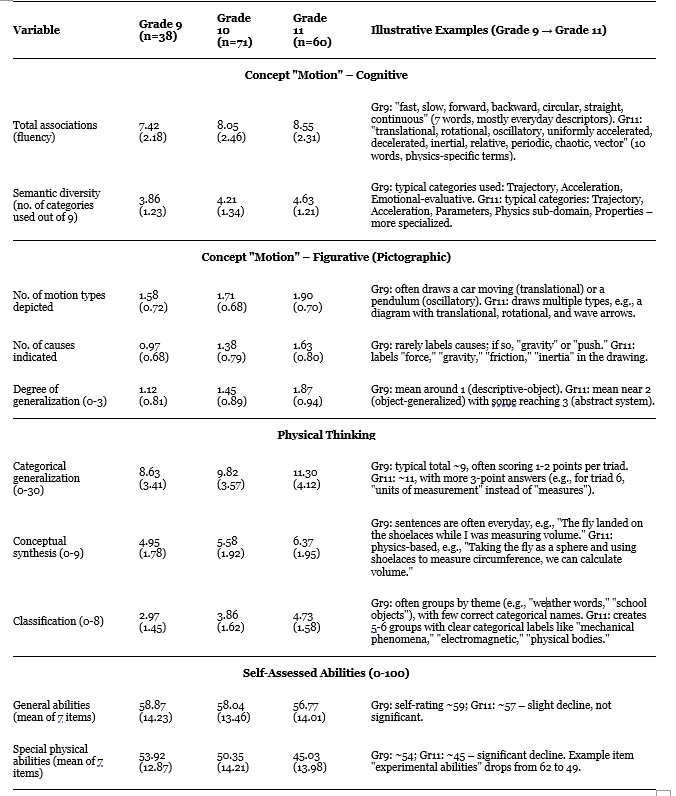
Note. Values in parentheses are standard deviations. Examples are translated from Russian and anonymized.
The data presented in Table 3 reveal a coherent pattern of conceptual and cognitive development across the three grade levels. Beginning with cognitive associations, a clear increase is observed in both fluency and semantic diversity, accompanied by a marked shift from everyday descriptors in grade 9 to physics‑specific terminology in grade 11. This progression reflects the growing conceptual vocabulary and the gradual reorganization of knowledge around scientific categories, indicating that students are not merely accumulating facts but are actively restructuring their mental representations of physical phenomena.
Parallel to these cognitive changes, figurative representations also demonstrate systematic improvement. Students in grade 11 depict a greater variety of motion types, identify more causal factors, and produce drawings that are increasingly abstract and integrated compared to their grade 9 counterparts. This progression, from concrete, scenario‑based depictions to more generalized, abstract diagrams, mirrors the stage model of conceptual development proposed by Usova (1988), suggesting that the refinement of visual‑spatial representations proceeds in tandem with the elaboration of verbal‑semantic knowledge.
Together, these cognitive and figurative developments provide the foundation for the observed growth in physical thinking operations. All three measured components (categorical generalization, conceptual synthesis, and classification) show significant increases across grades, with classification exhibiting the most pronounced gains. This pattern suggests that the ability to organize knowledge systematically into coherent categorical frameworks develops most robustly during high school physics education, potentially because it is the most explicitly practiced and reinforced operation in the standard physics curriculum.
A notable complement to this pattern of objective growth is the paradoxical decline in self‑assessed abilities, particularly for special physical abilities. As students acquire more sophisticated conceptual understanding and become more aware of the complexity and depth of the discipline, they apply increasingly stringent standards to their own performance. This phenomenon, consistent with the Dunning–Kruger effect (Kruger & Dunning, 1999), highlights the role of metacognitive development in physics education and underscores the importance of distinguishing between objective competence and subjective self‑evaluation when interpreting student performance.
Taken together, the findings summarized in Table 3 paint a coherent picture of conceptual development in physics education: as students progress from grade 9 to grade 11, they acquire more specialized vocabulary, develop more abstract and integrated mental models, demonstrate measurable growth in domain‑specific thinking operations, and simultaneously develop a more realistic and often more critical appreciation of their own abilities.
3.2. Structural Reorganization of the Concept “Motion”
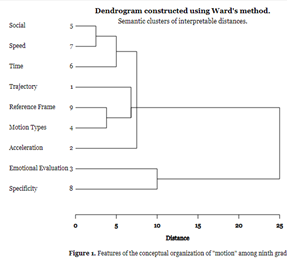
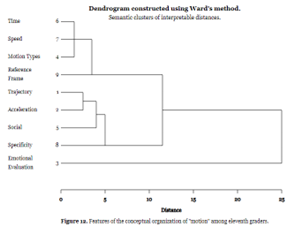
To test H1, we performed hierarchical cluster analysis (Ward’s method) on the semantic category profiles for the cognitive composition task separately for each grade. The resulting dendrograms revealed a clear developmental progression in the organization of the concept “motion” across the three grade levels.
At grade 9, two major clusters emerged (Figure 1). The first cluster combined cognitive associations across multiple physics categories, including kinematics, dynamics, parameters, and trajectory, with no clear internal ordering. This pattern reflects a syncretic structure in which diverse semantic elements remain undifferentiated. The second cluster comprised emotional‑evaluative responses. Thus, at this early stage, emotional and cognitive contents were only partially differentiated, suggesting that students have not yet developed a systematic conceptual framework for organizing their knowledge about motion.

By grade 10, a notable restructuring occurred as three distinct clusters appeared (Figure 2). The emotional‑evaluative cluster separated completely from the cognitive clusters, indicating a clearer differentiation between affective and cognitive components of the concept. Within the cognitive domain, two subclusters emerged: one related to descriptive and quantitative aspects (parameters, method, properties) and another associated with physics subdomains (kinematics, dynamics). However, the structure remained partly disordered, with some cross‑loadings between the subclusters. This suggests that while students have begun to differentiate their conceptual knowledge, the organization is not yet fully stabilized or hierarchical.
Finally, at grade 11, three well‑defined clusters with clear internal hierarchies were observed (Figure 3). The emotional‑evaluative responses formed an independent cluster, now fully separated from the cognitive domain. The cognitive component was further split into two distinct subclusters: a formal‑structural cluster encompassing trajectory, acceleration, parameters, and properties, and a domain‑thematic cluster comprising physics subdomains and method. Within each cluster, items were organized hierarchically. For example, within the structural cluster, trajectory and acceleration formed a subcluster of “mechanical descriptors” that remained distinct from parameters. This refined organization indicates that by the end of high school, students have developed a differentiated, integrated, and hierarchically structured conceptual system.
To further examine the relationship between verbal and figurative modalities of the concept, we computed the correlation between the content diversity score (number of semantic categories used in the association task) and the figurative generalization score (degree of generalization in the pictographic task). In grade 9, this correlation was non‑significant (r = 0.12, p = .47), and it remained non‑significant in grade 10 (r = 0.09, p = .45). However, in grade 11, a significant negative correlation emerged (r = –0.359, p = .005). This indicates that by 11th grade, students who produced more semantically diverse verbal associations tended to produce more abstract figurative representations. In other words, the two modalities became integrated, albeit inversely, as higher verbal breadth predicted higher figurative abstraction. The negative sign likely reflects that students with more integrated conceptual systems use fewer but more abstracted images rather than relying on many concrete depictions.
Taken together, these findings strongly support H1. The concept “motion” undergoes significant qualitative reorganization from a syncretic, undifferentiated structure in early high school to a differentiated, integrated, and hierarchically organized system by the end of high school. This progression aligns with theoretical predictions regarding the development of conceptual structures during adolescence and the role of formal education in facilitating conceptual change.
3.3. Growth in Physical Thinking Operations
We tested H2 using one‑way ANOVA with grade as the independent variable. Table 4 presents the results.
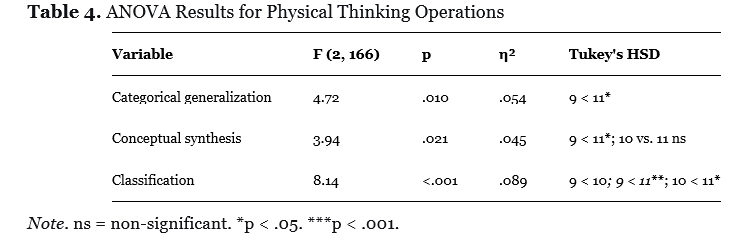
Analysis of variance revealed significant increases across all three physical thinking measures from grade 9 to grade 11. The effect size was moderate for classification (η² = .089) and smaller, though still significant, for categorical generalization and conceptual synthesis. These differential effect sizes suggest that not all thinking operations develop at the same rate or through the same mechanisms.
Examining the specific developmental trajectories through post‑hoc comparisons provides a more nuanced picture of how each operation evolves. For categorical generalization, significant improvement was observed only between grade 9 and grade 11 (p = .012), while the grade 9–10 and grade 10–11 differences did not reach statistical significance. This pattern points to a steady, gradual accumulation of the ability to abstract common principles from diverse phenomena, rather than abrupt leaps occurring at specific educational transitions. The operation appears to develop incrementally across the full three‑year period, with improvements accumulating over time.
Turning to conceptual synthesis, a different trajectory emerged. The only significant pairwise difference was between grade 9 and grade 11 (p = .018), with no significant change from grade 10 to grade 11. This suggests that the ability to integrate multiple concepts into novel statements develops later and more abruptly than categorical generalization. It may require a threshold level of conceptual knowledge that is only reached after extended physics instruction, consistent with the notion that higher‑order synthesis depends on a sufficiently rich and organized conceptual base.
In contrast, classification showed the clearest stepwise progression among the three measures. Significant improvements were observed at each transition: grade 9 to grade 10 (p = .033), grade 10 to grade 11 (p = .021), and grade 9 to grade 11 (p < .001). This pattern indicates that the ability to systematically organize physical phenomena into categorical frameworks develops steadily and consistently across all three years of high school physics education. The stepwise nature of this growth may reflect the cumulative effect of repeated practice in classifying physical phenomena, an operation that is extensively trained through standard physics curricula.
Taken together, these developmental trajectories reveal that the three physical thinking operations follow distinct but complementary paths. Categorical generalization develops through gradual accumulation, conceptual synthesis emerges later and more abruptly, and classification shows the most consistent stepwise growth. These differences likely reflect the varying cognitive demands and instructional emphasis placed on each operation. Categorical generalization and classification are foundational operations practiced throughout physics education, whereas conceptual synthesis represents a higher‑order skill that requires a sufficiently developed conceptual base to emerge.
These results confirm H2: physical thinking operations improve with physics education, with classification showing the most consistent growth. The differential trajectories observed provide insight into the cognitive mechanisms underlying the development of domain‑specific thinking operations and offer guidance for instructional design, suggesting that synthesis skills may benefit from explicit pedagogical support once foundational categorization and generalization abilities have been established.
Structural Relationship Between Conceptual Organization, Physical Thinking, and Abilities
We tested H3 using exploratory factor analysis (EFA) on the full set of variables: cognitive composition (total associations × diversity), figurative composition (degree of generalization and counts of types/causes), emotional composition (total emotional associations), the three physical thinking scores, the seven special physical ability self‑ratings, and the seven general ability self‑ratings. The KMO measure was 0.854, indicating excellent sampling adequacy, and Bartlett’s test of sphericity was highly significant, χ²(136) = 1119.95, p < .001, confirming that the correlation matrix was suitable for factor analysis.
Using eigenvalues > 1 and scree‑plot inspection, we retained three factors, which together explained 52.3% of the total variance. The rotated (Varimax) factor matrix is presented in Table 5.
Exploratory factor analysis extracted three distinct factors that together explained 52.3% of the total variance, each reflecting a different dimension of the relationship between conceptual organization, physical thinking, and abilities.
Factor 1, accounting for 23.8% of the variance, was labeled Special Physical Abilities. This factor comprises high loadings, exceeding .60, for mind orientation toward solving physical problems, physical memory, language of physics, thinking in physics, and problem‑solving abilities. Intuition in physics (0.59) and experimental abilities (0.54) also load on this factor, although they show moderate secondary loadings on Factor 2. Notably, conceptual synthesis (0.43) loads positively on Factor 1, indicating that the ability to integrate physical concepts into coherent frameworks is an integral component of the special physical ability construct. Overall, this factor clearly represents the domain‑specific cognitive resources required for successful performance in physics.
Turning to Factor 2, which explained 19.2% of the variance and was labeled General Abilities, a different pattern emerged. This factor comprises high loadings for general memory (0.65), intuition (0.82), thinking (0.77), language abilities (0.62), and manual skills (0.66). Somewhat unexpectedly, mathematical abilities (0.43) loaded lower on this factor than might be anticipated, suggesting that mathematical reasoning may be less central to general cognitive ability than other components. Additionally, special physical intuition and experimental abilities show secondary loadings on Factor 2, implying that these abilities draw on both general and domain‑specific resources. This cross‑loading pattern suggests that certain cognitive operations, particularly those involving intuitive judgment and hands‑on experimentation, are not exclusively domain‑specific but recruit general cognitive capacities as well.
The third factor, accounting for 9.3% of the variance, was labeled Conceptual Information Capacity. This factor comprises high loadings for the cognitive‑emotional composition of the concept “motion” (0.75), categorical generalization (0.66), and classification (0.58). Importantly, conceptual synthesis does not load on this factor; instead, it loads on Factor 1 (Special Physical Abilities). The interpretation of Factor 3 follows Kholodnaya’s (2012) theoretical framework: it reflects the representational richness and semantic organization of the conceptual system, specifically, how many attributes are available and how they are structured for abstraction and categorization. This factor is distinct from both general ability and special ability self‑ratings, confirming that conceptual organization constitutes a separate cognitive resource that underlies domain‑specific operations rather than being reducible to either general intelligence or domain‑specific skills.
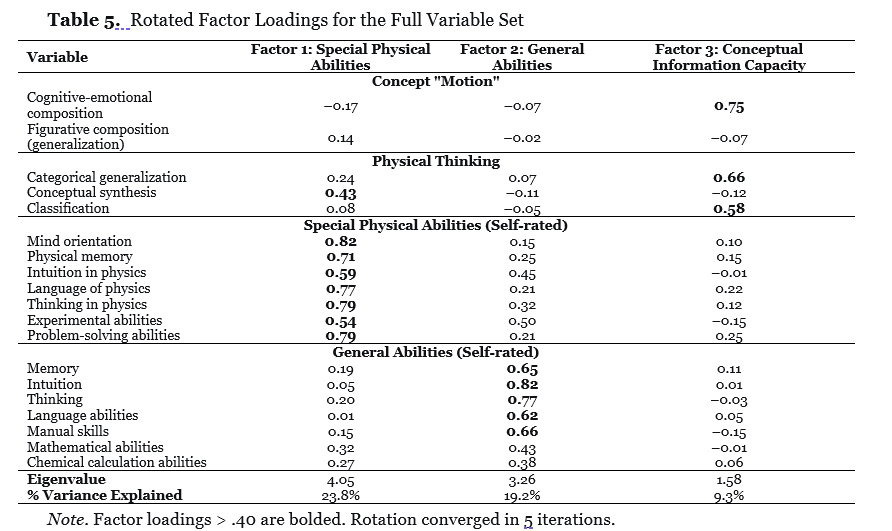
A critical and unexpected finding concerns the figurative composition of the concept, which did not load on any factor, with loadings below 0.15 on all three factors. This suggests that the visual‑imagery component of the concept “motion” is neither strongly associated with general abilities, special physical abilities, nor with conceptual information capacity, at least in this age group and within the domain of physics. We return to this surprising result in the Discussion section, where we consider possible explanations, including the possibility that our pictographic measure captured everyday rather than expert‑like imagery, or that formal physics thinking in late adolescence is increasingly dominated by symbolic‑mathematical representations.
The data obtained support Hypothesis 3 in part. The cognitive‑emotional composition of the concept is indeed associated with physical thinking, specifically with categorization and classification operations, but this relationship operates through a distinct conceptual factor rather than through the special abilities factor. This suggests that conceptual organization and domain‑specific abilities are related but separable constructs. In contrast, the figurative component appears to be orthogonal to all three ability dimensions, highlighting the complex and multifaceted nature of conceptual representation in physics and raising important questions about the role of visual imagery in scientific thinking during adolescence.
3.5. Self‑Assessed Ability Declines with Grade
To test H4, we compared the mean self‑rated special physical abilities across grades using one‑way ANOVA (Table 6). The overall effect was significant, F(2, 166) = 6.18, p = .003, η² = .069.
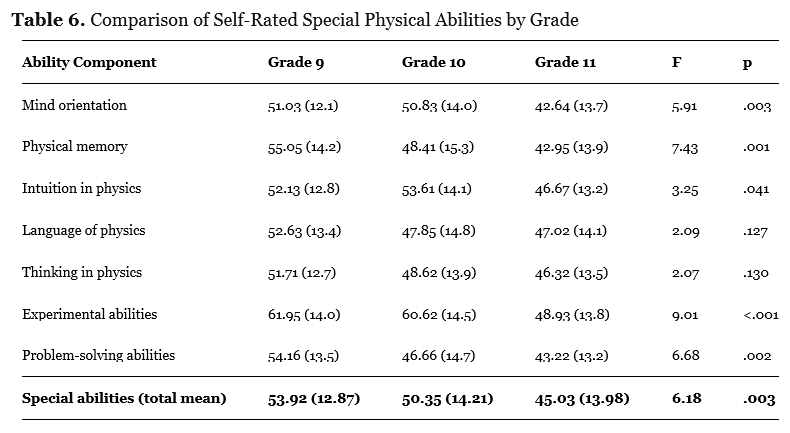
Post‑hoc comparisons using Tukey’s HSD test revealed that the decline in self‑assessed special physical abilities was most pronounced between grade 10 and grade 11 for most components. This pattern was particularly striking for experimental abilities, which dropped from a relatively high mean of 61.95 in grade 9 to 48.93 in grade 11 (p < .001). Overall, the total mean special ability score showed a steady and significant decrease across the three years, from 53.92 in grade 9 to 45.03 in grade 11 (p = .002).
In contrast, general ability self‑ratings showed no significant decline over the same period, F(2, 166) = 0.49, p = .61, with means of 58.87, 58.04, and 56.77 for grades 9, 10, and 11, respectively. This divergence between the two types of self‑assessment is noteworthy: while students’ perceptions of their general cognitive abilities remained relatively stable, their evaluations of their specific physics competencies became increasingly critical.
This contrasting pattern, characterized by declining self‑assessment in a domain alongside objective improvement in performance, is a hallmark of the Dunning–Kruger effect (Kruger & Dunning, 1999). As students acquire more sophisticated conceptual understanding and become more aware of the complexity and depth of physics, they apply increasingly stringent standards to their own performance. The most marked decline was observed for experimental abilities, which may reflect the particular challenge students perceive in bridging the gap between theoretical understanding and hands‑on practical skills. Unlike conceptual knowledge, which can be acquired through reading and listening, experimental skills require direct engagement with equipment and procedures, and students may develop a realistic appreciation for the difficulty of this aspect of physics.
These findings provide strong support for Hypothesis 4. The paradoxical decline in self‑assessed special physical abilities, occurring simultaneously with objective growth in physical thinking performance, highlights the importance of metacognitive development in physics education. It also cautions against interpreting low self‑ratings as simple indicators of low ability, particularly in demanding STEM domains where increased expertise may paradoxically lead to more critical self‑evaluation.
Discussion
The most robust finding of this study is the systematic restructuring of the concept “motion” across grades 9–11. The shift from a syncretic, loosely organized structure in grade 9 to a differentiated, hierarchically organized system by grade 11 closely follows Werner’s (1957) developmental criteria: from syncretic to discrete, from diffuse to articulated, and from labile to stable. This is also consistent with Usova’s (1988) qualitative levels of physical concept formation, where students move from simple discrimination (Level 1) to generalized, integrated concepts (Levels 4‑5). The progression from syncretic to differentiated structures also aligns with Chuprikova’s (2007) principle of differentiation as the fundamental mechanism of mental development. Importantly, our cluster analysis provides empirical, quantitative evidence for this theoretical progression, whereas prior work relied on qualitative teacher observations.
The integration of verbal‑semantic (cognitive) and figurative (imagery) modalities by grade 11 is particularly telling. The emergence of a significant negative correlation between semantic diversity and figurative abstraction in 11th grade suggests that by this point, students have developed the ability to compress rich verbal knowledge into compact, abstract mental models, which is the hallmark of expert‑like thinking in physics (Chi et al., 1981). This integration likely underpins the ability to transition from concrete, everyday representations to formal, mathematical models, a crucial step in advanced physics problem‑solving (Lipkin, 2011).
Volkova and Moss (2023) examined the organization of the concept “director” across different stages of age development, demonstrating that conceptual structures undergo systematic restructuring that is domain‑specific and influenced by professional training. Their findings resonate with our observation that the concept “motion” undergoes reorganization specifically in the context of physics education. Similarly, Moss and Volkova (2024) demonstrated that the measure of differentiation and the measure of hierarchy are associated with different types of thinking (meaningful, event‑driven, and associative‑imaginative), supporting our interpretation that conceptual differentiation is a key mechanism underlying the development of domain‑specific abilities.
Our findings resonate with the ontological approach to conceptual structures proposed by Kholodnaya and Volkova (2016). They demonstrated that the higher the level of conceptual structures, the higher the level of conceptual thinking, creativity, and successfulness in real professional activity. The developmental progression we observed, from syncretic to differentiated structures, directly supports their claim that conceptual structures are ontologically real cognitive formations that determine the effectiveness of cognitive functioning from within. Our study extends their work by showing that this progression is not merely age‑related but is specifically driven by cumulative educational experience in physics, as evidenced by the systematic differences observed across grades 9, 10, and 11.
Our findings on physical thinking operations reveal distinct developmental profiles. Classification showed the most consistent and largest gains, with significant improvements at each grade transition. This makes sense: classification is a foundational operation that organizes domain knowledge into coherent categories, and it is extensively trained through physics curricula (e.g., distinguishing mechanical, thermal, and electromagnetic phenomena). This finding aligns with the broader literature on conceptual development in physics education. Wells et al. (2020) demonstrated that systematic analysis of student misconceptions using the Force and Motion Conceptual Evaluation can reveal the underlying structure of student conceptual understanding, with different misconceptions showing distinct patterns of co‑occurrence and resolution. Our finding that classification skills show the most consistent growth suggests that the ability to correctly categorize physical phenomena is a fundamental skill that develops steadily with instruction.
In contrast, conceptual synthesis showed only a grade‑9‑to‑11 difference, with a flat trajectory from grade 10 to 11. This operation, generating novel connections among disparate concepts, is more demanding and may require a threshold of conceptual knowledge that is only reached by the later stage of high school. This pattern aligns with the notion that higher‑order synthesis depends on a sufficiently rich and organized conceptual base (Kholodnaya, 2012). Klaschus and Volkova (2022) demonstrated that higher‑order conceptual thinking operations in adolescence require a threshold of domain‑specific knowledge that is only reached after sustained instruction. Gifford and Finkelstein’s (2020) categorical framework for mathematical sense‑making in physics suggests that the most sophisticated reasoning mode, using mathematical tools to understand physical objects, requires coordination of multiple representational systems, which may explain why synthesis develops later than simpler categorization.
Categorical generalization fell between the two, showing gradual but significant improvement across the full three‑year span. This suggests that the ability to abstract common principles from diverse exemplars is practiced throughout physics education, but does not show the sharp acceleration seen in classification.
One of the most theoretically important findings is that conceptual organization, as measured by the cognitive‑emotional composition of the concept “motion”, loaded on a separate factor from both general abilities and self‑rated special physical abilities. This factor, which we labeled Conceptual Information Capacity, also included categorical generalization and classification. This provides strong empirical support for Kholodnaya’s (2012) proposal that conceptual structures are not reducible to either general intelligence or domain‑specific skills. Rather, they constitute a third cognitive resource, the rich, organized semantic network that supports domain‑specific thinking operations.
This tripartite structure aligns with the ontological approach of Kholodnaya and Volkova (2016), who argued that conceptual structures, conceptual abilities, and cognitive productivity are fundamentally interconnected. Our factor analysis provides empirical evidence for this interconnection: conceptual structures (measured through the cognitive‑emotional composition of the concept) are associated with conceptual abilities (categorical generalization and classification), and this association operates through a distinct factor that is separable from both general and special abilities. Volkova’s (2013) triune model of the functional organization of concepts, integrating past, present, and future, provides a theoretical framework for understanding why the cognitive and emotional components load together on this factor.
This finding has implications for educational assessment: students may have strong general cognitive abilities but poor conceptual organization in physics, or vice versa. Traditional tests of intelligence or even school grades cannot fully capture this distinction. The diagnostic battery we have developed may offer a way to identify students whose poor physics performance stems from gaps in conceptual organization rather than low reasoning capacity. Volkova (2018) emphasized that the measurement of special abilities requires attention to both objective performance and subjective self‑evaluation, as abilities are integrated properties of mental structures that are reflected upon by the individual.
The most unexpected result was that the figurative composition of the concept (the pictographic measure) did not load on any factor. This does not mean that imagery is unimportant in physics thinking; expert physicists do use mental imagery (e.g., visualizing field lines or trajectories). However, our measure may have been insensitive to the type of imagery that matters for formal physics.
Two explanations are plausible. First, the pictographic task may capture primarily concrete, everyday imagery (e.g., a car moving, a ball falling), rather than the abstract, schematic imagery used in physics (e.g., vector diagrams, energy‑level schematics). High‑school students, even in 11th grade, may still rely on concrete imagery, which is not strongly correlated with either formal ability or conceptual breadth. Second, formal physics thinking in late adolescence is increasingly dominated by symbolic‑mathematical representations, which are only weakly related to visual imagery (the “symbolic distance” effect). The development of expertise in physics involves a shift from reliance on visual‑spatial to symbolic‑logical processing, as demonstrated by Kozhevnikov et al. (2005). Our cross‑sectional data may be capturing this shift: by grade 11, the “imagery” component has become decoupled from the conceptual system, as symbolic reasoning takes over.
Stern et al. (2017) validation of the Kinematics Concept Test revealed a hierarchical structure of concepts, where at the higher level mathematical concepts group together and then split up into physics concepts at the lower level. This finding supports our interpretation that mathematical‑symbolic reasoning becomes increasingly dominant in physics thinking, while purely imagistic representations become less central to performance. Merzel et al. (2024) demonstrated that mathematical structures in physics education facilitate both problem solving and conceptual understanding, reinforcing that mathematical‑symbolic competence is a key component of physics expertise. Furthermore, Kuo et al. (2020) showed that mathematical sense‑making, the practice of seeking coherence between formal mathematics and conceptual understanding, is a key target of successful physics problem‑solving instruction. Our finding that figurative imagery does not load on any ability factor may reflect that by high school, physics performance is more strongly predicted by symbolic‑mathematical competence than by visual‑spatial ability.
Robertson et al. (2021) offered a complementary perspective. They demonstrated that students’ conceptual resources for understanding forces are context‑sensitive and can serve as productive starting points for learning. This resources‑oriented approach suggests that even concrete, everyday imagery may have pedagogical value as a bridge to more abstract understanding, even if it does not correlate strongly with formal ability measures in cross‑sectional analysis.
The decline in self‑assessed abilities across grades, while objective performance improved, is a classic demonstration of the Dunning–Kruger effect (Kruger & Dunning, 1999). Novices in a domain lack metacognitive awareness of their own competence; as they gain expertise, they become more aware of the complexity and depth of the field, and thus rate themselves more critically. The steepest decline in experimental abilities is particularly illuminating: hands‑on practical work is often perceived as difficult, and students may develop a realistic appreciation for the gap between textbook knowledge and laboratory competence.
Volkova (2016) demonstrated that the interaction of general and special abilities serves as a resource basis for higher professionalism in chemistry, suggesting that self‑evaluation of abilities reflects the integration of domain‑specific competence and metacognitive awareness. This finding aligns with our observation that students become more critical of their own performance as they develop greater expertise in physics. Volkova (2020) further showed that conceptual structures in chemistry develop systematically across age stages and the process of learning chemistry, with self‑evaluation being a key component of this development.
This finding has practical implications: teachers should be aware that students in higher grades may underestimate their abilities, and interventions that build metacognitive awareness and self‑efficacy may be beneficial. Conversely, low self‑assessment should not be taken as a simple indicator of low ability, especially in demanding STEM domains.
Our findings contribute to the differentiation‑integration theory of abilities (Volkova, 2011, 2014) by providing empirical evidence that special physical abilities are not merely a subset of general abilities. The factor analysis clearly separates the special physical abilities from the general abilities, with the special factor loading on domain‑specific cognitive operations (e.g., language of physics, physical thinking). Crucially, the conceptual organization factor stands as a third, separable resource. This suggests a tripartite model of cognitive resources in science education: (1) general cognitive resources (working memory, reasoning, fluid intelligence); (2) specialized domain resources (physical thinking operations, experimental skills, etc.); and (3) conceptual resources (organized semantic networks, representational richness, hierarchical concept structures).
This tripartite model is consistent with the ontological approach of Kholodnaya and Volkova (2016), who argued that conceptual structures are not reducible to either intelligence or creativity but constitute a distinct ontological reality that determines cognitive productivity from within. The work of Kholodnaya and Sipovskaya (2023) further elaborated the theory of conceptual abilities, distinguishing three types: semantic, categorical, and conceptual. Our factor structure aligns with this typology: categorical generalization and classification represent categorical abilities, while the cognitive‑emotional composition of the concept reflects conceptual abilities. Effective physics learning likely requires the coordinated development of all three, and instructional interventions could target each separately.
Volkova (2013) provided a theoretical framework for understanding how concepts integrate past experience, present representation, and future‑oriented anticipation. Our finding that the cognitive and emotional components of the concept load together on Factor 3 supports this triune model of functional organization, suggesting that concepts are dynamic formations that integrate multiple temporal dimensions of experience.
Several limitations should be acknowledged. First, the cross‑sectional design cannot establish causal or truly developmental effects; cohort effects may partially explain grade differences. A longitudinal follow‑up would be stronger. Second, our sample was drawn from highly selective schools in two Russian cities; findings may not generalize to other educational systems or less advantaged settings. Third, the physical thinking measures, while psychometrically sound, are still novel and require further validation with external criteria (e.g., standardized physics exams, teacher ratings, problem‑solving performance). The psychometric approach used in this study aligns with the methodology validated by Moss (2022), who developed and tested the psychometric characteristics of a diagnostic instrument on a Russian sample, demonstrating the applicability of such tools in the Russian educational context. Fourth, the self‑assessment measures, while reliable, are subjective and may be influenced by individual differences in response style (e.g., modesty, social desirability). Finally, the figurative measure may need revision to capture expert‑like rather than everyday imagery.
Building on this study, future research should: (1) conduct a longitudinal study tracking the same students from grade 9 to 11 to confirm the observed structural changes; (2) validate the diagnostic battery against objective measures of physics achievement, such as final exam scores or standardized test performance; (3) extend the battery to younger students (grades 6‑8) to trace the full developmental trajectory from initial concept formation to abstract modeling; (4) include more sophisticated measures of abstract imagery (e.g., mental animation tasks, dynamic visualization tests) to better understand the role of the figurative component in physics thinking; and (5) develop intervention studies that explicitly train conceptual organization (e.g., concept mapping, semantic sorting tasks) and test their effects on physical thinking and problem‑solving.
Conclusions
This study provides the first comprehensive, psychometrically validated investigation of the concept “motion” in the structure of general and special physical abilities among Russian high school students. We developed and validated a diagnostic battery that reliably assesses the cognitive, figurative, and emotional organization of the concept “motion,” along with core physical thinking operations. The battery shows good reliability and a coherent factor structure, supporting its use in both research and educational practice. The diagnostic methods, “Three‑Word Generalization” and “Conceptual Synthesis”, were adapted from the work of Kholodnaya and Sipovskaya (2023), who elaborated these methods for assessing conceptual abilities, and our results confirm their applicability to physical content.
Our findings demonstrate that the concept “motion” undergoes substantial qualitative restructuring across high school physics education: from a syncretic, undifferentiated structure in grade 9 to a differentiated, integrated, and hierarchical system by grade 11. This restructuring is tightly coupled with the development of physical thinking operations, namely categorical generalization, conceptual synthesis, and classification, each of which shows its own developmental trajectory. This developmental progression supports Chuprikova’s (2007) principle of differentiation as the fundamental mechanism of mental development. Factor analysis confirmed that conceptual organization is a distinct cognitive resource, separable from both general abilities and self‑rated special abilities, and specifically associated with categorization and classification operations. This finding aligns with the ontological approach of Kholodnaya and Volkova (2016), who demonstrated that conceptual structures determine the effectiveness of cognitive functioning from within.
The figurative component of the concept, surprisingly, was orthogonal to both abilities and conceptual organization, suggesting that formal physics thinking in late adolescence operates primarily through symbolic‑abstract rather than image‑based representations. This finding, while unexpected, aligns with theories of expertise development that posit a shift from imagistic to symbolic reasoning, as demonstrated by Kozhevnikov et al. (2005). It is consistent with the hierarchical structure of concepts revealed by Stern et al. (2017), where mathematical concepts group together at higher levels before splitting into physics concepts at lower levels. It also resonates with the work of Gifford and Finkelstein (2020), who showed that sophisticated mathematical sense‑making requires coordination of multiple representational systems, and with Kuo et al. (2020), who demonstrated that mathematical sense‑making is a key target of successful physics problem‑solving instruction. Merzel et al. (2024) further reinforced this interpretation by showing that mathematical structures in physics education facilitate both problem solving and conceptual understanding.
Furthermore, Robertson et al. (2021) demonstrated that students’ conceptual resources, even when framed as intuitive formulations, can serve as productive starting points for learning. Our findings extend this resources‑oriented perspective by showing that these conceptual resources undergo systematic reorganization across educational stages, becoming more differentiated and integrated with formal instruction. Klaschus and Volkova (2022) showed that the transition from concrete to abstract thinking in adolescence depends on the quality of conceptual structures formed through domain‑specific instruction, supporting our interpretation that physics education drives the observed conceptual restructuring.
Finally, the paradox of declining self‑assessment alongside objective growth highlights the importance of metacognitive development in physics education and cautions against interpreting low self‑ratings as evidence of low ability. This pattern, consistent with the Dunning–Kruger effect (Kruger & Dunning, 1999), suggests that as students develop expertise, they become more critical evaluators of their own performance, a process that should be supported rather than discouraged. Volkova (2016) demonstrated that the interaction of general and special abilities serves as a resource basis for higher professionalism, and Volkova (2020) showed that self‑evaluation is a key component of conceptual development in science education.
The results obtained support the differentiation‑integration theory of abilities and provide a robust empirical foundation for understanding the psychological mechanisms underlying special physical abilities. The diagnostic battery offers a replicable, theoretically grounded tool that can be used by researchers and educators to assess conceptual development and identify areas for instructional intervention in physics education. The cross‑disciplinary consistency of conceptual restructuring across physics (this study), chemistry (Volkova, 2020), and film direction (Volkova & Moss, 2023) suggests that this phenomenon is a general feature of expertise development, not limited to a single domain. By integrating insights from the ontological approach to conceptual structures (Kholodnaya & Volkova, 2016), the resources framework (Robertson et al., 2021), the mathematical sense‑making literature (Gifford & Finkelstein, 2020; Kuo et al., 2020), and the principle of differentiation (Chuprikova, 2007), our study contributes to a more comprehensive understanding of how domain‑specific abilities develop through the reorganization of conceptual knowledge during adolescence.
Ethics approval and consent to participate: The study was conducted in accordance with the ethical standards of the institutional research committee and with the 1964 Helsinki Declaration and its later amendments. The research protocol was approved by the Ethics Committee of the State Academic University for the Humanities. Informed consent was obtained from all participants and, for minors, from their parents or legal guardians. Participation was voluntary, and confidentiality was guaranteed.
Conflict of interest: The author declares no actual or potential conflicts of interest with respect to the research, authorship, and/or publication of this article. The author received no financial or non-financial support from organizations that could have influenced the results or their interpretation.
Author’s responsibility: The author takes full responsibility for the accuracy of the data, the correctness of statistical analyses, and the consistency of the conclusions with the results obtained. All stages of the study from conceptualization and data collection to analysis and manuscript writing were performed by the author personally. The author confirms that the manuscript contains no plagiarism, fabricated data, or redundant publication.
Funding: This research received no external funding.
Acknowledgements: The author expresses sincere gratitude to her scientific supervisor, Dr. E.V. Volkova (Doctor of Psychological Sciences), for valuable theoretical and methodological guidance; to S.N. Degtyareva for assistance in data collection and expert evaluation; as well as to the administrations and teachers of the participating schools for their organizational support, to all students and their parents for their voluntary participation, and to the anonymous expert judges for their contribution to the inter-rater reliability assessment. The author also thanks colleagues for constructive discussions during the preparation of the diagnostic battery and the interpretation of the results.
Use of artificial intelligence: During the preparation of this work, AI-based tools were used solely for stylistic editing and grammar correction of the English text. No generative AI was used for data analysis, interpretation, hypothesis generation, or the core scientific writing. All substantive intellectual content, analytical decisions, and conclusions remain the sole responsibility of the author.
References
- Banda, H. J., & Nzabahimana, J. (2021). Effect of integrating physics education technology simulations on students’ conceptual understanding in physics: A review of literature. Physical Review Physics Education Research, 17(2), 023108. https://doi.org/10.1103/PhysRevPhysEducRes.17.023108
- Bogoyavlenskii, D. N., & Menchinskaia, N. A. (1959). Psychology of knowledge acquisition in school. APN RSFSR.
- Chi, M. T. H., Feltovich, P. J., & Glaser, R. (1981). Categorization and representation of physics problems by experts and novices. Cognitive Science, 5(2), 121–152.
- Druzhinin, V. N. (1994). Psychology of general abilities.
- Gifford, J. D., & Finkelstein, N. D. (2020). Categorical framework for mathematical sense making in physics. Physical Review Physics Education Research, 16(2), 020121. https://doi.org/10.1103/PhysRevPhysEducRes.16.020121
- Kholodnaya, M. A. (2012). Psychology of conceptual thinking: From conceptual structures to conceptual abilities. Institute of Psychology RAS.
- Kholodnaya, M. A., & Sipovskaya, Y. I. (2023). Ponyatiynye sposobnosti. Teoriya, diagnostika, empirika[Conceptual abilities. Theory, diagnostics, empirics]. Institute of Psychology RAS.
- Kholodnaya, M. A., & Volkova, E. V. (2016). Conceptual structures, conceptual abilities and productivity of cognitive functioning: The ontological approach. Procedia – Social and Behavioral Sciences, 217, 914–922. https://doi.org/10.1016/j.sbspro.2016.02.063
- Klaschus, N. G., & Volkova, E. V. (2022). The ways of conceptual thinking development in adolescence. Natural Systems of Mind, 2(3), 22–36. https://doi.org/10.38098/nsom_2022_02_03_03
- Kozhevnikov, M., Motes, M. A., & Hegarty, M. (2005). Spatial processing in the development of expertise in physics. Journal of Experimental Psychology: Applied, 11(3), 187–200.
- Kruger, J., & Dunning, D. (1999). Unskilled and unaware of it: How difficulties in recognizing one’s own incompetence lead to inflated self-assessments. Journal of Personality and Social Psychology, 77(6), 1121–1134.
- Krutetskii, V. A. (1998). Psychology of mathematical abilities in schoolchildren. Institute of Practical Psychology.
- Kuo, E., Hull, M. M., Elby, A., & Gupta, A. (2020). Assessing mathematical sensemaking in physics through calculation-concept crossover. Physical Review Physics Education Research, 16(2), 020109. https://doi.org/10.1103/PhysRevPhysEducRes.16.020109
- Lipkin, A. I. (2011). Model of modern physics: View from inside and outside. Vuzovskaya Kniga.
- Merzel, A., Weissman, E. Y., Katz, N., & Galili, I. (2024). Mathematical structures in quantum physics education for high school students: Unveiling the power of Dirac notation for conceptual and problem-solving proficiency. Physical Review Physics Education Research, 20(2), 020134. https://doi.org/10.1103/PhysRevPhysEducRes.20.020134
- Moss, V. A. (2022). A test “5 shots”: Psychometric characteristics on the Russian sample. Natural Systems of Mind, 2(3), 40–78. https://doi.org/10.38098/nsom_2022_02_03_04
- Moss, V. A., & Volkova, E. V. (2024). Vzaimosvyaz’ mery differentsirovannosti i mery ierarkhichnosti so smyslovym, sobytiyno-deystvennym i assotsiativno-obraznym myshleniem kinorezhisser [The relationship between the measure of differentiation and the measure of hierarchy with the meaningful, event-driven and associative-imaginative thinking of the film director]. Vestnik Kostromskogo Gosudarstvennogo Universiteta. Seriya: Pedagogika. Psikhologiya. Sotsiokinetika, 30(3), 50–60.
- Rollinde, E., Decamp, N., & Derniaux, C. (2021). Should frames of reference be enacted in astronomy instruction? Physical Review Physics Education Research, 17(1), 013105. https://doi.org/10.1103/PhysRevPhysEducRes.17.013105
- Stern, E., Aprea, C., & Ebner, H. G. (2017). Validation and structural analysis of the kinematics concept test. Physical Review Physics Education Research, 13(1), 010115. https://doi.org/10.1103/PhysRevPhysEducRes.13.010115
- Teplov, B. M. (1985). Selected works.
- Robertson, A. D., Goodhew, L. M., Scherr, R. E., & Heron, P. R. L. (2021). University student conceptual resources for understanding forces. Physical Review Physics Education Research, 17(1), 010121. https://doi.org/10.1103/PhysRevPhysEducRes.17.010121
- Usova, A. V. (1988). Psychological and didactic foundations of physical concept formation. Chelyabinsk Worker.
- Volkova, E. V. (2011). Psychology of special abilities: Differentiation-integration approach. Institute of Psychology RAS.
- Volkova, E. V. (2013). Triyedinyy aspekt funktsional’noy organizatsii kontsepta: proshloe, nastoyashchee i budushchee [The triune aspect of the functional organization of the concept: Past, present and future]. Mir Psikhologii, 2(74), 29–41.
- Volkova, E. V. (2014). Rol’ differentsionno-integrationnogo podkhoda v razrabotke teorii spetsial’nykh sposobnostey [The role of the differentiation-integration approach in the development of the theory of special abilities]. In Differentsionno-integrationnaya teoriya razvitiya(pp. 61–86). Yazyki slavyanskoy kul’tury.
- Volkova, E. V. (2014). Unity of differential-integration mechanisms of development of special abilities and creativity in the context of the growth of scientific knowledge. Psikhologicheskii Zhurnal, 35(2), 27–38.
- Volkova, E. V. (2016). Vzaimodeystvie obshchikh i spetsial’nykh sposobnostey kak resursnaya osnova vysshego professionalizma (khimiki) [Interaction of general and special abilities as a resource basis of higher professionalism (chemists)]. In Sed’maya mezhdunarodnaya konferentsiya po kognitivnoy nauke: Tezisy dokladov(pp. 698–700). Institut psikhologii RAN.
- Volkova, E. V. (2018). Voprosy opredeleniya i izmereniya spetsial’nykh sposobnostey [Issues of definition and measurement of special abilities]. In A. L. Zhuravlev & E. A. Sergienko (Eds.), Razrabotka ponyatiy sovremennoy psikhologii(pp. 482–507). Institut psikhologii RAN.
- Volkova, E. V. (2020). Osobennosti individual’nogo opyta vzaimodeystviya s veshchestvom na raznykh stadiyakh vozrastnogo razvitiya i osvoeniya khimii [Features of individual experience of interaction with substance at different stages of age development and chemistry learning]. In Sposobnosti i mental’nye resursy cheloveka v mire global’nykh peremen(pp. 1806–1816). Institut psikhologii RAN.
- Volkova, E. V., & Moss, V. A. (2023). Osobennosti organizatsii kontsepta rezhisser na raznykh stadiyakh vozrastnogo razvitiya [Features of the organization of the concept director at different stages of age development]. Vestnik Kostromskogo Gosudarstvennogo Universiteta. Seriya: Pedagogika. Psikhologiya. Sotsiokinetika, 29(2), 50–58.
- Vygotsky, L. S. (1972). Thinking and speech. In Selected works(Vol. 2). Pedagogika.
- Wells, J., Henderson, R., Traxler, A., Miller, P., & Stewart, J. (2020). Exploring the structure of misconceptions in the Force and Motion Conceptual Evaluation with modified module analysis. Physical Review Physics Education Research, 16(1), 010121. https://doi.org/10.1103/PhysRevPhysEducRes.16.010121
- Werner, H. (1957). The concept of development from a comparative and organismic point of view. In D. B. Harris (Ed.), The concept of development(pp. 125–148). University of Minnesota Press.
Comments (0)
Background. Despite extensive research on general intellectual and special abilities, the psychological nature of physical abilities remains theoretically underdeveloped. Conceptual structures, integral cognitive formations that encode knowledge about objects and their interrelations, are hypothesized to underlie both general and special abilities; however, empirical evidence linking conceptual organization to the development of physical abilities remains scarce. Objective. This study examined (1) age‑related differences in the organization of the concept “motion” across high school physics education (grades 9–11), (2) the relationship between conceptual organization and physical thinking, and (3) the psychometric properties of a newly developed diagnostic battery for assessing these constructs. Methods. A cross‑sectional design was employed with 169 Russian high school students (M = 16.36, SD = 0.895, 52.1% male). The diagnostic battery comprised three blocks: (a) assessment of the concept “motion” (cognitive, figurative, and emotional components via associative experiment and pictographic methods); (b) assessment of physical thinking (categorical generalization, conceptual synthesis, and classification of physical concepts); and (c) self‑assessment of general and special physical abilities (MDSCGSA). Psychometric evaluation included Cronbach’s α, inter‑rater reliability (Kendall’s coefficient of concordance), and exploratory factor analysis (EFA). Group differences were tested using analysis of variance (ANOVA) with post‑hoc comparisons. Results. Internal consistency ranged from acceptable to excellent (α = 0.65–0.87). Inter‑rater reliability was high (Kendall’s W = 0.82–0.94). Hierarchical cluster analysis revealed systematic restructuring of the concept “motion”: from a syncretic two‑cluster structure in grade 9 to a differentiated three‑cluster structure with integrated content‑imagery modalities by grade 11. All physical thinking measures showed significant growth from grade 9 to 11 (F = 4.72–8.14, all p < .05). Exploratory factor analysis extracted three factors explaining 52.3% of the variance: Special Physical Abilities (23.8%), General Abilities (19.2%), and Conceptual Information Capacity (9.3%). The cognitive‑emotional composition of the concept loaded exclusively onto Factor 3, alongside categorical generalization and classification, confirming its specific association with physical thinking. Self‑assessed abilities paradoxically declined with grade level, consistent with the Dunning–Kruger effect. Conclusions. The concept “motion” undergoes substantial qualitative reorganization during late adolescence, tightly coupled with the development of physical thinking. The developed diagnostic battery demonstrates sound psychometric properties and offers a replicable tool for assessing the development of conceptual structures and special abilities in physics education. The findings support the differentiation‑integration theory of abilities and underscore the foundational role of conceptual structures in the formation of special abilities.
Актуальность исследования. Несмотря на обширные исследования общих интеллектуальных и специальных способностей, психологическая природа физических способностей остаётся теоретически недостаточно разработанной. Концептуальные структуры — интегральные когнитивные образования, кодирующие знания об объектах и их взаимосвязях, — предположительно лежат в основе как общих, так и специальных способностей, однако эмпирических данных, связывающих организацию концепта с развитием физических способностей, недостаточно. Цель исследования. Изучение (1) возрастных различий в организации концепта «движение» в процессе изучения физики в старших классах школы (9–11 классы), (2) взаимосвязи между организацией концепта и физическим мышлением, (3) психометрических свойств разработанного диагностического комплекса для оценки данных конструктов. Методы. В кросс-секционном исследовании приняли участие 169 российских старшеклассников (M = 16,36, SD = 0,895, 52,1% юношей). Диагностический комплекс включал три блока: (а) оценку концепта «движение» (когнитивный, образный и эмоциональный компоненты с использованием ассоциативного эксперимента и пиктографического методов); (б) оценку физического мышления (категориальное обобщение, понятийный синтез и классификация физических понятий); (в) самооценку общих и специальных физических способностей (МИКОСС). Психометрическая проверка включала вычисление α Кронбаха, межэкспертной согласованности (коэффициент конкордации Кендалла) и эксплораторный факторный анализ (EFA). Различия между группами оценивались с помощью дисперсионного анализа (ANOVA) с пост-хок сравнениями. Результаты. Внутренняя согласованность шкал варьировала от приемлемой до отличной (α = 0,65–0,87). Межэкспертная согласованность была высокой (коэффициент конкордации Кендалла W = 0,82–0,94). Иерархический кластерный анализ выявил системную перестройку концепта «движение»: от синкретической двухкластерной структуры в 9 классе к дифференцированной трёхкластерной структуре с интегрированными содержательно-образными модальностями к 11 классу. Все показатели физического мышления значимо возрастали от 9 к 11 классу (F = 4,72–8,14, все p < 0,05). Эксплораторный факторный анализ выделил три фактора, объясняющих 52,3% дисперсии: Специальные физические способности (23,8%), Общие способности (19,2%) и Информационная ёмкость концепта (9,3%). Когнитивно-эмоциональный состав концепта вошёл исключительно в Третий фактор, наряду с категориальным обобщением и классификацией, что подтверждает его специфическую связь с физическим мышлением. Самооценка способностей парадоксально снижалась с повышением класса, что согласуется с эффектом Даннинга–Крюгера. Выводы. Концепт «движение» претерпевает существенную качественную перестройку в старшем подростковом возрасте, тесно связанную с развитием физического мышления. Разработанный диагностический комплекс обладает удовлетворительными психометрическими свойствами и может служить воспроизводимым инструментом для оценки развития концептуальных структур и специальных способностей в процессе обучения физике. Полученные результаты поддерживают дифференционно-интеграционную теорию способностей и подчёркивают фундаментальную роль концептуальных структур в формировании специальных способностей.
Ключевые слова: концепт, движение, физические способности, концептуальные структуры, физическое мышление, когнитивное развитие, специальные способности, психометрическая валидизация, старшеклассники
The nature of human abilities has been a perennial question in psychology. Within the Russian psychological tradition abilities are understood as individual psychological properties that determine the success and qualitative uniqueness activities. A core distinction is drawn between general abilities (e.g., intelligence, creativity, learning capacity) and special abilities (e.g., mathematical, musical, linguistic, chemical, and, relevant to this study, physical abilities). General abilities are presumed to operate across diverse domains (Druzhinin, 1994), special abilities are domain‑specific and emerge through the refinement of cognitive operations within a particular content area (Volkova, 2011).
However, the transition from general to special abilities remains theoretically opaque. What cognitive structures support this transition? How do domain‑specific concepts become organized and integrated into broader ability systems? Despite extensive research on mathematical, musical, and chemical abilities (Krutetskii, 1998; Teplov, 1985; Volkova, 2011), the psychological foundations of physical abilities have received surprisingly little empirical attention. There is no universally accepted definition of physical thinking, nor any validated diagnostic instrument to assess its components. This theoretical and methodological gap constrains both educational practice (e.g., identification of talented students) and basic research on cognitive development in science education. Volkova (2018) emphasized that the measurement of special abilities requires not only objective performance indicators but also subjective self‑evaluation, as abilities manifest as integrated properties of mental structures that are experienced and reflected upon by the individual.
Recent research has begun to address this gap. Wells, Henderson, Traxler, Miller, and Stewart (2020) explored the structure of misconceptions in the Force and Motion Conceptual Evaluation (FMCE) using modified module analysis with a large sample of 3,956 pretest and 3,719 post‑test responses, demonstrating that systematic analysis of student misconceptions can reveal the underlying structure of conceptual understanding in Newtonian mechanics. Similarly, Banda and Nzabahimana (2021) conducted a comprehensive review of 31 quasi‑experimental studies on the effect of PhET simulations on students’ conceptual understanding in physics, finding robust evidence that such simulations can significantly enhance conceptual understanding and can be integrated into active learning instructional environments. Rollinde, Decamp, and Derniaux (2021) explored the teaching of Galilean motion principles observed in different reference frames in an astronomical context with grade 10 students, demonstrating that embodied learning sessions had a significant and lasting effect on students’ understanding of the dependence of motions on reference frames. These findings underscore the importance of systematic, validated assessment approaches for understanding how students develop conceptual knowledge in physics.
Following Chuprikova (2007), Volkova (2011, 2014), and Kholodnaya (2012), we adopt a differentiation‑integration framework in which abilities are conceptualized as functional properties of mental structures, stable cognitive formations that represent knowledge, experience, and operational procedures. Chuprikova (2007) demonstrated that mental development proceeds through the principle of differentiation, that is, from global, undifferentiated representations to increasingly differentiated and integrated cognitive systems. Mental structures perform three essential functions: representation (encoding information about reality), selection (filtering relevant information), and transformation (reorganizing information into new forms). Abilities are emergent properties of these structures, manifesting as speed, depth, flexibility, and success in task performance (Volkova, 2011, 2014).
Central to this framework is the concept of conceptual structures (or simply concepts). Following Kholodnaya (2012), we define conceptual structures as integral cognitive formations that comprise multiple components: verbal‑semantic (linguistic representation), visual‑spatial (imagery), sensory‑emotional (affective and perceptual experience), operational‑logical (rules and operations), mnemonic (memory organization), and attentional (selective focus). These components are neither independent nor merely additive; they are organized hierarchically and selectively interconnected. The maturity of a conceptual structure can be assessed by several criteria derived from Werner (1957): progression from syncretic to discrete organization, from diffuse to articulated relations, from rigid to flexible application, and from labile to stable representation. Volkova (2013) proposed a triune model of the functional organization of the concept, integrating past experience, present representation, and future‑oriented anticipation. This model highlights that concepts are not static repositories of knowledge but dynamic formations that continuously integrate temporal dimensions of experience. Kholodnaya and Volkova (2016) demonstrated that the higher the level of conceptual structures, the higher the level of conceptual thinking, field independence, reflectivity, creativity, intelligence, competence, and successfulness in real professional activity. This finding provides a critical theoretical foundation for our investigation, as it establishes that conceptual structures are not merely descriptive categories but are ontologically real cognitive formations that determine the effectiveness of cognitive functioning.
Importantly, conceptual structures are not static repositories of knowledge; they undergo continuous reorganization during development and learning. Vygotsky (1972) demonstrated that true concept formation, characterized by the ability to abstract essential attributes and embed concepts in systematic networks, emerges only in adolescence, building on earlier sensory‑motor and image‑based thinking. This developmental timing is critical for understanding science education, as students encounter formal scientific concepts precisely during this sensitive period. The foundational work of Bogoyavlenskii and Menchinskaia (1959) on the psychology of knowledge acquisition in school established that the quality of concept formation depends on the organization of the conceptual system and the operations available to the learner.
In the domain of physics, the concept of motion holds a privileged position. Physics is fundamentally the science of matter, its properties, and its motion. The concept of motion organizes and integrates virtually all sub‑domains of physics: kinematics (description of motion), dynamics (causes of motion), thermodynamics (motion of molecules), electromagnetism (motion of charges), and wave phenomena (propagation of motion). Thus, the way in which a student organizes the concept of motion may reflect the overall quality of their physical conceptual system.
Despite its centrality, no empirical studies have systematically examined the psychological organization of the concept “motion” across physics education. However, recent work in physics education research has highlighted the importance of understanding how students develop conceptual understanding of motion‑related topics. Stern, Aprea, and Ebner (2017) developed and validated the Kinematics Concept Test (KCT), a 49‑item multiple‑choice test designed to evaluate high school students’ conceptual understanding of kinematics. Their structural analysis revealed a hierarchical organization of concepts: at the higher level, mathematical concepts group together and then split up into physics concepts at the lower level; furthermore, students who understand a concept in one representation often have difficulties transferring it to similar problems in another representation. This finding is particularly relevant to our study, as we examine how students organize the concept of motion across different representational modalities (verbal, figurative).
Merzel, Weissman, Katz, and Galili (2024) demonstrated that mathematical structures, specifically Dirac notation, facilitate both conceptual understanding and quantitative problem solving in quantum physics by enabling students to interpret and produce representations of physical states. Their finding that proficiency with such structures requires extensive practice and well‑structured teaching sequences aligns with our observation of progressive conceptual restructuring across grades 9–11. This work reinforces the importance of mathematical‑symbolic competence in physics thinking.
Physical thinking can be characterized as the ability to operate with physical models, that is, mental representations that combine physical objects, quantities, and laws into coherent explanatory frameworks (Lipkin, 2011). Unlike everyday thinking, physical thinking requires: (1) categorical generalization: abstracting common principles from diverse phenomena; (2) conceptual synthesis: integrating multiple concepts into a coherent explanation or prediction; and (3) classification: organizing phenomena into theoretically meaningful categories.
These operations are domain‑specific because they depend on the content and structure of physical knowledge. However, they also recruit general cognitive resources (e.g., working memory, reasoning). The interplay between general and domain‑specific components is precisely what makes the study of special abilities both challenging and theoretically important.
Recent research on mathematical sensemaking in physics has provided a valuable framework for understanding how students integrate conceptual and quantitative reasoning. Gifford and Finkelstein (2020) proposed a categorical framework for mathematical sense making in physics, identifying four basic modes of reasoning: using mathematical tools to understand mathematical objects, mathematical tools for physical objects, physical tools for mathematical objects, and physical tools for physical objects. They further identified three fundamental processes by which these modes may be combined: translation, chaining, and coordination. This framework is directly relevant to our study, as it explains how students integrate mathematical and physical knowledge, a process we observed as the integration of content and imagery modalities of the concept “motion” by grade 11. Our finding that the figurative component of the concept did not load on any factor aligns with the observation that physical sense‑making in high school becomes increasingly dominated by mathematical tools.
Kuo, Hull, Elby, and Gupta (2020) introduced an assessment paradigm of calculation‑concept crossover that operationalizes mathematical sense‑making in physics. They showed that the ability to use calculations on qualitative problems and conceptual arguments on quantitative problems is a key dimension of physics problem‑solving competence, rejecting the assumed dichotomy underlying the design of standard physics assessments. This reinforces the idea that conceptual organization and mathematical reasoning are deeply intertwined in physics expertise. Kozhevnikov, Motes, and Hegarty (2005) demonstrated that the development of expertise in physics involves a shift from reliance on visual‑spatial processing to symbolic‑logical processing, providing neurocognitive support for the transition from imagistic to abstract‑symbolic reasoning we observed.
Furthermore, Robertson, Goodhew, Scherr, and Heron (2021) identified six common conceptual resources for understanding forces based on analysis of 2,048 written student responses. They demonstrated that students’ intuitive formulations can serve as productive starting points for learning rather than merely as misconceptions to be overcome, framing student thinking as continuous with formal physics. This resources‑oriented approach aligns with our perspective that conceptual structures, even those that are not yet fully aligned with formal physics, represent valuable cognitive assets that undergo reorganization with education.
Klaschus and Volkova (2022) examined the ways of conceptual thinking development in adolescence, demonstrating that the transition from concrete to abstract thinking is not uniform but depends on the quality of conceptual structures formed through domain‑specific instruction. This finding provides further support for our investigation into how physics education shapes conceptual organization.
Despite the theoretical importance of conceptual structures for special abilities, no validated psychometric battery exists to assess the organization of core physics concepts in relation to physical thinking and abilities. Prior research has relied on qualitative case studies or teacher judgments. The absence of standardized, replicable instruments hinders both basic research and practical applications (e.g., talent identification, curriculum evaluation).
The present study addresses this gap by: (1) developing and psychometrically validating a diagnostic battery to assess the concept “motion” (cognitive, figurative, and emotional components), physical thinking operations, and self‑assessed abilities; (2) examining cross‑sectional differences in the organization of the concept “motion” across grades 9–11, to trace developmental trajectories; and (3) testing the structural relationship between conceptual organization, physical thinking, and general versus special abilities, using exploratory factor analysis.
Based on the theoretical framework and prior research, we formulated the following hypotheses:
(H1): The organization of the concept “motion” will show systematic qualitative changes across grades 9–11, moving from a syncretic, undifferentiated structure to a more differentiated, integrated, and hierarchical structure (consistent with Werner’s developmental criteria and Usova’s stage model).
(H2): Physical thinking operations (categorical generalization, conceptual synthesis, and classification) will show significant improvement across grades, with different developmental trajectories: classification and conceptual synthesis may show later acceleration than categorical generalization.
(H3): The cognitive‑emotional composition of the concept “motion” will be specifically associated with physical thinking operations, rather than with general abilities, providing evidence for domain‑specificity. By contrast, figurative components of the concept may show weaker or no association with either general or special abilities, due to the abstract nature of formal physics.
(H4): Self‑assessed special physical abilities will decline with grade level, reflecting increased metacognitive awareness of the complexity of physics (Dunning–Kruger effect), even as objective performance on physical thinking tasks improves.
- Participants
Participants were 169 high school students recruited from two educational institutions in Russia: Moscow Multidisciplinary Technical Lyceum No. 1501 (a selective STEM‑focused school) and Tyumen State University Gymnasium (a general academic high school). The sample comprised 88 males (52.1%) and 81 females (47.9%), ranging in age from 15 to 18 years (M = 16.36, SD = 0.895). Students were distributed across three grade levels:
Grade 9: n = 38 (22 male, 16 female), M = 15.22 (SD = 0.42);
Grade 10: n = 71 (44 male, 27 female), M = 16.20 (SD = 0.47);
Grade 11: n = 60 (22 male, 38 female), M = 17.27 (SD = 0.47).
All participants had studied physics as a compulsory subject from grade 7 onward. Grade 9 students had completed approximately 2.5 years of physics; grade 10 students, 3.5 years; grade 11 students, 4.5 years. The curriculum was standardized across the two schools, covering mechanics (kinematics and dynamics), thermodynamics, electromagnetism, and wave/optical phenomena.
The study was conducted in accordance with the ethical standards of the institutional research committee and with the 1964 Helsinki Declaration and its later amendments. Informed consent was obtained from all participants and, for minors, from their parents or legal guardians. Participation was voluntary, and no compensation was provided.
- Procedure
Data collection was conducted from October 2015 to May 2017 during regular school hours. Participants completed the diagnostic battery in a single session lasting approximately 60 minutes, in the following fixed order:
- Cognitive composition of the concept “motion” (associative experiment) – 3 min;
- Figurative composition of the concept “motion” (pictographic task) – 2 min;
- Emotional composition of the concept “motion” (associative experiment) – 3 min;
- Categorical generalization – 5 min;
- Conceptual synthesis – 9 min;
- Classification of physical concepts – 5 min;
- Self‑assessment of abilities (MDSCGSA) – 15 min.
All tasks were administered in a classroom group setting. Verbal instructions were read aloud by a trained research assistant; written instructions were also provided on the response forms. For the pictographic task, participants were given unlined paper; for all other tasks, structured response sheets were used.
- Measures
The diagnostic battery comprised three blocks, developed specifically for this study based on the theoretical frameworks of Volkova (2011), Kholodnaya (2012), and Usova (1988). In the following sections, we describe each task in sufficient detail to permit independent replication.
Block 1: Assessment of the Concept “Motion”
This block assessed three interdependent components of the concept: cognitive (semantic associations), figurative (visual representation), and emotional (affective evaluation). The stimulus word throughout was “движение“ (Russian for “motion”).
- Cognitive Composition of the Concept (Directed Associative Experiment)
Task description. Participants were instructed: “Please write down as many adjectives as possible that, in your opinion, characterize the word motion. Work for the full 3 minutes. Write down every adjective that comes to mind, regardless of whether it seems trivial or unusual. Do not explain your choices; simply list the adjectives.” The instruction emphasized that only adjectives (qualifying words) should be written, not nouns or verbs. Response forms provided numbered lines (1 to 30).
Scoring and coding. After data collection, all responses were transcribed and reviewed for spelling variants. A coding scheme was developed based on semantic analysis of the entire corpus, resulting in nine a priori semantic categories (see Table 1). These categories were derived both from theoretical considerations (physics sub‑domains, dimensions of motion) and from the actual distribution of responses.
Two independent judges (trained graduate students in psychology) coded all responses into these categories. Inter‑rater agreement was high (Cohen’s κ = 0.87). Disagreements were resolved through discussion. For each participant, we computed the total number of associations (fluency) and the number of distinct categories represented (semantic diversity). A cognitive composition score was derived as the weighted sum of associations across categories (with rare categories given higher weight to capture conceptual breadth), but for the main analyses we used the category profile as input to cluster analysis.
Psychometric properties. Test‑retest reliability (n = 30, 2‑week interval) for total number of associations was r = 0.79. Inter‑coder reliability was κ = 0.87. Convergent validity was assessed by correlating the cognitive composition score with physics grade (r = 0.34, p < .01, n = 169), supporting the criterion validity of the measure.
- Figurative Composition of the Concept (Pictographic Method)
Task description. Participants were given a blank sheet of paper (A5 size) and instructed: “Please make a drawing that represents the concept motion. Try to depict its most important, essential characteristics. You have 2 minutes. Do not worry about artistic quality; we are interested in the content of your drawing, not its aesthetic merit.” No further guidance was provided, and participants were not told what “essential characteristics” might be, to avoid priming.
Scoring system. Each drawing was evaluated by three expert judges on three dimensions:
- Number of motion typesdepicted (e.g., translational, rotational, oscillatory, wave‑like) — raw count.
- Number of causes of motionindicated (e.g., force, gravity, friction, impetus) — raw count.
- scale (0 to 3) assessing the abstraction level of the representation, developed a priori based on the developmental criteria of Usova (1988) and Werner (1957):
0 points (Situational/Emotional). The drawing depicts specific, concrete objects or scenes without abstracting physical content. The stimulus is interpreted at the level of everyday experience or affective response.
1 point (Descriptive‑Object). The drawing shows a specific type of motion (e.g., a ball rolling down a hill) and identifies at least one cause (e.g., “gravity”). Physical meaning is beginning to emerge but remains tied to a single example.
2 points (Object‑Generalized). The drawing attempts to represent motion as a physical model, showing multiple causes and types of motion, but lacks integration of key elements or the model remains schematic and incomplete.
3 points (Generalized Abstract System). The drawing presents motion as an organized system reflecting all major components (types, causes, parameters) and their interrelations, often using abstract symbols or diagrams. The model shows high structure and cross‑domain integration (e.g., connecting mechanical, wave, and thermal aspects).
Example scoring with actual student drawings:
0 points: A student drew a smiling person running on a track, with clouds and a sun. No arrows, no forces, no indication of physical quantities. The drawing expresses the everyday concept of “moving” but not the physics concept.
1 point: A student drew a ball rolling down an inclined plane with an arrow labeled “gravity” and a wavy line for the trajectory. The drawing identifies one type of motion (translational) and one cause (gravity), but lacks integration with other types or parameters.
2 points: A student drew a diagram showing a car moving on a road, with arrows for velocity and acceleration, and a note “F = ma” alongside a curved path indicating turning. The drawing shows multiple types (translational, rotational from wheels) and causes (force, friction), but the model is still object‑based and not fully abstracted.
3 points: A student drew a complex schema with a central circle labeled “motion” connected by arrows to boxes labeled “translational,” “rotational,” “oscillatory,” “wave,” with sub‑boxes for “velocity,” “acceleration,” “force,” “energy,” and equations such as E = mv²/2 and ω = v/r. The drawing integrates multiple physics domains and shows a hierarchical, systematic representation of the concept.
Psychometric properties. Inter‑rater reliability for the three judges (doctoral‑level physicist, two senior physics teachers) was excellent: Kendall’s W = 0.91 for degree of generalization, W = 0.88 for number of motion types, and W = 0.84 for number of causes. Inter‑correlations among the three dimensions were moderate (r = 0.42–0.58), suggesting they tap related but distinct aspects of figurative representation.
1.3 Emotional Composition of the Concept (Affective Associative Experiment)
Task description. This task was procedurally identical to the cognitive association task, but participants were asked: “Write down the emotions, feelings, or moods that the word motion evokes in you. Again, work for 3 minutes and list as many as possible.” This was counterbalanced with the cognitive task to avoid priming effects. For the purpose of this study,
the emotional composition score was included as a supplementary indicator but is not a focus of the main analysis; however, it was included in cluster analyses of the concept structure.
Block 2: Assessment of Physical Thinking
This block comprised three tasks designed to assess core operations of physical thinking, adapted from Kholodnaya’s (2012) “Conceptual Abilities” battery but developed specifically on physical content.
2.1. Categorical Generalization
Task description. Ten triads of physical concepts were read aloud by the experimenter at a natural pace. For each triad, participants were instructed: “Think about what is common among these three concepts. Write your answer in the space provided, using one word if possible.” Time limit was 30 seconds per triad; total task duration 5 minutes. All triads are presented in Table 2.
Table 2. Stimulus Triads for Categorical Generalization with Scoring Rubric
Scoring procedure. For each triad, responses were scored from 0 to 3 based on the rubric above. The total categorical generalization score was the sum across the 10 triads (range 0–30). To establish objective scoring criteria, three independent experts (two advanced physics teachers with ≥15 years of experience, and one doctoral‑level physicist) evaluated all responses from a pilot sample (n = 40). Experts were blind to student grade and identity. They assigned scores based on the rubric; disagreements were resolved by majority vote. The final scoring rules (Table 2) reflect the consensus.
Psychometric properties.
Internal consistency: Cronbach’s α for the 10‑item scale = 0.759, indicating acceptable reliability.
Inter‑rater reliability: For the full sample (n = 169), two independent trained scorers rated all responses. Kendall’s W across the three expert judges (on the pilot sample) ranged from 0.82 to 0.94 for individual triads, with mean W = 0.87, indicating high agreement. The two main scorers achieved an intraclass correlation (ICC[2,k]) of 0.91 for the total score.
Item discrimination: Item‑total correlations ranged from 0.34 to 0.61, all acceptable. Three triads (1, 5, and 8) had lower discrimination (r < 0.40) and may be candidates for revision in future studies.
2.2 Conceptual Synthesis
Task description. Three triads of words were presented orally. For each triad, participants were instructed: “Establish different variants of meaningful connections among these three words. For each variant, write one or two sentences that use all three words simultaneously. Try to find as many different connections as you can. You have 3 minutes per triad.” Total task time was 9 minutes. The triads were:
- Gorge – stopwatch – ammeter
- Fly – shoelaces – volume
- Tree – mirror – ruler
Scoring procedure. For each triad, each proposed sentence was scored from 0 to 3:
0 points: Only two of the three words were connected; or the sentence contained a factual physics error (e.g., “Ammeter measures voltage”); or the connection was purely non‑physical.
1 point: All three words are included but the connection is through simple enumeration or formal opposition (e.g., “The stopwatch and ammeter are both instruments, and the gorge is a place”); or the sentence is everyday/descriptive without physical content.
2 points: All three words are embedded in a specific physical situation that reflects the student’s physics experience; the connection is concrete but physically meaningful (e.g., “The ammeter and stopwatch were used to measure current and time in an experiment near the gorge”).
3 points: All three words are united through a generalized categorical foundation (e.g., analogy, causal chain, abstract physical model); the sentence expresses novel mental content by establishing non‑obvious connections (e.g., “Using an ammeter, ohmmeter, and stopwatch, we can determine the work done by an aircraft ascending from the gorge”).
For each triad, the total score was the sum of scores for all sentences produced, divided by the number of sentences (to control for verbosity), yielding a mean score per triad (range 0–3). The total conceptual synthesis score was the sum of the mean scores for the three triads (range 0–9).
Reliability. Inter‑rater reliability for conceptual synthesis (two scorers, n = 169) was ICC(2,k) = 0.86. Cronbach’s α for the three triads was 0.73, acceptable for such a short scale.
2.3 Classification of Physical Concepts
Task description. Participants were given a list of 30 words (nouns) representing physical objects, phenomena, and quantities. The instruction read: “Below is a list of 30 words. Distribute them into groups in the way that seems most logical, natural, and meaningful to you. You may create as many groups as you wish. Write a name for each group (one or two words).” The 30 words, in the presented order, were:
convection, diffusion, waves, light, rainbow, tsunami, noise, magnetic field, induction, Moon, blizzard, flood, rails, dawn, snowstorm, charged particle, boiling, condensation, echo, pendulum, oscillations, amplitude, shadow, compass, machine, table, heating, motion, deformation, lightning
Scoring. The scoring system focused on the quality of the grouping rather than a single “correct” answer. A response received 1 point for each group that was both (a) correctly classified in terms of physical content and (b) given a categorical name (rather than a formal or thematic name). Categorical names included, for example, “mechanical phenomena,” “optical phenomena,” “thermal phenomena,” “electromagnetic phenomena,” “sound phenomena,” “physical bodies,” “physical quantities/parameters.”
0 points: Formal or thematic names (e.g., “Things that happen in nature,” “Words I know,” “Words starting with ‘p'”), or groups that mix different physical categories without a unifying physical principle.
1 point: Clear, physically correct categorical name.
Examples:
Correct group: “waves, light, rainbow, shadow” → named “Optical phenomena” → 1 point.
Incorrect group: “Moon, rails, compass, machine, table, pendulum” → named “Objects” → 1 point (if correctly identified as physical bodies), but if named “Things I see around me” → 0 points.
Mixed group: “tsunami, blizzard, snowstorm, flood” → named “Natural phenomena” → 1 point.
The maximum possible score was 8 (reflecting 8 distinct superordinate categories: mechanical, thermal, optical, electromagnetic, sound, atomic/molecular, physical bodies, and phenomena‑in‑general). The total classification score ranged from 0 to 8.
Reliability. Cronbach’s α for the classification task (scored as a single composite of group quality) was 0.871 (excellent). Inter‑rater reliability between two independent scorers (physics graduate students) was κ = 0.89 for group naming and κ = 0.91 for group composition.
Block 3: Self‑Assessment of General and Special Abilities (MDSCGSA)
Task description. The final block used the MDSCGSA methodology (Method of Direct Scaling of Components of General and Special Abilities), developed by Volkova (2011). Participants were presented with a list of abilities and asked to rate their current level on a 100‑point scale (0 = “no ability at all,” 100 = “maximum possible development”). They also rated their desired level, but the current level is the focus of this study. The abilities comprised two sets:
General abilities (7 items): memory, intuition, thinking, language abilities, manual skills, mathematical abilities, ability to perform chemical calculations.
Special physical abilities (7 items):
- Mind orientation toward solving physical problems: ability to formulate hypotheses, construct arguments, draw conclusions, notice physical patterns in the environment.
- Physical memory: ability to store, retain, and reproduce physical information; organization of the conceptual system of the subject.
- Intuition in physics: ability to grasp the essence of physical processes and solve problems without deep analytical reasoning.
- Language of physics: ability to encode and decode physical information using signs and symbols; understanding scientific literature.
- Thinking in physics: mastery of higher‑level cognitive operations on physical representations, judgments, and concepts.
- Experimental abilities: ability to design, conduct, and interpret physical experiments, make measurements, and record data.
- Problem‑solving abilities: ability to perform mathematical calculations, represent physical situations, and find solutions using formulas and laws.
For each item, participants placed a mark on a continuous visual‑analogue scale from 0 to 100. Scores were measured to the nearest integer.
Psychometric properties. Internal consistency for the special physical abilities’ subscale was Cronbach’s α = 0.85; for the general abilities’ subscale, α = 0.82. Test‑retest reliability over 2 weeks (n = 30) was r = 0.76 for the special subscale and r = 0.79 for the general subscale.
- Data Analysis
All statistical analyses were performed using IBM SPSS Statistics 22.0 (IBM Corp., Armonk, NY). The analysis plan comprised four stages:
Descriptive and psychometric analysis. For all measures, we computed means, standard deviations, skewness, and kurtosis. Reliability was assessed via Cronbach’s α (internal consistency) and ICC/Kendall’s W (inter‑rater reliability). Normality was checked using Shapiro–Wilk tests (all variables were approximately normal, skewness < |1.0|).
Developmental comparisons (cross‑sectional). We used one‑way ANOVA
with grade (9, 10, 11) as the independent variable, followed by Tukey’s HSD post‑hoc comparisons for pairwise differences. For the pictographic task, which yielded count data, we used Kruskal–Wallis non‑parametric tests due to non‑normality of the distributions.
Structural analysis of the concept “motion.” We performed hierarchical cluster analysis (Ward’s method, squared Euclidean distance) on the category profiles of the cognitive composition task to examine the organizational structure of the concept at each grade level. Dendrograms were visually inspected and cluster solutions were validated by comparing with the 2‑, 3‑, and 4‑cluster solutions.
Factor analysis of abilities and conceptual measures. We conducted exploratory factor analysis (principal axis factoring with Varimax rotation) on the full set of variables: cognitive composition score, figurative composition score, emotional composition score, categorical generalization, conceptual synthesis, classification, and the seven special ability ratings. The seven general ability ratings were also included. Kaiser–Meyer–Olkin (KMO) measure of sampling adequacy and Bartlett’s test of sphericity were used to assess factorability. Eigenvalues > 1 and scree‑plot inspection were used to determine the number of factors.
Significance was set at α = .05 (two‑tailed). For post‑hoc comparisons, we report effect sizes (η² for ANOVA, Cohen’s d for pairwise comparisons where appropriate).
3.2Descriptive Statistics and Examples of Concept “Motion” Responses
Table 3 presents detailed descriptive statistics for all primary measures by grade level. To make the data interpretable, we also include illustrative examples of actual student responses for each concept component.
Table 3. Descriptive Statistics and Illustrative Examples for Concept “Motion” and Physical Thinking Measures by Grade
Note. Values in parentheses are standard deviations. Examples are translated from Russian and anonymized.
The data presented in Table 3 reveal a coherent pattern of conceptual and cognitive development across the three grade levels. Beginning with cognitive associations, a clear increase is observed in both fluency and semantic diversity, accompanied by a marked shift from everyday descriptors in grade 9 to physics‑specific terminology in grade 11. This progression reflects the growing conceptual vocabulary and the gradual reorganization of knowledge around scientific categories, indicating that students are not merely accumulating facts but are actively restructuring their mental representations of physical phenomena.
Parallel to these cognitive changes, figurative representations also demonstrate systematic improvement. Students in grade 11 depict a greater variety of motion types, identify more causal factors, and produce drawings that are increasingly abstract and integrated compared to their grade 9 counterparts. This progression, from concrete, scenario‑based depictions to more generalized, abstract diagrams, mirrors the stage model of conceptual development proposed by Usova (1988), suggesting that the refinement of visual‑spatial representations proceeds in tandem with the elaboration of verbal‑semantic knowledge.
Together, these cognitive and figurative developments provide the foundation for the observed growth in physical thinking operations. All three measured components (categorical generalization, conceptual synthesis, and classification) show significant increases across grades, with classification exhibiting the most pronounced gains. This pattern suggests that the ability to organize knowledge systematically into coherent categorical frameworks develops most robustly during high school physics education, potentially because it is the most explicitly practiced and reinforced operation in the standard physics curriculum.
A notable complement to this pattern of objective growth is the paradoxical decline in self‑assessed abilities, particularly for special physical abilities. As students acquire more sophisticated conceptual understanding and become more aware of the complexity and depth of the discipline, they apply increasingly stringent standards to their own performance. This phenomenon, consistent with the Dunning–Kruger effect (Kruger & Dunning, 1999), highlights the role of metacognitive development in physics education and underscores the importance of distinguishing between objective competence and subjective self‑evaluation when interpreting student performance.
Taken together, the findings summarized in Table 3 paint a coherent picture of conceptual development in physics education: as students progress from grade 9 to grade 11, they acquire more specialized vocabulary, develop more abstract and integrated mental models, demonstrate measurable growth in domain‑specific thinking operations, and simultaneously develop a more realistic and often more critical appreciation of their own abilities.
3.2. Structural Reorganization of the Concept “Motion”
To test H1, we performed hierarchical cluster analysis (Ward’s method) on the semantic category profiles for the cognitive composition task separately for each grade. The resulting dendrograms revealed a clear developmental progression in the organization of the concept “motion” across the three grade levels.
At grade 9, two major clusters emerged (Figure 1). The first cluster combined cognitive associations across multiple physics categories, including kinematics, dynamics, parameters, and trajectory, with no clear internal ordering. This pattern reflects a syncretic structure in which diverse semantic elements remain undifferentiated. The second cluster comprised emotional‑evaluative responses. Thus, at this early stage, emotional and cognitive contents were only partially differentiated, suggesting that students have not yet developed a systematic conceptual framework for organizing their knowledge about motion.
By grade 10, a notable restructuring occurred as three distinct clusters appeared (Figure 2). The emotional‑evaluative cluster separated completely from the cognitive clusters, indicating a clearer differentiation between affective and cognitive components of the concept. Within the cognitive domain, two subclusters emerged: one related to descriptive and quantitative aspects (parameters, method, properties) and another associated with physics subdomains (kinematics, dynamics). However, the structure remained partly disordered, with some cross‑loadings between the subclusters. This suggests that while students have begun to differentiate their conceptual knowledge, the organization is not yet fully stabilized or hierarchical.
Finally, at grade 11, three well‑defined clusters with clear internal hierarchies were observed (Figure 3). The emotional‑evaluative responses formed an independent cluster, now fully separated from the cognitive domain. The cognitive component was further split into two distinct subclusters: a formal‑structural cluster encompassing trajectory, acceleration, parameters, and properties, and a domain‑thematic cluster comprising physics subdomains and method. Within each cluster, items were organized hierarchically. For example, within the structural cluster, trajectory and acceleration formed a subcluster of “mechanical descriptors” that remained distinct from parameters. This refined organization indicates that by the end of high school, students have developed a differentiated, integrated, and hierarchically structured conceptual system.
To further examine the relationship between verbal and figurative modalities of the concept, we computed the correlation between the content diversity score (number of semantic categories used in the association task) and the figurative generalization score (degree of generalization in the pictographic task). In grade 9, this correlation was non‑significant (r = 0.12, p = .47), and it remained non‑significant in grade 10 (r = 0.09, p = .45). However, in grade 11, a significant negative correlation emerged (r = –0.359, p = .005). This indicates that by 11th grade, students who produced more semantically diverse verbal associations tended to produce more abstract figurative representations. In other words, the two modalities became integrated, albeit inversely, as higher verbal breadth predicted higher figurative abstraction. The negative sign likely reflects that students with more integrated conceptual systems use fewer but more abstracted images rather than relying on many concrete depictions.
Taken together, these findings strongly support H1. The concept “motion” undergoes significant qualitative reorganization from a syncretic, undifferentiated structure in early high school to a differentiated, integrated, and hierarchically organized system by the end of high school. This progression aligns with theoretical predictions regarding the development of conceptual structures during adolescence and the role of formal education in facilitating conceptual change.
3.3. Growth in Physical Thinking Operations
We tested H2 using one‑way ANOVA with grade as the independent variable. Table 4 presents the results.
Analysis of variance revealed significant increases across all three physical thinking measures from grade 9 to grade 11. The effect size was moderate for classification (η² = .089) and smaller, though still significant, for categorical generalization and conceptual synthesis. These differential effect sizes suggest that not all thinking operations develop at the same rate or through the same mechanisms.
Examining the specific developmental trajectories through post‑hoc comparisons provides a more nuanced picture of how each operation evolves. For categorical generalization, significant improvement was observed only between grade 9 and grade 11 (p = .012), while the grade 9–10 and grade 10–11 differences did not reach statistical significance. This pattern points to a steady, gradual accumulation of the ability to abstract common principles from diverse phenomena, rather than abrupt leaps occurring at specific educational transitions. The operation appears to develop incrementally across the full three‑year period, with improvements accumulating over time.
Turning to conceptual synthesis, a different trajectory emerged. The only significant pairwise difference was between grade 9 and grade 11 (p = .018), with no significant change from grade 10 to grade 11. This suggests that the ability to integrate multiple concepts into novel statements develops later and more abruptly than categorical generalization. It may require a threshold level of conceptual knowledge that is only reached after extended physics instruction, consistent with the notion that higher‑order synthesis depends on a sufficiently rich and organized conceptual base.
In contrast, classification showed the clearest stepwise progression among the three measures. Significant improvements were observed at each transition: grade 9 to grade 10 (p = .033), grade 10 to grade 11 (p = .021), and grade 9 to grade 11 (p < .001). This pattern indicates that the ability to systematically organize physical phenomena into categorical frameworks develops steadily and consistently across all three years of high school physics education. The stepwise nature of this growth may reflect the cumulative effect of repeated practice in classifying physical phenomena, an operation that is extensively trained through standard physics curricula.
Taken together, these developmental trajectories reveal that the three physical thinking operations follow distinct but complementary paths. Categorical generalization develops through gradual accumulation, conceptual synthesis emerges later and more abruptly, and classification shows the most consistent stepwise growth. These differences likely reflect the varying cognitive demands and instructional emphasis placed on each operation. Categorical generalization and classification are foundational operations practiced throughout physics education, whereas conceptual synthesis represents a higher‑order skill that requires a sufficiently developed conceptual base to emerge.
These results confirm H2: physical thinking operations improve with physics education, with classification showing the most consistent growth. The differential trajectories observed provide insight into the cognitive mechanisms underlying the development of domain‑specific thinking operations and offer guidance for instructional design, suggesting that synthesis skills may benefit from explicit pedagogical support once foundational categorization and generalization abilities have been established.
Structural Relationship Between Conceptual Organization, Physical Thinking, and Abilities
We tested H3 using exploratory factor analysis (EFA) on the full set of variables: cognitive composition (total associations × diversity), figurative composition (degree of generalization and counts of types/causes), emotional composition (total emotional associations), the three physical thinking scores, the seven special physical ability self‑ratings, and the seven general ability self‑ratings. The KMO measure was 0.854, indicating excellent sampling adequacy, and Bartlett’s test of sphericity was highly significant, χ²(136) = 1119.95, p < .001, confirming that the correlation matrix was suitable for factor analysis.
Using eigenvalues > 1 and scree‑plot inspection, we retained three factors, which together explained 52.3% of the total variance. The rotated (Varimax) factor matrix is presented in Table 5.
Exploratory factor analysis extracted three distinct factors that together explained 52.3% of the total variance, each reflecting a different dimension of the relationship between conceptual organization, physical thinking, and abilities.
Factor 1, accounting for 23.8% of the variance, was labeled Special Physical Abilities. This factor comprises high loadings, exceeding .60, for mind orientation toward solving physical problems, physical memory, language of physics, thinking in physics, and problem‑solving abilities. Intuition in physics (0.59) and experimental abilities (0.54) also load on this factor, although they show moderate secondary loadings on Factor 2. Notably, conceptual synthesis (0.43) loads positively on Factor 1, indicating that the ability to integrate physical concepts into coherent frameworks is an integral component of the special physical ability construct. Overall, this factor clearly represents the domain‑specific cognitive resources required for successful performance in physics.
Turning to Factor 2, which explained 19.2% of the variance and was labeled General Abilities, a different pattern emerged. This factor comprises high loadings for general memory (0.65), intuition (0.82), thinking (0.77), language abilities (0.62), and manual skills (0.66). Somewhat unexpectedly, mathematical abilities (0.43) loaded lower on this factor than might be anticipated, suggesting that mathematical reasoning may be less central to general cognitive ability than other components. Additionally, special physical intuition and experimental abilities show secondary loadings on Factor 2, implying that these abilities draw on both general and domain‑specific resources. This cross‑loading pattern suggests that certain cognitive operations, particularly those involving intuitive judgment and hands‑on experimentation, are not exclusively domain‑specific but recruit general cognitive capacities as well.
The third factor, accounting for 9.3% of the variance, was labeled Conceptual Information Capacity. This factor comprises high loadings for the cognitive‑emotional composition of the concept “motion” (0.75), categorical generalization (0.66), and classification (0.58). Importantly, conceptual synthesis does not load on this factor; instead, it loads on Factor 1 (Special Physical Abilities). The interpretation of Factor 3 follows Kholodnaya’s (2012) theoretical framework: it reflects the representational richness and semantic organization of the conceptual system, specifically, how many attributes are available and how they are structured for abstraction and categorization. This factor is distinct from both general ability and special ability self‑ratings, confirming that conceptual organization constitutes a separate cognitive resource that underlies domain‑specific operations rather than being reducible to either general intelligence or domain‑specific skills.
A critical and unexpected finding concerns the figurative composition of the concept, which did not load on any factor, with loadings below 0.15 on all three factors. This suggests that the visual‑imagery component of the concept “motion” is neither strongly associated with general abilities, special physical abilities, nor with conceptual information capacity, at least in this age group and within the domain of physics. We return to this surprising result in the Discussion section, where we consider possible explanations, including the possibility that our pictographic measure captured everyday rather than expert‑like imagery, or that formal physics thinking in late adolescence is increasingly dominated by symbolic‑mathematical representations.
The data obtained support Hypothesis 3 in part. The cognitive‑emotional composition of the concept is indeed associated with physical thinking, specifically with categorization and classification operations, but this relationship operates through a distinct conceptual factor rather than through the special abilities factor. This suggests that conceptual organization and domain‑specific abilities are related but separable constructs. In contrast, the figurative component appears to be orthogonal to all three ability dimensions, highlighting the complex and multifaceted nature of conceptual representation in physics and raising important questions about the role of visual imagery in scientific thinking during adolescence.
3.5. Self‑Assessed Ability Declines with Grade
To test H4, we compared the mean self‑rated special physical abilities across grades using one‑way ANOVA (Table 6). The overall effect was significant, F(2, 166) = 6.18, p = .003, η² = .069.
Post‑hoc comparisons using Tukey’s HSD test revealed that the decline in self‑assessed special physical abilities was most pronounced between grade 10 and grade 11 for most components. This pattern was particularly striking for experimental abilities, which dropped from a relatively high mean of 61.95 in grade 9 to 48.93 in grade 11 (p < .001). Overall, the total mean special ability score showed a steady and significant decrease across the three years, from 53.92 in grade 9 to 45.03 in grade 11 (p = .002).
In contrast, general ability self‑ratings showed no significant decline over the same period, F(2, 166) = 0.49, p = .61, with means of 58.87, 58.04, and 56.77 for grades 9, 10, and 11, respectively. This divergence between the two types of self‑assessment is noteworthy: while students’ perceptions of their general cognitive abilities remained relatively stable, their evaluations of their specific physics competencies became increasingly critical.
This contrasting pattern, characterized by declining self‑assessment in a domain alongside objective improvement in performance, is a hallmark of the Dunning–Kruger effect (Kruger & Dunning, 1999). As students acquire more sophisticated conceptual understanding and become more aware of the complexity and depth of physics, they apply increasingly stringent standards to their own performance. The most marked decline was observed for experimental abilities, which may reflect the particular challenge students perceive in bridging the gap between theoretical understanding and hands‑on practical skills. Unlike conceptual knowledge, which can be acquired through reading and listening, experimental skills require direct engagement with equipment and procedures, and students may develop a realistic appreciation for the difficulty of this aspect of physics.
These findings provide strong support for Hypothesis 4. The paradoxical decline in self‑assessed special physical abilities, occurring simultaneously with objective growth in physical thinking performance, highlights the importance of metacognitive development in physics education. It also cautions against interpreting low self‑ratings as simple indicators of low ability, particularly in demanding STEM domains where increased expertise may paradoxically lead to more critical self‑evaluation.
The most robust finding of this study is the systematic restructuring of the concept “motion” across grades 9–11. The shift from a syncretic, loosely organized structure in grade 9 to a differentiated, hierarchically organized system by grade 11 closely follows Werner’s (1957) developmental criteria: from syncretic to discrete, from diffuse to articulated, and from labile to stable. This is also consistent with Usova’s (1988) qualitative levels of physical concept formation, where students move from simple discrimination (Level 1) to generalized, integrated concepts (Levels 4‑5). The progression from syncretic to differentiated structures also aligns with Chuprikova’s (2007) principle of differentiation as the fundamental mechanism of mental development. Importantly, our cluster analysis provides empirical, quantitative evidence for this theoretical progression, whereas prior work relied on qualitative teacher observations.
The integration of verbal‑semantic (cognitive) and figurative (imagery) modalities by grade 11 is particularly telling. The emergence of a significant negative correlation between semantic diversity and figurative abstraction in 11th grade suggests that by this point, students have developed the ability to compress rich verbal knowledge into compact, abstract mental models, which is the hallmark of expert‑like thinking in physics (Chi et al., 1981). This integration likely underpins the ability to transition from concrete, everyday representations to formal, mathematical models, a crucial step in advanced physics problem‑solving (Lipkin, 2011).
Volkova and Moss (2023) examined the organization of the concept “director” across different stages of age development, demonstrating that conceptual structures undergo systematic restructuring that is domain‑specific and influenced by professional training. Their findings resonate with our observation that the concept “motion” undergoes reorganization specifically in the context of physics education. Similarly, Moss and Volkova (2024) demonstrated that the measure of differentiation and the measure of hierarchy are associated with different types of thinking (meaningful, event‑driven, and associative‑imaginative), supporting our interpretation that conceptual differentiation is a key mechanism underlying the development of domain‑specific abilities.
Our findings resonate with the ontological approach to conceptual structures proposed by Kholodnaya and Volkova (2016). They demonstrated that the higher the level of conceptual structures, the higher the level of conceptual thinking, creativity, and successfulness in real professional activity. The developmental progression we observed, from syncretic to differentiated structures, directly supports their claim that conceptual structures are ontologically real cognitive formations that determine the effectiveness of cognitive functioning from within. Our study extends their work by showing that this progression is not merely age‑related but is specifically driven by cumulative educational experience in physics, as evidenced by the systematic differences observed across grades 9, 10, and 11.
Our findings on physical thinking operations reveal distinct developmental profiles. Classification showed the most consistent and largest gains, with significant improvements at each grade transition. This makes sense: classification is a foundational operation that organizes domain knowledge into coherent categories, and it is extensively trained through physics curricula (e.g., distinguishing mechanical, thermal, and electromagnetic phenomena). This finding aligns with the broader literature on conceptual development in physics education. Wells et al. (2020) demonstrated that systematic analysis of student misconceptions using the Force and Motion Conceptual Evaluation can reveal the underlying structure of student conceptual understanding, with different misconceptions showing distinct patterns of co‑occurrence and resolution. Our finding that classification skills show the most consistent growth suggests that the ability to correctly categorize physical phenomena is a fundamental skill that develops steadily with instruction.
In contrast, conceptual synthesis showed only a grade‑9‑to‑11 difference, with a flat trajectory from grade 10 to 11. This operation, generating novel connections among disparate concepts, is more demanding and may require a threshold of conceptual knowledge that is only reached by the later stage of high school. This pattern aligns with the notion that higher‑order synthesis depends on a sufficiently rich and organized conceptual base (Kholodnaya, 2012). Klaschus and Volkova (2022) demonstrated that higher‑order conceptual thinking operations in adolescence require a threshold of domain‑specific knowledge that is only reached after sustained instruction. Gifford and Finkelstein’s (2020) categorical framework for mathematical sense‑making in physics suggests that the most sophisticated reasoning mode, using mathematical tools to understand physical objects, requires coordination of multiple representational systems, which may explain why synthesis develops later than simpler categorization.
Categorical generalization fell between the two, showing gradual but significant improvement across the full three‑year span. This suggests that the ability to abstract common principles from diverse exemplars is practiced throughout physics education, but does not show the sharp acceleration seen in classification.
One of the most theoretically important findings is that conceptual organization, as measured by the cognitive‑emotional composition of the concept “motion”, loaded on a separate factor from both general abilities and self‑rated special physical abilities. This factor, which we labeled Conceptual Information Capacity, also included categorical generalization and classification. This provides strong empirical support for Kholodnaya’s (2012) proposal that conceptual structures are not reducible to either general intelligence or domain‑specific skills. Rather, they constitute a third cognitive resource, the rich, organized semantic network that supports domain‑specific thinking operations.
This tripartite structure aligns with the ontological approach of Kholodnaya and Volkova (2016), who argued that conceptual structures, conceptual abilities, and cognitive productivity are fundamentally interconnected. Our factor analysis provides empirical evidence for this interconnection: conceptual structures (measured through the cognitive‑emotional composition of the concept) are associated with conceptual abilities (categorical generalization and classification), and this association operates through a distinct factor that is separable from both general and special abilities. Volkova’s (2013) triune model of the functional organization of concepts, integrating past, present, and future, provides a theoretical framework for understanding why the cognitive and emotional components load together on this factor.
This finding has implications for educational assessment: students may have strong general cognitive abilities but poor conceptual organization in physics, or vice versa. Traditional tests of intelligence or even school grades cannot fully capture this distinction. The diagnostic battery we have developed may offer a way to identify students whose poor physics performance stems from gaps in conceptual organization rather than low reasoning capacity. Volkova (2018) emphasized that the measurement of special abilities requires attention to both objective performance and subjective self‑evaluation, as abilities are integrated properties of mental structures that are reflected upon by the individual.
The most unexpected result was that the figurative composition of the concept (the pictographic measure) did not load on any factor. This does not mean that imagery is unimportant in physics thinking; expert physicists do use mental imagery (e.g., visualizing field lines or trajectories). However, our measure may have been insensitive to the type of imagery that matters for formal physics.
Two explanations are plausible. First, the pictographic task may capture primarily concrete, everyday imagery (e.g., a car moving, a ball falling), rather than the abstract, schematic imagery used in physics (e.g., vector diagrams, energy‑level schematics). High‑school students, even in 11th grade, may still rely on concrete imagery, which is not strongly correlated with either formal ability or conceptual breadth. Second, formal physics thinking in late adolescence is increasingly dominated by symbolic‑mathematical representations, which are only weakly related to visual imagery (the “symbolic distance” effect). The development of expertise in physics involves a shift from reliance on visual‑spatial to symbolic‑logical processing, as demonstrated by Kozhevnikov et al. (2005). Our cross‑sectional data may be capturing this shift: by grade 11, the “imagery” component has become decoupled from the conceptual system, as symbolic reasoning takes over.
Stern et al. (2017) validation of the Kinematics Concept Test revealed a hierarchical structure of concepts, where at the higher level mathematical concepts group together and then split up into physics concepts at the lower level. This finding supports our interpretation that mathematical‑symbolic reasoning becomes increasingly dominant in physics thinking, while purely imagistic representations become less central to performance. Merzel et al. (2024) demonstrated that mathematical structures in physics education facilitate both problem solving and conceptual understanding, reinforcing that mathematical‑symbolic competence is a key component of physics expertise. Furthermore, Kuo et al. (2020) showed that mathematical sense‑making, the practice of seeking coherence between formal mathematics and conceptual understanding, is a key target of successful physics problem‑solving instruction. Our finding that figurative imagery does not load on any ability factor may reflect that by high school, physics performance is more strongly predicted by symbolic‑mathematical competence than by visual‑spatial ability.
Robertson et al. (2021) offered a complementary perspective. They demonstrated that students’ conceptual resources for understanding forces are context‑sensitive and can serve as productive starting points for learning. This resources‑oriented approach suggests that even concrete, everyday imagery may have pedagogical value as a bridge to more abstract understanding, even if it does not correlate strongly with formal ability measures in cross‑sectional analysis.
The decline in self‑assessed abilities across grades, while objective performance improved, is a classic demonstration of the Dunning–Kruger effect (Kruger & Dunning, 1999). Novices in a domain lack metacognitive awareness of their own competence; as they gain expertise, they become more aware of the complexity and depth of the field, and thus rate themselves more critically. The steepest decline in experimental abilities is particularly illuminating: hands‑on practical work is often perceived as difficult, and students may develop a realistic appreciation for the gap between textbook knowledge and laboratory competence.
Volkova (2016) demonstrated that the interaction of general and special abilities serves as a resource basis for higher professionalism in chemistry, suggesting that self‑evaluation of abilities reflects the integration of domain‑specific competence and metacognitive awareness. This finding aligns with our observation that students become more critical of their own performance as they develop greater expertise in physics. Volkova (2020) further showed that conceptual structures in chemistry develop systematically across age stages and the process of learning chemistry, with self‑evaluation being a key component of this development.
This finding has practical implications: teachers should be aware that students in higher grades may underestimate their abilities, and interventions that build metacognitive awareness and self‑efficacy may be beneficial. Conversely, low self‑assessment should not be taken as a simple indicator of low ability, especially in demanding STEM domains.
Our findings contribute to the differentiation‑integration theory of abilities (Volkova, 2011, 2014) by providing empirical evidence that special physical abilities are not merely a subset of general abilities. The factor analysis clearly separates the special physical abilities from the general abilities, with the special factor loading on domain‑specific cognitive operations (e.g., language of physics, physical thinking). Crucially, the conceptual organization factor stands as a third, separable resource. This suggests a tripartite model of cognitive resources in science education: (1) general cognitive resources (working memory, reasoning, fluid intelligence); (2) specialized domain resources (physical thinking operations, experimental skills, etc.); and (3) conceptual resources (organized semantic networks, representational richness, hierarchical concept structures).
This tripartite model is consistent with the ontological approach of Kholodnaya and Volkova (2016), who argued that conceptual structures are not reducible to either intelligence or creativity but constitute a distinct ontological reality that determines cognitive productivity from within. The work of Kholodnaya and Sipovskaya (2023) further elaborated the theory of conceptual abilities, distinguishing three types: semantic, categorical, and conceptual. Our factor structure aligns with this typology: categorical generalization and classification represent categorical abilities, while the cognitive‑emotional composition of the concept reflects conceptual abilities. Effective physics learning likely requires the coordinated development of all three, and instructional interventions could target each separately.
Volkova (2013) provided a theoretical framework for understanding how concepts integrate past experience, present representation, and future‑oriented anticipation. Our finding that the cognitive and emotional components of the concept load together on Factor 3 supports this triune model of functional organization, suggesting that concepts are dynamic formations that integrate multiple temporal dimensions of experience.
Several limitations should be acknowledged. First, the cross‑sectional design cannot establish causal or truly developmental effects; cohort effects may partially explain grade differences. A longitudinal follow‑up would be stronger. Second, our sample was drawn from highly selective schools in two Russian cities; findings may not generalize to other educational systems or less advantaged settings. Third, the physical thinking measures, while psychometrically sound, are still novel and require further validation with external criteria (e.g., standardized physics exams, teacher ratings, problem‑solving performance). The psychometric approach used in this study aligns with the methodology validated by Moss (2022), who developed and tested the psychometric characteristics of a diagnostic instrument on a Russian sample, demonstrating the applicability of such tools in the Russian educational context. Fourth, the self‑assessment measures, while reliable, are subjective and may be influenced by individual differences in response style (e.g., modesty, social desirability). Finally, the figurative measure may need revision to capture expert‑like rather than everyday imagery.
Building on this study, future research should: (1) conduct a longitudinal study tracking the same students from grade 9 to 11 to confirm the observed structural changes; (2) validate the diagnostic battery against objective measures of physics achievement, such as final exam scores or standardized test performance; (3) extend the battery to younger students (grades 6‑8) to trace the full developmental trajectory from initial concept formation to abstract modeling; (4) include more sophisticated measures of abstract imagery (e.g., mental animation tasks, dynamic visualization tests) to better understand the role of the figurative component in physics thinking; and (5) develop intervention studies that explicitly train conceptual organization (e.g., concept mapping, semantic sorting tasks) and test their effects on physical thinking and problem‑solving.
This study provides the first comprehensive, psychometrically validated investigation of the concept “motion” in the structure of general and special physical abilities among Russian high school students. We developed and validated a diagnostic battery that reliably assesses the cognitive, figurative, and emotional organization of the concept “motion,” along with core physical thinking operations. The battery shows good reliability and a coherent factor structure, supporting its use in both research and educational practice. The diagnostic methods, “Three‑Word Generalization” and “Conceptual Synthesis”, were adapted from the work of Kholodnaya and Sipovskaya (2023), who elaborated these methods for assessing conceptual abilities, and our results confirm their applicability to physical content.
Our findings demonstrate that the concept “motion” undergoes substantial qualitative restructuring across high school physics education: from a syncretic, undifferentiated structure in grade 9 to a differentiated, integrated, and hierarchical system by grade 11. This restructuring is tightly coupled with the development of physical thinking operations, namely categorical generalization, conceptual synthesis, and classification, each of which shows its own developmental trajectory. This developmental progression supports Chuprikova’s (2007) principle of differentiation as the fundamental mechanism of mental development. Factor analysis confirmed that conceptual organization is a distinct cognitive resource, separable from both general abilities and self‑rated special abilities, and specifically associated with categorization and classification operations. This finding aligns with the ontological approach of Kholodnaya and Volkova (2016), who demonstrated that conceptual structures determine the effectiveness of cognitive functioning from within.
The figurative component of the concept, surprisingly, was orthogonal to both abilities and conceptual organization, suggesting that formal physics thinking in late adolescence operates primarily through symbolic‑abstract rather than image‑based representations. This finding, while unexpected, aligns with theories of expertise development that posit a shift from imagistic to symbolic reasoning, as demonstrated by Kozhevnikov et al. (2005). It is consistent with the hierarchical structure of concepts revealed by Stern et al. (2017), where mathematical concepts group together at higher levels before splitting into physics concepts at lower levels. It also resonates with the work of Gifford and Finkelstein (2020), who showed that sophisticated mathematical sense‑making requires coordination of multiple representational systems, and with Kuo et al. (2020), who demonstrated that mathematical sense‑making is a key target of successful physics problem‑solving instruction. Merzel et al. (2024) further reinforced this interpretation by showing that mathematical structures in physics education facilitate both problem solving and conceptual understanding.
Furthermore, Robertson et al. (2021) demonstrated that students’ conceptual resources, even when framed as intuitive formulations, can serve as productive starting points for learning. Our findings extend this resources‑oriented perspective by showing that these conceptual resources undergo systematic reorganization across educational stages, becoming more differentiated and integrated with formal instruction. Klaschus and Volkova (2022) showed that the transition from concrete to abstract thinking in adolescence depends on the quality of conceptual structures formed through domain‑specific instruction, supporting our interpretation that physics education drives the observed conceptual restructuring.
Finally, the paradox of declining self‑assessment alongside objective growth highlights the importance of metacognitive development in physics education and cautions against interpreting low self‑ratings as evidence of low ability. This pattern, consistent with the Dunning–Kruger effect (Kruger & Dunning, 1999), suggests that as students develop expertise, they become more critical evaluators of their own performance, a process that should be supported rather than discouraged. Volkova (2016) demonstrated that the interaction of general and special abilities serves as a resource basis for higher professionalism, and Volkova (2020) showed that self‑evaluation is a key component of conceptual development in science education.
The results obtained support the differentiation‑integration theory of abilities and provide a robust empirical foundation for understanding the psychological mechanisms underlying special physical abilities. The diagnostic battery offers a replicable, theoretically grounded tool that can be used by researchers and educators to assess conceptual development and identify areas for instructional intervention in physics education. The cross‑disciplinary consistency of conceptual restructuring across physics (this study), chemistry (Volkova, 2020), and film direction (Volkova & Moss, 2023) suggests that this phenomenon is a general feature of expertise development, not limited to a single domain. By integrating insights from the ontological approach to conceptual structures (Kholodnaya & Volkova, 2016), the resources framework (Robertson et al., 2021), the mathematical sense‑making literature (Gifford & Finkelstein, 2020; Kuo et al., 2020), and the principle of differentiation (Chuprikova, 2007), our study contributes to a more comprehensive understanding of how domain‑specific abilities develop through the reorganization of conceptual knowledge during adolescence.
Ethics approval and consent to participate: The study was conducted in accordance with the ethical standards of the institutional research committee and with the 1964 Helsinki Declaration and its later amendments. The research protocol was approved by the Ethics Committee of the State Academic University for the Humanities. Informed consent was obtained from all participants and, for minors, from their parents or legal guardians. Participation was voluntary, and confidentiality was guaranteed.
Conflict of interest: The author declares no actual or potential conflicts of interest with respect to the research, authorship, and/or publication of this article. The author received no financial or non-financial support from organizations that could have influenced the results or their interpretation.
Author’s responsibility: The author takes full responsibility for the accuracy of the data, the correctness of statistical analyses, and the consistency of the conclusions with the results obtained. All stages of the study from conceptualization and data collection to analysis and manuscript writing were performed by the author personally. The author confirms that the manuscript contains no plagiarism, fabricated data, or redundant publication.
Funding: This research received no external funding.
Acknowledgements: The author expresses sincere gratitude to her scientific supervisor, Dr. E.V. Volkova (Doctor of Psychological Sciences), for valuable theoretical and methodological guidance; to S.N. Degtyareva for assistance in data collection and expert evaluation; as well as to the administrations and teachers of the participating schools for their organizational support, to all students and their parents for their voluntary participation, and to the anonymous expert judges for their contribution to the inter-rater reliability assessment. The author also thanks colleagues for constructive discussions during the preparation of the diagnostic battery and the interpretation of the results.
Use of artificial intelligence: During the preparation of this work, AI-based tools were used solely for stylistic editing and grammar correction of the English text. No generative AI was used for data analysis, interpretation, hypothesis generation, or the core scientific writing. All substantive intellectual content, analytical decisions, and conclusions remain the sole responsibility of the author.
- Banda, H. J., & Nzabahimana, J. (2021). Effect of integrating physics education technology simulations on students’ conceptual understanding in physics: A review of literature. Physical Review Physics Education Research, 17(2), 023108. https://doi.org/10.1103/PhysRevPhysEducRes.17.023108
- Bogoyavlenskii, D. N., & Menchinskaia, N. A. (1959). Psychology of knowledge acquisition in school. APN RSFSR.
- Chi, M. T. H., Feltovich, P. J., & Glaser, R. (1981). Categorization and representation of physics problems by experts and novices. Cognitive Science, 5(2), 121–152.
- Druzhinin, V. N. (1994). Psychology of general abilities.
- Gifford, J. D., & Finkelstein, N. D. (2020). Categorical framework for mathematical sense making in physics. Physical Review Physics Education Research, 16(2), 020121. https://doi.org/10.1103/PhysRevPhysEducRes.16.020121
- Kholodnaya, M. A. (2012). Psychology of conceptual thinking: From conceptual structures to conceptual abilities. Institute of Psychology RAS.
- Kholodnaya, M. A., & Sipovskaya, Y. I. (2023). Ponyatiynye sposobnosti. Teoriya, diagnostika, empirika[Conceptual abilities. Theory, diagnostics, empirics]. Institute of Psychology RAS.
- Kholodnaya, M. A., & Volkova, E. V. (2016). Conceptual structures, conceptual abilities and productivity of cognitive functioning: The ontological approach. Procedia – Social and Behavioral Sciences, 217, 914–922. https://doi.org/10.1016/j.sbspro.2016.02.063
- Klaschus, N. G., & Volkova, E. V. (2022). The ways of conceptual thinking development in adolescence. Natural Systems of Mind, 2(3), 22–36. https://doi.org/10.38098/nsom_2022_02_03_03
- Kozhevnikov, M., Motes, M. A., & Hegarty, M. (2005). Spatial processing in the development of expertise in physics. Journal of Experimental Psychology: Applied, 11(3), 187–200.
- Kruger, J., & Dunning, D. (1999). Unskilled and unaware of it: How difficulties in recognizing one’s own incompetence lead to inflated self-assessments. Journal of Personality and Social Psychology, 77(6), 1121–1134.
- Krutetskii, V. A. (1998). Psychology of mathematical abilities in schoolchildren. Institute of Practical Psychology.
- Kuo, E., Hull, M. M., Elby, A., & Gupta, A. (2020). Assessing mathematical sensemaking in physics through calculation-concept crossover. Physical Review Physics Education Research, 16(2), 020109. https://doi.org/10.1103/PhysRevPhysEducRes.16.020109
- Lipkin, A. I. (2011). Model of modern physics: View from inside and outside. Vuzovskaya Kniga.
- Merzel, A., Weissman, E. Y., Katz, N., & Galili, I. (2024). Mathematical structures in quantum physics education for high school students: Unveiling the power of Dirac notation for conceptual and problem-solving proficiency. Physical Review Physics Education Research, 20(2), 020134. https://doi.org/10.1103/PhysRevPhysEducRes.20.020134
- Moss, V. A. (2022). A test “5 shots”: Psychometric characteristics on the Russian sample. Natural Systems of Mind, 2(3), 40–78. https://doi.org/10.38098/nsom_2022_02_03_04
- Moss, V. A., & Volkova, E. V. (2024). Vzaimosvyaz’ mery differentsirovannosti i mery ierarkhichnosti so smyslovym, sobytiyno-deystvennym i assotsiativno-obraznym myshleniem kinorezhisser [The relationship between the measure of differentiation and the measure of hierarchy with the meaningful, event-driven and associative-imaginative thinking of the film director]. Vestnik Kostromskogo Gosudarstvennogo Universiteta. Seriya: Pedagogika. Psikhologiya. Sotsiokinetika, 30(3), 50–60.
- Rollinde, E., Decamp, N., & Derniaux, C. (2021). Should frames of reference be enacted in astronomy instruction? Physical Review Physics Education Research, 17(1), 013105. https://doi.org/10.1103/PhysRevPhysEducRes.17.013105
- Stern, E., Aprea, C., & Ebner, H. G. (2017). Validation and structural analysis of the kinematics concept test. Physical Review Physics Education Research, 13(1), 010115. https://doi.org/10.1103/PhysRevPhysEducRes.13.010115
- Teplov, B. M. (1985). Selected works.
- Robertson, A. D., Goodhew, L. M., Scherr, R. E., & Heron, P. R. L. (2021). University student conceptual resources for understanding forces. Physical Review Physics Education Research, 17(1), 010121. https://doi.org/10.1103/PhysRevPhysEducRes.17.010121
- Usova, A. V. (1988). Psychological and didactic foundations of physical concept formation. Chelyabinsk Worker.
- Volkova, E. V. (2011). Psychology of special abilities: Differentiation-integration approach. Institute of Psychology RAS.
- Volkova, E. V. (2013). Triyedinyy aspekt funktsional’noy organizatsii kontsepta: proshloe, nastoyashchee i budushchee [The triune aspect of the functional organization of the concept: Past, present and future]. Mir Psikhologii, 2(74), 29–41.
- Volkova, E. V. (2014). Rol’ differentsionno-integrationnogo podkhoda v razrabotke teorii spetsial’nykh sposobnostey [The role of the differentiation-integration approach in the development of the theory of special abilities]. In Differentsionno-integrationnaya teoriya razvitiya(pp. 61–86). Yazyki slavyanskoy kul’tury.
- Volkova, E. V. (2014). Unity of differential-integration mechanisms of development of special abilities and creativity in the context of the growth of scientific knowledge. Psikhologicheskii Zhurnal, 35(2), 27–38.
- Volkova, E. V. (2016). Vzaimodeystvie obshchikh i spetsial’nykh sposobnostey kak resursnaya osnova vysshego professionalizma (khimiki) [Interaction of general and special abilities as a resource basis of higher professionalism (chemists)]. In Sed’maya mezhdunarodnaya konferentsiya po kognitivnoy nauke: Tezisy dokladov(pp. 698–700). Institut psikhologii RAN.
- Volkova, E. V. (2018). Voprosy opredeleniya i izmereniya spetsial’nykh sposobnostey [Issues of definition and measurement of special abilities]. In A. L. Zhuravlev & E. A. Sergienko (Eds.), Razrabotka ponyatiy sovremennoy psikhologii(pp. 482–507). Institut psikhologii RAN.
- Volkova, E. V. (2020). Osobennosti individual’nogo opyta vzaimodeystviya s veshchestvom na raznykh stadiyakh vozrastnogo razvitiya i osvoeniya khimii [Features of individual experience of interaction with substance at different stages of age development and chemistry learning]. In Sposobnosti i mental’nye resursy cheloveka v mire global’nykh peremen(pp. 1806–1816). Institut psikhologii RAN.
- Volkova, E. V., & Moss, V. A. (2023). Osobennosti organizatsii kontsepta rezhisser na raznykh stadiyakh vozrastnogo razvitiya [Features of the organization of the concept director at different stages of age development]. Vestnik Kostromskogo Gosudarstvennogo Universiteta. Seriya: Pedagogika. Psikhologiya. Sotsiokinetika, 29(2), 50–58.
- Vygotsky, L. S. (1972). Thinking and speech. In Selected works(Vol. 2). Pedagogika.
- Wells, J., Henderson, R., Traxler, A., Miller, P., & Stewart, J. (2020). Exploring the structure of misconceptions in the Force and Motion Conceptual Evaluation with modified module analysis. Physical Review Physics Education Research, 16(1), 010121. https://doi.org/10.1103/PhysRevPhysEducRes.16.010121
- Werner, H. (1957). The concept of development from a comparative and organismic point of view. In D. B. Harris (Ed.), The concept of development(pp. 125–148). University of Minnesota Press.
References