
Issue of Cognitive Styles Formation: Nature or Nurture?
Abstract
Abstract
Background and Problem. The question concerning the mechanisms underlying the formation of analytical and holistic cognitive styles in adults remains unresolved. The dichotomy between analytical and holistic cultures is typically framed within a paradigm positing a “top-down” vector of influence, where the cultural or social environment is considered as a primary factor shaping the cognitive style of its members. However, this approach cannot adequately account for the coexistence of both cognitive styles within a single culture, nor the instability of analytical/holistic characteristics in cultures and societies across time (diachrony). Objective. This study aims to substantiate an alternative “bottom-up” direction of influence. It seeks to identify the neuropsychological basis for the formation of cognitive styles by investigating the early ontogeny of cognitive functions in preschoolers representing two contrasting strategies of native language acquisition: analytical (referential) and holistic (expressive). Methods. The research employed an inclusive longitudinal observation of 44 preschool-aged children (36–48 months at baseline), divided into two groups of 22 children each, identified by their analytical or holistic language acquisition profile. Observation spanned 24 to 48 months, with annual assessments including: testing of motor and articulatory abilities (manual praxis, repetition and independent reproduction of movement sequences, repetition of syllable pairs) and evaluation of language abilities (lexicon and categorization, sentence production, discourse comprehension and production). Results. Behavioral testing revealed distinct neuropsychological correlates for each strategy. Children with an analytical style demonstrated significantly more accurate proprioceptive control but relative weakness in programming motor sequences, indicating functional dominance of parietal (somatosensory) cortical areas. Conversely, children with a holistic style showed less accurate proprioceptive control but greater success in motor programming, suggesting relative dominance of frontal cortical functions. These differences were also reflected in language development: the analytical group excelled in categorization and precise verbal reproduction, while the holistic group was more successful in using situational context and understanding presuppositions in discourse. Conclusion. The findings suggest that an individual’s cognitive style is rooted in early-forming neuropsychological configurations—specifically, the balance between somatosensory/proprioceptive (parietal) and programming/sequential (frontal) cortical functions. Consequently, the predominance of carriers of a particular cognitive style within a population may shape macro-level cultural characteristics (analytical vs. holistic), offering an explanation for diachronic cultural changes from a “bottom-up” perspective.
Формирование когнитивных стилей: природа или воспитание?
О.Б. Сизова
Психолого-педагогический центр по социальной адаптации детей с тяжелыми нарушениями речи, Россия, Санкт-Петербург
Резюме. Актуальность и проблема. Вопрос о механизмах формирования аналитического и холистического когнитивных стилей у взрослых до сих пор не имеет однозначного решения.
Противопоставление аналитических и холистических культур строится в парадигме понимания вектора влияния «сверху вниз»: культурная/социальная среда рассматривается как фактор формирования когнитивного стиля ее представителей. Однако данный подход не может удовлетворительно объяснить сосуществование обоих когнитивных стилей в рамках одной культуры, а также нестабильность аналитических/холистических характеристик культур/социумов в диахронии. Цель. Исследование направлено на обоснование альтернативного направления влияния «снизу вверх». Оно ставит целью выявить нейропсихологическую основу формирования когнитивных стилей путем изучения раннего онтогенеза когнитивных функций у дошкольников — представителей двух противопоставляемых стратегий освоения родного языка: аналитической (референциальной) и холистической (экспрессивной). Методы. В исследовании применялось включенное лонгитюдное наблюдение за 44 детьми дошкольного возраста (36-48 месяцев на момент начала наблюдения), разделенными на две группы по 22 ребенка, идентифицированных по аналитическому или холистическому профилю овладения языком. Наблюдение длилось от 24 до 48 месяцев с ежегодной оценкой: тестирование моторных и артикуляционных способностей (мануальный праксис, повторение и самостоятельное воспроизведение последовательности движений, повторение пар слогов) и оценку языковых способностей (лексикон и категоризация, порождение предложений, понимание и продуцирование дискурса). Результаты. Поведенческое тестирование выявило отчетливые нейропсихологические корреляты для каждой стратегии. Дети с аналитическим стилем продемонстрировали достоверно более точный проприоцептивный контроль, но относительную слабость в программировании двигательных последовательностей, что указывает на функциональное доминирование теменных (соматосенсорных) корковых зон. Напротив, дети с холистическим стилем показали менее точный проприоцептивный контроль, но большую успешность в моторном программировании, что свидетельствует об относительном доминировании функций лобной коры. Эти различия отразились и в языковом развитии: аналитическая группа преуспела в категоризации и точном вербальном воспроизведении, тогда как холистическая группа оказалась более успешной в использовании ситуативного контекста и понимании пресуппозиций в дискурсе. Заключение. Полученные данные позволяют предположить, что когнитивный стиль индивида коренится в рано формирующихся нейропсихологических конфигурациях, а именно в балансе между соматосенсорными/проприоцептивными (теменными) и программирующими/последовательными (лобными) корковыми функциями. Таким образом, преобладание в популяции носителей определенного когнитивного стиля может обуславливать макроуровневые характеристики культуры (аналитической vs. холистической), что предлагает объяснение диахронических культурных изменений с позиций «восходящего» влияния.
Ключевые слова: когнитивные стили, стратегии освоения родного языка, кортикальные механизмы формирования когнитивных стилей, образные схемы и метафорический перенос, воплощенное познание
Introduction
Analytical and holistic cognitive styles are differentiated not only in psychological researches. This dichotomy continues to characterize hemispheric differences for processing information in neuropsychology, and it is used to determine the properties of cultures and societies in anthropology and sociology. Active manipulation of terms is not based on a clear understanding of the cognitive styles mechanisms themselves. Attempts to justify the cognitive styles formation by the functional predominance of the left or right brain hemisphere have not yielded unambiguous results (Springer & Deutsch, 1981; Bates et al., 1995).
The constructivist approach to the formation of cognitive functions considers the socio-cultural environment as the main factor in the formation of an individual’s cognitive style (Barrett et al., 2021; Castelain et al., 2023; Choi et al., 1997; Oyserman et al., 2008; Peng & Nisbett, 1999). Nisbett’s research group believes that analytical Western culture traces its roots to the culture of the ancient city-states. It is based on a personality as an agent of influence, “localization of power in each individual” and formation of laws (rules) in the process of debate. Such epistemic attitudes have focused attention on the internal properties of the object and field independence, propensity to formal logic, categorization, and abstract analysis instead of empirical knowledge, and categorical assurance in the certainty of the only one option in the bearers of analytical culture. Eastern holistic culture dates back to ancient China with its mutual social obligations, expectations and collective subjectivity and is based on harmony of the social whole/consistency and “a benevolent social organism”. The bearers of holistic culture are field-dependent, since they consider field or background as the reason for changing the object. They rely on relationships and the importance of context, on empirical knowledge instead of logical analysis. Representatives of holistic cognitive style tend to search for a compromise, “middle way” under the influence of the epistemic attitudes of their culture (Choi et al., 1997; Peng & Nisbett, 1999).
However, similar top-down vector of influence, in the limit, should lead to uniformity of cognitive styles among representatives of a culture, but this does not correspond to reality. Moreover, the concept of the unidirectional influence of cultural characteristics on individuals does not explain the causes and mechanisms of diachronic changes in different areas of culture (Lotman, 2009), in particular, the change of analytical and synthetic tendencies in the structure of languages. Therefore, the relevant goal of the study may be a) to identify basic neuropsychological mechanisms that determine the formation of an individual’s cognitive style in the early stages of ontogenesis, and b) to discover transition patterns from the individual level of cognitive style (determined in neuropsychology) to the collective level of the analytical or holistic culture.
The study is based on the concept of referential and expressive strategies for acquiring the native language in early childhood (also considered as analytical and holistic strategies, respectively) (Bates et al., 1988, 1995). The differential features of analytical (referential) and holistic (expressive) strategies of language acquisition in childhood are presented in the table below.
Table 1. Language acquisition strategies as cognitive styles
| Referential analytical strategy | Expressive holistic strategy |
| Precise articulation of isolated sounds/syllables, reduction of syllabic structure of the word
|
Inaccurate articulation of each sound, preservation of syllabic structure of the word
|
| Stability of substitutes in any contexts
|
Instability of substitutes
|
| Stability of phonetic signifiers → intelligibility
|
Variability of phonetic signifiers with every utterance → role of context in understanding
|
| Predominance of nouns in the initial lexicon
|
Equal proportion of nouns and verbs in the initial lexicon
|
| Prolonged predominance of one-word holophrase utterances
|
Early formation of non–one-word utterances
|
| Long-term use of a personal name for self-reference | Early acquisition of pronouns for self-reference |
Main research questions:
- Identification of the neuropsychological basis for the formation of the analytical/holistic strategy for language acquisition.
- Discovery of causality between neuropsychological mechanisms of programming and proprioceptive control of goal-directed movements and the formation of high-level cognitive functions that determine the styles of language acquisition, the development of intellect and purposeful behavior.
- Identification of rules and mechanisms for the transition from the level of individual cognitive style to the macro-level of culture.
Method
2.1 Participants
The study involved 44 preschool-aged children (aged 36-48 months at the beginning of observation), 2 groups of 22 children with signs of referential (analytical) and expressive (holistic) strategies of language acquisition identified in accordance with the pool of differential features of language acquisition strategies described by E. Bates (see above) (Bates et al., 1988, 1995).
2.2 Methods
The study used the methods of inclusive longitudinal observation, which continued for 24 to 48 months with annual testing of motor and articulatory abilities (manual praxis, movements’ consequence repetition & reproduction, reproduction of syllable pairs) as well as research into language abilities: lexicon & categorization formation, sentence production, discourse comprehension, discourse production). The significance of the identified intergroup differences was verified with a t-test.
The study of the state of motor abilities included a battery of tests for neuropsychological examination of preschool children (Akhutina et al., 2016), modified for younger and middle preschool age. In a study of a single movement proprioceptive control in the manual praxis, the experimenter asked children to reproduce finger positions presented monomanually. To study the programming of goal-directed action, the experimenter demonstrated consequences of 2-3 movements that the participants had to repeat together with the experimenter and then reproduce on their own. The state of articulatory motor skills was studied by repeating pairs of syllables with consonants, contrasting in place and/or manner of formation (Orphinskaya, 1963).
The study of the development level of language abilities included identifying the ability to name images of objects and actualize hypernyms; generating statements when images of scenes are shown. The study of discourse reproduction and discourse comprehension assessed the ability to understand the hidden meaning of a text based on the perception of the meaning of the keywords contained therein. The study included retelling a short text and answering questions that revealed the ability to take into account the meaning of keywords (Belopolskaya, 2008). There is a text below with highlighted keywords, the extra-textual meaning of the text should be taken into account when answering the questions.
Little Sasha woke up in the morning unhappy. Mom gave him medicine, took an umbrella and left.
Why did Sasha wake up unhappy? What was the weather like outside?
Results
3.1. Motor and articulatory abilities
The study of the state of motor and articulatory abilities revealed a better level of proprioceptive control in children with the analytical referential style. The analysis of the manual praxis tests performance included the calculation of the proportion of failures associated with two types of dysfunctions. Dysfunction of the somatosensory cortex (primary somatosensory dysfunction, hereinafter PSD) leads to inaccurate proprioceptive control. Dysfunction of the frontal cortex leads to failures of the kinetic program of the motor sequence (hereinafter primary kinetic dysfunction, PKD). The signs of PKD included stereotypes and perseverations of previous finger positions when performing the test; the signs of PSD manifested themselves in the inaccuracy of reproducing the configuration of the fingers. Since children with the analytical style are characterized by predominantly PKD-type failures, while children with the holistic style are characterized by PSD-type failures. In studies of motor abilities, the groups of analytical and holistic styles are designated as PKD and PSD, respectively.
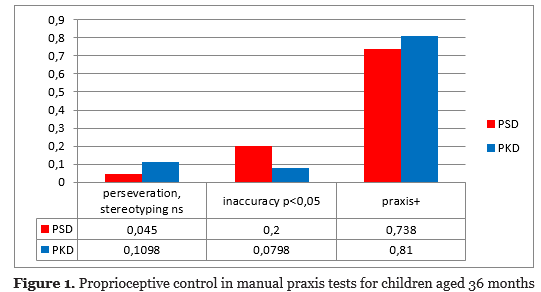
The results confirm that 36-month-old children with the analytical style (PKD) exhibit significantly fewer proprioceptive control failures than children with the holistic style (PSD). The tendency of children with the analytical style to experience failures due to frontal cortex dysfunction (CAS) does not reach statistical significance. However, the proportion of accurately reproduced finger configuration (praxis+) at this age is similar in both groups of preschoolers (Fig.1). At 48 months, children with the analytical style are significantly more successful than their peers with the holistic style in reproducing more complex finger configurations: average proportions of correctly reproduced finger configurations related to the total number of reproduced configurations in the PKD and PSD groups 0.8583/0. 6095, p<0.05 (Sizova, 2016).
When repeating pairs of syllables, younger preschoolers with the analytical style more often make perseverations and assimilations, indicating PKD-dysfunction of the secondary fields of the frontal cortex (0.09/0.018, p<0.1). Among the PSD-failures of proprioceptive control of articulatory posture like random substitutions, a greater proportion of errors is made by children with the holistic style (0.12/0.03, p<0.1) (Fig. 2).

Thus, more developed abilities for proprioceptive control, which characterize adult carriers of the analytical cognitive style (Kholodnaya, 2021), are revealed already in early preschool age. However, the accuracy of proprioceptive control is accompanied by a relative deficiency of functions of the frontal cortex in carriers of the analytical style. If children of the holistic style (hereinafter HS) are equally successful in repeating and independently reproducing a series of movements, then representatives of the analytical style (hereinafter AS) significantly lose in accuracy during independent reproduction (Fig. 3).

The obtained results demonstrate the functional predominance of the parietal cortical areas in proprioceptive controlling the accuracy of purposeful movement in children with AS with a relative delay in the development of motor sequence programming. On the contrary, the frontal cortex, which ensures the programming of sequential actions, is functionally predominant in children with HS with insufficient somatosensory/proprioceptive control of the accuracy of a single movement. Since somatosensory gnosis based on contact sensorics is an evolutionary precursor of telereception, in particular, visual gnosis (Bernstein, 2001), the problematic nature of the Embedded Figures Test for carriers of HS may be a consequence of ontogenetically early gnostic dysfunction.
3.2 Language abilities
A study of language abilities revealed intergroup differences between children with analytical and holistic styles. As early as at the age of 48 months, children with the analytical style are more successful in actualizing hypernyms to designate categories of objects. The intergroup differences obtained by comparing the average number of actualized hypernyms out of five possible ones are approaching statistical significance (AS 3.56/ HS 2.06, p<0.1) (Sizova, 2023).
In elicited narratives of speakers of the holistic style, demonstrative particles and demonstrative and attributive pronouns are used more often. Children with the analytical style prefer to use full-fledged lexemes to denote objects and subjects in their narratives. Intergroup differences are revealed in the average rates of use of demonstrative and attributive pronouns (AS 0.03 /HS 0.12, p<0.1) and demonstrative particles (AS 0.04 / HS 0.19, p<0.05) compared to the total number of lexemes in narratives (Sizova, 2024).
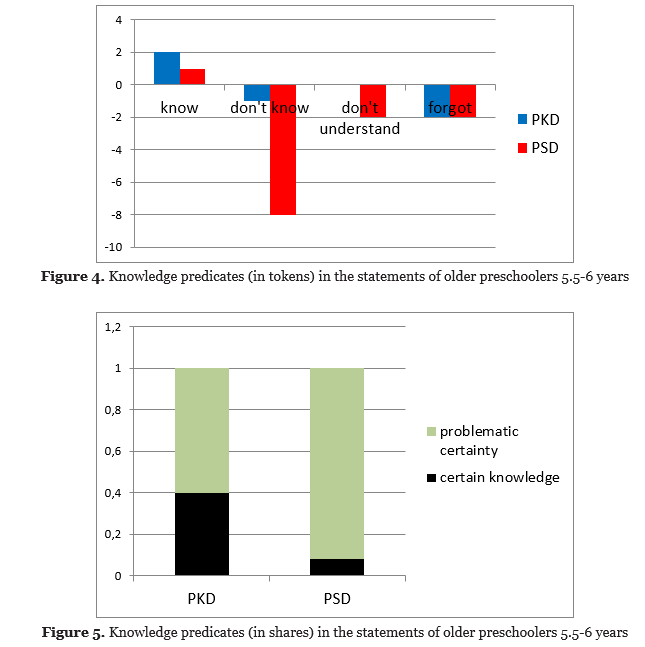
The strategies for using knowledge predicates expressing certain knowledge about the transmitted information (such as know, remember) and problematic certainty (such as don’t know, don’t understand, forgot) were counted and compared in the children’s comments accompanying the naming of images of objects and the generation of narratives based on images of scenes. Predicates of knowledge were not the target of the study and were used by children in the modal frame of the main statement, for example, *A odin ne znayu chto delaet (=And I don’t know what this one is doing). Therefore, the absolute number of knowledge predicates used was counted and compared. The absolute number of using certain knowledge markers is 40%, markers of problematic certainty is 60% of all uses in tokens in PKD group. In the PSD group, a total predominance of marking of problematic certainty was revealed (92% of all uses in tokens). Comparison of the share of knowledge predicates with the value of problematic certainty and certain knowledge in the statements of older preschoolers confirmed a more pronounced assurance in the certainty of their knowledge in children of analytical strategy (PKD) (Fig. 4, 5) (Sizova, 2023).
In the study of discourse reproduction, we assessed the correctness of retelling taking into account the reproduction of two keywords. In the study of discourse comprehension, we assessed the usage of keywords to activate the contextual presupposition, revealing the hidden meaning of the text. The results of the study are shown in Table 2.
Table 2. The results of discourse reproduction and comprehension study
| Analytical strategy (PKD)
|
Holistic strategy (PSD)
|
t-test | |
| Correctness of reproduction
|
1.83
|
1.4
|
p=0.2
|
| Using keywords
|
0.91
|
1.0
|
ns
|
| t-test | p<0.01
|
ns
|
Discussion
A human gets basic bodily experience by virtue of the functions of his/her parietal (somatosensory) cortex and frontal cortex. And in terms of embodied cognition, it is due to these basic functions, while maintaining the structural characteristics of low-level experience, that high-level cognitive abilities are formed through metaphorical transfer. The ability of categorization is based on the somatosensory experience of defining the boundaries of one’s own body through the image scheme “container”. Programming of goal-oriented behavior and generating narratives are based on early experience of achieving a material goal through movement in space on the base of image scheme “source-path-goal.” (Lakoff & Johnsen, 2003). Children with primary kinetic dysfunction of the analytical strategy rely in their activities on the more functionally complete posterior cortex and they are more successful in mastering cognitive functions mediated by the image schema “container”. Children with the holistic strategy, on the contrary, rely on the functions of the frontal cortex and are more successful in forming functions mediated by the image scheme “source-path-goal.”
Relying on the image scheme “container”, children with the analytical style are more successful in categorization and master hypernyms denoting categories of objects earlier.
Children with holistic strategy learn multi-word utterances and pragmatic aspects of language as a means of situational adaptation earlier than their peers with AS; first utterances of HS children are more often directives (Bates et al., 1995). Thus, language acquisition in this group of children is provided by goal-oriented behavior within the framework of reliance on an image scheme “source-path-goal.” At the same time, the results of the study confirm the appropriateness of the definition “field-sensitive” rather than “field-dependent” for speakers of the holistic style (Kholodnaya, 2021): in their texts, demonstrative lexemes are used more often, directly involving the situational extra-linguistic context in the process of generating utterances. Consequently, the theory of embodied cognition substantiates the relationship between the configuration of prevailing cortical functions and the formation of cognitive style in carriers of AS and HS already in early preschool childhood.
A study of such characteristics that differentiate analytical and holistic cultures, e.g. to be confident in the assurance in the certainty of reported knowledge, to rely on verbal or empirical knowledge, also demonstrated the presence of intergroup differences on these characteristics in older preschoolers. Children with the analytical strategy rely on verbal-logical knowledge, accurately reproducing the lexical composition of a text. However, children with the holistic style are more successful in understanding the situational presuppositions underlying the verbal composition of a text and are more sensitive to the contextual components of meaning. The activities of children with the analytical strategy rely on the “container” image schema, which ensures the successful storage and retrieval of information. The “source-path-goal” image schema helps children with the holistic style to understand and to use the hidden meaning of events to successfully adapt to the situational context. But it is precisely the understanding of the variability of extra-textual reality that makes children with the holistic style less confident in the universal correctness of the knowledge available to them.
Conclusions
The concept of the “invisible hand” (Keller, 1997) explains changes in language and culture as unintentional coincidences of individual actions, but does not explain why such coincidences occur. The assumption about the formation of an individual’s cognitive style on the basis of his/her neuropsychological characteristics allows us to understand the coincidence of individual actions as a consequence of the synchronic predominance of carriers of a certain neuropsychological configuration and the corresponding cognitive style in the population. The predominance of carriers of the analytical cognitive style, based on the functions of the posterior cortex, forms the predominance of high-level markers of the analytical culture; meanwhile the predominance of representatives of the holistic style, based on the functions of the anterior cortex at all stages of ontogenesis, forms the prevalence of holistic markers in the synchrony of culture. Therefore, changes in analytical/holistic tendencies in different layers of culture/society are explained by changes in the balance of carriers of AS and HS in the population.
CRediT author statement: The author is accountable for delivering the finalized version of the manuscript for publication. The finalized version of the manuscript was endorsed by the author.
Conflict of interest: The author declares no conflicts of interest.
References
- Akhutina, T. V., Kornev, A. N., & Matveeva, E. Y. (2016). Metody neiropsikhologicheskogo obsledovaniya detey 6–9 let [Methods of neuropsychological examination of children aged 6–9 years]. V. Sekachev, Moscow.
- Barrett, H. C., Bolyanatz, A., Broesch, T., Cohen, E., Froerer, P., Kanovsky, M., Schug, M. G., & Laurence, S. (2021). Intuitive dualism and afterlife beliefs: A cross‐cultural study. Cognitive Science, 45(6), Article e12992. https://doi.org/10.1111/cogs.12992
- Bates, E., Bretherton, I., & Snyder, L. (1988). From first words to grammar: Individual differences and dissociable mechanisms. Cambridge University Press, Cambridge.
- Bates, E., Dale, P. S., & Thal, D. (1995). Individual differences and their implications for theories of language development. In P. Fletcher & B. MacWhinney (Eds.), The handbook of child language (pp. 96–151). Blackwell Publishing.
- Belopolskaya, N. L. (2008). Metody issledovaniya poznavatel’nykh protsessov u detey 4–6 let [Methods for studying cognitive processes in children aged 4–6 years]. Cogito-Center, Moscow.
- Bernstein, N. (1967). The co-ordination and regulation of movements. Pergamon Press, Oxford.
- Castelain, T., Bernard, S., Sudo, M., & Mercier, H. (2023, January 5–7). Is the boss always right? Evidence from preschoolers from three different cultures [Conference presentation abstract]. Budapest CEU Conference on Cognitive Development, Budapest, Hungary.
- Choi, I., Nisbett, R. E., & Smith, E. E. (1997). Culture, categorization and inductive reasoning. Cognition, 65(1), 15–32. https://doi.org/10.1016/S0010-0277(97)00034-6
- Keller, R. (1994). Sprachwandel: Von der unsichtbaren Hand in der Sprache. A. Francke Verlag Tübingen und Basel
- Kholodnaya, M. A. (2004). Kognitivnye stili: O prirode individual’nogo uma [Cognitive styles: On the nature of the individual mind]. Piter. Moscow
- Lakoff, G., & Johnson, M. (2003). Metaphors we live by. The University of Chicago Press. London
- Lotman, J. (2009). Culture and explosion. De Gruyter Mouton, Berlin, New York.
- Orfinskaya, V. K. (1963). Printsipy postroeniya differentsirovannogo metoda obucheniya alalikov na osnove lingvisticheskoy klassifikatsii form alalii [Principles of constructing a differential teaching method for alalia sufferers based on the linguistic classification of alalia forms]. In Sbornik rabot po defektologii (pp. 107–137). Izdatel’stvo Leningradskogo pedagogicheskogo instituta.
- Oyserman, D., & Lee, S. W. S. (2008). A situated cognition perspective on culture: Effects of priming cultural syndromes on cognition and motivation. In R. M. Sorrentino & S. Yamaguchi (Eds.), Handbook of motivation and cognition across cultures (pp. 237–265). Academic Press.
- Peng, K., & Nisbett, R. E. (1999). Culture, dialectics, and reasoning about contradiction. American Psychologist, 54(9), 741–754.
- Sizova, O. B. (2016, January 7–9). Articulation, language and cognition in children with language impairment: Mutual influence of levels [Conference presentation abstract]. Budapest CEU Conference on Cognitive Development, Budapest, Hungary.
- Sizova, O. B. (2023, January 5–7). On the question of neurobiological correlates of the cognitive basis of culture [Conference presentation abstract]. Budapest CEU Conference on Cognitive Development, Budapest,Hungary. https://www.bcccd.org/down/bcccd_final_program_2023.pdf
- Sizova, O. B. (2024). Word as gesture. In Language-music-gesture: Information crossroads (LMGIC–2022): Proceedings of the international scientific conference, St. Petersburg, April 18–20, 2024 (pp. 79–81). Skifia-Print. Saint Petersburg.
- Springer, S. P., & Deutsch, G. (1981). Left brain, right brain. W. H. Freeman. San Francisco
Comments (0)
Background and Problem. The question concerning the mechanisms underlying the formation of analytical and holistic cognitive styles in adults remains unresolved. The dichotomy between analytical and holistic cultures is typically framed within a paradigm positing a “top-down” vector of influence, where the cultural or social environment is considered as a primary factor shaping the cognitive style of its members. However, this approach cannot adequately account for the coexistence of both cognitive styles within a single culture, nor the instability of analytical/holistic characteristics in cultures and societies across time (diachrony). Objective. This study aims to substantiate an alternative “bottom-up” direction of influence. It seeks to identify the neuropsychological basis for the formation of cognitive styles by investigating the early ontogeny of cognitive functions in preschoolers representing two contrasting strategies of native language acquisition: analytical (referential) and holistic (expressive). Methods. The research employed an inclusive longitudinal observation of 44 preschool-aged children (36–48 months at baseline), divided into two groups of 22 children each, identified by their analytical or holistic language acquisition profile. Observation spanned 24 to 48 months, with annual assessments including: testing of motor and articulatory abilities (manual praxis, repetition and independent reproduction of movement sequences, repetition of syllable pairs) and evaluation of language abilities (lexicon and categorization, sentence production, discourse comprehension and production). Results. Behavioral testing revealed distinct neuropsychological correlates for each strategy. Children with an analytical style demonstrated significantly more accurate proprioceptive control but relative weakness in programming motor sequences, indicating functional dominance of parietal (somatosensory) cortical areas. Conversely, children with a holistic style showed less accurate proprioceptive control but greater success in motor programming, suggesting relative dominance of frontal cortical functions. These differences were also reflected in language development: the analytical group excelled in categorization and precise verbal reproduction, while the holistic group was more successful in using situational context and understanding presuppositions in discourse. Conclusion. The findings suggest that an individual’s cognitive style is rooted in early-forming neuropsychological configurations—specifically, the balance between somatosensory/proprioceptive (parietal) and programming/sequential (frontal) cortical functions. Consequently, the predominance of carriers of a particular cognitive style within a population may shape macro-level cultural characteristics (analytical vs. holistic), offering an explanation for diachronic cultural changes from a “bottom-up” perspective.
Формирование когнитивных стилей: природа или воспитание?
О.Б. Сизова
Психолого-педагогический центр по социальной адаптации детей с тяжелыми нарушениями речи, Россия, Санкт-Петербург
Резюме. Актуальность и проблема. Вопрос о механизмах формирования аналитического и холистического когнитивных стилей у взрослых до сих пор не имеет однозначного решения.
Противопоставление аналитических и холистических культур строится в парадигме понимания вектора влияния «сверху вниз»: культурная/социальная среда рассматривается как фактор формирования когнитивного стиля ее представителей. Однако данный подход не может удовлетворительно объяснить сосуществование обоих когнитивных стилей в рамках одной культуры, а также нестабильность аналитических/холистических характеристик культур/социумов в диахронии. Цель. Исследование направлено на обоснование альтернативного направления влияния «снизу вверх». Оно ставит целью выявить нейропсихологическую основу формирования когнитивных стилей путем изучения раннего онтогенеза когнитивных функций у дошкольников — представителей двух противопоставляемых стратегий освоения родного языка: аналитической (референциальной) и холистической (экспрессивной). Методы. В исследовании применялось включенное лонгитюдное наблюдение за 44 детьми дошкольного возраста (36-48 месяцев на момент начала наблюдения), разделенными на две группы по 22 ребенка, идентифицированных по аналитическому или холистическому профилю овладения языком. Наблюдение длилось от 24 до 48 месяцев с ежегодной оценкой: тестирование моторных и артикуляционных способностей (мануальный праксис, повторение и самостоятельное воспроизведение последовательности движений, повторение пар слогов) и оценку языковых способностей (лексикон и категоризация, порождение предложений, понимание и продуцирование дискурса). Результаты. Поведенческое тестирование выявило отчетливые нейропсихологические корреляты для каждой стратегии. Дети с аналитическим стилем продемонстрировали достоверно более точный проприоцептивный контроль, но относительную слабость в программировании двигательных последовательностей, что указывает на функциональное доминирование теменных (соматосенсорных) корковых зон. Напротив, дети с холистическим стилем показали менее точный проприоцептивный контроль, но большую успешность в моторном программировании, что свидетельствует об относительном доминировании функций лобной коры. Эти различия отразились и в языковом развитии: аналитическая группа преуспела в категоризации и точном вербальном воспроизведении, тогда как холистическая группа оказалась более успешной в использовании ситуативного контекста и понимании пресуппозиций в дискурсе. Заключение. Полученные данные позволяют предположить, что когнитивный стиль индивида коренится в рано формирующихся нейропсихологических конфигурациях, а именно в балансе между соматосенсорными/проприоцептивными (теменными) и программирующими/последовательными (лобными) корковыми функциями. Таким образом, преобладание в популяции носителей определенного когнитивного стиля может обуславливать макроуровневые характеристики культуры (аналитической vs. холистической), что предлагает объяснение диахронических культурных изменений с позиций «восходящего» влияния.
Ключевые слова: когнитивные стили, стратегии освоения родного языка, кортикальные механизмы формирования когнитивных стилей, образные схемы и метафорический перенос, воплощенное познание
Analytical and holistic cognitive styles are differentiated not only in psychological researches. This dichotomy continues to characterize hemispheric differences for processing information in neuropsychology, and it is used to determine the properties of cultures and societies in anthropology and sociology. Active manipulation of terms is not based on a clear understanding of the cognitive styles mechanisms themselves. Attempts to justify the cognitive styles formation by the functional predominance of the left or right brain hemisphere have not yielded unambiguous results (Springer & Deutsch, 1981; Bates et al., 1995).
The constructivist approach to the formation of cognitive functions considers the socio-cultural environment as the main factor in the formation of an individual’s cognitive style (Barrett et al., 2021; Castelain et al., 2023; Choi et al., 1997; Oyserman et al., 2008; Peng & Nisbett, 1999). Nisbett’s research group believes that analytical Western culture traces its roots to the culture of the ancient city-states. It is based on a personality as an agent of influence, “localization of power in each individual” and formation of laws (rules) in the process of debate. Such epistemic attitudes have focused attention on the internal properties of the object and field independence, propensity to formal logic, categorization, and abstract analysis instead of empirical knowledge, and categorical assurance in the certainty of the only one option in the bearers of analytical culture. Eastern holistic culture dates back to ancient China with its mutual social obligations, expectations and collective subjectivity and is based on harmony of the social whole/consistency and “a benevolent social organism”. The bearers of holistic culture are field-dependent, since they consider field or background as the reason for changing the object. They rely on relationships and the importance of context, on empirical knowledge instead of logical analysis. Representatives of holistic cognitive style tend to search for a compromise, “middle way” under the influence of the epistemic attitudes of their culture (Choi et al., 1997; Peng & Nisbett, 1999).
However, similar top-down vector of influence, in the limit, should lead to uniformity of cognitive styles among representatives of a culture, but this does not correspond to reality. Moreover, the concept of the unidirectional influence of cultural characteristics on individuals does not explain the causes and mechanisms of diachronic changes in different areas of culture (Lotman, 2009), in particular, the change of analytical and synthetic tendencies in the structure of languages. Therefore, the relevant goal of the study may be a) to identify basic neuropsychological mechanisms that determine the formation of an individual’s cognitive style in the early stages of ontogenesis, and b) to discover transition patterns from the individual level of cognitive style (determined in neuropsychology) to the collective level of the analytical or holistic culture.
The study is based on the concept of referential and expressive strategies for acquiring the native language in early childhood (also considered as analytical and holistic strategies, respectively) (Bates et al., 1988, 1995). The differential features of analytical (referential) and holistic (expressive) strategies of language acquisition in childhood are presented in the table below.
Table 1. Language acquisition strategies as cognitive styles
| Referential analytical strategy | Expressive holistic strategy |
| Precise articulation of isolated sounds/syllables, reduction of syllabic structure of the word
|
Inaccurate articulation of each sound, preservation of syllabic structure of the word
|
| Stability of substitutes in any contexts
|
Instability of substitutes
|
| Stability of phonetic signifiers → intelligibility
|
Variability of phonetic signifiers with every utterance → role of context in understanding
|
| Predominance of nouns in the initial lexicon
|
Equal proportion of nouns and verbs in the initial lexicon
|
| Prolonged predominance of one-word holophrase utterances
|
Early formation of non–one-word utterances
|
| Long-term use of a personal name for self-reference | Early acquisition of pronouns for self-reference |
Main research questions:
- Identification of the neuropsychological basis for the formation of the analytical/holistic strategy for language acquisition.
- Discovery of causality between neuropsychological mechanisms of programming and proprioceptive control of goal-directed movements and the formation of high-level cognitive functions that determine the styles of language acquisition, the development of intellect and purposeful behavior.
- Identification of rules and mechanisms for the transition from the level of individual cognitive style to the macro-level of culture.
2.1 Participants
The study involved 44 preschool-aged children (aged 36-48 months at the beginning of observation), 2 groups of 22 children with signs of referential (analytical) and expressive (holistic) strategies of language acquisition identified in accordance with the pool of differential features of language acquisition strategies described by E. Bates (see above) (Bates et al., 1988, 1995).
2.2 Methods
The study used the methods of inclusive longitudinal observation, which continued for 24 to 48 months with annual testing of motor and articulatory abilities (manual praxis, movements’ consequence repetition & reproduction, reproduction of syllable pairs) as well as research into language abilities: lexicon & categorization formation, sentence production, discourse comprehension, discourse production). The significance of the identified intergroup differences was verified with a t-test.
The study of the state of motor abilities included a battery of tests for neuropsychological examination of preschool children (Akhutina et al., 2016), modified for younger and middle preschool age. In a study of a single movement proprioceptive control in the manual praxis, the experimenter asked children to reproduce finger positions presented monomanually. To study the programming of goal-directed action, the experimenter demonstrated consequences of 2-3 movements that the participants had to repeat together with the experimenter and then reproduce on their own. The state of articulatory motor skills was studied by repeating pairs of syllables with consonants, contrasting in place and/or manner of formation (Orphinskaya, 1963).
The study of the development level of language abilities included identifying the ability to name images of objects and actualize hypernyms; generating statements when images of scenes are shown. The study of discourse reproduction and discourse comprehension assessed the ability to understand the hidden meaning of a text based on the perception of the meaning of the keywords contained therein. The study included retelling a short text and answering questions that revealed the ability to take into account the meaning of keywords (Belopolskaya, 2008). There is a text below with highlighted keywords, the extra-textual meaning of the text should be taken into account when answering the questions.
Little Sasha woke up in the morning unhappy. Mom gave him medicine, took an umbrella and left.
Why did Sasha wake up unhappy? What was the weather like outside?
3.1. Motor and articulatory abilities
The study of the state of motor and articulatory abilities revealed a better level of proprioceptive control in children with the analytical referential style. The analysis of the manual praxis tests performance included the calculation of the proportion of failures associated with two types of dysfunctions. Dysfunction of the somatosensory cortex (primary somatosensory dysfunction, hereinafter PSD) leads to inaccurate proprioceptive control. Dysfunction of the frontal cortex leads to failures of the kinetic program of the motor sequence (hereinafter primary kinetic dysfunction, PKD). The signs of PKD included stereotypes and perseverations of previous finger positions when performing the test; the signs of PSD manifested themselves in the inaccuracy of reproducing the configuration of the fingers. Since children with the analytical style are characterized by predominantly PKD-type failures, while children with the holistic style are characterized by PSD-type failures. In studies of motor abilities, the groups of analytical and holistic styles are designated as PKD and PSD, respectively.
The results confirm that 36-month-old children with the analytical style (PKD) exhibit significantly fewer proprioceptive control failures than children with the holistic style (PSD). The tendency of children with the analytical style to experience failures due to frontal cortex dysfunction (CAS) does not reach statistical significance. However, the proportion of accurately reproduced finger configuration (praxis+) at this age is similar in both groups of preschoolers (Fig.1). At 48 months, children with the analytical style are significantly more successful than their peers with the holistic style in reproducing more complex finger configurations: average proportions of correctly reproduced finger configurations related to the total number of reproduced configurations in the PKD and PSD groups 0.8583/0. 6095, p<0.05 (Sizova, 2016).
When repeating pairs of syllables, younger preschoolers with the analytical style more often make perseverations and assimilations, indicating PKD-dysfunction of the secondary fields of the frontal cortex (0.09/0.018, p<0.1). Among the PSD-failures of proprioceptive control of articulatory posture like random substitutions, a greater proportion of errors is made by children with the holistic style (0.12/0.03, p<0.1) (Fig. 2).
Thus, more developed abilities for proprioceptive control, which characterize adult carriers of the analytical cognitive style (Kholodnaya, 2021), are revealed already in early preschool age. However, the accuracy of proprioceptive control is accompanied by a relative deficiency of functions of the frontal cortex in carriers of the analytical style. If children of the holistic style (hereinafter HS) are equally successful in repeating and independently reproducing a series of movements, then representatives of the analytical style (hereinafter AS) significantly lose in accuracy during independent reproduction (Fig. 3).
The obtained results demonstrate the functional predominance of the parietal cortical areas in proprioceptive controlling the accuracy of purposeful movement in children with AS with a relative delay in the development of motor sequence programming. On the contrary, the frontal cortex, which ensures the programming of sequential actions, is functionally predominant in children with HS with insufficient somatosensory/proprioceptive control of the accuracy of a single movement. Since somatosensory gnosis based on contact sensorics is an evolutionary precursor of telereception, in particular, visual gnosis (Bernstein, 2001), the problematic nature of the Embedded Figures Test for carriers of HS may be a consequence of ontogenetically early gnostic dysfunction.
3.2 Language abilities
A study of language abilities revealed intergroup differences between children with analytical and holistic styles. As early as at the age of 48 months, children with the analytical style are more successful in actualizing hypernyms to designate categories of objects. The intergroup differences obtained by comparing the average number of actualized hypernyms out of five possible ones are approaching statistical significance (AS 3.56/ HS 2.06, p<0.1) (Sizova, 2023).
In elicited narratives of speakers of the holistic style, demonstrative particles and demonstrative and attributive pronouns are used more often. Children with the analytical style prefer to use full-fledged lexemes to denote objects and subjects in their narratives. Intergroup differences are revealed in the average rates of use of demonstrative and attributive pronouns (AS 0.03 /HS 0.12, p<0.1) and demonstrative particles (AS 0.04 / HS 0.19, p<0.05) compared to the total number of lexemes in narratives (Sizova, 2024).
The strategies for using knowledge predicates expressing certain knowledge about the transmitted information (such as know, remember) and problematic certainty (such as don’t know, don’t understand, forgot) were counted and compared in the children’s comments accompanying the naming of images of objects and the generation of narratives based on images of scenes. Predicates of knowledge were not the target of the study and were used by children in the modal frame of the main statement, for example, *A odin ne znayu chto delaet (=And I don’t know what this one is doing). Therefore, the absolute number of knowledge predicates used was counted and compared. The absolute number of using certain knowledge markers is 40%, markers of problematic certainty is 60% of all uses in tokens in PKD group. In the PSD group, a total predominance of marking of problematic certainty was revealed (92% of all uses in tokens). Comparison of the share of knowledge predicates with the value of problematic certainty and certain knowledge in the statements of older preschoolers confirmed a more pronounced assurance in the certainty of their knowledge in children of analytical strategy (PKD) (Fig. 4, 5) (Sizova, 2023).
In the study of discourse reproduction, we assessed the correctness of retelling taking into account the reproduction of two keywords. In the study of discourse comprehension, we assessed the usage of keywords to activate the contextual presupposition, revealing the hidden meaning of the text. The results of the study are shown in Table 2.
Table 2. The results of discourse reproduction and comprehension study
| Analytical strategy (PKD)
|
Holistic strategy (PSD)
|
t-test | |
| Correctness of reproduction
|
1.83
|
1.4
|
p=0.2
|
| Using keywords
|
0.91
|
1.0
|
ns
|
| t-test | p<0.01
|
ns
|
A human gets basic bodily experience by virtue of the functions of his/her parietal (somatosensory) cortex and frontal cortex. And in terms of embodied cognition, it is due to these basic functions, while maintaining the structural characteristics of low-level experience, that high-level cognitive abilities are formed through metaphorical transfer. The ability of categorization is based on the somatosensory experience of defining the boundaries of one’s own body through the image scheme “container”. Programming of goal-oriented behavior and generating narratives are based on early experience of achieving a material goal through movement in space on the base of image scheme “source-path-goal.” (Lakoff & Johnsen, 2003). Children with primary kinetic dysfunction of the analytical strategy rely in their activities on the more functionally complete posterior cortex and they are more successful in mastering cognitive functions mediated by the image schema “container”. Children with the holistic strategy, on the contrary, rely on the functions of the frontal cortex and are more successful in forming functions mediated by the image scheme “source-path-goal.”
Relying on the image scheme “container”, children with the analytical style are more successful in categorization and master hypernyms denoting categories of objects earlier.
Children with holistic strategy learn multi-word utterances and pragmatic aspects of language as a means of situational adaptation earlier than their peers with AS; first utterances of HS children are more often directives (Bates et al., 1995). Thus, language acquisition in this group of children is provided by goal-oriented behavior within the framework of reliance on an image scheme “source-path-goal.” At the same time, the results of the study confirm the appropriateness of the definition “field-sensitive” rather than “field-dependent” for speakers of the holistic style (Kholodnaya, 2021): in their texts, demonstrative lexemes are used more often, directly involving the situational extra-linguistic context in the process of generating utterances. Consequently, the theory of embodied cognition substantiates the relationship between the configuration of prevailing cortical functions and the formation of cognitive style in carriers of AS and HS already in early preschool childhood.
A study of such characteristics that differentiate analytical and holistic cultures, e.g. to be confident in the assurance in the certainty of reported knowledge, to rely on verbal or empirical knowledge, also demonstrated the presence of intergroup differences on these characteristics in older preschoolers. Children with the analytical strategy rely on verbal-logical knowledge, accurately reproducing the lexical composition of a text. However, children with the holistic style are more successful in understanding the situational presuppositions underlying the verbal composition of a text and are more sensitive to the contextual components of meaning. The activities of children with the analytical strategy rely on the “container” image schema, which ensures the successful storage and retrieval of information. The “source-path-goal” image schema helps children with the holistic style to understand and to use the hidden meaning of events to successfully adapt to the situational context. But it is precisely the understanding of the variability of extra-textual reality that makes children with the holistic style less confident in the universal correctness of the knowledge available to them.
The concept of the “invisible hand” (Keller, 1997) explains changes in language and culture as unintentional coincidences of individual actions, but does not explain why such coincidences occur. The assumption about the formation of an individual’s cognitive style on the basis of his/her neuropsychological characteristics allows us to understand the coincidence of individual actions as a consequence of the synchronic predominance of carriers of a certain neuropsychological configuration and the corresponding cognitive style in the population. The predominance of carriers of the analytical cognitive style, based on the functions of the posterior cortex, forms the predominance of high-level markers of the analytical culture; meanwhile the predominance of representatives of the holistic style, based on the functions of the anterior cortex at all stages of ontogenesis, forms the prevalence of holistic markers in the synchrony of culture. Therefore, changes in analytical/holistic tendencies in different layers of culture/society are explained by changes in the balance of carriers of AS and HS in the population.
CRediT author statement: The author is accountable for delivering the finalized version of the manuscript for publication. The finalized version of the manuscript was endorsed by the author.
Conflict of interest: The author declares no conflicts of interest.
- Akhutina, T. V., Kornev, A. N., & Matveeva, E. Y. (2016). Metody neiropsikhologicheskogo obsledovaniya detey 6–9 let [Methods of neuropsychological examination of children aged 6–9 years]. V. Sekachev, Moscow.
- Barrett, H. C., Bolyanatz, A., Broesch, T., Cohen, E., Froerer, P., Kanovsky, M., Schug, M. G., & Laurence, S. (2021). Intuitive dualism and afterlife beliefs: A cross‐cultural study. Cognitive Science, 45(6), Article e12992. https://doi.org/10.1111/cogs.12992
- Bates, E., Bretherton, I., & Snyder, L. (1988). From first words to grammar: Individual differences and dissociable mechanisms. Cambridge University Press, Cambridge.
- Bates, E., Dale, P. S., & Thal, D. (1995). Individual differences and their implications for theories of language development. In P. Fletcher & B. MacWhinney (Eds.), The handbook of child language (pp. 96–151). Blackwell Publishing.
- Belopolskaya, N. L. (2008). Metody issledovaniya poznavatel’nykh protsessov u detey 4–6 let [Methods for studying cognitive processes in children aged 4–6 years]. Cogito-Center, Moscow.
- Bernstein, N. (1967). The co-ordination and regulation of movements. Pergamon Press, Oxford.
- Castelain, T., Bernard, S., Sudo, M., & Mercier, H. (2023, January 5–7). Is the boss always right? Evidence from preschoolers from three different cultures [Conference presentation abstract]. Budapest CEU Conference on Cognitive Development, Budapest, Hungary.
- Choi, I., Nisbett, R. E., & Smith, E. E. (1997). Culture, categorization and inductive reasoning. Cognition, 65(1), 15–32. https://doi.org/10.1016/S0010-0277(97)00034-6
- Keller, R. (1994). Sprachwandel: Von der unsichtbaren Hand in der Sprache. A. Francke Verlag Tübingen und Basel
- Kholodnaya, M. A. (2004). Kognitivnye stili: O prirode individual’nogo uma [Cognitive styles: On the nature of the individual mind]. Piter. Moscow
- Lakoff, G., & Johnson, M. (2003). Metaphors we live by. The University of Chicago Press. London
- Lotman, J. (2009). Culture and explosion. De Gruyter Mouton, Berlin, New York.
- Orfinskaya, V. K. (1963). Printsipy postroeniya differentsirovannogo metoda obucheniya alalikov na osnove lingvisticheskoy klassifikatsii form alalii [Principles of constructing a differential teaching method for alalia sufferers based on the linguistic classification of alalia forms]. In Sbornik rabot po defektologii (pp. 107–137). Izdatel’stvo Leningradskogo pedagogicheskogo instituta.
- Oyserman, D., & Lee, S. W. S. (2008). A situated cognition perspective on culture: Effects of priming cultural syndromes on cognition and motivation. In R. M. Sorrentino & S. Yamaguchi (Eds.), Handbook of motivation and cognition across cultures (pp. 237–265). Academic Press.
- Peng, K., & Nisbett, R. E. (1999). Culture, dialectics, and reasoning about contradiction. American Psychologist, 54(9), 741–754.
- Sizova, O. B. (2016, January 7–9). Articulation, language and cognition in children with language impairment: Mutual influence of levels [Conference presentation abstract]. Budapest CEU Conference on Cognitive Development, Budapest, Hungary.
- Sizova, O. B. (2023, January 5–7). On the question of neurobiological correlates of the cognitive basis of culture [Conference presentation abstract]. Budapest CEU Conference on Cognitive Development, Budapest,Hungary. https://www.bcccd.org/down/bcccd_final_program_2023.pdf
- Sizova, O. B. (2024). Word as gesture. In Language-music-gesture: Information crossroads (LMGIC–2022): Proceedings of the international scientific conference, St. Petersburg, April 18–20, 2024 (pp. 79–81). Skifia-Print. Saint Petersburg.
- Springer, S. P., & Deutsch, G. (1981). Left brain, right brain. W. H. Freeman. San Francisco
Abstract
References