The Formation of Life Competence in the Family as a Condition for Developing Autonomy in Children with Typical and Delayed Development
Abstract
Abstract
Background and Relevance. The formation of life competence within the family is a key condition for the development of a child’s autonomy. However, the age-related dynamics of acquiring life competence skills and the pedagogical conditions for their development in family upbringing remain insufficiently studied. This issue is particularly significant for parents of children with mental retardation (MR), as it directly impacts their child’s autonomy and successful socialization. Objective. To identify the specific dynamics of parents’ perceptions of essential life competence skills in children of different ages with typical and delayed development, as a factor in fostering child autonomy in family upbringing. Hypothesis. The perceived importance of life competence skills among parents follows a wave-like pattern—it increases during the period of active skill acquisition and decreases after the skill is consolidated, reflecting the logic of age-related autonomy development. Methods and Materials. An online survey was conducted with parents of typically developing children (n = 161) and parents of children with MR (n = 465) from 34 regions of Russia. In each group, subgroups were formed based on the child’s age: preschool, primary school, adolescent, and young adult. The study utilized an author-developed questionnaire listing skills across five domains of life competence. Statistical processing included frequency analysis and one-way ANOVA. Results. The results did not support the hypothesis of a wave-like dynamic. Instead, the importance of most skills either remained consistently high or increased by young adulthood, reflecting growing parental dissatisfaction with the child’s level of autonomy relative to their expectations. No statistically significant differences were found between parents of children with MR and those of typically developing children. Conclusions. Parents in both groups, regardless of their child’s developmental profile, do not differentiate age-specific tasks for developing life skills and do not account for the specific needs associated with MR. This underscores the need for targeted psychological and pedagogical support for families, aimed at fostering realistic expectations and providing pedagogical guidance to create conditions for the conscious development of life competence as the foundation of a child’s autonomy.
Резюме. Контекст и актуальность. Формирование жизненной компетенции в семье выступает ключевым условием становления самостоятельности ребенка. Вместе с тем возрастная динамика овладения навыками жизненной компетенции и педагогические условия их развития в семейном воспитании остаются недостаточно изученными. Особую значимость эта проблема приобретает для родителей детей с задержкой психического развития (ЗПР), поскольку напрямую влияет на самостоятельность и успешную социализацию их ребенка. Цель. Выявить особенности динамики представлений родителей о значимых навыках из сферы жизненной компетенции у детей разного возраста с нормативным и задержанным развитием как фактора становления самостоятельности ребенка в семейном воспитании. Гипотеза. Значимость навыков из областей жизненной компетенции в представлениях родителей имеет волнообразный характер — она повышается в период активного формирования навыка и снижается после его закрепления, отражая логику возрастного становления самостоятельности. Методы и материалы. Проведен онлайн-опрос родителей детей с нормативным развитием (n = 161) и родителей детей с ЗПР (n = 465) из 34 регионов России. В каждой группе выделены подгруппы родителей детей дошкольного, младшего школьного, подросткового и юношеского возраста. Использовался авторский опросник, включающий перечень навыков в пяти областях жизненной компетенции. Статистическая обработка включала частотный анализ и однофакторный дисперсионный анализ ANOVA. Результаты. Гипотеза о волнообразной динамике не подтвердилась. Напротив, значимость большинства навыков либо оставалась стабильно высокой, либо возрастала к юношескому возрасту, что отражает нарастающую родительскую неудовлетворенность уровнем самостоятельности ребенка по сравнению с их ожиданиями. Статистически значимых различий между родителями детей с ЗПР и родителей нормотипичных детей не выявлено. Заключение. Родители обеих групп независимо от варианта развития ребенка не дифференцируют возрастные задачи формирования жизненных навыков и не учитывают специфику ЗПР. Это указывает на необходимость адресного психолого-педагогического сопровождения семей, направленного на формирование реалистичных ожиданий и педагогическую поддержку создания условий осознанного развития жизненной компетенции как основы самостоятельности ребенка.
Ключевые слова: сфера жизненной компетенции, семейное воспитание, дети с задержкой психического развития, представления, самостоятельность.
Introduction
One of the primary objectives of family upbringing is to prepare children for successful adaptation in society and an independent, productive life. In contemporary pedagogical discourse, autonomy is regarded not merely as a desirable personality trait but as a critical indicator of educational quality. The development of autonomy in children and adolescents is actively discussed both in academic research (Polivanova & Bochaver, 2022; Antonova, 2021; Nisskaya & Tsyganova, 2024) and within parent communities—on forums, in online chats, and at school meetings (Belaya Medveditsa…, 2019). This sustained public interest underscores a strong demand for effective strategies to cultivate autonomy.
Traditionally, the development of autonomy has been examined within the framework of academic learning in pedagogical psychology. Within this perspective, parental roles were largely confined to monitoring homework completion and ensuring compliance with school rules. However, this approach overlooks other essential dimensions of family life: safety in social and natural environments, the internalization of cultural norms across diverse social roles, daily living skills, and financial and legal literacy. These domains, which are central to a child’s ability to navigate everyday life, have remained largely outside the scope of family–school collaboration.
This tension has been especially pronounced in the education of children with disabilities, including those with mental retardation (MR). In response, researchers at the Institute of Special Education introduced the concept of “life competence” (Malofeev, 2019; Babkina, 2017), which was subsequently incorporated into Russian educational standards as a key personal educational outcome. The identified domains of life competence and their content (Babkina & Fedoseeva, 2025; Akulina, 2024) provide a framework for systematically fostering autonomy by embedding skill development in progressively complex social and material contexts.
For parents of children with MR, the challenge of preparing their child for independent living and fostering life competence is particularly acute. The specific characteristics of mental development in these children qualitatively shape their socialization trajectories. The importance of life competence is formally recognized in educational standards, where it is listed as a priority among personal educational outcomes (Ministry of Education…, 2014). Developing autonomy in children with MR is inherently dependent on cultivating skills within the life competence domain.
Despite the acknowledged importance of life competence in education, the pedagogical conditions that support its development within the family remain critically underexplored. Open questions persist regarding the age-related dynamics of skill acquisition in family and school settings, the psychological and pedagogical factors that facilitate this process, and the methodological resources needed to support parents and educators effectively.
Contemporary approaches to psychological and pedagogical support for children with MR emphasize that the subject of support is not the individual child but rather a collective unit comprising the child, the family, and the educator (e.g., the homeroom teacher) (Babkina, 2018). Effective teamwork in this context depends on aligned goals and coordinated actions. Accordingly, the first step toward building a coherent system for fostering life competence is to understand parents’ perceptions of its content and how these perceptions evolve as children mature—from preschool through young adulthood. Without such understanding, productive family–school collaboration aimed at developing autonomy remains difficult to achieve.
Life competence, initially conceptualized as a personal educational outcome for students with disabilities in Russia by Malofeev and Kukushkina in the 1990s, builds on the competency-based approach developed in international educational psychology. In their framework, life competence is defined as the ability to appropriately and independently address everyday life tasks within current life situations to the greatest extent possible (N.V. Babkina, E.L. Goncharova, E.A. Ekzhanova, O.I. Kukushkina, N.N. Malofeev, O.S. Nikolskaya) (Malofeev, 2016). Contemporary Russian research increasingly examines life competence through the lens of the cultural-historical approach.
A distinctive feature of the framework developed at the Institute of Special Education is its grounding in practical thinking (Vygotsky, 1984; Maidansky, 2023; Babkina & Fedoseeva, 2024). Life competence is understood as a broad set of abilities to solve everyday problems, rooted in the development of practical intelligence. By attending not only to the “higher” forms of practical action but also to their intermediate and transitional forms, researchers have revealed the richness and diversity of practical skills (Fedoseeva et al., 2024). This practical intellect plays a crucial role in socialization and psychological well-being. Yet, despite its foundational importance, practical thinking often remains underdeveloped in young people—including those with high academic abilities—leading to difficulties in adulthood and impeding the realization of life plans.
The varied life experiences that children and adolescents acquire through interactions in educational settings serve as an empirical basis for appropriating modes of action and forming perceptions of social reality. In special education and psychology, five domains of life competence are traditionally distinguished (Babkina, 2017; Karabanova & Malofeev, 2019): mastering social and daily living skills; developing adequate perceptions of one’s own capabilities and limitations; mastering communication skills; differentiating and understanding the world and its spatiotemporal organization; and understanding one’s social environment while adopting age-appropriate values and social roles.
The development of life competence is relevant not only for children with MR but also for typically developing children. The traditional emphasis on academic achievement often leaves students with insufficient skills in navigating social norms, managing time, and regulating emotional states—despite high academic performance. The strong demand from parents and educators for fostering schoolchildren’s autonomy[1] (Chudinova, 2024; Polivanova & Bochaver, 2024; Antonova, 2021; Asonova, 2024) is thus not adequately met by current personal educational outcomes alone.
Most situations requiring life competence arise in everyday life, where the educational environment (school, kindergarten) offers limited opportunities for fully developing these skills. At the same time, the task of fostering life competence is highly accessible to parents, as it is embedded in daily family life. Household routines, time management, homework completion, and independent navigation of social and natural spaces are precisely the domains that populate parental concerns and instructive conversations from preschool to young adulthood. Consequently, family–school collaboration on life competence has the potential to increase parental motivation and engagement. In this context, parents become full participants in the pedagogical team, working toward shared educational goals. Whereas parents may perceive teacher requests to support academic learning as an unwelcome delegation of responsibility, they are more likely to embrace involvement in fostering life competence, which they recognize as intrinsically connected to family life.
Research on the development of autonomy in relation to parenting styles and parental involvement has primarily focused on preschool age (Kalinovskaya, 2024), as well as on primary school and early adolescence (Nisskaya & Chuvilina, 2024). Greater parental support for self-organization is associated with more developed executive functions—working memory, inhibitory control, and cognitive flexibility—in children (Distefano et al., 2018; Lehrer et al., 2017). Developing autonomy in life competence requires understanding the logic of skill acquisition, age-related complexity, individual appropriation styles, and the parent’s capacity for effective mediation (Elkonin, 2023; Zaretsky & Ageeva, 2021).
In 2023–2024, our research team conducted a comparative study of how teachers and parents of children with disabilities perceive the importance of skills across life competence domains (Fedoseeva, 2024; Makarova, 2024; Babkina, 2017, 2018). Despite the clear relevance of this topic, no studies to date have examined the dynamics of parental perceptions regarding life competence skills in children of different ages with typical and delayed development. This gap defines the relevance of the present study.
Objective is to identify the specific dynamics of parents’ perceptions of essential life competence skills in children of different ages with typical and delayed development, as a factor in fostering child autonomy in family upbringing.
*Hypothesis: the perceived importance of life competence skills among parents follows a wave-like pattern: it increases during periods of active skill acquisition and declines after the skill is consolidated, thereby reflecting the logic of age-related autonomy development.
Method
Materials and Methods
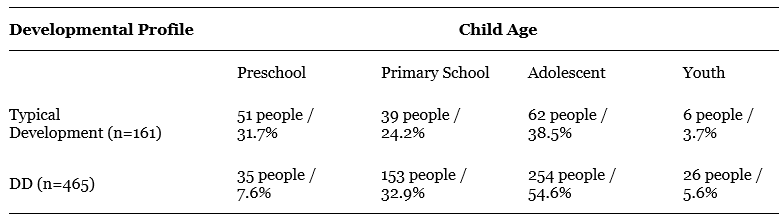
To identify parents’ perceptions of the importance of life competence skills, an online survey was conducted with parents of typically developing children (n = 161) and parents of children with MR (n = 465) from 34 regions of the Russian Federation. The parent sample was divided into groups based on the child’s age (see Table 1). Parents of boys accounted for 74.8% of the sample, and parents of girls for 25.2%. The questionnaire was primarily answered by mothers (93.8%), of whom 22.7% were aged 36–45 years, 47.6% were aged 29–35 years, and 21.9% were aged 46–55 years.
Table 1. Distribution of the parent sample by child age and developmental profile
| Developmental Profile | Child Age | |||
| Preschool | Primary School | Adolescent | Youth | |
| Typical Development (n=161) | 51 people / 31.7% | 39 people / 24.2% | 62 people / 38.5% | 6 people / 3.7% |
| MR (n=465) | 35 people / 7.6% | 153 people / 32.9% | 254 people / 54.6% | 26 people / 5.6% |
A questionnaire for parents (Fedoseeva, Babkina et al., 2023) was developed to assess perceptions of the life competence domain. It comprised two parts: the first part assessed general perceptions of what the child can already do and what they should learn at the next age stage; the second part presented a list of skills within each of the five life competence domains, asking parents to select the three most significant skills for their child in each domain.
For statistical processing, frequency analysis and one-way ANOVA with Bonferroni and Tukey corrections were used.
Results
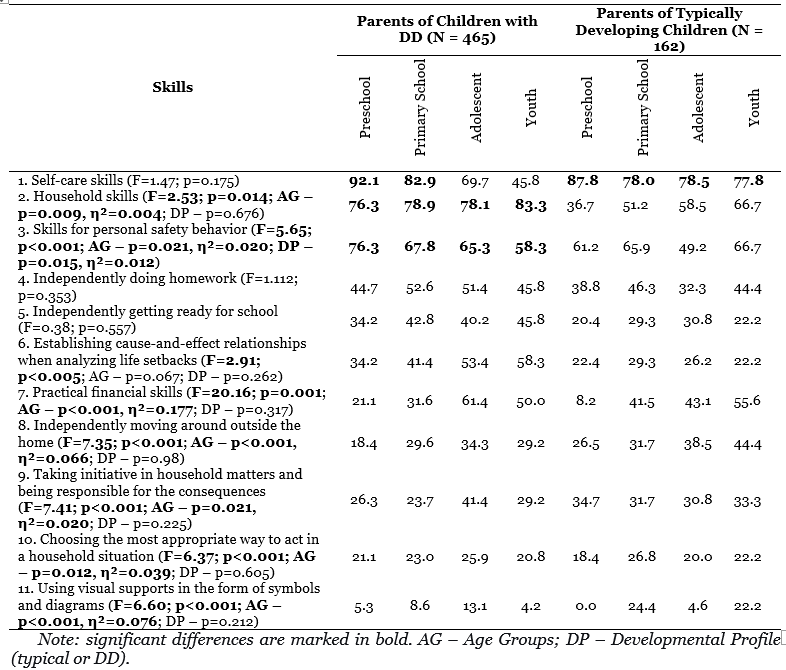
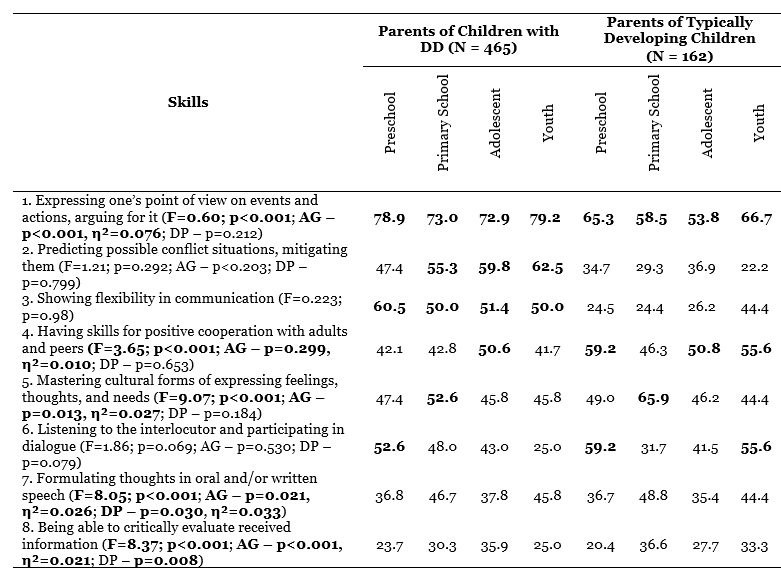
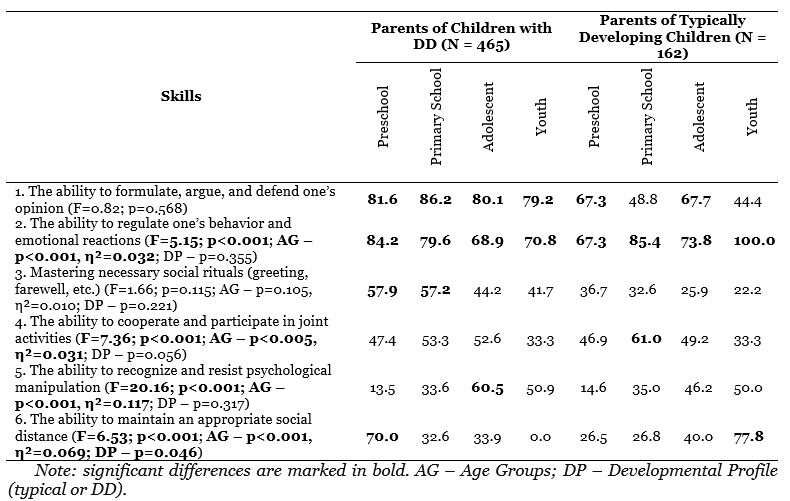
The results are structured by life competence domain and presented in Tables 2–6. Frequency analysis results for the significance of skills in each domain are presented as percentages according to the child’s age group and developmental profile. Differences between groups and developmental profiles (typical vs. MR) were determined using ANOVA, where the dependent variable was the skill, and the developmental profile and age group were independent variables. The tables show the overall model significance and the significance of the relationship for the developmental profile (DP) and age (Ag) parameters. For readability, skills in the tables are organized by their perceived importance for parents.
For parents of children with MR and typically developing children, the most important skills were self-care, household skills, and behaviors for personal safety. Interestingly, the dynamics of these skills across age groups differed from expectations: while the importance of self-care skills decreased by young adulthood in the MR parent group (92.1% → 45.8%), it remained at approximately the same level in the typical development parent group (87.8% → 77.8%). No statistically significant differences in the frequency of selecting this skill were found between parent groups.
Table 2. Frequency of parental selection of skills within the domain “Mastering social and everyday skills used in daily life” (%)
| Skills | Parents of Children with MR (N = 465) | Parents of Typically Developing Children (N = 162) | ||||||
| Preschool | Primary School | Adolescent | Youth | Preschool | Primary School | Adolescent | Youth | |
| 1. Self-care skills (F=1.47; p=0.175) | 92.1 | 82.9 | 69.7 | 45.8 | 87.8 | 78.0 | 78.5 | 77.8 |
| 2. Household skills (F=2.53; p=0.014; AG – p=0.009, η²=0.004; DP – p=0.676) | 76.3 | 78.9 | 78.1 | 83.3 | 36.7 | 51.2 | 58.5 | 66.7 |
| 3. Skills for personal safety behavior (F=5.65; p<0.001; AG – p=0.021, η²=0.020; DP – p=0.015, η²=0.012) | 76.3 | 67.8 | 65.3 | 58.3 | 61.2 | 65.9 | 49.2 | 66.7 |
| 4. Independently doing homework (F=1.112; p=0.353) | 44.7 | 52.6 | 51.4 | 45.8 | 38.8 | 46.3 | 32.3 | 44.4 |
| 5. Independently getting ready for school (F=0.38; p=0.557) | 34.2 | 42.8 | 40.2 | 45.8 | 20.4 | 29.3 | 30.8 | 22.2 |
| 6. Establishing cause-and-effect relationships when analyzing life setbacks (F=2.91; p<0.005; AG – p=0.067; DP – p=0.262) | 34.2 | 41.4 | 53.4 | 58.3 | 22.4 | 29.3 | 26.2 | 22.2 |
| 7. Practical financial skills (F=20.16; p=0.001; AG – p<0.001, η²=0.177; DP – p=0.317) | 21.1 | 31.6 | 61.4 | 50.0 | 8.2 | 41.5 | 43.1 | 55.6 |
| 8. Independently moving around outside the home (F=7.35; p<0.001; AG – p<0.001, η²=0.066; DP – p=0.98) | 18.4 | 29.6 | 34.3 | 29.2 | 26.5 | 31.7 | 38.5 | 44.4 |
| 9. Taking initiative in household matters and being responsible for the consequences (F=7.41; p<0.001; AG – p=0.021, η²=0.020; DP – p=0.225) | 26.3 | 23.7 | 41.4 | 29.2 | 34.7 | 31.7 | 30.8 | 33.3 |
| 10. Choosing the most appropriate way to act in a household situation (F=6.37; p<0.001; AG – p=0.012, η²=0.039; DP – p=0.605) | 21.1 | 23.0 | 25.9 | 20.8 | 18.4 | 26.8 | 20.0 | 22.2 |
| 11. Using visual supports in the form of symbols and diagrams (F=6.60; p<0.001; AG – p<0.001, η²=0.076; DP – p=0.212) | 5.3 | 8.6 | 13.1 | 4.2 | 0.0 | 24.4 | 4.6 | 22.2 |
Note: significant differences are marked in bold. AG – Age Groups; DP – Developmental Profile (typical or MR).
Household skills remained at a consistent level in the MR parent group (76.3% → 83.3%) but showed an increasing trend in the typical development parent group (36.7% → 66.7%). This suggests that parents of children with MR may be consistently dissatisfied with their children’s level of these skills, and this situation does not change as the child grows. For parents of typically developing children, household skills become increasingly important, as they expect the child to become more independent and take on household responsibilities. However, this expectation might conflict with the child’s developing autonomy and the dynamics of parent–child relationships. The slight variation in the significance of personal safety skills for parents likely reflects the increased importance of other skills within this domain, with no differences based on developmental profile and only minimal age-related differences (η²=0.020). For parents of children with MR, safety is more significant due to the children’s specific cognitive and regulatory challenges.
Overall, for this life competence domain, no differences were found between parent groups based on the child’s developmental profile; differences were only found for the age variable. The importance of practical financial skills and independent mobility outside the home increased sharply by young adulthood, regardless of the child’s developmental profile. Choosing the most appropriate way to act in a household situation was most important for parents of adolescents with MR (25.9%) and parents of typically developing primary school children (26.8%). These results clearly demonstrate a similar approach by parents to fostering household autonomy in children with different developmental profiles and the dynamics of their maturation. Using visual supports (symbols and diagrams), which require abstract thinking skills, was significant for parents of typically developing high school students (22.2%) but was not significant in the MR parent group.
Table 3. Frequency of parental selection of skills within the domain “Mastering communication skills and accepted rituals of social interaction” (%)
| Skills | Parents of Children with MR (N = 465) | Parents of Typically Developing Children (N = 162) | ||||||
| Preschool | Primary School | Adolescent | Youth | Preschool | Primary School | Adolescent | Youth | |
| 1. Expressing one’s point of view on events and actions, arguing for it (F=0.60; p<0.001; AG – p<0.001, η²=0.076; DP – p=0.212) | 78.9 | 73.0 | 72.9 | 79.2 | 65.3 | 58.5 | 53.8 | 66.7 |
| 2. Predicting possible conflict situations, mitigating them (F=1.21; p=0.292; AG – p<0.203; DP – p=0.799) | 47.4 | 55.3 | 59.8 | 62.5 | 34.7 | 29.3 | 36.9 | 22.2 |
| 3. Showing flexibility in communication (F=0.223; p=0.98) | 60.5 | 50.0 | 51.4 | 50.0 | 24.5 | 24.4 | 26.2 | 44.4 |
| 4. Having skills for positive cooperation with adults and peers (F=3.65; p<0.001; AG – p=0.299, η²=0.010; DP – p=0.653) | 42.1 | 42.8 | 50.6 | 41.7 | 59.2 | 46.3 | 50.8 | 55.6 |
| 5. Mastering cultural forms of expressing feelings, thoughts, and needs (F=9.07; p<0.001; AG – p=0.013, η²=0.027; DP – p=0.184) | 47.4 | 52.6 | 45.8 | 45.8 | 49.0 | 65.9 | 46.2 | 44.4 |
| 6. Listening to the interlocutor and participating in dialogue (F=1.86; p=0.069; AG – p=0.530; DP – p=0.079) | 52.6 | 48.0 | 43.0 | 25.0 | 59.2 | 31.7 | 41.5 | 55.6 |
| 7. Formulating thoughts in oral and/or written speech (F=8.05; p<0.001; AG – p=0.021, η²=0.026; DP – p=0.030, η²=0.033) | 36.8 | 46.7 | 37.8 | 45.8 | 36.7 | 48.8 | 35.4 | 44.4 |
| 8. Being able to critically evaluate received information (F=8.37; p<0.001; AG – p<0.001, η²=0.021; DP – p=0.008) | 23.7 | 30.3 | 35.9 | 25.0 | 20.4 | 36.6 | 27.7 | 33.3 |
For the domain “Developing the ability to understand one’s social environment, one’s place in it, and adopt age-appropriate values and social roles” (Table 4), the most significant skills for parents of children with MR were “Expressing one’s point of view…”, “Predicting possible conflict situations…”, and “Showing flexibility in communication.” For parents of typically developing children, the most significant were “Expressing one’s point of view…”, “Having skills for positive cooperation…”, and “Listening to the interlocutor…”. Thus, conflict avoidance skills are more relevant for parents of children with MR, while more complex cooperation and dialogue skills are prioritized by parents of typically developing children. Importantly, these skills did not lose significance as children grew older. The skills “Formulating thoughts in oral and/or written speech” and “Being able to critically evaluate received information” showed statistically significant differences across ages according to ANOVA, but percentage data suggest they are somewhat higher in primary school and young adulthood, and slightly lower in preschool and adolescence.
Table 4. Frequency of parental selection of skills within the domain “Developing the ability to understand one’s social environment, one’s place in it, and adopt age-appropriate values and social roles” (%)
| Skills | Parents of Children with MR (N = 465) | Parents of Typically Developing Children (N = 162) | ||||||
| Preschool | Primary School | Adolescent | Youth | Preschool | Primary School | Adolescent | Youth | |
| 1. The ability to formulate, argue, and defend one’s opinion (F=0.82; p=0.568) | 81.6 | 86.2 | 80.1 | 79.2 | 67.3 | 48.8 | 67.7 | 44.4 |
| 2. The ability to regulate one’s behavior and emotional reactions (F=5.15; p<0.001; AG – p<0.001, η²=0.032; DP – p=0.355) | 84.2 | 79.6 | 68.9 | 70.8 | 67.3 | 85.4 | 73.8 | 100.0 |
| 3. Mastering necessary social rituals (greeting, farewell, etc.) (F=1.66; p=0.115; AG – p=0.105, η²=0.010; DP – p=0.221) | 57.9 | 57.2 | 44.2 | 41.7 | 36.7 | 32.6 | 25.9 | 22.2 |
| 4. The ability to cooperate and participate in joint activities (F=7.36; p<0.001; AG – p<0.005, η²=0.031; DP – p=0.056) | 47.4 | 53.3 | 52.6 | 33.3 | 46.9 | 61.0 | 49.2 | 33.3 |
| 5. The ability to recognize and resist psychological manipulation (F=20.16; p<0.001; AG – p<0.001, η²=0.117; DP – p=0.317) | 13.5 | 33.6 | 60.5 | 50.9 | 14.6 | 35.0 | 46.2 | 50.0 |
| 6. The ability to maintain an appropriate social distance (F=6.53; p<0.001; AG – p<0.001, η²=0.069; DP – p=0.046) | 70.0 | 32.6 | 33.9 | 0.0 | 26.5 | 26.8 | 40.0 | 77.8 |
Note: significant differences are marked in bold. AG – Age Groups; DP – Developmental Profile (typical or MR).
As in other domains, no statistically significant differences were found between groups based on developmental profile. Age showed differences in the importance of the skills “The ability to cooperate and participate in joint activities,” “The ability to recognize and resist psychological manipulation,” and “The ability to maintain an appropriate social distance.” The importance of cooperation skills decreased with the child’s age, while the importance of resisting manipulation increased, likely due to the expanding social circle of the growing child and the consequent difficulty in controlling these contacts and the child’s behavior. The dynamics for the skill “The ability to maintain an appropriate social distance” are interesting: in the MR parent group, its importance decreased and became insignificant by young adulthood (70.0% → 0.0%); in the typical development parent group, the reverse trend was observed (26.5% → 77.8%). For parents of typically developing children, recognizing social roles and appropriate distance is not a major issue in preschool and primary school, unlike for parents of children with MR. It appears that the ability to independently determine appropriate distance in communication does not develop spontaneously by young adulthood in children with MR.
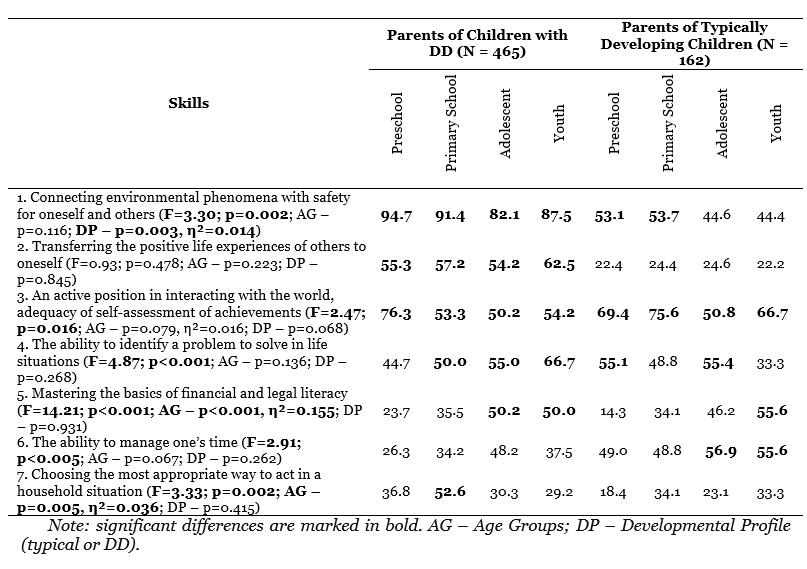
Table 5. Frequency of parental selection of skills within the domain “Developing the ability to understand and differentiate the world, its spatio-temporal organization” (%)
| Skills | Parents of Children with MR (N = 465) | Parents of Typically Developing Children (N = 162) | ||||||
| Preschool | Primary School | Adolescent | Youth | Preschool | Primary School | Adolescent | Youth | |
| 1. Connecting environmental phenomena with safety for oneself and others (F=3.30; p=0.002; AG – p=0.116; DP – p=0.003, η²=0.014) | 94.7 | 91.4 | 82.1 | 87.5 | 53.1 | 53.7 | 44.6 | 44.4 |
| 2. Transferring the positive life experiences of others to oneself (F=0.93; p=0.478; AG – p=0.223; DP – p=0.845) | 55.3 | 57.2 | 54.2 | 62.5 | 22.4 | 24.4 | 24.6 | 22.2 |
| 3. An active position in interacting with the world, adequacy of self-assessment of achievements (F=2.47; p=0.016; AG – p=0.079, η²=0.016; DP – p=0.068) | 76.3 | 53.3 | 50.2 | 54.2 | 69.4 | 75.6 | 50.8 | 66.7 |
| 4. The ability to identify a problem to solve in life situations (F=4.87; p<0.001; AG – p=0.136; DP – p=0.268) | 44.7 | 50.0 | 55.0 | 66.7 | 55.1 | 48.8 | 55.4 | 33.3 |
| 5. Mastering the basics of financial and legal literacy (F=14.21; p<0.001; AG – p<0.001, η²=0.155; DP – p=0.931) | 23.7 | 35.5 | 50.2 | 50.0 | 14.3 | 34.1 | 46.2 | 55.6 |
| 6. The ability to manage one’s time (F=2.91; p<0.005; AG – p=0.067; DP – p=0.262) | 26.3 | 34.2 | 48.2 | 37.5 | 49.0 | 48.8 | 56.9 | 55.6 |
| 7. Choosing the most appropriate way to act in a household situation (F=3.33; p=0.002; AG – p=0.005, η²=0.036; DP – p=0.415) | 36.8 | 52.6 | 30.3 | 29.2 | 18.4 | 34.1 | 23.1 | 33.3 |
Note: significant differences are marked in bold. AG – Age Groups; DP – Developmental Profile (typical or MR).
Statistically significant differences in age dynamics were found for three skills in this domain. The skill “Connecting environmental phenomena with safety for oneself and others” (DP – p=0.003, η²=0.014) showed a small effect for developmental profile: in the MR parent group, its importance did not change from preschool to young adulthood (94.7% → 87.5%), suggesting the child did not become more independent regarding safe behavior; in the typical development parent group, a decreasing trend was observed (53.1% → 44.4%). Mastering the basics of financial and legal literacy (F=14.21; p<0.001; AG – p<0.001, η²=0.155; DP – p=0.931) shows a positive age dynamic: from 23.7% to 55.6%. Here, the increasing independence of adolescents and young adults likely makes this skill more important with age; simultaneously, it indicates a lack of development of this skill in family upbringing.
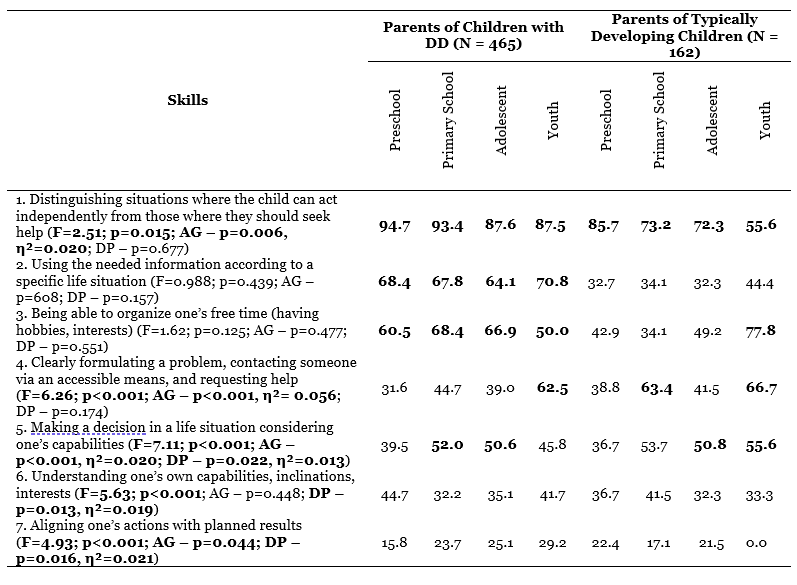
Table 6. Frequency of parental selection of skills within the domain “Developing adequate perceptions of one’s own capabilities and essential life needs” (%)
| Skills | Parents of Children with MR (N = 465) | Parents of Typically Developing Children (N = 162) | ||||||
| Preschool | Primary School | Adolescent | Youth | Preschool | Primary School | Adolescent | Youth | |
| 1. Distinguishing situations where the child can act independently from those where they should seek help (F=2.51; p=0.015; AG – p=0.006, η²=0.020; DP – p=0.677) | 94.7 | 93.4 | 87.6 | 87.5 | 85.7 | 73.2 | 72.3 | 55.6 |
| 2. Using the needed information according to a specific life situation (F=0.988; p=0.439; AG – p=608; DP – p=0.157) | 68.4 | 67.8 | 64.1 | 70.8 | 32.7 | 34.1 | 32.3 | 44.4 |
| 3. Being able to organize one’s free time (having hobbies, interests) (F=1.62; p=0.125; AG – p=0.477; DP – p=0.551) | 60.5 | 68.4 | 66.9 | 50.0 | 42.9 | 34.1 | 49.2 | 77.8 |
| 4. Clearly formulating a problem, contacting someone via an accessible means, and requesting help (F=6.26; p<0.001; AG – p<0.001, η²= 0.056; DP – p=0.174) | 31.6 | 44.7 | 39.0 | 62.5 | 38.8 | 63.4 | 41.5 | 66.7 |
| 5. Making a decision in a life situation considering one’s capabilities (F=7.11; p<0.001; AG – p<0.001, η²=0.020; DP – p=0.022, η²=0.013) | 39.5 | 52.0 | 50.6 | 45.8 | 36.7 | 53.7 | 50.8 | 55.6 |
| 6. Understanding one’s own capabilities, inclinations, interests (F=5.63; p<0.001; AG – p=0.448; DP – p=0.013, η²=0.019) | 44.7 | 32.2 | 35.1 | 41.7 | 36.7 | 41.5 | 32.3 | 33.3 |
| 7. Aligning one’s actions with planned results (F=4.93; p<0.001; AG – p=0.044; DP – p=0.016, η²=0.021) | 15.8 | 23.7 | 25.1 | 29.2 | 22.4 | 17.1 | 21.5 | 0.0 |
Note: significant differences are marked in bold. AG – Age Groups; DP – Developmental Profile (typical or MR).
In the final domain, the most significant skills for parents of children with MR were “Distinguishing situations where the child can act independently…”, “Using the needed information…”, and “Being able to organize one’s free time…”. For parents of typically developing children, the skill of distinguishing independent action situations was also prominent, along with “Clearly formulating a problem…” and “Making a decision in a life situation considering one’s capabilities.” Within this domain, the parental demand for child autonomy is particularly evident: parents of children with MR want the child to distinguish when help is needed and to use information, while parents of typically developing children prioritize accurate self-assessment and decision-making based on capabilities. The dynamic for the skill “Being able to organize one’s free time…” in the typical development parent group is notable: its importance increased from 49.2% in adolescence to 77.8% in young adulthood. This may reflect the small sample size in this subgroup, but it could also indicate unrealistic parental expectations regarding their adult child’s active and meaningful use of free time. The importance of the skill “Making a decision in a life situation considering one’s capabilities” remained consistently high for parents, suggesting that children and adolescents do not learn to understand their capabilities with age, continuing to cause parental concern as they gain personal autonomy. Finally, the skill of aligning actions with planned results maintained a consistent level of importance across all age periods and was significantly less important in the typical development parent group. However, there was no decrease in importance by young adulthood, which would indicate the consolidation of this skill.
Discussion
The findings of this study do not support the hypothesis that parents’ perceptions of the importance of life competence skills follow a wave-like dynamic that mirrors age-related mastery. Instead, for most skills, importance either remained consistently high across age groups or increased by young adulthood. This pattern suggests that parents do not view skill acquisition as a process that reaches completion; rather, their expectations appear to escalate with the child’s age, reflecting a sustained—and often growing—dissatisfaction with the child’s level of autonomy.
One of the most striking findings is the absence of statistically significant differences between parents of children with typical development and parents of children with MR. Across all five domains, the two groups exhibited remarkably similar patterns in which skills they prioritized and how those priorities shifted with the child’s age. This convergence indicates that parents of children with MR largely do not adjust their expectations to account for the specific characteristics of their child’s developmental trajectory. Several interpretations are plausible. First, parents may lack sufficient awareness of how MR affects the acquisition of life skills and the extended timelines often required for mastery. Second, the development of life competence may be so deeply embedded in daily routines that it remains largely unconscious for parents—a background process that they do not explicitly connect to their child’s diagnosis. Regardless of the underlying mechanism, this finding points to a critical gap in family support: without accurate understanding of their child’s developmental profile, parents may hold expectations that are either prematurely high or mismatched with the child’s actual capacities, potentially leading to frustration for both parties.
The persistent prioritization of safety-related skills across all domains and age groups warrants particular attention. In the MR parent group, the importance of skills such as “connecting environmental phenomena with safety for oneself and others” remained consistently high from preschool through young adulthood. This stability suggests that parents do not perceive their child as developing greater autonomy in managing safety, even as the child ages. Rather, safety concerns appear to sustain a pattern of continued parental vigilance and control. In contrast, among parents of typically developing children, the importance of some safety-related skills showed a slight decline, implying a gradual transfer of responsibility to the child. The enduring emphasis on safety in the MR group may reflect not only genuine risk considerations but also a broader difficulty in relinquishing control, which can constrain opportunities for the child to develop autonomy in other domains.
Several skills exhibited increasing importance in older age groups, most notably practical financial literacy, time management, and the ability to formulate a problem and request help. For both parent groups, these skills were rated as significantly more important for adolescents and young adults than for younger children. This pattern contradicts the wave-like hypothesis, which would predict heightened importance during a sensitive period followed by a decline after mastery. Instead, the data suggest that these skills are not systematically developed during earlier stages; parents’ growing concern in later years likely reflects the belated recognition that their children lack competencies now considered essential for near-adult independence. In other words, the increasing importance assigned to these skills may be a reactive response to perceived deficits rather than a proactive alignment with developmental readiness.
The fact that the importance of many skills remained stable or increased over time also points to the largely unplanned nature of life competence development in family settings. In the absence of explicit pedagogical guidance, parents may not consciously structure opportunities for skill acquisition during sensitive periods. As a result, they may find themselves confronting the consequences of underdeveloped skills precisely when the stakes are highest—as their children approach young adulthood and face demands for independent living. This interpretation is consistent with the observed lack of age-related decline in skill importance: if skills are not consolidated in earlier stages, there is no point at which parents feel they can “stop worrying.”
Taken together, these findings underscore the need for targeted psychological and pedagogical support for families. Such support should aim to help parents develop realistic, age-appropriate expectations that take into account the specific developmental characteristics of their child. It should also equip parents with concrete strategies for intentionally fostering life competence within everyday family routines, transforming what is often an implicit process into an explicit, collaborative effort. For parents of children with MR, this includes understanding the extended timelines and alternative pathways through which these skills may develop. For all parents, it involves recognizing that autonomy does not emerge spontaneously but must be systematically cultivated.
This study represents an initial step in mapping the age-related dynamics of life competence development in children with typical and delayed development. As manifestations of practical thinking (Vygotsky, 1984), life competence skills are profoundly shaped by individual and social conditions. Future research should examine how the development of these skills interacts with leading activities across developmental stages and how parental support strategies can be tailored to optimize outcomes. A critical next step is the development and validation of a structured system for psychological and pedagogical support that can be implemented in both family and school contexts, enabling genuine collaboration around shared goals for children’s autonomy.
Conclusions
he hypothesis of a wave-like dynamic in the perceived importance of life competence skills was not supported. Instead, for most skills, importance either remained consistently high or increased by young adulthood. This reflects not so much the logic of age-related autonomy development but rather growing parental dissatisfaction with the level of skill development and anxiety associated with the child’s increasing autonomy, their entry into broader social communities, and more complex social interaction situations.
Parents of children with MR do not fully account for the specific characteristics of their child’s development—their expectations are often inconsistent with the individual characteristics of the child’s developmental trajectory. This result may indicate insufficient parental awareness of the features of atypical development and a deficit in targeted psychological and pedagogical support aimed at fostering realistic perceptions of the zone of proximal development for a child with MR.
The results show that parents of both typically developing children and those with MR need specially organized psychological and pedagogical support for the conscious development of life competence in their children within family upbringing. Key directions for such support include: forming realistic age-related expectations, informing parents about the logic of skill development within each life competence domain, and teaching methods for effective mediation in interactions with children and adolescents.
Limitations. Potential limitations of this study include the uneven sample distribution: parents of young adults are least represented, and the majority of respondents were mothers. The survey involved a self-selection of skills, and insufficient awareness of skill content may have led to inaccurate selections by parents.
CRediT Author Statement: Anna M. Fedoseeva: Conceptualization, Methodology, Investigation, Formal analysis, Writing – original draft, Writing – review & editing, Project administration, Funding acquisition.
Author Responsibility: The author confirms sole responsibility for the conception, design, data collection, analysis, interpretation of results, and drafting of this manuscript. The author has read and approved the final version of the manuscript and agrees to be accountable for all aspects of the work.
Conflict of Interest: The author declares no conflict of interest.
Ethics Declaration: The study was reviewed and approved by the Ethics Committee of the Institute of Special Education (Federal State Budgetary Scientific Institution “Institute of Special Education”) (Protocol No. 2 of February 10, 2023).
References
- Akulina, A. V. (2024). Comparison of the significance of life competence skills in preschoolers with mental retardation for parents and teachers. Special Education, (2), 147–160.
- Antonova, P. A., Eftimitse, M., Ivanova, E. V., Progatskaya, T. K., & Kalabina, I. A. (2021). The goals of family education: The perspective of modern parents. Comprehensive Child Studies, 3(2), 91–100. https://doi.org/10.33910/2687-0223-2021-3-2-91-100
- Asonova, E. A. (2024). How readers of children’s and adolescent literature interpret autonomy. MCU Journal of Pedagogy and Psychology, 18(4), 10–21. https://doi.org/10.24412/2076-9121-2024-4-10-21
- Babkina, N. V. (2017). Life competencies as an integral component of the educational content for children with mental retardation. Clinical Psychology and Special Education, 6(1), 138–156. https://doi.org/10.17759/cpse.2017060109
- Babkina, N. V. (2018). A system of psychological support for the education of children with mental retardation. Russian Psychological Journal, 15(3), 52–69. https://doi.org/10.21702/rpj.2018.3.3
- Babkina, N. V., & Fedoseeva, A. M. (2025). Life competence of adolescents with disabilities: Structural content and developmental logic in psychological and pedagogical support. Clinical Psychology and Special Education, 14(2), 5–20. https://doi.org/10.17759/cpse.2025140201
- Belaya Medveditsa. (2019). Children’s autonomy (home alone, sending to camp, letting go for walks) from what age?[Forum post]. Moya-semya.ru Retrieved March 15, 2026, from http://forum.moya-semya.ru/index.php?app=forums&module= forums&controller= topic&id= 101394&page=12
- Chudinova, E. V., Zaitseva, V. E., & Minkin, D. I. (2024). Autonomy and initiative of senior school students in educational modeling. Psychological Science and Education, 29(1), 61–74. https://doi.org/10.17759/pse.2024290105
- Distefano, R., Galinsky, E., McClelland, M. M., Zelazo, P. D., & Carlson, S. M. (2018). Autonomy-supportive parenting and associations with child and parent executive function. Journal of Applied Developmental Psychology, 58, 77–85. https://doi.org/10.1016/j.appdev.2018.04.007
- Elkonin, B. D. (2023). The situation and the key quest of the Mediating Action (MA). Cultural-Historical Psychology, 19(1), 13–19. https://doi.org/10.17759/chp.2023190102
- Fedoseeva, A. M., Babkina, N. V., & Makarova, E. M. (2024). Teacher’s and parent’s representations about the life skills of children and adolescents with disabilities: different views, a common goal. Counseling Psychology and Psychotherapy, 32(4), 120–140. https://doi.org/10.17759/cpp.2024320406
- Fedoseeva, A. M., Babkina, N. V., Makarova, E. M., et al. (2023). Parents’ perceptions of the content of life competence in children with disabilities[Database]. State Registration Certificate No. 2023624478. Institute of Special Education.
- Gladkova, Yu. A., & Solomennikova, O. A. (2025). On factors for developing autonomy and responsibility in preschool children in family and preschool group settings. Innovative Projects and Programs in Education, (4), 32–36.
- Kalinovskaya, K. S., Fedorenko, E. Yu., Ostroverkh, O. S., & Alexandrova, O. V. (2024). Parental actions in the context of perceptions of child autonomy. MCU Journal of Pedagogy and Psychology, 18(3), 139–162.
- Karabanova, O. A., & Malofeev, N. N. (2019). Education development strategy for children with disabilities: on the way to implementing a cultural-historical approach. Cultural-Historical Psychology, 15(4), 89–99. https://doi.org/10.17759/chp.2019150409
- Lehrer, J., Bigras, N., & Laurin, I. (2017). Preparing children and families for the transition to school: The role of early childhood educators. International Journal of Transitions in Childhood, 10, 3–23.
- Maidansky, A. D. (2023). Thinking and labor (reading Vygotsky). Cultural-Historical Psychology, 19(3), 4–12. https://doi.org/10.17759/chp.2023190301
- Makarova, E. M. (2024). Analysis of parents’ perceptions of present and future life competence skills in children with mental retardation. In Life trajectories of the individual in the modern world: Social and individual context: Proceedings of the II International Scientific-Practical Conference(pp. 289–293). Kostroma State University.
- Malofeev, N. N. (2019). The concept of education development for children with disabilities: Main provisions. Almanac of the Institute of Special Education, 36. Retrieved March 15, 2026, from https://alldef.ru/ru/articles/almanac-36/the-concept-of-development-of-education-of-children-with-disabilities
- Ministry of Education and Science of the Russian Federation. (2014). Federal State Educational Standard for Primary General Education of Students with Disabilities(Order No. 1598). ConsultantPlus. Retrieved March 15, 2026, from https://www.consultant.ru/document/cons_doc_LAW_175495/
- Nisskaya, A. K., & Chuvilina, A. S. (2024). Factors supporting child autonomy during the transition to schooling: A theoretical review. Educational Studies, (4), 184–213. https://doi.org/10.17323/vo-2024-18254
- Nisskaya, A. K., & Tsyganova, E. M. (2024). Support and limitation of children’s autonomy in the practices of modern Russian parents. In Research transformation of teacher education: Traditions as a basis for innovation: Proceedings of the X International Forum on Teacher Education(pp. 436–439). Kazan Federal University.
- Polivanova, K. N., & Bochaver, A. A. (2022). Preface to the special issue “Development of Child Autonomy.” Psychological Science and Education, 27(3), 4–5.
- Vygotsky, L. S. (1984). Collected works: In 6 vols. Vol. 4. Child psychology. D. B. Elkonin (Ed.). Pedagogy.
- Zaretsky, V. K., & Ageeva, A. A. (2021). Problem of the effectiveness of parental assistance to children in situations of educational difficulties from the perspectives of the reflection-activity approach and cognitive-behavioral therapy. Counseling Psychology and Psychotherapy, 29(3), 159–179. https://doi.org/10.17759/cpp.2021290310
Comments (0)
Background and Relevance. The formation of life competence within the family is a key condition for the development of a child’s autonomy. However, the age-related dynamics of acquiring life competence skills and the pedagogical conditions for their development in family upbringing remain insufficiently studied. This issue is particularly significant for parents of children with mental retardation (MR), as it directly impacts their child’s autonomy and successful socialization. Objective. To identify the specific dynamics of parents’ perceptions of essential life competence skills in children of different ages with typical and delayed development, as a factor in fostering child autonomy in family upbringing. Hypothesis. The perceived importance of life competence skills among parents follows a wave-like pattern—it increases during the period of active skill acquisition and decreases after the skill is consolidated, reflecting the logic of age-related autonomy development. Methods and Materials. An online survey was conducted with parents of typically developing children (n = 161) and parents of children with MR (n = 465) from 34 regions of Russia. In each group, subgroups were formed based on the child’s age: preschool, primary school, adolescent, and young adult. The study utilized an author-developed questionnaire listing skills across five domains of life competence. Statistical processing included frequency analysis and one-way ANOVA. Results. The results did not support the hypothesis of a wave-like dynamic. Instead, the importance of most skills either remained consistently high or increased by young adulthood, reflecting growing parental dissatisfaction with the child’s level of autonomy relative to their expectations. No statistically significant differences were found between parents of children with MR and those of typically developing children. Conclusions. Parents in both groups, regardless of their child’s developmental profile, do not differentiate age-specific tasks for developing life skills and do not account for the specific needs associated with MR. This underscores the need for targeted psychological and pedagogical support for families, aimed at fostering realistic expectations and providing pedagogical guidance to create conditions for the conscious development of life competence as the foundation of a child’s autonomy.
Резюме. Контекст и актуальность. Формирование жизненной компетенции в семье выступает ключевым условием становления самостоятельности ребенка. Вместе с тем возрастная динамика овладения навыками жизненной компетенции и педагогические условия их развития в семейном воспитании остаются недостаточно изученными. Особую значимость эта проблема приобретает для родителей детей с задержкой психического развития (ЗПР), поскольку напрямую влияет на самостоятельность и успешную социализацию их ребенка. Цель. Выявить особенности динамики представлений родителей о значимых навыках из сферы жизненной компетенции у детей разного возраста с нормативным и задержанным развитием как фактора становления самостоятельности ребенка в семейном воспитании. Гипотеза. Значимость навыков из областей жизненной компетенции в представлениях родителей имеет волнообразный характер — она повышается в период активного формирования навыка и снижается после его закрепления, отражая логику возрастного становления самостоятельности. Методы и материалы. Проведен онлайн-опрос родителей детей с нормативным развитием (n = 161) и родителей детей с ЗПР (n = 465) из 34 регионов России. В каждой группе выделены подгруппы родителей детей дошкольного, младшего школьного, подросткового и юношеского возраста. Использовался авторский опросник, включающий перечень навыков в пяти областях жизненной компетенции. Статистическая обработка включала частотный анализ и однофакторный дисперсионный анализ ANOVA. Результаты. Гипотеза о волнообразной динамике не подтвердилась. Напротив, значимость большинства навыков либо оставалась стабильно высокой, либо возрастала к юношескому возрасту, что отражает нарастающую родительскую неудовлетворенность уровнем самостоятельности ребенка по сравнению с их ожиданиями. Статистически значимых различий между родителями детей с ЗПР и родителей нормотипичных детей не выявлено. Заключение. Родители обеих групп независимо от варианта развития ребенка не дифференцируют возрастные задачи формирования жизненных навыков и не учитывают специфику ЗПР. Это указывает на необходимость адресного психолого-педагогического сопровождения семей, направленного на формирование реалистичных ожиданий и педагогическую поддержку создания условий осознанного развития жизненной компетенции как основы самостоятельности ребенка.
Ключевые слова: сфера жизненной компетенции, семейное воспитание, дети с задержкой психического развития, представления, самостоятельность.
One of the primary objectives of family upbringing is to prepare children for successful adaptation in society and an independent, productive life. In contemporary pedagogical discourse, autonomy is regarded not merely as a desirable personality trait but as a critical indicator of educational quality. The development of autonomy in children and adolescents is actively discussed both in academic research (Polivanova & Bochaver, 2022; Antonova, 2021; Nisskaya & Tsyganova, 2024) and within parent communities—on forums, in online chats, and at school meetings (Belaya Medveditsa…, 2019). This sustained public interest underscores a strong demand for effective strategies to cultivate autonomy.
Traditionally, the development of autonomy has been examined within the framework of academic learning in pedagogical psychology. Within this perspective, parental roles were largely confined to monitoring homework completion and ensuring compliance with school rules. However, this approach overlooks other essential dimensions of family life: safety in social and natural environments, the internalization of cultural norms across diverse social roles, daily living skills, and financial and legal literacy. These domains, which are central to a child’s ability to navigate everyday life, have remained largely outside the scope of family–school collaboration.
This tension has been especially pronounced in the education of children with disabilities, including those with mental retardation (MR). In response, researchers at the Institute of Special Education introduced the concept of “life competence” (Malofeev, 2019; Babkina, 2017), which was subsequently incorporated into Russian educational standards as a key personal educational outcome. The identified domains of life competence and their content (Babkina & Fedoseeva, 2025; Akulina, 2024) provide a framework for systematically fostering autonomy by embedding skill development in progressively complex social and material contexts.
For parents of children with MR, the challenge of preparing their child for independent living and fostering life competence is particularly acute. The specific characteristics of mental development in these children qualitatively shape their socialization trajectories. The importance of life competence is formally recognized in educational standards, where it is listed as a priority among personal educational outcomes (Ministry of Education…, 2014). Developing autonomy in children with MR is inherently dependent on cultivating skills within the life competence domain.
Despite the acknowledged importance of life competence in education, the pedagogical conditions that support its development within the family remain critically underexplored. Open questions persist regarding the age-related dynamics of skill acquisition in family and school settings, the psychological and pedagogical factors that facilitate this process, and the methodological resources needed to support parents and educators effectively.
Contemporary approaches to psychological and pedagogical support for children with MR emphasize that the subject of support is not the individual child but rather a collective unit comprising the child, the family, and the educator (e.g., the homeroom teacher) (Babkina, 2018). Effective teamwork in this context depends on aligned goals and coordinated actions. Accordingly, the first step toward building a coherent system for fostering life competence is to understand parents’ perceptions of its content and how these perceptions evolve as children mature—from preschool through young adulthood. Without such understanding, productive family–school collaboration aimed at developing autonomy remains difficult to achieve.
Life competence, initially conceptualized as a personal educational outcome for students with disabilities in Russia by Malofeev and Kukushkina in the 1990s, builds on the competency-based approach developed in international educational psychology. In their framework, life competence is defined as the ability to appropriately and independently address everyday life tasks within current life situations to the greatest extent possible (N.V. Babkina, E.L. Goncharova, E.A. Ekzhanova, O.I. Kukushkina, N.N. Malofeev, O.S. Nikolskaya) (Malofeev, 2016). Contemporary Russian research increasingly examines life competence through the lens of the cultural-historical approach.
A distinctive feature of the framework developed at the Institute of Special Education is its grounding in practical thinking (Vygotsky, 1984; Maidansky, 2023; Babkina & Fedoseeva, 2024). Life competence is understood as a broad set of abilities to solve everyday problems, rooted in the development of practical intelligence. By attending not only to the “higher” forms of practical action but also to their intermediate and transitional forms, researchers have revealed the richness and diversity of practical skills (Fedoseeva et al., 2024). This practical intellect plays a crucial role in socialization and psychological well-being. Yet, despite its foundational importance, practical thinking often remains underdeveloped in young people—including those with high academic abilities—leading to difficulties in adulthood and impeding the realization of life plans.
The varied life experiences that children and adolescents acquire through interactions in educational settings serve as an empirical basis for appropriating modes of action and forming perceptions of social reality. In special education and psychology, five domains of life competence are traditionally distinguished (Babkina, 2017; Karabanova & Malofeev, 2019): mastering social and daily living skills; developing adequate perceptions of one’s own capabilities and limitations; mastering communication skills; differentiating and understanding the world and its spatiotemporal organization; and understanding one’s social environment while adopting age-appropriate values and social roles.
The development of life competence is relevant not only for children with MR but also for typically developing children. The traditional emphasis on academic achievement often leaves students with insufficient skills in navigating social norms, managing time, and regulating emotional states—despite high academic performance. The strong demand from parents and educators for fostering schoolchildren’s autonomy[1] (Chudinova, 2024; Polivanova & Bochaver, 2024; Antonova, 2021; Asonova, 2024) is thus not adequately met by current personal educational outcomes alone.
Most situations requiring life competence arise in everyday life, where the educational environment (school, kindergarten) offers limited opportunities for fully developing these skills. At the same time, the task of fostering life competence is highly accessible to parents, as it is embedded in daily family life. Household routines, time management, homework completion, and independent navigation of social and natural spaces are precisely the domains that populate parental concerns and instructive conversations from preschool to young adulthood. Consequently, family–school collaboration on life competence has the potential to increase parental motivation and engagement. In this context, parents become full participants in the pedagogical team, working toward shared educational goals. Whereas parents may perceive teacher requests to support academic learning as an unwelcome delegation of responsibility, they are more likely to embrace involvement in fostering life competence, which they recognize as intrinsically connected to family life.
Research on the development of autonomy in relation to parenting styles and parental involvement has primarily focused on preschool age (Kalinovskaya, 2024), as well as on primary school and early adolescence (Nisskaya & Chuvilina, 2024). Greater parental support for self-organization is associated with more developed executive functions—working memory, inhibitory control, and cognitive flexibility—in children (Distefano et al., 2018; Lehrer et al., 2017). Developing autonomy in life competence requires understanding the logic of skill acquisition, age-related complexity, individual appropriation styles, and the parent’s capacity for effective mediation (Elkonin, 2023; Zaretsky & Ageeva, 2021).
In 2023–2024, our research team conducted a comparative study of how teachers and parents of children with disabilities perceive the importance of skills across life competence domains (Fedoseeva, 2024; Makarova, 2024; Babkina, 2017, 2018). Despite the clear relevance of this topic, no studies to date have examined the dynamics of parental perceptions regarding life competence skills in children of different ages with typical and delayed development. This gap defines the relevance of the present study.
Objective is to identify the specific dynamics of parents’ perceptions of essential life competence skills in children of different ages with typical and delayed development, as a factor in fostering child autonomy in family upbringing.
*Hypothesis: the perceived importance of life competence skills among parents follows a wave-like pattern: it increases during periods of active skill acquisition and declines after the skill is consolidated, thereby reflecting the logic of age-related autonomy development.
Materials and Methods
To identify parents’ perceptions of the importance of life competence skills, an online survey was conducted with parents of typically developing children (n = 161) and parents of children with MR (n = 465) from 34 regions of the Russian Federation. The parent sample was divided into groups based on the child’s age (see Table 1). Parents of boys accounted for 74.8% of the sample, and parents of girls for 25.2%. The questionnaire was primarily answered by mothers (93.8%), of whom 22.7% were aged 36–45 years, 47.6% were aged 29–35 years, and 21.9% were aged 46–55 years.
Table 1. Distribution of the parent sample by child age and developmental profile
| Developmental Profile | Child Age | |||
| Preschool | Primary School | Adolescent | Youth | |
| Typical Development (n=161) | 51 people / 31.7% | 39 people / 24.2% | 62 people / 38.5% | 6 people / 3.7% |
| MR (n=465) | 35 people / 7.6% | 153 people / 32.9% | 254 people / 54.6% | 26 people / 5.6% |
A questionnaire for parents (Fedoseeva, Babkina et al., 2023) was developed to assess perceptions of the life competence domain. It comprised two parts: the first part assessed general perceptions of what the child can already do and what they should learn at the next age stage; the second part presented a list of skills within each of the five life competence domains, asking parents to select the three most significant skills for their child in each domain.
For statistical processing, frequency analysis and one-way ANOVA with Bonferroni and Tukey corrections were used.
The results are structured by life competence domain and presented in Tables 2–6. Frequency analysis results for the significance of skills in each domain are presented as percentages according to the child’s age group and developmental profile. Differences between groups and developmental profiles (typical vs. MR) were determined using ANOVA, where the dependent variable was the skill, and the developmental profile and age group were independent variables. The tables show the overall model significance and the significance of the relationship for the developmental profile (DP) and age (Ag) parameters. For readability, skills in the tables are organized by their perceived importance for parents.
For parents of children with MR and typically developing children, the most important skills were self-care, household skills, and behaviors for personal safety. Interestingly, the dynamics of these skills across age groups differed from expectations: while the importance of self-care skills decreased by young adulthood in the MR parent group (92.1% → 45.8%), it remained at approximately the same level in the typical development parent group (87.8% → 77.8%). No statistically significant differences in the frequency of selecting this skill were found between parent groups.
Table 2. Frequency of parental selection of skills within the domain “Mastering social and everyday skills used in daily life” (%)
| Skills | Parents of Children with MR (N = 465) | Parents of Typically Developing Children (N = 162) | ||||||
| Preschool | Primary School | Adolescent | Youth | Preschool | Primary School | Adolescent | Youth | |
| 1. Self-care skills (F=1.47; p=0.175) | 92.1 | 82.9 | 69.7 | 45.8 | 87.8 | 78.0 | 78.5 | 77.8 |
| 2. Household skills (F=2.53; p=0.014; AG – p=0.009, η²=0.004; DP – p=0.676) | 76.3 | 78.9 | 78.1 | 83.3 | 36.7 | 51.2 | 58.5 | 66.7 |
| 3. Skills for personal safety behavior (F=5.65; p<0.001; AG – p=0.021, η²=0.020; DP – p=0.015, η²=0.012) | 76.3 | 67.8 | 65.3 | 58.3 | 61.2 | 65.9 | 49.2 | 66.7 |
| 4. Independently doing homework (F=1.112; p=0.353) | 44.7 | 52.6 | 51.4 | 45.8 | 38.8 | 46.3 | 32.3 | 44.4 |
| 5. Independently getting ready for school (F=0.38; p=0.557) | 34.2 | 42.8 | 40.2 | 45.8 | 20.4 | 29.3 | 30.8 | 22.2 |
| 6. Establishing cause-and-effect relationships when analyzing life setbacks (F=2.91; p<0.005; AG – p=0.067; DP – p=0.262) | 34.2 | 41.4 | 53.4 | 58.3 | 22.4 | 29.3 | 26.2 | 22.2 |
| 7. Practical financial skills (F=20.16; p=0.001; AG – p<0.001, η²=0.177; DP – p=0.317) | 21.1 | 31.6 | 61.4 | 50.0 | 8.2 | 41.5 | 43.1 | 55.6 |
| 8. Independently moving around outside the home (F=7.35; p<0.001; AG – p<0.001, η²=0.066; DP – p=0.98) | 18.4 | 29.6 | 34.3 | 29.2 | 26.5 | 31.7 | 38.5 | 44.4 |
| 9. Taking initiative in household matters and being responsible for the consequences (F=7.41; p<0.001; AG – p=0.021, η²=0.020; DP – p=0.225) | 26.3 | 23.7 | 41.4 | 29.2 | 34.7 | 31.7 | 30.8 | 33.3 |
| 10. Choosing the most appropriate way to act in a household situation (F=6.37; p<0.001; AG – p=0.012, η²=0.039; DP – p=0.605) | 21.1 | 23.0 | 25.9 | 20.8 | 18.4 | 26.8 | 20.0 | 22.2 |
| 11. Using visual supports in the form of symbols and diagrams (F=6.60; p<0.001; AG – p<0.001, η²=0.076; DP – p=0.212) | 5.3 | 8.6 | 13.1 | 4.2 | 0.0 | 24.4 | 4.6 | 22.2 |
Note: significant differences are marked in bold. AG – Age Groups; DP – Developmental Profile (typical or MR).
Household skills remained at a consistent level in the MR parent group (76.3% → 83.3%) but showed an increasing trend in the typical development parent group (36.7% → 66.7%). This suggests that parents of children with MR may be consistently dissatisfied with their children’s level of these skills, and this situation does not change as the child grows. For parents of typically developing children, household skills become increasingly important, as they expect the child to become more independent and take on household responsibilities. However, this expectation might conflict with the child’s developing autonomy and the dynamics of parent–child relationships. The slight variation in the significance of personal safety skills for parents likely reflects the increased importance of other skills within this domain, with no differences based on developmental profile and only minimal age-related differences (η²=0.020). For parents of children with MR, safety is more significant due to the children’s specific cognitive and regulatory challenges.
Overall, for this life competence domain, no differences were found between parent groups based on the child’s developmental profile; differences were only found for the age variable. The importance of practical financial skills and independent mobility outside the home increased sharply by young adulthood, regardless of the child’s developmental profile. Choosing the most appropriate way to act in a household situation was most important for parents of adolescents with MR (25.9%) and parents of typically developing primary school children (26.8%). These results clearly demonstrate a similar approach by parents to fostering household autonomy in children with different developmental profiles and the dynamics of their maturation. Using visual supports (symbols and diagrams), which require abstract thinking skills, was significant for parents of typically developing high school students (22.2%) but was not significant in the MR parent group.
Table 3. Frequency of parental selection of skills within the domain “Mastering communication skills and accepted rituals of social interaction” (%)
| Skills | Parents of Children with MR (N = 465) | Parents of Typically Developing Children (N = 162) | ||||||
| Preschool | Primary School | Adolescent | Youth | Preschool | Primary School | Adolescent | Youth | |
| 1. Expressing one’s point of view on events and actions, arguing for it (F=0.60; p<0.001; AG – p<0.001, η²=0.076; DP – p=0.212) | 78.9 | 73.0 | 72.9 | 79.2 | 65.3 | 58.5 | 53.8 | 66.7 |
| 2. Predicting possible conflict situations, mitigating them (F=1.21; p=0.292; AG – p<0.203; DP – p=0.799) | 47.4 | 55.3 | 59.8 | 62.5 | 34.7 | 29.3 | 36.9 | 22.2 |
| 3. Showing flexibility in communication (F=0.223; p=0.98) | 60.5 | 50.0 | 51.4 | 50.0 | 24.5 | 24.4 | 26.2 | 44.4 |
| 4. Having skills for positive cooperation with adults and peers (F=3.65; p<0.001; AG – p=0.299, η²=0.010; DP – p=0.653) | 42.1 | 42.8 | 50.6 | 41.7 | 59.2 | 46.3 | 50.8 | 55.6 |
| 5. Mastering cultural forms of expressing feelings, thoughts, and needs (F=9.07; p<0.001; AG – p=0.013, η²=0.027; DP – p=0.184) | 47.4 | 52.6 | 45.8 | 45.8 | 49.0 | 65.9 | 46.2 | 44.4 |
| 6. Listening to the interlocutor and participating in dialogue (F=1.86; p=0.069; AG – p=0.530; DP – p=0.079) | 52.6 | 48.0 | 43.0 | 25.0 | 59.2 | 31.7 | 41.5 | 55.6 |
| 7. Formulating thoughts in oral and/or written speech (F=8.05; p<0.001; AG – p=0.021, η²=0.026; DP – p=0.030, η²=0.033) | 36.8 | 46.7 | 37.8 | 45.8 | 36.7 | 48.8 | 35.4 | 44.4 |
| 8. Being able to critically evaluate received information (F=8.37; p<0.001; AG – p<0.001, η²=0.021; DP – p=0.008) | 23.7 | 30.3 | 35.9 | 25.0 | 20.4 | 36.6 | 27.7 | 33.3 |
For the domain “Developing the ability to understand one’s social environment, one’s place in it, and adopt age-appropriate values and social roles” (Table 4), the most significant skills for parents of children with MR were “Expressing one’s point of view…”, “Predicting possible conflict situations…”, and “Showing flexibility in communication.” For parents of typically developing children, the most significant were “Expressing one’s point of view…”, “Having skills for positive cooperation…”, and “Listening to the interlocutor…”. Thus, conflict avoidance skills are more relevant for parents of children with MR, while more complex cooperation and dialogue skills are prioritized by parents of typically developing children. Importantly, these skills did not lose significance as children grew older. The skills “Formulating thoughts in oral and/or written speech” and “Being able to critically evaluate received information” showed statistically significant differences across ages according to ANOVA, but percentage data suggest they are somewhat higher in primary school and young adulthood, and slightly lower in preschool and adolescence.
Table 4. Frequency of parental selection of skills within the domain “Developing the ability to understand one’s social environment, one’s place in it, and adopt age-appropriate values and social roles” (%)
| Skills | Parents of Children with MR (N = 465) | Parents of Typically Developing Children (N = 162) | ||||||
| Preschool | Primary School | Adolescent | Youth | Preschool | Primary School | Adolescent | Youth | |
| 1. The ability to formulate, argue, and defend one’s opinion (F=0.82; p=0.568) | 81.6 | 86.2 | 80.1 | 79.2 | 67.3 | 48.8 | 67.7 | 44.4 |
| 2. The ability to regulate one’s behavior and emotional reactions (F=5.15; p<0.001; AG – p<0.001, η²=0.032; DP – p=0.355) | 84.2 | 79.6 | 68.9 | 70.8 | 67.3 | 85.4 | 73.8 | 100.0 |
| 3. Mastering necessary social rituals (greeting, farewell, etc.) (F=1.66; p=0.115; AG – p=0.105, η²=0.010; DP – p=0.221) | 57.9 | 57.2 | 44.2 | 41.7 | 36.7 | 32.6 | 25.9 | 22.2 |
| 4. The ability to cooperate and participate in joint activities (F=7.36; p<0.001; AG – p<0.005, η²=0.031; DP – p=0.056) | 47.4 | 53.3 | 52.6 | 33.3 | 46.9 | 61.0 | 49.2 | 33.3 |
| 5. The ability to recognize and resist psychological manipulation (F=20.16; p<0.001; AG – p<0.001, η²=0.117; DP – p=0.317) | 13.5 | 33.6 | 60.5 | 50.9 | 14.6 | 35.0 | 46.2 | 50.0 |
| 6. The ability to maintain an appropriate social distance (F=6.53; p<0.001; AG – p<0.001, η²=0.069; DP – p=0.046) | 70.0 | 32.6 | 33.9 | 0.0 | 26.5 | 26.8 | 40.0 | 77.8 |
Note: significant differences are marked in bold. AG – Age Groups; DP – Developmental Profile (typical or MR).
As in other domains, no statistically significant differences were found between groups based on developmental profile. Age showed differences in the importance of the skills “The ability to cooperate and participate in joint activities,” “The ability to recognize and resist psychological manipulation,” and “The ability to maintain an appropriate social distance.” The importance of cooperation skills decreased with the child’s age, while the importance of resisting manipulation increased, likely due to the expanding social circle of the growing child and the consequent difficulty in controlling these contacts and the child’s behavior. The dynamics for the skill “The ability to maintain an appropriate social distance” are interesting: in the MR parent group, its importance decreased and became insignificant by young adulthood (70.0% → 0.0%); in the typical development parent group, the reverse trend was observed (26.5% → 77.8%). For parents of typically developing children, recognizing social roles and appropriate distance is not a major issue in preschool and primary school, unlike for parents of children with MR. It appears that the ability to independently determine appropriate distance in communication does not develop spontaneously by young adulthood in children with MR.
Table 5. Frequency of parental selection of skills within the domain “Developing the ability to understand and differentiate the world, its spatio-temporal organization” (%)
| Skills | Parents of Children with MR (N = 465) | Parents of Typically Developing Children (N = 162) | ||||||
| Preschool | Primary School | Adolescent | Youth | Preschool | Primary School | Adolescent | Youth | |
| 1. Connecting environmental phenomena with safety for oneself and others (F=3.30; p=0.002; AG – p=0.116; DP – p=0.003, η²=0.014) | 94.7 | 91.4 | 82.1 | 87.5 | 53.1 | 53.7 | 44.6 | 44.4 |
| 2. Transferring the positive life experiences of others to oneself (F=0.93; p=0.478; AG – p=0.223; DP – p=0.845) | 55.3 | 57.2 | 54.2 | 62.5 | 22.4 | 24.4 | 24.6 | 22.2 |
| 3. An active position in interacting with the world, adequacy of self-assessment of achievements (F=2.47; p=0.016; AG – p=0.079, η²=0.016; DP – p=0.068) | 76.3 | 53.3 | 50.2 | 54.2 | 69.4 | 75.6 | 50.8 | 66.7 |
| 4. The ability to identify a problem to solve in life situations (F=4.87; p<0.001; AG – p=0.136; DP – p=0.268) | 44.7 | 50.0 | 55.0 | 66.7 | 55.1 | 48.8 | 55.4 | 33.3 |
| 5. Mastering the basics of financial and legal literacy (F=14.21; p<0.001; AG – p<0.001, η²=0.155; DP – p=0.931) | 23.7 | 35.5 | 50.2 | 50.0 | 14.3 | 34.1 | 46.2 | 55.6 |
| 6. The ability to manage one’s time (F=2.91; p<0.005; AG – p=0.067; DP – p=0.262) | 26.3 | 34.2 | 48.2 | 37.5 | 49.0 | 48.8 | 56.9 | 55.6 |
| 7. Choosing the most appropriate way to act in a household situation (F=3.33; p=0.002; AG – p=0.005, η²=0.036; DP – p=0.415) | 36.8 | 52.6 | 30.3 | 29.2 | 18.4 | 34.1 | 23.1 | 33.3 |
Note: significant differences are marked in bold. AG – Age Groups; DP – Developmental Profile (typical or MR).
Statistically significant differences in age dynamics were found for three skills in this domain. The skill “Connecting environmental phenomena with safety for oneself and others” (DP – p=0.003, η²=0.014) showed a small effect for developmental profile: in the MR parent group, its importance did not change from preschool to young adulthood (94.7% → 87.5%), suggesting the child did not become more independent regarding safe behavior; in the typical development parent group, a decreasing trend was observed (53.1% → 44.4%). Mastering the basics of financial and legal literacy (F=14.21; p<0.001; AG – p<0.001, η²=0.155; DP – p=0.931) shows a positive age dynamic: from 23.7% to 55.6%. Here, the increasing independence of adolescents and young adults likely makes this skill more important with age; simultaneously, it indicates a lack of development of this skill in family upbringing.
Table 6. Frequency of parental selection of skills within the domain “Developing adequate perceptions of one’s own capabilities and essential life needs” (%)
| Skills | Parents of Children with MR (N = 465) | Parents of Typically Developing Children (N = 162) | ||||||
| Preschool | Primary School | Adolescent | Youth | Preschool | Primary School | Adolescent | Youth | |
| 1. Distinguishing situations where the child can act independently from those where they should seek help (F=2.51; p=0.015; AG – p=0.006, η²=0.020; DP – p=0.677) | 94.7 | 93.4 | 87.6 | 87.5 | 85.7 | 73.2 | 72.3 | 55.6 |
| 2. Using the needed information according to a specific life situation (F=0.988; p=0.439; AG – p=608; DP – p=0.157) | 68.4 | 67.8 | 64.1 | 70.8 | 32.7 | 34.1 | 32.3 | 44.4 |
| 3. Being able to organize one’s free time (having hobbies, interests) (F=1.62; p=0.125; AG – p=0.477; DP – p=0.551) | 60.5 | 68.4 | 66.9 | 50.0 | 42.9 | 34.1 | 49.2 | 77.8 |
| 4. Clearly formulating a problem, contacting someone via an accessible means, and requesting help (F=6.26; p<0.001; AG – p<0.001, η²= 0.056; DP – p=0.174) | 31.6 | 44.7 | 39.0 | 62.5 | 38.8 | 63.4 | 41.5 | 66.7 |
| 5. Making a decision in a life situation considering one’s capabilities (F=7.11; p<0.001; AG – p<0.001, η²=0.020; DP – p=0.022, η²=0.013) | 39.5 | 52.0 | 50.6 | 45.8 | 36.7 | 53.7 | 50.8 | 55.6 |
| 6. Understanding one’s own capabilities, inclinations, interests (F=5.63; p<0.001; AG – p=0.448; DP – p=0.013, η²=0.019) | 44.7 | 32.2 | 35.1 | 41.7 | 36.7 | 41.5 | 32.3 | 33.3 |
| 7. Aligning one’s actions with planned results (F=4.93; p<0.001; AG – p=0.044; DP – p=0.016, η²=0.021) | 15.8 | 23.7 | 25.1 | 29.2 | 22.4 | 17.1 | 21.5 | 0.0 |
Note: significant differences are marked in bold. AG – Age Groups; DP – Developmental Profile (typical or MR).
In the final domain, the most significant skills for parents of children with MR were “Distinguishing situations where the child can act independently…”, “Using the needed information…”, and “Being able to organize one’s free time…”. For parents of typically developing children, the skill of distinguishing independent action situations was also prominent, along with “Clearly formulating a problem…” and “Making a decision in a life situation considering one’s capabilities.” Within this domain, the parental demand for child autonomy is particularly evident: parents of children with MR want the child to distinguish when help is needed and to use information, while parents of typically developing children prioritize accurate self-assessment and decision-making based on capabilities. The dynamic for the skill “Being able to organize one’s free time…” in the typical development parent group is notable: its importance increased from 49.2% in adolescence to 77.8% in young adulthood. This may reflect the small sample size in this subgroup, but it could also indicate unrealistic parental expectations regarding their adult child’s active and meaningful use of free time. The importance of the skill “Making a decision in a life situation considering one’s capabilities” remained consistently high for parents, suggesting that children and adolescents do not learn to understand their capabilities with age, continuing to cause parental concern as they gain personal autonomy. Finally, the skill of aligning actions with planned results maintained a consistent level of importance across all age periods and was significantly less important in the typical development parent group. However, there was no decrease in importance by young adulthood, which would indicate the consolidation of this skill.
The findings of this study do not support the hypothesis that parents’ perceptions of the importance of life competence skills follow a wave-like dynamic that mirrors age-related mastery. Instead, for most skills, importance either remained consistently high across age groups or increased by young adulthood. This pattern suggests that parents do not view skill acquisition as a process that reaches completion; rather, their expectations appear to escalate with the child’s age, reflecting a sustained—and often growing—dissatisfaction with the child’s level of autonomy.
One of the most striking findings is the absence of statistically significant differences between parents of children with typical development and parents of children with MR. Across all five domains, the two groups exhibited remarkably similar patterns in which skills they prioritized and how those priorities shifted with the child’s age. This convergence indicates that parents of children with MR largely do not adjust their expectations to account for the specific characteristics of their child’s developmental trajectory. Several interpretations are plausible. First, parents may lack sufficient awareness of how MR affects the acquisition of life skills and the extended timelines often required for mastery. Second, the development of life competence may be so deeply embedded in daily routines that it remains largely unconscious for parents—a background process that they do not explicitly connect to their child’s diagnosis. Regardless of the underlying mechanism, this finding points to a critical gap in family support: without accurate understanding of their child’s developmental profile, parents may hold expectations that are either prematurely high or mismatched with the child’s actual capacities, potentially leading to frustration for both parties.
The persistent prioritization of safety-related skills across all domains and age groups warrants particular attention. In the MR parent group, the importance of skills such as “connecting environmental phenomena with safety for oneself and others” remained consistently high from preschool through young adulthood. This stability suggests that parents do not perceive their child as developing greater autonomy in managing safety, even as the child ages. Rather, safety concerns appear to sustain a pattern of continued parental vigilance and control. In contrast, among parents of typically developing children, the importance of some safety-related skills showed a slight decline, implying a gradual transfer of responsibility to the child. The enduring emphasis on safety in the MR group may reflect not only genuine risk considerations but also a broader difficulty in relinquishing control, which can constrain opportunities for the child to develop autonomy in other domains.
Several skills exhibited increasing importance in older age groups, most notably practical financial literacy, time management, and the ability to formulate a problem and request help. For both parent groups, these skills were rated as significantly more important for adolescents and young adults than for younger children. This pattern contradicts the wave-like hypothesis, which would predict heightened importance during a sensitive period followed by a decline after mastery. Instead, the data suggest that these skills are not systematically developed during earlier stages; parents’ growing concern in later years likely reflects the belated recognition that their children lack competencies now considered essential for near-adult independence. In other words, the increasing importance assigned to these skills may be a reactive response to perceived deficits rather than a proactive alignment with developmental readiness.
The fact that the importance of many skills remained stable or increased over time also points to the largely unplanned nature of life competence development in family settings. In the absence of explicit pedagogical guidance, parents may not consciously structure opportunities for skill acquisition during sensitive periods. As a result, they may find themselves confronting the consequences of underdeveloped skills precisely when the stakes are highest—as their children approach young adulthood and face demands for independent living. This interpretation is consistent with the observed lack of age-related decline in skill importance: if skills are not consolidated in earlier stages, there is no point at which parents feel they can “stop worrying.”
Taken together, these findings underscore the need for targeted psychological and pedagogical support for families. Such support should aim to help parents develop realistic, age-appropriate expectations that take into account the specific developmental characteristics of their child. It should also equip parents with concrete strategies for intentionally fostering life competence within everyday family routines, transforming what is often an implicit process into an explicit, collaborative effort. For parents of children with MR, this includes understanding the extended timelines and alternative pathways through which these skills may develop. For all parents, it involves recognizing that autonomy does not emerge spontaneously but must be systematically cultivated.
This study represents an initial step in mapping the age-related dynamics of life competence development in children with typical and delayed development. As manifestations of practical thinking (Vygotsky, 1984), life competence skills are profoundly shaped by individual and social conditions. Future research should examine how the development of these skills interacts with leading activities across developmental stages and how parental support strategies can be tailored to optimize outcomes. A critical next step is the development and validation of a structured system for psychological and pedagogical support that can be implemented in both family and school contexts, enabling genuine collaboration around shared goals for children’s autonomy.
he hypothesis of a wave-like dynamic in the perceived importance of life competence skills was not supported. Instead, for most skills, importance either remained consistently high or increased by young adulthood. This reflects not so much the logic of age-related autonomy development but rather growing parental dissatisfaction with the level of skill development and anxiety associated with the child’s increasing autonomy, their entry into broader social communities, and more complex social interaction situations.
Parents of children with MR do not fully account for the specific characteristics of their child’s development—their expectations are often inconsistent with the individual characteristics of the child’s developmental trajectory. This result may indicate insufficient parental awareness of the features of atypical development and a deficit in targeted psychological and pedagogical support aimed at fostering realistic perceptions of the zone of proximal development for a child with MR.
The results show that parents of both typically developing children and those with MR need specially organized psychological and pedagogical support for the conscious development of life competence in their children within family upbringing. Key directions for such support include: forming realistic age-related expectations, informing parents about the logic of skill development within each life competence domain, and teaching methods for effective mediation in interactions with children and adolescents.
Limitations. Potential limitations of this study include the uneven sample distribution: parents of young adults are least represented, and the majority of respondents were mothers. The survey involved a self-selection of skills, and insufficient awareness of skill content may have led to inaccurate selections by parents.
CRediT Author Statement: Anna M. Fedoseeva: Conceptualization, Methodology, Investigation, Formal analysis, Writing – original draft, Writing – review & editing, Project administration, Funding acquisition.
Author Responsibility: The author confirms sole responsibility for the conception, design, data collection, analysis, interpretation of results, and drafting of this manuscript. The author has read and approved the final version of the manuscript and agrees to be accountable for all aspects of the work.
Conflict of Interest: The author declares no conflict of interest.
Ethics Declaration: The study was reviewed and approved by the Ethics Committee of the Institute of Special Education (Federal State Budgetary Scientific Institution “Institute of Special Education”) (Protocol No. 2 of February 10, 2023).
- Akulina, A. V. (2024). Comparison of the significance of life competence skills in preschoolers with mental retardation for parents and teachers. Special Education, (2), 147–160.
- Antonova, P. A., Eftimitse, M., Ivanova, E. V., Progatskaya, T. K., & Kalabina, I. A. (2021). The goals of family education: The perspective of modern parents. Comprehensive Child Studies, 3(2), 91–100. https://doi.org/10.33910/2687-0223-2021-3-2-91-100
- Asonova, E. A. (2024). How readers of children’s and adolescent literature interpret autonomy. MCU Journal of Pedagogy and Psychology, 18(4), 10–21. https://doi.org/10.24412/2076-9121-2024-4-10-21
- Babkina, N. V. (2017). Life competencies as an integral component of the educational content for children with mental retardation. Clinical Psychology and Special Education, 6(1), 138–156. https://doi.org/10.17759/cpse.2017060109
- Babkina, N. V. (2018). A system of psychological support for the education of children with mental retardation. Russian Psychological Journal, 15(3), 52–69. https://doi.org/10.21702/rpj.2018.3.3
- Babkina, N. V., & Fedoseeva, A. M. (2025). Life competence of adolescents with disabilities: Structural content and developmental logic in psychological and pedagogical support. Clinical Psychology and Special Education, 14(2), 5–20. https://doi.org/10.17759/cpse.2025140201
- Belaya Medveditsa. (2019). Children’s autonomy (home alone, sending to camp, letting go for walks) from what age?[Forum post]. Moya-semya.ru Retrieved March 15, 2026, from http://forum.moya-semya.ru/index.php?app=forums&module= forums&controller= topic&id= 101394&page=12
- Chudinova, E. V., Zaitseva, V. E., & Minkin, D. I. (2024). Autonomy and initiative of senior school students in educational modeling. Psychological Science and Education, 29(1), 61–74. https://doi.org/10.17759/pse.2024290105
- Distefano, R., Galinsky, E., McClelland, M. M., Zelazo, P. D., & Carlson, S. M. (2018). Autonomy-supportive parenting and associations with child and parent executive function. Journal of Applied Developmental Psychology, 58, 77–85. https://doi.org/10.1016/j.appdev.2018.04.007
- Elkonin, B. D. (2023). The situation and the key quest of the Mediating Action (MA). Cultural-Historical Psychology, 19(1), 13–19. https://doi.org/10.17759/chp.2023190102
- Fedoseeva, A. M., Babkina, N. V., & Makarova, E. M. (2024). Teacher’s and parent’s representations about the life skills of children and adolescents with disabilities: different views, a common goal. Counseling Psychology and Psychotherapy, 32(4), 120–140. https://doi.org/10.17759/cpp.2024320406
- Fedoseeva, A. M., Babkina, N. V., Makarova, E. M., et al. (2023). Parents’ perceptions of the content of life competence in children with disabilities[Database]. State Registration Certificate No. 2023624478. Institute of Special Education.
- Gladkova, Yu. A., & Solomennikova, O. A. (2025). On factors for developing autonomy and responsibility in preschool children in family and preschool group settings. Innovative Projects and Programs in Education, (4), 32–36.
- Kalinovskaya, K. S., Fedorenko, E. Yu., Ostroverkh, O. S., & Alexandrova, O. V. (2024). Parental actions in the context of perceptions of child autonomy. MCU Journal of Pedagogy and Psychology, 18(3), 139–162.
- Karabanova, O. A., & Malofeev, N. N. (2019). Education development strategy for children with disabilities: on the way to implementing a cultural-historical approach. Cultural-Historical Psychology, 15(4), 89–99. https://doi.org/10.17759/chp.2019150409
- Lehrer, J., Bigras, N., & Laurin, I. (2017). Preparing children and families for the transition to school: The role of early childhood educators. International Journal of Transitions in Childhood, 10, 3–23.
- Maidansky, A. D. (2023). Thinking and labor (reading Vygotsky). Cultural-Historical Psychology, 19(3), 4–12. https://doi.org/10.17759/chp.2023190301
- Makarova, E. M. (2024). Analysis of parents’ perceptions of present and future life competence skills in children with mental retardation. In Life trajectories of the individual in the modern world: Social and individual context: Proceedings of the II International Scientific-Practical Conference(pp. 289–293). Kostroma State University.
- Malofeev, N. N. (2019). The concept of education development for children with disabilities: Main provisions. Almanac of the Institute of Special Education, 36. Retrieved March 15, 2026, from https://alldef.ru/ru/articles/almanac-36/the-concept-of-development-of-education-of-children-with-disabilities
- Ministry of Education and Science of the Russian Federation. (2014). Federal State Educational Standard for Primary General Education of Students with Disabilities(Order No. 1598). ConsultantPlus. Retrieved March 15, 2026, from https://www.consultant.ru/document/cons_doc_LAW_175495/
- Nisskaya, A. K., & Chuvilina, A. S. (2024). Factors supporting child autonomy during the transition to schooling: A theoretical review. Educational Studies, (4), 184–213. https://doi.org/10.17323/vo-2024-18254
- Nisskaya, A. K., & Tsyganova, E. M. (2024). Support and limitation of children’s autonomy in the practices of modern Russian parents. In Research transformation of teacher education: Traditions as a basis for innovation: Proceedings of the X International Forum on Teacher Education(pp. 436–439). Kazan Federal University.
- Polivanova, K. N., & Bochaver, A. A. (2022). Preface to the special issue “Development of Child Autonomy.” Psychological Science and Education, 27(3), 4–5.
- Vygotsky, L. S. (1984). Collected works: In 6 vols. Vol. 4. Child psychology. D. B. Elkonin (Ed.). Pedagogy.
- Zaretsky, V. K., & Ageeva, A. A. (2021). Problem of the effectiveness of parental assistance to children in situations of educational difficulties from the perspectives of the reflection-activity approach and cognitive-behavioral therapy. Counseling Psychology and Psychotherapy, 29(3), 159–179. https://doi.org/10.17759/cpp.2021290310
References