
Dynamics of Time Perspective during Emerging Adulthood
Abstract
Abstract
Relevance and Background. During emerging adulthood, the formation of a balanced time perspective is crucial for psychological well‑being, yet systematic evidence on the age‑related dynamics of the content of future perceptions remains scarce. Existing research indicates that time perspective develops non‑linearly, but fine‑grained annual tracking of qualitative parameters across the entire 14 to 28 age span is lacking. Objective. The study aimed to identify the age dynamics of the content parameters of future perceptions at successive annual intervals between 14 and 28 years. Methods. In a cross‑sectional design, 1,381 respondents aged 14-28 (M = 19.87) provided five significant events for each time dimension using the “Past, Present, Future” technique. Three expert psychologists rated 19,881 events on four bipolar scales (agency – objectification, evaluation – statement, global – particular, conflict – adaptiveness), with excellent inter‑rater agreement (Fleiss’ κ = 0.937 – 0.975). Pairwise comparisons of adjacent age groups were conducted with the Mann–Whitney U test, and effect sizes were quantified with Cohen’s d. Results. Three critical age transitions were identified (14-15, 18-19, and 23-24 years) at which agency, objectification, evaluation, and statement changed significantly (p < 0.05 to p < 0.001). Agency and objectification displayed the largest effect sizes (Cohen’s d from -0.746 to 0.876) and moved in antiphase, as did evaluation and statement. Formal‑temporal characteristics varied only sporadically. Conclusion. The development of future perceptions during emerging adulthood follows a non‑linear, phase‑based pattern in which outward expansion (goal setting) alternates with inward deepening (value‑based meaning‑making). The findings provide a refined model for designing age‑appropriate psychological support programmes that foster an agentive position in life planning.
Динамика временной перспективы в период становления взрослости
Наталья П. Шилова
Покровский филиал Московского педагогического государственного университета, г. Покров, Российская Федерация
Резюме. Актуальность и теоретический контекст. В период становления взрослости формирование сбалансированной временной перспективы является ключевым условием психологического благополучия, однако систематических данных о возрастной динамике содержательных параметров представлений о будущем по‑прежнему недостаточно. Существующие исследования свидетельствуют о нелинейном характере развития временной перспективы, но детальное ежегодное отслеживание качественных характеристик на всём возрастном интервале от 14 до 28 лет отсутствует. Цель. Выявление возрастной динамики содержательных параметров представлений о будущем с шагом в один год в диапазоне от 14 до 28 лет. Методы. В кросс‑секционном исследовании приняли участие 1381 респондент в возрасте от 14 до 28 лет (M = 19,87), которые, используя методику «Прошлое, настоящее, будущее», назвали по пять значимых событий для каждого временного измерения. Три эксперта‑психолога оценили 19 881 событие по четырём биполярным шкалам (субъектность – объектность, оценочность – констатация, глобальность – частность, конфликтность – адаптивность); согласованность экспертных оценок была высокой (κ Фляйса = 0,937–0,975). Попарные сравнения смежных возрастных групп проводились с помощью U‑критерия Манна–Уитни, размер эффекта определялся коэффициентом d Коэна. Результаты. Выявлены три критических возрастных перехода (14–15, 18–19 и 23–24 года), на которых значимо изменялись показатели субъектности, объектности, оценочности и констатации (p < 0,05 … p < 0,001). Субъектность и объектность продемонстрировали наибольшие размеры эффекта (d Коэна от –0,746 до 0,876) и изменялись в противофазе, как и оценочность с констатацией. Формально‑временные характеристики варьировали лишь эпизодически. Выводы. Развитие представлений о будущем в период становления взрослости носит нелинейный, фазовый характер, при котором внешняя экспансия (целеполагание) чередуется с внутренним углублением (ценностно‑смысловое осмысление). Полученные результаты создают уточнённую модель для разработки учитывающих возраст программ психологического сопровождения, направленных на формирование субъектной позиции в планировании жизненного пути.
Ключевые слова: временная перспектива, представления о будущем, становление взрослости, возрастная динамика
Introduction
The problem of psychological time and future perceptions lies at the intersection of cognitive psychology, developmental psychology, and personality psychology. Time perspective serves as a system‑forming axis for the classification of mental phenomena: the past is not reproduced literally but is reconstructed under the influence of current goals; the present is evaluated through the prism of expected events; the future acts not simply as a chronological continuation of the present but as an active construct guiding current behaviour. As L. Kent et al. (2026) argue, all psychological functioning is inherently temporal regardless of whether it occurs at the individual or collective level; temporality spans from the most rapid mechanistic processes to the slowest evolutionary changes; and temporal relations both differentiate and integrate the wide variety of psychological functions.
The study of the development of time perspective during “emerging adulthood” is particularly relevant, because this period is sensitive for the formation of future perceptions, and any imbalances can have long‑term consequences. In introducing the rationale for their study, E.C.A. Mertens et al. (2024, p. 392) highlight young people’s typical present orientation, difficulties with planning, and limited ability to foresee long-term consequences, characterising this pattern as youthful shortsightedness. During this age period, time‑perspective skills related to identity and planning are actively formed, which makes studying their dynamics especially relevant. L. Molinari et al. (2016) found that time perspective in adolescence and young adulthood is not limited to future planning but also encompasses a positive orientation toward the present, which can coexist with relational confidence, personal responsibility, and trust in a better future.
Integrating these positions with data from time‑perspective research based on the approach of P.G. Zimbardo and J.N. Boyd (1999) allows us to assert that the formation of a balanced time perspective, combining a positive past, a moderately hedonistic present, and a future orientation, is the key to psychological well‑being throughout the transition from adolescence to early adulthood (Zimbardo & Boyd, 1999; Shilova, 2023; Shilova, 2025). However, the age dynamics of this balance, in particular the content characteristics of future perceptions, remain insufficiently studied. Recent research by C. Remondi et al. (2026) demonstrates that future time perspective mediates the relationship between self‑efficacy in self‑regulated learning and academic achievement, while past‑negative and present‑fatalistic perspectives mediate the links between emotional self‑efficacy and internalising/externalising problems in university students.
Contemporary research shows that a multi‑temporal perspective (focus on more than one time period) is associated with higher self‑esteem (Mello et al., 2022). At the same time, young men and women tend to evaluate their distant future positively. According to B. Bajcar et al. (2023), people evaluate their future selves more positively when they imagine a more distant future, which reflects a positivity bias driven by self‑enhancement. This is not merely an illusion but a psychological mechanism that can perform an adaptive function, especially during periods of age‑related transitions. Thus, the temporal‑distance effect requires cross‑sectional age analysis. However, the influence of temporal distance on behaviour is non‑linear and depends on context and age: for example, imagining a near‑future adult self improves task performance in children, whereas writing to a distant future self stimulates physical activity in students (Bajcar et al., 2023).
An important construct explaining the regulatory function of future perceptions is identification with the future self. As T. Tettero et al. (2026) suggest that a strong identification with one’s future self encourages people to engage in behaviours that are beneficial in the long term. According to their review, the more vividly individuals imagine their future self, the more they feel connected and similar to it, and the more positive their feelings toward it, the better their outcomes in domains such as retirement saving, academic performance, and health‑related choices. The key mechanism, according to the synthesis by D. Oyserman and E. Horowitz (2023), is the perception of the future self as relevant to current life tasks. The shift from a present to a future orientation occurs when the future self is perceived as relevant to the choices faced by the current self. The authors argue that individuals tend to act in identity‑congruent ways, interpreting their experiences accordingly. Moreover, they claim that a future self can direct current behaviour toward long‑term goals only when that future self is mentally accessible and, given the current context, feels relevant to the present self’s choices (Oyserman & Horowitz, 2023, p. 2).
In Russian psychology, the problem of future perceptions is traditionally associated with professional self‑determination and the development of agency. K.A. Abulkhanova‑Slavskaya (1991) emphasises that the personality becomes an independent centre of temporal determination, not simply reflecting time but constructing its own spatio‑temporal trajectory. Developing this idea, K.A. Abulkhanova‑Slavskaya and T.N. Berezina (2001) point out that the future is a projective personal space formed by the capacities of consciousness, imagination, thinking, achievement motivation, and aspirations. M.R. Ginzburg (1994) defines the psychological future as the provision of a semantic and temporal (chronological) perspective of the personality, and in youth this perspective is primarily associated with professional self‑determination.
Studies record the non‑linear nature of the development of future perceptions. As O. Isanejad and F. Kargar (2023) point out, it is during adolescence and young adulthood that the active formation of time perspective occurs, and age‑related tasks are closely linked to temporal orientations. S. Shulman (2023) shows that most young people achieve a certain stabilisation by age 30, but the path to it is rarely linear: periods of instability and fluctuations may reflect progress toward psychological reorganisation. Additionally, T. Bergstrom et al. (2024) found that people inclined toward a broad view of time (thinking in terms of years and their whole life) report higher subjective well‑being, which indirectly confirms the importance of qualitative restructuring of time perspective at a young age.
Thus, the analysis of the literature shows that, despite a significant number of studies on time perspective, there are insufficient systematic works tracing the annual dynamics of the content parameters of future perceptions throughout the entire period of emerging adulthood (from 14 to 28 years). The aim of the present study was to identify the age dynamics of the content parameters of future perceptions at successive annual intervals in the age range 14–28 years. The type of study is a cross‑sectional age design, which allows comparing indicators of respondents from different age groups and identifying age differences. We hypothesised that the dynamics of future perceptions from late adolescence to early adulthood (14–28 years) is non‑linear and phase‑based.
Method
- Participants
A total of 1,381 participants between 14 and 28 years old took part in the study (mean age = 19.87, median = 19, SD = 4.4). The sample consisted of 811 females and 570 males. The age distribution showed moderate positive skewness (0.368) and a kurtosis value of –1.126, indicating a near‑normal distribution with a slight leftward shift.
- Procedure
To form the sample, an invitation email with a link to the questionnaire was sent to educational organisations in the Russian Federation. Respondents were informed that participation was voluntary and that they could withdraw at any time. The questionnaire, accessed via the link, was hosted on the SurveyGizmo platform. The questionnaire requested consent to participate in the study and consent to use the provided data. Parental (legal guardian) consent for minor participants was collected through educational organisations. The study protocol was approved by the institutional review board of Moscow Pedagogical State University and conducted in accordance with the Declaration of Helsinki.
- Method and equipment
The “Past, Present, Future” technique (Venger & Desyatnikova, 1995) was used, which allows determining the range of significant events, their temporal distance, and ways of planning the future. Respondents were asked to name five significant events from the past, present, and future, indicating their temporal characteristics.
- Indicator registration and Variables
The analysis covered all 19,881 life events reported by the participants. Three expert psychologists with academic degrees in psychology evaluated every event along four bipolar dimensions: global vs. particular, agentive vs. objectified, evaluative vs. factual, and conflict‑laden vs. adaptive. The level of inter‑rater agreement was calculated using Fleiss’ kappa, ranging from 0.937 to 0.975 (p < 0.001), indicating excellent consistency.
For each respondent, we calculated the total number of events coded as agentive (range 0–5 per time dimension) and then averaged across the sample. The same procedure was applied to objectification, evaluation, and statement. Overall, global future events are described slightly more often (M = 2.95, SD = 1.6) than global present events (M = 1.83, SD = 1.4). Particular present events are described less often than particular future events (M = 2.82, SD = 1.5 vs M = 1.85, SD = 1.6). Agency is on average higher than objectification (M = 7.65, SD = 4.6 vs M = 6.46, SD = 4.4), statement is higher than evaluation (M = 11.96, SD = 3.6 vs M = 2.2, SD = 3.1). Conflict is low (M = 0.37, SD = 0.98), adaptiveness is high (M = 13.79, SD = 2.5).
- Statistical analysis
Statistical analysis included the Mann–Whitney U test and Cohen’s d coefficient.
Data availability
The datasets generated and analysed during the current study are not publicly available due to privacy restrictions but are available from the corresponding author on reasonable request.
Code availability
Not applicable.
Results
Data for all parameters were analyzed for each age separately in order to detect age dynamics. Mean values are shown in Figures 1–8.
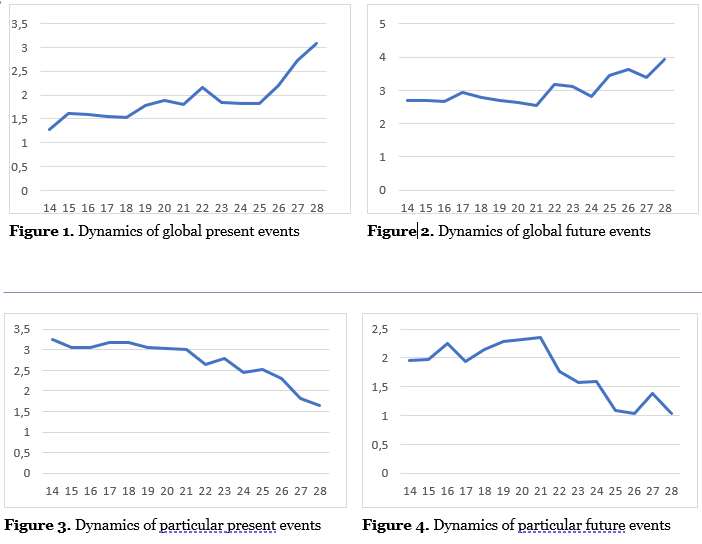
The figures 1, 2, 3 and figure 4 show changes in mean values of global and particular events separately for the present and the future. Mean values of global present events remained largely unchanged across most ages, with only two notable drops – between 14 and 15 years and between 26 and 27 years (see Table 1). Global future events also showed general stability, yet significant shifts emerged at the 21/22, 24/25, and 27/28 boundaries, suggesting oscillatory changes in how young people view the future as a broad time horizon. Regarding particular events, those in the present decreased towards the 23/24 transition and again at 26/27; particular future events, in contrast, changed mainly at 21/22 and 24/25.
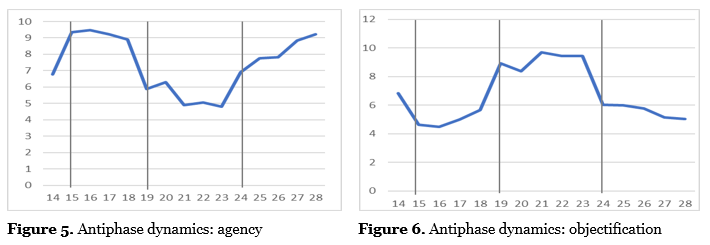
These figures (5 и 6) show how the active (agentive) role of the respondent in significant events and the passive (object) position change. The pattern for agency was characterised by a steep rise between 14 and 15 years, followed by a decline by age 18‑19, then another increase at 19‑20 and a particularly pronounced rise at 23‑24. Objectification showed precisely the reverse trend: it fell at 14‑15, rose by 18‑19, and fell again at 23‑24. These opposite movements clearly illustrate the antiphase relationship between the two constructs.

Evaluation (reflexive attitude with emotional‑value assessment) and statement (factual description without assessment) also change in antiphase (figures 7 и 8). Statement is higher at the beginning of the period (14–15 years) and at the 18/19 transition, whereas evaluation dominates at 15–18 years and especially at 23–24 years. The graphs show that at the transitions of 14/15, 18/19, and 23/24, a shift occurs in the dominant type of reflexive attitude.
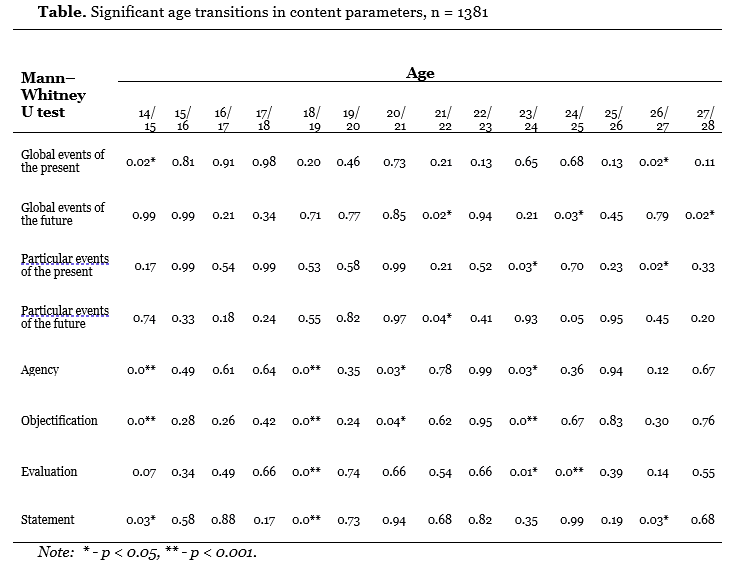
The table presents the results of pairwise comparisons of adjacent age groups (from 14/15 to 27/28) using the Mann‑Whitney U test. For each of the 8 analyzed parameters, p‑values for each age transition are indicated.
For transitions where significant differences were found, Cohen’s d effect sizes were additionally calculated:
Agency – between respondents aged 14 and 15 (d = –0.488), 18 and 19 (d = 0.690), and 23 and 24 (d = – 0.553);
Objectification – between 14 and 15 (d = 0.439), 18 and 19 (d = –0.746), and 23 and 24 (d = 0.876);
Evaluation – between 18 and 19 (d = –0.730) and 23 and 24 (d = 0.677);
Statement – between 14 and 15 (d = –0.239) and 18 and 19 (d = 0.620).
The largest effects were found for agency and objectification (d from –0.746 to 0.876), confirming the key role of these parameters in the age dynamics of time perspective.
The table clearly shows that the most “sensitive” to age are the parameters of agency, objectification, and evaluation, with critical transitions occurring at 14–15, 18–19, and 23–24 years.
Discussion
Description of the main result as a statistical solution. As a result of pairwise comparisons of adjacent age groups (from 14/15 to 27/28) using the Mann-Whitney U test and subsequent calculation of effect sizes (Cohen’s d), it was established that the development of content parameters of future perceptions in the period from 14 to 28 years is non‑linear and phase‑based. The analysis revealed three key turning points such as 14-15, 18-19, and 23-24 years, where the parameters reflecting the individual’s active role (agency vs. objectification) and the type of reflective attitude (evaluation vs. statement) underwent statistically significant shifts (p < 0.05 and p < 0.001). The largest effect sizes were obtained for agency (d = –0.488; 0.690; –0.553) and objectification (d = 0.439; –0.746; 0.876), confirming the key role of these parameters in the age dynamics of time perspective. At the same time, agency and statement change in antiphase with respect to objectification and evaluation, forming a cyclic pattern: the expansion of agentive activity is replaced by a deepening of reflexive meaning‑making. These results are comparable with contemporary discussions in psychological science: as S. Shulman (2023) notes, young people in emerging adulthood go through periods of instability, but by age 30 most achieve relative stabilization; the path to it is rarely linear, and periods of fluctuation may reflect progress in psychological reorganization rather than mere “missteps” (Shulman, 2023).
Evidence of the non‑artifactual nature of the results. The data obtained cannot be explained by random fluctuations or sampling artifacts. First, the sample size (n = 1381) and the number of analyzed events (19,881) provide high statistical power. Second, expert agreement in content analysis ranged from 0.937 to 0.975 (p < 0.001), eliminating subjectivity of ratings. Third, the parameter dynamics are not monotonic (e.g., agency first sharply increases at the 14/15 transition, then decreases by 18/19, and increases again at 23/24), contradicting a possible linear effect of age as a continuous variable. Finally, gender invariance shown in previous studies on similar age groups revealed no modifying effect of gender on the main patterns of time perspective dynamics, which allows us to speak of the generalizability of the results of this study (Shilova, 2026).
Comparison with results of other studies. The identified dynamics are consistent with modern foreign studies showing that the development of time perspective in adolescence and young adulthood is non‑linear. As O. Isanejad and F. Kargar (2023) emphasize, future time perspective plays a key role in adolescence and young adulthood, influencing identity formation, motivation, coping behavior, and life path choices, and age‑related tasks are closely linked to temporal orientations (Isanejad & Kargar, 2023). Furthermore, S. Shulman (2023) shows that the path to stabilization in early adulthood is rarely linear: periods of instability reflect psychological reorganization rather than chaotic deviations (Shulman, 2023). Additionally, T. Bergstrom et al. (2024) found that people inclined toward a broad view of time (thinking in terms of years and their whole life) report higher subjective well‑being and more often devote time to important rather than merely urgent tasks, which indirectly confirms the importance of qualitative restructuring of time perspective in young age (Bergstrom et al., 2024). Our data specify this idea, complementing previous findings, showing that the formation of an agentive position does not occur monotonically but through alternating phases of activation and stabilization, with key transitions occurring at 14–15, 18–19, and 23–24 years. The results on the identified phase transitions likely reflect moments of increased relevance of the future self in the context of age‑related tasks (career choice, self‑determination, etc.), as discussed in the review by D. Oyserman and E. Horowitz (2023). The antiphase pattern further suggests that agency and reflexive evaluation serve complementary functions: enhanced agency at 14–15 and 23–24 years may reflect the active construction of a future self, whereas the peak in evaluation and objectification at 18–19 may indicate a necessary phase of re‑evaluating one’s future self in light of imminent life transitions, consistent with the future self‑identification mechanism described by T. Tettero et al. (2026).
Thus, the transition at 14–15 years can be interpreted as the beginning of the formation of an agentive position. At this age, there is a reliable increase in agency and a decrease in objectification, which is consistent with the view of adolescence as a period of developing autonomy. L. Molinari et al. show that in adolescence and young adulthood, the ability to enjoy the present is combined with trust in others and active responsibility (Molinari et al., 2016, pp. 605–606). Our data confirm this: the increase in agency at 14–15 years may reflect a healthy balance between hedonistic present and future planning, accompanied by a beginning identification with a possible future self that feels identity‑congruent (Oyserman & Horowitz, 2023).
Next, the transition at 18–19 years, on the contrary, is associated with an increase in reflexive evaluation and a temporary strengthening of the object position. This phenomenon likely reflects a response to the need for real life choices – finishing school, entering university, starting professional activity. As S. Shulman (2023) notes, periods of fluctuation in emerging adulthood often reflect progress toward psychological reorganisation rather than mere “missteps”. Following this view, the 18–19 transition can be interpreted not as a “failure” but as an adaptive reorganization, in which the temporary dominance of reflection over action allows re‑evaluating past experience and adjusting plans, which in the long term leads to a new rise in agency at 23–24 years. This conclusion is consistent with the mechanism described by D. Oyserman and E. Horowitz (2023): the relevance of the future self to current tasks triggers future‑oriented action, but at the 18–19 stage the relevance itself is reconsidered, temporarily prioritizing evaluative processing over agentive expansion.
The identified transition at 23–24 years, marking a new strengthening of agency and a decrease in evaluation, deserves special attention. Modern research shows that at this age, the development of adaptive future perceptions capable of withstanding challenges of instability becomes especially important. This age corresponds to the period in which, according to S. Shulman (2023), the final “settling down” occurs, albeit with possible fluctuations (Shulman, 2023). The renewed dominance of agency may indicate that young adults, having re‑evaluated their identity and goals, now integrate a more committed agentive stance, better equipped for long‑term planning and well‑being (Bergstrom et al., 2024; Tettero et al., 2026).
Indication of alternatives that are rejected or require further study. The obtained results reject the linear model of future perceptions development and the simple “maturation” of time perspective. It is shown that the dynamics are wave‑like with regressive phases (e.g., the decrease in agency by 18–19 years). An alternative explanation, according to which the identified shifts may be related not to age per se but to the cumulative effect of crisis events (e.g., finishing school and taking final exams), is not rejected but requires verification in a longitudinal design controlling for event saturation. Furthermore, the question remains open as to how universal the identified cyclicality is for different sociocultural contexts and cohorts.
Rationale for the novelty of the study and its practical significance. The novelty of the study lies in the fact that for the first time in a Russian sample (n = 1381, age 14–28 years), the dynamics of not formal‑temporal but content characteristics of future perceptions (agency/objectification, evaluation/statement, globality/particularity, conflict/adaptiveness) were traced with an annual interval. The three identified critical points (14–15, 18–19, 23–24 years) allow us to view emerging adulthood not as a homogeneous period but as a sequence of phases, each imposing its own demands on psychological resources. The antiphase dynamics of agency and objectification, statement and evaluation, reveal the internal mechanism of constructing the future: outward expansion (goal setting) is replaced by inward deepening (value‑based meaning‑making), a rhythm that likely optimizes identity development and psychological adaptation.
Practical significance lies in the fact that the obtained results can be used in the development of psychological support programs for youth. For example, at age 14–15 it is advisable to support the development of an agentive position (leadership programs, project activities). At the 18–19 transition, on the contrary, support for reflexive practices (career counseling, self‑determination training) is important, so that the temporary strengthening of objectification does not develop into learned helplessness. At age 23–24, the emphasis can be placed on the integration of agency and value‑based meaningfulness, for example, in programs for building long‑term life strategies. Overall, a promising direction is the development of a conceptual model of future perceptions development that takes into account phase logic and critical transitions, with potential to inform interventions that promote a balanced time perspective and an agentive life stance.
Limitations. This study has several limitations that should be considered when interpreting the findings. First, the cross‑sectional design allows identification of age differences but not intra‑individual change; longitudinal tracking is needed to confirm the phase transitions and antiphase dynamics observed here. Second, the sample, while large, was recruited from educational organizations in the Russian Federation, which may limit generalizability to other cultural and socioeconomic contexts. Third, the reliance on self‑reported future events and subsequent expert coding, despite high inter‑rater reliability, may be influenced by social desirability and the immediate life context of respondents. Fourth, the annual interval comparisons, although fine‑grained for a cross‑sectional study, do not capture shorter‑term fluctuations or the exact timing of qualitative shifts. Fifth, the absence of additional measures of personality, cognitive ability, or life events prevents analysis of potential moderators of the observed dynamics. Finally, the study does not distinguish between the effects of chronological age and the cumulative impact of normative life transitions (e.g., school graduation, university entry). Future research should employ mixed‑method longitudinal designs across diverse sociocultural settings to validate and extend these results.
Conclusions
- Between the ages of 14 and 28, representations of the future do not follow a simple linear trajectory; instead, they evolve through distinct phases in which periods of pronounced change alternate with intervals of relative stabilisation. This non‑linear pattern challenges the assumption of gradual maturation and calls for phase‑sensitive theoretical models.
- Three key age transitions characterized by significant shifts in the parameters of agency‑objectification and evaluation‑statement were identified: 14–15, 18–19, and 23–24 years. These transitions mark critical windows during which the psychological construction of the future undergoes qualitative restructuring.
- Content parameters (the role of the subject in events, the type of reflexive attitude) are more sensitive indicators of age dynamics than formal‑temporal characteristics, highlighting the need to move beyond simple temporal extension measures toward the analysis of meaning‑making processes.
- The identified cyclicality (antiphase of agency and objectification, statement and evaluation) reflects the internal mechanism of constructing the future: outward expansion (goal setting) is replaced by inward deepening (value‑based meaning‑making). This dynamic equilibrium may serve as an adaptive engine of identity development, ensuring that agentive pursuits remain anchored in personal values and evaluated experience.
- The present findings offer a robust empirical basis for designing age‑targeted psychological interventions aimed at fostering a balanced time perspective and an agentive position in life planning, thereby contributing to the well‑being and successful transition of young people through emerging adulthood.
Author contributions: N.P.S. conceived the study, designed the methodology, collected the data, performed the statistical analyses, and wrote the manuscript. The author has carefully
References
- Abulkhanova‑Slavskaya, K. A. (1991). Strategiya zhizni[Life strategy]. Moscow: Mysl’. 299 р.
- Abulkhanova‑Slavskaya, K. A., & Berezina, T. N. (2001). Vremya lichnosti i vremya zhizni[Personality time and life time]. Petersburg: Aleteyya. 304 р.
- Bajcar, B., Lachowicz-Tabaczek, K., & Białek, M. (2023). Thinking about distant future self leads to better current task performance through higher future self-appraisals. Social Psychology. 54(4): 205-217. https://doi.org/10.1027/1864-9335/a000518
- Bergstrom, T., Reiff, J., Mogilner, C., & Hershfield, H. (2024). A broad view of time predicts greater subjective well-being. Personality and Individual Differences, 225(1), 112663. https://doi.org/10.1016/j.paid.2024.112663
- Ginzburg, M. R. (1994). Psikhologicheskoe soderzhanie lichnostnogo samoopredeleniya [Psychological content of personal self‑determination]. Voprosy psikhologii, (3), 43–53.
- Isanejad, O., & Kargar, F. (2023). Reliability, validity, and factor structure of future time perspective scale for adolescents and young adults (FTPS-AYA) in an Iranian female sample. Current Psychology, 42(8), 6722–6731. https://doi.org/10.1007/s12144-021-01950-x
- Kent, L., Van Doorn, G., Badcock, P., & Klein, B. (2026). Systema psyches: A temporal taxonomy of mental phenomena. Personality and Individual Differences, 250, 113531.https://doi.org/10.1016/j.paid.2025.113531
- Mello, Z. R., Barber, S. J., Vasilenko, S. A., Chandler, J., & Howell, R. (2022). Thinking about the past, present, and future: Time perspective and self-esteem in adolescents, young adults, middle-aged adults, and older adults. British Journal of Developmental Psychology, 40(1), 92–111. https://doi.org/10.1111/bjdp.12393
- Mertens, E. C. A., Siezenga, A. M., Van der Schalk, J., & van Gelder, J.-L. (2024). A novel smartphone-based intervention aimed at increasing future orientation via the future self: A pilot randomized controlled trial of a prototype application. Prevention Science, 25, 392–405. https://doi.org/10.1007/s11121-023-01609-y
- Molinari, L., Speltini, G., Passini, S., & Carelli, M. G. (2016). Time perspective in adolescents and young adults: Enjoying the present and trusting in a better future. Time & Society, 25(3), 594–612. https://doi.org/10.1177/0961463X15587833
- Oyserman, D., & Horowitz, E. (2023). From possible selves and future selves to current action: An integrated review and identity-based motivation synthesis. Advances in Motivation Science, 10, 74–147. https://doi.org/10.1016/bs.adms.2022.11.003
- Remondi, C., Gerbino, M., Cirimele, F., Thartori, E., Beolchini, E., Laghi, F., & Pastorelli, C. (2026). Thinking about time: The mediating role of time perspective in the relation between self‑efficacy beliefs and (mal)adjustment. Personality and Individual Differences, 250, 113527. https://doi.org/10.1016/j.paid.2025.113527
- Shilova, N. P. (2023). Vozrastnye razlichiya v predstavleniyakh o budushchem ot podrostnichestva do vzroslosti [Age differences in perceptions of the future from adolescence to adulthood]. Psychological Science and Education, 28(3), 62–74. https://doi.org/10.17759/pse.2023280305
- Shilova, N. P. (2025). Vremennaya perspektiva v sovremennykh zarubezhnykh issledovaniyakh: vozrastnye, kul’turnye i sotsial’nye aspekty [Time perspective in contemporary foreign research: Age-related, cultural, and social aspects]. Journal of Modern Foreign Psychology, 14(3), 105–114. https://doi.org/10.17759/jmfp.2025140309
- Shilova, N. P. (2026). Vzaimosvyaz’ vremennoy perspektivy i professional’nogo samoopredeleniya u yunoshey i devushek: polovye razlichiya [The relationship between time perspective and professional selfdetermination in male and female adolescents: sex differences]. Psychological Science and Education, 31(1), 68–81. https://doi.org/10.17759/pse.2026310103
- Shulman, S. (2023). A new lens on emerging adulthood: Fluidity as the path to settling down. Oxford University Press. 312 р. ISBN: 9780190841836
- Tettero, T., Mertens, E. C. A., Siezenga, A. M., & van Gelder, J.-L. (2026). From future vision to current action: The relationship between future self-identification and goal achievement. Personality and Individual Differences, 254, 113645. https://doi.org/10.1016/j.paid.2026.113645
- Venger, A. L., & Desyatnikova, Yu. M. (1995). Gruppovaya rabota so starsheklassnikami, napravlennaya na ikh adaptatsiyu k novym sotsial’nym usloviyam [Group work with high school students aimed at their adaptation to new social conditions]. Voprosy psikhologii, (1), 25–33.
- Zimbardo, P. G., & Boyd, J. N. (1999). Putting time in perspective: A valid, reliable individual-differences metric. Journal of Personality and Social Psychology, 77(6), 1271–1288. https://doi.org/10.1037/0022-3514.77.6.1271
Comments (0)
Relevance and Background. During emerging adulthood, the formation of a balanced time perspective is crucial for psychological well‑being, yet systematic evidence on the age‑related dynamics of the content of future perceptions remains scarce. Existing research indicates that time perspective develops non‑linearly, but fine‑grained annual tracking of qualitative parameters across the entire 14 to 28 age span is lacking. Objective. The study aimed to identify the age dynamics of the content parameters of future perceptions at successive annual intervals between 14 and 28 years. Methods. In a cross‑sectional design, 1,381 respondents aged 14-28 (M = 19.87) provided five significant events for each time dimension using the “Past, Present, Future” technique. Three expert psychologists rated 19,881 events on four bipolar scales (agency – objectification, evaluation – statement, global – particular, conflict – adaptiveness), with excellent inter‑rater agreement (Fleiss’ κ = 0.937 – 0.975). Pairwise comparisons of adjacent age groups were conducted with the Mann–Whitney U test, and effect sizes were quantified with Cohen’s d. Results. Three critical age transitions were identified (14-15, 18-19, and 23-24 years) at which agency, objectification, evaluation, and statement changed significantly (p < 0.05 to p < 0.001). Agency and objectification displayed the largest effect sizes (Cohen’s d from -0.746 to 0.876) and moved in antiphase, as did evaluation and statement. Formal‑temporal characteristics varied only sporadically. Conclusion. The development of future perceptions during emerging adulthood follows a non‑linear, phase‑based pattern in which outward expansion (goal setting) alternates with inward deepening (value‑based meaning‑making). The findings provide a refined model for designing age‑appropriate psychological support programmes that foster an agentive position in life planning.
Динамика временной перспективы в период становления взрослости
Наталья П. Шилова
Покровский филиал Московского педагогического государственного университета, г. Покров, Российская Федерация
Резюме. Актуальность и теоретический контекст. В период становления взрослости формирование сбалансированной временной перспективы является ключевым условием психологического благополучия, однако систематических данных о возрастной динамике содержательных параметров представлений о будущем по‑прежнему недостаточно. Существующие исследования свидетельствуют о нелинейном характере развития временной перспективы, но детальное ежегодное отслеживание качественных характеристик на всём возрастном интервале от 14 до 28 лет отсутствует. Цель. Выявление возрастной динамики содержательных параметров представлений о будущем с шагом в один год в диапазоне от 14 до 28 лет. Методы. В кросс‑секционном исследовании приняли участие 1381 респондент в возрасте от 14 до 28 лет (M = 19,87), которые, используя методику «Прошлое, настоящее, будущее», назвали по пять значимых событий для каждого временного измерения. Три эксперта‑психолога оценили 19 881 событие по четырём биполярным шкалам (субъектность – объектность, оценочность – констатация, глобальность – частность, конфликтность – адаптивность); согласованность экспертных оценок была высокой (κ Фляйса = 0,937–0,975). Попарные сравнения смежных возрастных групп проводились с помощью U‑критерия Манна–Уитни, размер эффекта определялся коэффициентом d Коэна. Результаты. Выявлены три критических возрастных перехода (14–15, 18–19 и 23–24 года), на которых значимо изменялись показатели субъектности, объектности, оценочности и констатации (p < 0,05 … p < 0,001). Субъектность и объектность продемонстрировали наибольшие размеры эффекта (d Коэна от –0,746 до 0,876) и изменялись в противофазе, как и оценочность с констатацией. Формально‑временные характеристики варьировали лишь эпизодически. Выводы. Развитие представлений о будущем в период становления взрослости носит нелинейный, фазовый характер, при котором внешняя экспансия (целеполагание) чередуется с внутренним углублением (ценностно‑смысловое осмысление). Полученные результаты создают уточнённую модель для разработки учитывающих возраст программ психологического сопровождения, направленных на формирование субъектной позиции в планировании жизненного пути.
Ключевые слова: временная перспектива, представления о будущем, становление взрослости, возрастная динамика
The problem of psychological time and future perceptions lies at the intersection of cognitive psychology, developmental psychology, and personality psychology. Time perspective serves as a system‑forming axis for the classification of mental phenomena: the past is not reproduced literally but is reconstructed under the influence of current goals; the present is evaluated through the prism of expected events; the future acts not simply as a chronological continuation of the present but as an active construct guiding current behaviour. As L. Kent et al. (2026) argue, all psychological functioning is inherently temporal regardless of whether it occurs at the individual or collective level; temporality spans from the most rapid mechanistic processes to the slowest evolutionary changes; and temporal relations both differentiate and integrate the wide variety of psychological functions.
The study of the development of time perspective during “emerging adulthood” is particularly relevant, because this period is sensitive for the formation of future perceptions, and any imbalances can have long‑term consequences. In introducing the rationale for their study, E.C.A. Mertens et al. (2024, p. 392) highlight young people’s typical present orientation, difficulties with planning, and limited ability to foresee long-term consequences, characterising this pattern as youthful shortsightedness. During this age period, time‑perspective skills related to identity and planning are actively formed, which makes studying their dynamics especially relevant. L. Molinari et al. (2016) found that time perspective in adolescence and young adulthood is not limited to future planning but also encompasses a positive orientation toward the present, which can coexist with relational confidence, personal responsibility, and trust in a better future.
Integrating these positions with data from time‑perspective research based on the approach of P.G. Zimbardo and J.N. Boyd (1999) allows us to assert that the formation of a balanced time perspective, combining a positive past, a moderately hedonistic present, and a future orientation, is the key to psychological well‑being throughout the transition from adolescence to early adulthood (Zimbardo & Boyd, 1999; Shilova, 2023; Shilova, 2025). However, the age dynamics of this balance, in particular the content characteristics of future perceptions, remain insufficiently studied. Recent research by C. Remondi et al. (2026) demonstrates that future time perspective mediates the relationship between self‑efficacy in self‑regulated learning and academic achievement, while past‑negative and present‑fatalistic perspectives mediate the links between emotional self‑efficacy and internalising/externalising problems in university students.
Contemporary research shows that a multi‑temporal perspective (focus on more than one time period) is associated with higher self‑esteem (Mello et al., 2022). At the same time, young men and women tend to evaluate their distant future positively. According to B. Bajcar et al. (2023), people evaluate their future selves more positively when they imagine a more distant future, which reflects a positivity bias driven by self‑enhancement. This is not merely an illusion but a psychological mechanism that can perform an adaptive function, especially during periods of age‑related transitions. Thus, the temporal‑distance effect requires cross‑sectional age analysis. However, the influence of temporal distance on behaviour is non‑linear and depends on context and age: for example, imagining a near‑future adult self improves task performance in children, whereas writing to a distant future self stimulates physical activity in students (Bajcar et al., 2023).
An important construct explaining the regulatory function of future perceptions is identification with the future self. As T. Tettero et al. (2026) suggest that a strong identification with one’s future self encourages people to engage in behaviours that are beneficial in the long term. According to their review, the more vividly individuals imagine their future self, the more they feel connected and similar to it, and the more positive their feelings toward it, the better their outcomes in domains such as retirement saving, academic performance, and health‑related choices. The key mechanism, according to the synthesis by D. Oyserman and E. Horowitz (2023), is the perception of the future self as relevant to current life tasks. The shift from a present to a future orientation occurs when the future self is perceived as relevant to the choices faced by the current self. The authors argue that individuals tend to act in identity‑congruent ways, interpreting their experiences accordingly. Moreover, they claim that a future self can direct current behaviour toward long‑term goals only when that future self is mentally accessible and, given the current context, feels relevant to the present self’s choices (Oyserman & Horowitz, 2023, p. 2).
In Russian psychology, the problem of future perceptions is traditionally associated with professional self‑determination and the development of agency. K.A. Abulkhanova‑Slavskaya (1991) emphasises that the personality becomes an independent centre of temporal determination, not simply reflecting time but constructing its own spatio‑temporal trajectory. Developing this idea, K.A. Abulkhanova‑Slavskaya and T.N. Berezina (2001) point out that the future is a projective personal space formed by the capacities of consciousness, imagination, thinking, achievement motivation, and aspirations. M.R. Ginzburg (1994) defines the psychological future as the provision of a semantic and temporal (chronological) perspective of the personality, and in youth this perspective is primarily associated with professional self‑determination.
Studies record the non‑linear nature of the development of future perceptions. As O. Isanejad and F. Kargar (2023) point out, it is during adolescence and young adulthood that the active formation of time perspective occurs, and age‑related tasks are closely linked to temporal orientations. S. Shulman (2023) shows that most young people achieve a certain stabilisation by age 30, but the path to it is rarely linear: periods of instability and fluctuations may reflect progress toward psychological reorganisation. Additionally, T. Bergstrom et al. (2024) found that people inclined toward a broad view of time (thinking in terms of years and their whole life) report higher subjective well‑being, which indirectly confirms the importance of qualitative restructuring of time perspective at a young age.
Thus, the analysis of the literature shows that, despite a significant number of studies on time perspective, there are insufficient systematic works tracing the annual dynamics of the content parameters of future perceptions throughout the entire period of emerging adulthood (from 14 to 28 years). The aim of the present study was to identify the age dynamics of the content parameters of future perceptions at successive annual intervals in the age range 14–28 years. The type of study is a cross‑sectional age design, which allows comparing indicators of respondents from different age groups and identifying age differences. We hypothesised that the dynamics of future perceptions from late adolescence to early adulthood (14–28 years) is non‑linear and phase‑based.
- Participants
A total of 1,381 participants between 14 and 28 years old took part in the study (mean age = 19.87, median = 19, SD = 4.4). The sample consisted of 811 females and 570 males. The age distribution showed moderate positive skewness (0.368) and a kurtosis value of –1.126, indicating a near‑normal distribution with a slight leftward shift.
- Procedure
To form the sample, an invitation email with a link to the questionnaire was sent to educational organisations in the Russian Federation. Respondents were informed that participation was voluntary and that they could withdraw at any time. The questionnaire, accessed via the link, was hosted on the SurveyGizmo platform. The questionnaire requested consent to participate in the study and consent to use the provided data. Parental (legal guardian) consent for minor participants was collected through educational organisations. The study protocol was approved by the institutional review board of Moscow Pedagogical State University and conducted in accordance with the Declaration of Helsinki.
- Method and equipment
The “Past, Present, Future” technique (Venger & Desyatnikova, 1995) was used, which allows determining the range of significant events, their temporal distance, and ways of planning the future. Respondents were asked to name five significant events from the past, present, and future, indicating their temporal characteristics.
- Indicator registration and Variables
The analysis covered all 19,881 life events reported by the participants. Three expert psychologists with academic degrees in psychology evaluated every event along four bipolar dimensions: global vs. particular, agentive vs. objectified, evaluative vs. factual, and conflict‑laden vs. adaptive. The level of inter‑rater agreement was calculated using Fleiss’ kappa, ranging from 0.937 to 0.975 (p < 0.001), indicating excellent consistency.
For each respondent, we calculated the total number of events coded as agentive (range 0–5 per time dimension) and then averaged across the sample. The same procedure was applied to objectification, evaluation, and statement. Overall, global future events are described slightly more often (M = 2.95, SD = 1.6) than global present events (M = 1.83, SD = 1.4). Particular present events are described less often than particular future events (M = 2.82, SD = 1.5 vs M = 1.85, SD = 1.6). Agency is on average higher than objectification (M = 7.65, SD = 4.6 vs M = 6.46, SD = 4.4), statement is higher than evaluation (M = 11.96, SD = 3.6 vs M = 2.2, SD = 3.1). Conflict is low (M = 0.37, SD = 0.98), adaptiveness is high (M = 13.79, SD = 2.5).
- Statistical analysis
Statistical analysis included the Mann–Whitney U test and Cohen’s d coefficient.
Data availability
The datasets generated and analysed during the current study are not publicly available due to privacy restrictions but are available from the corresponding author on reasonable request.
Code availability
Not applicable.
Data for all parameters were analyzed for each age separately in order to detect age dynamics. Mean values are shown in Figures 1–8.
The figures 1, 2, 3 and figure 4 show changes in mean values of global and particular events separately for the present and the future. Mean values of global present events remained largely unchanged across most ages, with only two notable drops – between 14 and 15 years and between 26 and 27 years (see Table 1). Global future events also showed general stability, yet significant shifts emerged at the 21/22, 24/25, and 27/28 boundaries, suggesting oscillatory changes in how young people view the future as a broad time horizon. Regarding particular events, those in the present decreased towards the 23/24 transition and again at 26/27; particular future events, in contrast, changed mainly at 21/22 and 24/25.
These figures (5 и 6) show how the active (agentive) role of the respondent in significant events and the passive (object) position change. The pattern for agency was characterised by a steep rise between 14 and 15 years, followed by a decline by age 18‑19, then another increase at 19‑20 and a particularly pronounced rise at 23‑24. Objectification showed precisely the reverse trend: it fell at 14‑15, rose by 18‑19, and fell again at 23‑24. These opposite movements clearly illustrate the antiphase relationship between the two constructs.
Evaluation (reflexive attitude with emotional‑value assessment) and statement (factual description without assessment) also change in antiphase (figures 7 и 8). Statement is higher at the beginning of the period (14–15 years) and at the 18/19 transition, whereas evaluation dominates at 15–18 years and especially at 23–24 years. The graphs show that at the transitions of 14/15, 18/19, and 23/24, a shift occurs in the dominant type of reflexive attitude.
The table presents the results of pairwise comparisons of adjacent age groups (from 14/15 to 27/28) using the Mann‑Whitney U test. For each of the 8 analyzed parameters, p‑values for each age transition are indicated.
For transitions where significant differences were found, Cohen’s d effect sizes were additionally calculated:
Agency – between respondents aged 14 and 15 (d = –0.488), 18 and 19 (d = 0.690), and 23 and 24 (d = – 0.553);
Objectification – between 14 and 15 (d = 0.439), 18 and 19 (d = –0.746), and 23 and 24 (d = 0.876);
Evaluation – between 18 and 19 (d = –0.730) and 23 and 24 (d = 0.677);
Statement – between 14 and 15 (d = –0.239) and 18 and 19 (d = 0.620).
The largest effects were found for agency and objectification (d from –0.746 to 0.876), confirming the key role of these parameters in the age dynamics of time perspective.
The table clearly shows that the most “sensitive” to age are the parameters of agency, objectification, and evaluation, with critical transitions occurring at 14–15, 18–19, and 23–24 years.
Description of the main result as a statistical solution. As a result of pairwise comparisons of adjacent age groups (from 14/15 to 27/28) using the Mann-Whitney U test and subsequent calculation of effect sizes (Cohen’s d), it was established that the development of content parameters of future perceptions in the period from 14 to 28 years is non‑linear and phase‑based. The analysis revealed three key turning points such as 14-15, 18-19, and 23-24 years, where the parameters reflecting the individual’s active role (agency vs. objectification) and the type of reflective attitude (evaluation vs. statement) underwent statistically significant shifts (p < 0.05 and p < 0.001). The largest effect sizes were obtained for agency (d = –0.488; 0.690; –0.553) and objectification (d = 0.439; –0.746; 0.876), confirming the key role of these parameters in the age dynamics of time perspective. At the same time, agency and statement change in antiphase with respect to objectification and evaluation, forming a cyclic pattern: the expansion of agentive activity is replaced by a deepening of reflexive meaning‑making. These results are comparable with contemporary discussions in psychological science: as S. Shulman (2023) notes, young people in emerging adulthood go through periods of instability, but by age 30 most achieve relative stabilization; the path to it is rarely linear, and periods of fluctuation may reflect progress in psychological reorganization rather than mere “missteps” (Shulman, 2023).
Evidence of the non‑artifactual nature of the results. The data obtained cannot be explained by random fluctuations or sampling artifacts. First, the sample size (n = 1381) and the number of analyzed events (19,881) provide high statistical power. Second, expert agreement in content analysis ranged from 0.937 to 0.975 (p < 0.001), eliminating subjectivity of ratings. Third, the parameter dynamics are not monotonic (e.g., agency first sharply increases at the 14/15 transition, then decreases by 18/19, and increases again at 23/24), contradicting a possible linear effect of age as a continuous variable. Finally, gender invariance shown in previous studies on similar age groups revealed no modifying effect of gender on the main patterns of time perspective dynamics, which allows us to speak of the generalizability of the results of this study (Shilova, 2026).
Comparison with results of other studies. The identified dynamics are consistent with modern foreign studies showing that the development of time perspective in adolescence and young adulthood is non‑linear. As O. Isanejad and F. Kargar (2023) emphasize, future time perspective plays a key role in adolescence and young adulthood, influencing identity formation, motivation, coping behavior, and life path choices, and age‑related tasks are closely linked to temporal orientations (Isanejad & Kargar, 2023). Furthermore, S. Shulman (2023) shows that the path to stabilization in early adulthood is rarely linear: periods of instability reflect psychological reorganization rather than chaotic deviations (Shulman, 2023). Additionally, T. Bergstrom et al. (2024) found that people inclined toward a broad view of time (thinking in terms of years and their whole life) report higher subjective well‑being and more often devote time to important rather than merely urgent tasks, which indirectly confirms the importance of qualitative restructuring of time perspective in young age (Bergstrom et al., 2024). Our data specify this idea, complementing previous findings, showing that the formation of an agentive position does not occur monotonically but through alternating phases of activation and stabilization, with key transitions occurring at 14–15, 18–19, and 23–24 years. The results on the identified phase transitions likely reflect moments of increased relevance of the future self in the context of age‑related tasks (career choice, self‑determination, etc.), as discussed in the review by D. Oyserman and E. Horowitz (2023). The antiphase pattern further suggests that agency and reflexive evaluation serve complementary functions: enhanced agency at 14–15 and 23–24 years may reflect the active construction of a future self, whereas the peak in evaluation and objectification at 18–19 may indicate a necessary phase of re‑evaluating one’s future self in light of imminent life transitions, consistent with the future self‑identification mechanism described by T. Tettero et al. (2026).
Thus, the transition at 14–15 years can be interpreted as the beginning of the formation of an agentive position. At this age, there is a reliable increase in agency and a decrease in objectification, which is consistent with the view of adolescence as a period of developing autonomy. L. Molinari et al. show that in adolescence and young adulthood, the ability to enjoy the present is combined with trust in others and active responsibility (Molinari et al., 2016, pp. 605–606). Our data confirm this: the increase in agency at 14–15 years may reflect a healthy balance between hedonistic present and future planning, accompanied by a beginning identification with a possible future self that feels identity‑congruent (Oyserman & Horowitz, 2023).
Next, the transition at 18–19 years, on the contrary, is associated with an increase in reflexive evaluation and a temporary strengthening of the object position. This phenomenon likely reflects a response to the need for real life choices – finishing school, entering university, starting professional activity. As S. Shulman (2023) notes, periods of fluctuation in emerging adulthood often reflect progress toward psychological reorganisation rather than mere “missteps”. Following this view, the 18–19 transition can be interpreted not as a “failure” but as an adaptive reorganization, in which the temporary dominance of reflection over action allows re‑evaluating past experience and adjusting plans, which in the long term leads to a new rise in agency at 23–24 years. This conclusion is consistent with the mechanism described by D. Oyserman and E. Horowitz (2023): the relevance of the future self to current tasks triggers future‑oriented action, but at the 18–19 stage the relevance itself is reconsidered, temporarily prioritizing evaluative processing over agentive expansion.
The identified transition at 23–24 years, marking a new strengthening of agency and a decrease in evaluation, deserves special attention. Modern research shows that at this age, the development of adaptive future perceptions capable of withstanding challenges of instability becomes especially important. This age corresponds to the period in which, according to S. Shulman (2023), the final “settling down” occurs, albeit with possible fluctuations (Shulman, 2023). The renewed dominance of agency may indicate that young adults, having re‑evaluated their identity and goals, now integrate a more committed agentive stance, better equipped for long‑term planning and well‑being (Bergstrom et al., 2024; Tettero et al., 2026).
Indication of alternatives that are rejected or require further study. The obtained results reject the linear model of future perceptions development and the simple “maturation” of time perspective. It is shown that the dynamics are wave‑like with regressive phases (e.g., the decrease in agency by 18–19 years). An alternative explanation, according to which the identified shifts may be related not to age per se but to the cumulative effect of crisis events (e.g., finishing school and taking final exams), is not rejected but requires verification in a longitudinal design controlling for event saturation. Furthermore, the question remains open as to how universal the identified cyclicality is for different sociocultural contexts and cohorts.
Rationale for the novelty of the study and its practical significance. The novelty of the study lies in the fact that for the first time in a Russian sample (n = 1381, age 14–28 years), the dynamics of not formal‑temporal but content characteristics of future perceptions (agency/objectification, evaluation/statement, globality/particularity, conflict/adaptiveness) were traced with an annual interval. The three identified critical points (14–15, 18–19, 23–24 years) allow us to view emerging adulthood not as a homogeneous period but as a sequence of phases, each imposing its own demands on psychological resources. The antiphase dynamics of agency and objectification, statement and evaluation, reveal the internal mechanism of constructing the future: outward expansion (goal setting) is replaced by inward deepening (value‑based meaning‑making), a rhythm that likely optimizes identity development and psychological adaptation.
Practical significance lies in the fact that the obtained results can be used in the development of psychological support programs for youth. For example, at age 14–15 it is advisable to support the development of an agentive position (leadership programs, project activities). At the 18–19 transition, on the contrary, support for reflexive practices (career counseling, self‑determination training) is important, so that the temporary strengthening of objectification does not develop into learned helplessness. At age 23–24, the emphasis can be placed on the integration of agency and value‑based meaningfulness, for example, in programs for building long‑term life strategies. Overall, a promising direction is the development of a conceptual model of future perceptions development that takes into account phase logic and critical transitions, with potential to inform interventions that promote a balanced time perspective and an agentive life stance.
Limitations. This study has several limitations that should be considered when interpreting the findings. First, the cross‑sectional design allows identification of age differences but not intra‑individual change; longitudinal tracking is needed to confirm the phase transitions and antiphase dynamics observed here. Second, the sample, while large, was recruited from educational organizations in the Russian Federation, which may limit generalizability to other cultural and socioeconomic contexts. Third, the reliance on self‑reported future events and subsequent expert coding, despite high inter‑rater reliability, may be influenced by social desirability and the immediate life context of respondents. Fourth, the annual interval comparisons, although fine‑grained for a cross‑sectional study, do not capture shorter‑term fluctuations or the exact timing of qualitative shifts. Fifth, the absence of additional measures of personality, cognitive ability, or life events prevents analysis of potential moderators of the observed dynamics. Finally, the study does not distinguish between the effects of chronological age and the cumulative impact of normative life transitions (e.g., school graduation, university entry). Future research should employ mixed‑method longitudinal designs across diverse sociocultural settings to validate and extend these results.
- Between the ages of 14 and 28, representations of the future do not follow a simple linear trajectory; instead, they evolve through distinct phases in which periods of pronounced change alternate with intervals of relative stabilisation. This non‑linear pattern challenges the assumption of gradual maturation and calls for phase‑sensitive theoretical models.
- Three key age transitions characterized by significant shifts in the parameters of agency‑objectification and evaluation‑statement were identified: 14–15, 18–19, and 23–24 years. These transitions mark critical windows during which the psychological construction of the future undergoes qualitative restructuring.
- Content parameters (the role of the subject in events, the type of reflexive attitude) are more sensitive indicators of age dynamics than formal‑temporal characteristics, highlighting the need to move beyond simple temporal extension measures toward the analysis of meaning‑making processes.
- The identified cyclicality (antiphase of agency and objectification, statement and evaluation) reflects the internal mechanism of constructing the future: outward expansion (goal setting) is replaced by inward deepening (value‑based meaning‑making). This dynamic equilibrium may serve as an adaptive engine of identity development, ensuring that agentive pursuits remain anchored in personal values and evaluated experience.
- The present findings offer a robust empirical basis for designing age‑targeted psychological interventions aimed at fostering a balanced time perspective and an agentive position in life planning, thereby contributing to the well‑being and successful transition of young people through emerging adulthood.
Author contributions: N.P.S. conceived the study, designed the methodology, collected the data, performed the statistical analyses, and wrote the manuscript. The author has carefully
- Abulkhanova‑Slavskaya, K. A. (1991). Strategiya zhizni[Life strategy]. Moscow: Mysl’. 299 р.
- Abulkhanova‑Slavskaya, K. A., & Berezina, T. N. (2001). Vremya lichnosti i vremya zhizni[Personality time and life time]. Petersburg: Aleteyya. 304 р.
- Bajcar, B., Lachowicz-Tabaczek, K., & Białek, M. (2023). Thinking about distant future self leads to better current task performance through higher future self-appraisals. Social Psychology. 54(4): 205-217. https://doi.org/10.1027/1864-9335/a000518
- Bergstrom, T., Reiff, J., Mogilner, C., & Hershfield, H. (2024). A broad view of time predicts greater subjective well-being. Personality and Individual Differences, 225(1), 112663. https://doi.org/10.1016/j.paid.2024.112663
- Ginzburg, M. R. (1994). Psikhologicheskoe soderzhanie lichnostnogo samoopredeleniya [Psychological content of personal self‑determination]. Voprosy psikhologii, (3), 43–53.
- Isanejad, O., & Kargar, F. (2023). Reliability, validity, and factor structure of future time perspective scale for adolescents and young adults (FTPS-AYA) in an Iranian female sample. Current Psychology, 42(8), 6722–6731. https://doi.org/10.1007/s12144-021-01950-x
- Kent, L., Van Doorn, G., Badcock, P., & Klein, B. (2026). Systema psyches: A temporal taxonomy of mental phenomena. Personality and Individual Differences, 250, 113531.https://doi.org/10.1016/j.paid.2025.113531
- Mello, Z. R., Barber, S. J., Vasilenko, S. A., Chandler, J., & Howell, R. (2022). Thinking about the past, present, and future: Time perspective and self-esteem in adolescents, young adults, middle-aged adults, and older adults. British Journal of Developmental Psychology, 40(1), 92–111. https://doi.org/10.1111/bjdp.12393
- Mertens, E. C. A., Siezenga, A. M., Van der Schalk, J., & van Gelder, J.-L. (2024). A novel smartphone-based intervention aimed at increasing future orientation via the future self: A pilot randomized controlled trial of a prototype application. Prevention Science, 25, 392–405. https://doi.org/10.1007/s11121-023-01609-y
- Molinari, L., Speltini, G., Passini, S., & Carelli, M. G. (2016). Time perspective in adolescents and young adults: Enjoying the present and trusting in a better future. Time & Society, 25(3), 594–612. https://doi.org/10.1177/0961463X15587833
- Oyserman, D., & Horowitz, E. (2023). From possible selves and future selves to current action: An integrated review and identity-based motivation synthesis. Advances in Motivation Science, 10, 74–147. https://doi.org/10.1016/bs.adms.2022.11.003
- Remondi, C., Gerbino, M., Cirimele, F., Thartori, E., Beolchini, E., Laghi, F., & Pastorelli, C. (2026). Thinking about time: The mediating role of time perspective in the relation between self‑efficacy beliefs and (mal)adjustment. Personality and Individual Differences, 250, 113527. https://doi.org/10.1016/j.paid.2025.113527
- Shilova, N. P. (2023). Vozrastnye razlichiya v predstavleniyakh o budushchem ot podrostnichestva do vzroslosti [Age differences in perceptions of the future from adolescence to adulthood]. Psychological Science and Education, 28(3), 62–74. https://doi.org/10.17759/pse.2023280305
- Shilova, N. P. (2025). Vremennaya perspektiva v sovremennykh zarubezhnykh issledovaniyakh: vozrastnye, kul’turnye i sotsial’nye aspekty [Time perspective in contemporary foreign research: Age-related, cultural, and social aspects]. Journal of Modern Foreign Psychology, 14(3), 105–114. https://doi.org/10.17759/jmfp.2025140309
- Shilova, N. P. (2026). Vzaimosvyaz’ vremennoy perspektivy i professional’nogo samoopredeleniya u yunoshey i devushek: polovye razlichiya [The relationship between time perspective and professional selfdetermination in male and female adolescents: sex differences]. Psychological Science and Education, 31(1), 68–81. https://doi.org/10.17759/pse.2026310103
- Shulman, S. (2023). A new lens on emerging adulthood: Fluidity as the path to settling down. Oxford University Press. 312 р. ISBN: 9780190841836
- Tettero, T., Mertens, E. C. A., Siezenga, A. M., & van Gelder, J.-L. (2026). From future vision to current action: The relationship between future self-identification and goal achievement. Personality and Individual Differences, 254, 113645. https://doi.org/10.1016/j.paid.2026.113645
- Venger, A. L., & Desyatnikova, Yu. M. (1995). Gruppovaya rabota so starsheklassnikami, napravlennaya na ikh adaptatsiyu k novym sotsial’nym usloviyam [Group work with high school students aimed at their adaptation to new social conditions]. Voprosy psikhologii, (1), 25–33.
- Zimbardo, P. G., & Boyd, J. N. (1999). Putting time in perspective: A valid, reliable individual-differences metric. Journal of Personality and Social Psychology, 77(6), 1271–1288. https://doi.org/10.1037/0022-3514.77.6.1271
Abstract
Conclusions