
Enhancing Competitive Stress Resistance in Elite Tennis Players: Experimental Validation of a Comprehensive, Diagnostics-Driven Multi-Component Intervention
Abstract
Abstract
Relevance and Background. Modern elite tennis places escalating psycho‑emotional demands on athletes, yet psychological interventions targeting stress resistance are rarely subjected to rigorous experimental validation. Fragmented approaches prevail, and comprehensive, diagnostics‑driven programmes tailored to individual sports remain scarce. Objective. This study experimentally tested a comprehensive, diagnostics‑driven method for increasing stress resistance in elite tennis players during competitive activity. Method. Twenty-four highly qualified tennis players (CMS/MS) were assigned to an experimental group (N = 12) and a control group (N = 12), both comparable in age, experience, and skill level. Over 12 weeks, the experimental group received a multi-component psychological training program that integrated psychoregulation, cognitive-behavioral techniques, and simulated competitive situations, while the control group followed standard training. Validated measures of stress resistance, competitive anxiety, and self-regulation were administered pre- and post-intervention, and data were analyzed with Student’s t-tests, Mann-Whitney U-tests, and Pearson and Spearman correlations. Results. The experimental group showed a significant increase in stress resistance (t = 2.84, p < .01), whereas the control group’s change was non-significant. Post-intervention between-group differences were significant (t = 2.31, p < .05; U = 38, p < .05). Positive correlations between stress resistance and stability of game actions (r = .56, p < .05) and negative correlations between competitive anxiety and effectiveness of technical-tactical actions (ρ = –.49, p < .05) were found. Conclusion. The diagnostics-based, multi-component methodology effectively enhances stress resistance in elite tennis players, with gains associated with improved competitive reliability. The findings are discussed in light of recent models linking personal authenticity to mental toughness, suggesting that multi‑component interventions may operate partly by strengthening the authentically motivated, self‑congruent core of the athlete’s psychological preparation.
Повышение устойчивости теннисистов высокой квалификации к соревновательному стрессу: экспериментальная проверка комплексного, основанного на диагностике многокомпонентного вмешательства
Александр С. Чепикa, Александр С. Огневb, c
aРоссийский новый университет, Москва, Россия
bФинансовый университет при Правительстве Российской Федерации, Москва, Россия
cМосковский педагогический государственный университет, Москва, Россия
Резюме. Актуальность и исходные предпосылки. Современный теннис высших достижений предъявляет повышенные психоэмоциональные требования к спортсменам, однако психологические интервенции, направленные на повышение стрессоустойчивости, редко проходят строгую экспериментальную проверку. Преобладают фрагментарные подходы, а комплексные, диагностически обоснованные программы, адаптированные к индивидуальным видам спорта, остаются дефицитом. Цель. Экспериментально проверить эффективность комплексного, основанного на психодиагностике метода повышения стрессоустойчивости высококвалифицированных теннисистов в условиях соревновательной деятельности. Метод. Двадцать четыре высококвалифицированных теннисиста (КМС/МС) были распределены в экспериментальную (N= 12) и контрольную N = 12) группы, сопоставимые по возрасту, спортивному стажу и уровню мастерства. В течение 12 недель экспериментальная группа в дополнение к стандартной тренировочной программе проходила структурированную психологическую подготовку, объединяющую психорегуляцию, когнитивно-поведенческие техники и моделирование соревновательных ситуаций; контрольная группа тренировалась по традиционной методике. До и после вмешательства применялись валидные психодиагностические инструменты для оценки стрессоустойчивости, соревновательной тревожности и саморегуляции. Данные анализировались с помощью t‑критерия Стьюдента, U‑критерия Манна-Уитни, а также корреляционного анализа (коэффициенты Пирсона и Спирмена). Результаты. В экспериментальной группе зафиксирован значимый прирост стрессоустойчивости (t = 2.84, p <0.01), тогда как изменения в контрольной группе были статистически незначимы. Межгрупповые различия по завершении вмешательства оказались достоверными (t = 2.31, p <0.05; U = 38, p <0.05). Обнаружены положительная корреляция между стрессоустойчивостью и стабильностью игровых действий (r = 0.56, p <0.05), а также отрицательная связь между соревновательной тревожностью и эффективностью технико-тактических действий (ρ = –0.49, p <0.05). Заключение. Диагностически обоснованная многокомпонентная методика эффективно повышает стрессоустойчивость высококвалифицированных теннисистов, причём улучшение сопряжено с ростом соревновательной надёжности. Результаты обсуждаются в контексте современных моделей, связывающих личностную аутентичность с ментальной прочностью, и позволяют предположить, что подобные интервенции способны укреплять аутентично мотивированное, самоконгруэнтное ядро психологической подготовки спортсменов.
Ключевые слова: стрессоустойчивость, теннис, высококвалифицированные спортсмены, соревновательная деятельность, психологическая подготовка
Introduction
Modern tennis is characterized by highly dynamic competition, an increasingly dense tournament calendar, and escalating psycho-emotional stress placed on elite athletes. Under these conditions, stress resistance is considered one of the key factors ensuring the stability of competitive performance and the effective realization of athletes’ technical and tactical potential (Fletcher & Sarkar, 2020; Gucciardi et al., 2020).
An analysis of recent scientific research indicates a growing interest in the issue of psychological resilience and stress resistance in high-performance sports (Nicholls et al., 2022; Sarkar & Fletcher, 2021; Weinberg & Gould, 2023). In this context, the concept of mental toughness has gained particular attention as a multidimensional resource integrating emotional control, cognitive stability, and behavioral persistence under competitive pressure (Fedunina, 2017). In competitive tennis specifically, latent profile analysis has revealed that athletes who endorse approach‑oriented achievement goals, regardless of whether they also pursue avoidance goals, report significantly higher levels of mental toughness and autonomous motivation, suggesting that the combination of goal orientations matters more than the presence or absence of avoidance goals alone (Cowden et al., 2021). Developing these attributes is increasingly regarded as a promising direction for building stress resistance in elite athletes. Although meta-analytic evidence confirms that interventions targeting mental toughness can yield large overall effects in sport, their methodological quality varies considerably and they remain largely untested in tennis specifically (Stamatis et al., 2020). However, in tennis, issues of increasing stress resilience are often addressed in a fragmented manner, without reliance on comprehensive diagnostics and experimental testing of the effectiveness of educational interventions, which underlies the relevance of this study.
A recent large‑scale meta‑analysis by Ayranci and Aydin (2025), encompassing 127 studies and 24,358 athletes, confirmed that psychological factors overall exert a moderate positive effect on sports performance (d = 0.329), with particularly robust effect sizes for motivation (d = 0.525), self‑efficacy (d = 0.413), goal setting (d = 0.460), and personality traits (d = 0.607). These findings reinforce the necessity of systematically developing psychological skills in athletes and provide a strong, evidence‑based rationale for the comprehensive, diagnostics‑driven intervention tested in the present study.
A recent scoping review of tennis and mental health (Konstantinou et al., 2025) corroborates this perspective, showing that tennis participation yields clear psychological benefits—reduced depression and anxiety, improved self‑confidence, and enhanced resilience, while simultaneously exposing athletes to considerable competitive stress, attentional pressure, and a risk of maladaptive coping. The review highlights that effective psychological support in tennis must address emotional, cognitive, and environmental factors in an integrated manner, and proposes the Resilience Racket Model, a conceptual framework that unifies physical readiness (handle), psychological resilience competencies (strings), and systemic support structures (frame) to achieve optimal performance and well‑being (the “sweet spot”). The present experimental methodology, which systematically combines psychoregulation, cognitive‑behavioral techniques, and simulated competition, is fully aligned with this holistic, multi‑component philosophy.
Tennis‑specific research further indicates that adaptive stress responses depend not only on broad psychological skills but also on higher‑order cognitive processes and the motivational climate surrounding the athlete. Theodosiou et al. (2018) studied 226 national‑level Greek tennis players and found that metacognitive thinking during training significantly predicted approach‑oriented coping strategies in competition—such as self‑talk, effort increase, and planning. Mastery goal orientation (task involvement) and perceptions of a mastery motivational climate were positively associated with approach coping and negatively associated with avoidance coping, whereas performance‑avoidance goals and a performance‑avoidance climate predicted maladaptive, avoidant responses. These findings highlight that effective interventions in tennis must cultivate athletes’ metacognitive awareness and reinforce a mastery‑oriented focus on personal improvement rather than on outcome. The present experimental methodology, which integrates cognitive‑behavioral techniques (e.g., restructuring, self‑talk) with process‑orientated simulated competition, is specifically designed to activate these adaptive pathways.
Moreover, research in elite racquet sports indicates that the capacity to recover from daily stressors plays a more decisive role in preventing maladaptive outcomes than the mere presence of stress. In a prospective multilevel study of 159 young elite table‑tennis players, Martinent et al. (2022) found that higher levels of self‑reported recovery at mid‑season significantly predicted lower reduced accomplishment at the end of the season, whereas stress alone did not predict burnout symptoms. The authors concluded that achieving a balance between stress and personal resources, particularly recovery and effective coping, is critical for sustaining performance and well‑being in intensive training settings. This finding underscores the necessity of including structured recovery‑oriented techniques (e.g., controlled breathing, progressive muscle relaxation) within psychological preparation programmes for individual racket‑sport athletes, a principle directly reflected in the psychoregulation block of the present experimental method.
Recent research suggests that the roots of an athlete’s psychological resilience may lie even deeper. The construct of personal authenticity, being true to one’s self, aware of one’s values, and the autonomous author of one’s life path, has been proposed as a fundamental personality resource that undergirds mental toughness (Bochaver et al., 2023). In a large‑scale study of 347 elite male athletes, Bochaver et al. (2023) demonstrated that authenticity does not directly produce mental toughness in a simple way; instead, it strengthens intrinsic motivation (self‑development, learning, enjoyment), which in turn supports mental skills such as stress resistance, confidence, goal commitment, and diligence, ultimately enhancing mental toughness. This structural model explains why interventions that merely target stress symptoms may be less effective than those that foster the athlete’s autonomous, self‑congruent engagement with their sport. The present study, although not measuring authenticity itself, implements a multi‑component psychological programme whose design is highly compatible with this model: it simultaneously addresses emotional regulation, cognitive restructuring, and behavioural practice under pressure, processes that are precisely the downstream consequences of an authentic, intrinsically motivated sport involvement. Therefore, we expected that a comprehensive, diagnostics‑based intervention would not only improve stress resistance but would also do so via mechanisms aligned with the authenticity–mental toughness pathway.
Parallel findings from Palma Gil and Andacao (2025) reinforce this view. In a sample of 145 collegiate athletes, spiritual well‑being and spiritual locus of control, combined with mental training skills such as performance skills and mental imagery, significantly predicted sports resilience, explaining 43.3% of its variance. This evidence indicates that psychologically robust athletes draw on a broad spectrum of resources, including meaning‑oriented and self‑regulatory components, further justifying the comprehensive, multi‑component approach adopted in the present study.
Recent large‑scale findings further underscore the relevance of a sport‑specific approach. Naboichenko et al. (2022), in a study of 1,545 highly qualified athletes (14-17 years old) from individual and team sports, demonstrated that although athletes generally possess good neuropsychic stability, significant differences exist between sport types. Athletes from team sports showed higher emotional tone (p = .007) and lower tension (p = .0308) than those from individual sports. Tennis, as a predominantly individual sport, therefore places particularly high demands on an athlete’s autonomous capacity to regulate tension and maintain emotional balance under competitive pressure. These findings highlight the necessity of developing psychological interventions that are not only comprehensive but also tailored to the specific stressors of individual competition, a gap the present experimental methodology aims to fill.
A recent systematic review of coping in elite athletes (Nuetzel, 2023) reinforces this tailored approach. The review demonstrates that coping in elite sport is highly complex and dynamic, with athletes employing a broad spectrum of strategies such as problem‑focused, emotion‑focused, avoidance, and social‑support seeking, depending on the nature of the stressor, its appraisal, and the athlete’s available resources. Critically, Nuetzel (2023) found that problem‑focused coping is consistently associated with lower anxiety and higher resilience, while avoidant coping predicts burnout and psychological distress. Moreover, the effectiveness of any coping strategy is intimately tied to the situational demands of the sport. Individual‑sport athletes, who cannot share competitive pressure with teammates, may rely more heavily on self‑regulatory and cognitive restructuring skills. The present intervention, which integrates psychoregulation, cognitive‑behavioral techniques, and pressure simulation, directly targets these evidence‑based coping pathways and addresses the specific coping demands of tennis as an individual sport.
The aim of the study was to experimentally test the effectiveness of a method for increasing stress resistance in highly qualified tennis players during competitive activities. The specific objectives were:
To determine the initial level of stress resistance of highly qualified tennis players;
To develop a methodology aimed at increasing the stress resistance of highly qualified tennis players;
To evaluate the effectiveness of the methodology using methods of mathematical statistics;
To identify the relationship between stress resistance indicators and competitive performance.
Method
- Participants
Twenty-four highly qualified tennis players (Candidate Master of Sports and Master of Sports level) were divided into an experimental group (N = 12) and a control group (N = 12). The groups were comparable in age (M = 19.2 years, SD = 2.1), sports experience (M = 8.4 years, SD = 1.8), and level of sports achievements. All participants provided informed consent; the study was approved by the institutional ethics committee.
- Measures
Stress resistance and competitive anxiety were assessed using validated psychodiagnostic tools such as ACSI-28 (Athletic Coping Skills Inventory which consist of 28 scales) and measuring heart rate variability (HRV). Competitive reliability indicators were derived from match statistics. We adopted the definition of mental stability as “an innate dynamic personality trait, the athlete’s ability through self‑regulation to withstand stress‑inducing factors while maintaining performance, reliability, and health” (Naboichenko et al., 2022). Crucially, this trait is not static but develops throughout a career, which directly justifies targeted psychological interventions.
- Experimental Design and Procedure
The experiment was conducted over 12 weeks during the competitive preparation period. The experimental group, in addition to the standard training programme, underwent psychological training comprising three integrated blocks: psychoregulation methods, cognitive-behavioral techniques, and simulated competitive situations. The control group trained using the traditional method. Pre- and post-intervention assessments were administered identically to both groups.
Intervention
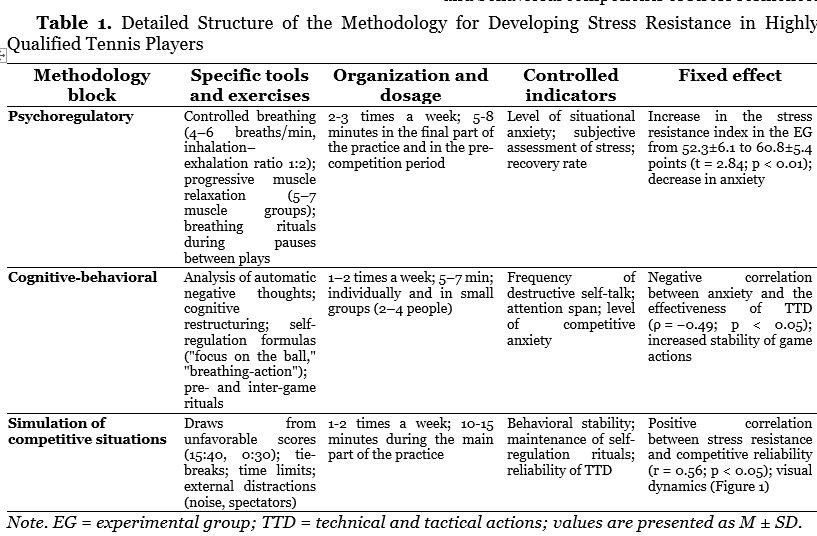
Psychoregulation methods. The intervention utilized psychoregulation methods aimed at reducing psychoemotional stress and optimizing athletes’ functional state. This block centered on breathing and muscle relaxation techniques adapted to the specifics of elite tennis. Voluntary breathing exercises with an extended exhalation phase (inhalation-exhalation ratio of 1:2) were performed under static and dynamic conditions, and elements of progressive muscle relaxation were applied to the major muscle groups. These exercises were used primarily at the end of training sessions and in the pre-competition period.
The choice of the breathing pattern with a frequency of 4–6 cycles per minute and an inhalation‑to‑exhalation ratio of 1:2 is based on current data on the psychophysiological effects of slow breathing. A systematic review by Zaccaro et al. (2018) demonstrated that slow, conscious breathing (fewer than 10 breaths/min) leads to a significant increase in heart rate variability (HRV), enhanced parasympathetic activity, and increased EEG alpha power, all of which are associated with reduced anxiety, greater comfort, and improved emotional control. The prolonged exhalation further accentuates respiratory sinus arrhythmia, a reliable marker of vagal regulation and stress resistance (Zaccaro et al., 2018). Thus, the selected breathing regime purposefully influences the central and autonomic mechanisms of emotional regulation, which aligns with the aims of increasing stress resistance in tennis players.
Beyond the anxiolytic effects of slow breathing, the deliberate inclusion of recovery‑oriented strategies is increasingly recognised as a critical factor in preventing maladaptive outcomes in elite athletes. In a prospective multilevel study of young elite table‑tennis players, Martinent et al. (2022) showed that athletes’ recovery scores significantly predicted lower levels of reduced accomplishment three months later, even after controlling for baseline burnout and stress. The psychoregulation techniques employed in the present intervention, controlled breathing, progressive muscle relaxation, and ritualised recovery during match pauses, were specifically designed to enhance this recovery dimension, helping athletes to restore emotional and physiological resources under competitive pressure.
This choice is consistent with Naboichenko et al. (2022), who found that athletes in individual sports, including tennis, exhibit higher tension than team‑sport athletes, reinforcing the need to target neuropsychic tension and emotional tone, which are key parameters of mental stability.
Additionally, elements of short-term psychoregulation were used during pauses between game episodes (ritualized breathing cycles, focusing on bodily sensations), which helped restore optimal activation levels without disrupting competitive rhythm.
Cognitive-behavioral techniques. This block aimed to develop more adaptive cognitive attitudes and response strategies. Work was conducted individually and in small groups and included cognitive restructuring and behavioral training. Stress-induced cognitive biases typical of tennis players, catastrophizing mistakes, overestimating the importance of individual game moments, negative expectations regarding match outcomes, were analyzed and replaced with more functional, process-oriented formulations. Athletes were taught self-talk and self-support skills, including short verbal self-regulation formulas used before serving, during side changes, and after unsuccessful actions. Sustainable pre-competition and intergame rituals were developed to stabilize emotional state and improve concentration.
Rituals are especially vital for tennis as an individual sport. Naboichenko et al. (2022) found that individual‑sport athletes have lower emotional tone and thus a smaller reserve of “emotional energy” under stress, making self‑support strategies like ritualized actions essential for stabilizing the emotional state.
Simulation of competitive situations. Simulated competitive situations were used to transfer psychoregulatory and cognitive-behavioral skills to conditions closely resembling real competition. This module employed specially designed training tasks with varying levels of psychological stress, including time limits, scoring from disadvantageous positions, decisive games and tiebreakers, and elements of competitive uncertainty. External distractions (noise, commentary, spectators) were introduced. The emphasis was on application of acquired techniques, not on task outcome. Brief reflective analysis followed each task to evaluate subjective states and the effectiveness of self-regulation strategies.
Integration of blocks. A key feature of the program was the integration of psychoregulation, cognitive-behavioral techniques, and competitive simulation into a unified system (see Table 1). This ensured a systemic impact on the emotional, cognitive, and behavioral components of stress resilience.
- Data Analysis
Statistical data processing included calculation of means and standard deviations, the Student t – test for dependent and independent samples, the Mann-Whitney U-test, and correlation analysis (Pearson’s r and Spearman’s ρ). The level of statistical significance was set at p < .05.
Results
Before the start of the experiment, no statistically significant differences were found between the experimental and control groups on the studied indicators (p > .05), confirming their initial homogeneity (Table 2).

At the end of the educational experiment, a significant increase in the level of stress resistance was recorded in the experimental group compared to initial values (t = 2.84, p < .01). In the control group, the changes were statistically insignificant (p > .05) (Table 3).

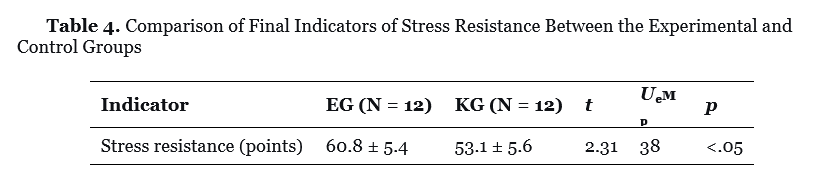
Between-group analysis revealed statistically significant differences between the experimental and control groups in the final indicators of stress resistance (t = 2.31, p < .05), which was confirmed by the results of the Mann–Whitney U-test (U = 38, p < .05) (Table 4).
Correlation analysis revealed moderate, statistically significant relationships between the level of stress resistance and competitive performance indicators: a positive correlation between the integral indicator of stress resistance and the stability of game actions (r = .56, p < .05), and a negative correlation between the level of competitive anxiety and the effectiveness of technical and tactical actions (ρ = –.49, p < .05) (Table 5).

Discussion
The present findings can be meaningfully interpreted within the framework of the recently proposed empirical model linking personal authenticity to mental toughness (Bochaver et al., 2023). In that model, authenticity indirectly builds mental toughness by enhancing intrinsic motivation and mental skills, including stress resistance, confidence, and goal commitment. The multi-component intervention tested here probably activated this pathway: psychoregulation enhanced emotional stability, cognitive-behavioral work restructured maladaptive thoughts and built self-confidence, and simulated competition transferred these skills into match-like situations, thereby reinforcing the behavioral persistence and stress resistance central to mental toughness. Although authenticity and intrinsic motivation were not directly measured, it is plausible that the program’s emphasis on self-awareness and autonomous skill application resonated with athletes’ authentic sport engagement, making the acquired skills more durable. This interpretation is consistent with Bochaver et al.’s (2023) finding that authenticity has a significant cumulative indirect effect on mental toughness (β = 0.488, p < .001), despite a modest direct effect.
Recent work further supports this interpretation: Palma Gil and Andacao (2025) found that spirituality and mental training jointly predicted athletic resilience (r = .50 to .61; R² = .433, p < .001), with spiritual well-being, locus of control, performance skills, and mental imagery as independent predictors. This confirms that multi-component psychological resources, including meaning-oriented and self-regulatory elements, are functionally linked to withstanding competitive pressure. It also suggests that future interventions could integrate values-based or purpose-oriented strategies to further strengthen the self-congruent, intrinsically motivated core of athletic resilience.
The experimental results, as shown in Tables 1–4, confirm a positive trend in stress resistance in the experimental group, with the average value increasing from 52.3 ± 6.1 to 60.8 ± 5.4 points (t = 2.84, p < .01). The control group’s change was not significant (t = 0.74, p > .05). These differences indicate that the effect is attributable to the targeted pedagogical program rather than to natural adaptation. Notably, this significant increase aligns with the Bochaver et al. (2023) model, in which stress resistance (as measured by the Connor-Davidson Resilience Scale) was one of the strongest direct predictors of mental toughness. The fact that our intervention, combining arousal regulation, cognitive reappraisal, and behavioral exposure to stress, produced a robust improvement in stress resistance supports the idea that such multi-component programs effectively strengthen the very skill that transfers the influence of authenticity and motivation into reliable competitive performance.
Intergroup analysis confirmed statistically significant differences between the experimental and control groups in final stress resistance (t = 2.31, p < .05; U = 38, p < .05). The use of both parametric and nonparametric criteria attests to the stability of the observed differences, which is particularly meaningful given the relatively small sample size (N = 24) typical of research with elite athletes.
Correlation analysis revealed functional relationships between psychological indicators and competitive performance. The moderate positive correlation between stress resistance and stability of game actions (r = .56, p < .05) indicates that athletes with higher stress resistance demonstrate greater reliability in executing technical and tactical actions under competitive pressure. The negative correlation between competitive anxiety and effectiveness of TTD (ρ = –.49, p < .05) confirms the disruptive effect of excessive emotional stress. These correlation patterns mirror the structural relationships observed in the Bochaver et al. (2023) model, where stress resistance served as a key mediator linking confidence and goal commitment to mental toughness. The moderate strength of these associations (r ≈ .5) is consistent with the model’s indirect effects (standardized indirect effects ranging from 0.15 to 0.39), emphasizing that stress resistance is an important, albeit not the sole, regulator of competitive stability. Moreover, these findings echo the conclusions of Naboichenko et al. (2022), who stressed that mental stability is a factor in the successful execution of all sports-activity tasks; athletes with good and high levels of neuropsychic stability demonstrated greater adaptability, higher working capacity, and lower anxiety.
The identified correlations should not be interpreted as causal but rather as reflecting the systemic interconnectedness of psychological and activity-based components of athletic mastery. This interpretation is in line with the meta-analytic results of Ayranci and Aydin (2025), who reported that psychological factors such as motivation, self-efficacy, stress management, and conscientiousness have consistent, moderate positive associations with sport performance. The moderate correlations observed here (r ≈ .5) fall well within the range of effect sizes documented in that synthesis, supporting the view that psychological skills are a reliable, albeit not exhaustive, determinant of competitive success. They are also consistent with meta-analytic findings indicating a large overall effect of mental toughness interventions in sport (d = 0.80), despite considerable methodological variability (Stamatis et al., 2020).
Furthermore, Cowden et al. (2021) demonstrated in a sample of 323 competitive tennis players that mental toughness is not simply a function of endorsing approach goals and avoiding avoidance goals; rather, athletes in high-goal-orientation and approach-dominant profiles both exhibited elevated mental toughness. This aligns with the present results by illustrating that a balanced, multi-component psychological skillset, one that integrates emotional regulation, cognitive reappraisal, and behavioral persistence, supports resilience even when athletes also hold avoidance-related performance concerns. The three blocks of our methodology directly parallel the core components of mental toughness: psychoregulation addresses emotional control, cognitive-behavioral techniques build self-confidence, and simulated competition reinforces behavioral stability under pressure (Fedunina, 2017). This convergence provides a robust theoretical explanation for the increase in stress resistance, suggesting that the intervention cultivated broader psychological attributes supporting reliable performance rather than merely reducing anxiety.
The observed moderate correlations also align closely with effect sizes reported in the tennis-specific mental health literature. Konstantinou et al. (2025) found that mental toughness is consistently associated with resilience (r ≈ .59) and inversely related to perceived stress (r ≈ –.44) in competitive tennis players, and that cognitive-behavioral and mindfulness-based interventions produce meaningful improvements in anxiety, self-confidence, and focus. The present results extend that evidence by demonstrating that a structured, diagnostics-driven program can shift these relationships in a performance-enhancing direction, possibly helping athletes operate nearer the “sweet spot” described in the Resilience Racket Model, the point of equilibrium where physical readiness, psychological resilience, and environmental support converge.
This finding is also consistent with the transactional model of stress and coping (Lazarus & Folkman, 1984), which posits that it is not the stressor per se but the individual’s appraisal and available coping resources that determine emotional and behavioral outcomes. Nuetzel (2023) observed that athletes who appraise competitive stressors as threats are more likely to adopt emotion-focused or avoidance strategies, which in turn are associated with heightened anxiety and performance decrements, whereas challenge appraisals facilitate problem-focused coping and adaptive outcomes. The present intervention’s emphasis on cognitive restructuring and pre-performance routines likely shifted athletes’ appraisal patterns from threat to challenge, thereby reducing competitive anxiety and strengthening technical execution under pressure.
An analysis of the intervention structure suggests that the observed positive effect is due to the comprehensive nature of the psychological training methods used. Psychoregulation contributed to a reduction in competitive anxiety, cognitive-behavioral techniques developed more adaptive strategies for responding to stressors, and simulation of competitive situations transferred acquired skills to real competitive conditions. This is in good agreement with evidence that slow, rhythmically controlled breathing induces a shift in autonomic balance toward parasympathetic predominance, increases LF power of HRV and EEG alpha activity, which is associated with a subjective increase in relaxation and a decrease in arousal symptoms (Zaccaro et al., 2018). Thus, the intervention simultaneously affected the emotional, cognitive, and behavioral levels of mental regulation.
The cognitive-behavioral component, in particular, targeted the metacognitive and motivational processes that recent tennis research has identified as critical for adaptive coping. Theodosiou et al. (2018) demonstrated that metacognitive thinking during training promotes approach coping strategies such as self-talk and planning, while mastery goal orientations and a mastery motivational climate reduce the likelihood of avoidance coping. By teaching athletes to restructure catastrophizing cognitions, to use process-focused self-talk, and to develop pre-performance rituals, the intervention likely enhanced metacognitive monitoring and reinforced a mastery-oriented, task-involved engagement with competition.
A limitation of the study is the relatively small sample size, which is inherent to research with elite athlete populations. The obtained statistical indicators and correlation coefficients are within the ranges described in contemporary domestic and international studies, supporting their representativeness. Future research could expand the sample, explore age- and skill-related differences in stress resilience, and examine the long-term effects of the proposed method. Moreover, because the sample consisted exclusively of tennis players, representatives of an individual sport, and because Naboichenko et al. (2022) showed that mental stability parameters differ between individual and team sport athletes, the results cannot be automatically generalized to team-sport athletes without further verification.
In light of the empirical model of authenticity and mental toughness (Bochaver et al., 2023), this study suggests that comprehensive psychological interventions in tennis may benefit from fostering not only isolated mental skills but also the athlete’s authentic self-determination and intrinsic motivation. The alignment of our multi-component method with the authenticity–mental toughness pathway provides a promising theoretical foundation for future programs aimed at developing resilient, self-congruent athletes capable of sustained competitive excellence.
Conclusions
This study provides rigorous experimental evidence that a comprehensive, diagnostics-driven psychological intervention can significantly enhance stress resistance in elite tennis players. The three-block methodology, integrating psychoregulation, cognitive-behavioral restructuring, and simulated competitive pressure, produced a statistically and practically meaningful increase in stress resistance, accompanied by stronger correlations with competitive reliability. These findings demonstrate that stress resistance is not a fixed trait but a trainable psychological capacity that responds to systematic, multi-component training.
The results align closely with contemporary theoretical models, particularly the authenticity–mental toughness pathway proposed by Bochaver et al. (2023). Although authenticity was not measured directly, the intervention’s design, which simultaneously cultivated self-regulatory skills, cognitive reappraisal, and autonomous behavioural practice, mirrors the very mechanisms through which authentic, intrinsically motivated sport engagement is thought to build mental toughness. Our data suggest that interventions of this kind may operate not by merely buffering stress, but by strengthening the self-congruent, mastery-oriented core of the athlete’s psychological functioning, thereby making stress resistance more robust and transferable to competitive settings. This interpretation is further supported by evidence that recovery-oriented strategies, metacognitive awareness, and problem-focused coping are critical for resilience in individual sport contexts (Martinent et al., 2022; Theodosiou et al., 2018; Nuetzel, 2023).
Beyond theoretical contribution, the study offers a replicable, structured methodology that can be integrated into the training regimens of elite tennis players. The explicit dosage, tools, and progression presented in Table 1 provide practitioners with a concrete framework for delivering psychological preparation that is tailored to the unique demands of an individual, high-pressure sport. Given that individual-sport athletes exhibit higher baseline tension and lower emotional tone than team-sport athletes (Naboychenko et al., 2022), such targeted interventions are not merely beneficial but may be essential for sustained competitive success.
Several limitations warrant consideration. The sample size, while typical of research with elite populations, was modest, and the study design did not include long-term follow-up. Future research should replicate the intervention with larger, more diverse samples, explore age- and skill-related moderators, and assess whether the observed gains in stress resistance are maintained across competitive seasons. In particular, incorporating direct measures of authenticity, intrinsic motivation, and metacognitive processes would allow for formal mediation analyses and a more precise empirical test of the proposed mechanisms. Moreover, the integration of values-based or purpose-oriented modules, consistent with the spiritual resilience findings of Palma Gil and Andacao (2025), could further strengthen the self-congruent foundations of stress resistance.
In conclusion, the present investigation moves beyond fragmented psychological training by validating a theoretically grounded, diagnostics-driven, and ecologically valid method for cultivating stress resistance in elite tennis. By simultaneously addressing emotional regulation, cognitive processing, and behavioural enactment under pressure, this approach equips athletes not simply to cope with competitive demands, but to perform with greater stability and authenticity when it matters most. We encourage the continued development of holistic, evidence-based psychological preparation programmes that foster resilient, self-determined athletes capable of sustaining excellence in the face of escalating competitive challenges.
Ethics approval: The study was conducted in accordance with the Declaration of Helsinki and was approved by the Ethics Committee of the Russian New University (Protocol No. 2023/04). All participants provided written informed consent prior to participation.
Conflict of interest: The author declares no conflict of interest.
Funding: This research did not receive any specific grant from funding agencies in the public, commercial, or not-for-profit sectors.
Author contributions: A. S. Chepik conceived and designed the study, collected and analyzed the data, drafted and revised the manuscript. The author has read and approved the final manuscript and assumes full responsibility for its content.
Data availability: The data that support the findings of this study are available from the corresponding author upon reasonable request.
References
- Ayranci, M., & Aydin, M. K. (2025). The complex interplay between psychological factors and sports performance: A systematic review and metaanalysis. PLoS ONE, 20(8), e0330862. https://doi.org/10.1371/journal.pone.0330862
- Bochaver, K.A., Reznichenko, S.I., Bondarev, D.V. (2023). Authenticity and Mental Toughness in Athletes: An Empirical Model. Experimental Psychology (Russia),16(4), 172–188. (In Russ.). https://doi.org/10.17759/exppsy.2023160412
- Cowden, R. G., Mudrak, J., & Dehghani, T. R. (2021). Latent profile analysis of achievement goal orientations in competitive tennis players: Associations with motivation and mental toughness. Journal of Sport and Health Science, 10(1), 73–80. https://doi.org/10.1016/j.jshs.2020.06.005
- Fedunina, N. Yu. (2017). Evolution of the concept of «mental strength» in foreign sport psychology. Journal of Modern Foreign Psychology, 6(4), 77-83. https://doi.org/10.17759/jmfp.2017060408
- Fletcher, D., & Sarkar, M. (2020). Psychological resilience: A review and critique of definitions, concepts, and theory. European Psychologist, 25(1), 1–15.
- Gucciardi, D. F., Hanton, S., & Gordon, S. (2020). Mental toughness in sport: Developments in theory and research. Journal of Sports Sciences, 38(9), 1013–1024.
- Hill, D. M., Hanton, S., & Matthews, N. (2020). A qualitative exploration of choking in elite sport. Psychology of Sport and Exercise, 47, Article 101637.
- Konstantinou, G. N., Kloiber, S., & Blumberger, D. M. (2025). The mental game of tennis: A scoping review and the introduction of the Resilience Racket Model. Sports, 13(5), 130. https://doi.org/10.3390/sports13050130
- Korneev, A. A., & Seleznev, S. V. (2022). Стрессоустойчивость как фактор надежности соревновательной деятельности спортсменов [Stress resistance as a factor in the reliability of competitive activity of athletes]. Fizicheskaya kul’tura: vospitanie, obrazovanie, trenirovka, (2), 22–27.
- Krylov, A. A., & Bocharov, A. V. (2023). Психологическая подготовка спортсменов в условиях высокой соревновательной интенсивности [Psychological preparation of athletes in conditions of high competitive intensity]. Uchenye zapiski universiteta imeni P.F. Lesgafta, (4(214)), 164–169.
- Laborde, S., Mosley, E., & Dosseville, F. (2021). Influence of anxiety on performance in elite athletes: A systematic review. Frontiers in Psychology, 12, Article 679804.
- Martinent, G., Cece, V., & Guillet Descas, E. (2022). The impact of stress, recovery and coping on burnout symptoms of young elite table tennis players: A prospective multilevel study. Frontiers in Psychology, 13, 1007697. https://doi.org/10.3389/fpsyg.2022.1007697
- Mironov, A. A., & Kiselev, I. V. (2021). Психологическая устойчивость высококвалифицированных спортсменов в соревновательных условиях [Psychological stability of highly qualified athletes in competitive conditions]. Teoriya i praktika fizicheskoy kul’tury, (6), 45–48.
- Naboychenko, E. S., Noskova, M. V., & Shershnev, V. N. (2022). Психическая устойчивость спортсменов высших достижений в индивидуальных и командных видах спорта как ключ успешной спортивной деятельности [Mental stability of elite athletes in individual and team sports as a key to successful sports activity]. Perspektivy nauki i obrazovaniya, (6(60)), 445–458. https://doi.org/10.32744/pse.2022.6.26
- Nicholls, A. R., Levy, A. R., & Perry, J. L. (2022). Stress, coping, and emotion regulation among professional athletes. International Journal of Sport and Exercise Psychology, 20(3), 759–776.
- Nuetzel, B. (2023). Coping strategies for handling stress and providing mental health in elite athletes: A systematic review. Frontiers in Sports and Active Living, 5, 1265783. https://doi.org/10.3389/fspor.2023.1265783
- Palma Gil, B. B. T., & Andacao, A. A. (2025). Spirituality and mental training as predictors of athletic resilience. Journal of Sports and Physical Activity, 1(2), 108–117. https://doi.org/10.64268/jospa.v1i2.19
- Sarkar, M., & Fletcher, D. (2021). How should we measure psychological resilience in sport performers? Measurement in Physical Education and Exercise Science, 25(4), 289–303.
- Stamatis, A., Grandjean, P., Morgan, G., et al. (2020). Developing and training mental toughness in sport: A systematic review and meta-analysis of observational studies and pre-test and posttest experiments. BMJ Open Sport & Exercise Medicine, 6, e000747. https://doi.org/10.1136/bmjsem-2020-000747
- Theodosiou, E. A., Mavvidis, A., & Tsigilis, N. (2018). Dealing with stress during tennis competition: The association of approach- and avoidance-coping with metacognition and achievement goal theory perspectives. Journal of Physical Education and Sport, 18(Suppl. 4), 2454–2465. https://doi.org/10.7752/jpes.2018.04368
- Weinberg, R. S., & Gould, D. (2023). Foundations of sport and exercise psychology(7th ed.). Human Kinetics.
- Zaccaro, A., Piarulli, A., Laurino, M., Garbella, E., Menicucci, D., Neri, B., & Gemignani, A. (2018). How breath-control can change your life: A systematic review on psycho-physiological correlates of slow breathing. Frontiers in Human Neuroscience, 12, Article 353. https://doi.org/10.3389/fnhum.2018.00353
Comments (0)
Relevance and Background. Modern elite tennis places escalating psycho‑emotional demands on athletes, yet psychological interventions targeting stress resistance are rarely subjected to rigorous experimental validation. Fragmented approaches prevail, and comprehensive, diagnostics‑driven programmes tailored to individual sports remain scarce. Objective. This study experimentally tested a comprehensive, diagnostics‑driven method for increasing stress resistance in elite tennis players during competitive activity. Method. Twenty-four highly qualified tennis players (CMS/MS) were assigned to an experimental group (N = 12) and a control group (N = 12), both comparable in age, experience, and skill level. Over 12 weeks, the experimental group received a multi-component psychological training program that integrated psychoregulation, cognitive-behavioral techniques, and simulated competitive situations, while the control group followed standard training. Validated measures of stress resistance, competitive anxiety, and self-regulation were administered pre- and post-intervention, and data were analyzed with Student’s t-tests, Mann-Whitney U-tests, and Pearson and Spearman correlations. Results. The experimental group showed a significant increase in stress resistance (t = 2.84, p < .01), whereas the control group’s change was non-significant. Post-intervention between-group differences were significant (t = 2.31, p < .05; U = 38, p < .05). Positive correlations between stress resistance and stability of game actions (r = .56, p < .05) and negative correlations between competitive anxiety and effectiveness of technical-tactical actions (ρ = –.49, p < .05) were found. Conclusion. The diagnostics-based, multi-component methodology effectively enhances stress resistance in elite tennis players, with gains associated with improved competitive reliability. The findings are discussed in light of recent models linking personal authenticity to mental toughness, suggesting that multi‑component interventions may operate partly by strengthening the authentically motivated, self‑congruent core of the athlete’s psychological preparation.
Повышение устойчивости теннисистов высокой квалификации к соревновательному стрессу: экспериментальная проверка комплексного, основанного на диагностике многокомпонентного вмешательства
Александр С. Чепикa, Александр С. Огневb, c
aРоссийский новый университет, Москва, Россия
bФинансовый университет при Правительстве Российской Федерации, Москва, Россия
cМосковский педагогический государственный университет, Москва, Россия
Резюме. Актуальность и исходные предпосылки. Современный теннис высших достижений предъявляет повышенные психоэмоциональные требования к спортсменам, однако психологические интервенции, направленные на повышение стрессоустойчивости, редко проходят строгую экспериментальную проверку. Преобладают фрагментарные подходы, а комплексные, диагностически обоснованные программы, адаптированные к индивидуальным видам спорта, остаются дефицитом. Цель. Экспериментально проверить эффективность комплексного, основанного на психодиагностике метода повышения стрессоустойчивости высококвалифицированных теннисистов в условиях соревновательной деятельности. Метод. Двадцать четыре высококвалифицированных теннисиста (КМС/МС) были распределены в экспериментальную (N= 12) и контрольную N = 12) группы, сопоставимые по возрасту, спортивному стажу и уровню мастерства. В течение 12 недель экспериментальная группа в дополнение к стандартной тренировочной программе проходила структурированную психологическую подготовку, объединяющую психорегуляцию, когнитивно-поведенческие техники и моделирование соревновательных ситуаций; контрольная группа тренировалась по традиционной методике. До и после вмешательства применялись валидные психодиагностические инструменты для оценки стрессоустойчивости, соревновательной тревожности и саморегуляции. Данные анализировались с помощью t‑критерия Стьюдента, U‑критерия Манна-Уитни, а также корреляционного анализа (коэффициенты Пирсона и Спирмена). Результаты. В экспериментальной группе зафиксирован значимый прирост стрессоустойчивости (t = 2.84, p <0.01), тогда как изменения в контрольной группе были статистически незначимы. Межгрупповые различия по завершении вмешательства оказались достоверными (t = 2.31, p <0.05; U = 38, p <0.05). Обнаружены положительная корреляция между стрессоустойчивостью и стабильностью игровых действий (r = 0.56, p <0.05), а также отрицательная связь между соревновательной тревожностью и эффективностью технико-тактических действий (ρ = –0.49, p <0.05). Заключение. Диагностически обоснованная многокомпонентная методика эффективно повышает стрессоустойчивость высококвалифицированных теннисистов, причём улучшение сопряжено с ростом соревновательной надёжности. Результаты обсуждаются в контексте современных моделей, связывающих личностную аутентичность с ментальной прочностью, и позволяют предположить, что подобные интервенции способны укреплять аутентично мотивированное, самоконгруэнтное ядро психологической подготовки спортсменов.
Ключевые слова: стрессоустойчивость, теннис, высококвалифицированные спортсмены, соревновательная деятельность, психологическая подготовка
Modern tennis is characterized by highly dynamic competition, an increasingly dense tournament calendar, and escalating psycho-emotional stress placed on elite athletes. Under these conditions, stress resistance is considered one of the key factors ensuring the stability of competitive performance and the effective realization of athletes’ technical and tactical potential (Fletcher & Sarkar, 2020; Gucciardi et al., 2020).
An analysis of recent scientific research indicates a growing interest in the issue of psychological resilience and stress resistance in high-performance sports (Nicholls et al., 2022; Sarkar & Fletcher, 2021; Weinberg & Gould, 2023). In this context, the concept of mental toughness has gained particular attention as a multidimensional resource integrating emotional control, cognitive stability, and behavioral persistence under competitive pressure (Fedunina, 2017). In competitive tennis specifically, latent profile analysis has revealed that athletes who endorse approach‑oriented achievement goals, regardless of whether they also pursue avoidance goals, report significantly higher levels of mental toughness and autonomous motivation, suggesting that the combination of goal orientations matters more than the presence or absence of avoidance goals alone (Cowden et al., 2021). Developing these attributes is increasingly regarded as a promising direction for building stress resistance in elite athletes. Although meta-analytic evidence confirms that interventions targeting mental toughness can yield large overall effects in sport, their methodological quality varies considerably and they remain largely untested in tennis specifically (Stamatis et al., 2020). However, in tennis, issues of increasing stress resilience are often addressed in a fragmented manner, without reliance on comprehensive diagnostics and experimental testing of the effectiveness of educational interventions, which underlies the relevance of this study.
A recent large‑scale meta‑analysis by Ayranci and Aydin (2025), encompassing 127 studies and 24,358 athletes, confirmed that psychological factors overall exert a moderate positive effect on sports performance (d = 0.329), with particularly robust effect sizes for motivation (d = 0.525), self‑efficacy (d = 0.413), goal setting (d = 0.460), and personality traits (d = 0.607). These findings reinforce the necessity of systematically developing psychological skills in athletes and provide a strong, evidence‑based rationale for the comprehensive, diagnostics‑driven intervention tested in the present study.
A recent scoping review of tennis and mental health (Konstantinou et al., 2025) corroborates this perspective, showing that tennis participation yields clear psychological benefits—reduced depression and anxiety, improved self‑confidence, and enhanced resilience, while simultaneously exposing athletes to considerable competitive stress, attentional pressure, and a risk of maladaptive coping. The review highlights that effective psychological support in tennis must address emotional, cognitive, and environmental factors in an integrated manner, and proposes the Resilience Racket Model, a conceptual framework that unifies physical readiness (handle), psychological resilience competencies (strings), and systemic support structures (frame) to achieve optimal performance and well‑being (the “sweet spot”). The present experimental methodology, which systematically combines psychoregulation, cognitive‑behavioral techniques, and simulated competition, is fully aligned with this holistic, multi‑component philosophy.
Tennis‑specific research further indicates that adaptive stress responses depend not only on broad psychological skills but also on higher‑order cognitive processes and the motivational climate surrounding the athlete. Theodosiou et al. (2018) studied 226 national‑level Greek tennis players and found that metacognitive thinking during training significantly predicted approach‑oriented coping strategies in competition—such as self‑talk, effort increase, and planning. Mastery goal orientation (task involvement) and perceptions of a mastery motivational climate were positively associated with approach coping and negatively associated with avoidance coping, whereas performance‑avoidance goals and a performance‑avoidance climate predicted maladaptive, avoidant responses. These findings highlight that effective interventions in tennis must cultivate athletes’ metacognitive awareness and reinforce a mastery‑oriented focus on personal improvement rather than on outcome. The present experimental methodology, which integrates cognitive‑behavioral techniques (e.g., restructuring, self‑talk) with process‑orientated simulated competition, is specifically designed to activate these adaptive pathways.
Moreover, research in elite racquet sports indicates that the capacity to recover from daily stressors plays a more decisive role in preventing maladaptive outcomes than the mere presence of stress. In a prospective multilevel study of 159 young elite table‑tennis players, Martinent et al. (2022) found that higher levels of self‑reported recovery at mid‑season significantly predicted lower reduced accomplishment at the end of the season, whereas stress alone did not predict burnout symptoms. The authors concluded that achieving a balance between stress and personal resources, particularly recovery and effective coping, is critical for sustaining performance and well‑being in intensive training settings. This finding underscores the necessity of including structured recovery‑oriented techniques (e.g., controlled breathing, progressive muscle relaxation) within psychological preparation programmes for individual racket‑sport athletes, a principle directly reflected in the psychoregulation block of the present experimental method.
Recent research suggests that the roots of an athlete’s psychological resilience may lie even deeper. The construct of personal authenticity, being true to one’s self, aware of one’s values, and the autonomous author of one’s life path, has been proposed as a fundamental personality resource that undergirds mental toughness (Bochaver et al., 2023). In a large‑scale study of 347 elite male athletes, Bochaver et al. (2023) demonstrated that authenticity does not directly produce mental toughness in a simple way; instead, it strengthens intrinsic motivation (self‑development, learning, enjoyment), which in turn supports mental skills such as stress resistance, confidence, goal commitment, and diligence, ultimately enhancing mental toughness. This structural model explains why interventions that merely target stress symptoms may be less effective than those that foster the athlete’s autonomous, self‑congruent engagement with their sport. The present study, although not measuring authenticity itself, implements a multi‑component psychological programme whose design is highly compatible with this model: it simultaneously addresses emotional regulation, cognitive restructuring, and behavioural practice under pressure, processes that are precisely the downstream consequences of an authentic, intrinsically motivated sport involvement. Therefore, we expected that a comprehensive, diagnostics‑based intervention would not only improve stress resistance but would also do so via mechanisms aligned with the authenticity–mental toughness pathway.
Parallel findings from Palma Gil and Andacao (2025) reinforce this view. In a sample of 145 collegiate athletes, spiritual well‑being and spiritual locus of control, combined with mental training skills such as performance skills and mental imagery, significantly predicted sports resilience, explaining 43.3% of its variance. This evidence indicates that psychologically robust athletes draw on a broad spectrum of resources, including meaning‑oriented and self‑regulatory components, further justifying the comprehensive, multi‑component approach adopted in the present study.
Recent large‑scale findings further underscore the relevance of a sport‑specific approach. Naboichenko et al. (2022), in a study of 1,545 highly qualified athletes (14-17 years old) from individual and team sports, demonstrated that although athletes generally possess good neuropsychic stability, significant differences exist between sport types. Athletes from team sports showed higher emotional tone (p = .007) and lower tension (p = .0308) than those from individual sports. Tennis, as a predominantly individual sport, therefore places particularly high demands on an athlete’s autonomous capacity to regulate tension and maintain emotional balance under competitive pressure. These findings highlight the necessity of developing psychological interventions that are not only comprehensive but also tailored to the specific stressors of individual competition, a gap the present experimental methodology aims to fill.
A recent systematic review of coping in elite athletes (Nuetzel, 2023) reinforces this tailored approach. The review demonstrates that coping in elite sport is highly complex and dynamic, with athletes employing a broad spectrum of strategies such as problem‑focused, emotion‑focused, avoidance, and social‑support seeking, depending on the nature of the stressor, its appraisal, and the athlete’s available resources. Critically, Nuetzel (2023) found that problem‑focused coping is consistently associated with lower anxiety and higher resilience, while avoidant coping predicts burnout and psychological distress. Moreover, the effectiveness of any coping strategy is intimately tied to the situational demands of the sport. Individual‑sport athletes, who cannot share competitive pressure with teammates, may rely more heavily on self‑regulatory and cognitive restructuring skills. The present intervention, which integrates psychoregulation, cognitive‑behavioral techniques, and pressure simulation, directly targets these evidence‑based coping pathways and addresses the specific coping demands of tennis as an individual sport.
The aim of the study was to experimentally test the effectiveness of a method for increasing stress resistance in highly qualified tennis players during competitive activities. The specific objectives were:
To determine the initial level of stress resistance of highly qualified tennis players;
To develop a methodology aimed at increasing the stress resistance of highly qualified tennis players;
To evaluate the effectiveness of the methodology using methods of mathematical statistics;
To identify the relationship between stress resistance indicators and competitive performance.
- Participants
Twenty-four highly qualified tennis players (Candidate Master of Sports and Master of Sports level) were divided into an experimental group (N = 12) and a control group (N = 12). The groups were comparable in age (M = 19.2 years, SD = 2.1), sports experience (M = 8.4 years, SD = 1.8), and level of sports achievements. All participants provided informed consent; the study was approved by the institutional ethics committee.
- Measures
Stress resistance and competitive anxiety were assessed using validated psychodiagnostic tools such as ACSI-28 (Athletic Coping Skills Inventory which consist of 28 scales) and measuring heart rate variability (HRV). Competitive reliability indicators were derived from match statistics. We adopted the definition of mental stability as “an innate dynamic personality trait, the athlete’s ability through self‑regulation to withstand stress‑inducing factors while maintaining performance, reliability, and health” (Naboichenko et al., 2022). Crucially, this trait is not static but develops throughout a career, which directly justifies targeted psychological interventions.
- Experimental Design and Procedure
The experiment was conducted over 12 weeks during the competitive preparation period. The experimental group, in addition to the standard training programme, underwent psychological training comprising three integrated blocks: psychoregulation methods, cognitive-behavioral techniques, and simulated competitive situations. The control group trained using the traditional method. Pre- and post-intervention assessments were administered identically to both groups.
Intervention
Psychoregulation methods. The intervention utilized psychoregulation methods aimed at reducing psychoemotional stress and optimizing athletes’ functional state. This block centered on breathing and muscle relaxation techniques adapted to the specifics of elite tennis. Voluntary breathing exercises with an extended exhalation phase (inhalation-exhalation ratio of 1:2) were performed under static and dynamic conditions, and elements of progressive muscle relaxation were applied to the major muscle groups. These exercises were used primarily at the end of training sessions and in the pre-competition period.
The choice of the breathing pattern with a frequency of 4–6 cycles per minute and an inhalation‑to‑exhalation ratio of 1:2 is based on current data on the psychophysiological effects of slow breathing. A systematic review by Zaccaro et al. (2018) demonstrated that slow, conscious breathing (fewer than 10 breaths/min) leads to a significant increase in heart rate variability (HRV), enhanced parasympathetic activity, and increased EEG alpha power, all of which are associated with reduced anxiety, greater comfort, and improved emotional control. The prolonged exhalation further accentuates respiratory sinus arrhythmia, a reliable marker of vagal regulation and stress resistance (Zaccaro et al., 2018). Thus, the selected breathing regime purposefully influences the central and autonomic mechanisms of emotional regulation, which aligns with the aims of increasing stress resistance in tennis players.
Beyond the anxiolytic effects of slow breathing, the deliberate inclusion of recovery‑oriented strategies is increasingly recognised as a critical factor in preventing maladaptive outcomes in elite athletes. In a prospective multilevel study of young elite table‑tennis players, Martinent et al. (2022) showed that athletes’ recovery scores significantly predicted lower levels of reduced accomplishment three months later, even after controlling for baseline burnout and stress. The psychoregulation techniques employed in the present intervention, controlled breathing, progressive muscle relaxation, and ritualised recovery during match pauses, were specifically designed to enhance this recovery dimension, helping athletes to restore emotional and physiological resources under competitive pressure.
This choice is consistent with Naboichenko et al. (2022), who found that athletes in individual sports, including tennis, exhibit higher tension than team‑sport athletes, reinforcing the need to target neuropsychic tension and emotional tone, which are key parameters of mental stability.
Additionally, elements of short-term psychoregulation were used during pauses between game episodes (ritualized breathing cycles, focusing on bodily sensations), which helped restore optimal activation levels without disrupting competitive rhythm.
Cognitive-behavioral techniques. This block aimed to develop more adaptive cognitive attitudes and response strategies. Work was conducted individually and in small groups and included cognitive restructuring and behavioral training. Stress-induced cognitive biases typical of tennis players, catastrophizing mistakes, overestimating the importance of individual game moments, negative expectations regarding match outcomes, were analyzed and replaced with more functional, process-oriented formulations. Athletes were taught self-talk and self-support skills, including short verbal self-regulation formulas used before serving, during side changes, and after unsuccessful actions. Sustainable pre-competition and intergame rituals were developed to stabilize emotional state and improve concentration.
Rituals are especially vital for tennis as an individual sport. Naboichenko et al. (2022) found that individual‑sport athletes have lower emotional tone and thus a smaller reserve of “emotional energy” under stress, making self‑support strategies like ritualized actions essential for stabilizing the emotional state.
Simulation of competitive situations. Simulated competitive situations were used to transfer psychoregulatory and cognitive-behavioral skills to conditions closely resembling real competition. This module employed specially designed training tasks with varying levels of psychological stress, including time limits, scoring from disadvantageous positions, decisive games and tiebreakers, and elements of competitive uncertainty. External distractions (noise, commentary, spectators) were introduced. The emphasis was on application of acquired techniques, not on task outcome. Brief reflective analysis followed each task to evaluate subjective states and the effectiveness of self-regulation strategies.
Integration of blocks. A key feature of the program was the integration of psychoregulation, cognitive-behavioral techniques, and competitive simulation into a unified system (see Table 1). This ensured a systemic impact on the emotional, cognitive, and behavioral components of stress resilience.
- Data Analysis
Statistical data processing included calculation of means and standard deviations, the Student t – test for dependent and independent samples, the Mann-Whitney U-test, and correlation analysis (Pearson’s r and Spearman’s ρ). The level of statistical significance was set at p < .05.
Before the start of the experiment, no statistically significant differences were found between the experimental and control groups on the studied indicators (p > .05), confirming their initial homogeneity (Table 2).
At the end of the educational experiment, a significant increase in the level of stress resistance was recorded in the experimental group compared to initial values (t = 2.84, p < .01). In the control group, the changes were statistically insignificant (p > .05) (Table 3).
Between-group analysis revealed statistically significant differences between the experimental and control groups in the final indicators of stress resistance (t = 2.31, p < .05), which was confirmed by the results of the Mann–Whitney U-test (U = 38, p < .05) (Table 4).
Correlation analysis revealed moderate, statistically significant relationships between the level of stress resistance and competitive performance indicators: a positive correlation between the integral indicator of stress resistance and the stability of game actions (r = .56, p < .05), and a negative correlation between the level of competitive anxiety and the effectiveness of technical and tactical actions (ρ = –.49, p < .05) (Table 5).
The present findings can be meaningfully interpreted within the framework of the recently proposed empirical model linking personal authenticity to mental toughness (Bochaver et al., 2023). In that model, authenticity indirectly builds mental toughness by enhancing intrinsic motivation and mental skills, including stress resistance, confidence, and goal commitment. The multi-component intervention tested here probably activated this pathway: psychoregulation enhanced emotional stability, cognitive-behavioral work restructured maladaptive thoughts and built self-confidence, and simulated competition transferred these skills into match-like situations, thereby reinforcing the behavioral persistence and stress resistance central to mental toughness. Although authenticity and intrinsic motivation were not directly measured, it is plausible that the program’s emphasis on self-awareness and autonomous skill application resonated with athletes’ authentic sport engagement, making the acquired skills more durable. This interpretation is consistent with Bochaver et al.’s (2023) finding that authenticity has a significant cumulative indirect effect on mental toughness (β = 0.488, p < .001), despite a modest direct effect.
Recent work further supports this interpretation: Palma Gil and Andacao (2025) found that spirituality and mental training jointly predicted athletic resilience (r = .50 to .61; R² = .433, p < .001), with spiritual well-being, locus of control, performance skills, and mental imagery as independent predictors. This confirms that multi-component psychological resources, including meaning-oriented and self-regulatory elements, are functionally linked to withstanding competitive pressure. It also suggests that future interventions could integrate values-based or purpose-oriented strategies to further strengthen the self-congruent, intrinsically motivated core of athletic resilience.
The experimental results, as shown in Tables 1–4, confirm a positive trend in stress resistance in the experimental group, with the average value increasing from 52.3 ± 6.1 to 60.8 ± 5.4 points (t = 2.84, p < .01). The control group’s change was not significant (t = 0.74, p > .05). These differences indicate that the effect is attributable to the targeted pedagogical program rather than to natural adaptation. Notably, this significant increase aligns with the Bochaver et al. (2023) model, in which stress resistance (as measured by the Connor-Davidson Resilience Scale) was one of the strongest direct predictors of mental toughness. The fact that our intervention, combining arousal regulation, cognitive reappraisal, and behavioral exposure to stress, produced a robust improvement in stress resistance supports the idea that such multi-component programs effectively strengthen the very skill that transfers the influence of authenticity and motivation into reliable competitive performance.
Intergroup analysis confirmed statistically significant differences between the experimental and control groups in final stress resistance (t = 2.31, p < .05; U = 38, p < .05). The use of both parametric and nonparametric criteria attests to the stability of the observed differences, which is particularly meaningful given the relatively small sample size (N = 24) typical of research with elite athletes.
Correlation analysis revealed functional relationships between psychological indicators and competitive performance. The moderate positive correlation between stress resistance and stability of game actions (r = .56, p < .05) indicates that athletes with higher stress resistance demonstrate greater reliability in executing technical and tactical actions under competitive pressure. The negative correlation between competitive anxiety and effectiveness of TTD (ρ = –.49, p < .05) confirms the disruptive effect of excessive emotional stress. These correlation patterns mirror the structural relationships observed in the Bochaver et al. (2023) model, where stress resistance served as a key mediator linking confidence and goal commitment to mental toughness. The moderate strength of these associations (r ≈ .5) is consistent with the model’s indirect effects (standardized indirect effects ranging from 0.15 to 0.39), emphasizing that stress resistance is an important, albeit not the sole, regulator of competitive stability. Moreover, these findings echo the conclusions of Naboichenko et al. (2022), who stressed that mental stability is a factor in the successful execution of all sports-activity tasks; athletes with good and high levels of neuropsychic stability demonstrated greater adaptability, higher working capacity, and lower anxiety.
The identified correlations should not be interpreted as causal but rather as reflecting the systemic interconnectedness of psychological and activity-based components of athletic mastery. This interpretation is in line with the meta-analytic results of Ayranci and Aydin (2025), who reported that psychological factors such as motivation, self-efficacy, stress management, and conscientiousness have consistent, moderate positive associations with sport performance. The moderate correlations observed here (r ≈ .5) fall well within the range of effect sizes documented in that synthesis, supporting the view that psychological skills are a reliable, albeit not exhaustive, determinant of competitive success. They are also consistent with meta-analytic findings indicating a large overall effect of mental toughness interventions in sport (d = 0.80), despite considerable methodological variability (Stamatis et al., 2020).
Furthermore, Cowden et al. (2021) demonstrated in a sample of 323 competitive tennis players that mental toughness is not simply a function of endorsing approach goals and avoiding avoidance goals; rather, athletes in high-goal-orientation and approach-dominant profiles both exhibited elevated mental toughness. This aligns with the present results by illustrating that a balanced, multi-component psychological skillset, one that integrates emotional regulation, cognitive reappraisal, and behavioral persistence, supports resilience even when athletes also hold avoidance-related performance concerns. The three blocks of our methodology directly parallel the core components of mental toughness: psychoregulation addresses emotional control, cognitive-behavioral techniques build self-confidence, and simulated competition reinforces behavioral stability under pressure (Fedunina, 2017). This convergence provides a robust theoretical explanation for the increase in stress resistance, suggesting that the intervention cultivated broader psychological attributes supporting reliable performance rather than merely reducing anxiety.
The observed moderate correlations also align closely with effect sizes reported in the tennis-specific mental health literature. Konstantinou et al. (2025) found that mental toughness is consistently associated with resilience (r ≈ .59) and inversely related to perceived stress (r ≈ –.44) in competitive tennis players, and that cognitive-behavioral and mindfulness-based interventions produce meaningful improvements in anxiety, self-confidence, and focus. The present results extend that evidence by demonstrating that a structured, diagnostics-driven program can shift these relationships in a performance-enhancing direction, possibly helping athletes operate nearer the “sweet spot” described in the Resilience Racket Model, the point of equilibrium where physical readiness, psychological resilience, and environmental support converge.
This finding is also consistent with the transactional model of stress and coping (Lazarus & Folkman, 1984), which posits that it is not the stressor per se but the individual’s appraisal and available coping resources that determine emotional and behavioral outcomes. Nuetzel (2023) observed that athletes who appraise competitive stressors as threats are more likely to adopt emotion-focused or avoidance strategies, which in turn are associated with heightened anxiety and performance decrements, whereas challenge appraisals facilitate problem-focused coping and adaptive outcomes. The present intervention’s emphasis on cognitive restructuring and pre-performance routines likely shifted athletes’ appraisal patterns from threat to challenge, thereby reducing competitive anxiety and strengthening technical execution under pressure.
An analysis of the intervention structure suggests that the observed positive effect is due to the comprehensive nature of the psychological training methods used. Psychoregulation contributed to a reduction in competitive anxiety, cognitive-behavioral techniques developed more adaptive strategies for responding to stressors, and simulation of competitive situations transferred acquired skills to real competitive conditions. This is in good agreement with evidence that slow, rhythmically controlled breathing induces a shift in autonomic balance toward parasympathetic predominance, increases LF power of HRV and EEG alpha activity, which is associated with a subjective increase in relaxation and a decrease in arousal symptoms (Zaccaro et al., 2018). Thus, the intervention simultaneously affected the emotional, cognitive, and behavioral levels of mental regulation.
The cognitive-behavioral component, in particular, targeted the metacognitive and motivational processes that recent tennis research has identified as critical for adaptive coping. Theodosiou et al. (2018) demonstrated that metacognitive thinking during training promotes approach coping strategies such as self-talk and planning, while mastery goal orientations and a mastery motivational climate reduce the likelihood of avoidance coping. By teaching athletes to restructure catastrophizing cognitions, to use process-focused self-talk, and to develop pre-performance rituals, the intervention likely enhanced metacognitive monitoring and reinforced a mastery-oriented, task-involved engagement with competition.
A limitation of the study is the relatively small sample size, which is inherent to research with elite athlete populations. The obtained statistical indicators and correlation coefficients are within the ranges described in contemporary domestic and international studies, supporting their representativeness. Future research could expand the sample, explore age- and skill-related differences in stress resilience, and examine the long-term effects of the proposed method. Moreover, because the sample consisted exclusively of tennis players, representatives of an individual sport, and because Naboichenko et al. (2022) showed that mental stability parameters differ between individual and team sport athletes, the results cannot be automatically generalized to team-sport athletes without further verification.
In light of the empirical model of authenticity and mental toughness (Bochaver et al., 2023), this study suggests that comprehensive psychological interventions in tennis may benefit from fostering not only isolated mental skills but also the athlete’s authentic self-determination and intrinsic motivation. The alignment of our multi-component method with the authenticity–mental toughness pathway provides a promising theoretical foundation for future programs aimed at developing resilient, self-congruent athletes capable of sustained competitive excellence.
This study provides rigorous experimental evidence that a comprehensive, diagnostics-driven psychological intervention can significantly enhance stress resistance in elite tennis players. The three-block methodology, integrating psychoregulation, cognitive-behavioral restructuring, and simulated competitive pressure, produced a statistically and practically meaningful increase in stress resistance, accompanied by stronger correlations with competitive reliability. These findings demonstrate that stress resistance is not a fixed trait but a trainable psychological capacity that responds to systematic, multi-component training.
The results align closely with contemporary theoretical models, particularly the authenticity–mental toughness pathway proposed by Bochaver et al. (2023). Although authenticity was not measured directly, the intervention’s design, which simultaneously cultivated self-regulatory skills, cognitive reappraisal, and autonomous behavioural practice, mirrors the very mechanisms through which authentic, intrinsically motivated sport engagement is thought to build mental toughness. Our data suggest that interventions of this kind may operate not by merely buffering stress, but by strengthening the self-congruent, mastery-oriented core of the athlete’s psychological functioning, thereby making stress resistance more robust and transferable to competitive settings. This interpretation is further supported by evidence that recovery-oriented strategies, metacognitive awareness, and problem-focused coping are critical for resilience in individual sport contexts (Martinent et al., 2022; Theodosiou et al., 2018; Nuetzel, 2023).
Beyond theoretical contribution, the study offers a replicable, structured methodology that can be integrated into the training regimens of elite tennis players. The explicit dosage, tools, and progression presented in Table 1 provide practitioners with a concrete framework for delivering psychological preparation that is tailored to the unique demands of an individual, high-pressure sport. Given that individual-sport athletes exhibit higher baseline tension and lower emotional tone than team-sport athletes (Naboychenko et al., 2022), such targeted interventions are not merely beneficial but may be essential for sustained competitive success.
Several limitations warrant consideration. The sample size, while typical of research with elite populations, was modest, and the study design did not include long-term follow-up. Future research should replicate the intervention with larger, more diverse samples, explore age- and skill-related moderators, and assess whether the observed gains in stress resistance are maintained across competitive seasons. In particular, incorporating direct measures of authenticity, intrinsic motivation, and metacognitive processes would allow for formal mediation analyses and a more precise empirical test of the proposed mechanisms. Moreover, the integration of values-based or purpose-oriented modules, consistent with the spiritual resilience findings of Palma Gil and Andacao (2025), could further strengthen the self-congruent foundations of stress resistance.
In conclusion, the present investigation moves beyond fragmented psychological training by validating a theoretically grounded, diagnostics-driven, and ecologically valid method for cultivating stress resistance in elite tennis. By simultaneously addressing emotional regulation, cognitive processing, and behavioural enactment under pressure, this approach equips athletes not simply to cope with competitive demands, but to perform with greater stability and authenticity when it matters most. We encourage the continued development of holistic, evidence-based psychological preparation programmes that foster resilient, self-determined athletes capable of sustaining excellence in the face of escalating competitive challenges.
Ethics approval: The study was conducted in accordance with the Declaration of Helsinki and was approved by the Ethics Committee of the Russian New University (Protocol No. 2023/04). All participants provided written informed consent prior to participation.
Conflict of interest: The author declares no conflict of interest.
Funding: This research did not receive any specific grant from funding agencies in the public, commercial, or not-for-profit sectors.
Author contributions: A. S. Chepik conceived and designed the study, collected and analyzed the data, drafted and revised the manuscript. The author has read and approved the final manuscript and assumes full responsibility for its content.
Data availability: The data that support the findings of this study are available from the corresponding author upon reasonable request.
- Ayranci, M., & Aydin, M. K. (2025). The complex interplay between psychological factors and sports performance: A systematic review and metaanalysis. PLoS ONE, 20(8), e0330862. https://doi.org/10.1371/journal.pone.0330862
- Bochaver, K.A., Reznichenko, S.I., Bondarev, D.V. (2023). Authenticity and Mental Toughness in Athletes: An Empirical Model. Experimental Psychology (Russia),16(4), 172–188. (In Russ.). https://doi.org/10.17759/exppsy.2023160412
- Cowden, R. G., Mudrak, J., & Dehghani, T. R. (2021). Latent profile analysis of achievement goal orientations in competitive tennis players: Associations with motivation and mental toughness. Journal of Sport and Health Science, 10(1), 73–80. https://doi.org/10.1016/j.jshs.2020.06.005
- Fedunina, N. Yu. (2017). Evolution of the concept of «mental strength» in foreign sport psychology. Journal of Modern Foreign Psychology, 6(4), 77-83. https://doi.org/10.17759/jmfp.2017060408
- Fletcher, D., & Sarkar, M. (2020). Psychological resilience: A review and critique of definitions, concepts, and theory. European Psychologist, 25(1), 1–15.
- Gucciardi, D. F., Hanton, S., & Gordon, S. (2020). Mental toughness in sport: Developments in theory and research. Journal of Sports Sciences, 38(9), 1013–1024.
- Hill, D. M., Hanton, S., & Matthews, N. (2020). A qualitative exploration of choking in elite sport. Psychology of Sport and Exercise, 47, Article 101637.
- Konstantinou, G. N., Kloiber, S., & Blumberger, D. M. (2025). The mental game of tennis: A scoping review and the introduction of the Resilience Racket Model. Sports, 13(5), 130. https://doi.org/10.3390/sports13050130
- Korneev, A. A., & Seleznev, S. V. (2022). Стрессоустойчивость как фактор надежности соревновательной деятельности спортсменов [Stress resistance as a factor in the reliability of competitive activity of athletes]. Fizicheskaya kul’tura: vospitanie, obrazovanie, trenirovka, (2), 22–27.
- Krylov, A. A., & Bocharov, A. V. (2023). Психологическая подготовка спортсменов в условиях высокой соревновательной интенсивности [Psychological preparation of athletes in conditions of high competitive intensity]. Uchenye zapiski universiteta imeni P.F. Lesgafta, (4(214)), 164–169.
- Laborde, S., Mosley, E., & Dosseville, F. (2021). Influence of anxiety on performance in elite athletes: A systematic review. Frontiers in Psychology, 12, Article 679804.
- Martinent, G., Cece, V., & Guillet Descas, E. (2022). The impact of stress, recovery and coping on burnout symptoms of young elite table tennis players: A prospective multilevel study. Frontiers in Psychology, 13, 1007697. https://doi.org/10.3389/fpsyg.2022.1007697
- Mironov, A. A., & Kiselev, I. V. (2021). Психологическая устойчивость высококвалифицированных спортсменов в соревновательных условиях [Psychological stability of highly qualified athletes in competitive conditions]. Teoriya i praktika fizicheskoy kul’tury, (6), 45–48.
- Naboychenko, E. S., Noskova, M. V., & Shershnev, V. N. (2022). Психическая устойчивость спортсменов высших достижений в индивидуальных и командных видах спорта как ключ успешной спортивной деятельности [Mental stability of elite athletes in individual and team sports as a key to successful sports activity]. Perspektivy nauki i obrazovaniya, (6(60)), 445–458. https://doi.org/10.32744/pse.2022.6.26
- Nicholls, A. R., Levy, A. R., & Perry, J. L. (2022). Stress, coping, and emotion regulation among professional athletes. International Journal of Sport and Exercise Psychology, 20(3), 759–776.
- Nuetzel, B. (2023). Coping strategies for handling stress and providing mental health in elite athletes: A systematic review. Frontiers in Sports and Active Living, 5, 1265783. https://doi.org/10.3389/fspor.2023.1265783
- Palma Gil, B. B. T., & Andacao, A. A. (2025). Spirituality and mental training as predictors of athletic resilience. Journal of Sports and Physical Activity, 1(2), 108–117. https://doi.org/10.64268/jospa.v1i2.19
- Sarkar, M., & Fletcher, D. (2021). How should we measure psychological resilience in sport performers? Measurement in Physical Education and Exercise Science, 25(4), 289–303.
- Stamatis, A., Grandjean, P., Morgan, G., et al. (2020). Developing and training mental toughness in sport: A systematic review and meta-analysis of observational studies and pre-test and posttest experiments. BMJ Open Sport & Exercise Medicine, 6, e000747. https://doi.org/10.1136/bmjsem-2020-000747
- Theodosiou, E. A., Mavvidis, A., & Tsigilis, N. (2018). Dealing with stress during tennis competition: The association of approach- and avoidance-coping with metacognition and achievement goal theory perspectives. Journal of Physical Education and Sport, 18(Suppl. 4), 2454–2465. https://doi.org/10.7752/jpes.2018.04368
- Weinberg, R. S., & Gould, D. (2023). Foundations of sport and exercise psychology(7th ed.). Human Kinetics.
- Zaccaro, A., Piarulli, A., Laurino, M., Garbella, E., Menicucci, D., Neri, B., & Gemignani, A. (2018). How breath-control can change your life: A systematic review on psycho-physiological correlates of slow breathing. Frontiers in Human Neuroscience, 12, Article 353. https://doi.org/10.3389/fnhum.2018.00353
Conclusions




