Verbal and Visual Metaphorization as a Tool for Constructing Students’ Metacognitive Knowledge
Abstract
Abstract
Relevance and Background. The study addresses the fundamental challenge of explicating latent reflexive structures in students’ metacognitive knowledge, which remain inadequately captured by traditional standardized questionnaires. The integration of metaphorical tools offers a promising avenue for accessing these implicit cognitive representations. Objective is to empirically validate the autonomy of visual and verbal channels in metaphorical construction of metacognitive knowledge and to establish the predictive validity of metaphorical tools for academic success. Methods. A two-stage replication design was implemented with independent samples (N=100 in 2024; N=78 in 2026). Author-developed metaphorical instruments, “Unfinished Sentences” (verbal) and “Knowledge Map” (visual), were administered alongside the Metacognitive Awareness Inventory (MAI) and academic performance measures. Data analysis employed Spearman correlation, factor analysis, Mann-Whitney tests, and qualitative content analysis. Results. Factor analysis confirmed two independent cognitive codes (imagines and logogens) with factor loadings exceeding 0.90 for visual indicators and 0.80 for verbal indicators. Visual metaphorization demonstrated stable predictive validity for academic success (r=0.272, p<0.01 in the replicated sample), while a paradoxical negative correlation was observed between verbal metaphorization and MAI scores (r=-0.250, p<0.05). Three distinct visualization strategies were qualitatively identified: “island” (fragmented), “network” (developed regulation), and “organic” (holistic hierarchical system). Conclusion. Visual metaphorical mapping serves as a detecting function revealing boundaries of ignorance (“white spots”), representing the highest form of metacognitive monitoring unavailable to standardized self-report questionnaires. The findings have significant implications for developing psychotechnologies for educational reflection and diagnostic tools in higher education.
Вербальная и визуальная метафоризация как инструмент конструирования метакогнитивного знания студентов
А.А. Косова, А.Е. Фомин
КГУ им. К.Э. Циолковского, Калуга, Россия
Резюме. Актуальность. Исследование направлено на решение фундаментальной проблемы экспликации латентных рефлексивных структур в метакогнитивном знании студентов, которые остаются недостаточно выявляемыми с помощью традиционных стандартизированных опросников. Интеграция метафорических инструментов предлагает перспективный путь доступа к этим имплицитным когнитивным репрезентациям. Цель. Эмпирически обосновать автономность визуального и вербального каналов метафорического конструирования метакогнитивного знания и установить прогностическую валидность метафорических инструментов для академической успешности. Методы. Реализован двухэтапный дизайн с репликацией на независимых выборках (N=100 в 2024 г.; N=78 в 2026 г.). Применялись авторские метафорические методики «Незаконченные предложения» (вербальная) и «Карта знаний» (визуальная) наряду с опросником метакогнитивной осведомленности MAI и показателями академической успеваемости. Анализ данных включал корреляционный анализ Спирмена, факторный анализ, U-критерий Манна-Уитни и качественный контент-анализ. Результаты. Факторный анализ подтвердил наличие двух независимых когнитивных кодов (имагенов и логогенов) с факторными нагрузками, превышающими 0.90 для визуальных индикаторов и 0.80 для вербальных индикаторов. Визуальная метафоризация продемонстрировала стабильную прогностическую валидность по отношению к академической успеваемости (r=0.272, p<0.01 на реплицированной выборке), при этом обнаружена парадоксальная отрицательная корреляция между вербальной метафоризацией и показателями MAI (r=-0.250, p<0.05). Качественно выделены три стратегии визуализации: «островная» (фрагментарная), «сетевая» (развитая регуляция) и «органическая» (целостная иерархическая система). Заключение. Визуальное метафорическое картирование выполняет детектирующую функцию, выявляя границы незнания («белые пятна»), что представляет собой высшую форму метакогнитивного мониторинга, недоступную для стандартизированных опросников самоотчета. Полученные результаты имеют значимые импликации для разработки психотехнологий формирования образовательной рефлексии и диагностического инструментария в высшем образовании.
Ключевые слова: метакогнитивное знание, метакогнитивная регуляция, метафоризация, когнитивная метафора, двойное кодирование, визуальная метафора, академическая успеваемость, рефлексия, эмоциональный интеллект
Introduction
Metacognitive knowledge constitutes a fundamental mechanism of cognitive self-regulation in modern psychological and pedagogical science, functioning not merely as a private characteristic of intelligence but as an integral system for managing one’s own cognitive activity. Traditionally conceptualized as a conscious system of the subject’s representations about their cognitive processes, resources, limitations, and potential in solving intellectual problems (Schraw & Moshman, 1995), metacognitive knowledge has been established as a key predictor of learning achievements across diverse educational contexts (Ohtani & Hisasaka, 2018).
The classical model of metacognitive knowledge, as articulated by Schraw and Moshman (1995), posits three orthogonal yet interconnected components: declarative knowledge – the subject’s knowledge about facts, principles, and characteristics of their own cognitive system (“knowing that…”); procedural knowledge – awareness of how to implement effective cognitive strategies (“knowing how to…”); and conditional knowledge – understanding when and why to activate particular strategies for maximum results (“knowing when…”). This tripartite framework has received substantial empirical support, with meta-analytical studies confirming a direct positive correlation between metacognitive knowledge levels and academic performance (Ohtani & Hisasaka, 2018).
Students with high metacognitive knowledge demonstrate the capacity to accurately “calibrate” their knowledge, ensuring alignment between subjective assessments and actual outcomes. Contemporary research emphasizes that judgment accuracy depends on systematic feedback (Wang, Sperling, & Malcos, 2024), utilization of practice testing (Bol & Hacker, 2001), and development of verbalized reflection skills (Bosch et al., 2021). Fomin and Stekanova (2019) demonstrated that the genesis of metacognitive knowledge involves a complex dynamic process incorporating both “upward” and “downward” mechanisms: primary metacognitive judgments serve as material for inductive inference of more general declarative forms, while already-formed general metacognitive knowledge determines assessment of particular learning situations.
A critical methodological challenge emerges in measuring what frequently remains at an intuitive, pre-verbal level. Self-report questionnaires, particularly the widely utilized MAI (Metacognitive Awareness Inventory) developed by Schraw and Dennison (1994), capture only that portion of knowledge amenable to direct verbalization, knowledge that may be fragmented and influenced by social desirability. We contend that metaphorization offers an effective means of “objectifying” this latent level of knowledge, transferring it from the realm of vague sensations to concrete, analyzable representations.
The cognitive turn in metaphor research, pioneered by Lakoff and Johnson (2004), fundamentally transformed understanding of metaphor from mere linguistic decoration to a fundamental cognitive category (Figure 1).
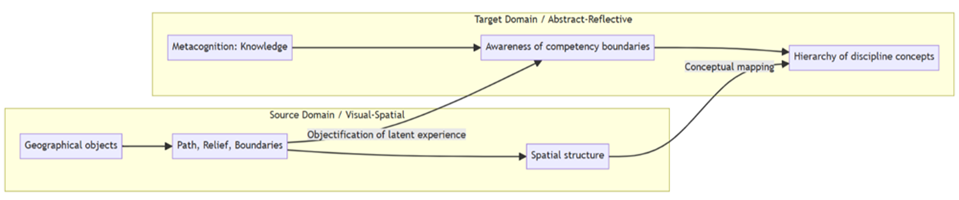
Figure 1. Cognitive mechanism of metaphorization in the formation of metacognitive knowledge (based on the Lakoff-Johnson model and Pavio’s double coding)
Metaphorization constitutes the process of conceptual projection of structure from a source domain possessing vivid sensory and spatial representation to an abstract target domain difficult to describe directly. Within metacognitive modeling, when students create metaphors such as “my knowledge is a forest” or “it is an endless snake,” they construct their own metacognitive knowledge through individual non-conventional metaphors that make sense of inner experience. Fauconnier’s (1994) theory of conceptual integration complements this framework by describing how new knowledge emerges in the “blend”, integrated space irreducible to either source or target alone.
In Russian psychological tradition, Vachkov (2024) proposed metaphorization as a tool for developmental impact, with metaphor functioning as a reflective mediator enabling learners to recognize the boundaries of their self and competence. Metaphorization facilitates the transition from declarative metacognitive knowledge to deep self-awareness of the cognitive subject.
International research demonstrates diverse applications of metaphorical tools: psychotherapy contexts employ metaphor to symbolize implicit emotions and transform personal meanings, representing a form of metacognitive regulation (Lyddon, Clay, & Sparks, 2001; McMullen, 2008); pedagogy utilizes metaphor to develop professional identity among future teachers through analysis of poetic images (Gulla, 2014); science education research demonstrates metaphor’s power for
enhancing metacognitive awareness (Sillman & Thomas, 1998); and visual metaphors serve as spatial memory support and information flow management tools (Bowler & Mattern, 2012). However, these studies predominantly employ qualitative designs with limited sample sizes. The present investigation addresses this gap through quantitative verification of metaphorization productivity using representative student samples.
The theoretical framework distinguishes between verbal and visual metaphors, drawing on dual coding theory (Clark & Paivio, 1991), which postulates two functionally independent yet actively interacting systems: the verbal system (logogens) responsible for logical and linguistic processing, and the visual-figurative system (imagens) operating with spatial structures and holistic images. Applying this framework to metacognitive knowledge suggests that declarative metacognitive knowledge can be encoded both as abstract statements (verbal channel) and spatial-figurative representations (visual channel). The visual metaphor in the form of the “Knowledge Map” enables subjects to utilize spatial components of intelligence (Kholodnaya, 2002) to structure conceptual fields, revealing boundaries (“coastline”) of knowledge and unexplored areas (“white spots”). We propose that the combination of verbal creativity and visual mapping creates the most complete and accurate representation of metacognitive knowledge.
Method
- Research Design and Participants
The methodological design employed a comprehensive analytical approach incorporating replication logic to test stability of identified patterns across independent samples, essential for validating new diagnostic instruments within dissertation research. The study was conducted in two chronological stages with independent groups of second-year students from Kaluga State University named after K.E. Tsiolkovsky, all having completed the “Emotional Intelligence” course.
Stage 1 (2024): Participants included 100 students (11 males, 89 females) with mean age 19.4 years (SD=1.2). This stage focused on primary approbation of the author’s diagnostic complex and identification of basic correlations between MAI scales and metaphorization characteristics, testing the hypothesis that visual and verbal metaphors predict academic success.
Stage 2 (2026): A new sample of 78 students from similar specialties participated, with no overlap with Stage 1. The purpose was critical reliability testing: determining whether identified connections were universal or specific to particular student populations. Rigorous protocol filtering excluded works containing signs of group modeling, incomplete responses, or formal excuses (“I don’t know,” “I find it difficult to answer”).
The diagnostic procedure was administered in group format during classroom sessions, requiring 40-60 minutes total. The research design sequentially activated different information coding systems: abstract-logical (MAI), verbal-figurative (“Unfinished Sentences”), and spatial-graphical (“Knowledge Map”).
- Instruments
Verbal Metaphorization Measure (“Unfinished Sentences”). Students completed a projective task with the instruction: “You are presented with a series of unfinished sentences. Please complete them with the first image that comes to your mind, which best describes your state and your knowledge of the subject ‘Emotional Intelligence.’ There are no right or wrong answers; your individual association is important.”
Stimulus phrases included:
- “My knowledge of this discipline is similar to…”
- “My knowledge of emotional intelligence is…”
- “If my knowledge could be written down in a book, it would be a book about…”
- “If my knowledge of emotional intelligence were presented in the form of an image, then it would be…”
- “My knowledge can be compared with…”
- “If we put together all the knowledge I have gained in this discipline, we will get…”
Each protocol underwent content analysis and evaluation on three author-developed scales:
- Level of metaphorization (0-1 points per utterance): 1 point for metaphorical transfer (likening knowledge to physical objects, natural phenomena, or abstract symbols); 0 points for formal answers (“my knowledge is average,” “I know the basics”).
- Creativity of metaphor (0-1 points per utterance): Expert assessment of image originality; “conventional” metaphors (luggage, book, library, warehouse) received 0 points; “individual” or atypical metaphors (snake, galaxy of stars, clouds in fog, swallow’s tail) received 1 point.
- Subjective self-assessment of knowledge: Derived from linguistic analysis of answers (mention of volume, completeness, confidence) on a scale from 1 (low) to 3 (high).
Visual Metaphorization Measure (“Knowledge Map”). This technique activated spatial representations of metacognitive knowledge. Instruction: “Imagine your knowledge system in the discipline of Emotional Intelligence as a geographical map. Draw a map of your knowledge in as much detail as possible, and label the objects.”
Quantification criteria:
- Differentiation (structural complexity): Total count of unique, named objects on the map. Each correctly labeled element (e.g., “Island of Empathy,” “River of Self-Regulation,” “Mountain of Motivation”) received 1 point. This indicator reflected detail of metacognitive knowledge.
- Division of knowledge and ignorance areas (0-1 points): 1 point when the map clearly identified zones of unlearned material (e.g., “Desert of the Unknown,” question marks in the “ocean”); interpreted as indicator of metacognitive monitoring level.
- Substantive compliance with subject area (0-2 points): 0 points for purely formal/abstract drawing unrelated to “Emotional Intelligence” course topics; 1 point for partial compliance (1-2 basic terms named); 2 points for representative map reflecting systemic connections between key sections (self-understanding, emotion management, social skills).
Metacognitive Awareness Inventory (MAI). The MAI questionnaire by Schraw and Dennison (1994) contains 52 statements measuring two macro-factors: metacognitive knowledge (declarative, procedural, and conditional) and metacognitive regulation (planning, strategies, monitoring, correction, and evaluation).
Academic Performance. Final rating score in the discipline served as objective criterion, accumulating results of current control, testing, and practical assignments for the entire training period.
- Data Analysis
Primary data processing utilized Statistica 10.0 and IBM SPSS Statistics 26. Given non-normal distribution of most variables (Kolmogorov-Smirnov test, p<0.05), non-parametric Spearman rank correlation coefficients were employed for correlation analysis. Factor analysis (principal component analysis) tested stability of indicator structure. Mann-Whitney test compared independent samples (2024 and 2026) and assessed
statistical significance of mean differences. Qualitative analysis employed expert evaluation of drawings and responses with subsequent triangulation.
Results
Quantitative Findings
At the first analytical stage, data describing relationships between self-reported metacognitive awareness (MAI) and productivity of verbal and visual metaphorization were obtained. Variable distribution analysis revealed significant deviation from normal form, justifying nonparametric statistics.
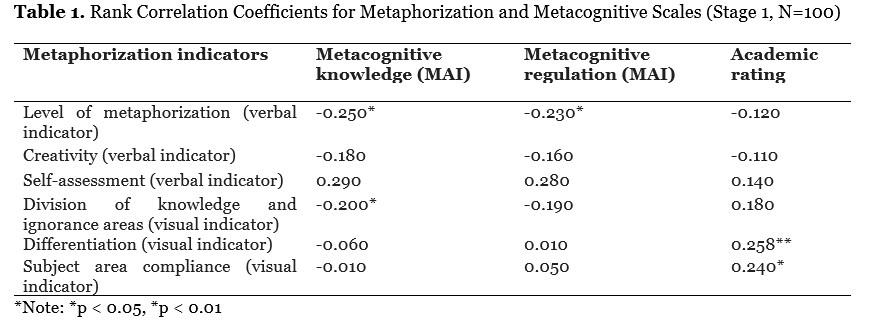
Table 1 presents key correlation coefficients for the first sample.
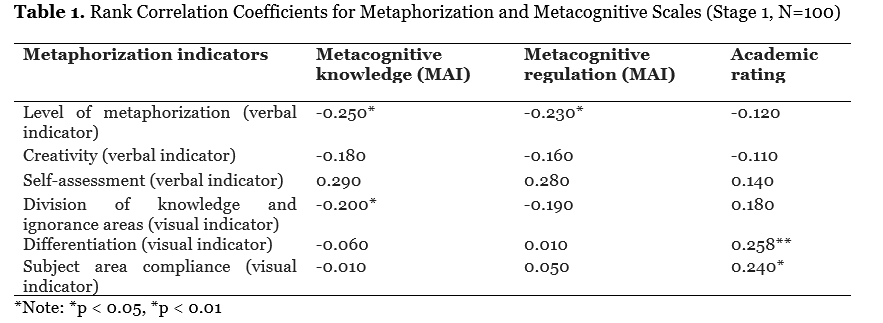
Analysis revealed several fundamental findings. First, a stable negative correlation emerged between verbal metaphorization level and MAI scales. This paradoxical result suggests students with high MAI scores (engaged in conscious, rational analysis of learning) exhibit lower productivity in creating metaphorical images. We interpret this as indicating a dichotomy of thinking modes: the conceptual mode (actualized by MAI) may function as antagonist to the figurative-symbolic mode underlying metaphor.
Second, statistically significant links between visual metaphorization parameters (“Differentiation” and “Subject Area Compliance”) and academic success were identified. This confirms our hypothesis: students’ capacity to spatially structure and detail knowledge on the map directly relates to subject understanding depth.
Stage 2 (2026) replicated identified patterns on the cleaned sample, filtering random influences and confirming visual tool reliability.
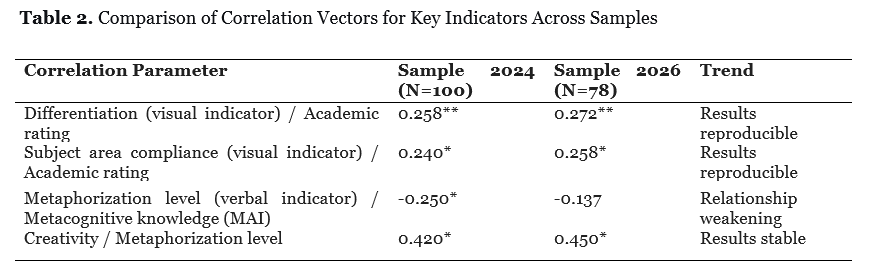
Comparative analysis demonstrates that the relationship between visual differentiation and academic performance is most stable and invariant. The “Knowledge Map” technique exhibits high predictive validity for academic achievements. The weakening of negative relationship between verbal metaphorization and MAI in the second sample suggests a more complex, nonlinear relationship dependent on individual typological characteristics.
Factor analysis using principal component analysis confirmed the hypothesis of independence between visual and verbal channels of metacognitive experience encoding.
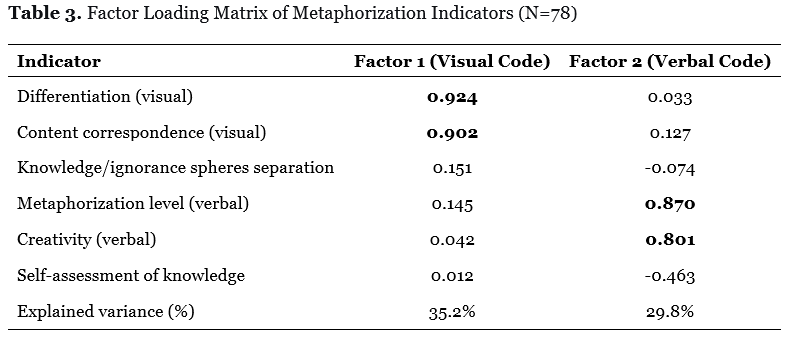
The factor structure proved transparent and significant. Factor 1 (“Visual-content modeling”) absorbed nearly all “Knowledge Map” indicators with extremely high loadings (>0.90), confirming that visual mapping is a holistic cognitive operation aimed at structuring the subject field. Factor 2 (“Verbal metaphorical construction”) combined creativity and metaphorization level indicators from the “Unfinished Sentences” technique. The zero loadings of visual indicators on the second factor and vice versa demonstrate complete autonomy of the two channels (imagines and logogens per Paivio’s theory). Thus, students may demonstrate high productivity in visual modeling while remaining stereotypical in verbal descriptions, and conversely.
- Qualitative Analysis
To gain fundamental understanding of metacognitive knowledge formation mechanisms, substantive qualitative analysis of student productivity was conducted. Metaphor as projective technique externalizes hidden meanings and individual “worldviews” elusive in closed-ended questionnaires.
Analysis of over 1,000 verbal responses and 178 visual maps from both stages enabled identification of stable typologies of metaphorical modeling.
Verbal Metaphor Classification. The “Unfinished Sentences” method responses revealed metaphorical representation varying from formal linguistic clichés to deep personalized images. Four dominant categories were classified (Table 4).
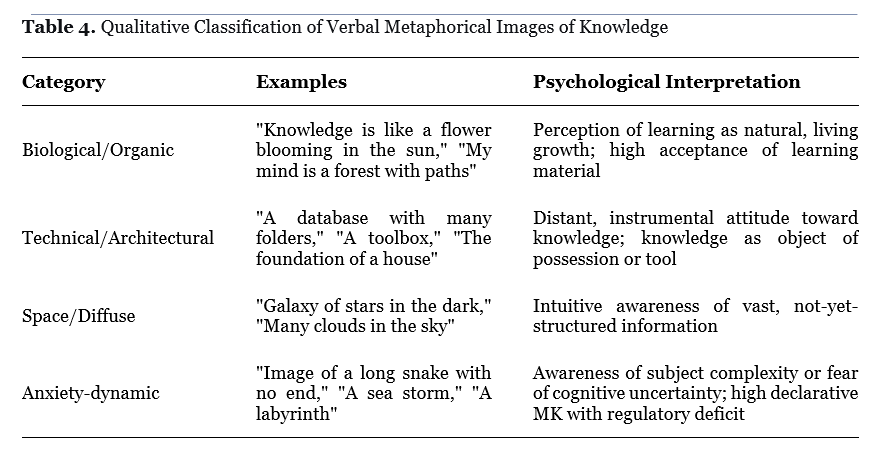
Examples of creative responses from the 2026 sample:
- “My knowledge is like a swallow’s tail: something flies away when I’m preparing for a test, but it always returns at the right moment.”
- “If I were to collect all the knowledge about emotional intelligence, I would create my own textbook written in the language of my emotions.”
These non-trivial images demonstrate high integration of educational material with personal experience. Students not only assimilate information but “live” it, creating unique cognitive representations.
Visualization Strategies. The visual module provided the most valuable material for assessing metacognitive knowledge structure. Three basic cognitive strategies were identified that students employ to visualize knowledge in emotional intelligence.
- “Island Archipelago” Strategy (Diffuse Strategy).Maps depict isolated objects such as “Empathy Island,” “Self-Control Island,” and “Societal Cape,” with vast water expanses between them, often marked with question marks or “the sea of ignorance.” Interpretation: the student is aware of fragmented knowledge. Course topics have been learned as separate blocks (declarative knowledge present), but systemic and procedural connections (“bridges”) have not yet been established.
- “Network Infrastructure” Strategy (Roadmap).Maps are filled with paths, bridges, and roads connecting concept cities: “City of Joy,” “Road of Regulation,” “Communication Hub.” Borders between countries of “Mind” and “Feelings” are often depicted. Interpretation: reflects advanced metacognitive regulation. The subject sees not just terms but ways of transition between states, mechanisms of interaction between various components of emotional intelligence.
- “Organic Unity” Strategy (Flower of Knowledge).Central object is a large continent or “heart-center” (emotional intelligence), from which “petals” or “branches” of competencies extend symmetrically and hierarchically. Interpretation: indicates high level of declarative metacognitive knowledge. Knowledge is presented as a holistic, balanced, hierarchical system. This map type correlates most closely with highest academic rankings (p < 0.01).
Discussion
The findings provoke reconsideration of traditional self-report questionnaire utilization. The paradoxical negative correlation between verbal metaphorization and MAI scales (-0.25 in the first sample) raises fundamental questions about reflection mechanisms.
We propose that the MAI questionnaire activates an analytical mode of reflection based on logical verification of strategies (“I am aware when I am distracted”). In contrast, metaphor represents a synthetic mode of reflection. To create a map or image, a student must integrate the entire array of experience into a single “blend” (Fauconnier’s term), synthesizing rather than analyzing individual actions.
From dual coding theory perspective (Clark & Paivio, 1991), the “Knowledge Map” activates imagens (visual codes). When students draw maps, they confront “spatial truth”: they cannot draw what they do not understand. While students may simulate knowledge verbally using empty clichéd terms, emptiness becomes evident on visual maps (“white spots”). This constitutes the detecting function of metaphor—it enables students to see the boundaries of their own ignorance, representing the highest form of metacognitive awareness.
The three identified visualization strategies demonstrate a developmental trajectory from fragmented to integrated metacognitive representation. The “island” strategy corresponds to declarative knowledge without procedural integration; “network” strategy indicates emerging regulation; “organic” strategy represents fully integrated metacognitive knowledge. This progression parallels theoretical models of metacognitive development (Schraw & Moshman, 1995; Fomin & Stekanova, 2019) and provides empirical grounding for pedagogical interventions targeting metacognitive skill development.
The factor analytical confirmation of independent visual and verbal channels has both theoretical and practical significance. Theoretically, it extends dual coding theory to the domain of metacognitive knowledge representation. Practically, it suggests that diagnostic instruments should assess both channels, as high performance in one does not predict performance in the other. Educational interventions should therefore incorporate both verbal reflection tasks and visual mapping
activities to fully develop metacognitive competence.
The superior predictive validity of visual metaphorization for academic success has implications for assessment practices. Traditional self-report measures like MAI, while valuable, may capture only a portion of metacognitive knowledge accessible through conscious verbalization. Visual mapping reveals structural properties of knowledge representation that are strongly associated with learning outcomes. This finding aligns with Kholodnaya’s (2002) emphasis on spatial components of intelligence and extends it to the metacognitive domain.
Based on these findings, we propose implementing the “Metacognitive Mirror” technique (Figure 2) in educational processes. This technology transforms assessment from formal procedure into act of deep self-knowledge. Teachers analyzing knowledge maps obtain a “snapshot” of the cognitive base, identifying which sections (islands) cause greatest integration difficulties. The application enables formative assessment that reveals not just what students know but how they organize and perceive their knowledge, and where their metacognitive monitoring may be deficient.
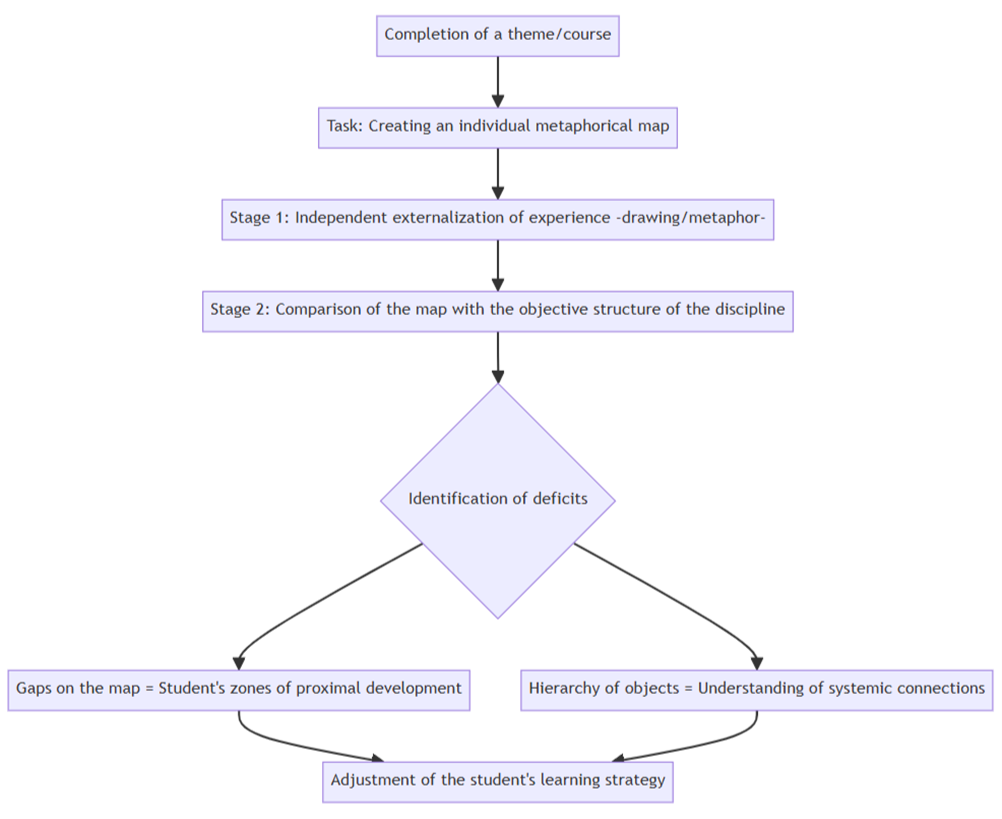
Figure 2. Technology of using metaphorical mapping in the educational process
Conclusions
This verification of metaphorical methods across two independent samples (N=100 and N=78) supports the following conclusions:
- Metaphorization represents a valid tool for constructing and explicating students’ metacognitive knowledge. Visual methods (mapping) demonstrate greater predictive power for academic success than verbal self-reports.
- The factor structure of students’ cognitive domain when working with metaphors is dualistic, divided into visual-content and verbal-creative channels functioning relatively independently.
- The developed and verified diagnostic form constitutes a reliable tool enabling quantification of knowledge qualities including differentiation, systematization, and awareness of one’s own competence.
- Individual metaphor functions as a reflective mediator that overcomes declarative facade limitations and elevates learning awareness to deep personal integration.
The research findings open opportunities for creating automated knowledge assessment systems based on mind maps and metaphorical modeling, potentially representing a breakthrough in digital pedagogy and higher education psychology. Future research should investigate developmental trajectories of metaphorical competence across educational levels and explore interventions designed to enhance visual metaphorical skill.
Funding: This research received no specific grant from any funding agency in the public, commercial, or not-for-profit sectors.
Conflict of Interest: The authors declare that the research was conducted in the absence of any commercial or financial relationships that could be construed as a potential conflict of interest.
Ethics: The research was conducted in accordance with local legislation and institutional requirements. All participants provided informed consent to participate in this study. The study protocol was approved by the Ethics Committee of Tsiolkovskiy Kaluga State University.
Authors’ Contributions: All individuals entitled to authorship are listed. All authors’ contributions are approximately equal. Kosova A.A. contributed to conceptualization, methodology, data collection, formal analysis,
and writing-original draft. Fomin A.E. contributed to conceptualization, methodology, supervision, validation, and writing-review and editing. Both authors approved the final version and are responsible for all aspects of the publication.
Data Availability: The datasets generated and analyzed during the current study are available from the corresponding author upon reasonable request.
References
- Bol, L., & Hacker, D. J. (2001). A comparison of the effects of practice tests and traditional review on performance and calibration. The Journal of Experimental Education, 69(2), 133–151. https://doi.org/10.1080/00220970109600653
- Bosch, N., et al. (2021). Students’ verbalized metacognition during computerized learning. Proceedings of the 2021 CHI Conference on Human Factors in Computing Systems, 1–12. https://doi.org/10.1145/3411764.3445809
- Bowler, L., & Mattern, E. (2012). Visual metaphors to model metacognitive strategies that support memory during the process of refinding information. Proceedings of the 4th Information Interaction in Context Symposium, 250–253. https://doi.org/10.1145/2362724.2362767
- Carvalho Filho, M. K. de. (2009). Confidence judgments in real classroom settings: Monitoring performance in different types of tests. International Journal of Psychology, 44(2), 93–108. https://doi.org/10.1080/00207590701436744
- Clark, J. M., & Paivio, A. (1991). Dual coding theory and education. Educational Psychology Review, 3(3), 149–210. https://doi.org/10.1007/BF01320076
- Fauconnier, G. (1994). Mental spaces: Aspects of meaning construction in natural language. Cambridge University Press.
- Fomin, A. E., & Stekanova, Yu. O. (2019). The genesis of metacognitive knowledge in learning: From general structures to current metacognitive judgments and back. Psychology of Learning, 2, 14–22.
- Glasersfeld, E. von. (2013). Radical constructivism. Taylor and Francis.
- Gulla, A. N. (2014). Myth, metaphor, and metacognition: Shaping voice and identity through poetry in teacher education. LEARNing Landscapes, 8(1), 139–152. https://doi.org/10.36510/learnland.v8i1.679
- Kholodnaya, M. A. (2002). Psychology of intelligence: Research paradoxes. Peter.
- Lakoff, J., & Johnson, M. (2004). The metaphors we live by(A. N. Baranov, Ed. & Trans.). Editorial URSS.
- Lyddon, W. J., Clay, A. L., & Sparks, C. L. (2001). Metaphor and change in counseling. Journal of Counseling & Development, 79(3), 269–274. https://doi.org/10.1002/j.1556-6676.2001.tb01971.x
- McMullen, L. M. (2008). Putting it in context: Metaphor and psychotherapy. In R. W. Gibbs (Ed.), The Cambridge handbook of metaphor and thought(pp. 397–411). Cambridge University Press. https://doi.org/10.1017/CBO9780511816802.024
- Nelson, T., & Narens, L. (1996). Why investigate metacognition? In J. Metcalfe & A. P. Shimamura (Eds.), Metacognition: Knowing about knowing(pp. 1–26). MIT Press.
- Ohtani, K., & Hisasaka, T. (2018). Beyond intelligence: A meta-analytic review of the relationship among metacognition, intelligence, and academic performance. Metacognition and Learning, 13, 179–212. https://doi.org/10.1007/s11409-018-9183-8
- Russell, T., & Hrycenko, M. (2006). The role of metaphor in a new science teacher’s learning from experience. In Metaphor and analogy in science education(pp. 131–142). Springer. https://doi.org/10.1007/1-4020-3830-5_11
- Schraw, G., & Dennison, R. S. (1994). Assessing metacognitive awareness. Contemporary Educational Psychology, 19(4), 460–475. https://doi.org/10.1006/ceps.1994.1033
- Schraw, G., & Moshman, D. (1995). Metacognitive theories. Educational Psychology Review, 7(4), 351–371. https://doi.org/10.1007/BF02212307
- Sillman, K., & Thomas, D. (1998). Metaphor: A tool for monitoring prospective elementary teachers’ developing metacognitive awareness of learning and teaching science. The Pennsylvania State University.
- Thomas, G. P., & McRobbie, C. J. (2001). Using a metaphor for learning to improve students’ metacognition in the chemistry classroom. Journal of Research in Science Teaching, 38(2), 222–259. https://doi.org/10.1002/1098-2736(200102)38:2<222::AID-TEA1004>3.0.CO;2-S
- Vachkov, I. V. (2024). Metaphorization in developing psychological and pedagogical technologies. Academic Project.
- Wang, Y., Sperling, R. A., & Malcos, J. L. (2024). Supporting college students’ metacognitive monitoring in a biology course through practice and timely monitoring feedback. Metacognition and Learning, 1–40. https://doi.org/10.1007/s11409-024-09385-y
- Williamson, R. A. (1996). Self-questioning—An aid to metacognition. Reading Horizons: A Journal of Literacy and Language Arts, 37(1), 31–47.
- Wilson, N. S., & Smetana, L. (2009). Questioning as thinking: A metacognitive framework. Middle School Journal, 41(2), 20–28. https://doi.org/10.1080/00940771.2009.11461709
Comments (0)
Relevance and Background. The study addresses the fundamental challenge of explicating latent reflexive structures in students’ metacognitive knowledge, which remain inadequately captured by traditional standardized questionnaires. The integration of metaphorical tools offers a promising avenue for accessing these implicit cognitive representations. Objective is to empirically validate the autonomy of visual and verbal channels in metaphorical construction of metacognitive knowledge and to establish the predictive validity of metaphorical tools for academic success. Methods. A two-stage replication design was implemented with independent samples (N=100 in 2024; N=78 in 2026). Author-developed metaphorical instruments, “Unfinished Sentences” (verbal) and “Knowledge Map” (visual), were administered alongside the Metacognitive Awareness Inventory (MAI) and academic performance measures. Data analysis employed Spearman correlation, factor analysis, Mann-Whitney tests, and qualitative content analysis. Results. Factor analysis confirmed two independent cognitive codes (imagines and logogens) with factor loadings exceeding 0.90 for visual indicators and 0.80 for verbal indicators. Visual metaphorization demonstrated stable predictive validity for academic success (r=0.272, p<0.01 in the replicated sample), while a paradoxical negative correlation was observed between verbal metaphorization and MAI scores (r=-0.250, p<0.05). Three distinct visualization strategies were qualitatively identified: “island” (fragmented), “network” (developed regulation), and “organic” (holistic hierarchical system). Conclusion. Visual metaphorical mapping serves as a detecting function revealing boundaries of ignorance (“white spots”), representing the highest form of metacognitive monitoring unavailable to standardized self-report questionnaires. The findings have significant implications for developing psychotechnologies for educational reflection and diagnostic tools in higher education.
Вербальная и визуальная метафоризация как инструмент конструирования метакогнитивного знания студентов
А.А. Косова, А.Е. Фомин
КГУ им. К.Э. Циолковского, Калуга, Россия
Резюме. Актуальность. Исследование направлено на решение фундаментальной проблемы экспликации латентных рефлексивных структур в метакогнитивном знании студентов, которые остаются недостаточно выявляемыми с помощью традиционных стандартизированных опросников. Интеграция метафорических инструментов предлагает перспективный путь доступа к этим имплицитным когнитивным репрезентациям. Цель. Эмпирически обосновать автономность визуального и вербального каналов метафорического конструирования метакогнитивного знания и установить прогностическую валидность метафорических инструментов для академической успешности. Методы. Реализован двухэтапный дизайн с репликацией на независимых выборках (N=100 в 2024 г.; N=78 в 2026 г.). Применялись авторские метафорические методики «Незаконченные предложения» (вербальная) и «Карта знаний» (визуальная) наряду с опросником метакогнитивной осведомленности MAI и показателями академической успеваемости. Анализ данных включал корреляционный анализ Спирмена, факторный анализ, U-критерий Манна-Уитни и качественный контент-анализ. Результаты. Факторный анализ подтвердил наличие двух независимых когнитивных кодов (имагенов и логогенов) с факторными нагрузками, превышающими 0.90 для визуальных индикаторов и 0.80 для вербальных индикаторов. Визуальная метафоризация продемонстрировала стабильную прогностическую валидность по отношению к академической успеваемости (r=0.272, p<0.01 на реплицированной выборке), при этом обнаружена парадоксальная отрицательная корреляция между вербальной метафоризацией и показателями MAI (r=-0.250, p<0.05). Качественно выделены три стратегии визуализации: «островная» (фрагментарная), «сетевая» (развитая регуляция) и «органическая» (целостная иерархическая система). Заключение. Визуальное метафорическое картирование выполняет детектирующую функцию, выявляя границы незнания («белые пятна»), что представляет собой высшую форму метакогнитивного мониторинга, недоступную для стандартизированных опросников самоотчета. Полученные результаты имеют значимые импликации для разработки психотехнологий формирования образовательной рефлексии и диагностического инструментария в высшем образовании.
Ключевые слова: метакогнитивное знание, метакогнитивная регуляция, метафоризация, когнитивная метафора, двойное кодирование, визуальная метафора, академическая успеваемость, рефлексия, эмоциональный интеллект
Metacognitive knowledge constitutes a fundamental mechanism of cognitive self-regulation in modern psychological and pedagogical science, functioning not merely as a private characteristic of intelligence but as an integral system for managing one’s own cognitive activity. Traditionally conceptualized as a conscious system of the subject’s representations about their cognitive processes, resources, limitations, and potential in solving intellectual problems (Schraw & Moshman, 1995), metacognitive knowledge has been established as a key predictor of learning achievements across diverse educational contexts (Ohtani & Hisasaka, 2018).
The classical model of metacognitive knowledge, as articulated by Schraw and Moshman (1995), posits three orthogonal yet interconnected components: declarative knowledge – the subject’s knowledge about facts, principles, and characteristics of their own cognitive system (“knowing that…”); procedural knowledge – awareness of how to implement effective cognitive strategies (“knowing how to…”); and conditional knowledge – understanding when and why to activate particular strategies for maximum results (“knowing when…”). This tripartite framework has received substantial empirical support, with meta-analytical studies confirming a direct positive correlation between metacognitive knowledge levels and academic performance (Ohtani & Hisasaka, 2018).
Students with high metacognitive knowledge demonstrate the capacity to accurately “calibrate” their knowledge, ensuring alignment between subjective assessments and actual outcomes. Contemporary research emphasizes that judgment accuracy depends on systematic feedback (Wang, Sperling, & Malcos, 2024), utilization of practice testing (Bol & Hacker, 2001), and development of verbalized reflection skills (Bosch et al., 2021). Fomin and Stekanova (2019) demonstrated that the genesis of metacognitive knowledge involves a complex dynamic process incorporating both “upward” and “downward” mechanisms: primary metacognitive judgments serve as material for inductive inference of more general declarative forms, while already-formed general metacognitive knowledge determines assessment of particular learning situations.
A critical methodological challenge emerges in measuring what frequently remains at an intuitive, pre-verbal level. Self-report questionnaires, particularly the widely utilized MAI (Metacognitive Awareness Inventory) developed by Schraw and Dennison (1994), capture only that portion of knowledge amenable to direct verbalization, knowledge that may be fragmented and influenced by social desirability. We contend that metaphorization offers an effective means of “objectifying” this latent level of knowledge, transferring it from the realm of vague sensations to concrete, analyzable representations.
The cognitive turn in metaphor research, pioneered by Lakoff and Johnson (2004), fundamentally transformed understanding of metaphor from mere linguistic decoration to a fundamental cognitive category (Figure 1).
Figure 1. Cognitive mechanism of metaphorization in the formation of metacognitive knowledge (based on the Lakoff-Johnson model and Pavio’s double coding)
Metaphorization constitutes the process of conceptual projection of structure from a source domain possessing vivid sensory and spatial representation to an abstract target domain difficult to describe directly. Within metacognitive modeling, when students create metaphors such as “my knowledge is a forest” or “it is an endless snake,” they construct their own metacognitive knowledge through individual non-conventional metaphors that make sense of inner experience. Fauconnier’s (1994) theory of conceptual integration complements this framework by describing how new knowledge emerges in the “blend”, integrated space irreducible to either source or target alone.
In Russian psychological tradition, Vachkov (2024) proposed metaphorization as a tool for developmental impact, with metaphor functioning as a reflective mediator enabling learners to recognize the boundaries of their self and competence. Metaphorization facilitates the transition from declarative metacognitive knowledge to deep self-awareness of the cognitive subject.
International research demonstrates diverse applications of metaphorical tools: psychotherapy contexts employ metaphor to symbolize implicit emotions and transform personal meanings, representing a form of metacognitive regulation (Lyddon, Clay, & Sparks, 2001; McMullen, 2008); pedagogy utilizes metaphor to develop professional identity among future teachers through analysis of poetic images (Gulla, 2014); science education research demonstrates metaphor’s power for
enhancing metacognitive awareness (Sillman & Thomas, 1998); and visual metaphors serve as spatial memory support and information flow management tools (Bowler & Mattern, 2012). However, these studies predominantly employ qualitative designs with limited sample sizes. The present investigation addresses this gap through quantitative verification of metaphorization productivity using representative student samples.
The theoretical framework distinguishes between verbal and visual metaphors, drawing on dual coding theory (Clark & Paivio, 1991), which postulates two functionally independent yet actively interacting systems: the verbal system (logogens) responsible for logical and linguistic processing, and the visual-figurative system (imagens) operating with spatial structures and holistic images. Applying this framework to metacognitive knowledge suggests that declarative metacognitive knowledge can be encoded both as abstract statements (verbal channel) and spatial-figurative representations (visual channel). The visual metaphor in the form of the “Knowledge Map” enables subjects to utilize spatial components of intelligence (Kholodnaya, 2002) to structure conceptual fields, revealing boundaries (“coastline”) of knowledge and unexplored areas (“white spots”). We propose that the combination of verbal creativity and visual mapping creates the most complete and accurate representation of metacognitive knowledge.
- Research Design and Participants
The methodological design employed a comprehensive analytical approach incorporating replication logic to test stability of identified patterns across independent samples, essential for validating new diagnostic instruments within dissertation research. The study was conducted in two chronological stages with independent groups of second-year students from Kaluga State University named after K.E. Tsiolkovsky, all having completed the “Emotional Intelligence” course.
Stage 1 (2024): Participants included 100 students (11 males, 89 females) with mean age 19.4 years (SD=1.2). This stage focused on primary approbation of the author’s diagnostic complex and identification of basic correlations between MAI scales and metaphorization characteristics, testing the hypothesis that visual and verbal metaphors predict academic success.
Stage 2 (2026): A new sample of 78 students from similar specialties participated, with no overlap with Stage 1. The purpose was critical reliability testing: determining whether identified connections were universal or specific to particular student populations. Rigorous protocol filtering excluded works containing signs of group modeling, incomplete responses, or formal excuses (“I don’t know,” “I find it difficult to answer”).
The diagnostic procedure was administered in group format during classroom sessions, requiring 40-60 minutes total. The research design sequentially activated different information coding systems: abstract-logical (MAI), verbal-figurative (“Unfinished Sentences”), and spatial-graphical (“Knowledge Map”).
- Instruments
Verbal Metaphorization Measure (“Unfinished Sentences”). Students completed a projective task with the instruction: “You are presented with a series of unfinished sentences. Please complete them with the first image that comes to your mind, which best describes your state and your knowledge of the subject ‘Emotional Intelligence.’ There are no right or wrong answers; your individual association is important.”
Stimulus phrases included:
- “My knowledge of this discipline is similar to…”
- “My knowledge of emotional intelligence is…”
- “If my knowledge could be written down in a book, it would be a book about…”
- “If my knowledge of emotional intelligence were presented in the form of an image, then it would be…”
- “My knowledge can be compared with…”
- “If we put together all the knowledge I have gained in this discipline, we will get…”
Each protocol underwent content analysis and evaluation on three author-developed scales:
- Level of metaphorization (0-1 points per utterance): 1 point for metaphorical transfer (likening knowledge to physical objects, natural phenomena, or abstract symbols); 0 points for formal answers (“my knowledge is average,” “I know the basics”).
- Creativity of metaphor (0-1 points per utterance): Expert assessment of image originality; “conventional” metaphors (luggage, book, library, warehouse) received 0 points; “individual” or atypical metaphors (snake, galaxy of stars, clouds in fog, swallow’s tail) received 1 point.
- Subjective self-assessment of knowledge: Derived from linguistic analysis of answers (mention of volume, completeness, confidence) on a scale from 1 (low) to 3 (high).
Visual Metaphorization Measure (“Knowledge Map”). This technique activated spatial representations of metacognitive knowledge. Instruction: “Imagine your knowledge system in the discipline of Emotional Intelligence as a geographical map. Draw a map of your knowledge in as much detail as possible, and label the objects.”
Quantification criteria:
- Differentiation (structural complexity): Total count of unique, named objects on the map. Each correctly labeled element (e.g., “Island of Empathy,” “River of Self-Regulation,” “Mountain of Motivation”) received 1 point. This indicator reflected detail of metacognitive knowledge.
- Division of knowledge and ignorance areas (0-1 points): 1 point when the map clearly identified zones of unlearned material (e.g., “Desert of the Unknown,” question marks in the “ocean”); interpreted as indicator of metacognitive monitoring level.
- Substantive compliance with subject area (0-2 points): 0 points for purely formal/abstract drawing unrelated to “Emotional Intelligence” course topics; 1 point for partial compliance (1-2 basic terms named); 2 points for representative map reflecting systemic connections between key sections (self-understanding, emotion management, social skills).
Metacognitive Awareness Inventory (MAI). The MAI questionnaire by Schraw and Dennison (1994) contains 52 statements measuring two macro-factors: metacognitive knowledge (declarative, procedural, and conditional) and metacognitive regulation (planning, strategies, monitoring, correction, and evaluation).
Academic Performance. Final rating score in the discipline served as objective criterion, accumulating results of current control, testing, and practical assignments for the entire training period.
- Data Analysis
Primary data processing utilized Statistica 10.0 and IBM SPSS Statistics 26. Given non-normal distribution of most variables (Kolmogorov-Smirnov test, p<0.05), non-parametric Spearman rank correlation coefficients were employed for correlation analysis. Factor analysis (principal component analysis) tested stability of indicator structure. Mann-Whitney test compared independent samples (2024 and 2026) and assessed
statistical significance of mean differences. Qualitative analysis employed expert evaluation of drawings and responses with subsequent triangulation.
Quantitative Findings
At the first analytical stage, data describing relationships between self-reported metacognitive awareness (MAI) and productivity of verbal and visual metaphorization were obtained. Variable distribution analysis revealed significant deviation from normal form, justifying nonparametric statistics.
Table 1 presents key correlation coefficients for the first sample.
Analysis revealed several fundamental findings. First, a stable negative correlation emerged between verbal metaphorization level and MAI scales. This paradoxical result suggests students with high MAI scores (engaged in conscious, rational analysis of learning) exhibit lower productivity in creating metaphorical images. We interpret this as indicating a dichotomy of thinking modes: the conceptual mode (actualized by MAI) may function as antagonist to the figurative-symbolic mode underlying metaphor.
Second, statistically significant links between visual metaphorization parameters (“Differentiation” and “Subject Area Compliance”) and academic success were identified. This confirms our hypothesis: students’ capacity to spatially structure and detail knowledge on the map directly relates to subject understanding depth.
Stage 2 (2026) replicated identified patterns on the cleaned sample, filtering random influences and confirming visual tool reliability.
Comparative analysis demonstrates that the relationship between visual differentiation and academic performance is most stable and invariant. The “Knowledge Map” technique exhibits high predictive validity for academic achievements. The weakening of negative relationship between verbal metaphorization and MAI in the second sample suggests a more complex, nonlinear relationship dependent on individual typological characteristics.
Factor analysis using principal component analysis confirmed the hypothesis of independence between visual and verbal channels of metacognitive experience encoding.
The factor structure proved transparent and significant. Factor 1 (“Visual-content modeling”) absorbed nearly all “Knowledge Map” indicators with extremely high loadings (>0.90), confirming that visual mapping is a holistic cognitive operation aimed at structuring the subject field. Factor 2 (“Verbal metaphorical construction”) combined creativity and metaphorization level indicators from the “Unfinished Sentences” technique. The zero loadings of visual indicators on the second factor and vice versa demonstrate complete autonomy of the two channels (imagines and logogens per Paivio’s theory). Thus, students may demonstrate high productivity in visual modeling while remaining stereotypical in verbal descriptions, and conversely.
- Qualitative Analysis
To gain fundamental understanding of metacognitive knowledge formation mechanisms, substantive qualitative analysis of student productivity was conducted. Metaphor as projective technique externalizes hidden meanings and individual “worldviews” elusive in closed-ended questionnaires.
Analysis of over 1,000 verbal responses and 178 visual maps from both stages enabled identification of stable typologies of metaphorical modeling.
Verbal Metaphor Classification. The “Unfinished Sentences” method responses revealed metaphorical representation varying from formal linguistic clichés to deep personalized images. Four dominant categories were classified (Table 4).
Examples of creative responses from the 2026 sample:
- “My knowledge is like a swallow’s tail: something flies away when I’m preparing for a test, but it always returns at the right moment.”
- “If I were to collect all the knowledge about emotional intelligence, I would create my own textbook written in the language of my emotions.”
These non-trivial images demonstrate high integration of educational material with personal experience. Students not only assimilate information but “live” it, creating unique cognitive representations.
Visualization Strategies. The visual module provided the most valuable material for assessing metacognitive knowledge structure. Three basic cognitive strategies were identified that students employ to visualize knowledge in emotional intelligence.
- “Island Archipelago” Strategy (Diffuse Strategy).Maps depict isolated objects such as “Empathy Island,” “Self-Control Island,” and “Societal Cape,” with vast water expanses between them, often marked with question marks or “the sea of ignorance.” Interpretation: the student is aware of fragmented knowledge. Course topics have been learned as separate blocks (declarative knowledge present), but systemic and procedural connections (“bridges”) have not yet been established.
- “Network Infrastructure” Strategy (Roadmap).Maps are filled with paths, bridges, and roads connecting concept cities: “City of Joy,” “Road of Regulation,” “Communication Hub.” Borders between countries of “Mind” and “Feelings” are often depicted. Interpretation: reflects advanced metacognitive regulation. The subject sees not just terms but ways of transition between states, mechanisms of interaction between various components of emotional intelligence.
- “Organic Unity” Strategy (Flower of Knowledge).Central object is a large continent or “heart-center” (emotional intelligence), from which “petals” or “branches” of competencies extend symmetrically and hierarchically. Interpretation: indicates high level of declarative metacognitive knowledge. Knowledge is presented as a holistic, balanced, hierarchical system. This map type correlates most closely with highest academic rankings (p < 0.01).
The findings provoke reconsideration of traditional self-report questionnaire utilization. The paradoxical negative correlation between verbal metaphorization and MAI scales (-0.25 in the first sample) raises fundamental questions about reflection mechanisms.
We propose that the MAI questionnaire activates an analytical mode of reflection based on logical verification of strategies (“I am aware when I am distracted”). In contrast, metaphor represents a synthetic mode of reflection. To create a map or image, a student must integrate the entire array of experience into a single “blend” (Fauconnier’s term), synthesizing rather than analyzing individual actions.
From dual coding theory perspective (Clark & Paivio, 1991), the “Knowledge Map” activates imagens (visual codes). When students draw maps, they confront “spatial truth”: they cannot draw what they do not understand. While students may simulate knowledge verbally using empty clichéd terms, emptiness becomes evident on visual maps (“white spots”). This constitutes the detecting function of metaphor—it enables students to see the boundaries of their own ignorance, representing the highest form of metacognitive awareness.
The three identified visualization strategies demonstrate a developmental trajectory from fragmented to integrated metacognitive representation. The “island” strategy corresponds to declarative knowledge without procedural integration; “network” strategy indicates emerging regulation; “organic” strategy represents fully integrated metacognitive knowledge. This progression parallels theoretical models of metacognitive development (Schraw & Moshman, 1995; Fomin & Stekanova, 2019) and provides empirical grounding for pedagogical interventions targeting metacognitive skill development.
The factor analytical confirmation of independent visual and verbal channels has both theoretical and practical significance. Theoretically, it extends dual coding theory to the domain of metacognitive knowledge representation. Practically, it suggests that diagnostic instruments should assess both channels, as high performance in one does not predict performance in the other. Educational interventions should therefore incorporate both verbal reflection tasks and visual mapping
activities to fully develop metacognitive competence.
The superior predictive validity of visual metaphorization for academic success has implications for assessment practices. Traditional self-report measures like MAI, while valuable, may capture only a portion of metacognitive knowledge accessible through conscious verbalization. Visual mapping reveals structural properties of knowledge representation that are strongly associated with learning outcomes. This finding aligns with Kholodnaya’s (2002) emphasis on spatial components of intelligence and extends it to the metacognitive domain.
Based on these findings, we propose implementing the “Metacognitive Mirror” technique (Figure 2) in educational processes. This technology transforms assessment from formal procedure into act of deep self-knowledge. Teachers analyzing knowledge maps obtain a “snapshot” of the cognitive base, identifying which sections (islands) cause greatest integration difficulties. The application enables formative assessment that reveals not just what students know but how they organize and perceive their knowledge, and where their metacognitive monitoring may be deficient.
Figure 2. Technology of using metaphorical mapping in the educational process
This verification of metaphorical methods across two independent samples (N=100 and N=78) supports the following conclusions:
- Metaphorization represents a valid tool for constructing and explicating students’ metacognitive knowledge. Visual methods (mapping) demonstrate greater predictive power for academic success than verbal self-reports.
- The factor structure of students’ cognitive domain when working with metaphors is dualistic, divided into visual-content and verbal-creative channels functioning relatively independently.
- The developed and verified diagnostic form constitutes a reliable tool enabling quantification of knowledge qualities including differentiation, systematization, and awareness of one’s own competence.
- Individual metaphor functions as a reflective mediator that overcomes declarative facade limitations and elevates learning awareness to deep personal integration.
The research findings open opportunities for creating automated knowledge assessment systems based on mind maps and metaphorical modeling, potentially representing a breakthrough in digital pedagogy and higher education psychology. Future research should investigate developmental trajectories of metaphorical competence across educational levels and explore interventions designed to enhance visual metaphorical skill.
Funding: This research received no specific grant from any funding agency in the public, commercial, or not-for-profit sectors.
Conflict of Interest: The authors declare that the research was conducted in the absence of any commercial or financial relationships that could be construed as a potential conflict of interest.
Ethics: The research was conducted in accordance with local legislation and institutional requirements. All participants provided informed consent to participate in this study. The study protocol was approved by the Ethics Committee of Tsiolkovskiy Kaluga State University.
Authors’ Contributions: All individuals entitled to authorship are listed. All authors’ contributions are approximately equal. Kosova A.A. contributed to conceptualization, methodology, data collection, formal analysis,
and writing-original draft. Fomin A.E. contributed to conceptualization, methodology, supervision, validation, and writing-review and editing. Both authors approved the final version and are responsible for all aspects of the publication.
Data Availability: The datasets generated and analyzed during the current study are available from the corresponding author upon reasonable request.
- Bol, L., & Hacker, D. J. (2001). A comparison of the effects of practice tests and traditional review on performance and calibration. The Journal of Experimental Education, 69(2), 133–151. https://doi.org/10.1080/00220970109600653
- Bosch, N., et al. (2021). Students’ verbalized metacognition during computerized learning. Proceedings of the 2021 CHI Conference on Human Factors in Computing Systems, 1–12. https://doi.org/10.1145/3411764.3445809
- Bowler, L., & Mattern, E. (2012). Visual metaphors to model metacognitive strategies that support memory during the process of refinding information. Proceedings of the 4th Information Interaction in Context Symposium, 250–253. https://doi.org/10.1145/2362724.2362767
- Carvalho Filho, M. K. de. (2009). Confidence judgments in real classroom settings: Monitoring performance in different types of tests. International Journal of Psychology, 44(2), 93–108. https://doi.org/10.1080/00207590701436744
- Clark, J. M., & Paivio, A. (1991). Dual coding theory and education. Educational Psychology Review, 3(3), 149–210. https://doi.org/10.1007/BF01320076
- Fauconnier, G. (1994). Mental spaces: Aspects of meaning construction in natural language. Cambridge University Press.
- Fomin, A. E., & Stekanova, Yu. O. (2019). The genesis of metacognitive knowledge in learning: From general structures to current metacognitive judgments and back. Psychology of Learning, 2, 14–22.
- Glasersfeld, E. von. (2013). Radical constructivism. Taylor and Francis.
- Gulla, A. N. (2014). Myth, metaphor, and metacognition: Shaping voice and identity through poetry in teacher education. LEARNing Landscapes, 8(1), 139–152. https://doi.org/10.36510/learnland.v8i1.679
- Kholodnaya, M. A. (2002). Psychology of intelligence: Research paradoxes. Peter.
- Lakoff, J., & Johnson, M. (2004). The metaphors we live by(A. N. Baranov, Ed. & Trans.). Editorial URSS.
- Lyddon, W. J., Clay, A. L., & Sparks, C. L. (2001). Metaphor and change in counseling. Journal of Counseling & Development, 79(3), 269–274. https://doi.org/10.1002/j.1556-6676.2001.tb01971.x
- McMullen, L. M. (2008). Putting it in context: Metaphor and psychotherapy. In R. W. Gibbs (Ed.), The Cambridge handbook of metaphor and thought(pp. 397–411). Cambridge University Press. https://doi.org/10.1017/CBO9780511816802.024
- Nelson, T., & Narens, L. (1996). Why investigate metacognition? In J. Metcalfe & A. P. Shimamura (Eds.), Metacognition: Knowing about knowing(pp. 1–26). MIT Press.
- Ohtani, K., & Hisasaka, T. (2018). Beyond intelligence: A meta-analytic review of the relationship among metacognition, intelligence, and academic performance. Metacognition and Learning, 13, 179–212. https://doi.org/10.1007/s11409-018-9183-8
- Russell, T., & Hrycenko, M. (2006). The role of metaphor in a new science teacher’s learning from experience. In Metaphor and analogy in science education(pp. 131–142). Springer. https://doi.org/10.1007/1-4020-3830-5_11
- Schraw, G., & Dennison, R. S. (1994). Assessing metacognitive awareness. Contemporary Educational Psychology, 19(4), 460–475. https://doi.org/10.1006/ceps.1994.1033
- Schraw, G., & Moshman, D. (1995). Metacognitive theories. Educational Psychology Review, 7(4), 351–371. https://doi.org/10.1007/BF02212307
- Sillman, K., & Thomas, D. (1998). Metaphor: A tool for monitoring prospective elementary teachers’ developing metacognitive awareness of learning and teaching science. The Pennsylvania State University.
- Thomas, G. P., & McRobbie, C. J. (2001). Using a metaphor for learning to improve students’ metacognition in the chemistry classroom. Journal of Research in Science Teaching, 38(2), 222–259. https://doi.org/10.1002/1098-2736(200102)38:2<222::AID-TEA1004>3.0.CO;2-S
- Vachkov, I. V. (2024). Metaphorization in developing psychological and pedagogical technologies. Academic Project.
- Wang, Y., Sperling, R. A., & Malcos, J. L. (2024). Supporting college students’ metacognitive monitoring in a biology course through practice and timely monitoring feedback. Metacognition and Learning, 1–40. https://doi.org/10.1007/s11409-024-09385-y
- Williamson, R. A. (1996). Self-questioning—An aid to metacognition. Reading Horizons: A Journal of Literacy and Language Arts, 37(1), 31–47.
- Wilson, N. S., & Smetana, L. (2009). Questioning as thinking: A metacognitive framework. Middle School Journal, 41(2), 20–28. https://doi.org/10.1080/00940771.2009.11461709
References