
Irrationality in the Structure of Individual Psychological Characteristics of Victims of Telephone Fraud: A Pilot Comparative Study
Abstract
Abstract
Relevance and Problem. Telephone fraud is one of the fastest-growing threats in the digital environment. The psychological profile of actual victims, particularly the role of irrational (magical) beliefs, remains insufficiently studied. It is unclear which personality traits distinguish actual victims from individuals who, after initiating contact with fraudsters, managed to terminate the interaction. Most studies compare victims with individuals who have not experienced fraud, which does not minimize the effect of chance. Objective. To identify the role of irrational (magical) beliefs in the structure of individual psychological characteristics of victims of telephone fraud compared with individuals who terminated contact with fraudsters. Methods. The sample comprised 83 individuals. The main group included 27 individuals recognized as victims under Article 159 of the Criminal Code of the Russian Federation who underwent comprehensive forensic psychological and psychiatric examination (22 women, 5 men). The control group included 56 individuals who terminated contact with fraudsters (40 women, 16 men); of these, 36 communicated with “interest” and 20 with “anxiety.” Instruments: an author-designed questionnaire, the suggestibility scale by S. V. Klauchek and V. V. Delaryu, the Individual Typological Questionnaire (ITQ, L. N. Sobchik), and the Questionnaire of Beliefs and Superstitions (QBS, V. A. Stoyanova). Statistics: Mann-Whitney U test with Benjamini-Hochberg false discovery rate correction for multiple comparisons, Spearman rank correlation, and descriptive statistics. Results. Victims differed significantly from controls in higher suggestibility (12.33 vs. 10.41; U = 452.5; p < 0.01; adjusted p = 0.021, marginally significant after correction), higher sensitivity (6.78 vs. 4.98; U = 378.0; p < 0.001), higher scores on all magical thinking scales (p < 0.001), and lower aggressiveness (2.56 vs. 4.61; U = 412.0; p < 0.001) and spontaneity (4.33 vs. 5.43; U = 510.5; p < 0.05; adjusted p = 0.081, non-significant after correction). No significant differences were found for extraversion, rigidity, introversion, anxiety, or lability (p > 0.05). In the control group, suggestibility was negatively correlated with spontaneity, and spontaneity was positively correlated with aggressiveness. In the victim group, these associations were absent and were replaced by positive correlations between suggestibility and irrational constructs, and between irrational constructs and anxiety and rigidity. Discussion. Irrationality appears to be a vulnerability factor for fraud victimization, forming a “victimogenic symptom complex” together with anxiety and suggestibility. The findings are consistent with the concept of the pseudo-protective function of superstitions (Stoyanova, 2007) and the theory of operational attitudes (Kiryushina, 2025), as well as with international studies linking neuroticism and irrational beliefs to victimization (Deliema et al., 2020; Modic & Lea, 2013; Whitty, 2025). Conclusion. Irrational (magical) thinking may serve as a predictor of victimization in telephone fraud, opening possibilities for prevention and correction programs.
Keywords: Telephone Fraud, Victims, Irrationality, Magical Thinking, Suggestibility, Individual Psychological Characteristics
Иррациональность в структуре индивидуально-психологических особенностей жертв телефонного мошенничества: пилотное сравнительное исследование
Н. В. Алексеева, Д. В. Данилова
Ярославский государственный университет им. П. Г. Демидова, Ярославль, Россия
Резюме. Актуальность и проблема. Телефонное мошенничество является одной из наиболее быстрорастущих угроз цифровой среды. Вместе с тем психологический профиль реальных потерпевших, особенно роль иррациональных (магических) установок, остаётся недостаточно изученным. Остается неясным вопрос о том, какие личностные особенности отличают реальных жертв от лиц, которые, начав взаимодействие с мошенниками, сумели прервать контакт. Большинство исследований сравнивают жертв с людьми, не имевшими такого опыта, что не позволяет минимизировать эффект случайности. Цель. Выявить роль иррациональных (магических) установок в структуре индивидуально-психологических особенностей жертв телефонного мошенничества по сравнению с лицами, прервавшими общение с мошенниками. Методы. Выборка включала 83 человека: 27 человек, признанных потерпевшими по ст. 159 УК РФ и прошедших комплексную судебную психолого-психиатрическую экспертизу (22 женщины, 5 мужчин) и 56 человек, прервавших общение с мошенниками (40 женщин, 16 мужчин), из них 36 человек общались «с интересом», а 20 – «с тревогой». Использованы авторская анкета, методика определения степени внушаемости С. В. Клаучека и В. В. Деларю, Индивидуально-типологический опросник (ИТО, Л. Н. Собчик), опросник иррациональных установок ОВИС (В. А. Стоянова). Статистика: U-критерий Манна–Уитни с поправкой Бенджамини–Хохберга на множественные сравнения, корреляция Спирмена, описательные статистики. Результаты. Жертвы статистически значимо отличались более высокой внушаемостью (12,33 против 10,41; U = 452,5; p < 0,01; после поправки pFDR = 0,021, маргинально значимо), сензитивностью (6,78 против 4,98; U = 378,0; p < 0,001), более высокими значениями по всем шкалам магического мышления (p < 0,001), а также более низкими агрессивностью (2,56 против 4,61; U = 412,0; p < 0,001) и спонтанностью (4,33 против 5,43; U = 510,5; p < 0,05; после поправки pFDR = 0,081, незначимо). Значимых различий по экстраверсии, ригидности, интроверсии, тревожности и лабильности не выявлено (p > 0,05). В контрольной группе обнаружена отрицательная связь внушаемости со спонтанностью и положительная связь спонтанности с агрессивностью; в группе жертв эти связи отсутствовали и заменялись положительными корреляциями внушаемости с иррациональными конструктами, а иррациональных конструктов с тревожностью и ригидностью. Обсуждение. Иррациональность является одним из факторов уязвимости к мошенническим действиям, образуя совместно с тревожностью и внушаемостью «виктимный симптомокомплекс». Полученные данные согласуются с концепцией псевдозащитной функции суеверий (Стоянова, 2007) и теорией операционных установок (Кирюшина, 2025), а также с результатами зарубежных исследований, показавших связь нейротизма и иррациональных убеждений с виктимизацией (Deliema et al., 2020; Modic & Lea, 2013; Whitty, 2025). Заключение. Иррациональное (магическое) мышление может выступать одним из предикторов виктимизации при телефонном мошенничестве, что открывает возможности для профилактических и коррекционных программ.
Ключевые слова: телефонное мошенничество, жертвы, иррациональность, магическое мышление, внушаемость, индивидуально-психологические особенности.
Introduction
In the context of the widespread use of mobile communications and the internet, telephone fraud has become one of the most common and socially significant threats. Since 2024, there has been an explosive increase in criminal cases related to fraudulent activities, along with a growing number of forensic examinations in this relatively new domain. Telephone fraud is characterized by sophisticated methods of influence and the exploitation of vulnerabilities in the human mind. It leads to significant financial losses and causes victims deep psychological stress, impaired adaptation, feelings of guilt and shame, and reduced trust in others.
Despite the apparent simplicity of fraud schemes and ongoing prevention efforts, a significant number of people still become victims. This raises the question of specific psychological preconditions and vulnerabilities. Identifying these vulnerabilities is necessary for developing effective prevention programs and providing psychological assistance.
Telephone fraud is a particular form of manipulation carried out remotely, under time pressure and high emotional tension. The fraudster creates an artificial situation of uncertainty (“your Government Services account has been hacked,” “loans are being taken out in your name”) and demands immediate action. According to previous research, the success of fraudulent influence depends not only on the offender’s tactics but also on the psychological characteristics of the victim (Meshkova, Kudryavtsev, & Enikolopov, 2022).
In Russian science, issues of forensic psychological examination of telephone fraud victims have been developed by F. S. Safuanov, O. F. Savina, M. V. Morozova, Yu. O. Perepravina, and V. V. Shirokova; psychological characteristics of victims have been studied by N. V. Meshkova, V. T. Kudryavtsev, and S. N. Enikolopov; factors of victim behavior have been studied by D. A. Kolodkina, N. V. Dvoryanchikov, and K. N. Dvoryanchikova; manipulative aspects have been analyzed by L. Yu. Kiryushina and E. V. Zotina. In international literature, the greatest attention has been paid to factors such as gullibility, impulsivity, low self-esteem, anxiety, and extraversion (Cawvey et al., 2018; Koning et al., 2024; Van de Weijer & Leukfeldt, 2017). However, research findings remain contradictory.
The question remains open as to which personality traits distinguish actual victims from those who, after initiating contact with offenders, managed to terminate the interaction. Most studies compare victims with individuals who have not encountered fraudsters. Such an approach does not fully exclude the effect of chance. It seems that comparing individuals who have been exposed to a fraudulent attack, those who became victims and those who terminated contact in time, may help identify possible vulnerability factors.
At the initial stage of the study, a qualitative analysis of 13 forensic psychological examinations of victims in telephone fraud cases was conducted within comprehensive forensic psychological and psychiatric examinations. It allowed the following individual psychological characteristics of the examinees to be outlined: relatively preserved cognitive and intellectual sphere; average and above-average suggestibility according to the method of S. V. Klauchek and V. V. Delaryu; prosocial personality orientation; on the Individual Typological Questionnaire, excessively pronounced traits of anxiety, sensitivity, rigidity, and lability; impulsivity in action combined with affective rigidity; in subjectively difficult, non-standard, and frustrating situations, a tendency toward reactions of confusion, delayed orientation and decision-making, and compliance under directive or uncertain conditions; feelings of loneliness, selectivity in communication, an internal form of emotional experience, and an inability to refuse; naivety and signs of subjectivism in judgments, elements of prelogical thinking according to clinical psychological interview data; on the Link Cube test, an impulsive execution style, incomplete coverage of the situation with exceeding assembly time up to 20 minutes, and a large number of errors at the initial construction level; according to the ORDPS method (Shipshin, 2009), no clear peaks, and throughout the development of the criminal situation, emotional tension with an unstable level and a wide range of experiences from anxiety and activity to fear and despair. Most examinees in the clinical psychological interview described escalating tension requiring discharge. These characteristics became accentuated and manifested specifically in interaction according to the “key to lock” principle with manipulative influences from offenders (systematic, continuous, directive instruction) combined with the so-called “soil”: rush and multitasking, traumatic situations, mental tension, loneliness, and unsatisfactory psychophysiological state (Alekseeva et al., 2025).
Already at the stage of the first examinations, it was noted that almost all examinees, according to directed clinical psychological interviews, believed in omens and superstitions, astrological forecasts and horoscopes, extrasensory abilities, were interested in paranormal phenomena, and watched programs such as “Battle of Psychics,” that is, they displayed signs of irrationality. Therefore, among the individual psychological characteristics studied, it was decided to investigate “prelogical formations.” The tendency toward superstitions and magical thinking is most pronounced and reaches maximum intensity in crisis and stressful situations, under conditions of high uncertainty, anxiety, and limited control over events. This is why irrationality as a system-forming factor was placed at the focus of the study. This qualitative analysis leads to the need for empirical verification of the role of irrational beliefs. Accordingly, the objective of this study is to identify the role of irrational (magical) beliefs in the structure of individual psychological characteristics of victims of telephone fraud compared with individuals who terminated contact with fraudsters.
Hypotheses:
H(1) – Victims, unlike individuals who managed to terminate contact with offenders, have higher suggestibility, sensitivity, and magical thinking, and lower aggressiveness and spontaneity.
H(2) – Anxiety alone is not a factor in victimization; anxiety combined with higher suggestibility and irrationality increases vulnerability risk.
H(3) – The structure of correlations in the victim group differs qualitatively: loss of protective correlations and appearance of associations between suggestibility and magical constructs.
Method
The study involved individuals aged 18 to 75 years who had experienced interaction with telephone fraudsters. The total sample comprised 83 individuals.
The main group (victims) included individuals who transferred money to fraudsters or provided card data, or completed housing sale transactions in favor of fraudsters, and who underwent examination as victims within comprehensive forensic psychological and psychiatric examination at the outpatient forensic psychiatric examination department of the Yaroslavl Regional Psychiatric Hospital (n = 27; 22 women, 5 men). The control group included individuals who terminated contact with fraudsters (n = 56; 40 women, 16 men). The control group was divided into subgroups based on self-reported emotional state during the call: those who communicated “with interest” (n = 36) and those who communicated “with anxiety” (n = 20). The groups were comparable in sex, age, and education (p > 0.05). All participants provided informed consent.
The following instruments were used: a questionnaire for sample selection and analysis of experience with fraudsters (developed by the authors); the suggestibility scale by S. V. Klauchek and V. V. Delaryu, measuring susceptibility to external influence (0 to 20 points); the Individual Typological Questionnaire (ITQ, L. N. Sobchik) with scales for extraversion, spontaneity, aggressiveness, rigidity, introversion, sensitivity, anxiety, and lability (sten scores); and the Questionnaire of Beliefs and Superstitions by I. Ya. Stoyanova (QBS) with six scales of magical thinking: prelogical protection, superstition, magical anxiety, magical prognosis, alternative treatment, and active application (raw scores converted to a 100-point scale).
The study was conducted individually: paper forms for victims within comprehensive forensic psychological and psychiatric examination, and online forms for the control group. Statistical processing used the Mann-Whitney U test for independent groups, Spearman rank correlation (rs), and descriptive statistics. The significance level was set at p < 0.05. To control for false discoveries in multiple comparisons (15 indicators), the Benjamini-Hochberg false discovery rate (FDR) correction was applied. Adjusted p-values (pFDR) are reported in the table and text. All calculations were performed using a statistical package IBM SPSS Statistics 28; exact statistics are reported for reproducibility.
Results
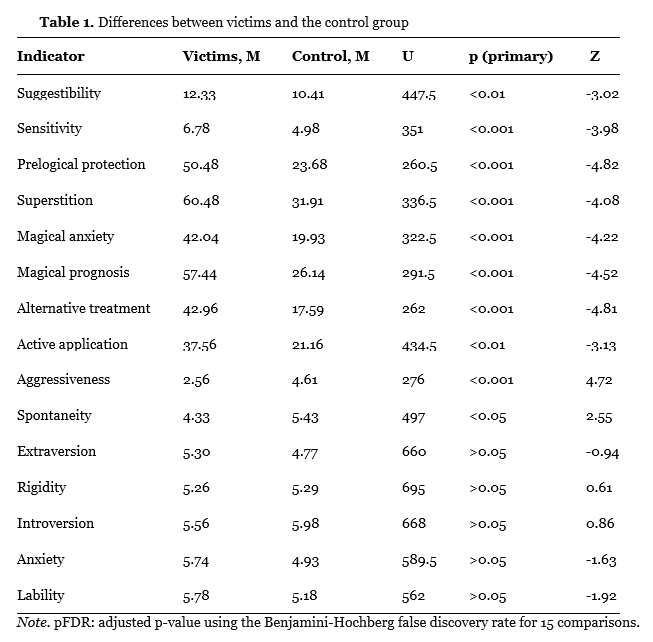
Comparison of the control group (those who terminated contact) and the main group (victims) revealed statistically significant differences on 10 of 15 indicators (Table 1). Victims demonstrated higher suggestibility (12.33 vs. 10.41; U = 452.5; p < 0.01; pFDR = 0.021, marginally significant after correction); higher sensitivity (6.78 vs. 4.98; U = 378.0; p < 0.001; pFDR < 0.001); higher scores on all magical thinking scales (p < 0.001; pFDR < 0.001): prelogical protection (50.48 vs. 23.68), superstition (60.48 vs. 31.91), magical anxiety (42.04 vs. 19.93), magical prognosis (57.44 vs. 26.14), alternative treatment (42.96 vs. 17.59), and active application (37.56 vs. 21.16); lower aggressiveness (2.56 vs. 4.61; U = 412.0; p < 0.001; pFDR < 0.001) and spontaneity (4.33 vs. 5.43; U = 510.5; p < 0.05; pFDR = 0.081, non-significant after correction).
Lower aggressiveness and spontaneity in victims indicate a deficit in assertiveness, the ability to actively defend one’s boundaries. This result is consistent with data from N. V. Meshkova et al. that victims are less inclined toward confrontation and terminating contact. No statistically significant differences were found for extraversion, rigidity, introversion, anxiety, or lability (p > 0.05; pFDR > 0.05). The first hypothesis was thus confirmed for sensitivity, magical thinking, and aggressiveness; for suggestibility and spontaneity, results remained significant only at the trend level after correction for multiple comparisons.
Comparison of control subgroups (“interest” vs. “anxiety”) showed significant differences only in anxiety level (5.80 vs. 4.44; U = 215.0; p < 0.05; pFDR = 0.081). No differences were found on other indicators. Anxiety as a stable trait most likely influences emotional response during the call, but by itself does not prevent successful termination of contact; both subgroups were able to terminate contact with offenders. These results are consistent with literature data (Abitov, 2022; Gasper, 2004; Norris et al., 2019), according to which anxiety as a personality trait is not an unambiguous risk factor. The decisive role is likely played not by anxiety itself but by its combination with other characteristics, in particular with suggestibility and a tendency toward magical thinking. In the subgroup that communicated “with anxiety,” despite high anxiety scores, suggestibility and irrational beliefs remained relatively low, which allowed contact to be terminated. Thus, anxiety by itself does not prevent termination of contact with offenders if it is not combined with elevated suggestibility and magical beliefs.
Comparison of victims with the “interest” subgroup revealed a significant difference in anxiety: victims were more anxious (5.74 vs. 4.44; p < 0.05). The combination of interest in the fraudster’s offer with elevated anxiety may therefore be a risk factor. Comparison of victims with the “anxiety” subgroup showed no differences in anxiety levels (5.74 and 5.80; p > 0.05). Victims differed from anxious individuals who successfully terminated contact only in higher suggestibility (p < 0.05), sensitivity (p < 0.05), all magical thinking scales (p < 0.05 to 0.001), and lower aggressiveness (p < 0.001). Thus, the decisive role is played not by anxiety itself but by its combination with higher suggestibility and irrationality. The second hypothesis H(2) was confirmed.
It is also important to note that no significant differences in extraversion/introversion were found between groups (p > 0.05). Contrary to some international data (Cawvey et al., 2018; Xiang et al., 2020), extraversion was not a significant predictor of victimization in this sample. Indirect confirmation was obtained at the stage of qualitative analysis during the first expert examinations: the examined victims were characterized by selective sociability. This may be because telephone fraud does not require face-to-face communication, and introverts may even be more vulnerable due to less experience in social contacts. However, this issue requires further study.
In the control group, strong positive correlations were found among all scales of irrational thinking (QBS) (rs from 0.58 to 0.89; p < 0.001). This indicates that various forms of irrational thinking form a single “symptom complex.” The key protective mechanism is the negative correlation between suggestibility and spontaneity (p < 0.001) and the positive correlation between spontaneity and aggressiveness (p < 0.05). This means that even with elevated suggestibility, individuals who terminated contact retained the ability to impulsively terminate contact and actively defend boundaries. A positive association was also found between sensitivity and anxiety (p < 0.001) and lability (p < 0.01). High spontaneity and aggressiveness thus impede the realization of suggestibility.
In the victim group, compared with the control group, the negative correlation between suggestibility and spontaneity was absent (rs = -0.11; p > 0.05), as was the positive correlation between spontaneity and aggressiveness (rs = 0.13; p > 0.05). Positive associations were found between suggestibility and irrational constructs: prelogical protection (rs = 0.45; p < 0.05; pFDR = 0.081) and magical prognosis (rs = 0.48; p < 0.05; pFDR = 0.081). Irrational thinking was positively associated with basic individual psychological characteristics: magical anxiety correlated with anxiety (rs = 0.42; p < 0.05; pFDR = 0.081), rigidity correlated with prelogical protection (rs = 0.39; p < 0.05; pFDR = 0.081) and alternative treatment (rs = 0.44; p < 0.05; pFDR = 0.081). This association confirms data from I. R. Abitov et al. that personality-related superstitious thinking correlates with neuroticism (anxiety), aggravation (tendency to exaggerate problems), and pessimism. In fraud victims, high anxiety not only accompanies but directly “feeds” magical coping strategies, creating a vicious circle: anxiety generates a search for supernatural salvation, and rituals, actions following the fraudster’s instructions, temporarily reduce anxiety, reinforcing a dependent pattern. Moreover, the positive correlation between magical anxiety and anxiety in the victim group confirms that magical beliefs perform a pseudo-protective function for them, replacing rational coping (Stoyanova, 2007). Internal associations among QBS scales were even stronger than in the control group (rs up to 0.95).
Thus, the results allow a “victimogenic symptom complex” to be outlined: emotional (sensitivity, anxiety), cognitive-behavioral (elevated suggestibility, magical rituals), and regulatory (low spontaneity and aggressiveness, rigidity). These components are closely interrelated: for example, anxiety positively correlates with magical anxiety (p < 0.05), and suggestibility with prelogical protection (p < 0.05). The third hypothesis was thus confirmed.
The “interest” subgroup retained protective associations: a strong negative correlation between suggestibility and spontaneity (p < 0.001) and a positive correlation between spontaneity and aggressiveness (p < 0.05), as well as a negative correlation between suggestibility and rigidity (p < 0.05). This indicates that individuals with higher suggestibility but also greater flexibility (low rigidity) are able to reconsider their decision in time and terminate contact with the fraudster. The “anxiety” subgroup also retained a negative correlation between suggestibility and spontaneity (rs = -0.45; p < 0.05) and showed a positive correlation between suggestibility and extraversion (rs = 0.48; p < 0.05), possibly compensatory. There was no direct association between suggestibility and magical constructs. In the “anxiety” subgroup, despite pronounced anxiety and sensitivity, the absence of a direct association between suggestibility and irrational constructs, as seen in the victim group, allows anxious individuals to retain the ability to terminate contact.
In the entire sample (N = 83), the identified patterns were confirmed: suggestibility was negatively correlated with spontaneity (rs = -0.35; p < 0.001) and aggressiveness (rs = -0.24; p < 0.05), and positively correlated with anxiety (rs = 0.42; p < 0.001) and sensitivity (rs = 0.27; p < 0.05). All QBS scales formed a single block (rs from 0.62 to 0.94; p < 0.001). Overall, the correlation structure of the entire sample reflects a common pattern: higher suggestibility, high sensitivity and anxiety are combined with low spontaneity/aggressiveness and pronounced magical thinking.
Discussion
The findings contribute to understanding the psychological mechanisms of victimization in telephone fraud. They specify data on the role of suggestibility and sensitivity in the structure of individual psychological characteristics of victims. The mean suggestibility score in victims (12.33) exceeds population norms (8 to 10 points on the Klauchek and Delaryu scale), indicating increased susceptibility of victims to external influence. This is consistent with international studies in which suggestibility is considered a key vulnerability factor for fraud (Modic & Lea, 2013; Norris et al., 2019). In particular, Modic and Lea (2013) showed that neuroticism, a trait closely related to suggestibility and emotional instability, correlates most strongly with response to phishing emails. Similarly, Koning et al. (2024), in a large study of 1,986 respondents, found that neuroticism and low conscientiousness increase the risk of financial fraud.
For the first time, empirical evidence shows that irrationality (magical thinking) is an important vulnerability factor. Differences on QBS scales between victims and individuals who managed to terminate contact reach 3 to 4 standard deviations. According to V. A. Stoyanova’s concept (2007), superstition performs a pseudo-protective function, reducing anxiety through an illusion of control. The fraudster, acting as a “savior,” easily fits into this magical worldview. This is consistent with previously obtained qualitative data from expert examinations, where examinees (victims) displayed elements of magical thinking during directed clinical psychological interviews. Moreover, a systematic review by Whitty (2025), covering 22 studies, showed that beliefs and attitudes are significant predictors of victimization in cyber fraud. The author emphasizes that romantic beliefs predict victimization in romance scams (Buchanan & Whitty, 2014), and favorable attitudes toward unregulated investments predict victimization in investment scams (Deliema et al., 2020). Our data extend this list by showing that magical beliefs are an independent predictor of victimization in telephone fraud. The phenomenon of magical thinking in fraud victims has also been addressed in international literature. In particular, studies on psychic scams note that fraudsters exploit cognitive biases, including magical thinking, to manipulate victims. Victims seeking clarity or reassurance often become dependent on the “psychic,” which increases their anxiety and financial losses. These data are consistent with our hypothesis that magical beliefs perform a pseudo-protective function, temporarily reducing anxiety but ultimately increasing vulnerability.
The data show that anxiety operates ambiguously in interactions with fraudsters depending on context: in the subgroup that communicated “with anxiety,” high anxiety did not lead to victimization, most likely due to lower suggestibility and magical beliefs. In the victim group, anxiety was combined with suggestibility and irrational constructs. Therefore, an anxiety-magical response type can be hypothesized. This result is consistent with Van de Weijer and Leukfeldt (2017), who found that neuroticism increases victimization risk but only in combination with other factors such as low impulsivity and high gullibility. Similarly, in Koning et al. (2024), neuroticism was a significant predictor, but its effect was enhanced by low cognitive engagement and high gullibility.
Qualitative differences in correlation matrices deserve separate consideration. In the control group, a mechanism of “assertive inhibition” operates: higher spontaneity and aggressiveness impede the realization of suggestibility, consistent with L. Yu. Kiryushina’s theory of operational attitudes (2025). In victims, this mechanism does not work, and suggestibility is instead reinforced by magical constructs. This result echoes data that impulsivity and low self-control are risk factors for victimization (Norris et al., 2019; Whitty, 2025). However, in our sample, the decisive role is played not by impulsivity as such but by the loss of the protective association between suggestibility and spontaneity, which opens the way for magical “coping.”
Extraversion/introversion did not differentiate the groups, contrary to some international data (Cawvey et al., 2018; Xiang et al., 2020), but this may be explained by the remote nature of telephone interaction and possibly cultural characteristics. In Whitty’s systematic review (2025), significant heterogeneity of results is also noted: some studies find extraversion a risk factor, others do not. Our data are consistent with Whitty’s (2025) conclusion that there is no universal “victim profile” and that different types of fraud exploit different vulnerabilities.
The study is pilot in nature. Limitations include the small sample size (especially the victim group) and retrospective self-report of emotions. The control group was recruited through an online survey, which may have introduced bias. The application of multiple comparison correction showed that some results (suggestibility, spontaneity) remained significant only at the trend level; this must be considered in interpretation. Future research should expand the sample, conduct longitudinal observations, and develop correction programs.
Conclusions
- Victims of telephone fraud have a specific psychological profile: elevated suggestibility, sensitivity, higher scores on all magical thinking scales, and reduced aggressiveness and spontaneity.
- Irrationality (magical thinking) is an important vulnerability factor; its contribution to group differences exceeds that of other studied variables.
- Anxiety alone does not victimize, but its combination with suggestibility and magical beliefs creates an “anxiety-magical” response type.
- The structure of correlations in the victim group differs qualitatively: loss of protective correlations between suggestibility and spontaneity, and appearance of associations between suggestibility and magical constructs.
- Practical significance: the identified factors can serve as targets for prevention, including the development of critical thinking, reduction of superstition, and assertiveness training for refusal and boundary-setting.
Conflict of Interest: The authors declare no competing interests.
Ethics Statement: The study was conducted in accordance with the ethical principles of the Declaration of Helsinki (1964, revised 1975). All participants were informed about the aims and procedure of the study and provided informed consent for data processing.
Author Contributions: N. V. Alekseeva – Research design, collection and analysis of forensic psychological examination data, manuscript writing, critical revision of content, editing, approval of the final version; D. V. Danilova – Development of the questionnaire, collection of the control group, statistical processing, translation of literature.
AI Use Statement: The authors declare that artificial intelligence (AI) tools were not used to generate scientific content, analyze data, or draw conclusions. AI-assisted technologies were used solely for language editing and translation of the manuscript. All content was reviewed, verified, and approved by the authors.
References
- Abitov, I. R., Gorodetskaya, I. M., & Dvoinin, A. M. (2022). Vzaimosvyaz’ prediktorov irratsional’nogo povedeniya s individual’no-tipologicheskimi i lichnostnymi osobennostyami [The relationship between predictors of irrational behavior and individual-typological and personality characteristics]. Obrazovanie i Samorazvitie [Education and Self Development], 17(3), 131–https://doi.org/10.26907/esd.17.3.11
- Alekseeva, N. V., Koneva, E. V., Mishenin, I. O., & Moskvina, P. A. (2025). Nekotorye individual’no-psikhologicheskie osobennosti zhertv telefonnogo moshennichestva (po rezul’tatam KSPPE v grazhdanskom i ugolovnom protsesse) [Some individual psychological characteristics of victims of telephone fraud (based on forensic psychological and psychiatric examinations in civil and criminal proceedings)]. In Praktika sudebno-psikhiatricheskoi ekspertizy: Sbornik No. 63(pp. 23–42). NMITs PN im. P. Serbskogo.
- Buchanan, T., & Whitty, M. T. (2014). The online dating romance scam: Causes and consequences of victimhood. Psychology, Crime & Law, 20(3), 261–283. https://doi.org/10.1080/1068316X.2013.772180
- Cawvey, M., Hayes, M., Canache, D., & Mondak, J. J. (2018). Personality and victimization in the Americas. International Review of Victimology, 24(1), 123–139. https://doi.org/10.1177/0269758017727345
- Deliema, M., Shadel, D., & Pak, K. (2020). Profiling victims of investment fraud: Mindsets and risky behaviors. Journal of Consumer Research, 46(5), 904–914. https://doi.org/10.1093/jcr/ucz020
- Gasper, K. (2004). Do you see what I see? Affect and visual information processing. Cognition and Emotion, 18(3), 405–421. https://doi.org/10.1080/02699930341000068
- Kiryushina, L. Yu. (2025). Manipulyativnaya forma obshcheniya kak odin iz sposobov soversheniya telefonnogo moshennichestva [Manipulative communication as one of the methods of telephone fraud]. Yurislingvistika [Legal Linguistics], 37(48), 103–107. https://doi.org/10.14258/leglin(2025)3716
- Klauchek, S. V., & Delaryu, V. V. (1997). Razrabotka skriningovogo metoda dlya vyyavleniya sklonnosti k razvitiyu indutsirovannykh sostoyanii [Development of a screening method for identifying susceptibility to induced states]. Psikhologicheskii Zhurnal [Psychological Journal], 18(2), 123–128.
- Koning, L., Junger, M., & Veldkamp, B. (2024). Risk factors for fraud victimization: The role of socio-demographics, personality, mental, general, and cognitive health, activities, and fraud knowledge. International Review of Victimology, 30(3), 443–479. https://doi.org/10.1177/02697580231215839
- Meshkova, N. V., Kudryavtsev, V. T., & Enikolopov, S. N. (2022). K psikhologicheskomu portretu zhertv telefonnogo moshennichestva [Toward a psychological portrait of victims of telephone fraud]. Vestnik Moskovskogo Universiteta. Seriya 14. Psikhologiya [Moscow University Psychology Bulletin], 45(1), 138–157. https://doi.org/10.11621/vsp.2022.01.06
- Modic, D., & Lea, S. E. G. (2013). How neurotic are scam victims, really? The Big Five and Internet scams. SSRN Electronic Journal. https://doi.org/10.2139/ssrn.2448130
- Norris, G., Brookes, A., & Dowell, D. (2019). The psychology of internet fraud victimisation: A systematic review. Journal of Police and Criminal Psychology, 34(3), 231–245. https://doi.org/10.1007/s11896-019-09334-5
- Rozenova, M. I., Ognev, A. S., & Likhacheva, E. V. (2025). Psikhologicheskie mekhanizmy destruktivnogo manipulirovaniya i strategii profilaktiki tsifrovogo moshennichestva [Psychological mechanisms of destructive manipulation and strategies for preventing digital fraud]. Sovremennaya Zarubezhnaya Psikhologiya [Journal of Modern Foreign Psychology], 14(2), 26–37. https://doi.org/10.17759/jmfp.2025140203
- Safuanov, F. S., & Shirokova, V. V. (2025). Kompleksnaya sudebnaya psikhologo-psikhiatricheskaya ekspertiza zhertv telefonnogo moshennichestva: ekspertnye otsenki [Comprehensive forensic psychological and psychiatric examination of victims of telephone fraud: Expert assessments]. Psikhologiya i Pravo [Psychology and Law], 15(2), 3–18. https://doi.org/10.17759/psylaw.2025150201
- Shipshin, S. S. (2009). Metod oposredovannoi retrospektivnoi diagnostiki psikhicheskogo sostoyaniya: Metodicheskie rekomendatsii[Method of mediated retrospective diagnosis of mental state: Methodological recommendations]. Rossiiskii Federal’nyi Tsentr Sudebnoi Ekspertizy pri Minyuste RF.
- Sobchik, L. N. (2010). Individual’no-tipologicheskii oprosnik: Prakticheskoe rukovodstvo[Individual Typological Questionnaire: Practical guide]. Rech’.
- Stoyanova, I. Ya. (2007). Pralogicheskie obrazovaniya v norme i patologii[Prelogical formations in normal and pathological conditions] (Author’s abstract of doctoral dissertation). Tomsk State University, Tomsk, Russia.
- Van de Weijer, S. G. A., & Leukfeldt, E. R. (2017). Big Five personality traits of cybercrime victims. Cyberpsychology, Behavior, and Social Networking, 20(7), 407–412. https://doi.org/10.1089/cyber.2017.0028
- Whitty, M. T. (2025). A systematic literature review of profiling victims of cyber scams: Setting up a framework for future research. Cogent Social Sciences, 11(1). https://doi.org/10.1080/23311886.2025.2563781
- Xiang, H., Zhou, J., & Xie, B. (2020). Understanding older adults’ vulnerability and reactions to telecommunication fraud: The effects of personality and cognition. In Q. Gao & J. Zhou (Eds.), Human aspects of IT for the aged population. Technology and society. HCII 2020. Lecture Notes in Computer Science(Vol. 12209). https://doi.org/10.1007/978-3-030-50232-4_25
Comments (0)
Relevance and Problem. Telephone fraud is one of the fastest-growing threats in the digital environment. The psychological profile of actual victims, particularly the role of irrational (magical) beliefs, remains insufficiently studied. It is unclear which personality traits distinguish actual victims from individuals who, after initiating contact with fraudsters, managed to terminate the interaction. Most studies compare victims with individuals who have not experienced fraud, which does not minimize the effect of chance. Objective. To identify the role of irrational (magical) beliefs in the structure of individual psychological characteristics of victims of telephone fraud compared with individuals who terminated contact with fraudsters. Methods. The sample comprised 83 individuals. The main group included 27 individuals recognized as victims under Article 159 of the Criminal Code of the Russian Federation who underwent comprehensive forensic psychological and psychiatric examination (22 women, 5 men). The control group included 56 individuals who terminated contact with fraudsters (40 women, 16 men); of these, 36 communicated with “interest” and 20 with “anxiety.” Instruments: an author-designed questionnaire, the suggestibility scale by S. V. Klauchek and V. V. Delaryu, the Individual Typological Questionnaire (ITQ, L. N. Sobchik), and the Questionnaire of Beliefs and Superstitions (QBS, V. A. Stoyanova). Statistics: Mann-Whitney U test with Benjamini-Hochberg false discovery rate correction for multiple comparisons, Spearman rank correlation, and descriptive statistics. Results. Victims differed significantly from controls in higher suggestibility (12.33 vs. 10.41; U = 452.5; p < 0.01; adjusted p = 0.021, marginally significant after correction), higher sensitivity (6.78 vs. 4.98; U = 378.0; p < 0.001), higher scores on all magical thinking scales (p < 0.001), and lower aggressiveness (2.56 vs. 4.61; U = 412.0; p < 0.001) and spontaneity (4.33 vs. 5.43; U = 510.5; p < 0.05; adjusted p = 0.081, non-significant after correction). No significant differences were found for extraversion, rigidity, introversion, anxiety, or lability (p > 0.05). In the control group, suggestibility was negatively correlated with spontaneity, and spontaneity was positively correlated with aggressiveness. In the victim group, these associations were absent and were replaced by positive correlations between suggestibility and irrational constructs, and between irrational constructs and anxiety and rigidity. Discussion. Irrationality appears to be a vulnerability factor for fraud victimization, forming a “victimogenic symptom complex” together with anxiety and suggestibility. The findings are consistent with the concept of the pseudo-protective function of superstitions (Stoyanova, 2007) and the theory of operational attitudes (Kiryushina, 2025), as well as with international studies linking neuroticism and irrational beliefs to victimization (Deliema et al., 2020; Modic & Lea, 2013; Whitty, 2025). Conclusion. Irrational (magical) thinking may serve as a predictor of victimization in telephone fraud, opening possibilities for prevention and correction programs.
Keywords: Telephone Fraud, Victims, Irrationality, Magical Thinking, Suggestibility, Individual Psychological Characteristics
Иррациональность в структуре индивидуально-психологических особенностей жертв телефонного мошенничества: пилотное сравнительное исследование
Н. В. Алексеева, Д. В. Данилова
Ярославский государственный университет им. П. Г. Демидова, Ярославль, Россия
Резюме. Актуальность и проблема. Телефонное мошенничество является одной из наиболее быстрорастущих угроз цифровой среды. Вместе с тем психологический профиль реальных потерпевших, особенно роль иррациональных (магических) установок, остаётся недостаточно изученным. Остается неясным вопрос о том, какие личностные особенности отличают реальных жертв от лиц, которые, начав взаимодействие с мошенниками, сумели прервать контакт. Большинство исследований сравнивают жертв с людьми, не имевшими такого опыта, что не позволяет минимизировать эффект случайности. Цель. Выявить роль иррациональных (магических) установок в структуре индивидуально-психологических особенностей жертв телефонного мошенничества по сравнению с лицами, прервавшими общение с мошенниками. Методы. Выборка включала 83 человека: 27 человек, признанных потерпевшими по ст. 159 УК РФ и прошедших комплексную судебную психолого-психиатрическую экспертизу (22 женщины, 5 мужчин) и 56 человек, прервавших общение с мошенниками (40 женщин, 16 мужчин), из них 36 человек общались «с интересом», а 20 – «с тревогой». Использованы авторская анкета, методика определения степени внушаемости С. В. Клаучека и В. В. Деларю, Индивидуально-типологический опросник (ИТО, Л. Н. Собчик), опросник иррациональных установок ОВИС (В. А. Стоянова). Статистика: U-критерий Манна–Уитни с поправкой Бенджамини–Хохберга на множественные сравнения, корреляция Спирмена, описательные статистики. Результаты. Жертвы статистически значимо отличались более высокой внушаемостью (12,33 против 10,41; U = 452,5; p < 0,01; после поправки pFDR = 0,021, маргинально значимо), сензитивностью (6,78 против 4,98; U = 378,0; p < 0,001), более высокими значениями по всем шкалам магического мышления (p < 0,001), а также более низкими агрессивностью (2,56 против 4,61; U = 412,0; p < 0,001) и спонтанностью (4,33 против 5,43; U = 510,5; p < 0,05; после поправки pFDR = 0,081, незначимо). Значимых различий по экстраверсии, ригидности, интроверсии, тревожности и лабильности не выявлено (p > 0,05). В контрольной группе обнаружена отрицательная связь внушаемости со спонтанностью и положительная связь спонтанности с агрессивностью; в группе жертв эти связи отсутствовали и заменялись положительными корреляциями внушаемости с иррациональными конструктами, а иррациональных конструктов с тревожностью и ригидностью. Обсуждение. Иррациональность является одним из факторов уязвимости к мошенническим действиям, образуя совместно с тревожностью и внушаемостью «виктимный симптомокомплекс». Полученные данные согласуются с концепцией псевдозащитной функции суеверий (Стоянова, 2007) и теорией операционных установок (Кирюшина, 2025), а также с результатами зарубежных исследований, показавших связь нейротизма и иррациональных убеждений с виктимизацией (Deliema et al., 2020; Modic & Lea, 2013; Whitty, 2025). Заключение. Иррациональное (магическое) мышление может выступать одним из предикторов виктимизации при телефонном мошенничестве, что открывает возможности для профилактических и коррекционных программ.
Ключевые слова: телефонное мошенничество, жертвы, иррациональность, магическое мышление, внушаемость, индивидуально-психологические особенности.
In the context of the widespread use of mobile communications and the internet, telephone fraud has become one of the most common and socially significant threats. Since 2024, there has been an explosive increase in criminal cases related to fraudulent activities, along with a growing number of forensic examinations in this relatively new domain. Telephone fraud is characterized by sophisticated methods of influence and the exploitation of vulnerabilities in the human mind. It leads to significant financial losses and causes victims deep psychological stress, impaired adaptation, feelings of guilt and shame, and reduced trust in others.
Despite the apparent simplicity of fraud schemes and ongoing prevention efforts, a significant number of people still become victims. This raises the question of specific psychological preconditions and vulnerabilities. Identifying these vulnerabilities is necessary for developing effective prevention programs and providing psychological assistance.
Telephone fraud is a particular form of manipulation carried out remotely, under time pressure and high emotional tension. The fraudster creates an artificial situation of uncertainty (“your Government Services account has been hacked,” “loans are being taken out in your name”) and demands immediate action. According to previous research, the success of fraudulent influence depends not only on the offender’s tactics but also on the psychological characteristics of the victim (Meshkova, Kudryavtsev, & Enikolopov, 2022).
In Russian science, issues of forensic psychological examination of telephone fraud victims have been developed by F. S. Safuanov, O. F. Savina, M. V. Morozova, Yu. O. Perepravina, and V. V. Shirokova; psychological characteristics of victims have been studied by N. V. Meshkova, V. T. Kudryavtsev, and S. N. Enikolopov; factors of victim behavior have been studied by D. A. Kolodkina, N. V. Dvoryanchikov, and K. N. Dvoryanchikova; manipulative aspects have been analyzed by L. Yu. Kiryushina and E. V. Zotina. In international literature, the greatest attention has been paid to factors such as gullibility, impulsivity, low self-esteem, anxiety, and extraversion (Cawvey et al., 2018; Koning et al., 2024; Van de Weijer & Leukfeldt, 2017). However, research findings remain contradictory.
The question remains open as to which personality traits distinguish actual victims from those who, after initiating contact with offenders, managed to terminate the interaction. Most studies compare victims with individuals who have not encountered fraudsters. Such an approach does not fully exclude the effect of chance. It seems that comparing individuals who have been exposed to a fraudulent attack, those who became victims and those who terminated contact in time, may help identify possible vulnerability factors.
At the initial stage of the study, a qualitative analysis of 13 forensic psychological examinations of victims in telephone fraud cases was conducted within comprehensive forensic psychological and psychiatric examinations. It allowed the following individual psychological characteristics of the examinees to be outlined: relatively preserved cognitive and intellectual sphere; average and above-average suggestibility according to the method of S. V. Klauchek and V. V. Delaryu; prosocial personality orientation; on the Individual Typological Questionnaire, excessively pronounced traits of anxiety, sensitivity, rigidity, and lability; impulsivity in action combined with affective rigidity; in subjectively difficult, non-standard, and frustrating situations, a tendency toward reactions of confusion, delayed orientation and decision-making, and compliance under directive or uncertain conditions; feelings of loneliness, selectivity in communication, an internal form of emotional experience, and an inability to refuse; naivety and signs of subjectivism in judgments, elements of prelogical thinking according to clinical psychological interview data; on the Link Cube test, an impulsive execution style, incomplete coverage of the situation with exceeding assembly time up to 20 minutes, and a large number of errors at the initial construction level; according to the ORDPS method (Shipshin, 2009), no clear peaks, and throughout the development of the criminal situation, emotional tension with an unstable level and a wide range of experiences from anxiety and activity to fear and despair. Most examinees in the clinical psychological interview described escalating tension requiring discharge. These characteristics became accentuated and manifested specifically in interaction according to the “key to lock” principle with manipulative influences from offenders (systematic, continuous, directive instruction) combined with the so-called “soil”: rush and multitasking, traumatic situations, mental tension, loneliness, and unsatisfactory psychophysiological state (Alekseeva et al., 2025).
Already at the stage of the first examinations, it was noted that almost all examinees, according to directed clinical psychological interviews, believed in omens and superstitions, astrological forecasts and horoscopes, extrasensory abilities, were interested in paranormal phenomena, and watched programs such as “Battle of Psychics,” that is, they displayed signs of irrationality. Therefore, among the individual psychological characteristics studied, it was decided to investigate “prelogical formations.” The tendency toward superstitions and magical thinking is most pronounced and reaches maximum intensity in crisis and stressful situations, under conditions of high uncertainty, anxiety, and limited control over events. This is why irrationality as a system-forming factor was placed at the focus of the study. This qualitative analysis leads to the need for empirical verification of the role of irrational beliefs. Accordingly, the objective of this study is to identify the role of irrational (magical) beliefs in the structure of individual psychological characteristics of victims of telephone fraud compared with individuals who terminated contact with fraudsters.
Hypotheses:
H(1) – Victims, unlike individuals who managed to terminate contact with offenders, have higher suggestibility, sensitivity, and magical thinking, and lower aggressiveness and spontaneity.
H(2) – Anxiety alone is not a factor in victimization; anxiety combined with higher suggestibility and irrationality increases vulnerability risk.
H(3) – The structure of correlations in the victim group differs qualitatively: loss of protective correlations and appearance of associations between suggestibility and magical constructs.
The study involved individuals aged 18 to 75 years who had experienced interaction with telephone fraudsters. The total sample comprised 83 individuals.
The main group (victims) included individuals who transferred money to fraudsters or provided card data, or completed housing sale transactions in favor of fraudsters, and who underwent examination as victims within comprehensive forensic psychological and psychiatric examination at the outpatient forensic psychiatric examination department of the Yaroslavl Regional Psychiatric Hospital (n = 27; 22 women, 5 men). The control group included individuals who terminated contact with fraudsters (n = 56; 40 women, 16 men). The control group was divided into subgroups based on self-reported emotional state during the call: those who communicated “with interest” (n = 36) and those who communicated “with anxiety” (n = 20). The groups were comparable in sex, age, and education (p > 0.05). All participants provided informed consent.
The following instruments were used: a questionnaire for sample selection and analysis of experience with fraudsters (developed by the authors); the suggestibility scale by S. V. Klauchek and V. V. Delaryu, measuring susceptibility to external influence (0 to 20 points); the Individual Typological Questionnaire (ITQ, L. N. Sobchik) with scales for extraversion, spontaneity, aggressiveness, rigidity, introversion, sensitivity, anxiety, and lability (sten scores); and the Questionnaire of Beliefs and Superstitions by I. Ya. Stoyanova (QBS) with six scales of magical thinking: prelogical protection, superstition, magical anxiety, magical prognosis, alternative treatment, and active application (raw scores converted to a 100-point scale).
The study was conducted individually: paper forms for victims within comprehensive forensic psychological and psychiatric examination, and online forms for the control group. Statistical processing used the Mann-Whitney U test for independent groups, Spearman rank correlation (rs), and descriptive statistics. The significance level was set at p < 0.05. To control for false discoveries in multiple comparisons (15 indicators), the Benjamini-Hochberg false discovery rate (FDR) correction was applied. Adjusted p-values (pFDR) are reported in the table and text. All calculations were performed using a statistical package IBM SPSS Statistics 28; exact statistics are reported for reproducibility.
Comparison of the control group (those who terminated contact) and the main group (victims) revealed statistically significant differences on 10 of 15 indicators (Table 1). Victims demonstrated higher suggestibility (12.33 vs. 10.41; U = 452.5; p < 0.01; pFDR = 0.021, marginally significant after correction); higher sensitivity (6.78 vs. 4.98; U = 378.0; p < 0.001; pFDR < 0.001); higher scores on all magical thinking scales (p < 0.001; pFDR < 0.001): prelogical protection (50.48 vs. 23.68), superstition (60.48 vs. 31.91), magical anxiety (42.04 vs. 19.93), magical prognosis (57.44 vs. 26.14), alternative treatment (42.96 vs. 17.59), and active application (37.56 vs. 21.16); lower aggressiveness (2.56 vs. 4.61; U = 412.0; p < 0.001; pFDR < 0.001) and spontaneity (4.33 vs. 5.43; U = 510.5; p < 0.05; pFDR = 0.081, non-significant after correction).
Lower aggressiveness and spontaneity in victims indicate a deficit in assertiveness, the ability to actively defend one’s boundaries. This result is consistent with data from N. V. Meshkova et al. that victims are less inclined toward confrontation and terminating contact. No statistically significant differences were found for extraversion, rigidity, introversion, anxiety, or lability (p > 0.05; pFDR > 0.05). The first hypothesis was thus confirmed for sensitivity, magical thinking, and aggressiveness; for suggestibility and spontaneity, results remained significant only at the trend level after correction for multiple comparisons.
Comparison of control subgroups (“interest” vs. “anxiety”) showed significant differences only in anxiety level (5.80 vs. 4.44; U = 215.0; p < 0.05; pFDR = 0.081). No differences were found on other indicators. Anxiety as a stable trait most likely influences emotional response during the call, but by itself does not prevent successful termination of contact; both subgroups were able to terminate contact with offenders. These results are consistent with literature data (Abitov, 2022; Gasper, 2004; Norris et al., 2019), according to which anxiety as a personality trait is not an unambiguous risk factor. The decisive role is likely played not by anxiety itself but by its combination with other characteristics, in particular with suggestibility and a tendency toward magical thinking. In the subgroup that communicated “with anxiety,” despite high anxiety scores, suggestibility and irrational beliefs remained relatively low, which allowed contact to be terminated. Thus, anxiety by itself does not prevent termination of contact with offenders if it is not combined with elevated suggestibility and magical beliefs.
Comparison of victims with the “interest” subgroup revealed a significant difference in anxiety: victims were more anxious (5.74 vs. 4.44; p < 0.05). The combination of interest in the fraudster’s offer with elevated anxiety may therefore be a risk factor. Comparison of victims with the “anxiety” subgroup showed no differences in anxiety levels (5.74 and 5.80; p > 0.05). Victims differed from anxious individuals who successfully terminated contact only in higher suggestibility (p < 0.05), sensitivity (p < 0.05), all magical thinking scales (p < 0.05 to 0.001), and lower aggressiveness (p < 0.001). Thus, the decisive role is played not by anxiety itself but by its combination with higher suggestibility and irrationality. The second hypothesis H(2) was confirmed.
It is also important to note that no significant differences in extraversion/introversion were found between groups (p > 0.05). Contrary to some international data (Cawvey et al., 2018; Xiang et al., 2020), extraversion was not a significant predictor of victimization in this sample. Indirect confirmation was obtained at the stage of qualitative analysis during the first expert examinations: the examined victims were characterized by selective sociability. This may be because telephone fraud does not require face-to-face communication, and introverts may even be more vulnerable due to less experience in social contacts. However, this issue requires further study.
In the control group, strong positive correlations were found among all scales of irrational thinking (QBS) (rs from 0.58 to 0.89; p < 0.001). This indicates that various forms of irrational thinking form a single “symptom complex.” The key protective mechanism is the negative correlation between suggestibility and spontaneity (p < 0.001) and the positive correlation between spontaneity and aggressiveness (p < 0.05). This means that even with elevated suggestibility, individuals who terminated contact retained the ability to impulsively terminate contact and actively defend boundaries. A positive association was also found between sensitivity and anxiety (p < 0.001) and lability (p < 0.01). High spontaneity and aggressiveness thus impede the realization of suggestibility.
In the victim group, compared with the control group, the negative correlation between suggestibility and spontaneity was absent (rs = -0.11; p > 0.05), as was the positive correlation between spontaneity and aggressiveness (rs = 0.13; p > 0.05). Positive associations were found between suggestibility and irrational constructs: prelogical protection (rs = 0.45; p < 0.05; pFDR = 0.081) and magical prognosis (rs = 0.48; p < 0.05; pFDR = 0.081). Irrational thinking was positively associated with basic individual psychological characteristics: magical anxiety correlated with anxiety (rs = 0.42; p < 0.05; pFDR = 0.081), rigidity correlated with prelogical protection (rs = 0.39; p < 0.05; pFDR = 0.081) and alternative treatment (rs = 0.44; p < 0.05; pFDR = 0.081). This association confirms data from I. R. Abitov et al. that personality-related superstitious thinking correlates with neuroticism (anxiety), aggravation (tendency to exaggerate problems), and pessimism. In fraud victims, high anxiety not only accompanies but directly “feeds” magical coping strategies, creating a vicious circle: anxiety generates a search for supernatural salvation, and rituals, actions following the fraudster’s instructions, temporarily reduce anxiety, reinforcing a dependent pattern. Moreover, the positive correlation between magical anxiety and anxiety in the victim group confirms that magical beliefs perform a pseudo-protective function for them, replacing rational coping (Stoyanova, 2007). Internal associations among QBS scales were even stronger than in the control group (rs up to 0.95).
Thus, the results allow a “victimogenic symptom complex” to be outlined: emotional (sensitivity, anxiety), cognitive-behavioral (elevated suggestibility, magical rituals), and regulatory (low spontaneity and aggressiveness, rigidity). These components are closely interrelated: for example, anxiety positively correlates with magical anxiety (p < 0.05), and suggestibility with prelogical protection (p < 0.05). The third hypothesis was thus confirmed.
The “interest” subgroup retained protective associations: a strong negative correlation between suggestibility and spontaneity (p < 0.001) and a positive correlation between spontaneity and aggressiveness (p < 0.05), as well as a negative correlation between suggestibility and rigidity (p < 0.05). This indicates that individuals with higher suggestibility but also greater flexibility (low rigidity) are able to reconsider their decision in time and terminate contact with the fraudster. The “anxiety” subgroup also retained a negative correlation between suggestibility and spontaneity (rs = -0.45; p < 0.05) and showed a positive correlation between suggestibility and extraversion (rs = 0.48; p < 0.05), possibly compensatory. There was no direct association between suggestibility and magical constructs. In the “anxiety” subgroup, despite pronounced anxiety and sensitivity, the absence of a direct association between suggestibility and irrational constructs, as seen in the victim group, allows anxious individuals to retain the ability to terminate contact.
In the entire sample (N = 83), the identified patterns were confirmed: suggestibility was negatively correlated with spontaneity (rs = -0.35; p < 0.001) and aggressiveness (rs = -0.24; p < 0.05), and positively correlated with anxiety (rs = 0.42; p < 0.001) and sensitivity (rs = 0.27; p < 0.05). All QBS scales formed a single block (rs from 0.62 to 0.94; p < 0.001). Overall, the correlation structure of the entire sample reflects a common pattern: higher suggestibility, high sensitivity and anxiety are combined with low spontaneity/aggressiveness and pronounced magical thinking.
The findings contribute to understanding the psychological mechanisms of victimization in telephone fraud. They specify data on the role of suggestibility and sensitivity in the structure of individual psychological characteristics of victims. The mean suggestibility score in victims (12.33) exceeds population norms (8 to 10 points on the Klauchek and Delaryu scale), indicating increased susceptibility of victims to external influence. This is consistent with international studies in which suggestibility is considered a key vulnerability factor for fraud (Modic & Lea, 2013; Norris et al., 2019). In particular, Modic and Lea (2013) showed that neuroticism, a trait closely related to suggestibility and emotional instability, correlates most strongly with response to phishing emails. Similarly, Koning et al. (2024), in a large study of 1,986 respondents, found that neuroticism and low conscientiousness increase the risk of financial fraud.
For the first time, empirical evidence shows that irrationality (magical thinking) is an important vulnerability factor. Differences on QBS scales between victims and individuals who managed to terminate contact reach 3 to 4 standard deviations. According to V. A. Stoyanova’s concept (2007), superstition performs a pseudo-protective function, reducing anxiety through an illusion of control. The fraudster, acting as a “savior,” easily fits into this magical worldview. This is consistent with previously obtained qualitative data from expert examinations, where examinees (victims) displayed elements of magical thinking during directed clinical psychological interviews. Moreover, a systematic review by Whitty (2025), covering 22 studies, showed that beliefs and attitudes are significant predictors of victimization in cyber fraud. The author emphasizes that romantic beliefs predict victimization in romance scams (Buchanan & Whitty, 2014), and favorable attitudes toward unregulated investments predict victimization in investment scams (Deliema et al., 2020). Our data extend this list by showing that magical beliefs are an independent predictor of victimization in telephone fraud. The phenomenon of magical thinking in fraud victims has also been addressed in international literature. In particular, studies on psychic scams note that fraudsters exploit cognitive biases, including magical thinking, to manipulate victims. Victims seeking clarity or reassurance often become dependent on the “psychic,” which increases their anxiety and financial losses. These data are consistent with our hypothesis that magical beliefs perform a pseudo-protective function, temporarily reducing anxiety but ultimately increasing vulnerability.
The data show that anxiety operates ambiguously in interactions with fraudsters depending on context: in the subgroup that communicated “with anxiety,” high anxiety did not lead to victimization, most likely due to lower suggestibility and magical beliefs. In the victim group, anxiety was combined with suggestibility and irrational constructs. Therefore, an anxiety-magical response type can be hypothesized. This result is consistent with Van de Weijer and Leukfeldt (2017), who found that neuroticism increases victimization risk but only in combination with other factors such as low impulsivity and high gullibility. Similarly, in Koning et al. (2024), neuroticism was a significant predictor, but its effect was enhanced by low cognitive engagement and high gullibility.
Qualitative differences in correlation matrices deserve separate consideration. In the control group, a mechanism of “assertive inhibition” operates: higher spontaneity and aggressiveness impede the realization of suggestibility, consistent with L. Yu. Kiryushina’s theory of operational attitudes (2025). In victims, this mechanism does not work, and suggestibility is instead reinforced by magical constructs. This result echoes data that impulsivity and low self-control are risk factors for victimization (Norris et al., 2019; Whitty, 2025). However, in our sample, the decisive role is played not by impulsivity as such but by the loss of the protective association between suggestibility and spontaneity, which opens the way for magical “coping.”
Extraversion/introversion did not differentiate the groups, contrary to some international data (Cawvey et al., 2018; Xiang et al., 2020), but this may be explained by the remote nature of telephone interaction and possibly cultural characteristics. In Whitty’s systematic review (2025), significant heterogeneity of results is also noted: some studies find extraversion a risk factor, others do not. Our data are consistent with Whitty’s (2025) conclusion that there is no universal “victim profile” and that different types of fraud exploit different vulnerabilities.
The study is pilot in nature. Limitations include the small sample size (especially the victim group) and retrospective self-report of emotions. The control group was recruited through an online survey, which may have introduced bias. The application of multiple comparison correction showed that some results (suggestibility, spontaneity) remained significant only at the trend level; this must be considered in interpretation. Future research should expand the sample, conduct longitudinal observations, and develop correction programs.
- Victims of telephone fraud have a specific psychological profile: elevated suggestibility, sensitivity, higher scores on all magical thinking scales, and reduced aggressiveness and spontaneity.
- Irrationality (magical thinking) is an important vulnerability factor; its contribution to group differences exceeds that of other studied variables.
- Anxiety alone does not victimize, but its combination with suggestibility and magical beliefs creates an “anxiety-magical” response type.
- The structure of correlations in the victim group differs qualitatively: loss of protective correlations between suggestibility and spontaneity, and appearance of associations between suggestibility and magical constructs.
- Practical significance: the identified factors can serve as targets for prevention, including the development of critical thinking, reduction of superstition, and assertiveness training for refusal and boundary-setting.
Conflict of Interest: The authors declare no competing interests.
Ethics Statement: The study was conducted in accordance with the ethical principles of the Declaration of Helsinki (1964, revised 1975). All participants were informed about the aims and procedure of the study and provided informed consent for data processing.
Author Contributions: N. V. Alekseeva – Research design, collection and analysis of forensic psychological examination data, manuscript writing, critical revision of content, editing, approval of the final version; D. V. Danilova – Development of the questionnaire, collection of the control group, statistical processing, translation of literature.
AI Use Statement: The authors declare that artificial intelligence (AI) tools were not used to generate scientific content, analyze data, or draw conclusions. AI-assisted technologies were used solely for language editing and translation of the manuscript. All content was reviewed, verified, and approved by the authors.
- Abitov, I. R., Gorodetskaya, I. M., & Dvoinin, A. M. (2022). Vzaimosvyaz’ prediktorov irratsional’nogo povedeniya s individual’no-tipologicheskimi i lichnostnymi osobennostyami [The relationship between predictors of irrational behavior and individual-typological and personality characteristics]. Obrazovanie i Samorazvitie [Education and Self Development], 17(3), 131–https://doi.org/10.26907/esd.17.3.11
- Alekseeva, N. V., Koneva, E. V., Mishenin, I. O., & Moskvina, P. A. (2025). Nekotorye individual’no-psikhologicheskie osobennosti zhertv telefonnogo moshennichestva (po rezul’tatam KSPPE v grazhdanskom i ugolovnom protsesse) [Some individual psychological characteristics of victims of telephone fraud (based on forensic psychological and psychiatric examinations in civil and criminal proceedings)]. In Praktika sudebno-psikhiatricheskoi ekspertizy: Sbornik No. 63(pp. 23–42). NMITs PN im. P. Serbskogo.
- Buchanan, T., & Whitty, M. T. (2014). The online dating romance scam: Causes and consequences of victimhood. Psychology, Crime & Law, 20(3), 261–283. https://doi.org/10.1080/1068316X.2013.772180
- Cawvey, M., Hayes, M., Canache, D., & Mondak, J. J. (2018). Personality and victimization in the Americas. International Review of Victimology, 24(1), 123–139. https://doi.org/10.1177/0269758017727345
- Deliema, M., Shadel, D., & Pak, K. (2020). Profiling victims of investment fraud: Mindsets and risky behaviors. Journal of Consumer Research, 46(5), 904–914. https://doi.org/10.1093/jcr/ucz020
- Gasper, K. (2004). Do you see what I see? Affect and visual information processing. Cognition and Emotion, 18(3), 405–421. https://doi.org/10.1080/02699930341000068
- Kiryushina, L. Yu. (2025). Manipulyativnaya forma obshcheniya kak odin iz sposobov soversheniya telefonnogo moshennichestva [Manipulative communication as one of the methods of telephone fraud]. Yurislingvistika [Legal Linguistics], 37(48), 103–107. https://doi.org/10.14258/leglin(2025)3716
- Klauchek, S. V., & Delaryu, V. V. (1997). Razrabotka skriningovogo metoda dlya vyyavleniya sklonnosti k razvitiyu indutsirovannykh sostoyanii [Development of a screening method for identifying susceptibility to induced states]. Psikhologicheskii Zhurnal [Psychological Journal], 18(2), 123–128.
- Koning, L., Junger, M., & Veldkamp, B. (2024). Risk factors for fraud victimization: The role of socio-demographics, personality, mental, general, and cognitive health, activities, and fraud knowledge. International Review of Victimology, 30(3), 443–479. https://doi.org/10.1177/02697580231215839
- Meshkova, N. V., Kudryavtsev, V. T., & Enikolopov, S. N. (2022). K psikhologicheskomu portretu zhertv telefonnogo moshennichestva [Toward a psychological portrait of victims of telephone fraud]. Vestnik Moskovskogo Universiteta. Seriya 14. Psikhologiya [Moscow University Psychology Bulletin], 45(1), 138–157. https://doi.org/10.11621/vsp.2022.01.06
- Modic, D., & Lea, S. E. G. (2013). How neurotic are scam victims, really? The Big Five and Internet scams. SSRN Electronic Journal. https://doi.org/10.2139/ssrn.2448130
- Norris, G., Brookes, A., & Dowell, D. (2019). The psychology of internet fraud victimisation: A systematic review. Journal of Police and Criminal Psychology, 34(3), 231–245. https://doi.org/10.1007/s11896-019-09334-5
- Rozenova, M. I., Ognev, A. S., & Likhacheva, E. V. (2025). Psikhologicheskie mekhanizmy destruktivnogo manipulirovaniya i strategii profilaktiki tsifrovogo moshennichestva [Psychological mechanisms of destructive manipulation and strategies for preventing digital fraud]. Sovremennaya Zarubezhnaya Psikhologiya [Journal of Modern Foreign Psychology], 14(2), 26–37. https://doi.org/10.17759/jmfp.2025140203
- Safuanov, F. S., & Shirokova, V. V. (2025). Kompleksnaya sudebnaya psikhologo-psikhiatricheskaya ekspertiza zhertv telefonnogo moshennichestva: ekspertnye otsenki [Comprehensive forensic psychological and psychiatric examination of victims of telephone fraud: Expert assessments]. Psikhologiya i Pravo [Psychology and Law], 15(2), 3–18. https://doi.org/10.17759/psylaw.2025150201
- Shipshin, S. S. (2009). Metod oposredovannoi retrospektivnoi diagnostiki psikhicheskogo sostoyaniya: Metodicheskie rekomendatsii[Method of mediated retrospective diagnosis of mental state: Methodological recommendations]. Rossiiskii Federal’nyi Tsentr Sudebnoi Ekspertizy pri Minyuste RF.
- Sobchik, L. N. (2010). Individual’no-tipologicheskii oprosnik: Prakticheskoe rukovodstvo[Individual Typological Questionnaire: Practical guide]. Rech’.
- Stoyanova, I. Ya. (2007). Pralogicheskie obrazovaniya v norme i patologii[Prelogical formations in normal and pathological conditions] (Author’s abstract of doctoral dissertation). Tomsk State University, Tomsk, Russia.
- Van de Weijer, S. G. A., & Leukfeldt, E. R. (2017). Big Five personality traits of cybercrime victims. Cyberpsychology, Behavior, and Social Networking, 20(7), 407–412. https://doi.org/10.1089/cyber.2017.0028
- Whitty, M. T. (2025). A systematic literature review of profiling victims of cyber scams: Setting up a framework for future research. Cogent Social Sciences, 11(1). https://doi.org/10.1080/23311886.2025.2563781
- Xiang, H., Zhou, J., & Xie, B. (2020). Understanding older adults’ vulnerability and reactions to telecommunication fraud: The effects of personality and cognition. In Q. Gao & J. Zhou (Eds.), Human aspects of IT for the aged population. Technology and society. HCII 2020. Lecture Notes in Computer Science(Vol. 12209). https://doi.org/10.1007/978-3-030-50232-4_25
Supplemental_material