
Opposing Pathways of Integration: How Hierarchical Individuality Traits Predict Psychological Hardiness
Abstract
Abstract
Background. Psychological hardiness is a personality resource enabling individuals to withstand stress, yet mechanisms integrating multi‑level individuality properties remain poorly understood. Traditional correlational methods fail to distinguish global undifferentiated activity from genuine systemic integration. Existing methodologies do not capture dynamic hierarchical transformation of temperament, character, and cognitive styles into adaptive resources. Objective. To investigate integration effects using Activity (ergonicity) and Emotionality as predictors of hardiness, operationalising static (comparative advantage) and dynamic (hierarchical propagation) integration.
Method. 616 participants (46% male, 18–46 years) completed validated measures of formal‑dynamic properties, character traits, cognitive styles, motivation, and hardiness. Hierarchical cluster analysis (Ward, NbClust) and automated linear modelling were applied. Results. Three Activity–Emotionality clusters emerged. Higher Activity consistently predicted higher hardiness (β = 0.333–0.536, all p < .001), while higher Emotionality predicted lower hardiness (β = −0.260 to −0.313, p < .01–.001). Activity propagated through Hyperthymicity and Pedanticity to cognitive flexibility, enhancing Control and Commitment. Emotionality propagated through emotional lability, Stuckness, and Anxiety to intolerance, impulsivity, and concrete conceptualisation, reducing all hardiness components. Conclusion. Integration of multi‑level properties produces measurable hardiness effects through opposing hierarchical pathways. This study offers the first empirical operationalisation of static and dynamic integration in personality research, supporting differential‑integration theory and challenging traditional correlation‑based approaches.
Противоположные пути интеграции: как иерархические свойства индивидуальности предсказывают психологическую жизнестойкость
Т. А. Дудникова
Государственный академический университет гуманитарных наук,
Москва, Россия
Резюме. Актуальность. Психологическая жизнестойкость является личностным ресурсом, позволяющим противостоять стрессовым обстоятельствам, однако механизмы интеграции разноуровневых свойств индивидуальности, лежащие в основе жизнестойкости, остаются недостаточно изученными. Традиционные корреляционные методы не позволяют различить глобальную недифференцированную активность и подлинную системную интеграцию. Существующие методологии не улавливают динамическую иерархическую трансформацию темпераментальных черт, характера и когнитивных стилей в адаптивный ресурс. Цель. Изучить эффекты интеграции разноуровневых свойств индивидуальности, используя Активность (эргичность) и Эмоциональность как предикторы жизнестойкости, и операционализировать статическую (сравнительные преимущества) и динамическую (иерархическая трансляция) интеграцию. Метод. Выборка из 616 участников (46% мужчин, возраст 18–46 лет) заполнила валидизированные опросники формально-динамических свойств, характерологических черт, когнитивных стилей, мотивации и тест жизнестойкости. Применены иерархический кластерный анализ (метод Уорда, NbClust) и автоматизированное линейное моделирование. Результаты. Выделены три кластера: (1) высокая Активность/низкая Эмоциональность; (2) средняя Активность/высокая Эмоциональность; (3) низкая Активность/низкая Эмоциональность. Высокая Активность предсказывала высокую жизнестойкость (β = 0.333–0.536, p < .001), а высокая Эмоциональность — низкую (β = −0.260 до −0.313, p < .01–.001). Активность транслировалась через гипертимность и педантичность в когнитивную гибкость, повышая Контроль и Вовлечённость. Эмоциональность транслировалась через эмотивность, застревание и тревожность в интолерантность, импульсивность и конкретную концептуализацию, снижая компоненты жизнестойкости. Заключение. Интеграция разноуровневых свойств даёт измеримые эффекты через противоположные иерархические пути. Работа предлагает первую эмпирическую операционализацию статической и динамической интеграции в психологии личности, подтверждая дифференционно-интеграционную теорию и ставя под сомнение традиционные корреляционные подходы.
Ключевые слова: интеграция, индивидуальность, жизнестойкость, активность, эмоциональность, когнитивные стили, иерархия личности
Introduction
Contemporary psychology faces a fundamental challenge: how disparate properties of individuality at different hierarchical levels, from temperament to character and cognitive styles, coalesce into adaptive resources enabling individuals to navigate adversity. The construct of psychological hardiness, introduced by Kobasa and Maddi (Khoshaba & Maddi, 1999; Maddi, 2005), captures this adaptive capacity through three attitudinal components: commitment (involvement in life activities), control (belief in one’s ability to influence outcomes), and challenge (viewing change as opportunity for growth). While hardiness has been extensively studied across age groups (Knizhnikova, 2005), professions (Loginova, 2010; Vanakova, 2014), and life circumstances (Rasskazova, 2005; Drobinina, 2007; Medvedeva, 2008), the mechanisms through which lower-level individuality properties integrate into this holistic formation remain largely unexplored.
The relevance of hardiness as a psychological resource is supported by recent cross-cultural and domain-specific studies. Skoglund, Risan, and Milne (2023) found hardiness significantly differentiated Norwegian police and psychology students, with police students scoring significantly higher on hardiness and on extraversion, conscientiousness, and emotional stability. Liu et al. (2024) demonstrated that hardiness personality significantly positively affects mental health among financially-struggling medical students, with coping styles serving as mediators between hardiness and mental health outcomes. Zabolotna and Omelianska (2023) directly examined the relationship between cognitive styles, creative abilities, and hardiness within the structure of human individuality, establishing empirical connections between cognitive-level properties and hardiness outcomes.
The theoretical foundation for understanding such integration processes draws upon V. S. Merlin’s concept of integral individuality (Merlin, 1986), which posits that human individuality constitutes a hierarchically organised system of properties spanning biochemical, physiological, neurodynamic, psychodynamic, personal, and socio historical levels. Merlin emphasised that “the same property of a person is simultaneously typical when considered in connection with other properties of the same hierarchical level, and individual when considered in connection with properties of another hierarchical level” (Merlin, 1980, p. 60). This implies that genuine integration occurs not within levels but between them, generating novel systemic qualities.
However, methodological challenges have long hindered empirical verification of integration effects. Traditional correlational and factor analytic approaches, as employed in Merlin’s school, conflate global undifferentiated activity with true systemic integration (Chuprikova, 2007; Volkova, 2016; Alexandrov & Maksimova, 2014). As Luhmann (2006) articulated, integration represents “the reproduction of unity of the differentiated at a new level of development”— a process qualitatively distinct from mere aggregation or correlation. In economics, static integration (comparative advantage analysis) and dynamic integration (system level growth and structural change) have long been distinguished (Taranova, 2015). Volkova (2011, 2016) proposed analogous distinctions in psychology, suggesting that increased speed of differentiations and enhanced correlations among measures signal integration effects.
The need for an integrative approach is increasingly recognised in contemporary psychology. Volkova and Kuvaeva (2023) developed a comprehensive differentiation-integration framework for coping intelligence, demonstrating how multi-level properties cohere into adaptive resources for overcoming stressful situations while preserving health potential. Recent studies have applied this methodology to explore complex phenomena such as social network addiction (Individual psychological indicators of a person’s addiction to social networks: An integrative approach, 2023) and academic achievement (Dorfman & Kalugin, 2023). Slavutskaya and Slavutskii (2023) further developed the differentiation- integration principle in personality development, providing a theoretical framework for mathematically describing how systemic change occurs through the interplay of differentiation and integration processes. Volkova, N. E. (2024) also demonstrated the relationship between hardiness and conceptual abilities, showing that intellectual activity and intellectual emotionality significantly influence hardiness.
Drawing on V. M. Rusalov’s special theory of individuality (Rusalov, 2012; Rusalov, 2022), which conceptualises character as an amplification or compensation of temperamental properties acquired through sociocultural adaptation, and on findings of stable cognitive style complexes in individuality structure (Volkova & Rusalov, 2016), we propose that psychological hardiness may serve as a behavioural marker of integration among multi-level properties. We select Activity (ergonicity—work capacity, speed, and plasticity across psychomotor, intellectual, and communicative domains) and Emotionality (sensitivity to discrepancies between planned and actual outcomes) as key predictors, since Rusalov (1986) linked them to successful stress resistance.
This study addresses three empirical questions: (1) Do integration effects between multi-level individuality properties and hardiness exist? (2) Do Activity and Emotionality expression levels influence hardiness outcomes? (3) Can the same property simultaneously function as typical (within level) and individual (cross level) depending on the hierarchical frame of reference? To examine these, we developed a dual framework methodology distinguishing static integration (comparative advantage via contrast groups) from dynamic integration (systemic effects through automated linear modelling).
Method
The sample comprised 616 participants (46% male, 54% female) recruited from Taganrog, Kostroma, and Perm, Russia. Inclusion criteria required age ≥18 years and complete responses; exclusion criteria included incomplete questionnaires. Age range was 18–46 years (M = 24.8, SD = 6.2). Participants represented diverse professional backgrounds, predominantly students of psychology, education, and humanities. Data collection occurred in spring semester sessions in quiet, well-lit classrooms, with researchers available to answer questions. To minimise social desirability, participants reported only age and gender, not names. All provided informed consent; ethical procedures were approved by the institutional review board.
2.2. Measures
The assessment battery comprised seven validated instruments.
- Formal Dynamic Properties of Individuality Questionnaire (QFDPI; Rusalov, 2004) – 105 items measuring Activity and Emotionality in psychomotor, intellectual, and communicative domains. α = 0.732–0.791.
- Eysenck Personality Questionnaire (EPQ; Russian adaptation by Slobodskaya, Knyazev, & Safronova, 2006) – 48 items assessing Extraversion, Neuroticism, and Psychoticism. α = 0.747–0.876.
- Character Traits Questionnaire (QChT; Rusalov & Manolova, 2003) – 99 items measuring ten traits: Hyperthymicity, Stuckness, Emotivity, Pedanticity, Anxiety, Cyclothymicity, Demonstrativeness, Excitability, Dystimicity, and Excitability. α = 0.559–0.714.
- Cognitive Personality Styles Questionnaire (CPS-Q; Rusalov & Volkova, 2016; Volkova, Rusalov, & Dudnikova, 2022) – 60 items measuring Field Dependence (FD) and Field Independence (FI), Narrow Range of Equivalence (NRE) and Wide Range of Equivalence (WRE), Flexibility of Cognitive Control (FCC) and Rigidity of Cognitive Control (RCC), Impulsivity (IMP) and Reflectivity (REF), Concrete Conceptualization (CC) and Abstract Conceptualization (AC), Tolerance of Unrealistic Experience (TUE) and Intolerance of Unrealistic Experience (IUE). Internal consistency α = 0.623–0.736. Psychometric properties confirmed on a Russian sample.
- Modified versions of the Achievement Motivation Scale (Spence & Helmreich, 1983) and Occupational Choice Motivation (assessing profession accessibility and value; adapted by V. M. Rusalov) – scales: Achievement Motivation, Accessibility Motivation, Value Motivation. α = 0.701–0.928 (Volkova, Rusalov, & Nilopets, 2018).
- Hardiness Test (Leontiev & Rasskazova, 2006; adapted from Maddi) – 45 items measuring Commitment, Control, and Challenge. α = 0.746–0.836.
All questionnaires used 5-point Likert scales. Raw scores were converted to sten scores (standardised decile scores) based on frequency distributions (Mitina, 2011); scores >5.5 were interpreted as high, <5.5 as low.
2.3. Statistical Analysis
Analyses were performed using IBM SPSS 22.0 and RStudio. Phase 1 (static integration): Hierarchical cluster analysis (Ward’s method, Euclidean distances) identified contrast groups based on Activity and Emotionality scores; optimal cluster number was determined using the NbClust package (30 indices). Hardiness scores were compared across clusters using independent samples t tests. Phase 2 (descriptive analysis): Kolmogorov–Smirnov tests indicated non normal distributions, but skewness and kurtosis fell within ±1.0, permitting parametric methods (Nasledov, 2008). Phase 3 (dynamic integration): Automated linear modelling (ALM) identified systemic effects; standardised coefficients, importance scores, and F statistics were computed.
Results
3.1. Static Integration: Comparative Advantages
Cluster analysis yielded three distinct groups (Figure 1). Cluster 1 (n = 239, 38.8%) – high Activity (M = 6.85, SD = 2.01) and low Emotionality (M = 4.22, SD = 1.98). Cluster 2 (n = 202, 32.8%) – moderate Activity (M = 5.06) and high Emotionality (M = 7.31). Cluster 3 (n = 175, 28.4%) – low Activity (M = 3.24) and low Emotionality (M = 3.91). All cluster differences were significant at p < .001.
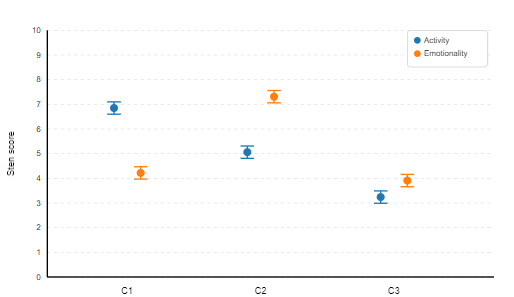
Figure 1. Mean Activity and Emotionality scores (±95% CI) for the three clusters.
C1 – high Activity/low Emotionality; C2 – moderate Activity/high Emotionality; C3 – low Activity/low Emotionality
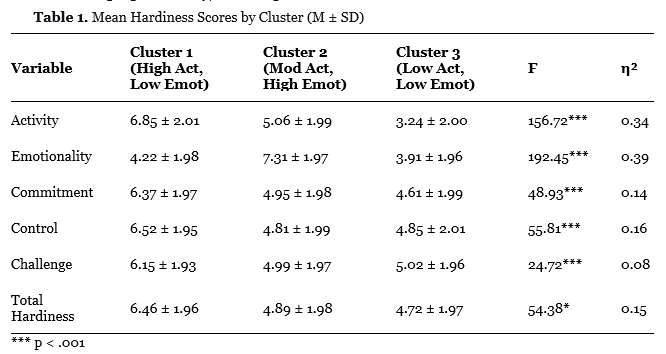
Comparison of hardiness scores (Table 1) revealed systematic comparative advantages. Cluster 1 demonstrated significantly higher scores on all hardiness components compared to both other clusters (all p < .001). Critically, Clusters 2 and 3 showed comparable total hardiness (M = 4.89 vs. 4.72, p = .142), despite Cluster 2 having higher Activity, indicating that high Emotionality neutralised the advantage of Activity. Cluster 2 exhibited significantly lower Control (M = 4.81 vs. 4.85, p < .05) and Challenge (M = 4.99 vs. 5.02, p < .05). Thus, Activity and Emotionality act in opposing directions, with high Emotionality attenuating the resource benefits of even moderate Activity.
3.2. Dynamic Integration: Hierarchical Propagation Effects
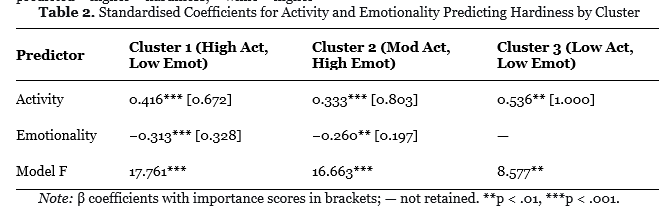
Automated linear modelling revealed consistent direct effects: higher Activity predicted higher hardiness, while higher Emotionality predicted lower hardiness (Table 2). These effects held across all clusters, with Activity showing substantially greater importance than Emotionality.
Beyond direct effects, ALM identified distinct hierarchical pathways (Table 3). Activity manifested at the character level through Hyperthymicity (β = 0.332, importance = 0.477) and Pedanticity (β = 0.256, importance = 0.355), which in turn predicted Flexibility of Cognitive Control (β = 0.238, importance = 0.459), ultimately enhancing Control and Commitment. Emotionality propagated through Emotivity (β = 0.216, importance = 0.364), Stuckness (β = 0.159, importance = 0.233), and Anxiety (β = 0.159, importance = 0.136), leading to Intolerance of Unrealistic Experience (β = 0.235, importance = 0.661), Narrow Range of Equivalence (β = 0.166), Concrete Conceptualization (β = 0.172), and Impulsivity (β = 0.156–0.194). These cognitive styles reduced hardiness: intolerance predicted lower Commitment (β = −0.117) and Challenge (β = −0.135); Concrete Conceptualisation and Impulsivity predicted lower Control (β = −0.122 to −0.106); Narrow Range of Equivalence predicted lower Challenge (β = −0.228).
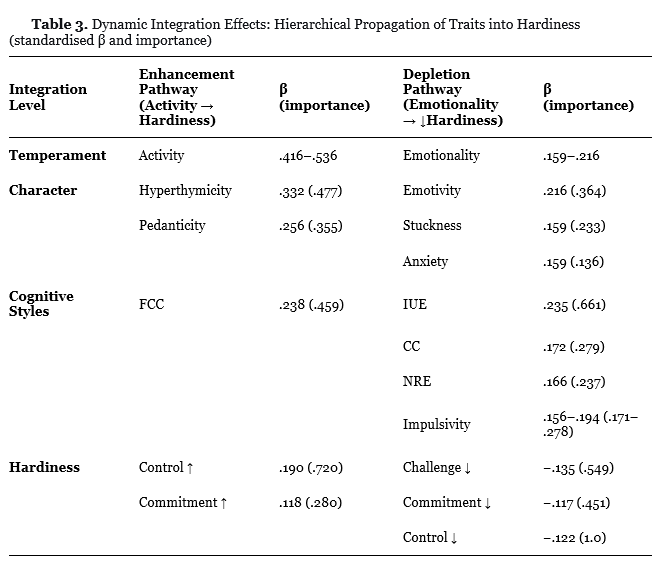
Figure 2 presents the complete integrative model derived from automated linear modelling, illustrating two opposing hierarchical pathways through which temperamental properties propagate to psychological hardiness.
The enhancement pathway (solid arrows, originating from Activity) represents a positive integration chain: Activity (temperament level) predicts characterological traits of Hyperthymicity (β = .332, importance = .477) and Pedanticity (β = .256, importance = .355). These character traits, in turn, predict Flexibility of Cognitive Control (β = .238, importance = .459) at the cognitive-style level. Finally, cognitive flexibility predicts increased Control (β = .190, importance = .720) and Commitment (β = .118, importance = .280), the two hardiness components most directly associated with active engagement and self-regulation.
The depletion pathway (dashed arrows, originating from Emotionality) represents a negative integration chain: Emotionality (temperament level) predicts characterological traits of Emotivity (β = .216, importance = .364), Stuckness (β = .159, importance = .233), and Anxiety (β = .159, importance = .136). These character traits, in turn, predict a constellation of maladaptive cognitive styles: Intolerance of Unrealistic Experience (β = .235, importance = .661), Concrete Conceptualisation (β = .172, importance = .279), Narrow Range of Equivalence (β = .166, importance = .237), and Impulsivity (β = .156–.194, importance = .171–.278). Collectively, these cognitive styles predict reduced hardiness across all three components: Challenge (β = −.135 from Intolerance, β = −.228 from Narrow Range of Equivalence), Commitment (β = −.117 from Intolerance), and Control (β = −.122 from Concrete Conceptualisation, β = −.106 from Impulsivity).
The model visually demonstrates that Activity and Emotionality do not merely correlate with hardiness but are systematically transformed through a series of qualitatively distinct hierarchical transitions. Each arrow represents a statistically significant directed relationship in which the predictor at one level shapes the emergence of a structurally different property at the next level, ultimately producing measurable enhancement or depletion of hardiness. This dynamic propagation constitutes the core evidence for genuine integration, as opposed to mere aggregation or global activation.
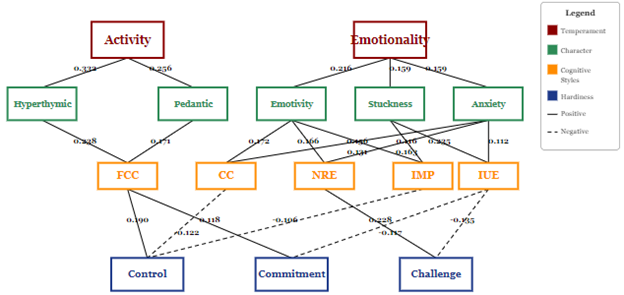
Figure 2. Final model of integration across hierarchical levels of individuality.
Solid arrows – enhancement pathway (Activity → Hyperthymicity /Pedanticity → Flexibility → ↑Control/Commitment). Dashed arrows – depletion pathway (Emotionality → Emotivity /Stuckness/Anxiety → Intolerance/Impulsivity/Concrete conceptualisation → ↓Challenge/↓Commitment/↓Control).
3.3. Methodological Validation: Comparison of Merlin’s Correlational Approach and the Proposed Procedure
To justify the need for the novel procedure developed in this study (assessing static and dynamic integration), a comparative analysis was conducted with the classical method proposed by V.S. Merlin. Merlin argued that hierarchical levels of integral individuality could be empirically distinguished by comparing the number of significant correlations within a single level versus those across different levels. According to this approach, cross-level correlations should be substantially stronger than within-level correlations, thereby allowing each level to be treated as a relatively autonomous subsystem (Merlin, 1986). In the present study, a correlational analysis was performed on the full sample (N = 616) following Merlin’s logic. For each of the five hierarchical levels identified in our theoretical framework (cognitive styles, temperament, character, motivation, hardiness), two indices were calculated:
- the percentage of significant intercorrelations among indicators within the same level;
- the percentage of significant cross-level correlations between indicators from different levels.
The results are presented in Tables 4 and 5.

As shown in the tables above, the proportion of significant cross-level correlations was comparable to the proportion of within-level correlations, and in many cases did not systematically exceed them. For example, cross-level correlations between cognitive styles and character traits (64.1%) were nearly identical to within-level correlations within character (66.6%) and substantially lower than within-level correlations within cognitive styles (90.9%). This pattern was consistent across most level pairings. The only apparent exceptions—motivation and hardiness, which showed 100% within-level correlations and high cross-level correlations, reflect the limited number of scales within those domains and should not be interpreted as evidence of genuine hierarchical distinctiveness.
These findings indicate that Merlin’s classical correlational criterion does not reliably differentiate hierarchical levels within the structure of individuality in our sample. This result aligns with critiques of the correlational approach advanced by Chuprikova (2007), Kholodnaya (2011), and Volkova (2016), and underscores the necessity of employing alternative statistical procedures for detecting integration effects. In contrast to correlational analysis, the automated linear modelling (ALM) applied in §§ 3.1–3.2 enabled the identification of directed, hierarchical transformations of individuality properties, thereby demonstrating its superior sensitivity to dynamic integration processes.
3.4. Additional Predictors
ALM also revealed that higher Extraversion (β = .318–.341) and lower Neuroticism (β = −.313 to −.406) predicted higher Hardiness. Achievement Motivation positively predicted Hardiness across clusters (β = .189–.264). Paradoxically, orientation toward value of profession reduced Hardiness (β = −.114 to −.195, p < .05–.001), while orientation toward accessibility enhanced it (β = .130–.199), further confirming that integration effects depend on the specific content of integrated properties.
Discussion
This study offers the first empirical operationalisation of integration effects among multi‑level individuality properties, distinguishing static and dynamic integration. Our results demonstrate that Activity and Emotionality do not merely additively affect Hardiness but are integrated into the system through opposing hierarchical pathways, reproducing unity of the differentiated at a new developmental level (Luhmann, 2006).
Static integration appears in comparative advantages. Cluster 1 (high Activity, low Emotionality) shows maximal hardiness. However, the comparability of Clusters 2 and 3 reveals that high Emotionality can fully neutralise Activity’s resource potential. This aligns with Rusalov’s (2012) theory of compensatory character mechanisms: Emotionality consumes regulatory resources needed for Control and Challenge.
Dynamic integration reveals how this occurs. Activity integrates through sequential transformation: temperament → Hyperthymicity/Pedanticity → Flexibility of Cognitive Control → Control/Commitment. Emotionality integrates through Emotivity/Stuckness/Anxiety → Intolerance of Unrealistic Experience/Impulsivity/Concrete Conceptualisation → reduced all hardiness components. These are not mere correlational chains but structural transformations, where each link is a qualitatively new system’s formation. For instance, Intolerance to Unrealistic Experience (derived from Emotionality) rigidly blocks goal revision under stress, directly reducing Challenge. Impulsivity combined with Concrete Conceptualisation undermines Control, as the person acts hastily based on surface cues rather than deep analysis.
The empirical evidence presented in Section 3.3 provides direct support for this limitation. When Merlin’s classical criterion, comparing the proportion of significant within-level versus cross-level correlations, was applied to our dataset, the resulting proportions were remarkably similar. Within-level correlations for cognitive styles reached 90.9%, while cross-level correlations between cognitive styles and character traits were 64.1%, and between cognitive styles and temperament, 62.7%. Crucially, these cross-level values are comparable to, or even lower than, the within-level correlations for character (66.6%) and temperament (69.7%). This pattern was replicated across all hierarchical levels (see Tables 4–5). Thus, the correlational method, as operationalised by Merlin, fails to yield the distinct patterns that would be necessary for the unambiguous identification of separate hierarchical levels or for the detection of genuine integration effects.
This finding is not merely a methodological artefact but carries substantive theoretical implications. If a classical correlational approach cannot reliably distinguish between levels, this suggests that such methods conflate global, undifferentiated covariance among all measured traits with true systemic integration. Global activation, a state in which all system components are simultaneously elevated without any structured relationship, can produce high correlations across all variables, mimicking the appearance of integration while actually reflecting a lack of differentiation. In contrast, the ALM-based procedure employed in this study revealed clear, directed propagation pathways: Activity → Hyperthymicity/Pedanticity → Flexibility of Cognitive Control → ↑Control/Commitment, and Emotionality → Emotivity/Stuckness/Anxiety → Intolerance/Impulsivity/Concrete Conceptualisation → ↓Hardiness. These are not simple correlational chains but represent qualitative transformations of properties as they move across hierarchical levels. Each step in these pathways involves a structural change, for instance, temperamental Activity is not merely associated with, but is systematically transformed into, characterological Hyperthymicity and Pedanticity, which in turn give rise to Flexibility of Cognitive Control, ultimately enhancing hardiness. This supports the view that integration is a dynamic process of “reproduction of unity of the differentiated at a new level of development” (Luhmann, 2006), a process that cannot be adequately captured by static, non-directional measures of association such as correlation coefficients.
This pattern of opposing hierarchical pathways is consistent with the broader ” principle of differentiation and integration” in personality development (Slavutskaya & Slavutskii, 2023), which suggests that the interplay of differentiation and integration is a fundamental driver of systemic change. Recent research on individual intellectual integrations (Dorfman & Kalugin, 2023) and coping intelligence (Volkova & Kuvaeva, 2023) further supports the notion that understanding how multi‑level properties cohere is essential for explaining complex psychological outcomes such as academic achievement and adaptive functioning. Liu et al. (2024) also demonstrated that coping styles serve as mediators between hardiness and mental health outcomes, validating the role of hardiness as a personal resource that operates through behavioural strategies. Skoglund, Risan, and Milne (2023) further showed that all Big Five traits (except agreeableness) predicted hardiness, with emotional stability as the strongest predictor, supporting the personality-relatedness of the hardiness construct.
Our findings on cognitive styles align with wider theoretical discussions on the manifestation of cognitive‑style patterns. Zabolotna and Omelianska (2023) showed that cognitive styles function as metacognitive abilities that determine the potential for objectification in human positions and actions, and are linked to a wide spectrum of personality traits and social behaviour characteristics. Hinterstoisser and Chittka (2019) noted that such patterns can be context‑dependent and diverse, which resonates with our identification of distinct cognitive‑style constellations—flexibility for the enhancement pathway versus intolerance/impulsivity for the depletion pathway. The relationship between hardiness and conceptual abilities, as demonstrated by Volkova, N. E. (2024), further supports the role of cognitive‑level properties in hardiness outcomes.
Our data challenge Merlin’s classical method based on comparing within‑ and cross‑level correlations. In our sample, the number of significant cross‑level correlations was comparable to within‑level correlations. Thus, correlation methods are insensitive to dynamic integration, conflating it with global activation. Automated linear modelling, by contrast, captures directed transformation of properties.
The paradox of Value Motivation deserves attention. High subjective value of a profession may create a “burden of meaning”, increasing fear of failure and thereby reducing hardiness. Conversely, perceiving a profession as accessible fosters flexibility and lowers perfectionistic pressure, consistent with self‑determination theory (Sheldon & Elliot, 1999).
The methodological contribution of this study, therefore, lies in providing a procedure that can operationalise and detect these dynamic systemic effects, thereby moving decisively beyond the limitations of traditional correlational approaches in personality research. While Merlin’s theory correctly posited a multi‑level system, his operationalisation proved insufficient for capturing the directed and hierarchical nature of integration. Our dual‑framework procedure, combining contrast‑group comparisons for static integration with automated linear modelling for dynamic integration, offers a more robust empirical foundation for differential‑integration theory.
Limitations. Cross‑sectional design precludes causal inferences; longitudinal studies are needed. The sample is predominantly student‑based and from European Russia, limiting generalisability. Nevertheless, the proposed procedure for assessing static and dynamic integration can be replicated with other samples and constructs. Future research should examine links between these integration patterns and real‑life coping strategies and objective psychophysiological stress markers.
Conclusions
Integration effects of multi‑level individuality properties are real, measurable, and operate through opposing pathways. High Activity enhances Hardiness through hierarchical propagation into Hyperthymicity, Pedanticity, and Flexibility of Cognitive Control. High Emotionality reduces Hardiness through propagation into Emotivity, Stuckness, Anxiety, and cognitive‑style deficits (Intolerance of Unrealistic Experience, Impulsivity, Concrete Conceptualisation). Our dual‑framework procedure, combining contrast‑group identification (static integration) and automated linear modelling of transformation chains (dynamic integration), allows objectification of system‑formation processes in individuality structure. Thus, we confirm differential‑integration theory and offer a new methodological tool for investigating how natural predispositions become resources for coping with life difficulties.
Ethics approval and consent to participate: All procedures performed in this study involving human participants were in accordance with the ethical standards of the institutional research committee and with the 1964 Helsinki Declaration and its later amendments. Informed consent was obtained from all participants included in the study.
Competing interests: The author declares no competing interests.
Funding: This research received no specific grant from any funding agency in the public, commercial, or not-for-profit sectors.
Authors’ contributions: The author is solely responsible for the study conception and design, data collection, analysis and interpretation of results, and manuscript preparation. The author reviewed and approved the final manuscript.
Acknowledgments: The author expresses sincere gratitude to Dr. E. V. Volkova for her invaluable guidance and supervision during the research, to Dr. V. M. Rusalov for his theoretical contributions, and to all participants who generously volunteered their time for this study.
AI Use Statement: Generative AI technologies were used in this manuscript solely for language editing, grammar correction, and reference formatting. All AI-generated content was critically reviewed and revised by the author(s), who take full responsibility for the final manuscript. No AI tools were used for data analysis, interpretation, or generation of scientific conclusions.
References
- 2014). Protsess differentsiatsii: soderzhanie kontsepta i vozmozhnosti operatsionalizatsii v psikhologicheskikh issledovaniyakh [The process of differentiation: The content of the concept and the possibilities of operationalization in psychological research]. In Differentsionno-integrationnaya teoriya razvitiya[Differentiation-integration theory of development] (Vol. 2, pp. 87–138). Yazyki slavyanskoy kultury.
- Chuprikova, N. I. (2007). Umstvennoe razvitie: Printsip differentsiatsii[Mental development: The principle of differentiation].
- Dorfman, L. Y., & Kalugin, A. Y. (2023). Contributions of individual intellectual integrations to the academic achievement of humanities students. RUDN Journal of Psychology and Pedagogics, 20(2), 289–310.
- Drobinina, L. V. (2007). Vzaimosvyaz zhiznestoykosti, udovletvorennosti zhiznyu i sub”ektivnogo blagopoluchiya u zhiteley regiona Sibiri [The relationship of hardiness, life satisfaction, and subjective well-being among residents of the Siberian region]. In Programma Mezhdunarodnoy nauchnoy konferentsii studentov, aspirantov i molodykh uchenykh “Lomonosov 2007” (Seriya “Psikhologiya”)[Program of the International Scientific Conference of Students, Postgraduates, and Young Scientists “Lomonosov 2007” (Series “Psychology”)] (pp. 341–336). Moscow State University.
- Hinterstoisser, R., & Chittka, L. (2019). Modelling the evolution of cognitive styles. BMC Evolutionary Biology, 19, 234. https://doi.org/10.1186/s12862-019-1565-2
- Belykh, T. V. (2023). Individual psychological indicators of a person’s addiction to social networks: An integrative approach. Izvestia of Saratov University. Educational Acmeology. Developmental Psychology, 12(3), 227–235.
- Khoshaba, D. M., & Maddi, S. R. (1999). Early experiences in hardiness development. Consulting Psychology Journal, 51(2), 106–117. https://doi.org/10.1037/1061-4087.51.2.106
- Knizhnikova, S. V. (2005). Pedagogicheskaya profilaktika suitsidalnogo povedeniya na osnove formirovaniya zhiznestoykosti podrostkov v usloviyakh obshcheobrazovatelnoy shkoly[Pedagogical prevention of suicidal behavior based on the formation of hardiness in adolescents in secondary school] [Unpublished candidate’s dissertation].
- Leontiev, D. A., & Rasskazova, E. I. (2006). Test zhiznestoykosti[Hardiness test]. Smysl.
- Liu, H., Chen, J., Peng, Q., Zhang, H., & He, Y. (2024). Hardiness personality and mental health of financially-struggling medical students in private universities in China: The intervening roles of coping styles and gender. Frontiers in Public Health, 12, 1458049. https://doi.org/10.3389/fpubh.2024.1458049
- Loginova, M. V. (2010). Psikhologicheskoe soderzhanie zhiznestoykosti lichnosti studentov[Psychological content of hardiness in students] [Unpublished candidate’s dissertation].
- Luhmann, N. (2006). Obshchestvo obshchestva[Society of society] (Part IV: Differentiation).
- Maddi, S. R. (2005). Smysloobrazovanie v protsesse prinyatiya resheniy [Meaning formation in the decision-making process]. Psikhologicheskiy Zhurnal, 26(6), 87–101.
- Medvedeva, E. V. (2008). Vzaimosvyaz tsennostno-smyslovykh orientatsiy i zhiznestoykosti invalidov [The relationship of value-meaning orientations and hardiness in disabled people]. Materialy Vserossiyskoy nauchno-prakticheskoy konferentsii[Proceedings of the All-Russian Scientific and Practical Conference], 2, 172–177.
- Merlin, V. S. (1980). Problemy psikhologii lichnosti [Problems of personality psychology]. In Problemy psikhologii lichnosti(p. 60). Moscow.
- Merlin, V. S. (1986). Ocherk integralnogo issledovaniya individualnosti[Essay on the integral research of individuality].
- Mitina, O. V. (2011). Razrabotka i adaptatsiya psikhologicheskikh oprosnikov[Development and adaptation of psychological questionnaires].
- Nasledov, A. D. (2008). SPSS 15: Professionalnyy statisticheskiy analiz dannykh[SPSS 15: Professional statistical data analysis].
- Rasskazova, E. I. (2005). Zhiznestoykost i vybor budushchego v protsesse reabilitatsii [Hardiness and the choice of the future in the rehabilitation process]. Izvestiya Taganrogskogo gosudarstvennogo radiotekhnicheskogo universiteta, *7*.
- Rusalov, V. M. (1986). Teoreticheskie problemy postroeniya spetsialnoy teorii individualnosti cheloveka [Theoretical problems of constructing a special theory of human individuality]. Psikhologicheskiy Zhurnal, 7(4), 23–35.
- Rusalov, V. M. (2004). Oprosnik formalno-dinamicheskikh svoystv individualnosti cheloveka (OFDSI)[Questionnaire of formal-dynamic properties of human individuality (QFDPI)]. Institute of Psychology RAS.
- Rusalov, V. M. (2012). Temperament v strukture individualnosti cheloveka: differentsialno-psikhofiziologicheskie i psikhologicheskie issledovaniya[Temperament in the structure of human individuality: Differential psychophysiological and psychological studies]. Institute of Psychology RAS.
- Rusalov, V. M. (2022). Some theoretical problems of constructing of a special theory of human individuality. Natural Systems of Mind, 2(1), 68–81. https://doi.org/10.38098/nsom_2022_02_01_08
- Rusalov, V. M., & Manolova, O. N. (2003). Oprosnik chert kharaktera vzroslogo cheloveka (OChKh-V)[Questionnaire of character traits of an adult (QChT-A)]. Institute of Psychology RAS.
- Sheldon, K. M., & Elliot, A. J. (1999). Goal striving, need satisfaction, and longitudinal well-being: The self-concordance model. Journal of Personality and Social Psychology, 76(3), 482–497. https://doi.org/1037/0022-3514.76.3.482
- Skoglund, T. H., Risan, P., & Milne, R. (2023). Personality and hardiness differences between Norwegian police and psychology students. Scandinavian Journal of Psychology, 64(2), 230–237.https://doi.org/10.1111/sjop.12877
- Slavutskaya, E. V., & Slavutskii, L. A. (2023). Integro-differential principle in personality development: The possibility of mathematical description within the structural theory framework. Russian Journal of Education and Psychology, 14(5), 88–108. https://doi.org/10.12731/2658-4034-2023-14-5-88-108
- Slobodskaya, E. R., Knyazev, G. G., & Safronova, M. V. (2006). Kratkaya forma lichnostnogo oprosnika Aysenka (LOA-K)[Short form of the Eysenck Personality Questionnaire (EPQ-S)]. State Research Institute of Physiology, Siberian Branch of the Russian Academy of Medical Sciences.
- Spence, J. T., & Helmreich, R. L. (1983). Achievement-related motives and behaviors. In J. T. Spence (Ed.), Achievement and achievement motives: Psychological and sociological approaches(pp. 10–74). H. Freeman.
- Taranova, A. L. (2015). Ekonomicheskie effekty integratsii v ramkakh institutsionalizma [Economic effects of integration within institutionalism]. Ekonomika i Upravlenie, 1(41), 1–7.
- Vanakova, G. V. (2014). Psikhologicheskaya podderzhka razvitiya zhiznestoykosti studentov[Psychological support for the development of hardiness in students] [Unpublished doctoral dissertation]. Priamursky State University.
- Volkova, E. V. (2011). Psikhologiya spetsialnykh sposobnostey: Differentsionno-integrationnyy podkhod[Psychology of special abilities: Differentiation-integration approach]. Institute of Psychology RAS.
- Volkova, E. V. (2016). Urovni organizatsii kontseptualnogo opyta kak osnova osushchestvleniya i razvitiya tvorcheskoy deyatelnosti [Levels of conceptual experience organization as the basis for the implementation and development of creative activity]. Mir Psikhologii, 1(85), 157–163.
- Volkova, E. V., & Kuvaeva, I. O. (2023). Sovladayushchiy intellekt: differentsionno-integrationnyy podkhod[Coping intelligence: A differentiation-integration approach]. Institute of Psychology RAS.
- Volkova, E. V., & Rusalov, V. M. (2015). Lichnostno-kognitivnye stili i ikh svyaz s temperamentom i kharakterom cheloveka v period ranney yunosti [Personal-cognitive styles and their relationship with temperament and character in early adolescence]. Psikhologicheskiy Zhurnal, 36(5), 32–42.
- Volkova, E. V., & Rusalov, V. M. (2016). Cognitive styles and personality. Personality and Individual Differences, 99, 266–271. https://doi.org/10.1016/j.paid.2016.04.097
- Volkova, E. V., Rusalov, V. M., & Dudnikova, T. A. (2022). Cognitive and Personal Styles Questionnaire: Validity and reliability of the CPS-Q based on a Russian sample. Natural Systems of Mind, 2(4), 49–73. https://doi.org/10.38098/nsom_2022_02_04_03
- Volkova, E. V., Rusalov, V. M., & Nilopets, M. N. (2018). An expert system for evaluation of human mental resources: Holistic and developmental approach. In 2017 Intelligent Systems Conference (IntelliSys)(pp. 1–6). IEEE.
- Volkova, N. E. (2024). The relationship between hardiness and conceptual abilities. Vestnik of Kostroma State University. Series: Pedagogy. Psychology. Sociokinetics, 30(2), 55–63. https://doi.org/10.34216/2073-1426-2024-30-2-55-63
- Zabolotna, N. M., & Omelianska, V. I. (2023). Kohnityvni styli, tvorchi zdibnosti ta zhyttiestiikist v strukturi indyvidualnosti liudyny [Cognitive styles, creative abilities and resilience in the structure of human individuality]. Habitus, 46, 134–138.
Comments (0)
Background. Psychological hardiness is a personality resource enabling individuals to withstand stress, yet mechanisms integrating multi‑level individuality properties remain poorly understood. Traditional correlational methods fail to distinguish global undifferentiated activity from genuine systemic integration. Existing methodologies do not capture dynamic hierarchical transformation of temperament, character, and cognitive styles into adaptive resources. Objective. To investigate integration effects using Activity (ergonicity) and Emotionality as predictors of hardiness, operationalising static (comparative advantage) and dynamic (hierarchical propagation) integration.
Method. 616 participants (46% male, 18–46 years) completed validated measures of formal‑dynamic properties, character traits, cognitive styles, motivation, and hardiness. Hierarchical cluster analysis (Ward, NbClust) and automated linear modelling were applied. Results. Three Activity–Emotionality clusters emerged. Higher Activity consistently predicted higher hardiness (β = 0.333–0.536, all p < .001), while higher Emotionality predicted lower hardiness (β = −0.260 to −0.313, p < .01–.001). Activity propagated through Hyperthymicity and Pedanticity to cognitive flexibility, enhancing Control and Commitment. Emotionality propagated through emotional lability, Stuckness, and Anxiety to intolerance, impulsivity, and concrete conceptualisation, reducing all hardiness components. Conclusion. Integration of multi‑level properties produces measurable hardiness effects through opposing hierarchical pathways. This study offers the first empirical operationalisation of static and dynamic integration in personality research, supporting differential‑integration theory and challenging traditional correlation‑based approaches.
Противоположные пути интеграции: как иерархические свойства индивидуальности предсказывают психологическую жизнестойкость
Т. А. Дудникова
Государственный академический университет гуманитарных наук,
Москва, Россия
Резюме. Актуальность. Психологическая жизнестойкость является личностным ресурсом, позволяющим противостоять стрессовым обстоятельствам, однако механизмы интеграции разноуровневых свойств индивидуальности, лежащие в основе жизнестойкости, остаются недостаточно изученными. Традиционные корреляционные методы не позволяют различить глобальную недифференцированную активность и подлинную системную интеграцию. Существующие методологии не улавливают динамическую иерархическую трансформацию темпераментальных черт, характера и когнитивных стилей в адаптивный ресурс. Цель. Изучить эффекты интеграции разноуровневых свойств индивидуальности, используя Активность (эргичность) и Эмоциональность как предикторы жизнестойкости, и операционализировать статическую (сравнительные преимущества) и динамическую (иерархическая трансляция) интеграцию. Метод. Выборка из 616 участников (46% мужчин, возраст 18–46 лет) заполнила валидизированные опросники формально-динамических свойств, характерологических черт, когнитивных стилей, мотивации и тест жизнестойкости. Применены иерархический кластерный анализ (метод Уорда, NbClust) и автоматизированное линейное моделирование. Результаты. Выделены три кластера: (1) высокая Активность/низкая Эмоциональность; (2) средняя Активность/высокая Эмоциональность; (3) низкая Активность/низкая Эмоциональность. Высокая Активность предсказывала высокую жизнестойкость (β = 0.333–0.536, p < .001), а высокая Эмоциональность — низкую (β = −0.260 до −0.313, p < .01–.001). Активность транслировалась через гипертимность и педантичность в когнитивную гибкость, повышая Контроль и Вовлечённость. Эмоциональность транслировалась через эмотивность, застревание и тревожность в интолерантность, импульсивность и конкретную концептуализацию, снижая компоненты жизнестойкости. Заключение. Интеграция разноуровневых свойств даёт измеримые эффекты через противоположные иерархические пути. Работа предлагает первую эмпирическую операционализацию статической и динамической интеграции в психологии личности, подтверждая дифференционно-интеграционную теорию и ставя под сомнение традиционные корреляционные подходы.
Ключевые слова: интеграция, индивидуальность, жизнестойкость, активность, эмоциональность, когнитивные стили, иерархия личности
Contemporary psychology faces a fundamental challenge: how disparate properties of individuality at different hierarchical levels, from temperament to character and cognitive styles, coalesce into adaptive resources enabling individuals to navigate adversity. The construct of psychological hardiness, introduced by Kobasa and Maddi (Khoshaba & Maddi, 1999; Maddi, 2005), captures this adaptive capacity through three attitudinal components: commitment (involvement in life activities), control (belief in one’s ability to influence outcomes), and challenge (viewing change as opportunity for growth). While hardiness has been extensively studied across age groups (Knizhnikova, 2005), professions (Loginova, 2010; Vanakova, 2014), and life circumstances (Rasskazova, 2005; Drobinina, 2007; Medvedeva, 2008), the mechanisms through which lower-level individuality properties integrate into this holistic formation remain largely unexplored.
The relevance of hardiness as a psychological resource is supported by recent cross-cultural and domain-specific studies. Skoglund, Risan, and Milne (2023) found hardiness significantly differentiated Norwegian police and psychology students, with police students scoring significantly higher on hardiness and on extraversion, conscientiousness, and emotional stability. Liu et al. (2024) demonstrated that hardiness personality significantly positively affects mental health among financially-struggling medical students, with coping styles serving as mediators between hardiness and mental health outcomes. Zabolotna and Omelianska (2023) directly examined the relationship between cognitive styles, creative abilities, and hardiness within the structure of human individuality, establishing empirical connections between cognitive-level properties and hardiness outcomes.
The theoretical foundation for understanding such integration processes draws upon V. S. Merlin’s concept of integral individuality (Merlin, 1986), which posits that human individuality constitutes a hierarchically organised system of properties spanning biochemical, physiological, neurodynamic, psychodynamic, personal, and socio historical levels. Merlin emphasised that “the same property of a person is simultaneously typical when considered in connection with other properties of the same hierarchical level, and individual when considered in connection with properties of another hierarchical level” (Merlin, 1980, p. 60). This implies that genuine integration occurs not within levels but between them, generating novel systemic qualities.
However, methodological challenges have long hindered empirical verification of integration effects. Traditional correlational and factor analytic approaches, as employed in Merlin’s school, conflate global undifferentiated activity with true systemic integration (Chuprikova, 2007; Volkova, 2016; Alexandrov & Maksimova, 2014). As Luhmann (2006) articulated, integration represents “the reproduction of unity of the differentiated at a new level of development”— a process qualitatively distinct from mere aggregation or correlation. In economics, static integration (comparative advantage analysis) and dynamic integration (system level growth and structural change) have long been distinguished (Taranova, 2015). Volkova (2011, 2016) proposed analogous distinctions in psychology, suggesting that increased speed of differentiations and enhanced correlations among measures signal integration effects.
The need for an integrative approach is increasingly recognised in contemporary psychology. Volkova and Kuvaeva (2023) developed a comprehensive differentiation-integration framework for coping intelligence, demonstrating how multi-level properties cohere into adaptive resources for overcoming stressful situations while preserving health potential. Recent studies have applied this methodology to explore complex phenomena such as social network addiction (Individual psychological indicators of a person’s addiction to social networks: An integrative approach, 2023) and academic achievement (Dorfman & Kalugin, 2023). Slavutskaya and Slavutskii (2023) further developed the differentiation- integration principle in personality development, providing a theoretical framework for mathematically describing how systemic change occurs through the interplay of differentiation and integration processes. Volkova, N. E. (2024) also demonstrated the relationship between hardiness and conceptual abilities, showing that intellectual activity and intellectual emotionality significantly influence hardiness.
Drawing on V. M. Rusalov’s special theory of individuality (Rusalov, 2012; Rusalov, 2022), which conceptualises character as an amplification or compensation of temperamental properties acquired through sociocultural adaptation, and on findings of stable cognitive style complexes in individuality structure (Volkova & Rusalov, 2016), we propose that psychological hardiness may serve as a behavioural marker of integration among multi-level properties. We select Activity (ergonicity—work capacity, speed, and plasticity across psychomotor, intellectual, and communicative domains) and Emotionality (sensitivity to discrepancies between planned and actual outcomes) as key predictors, since Rusalov (1986) linked them to successful stress resistance.
This study addresses three empirical questions: (1) Do integration effects between multi-level individuality properties and hardiness exist? (2) Do Activity and Emotionality expression levels influence hardiness outcomes? (3) Can the same property simultaneously function as typical (within level) and individual (cross level) depending on the hierarchical frame of reference? To examine these, we developed a dual framework methodology distinguishing static integration (comparative advantage via contrast groups) from dynamic integration (systemic effects through automated linear modelling).
The sample comprised 616 participants (46% male, 54% female) recruited from Taganrog, Kostroma, and Perm, Russia. Inclusion criteria required age ≥18 years and complete responses; exclusion criteria included incomplete questionnaires. Age range was 18–46 years (M = 24.8, SD = 6.2). Participants represented diverse professional backgrounds, predominantly students of psychology, education, and humanities. Data collection occurred in spring semester sessions in quiet, well-lit classrooms, with researchers available to answer questions. To minimise social desirability, participants reported only age and gender, not names. All provided informed consent; ethical procedures were approved by the institutional review board.
2.2. Measures
The assessment battery comprised seven validated instruments.
- Formal Dynamic Properties of Individuality Questionnaire (QFDPI; Rusalov, 2004) – 105 items measuring Activity and Emotionality in psychomotor, intellectual, and communicative domains. α = 0.732–0.791.
- Eysenck Personality Questionnaire (EPQ; Russian adaptation by Slobodskaya, Knyazev, & Safronova, 2006) – 48 items assessing Extraversion, Neuroticism, and Psychoticism. α = 0.747–0.876.
- Character Traits Questionnaire (QChT; Rusalov & Manolova, 2003) – 99 items measuring ten traits: Hyperthymicity, Stuckness, Emotivity, Pedanticity, Anxiety, Cyclothymicity, Demonstrativeness, Excitability, Dystimicity, and Excitability. α = 0.559–0.714.
- Cognitive Personality Styles Questionnaire (CPS-Q; Rusalov & Volkova, 2016; Volkova, Rusalov, & Dudnikova, 2022) – 60 items measuring Field Dependence (FD) and Field Independence (FI), Narrow Range of Equivalence (NRE) and Wide Range of Equivalence (WRE), Flexibility of Cognitive Control (FCC) and Rigidity of Cognitive Control (RCC), Impulsivity (IMP) and Reflectivity (REF), Concrete Conceptualization (CC) and Abstract Conceptualization (AC), Tolerance of Unrealistic Experience (TUE) and Intolerance of Unrealistic Experience (IUE). Internal consistency α = 0.623–0.736. Psychometric properties confirmed on a Russian sample.
- Modified versions of the Achievement Motivation Scale (Spence & Helmreich, 1983) and Occupational Choice Motivation (assessing profession accessibility and value; adapted by V. M. Rusalov) – scales: Achievement Motivation, Accessibility Motivation, Value Motivation. α = 0.701–0.928 (Volkova, Rusalov, & Nilopets, 2018).
- Hardiness Test (Leontiev & Rasskazova, 2006; adapted from Maddi) – 45 items measuring Commitment, Control, and Challenge. α = 0.746–0.836.
All questionnaires used 5-point Likert scales. Raw scores were converted to sten scores (standardised decile scores) based on frequency distributions (Mitina, 2011); scores >5.5 were interpreted as high, <5.5 as low.
2.3. Statistical Analysis
Analyses were performed using IBM SPSS 22.0 and RStudio. Phase 1 (static integration): Hierarchical cluster analysis (Ward’s method, Euclidean distances) identified contrast groups based on Activity and Emotionality scores; optimal cluster number was determined using the NbClust package (30 indices). Hardiness scores were compared across clusters using independent samples t tests. Phase 2 (descriptive analysis): Kolmogorov–Smirnov tests indicated non normal distributions, but skewness and kurtosis fell within ±1.0, permitting parametric methods (Nasledov, 2008). Phase 3 (dynamic integration): Automated linear modelling (ALM) identified systemic effects; standardised coefficients, importance scores, and F statistics were computed.
3.1. Static Integration: Comparative Advantages
Cluster analysis yielded three distinct groups (Figure 1). Cluster 1 (n = 239, 38.8%) – high Activity (M = 6.85, SD = 2.01) and low Emotionality (M = 4.22, SD = 1.98). Cluster 2 (n = 202, 32.8%) – moderate Activity (M = 5.06) and high Emotionality (M = 7.31). Cluster 3 (n = 175, 28.4%) – low Activity (M = 3.24) and low Emotionality (M = 3.91). All cluster differences were significant at p < .001.
Figure 1. Mean Activity and Emotionality scores (±95% CI) for the three clusters.
C1 – high Activity/low Emotionality; C2 – moderate Activity/high Emotionality; C3 – low Activity/low Emotionality
Comparison of hardiness scores (Table 1) revealed systematic comparative advantages. Cluster 1 demonstrated significantly higher scores on all hardiness components compared to both other clusters (all p < .001). Critically, Clusters 2 and 3 showed comparable total hardiness (M = 4.89 vs. 4.72, p = .142), despite Cluster 2 having higher Activity, indicating that high Emotionality neutralised the advantage of Activity. Cluster 2 exhibited significantly lower Control (M = 4.81 vs. 4.85, p < .05) and Challenge (M = 4.99 vs. 5.02, p < .05). Thus, Activity and Emotionality act in opposing directions, with high Emotionality attenuating the resource benefits of even moderate Activity.
3.2. Dynamic Integration: Hierarchical Propagation Effects
Automated linear modelling revealed consistent direct effects: higher Activity predicted higher hardiness, while higher Emotionality predicted lower hardiness (Table 2). These effects held across all clusters, with Activity showing substantially greater importance than Emotionality.
Beyond direct effects, ALM identified distinct hierarchical pathways (Table 3). Activity manifested at the character level through Hyperthymicity (β = 0.332, importance = 0.477) and Pedanticity (β = 0.256, importance = 0.355), which in turn predicted Flexibility of Cognitive Control (β = 0.238, importance = 0.459), ultimately enhancing Control and Commitment. Emotionality propagated through Emotivity (β = 0.216, importance = 0.364), Stuckness (β = 0.159, importance = 0.233), and Anxiety (β = 0.159, importance = 0.136), leading to Intolerance of Unrealistic Experience (β = 0.235, importance = 0.661), Narrow Range of Equivalence (β = 0.166), Concrete Conceptualization (β = 0.172), and Impulsivity (β = 0.156–0.194). These cognitive styles reduced hardiness: intolerance predicted lower Commitment (β = −0.117) and Challenge (β = −0.135); Concrete Conceptualisation and Impulsivity predicted lower Control (β = −0.122 to −0.106); Narrow Range of Equivalence predicted lower Challenge (β = −0.228).
Figure 2 presents the complete integrative model derived from automated linear modelling, illustrating two opposing hierarchical pathways through which temperamental properties propagate to psychological hardiness.
The enhancement pathway (solid arrows, originating from Activity) represents a positive integration chain: Activity (temperament level) predicts characterological traits of Hyperthymicity (β = .332, importance = .477) and Pedanticity (β = .256, importance = .355). These character traits, in turn, predict Flexibility of Cognitive Control (β = .238, importance = .459) at the cognitive-style level. Finally, cognitive flexibility predicts increased Control (β = .190, importance = .720) and Commitment (β = .118, importance = .280), the two hardiness components most directly associated with active engagement and self-regulation.
The depletion pathway (dashed arrows, originating from Emotionality) represents a negative integration chain: Emotionality (temperament level) predicts characterological traits of Emotivity (β = .216, importance = .364), Stuckness (β = .159, importance = .233), and Anxiety (β = .159, importance = .136). These character traits, in turn, predict a constellation of maladaptive cognitive styles: Intolerance of Unrealistic Experience (β = .235, importance = .661), Concrete Conceptualisation (β = .172, importance = .279), Narrow Range of Equivalence (β = .166, importance = .237), and Impulsivity (β = .156–.194, importance = .171–.278). Collectively, these cognitive styles predict reduced hardiness across all three components: Challenge (β = −.135 from Intolerance, β = −.228 from Narrow Range of Equivalence), Commitment (β = −.117 from Intolerance), and Control (β = −.122 from Concrete Conceptualisation, β = −.106 from Impulsivity).
The model visually demonstrates that Activity and Emotionality do not merely correlate with hardiness but are systematically transformed through a series of qualitatively distinct hierarchical transitions. Each arrow represents a statistically significant directed relationship in which the predictor at one level shapes the emergence of a structurally different property at the next level, ultimately producing measurable enhancement or depletion of hardiness. This dynamic propagation constitutes the core evidence for genuine integration, as opposed to mere aggregation or global activation.
Figure 2. Final model of integration across hierarchical levels of individuality.
Solid arrows – enhancement pathway (Activity → Hyperthymicity /Pedanticity → Flexibility → ↑Control/Commitment). Dashed arrows – depletion pathway (Emotionality → Emotivity /Stuckness/Anxiety → Intolerance/Impulsivity/Concrete conceptualisation → ↓Challenge/↓Commitment/↓Control).
3.3. Methodological Validation: Comparison of Merlin’s Correlational Approach and the Proposed Procedure
To justify the need for the novel procedure developed in this study (assessing static and dynamic integration), a comparative analysis was conducted with the classical method proposed by V.S. Merlin. Merlin argued that hierarchical levels of integral individuality could be empirically distinguished by comparing the number of significant correlations within a single level versus those across different levels. According to this approach, cross-level correlations should be substantially stronger than within-level correlations, thereby allowing each level to be treated as a relatively autonomous subsystem (Merlin, 1986). In the present study, a correlational analysis was performed on the full sample (N = 616) following Merlin’s logic. For each of the five hierarchical levels identified in our theoretical framework (cognitive styles, temperament, character, motivation, hardiness), two indices were calculated:
- the percentage of significant intercorrelations among indicators within the same level;
- the percentage of significant cross-level correlations between indicators from different levels.
The results are presented in Tables 4 and 5.
As shown in the tables above, the proportion of significant cross-level correlations was comparable to the proportion of within-level correlations, and in many cases did not systematically exceed them. For example, cross-level correlations between cognitive styles and character traits (64.1%) were nearly identical to within-level correlations within character (66.6%) and substantially lower than within-level correlations within cognitive styles (90.9%). This pattern was consistent across most level pairings. The only apparent exceptions—motivation and hardiness, which showed 100% within-level correlations and high cross-level correlations, reflect the limited number of scales within those domains and should not be interpreted as evidence of genuine hierarchical distinctiveness.
These findings indicate that Merlin’s classical correlational criterion does not reliably differentiate hierarchical levels within the structure of individuality in our sample. This result aligns with critiques of the correlational approach advanced by Chuprikova (2007), Kholodnaya (2011), and Volkova (2016), and underscores the necessity of employing alternative statistical procedures for detecting integration effects. In contrast to correlational analysis, the automated linear modelling (ALM) applied in §§ 3.1–3.2 enabled the identification of directed, hierarchical transformations of individuality properties, thereby demonstrating its superior sensitivity to dynamic integration processes.
3.4. Additional Predictors
ALM also revealed that higher Extraversion (β = .318–.341) and lower Neuroticism (β = −.313 to −.406) predicted higher Hardiness. Achievement Motivation positively predicted Hardiness across clusters (β = .189–.264). Paradoxically, orientation toward value of profession reduced Hardiness (β = −.114 to −.195, p < .05–.001), while orientation toward accessibility enhanced it (β = .130–.199), further confirming that integration effects depend on the specific content of integrated properties.
This study offers the first empirical operationalisation of integration effects among multi‑level individuality properties, distinguishing static and dynamic integration. Our results demonstrate that Activity and Emotionality do not merely additively affect Hardiness but are integrated into the system through opposing hierarchical pathways, reproducing unity of the differentiated at a new developmental level (Luhmann, 2006).
Static integration appears in comparative advantages. Cluster 1 (high Activity, low Emotionality) shows maximal hardiness. However, the comparability of Clusters 2 and 3 reveals that high Emotionality can fully neutralise Activity’s resource potential. This aligns with Rusalov’s (2012) theory of compensatory character mechanisms: Emotionality consumes regulatory resources needed for Control and Challenge.
Dynamic integration reveals how this occurs. Activity integrates through sequential transformation: temperament → Hyperthymicity/Pedanticity → Flexibility of Cognitive Control → Control/Commitment. Emotionality integrates through Emotivity/Stuckness/Anxiety → Intolerance of Unrealistic Experience/Impulsivity/Concrete Conceptualisation → reduced all hardiness components. These are not mere correlational chains but structural transformations, where each link is a qualitatively new system’s formation. For instance, Intolerance to Unrealistic Experience (derived from Emotionality) rigidly blocks goal revision under stress, directly reducing Challenge. Impulsivity combined with Concrete Conceptualisation undermines Control, as the person acts hastily based on surface cues rather than deep analysis.
The empirical evidence presented in Section 3.3 provides direct support for this limitation. When Merlin’s classical criterion, comparing the proportion of significant within-level versus cross-level correlations, was applied to our dataset, the resulting proportions were remarkably similar. Within-level correlations for cognitive styles reached 90.9%, while cross-level correlations between cognitive styles and character traits were 64.1%, and between cognitive styles and temperament, 62.7%. Crucially, these cross-level values are comparable to, or even lower than, the within-level correlations for character (66.6%) and temperament (69.7%). This pattern was replicated across all hierarchical levels (see Tables 4–5). Thus, the correlational method, as operationalised by Merlin, fails to yield the distinct patterns that would be necessary for the unambiguous identification of separate hierarchical levels or for the detection of genuine integration effects.
This finding is not merely a methodological artefact but carries substantive theoretical implications. If a classical correlational approach cannot reliably distinguish between levels, this suggests that such methods conflate global, undifferentiated covariance among all measured traits with true systemic integration. Global activation, a state in which all system components are simultaneously elevated without any structured relationship, can produce high correlations across all variables, mimicking the appearance of integration while actually reflecting a lack of differentiation. In contrast, the ALM-based procedure employed in this study revealed clear, directed propagation pathways: Activity → Hyperthymicity/Pedanticity → Flexibility of Cognitive Control → ↑Control/Commitment, and Emotionality → Emotivity/Stuckness/Anxiety → Intolerance/Impulsivity/Concrete Conceptualisation → ↓Hardiness. These are not simple correlational chains but represent qualitative transformations of properties as they move across hierarchical levels. Each step in these pathways involves a structural change, for instance, temperamental Activity is not merely associated with, but is systematically transformed into, characterological Hyperthymicity and Pedanticity, which in turn give rise to Flexibility of Cognitive Control, ultimately enhancing hardiness. This supports the view that integration is a dynamic process of “reproduction of unity of the differentiated at a new level of development” (Luhmann, 2006), a process that cannot be adequately captured by static, non-directional measures of association such as correlation coefficients.
This pattern of opposing hierarchical pathways is consistent with the broader ” principle of differentiation and integration” in personality development (Slavutskaya & Slavutskii, 2023), which suggests that the interplay of differentiation and integration is a fundamental driver of systemic change. Recent research on individual intellectual integrations (Dorfman & Kalugin, 2023) and coping intelligence (Volkova & Kuvaeva, 2023) further supports the notion that understanding how multi‑level properties cohere is essential for explaining complex psychological outcomes such as academic achievement and adaptive functioning. Liu et al. (2024) also demonstrated that coping styles serve as mediators between hardiness and mental health outcomes, validating the role of hardiness as a personal resource that operates through behavioural strategies. Skoglund, Risan, and Milne (2023) further showed that all Big Five traits (except agreeableness) predicted hardiness, with emotional stability as the strongest predictor, supporting the personality-relatedness of the hardiness construct.
Our findings on cognitive styles align with wider theoretical discussions on the manifestation of cognitive‑style patterns. Zabolotna and Omelianska (2023) showed that cognitive styles function as metacognitive abilities that determine the potential for objectification in human positions and actions, and are linked to a wide spectrum of personality traits and social behaviour characteristics. Hinterstoisser and Chittka (2019) noted that such patterns can be context‑dependent and diverse, which resonates with our identification of distinct cognitive‑style constellations—flexibility for the enhancement pathway versus intolerance/impulsivity for the depletion pathway. The relationship between hardiness and conceptual abilities, as demonstrated by Volkova, N. E. (2024), further supports the role of cognitive‑level properties in hardiness outcomes.
Our data challenge Merlin’s classical method based on comparing within‑ and cross‑level correlations. In our sample, the number of significant cross‑level correlations was comparable to within‑level correlations. Thus, correlation methods are insensitive to dynamic integration, conflating it with global activation. Automated linear modelling, by contrast, captures directed transformation of properties.
The paradox of Value Motivation deserves attention. High subjective value of a profession may create a “burden of meaning”, increasing fear of failure and thereby reducing hardiness. Conversely, perceiving a profession as accessible fosters flexibility and lowers perfectionistic pressure, consistent with self‑determination theory (Sheldon & Elliot, 1999).
The methodological contribution of this study, therefore, lies in providing a procedure that can operationalise and detect these dynamic systemic effects, thereby moving decisively beyond the limitations of traditional correlational approaches in personality research. While Merlin’s theory correctly posited a multi‑level system, his operationalisation proved insufficient for capturing the directed and hierarchical nature of integration. Our dual‑framework procedure, combining contrast‑group comparisons for static integration with automated linear modelling for dynamic integration, offers a more robust empirical foundation for differential‑integration theory.
Limitations. Cross‑sectional design precludes causal inferences; longitudinal studies are needed. The sample is predominantly student‑based and from European Russia, limiting generalisability. Nevertheless, the proposed procedure for assessing static and dynamic integration can be replicated with other samples and constructs. Future research should examine links between these integration patterns and real‑life coping strategies and objective psychophysiological stress markers.
Integration effects of multi‑level individuality properties are real, measurable, and operate through opposing pathways. High Activity enhances Hardiness through hierarchical propagation into Hyperthymicity, Pedanticity, and Flexibility of Cognitive Control. High Emotionality reduces Hardiness through propagation into Emotivity, Stuckness, Anxiety, and cognitive‑style deficits (Intolerance of Unrealistic Experience, Impulsivity, Concrete Conceptualisation). Our dual‑framework procedure, combining contrast‑group identification (static integration) and automated linear modelling of transformation chains (dynamic integration), allows objectification of system‑formation processes in individuality structure. Thus, we confirm differential‑integration theory and offer a new methodological tool for investigating how natural predispositions become resources for coping with life difficulties.
Ethics approval and consent to participate: All procedures performed in this study involving human participants were in accordance with the ethical standards of the institutional research committee and with the 1964 Helsinki Declaration and its later amendments. Informed consent was obtained from all participants included in the study.
Competing interests: The author declares no competing interests.
Funding: This research received no specific grant from any funding agency in the public, commercial, or not-for-profit sectors.
Authors’ contributions: The author is solely responsible for the study conception and design, data collection, analysis and interpretation of results, and manuscript preparation. The author reviewed and approved the final manuscript.
Acknowledgments: The author expresses sincere gratitude to Dr. E. V. Volkova for her invaluable guidance and supervision during the research, to Dr. V. M. Rusalov for his theoretical contributions, and to all participants who generously volunteered their time for this study.
AI Use Statement: Generative AI technologies were used in this manuscript solely for language editing, grammar correction, and reference formatting. All AI-generated content was critically reviewed and revised by the author(s), who take full responsibility for the final manuscript. No AI tools were used for data analysis, interpretation, or generation of scientific conclusions.
- 2014). Protsess differentsiatsii: soderzhanie kontsepta i vozmozhnosti operatsionalizatsii v psikhologicheskikh issledovaniyakh [The process of differentiation: The content of the concept and the possibilities of operationalization in psychological research]. In Differentsionno-integrationnaya teoriya razvitiya[Differentiation-integration theory of development] (Vol. 2, pp. 87–138). Yazyki slavyanskoy kultury.
- Chuprikova, N. I. (2007). Umstvennoe razvitie: Printsip differentsiatsii[Mental development: The principle of differentiation].
- Dorfman, L. Y., & Kalugin, A. Y. (2023). Contributions of individual intellectual integrations to the academic achievement of humanities students. RUDN Journal of Psychology and Pedagogics, 20(2), 289–310.
- Drobinina, L. V. (2007). Vzaimosvyaz zhiznestoykosti, udovletvorennosti zhiznyu i sub”ektivnogo blagopoluchiya u zhiteley regiona Sibiri [The relationship of hardiness, life satisfaction, and subjective well-being among residents of the Siberian region]. In Programma Mezhdunarodnoy nauchnoy konferentsii studentov, aspirantov i molodykh uchenykh “Lomonosov 2007” (Seriya “Psikhologiya”)[Program of the International Scientific Conference of Students, Postgraduates, and Young Scientists “Lomonosov 2007” (Series “Psychology”)] (pp. 341–336). Moscow State University.
- Hinterstoisser, R., & Chittka, L. (2019). Modelling the evolution of cognitive styles. BMC Evolutionary Biology, 19, 234. https://doi.org/10.1186/s12862-019-1565-2
- Belykh, T. V. (2023). Individual psychological indicators of a person’s addiction to social networks: An integrative approach. Izvestia of Saratov University. Educational Acmeology. Developmental Psychology, 12(3), 227–235.
- Khoshaba, D. M., & Maddi, S. R. (1999). Early experiences in hardiness development. Consulting Psychology Journal, 51(2), 106–117. https://doi.org/10.1037/1061-4087.51.2.106
- Knizhnikova, S. V. (2005). Pedagogicheskaya profilaktika suitsidalnogo povedeniya na osnove formirovaniya zhiznestoykosti podrostkov v usloviyakh obshcheobrazovatelnoy shkoly[Pedagogical prevention of suicidal behavior based on the formation of hardiness in adolescents in secondary school] [Unpublished candidate’s dissertation].
- Leontiev, D. A., & Rasskazova, E. I. (2006). Test zhiznestoykosti[Hardiness test]. Smysl.
- Liu, H., Chen, J., Peng, Q., Zhang, H., & He, Y. (2024). Hardiness personality and mental health of financially-struggling medical students in private universities in China: The intervening roles of coping styles and gender. Frontiers in Public Health, 12, 1458049. https://doi.org/10.3389/fpubh.2024.1458049
- Loginova, M. V. (2010). Psikhologicheskoe soderzhanie zhiznestoykosti lichnosti studentov[Psychological content of hardiness in students] [Unpublished candidate’s dissertation].
- Luhmann, N. (2006). Obshchestvo obshchestva[Society of society] (Part IV: Differentiation).
- Maddi, S. R. (2005). Smysloobrazovanie v protsesse prinyatiya resheniy [Meaning formation in the decision-making process]. Psikhologicheskiy Zhurnal, 26(6), 87–101.
- Medvedeva, E. V. (2008). Vzaimosvyaz tsennostno-smyslovykh orientatsiy i zhiznestoykosti invalidov [The relationship of value-meaning orientations and hardiness in disabled people]. Materialy Vserossiyskoy nauchno-prakticheskoy konferentsii[Proceedings of the All-Russian Scientific and Practical Conference], 2, 172–177.
- Merlin, V. S. (1980). Problemy psikhologii lichnosti [Problems of personality psychology]. In Problemy psikhologii lichnosti(p. 60). Moscow.
- Merlin, V. S. (1986). Ocherk integralnogo issledovaniya individualnosti[Essay on the integral research of individuality].
- Mitina, O. V. (2011). Razrabotka i adaptatsiya psikhologicheskikh oprosnikov[Development and adaptation of psychological questionnaires].
- Nasledov, A. D. (2008). SPSS 15: Professionalnyy statisticheskiy analiz dannykh[SPSS 15: Professional statistical data analysis].
- Rasskazova, E. I. (2005). Zhiznestoykost i vybor budushchego v protsesse reabilitatsii [Hardiness and the choice of the future in the rehabilitation process]. Izvestiya Taganrogskogo gosudarstvennogo radiotekhnicheskogo universiteta, *7*.
- Rusalov, V. M. (1986). Teoreticheskie problemy postroeniya spetsialnoy teorii individualnosti cheloveka [Theoretical problems of constructing a special theory of human individuality]. Psikhologicheskiy Zhurnal, 7(4), 23–35.
- Rusalov, V. M. (2004). Oprosnik formalno-dinamicheskikh svoystv individualnosti cheloveka (OFDSI)[Questionnaire of formal-dynamic properties of human individuality (QFDPI)]. Institute of Psychology RAS.
- Rusalov, V. M. (2012). Temperament v strukture individualnosti cheloveka: differentsialno-psikhofiziologicheskie i psikhologicheskie issledovaniya[Temperament in the structure of human individuality: Differential psychophysiological and psychological studies]. Institute of Psychology RAS.
- Rusalov, V. M. (2022). Some theoretical problems of constructing of a special theory of human individuality. Natural Systems of Mind, 2(1), 68–81. https://doi.org/10.38098/nsom_2022_02_01_08
- Rusalov, V. M., & Manolova, O. N. (2003). Oprosnik chert kharaktera vzroslogo cheloveka (OChKh-V)[Questionnaire of character traits of an adult (QChT-A)]. Institute of Psychology RAS.
- Sheldon, K. M., & Elliot, A. J. (1999). Goal striving, need satisfaction, and longitudinal well-being: The self-concordance model. Journal of Personality and Social Psychology, 76(3), 482–497. https://doi.org/1037/0022-3514.76.3.482
- Skoglund, T. H., Risan, P., & Milne, R. (2023). Personality and hardiness differences between Norwegian police and psychology students. Scandinavian Journal of Psychology, 64(2), 230–237.https://doi.org/10.1111/sjop.12877
- Slavutskaya, E. V., & Slavutskii, L. A. (2023). Integro-differential principle in personality development: The possibility of mathematical description within the structural theory framework. Russian Journal of Education and Psychology, 14(5), 88–108. https://doi.org/10.12731/2658-4034-2023-14-5-88-108
- Slobodskaya, E. R., Knyazev, G. G., & Safronova, M. V. (2006). Kratkaya forma lichnostnogo oprosnika Aysenka (LOA-K)[Short form of the Eysenck Personality Questionnaire (EPQ-S)]. State Research Institute of Physiology, Siberian Branch of the Russian Academy of Medical Sciences.
- Spence, J. T., & Helmreich, R. L. (1983). Achievement-related motives and behaviors. In J. T. Spence (Ed.), Achievement and achievement motives: Psychological and sociological approaches(pp. 10–74). H. Freeman.
- Taranova, A. L. (2015). Ekonomicheskie effekty integratsii v ramkakh institutsionalizma [Economic effects of integration within institutionalism]. Ekonomika i Upravlenie, 1(41), 1–7.
- Vanakova, G. V. (2014). Psikhologicheskaya podderzhka razvitiya zhiznestoykosti studentov[Psychological support for the development of hardiness in students] [Unpublished doctoral dissertation]. Priamursky State University.
- Volkova, E. V. (2011). Psikhologiya spetsialnykh sposobnostey: Differentsionno-integrationnyy podkhod[Psychology of special abilities: Differentiation-integration approach]. Institute of Psychology RAS.
- Volkova, E. V. (2016). Urovni organizatsii kontseptualnogo opyta kak osnova osushchestvleniya i razvitiya tvorcheskoy deyatelnosti [Levels of conceptual experience organization as the basis for the implementation and development of creative activity]. Mir Psikhologii, 1(85), 157–163.
- Volkova, E. V., & Kuvaeva, I. O. (2023). Sovladayushchiy intellekt: differentsionno-integrationnyy podkhod[Coping intelligence: A differentiation-integration approach]. Institute of Psychology RAS.
- Volkova, E. V., & Rusalov, V. M. (2015). Lichnostno-kognitivnye stili i ikh svyaz s temperamentom i kharakterom cheloveka v period ranney yunosti [Personal-cognitive styles and their relationship with temperament and character in early adolescence]. Psikhologicheskiy Zhurnal, 36(5), 32–42.
- Volkova, E. V., & Rusalov, V. M. (2016). Cognitive styles and personality. Personality and Individual Differences, 99, 266–271. https://doi.org/10.1016/j.paid.2016.04.097
- Volkova, E. V., Rusalov, V. M., & Dudnikova, T. A. (2022). Cognitive and Personal Styles Questionnaire: Validity and reliability of the CPS-Q based on a Russian sample. Natural Systems of Mind, 2(4), 49–73. https://doi.org/10.38098/nsom_2022_02_04_03
- Volkova, E. V., Rusalov, V. M., & Nilopets, M. N. (2018). An expert system for evaluation of human mental resources: Holistic and developmental approach. In 2017 Intelligent Systems Conference (IntelliSys)(pp. 1–6). IEEE.
- Volkova, N. E. (2024). The relationship between hardiness and conceptual abilities. Vestnik of Kostroma State University. Series: Pedagogy. Psychology. Sociokinetics, 30(2), 55–63. https://doi.org/10.34216/2073-1426-2024-30-2-55-63
- Zabolotna, N. M., & Omelianska, V. I. (2023). Kohnityvni styli, tvorchi zdibnosti ta zhyttiestiikist v strukturi indyvidualnosti liudyny [Cognitive styles, creative abilities and resilience in the structure of human individuality]. Habitus, 46, 134–138.
References