
Do Cognitive Abilities and Rationality Protect Against Susceptibility to Epistemically Unwarranted Beliefs?
Abstract
Abstract
Background and research problem. The prevalence of epistemically unwarranted beliefs makes it critically important to study human cognitive capacities to resist indoctrination by pseudoscientific, conspiracist, and paranormal doctrines. The research problem addressed the question of whether cognitive abilities and rationality protect against susceptibility to epistemically unwarranted beliefs. Objective. To present a theoretical analysis of contemporary empirical studies examining the role of cognitive abilities (intelligence and creativity) and rational-intuitive thinking styles in the formation of epistemically unwarranted beliefs. Methods. A non-systematic theoretical review of the scientific literature using narrative analysis and synthesis. Literature searches were conducted in major scientific databases, including Scopus, Web of Science, and PsycINFO. Sources were included if they presented empirical data and provided detailed descriptions of their methodological procedures. Results. Empirical evidence indicates weak to moderate negative correlations between intelligence and epistemically unwarranted beliefs, although some studies find no association, and in exceptional cases, the relationship may be negative. The relationship between creativity and such beliefs is inconsistent: creativity may help avoid rapid stereotypical evaluations of epistemically questionable ideas, yet may also increase vulnerability to them in the absence of criticality. A tendency toward rational thinking style generally serves as a negative predictor of belief in pseudoscience and conspiracy theories, though its relationship with paranormal beliefs is often absent. These patterns vary depending on methodological and contextual differences across studies. A tendency toward intuitive thinking style constitutes a consistent risk factor that increases the likelihood of accepting irrational ideas and forming epistemically unwarranted beliefs. Conclusion. Cognitive abilities and rationality do not guarantee protection against indoctrination. Nevertheless, intelligence and rational thinking style can be beneficial in specific situations when individuals encounter epistemically unwarranted ideas and doctrines, provided they suppress intuitive impulses and evaluations and sufficiently engage intelligence as a mental resource.
Introduction
In the contemporary information environment (saturated, fragmented, and weakly regulated) the problem of disseminating epistemically unwarranted ideas and doctrines has become particularly acute, as such ideas can significantly influence people’s decision making and the formation of their epistemically unwarranted beliefs.
Among such beliefs, various forms of belief in pseudoscience are highly prevalent, representing a psychological consequence of the phenomenon of descientization, which is “a prolonged, persistent process of replacing scientific knowledge with knowledge that does not meet its criteria, presented in a systematized form difficult to distinguish from genuine science” (Agapova, 2019). The promotion and popularisation of non scientific knowledge leads to increasing denial of scientific consensus and adherence to pseudoscientific theories. Empirical confirmation of this trend can be seen in the spread of astrology, the anti vaccination movement, denial of anthropogenic climate change, HIV and cancer dissidence, denial of COVID 19, interest in alternative medicine, and others (Antonova et al., 2023; Bobrovskaya, 2017; Isupova et al., 2021; Sherer, 2004; Das et al., 2022; Mikheev & Nestik, 2021).
Another equally prevalent type of epistemically unwarranted beliefs consists of conspiracy beliefs, which arise from accepting theories that interpret significant events as secret conspiracies by powerful and malevolent groups (Goertzel, 1994). Examples include beliefs regarding outgroup members (conspiracies against Jews, Muslims, etc.) (Swami et al., 2018), social upheavals (revolutions, terrorist attacks, etc.), the existence of a world government and the Judeo Masonic conspiracy, government concealment of information about extraterrestrial visits, and others (Spiridonov, 2019). One might also mention conspiracist beliefs about medicine (e.g., that pharmaceutical companies conceal harmful side effects of drugs to maintain profits) and beliefs underlying doubts about scientific facts. Douglas et al. (2017) conclude that the popularity of conspiracy theories is driven by key socio psychological motives: epistemic (need for understanding and certainty), existential (need for security and environmental control), and social (desire to maintain a positive self and group image).
Paranormal beliefs are also classified as epistemically unwarranted. In the scientific literature, these are defined as belief in the existence of phenomena, forces, and abilities that violate fundamental natural laws of biology, physics, psychology, etc., and lack scientific confirmation (Lindeman & Aarnio, 2007; Irwin, 2009). They typically include superstitions, belief in the supernatural, the existence of spirits, deities, extraordinary life forms, witchcraft, predictions, and extrasensory human abilities (Tobacyk, 2004). Abitov et al. (2017) define superstitiousness as a worldview characteristic mediating an individual’s relationship to reality, similar to religious faith. Its essence lies in conviction regarding causal relationships between human actions (or inactions) and future events, as well as in the existence of supernatural forces and their influence on people’s lives. Lindeman and Aarnio (2007) explain belief in the paranormal through categorisation errors, wherein the core attributes of mental, physical, and biological entities and processes become mixed. Furthermore, magical representations characteristic of preschool children persist at an implicit level into adulthood and may be activated in adults despite possessing more rational knowledge that formally refutes these beliefs (Subbotsky, 2001).
The dissemination and impact of epistemically unwarranted ideas on mass consciousness can be understood as a particular case of indoctrination. Broadly defined, indoctrination refers to a specific process of social influence that entails implanting doctrinal ideas into an individual’s or group’s consciousness while bypassing recipients’ critical perception (Dvoinin & Bulanova, 2020, 2021; Dvoinin & Romantsova, 2021; Savenkov, 2006a, 2006b). What distinguishes indoctrination from related concepts and mechanisms of social influence and manipulation is the presence of a doctrine that is implanted into recipients’ consciousness (Savenkov, 2022). Recipients typically do not recognise indoctrinating influence, and their adoption of various ideas, concepts, and explanatory schemas is illusorily perceived as their own choice. Pseudoscientific, conspiracist, and paranormal theories and concepts constitute the content of indoctrination.
The prevalence of epistemically unwarranted beliefs raises questions about human cognitive capacities to resist indoctrination by pseudoscientific, conspiracist, and paranormal doctrines. The most generalised and comprehensive cognitive structures involved in an individual’s cognitive activity are intelligence and creativity (or convergent and divergent thinking), which researchers examine as general cognitive abilities (Guilford, 1982; Druzhinin, 1995; Savenkov, 2024; Kholodnaya, 2002, etc.).
One might suppose that intelligence, understood as the ability to draw logical inferences, form and manipulate concepts, classify information, generate and test hypotheses, recognise causal relationships, understand consequences, and solve problems (McGrew, 2009), should serve as a factor impeding susceptibility to epistemically unwarranted theories. To recognise the irrational and epistemically unwarranted doctrinal nature of a theory, a certain level of intelligence is evidently required to relate it to an established body of scientifically validated knowledge (e.g., facts and theories accepted by the expert community), identify logical contradictions, violations of causal, genetic, and functional relationships, ontological properties, and much more.
The role of creativity in the indoctrination process requires clarification. On the one hand, as the capacity to generate original ideas characterised by novelty and unconventionality, creativity might ostensibly resist indoctrination by epistemically unwarranted doctrines; through creative thinking, individuals may question the initial epistemic premises of doctrines, seek latent connections, and be less susceptible to external authority, seeking truth independently. On the other hand, epistemic curiosity characteristic of creative individuals, their habituation to multiple perspectives and diversity of viewpoints, combined with what some researchers (e.g., Barysheva, 2012; Sergienko, 2025) assert is the irrational and intuitive nature of creativity, may predispose such individuals to form epistemically unwarranted beliefs.
Beyond these general cognitive abilities, the outcomes of cognitive processing are influenced by the manner and nature of information processing. It is reasonable to suppose that indoctrination outcomes depend on the extent to which, and under what conditions, rational (analytic) and intuitive pathways of information processing (or individuals’ tendencies toward rational or intuitive thinking styles) are engaged. In this logic, rationality should serve as a protective buffer against accepting epistemically unwarranted ideas.
However, analysis of cognitive models and information processing theories (Dvoinina, 2025) has revealed substantial contradictions to the traditional view of intelligence and rationality’s role in information perception. Dual process models and theories (Epstein, 1994; Evans, 2008; Evans & Stanovich, 2013; Stanovich, 2009; Kahneman, 2011) explain the primary assimilation of epistemically unwarranted ideas and doctrines through the intuitive information processing system, which minimises cognitive costs. Cognitive dissonance theory (Festinger, 2000) reveals the motivational basis for the persistence of epistemically unwarranted beliefs: avoiding inconsistency even at the cost of rejecting or reinterpreting scientific knowledge. The argumentative theory of reasoning (Mercier, 2016; Mercier & Sperber, 2011), epistemic vigilance theory (Sperber et al., 2010), and epistemic motivation theory (Kruglanski et al., 2009) can explain the effectiveness of indoctrination through reasoning oriented toward “winning” social communication rather than truth seeking; the simplicity and authority of sources that blunt critical evaluation; and individuals’ striving for epistemic clarity, certainty, and confidence rather than reliability. Conceptual change theory (Kurbanov & Spiridonov, 2023) explains susceptibility to indoctrination through the possibility of parallel coexistence of logically incompatible models of reality in an individual’s cognitive domain.
In this context, the present article aims to review and analyse contemporary empirical research on the role of cognitive abilities and rational intuitive thinking styles in forming epistemically unwarranted beliefs, and to address the question of whether cognitive abilities and rationality protect against susceptibility to such beliefs.
Method
This study is a non‑systematic theoretical review of the scientific literature using narrative analysis and synthesis, aimed at identifying empirical evidence regarding the contribution of cognitive abilities and rationality to predicting susceptibility to epistemically unwarranted beliefs.
Literature search strategy. Sources were identified through search queries in major scientific databases, including Scopus, Web of Science, and PsycINFO, using keywords that defined the thematic scope: “cognitive ability,” “intelligence,” “fluid reasoning,” “crystallised reasoning,” “creativity,” “rational thinking style,” “analytic thinking style,” “intuitive thinking style” in combination with “epistemically unwarranted beliefs,” “epistemically unjustified beliefs,” “unfounded beliefs,” “pseudoscientific beliefs,” “conspiracy beliefs,” “conspiracy thinking,” and “paranormal beliefs.”
Inclusion criteria and analytical approach. The review included sources that presented empirical data and provided detailed descriptions of their methodological procedures. Sources in which the reliability and validity of findings were not adequately ensured by methods and design were excluded. Analysis proceeded by comparing the nature, magnitude, and direction of statistical relationships between cognitive abilities, rational and intuitive thinking styles, and the expression of epistemically unwarranted beliefs. Data were then subjected to narrative synthesis. To systematise the empirical sources cited in each of the three main analytical directions (Sections 3.1–3.3), we compiled a summary table of all studies that provided original data for the respective correlates (see Table 1).
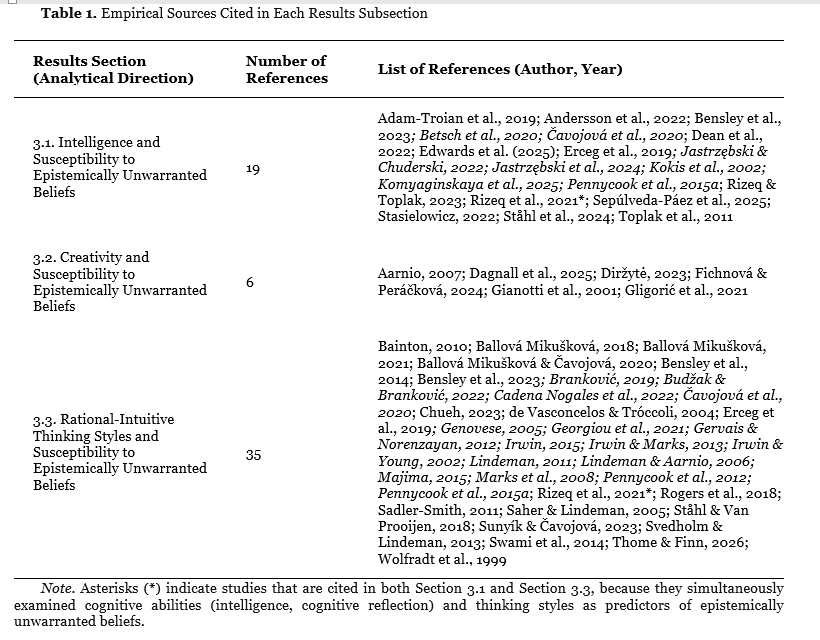
This review combines studies that are quite diverse conceptually, methodologically, disciplinarily, and thematically. For instance, they employ different concepts or models of intelligence, creativity, or thinking styles, yielding different and sometimes contradictory results. Studies also vary in design, from correlational and comparative to experimental and longitudinal. Accordingly, their authors, when discussing relationships between cognitive abilities or thinking styles and susceptibility to epistemically unwarranted beliefs, variously refer to these cognitive characteristics as “factors,” “predictors,” “conditions,” or simply establish correlations. These nuances are important theoretically, but to avoid confusion, we have generalised by referring to such cognitive characteristics as “correlates” or noting “relationships” with the constructs of interest.
The results of the studies analysed were conducted within different scientific themes and subfields of psychological disciplines: psychology of thinking, psychology of abilities, giftedness and creativity, psychology of beliefs, developmental psychology of children’s thinking, psychology of social influence, and others. Therefore, in the analysis, beyond methodological considerations, we accounted for contextual aspects of implementation, as well as gender, age, sociocultural, and other specific characteristics of respondents.
Results
Epistemically Unwarranted Beliefs
Empirical studies examining the relationship between intelligence and various types of epistemically unwarranted beliefs, including pseudoscientific, conspiracist, and paranormal beliefs, are relatively sparse. Moreover, the correlations found are generally modest and/or statistically unstable.
Some studies have found weak to moderate relationships between cognitive abilities and epistemically unwarranted beliefs concerning pseudoscience, paranormal phenomena, and conspiracy theories. Three studies by Jastrzębski and Chuderski (2022) show that fluid intelligence is negatively correlated with epistemically unwarranted beliefs; however, the strength of this relationship depends on belief type. For pseudoscientific beliefs, fluid intelligence explains approximately 11% of the variance (mean r = −0.33). For paranormal beliefs, explained variance is about 4% (mean r = −0.20), and for conspiracist beliefs, less than 2.5% (mean r = −0.16). Thus, the most moderate relationship is observed specifically for pseudoscientific beliefs.
In Jastrzębski et al. (2024), “cognitive ability” was computed as a latent variable based on three observed variables: scores on the Expanded Cognitive Reflection Test, performance on Number Series tasks (4 items), and the self‑reported Need for Cognition scale (7 items). Analysis revealed a statistically significant negative correlation between cognitive ability and level of pseudoscientific belief acceptance (r = −0.26, p < 0.001), corresponding to 6.8% variance explained in pseudoscience susceptibility. The relationship was stronger in men (r = −0.361, p = 0.039), whereas in women it was weaker and not statistically significant (r = −0.167, p > 0.05). The authors conclude that cognitive abilities are weakly to moderately, but reliably, associated with the tendency to reject pseudoscientific beliefs, and this association holds even in field research conducted on representative samples from several European countries.
In Andersson et al. (2022), nonverbal intelligence (measured using the 3D rotation scale of the ICAR16 test) showed a negative correlation with belief in astrology (r = −0.16, *p* < 0.01). In a regression model explaining 23% of variance and including demographic variables (gender, age), Big Five traits, narcissism, and assessment of astrology’s scientific validity, nonverbal intelligence emerged as a significant predictor: higher intelligence was associated with lower belief in astrology (β = −0.15, p = 0.014). These findings align with Edwards et al. (2025) who found that higher intelligence is associated with lower belief in astrology.
Čavojová et al. (2020) found weak predictive power of nonverbal intelligence for epistemically unwarranted beliefs (β = −0.211, p < 0.001). In simple linear regression, it explained 4% of belief variance. When controlling for analytic thinking style, scientific thinking, and dogmatism in the regression model, nonverbal intelligence showed an even weaker association (β = −0.141, p = 0.020).
In other studies, authors failed to identify a substantial relationship between epistemically unwarranted beliefs and cognitive abilities.
According to Erceg et al. (2019), nonverbal intelligence measured by Raven’s Progressive Matrices showed no significant correlation with level of epistemically unwarranted beliefs (r= −0.04, p > 0.05). In a regression model controlling for thinking styles and self‑control, intelligence was also a nonsignificant predictor (β = 0.04, p > 0.05). At the same time, rational thinking abilities (including cognitive reflection, rational reasoning skills, and syllogistic inference) significantly predicted lower levels of epistemically unwarranted beliefs (β = −0.17, p < 0.05) (Erceg et al., 2019). Intelligence (nonverbal and verbal) and cognitive reflection did not predict anti‑scientific attitudes, belief in conspiracy, or conspiracy theories in either adolescent‑youth samples (Rizeq & Toplak, 2023) or young adult samples (Rizeq et al., 2021).
According to Bensley et al. (2023), intelligence contributes less to predicting pseudoscientific beliefs compared to critical thinking. The authors note that although general cognitive potential (intelligence) contributes to rejecting false claims, a more complete explanation of pseudoscientific belief susceptibility is achieved through components of critical thinking, including specific reasoning skills, scientific skepticism, analytic cognitive style, and domain‑relevant knowledge, which collectively extend beyond what standard intelligence tests measure.
Overall, intelligence shows varying degrees of association not only with pseudoscientific but also with other empirically unwarranted beliefs, as well as with susceptibility to pseudo‑profound bullshit, suggesting intelligence’s general role in resisting various types of irrational and superficial ideas. People inclined to perceive meaningless yet impressively sounding statements as profound demonstrate lower verbal and nonverbal (fluid) intelligence scores and are more likely to hold paranormal and conspiracist beliefs, as well as belief in the efficacy of alternative medicine (Komyaginskaya et al., 2025; Čavojová et al., 2019; Pennycook et al., 2015a). Negative relationships between intelligence level (verbal and nonverbal) and susceptibility to pseudo‑profound bullshit have been found in other studies as well (Pennycook et al., 2015a; Sepúlveda‑Páez et al., 2025; Ståhl et al., 2024).
Toplak et al. (2011) found a weak negative relationship between intelligence (fluid and crystallised) and superstitious thinking. The same pattern was previously identified in a sample of 10–13‑year‑old children (Kokis et al., 2002). Betsch et al. (2020) found that psychometric intelligence (IQ) as a predictor behaves ambiguously: it serves as a negative predictor of paranormal beliefs (including belief in astrology) when controlling for HEXACO personality traits, but becomes statistically nonsignificant when other variables (including strong predictors such as gender, ontological confusion, and fear of death) are added to the regression model.
It should be noted that activating the striving for rationality strengthens the negative relationship between intellectual abilities and various epistemically unwarranted beliefs (Adam‑Troian et al., 2019). Similarly, the combined influence of intellectual abilities and motivation toward epistemic rationality promotes skepticism toward epistemically questionable ideas and pseudo‑profound bullshit (Ståhl et al., 2024).
3.2. Creativity and Susceptibility to Epistemically Unwarranted Beliefs
Empirical data on creativity’s role in processing pseudoscientific information are extremely scarce, and the few studies available largely address belief in the paranormal and conspiracy theories. Some publications seeking ways to counter pseudoscience in educational contexts suggest that creativity, along with other factors, can resist pseudoscientific views and concepts, as well as other epistemically unwarranted theories (Benjamin & McLean, 2022). This view seems plausible, given that creative individuals are less prone to hasty conclusions (Torrance, 1971). They are more tolerant of uncertainty and ambiguity, and thus should not succumb to quick, formulaic, stereotyped solutions (Guilford, 1982; Dacey & Lennon, 1998; Van Hiel et al., 2016; Zenasni et al., 2008).
However, empirical evidence presents a different and not entirely consistent picture. It has been found that paranormal beliefs, intuitive thinking, and creativity share some common qualities (Gianotti et al., 2001). This is confirmed by Aarnio (2007), who showed that people believing in paranormal phenomena value openness to experience, such as creativity and novelty. In a small pilot study, Fichnová and Peráčková (2024) found no direct relationship between creativity and conspiracy belief, although they noted a tendency toward nonlinear association: higher susceptibility to conspiracy theories at extreme values of creativity (low and high) and weaker at moderate values.
Absence of direct correlation was also established in Gligorić et al. (2021). Diržytė (2023) likewise found no direct correlation between creativity and conspiracist beliefs; however, in a regression model controlling for predictors such as psychological wellbeing and attitudes toward people, creativity showed a very weak but statistically significant positive predictive relationship with conspiracy belief levels (β = 0.034, p < 0.001). It was also found that creativity mediated the relationship between attitudes toward people and belief in conspiracy theories (Diržytė, 2023). Creativity’s mediating role also appeared in another study, where it, positively associated with paranormal and conspiracist beliefs (at β = 0.15–0.22), mediated their relationship with meaning in life (Dagnall et al., 2025). This aligns with Kaufman’s (2018) conclusion that creativity enables people to achieve core characteristics of meaningful life, such as purpose, significance, and coherence.
3.3. Rational‑Intuitive Thinking Styles and Susceptibility to Epistemically Unwarranted Beliefs
Regarding susceptibility to various epistemically unwarranted ideas, contemporary studies examine individual tendencies toward particular pathways of cognitive information processing in specific contexts or generally. Drawing on dual‑process theories (Epstein, 1994; Evans, 2008; Evans & Stanovich, 2013; Stanovich, 2009; Kahneman, 2011), these studies widely employ the Rational‑Experiential Inventory (REI) developed by Epstein (Epstein et al., 1996; Pacini & Epstein, 1999) based on Cognitive‑Experiential Self‑Theory (CEST) to assess rational and intuitive styles of cognitive information processing.
It should be noted that research focus on these styles as predictors of susceptibility to epistemically unwarranted ideas is skewed toward paranormal and conspiracist beliefs. Empirical data on susceptibility to pseudoscientific theories are considerably fewer. Contemporary psychology presents a rather complex and sometimes contradictory picture of relationships between thinking styles and unwarranted beliefs (pseudoscientific, paranormal, conspiracist).
Broadly speaking, most empirical studies show that rational style serves as a negative predictor of epistemically unwarranted beliefs overall. Bensley et al. (2023) found that scores on the REI rational style scale, Cognitive Reflection Test, and scientific skepticism scale correlate with each other and are reliable negative predictors of epistemically unwarranted beliefs. Sunyík and Čavojová (2023) established that analytic thinking style, measured using numerical Cognitive Reflection Test (Frederick, 2005) and verbal cognitive reflection test (Sirota et al., 2021) tasks, significantly negatively predicts belief in complementary and alternative medicine (β = −0.09, p = 0.013), COVID‑19 conspiracy theories (β = −0.07, p = 0.016), and pseudoscientific beliefs (β = −0.15, p = 0.001).
In experiments by Ballová Mikušková and Čavojová (2020), the Barnum effect was studied under conditions of prior activation of rational thinking style. Experimental group participants (1, 2) with activated style evaluated the accuracy of presented false personality descriptions (vague and ambiguous), allegedly based on (1) psychological diagnostics or (2) astrological calculation. Comparison with control samples (3, 4), where rational style was not activated, showed that people with activated rational style perceived false descriptions as less accurate, regardless of their source (psychology/astrology). Notably, the pseudoscientific nature of astrological doctrine compared to perceived scientific psychology did not play a specific role.
In Thome and Finn (2026), a significant positive correlation was found between scores on the Susceptibility to Pseudoscience Scale (STOP) and the brief Need for Cognition Scale (NFC), scientific thinking scale, and the brief Actively Open‑Minded Thinking Scale (AOT). The authors consider the latter two scales as measures of rational (analytic) style. Using the latter scale, Rizeq et al. (2021) found that rational style (as actively open‑minded thinking) negatively correlates with anti‑scientific attitudes (r =−0.56, p < 0.05), paranormal beliefs (r = −0.44, p < 0.05), and conspiracy belief (r = −0.20, p < 0.05). However, this style’s predictive power for conspiracy belief was statistically nonsignificant. Despite this result, according to Ballová Mikušková (2018), student teachers with low conspiracy belief levels significantly more often demonstrated a tendency toward rational cognitive processing style.
This aligns with other research findings. Rational thinking scores on REI and NFC scales significantly and negatively predicted belief in paranormal phenomena (Pennycook et al., 2012; Svedholm & Lindeman, 2013). Other earlier studies also found negative correlations between preference for rational style and belief in paranormal phenomena (Irwin & Young, 2002; Lindeman & Aarnio, 2006; Marks et al., 2008; Rogers et al., 2018; Ståhl & Van Prooijen, 2018), as well as conspiracy theory belief (Georgiou et al., 2021) and epistemically unwarranted beliefs in whole (Cadena Nogales et al., 2022). Experimental evidence also points to the positive influence of rational information processing on religious disbelief (Gervais & Norenzayan, 2012).
Despite this trend, some studies show absent or even reversed relationships. Čavojová et al. (2020) found that when entering a regression model including nonverbal intelligence (β = −0.141, p = 0.020), scientific thinking, dogmatism, and rational (analytic) thinking style as predictors of epistemically unwarranted beliefs, the latter’s contribution was statistically nonsignificant (p = 0.829). Genovese (2005), and Pennycook et al. (2015a) also found that rational style measured by NFC scale has no significant correlation with paranormal belief. Exactly the same absence of relationship was established by Bensley et al. (2014); however, rational style positively correlated with the ability to distinguish pseudoscience from genuine science (r = = 0.17, p < 0.05). In Irwin’s (2015) study, rational thinking style showed no significant correlation with paranormal belief and was not a predictor. However, people who developed disbelief in paranormal phenomena during a preliminary test session tended to habitually use rational information processing. Absence of statistically significant relationships between rational style and paranormal belief was previously noted by other researchers (Bainton, 2010; de Vasconcelos & Tróccoli, 2004; Irwin & Marks, 2013; Sadler‑Smith, 2011).
Mixed findings were obtained by Swami et al. (2014): REI rational style scores negatively correlated with conspiracy theory belief, whereas NFC scale scores showed no such relationship. Ballová Mikušková (2021) found correlations between conspiracist beliefs and rational (r = −0.19, p < 0.001) and intuitive (r = 0.18, p < 0.001) styles, but in the regression model, thinking styles were statistically nonsignificant predictors of conspiracy theory belief.
Particular attention should be paid to Majima’s (2015) findings. In a Japanese sample, rational thinking style emerged as a positive predictor of pseudoscientific beliefs (β = 0.18, p = 0.009) and paranormal belief (β = 0.14, p = 0.039). Meanwhile, intuitive style did not contribute significantly to predicting pseudoscientific beliefs but was a positive significant predictor of paranormal belief (β = 0.24, p = 0.000). These trends were found controlling for gender, age, scientific literacy, and cognitive abilities. The latter were understood not as general intelligence (g‑factor) but as logical and probabilistic reasoning abilities, and were unrelated to either pseudoscience belief or paranormal belief (Majima, 2015). These results likely reflect cultural differences in cognitive styles between Western and Eastern populations. Wolfradt et al. (1999) suggest that analytically thinking individuals have strong curiosity and derive pleasure from intellectual challenges. Therefore, encountering large amounts of information, including about paranormal phenomena, they may engage with such ideas and believe in them.
Regarding intuitive thinking style, empirical evidence indicates that it plays a key role in susceptibility to epistemically questionable ideas: the higher the intuitive style, the greater the likelihood of accepting such ideas. Intuitive thinking style emerged as the strongest predictor of endorsement of epistemically unwarranted beliefs overall (β = 0.33, p < 0.01) (Erceg et al., 2019). Concerning specific types of beliefs, intuitive style significantly predicted paranormal belief (β = 0.388, p < 0.001) while rational style did not predict it (Irwin, 2015). Branković (2019) emphasises the significant role of intuitive style in forming paranormal beliefs such as belief in extrasensory perception (psi abilities). Chueh’s (2023) research shows that people inclined toward intuitive style more often believe in common misconceptions and conspiracy theories than those inclined toward rational style. Numerous earlier studies also demonstrated positive relationships between intuitive style and paranormal belief (Irwin & Marks, 2013; Irwin & Young, 2002; Marks et al., 2008; Sadler‑Smith, 2011; Svedholm, 2013).
Regarding pseudoscience specifically, intuitive style’s role appears as follows. Thome and Finn (2026) established a significant negative correlation between resistance to pseudoscientific ideas and preference for intuitive thinking style. Some studies found statistically significant positive correlations between intuitive style and attitudes toward alternative medicine (Lindeman, 2011; Saher & Lindeman, 2005). Interestingly, people inclined to rely on intuition believe more strongly in complementary and alternative medicine, paranormal phenomena, and magical properties of food and health practices. Conversely, people inclined toward rational thinking believe less in paranormal phenomena, magical properties of food, and health practices, but not necessarily in alternative medicine (Saher & Lindeman, 2005). Budžak and Branković (2022), studying attitudes toward complementary and alternative medicine, found that intuitive style, while positively correlating with beliefs in its effectiveness, did not directly predict attitude toward it. At the same time, tendency toward rational style significantly predicted negative attitudes toward such medical practices.
Discussion
4.1. Analysis of Intelligence’s Role
The variability in findings concerning intelligence’s role as a correlate of epistemically unwarranted beliefs is, in our view, largely related to differences in intelligence models employed, the varying sets of intellectual skills measured, and the characteristics of study samples and psychometric instruments used. As shown in meta‑analyses by Dean et al. (2022) and Stasielowicz (2022), many studies use only isolated single indicators of intellectual abilities, which may weaken the relationship between intelligence overall and epistemically unwarranted beliefs (Jastrzębski & Chuderski, 2022).
Summarising available data, Jastrzębski and Chuderski (2022) note that the precise relationship between unwarranted beliefs and intelligence remains unclear. A significant gap is the insufficient empirical data on verbal intelligence and conceptual abilities, which remain on the periphery of scientific inquiry.
We consider it important for elucidating intelligence’s role as a potential predictor of susceptibility to pseudoscientific theories to draw on psychology’s distinction between nonverbal and verbal intelligence. Such differentiation would allow for nuanced identification of their contributions as cognitive predictors, which we believe will be uneven. Since pseudoscientific doctrines are presented in narratives and organised through verbal‑logical structures and conceptual schemas, verbal intelligence likely plays a greater role in their recognition and counteraction. However, nonverbal intelligence may also play a role by contributing to recognition of contradictions and logical violations at the level of nonverbal signals, actions, or images.
In foreign research, instead of this distinction, one more often encounters differentiation of general intelligence (g‑factor) into two key components: fluid (Gf) and crystallised (Gc) intelligence. This dichotomy originates in Cattell’s (1971) intelligence theory and the CHC (Cattell‑Horn‑Carroll) hierarchical theory (McGrew, 2009), widely adopted in psychological science. In the context of this research, this dichotomy is also relevant as it distinguishes cognitive abilities related to processing novel information and logical reasoning (Gf) from those relying on accumulated knowledge and cultural experience (Gc).
Fluid intelligence (Gf) represents the cognitive ability directed at solving perceptual tasks requiring minimal reliance on previously acquired knowledge, skills, or life experience. This form of intelligence is realised primarily through nonverbal operations such as inductive and deductive reasoning, working with numerical structures, and rapid generation of logical conclusions (Druzhinin, 1995; Rzhanova et al., 2018; Ushakov, 2011).
Crystallised intelligence (Gc), understood as the aggregate of acquired knowledge and intellectual skills, including verbal abilities, vocabulary, and cultural awareness, is closely tied to the accumulation of both general and domain‑specific knowledge, mediated by sociocultural experience and educational environment; functionally, it corresponds to verbal intelligence (Druzhinin, 1995; Ushakov, 2011).
As Kornilova et al. (2019, p. 33) note: “The distinction between verbal and nonverbal intelligence captured differences in task types and corresponding forms of cognitive processes. This partially corresponded to differing degrees of cultural conditioning (cultural‑historical in some interpretations, environmental in others). After Cattell’s distinction of crystallised and fluid intelligence … the former became quite congruent with ‘verbal,’ while ‘fluid’ could be assumed to have two forms of manifestation—both verbal and nonverbal.”
For future research, the verbal/nonverbal intelligence dichotomy appears preferable because it allows separation of conceptual structures (within verbal intelligence) from cognitive formations of other kinds. It is with conceptual structures and processes (conceptual abilities, conceptual thinking) that we associate a potential contribution of intelligence to resisting informational‑psychological influence (indoctrination) more than with others.
Many researchers have noted the key role of conceptual thinking in intelligence structure, viewing the capacity for conceptual reflection of reality as the highest stage of intellectual development, providing the possibility for conscious (voluntary) regulation of activity (Kholodnaya & Sipovskaya, 2023).
According to Kholodnaya’s concept, intelligence is not reducible to a set of cognitive information‑processing operations but is understood as a form of organisation of individual mental experience, in which conceptual abilities perform a system‑forming function. They ensure integration of heterogeneous mental mechanisms (perception, memory, thinking, regulation) into a unified cognitive system capable of adaptive reflection of reality (Kholodnaya, 2026a, 2026b; Kholodnaya & Sipovskaya, 2023).
As Kholodnaya and Sipovskaya (2023, p. 8) state: “Conceptual thinking is a cognitive process providing a mediated (through meanings of acquired signs and knowledge system), generalized (through identifying essential features and using categories), and generative (through revealing hidden patterns and constructing new mental contents) form of reflection of reality.”
Regarding resistance to epistemically unwarranted ideas, this structural and functional complexity suggests that conceptual thinking may be a critically important and powerful tool for:
- differentiating rationally‑analytically justified and epistemically unwarranted discourses, through the ability to operate with abstract categories, identify logical inconsistencies, and recognise irrational judgments;
- critical verification of claims, through comparing new information with an established system of conceptual knowledge and identifying conceptual contradictions;
- generating alternative interpretations.
Individuals with insufficiently developed conceptual apparatus (e.g., with dominance of concrete‑situational or associative thinking) may be more vulnerable to indoctrination because they (1) tend toward literal perception of verbally complex but logically empty formulations; (2) experience difficulties in identifying categorical substitutions; (3) demonstrate reduced ability for mental modelling and testing alternative hypotheses.
4.2. Analysis of Creativity’s Role
Analysing the ambiguous and sometimes contradictory findings regarding creativity as a correlate of epistemically unwarranted beliefs, we offer the following interpretation. In the logic of Guilford’s three‑component model of intelligence structure, creativity represented as divergent thinking, with its fluency, flexibility, and other components, may contribute not only to generating innovative ideas but also to heightened susceptibility to epistemically questionable information if the individual lacks mechanisms for verifying acquired knowledge.
However, if creativity is interpreted more broadly than divergent thinking alone, the ambiguity of the reviewed empirical findings may receive more precise explanation. Several scholarly works rightly point out that understanding creativity solely as divergent thinking (the capacity to generate original ideas characterised by novelty and unconventionality) is insufficient in isolation from their usefulness and applicability (Stein, 1953; Cropley, 1997). The question arises: can an idea be “creative” if it is meaningless, inapplicable, or even harmful? In the two‑component model of creativity (Campbell, 1960; Finke et al., 1996), the necessity of accounting for the additional criterion of effectiveness, appropriateness, or usefulness is substantiated. According to this model, the creative process comprises two phases:
- idea generation, associated with divergent thinking;
- idea evaluation, associated with convergent thinking.
Convergent thinking performs a threshold function, filtering out original ideas when they lack effectiveness. Thus, genuine creativity should be distinguished from pseudo‑creativity as the capacity to generate original but ineffective and/or useless ideas. Pseudo‑creativity is operationalised through high divergent thinking levels combined with low convergent thinking levels and absence of socially recognised creative achievements (Yao et al., 2026).
Thus, considering convergent thinking as a tool for checking ideas for effectiveness and applicability, creativity’s relationships with epistemically unwarranted beliefs may be predictably bidirectional or absent altogether, since divergent and convergent components of creativity may “push” the process of perceiving epistemically questionable information in opposite directions: toward rejection or acceptance.
For complete analysis, we turn to concepts emphasising the intuitive mechanisms of creativity (Barysheva, 2012; Ponomarev, 2006; Sergienko, 2025; Mednick, 1962). Based on these, one might hypothesise that creativity would contribute to susceptibility to epistemically unwarranted ideas and possibly mediate those rational components of mental activity that may not directly manifest as reliable predictors of epistemically unwarranted beliefs. Mednick’s (1962) so‑called “lateral thinking,” aimed at going beyond templates and stereotypes, in the absence of analytic verification, may lead to accepting false but superficially original explanations. In Ponomarev’s (2006) theory, sensitivity to “by‑products” of activity and dominance of the intuitive level in the creative process may also contribute to erroneous interpretation of epistemically questionable ideas as intellectual insights.
Analysing Thurstone’s concept, which emphasises that creative insights more often arise in states of diffuse attention and relaxation (see Tikhomirova, 2010), one may conclude that these conditions, under which critical control is reduced, will increase individual vulnerability to manipulative narratives.
Johnson’s (1976) approach to creativity, considering its spontaneity in social influence contexts, also allows explaining its positive relationships with epistemically unwarranted beliefs. Pseudoscientific, conspiracist, and paranormal narratives are often transmitted in dynamic, affectively saturated social‑communicative environments (social media, video blogs, group discussions) where recipients’ critical control is weakened, and novelty and unexpectedness often serve as key markers of “depth” and “revolutionary” nature. In such conditions, individuals with high spontaneous creativity (in Johnson’s sense) may easily generate meaning from fragmentary and distorted information, integrating epistemically questionable premises into their belief system as the result of personal “insight” or “creative breakthrough.”
4.3. Analysis of Rational‑Intuitive Thinking Styles’ Role
Summarising research on rational and intuitive thinking styles, we note insufficient empirical data concerning relationships between these styles specifically and susceptibility to pseudoscientific beliefs (compared to studies of relationships with conspiracy and paranormal belief). Nevertheless, some trends can be discerned. For instance, rational thinking style shows more consistently as a negative predictor of epistemically unwarranted beliefs overall, and pseudoscientific beliefs specifically. Intuitive style has more stable positive predictive power for paranormal and conspiracy belief. This is understandable, as pseudoscientific theories, mimicking scientific form, are more rationally structured than, say, paranormal ideas (belief in magic, witchcraft, superstitions, etc.) or conspiracy theories. Accordingly, pseudoscientific narratives may correlate more with rational style, whereas paranormal and conspiracist narratives with intuitive style.
However, even within these general trends, there are contrasting results. This is particularly noticeable regarding rational thinking style. Perhaps, as in Majima’s (2015) findings, the cause lies in cultural characteristics or natural differences in research samples. It also appears that in some cases, this is due to differences in methodological instruments. To measure rational (analytic) style tendency, researchers use, in addition to the corresponding scale of the REI questionnaire (Pacini & Epstein, 1999), the Cognitive Reflection Test (CRT) developed by Frederick (2005), the Need for Cognition Scale (NFC) (Cacioppo & Petty, 1982), their modifications, and others. These instruments measure somewhat different tendencies. The REI assesses self‑reported tendency toward rational thinking style; the CRT measures the ability to suppress initial intuitively predictable but incorrect responses during mental problem‑solving and rely on analytically deliberated solutions; the NFC scale, based on self‑assessment, identifies the motivational aspect of thinking, i.e., the tendency to engage in and derive pleasure from thinking. Thus, these methodological nuances may be reflected in specific findings.
It should be noted that dual‑process theories of cognitive information processing (Epstein, 1994; Evans, 2008; Evans & Stanovich, 2013; Stanovich, 2009; Kahneman, 2011) possess good explanatory potential for the identified trends. For example, people’s tendency toward epistemically unwarranted judgments likely arises from intuitive information processing (System 1), operating by default and based on heuristics. Under standard conditions, dominance of the analytic cognitive processing system (System 2) facilitates suppression of intuitive judgments. This system’s operation creates a moderate protective effect of so‑called “cognitive immunity” toward pseudoscientific, paranormal, conspiracist, and other narratives (Pennycook et al., 2015b).
However, under time constraints and increased cognitive load, the intuitive system begins to dominate, and the capacity of analytic processes to correct intuitive judgments is disrupted (De Neys, 2006; Evans & Curtis‑Holmes, 2005). Even if an individual simultaneously holds two representations of the same phenomenon, under such conditions, early‑formed intuitive biases will manifest (Kahneman, 2003; Kelemen & Rosset, 2009). Svedholm (2013) notes that this effect is observed even among people with higher education in physics: in the absence of attentional resources, they revert to intuitive but erroneous conceptions of mechanics that they typically suppress (McCloskey et al., 1980). Intuitive processing as a default cognitive mode, activated automatically and effortlessly, explains the persistence of intuitive theories (naïve biology, naïve psychology, naïve physics), the tendency toward teleological explanations (Kurbanov & Spiridonov, 2023; Kelemen et al., 2009, 2013; Ronfard et al., 2021; Young & Shtulman, 2020).
In a meta‑analysis, Gallyamova et al. (2024) note that the tendency toward intuitive thinking and difficulties in transitioning to analytic processing may be due to both reduced inhibitory control efficiency and limited cognitive monitoring capacities (Svedholm & Lindeman, 2013), cognitive limitations such as low verbal intelligence and limited working memory (Pennycook et al., 2015a), and high trust in initial intuitive judgments under insufficient motivation or time for deeper analysis (Evans, 2011), while suppression mechanisms of intuitive responses rely on executive functions and the analytic system, providing evaluation and selection between competing interpretations (Stanovich, 2011). Thus, explicit rational reasoning proves relatively ineffective under conditions where strong intuitive impulses dominate (Bargh, 1999; Bargh et al., 2012; Haidt, 2001). As a metaphor reflecting this position, the image of human cognition as an “emotional (intuitive) dog with a rational tail” (Haidt, 2001) or, in later interpretations, an “intuitive elephant and analytic rider” (Haidt, 2012) has been used.
Conclusions
The question of whether cognitive abilities and rationality confer immunity against epistemically unwarranted beliefs, as the present review demonstrates, admits of no simple affirmative answer. Rather, the available evidence compels a more nuanced conclusion: intelligence and rational thinking style are necessary but insufficient conditions for epistemic resilience. While high psychometric intelligence and a self-reported preference for analytic cognition correlate negatively with pseudoscientific and, to a lesser extent, conspiracist beliefs, these protective effects are modest, context-dependent, and consistently overshadowed by the default operations of intuitive processing (System 1). Critically, the protective potential of intellectual resources materialises only when individuals actively suppress intuitive heuristics, engage effortful analytic scrutiny, and deploy their cognitive capacities as a sustained mental resource, a condition that is frequently unmet in naturalistic settings characterised by time pressure, cognitive load, or strong motivational biases.
The inconsistency of creativity as a correlate of unwarranted beliefs further complicates the picture. Rather than serving as a straightforward protective factor, creativity appears as a double-edged sword: its divergent component may facilitate openness to novel perspectives, yet in the absence of convergent evaluative control (i.e., pseudo‑creativity), it may equally foster susceptibility to epistemically questionable narratives, particularly within affectively charged and socially validating environments such as digital media.
Three overarching theoretical implications emerge from our synthesis. First, the dual‑process framework remains the most parsimonious explanatory model: the intuitive System 1 operates by default, whereas the analytic System 2, though capable of correction, requires both sufficient cognitive capacity and deliberate activation. Second, the efficacy of rationality is not a stable trait but a state‑dependent function of epistemic motivation and metacognitive monitoring; individuals must not only possess the ability to reason well but also recognise when such reasoning is warranted. Third, the observed cross‑cultural variability (e.g., Majima, 2015) underscores that the relationship between analytic thinking and belief rejection is moderated by sociocultural schemas, educational systems, and the perceived authority of knowledge sources, factors that warrant systematic comparative investigation.
From a practical standpoint, these findings challenge the prevalent assumption that simply enhancing general intelligence or teaching formal logic will suffice to curb the spread of pseudoscience and conspiracy theories. Effective interventions must instead target the cognitive‑motivational interface: training individuals to detect contexts that trigger intuitive fallacies, cultivating active open‑mindedness, and fostering habitual analytic engagement through repeated, contextualised practice. Moreover, debunking strategies should account for the motivational underpinnings of unwarranted beliefs, such as the need for control, meaning, and social belonging, which cognitive resources alone cannot override.
Future research must move beyond cross‑sectional correlations toward experimental and longitudinal designs that dissect the causal architecture of these relationships. Key priorities include: (a) manipulating cognitive load and time constraints to test the boundary conditions of analytic protection; (b) examining the moderating roles of epistemic trust, ideological identity, and source credibility; (c) developing integrated models that jointly estimate the contributions of intelligence, creativity, thinking styles, and motivational factors within unified analytical frameworks; and (d) conducting cross‑cultural replication studies to validate the generalisability of existing findings.
In sum, while cognitive abilities and rationality are valuable assets in the struggle against epistemically unwarranted beliefs, they are neither a panacea nor a passive shield. Their defensive power is contingent upon active, effortful deployment, a state that our cognitive architecture does not guarantee. The dual vulnerability of the human mind, its intuitive fallibility and the demanding nature of analytic correction, remains the central challenge for both psychological science and societal efforts to protect against misinformation and indoctrination.
References
- Aarnio, K. (2007). Paranormal, superstitious, magical, and religious beliefs(Doctoral dissertation). University of Helsinki.
- Abitov, I. R., Akbirova, R. R., & Sibgatullina, L. R. (2017). Osobennosti very v sverkh”estestvennoye u studentov gumanitarnogo i yestestvenno-nauchnogo napravleniy podgotovki [Features of belief in the supernatural among students of humanities and natural sciences]. In A. L. Zhuravlev & V. A. Koltsova (Eds.), Fundamental’nyye i prikladnyye issledovaniya sovremennoy psikhologii: rezul’taty i perspektivy razvitiya[Fundamental and applied research in contemporary psychology: Results and development prospects] (pp. 630–637). Institute of Psychology RAS.
- Adam-Troian, J., Caroti, D., Arciszewski, T., & Ståhl, T. (2019). Unfounded beliefs among teachers: The interactive role of rationality priming and cognitive ability. Applied Cognitive Psychology, 33(4), 720–727. https://doi.org/10.1002/acp.3547
- Agapova, E. A. (2019). Fenomen dessientizatsii obshchestvennogo soznaniya [The phenomenon of descientization of public consciousness]. Gumanitarnyye i sotsial’nyye nauki[Humanities and Social Sciences], 6, 2–9.
- Andersson, I., Persson, J., & Kajonius, P. (2022). Even the stars think that I am superior: Personality, intelligence and belief in astrology. Personality and Individual Differences, 187, 111389. https://doi.org/10.1016/j.paid.2021.111389
- Antonova, N. A., Eritsyán, K. Y., & Usacheva, N. M. (2023). Rol’ mirovozzrencheskikh ubezhdeniy i tolerantnosti k neopredelennosti v obrashchenii za ezotericheskimi uslugami [The role of worldview beliefs and tolerance for uncertainty in seeking esoteric services]. Sotsial’naya psikhologiya i obshchestvo[Social Psychology and Society], 14(4), 194–209. https://doi.org/10.17759/sps.2023140412
- Bainton, J. (2010). The relationship between thinking style and paranormal belief(Master’s thesis). University of Edinburgh.
- Ballová Mikušková, E. (2018). Conspiracy beliefs of future teachers. Current Psychology, 37(3), 692–701. https://doi.org/10.1007/s12144-017-9561-4
- Ballová Mikušková, E. (2021). The analytic cognitive style and conspiracy mentality as predictors of conspiracy beliefs. Studia Psychologica, 63(2), 190–203. https://doi.org/31577/sp.2021.02.819
- Ballová Mikušková, E., & Čavojová, V. (2020). The effect of analytic cognitive style on credulity. Frontiers in Psychology, 11, 584424. https://doi.org/10.3389/fpsyg.2020.584424
- Bargh, J. A., & Chartrand, T. L. (1999). The unbearable automaticity of being. American Psychologist, 54(7), 462–479.
- Bargh, J. A., Schwader, K. L., Hailey, S. E., Dyer, R. L., & Boothby, E. J. (2012). Automaticity in social-cognitive processes. Trends in Cognitive Sciences, 16(12), 593–605. https://doi.org/10.1016/j.tics.2012.10.002
- Barysheva, T. A. (2012). Psikhologicheskaya struktura kreativnosti (opyt empiricheskogo issledovaniya) [Psychological structure of creativity (an empirical study)]. Izvestiya Rossiyskogo gosudarstvennogo pedagogicheskogo universiteta im. A.I. Gertsena[Proceedings of Herzen State Pedagogical University of Russia], 145, 54–64.
- Benjamin, K. A., & McLean, S. (2022). Change the medium, change the message: Creativity is key to battle misinformation. Advances in Physiology Education, 46(2), 259–267. https://doi.org/10.1152/advan.00021.2021
- Bensley, D. A., Lilienfeld, S. O., & Powell, L. A. (2014). A new measure of psychological misconceptions: Relations with academic background, critical thinking, and acceptance of paranormal and pseudoscientific claims. Learning and Individual Differences, 36, 9–18. https://doi.org/10.1016/j.lindif.2014.07.009
- Bensley, D. A., Rodrigo, M., Bravo, M., & Jocoy, K. (2023). Dual-process theory and cognitive style predictors of the general endorsement of unsubstantiated claims. Unpublished manuscript, Frostburg State University.
- Betsch, T., Aßmann, L., & Glöckner, A. (2020). Paranormal beliefs and individual differences: Story seeking without reasoned review. Heliyon, 6(6), e04259. https://doi.org/10.1016/j.heliyon.2020.e04259
- Bobrovskaya, E. V. (2017). Vliyaniye konspirologicheskikh teoriy na gosudarstvennuyu politiku v sfere zdravookhraneniya: VICH-dissidentstvo v Rossii i za rubezhom [The influence of conspiracy theories on public health policy: HIV dissidence in Russia and abroad]. Politicheskaya nauka[Political Science], Special Issue, 149–164.
- Branković, M. (2019). Who believes in ESP: Cognitive and motivational determinants of the belief in extra-sensory perception. Europe’s Journal of Psychology, 15(1), 120–139. https://doi.org/10.5964/ejop.v15i1.1689
- Budžak, A., & Branković, M. (2022). Alternative ways to mental health: Exploring psychological determinants of preference for CAM treatments. Studia Psychologica, 64(1), 118–135. https://doi.org/10.31577/sp.2022.01.843
- Cacioppo, J. T., & Petty, R. E. (1982). The need for cognition. Journal of Personality and Social Psychology, 42(1), 116–131.
- Cadena Nogales, P. D., Solaz Portolés, J. J., Echegoyen Sanz, Y., & Sanjosé López, V. (2022). Level of acceptance of epistemically unwarranted beliefs in pre-service primary school teachers: Influence of cognitive style, academic level and gender. Journal of Baltic Science Education, 21(3), 398–407. https://doi.org/10.33225/jbse/22.21.398
- Campbell, D. T. (1960). Blind variation and selective retentions in creative thought as in other knowledge processes. Psychological Review, 67(6), 380–400. https://doi.org/10.1037/h0040373
- Cattell, R. B. (1971). Abilities: Their structure, growth, and action. Houghton Mifflin.
- Čavojová, V., Secară, E. C., Jurkovič, M., & Šrol, J. (2019). Reception and willingness to share pseudo-profound bullshit and their relation to other epistemically suspect beliefs and cognitive ability in Slovakia and Romania. Applied Cognitive Psychology, 33(2), 299–311. https://doi.org/10.1002/acp.3486
- Čavojová, V., Šrol, J., & Jurkovič, M. (2020). Why should we try to think like scientists? Scientific reasoning and susceptibility to epistemically suspect beliefs and cognitive biases. Applied Cognitive Psychology, 34(1), 85–95. https://doi.org/10.1002/acp.3595
- Chueh, Z. (2023). Exploring the relationship between thinking style and belief in common misconceptions and conspiracy-related claims(Master’s thesis). Massey University.
- Cropley, A. (1997). Creativity: A bundle of paradoxes. Gifted and Talented International, 12(1), 8–14. https://doi.org/10.1080/15332276.1997.11672859
- Dacey, J. S., & Lennon, K. H. (1998). Understanding creativity: The interplay of biological, psychological, and social factors. Jossey-Bass.
- Dagnall, N., Denovan, A., & Drinkwater, K. G. (2025). Examining the degree to which paranormal belief and conspiracy endorsement influence meaning in life: Sequential mediating effects of creativity and self-esteem. Frontiers in Psychology, 16, Article 1567920. https://doi.org/10.3389/fpsyg.2025.1567920
- Das, A., Sharma, M. K., Kashyap, H., & Gupta, S. (2022). Fixating on the future: An overview of increased astrology use. International Journal of Social Psychiatry, 68(5), 925–932. https://doi.org/10.1177/00207640221094155
- Dean, C. E., Akhtar, S., Gale, T. M., Irvine, K., Grohmann, D., & Laws, K. R. (2022). Paranormal beliefs and cognitive function: A systematic review and assessment of study quality across four decades of research. PLoS One, 17(5), Article e0267360. https://doi.org/10.1371/journal.pone.0267360
- De Neys, W. (2006). Automatic–heuristic and executive–analytic processing during reasoning: Chronometric and dual-task considerations. Quarterly Journal of Experimental Psychology, 59(6), 1070–1100. https://doi.org/10.1080/02724980543000123
- De Vasconcelos, T. S., & Tróccoli, B. T. (2004). Crenças no paranormal e estilos de pensamento racional versus experiencial [Belief in the paranormal and rational versus experiential thinking styles]. Psico-USF, 9(2), 155–164. https://doi.org/10.1590/S1413-82712004000200006
- Diržytė, A. (2023). Exploring the nexus between conspiracy beliefs and creativity, attitudes toward people, and psychological wellbeing: Insights from the 10th European social survey. Sustainability, 15(22), 15722. https://doi.org/10.3390/su152215722
- Douglas, K. M., Sutton, R. M., & Chichoka, A. (2017). The psychology of conspiracy theories. Current Directions in Psychological Science, 26(6), 538–542. https://doi.org/10.1177/0963721417718261
- Druzhinin, V. N. (1995). Psikhologiya obshchikh sposobnostey[Psychology of general abilities]. Lanterna-Vita.
- Dvoinin, A. M., & Bulanova, I. S. (2020). Psikhologiya indoktrinatsii: Podkhody i sovremennyye napravleniya issledovaniy [Psychology of indoctrination: Approaches and contemporary research directions]. Voprosy psikhologii[Issues of Psychology], 4, 3–15.
- Dvoinin, A. M., & Bulanova, I. S. (2021). Fenomen indoktrinatsii: Psikhologicheskiye podkhody i sovremennyye napravleniya issledovaniy [The phenomenon of indoctrination: Psychological approaches and contemporary research directions]. In A. L. Zhuravlev & A. V. Yurevich (Eds.), Psikhologicheskoye znaniye: vidy, istochniki, puti postroyeniya[Psychological knowledge: Types, sources, paths of construction] (pp. 92–115). Institute of Psychology RAS.
- Dvoinin, A. M., & Romantsova, V. K. (2021). O soderzhanii kategorii «indoktrinatsiya» v psikhologicheskoy nauke [On the content of the category “indoctrination” in psychological science]. Izvestiya instituta pedagogiki i psikhologii obrazovaniya[Proceedings of the Institute of Pedagogy and Educational Psychology], 3, 75–81.
- Dvoinina, V. K. (2025). Problema indoktrinatsii psevdonaukoy: Ob”yasnitel’nyye vozmozhnosti modeley kognitivnoy obrabotki informatsii [The problem of indoctrination by pseudoscience: Explanatory potential of cognitive information processing models]. Mir nauki. Pedagogika i psikhologiya[World of Science. Pedagogy and Psychology], 13(3), 47PSMN325.
- Edwards, T., March, M. J., Willoughby, E. A., & Giannelis, A. (2025). Intelligence and individual differences in astrological belief. Journal of Individual Differences, 46(1), 50–57. https://doi.org/10.1027/1614-0001/a000434
- Epstein, S. (1994). Integration of the cognitive and the psychodynamic unconscious. American Psychologist, 49(8), 709–724. https://doi.org/10.1037//0003-066x.49.8.709
- Epstein, S., Pacini, R., Denes-Raj, V., & Heier, H. (1996). Individual differences in Intuitive-Experiential and Analytical-Rational Thinking Styles. Journal of Personality and Social Psychology, 71(2), 390–405. https://doi.org/10.1037/0022-3514.71.2.390
- Erceg, N., Galić, Z., & Bubić, A. (2019). “Dysrationalia” among university students: The role of cognitive abilities, different aspects of rational thought and self-control in explaining epistemically suspect beliefs. Europe’s Journal of Psychology, 15(1), Article e1696. https://doi.org/10.5964/ejop.v15i1.1696
- Evans, J. S. B. T. (2008). Dual-processing accounts of reasoning, judgment and social cognition. Annual Review of Psychology, 59, 255–278. https://doi.org/10.1146/annurev.psych.59.103006.093629
- Evans, J. S. B. T. (2011). Dual-process theories of reasoning: Contemporary issues and developmental applications. Developmental Review, 31(2-3), 86–102. https://doi.org/10.1016/j.dr.2011.07.007
- Evans, J. S. B. T., & Curtis-Holmes, J. (2005). Rapid responding increases belief bias: Evidence for the dual-process theory of reasoning. Thinking & Reasoning, 11(4), 382–389. https://doi.org/10.1080/13546780542000005
- Evans, J. S. B. T., & Stanovich, K. E. (2013). Dual-process theories of higher cognition: Advancing the debate. Perspectives on Psychological Science, 8(3), 223–241. https://doi.org/10.1177/1745691612460685
- Festinger, L. (2000). Teoriya kognitivnogo dissonansa[A theory of cognitive dissonance]. Rech’.
- Fichnová, K., & Peráčková, V. (2024). Human creativity, perceptual rigidity, the media and conspiracy theories in the age of AI. Marketing Identity: Human vs. Artificial Intelligence, 131–144. https://doi.org/10.34135/mmidentity-2024-13
- Finke, R. A., Ward, T. B., & Smith, S. M. (1996). Creative cognition: Theory, research, and applications. MIT Press.
- Frederick, S. (2005). Cognitive reflection and decision making. The Journal of Economic Perspectives, 19(4), 25–42. https://doi.org/10.1257/089533005775196732
- Gallyamova, A., Komyaginskaya, E., & Grigoryev, D. (2024). Paranormal beliefs and core knowledge confusions: A meta-analysis. Personality and Individual Differences, 230, 112780. https://doi.org/10.1016/j.paid.2024.112780
- Genovese, J. E. C. (2005). Paranormal beliefs, schizotypy, and thinking styles among teachers and future teachers. Personality and Individual Differences, 39(1), 93–102. https://doi.org/10.1016/j.paid.2004.12.008
- Georgiou, N., Delfabbro, P., & Balzan, R. (2021). Conspiracy theory beliefs, scientific reasoning and the analytical thinking paradox. Applied Cognitive Psychology, 35(6), 1523–1534. https://doi.org/10.1002/acp.3885
- Gervais, W. M., & Norenzayan, A. (2012). Analytic thinking promotes religious disbelief. Science, 336(6080), 493–496. https://doi.org/10.1126/science.1215647
- Gianotti, L. R. R., Mohr, C., Pizzagalli, D., Lehmann, D., & Brugger, P. (2001). Associative processing and paranormal belief. Psychiatry and Clinical Neurosciences, 55(6), 595–603. https://doi.org/10.1046/j.1440-1819.2001.00911.x
- Gligorić, V., da Silva, M. M., Eker, S., van Hoek, N., Nieuwenhuijzen, E., Popova, U., & Zeighami, G. (2021). The usual suspects: How psychological motives and thinking styles predict the endorsement of well-known and COVID-19 conspiracy beliefs. Applied Cognitive Psychology, 35(5), 1171–1181. https://doi.org/10.1002/acp.3844
- Goertzel, T. (1994). Belief in conspiracy theories. Political Psychology, 15, 731–742.
- Guilford, J. P. (1982). Cognitive psychology’s ambiguities: Some suggested remedies. Psychological Review, 89(1), 48–59. https://doi.org/10.1037/0033-295X.89.1.48
- Haidt, J. (2001). The emotional dog and its rational tail: A social intuitionist approach to moral judgment. Psychological Review, 108(4), 814–834. https://doi.org/10.1037/0033-295X.108.4.814
- Haidt, J. (2012). Moral psychology and the law: How intuitions drive reasoning, judgment, and the search for evidence. Alabama Law Review, 64(4), 867–879.
- Irwin, H. J. (2009). The psychology of paranormal belief: A researcher’s handbook. University of Hertfordshire Press.
- Irwin, H. J. (2015). Thinking style and the making of a paranormal disbelief. Journal of the Society for Psychical Research, 79(920), 129–139.
- Irwin, H. J., & Marks, A. D. G. (2013). The survey of scientifically unaccepted beliefs: A new measure of paranormal and related beliefs. Australian Journal of Parapsychology, 13(2), 133–167.
- Irwin, H. J., & Young, J. M. (2002). Intuitive versus reflective processes in the formation of paranormal beliefs. European Journal of Parapsychology, 17, 45–55.
- Isupova, O. G., Rozhdestvenskaya, E. Y., & Lagereva, A. E. (2021). Kovidnyy resenment v sotsial’nykh setyakh: Repertuar motivirovannykh suzhdeniy [COVID resentiment in social networks: Repertoire of motivated judgments]. Monitoring obshchestvennogo mneniya: ekonomicheskiye i sotsial’nyye peremeny[Public Opinion Monitoring: Economic and Social Changes], 5, 374–398.
- Jastrzębski, J., & Chuderski, A. (2022). Analytic thinking outruns fluid reasoning in explaining rejection of pseudoscience, paranormal, and conspiracist beliefs. Intelligence, 95, Article 101705. https://doi.org/10.1016/j.intell.2022.101705
- Jastrzębski, J., Chuderski, A., & Kucwaj, H. (2024). Is cognitive ability related with rejecting pseudoscience, conspiracist, and paranormal beliefs? A field study. Proceedings of the Annual Meeting of the Cognitive Science Society, 46, 3658–3664.
- Johnson, D. L. (1976). Creativity Checklist (CCh). Institute of Human Resources. (ERIC Document Reproduction Service No. ED144974)
- Kahneman, D. (2003). Maps of bounded rationality: Psychology for behavioral economics. American Economic Review, 93(5), 1449–1475.
- Kahneman, D. (2011). Thinking, fast and slow. Farrar, Straus and Giroux.
- Kaufman, J. C. (2018). Finding meaning with creativity in the past, present, and future. Perspectives on Psychological Science, 13(6), 734–749. https://doi.org/ 1177/1745691618771981
- Kelemen, D., & Rosset, E. (2009). The human function compunction: Teleological explanation in adults. Cognition, 111(1), 138–143. https://doi.org/10.1016/j.cognition.2009.01.001
- Kelemen, D., Rottman, J., & Seston, R. (2013). Professional physical scientists display tenacious teleological tendencies: Purpose-based reasoning as a cognitive default. Journal of Experimental Psychology: General, 142(4), 1074–1083. https://doi.org/10.1037/a0030399
- Kholodnaya, M. A. (2026). Psikhologiya intellekta. Paradoksy issledovaniya[Psychology of intelligence. Paradoxes of research]. Urait.
- Kholodnaya, M. A. (2026). Kognitivnaya psikhologiya. Kognitivnyye stili.[Cognitive psychology. Cognitive styles] (3d ed.). Urait.
- Kholodnaya, M. A., & Sipovskaya, Y. I. (2023). Ponyatiynyye sposobnosti: teoriya, diagnostika, empirika[Conceptual abilities: Theory, diagnostics, empirics]. Institute of Psychology RAS.
- Kokis, J. V., Macpherson, R., Toplak, M. E., West, R. F., & Stanovich, K. E. (2002). Heuristic and analytic processing: Age trends and associations with cognitive ability and cognitive styles. Journal of Experimental Child Psychology, 83(1), 26–52. https://doi.org/10.1016/s0022-0965(02)00121-2
- Komyaginskaya, E. S., Gallyamova, A. A., Ocheret, A. Y., & Grigoryev, D. S. (2025). Russkoyazychnyye versii metodik dlya otsenki putanitsy v bazovykh znaniyakh i vospriimchivosti k chushi: adaptatsiya i validizatsiya [Russian-language versions of instruments for assessing confusion in core knowledge and bullshit receptivity: Adaptation and validation]. Vestnik Rossiyskogo universiteta druzhby narodov. Seriya: Psikhologiya i pedagogika[RUDN Journal of Psychology and Pedagogics], 22(2), 268–288. https://doi.org/10.22363/2313-1683-2025-22-2-268-288
- Kornilova, T. V., Kornilov, S. A., Zirenko, M. S., & Chumakova, M. A. (2019). Psikhometricheskiye svoystva modifitsirovannoy batterii Mezhdunarodnogo Resursa Kognitivnykh Sposobnostey (ICAR) [Psychometric properties of the modified International Cognitive Ability Resource (ICAR) battery]. Natsional’nyy psikhologicheskiy zhurnal[National Psychological Journal], 3(35), 32–45. https://doi.org/10.11621/npj.2019.0304
- Kruglanski, A. W., Dechesne, M., Orehek, E. & Pierro, A. (2009). Three decades of lay epistemics: The why, how, and who of knowledge formation. European Review of Social Psychology, 20(1), 146–191. https://doi.org/1080/10463280902860037
- Kurbanov, K. A., & Spiridonov, V. F. (2023). Chto my znayem ob ustroystve intuitivnykh teoriy? [What do we know about the structure of intuitive theories?]. Psikhologicheskiye issledovaniya[Psychological Research], 16(90), Article 6. https://doi.org/10.54359/ps.v16i90.1438
- Lindeman, M. (2011). Biases in intuitive reasoning and belief in complementary and alternative medicine. Psychology and Health, 26(3), 371–382. https://doi.org/10.1080/08870440903440707
- Lindeman, M., & Aarnio, K. (2006). Paranormal beliefs: Their dimensionality and correlates. European Journal of Personality, 20(7), 585–602. https://doi.org/10.1002/per.608
- Lindeman, M., & Aarnio, K. (2007). Superstitious, magical, and paranormal beliefs: An integrative model. Journal of Research in Personality, 41(4), 731–744. https://doi.org/10.1016/j.jrp.2006.06.009
- Majima, Y. (2015). Belief in pseudoscience, cognitive style and science literacy. Applied Cognitive Psychology, 29(4), 552–559. https://doi.org/10.1002/acp.3136
- Marks, A. D., Hine, D. W., Blore, R. L., & Phillips, W. J. (2008). Assessing individual differences in adolescents’ preference for rational and experiential cognition. Personality and Individual Differences, 44(1), 42–52. https://doi.org/10.1016/j.paid.2007.07.006
- McCloskey, M., Caramazza, A., & Green, B. (1980). Curvilinear motion in the absence of external forces: Naive beliefs about the motion of objects. Science, 210(4474), 1139–1141. https://doi.org/10.1126/science.210.4474.1139
- McGrew, K. S. (2009). CHC theory and the human cognitive abilities project: Standing on the shoulders of the giants of psychometric intelligence research. Intelligence, 37(1), 1–10. https://doi.org/10.1016/j.intell.2008.08.004
- Mednick, S. (1962). The associative basis of the creative process. Psychological Review, 69(3), 220–232. https://doi.org/10.1037/h0048850
- Mercier, H. (2016). The argumentative theory: Predictions and empirical evidence. Trends in Cognitive Sciences, 20(9), 689–700. https://doi.org/10.1016/j.tics.2016.07.001
- Mercier, H., & Sperber, D. (2011). Why do humans reason? Arguments for an argumentative theory. Behavioral and Brain Sciences, 34(2), 57–74.
- Mikheev, E. A., & Nestik, T. A. (2021). Psikhologicheskiye mekhanizmy infodemii i otnosheniye lichnosti k dezinformatsii o COVID-19 v sotsial’nykh setyakh [Psychological mechanisms of infodemia and individual attitudes toward COVID-19 misinformation in social networks]. Sotsial’naya i ekonomicheskaya psikhologiya[Social and Economic Psychology], 6(1), 37–64. https://doi.org/10.38098/ipran.sep.2021.21.1.002
- Pacini, R., & Epstein, S. (1999). The relation of rational and experiential information processing styles to personality, basic beliefs, and the ratio-bias phenomenon. Journal of Personality and Social Psychology, 76(6), 972–987. https://doi.org/10.1037//0022-3514.76.6.972
- Pennycook, G., Cheyne, J. A., Seli, P., Koehler, D. J., & Fugelsang, J. A. (2012). Analytic cognitive style predicts religious and paranormal belief. Cognition, 123(3), 335–346. https://doi.org/10.1016/j.cognition.2012.03.003
- Pennycook, G., Cheyne, J. A., Barr, N., Koehler, D. J., & Fugelsang, J. A. (2015a). On the reception and detection of pseudo-profound bullshit. Judgment and Decision Making, 10(6), 549–563. https://doi.org/10.1017/S1930297500006999
- Pennycook, G., Fugelsang, J. A., & Koehler, D. J. (2015b). Everyday consequences of analytic thinking. Current Directions in Psychological Science, 24(6), 425–432. https://doi.org/10.1177/0963721415604610
- Ponomarev, Y. A. (2006). Perspektivy razvitiya psikhologii tvorchestva [Prospects for the development of creativity psychology]. In D. V. Ushakov (Ed.), Psikhologiya tvorchestva: shkola Ya.A. Ponomareva[Psychology of creativity: Ya.A. Ponomarev’s school] (pp. 145–277). Institute of Psychology RAS.
- Rizeq, J., Flora, D. B., & Toplak, M. E. (2021). An examination of the underlying dimensional structure of three domains of contaminated mindware: Paranormal beliefs, conspiracy beliefs, and anti-science attitudes. Thinking & Reasoning, 27(2), 187–211. https://doi.org/10.1080/13546783.2020.1759688
- Rizeq, J., & Toplak, M. E. (2023). Assessment of the generation of cognitively sophisticated responses and implications for the study of creative cognition. In L. J. Ball & F. Vallée-Tourangeau (Eds.), The Routledge international handbook of creative cognition(pp. 284–307).
- Rogers, P., Fisk, J. E., & Lowrie, E. (2018). Paranormal belief, thinking style preference and susceptibility to confirmatory conjunction errors. Consciousness and Cognition, 65, 182–196. https://doi.org/10.1016/j.concog.2018.07.013
- Ronfard, B., Brown, S., Doncaster, E., & Kelemen, D. (2021). Inhibiting intuition: Scaffolding children’s theory construction about species evolution in the face of competing explanations. Cognition, 211, Article 104635. https://doi.org/10.1016/j.cognition.2021.104635
- Rzhanova, I. E., Britova, V. S., Alekseeva, O. S., & Burdukova, Y. A. (2018). Flyuidnyy intellekt: obzor zarubezhnykh issledovaniy [Fluid intelligence: Review of foreign studies]. Klinicheskaya i spetsial’naya psikhologiya[Clinical and Special Psychology], 7(4), 19–43. https://doi.org/10.17759/cpse.2018070402
- Sadler-Smith, E. (2011). The intuitive style: Relationships with local/global and verbal/visual styles, gender, and superstitious reasoning. Learning and Individual Differences, 21(3), 263–270. https://doi.org/10.1016/j.lindif.2010.11.013
- Saher, M., & Lindeman, M. (2005). Alternative medicine: A psychological perspective. Personality and Individual Differences, 39(7), 1169–1178. https://doi.org/10.1016/j.paid.2005.04.008
- Savenkov, A. I. (2006a). Indoktrinatsiya lichnosti [Indoctrination of personality]. Razvitiye lichnosti[Personality Development], 1, 53–61.
- Savenkov, A. I. (2006b). Indoktrinatsiya lichnosti (okonchaniye) [Indoctrination of personality (conclusion)]. Razvitiye lichnosti[Personality Development], 2, 46–60.
- Savenkov, A. I. (2022). Psikhologiya protivodeystviya lzhi i manipulirovaniyu: uchebnoye posobiye dlya vuzov[Psychology of countering lies and manipulation: A textbook for universities].
- Savenkov, A. I. (2024). Teoreticheskiye osnovy i praktika diagnostiki kognitivnykh i metakognitivnykh sposobnostey lichnosti v obrazovanii [Theoretical foundations and diagnostic practice of cognitive and metacognitive abilities in education]. In A. I. Savenkov (Ed.), Kognitivnoye i metakognitivnoye razvitiye lichnosti v sovremennoy obrazovatel’noy srede[Cognitive and metacognitive development of personality in the contemporary educational environment] (pp. 45–64).
- Sepúlveda-Páez, G., Leiva-Bianchi, M., Ferrer-Urbina, R., Escudero-Pastén, J., & Salas, F. (2025). Relationship between bullshit, cognitive skills, and belief systems: A meta-analytic review. Applied Cognitive Psychology, 39(1), Article e70029. https://doi.org/10.1002/acp.70029
- Sergienko, E. A. (2025). Intuitsiya i kontrintuitsiya v kognitivnom razvitii [Intuition and counterintuition in cognitive development]. In S. Y. Korovkin, D. V. Ushakov, & A. L. Zhuravlev (Eds.), Psikhologiya tvorchestva: traditsii, innovatsii, perspektivy: Materialy Mezhdunarodnoy nauch. konf., posvyashchennoy 105-letiyu so dnya rozhdeniya Ya.A. Ponomareva[Psychology of creativity: Traditions, innovations, perspectives: Proceedings of the International Scientific Conference dedicated to the 105th anniversary of Ya.A. Ponomarev’s birth] (pp. 337–340). Institute of Psychology RAS.
- Sherer, I. N. (2004). Sotsial’nyy status al’ternativnoy meditsiny v sovremennoy Rossii[Social status of alternative medicine in contemporary Russia] (Doctoral dissertation). Volgograd State Medical University.
- Sirota, M., Dewberry, C., Juanchich, M., Valuš, L., & Marshall, A. C. (2021). Measuring cognitive reflection without maths: Development and validation of the verbal cognitive reflection test. Journal of Behavioral Decision Making, 34(3), 322–343. https://doi.org/10.1002/bdm.2213
- Sperber, D., Clement, F., Heintz, C., Mascaro, O., Mercier, H., Origgi, G., & Wilson, D. (2010). Epistemic vigilance. Mind & Language, 25(4), 359–393. https://doi.org/ 1111/j.1468-0017.2010.01394.x
- Spiridonov, V. (2019). Konspirologicheskaya kartina mira, ili Kak ustroena teoriya zagovora[The conspiracist worldview, or How conspiracy theory is structured].
- Ståhl, T., & van Prooijen, J. W. (2018). Epistemic rationality: Skepticism toward unfounded beliefs requires sufficient cognitive ability and motivation to be rational. Personality and Individual Differences, 122, 155–163. https://doi.org/10.1016/j.paid.2017.10.026
- Ståhl, T., van Prooijen, J. W., & Krouwel, A. P. (2024). Valuing epistemic rationality bolsters the effect of analytic thinking on skepticism toward pseudo-profound bullshit. Personality and Individual Differences, 217, Article 112452. https://doi.org/10.1016/j.paid.2023.112452
- Stanovich, K. E. (2009). Is it time for a tri-process theory? Distinguishing the reflective and algorithmic mind. In J. S. B. T. Evans & K. Frankish (Eds.), In two minds: Dual processes and beyond(pp. 55–88). Oxford University Press.
- Stanovich, K. (2011). Rationality and the reflective mind. Oxford University Press.
- Stasielowicz, L. (2022). Who believes in conspiracy theories? A meta-analysis on personality correlates. Journal of Research in Personality, 98, 104229. https://doi.org/10.1016/j.jrp.2022.104229
- Stein, M. I. (1953). Creativity and culture. The Journal of Psychology, 36(2), 311–322. https://doi.org/10.1080/00223980.1953.9712897
- Subbotsky, E. (2001). Causal explanations of events by children and adults: Can alternative causal modes coexist in one mind? British Journal of Developmental Psychology, 19(1), 23–45. https://doi.org/10.1348/026151001165949
- Sunyík, V., & Čavojová, V. (2023). Alternative medicine, COVID-19 conspiracies, and other health-related unfounded beliefs: The role of scientific literacy, analytical thinking, and importance of epistemic rationality. Studia Psychologica, 65(3), 246–261. https://doi.org/10.31577/sp.2023.03.878
- Svedholm, A. M. (2013). The cognitive basis of paranormal, superstitious, magical, and supernatural beliefs: The roles of core knowledge, intuitive and reflective thinking, and cognitive inhibition(Doctoral dissertation). University of Helsinki.
- Svedholm, A. M., & Lindeman, M. (2013). The separate roles of the reflective mind and involuntary inhibitory control in gatekeeping paranormal beliefs and the underlying intuitive confusions. British Journal of Psychology, 104(3), 303–319. https://doi.org/10.1111/j.2044-8295.2012.02118.x
- Swami, V., Barron, D., Weis, L., Itagaki, J., & Furnham, A. (2018). To Brexit or not to Brexit: The roles of Islamophobia, conspiracist beliefs, and integrated threat in voting intentions for the United Kingdom European Union membership referendum. British Journal of Psychology, 109(1), 156–179. https://doi.org/10.1111/bjop.12252
- Swami, V., Voracek, M., Stieger, S., Tran, U. S., & Furnham, A. (2014). Analytic thinking reduces belief in conspiracy theories. Cognition, 133(3), 572–577. https://doi.org/10.1016/j.cognition.2014.08.006
- Thome, E. K., & Finn, P. (2026). Developing and validating the susceptibility to Pseudoscience Scale. American Journal of Speech-Language Pathology, 35(1), 317–339. https://doi.org/10.1044/2025_AJSLP-25-00166
- Tikhomirova, T. N. (2010). Intellekt i kreativnost’ v usloviyakh sotsial’noy sredy[Intelligence and creativity in social environment conditions]. Institute of Psychology RAS.
- Tobacyk, J. J. (2004). A revised paranormal belief scale. International Journal of Transpersonal Studies, 23(1), 94–98. https://doi.org/10.24972/ijts.2004.23.1.94
- Toplak, M. E., West, R. F., & Stanovich, K. E. (2011). The Cognitive Reflection Test as a predictor of performance on heuristics-and-biases tasks. Memory & Cognition, 39(7), 1275–1289. https://doi.org/10.3758/s13421-011-0104-1
- Torrance, E. P. (1971). Some validity studies of two brief screening devices for studying the creative personality. The Journal of Creative Behavior, 5(2), 94–103. https://doi.org/10.1002/j.2162-6057.1971.tb00879.x
- Ushakov, D. V. (2011). Psikhologiya intellekta i odarennosti[Psychology of intelligence and giftedness]. Institute of Psychology RAS.
- Van Hiel, A., Onraet, E., Crowson, H., & Roets, A. (2016). The relationship between rightwing attitudes and cognitive style: A comparison of self‐report and behavioural measures of rigidity and intolerance of ambiguity. European Journal of Personality, 30(6), 523–531. https://doi.org/10.1002/per.2082
- Wolfradt, U., Oubaid, V., Straube, E. R., Bischoff, N., & Mischo, J. (1999). Thinking styles, schizotypal traits and anomalous experiences. Personality and Individual Differences, 27(5), 821–830. https://doi.org/10.1016/S0191-8869(99)00031-8
- Yao, Y., Runco, M. A., Mo, C., Zhang, S., Zhang, M., & Mo, L. (2025). Pseudo-creativity and authentic creativity differ in conceptual boundaries. Thinking Skills and Creativity, Article 102007. https://doi.org/10.1016/j.tsc.2025.102007
- Young, A. G., & Shtulman, A. (2020). How children’s cognitive reflection shapes their science understanding. Frontiers in Psychology, 11, Article 1247. https://doi.org/10.3389/fpsyg.2020.01247
- Zenasni, F., Besançon, M., & Lubart, T. (2008). Creativity and tolerance of ambiguity: An empirical study. The Journal of Creative Behavior, 42(1), 61–73. https://doi.org/10.1002/j.2162-6057.2008.tb01080.x
Comments (0)
Background and research problem. The prevalence of epistemically unwarranted beliefs makes it critically important to study human cognitive capacities to resist indoctrination by pseudoscientific, conspiracist, and paranormal doctrines. The research problem addressed the question of whether cognitive abilities and rationality protect against susceptibility to epistemically unwarranted beliefs. Objective. To present a theoretical analysis of contemporary empirical studies examining the role of cognitive abilities (intelligence and creativity) and rational-intuitive thinking styles in the formation of epistemically unwarranted beliefs. Methods. A non-systematic theoretical review of the scientific literature using narrative analysis and synthesis. Literature searches were conducted in major scientific databases, including Scopus, Web of Science, and PsycINFO. Sources were included if they presented empirical data and provided detailed descriptions of their methodological procedures. Results. Empirical evidence indicates weak to moderate negative correlations between intelligence and epistemically unwarranted beliefs, although some studies find no association, and in exceptional cases, the relationship may be negative. The relationship between creativity and such beliefs is inconsistent: creativity may help avoid rapid stereotypical evaluations of epistemically questionable ideas, yet may also increase vulnerability to them in the absence of criticality. A tendency toward rational thinking style generally serves as a negative predictor of belief in pseudoscience and conspiracy theories, though its relationship with paranormal beliefs is often absent. These patterns vary depending on methodological and contextual differences across studies. A tendency toward intuitive thinking style constitutes a consistent risk factor that increases the likelihood of accepting irrational ideas and forming epistemically unwarranted beliefs. Conclusion. Cognitive abilities and rationality do not guarantee protection against indoctrination. Nevertheless, intelligence and rational thinking style can be beneficial in specific situations when individuals encounter epistemically unwarranted ideas and doctrines, provided they suppress intuitive impulses and evaluations and sufficiently engage intelligence as a mental resource.
In the contemporary information environment (saturated, fragmented, and weakly regulated) the problem of disseminating epistemically unwarranted ideas and doctrines has become particularly acute, as such ideas can significantly influence people’s decision making and the formation of their epistemically unwarranted beliefs.
Among such beliefs, various forms of belief in pseudoscience are highly prevalent, representing a psychological consequence of the phenomenon of descientization, which is “a prolonged, persistent process of replacing scientific knowledge with knowledge that does not meet its criteria, presented in a systematized form difficult to distinguish from genuine science” (Agapova, 2019). The promotion and popularisation of non scientific knowledge leads to increasing denial of scientific consensus and adherence to pseudoscientific theories. Empirical confirmation of this trend can be seen in the spread of astrology, the anti vaccination movement, denial of anthropogenic climate change, HIV and cancer dissidence, denial of COVID 19, interest in alternative medicine, and others (Antonova et al., 2023; Bobrovskaya, 2017; Isupova et al., 2021; Sherer, 2004; Das et al., 2022; Mikheev & Nestik, 2021).
Another equally prevalent type of epistemically unwarranted beliefs consists of conspiracy beliefs, which arise from accepting theories that interpret significant events as secret conspiracies by powerful and malevolent groups (Goertzel, 1994). Examples include beliefs regarding outgroup members (conspiracies against Jews, Muslims, etc.) (Swami et al., 2018), social upheavals (revolutions, terrorist attacks, etc.), the existence of a world government and the Judeo Masonic conspiracy, government concealment of information about extraterrestrial visits, and others (Spiridonov, 2019). One might also mention conspiracist beliefs about medicine (e.g., that pharmaceutical companies conceal harmful side effects of drugs to maintain profits) and beliefs underlying doubts about scientific facts. Douglas et al. (2017) conclude that the popularity of conspiracy theories is driven by key socio psychological motives: epistemic (need for understanding and certainty), existential (need for security and environmental control), and social (desire to maintain a positive self and group image).
Paranormal beliefs are also classified as epistemically unwarranted. In the scientific literature, these are defined as belief in the existence of phenomena, forces, and abilities that violate fundamental natural laws of biology, physics, psychology, etc., and lack scientific confirmation (Lindeman & Aarnio, 2007; Irwin, 2009). They typically include superstitions, belief in the supernatural, the existence of spirits, deities, extraordinary life forms, witchcraft, predictions, and extrasensory human abilities (Tobacyk, 2004). Abitov et al. (2017) define superstitiousness as a worldview characteristic mediating an individual’s relationship to reality, similar to religious faith. Its essence lies in conviction regarding causal relationships between human actions (or inactions) and future events, as well as in the existence of supernatural forces and their influence on people’s lives. Lindeman and Aarnio (2007) explain belief in the paranormal through categorisation errors, wherein the core attributes of mental, physical, and biological entities and processes become mixed. Furthermore, magical representations characteristic of preschool children persist at an implicit level into adulthood and may be activated in adults despite possessing more rational knowledge that formally refutes these beliefs (Subbotsky, 2001).
The dissemination and impact of epistemically unwarranted ideas on mass consciousness can be understood as a particular case of indoctrination. Broadly defined, indoctrination refers to a specific process of social influence that entails implanting doctrinal ideas into an individual’s or group’s consciousness while bypassing recipients’ critical perception (Dvoinin & Bulanova, 2020, 2021; Dvoinin & Romantsova, 2021; Savenkov, 2006a, 2006b). What distinguishes indoctrination from related concepts and mechanisms of social influence and manipulation is the presence of a doctrine that is implanted into recipients’ consciousness (Savenkov, 2022). Recipients typically do not recognise indoctrinating influence, and their adoption of various ideas, concepts, and explanatory schemas is illusorily perceived as their own choice. Pseudoscientific, conspiracist, and paranormal theories and concepts constitute the content of indoctrination.
The prevalence of epistemically unwarranted beliefs raises questions about human cognitive capacities to resist indoctrination by pseudoscientific, conspiracist, and paranormal doctrines. The most generalised and comprehensive cognitive structures involved in an individual’s cognitive activity are intelligence and creativity (or convergent and divergent thinking), which researchers examine as general cognitive abilities (Guilford, 1982; Druzhinin, 1995; Savenkov, 2024; Kholodnaya, 2002, etc.).
One might suppose that intelligence, understood as the ability to draw logical inferences, form and manipulate concepts, classify information, generate and test hypotheses, recognise causal relationships, understand consequences, and solve problems (McGrew, 2009), should serve as a factor impeding susceptibility to epistemically unwarranted theories. To recognise the irrational and epistemically unwarranted doctrinal nature of a theory, a certain level of intelligence is evidently required to relate it to an established body of scientifically validated knowledge (e.g., facts and theories accepted by the expert community), identify logical contradictions, violations of causal, genetic, and functional relationships, ontological properties, and much more.
The role of creativity in the indoctrination process requires clarification. On the one hand, as the capacity to generate original ideas characterised by novelty and unconventionality, creativity might ostensibly resist indoctrination by epistemically unwarranted doctrines; through creative thinking, individuals may question the initial epistemic premises of doctrines, seek latent connections, and be less susceptible to external authority, seeking truth independently. On the other hand, epistemic curiosity characteristic of creative individuals, their habituation to multiple perspectives and diversity of viewpoints, combined with what some researchers (e.g., Barysheva, 2012; Sergienko, 2025) assert is the irrational and intuitive nature of creativity, may predispose such individuals to form epistemically unwarranted beliefs.
Beyond these general cognitive abilities, the outcomes of cognitive processing are influenced by the manner and nature of information processing. It is reasonable to suppose that indoctrination outcomes depend on the extent to which, and under what conditions, rational (analytic) and intuitive pathways of information processing (or individuals’ tendencies toward rational or intuitive thinking styles) are engaged. In this logic, rationality should serve as a protective buffer against accepting epistemically unwarranted ideas.
However, analysis of cognitive models and information processing theories (Dvoinina, 2025) has revealed substantial contradictions to the traditional view of intelligence and rationality’s role in information perception. Dual process models and theories (Epstein, 1994; Evans, 2008; Evans & Stanovich, 2013; Stanovich, 2009; Kahneman, 2011) explain the primary assimilation of epistemically unwarranted ideas and doctrines through the intuitive information processing system, which minimises cognitive costs. Cognitive dissonance theory (Festinger, 2000) reveals the motivational basis for the persistence of epistemically unwarranted beliefs: avoiding inconsistency even at the cost of rejecting or reinterpreting scientific knowledge. The argumentative theory of reasoning (Mercier, 2016; Mercier & Sperber, 2011), epistemic vigilance theory (Sperber et al., 2010), and epistemic motivation theory (Kruglanski et al., 2009) can explain the effectiveness of indoctrination through reasoning oriented toward “winning” social communication rather than truth seeking; the simplicity and authority of sources that blunt critical evaluation; and individuals’ striving for epistemic clarity, certainty, and confidence rather than reliability. Conceptual change theory (Kurbanov & Spiridonov, 2023) explains susceptibility to indoctrination through the possibility of parallel coexistence of logically incompatible models of reality in an individual’s cognitive domain.
In this context, the present article aims to review and analyse contemporary empirical research on the role of cognitive abilities and rational intuitive thinking styles in forming epistemically unwarranted beliefs, and to address the question of whether cognitive abilities and rationality protect against susceptibility to such beliefs.
This study is a non‑systematic theoretical review of the scientific literature using narrative analysis and synthesis, aimed at identifying empirical evidence regarding the contribution of cognitive abilities and rationality to predicting susceptibility to epistemically unwarranted beliefs.
Literature search strategy. Sources were identified through search queries in major scientific databases, including Scopus, Web of Science, and PsycINFO, using keywords that defined the thematic scope: “cognitive ability,” “intelligence,” “fluid reasoning,” “crystallised reasoning,” “creativity,” “rational thinking style,” “analytic thinking style,” “intuitive thinking style” in combination with “epistemically unwarranted beliefs,” “epistemically unjustified beliefs,” “unfounded beliefs,” “pseudoscientific beliefs,” “conspiracy beliefs,” “conspiracy thinking,” and “paranormal beliefs.”
Inclusion criteria and analytical approach. The review included sources that presented empirical data and provided detailed descriptions of their methodological procedures. Sources in which the reliability and validity of findings were not adequately ensured by methods and design were excluded. Analysis proceeded by comparing the nature, magnitude, and direction of statistical relationships between cognitive abilities, rational and intuitive thinking styles, and the expression of epistemically unwarranted beliefs. Data were then subjected to narrative synthesis. To systematise the empirical sources cited in each of the three main analytical directions (Sections 3.1–3.3), we compiled a summary table of all studies that provided original data for the respective correlates (see Table 1).
This review combines studies that are quite diverse conceptually, methodologically, disciplinarily, and thematically. For instance, they employ different concepts or models of intelligence, creativity, or thinking styles, yielding different and sometimes contradictory results. Studies also vary in design, from correlational and comparative to experimental and longitudinal. Accordingly, their authors, when discussing relationships between cognitive abilities or thinking styles and susceptibility to epistemically unwarranted beliefs, variously refer to these cognitive characteristics as “factors,” “predictors,” “conditions,” or simply establish correlations. These nuances are important theoretically, but to avoid confusion, we have generalised by referring to such cognitive characteristics as “correlates” or noting “relationships” with the constructs of interest.
The results of the studies analysed were conducted within different scientific themes and subfields of psychological disciplines: psychology of thinking, psychology of abilities, giftedness and creativity, psychology of beliefs, developmental psychology of children’s thinking, psychology of social influence, and others. Therefore, in the analysis, beyond methodological considerations, we accounted for contextual aspects of implementation, as well as gender, age, sociocultural, and other specific characteristics of respondents.
Epistemically Unwarranted Beliefs
Empirical studies examining the relationship between intelligence and various types of epistemically unwarranted beliefs, including pseudoscientific, conspiracist, and paranormal beliefs, are relatively sparse. Moreover, the correlations found are generally modest and/or statistically unstable.
Some studies have found weak to moderate relationships between cognitive abilities and epistemically unwarranted beliefs concerning pseudoscience, paranormal phenomena, and conspiracy theories. Three studies by Jastrzębski and Chuderski (2022) show that fluid intelligence is negatively correlated with epistemically unwarranted beliefs; however, the strength of this relationship depends on belief type. For pseudoscientific beliefs, fluid intelligence explains approximately 11% of the variance (mean r = −0.33). For paranormal beliefs, explained variance is about 4% (mean r = −0.20), and for conspiracist beliefs, less than 2.5% (mean r = −0.16). Thus, the most moderate relationship is observed specifically for pseudoscientific beliefs.
In Jastrzębski et al. (2024), “cognitive ability” was computed as a latent variable based on three observed variables: scores on the Expanded Cognitive Reflection Test, performance on Number Series tasks (4 items), and the self‑reported Need for Cognition scale (7 items). Analysis revealed a statistically significant negative correlation between cognitive ability and level of pseudoscientific belief acceptance (r = −0.26, p < 0.001), corresponding to 6.8% variance explained in pseudoscience susceptibility. The relationship was stronger in men (r = −0.361, p = 0.039), whereas in women it was weaker and not statistically significant (r = −0.167, p > 0.05). The authors conclude that cognitive abilities are weakly to moderately, but reliably, associated with the tendency to reject pseudoscientific beliefs, and this association holds even in field research conducted on representative samples from several European countries.
In Andersson et al. (2022), nonverbal intelligence (measured using the 3D rotation scale of the ICAR16 test) showed a negative correlation with belief in astrology (r = −0.16, *p* < 0.01). In a regression model explaining 23% of variance and including demographic variables (gender, age), Big Five traits, narcissism, and assessment of astrology’s scientific validity, nonverbal intelligence emerged as a significant predictor: higher intelligence was associated with lower belief in astrology (β = −0.15, p = 0.014). These findings align with Edwards et al. (2025) who found that higher intelligence is associated with lower belief in astrology.
Čavojová et al. (2020) found weak predictive power of nonverbal intelligence for epistemically unwarranted beliefs (β = −0.211, p < 0.001). In simple linear regression, it explained 4% of belief variance. When controlling for analytic thinking style, scientific thinking, and dogmatism in the regression model, nonverbal intelligence showed an even weaker association (β = −0.141, p = 0.020).
In other studies, authors failed to identify a substantial relationship between epistemically unwarranted beliefs and cognitive abilities.
According to Erceg et al. (2019), nonverbal intelligence measured by Raven’s Progressive Matrices showed no significant correlation with level of epistemically unwarranted beliefs (r= −0.04, p > 0.05). In a regression model controlling for thinking styles and self‑control, intelligence was also a nonsignificant predictor (β = 0.04, p > 0.05). At the same time, rational thinking abilities (including cognitive reflection, rational reasoning skills, and syllogistic inference) significantly predicted lower levels of epistemically unwarranted beliefs (β = −0.17, p < 0.05) (Erceg et al., 2019). Intelligence (nonverbal and verbal) and cognitive reflection did not predict anti‑scientific attitudes, belief in conspiracy, or conspiracy theories in either adolescent‑youth samples (Rizeq & Toplak, 2023) or young adult samples (Rizeq et al., 2021).
According to Bensley et al. (2023), intelligence contributes less to predicting pseudoscientific beliefs compared to critical thinking. The authors note that although general cognitive potential (intelligence) contributes to rejecting false claims, a more complete explanation of pseudoscientific belief susceptibility is achieved through components of critical thinking, including specific reasoning skills, scientific skepticism, analytic cognitive style, and domain‑relevant knowledge, which collectively extend beyond what standard intelligence tests measure.
Overall, intelligence shows varying degrees of association not only with pseudoscientific but also with other empirically unwarranted beliefs, as well as with susceptibility to pseudo‑profound bullshit, suggesting intelligence’s general role in resisting various types of irrational and superficial ideas. People inclined to perceive meaningless yet impressively sounding statements as profound demonstrate lower verbal and nonverbal (fluid) intelligence scores and are more likely to hold paranormal and conspiracist beliefs, as well as belief in the efficacy of alternative medicine (Komyaginskaya et al., 2025; Čavojová et al., 2019; Pennycook et al., 2015a). Negative relationships between intelligence level (verbal and nonverbal) and susceptibility to pseudo‑profound bullshit have been found in other studies as well (Pennycook et al., 2015a; Sepúlveda‑Páez et al., 2025; Ståhl et al., 2024).
Toplak et al. (2011) found a weak negative relationship between intelligence (fluid and crystallised) and superstitious thinking. The same pattern was previously identified in a sample of 10–13‑year‑old children (Kokis et al., 2002). Betsch et al. (2020) found that psychometric intelligence (IQ) as a predictor behaves ambiguously: it serves as a negative predictor of paranormal beliefs (including belief in astrology) when controlling for HEXACO personality traits, but becomes statistically nonsignificant when other variables (including strong predictors such as gender, ontological confusion, and fear of death) are added to the regression model.
It should be noted that activating the striving for rationality strengthens the negative relationship between intellectual abilities and various epistemically unwarranted beliefs (Adam‑Troian et al., 2019). Similarly, the combined influence of intellectual abilities and motivation toward epistemic rationality promotes skepticism toward epistemically questionable ideas and pseudo‑profound bullshit (Ståhl et al., 2024).
3.2. Creativity and Susceptibility to Epistemically Unwarranted Beliefs
Empirical data on creativity’s role in processing pseudoscientific information are extremely scarce, and the few studies available largely address belief in the paranormal and conspiracy theories. Some publications seeking ways to counter pseudoscience in educational contexts suggest that creativity, along with other factors, can resist pseudoscientific views and concepts, as well as other epistemically unwarranted theories (Benjamin & McLean, 2022). This view seems plausible, given that creative individuals are less prone to hasty conclusions (Torrance, 1971). They are more tolerant of uncertainty and ambiguity, and thus should not succumb to quick, formulaic, stereotyped solutions (Guilford, 1982; Dacey & Lennon, 1998; Van Hiel et al., 2016; Zenasni et al., 2008).
However, empirical evidence presents a different and not entirely consistent picture. It has been found that paranormal beliefs, intuitive thinking, and creativity share some common qualities (Gianotti et al., 2001). This is confirmed by Aarnio (2007), who showed that people believing in paranormal phenomena value openness to experience, such as creativity and novelty. In a small pilot study, Fichnová and Peráčková (2024) found no direct relationship between creativity and conspiracy belief, although they noted a tendency toward nonlinear association: higher susceptibility to conspiracy theories at extreme values of creativity (low and high) and weaker at moderate values.
Absence of direct correlation was also established in Gligorić et al. (2021). Diržytė (2023) likewise found no direct correlation between creativity and conspiracist beliefs; however, in a regression model controlling for predictors such as psychological wellbeing and attitudes toward people, creativity showed a very weak but statistically significant positive predictive relationship with conspiracy belief levels (β = 0.034, p < 0.001). It was also found that creativity mediated the relationship between attitudes toward people and belief in conspiracy theories (Diržytė, 2023). Creativity’s mediating role also appeared in another study, where it, positively associated with paranormal and conspiracist beliefs (at β = 0.15–0.22), mediated their relationship with meaning in life (Dagnall et al., 2025). This aligns with Kaufman’s (2018) conclusion that creativity enables people to achieve core characteristics of meaningful life, such as purpose, significance, and coherence.
3.3. Rational‑Intuitive Thinking Styles and Susceptibility to Epistemically Unwarranted Beliefs
Regarding susceptibility to various epistemically unwarranted ideas, contemporary studies examine individual tendencies toward particular pathways of cognitive information processing in specific contexts or generally. Drawing on dual‑process theories (Epstein, 1994; Evans, 2008; Evans & Stanovich, 2013; Stanovich, 2009; Kahneman, 2011), these studies widely employ the Rational‑Experiential Inventory (REI) developed by Epstein (Epstein et al., 1996; Pacini & Epstein, 1999) based on Cognitive‑Experiential Self‑Theory (CEST) to assess rational and intuitive styles of cognitive information processing.
It should be noted that research focus on these styles as predictors of susceptibility to epistemically unwarranted ideas is skewed toward paranormal and conspiracist beliefs. Empirical data on susceptibility to pseudoscientific theories are considerably fewer. Contemporary psychology presents a rather complex and sometimes contradictory picture of relationships between thinking styles and unwarranted beliefs (pseudoscientific, paranormal, conspiracist).
Broadly speaking, most empirical studies show that rational style serves as a negative predictor of epistemically unwarranted beliefs overall. Bensley et al. (2023) found that scores on the REI rational style scale, Cognitive Reflection Test, and scientific skepticism scale correlate with each other and are reliable negative predictors of epistemically unwarranted beliefs. Sunyík and Čavojová (2023) established that analytic thinking style, measured using numerical Cognitive Reflection Test (Frederick, 2005) and verbal cognitive reflection test (Sirota et al., 2021) tasks, significantly negatively predicts belief in complementary and alternative medicine (β = −0.09, p = 0.013), COVID‑19 conspiracy theories (β = −0.07, p = 0.016), and pseudoscientific beliefs (β = −0.15, p = 0.001).
In experiments by Ballová Mikušková and Čavojová (2020), the Barnum effect was studied under conditions of prior activation of rational thinking style. Experimental group participants (1, 2) with activated style evaluated the accuracy of presented false personality descriptions (vague and ambiguous), allegedly based on (1) psychological diagnostics or (2) astrological calculation. Comparison with control samples (3, 4), where rational style was not activated, showed that people with activated rational style perceived false descriptions as less accurate, regardless of their source (psychology/astrology). Notably, the pseudoscientific nature of astrological doctrine compared to perceived scientific psychology did not play a specific role.
In Thome and Finn (2026), a significant positive correlation was found between scores on the Susceptibility to Pseudoscience Scale (STOP) and the brief Need for Cognition Scale (NFC), scientific thinking scale, and the brief Actively Open‑Minded Thinking Scale (AOT). The authors consider the latter two scales as measures of rational (analytic) style. Using the latter scale, Rizeq et al. (2021) found that rational style (as actively open‑minded thinking) negatively correlates with anti‑scientific attitudes (r =−0.56, p < 0.05), paranormal beliefs (r = −0.44, p < 0.05), and conspiracy belief (r = −0.20, p < 0.05). However, this style’s predictive power for conspiracy belief was statistically nonsignificant. Despite this result, according to Ballová Mikušková (2018), student teachers with low conspiracy belief levels significantly more often demonstrated a tendency toward rational cognitive processing style.
This aligns with other research findings. Rational thinking scores on REI and NFC scales significantly and negatively predicted belief in paranormal phenomena (Pennycook et al., 2012; Svedholm & Lindeman, 2013). Other earlier studies also found negative correlations between preference for rational style and belief in paranormal phenomena (Irwin & Young, 2002; Lindeman & Aarnio, 2006; Marks et al., 2008; Rogers et al., 2018; Ståhl & Van Prooijen, 2018), as well as conspiracy theory belief (Georgiou et al., 2021) and epistemically unwarranted beliefs in whole (Cadena Nogales et al., 2022). Experimental evidence also points to the positive influence of rational information processing on religious disbelief (Gervais & Norenzayan, 2012).
Despite this trend, some studies show absent or even reversed relationships. Čavojová et al. (2020) found that when entering a regression model including nonverbal intelligence (β = −0.141, p = 0.020), scientific thinking, dogmatism, and rational (analytic) thinking style as predictors of epistemically unwarranted beliefs, the latter’s contribution was statistically nonsignificant (p = 0.829). Genovese (2005), and Pennycook et al. (2015a) also found that rational style measured by NFC scale has no significant correlation with paranormal belief. Exactly the same absence of relationship was established by Bensley et al. (2014); however, rational style positively correlated with the ability to distinguish pseudoscience from genuine science (r = = 0.17, p < 0.05). In Irwin’s (2015) study, rational thinking style showed no significant correlation with paranormal belief and was not a predictor. However, people who developed disbelief in paranormal phenomena during a preliminary test session tended to habitually use rational information processing. Absence of statistically significant relationships between rational style and paranormal belief was previously noted by other researchers (Bainton, 2010; de Vasconcelos & Tróccoli, 2004; Irwin & Marks, 2013; Sadler‑Smith, 2011).
Mixed findings were obtained by Swami et al. (2014): REI rational style scores negatively correlated with conspiracy theory belief, whereas NFC scale scores showed no such relationship. Ballová Mikušková (2021) found correlations between conspiracist beliefs and rational (r = −0.19, p < 0.001) and intuitive (r = 0.18, p < 0.001) styles, but in the regression model, thinking styles were statistically nonsignificant predictors of conspiracy theory belief.
Particular attention should be paid to Majima’s (2015) findings. In a Japanese sample, rational thinking style emerged as a positive predictor of pseudoscientific beliefs (β = 0.18, p = 0.009) and paranormal belief (β = 0.14, p = 0.039). Meanwhile, intuitive style did not contribute significantly to predicting pseudoscientific beliefs but was a positive significant predictor of paranormal belief (β = 0.24, p = 0.000). These trends were found controlling for gender, age, scientific literacy, and cognitive abilities. The latter were understood not as general intelligence (g‑factor) but as logical and probabilistic reasoning abilities, and were unrelated to either pseudoscience belief or paranormal belief (Majima, 2015). These results likely reflect cultural differences in cognitive styles between Western and Eastern populations. Wolfradt et al. (1999) suggest that analytically thinking individuals have strong curiosity and derive pleasure from intellectual challenges. Therefore, encountering large amounts of information, including about paranormal phenomena, they may engage with such ideas and believe in them.
Regarding intuitive thinking style, empirical evidence indicates that it plays a key role in susceptibility to epistemically questionable ideas: the higher the intuitive style, the greater the likelihood of accepting such ideas. Intuitive thinking style emerged as the strongest predictor of endorsement of epistemically unwarranted beliefs overall (β = 0.33, p < 0.01) (Erceg et al., 2019). Concerning specific types of beliefs, intuitive style significantly predicted paranormal belief (β = 0.388, p < 0.001) while rational style did not predict it (Irwin, 2015). Branković (2019) emphasises the significant role of intuitive style in forming paranormal beliefs such as belief in extrasensory perception (psi abilities). Chueh’s (2023) research shows that people inclined toward intuitive style more often believe in common misconceptions and conspiracy theories than those inclined toward rational style. Numerous earlier studies also demonstrated positive relationships between intuitive style and paranormal belief (Irwin & Marks, 2013; Irwin & Young, 2002; Marks et al., 2008; Sadler‑Smith, 2011; Svedholm, 2013).
Regarding pseudoscience specifically, intuitive style’s role appears as follows. Thome and Finn (2026) established a significant negative correlation between resistance to pseudoscientific ideas and preference for intuitive thinking style. Some studies found statistically significant positive correlations between intuitive style and attitudes toward alternative medicine (Lindeman, 2011; Saher & Lindeman, 2005). Interestingly, people inclined to rely on intuition believe more strongly in complementary and alternative medicine, paranormal phenomena, and magical properties of food and health practices. Conversely, people inclined toward rational thinking believe less in paranormal phenomena, magical properties of food, and health practices, but not necessarily in alternative medicine (Saher & Lindeman, 2005). Budžak and Branković (2022), studying attitudes toward complementary and alternative medicine, found that intuitive style, while positively correlating with beliefs in its effectiveness, did not directly predict attitude toward it. At the same time, tendency toward rational style significantly predicted negative attitudes toward such medical practices.
4.1. Analysis of Intelligence’s Role
The variability in findings concerning intelligence’s role as a correlate of epistemically unwarranted beliefs is, in our view, largely related to differences in intelligence models employed, the varying sets of intellectual skills measured, and the characteristics of study samples and psychometric instruments used. As shown in meta‑analyses by Dean et al. (2022) and Stasielowicz (2022), many studies use only isolated single indicators of intellectual abilities, which may weaken the relationship between intelligence overall and epistemically unwarranted beliefs (Jastrzębski & Chuderski, 2022).
Summarising available data, Jastrzębski and Chuderski (2022) note that the precise relationship between unwarranted beliefs and intelligence remains unclear. A significant gap is the insufficient empirical data on verbal intelligence and conceptual abilities, which remain on the periphery of scientific inquiry.
We consider it important for elucidating intelligence’s role as a potential predictor of susceptibility to pseudoscientific theories to draw on psychology’s distinction between nonverbal and verbal intelligence. Such differentiation would allow for nuanced identification of their contributions as cognitive predictors, which we believe will be uneven. Since pseudoscientific doctrines are presented in narratives and organised through verbal‑logical structures and conceptual schemas, verbal intelligence likely plays a greater role in their recognition and counteraction. However, nonverbal intelligence may also play a role by contributing to recognition of contradictions and logical violations at the level of nonverbal signals, actions, or images.
In foreign research, instead of this distinction, one more often encounters differentiation of general intelligence (g‑factor) into two key components: fluid (Gf) and crystallised (Gc) intelligence. This dichotomy originates in Cattell’s (1971) intelligence theory and the CHC (Cattell‑Horn‑Carroll) hierarchical theory (McGrew, 2009), widely adopted in psychological science. In the context of this research, this dichotomy is also relevant as it distinguishes cognitive abilities related to processing novel information and logical reasoning (Gf) from those relying on accumulated knowledge and cultural experience (Gc).
Fluid intelligence (Gf) represents the cognitive ability directed at solving perceptual tasks requiring minimal reliance on previously acquired knowledge, skills, or life experience. This form of intelligence is realised primarily through nonverbal operations such as inductive and deductive reasoning, working with numerical structures, and rapid generation of logical conclusions (Druzhinin, 1995; Rzhanova et al., 2018; Ushakov, 2011).
Crystallised intelligence (Gc), understood as the aggregate of acquired knowledge and intellectual skills, including verbal abilities, vocabulary, and cultural awareness, is closely tied to the accumulation of both general and domain‑specific knowledge, mediated by sociocultural experience and educational environment; functionally, it corresponds to verbal intelligence (Druzhinin, 1995; Ushakov, 2011).
As Kornilova et al. (2019, p. 33) note: “The distinction between verbal and nonverbal intelligence captured differences in task types and corresponding forms of cognitive processes. This partially corresponded to differing degrees of cultural conditioning (cultural‑historical in some interpretations, environmental in others). After Cattell’s distinction of crystallised and fluid intelligence … the former became quite congruent with ‘verbal,’ while ‘fluid’ could be assumed to have two forms of manifestation—both verbal and nonverbal.”
For future research, the verbal/nonverbal intelligence dichotomy appears preferable because it allows separation of conceptual structures (within verbal intelligence) from cognitive formations of other kinds. It is with conceptual structures and processes (conceptual abilities, conceptual thinking) that we associate a potential contribution of intelligence to resisting informational‑psychological influence (indoctrination) more than with others.
Many researchers have noted the key role of conceptual thinking in intelligence structure, viewing the capacity for conceptual reflection of reality as the highest stage of intellectual development, providing the possibility for conscious (voluntary) regulation of activity (Kholodnaya & Sipovskaya, 2023).
According to Kholodnaya’s concept, intelligence is not reducible to a set of cognitive information‑processing operations but is understood as a form of organisation of individual mental experience, in which conceptual abilities perform a system‑forming function. They ensure integration of heterogeneous mental mechanisms (perception, memory, thinking, regulation) into a unified cognitive system capable of adaptive reflection of reality (Kholodnaya, 2026a, 2026b; Kholodnaya & Sipovskaya, 2023).
As Kholodnaya and Sipovskaya (2023, p. 8) state: “Conceptual thinking is a cognitive process providing a mediated (through meanings of acquired signs and knowledge system), generalized (through identifying essential features and using categories), and generative (through revealing hidden patterns and constructing new mental contents) form of reflection of reality.”
Regarding resistance to epistemically unwarranted ideas, this structural and functional complexity suggests that conceptual thinking may be a critically important and powerful tool for:
- differentiating rationally‑analytically justified and epistemically unwarranted discourses, through the ability to operate with abstract categories, identify logical inconsistencies, and recognise irrational judgments;
- critical verification of claims, through comparing new information with an established system of conceptual knowledge and identifying conceptual contradictions;
- generating alternative interpretations.
Individuals with insufficiently developed conceptual apparatus (e.g., with dominance of concrete‑situational or associative thinking) may be more vulnerable to indoctrination because they (1) tend toward literal perception of verbally complex but logically empty formulations; (2) experience difficulties in identifying categorical substitutions; (3) demonstrate reduced ability for mental modelling and testing alternative hypotheses.
4.2. Analysis of Creativity’s Role
Analysing the ambiguous and sometimes contradictory findings regarding creativity as a correlate of epistemically unwarranted beliefs, we offer the following interpretation. In the logic of Guilford’s three‑component model of intelligence structure, creativity represented as divergent thinking, with its fluency, flexibility, and other components, may contribute not only to generating innovative ideas but also to heightened susceptibility to epistemically questionable information if the individual lacks mechanisms for verifying acquired knowledge.
However, if creativity is interpreted more broadly than divergent thinking alone, the ambiguity of the reviewed empirical findings may receive more precise explanation. Several scholarly works rightly point out that understanding creativity solely as divergent thinking (the capacity to generate original ideas characterised by novelty and unconventionality) is insufficient in isolation from their usefulness and applicability (Stein, 1953; Cropley, 1997). The question arises: can an idea be “creative” if it is meaningless, inapplicable, or even harmful? In the two‑component model of creativity (Campbell, 1960; Finke et al., 1996), the necessity of accounting for the additional criterion of effectiveness, appropriateness, or usefulness is substantiated. According to this model, the creative process comprises two phases:
- idea generation, associated with divergent thinking;
- idea evaluation, associated with convergent thinking.
Convergent thinking performs a threshold function, filtering out original ideas when they lack effectiveness. Thus, genuine creativity should be distinguished from pseudo‑creativity as the capacity to generate original but ineffective and/or useless ideas. Pseudo‑creativity is operationalised through high divergent thinking levels combined with low convergent thinking levels and absence of socially recognised creative achievements (Yao et al., 2026).
Thus, considering convergent thinking as a tool for checking ideas for effectiveness and applicability, creativity’s relationships with epistemically unwarranted beliefs may be predictably bidirectional or absent altogether, since divergent and convergent components of creativity may “push” the process of perceiving epistemically questionable information in opposite directions: toward rejection or acceptance.
For complete analysis, we turn to concepts emphasising the intuitive mechanisms of creativity (Barysheva, 2012; Ponomarev, 2006; Sergienko, 2025; Mednick, 1962). Based on these, one might hypothesise that creativity would contribute to susceptibility to epistemically unwarranted ideas and possibly mediate those rational components of mental activity that may not directly manifest as reliable predictors of epistemically unwarranted beliefs. Mednick’s (1962) so‑called “lateral thinking,” aimed at going beyond templates and stereotypes, in the absence of analytic verification, may lead to accepting false but superficially original explanations. In Ponomarev’s (2006) theory, sensitivity to “by‑products” of activity and dominance of the intuitive level in the creative process may also contribute to erroneous interpretation of epistemically questionable ideas as intellectual insights.
Analysing Thurstone’s concept, which emphasises that creative insights more often arise in states of diffuse attention and relaxation (see Tikhomirova, 2010), one may conclude that these conditions, under which critical control is reduced, will increase individual vulnerability to manipulative narratives.
Johnson’s (1976) approach to creativity, considering its spontaneity in social influence contexts, also allows explaining its positive relationships with epistemically unwarranted beliefs. Pseudoscientific, conspiracist, and paranormal narratives are often transmitted in dynamic, affectively saturated social‑communicative environments (social media, video blogs, group discussions) where recipients’ critical control is weakened, and novelty and unexpectedness often serve as key markers of “depth” and “revolutionary” nature. In such conditions, individuals with high spontaneous creativity (in Johnson’s sense) may easily generate meaning from fragmentary and distorted information, integrating epistemically questionable premises into their belief system as the result of personal “insight” or “creative breakthrough.”
4.3. Analysis of Rational‑Intuitive Thinking Styles’ Role
Summarising research on rational and intuitive thinking styles, we note insufficient empirical data concerning relationships between these styles specifically and susceptibility to pseudoscientific beliefs (compared to studies of relationships with conspiracy and paranormal belief). Nevertheless, some trends can be discerned. For instance, rational thinking style shows more consistently as a negative predictor of epistemically unwarranted beliefs overall, and pseudoscientific beliefs specifically. Intuitive style has more stable positive predictive power for paranormal and conspiracy belief. This is understandable, as pseudoscientific theories, mimicking scientific form, are more rationally structured than, say, paranormal ideas (belief in magic, witchcraft, superstitions, etc.) or conspiracy theories. Accordingly, pseudoscientific narratives may correlate more with rational style, whereas paranormal and conspiracist narratives with intuitive style.
However, even within these general trends, there are contrasting results. This is particularly noticeable regarding rational thinking style. Perhaps, as in Majima’s (2015) findings, the cause lies in cultural characteristics or natural differences in research samples. It also appears that in some cases, this is due to differences in methodological instruments. To measure rational (analytic) style tendency, researchers use, in addition to the corresponding scale of the REI questionnaire (Pacini & Epstein, 1999), the Cognitive Reflection Test (CRT) developed by Frederick (2005), the Need for Cognition Scale (NFC) (Cacioppo & Petty, 1982), their modifications, and others. These instruments measure somewhat different tendencies. The REI assesses self‑reported tendency toward rational thinking style; the CRT measures the ability to suppress initial intuitively predictable but incorrect responses during mental problem‑solving and rely on analytically deliberated solutions; the NFC scale, based on self‑assessment, identifies the motivational aspect of thinking, i.e., the tendency to engage in and derive pleasure from thinking. Thus, these methodological nuances may be reflected in specific findings.
It should be noted that dual‑process theories of cognitive information processing (Epstein, 1994; Evans, 2008; Evans & Stanovich, 2013; Stanovich, 2009; Kahneman, 2011) possess good explanatory potential for the identified trends. For example, people’s tendency toward epistemically unwarranted judgments likely arises from intuitive information processing (System 1), operating by default and based on heuristics. Under standard conditions, dominance of the analytic cognitive processing system (System 2) facilitates suppression of intuitive judgments. This system’s operation creates a moderate protective effect of so‑called “cognitive immunity” toward pseudoscientific, paranormal, conspiracist, and other narratives (Pennycook et al., 2015b).
However, under time constraints and increased cognitive load, the intuitive system begins to dominate, and the capacity of analytic processes to correct intuitive judgments is disrupted (De Neys, 2006; Evans & Curtis‑Holmes, 2005). Even if an individual simultaneously holds two representations of the same phenomenon, under such conditions, early‑formed intuitive biases will manifest (Kahneman, 2003; Kelemen & Rosset, 2009). Svedholm (2013) notes that this effect is observed even among people with higher education in physics: in the absence of attentional resources, they revert to intuitive but erroneous conceptions of mechanics that they typically suppress (McCloskey et al., 1980). Intuitive processing as a default cognitive mode, activated automatically and effortlessly, explains the persistence of intuitive theories (naïve biology, naïve psychology, naïve physics), the tendency toward teleological explanations (Kurbanov & Spiridonov, 2023; Kelemen et al., 2009, 2013; Ronfard et al., 2021; Young & Shtulman, 2020).
In a meta‑analysis, Gallyamova et al. (2024) note that the tendency toward intuitive thinking and difficulties in transitioning to analytic processing may be due to both reduced inhibitory control efficiency and limited cognitive monitoring capacities (Svedholm & Lindeman, 2013), cognitive limitations such as low verbal intelligence and limited working memory (Pennycook et al., 2015a), and high trust in initial intuitive judgments under insufficient motivation or time for deeper analysis (Evans, 2011), while suppression mechanisms of intuitive responses rely on executive functions and the analytic system, providing evaluation and selection between competing interpretations (Stanovich, 2011). Thus, explicit rational reasoning proves relatively ineffective under conditions where strong intuitive impulses dominate (Bargh, 1999; Bargh et al., 2012; Haidt, 2001). As a metaphor reflecting this position, the image of human cognition as an “emotional (intuitive) dog with a rational tail” (Haidt, 2001) or, in later interpretations, an “intuitive elephant and analytic rider” (Haidt, 2012) has been used.
The question of whether cognitive abilities and rationality confer immunity against epistemically unwarranted beliefs, as the present review demonstrates, admits of no simple affirmative answer. Rather, the available evidence compels a more nuanced conclusion: intelligence and rational thinking style are necessary but insufficient conditions for epistemic resilience. While high psychometric intelligence and a self-reported preference for analytic cognition correlate negatively with pseudoscientific and, to a lesser extent, conspiracist beliefs, these protective effects are modest, context-dependent, and consistently overshadowed by the default operations of intuitive processing (System 1). Critically, the protective potential of intellectual resources materialises only when individuals actively suppress intuitive heuristics, engage effortful analytic scrutiny, and deploy their cognitive capacities as a sustained mental resource, a condition that is frequently unmet in naturalistic settings characterised by time pressure, cognitive load, or strong motivational biases.
The inconsistency of creativity as a correlate of unwarranted beliefs further complicates the picture. Rather than serving as a straightforward protective factor, creativity appears as a double-edged sword: its divergent component may facilitate openness to novel perspectives, yet in the absence of convergent evaluative control (i.e., pseudo‑creativity), it may equally foster susceptibility to epistemically questionable narratives, particularly within affectively charged and socially validating environments such as digital media.
Three overarching theoretical implications emerge from our synthesis. First, the dual‑process framework remains the most parsimonious explanatory model: the intuitive System 1 operates by default, whereas the analytic System 2, though capable of correction, requires both sufficient cognitive capacity and deliberate activation. Second, the efficacy of rationality is not a stable trait but a state‑dependent function of epistemic motivation and metacognitive monitoring; individuals must not only possess the ability to reason well but also recognise when such reasoning is warranted. Third, the observed cross‑cultural variability (e.g., Majima, 2015) underscores that the relationship between analytic thinking and belief rejection is moderated by sociocultural schemas, educational systems, and the perceived authority of knowledge sources, factors that warrant systematic comparative investigation.
From a practical standpoint, these findings challenge the prevalent assumption that simply enhancing general intelligence or teaching formal logic will suffice to curb the spread of pseudoscience and conspiracy theories. Effective interventions must instead target the cognitive‑motivational interface: training individuals to detect contexts that trigger intuitive fallacies, cultivating active open‑mindedness, and fostering habitual analytic engagement through repeated, contextualised practice. Moreover, debunking strategies should account for the motivational underpinnings of unwarranted beliefs, such as the need for control, meaning, and social belonging, which cognitive resources alone cannot override.
Future research must move beyond cross‑sectional correlations toward experimental and longitudinal designs that dissect the causal architecture of these relationships. Key priorities include: (a) manipulating cognitive load and time constraints to test the boundary conditions of analytic protection; (b) examining the moderating roles of epistemic trust, ideological identity, and source credibility; (c) developing integrated models that jointly estimate the contributions of intelligence, creativity, thinking styles, and motivational factors within unified analytical frameworks; and (d) conducting cross‑cultural replication studies to validate the generalisability of existing findings.
In sum, while cognitive abilities and rationality are valuable assets in the struggle against epistemically unwarranted beliefs, they are neither a panacea nor a passive shield. Their defensive power is contingent upon active, effortful deployment, a state that our cognitive architecture does not guarantee. The dual vulnerability of the human mind, its intuitive fallibility and the demanding nature of analytic correction, remains the central challenge for both psychological science and societal efforts to protect against misinformation and indoctrination.
- Aarnio, K. (2007). Paranormal, superstitious, magical, and religious beliefs(Doctoral dissertation). University of Helsinki.
- Abitov, I. R., Akbirova, R. R., & Sibgatullina, L. R. (2017). Osobennosti very v sverkh”estestvennoye u studentov gumanitarnogo i yestestvenno-nauchnogo napravleniy podgotovki [Features of belief in the supernatural among students of humanities and natural sciences]. In A. L. Zhuravlev & V. A. Koltsova (Eds.), Fundamental’nyye i prikladnyye issledovaniya sovremennoy psikhologii: rezul’taty i perspektivy razvitiya[Fundamental and applied research in contemporary psychology: Results and development prospects] (pp. 630–637). Institute of Psychology RAS.
- Adam-Troian, J., Caroti, D., Arciszewski, T., & Ståhl, T. (2019). Unfounded beliefs among teachers: The interactive role of rationality priming and cognitive ability. Applied Cognitive Psychology, 33(4), 720–727. https://doi.org/10.1002/acp.3547
- Agapova, E. A. (2019). Fenomen dessientizatsii obshchestvennogo soznaniya [The phenomenon of descientization of public consciousness]. Gumanitarnyye i sotsial’nyye nauki[Humanities and Social Sciences], 6, 2–9.
- Andersson, I., Persson, J., & Kajonius, P. (2022). Even the stars think that I am superior: Personality, intelligence and belief in astrology. Personality and Individual Differences, 187, 111389. https://doi.org/10.1016/j.paid.2021.111389
- Antonova, N. A., Eritsyán, K. Y., & Usacheva, N. M. (2023). Rol’ mirovozzrencheskikh ubezhdeniy i tolerantnosti k neopredelennosti v obrashchenii za ezotericheskimi uslugami [The role of worldview beliefs and tolerance for uncertainty in seeking esoteric services]. Sotsial’naya psikhologiya i obshchestvo[Social Psychology and Society], 14(4), 194–209. https://doi.org/10.17759/sps.2023140412
- Bainton, J. (2010). The relationship between thinking style and paranormal belief(Master’s thesis). University of Edinburgh.
- Ballová Mikušková, E. (2018). Conspiracy beliefs of future teachers. Current Psychology, 37(3), 692–701. https://doi.org/10.1007/s12144-017-9561-4
- Ballová Mikušková, E. (2021). The analytic cognitive style and conspiracy mentality as predictors of conspiracy beliefs. Studia Psychologica, 63(2), 190–203. https://doi.org/31577/sp.2021.02.819
- Ballová Mikušková, E., & Čavojová, V. (2020). The effect of analytic cognitive style on credulity. Frontiers in Psychology, 11, 584424. https://doi.org/10.3389/fpsyg.2020.584424
- Bargh, J. A., & Chartrand, T. L. (1999). The unbearable automaticity of being. American Psychologist, 54(7), 462–479.
- Bargh, J. A., Schwader, K. L., Hailey, S. E., Dyer, R. L., & Boothby, E. J. (2012). Automaticity in social-cognitive processes. Trends in Cognitive Sciences, 16(12), 593–605. https://doi.org/10.1016/j.tics.2012.10.002
- Barysheva, T. A. (2012). Psikhologicheskaya struktura kreativnosti (opyt empiricheskogo issledovaniya) [Psychological structure of creativity (an empirical study)]. Izvestiya Rossiyskogo gosudarstvennogo pedagogicheskogo universiteta im. A.I. Gertsena[Proceedings of Herzen State Pedagogical University of Russia], 145, 54–64.
- Benjamin, K. A., & McLean, S. (2022). Change the medium, change the message: Creativity is key to battle misinformation. Advances in Physiology Education, 46(2), 259–267. https://doi.org/10.1152/advan.00021.2021
- Bensley, D. A., Lilienfeld, S. O., & Powell, L. A. (2014). A new measure of psychological misconceptions: Relations with academic background, critical thinking, and acceptance of paranormal and pseudoscientific claims. Learning and Individual Differences, 36, 9–18. https://doi.org/10.1016/j.lindif.2014.07.009
- Bensley, D. A., Rodrigo, M., Bravo, M., & Jocoy, K. (2023). Dual-process theory and cognitive style predictors of the general endorsement of unsubstantiated claims. Unpublished manuscript, Frostburg State University.
- Betsch, T., Aßmann, L., & Glöckner, A. (2020). Paranormal beliefs and individual differences: Story seeking without reasoned review. Heliyon, 6(6), e04259. https://doi.org/10.1016/j.heliyon.2020.e04259
- Bobrovskaya, E. V. (2017). Vliyaniye konspirologicheskikh teoriy na gosudarstvennuyu politiku v sfere zdravookhraneniya: VICH-dissidentstvo v Rossii i za rubezhom [The influence of conspiracy theories on public health policy: HIV dissidence in Russia and abroad]. Politicheskaya nauka[Political Science], Special Issue, 149–164.
- Branković, M. (2019). Who believes in ESP: Cognitive and motivational determinants of the belief in extra-sensory perception. Europe’s Journal of Psychology, 15(1), 120–139. https://doi.org/10.5964/ejop.v15i1.1689
- Budžak, A., & Branković, M. (2022). Alternative ways to mental health: Exploring psychological determinants of preference for CAM treatments. Studia Psychologica, 64(1), 118–135. https://doi.org/10.31577/sp.2022.01.843
- Cacioppo, J. T., & Petty, R. E. (1982). The need for cognition. Journal of Personality and Social Psychology, 42(1), 116–131.
- Cadena Nogales, P. D., Solaz Portolés, J. J., Echegoyen Sanz, Y., & Sanjosé López, V. (2022). Level of acceptance of epistemically unwarranted beliefs in pre-service primary school teachers: Influence of cognitive style, academic level and gender. Journal of Baltic Science Education, 21(3), 398–407. https://doi.org/10.33225/jbse/22.21.398
- Campbell, D. T. (1960). Blind variation and selective retentions in creative thought as in other knowledge processes. Psychological Review, 67(6), 380–400. https://doi.org/10.1037/h0040373
- Cattell, R. B. (1971). Abilities: Their structure, growth, and action. Houghton Mifflin.
- Čavojová, V., Secară, E. C., Jurkovič, M., & Šrol, J. (2019). Reception and willingness to share pseudo-profound bullshit and their relation to other epistemically suspect beliefs and cognitive ability in Slovakia and Romania. Applied Cognitive Psychology, 33(2), 299–311. https://doi.org/10.1002/acp.3486
- Čavojová, V., Šrol, J., & Jurkovič, M. (2020). Why should we try to think like scientists? Scientific reasoning and susceptibility to epistemically suspect beliefs and cognitive biases. Applied Cognitive Psychology, 34(1), 85–95. https://doi.org/10.1002/acp.3595
- Chueh, Z. (2023). Exploring the relationship between thinking style and belief in common misconceptions and conspiracy-related claims(Master’s thesis). Massey University.
- Cropley, A. (1997). Creativity: A bundle of paradoxes. Gifted and Talented International, 12(1), 8–14. https://doi.org/10.1080/15332276.1997.11672859
- Dacey, J. S., & Lennon, K. H. (1998). Understanding creativity: The interplay of biological, psychological, and social factors. Jossey-Bass.
- Dagnall, N., Denovan, A., & Drinkwater, K. G. (2025). Examining the degree to which paranormal belief and conspiracy endorsement influence meaning in life: Sequential mediating effects of creativity and self-esteem. Frontiers in Psychology, 16, Article 1567920. https://doi.org/10.3389/fpsyg.2025.1567920
- Das, A., Sharma, M. K., Kashyap, H., & Gupta, S. (2022). Fixating on the future: An overview of increased astrology use. International Journal of Social Psychiatry, 68(5), 925–932. https://doi.org/10.1177/00207640221094155
- Dean, C. E., Akhtar, S., Gale, T. M., Irvine, K., Grohmann, D., & Laws, K. R. (2022). Paranormal beliefs and cognitive function: A systematic review and assessment of study quality across four decades of research. PLoS One, 17(5), Article e0267360. https://doi.org/10.1371/journal.pone.0267360
- De Neys, W. (2006). Automatic–heuristic and executive–analytic processing during reasoning: Chronometric and dual-task considerations. Quarterly Journal of Experimental Psychology, 59(6), 1070–1100. https://doi.org/10.1080/02724980543000123
- De Vasconcelos, T. S., & Tróccoli, B. T. (2004). Crenças no paranormal e estilos de pensamento racional versus experiencial [Belief in the paranormal and rational versus experiential thinking styles]. Psico-USF, 9(2), 155–164. https://doi.org/10.1590/S1413-82712004000200006
- Diržytė, A. (2023). Exploring the nexus between conspiracy beliefs and creativity, attitudes toward people, and psychological wellbeing: Insights from the 10th European social survey. Sustainability, 15(22), 15722. https://doi.org/10.3390/su152215722
- Douglas, K. M., Sutton, R. M., & Chichoka, A. (2017). The psychology of conspiracy theories. Current Directions in Psychological Science, 26(6), 538–542. https://doi.org/10.1177/0963721417718261
- Druzhinin, V. N. (1995). Psikhologiya obshchikh sposobnostey[Psychology of general abilities]. Lanterna-Vita.
- Dvoinin, A. M., & Bulanova, I. S. (2020). Psikhologiya indoktrinatsii: Podkhody i sovremennyye napravleniya issledovaniy [Psychology of indoctrination: Approaches and contemporary research directions]. Voprosy psikhologii[Issues of Psychology], 4, 3–15.
- Dvoinin, A. M., & Bulanova, I. S. (2021). Fenomen indoktrinatsii: Psikhologicheskiye podkhody i sovremennyye napravleniya issledovaniy [The phenomenon of indoctrination: Psychological approaches and contemporary research directions]. In A. L. Zhuravlev & A. V. Yurevich (Eds.), Psikhologicheskoye znaniye: vidy, istochniki, puti postroyeniya[Psychological knowledge: Types, sources, paths of construction] (pp. 92–115). Institute of Psychology RAS.
- Dvoinin, A. M., & Romantsova, V. K. (2021). O soderzhanii kategorii «indoktrinatsiya» v psikhologicheskoy nauke [On the content of the category “indoctrination” in psychological science]. Izvestiya instituta pedagogiki i psikhologii obrazovaniya[Proceedings of the Institute of Pedagogy and Educational Psychology], 3, 75–81.
- Dvoinina, V. K. (2025). Problema indoktrinatsii psevdonaukoy: Ob”yasnitel’nyye vozmozhnosti modeley kognitivnoy obrabotki informatsii [The problem of indoctrination by pseudoscience: Explanatory potential of cognitive information processing models]. Mir nauki. Pedagogika i psikhologiya[World of Science. Pedagogy and Psychology], 13(3), 47PSMN325.
- Edwards, T., March, M. J., Willoughby, E. A., & Giannelis, A. (2025). Intelligence and individual differences in astrological belief. Journal of Individual Differences, 46(1), 50–57. https://doi.org/10.1027/1614-0001/a000434
- Epstein, S. (1994). Integration of the cognitive and the psychodynamic unconscious. American Psychologist, 49(8), 709–724. https://doi.org/10.1037//0003-066x.49.8.709
- Epstein, S., Pacini, R., Denes-Raj, V., & Heier, H. (1996). Individual differences in Intuitive-Experiential and Analytical-Rational Thinking Styles. Journal of Personality and Social Psychology, 71(2), 390–405. https://doi.org/10.1037/0022-3514.71.2.390
- Erceg, N., Galić, Z., & Bubić, A. (2019). “Dysrationalia” among university students: The role of cognitive abilities, different aspects of rational thought and self-control in explaining epistemically suspect beliefs. Europe’s Journal of Psychology, 15(1), Article e1696. https://doi.org/10.5964/ejop.v15i1.1696
- Evans, J. S. B. T. (2008). Dual-processing accounts of reasoning, judgment and social cognition. Annual Review of Psychology, 59, 255–278. https://doi.org/10.1146/annurev.psych.59.103006.093629
- Evans, J. S. B. T. (2011). Dual-process theories of reasoning: Contemporary issues and developmental applications. Developmental Review, 31(2-3), 86–102. https://doi.org/10.1016/j.dr.2011.07.007
- Evans, J. S. B. T., & Curtis-Holmes, J. (2005). Rapid responding increases belief bias: Evidence for the dual-process theory of reasoning. Thinking & Reasoning, 11(4), 382–389. https://doi.org/10.1080/13546780542000005
- Evans, J. S. B. T., & Stanovich, K. E. (2013). Dual-process theories of higher cognition: Advancing the debate. Perspectives on Psychological Science, 8(3), 223–241. https://doi.org/10.1177/1745691612460685
- Festinger, L. (2000). Teoriya kognitivnogo dissonansa[A theory of cognitive dissonance]. Rech’.
- Fichnová, K., & Peráčková, V. (2024). Human creativity, perceptual rigidity, the media and conspiracy theories in the age of AI. Marketing Identity: Human vs. Artificial Intelligence, 131–144. https://doi.org/10.34135/mmidentity-2024-13
- Finke, R. A., Ward, T. B., & Smith, S. M. (1996). Creative cognition: Theory, research, and applications. MIT Press.
- Frederick, S. (2005). Cognitive reflection and decision making. The Journal of Economic Perspectives, 19(4), 25–42. https://doi.org/10.1257/089533005775196732
- Gallyamova, A., Komyaginskaya, E., & Grigoryev, D. (2024). Paranormal beliefs and core knowledge confusions: A meta-analysis. Personality and Individual Differences, 230, 112780. https://doi.org/10.1016/j.paid.2024.112780
- Genovese, J. E. C. (2005). Paranormal beliefs, schizotypy, and thinking styles among teachers and future teachers. Personality and Individual Differences, 39(1), 93–102. https://doi.org/10.1016/j.paid.2004.12.008
- Georgiou, N., Delfabbro, P., & Balzan, R. (2021). Conspiracy theory beliefs, scientific reasoning and the analytical thinking paradox. Applied Cognitive Psychology, 35(6), 1523–1534. https://doi.org/10.1002/acp.3885
- Gervais, W. M., & Norenzayan, A. (2012). Analytic thinking promotes religious disbelief. Science, 336(6080), 493–496. https://doi.org/10.1126/science.1215647
- Gianotti, L. R. R., Mohr, C., Pizzagalli, D., Lehmann, D., & Brugger, P. (2001). Associative processing and paranormal belief. Psychiatry and Clinical Neurosciences, 55(6), 595–603. https://doi.org/10.1046/j.1440-1819.2001.00911.x
- Gligorić, V., da Silva, M. M., Eker, S., van Hoek, N., Nieuwenhuijzen, E., Popova, U., & Zeighami, G. (2021). The usual suspects: How psychological motives and thinking styles predict the endorsement of well-known and COVID-19 conspiracy beliefs. Applied Cognitive Psychology, 35(5), 1171–1181. https://doi.org/10.1002/acp.3844
- Goertzel, T. (1994). Belief in conspiracy theories. Political Psychology, 15, 731–742.
- Guilford, J. P. (1982). Cognitive psychology’s ambiguities: Some suggested remedies. Psychological Review, 89(1), 48–59. https://doi.org/10.1037/0033-295X.89.1.48
- Haidt, J. (2001). The emotional dog and its rational tail: A social intuitionist approach to moral judgment. Psychological Review, 108(4), 814–834. https://doi.org/10.1037/0033-295X.108.4.814
- Haidt, J. (2012). Moral psychology and the law: How intuitions drive reasoning, judgment, and the search for evidence. Alabama Law Review, 64(4), 867–879.
- Irwin, H. J. (2009). The psychology of paranormal belief: A researcher’s handbook. University of Hertfordshire Press.
- Irwin, H. J. (2015). Thinking style and the making of a paranormal disbelief. Journal of the Society for Psychical Research, 79(920), 129–139.
- Irwin, H. J., & Marks, A. D. G. (2013). The survey of scientifically unaccepted beliefs: A new measure of paranormal and related beliefs. Australian Journal of Parapsychology, 13(2), 133–167.
- Irwin, H. J., & Young, J. M. (2002). Intuitive versus reflective processes in the formation of paranormal beliefs. European Journal of Parapsychology, 17, 45–55.
- Isupova, O. G., Rozhdestvenskaya, E. Y., & Lagereva, A. E. (2021). Kovidnyy resenment v sotsial’nykh setyakh: Repertuar motivirovannykh suzhdeniy [COVID resentiment in social networks: Repertoire of motivated judgments]. Monitoring obshchestvennogo mneniya: ekonomicheskiye i sotsial’nyye peremeny[Public Opinion Monitoring: Economic and Social Changes], 5, 374–398.
- Jastrzębski, J., & Chuderski, A. (2022). Analytic thinking outruns fluid reasoning in explaining rejection of pseudoscience, paranormal, and conspiracist beliefs. Intelligence, 95, Article 101705. https://doi.org/10.1016/j.intell.2022.101705
- Jastrzębski, J., Chuderski, A., & Kucwaj, H. (2024). Is cognitive ability related with rejecting pseudoscience, conspiracist, and paranormal beliefs? A field study. Proceedings of the Annual Meeting of the Cognitive Science Society, 46, 3658–3664.
- Johnson, D. L. (1976). Creativity Checklist (CCh). Institute of Human Resources. (ERIC Document Reproduction Service No. ED144974)
- Kahneman, D. (2003). Maps of bounded rationality: Psychology for behavioral economics. American Economic Review, 93(5), 1449–1475.
- Kahneman, D. (2011). Thinking, fast and slow. Farrar, Straus and Giroux.
- Kaufman, J. C. (2018). Finding meaning with creativity in the past, present, and future. Perspectives on Psychological Science, 13(6), 734–749. https://doi.org/ 1177/1745691618771981
- Kelemen, D., & Rosset, E. (2009). The human function compunction: Teleological explanation in adults. Cognition, 111(1), 138–143. https://doi.org/10.1016/j.cognition.2009.01.001
- Kelemen, D., Rottman, J., & Seston, R. (2013). Professional physical scientists display tenacious teleological tendencies: Purpose-based reasoning as a cognitive default. Journal of Experimental Psychology: General, 142(4), 1074–1083. https://doi.org/10.1037/a0030399
- Kholodnaya, M. A. (2026). Psikhologiya intellekta. Paradoksy issledovaniya[Psychology of intelligence. Paradoxes of research]. Urait.
- Kholodnaya, M. A. (2026). Kognitivnaya psikhologiya. Kognitivnyye stili.[Cognitive psychology. Cognitive styles] (3d ed.). Urait.
- Kholodnaya, M. A., & Sipovskaya, Y. I. (2023). Ponyatiynyye sposobnosti: teoriya, diagnostika, empirika[Conceptual abilities: Theory, diagnostics, empirics]. Institute of Psychology RAS.
- Kokis, J. V., Macpherson, R., Toplak, M. E., West, R. F., & Stanovich, K. E. (2002). Heuristic and analytic processing: Age trends and associations with cognitive ability and cognitive styles. Journal of Experimental Child Psychology, 83(1), 26–52. https://doi.org/10.1016/s0022-0965(02)00121-2
- Komyaginskaya, E. S., Gallyamova, A. A., Ocheret, A. Y., & Grigoryev, D. S. (2025). Russkoyazychnyye versii metodik dlya otsenki putanitsy v bazovykh znaniyakh i vospriimchivosti k chushi: adaptatsiya i validizatsiya [Russian-language versions of instruments for assessing confusion in core knowledge and bullshit receptivity: Adaptation and validation]. Vestnik Rossiyskogo universiteta druzhby narodov. Seriya: Psikhologiya i pedagogika[RUDN Journal of Psychology and Pedagogics], 22(2), 268–288. https://doi.org/10.22363/2313-1683-2025-22-2-268-288
- Kornilova, T. V., Kornilov, S. A., Zirenko, M. S., & Chumakova, M. A. (2019). Psikhometricheskiye svoystva modifitsirovannoy batterii Mezhdunarodnogo Resursa Kognitivnykh Sposobnostey (ICAR) [Psychometric properties of the modified International Cognitive Ability Resource (ICAR) battery]. Natsional’nyy psikhologicheskiy zhurnal[National Psychological Journal], 3(35), 32–45. https://doi.org/10.11621/npj.2019.0304
- Kruglanski, A. W., Dechesne, M., Orehek, E. & Pierro, A. (2009). Three decades of lay epistemics: The why, how, and who of knowledge formation. European Review of Social Psychology, 20(1), 146–191. https://doi.org/1080/10463280902860037
- Kurbanov, K. A., & Spiridonov, V. F. (2023). Chto my znayem ob ustroystve intuitivnykh teoriy? [What do we know about the structure of intuitive theories?]. Psikhologicheskiye issledovaniya[Psychological Research], 16(90), Article 6. https://doi.org/10.54359/ps.v16i90.1438
- Lindeman, M. (2011). Biases in intuitive reasoning and belief in complementary and alternative medicine. Psychology and Health, 26(3), 371–382. https://doi.org/10.1080/08870440903440707
- Lindeman, M., & Aarnio, K. (2006). Paranormal beliefs: Their dimensionality and correlates. European Journal of Personality, 20(7), 585–602. https://doi.org/10.1002/per.608
- Lindeman, M., & Aarnio, K. (2007). Superstitious, magical, and paranormal beliefs: An integrative model. Journal of Research in Personality, 41(4), 731–744. https://doi.org/10.1016/j.jrp.2006.06.009
- Majima, Y. (2015). Belief in pseudoscience, cognitive style and science literacy. Applied Cognitive Psychology, 29(4), 552–559. https://doi.org/10.1002/acp.3136
- Marks, A. D., Hine, D. W., Blore, R. L., & Phillips, W. J. (2008). Assessing individual differences in adolescents’ preference for rational and experiential cognition. Personality and Individual Differences, 44(1), 42–52. https://doi.org/10.1016/j.paid.2007.07.006
- McCloskey, M., Caramazza, A., & Green, B. (1980). Curvilinear motion in the absence of external forces: Naive beliefs about the motion of objects. Science, 210(4474), 1139–1141. https://doi.org/10.1126/science.210.4474.1139
- McGrew, K. S. (2009). CHC theory and the human cognitive abilities project: Standing on the shoulders of the giants of psychometric intelligence research. Intelligence, 37(1), 1–10. https://doi.org/10.1016/j.intell.2008.08.004
- Mednick, S. (1962). The associative basis of the creative process. Psychological Review, 69(3), 220–232. https://doi.org/10.1037/h0048850
- Mercier, H. (2016). The argumentative theory: Predictions and empirical evidence. Trends in Cognitive Sciences, 20(9), 689–700. https://doi.org/10.1016/j.tics.2016.07.001
- Mercier, H., & Sperber, D. (2011). Why do humans reason? Arguments for an argumentative theory. Behavioral and Brain Sciences, 34(2), 57–74.
- Mikheev, E. A., & Nestik, T. A. (2021). Psikhologicheskiye mekhanizmy infodemii i otnosheniye lichnosti k dezinformatsii o COVID-19 v sotsial’nykh setyakh [Psychological mechanisms of infodemia and individual attitudes toward COVID-19 misinformation in social networks]. Sotsial’naya i ekonomicheskaya psikhologiya[Social and Economic Psychology], 6(1), 37–64. https://doi.org/10.38098/ipran.sep.2021.21.1.002
- Pacini, R., & Epstein, S. (1999). The relation of rational and experiential information processing styles to personality, basic beliefs, and the ratio-bias phenomenon. Journal of Personality and Social Psychology, 76(6), 972–987. https://doi.org/10.1037//0022-3514.76.6.972
- Pennycook, G., Cheyne, J. A., Seli, P., Koehler, D. J., & Fugelsang, J. A. (2012). Analytic cognitive style predicts religious and paranormal belief. Cognition, 123(3), 335–346. https://doi.org/10.1016/j.cognition.2012.03.003
- Pennycook, G., Cheyne, J. A., Barr, N., Koehler, D. J., & Fugelsang, J. A. (2015a). On the reception and detection of pseudo-profound bullshit. Judgment and Decision Making, 10(6), 549–563. https://doi.org/10.1017/S1930297500006999
- Pennycook, G., Fugelsang, J. A., & Koehler, D. J. (2015b). Everyday consequences of analytic thinking. Current Directions in Psychological Science, 24(6), 425–432. https://doi.org/10.1177/0963721415604610
- Ponomarev, Y. A. (2006). Perspektivy razvitiya psikhologii tvorchestva [Prospects for the development of creativity psychology]. In D. V. Ushakov (Ed.), Psikhologiya tvorchestva: shkola Ya.A. Ponomareva[Psychology of creativity: Ya.A. Ponomarev’s school] (pp. 145–277). Institute of Psychology RAS.
- Rizeq, J., Flora, D. B., & Toplak, M. E. (2021). An examination of the underlying dimensional structure of three domains of contaminated mindware: Paranormal beliefs, conspiracy beliefs, and anti-science attitudes. Thinking & Reasoning, 27(2), 187–211. https://doi.org/10.1080/13546783.2020.1759688
- Rizeq, J., & Toplak, M. E. (2023). Assessment of the generation of cognitively sophisticated responses and implications for the study of creative cognition. In L. J. Ball & F. Vallée-Tourangeau (Eds.), The Routledge international handbook of creative cognition(pp. 284–307).
- Rogers, P., Fisk, J. E., & Lowrie, E. (2018). Paranormal belief, thinking style preference and susceptibility to confirmatory conjunction errors. Consciousness and Cognition, 65, 182–196. https://doi.org/10.1016/j.concog.2018.07.013
- Ronfard, B., Brown, S., Doncaster, E., & Kelemen, D. (2021). Inhibiting intuition: Scaffolding children’s theory construction about species evolution in the face of competing explanations. Cognition, 211, Article 104635. https://doi.org/10.1016/j.cognition.2021.104635
- Rzhanova, I. E., Britova, V. S., Alekseeva, O. S., & Burdukova, Y. A. (2018). Flyuidnyy intellekt: obzor zarubezhnykh issledovaniy [Fluid intelligence: Review of foreign studies]. Klinicheskaya i spetsial’naya psikhologiya[Clinical and Special Psychology], 7(4), 19–43. https://doi.org/10.17759/cpse.2018070402
- Sadler-Smith, E. (2011). The intuitive style: Relationships with local/global and verbal/visual styles, gender, and superstitious reasoning. Learning and Individual Differences, 21(3), 263–270. https://doi.org/10.1016/j.lindif.2010.11.013
- Saher, M., & Lindeman, M. (2005). Alternative medicine: A psychological perspective. Personality and Individual Differences, 39(7), 1169–1178. https://doi.org/10.1016/j.paid.2005.04.008
- Savenkov, A. I. (2006a). Indoktrinatsiya lichnosti [Indoctrination of personality]. Razvitiye lichnosti[Personality Development], 1, 53–61.
- Savenkov, A. I. (2006b). Indoktrinatsiya lichnosti (okonchaniye) [Indoctrination of personality (conclusion)]. Razvitiye lichnosti[Personality Development], 2, 46–60.
- Savenkov, A. I. (2022). Psikhologiya protivodeystviya lzhi i manipulirovaniyu: uchebnoye posobiye dlya vuzov[Psychology of countering lies and manipulation: A textbook for universities].
- Savenkov, A. I. (2024). Teoreticheskiye osnovy i praktika diagnostiki kognitivnykh i metakognitivnykh sposobnostey lichnosti v obrazovanii [Theoretical foundations and diagnostic practice of cognitive and metacognitive abilities in education]. In A. I. Savenkov (Ed.), Kognitivnoye i metakognitivnoye razvitiye lichnosti v sovremennoy obrazovatel’noy srede[Cognitive and metacognitive development of personality in the contemporary educational environment] (pp. 45–64).
- Sepúlveda-Páez, G., Leiva-Bianchi, M., Ferrer-Urbina, R., Escudero-Pastén, J., & Salas, F. (2025). Relationship between bullshit, cognitive skills, and belief systems: A meta-analytic review. Applied Cognitive Psychology, 39(1), Article e70029. https://doi.org/10.1002/acp.70029
- Sergienko, E. A. (2025). Intuitsiya i kontrintuitsiya v kognitivnom razvitii [Intuition and counterintuition in cognitive development]. In S. Y. Korovkin, D. V. Ushakov, & A. L. Zhuravlev (Eds.), Psikhologiya tvorchestva: traditsii, innovatsii, perspektivy: Materialy Mezhdunarodnoy nauch. konf., posvyashchennoy 105-letiyu so dnya rozhdeniya Ya.A. Ponomareva[Psychology of creativity: Traditions, innovations, perspectives: Proceedings of the International Scientific Conference dedicated to the 105th anniversary of Ya.A. Ponomarev’s birth] (pp. 337–340). Institute of Psychology RAS.
- Sherer, I. N. (2004). Sotsial’nyy status al’ternativnoy meditsiny v sovremennoy Rossii[Social status of alternative medicine in contemporary Russia] (Doctoral dissertation). Volgograd State Medical University.
- Sirota, M., Dewberry, C., Juanchich, M., Valuš, L., & Marshall, A. C. (2021). Measuring cognitive reflection without maths: Development and validation of the verbal cognitive reflection test. Journal of Behavioral Decision Making, 34(3), 322–343. https://doi.org/10.1002/bdm.2213
- Sperber, D., Clement, F., Heintz, C., Mascaro, O., Mercier, H., Origgi, G., & Wilson, D. (2010). Epistemic vigilance. Mind & Language, 25(4), 359–393. https://doi.org/ 1111/j.1468-0017.2010.01394.x
- Spiridonov, V. (2019). Konspirologicheskaya kartina mira, ili Kak ustroena teoriya zagovora[The conspiracist worldview, or How conspiracy theory is structured].
- Ståhl, T., & van Prooijen, J. W. (2018). Epistemic rationality: Skepticism toward unfounded beliefs requires sufficient cognitive ability and motivation to be rational. Personality and Individual Differences, 122, 155–163. https://doi.org/10.1016/j.paid.2017.10.026
- Ståhl, T., van Prooijen, J. W., & Krouwel, A. P. (2024). Valuing epistemic rationality bolsters the effect of analytic thinking on skepticism toward pseudo-profound bullshit. Personality and Individual Differences, 217, Article 112452. https://doi.org/10.1016/j.paid.2023.112452
- Stanovich, K. E. (2009). Is it time for a tri-process theory? Distinguishing the reflective and algorithmic mind. In J. S. B. T. Evans & K. Frankish (Eds.), In two minds: Dual processes and beyond(pp. 55–88). Oxford University Press.
- Stanovich, K. (2011). Rationality and the reflective mind. Oxford University Press.
- Stasielowicz, L. (2022). Who believes in conspiracy theories? A meta-analysis on personality correlates. Journal of Research in Personality, 98, 104229. https://doi.org/10.1016/j.jrp.2022.104229
- Stein, M. I. (1953). Creativity and culture. The Journal of Psychology, 36(2), 311–322. https://doi.org/10.1080/00223980.1953.9712897
- Subbotsky, E. (2001). Causal explanations of events by children and adults: Can alternative causal modes coexist in one mind? British Journal of Developmental Psychology, 19(1), 23–45. https://doi.org/10.1348/026151001165949
- Sunyík, V., & Čavojová, V. (2023). Alternative medicine, COVID-19 conspiracies, and other health-related unfounded beliefs: The role of scientific literacy, analytical thinking, and importance of epistemic rationality. Studia Psychologica, 65(3), 246–261. https://doi.org/10.31577/sp.2023.03.878
- Svedholm, A. M. (2013). The cognitive basis of paranormal, superstitious, magical, and supernatural beliefs: The roles of core knowledge, intuitive and reflective thinking, and cognitive inhibition(Doctoral dissertation). University of Helsinki.
- Svedholm, A. M., & Lindeman, M. (2013). The separate roles of the reflective mind and involuntary inhibitory control in gatekeeping paranormal beliefs and the underlying intuitive confusions. British Journal of Psychology, 104(3), 303–319. https://doi.org/10.1111/j.2044-8295.2012.02118.x
- Swami, V., Barron, D., Weis, L., Itagaki, J., & Furnham, A. (2018). To Brexit or not to Brexit: The roles of Islamophobia, conspiracist beliefs, and integrated threat in voting intentions for the United Kingdom European Union membership referendum. British Journal of Psychology, 109(1), 156–179. https://doi.org/10.1111/bjop.12252
- Swami, V., Voracek, M., Stieger, S., Tran, U. S., & Furnham, A. (2014). Analytic thinking reduces belief in conspiracy theories. Cognition, 133(3), 572–577. https://doi.org/10.1016/j.cognition.2014.08.006
- Thome, E. K., & Finn, P. (2026). Developing and validating the susceptibility to Pseudoscience Scale. American Journal of Speech-Language Pathology, 35(1), 317–339. https://doi.org/10.1044/2025_AJSLP-25-00166
- Tikhomirova, T. N. (2010). Intellekt i kreativnost’ v usloviyakh sotsial’noy sredy[Intelligence and creativity in social environment conditions]. Institute of Psychology RAS.
- Tobacyk, J. J. (2004). A revised paranormal belief scale. International Journal of Transpersonal Studies, 23(1), 94–98. https://doi.org/10.24972/ijts.2004.23.1.94
- Toplak, M. E., West, R. F., & Stanovich, K. E. (2011). The Cognitive Reflection Test as a predictor of performance on heuristics-and-biases tasks. Memory & Cognition, 39(7), 1275–1289. https://doi.org/10.3758/s13421-011-0104-1
- Torrance, E. P. (1971). Some validity studies of two brief screening devices for studying the creative personality. The Journal of Creative Behavior, 5(2), 94–103. https://doi.org/10.1002/j.2162-6057.1971.tb00879.x
- Ushakov, D. V. (2011). Psikhologiya intellekta i odarennosti[Psychology of intelligence and giftedness]. Institute of Psychology RAS.
- Van Hiel, A., Onraet, E., Crowson, H., & Roets, A. (2016). The relationship between rightwing attitudes and cognitive style: A comparison of self‐report and behavioural measures of rigidity and intolerance of ambiguity. European Journal of Personality, 30(6), 523–531. https://doi.org/10.1002/per.2082
- Wolfradt, U., Oubaid, V., Straube, E. R., Bischoff, N., & Mischo, J. (1999). Thinking styles, schizotypal traits and anomalous experiences. Personality and Individual Differences, 27(5), 821–830. https://doi.org/10.1016/S0191-8869(99)00031-8
- Yao, Y., Runco, M. A., Mo, C., Zhang, S., Zhang, M., & Mo, L. (2025). Pseudo-creativity and authentic creativity differ in conceptual boundaries. Thinking Skills and Creativity, Article 102007. https://doi.org/10.1016/j.tsc.2025.102007
- Young, A. G., & Shtulman, A. (2020). How children’s cognitive reflection shapes their science understanding. Frontiers in Psychology, 11, Article 1247. https://doi.org/10.3389/fpsyg.2020.01247
- Zenasni, F., Besançon, M., & Lubart, T. (2008). Creativity and tolerance of ambiguity: An empirical study. The Journal of Creative Behavior, 42(1), 61–73. https://doi.org/10.1002/j.2162-6057.2008.tb01080.x
References