
Body Sizes Mental Representations Distortions during VR Immersions
Abstract
Abstract
Practical aspects of the use of VR technology in psychotherapy are widely presented in scientific research. While there is a large amount of evidence for the effectiveness of using VR in various areas of mental health, there is no detailed description of the mental state during VR Immersion. In this pilot study we focus on Human Body Sizes Mental Representation (BSMR) and its distortions during VR Immersion. This topic of mental reflection was chosen as the most adaptively significant. The results should form the basis of a detailed description of the mental state of a person during VR Immersion. The study design is described and presented. A sample of 32 female students participated in a series of 3 VR Immersions in Beat Saber VR over a 3-week period. A series of measurements of BSMR made it possible to compile time series of data for the analysis of trends in distortion dynamics. It has been established that BSMR distortions have adaptive significance. The BSMR of respondents increases during VR Immersion, however, with each subsequent VR Immersion this exaggeration decreases. At the same time, the daily life used BSMR that we can measure before VR Immersion becomes smaller with each new stage of the experiment and approaches the actual size of current body part with ln(x) function. GLM examination of Torso and Lower Limbs sizes consistent with this trend confirmed the significance of the differences. This fact shows that directional changes of BSMR distortions are a consequence of the VR Immersions quantity.
Introduction
Glossary:
- MR – Mental Representation
- FPV – First Person View
- BSMR – Body Sizes Mental Representation
- BSMR(b) – Body Sizes Mental Representation before VR Immersion
- BSMR(diff) – Difference of Body Sizes Mental Representation before and after VR Immersion
- BSMR(VR) – Body Sizes Mental Representation after VR Immersion
- GLM – General Linear Model
- FBM – Feldenkrais’ Bodily Measurement (test scale)
- HH – Head Height FBM
- HW – Head Width FBM
- NL – Neck Length FBM
- SL – Shoulder Length FBM
- HL – Humerus Length FBM
- EW – Elbow Width FBM
- FL – Forearm Length FBM
- WL – Wrist Length FBM
- BLNN – Body Length from Neck to Navel FBM
- BLNG – Body Length from Navel to Groin FBM
- CW – Chest Width FBM
- WW – Waist Width FBM
- PW – Pelvis Width FBM
- TL – Thigh Length FBM
- KW – Knee Width FBM
- LL – Leg Length FBM
- FoL – Foot Length FBM
- Introduction
The psychological context of VR Immersion is a popular topic in the scientific community. A search queries using the keywords “virtual reality” and “psychology” in PubMed shows 887 matching results around Clinical Trials, Meta-Analysis, Reviews and other article types (Fig. 1) (pubmed.ncbi.nlm.nih.gov).
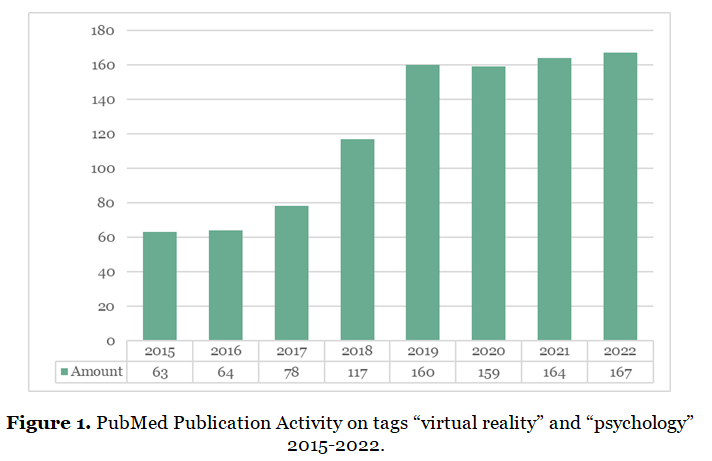
A sharp increase in the number of publications occurs in 2017-2019 years after the most popular VR headsets models HTC Vive and Oculus Rift releases in 2016 (Borrego, 2018). Scientific community respond to the technological trend and seeks to describe the practical prospects and risks of VR technologies in psychotherapy, education and entertainment.
Against the background of high practical interest, the fundamental importance of the VR problem is underestimated. There are many clinical studies of VR as a treatment tool for eating disorders (Ciążyńska, 2022; Riva, 2021), phobias (Elphinston, 2023; Maples-Keller, 2017;) and anxiety-depressive disorder (Camacho-Conde, 2021; Ioannou, 2020). There are a number of meta-analyses (Carl, 2019; Zhang, 2021) and systematic reviews (Cieślik, 2020; Wiebe, 2022). Unambiguous information about the effectiveness of the VR technology in clinical psychology and psychotherapy is presented. VR is considered as a tool for psychotherapy and the VR Immersion effect on symptoms before and after exposure is compared. But there is no information about the specifics of the mental state that the respondent develops during VR Immersion.
We rely on the generally accepted definition of VR: VR is a set of images and sounds, produced by a computer, that seem to represent a place or a situation that a person can take part in (Virtual Reality, 2023).
This definition follows that any modern media content can be part of VR. But only the usage of VR headsets is considered by the authors as a tool of VR Immersion. It should be clarified that this approach limits the term “virtual” in comparison with its broad interpretations (Nosov, 1994). But it also allows us to use it in the study of the specific psychological statements of a person using a VR headset.
We remain within this approach, so we must consider body sensation as an important feature of using a VR headset. The VR pioneers have described the body-transfer illusion in VR as the most valuable factor of VR Immersion (Lanier, 2017). Body movements are mentioned as a means of interaction with VR objects. In mental reflection they constitute a dynamic structure (Mental Representation) that serves to adapt to new environmental conditions.
Modern studies of human bodily experience show its significance as a phenomenon between psychic reality and material reality. The Body as psychological construct is dual. For a person it is both an important part of the Self and an object of the material world (Rebeko, 2015). Both constructs are based on constant sensory feedback. VR Immersion introduces significant amendments to this balance as it forces a person to interact with virtual objects with real body movements. Given the opposition of subjectively internal (psychological) and subjectively external (material world) realities, VR should be perceived as a subjectively external reality. It should be noted that in this context human adaptation to VR environment is a special case of human adaptation to the conditions of the material world.
We believe that in order to study the specifics of a person’s mental state during VR Immersion, it is necessary to describe in detail the patterns of changes in his Mental Representations in this process. In this case, the first step should be to describe Bodily Mental Representations as the most sensitive to changes in environmental conditions. To do this in our work we separate Bodily Mental Representations in a person’s daily life and Bodily Mental Representations during VR immersions. We use Body Size Mental Representation (BSMR) construct to reduce the influence of respondents’ personality and emotional factors on the results.
Distortion of Body Size Mental Representation before and after VR Immersion may indicate the respondent’s adaptation mechanisms to the conditions of the VR environment. The dynamics of these distortions as the number of repeated regular VR Immersions increases should reflect their stability and the respondent’s habituation to the conditions of the VR environment. The study of these distortions in dynamics should become the basis for a comprehensive description of the respondents’ mental state during VR Immersion.
Following this topic, a pilot experimental design has been developed and applied. It should be noted that for the representativeness of the results, we had to use the widespread and popular entertaining VR environment with large audiences of actual and potential users.
The article aimed to the investigation of Body Sizes Mental Representation distortions dynamics through repetitive and regular VR Immersions.
Tasks:
- To set the specifics of BSMR distortions occurring during VR Immersions.
- To identify BSMR distortions directly related to VR Immersions.
- To identify BSMR distortions that are embedded in respondents’ daily BSMR.
- To discuss the limitations and prospects of the developed experimental design.
Method
2.1. Measures
To collect data on the distortion of the Body Sizes Mental Representation (BSMR) in VR, the test Feldenkrais Bodily Measurements was used (Solovieva, 2014).
The principle of this test was formulated by M. Feldenkrais based on Conscious Movement Method (Jeannerod, 1995). Feldenkrais writes that judging the size of different parts of the body with closed eyes reflects its unconscious image (Feldenkrais, 1972). If you ask a person to close their eyes and indicate the size of their chest with the help of their hands, the result will almost always differ from the actual size. According to Feldenkrais such distortions are normative since they occur in mentally healthy people.
This principle is used in the first modification of Feldenkrais Bodily Measurements test that was developed by I.A. Solovieva, 2002 (Solovieva, 2014). Here are the main features of this modification:
- Measurements are carried out on 15 scales which are combined into 2 blocks – Width (7) and Length (8).
- There is no lateralization. For
example, instead of measuring the parts of the right and left arms, an abstract indicator Arm Length is included.
- Measurements are taken 2 times. The first measurement reflects the Unconscious Body Image. It is carried out by asking the measures that the subjects show with both hands while their eyes are closed. Such tasks correspond to the measures of the test and are expressed in centimeters. The test is provided by a tailor’s tape (Fig. 2). The second measurement reflects the real dimensions of the body. The researcher checks them by putting tailor’s tape directly to the physical body of the subject (Fig. 3).
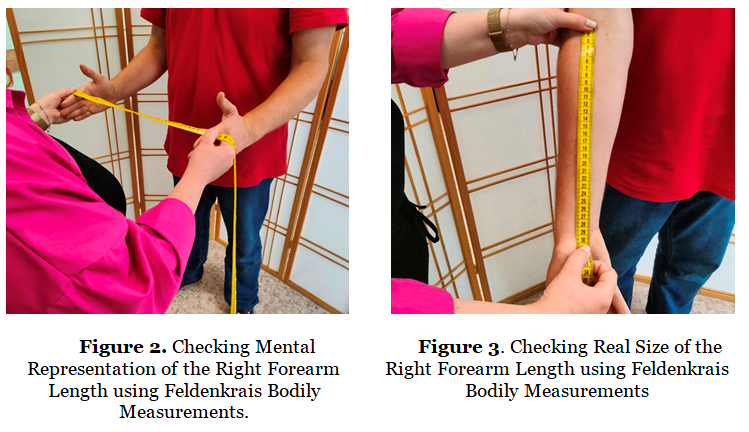
The proportional difference between the real sizes and their unconscious projection can be calculated.
The test was developed in science and practice. In particular, a modification has been proposed that includes lateral limbs measures (Belaveshkin, 2017). It was supposed to study 27 measures grouped by specific parts of the body from head to feet – Head and Neck, Upper Limbs, Torso and Lower Limbs sets. In this modification, measurements are made in one plane – the subjects indicate the dimensions vertically or horizontally. This allows the researcher to observe the isomorphism of the testing procedure.
The selected for the research modification is based on the scales of the late test modification (Belaveshkin, 2017). In order to maintain the data homology, the subjects in our study could demonstrate the size of their hands only in the horizontal plane.
Despite the fact that the test was originally presented as a tool for exploring the Unconscious Body Image, we use it to identify Body Sizes Mental Representations. Mental representations are part of mental experience and part of consciousness. When the subjects concentrate on their own body in order to demonstrate its size with eyes closed, they actualize mental representations from the consciousness. To reproduce them with hands, subject is forced to use proprioceptive sense, which provides feedback through nervous system. In other words, the subject can correct these dimensions consciously.
To sum up, we used the Feldenkrais Bodily Measurements test to study the BSMR of the respondents. We justified that the data obtained in this test are data on the BSMR of the respondents, and not on the unconscious body image.
The current version of the test was used, which included paired lateral measurements. They allowed for an accurate assessment of the BSMR, based on 27 measures, corresponding to parts of the human body. To unify the terms, the measures of the Feldenkrais Bodily Measurements test will be denoted by the abbreviation FBM (Feldenkrais Bodily Measure). The scale names will also be presented as abbreviations (see glossary).
2.2. Procedure and Participants
2.2.1. VR Environment
The Beat Saber (beatsaber.com) VR environment was used. Beat Saber is an active VR rhythm game app. In VR, players are standing in front of a receding path. Along the pass blue and red dices move evenly in their direction. Respondents hold a blue sword in the right hand and a red sword in the left hand (Fig. 4). The color of the die corresponds to the color of the sword with which it should be cut. The arrow on the die indicates the direction of the hit. There are additional obstacles – walls, which should be avoided by player’s movements (Fig. 5). Details of the immersion process can be found in the video.
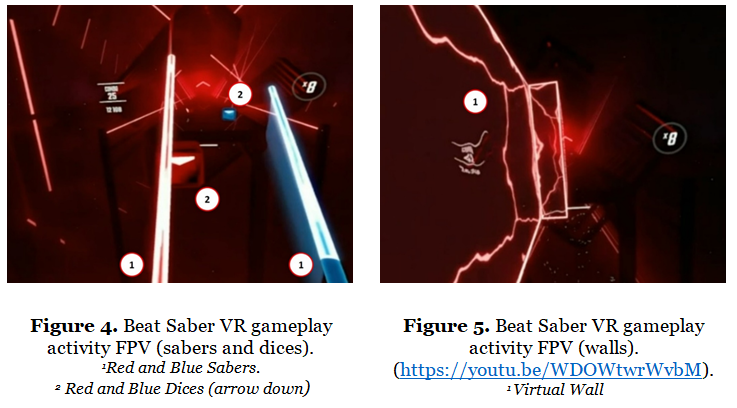
Beat Saber released in 2019 and has been a top seller in the VR category across venues and platforms. This VR game has an active audience. The popularity of the Beat Saber determines the representativeness of its use in the experiment. We believe that Beat Saber should immersion induce the mental distortions of a regular VR user.
The psychological context of Beat Saber VR gameplay activity could be described with the theses below.
(1) Actions in VR (saber swings) and in the real world (controller swings) are congruent.
(2) Actions in VR are active.
(3) Actions in VR are continuous and rhythmic.
(4) Actions in VR are organized according to the principle of cognitive differentiation (distinguishing the color and structure of the stimulus). This activity roughly corresponds to a classic cognitive experiment.
(5) The illusion of presence in VR is
created with usage of the first-person point of view (FPV).
The reasons above contributed to the choice of Beat Saber VR as an experimental environment.
2.2.2. VR Headset and PC
The following equipment was used to launch and expose Beat Saber VR through the experiment:
(1) Intel NUCxi7HNK (2018) PC- Quad core Intel Kaby Lake-H CPU and graphics.
(2) HTC Vive (2018) VR Headset. Tracking of user movements in this model is carried out using 2 bluetooth base stations (Fig. 6). The kit provides reliable and uninterrupted motion tracking. Cleared from foreign objects safe zone for VR Immersion – 2×2 meters.

2.2.3. Design
Experimental design uses respondents’ BSMR scores in 3 realities:
- BSMR(b) – BSMR before VR Immersion. We believe that this indicator reflects the habitual BSMR of respondents. It is used in everyday life.
- BSMR(diff) – BSMR difference before and after VR Immersion. Such difference describes the additional BSMR distortion that occurs in respondents’ mind during direct experimental exposure.
- BSMR(VR) – BSMR after VR Immersion. This indicator is considered as an instrumental intrapsychic structure. BSMR(VR) is presumably used by respondents to adapt to new conditions within the VR environment.
BSMR data obtained using the Feldenkrais Bodily Measurements test. In the following analysis, we focus on the study of dynamics in BSMR(b) and BSMR(diff) distortions during repetitive VR Immersions.
BSMR(b) distortion is described by the proportional difference between the MR of a body part and its Actual Size (AS): (BSMR(b) – AS)/AS.
- Example 1: if the actual Right Wrist Length is 18 cm (AS) and its BSMR(b) is 24 cm, then the value (24-18)/18 = 0.33 means that the BSMR(b) distortion of the Right Wrist Length is 33%.
- Example 2: If the actual Left Thigh Length is 45 cm (AS), and its BSMR(b) is 36 cm, then the value (36-45)/45 = -0.20 means that the BSMR(b) distortion of the Left Thigh Length is -20%.
BSMR (diff) distortion is described by the difference in the MR of the body part after VR Immersion (MR2) from its MR before VR Immersion (MR1) proportional to the actual size of the body part (AS): (BSMR(VR) – BSMR(b))/AS.
- Example: if MR of head width was 16 centimeters before VR Immersion BSMR(b) and after VR Immersion it became 20 centimeters BSMR(VR) with an actual size of 15 centimeters (AS), then the value (20-16)/15 = 0.26 means that the Head Width BSMR (diff) is 26%.
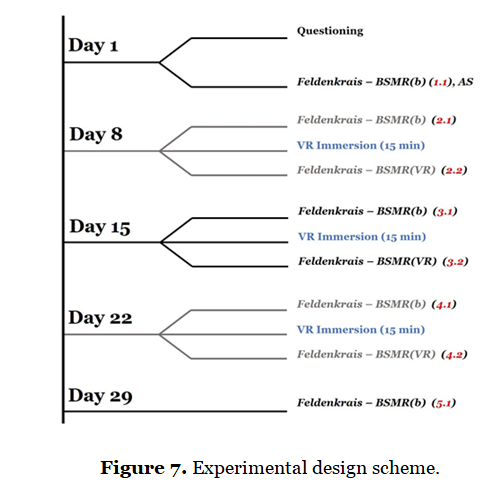
To study these distortions in dynamics, an experiment design was developed, consisting of 5 stages (Fig. 7). The break between stages was 7 days. At stages 1 and 5, only BSMR(b) data were collected. Stages 2-3 also featured VR Immersions.
- Stage 1, Day 1. Obtaining informed consent, questioning, collecting data on the actual body sizes of the subjects and BSMR(b). Measurement code – 1.1;
- Stage 2, Day 8. Collecting BSMR(b) data (measurement code – 2.1), VR Immersion in Beat Saber for 15 minutes, final collection of BSMR(VR) data (measurement code –2);
- Stage 3, Day 15. Collecting BSMR(b) data (measurement code – 3.1), VR Immersion in Beat Saber for 15 minutes, final collection of BSMR(VR) data (measurement code – 3.2);
- Stage 4, Day 22. Collecting BSMR(b) data (measurement code – 4.1), VR Immersion in Beat Saber for 15 minutes, final collection of BSMR(VR) data (measurement code – 4.2);
- Stage 5, Day 29. Collecting BSMR(b) data (measurement code – 5.1).
The data obtained made it possible to assess the fluctuations in subjects’ BSMR. Although we could establish trends and statistical significance.
2.2.4. Sample
The participants were selected among students of the Ryazan State Medical University named after Academician I.P. Pavlov. A total of 40 volunteers (36 women and 4 men) responded. Men (4) and women older than 20 years (4) were excluded from the final sample. The final sample consisted of 32 women, mean age 19.15 ± 0.68 years.
2.3. Statistical Methods
Statistical analysis of data was carried out in 3 stages. The software used was MS Excel 21 and IBM SPSS Statistics 26.
2.3.1. Checking the homology of BSMR(b) and BSMR(diff) distortion data in paired lateral parts of the body
The selected modification of the Feldenkrais Bodily Measurements test allows you to collect data on BSMR of the lateral body dimensions separately. For example, “Left Wrist Length” and “Right Wrist Length” are different test measures (FBMs). The amount of the test scales was reduced. For this purpose, a test of the homology in their BSMR(b) and BSMR(diff) distortion was organized. The following paired lateral FBMs used in the analysis: “Left Shoulder Length” and “Right Shoulder Length”, “Left Humerus Length” and “Right Humerus Length”, “Left Elbow Width” and “Right Elbow Width”, “Left Forearm Length” and “Right Forearm Length”, “Left Wrist Length” and “Right Wrist Length”, “Left Thigh Length” and “Right Thigh Length”, “Left Knee Width” and “Right Knee Width”, “Left Leg Length” and “Right Leg Length”, “Left Foot Length” and “Right Foot Length”. A total of 18 (out of 26) test measurements were involved. It was planned to reduce them to 9 (out of 17) integrative indicators.
The homology of BSMR(b) distortions was tested on a pooled sample. In accordance with the sequence of measurements, proportional BSMR(b) distortions relative to AS were established for 5 (out of 8) measurements:
BSMR(b) distortions calculated using the formulas:
- (BSMR(b)1.1 – AS)/AS (Before all Immersions, Day 1, N=32);
- (BSMR(b)2.1 – AS)/AS (Before 1’st Immersion, Day 8, N=32);
- (BSMR(b)3.1 – AS)/AS (Before 2’nd Immersion, Day 15, N=32);
- (BSMR(b)4.1 – AS)/AS (Before 3’rd Immersion, Day 22, N=32);
- (BSMR(b)5.1 – AS)/AS (7 days after all Immersions, Day 29, N=32);
The size of pooled sample was 160 subjects (32*5). Data on BSMR(b) distortions on days 1, 8, 15, 22 and 29 respectively were taken into account. For distortions corresponding to the lateral dimensions indicated above, a comparative and correlation analysis was carried out in pairs (left-right). The search for differences is implemented using Student’s T-test for related samples. The search for relationships was performed using Pearson’s R-correlation test.
The homology of BSMR(diff) distortions was also tested on a pooled sample. In accordance with the sequence of measurements, proportional BSMR(diff) distortions relative to AS were established for 3 VR Immersions (Days 8, 15 and 22):
BSMR(diff) distortions calculated using the formulas:
- (BSMR(VR)2.2 – BSMR(b)2.1)/AS (Immersion 1, Day 8, N=32);
- (BSMR(VR)3.2 – BSMR(b)3.1)/AS (Immersion 2, Day 15, N=32);
- (BSMR(VR)4.2 – BSMR(b)4.1)/AS (Immersion 3, Day 22, N=32);
The size of pooled sample was 96 subjects (32*3). Those. data on the BSMR(diff) distortions after VR Immersions on days 8, 15, and 22 respectively were taken into account. The analysis procedure is identical to the study of BSMR(b) distortions – Student’s T-test and Pearson’s R-test were used.
2.3.2. Time Trend Analysis on BSMR(b) and BSMR(diff) distortions changes
H(1): We believe that BSMR(b) and BSMR(diff) distortions of respondents during the experiment change directionally.
Time Trend analysis was used to test this hypothesis. Dot plots of the averages for each of the successive series (5) of BSMR(b) distortion data for each FBM were constructed. A similar procedure was performed for BSMR(diff) data based on successive series (3).
Using the MS Excel tool Trends Lines for each of the scales was built. The values of the approximation (R2) were calculated. Trends with R2>0.8 were considered as quite reliable.
2.3.3. GLM Repeated Measures in BSMR(b) and BSMR(diff) distortions changes
H(2): We believe that the directional changes of BSMR(b) and BSMR(diff) distortions are caused by the quantity factor of VR Immersions.
The General Linear Model (GLM) Repeated Measures tool IBM SPSS Statistics 26 was used to test this hypothesis.
Results
3.1. Lateral homology of BSMR distortion
3.1.1. BSMR(b) distortion
The analysis of BSMR(b) distortions lateral homology is presented in Table 4. All paired lateral FBMs included in the analysis demonstrated a high positive correlation coefficient by Pearson’s R-test (p<.001). Also, all paired lateral FBMs showed a low level of differences according to Student’s T-test (p>.05). The data indicate a high homology of the distortions in BSMR(b), correlated with the paired lateral FBMs of the Feldenkrais Bodily Measurements test during the experiment. In other words, such FBMs as Left Forearm Length and Right Forearm Length for this sample during the experiment demonstrated a unidirectional BSMR(b) distortions of similar intensity.
3.1.2. BSMR(diff) distortion
The analysis of BSMR(diff) distortions lateral homology is presented in Table 5. All paired lateral FBMs included in the analysis demonstrated a high positive correlation coefficient by Pearson’s R-test (p<.05). Also, all paired lateral FBMs showed a low level of differences according to Student’s T-test (p>.05). The data indicate a high homology of BSMR(diff) distortions, correlated with paired lateral FBMs of Feldenkrais Bodily Measurements test during the experiment. In other words, such FBMs as “Left Knee Width” and “Right Knee Width” for this sample during the experiment demonstrated a unidirectional BSMR(diff) distortions of similar intensity.
The patterns established at this stage allowed us to combine paired lateral FBMs using the average value for each of the subjects. The number of FBMs according to the Feldenkrais Bodily Measurements test used in further analysis was 17 (instead of 26).
3.2. Time Trends analysis
3.2.1. Time Trends in BSMR(b) distortions
A Time Trends analysis in BSMR(b) distortions during the experiment is presented in Table 1. It shows the direction of the trend for each of the FBMs. as well as the mathematical function that describes it. Logarithmic functions most accurately described the identified trends.
The table also presents data on the approximation of each of the trends (R2). Average BSMR(b) distortion for FBMs illustrated by values X1 (BSMR(b) distortion before the experiment) and X5 (BSMR(b) distortion after the experiment). The table highlights trends with high approximation value (R2>.80) of the BSMR(b) distortion dynamics during the experiment. In other words. the BSMR(b) distortion of these FBMs in general gradually decreases during the experiment (between VR Immersions).
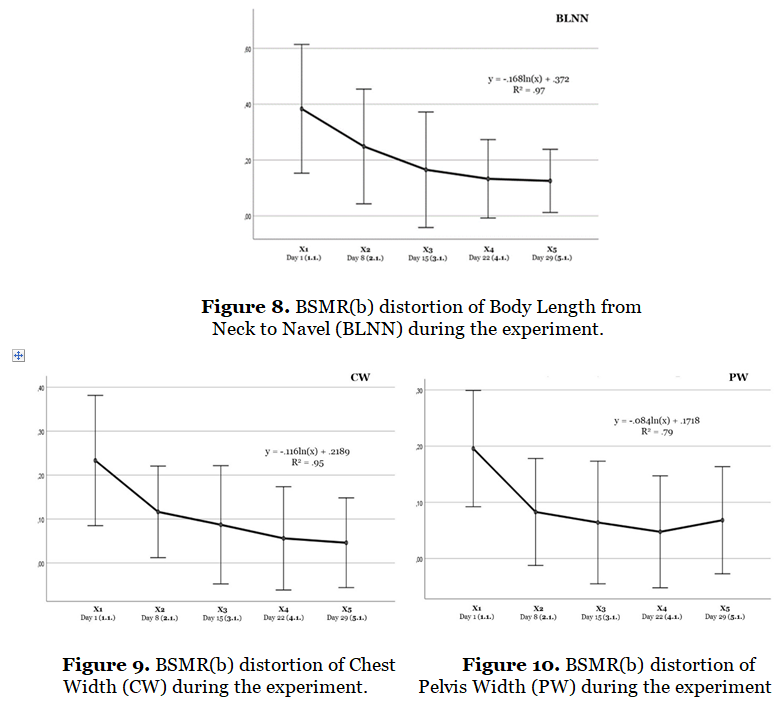
These FBMs include: Humerus Length (HL: R2=0.97; trend down), Forearm Length (FL: R2=.91; trend down), Body Length from Neck to Navel (BLNN: R2=.97; trend down), Chest Width (CW: R2=.95; trend down), Thigh Length (TL: R2=.93; trend down), Leg Length (LL: R2=.82; trend down), Foot Length (FoL: R2=.90; trend down). Also. the trend of 3 FBMs has an approximation level close to significant. These are Wrist Length (WL: R2=.78; trend up), Body Length from Navel to Groin (BLNG: R2=.78; trend down), and Pelvis Width (PW: R2=.79; trend down). It is noteworthy that it is Wrist Length that has the only uptrend among the significant ones. It follows from this that only the baseline BSMR of Wrist Length increases in the experiment.
Table 1. Time Trend analysis of BSMR(b) distortions
Trend Up means that BSMR(b) distortion increases with every VR Immersion
Trend Down means that BSMR(b) distortion decreases with every VR Immersion
R2 – reliability of trend approximation
X1 – (MR1.1-AS)/AS (Before all Immersions. Day 1. N=32).
X5 – (MR5.1-AS)/AS (7 days after all Immersions. Day 28. N=32).
| Scale (N=32; series=5) | FBM | Trend Analysis | ||||
| Trend | Function | R2 | X1 | X5 | ||
| Head and Neck measures set | ||||||
| Head Height | HH | down | y =-.039ln(x)+.2543 | 0.67 | 26% | 19% |
| Head Width | HW | down | y =-.067ln(x)+.336 | 0.66 | 36% | 23% |
| Neck Length | NL | down | y =-.007ln(x)+.7005 | 0.01 | 63% | 54% |
| Upper Limbs measures set | ||||||
| Shoulder Length | SL | up | y =.0398ln(x)+.247 | 0.34 | 25% | 28% |
| Humerus Length | HL | down | y =-.044ln(x)+.0652 | 0.97 | 6% | -1% |
| Elbow Width | EW | up | y =.0105ln(x)+.2195 | 0.02 | 21% | 16% |
| Forearm Length | FL | down | y = -.05ln(x)+.1914 | 0.91 | 19% | 12% |
| Wrist Length | WL | up | y = .0377ln(x)+.0733 | 0.78 | 7% | 12% |
| Torso measures set | ||||||
| Body Length from Neck to Navel | BLNN | down | y = -.168ln(x)+.372 | 0.97 | 38% | 13% |
| Body Length from Navel to Groin | BLNG | down | y = -.067ln(x)+.2742 | 0.78 | 26% | 14% |
| Chest Width | CW | down | y = -.116ln(x)+.2189 | 0.95 | 23% | 5% |
| Waist Width | WW | down | y = -.048ln(x)+.0461 | 0.53 | 6% | -1% |
| Pelvis Width | PW | down | y = -.084ln(x)+.1718 | 0.79 | 20% | 7% |
| Lower Limbs measures set | ||||||
| Thigh Length | TL | down | y = -.168ln(x)+.2336 | 0.93 | 25% | 0% |
| Knee Width | KW | down | y = -.059ln(x)+.3257 | 0.37 | 33% | 18% |
| Leg Length | LL | down | y = -.124ln(x)+.0527 | 0.82 | 8% | -10% |
| Foot Length | FoL | down | y = -.057ln(x)+.0801 | 0.90 | 8% | -1% |
It should be noted that among these FBMs. 3 refer to Upper Limb BSMR (HL. FL and WL). 4 refer to Torso BSMR (BLNN BLNG CW and PW). and 3 refer to Lower Limbs BSMR (TL. LL and FoL). No trend of changing distortion in Head and Neck baseline BSMR was found in the study. The described trends are dominated by a downtrend. which means that with each subsequent measurement. the BSMR(b) distortion becomes smaller in absolute value. with the exception of the WL FBMs. which becomes larger. Separate FBMs demonstrate a decrease in the absolute value of BSMR(b) distortion up to an underestimation relative to the actual size of the corresponding body part. For example. by the end of the experiment. the “LL” FBMs was underestimated by the subjects by an average of 10% relative to the actual Leg Length.
3.2.2. Time Trends in BSMR(diff) distortions
A Time Trends analysis in BSMR(diff) distortions during the experiment is presented in Table 2. It shows the direction of the trend for each of the FBMs. as well as the mathematical function that describes it. Linear functions most accurately described the identified trends and were chosen for analysis.
Table 2. Time Trend analysis of BSMR(diff) distortions
Trend Up means that BSMR(diff) distortion increases between VR Immersions 1-3
Trend Down means that BSMR(diff) decreases between VR Immersions 1-3
R2 – reliability of trend approximation
X1 – (MR2.2-MR2.1)/AS (Immersion 1. Day 8. N=32).
X3 – (MR4.2-MR4.1)/AS (Immersion 3. Day 21. N=32)
|
Scale (N=32; series=3) |
FBM | Trend Analysis | ||||
| Trend | Function | R2 | X1 | X5 | ||
| Head and Neck measures set | ||||||
| Head Height | HH | down | y = -.0176x + .132 | .40 | 13% | 9% |
| Head Width | HW | down | y = -.0185x + .226 | .64 | 22% | 18% |
| Neck Length | NL | up | y = .0035x + .286 | .01 | 34% | 34% |
| Upper Limbs measures set | ||||||
| Shoulder Length | SL | down | y = -.0179x + .4754 | .51 | 42% | 19% |
| Humerus Length | HL | down | y = -.0305x + .1563 | .99 | 12% | 6% |
| Elbow Width | EW | down | y = -.042x + .2548 | .99 | 21% | 13% |
| Forearm Length | FL | down | y = -.008x + .1115 | .03 | 10% | 8% |
| Wrist Length | WL | down | y = -.0193x + .1653 | .46 | 16% | 12% |
| Torso measures set | ||||||
| Body Length from Neck to Navel | BLNN | down | y = -.0085x + .0719 | .04 | 4% | 2% |
| Body Length from Navel to Groin | BLNG | down | y = -.028x + .1725 | .95 | 15% | 9% |
| Chest Width | CW | down | y = -.0251x + .1199 | .69 | 9% | 3% |
| Waist Width | WW | down | y = -.034x + .1258 | .67 | 8% | 1% |
| Pelvis Width | PW | down | y = -.0464x + .1976 | .98 | 15% | 6% |
| Lower Limbs measures set | ||||||
| Thigh Length | TL | up | y = .0012x + .0389 | .02 | 5% | 5% |
| Knee Width | KW | down | y = -.0518x + .2302 | .62 | 16% | 5% |
| Leg Length | LL | up | y = .0015x + .0664 | .34 | 7% | 7% |
| Foot Length | FoL | up | y = .0001x + .0448 | .01 | 3% | 3% |
The table also presents data on the approximation of each of the trends (R2). Average BSMR(diff) distortion for each of the FBMs illustrated by values X1 (BSMR(diff) distortion after 1-st VR immersion at the Day 8) and X3
(BSMR(diff) distortion after 3-rd VR immersion at the Day 21). The table highlights trends with high approximation value (R2>.80) of the BSMR(diff) distortion dynamics during the experiment. In other words. the BSMR(diff) distortion of these FBMs gets smaller with each successive VR immersion.
These FBMs include: Humerus Length (HL: R2=.99; trend down), Elbow Width (EW: R2=.99; trend down), Body Length from Navel to Groin (BLNG: R2=.95; trend down), and Pelvis Width (PW: R2=.98; trend down). Since all the above FBMs have a downward trend. we can state that the BSMR(diff) distortion of the corresponding body parts of the subjects is distorted with less intensity with each subsequent VR Immersion (Day 8 – Day 15 – Day 21).
3.3. Dependence of BSMR distortion on the number of VR Immersions
3.3.1. GLM Repeated Measures in BSMR(b) distortions
General Linear Model (GLM) Repeated Measures for BSMR(b) distortions using IBM SPSS Statistics 26 was built. The model included 5 data series (see 2.2.3). The Pillai’s Trace value for each measure illustrates the strength of the difference in BSMR(b) distortion for 5 repeated measures. The test of the general effect influence identified marginal average values describes a causal relationship between the quantity of measurement and identified BSMR(b) distortion.
A total of 7 FBMs which time series had a high Pillai’s Trace (F) value were identified: NL (F=.409; p<.01). BLNN (F=.314; p<.05). CW (F=.314; p<.05). WW (F=.289; p<.05). PW (F=.371; p<.01). TL (F=.430; p<.01). LL (F= .423; p<.01). Two of the listed FBMs (NL and WW) have no significant time trends. The reduction in BSMR(b) distortion for BLNN. CW. PW. TL and LL are highly significant and described by a high-fitting logarithmic function (Fig. 8-12). Pairwise comparisons of the main effect (quantity of measurements) for each of these trends show strong differences between X1 and X2-5. while X2. X3. X4 and X5 do not have significant differences among themselves.

Discussion
- General Discussion
4.1. Lateral homology of BSMR distortions
The selected modification of the Feldenkrais Bodily Measurements test based on a larger number of included FBMs and the use of paired lateral dimensions. There is no contradiction in this with the combination of these indicators into integrative scales during statistical processing of our research.
Since the Feldenkrais Bodily Measurements test does not have an official standardization, we had to exclude the influence of such artifacts as the dominant arm or leg as well as the order FBM was asked. The high correlations and lack of differences in paired FBMs allowed us to use integrative averages to assess overall trends in BSMR distortions specific to these body parts. The preservation of the original structure of the stimulus material allowed the subjects to assess the MR of real body parts rather than abstract ones. Since the paired FBMs are presented as separate scales. the subject assessed the MR of the real Left Leg Length and not an imaginary Leg Length.
4.2. BSMR distortions in VR
It is important to comment the specifics of the respondent’s motor activity in the context of analysis of BSMR distortions associated with VR Immersions. We believe that two psychological realities of movement should be taken into account in this study.
- The first reality is related to the feedback that the respondent receives from VR. Precise movements of the Head and Upper Limbs (especially the hands and forearms) ensure effective interaction with objects in VR. In fact, only these body parts have a material embodiment inside the Beat Saber VR game.
- The second reality is based on the muscular sensations of the real body of the respondents. The gross motor skills of Torso and Lower Limbs play a supporting role in the Beat Saber VR gameplay activity and allow you to take up positions that are convenient for swinging and dodging. Respondents have no visual feedback about these movements.
4.2.1. Dynamics of BSMR(b) distortions
BSMR(b) in this study describes the BSMR that respondents use in their daily lives. Presumably, they reflect the phenomena that the mind of respondents adopts from VR to objective reality.
Using Time Trend Analysis. it was found that the dynamics of BSMR(b) of 10 out of 17 FBMs included in the Feldenkrais Body Measures test can be described by ln(x) function with a high R2 level based on 5 data series. These FBMs include: Humerus Length (HL), Forearm Length (FL), Wrist Length (WL), Body Length from Neck to Navel (BLNN), Body Length from Navel to Groin (BLNG), Chest Width (CW), Pelvis Width (PW), Thigh Length (TL), Leg Length (LL), and Foot Length (FoL). Only BSMR(b) distortion of Wrist Length (WL) gets bigger with each sample, while BSMR(b) distortion of other FBMs gets smaller. At the end of the experiment the BSMR(b) of Humerus Length, Leg Length, and Foot Length FBMs becomes smaller than the real sizes of these body parts of the respondents.
The function ln(x) shows that the changes in BSMR(b) distortion with each VR Immersion become less intense and tend to some limit. Moreover, a decrease in BSMR(b) distortion in most cases leads to a BSMR that more adequately reflects the real body sizes of the respondents.
Such a directed decrease of BSMR(b) of the respondents during the experiment allows us to judge the presence of a direct influence of the experimental impact on the BSMR correction. Due to the absence of a control group, it is difficult to differentiate the effect of VR on the reduction of BSMR(b) distortions. However. the following observations support this conclusion:
- FBM “Wrist Length” (WL) is the only measure whose BSMR(b) significantly increased during the experiment. It is the wrists that are most important in performing the Beat Saber VR gameplay activity based on visual feedback in VR. Therefore, this pattern should show the adaptive significance of FBM WL.
- GLM Repeated Measures models confirmed the significance of changes in BSMR(b) distortions of BLNN, CW, PW, TL, and LL FBMs. This fact shows that these directional changes of BSMR(b) distortions are a consequence of the VR Immersions quantity.
4.2.2. Dynamics of BSMR(diff) distortions
The BSMR(diff) distortions in this study describe the difference between BSMR(b) and BSMR(VR). An analysis of their dynamics from VR Immersion 1 (Day 8) to VR Immersion 3 (Day 22) provides information about the change in the subjects’ reactions to repeated VR Immersions.
For BSMR(diff) distortions of Humerus Length (HL), Elbow Width (EW), Body Length from Navel to Groin (BLNG), and Pelvis Width (PW) significant directional small changes were established during the experiment. This dynamic with high R2 level is described as a linear function, although we believe that the trend may take a different form with an increase in the number of dives. During each of the three VR Immersions the FBMs data in the BSMR of the respondents became larger. But this exaggeration with each VR Immersion became less. The decrease in BSMR(diff) distortions as the number of VR Immersions increases indicates that the subjects are gradually getting used to the experimental exposure. which is expressed in the indicated FBMs.
FBMs data refer to measures of Upper Limbs and Torso, more precisely, to the base of the shoulder girdle and the pelvic area. Upper Limbs are involved in swinging arms and interacting with Beat Saber VR game objects, but only the wrists perform an instrumental function. The joints of the shoulder and pelvis perform an energetic and guiding role not having a high specification in the Beat Saber VR gameplay activity. Obviously. the steady trend of these BSMR(diff) distortions changing is due to the gradual adaptation of respondents’ BSMR to repetitive VR Immersions.
4.3. Limitations and prospects
This pilot study has a number of limitations that open up prospects for further development of the topic of BSMR during VR Immersions (Table 3).
Table 3. Limitations and Prospects of the study.
| Problem | Solution | |
| 1 | There is no control group. | An identical experimental design should be applied to the control group of subjects with no VR Immersions. |
| 2 | Small sample size. | The list of subjects should be expended with volunteers. |
| 3 | Gender differences of BSMR distortions are not considered. | Male volunteers should be included in the sample. |
| 4 | A small number of repeated VR Immersions to build reliable and accurate GLM Repeated Measures for BSMR(b) and BSMR(diff) distortions. | Prolongation of the experiment to increase the number of repeating VR Immersions for new subjects. |
| 5 | The reality of BSMR(VR) remained outside the focus of the study. | Implementation of an additional stage of analysis on an expanded sample. |
Conclusions
The study obtained important data describing the specifics of Body Size Mental Representation distortions during VR Immersions.
Situational distortions in respondents’ BSMR are identified and described. They are related to VR Immersions and lead to exaggerations of MR of different body parts relative to their actual sizes. With repeated VR Immersions. these distortions become smaller as the number of repetitions increases.
Distortions in respondents’ daily life used BSMR identified and described. The BSMR of many parts of the body becomes smaller and approaches their real sizes as the number of VR Immersions increases. The reverse trend is typical for BSMR(b) of Wrists Length FBM which becomes longer during the experiment. We consider that BSMR of highly active during VR Immersion body parts distorts differently.
The limitations and prospects of the developed pilot experimental plan are indicated. The directions of experimental plan correction are determined. Problems for continuing research are formulated:
- To research and BSMR(VR) specifically formed for interaction with the VR environment.
- To find out if the usage of VR environments with different psychological contexts of immersion in this experimental plan leads to different BSMR distortions.
- Set the duration of BSMR(b) distortions during the prolongation of experimental exposures. Set the dynamics of BSMR(b) distortions after a time period after the termination of experimental influences.
Competing interests: The author declare that the research was conducted in the absence of any commercial or financial relationships that could be construed as a potential conflict of interest.
References
- Belaveshkin, A. (2017). Body Image: The Feldenkrais Test. blogs. July 15, 2023 Belaveshkin, A. (2017, April 10). Retrieved July 15, 2022, from https://www.beloveshkin.com/2015/09/obraz-sobstvennogo-tela-test-feldenkrajza.html [Belaveshkin, A. (2017). Obraz tela: test Fel’denkrayza. blogi. 15 iyulya 2023 g.]
- Borrego, A., Latorre, J., Alcañiz, M., & Llorens, R. (2018). Comparison of Oculus Rift and HTC Vive: Feasibility for Virtual Reality-Based Exploration, Navigation, Exergaming, and Rehabilitation. Games for health journal, 7(3), 151–156. https://doi.org/10.1089/g4h.2017.0114
- Camacho-Conde, J.A., Legarra, L., Bolinches, V.M., Cano, P., Guasch, M., Llanos-Torres, M., Serret, V., Mejías, M., & Climent, G. (2021). Assessment of Attentional Processes in Patients with Anxiety-Depressive Disorders Using Virtual Reality. Journal of personalized medicine, 11(12), 1341. https://doi.org/10.3390/jpm11121341
- Carl, E., Stein, A. T., Levihn-Coon, A., Pogue, J. R., Rothbaum, B., Emmelkamp, P., Asmundson, G.J.G., Carlbring, P., & Powers, M.B. (2019). Virtual reality exposure therapy for anxiety and related disorders: A meta-analysis of randomized controlled trials. Journal of anxiety disorders, 61, 27–36. https://doi.org/10.1016/j.janxdis.2018.08.003
- Ciążyńska, J., & Maciaszek, J. (2022). Various Types of Virtual Reality-Based Therapy for Eating Disorders: A Systematic Review. Journal of clinical medicine, 11(17), https://doi.org/10.3390/jcm11174956
- Cieślik, B., Mazurek, J., Rutkowski, S., Kiper, P., Turolla, A., & Szczepańska-Gieracha, J. (2020). Virtual reality in psychiatric disorders: A systematic review of reviews. Complementary therapies in medicine, 52, https://doi.org/10.1016/j.ctim.2020.102480
- Elphinston, R.A., Vaezipour, A., Fowler, J.A., Russell, T.G., & Sterling, M. (2023). Psychological therapy using virtual reality for treatment of driving phobia: a systematic review. Disability and rehabilitation, 45(10), 1582–1594. https://doi.org/10.1080/09638288.2022.2069293
- Feldenkrais, M. (1972). Awareness through Movement: Health Exercises for Personal growth. Retrieved July 15, 2022, from http://ci.nii.ac.jp/ncid/BA19444138
- Ioannou, A., Papastavrou, E., Avraamides, M. N., & Charalambous, A. (2020). Virtual Reality and Symptoms Management of Anxiety, Depression, Fatigue, and Pain: A Systematic Review. SAGE open nursing, 6, https://doi.org/10.1177/2377960820936163
- Jeannerod, M. (1995). Mental imagery in the motor context. Neuropsychologia, 33(11), 1419–1432. https://doi.org/10.1016/0028-3932(95)00073-c
- Lanier, J. (2017). Dawn of the New Everything: Encounters with Reality and Virtual Reality. Retrieved July 15, 2022, from https://us.macmillan.com/books/9781627794107
- Maples-Keller, J.L., Yasinski, C., Manjin, N., & Rothbaum, B.O. (2017). Virtual Reality-Enhanced Extinction of Phobias and Post-Traumatic Stress. Neurotherapeutics : the journal of the American Society for Experimental NeuroTherapeutics, 14(3), 554–563. https://doi.org/10.1007/s13311-017-0534-y
- Nosov, N.A. (1994). Psychological virtual realities, Moscow. [Nosov, N.A. (1994). Psikhologicheskie virtual’nye real’nosti, Moskva]
- Rebeko, T.A. (2015). Bodily experience in exceptional individual knowledge, Moscow. [Rebeko, T.A. (2015). Telesnyi opyt v strukture individual’nogo znaniya, Moskva]
- Riva, G., Malighetti, C., & Serino, S. (2021). Virtual reality in the treatment of eating disorders. Clinical psychology & psychotherapy, 28(3), 477–488. https://doi.org/10.1002/cpp.2622
- Solovieva, I.A. (2014). Unconscious body image: who you really are? [Solov’yeva I.A. (2014). Bessoznatel’nyy obraz tela: kto vy na
samom dele?]. Retrieved July 15, 2022, from https://kso1.wordpress.com/2014/08/12/бессознательmш-образ-тела-кто-ты-на-с/ - Virtual reality (2023). Retrieved July 15, 2022, from https://dictionary.cambridge.org/dictionary/english/virtual-reality
- Wiebe, A., Kannen, K., Selaskowski, B., Mehren, A., Thöne, A. K., Pramme, L., Blumenthal, N., Li, M., Asché, L., Jonas, S., Bey, K., Schulze, M., Steffens, M., Pensel, M. C., Guth, M., Rohlfsen, F., Ekhlas, M., Lügering, H., Fileccia, H., Pakos, J., … Braun, N. (2022). Virtual reality in the diagnostic and therapy for mental disorders: A systematic review. Clinical psychology review, 98, https://doi.org/10.1016/j.cpr.2022.102213
- Zhang, Q., Fu, Y., Lu, Y., Zhang, Y., Huang, Q., Yang, Y., Zhang, K., & Li, M. (2021). Impact of Virtual Reality-Based Therapies on Cognition and Mental Health of Stroke Patients: Systematic Review and Meta-analysis. Journal of medical Internet research, 23(11), https://doi.org/10.2196/31007
Comments (0)
Practical aspects of the use of VR technology in psychotherapy are widely presented in scientific research. While there is a large amount of evidence for the effectiveness of using VR in various areas of mental health, there is no detailed description of the mental state during VR Immersion. In this pilot study we focus on Human Body Sizes Mental Representation (BSMR) and its distortions during VR Immersion. This topic of mental reflection was chosen as the most adaptively significant. The results should form the basis of a detailed description of the mental state of a person during VR Immersion. The study design is described and presented. A sample of 32 female students participated in a series of 3 VR Immersions in Beat Saber VR over a 3-week period. A series of measurements of BSMR made it possible to compile time series of data for the analysis of trends in distortion dynamics. It has been established that BSMR distortions have adaptive significance. The BSMR of respondents increases during VR Immersion, however, with each subsequent VR Immersion this exaggeration decreases. At the same time, the daily life used BSMR that we can measure before VR Immersion becomes smaller with each new stage of the experiment and approaches the actual size of current body part with ln(x) function. GLM examination of Torso and Lower Limbs sizes consistent with this trend confirmed the significance of the differences. This fact shows that directional changes of BSMR distortions are a consequence of the VR Immersions quantity.
Glossary:
- MR – Mental Representation
- FPV – First Person View
- BSMR – Body Sizes Mental Representation
- BSMR(b) – Body Sizes Mental Representation before VR Immersion
- BSMR(diff) – Difference of Body Sizes Mental Representation before and after VR Immersion
- BSMR(VR) – Body Sizes Mental Representation after VR Immersion
- GLM – General Linear Model
- FBM – Feldenkrais’ Bodily Measurement (test scale)
- HH – Head Height FBM
- HW – Head Width FBM
- NL – Neck Length FBM
- SL – Shoulder Length FBM
- HL – Humerus Length FBM
- EW – Elbow Width FBM
- FL – Forearm Length FBM
- WL – Wrist Length FBM
- BLNN – Body Length from Neck to Navel FBM
- BLNG – Body Length from Navel to Groin FBM
- CW – Chest Width FBM
- WW – Waist Width FBM
- PW – Pelvis Width FBM
- TL – Thigh Length FBM
- KW – Knee Width FBM
- LL – Leg Length FBM
- FoL – Foot Length FBM
- Introduction
The psychological context of VR Immersion is a popular topic in the scientific community. A search queries using the keywords “virtual reality” and “psychology” in PubMed shows 887 matching results around Clinical Trials, Meta-Analysis, Reviews and other article types (Fig. 1) (pubmed.ncbi.nlm.nih.gov).
A sharp increase in the number of publications occurs in 2017-2019 years after the most popular VR headsets models HTC Vive and Oculus Rift releases in 2016 (Borrego, 2018). Scientific community respond to the technological trend and seeks to describe the practical prospects and risks of VR technologies in psychotherapy, education and entertainment.
Against the background of high practical interest, the fundamental importance of the VR problem is underestimated. There are many clinical studies of VR as a treatment tool for eating disorders (Ciążyńska, 2022; Riva, 2021), phobias (Elphinston, 2023; Maples-Keller, 2017;) and anxiety-depressive disorder (Camacho-Conde, 2021; Ioannou, 2020). There are a number of meta-analyses (Carl, 2019; Zhang, 2021) and systematic reviews (Cieślik, 2020; Wiebe, 2022). Unambiguous information about the effectiveness of the VR technology in clinical psychology and psychotherapy is presented. VR is considered as a tool for psychotherapy and the VR Immersion effect on symptoms before and after exposure is compared. But there is no information about the specifics of the mental state that the respondent develops during VR Immersion.
We rely on the generally accepted definition of VR: VR is a set of images and sounds, produced by a computer, that seem to represent a place or a situation that a person can take part in (Virtual Reality, 2023).
This definition follows that any modern media content can be part of VR. But only the usage of VR headsets is considered by the authors as a tool of VR Immersion. It should be clarified that this approach limits the term “virtual” in comparison with its broad interpretations (Nosov, 1994). But it also allows us to use it in the study of the specific psychological statements of a person using a VR headset.
We remain within this approach, so we must consider body sensation as an important feature of using a VR headset. The VR pioneers have described the body-transfer illusion in VR as the most valuable factor of VR Immersion (Lanier, 2017). Body movements are mentioned as a means of interaction with VR objects. In mental reflection they constitute a dynamic structure (Mental Representation) that serves to adapt to new environmental conditions.
Modern studies of human bodily experience show its significance as a phenomenon between psychic reality and material reality. The Body as psychological construct is dual. For a person it is both an important part of the Self and an object of the material world (Rebeko, 2015). Both constructs are based on constant sensory feedback. VR Immersion introduces significant amendments to this balance as it forces a person to interact with virtual objects with real body movements. Given the opposition of subjectively internal (psychological) and subjectively external (material world) realities, VR should be perceived as a subjectively external reality. It should be noted that in this context human adaptation to VR environment is a special case of human adaptation to the conditions of the material world.
We believe that in order to study the specifics of a person’s mental state during VR Immersion, it is necessary to describe in detail the patterns of changes in his Mental Representations in this process. In this case, the first step should be to describe Bodily Mental Representations as the most sensitive to changes in environmental conditions. To do this in our work we separate Bodily Mental Representations in a person’s daily life and Bodily Mental Representations during VR immersions. We use Body Size Mental Representation (BSMR) construct to reduce the influence of respondents’ personality and emotional factors on the results.
Distortion of Body Size Mental Representation before and after VR Immersion may indicate the respondent’s adaptation mechanisms to the conditions of the VR environment. The dynamics of these distortions as the number of repeated regular VR Immersions increases should reflect their stability and the respondent’s habituation to the conditions of the VR environment. The study of these distortions in dynamics should become the basis for a comprehensive description of the respondents’ mental state during VR Immersion.
Following this topic, a pilot experimental design has been developed and applied. It should be noted that for the representativeness of the results, we had to use the widespread and popular entertaining VR environment with large audiences of actual and potential users.
The article aimed to the investigation of Body Sizes Mental Representation distortions dynamics through repetitive and regular VR Immersions.
Tasks:
- To set the specifics of BSMR distortions occurring during VR Immersions.
- To identify BSMR distortions directly related to VR Immersions.
- To identify BSMR distortions that are embedded in respondents’ daily BSMR.
- To discuss the limitations and prospects of the developed experimental design.
2.1. Measures
To collect data on the distortion of the Body Sizes Mental Representation (BSMR) in VR, the test Feldenkrais Bodily Measurements was used (Solovieva, 2014).
The principle of this test was formulated by M. Feldenkrais based on Conscious Movement Method (Jeannerod, 1995). Feldenkrais writes that judging the size of different parts of the body with closed eyes reflects its unconscious image (Feldenkrais, 1972). If you ask a person to close their eyes and indicate the size of their chest with the help of their hands, the result will almost always differ from the actual size. According to Feldenkrais such distortions are normative since they occur in mentally healthy people.
This principle is used in the first modification of Feldenkrais Bodily Measurements test that was developed by I.A. Solovieva, 2002 (Solovieva, 2014). Here are the main features of this modification:
- Measurements are carried out on 15 scales which are combined into 2 blocks – Width (7) and Length (8).
- There is no lateralization. For
example, instead of measuring the parts of the right and left arms, an abstract indicator Arm Length is included.
- Measurements are taken 2 times. The first measurement reflects the Unconscious Body Image. It is carried out by asking the measures that the subjects show with both hands while their eyes are closed. Such tasks correspond to the measures of the test and are expressed in centimeters. The test is provided by a tailor’s tape (Fig. 2). The second measurement reflects the real dimensions of the body. The researcher checks them by putting tailor’s tape directly to the physical body of the subject (Fig. 3).
The proportional difference between the real sizes and their unconscious projection can be calculated.
The test was developed in science and practice. In particular, a modification has been proposed that includes lateral limbs measures (Belaveshkin, 2017). It was supposed to study 27 measures grouped by specific parts of the body from head to feet – Head and Neck, Upper Limbs, Torso and Lower Limbs sets. In this modification, measurements are made in one plane – the subjects indicate the dimensions vertically or horizontally. This allows the researcher to observe the isomorphism of the testing procedure.
The selected for the research modification is based on the scales of the late test modification (Belaveshkin, 2017). In order to maintain the data homology, the subjects in our study could demonstrate the size of their hands only in the horizontal plane.
Despite the fact that the test was originally presented as a tool for exploring the Unconscious Body Image, we use it to identify Body Sizes Mental Representations. Mental representations are part of mental experience and part of consciousness. When the subjects concentrate on their own body in order to demonstrate its size with eyes closed, they actualize mental representations from the consciousness. To reproduce them with hands, subject is forced to use proprioceptive sense, which provides feedback through nervous system. In other words, the subject can correct these dimensions consciously.
To sum up, we used the Feldenkrais Bodily Measurements test to study the BSMR of the respondents. We justified that the data obtained in this test are data on the BSMR of the respondents, and not on the unconscious body image.
The current version of the test was used, which included paired lateral measurements. They allowed for an accurate assessment of the BSMR, based on 27 measures, corresponding to parts of the human body. To unify the terms, the measures of the Feldenkrais Bodily Measurements test will be denoted by the abbreviation FBM (Feldenkrais Bodily Measure). The scale names will also be presented as abbreviations (see glossary).
2.2. Procedure and Participants
2.2.1. VR Environment
The Beat Saber (beatsaber.com) VR environment was used. Beat Saber is an active VR rhythm game app. In VR, players are standing in front of a receding path. Along the pass blue and red dices move evenly in their direction. Respondents hold a blue sword in the right hand and a red sword in the left hand (Fig. 4). The color of the die corresponds to the color of the sword with which it should be cut. The arrow on the die indicates the direction of the hit. There are additional obstacles – walls, which should be avoided by player’s movements (Fig. 5). Details of the immersion process can be found in the video.
Beat Saber released in 2019 and has been a top seller in the VR category across venues and platforms. This VR game has an active audience. The popularity of the Beat Saber determines the representativeness of its use in the experiment. We believe that Beat Saber should immersion induce the mental distortions of a regular VR user.
The psychological context of Beat Saber VR gameplay activity could be described with the theses below.
(1) Actions in VR (saber swings) and in the real world (controller swings) are congruent.
(2) Actions in VR are active.
(3) Actions in VR are continuous and rhythmic.
(4) Actions in VR are organized according to the principle of cognitive differentiation (distinguishing the color and structure of the stimulus). This activity roughly corresponds to a classic cognitive experiment.
(5) The illusion of presence in VR is
created with usage of the first-person point of view (FPV).
The reasons above contributed to the choice of Beat Saber VR as an experimental environment.
2.2.2. VR Headset and PC
The following equipment was used to launch and expose Beat Saber VR through the experiment:
(1) Intel NUCxi7HNK (2018) PC- Quad core Intel Kaby Lake-H CPU and graphics.
(2) HTC Vive (2018) VR Headset. Tracking of user movements in this model is carried out using 2 bluetooth base stations (Fig. 6). The kit provides reliable and uninterrupted motion tracking. Cleared from foreign objects safe zone for VR Immersion – 2×2 meters.
2.2.3. Design
Experimental design uses respondents’ BSMR scores in 3 realities:
- BSMR(b) – BSMR before VR Immersion. We believe that this indicator reflects the habitual BSMR of respondents. It is used in everyday life.
- BSMR(diff) – BSMR difference before and after VR Immersion. Such difference describes the additional BSMR distortion that occurs in respondents’ mind during direct experimental exposure.
- BSMR(VR) – BSMR after VR Immersion. This indicator is considered as an instrumental intrapsychic structure. BSMR(VR) is presumably used by respondents to adapt to new conditions within the VR environment.
BSMR data obtained using the Feldenkrais Bodily Measurements test. In the following analysis, we focus on the study of dynamics in BSMR(b) and BSMR(diff) distortions during repetitive VR Immersions.
BSMR(b) distortion is described by the proportional difference between the MR of a body part and its Actual Size (AS): (BSMR(b) – AS)/AS.
- Example 1: if the actual Right Wrist Length is 18 cm (AS) and its BSMR(b) is 24 cm, then the value (24-18)/18 = 0.33 means that the BSMR(b) distortion of the Right Wrist Length is 33%.
- Example 2: If the actual Left Thigh Length is 45 cm (AS), and its BSMR(b) is 36 cm, then the value (36-45)/45 = -0.20 means that the BSMR(b) distortion of the Left Thigh Length is -20%.
BSMR (diff) distortion is described by the difference in the MR of the body part after VR Immersion (MR2) from its MR before VR Immersion (MR1) proportional to the actual size of the body part (AS): (BSMR(VR) – BSMR(b))/AS.
- Example: if MR of head width was 16 centimeters before VR Immersion BSMR(b) and after VR Immersion it became 20 centimeters BSMR(VR) with an actual size of 15 centimeters (AS), then the value (20-16)/15 = 0.26 means that the Head Width BSMR (diff) is 26%.
To study these distortions in dynamics, an experiment design was developed, consisting of 5 stages (Fig. 7). The break between stages was 7 days. At stages 1 and 5, only BSMR(b) data were collected. Stages 2-3 also featured VR Immersions.
- Stage 1, Day 1. Obtaining informed consent, questioning, collecting data on the actual body sizes of the subjects and BSMR(b). Measurement code – 1.1;
- Stage 2, Day 8. Collecting BSMR(b) data (measurement code – 2.1), VR Immersion in Beat Saber for 15 minutes, final collection of BSMR(VR) data (measurement code –2);
- Stage 3, Day 15. Collecting BSMR(b) data (measurement code – 3.1), VR Immersion in Beat Saber for 15 minutes, final collection of BSMR(VR) data (measurement code – 3.2);
- Stage 4, Day 22. Collecting BSMR(b) data (measurement code – 4.1), VR Immersion in Beat Saber for 15 minutes, final collection of BSMR(VR) data (measurement code – 4.2);
- Stage 5, Day 29. Collecting BSMR(b) data (measurement code – 5.1).
The data obtained made it possible to assess the fluctuations in subjects’ BSMR. Although we could establish trends and statistical significance.
2.2.4. Sample
The participants were selected among students of the Ryazan State Medical University named after Academician I.P. Pavlov. A total of 40 volunteers (36 women and 4 men) responded. Men (4) and women older than 20 years (4) were excluded from the final sample. The final sample consisted of 32 women, mean age 19.15 ± 0.68 years.
2.3. Statistical Methods
Statistical analysis of data was carried out in 3 stages. The software used was MS Excel 21 and IBM SPSS Statistics 26.
2.3.1. Checking the homology of BSMR(b) and BSMR(diff) distortion data in paired lateral parts of the body
The selected modification of the Feldenkrais Bodily Measurements test allows you to collect data on BSMR of the lateral body dimensions separately. For example, “Left Wrist Length” and “Right Wrist Length” are different test measures (FBMs). The amount of the test scales was reduced. For this purpose, a test of the homology in their BSMR(b) and BSMR(diff) distortion was organized. The following paired lateral FBMs used in the analysis: “Left Shoulder Length” and “Right Shoulder Length”, “Left Humerus Length” and “Right Humerus Length”, “Left Elbow Width” and “Right Elbow Width”, “Left Forearm Length” and “Right Forearm Length”, “Left Wrist Length” and “Right Wrist Length”, “Left Thigh Length” and “Right Thigh Length”, “Left Knee Width” and “Right Knee Width”, “Left Leg Length” and “Right Leg Length”, “Left Foot Length” and “Right Foot Length”. A total of 18 (out of 26) test measurements were involved. It was planned to reduce them to 9 (out of 17) integrative indicators.
The homology of BSMR(b) distortions was tested on a pooled sample. In accordance with the sequence of measurements, proportional BSMR(b) distortions relative to AS were established for 5 (out of 8) measurements:
BSMR(b) distortions calculated using the formulas:
- (BSMR(b)1.1 – AS)/AS (Before all Immersions, Day 1, N=32);
- (BSMR(b)2.1 – AS)/AS (Before 1’st Immersion, Day 8, N=32);
- (BSMR(b)3.1 – AS)/AS (Before 2’nd Immersion, Day 15, N=32);
- (BSMR(b)4.1 – AS)/AS (Before 3’rd Immersion, Day 22, N=32);
- (BSMR(b)5.1 – AS)/AS (7 days after all Immersions, Day 29, N=32);
The size of pooled sample was 160 subjects (32*5). Data on BSMR(b) distortions on days 1, 8, 15, 22 and 29 respectively were taken into account. For distortions corresponding to the lateral dimensions indicated above, a comparative and correlation analysis was carried out in pairs (left-right). The search for differences is implemented using Student’s T-test for related samples. The search for relationships was performed using Pearson’s R-correlation test.
The homology of BSMR(diff) distortions was also tested on a pooled sample. In accordance with the sequence of measurements, proportional BSMR(diff) distortions relative to AS were established for 3 VR Immersions (Days 8, 15 and 22):
BSMR(diff) distortions calculated using the formulas:
- (BSMR(VR)2.2 – BSMR(b)2.1)/AS (Immersion 1, Day 8, N=32);
- (BSMR(VR)3.2 – BSMR(b)3.1)/AS (Immersion 2, Day 15, N=32);
- (BSMR(VR)4.2 – BSMR(b)4.1)/AS (Immersion 3, Day 22, N=32);
The size of pooled sample was 96 subjects (32*3). Those. data on the BSMR(diff) distortions after VR Immersions on days 8, 15, and 22 respectively were taken into account. The analysis procedure is identical to the study of BSMR(b) distortions – Student’s T-test and Pearson’s R-test were used.
2.3.2. Time Trend Analysis on BSMR(b) and BSMR(diff) distortions changes
H(1): We believe that BSMR(b) and BSMR(diff) distortions of respondents during the experiment change directionally.
Time Trend analysis was used to test this hypothesis. Dot plots of the averages for each of the successive series (5) of BSMR(b) distortion data for each FBM were constructed. A similar procedure was performed for BSMR(diff) data based on successive series (3).
Using the MS Excel tool Trends Lines for each of the scales was built. The values of the approximation (R2) were calculated. Trends with R2>0.8 were considered as quite reliable.
2.3.3. GLM Repeated Measures in BSMR(b) and BSMR(diff) distortions changes
H(2): We believe that the directional changes of BSMR(b) and BSMR(diff) distortions are caused by the quantity factor of VR Immersions.
The General Linear Model (GLM) Repeated Measures tool IBM SPSS Statistics 26 was used to test this hypothesis.
3.1. Lateral homology of BSMR distortion
3.1.1. BSMR(b) distortion
The analysis of BSMR(b) distortions lateral homology is presented in Table 4. All paired lateral FBMs included in the analysis demonstrated a high positive correlation coefficient by Pearson’s R-test (p<.001). Also, all paired lateral FBMs showed a low level of differences according to Student’s T-test (p>.05). The data indicate a high homology of the distortions in BSMR(b), correlated with the paired lateral FBMs of the Feldenkrais Bodily Measurements test during the experiment. In other words, such FBMs as Left Forearm Length and Right Forearm Length for this sample during the experiment demonstrated a unidirectional BSMR(b) distortions of similar intensity.
3.1.2. BSMR(diff) distortion
The analysis of BSMR(diff) distortions lateral homology is presented in Table 5. All paired lateral FBMs included in the analysis demonstrated a high positive correlation coefficient by Pearson’s R-test (p<.05). Also, all paired lateral FBMs showed a low level of differences according to Student’s T-test (p>.05). The data indicate a high homology of BSMR(diff) distortions, correlated with paired lateral FBMs of Feldenkrais Bodily Measurements test during the experiment. In other words, such FBMs as “Left Knee Width” and “Right Knee Width” for this sample during the experiment demonstrated a unidirectional BSMR(diff) distortions of similar intensity.
The patterns established at this stage allowed us to combine paired lateral FBMs using the average value for each of the subjects. The number of FBMs according to the Feldenkrais Bodily Measurements test used in further analysis was 17 (instead of 26).
3.2. Time Trends analysis
3.2.1. Time Trends in BSMR(b) distortions
A Time Trends analysis in BSMR(b) distortions during the experiment is presented in Table 1. It shows the direction of the trend for each of the FBMs. as well as the mathematical function that describes it. Logarithmic functions most accurately described the identified trends.
The table also presents data on the approximation of each of the trends (R2). Average BSMR(b) distortion for FBMs illustrated by values X1 (BSMR(b) distortion before the experiment) and X5 (BSMR(b) distortion after the experiment). The table highlights trends with high approximation value (R2>.80) of the BSMR(b) distortion dynamics during the experiment. In other words. the BSMR(b) distortion of these FBMs in general gradually decreases during the experiment (between VR Immersions).
These FBMs include: Humerus Length (HL: R2=0.97; trend down), Forearm Length (FL: R2=.91; trend down), Body Length from Neck to Navel (BLNN: R2=.97; trend down), Chest Width (CW: R2=.95; trend down), Thigh Length (TL: R2=.93; trend down), Leg Length (LL: R2=.82; trend down), Foot Length (FoL: R2=.90; trend down). Also. the trend of 3 FBMs has an approximation level close to significant. These are Wrist Length (WL: R2=.78; trend up), Body Length from Navel to Groin (BLNG: R2=.78; trend down), and Pelvis Width (PW: R2=.79; trend down). It is noteworthy that it is Wrist Length that has the only uptrend among the significant ones. It follows from this that only the baseline BSMR of Wrist Length increases in the experiment.
Table 1. Time Trend analysis of BSMR(b) distortions
Trend Up means that BSMR(b) distortion increases with every VR Immersion
Trend Down means that BSMR(b) distortion decreases with every VR Immersion
R2 – reliability of trend approximation
X1 – (MR1.1-AS)/AS (Before all Immersions. Day 1. N=32).
X5 – (MR5.1-AS)/AS (7 days after all Immersions. Day 28. N=32).
| Scale (N=32; series=5) | FBM | Trend Analysis | ||||
| Trend | Function | R2 | X1 | X5 | ||
| Head and Neck measures set | ||||||
| Head Height | HH | down | y =-.039ln(x)+.2543 | 0.67 | 26% | 19% |
| Head Width | HW | down | y =-.067ln(x)+.336 | 0.66 | 36% | 23% |
| Neck Length | NL | down | y =-.007ln(x)+.7005 | 0.01 | 63% | 54% |
| Upper Limbs measures set | ||||||
| Shoulder Length | SL | up | y =.0398ln(x)+.247 | 0.34 | 25% | 28% |
| Humerus Length | HL | down | y =-.044ln(x)+.0652 | 0.97 | 6% | -1% |
| Elbow Width | EW | up | y =.0105ln(x)+.2195 | 0.02 | 21% | 16% |
| Forearm Length | FL | down | y = -.05ln(x)+.1914 | 0.91 | 19% | 12% |
| Wrist Length | WL | up | y = .0377ln(x)+.0733 | 0.78 | 7% | 12% |
| Torso measures set | ||||||
| Body Length from Neck to Navel | BLNN | down | y = -.168ln(x)+.372 | 0.97 | 38% | 13% |
| Body Length from Navel to Groin | BLNG | down | y = -.067ln(x)+.2742 | 0.78 | 26% | 14% |
| Chest Width | CW | down | y = -.116ln(x)+.2189 | 0.95 | 23% | 5% |
| Waist Width | WW | down | y = -.048ln(x)+.0461 | 0.53 | 6% | -1% |
| Pelvis Width | PW | down | y = -.084ln(x)+.1718 | 0.79 | 20% | 7% |
| Lower Limbs measures set | ||||||
| Thigh Length | TL | down | y = -.168ln(x)+.2336 | 0.93 | 25% | 0% |
| Knee Width | KW | down | y = -.059ln(x)+.3257 | 0.37 | 33% | 18% |
| Leg Length | LL | down | y = -.124ln(x)+.0527 | 0.82 | 8% | -10% |
| Foot Length | FoL | down | y = -.057ln(x)+.0801 | 0.90 | 8% | -1% |
It should be noted that among these FBMs. 3 refer to Upper Limb BSMR (HL. FL and WL). 4 refer to Torso BSMR (BLNN BLNG CW and PW). and 3 refer to Lower Limbs BSMR (TL. LL and FoL). No trend of changing distortion in Head and Neck baseline BSMR was found in the study. The described trends are dominated by a downtrend. which means that with each subsequent measurement. the BSMR(b) distortion becomes smaller in absolute value. with the exception of the WL FBMs. which becomes larger. Separate FBMs demonstrate a decrease in the absolute value of BSMR(b) distortion up to an underestimation relative to the actual size of the corresponding body part. For example. by the end of the experiment. the “LL” FBMs was underestimated by the subjects by an average of 10% relative to the actual Leg Length.
3.2.2. Time Trends in BSMR(diff) distortions
A Time Trends analysis in BSMR(diff) distortions during the experiment is presented in Table 2. It shows the direction of the trend for each of the FBMs. as well as the mathematical function that describes it. Linear functions most accurately described the identified trends and were chosen for analysis.
Table 2. Time Trend analysis of BSMR(diff) distortions
Trend Up means that BSMR(diff) distortion increases between VR Immersions 1-3
Trend Down means that BSMR(diff) decreases between VR Immersions 1-3
R2 – reliability of trend approximation
X1 – (MR2.2-MR2.1)/AS (Immersion 1. Day 8. N=32).
X3 – (MR4.2-MR4.1)/AS (Immersion 3. Day 21. N=32)
|
Scale (N=32; series=3) |
FBM | Trend Analysis | ||||
| Trend | Function | R2 | X1 | X5 | ||
| Head and Neck measures set | ||||||
| Head Height | HH | down | y = -.0176x + .132 | .40 | 13% | 9% |
| Head Width | HW | down | y = -.0185x + .226 | .64 | 22% | 18% |
| Neck Length | NL | up | y = .0035x + .286 | .01 | 34% | 34% |
| Upper Limbs measures set | ||||||
| Shoulder Length | SL | down | y = -.0179x + .4754 | .51 | 42% | 19% |
| Humerus Length | HL | down | y = -.0305x + .1563 | .99 | 12% | 6% |
| Elbow Width | EW | down | y = -.042x + .2548 | .99 | 21% | 13% |
| Forearm Length | FL | down | y = -.008x + .1115 | .03 | 10% | 8% |
| Wrist Length | WL | down | y = -.0193x + .1653 | .46 | 16% | 12% |
| Torso measures set | ||||||
| Body Length from Neck to Navel | BLNN | down | y = -.0085x + .0719 | .04 | 4% | 2% |
| Body Length from Navel to Groin | BLNG | down | y = -.028x + .1725 | .95 | 15% | 9% |
| Chest Width | CW | down | y = -.0251x + .1199 | .69 | 9% | 3% |
| Waist Width | WW | down | y = -.034x + .1258 | .67 | 8% | 1% |
| Pelvis Width | PW | down | y = -.0464x + .1976 | .98 | 15% | 6% |
| Lower Limbs measures set | ||||||
| Thigh Length | TL | up | y = .0012x + .0389 | .02 | 5% | 5% |
| Knee Width | KW | down | y = -.0518x + .2302 | .62 | 16% | 5% |
| Leg Length | LL | up | y = .0015x + .0664 | .34 | 7% | 7% |
| Foot Length | FoL | up | y = .0001x + .0448 | .01 | 3% | 3% |
The table also presents data on the approximation of each of the trends (R2). Average BSMR(diff) distortion for each of the FBMs illustrated by values X1 (BSMR(diff) distortion after 1-st VR immersion at the Day 8) and X3
(BSMR(diff) distortion after 3-rd VR immersion at the Day 21). The table highlights trends with high approximation value (R2>.80) of the BSMR(diff) distortion dynamics during the experiment. In other words. the BSMR(diff) distortion of these FBMs gets smaller with each successive VR immersion.
These FBMs include: Humerus Length (HL: R2=.99; trend down), Elbow Width (EW: R2=.99; trend down), Body Length from Navel to Groin (BLNG: R2=.95; trend down), and Pelvis Width (PW: R2=.98; trend down). Since all the above FBMs have a downward trend. we can state that the BSMR(diff) distortion of the corresponding body parts of the subjects is distorted with less intensity with each subsequent VR Immersion (Day 8 – Day 15 – Day 21).
3.3. Dependence of BSMR distortion on the number of VR Immersions
3.3.1. GLM Repeated Measures in BSMR(b) distortions
General Linear Model (GLM) Repeated Measures for BSMR(b) distortions using IBM SPSS Statistics 26 was built. The model included 5 data series (see 2.2.3). The Pillai’s Trace value for each measure illustrates the strength of the difference in BSMR(b) distortion for 5 repeated measures. The test of the general effect influence identified marginal average values describes a causal relationship between the quantity of measurement and identified BSMR(b) distortion.
A total of 7 FBMs which time series had a high Pillai’s Trace (F) value were identified: NL (F=.409; p<.01). BLNN (F=.314; p<.05). CW (F=.314; p<.05). WW (F=.289; p<.05). PW (F=.371; p<.01). TL (F=.430; p<.01). LL (F= .423; p<.01). Two of the listed FBMs (NL and WW) have no significant time trends. The reduction in BSMR(b) distortion for BLNN. CW. PW. TL and LL are highly significant and described by a high-fitting logarithmic function (Fig. 8-12). Pairwise comparisons of the main effect (quantity of measurements) for each of these trends show strong differences between X1 and X2-5. while X2. X3. X4 and X5 do not have significant differences among themselves.
- General Discussion
4.1. Lateral homology of BSMR distortions
The selected modification of the Feldenkrais Bodily Measurements test based on a larger number of included FBMs and the use of paired lateral dimensions. There is no contradiction in this with the combination of these indicators into integrative scales during statistical processing of our research.
Since the Feldenkrais Bodily Measurements test does not have an official standardization, we had to exclude the influence of such artifacts as the dominant arm or leg as well as the order FBM was asked. The high correlations and lack of differences in paired FBMs allowed us to use integrative averages to assess overall trends in BSMR distortions specific to these body parts. The preservation of the original structure of the stimulus material allowed the subjects to assess the MR of real body parts rather than abstract ones. Since the paired FBMs are presented as separate scales. the subject assessed the MR of the real Left Leg Length and not an imaginary Leg Length.
4.2. BSMR distortions in VR
It is important to comment the specifics of the respondent’s motor activity in the context of analysis of BSMR distortions associated with VR Immersions. We believe that two psychological realities of movement should be taken into account in this study.
- The first reality is related to the feedback that the respondent receives from VR. Precise movements of the Head and Upper Limbs (especially the hands and forearms) ensure effective interaction with objects in VR. In fact, only these body parts have a material embodiment inside the Beat Saber VR game.
- The second reality is based on the muscular sensations of the real body of the respondents. The gross motor skills of Torso and Lower Limbs play a supporting role in the Beat Saber VR gameplay activity and allow you to take up positions that are convenient for swinging and dodging. Respondents have no visual feedback about these movements.
4.2.1. Dynamics of BSMR(b) distortions
BSMR(b) in this study describes the BSMR that respondents use in their daily lives. Presumably, they reflect the phenomena that the mind of respondents adopts from VR to objective reality.
Using Time Trend Analysis. it was found that the dynamics of BSMR(b) of 10 out of 17 FBMs included in the Feldenkrais Body Measures test can be described by ln(x) function with a high R2 level based on 5 data series. These FBMs include: Humerus Length (HL), Forearm Length (FL), Wrist Length (WL), Body Length from Neck to Navel (BLNN), Body Length from Navel to Groin (BLNG), Chest Width (CW), Pelvis Width (PW), Thigh Length (TL), Leg Length (LL), and Foot Length (FoL). Only BSMR(b) distortion of Wrist Length (WL) gets bigger with each sample, while BSMR(b) distortion of other FBMs gets smaller. At the end of the experiment the BSMR(b) of Humerus Length, Leg Length, and Foot Length FBMs becomes smaller than the real sizes of these body parts of the respondents.
The function ln(x) shows that the changes in BSMR(b) distortion with each VR Immersion become less intense and tend to some limit. Moreover, a decrease in BSMR(b) distortion in most cases leads to a BSMR that more adequately reflects the real body sizes of the respondents.
Such a directed decrease of BSMR(b) of the respondents during the experiment allows us to judge the presence of a direct influence of the experimental impact on the BSMR correction. Due to the absence of a control group, it is difficult to differentiate the effect of VR on the reduction of BSMR(b) distortions. However. the following observations support this conclusion:
- FBM “Wrist Length” (WL) is the only measure whose BSMR(b) significantly increased during the experiment. It is the wrists that are most important in performing the Beat Saber VR gameplay activity based on visual feedback in VR. Therefore, this pattern should show the adaptive significance of FBM WL.
- GLM Repeated Measures models confirmed the significance of changes in BSMR(b) distortions of BLNN, CW, PW, TL, and LL FBMs. This fact shows that these directional changes of BSMR(b) distortions are a consequence of the VR Immersions quantity.
4.2.2. Dynamics of BSMR(diff) distortions
The BSMR(diff) distortions in this study describe the difference between BSMR(b) and BSMR(VR). An analysis of their dynamics from VR Immersion 1 (Day 8) to VR Immersion 3 (Day 22) provides information about the change in the subjects’ reactions to repeated VR Immersions.
For BSMR(diff) distortions of Humerus Length (HL), Elbow Width (EW), Body Length from Navel to Groin (BLNG), and Pelvis Width (PW) significant directional small changes were established during the experiment. This dynamic with high R2 level is described as a linear function, although we believe that the trend may take a different form with an increase in the number of dives. During each of the three VR Immersions the FBMs data in the BSMR of the respondents became larger. But this exaggeration with each VR Immersion became less. The decrease in BSMR(diff) distortions as the number of VR Immersions increases indicates that the subjects are gradually getting used to the experimental exposure. which is expressed in the indicated FBMs.
FBMs data refer to measures of Upper Limbs and Torso, more precisely, to the base of the shoulder girdle and the pelvic area. Upper Limbs are involved in swinging arms and interacting with Beat Saber VR game objects, but only the wrists perform an instrumental function. The joints of the shoulder and pelvis perform an energetic and guiding role not having a high specification in the Beat Saber VR gameplay activity. Obviously. the steady trend of these BSMR(diff) distortions changing is due to the gradual adaptation of respondents’ BSMR to repetitive VR Immersions.
4.3. Limitations and prospects
This pilot study has a number of limitations that open up prospects for further development of the topic of BSMR during VR Immersions (Table 3).
Table 3. Limitations and Prospects of the study.
| Problem | Solution | |
| 1 | There is no control group. | An identical experimental design should be applied to the control group of subjects with no VR Immersions. |
| 2 | Small sample size. | The list of subjects should be expended with volunteers. |
| 3 | Gender differences of BSMR distortions are not considered. | Male volunteers should be included in the sample. |
| 4 | A small number of repeated VR Immersions to build reliable and accurate GLM Repeated Measures for BSMR(b) and BSMR(diff) distortions. | Prolongation of the experiment to increase the number of repeating VR Immersions for new subjects. |
| 5 | The reality of BSMR(VR) remained outside the focus of the study. | Implementation of an additional stage of analysis on an expanded sample. |
The study obtained important data describing the specifics of Body Size Mental Representation distortions during VR Immersions.
Situational distortions in respondents’ BSMR are identified and described. They are related to VR Immersions and lead to exaggerations of MR of different body parts relative to their actual sizes. With repeated VR Immersions. these distortions become smaller as the number of repetitions increases.
Distortions in respondents’ daily life used BSMR identified and described. The BSMR of many parts of the body becomes smaller and approaches their real sizes as the number of VR Immersions increases. The reverse trend is typical for BSMR(b) of Wrists Length FBM which becomes longer during the experiment. We consider that BSMR of highly active during VR Immersion body parts distorts differently.
The limitations and prospects of the developed pilot experimental plan are indicated. The directions of experimental plan correction are determined. Problems for continuing research are formulated:
- To research and BSMR(VR) specifically formed for interaction with the VR environment.
- To find out if the usage of VR environments with different psychological contexts of immersion in this experimental plan leads to different BSMR distortions.
- Set the duration of BSMR(b) distortions during the prolongation of experimental exposures. Set the dynamics of BSMR(b) distortions after a time period after the termination of experimental influences.
Competing interests: The author declare that the research was conducted in the absence of any commercial or financial relationships that could be construed as a potential conflict of interest.
- Belaveshkin, A. (2017). Body Image: The Feldenkrais Test. blogs. July 15, 2023 Belaveshkin, A. (2017, April 10). Retrieved July 15, 2022, from https://www.beloveshkin.com/2015/09/obraz-sobstvennogo-tela-test-feldenkrajza.html [Belaveshkin, A. (2017). Obraz tela: test Fel’denkrayza. blogi. 15 iyulya 2023 g.]
- Borrego, A., Latorre, J., Alcañiz, M., & Llorens, R. (2018). Comparison of Oculus Rift and HTC Vive: Feasibility for Virtual Reality-Based Exploration, Navigation, Exergaming, and Rehabilitation. Games for health journal, 7(3), 151–156. https://doi.org/10.1089/g4h.2017.0114
- Camacho-Conde, J.A., Legarra, L., Bolinches, V.M., Cano, P., Guasch, M., Llanos-Torres, M., Serret, V., Mejías, M., & Climent, G. (2021). Assessment of Attentional Processes in Patients with Anxiety-Depressive Disorders Using Virtual Reality. Journal of personalized medicine, 11(12), 1341. https://doi.org/10.3390/jpm11121341
- Carl, E., Stein, A. T., Levihn-Coon, A., Pogue, J. R., Rothbaum, B., Emmelkamp, P., Asmundson, G.J.G., Carlbring, P., & Powers, M.B. (2019). Virtual reality exposure therapy for anxiety and related disorders: A meta-analysis of randomized controlled trials. Journal of anxiety disorders, 61, 27–36. https://doi.org/10.1016/j.janxdis.2018.08.003
- Ciążyńska, J., & Maciaszek, J. (2022). Various Types of Virtual Reality-Based Therapy for Eating Disorders: A Systematic Review. Journal of clinical medicine, 11(17), https://doi.org/10.3390/jcm11174956
- Cieślik, B., Mazurek, J., Rutkowski, S., Kiper, P., Turolla, A., & Szczepańska-Gieracha, J. (2020). Virtual reality in psychiatric disorders: A systematic review of reviews. Complementary therapies in medicine, 52, https://doi.org/10.1016/j.ctim.2020.102480
- Elphinston, R.A., Vaezipour, A., Fowler, J.A., Russell, T.G., & Sterling, M. (2023). Psychological therapy using virtual reality for treatment of driving phobia: a systematic review. Disability and rehabilitation, 45(10), 1582–1594. https://doi.org/10.1080/09638288.2022.2069293
- Feldenkrais, M. (1972). Awareness through Movement: Health Exercises for Personal growth. Retrieved July 15, 2022, from http://ci.nii.ac.jp/ncid/BA19444138
- Ioannou, A., Papastavrou, E., Avraamides, M. N., & Charalambous, A. (2020). Virtual Reality and Symptoms Management of Anxiety, Depression, Fatigue, and Pain: A Systematic Review. SAGE open nursing, 6, https://doi.org/10.1177/2377960820936163
- Jeannerod, M. (1995). Mental imagery in the motor context. Neuropsychologia, 33(11), 1419–1432. https://doi.org/10.1016/0028-3932(95)00073-c
- Lanier, J. (2017). Dawn of the New Everything: Encounters with Reality and Virtual Reality. Retrieved July 15, 2022, from https://us.macmillan.com/books/9781627794107
- Maples-Keller, J.L., Yasinski, C., Manjin, N., & Rothbaum, B.O. (2017). Virtual Reality-Enhanced Extinction of Phobias and Post-Traumatic Stress. Neurotherapeutics : the journal of the American Society for Experimental NeuroTherapeutics, 14(3), 554–563. https://doi.org/10.1007/s13311-017-0534-y
- Nosov, N.A. (1994). Psychological virtual realities, Moscow. [Nosov, N.A. (1994). Psikhologicheskie virtual’nye real’nosti, Moskva]
- Rebeko, T.A. (2015). Bodily experience in exceptional individual knowledge, Moscow. [Rebeko, T.A. (2015). Telesnyi opyt v strukture individual’nogo znaniya, Moskva]
- Riva, G., Malighetti, C., & Serino, S. (2021). Virtual reality in the treatment of eating disorders. Clinical psychology & psychotherapy, 28(3), 477–488. https://doi.org/10.1002/cpp.2622
- Solovieva, I.A. (2014). Unconscious body image: who you really are? [Solov’yeva I.A. (2014). Bessoznatel’nyy obraz tela: kto vy na
samom dele?]. Retrieved July 15, 2022, from https://kso1.wordpress.com/2014/08/12/бессознательmш-образ-тела-кто-ты-на-с/ - Virtual reality (2023). Retrieved July 15, 2022, from https://dictionary.cambridge.org/dictionary/english/virtual-reality
- Wiebe, A., Kannen, K., Selaskowski, B., Mehren, A., Thöne, A. K., Pramme, L., Blumenthal, N., Li, M., Asché, L., Jonas, S., Bey, K., Schulze, M., Steffens, M., Pensel, M. C., Guth, M., Rohlfsen, F., Ekhlas, M., Lügering, H., Fileccia, H., Pakos, J., … Braun, N. (2022). Virtual reality in the diagnostic and therapy for mental disorders: A systematic review. Clinical psychology review, 98, https://doi.org/10.1016/j.cpr.2022.102213
- Zhang, Q., Fu, Y., Lu, Y., Zhang, Y., Huang, Q., Yang, Y., Zhang, K., & Li, M. (2021). Impact of Virtual Reality-Based Therapies on Cognition and Mental Health of Stroke Patients: Systematic Review and Meta-analysis. Journal of medical Internet research, 23(11), https://doi.org/10.2196/31007