
What Objective Sensory Metrics Can Do for Psychophysics?
Abstract
Abstract

Docent Marta Borisovna Mikhalevskaya is one of those who created the Faculty of Psychology of Lomonosov Moscow State University in the 60-90 years. She graduated from the Psychology department of the Faculty of Philosophy of Moscow State University, and her career has been associated with the faculty for more than 40 years. M.B. Mikhalevskaya was the student of the 20th century Psychophysiologist Professor E.N. Sokolov. She is a brilliant psychophysiologist and psychophysicist. M.B. Mikhalevskaya is one of the founders of the task approach in psychophysics, which showed the productivity and prospects of applying the general principles of the psychological theory of activity to understand psychophysical mechanisms of sensory signals detection, discrimination and identification. It is impossible to overestimate the theoretical contribution of M.B. Mikhalevskaya to world science. She proposed two constructive solutions to the classic problem of psychophysics: if there is a threshold in the sensory system:
- The concept of two consecutive
thresholds are proposed: a) the threshold of an involuntary indicative reaction, which is objectively registered by the reaction of depression of the alpha rhythm; b) the criterion for decision-making performing the function of the second threshold (this is the threshold of a conscious arbitrary response). Both thresholds were identified based on empirical differences in the psychometric curves of both reactions and confirmed by computer modeling. - A theoretical concept was developed in which it was proposed to evaluate not threshold points, but a threshold range in which the probability of the “yes” response varies from 0 to 1, and which exists objectively, in contrast to the debatable threshold as a point on the sensory axis.
She is one of those who helped to organize the educational process at the Department of General Psychology as A.N. Leontiev’s deputy for academic work. Faculty staff and its graduates remember and appreciate M.B. Mikhalevskaya as one of the creators of the first workshop on general psychology, the developer of its methodological base and curriculum (1960-1980). To the maximum extent, her talent as a scientist, teacher and organizer was manifested from 1979 to 1993. She was the head of the General Psychological Workshop, which was the largest and a modernly equipped department of the Faculty of Psychology of Moscow State University at that time.
Colleagues and students of M.B. Mikhalevskaya remember her rare personal qualities as a scientist and teacher of Moscow University – diligence, scientific honesty, the highest demands on themselves and others, boundless respect for scientific fact, love for their students and respect for colleagues.
The employment of objective sensory metrics in psychophysics is discussed. Objective sensory metrics is an investigation of sensory functions by means of different voluntarily uncontrollable vegetative and EEG-reactions, which are simultaneously recorded together with voluntary (motor and verbal) responses. The approach can be productive in experimental and theoretical psychophysics for solving some important problem of its own.
Introduction
The psychophysicist is known to see his/her aim in giving a full description of sensory space corresponding to reality and in elucidating its properties and metrics. While solving his/her problem by means of traditional methods, the psychophysicist controls only the terminal links of the process that is being practically investigated in the experiment –stimulation at the input and voluntarily controlled reactions at the output. By modifying the stimuli situation (a stimuli range, a character of a stimuli sequence etc.) and by supposing “inner conditions” of the subject (motivation, strategy for solving the task set to him etc.) to be constant, and by adopting such possible measures as to guarantee in fact their constancy, the psychophysicist investigates a character of the connection “stimulus-response”; to explain the latter he/she suggests a hypothesis concerning the structure of the process. The shaping of this theoretical construction as a model will make it possible to verify experimentally whether it corresponds to the real process. However, the process that is being investigated by psychophysics has a complex hierarchical structure of many links, and the ultimate results of this process – the response of the observer – is determined by many variables, and only some of them are controlled by the experimenter. Therefore, an adequate description of the process, as a whole, can be achieved only in quite a complex and developed model, which is difficult to construct under the condition of an acute shortage of information, that is, on the basis of “input” and “output” data alone. The situation becomes more complicated due to the fact that psychophysical dependencies are basically the subject to probabilities and, as a rule, are characterized by the grate dispersion.
Therefore, it is not at all frequent that on the basis of experimental data one of the hypotheses compared may be given a preference as corresponding most closely to reality. The employment of reciprocal tests of conclusions of one theory by methods of another is not always possible, since the method itself affects the process, and therefore changes its final result. Most likely, these circumstances explain why the majority of existing models are not universal, that is, why they do not offer any adequate description of the process as a whole. More often the entire “responsibility” for the change in the final results is attributed to merely one part of the process.
Method
The problem of constructing a model that embraces more fully the process investigated by psychophysics and all the aspects of the process, may be solved, provided there is more supplementary information about it. One of the ways to obtain the necessary information is that adopted by contemporary psychophysics, in particular the signal detection theory. The process under investigation is considered to be active and to include decision making. The psychophysicist does not only control the stimulus situation, but also exerts his influence upon “inner conditions” of the decision by changing a payoff matrix, introducing a feed-back etc. In this way he tries to evaluate the contribution of non-sensory factors into the ultimate result – the verbal response – so as to be in a position to “deduce” it and to get a clear measure of sensitivity.
Another way consists in eliciting additional information about the investigated process from the physiological reactions of the organism which originates as a result of stimulus action. This line is developing within the framework of objective sensory metrics (Gershuni, 1949) – the investigation of sensory functions by means of different physiological reactions. For this purpose, different voluntarily uncontrollable vegetative and EEG reactions are commonly used, which are simultaneously recorded with voluntary (motor and verbal) responses. The observer’s involuntary reactions represent a wider reaction class, both as to the number of efferent systems involved in the reaction and as to their place and role in the process investigated by psychophysics.
They may be classified by the following grounds:
- according to their biological significance of the reactions as orienting, defensive and adaptive ones. The biological nature of the reaction determines its properties as indicator and its function and place in the process under investigation by the psychophysicist (Sokolov 1958);
- according to readiness to be used for psychophysical measurements as indicators of a conditioned reflex type; different vegetative and EEG reactions, arising from “on the spot” and voluntarily controlled responses as a result of the instruction;
- according to the common character as local responses of the sensory system and general reactions of the organism (e.g., orienting reaction) and, finally, according to the presence or absence of output in special efferent systems.
From the above mentioned, enumeration of reactions used in objective sensory metrics, it follows directly that objective sensory metrics opens up wide possibilities for an objective study of the process investigated by psychophysics. Yet it has not been applied in psychophysics to the extent it deserves. This can hardly be accounted for, if not by its labor-consuming character and the complexity of tools to be used in such investigations compared with an ordinary psychophysical experiment with verbal responses.
Most probably, the point is mainly that psychophysicists do not see the potentialities that objective sensory metrics opens up to them. Its methods have already long been used to diagnose sensory functions of various diseases of the central nervous system. Extensive practice in clinics has confirmed their value for such purposes. However, this alone does not exhaust the sphere in which objective sensory metrics may be employed. From our point of view its application can, in some respects, be productive in solving some problems of theoretical and experimental psychophysics in its own unique way.
- The contrast between objective and subjective data received simultaneously permits us not only to verify and specify the psychophysical model built on subjective data, but opens a way for a more comprehensive and representative psychophysical conception. The use of various physiological reactions, in which intermediate results are fixed, permits us to get a more complete and accurate idea about the structure of the process, about including different functional systems into the process (Anokhin, 1973) and their interaction. The evident consequence of this will be our more precise notions of the properties and metrics of the sensory space.
- The employment of objective sensory metrics widens the sphere of application of psychophysical methods. It is common knowledge that to investigate the sensitivity of animals, of children who have not got the command of speech, to establish cases of malingering, is possible only on the basis of behavior and involuntary physiological reactions (Gershuni, 1950).
But there are more interesting applications. The employment of objective sensory metrics extends the range of problems liable to experimental investigation. Due to the fact that by means of vegetative and EEG reactions a continuous control over the intermediate stages of the current process may be exercised, a new way is opened for an experimental investigation of the process dynamics in the course of uninterrupted observation during the action of a long-lasting stimulus. There is the reason to believe that under these conditions the process of perceiving the stimulus and
forming the response has time to “develop” during the action of the stimulus. According to some experimental data (Borozdina, 1973) it happens to be more complex as to structure, with a greater number of feed-backs, repeated tests and specifying them during the stimulus action. At the same time the operational structure of the observer’s activity changes as well. Up to now psychophysics had no approach to an experimental study of the dynamics of such observation, since a voluntary response fixes only the ultimate result of the whole process under investigation in a psychophysical experiment. The employment of objective sensory metrical methods permits us to avoid this difficulty.
- Only the use of physiological indicators makes it possible to take into account the physiological state of the organism and study the kind of influence on psychological phenomena. As an example of such a type of investigation that bears more or less a particular character, papers may serve in which possible physiological (“intra subjective”) sources of the observer’s verbal response in the detection experiment are studied (Flexman, Demaree, & Simpson 1974; Obristet al., 1970; Saxon, 1970).
This type of investigation represents traditionally used physiological data, and we shall not further dwell upon it in detail.
Results
In order to show the expediency of using objective sensory metrics in the first two aspects, let us consider the employment of objective data to analyze the process of detection. As a foundation for such an analysis the observer’s scheme of work was suggested by Zabrodin (1975). According to this scheme the process of detection in its classical variant with fixed observation intervals and the observer’s voluntary responses is described in the following way (Fig. 1).
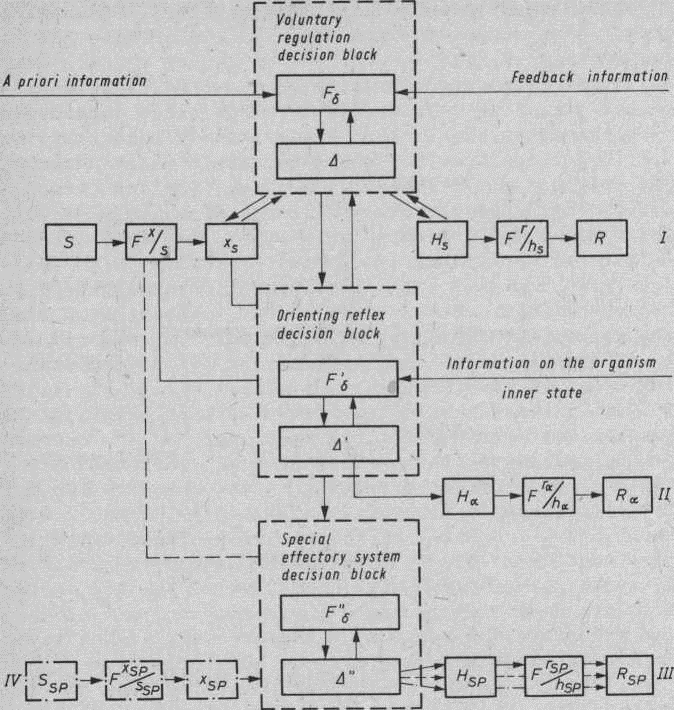
Figure 1. The schemes II, III, IY describe the correlations between the orienting and defensive reflexes that were studied in detail by Sokolov and Vinogradova.
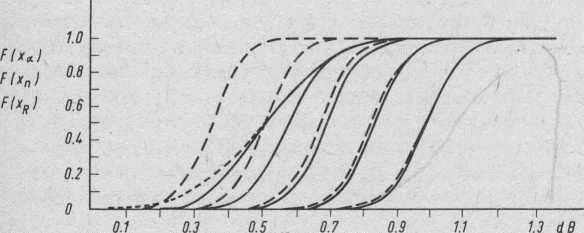
Figure 2. Distribution functions of decision-making criteria in the system of orienting reflex F(Хα), in the system of voluntary regulation F(Xν) and of resulting psychometric functions of a voluntary response F(Хα) F(Xν).
(Abscissa – logarithm of the stimuli intensity; ordinate – probability; standard deviations are constant, but not equal (δα = 0.16; δν = 0.08); the center of the criteria distribution in the system of the orienting reflex is fixed (X ̅α = 0.52), and the distribution center of the voluntarily controlled criterion X ̅ν is shifted in relation to it: for 1 – 0.36, for 2 – 0.52, for 3 – 0.68, for 4 – 0.74, for 5 – 1.00.)
The space of stimuli S is reflected by means of the operator for forming a sensory effect FXS/S in the space of sensory effects Xs. The decision-making block includes a criterion forming subblock and a subblock for the decision rule. The formation of the criterion occurs on the basis of a priori information about the situation at the input and information feedback about the results of the response activity. In conformity with the decision made, the sensory effect from X8 is reflected into the space of ways of action H8, then through the operator for the implementation of the chosen way of action Fr/hs into the space of response R. In case there is some difficulty as to the choice of way of action, a repeated “inquiry” for sensory information from Xs is taking place, and after its reception a decision is made on the way of action.
Let us try to analyte this scheme in the case where the observer’s work is done in the regime of detection with non-fixed interval of observation (the observer does not receive any warning signal). In essence, a similar case is the observer’s work while measuring the absolute threshold, when the observer must detect quite a faint signal against the background of inner sensory noises.
It is such a case of measuring absolute light sensitivity that was investigated by Mikhalevskaya (1964). The effectiveness of detection was evaluated according to voluntary motor reactions. Supplementary information was elicited from the involuntary orienting reactions (alpha-rhythm blockade and SGR). It was shown that very low light stimulus intensities partially detected by the observer produce the both components of the orienting reflex. At the same time the alpha-rhythm blockade is not being extinguished in the course of hundreds of trials, while the SGR extinguishes rather quickly. The explanation for the speed of extinction is that the alpha-rhythm blockade is a component of local orienting reaction (Sokolov 1958) and is intimately included in the sensory process. Both reactions, as components of one reflex, bear a nonspecific character and are subjected to the general laws of the orienting reflex. On the other hand, they happen at different times and are characterized by “semi-independence” in their relations with each other. Obviously, they depend on the system of conjugated nerve centers, which are unified by a common integrating mechanism, regulating their relationship.
In the case under consideration of the observer’s work in the regime of detecting a long-lasting signal (5 sec.) with a non-fixed interval and with simultaneous recording of voluntary and involuntary responses of the observer, Zabrоdin’s scheme must be supplemented with a number of links, reflecting the inclusion of the orienting reflex in the process of detection (Fig. 1, II-III). Inasmuch as the response to stimulus S, reflected in Xs, is not only a voluntary reaction but an involuntary reaction as well, schemes I, II, III have the three blocks in common.
As the orienting reflex is a response to novelty, there must be in its system its own discriminator for the appearance of novelty in the space of sensory effects Xs. It may be interpreted in the same way as the decision-making block about the presence of changes in X8. Apparently, this block assumes the functions of the above mentioned central integrating mechanism in the system of orienting reflex. So far, we have little knowledge about the properties of this block. Evidently it also consists of two subblocks. The formation of a criterion and decision-making rule for the orienting reflex occurs under the influence of decision block I, which regulates voluntary behavior on the one hand, and the needs of the organism, its inner conditions on the other. The latter does not appear to need any further argumentation. The existence of the first is testified by facts of the orienting reaction occurring, when through instruction the stimuli are lent the significance of conditioned signals (Marouseva, Chistovitch, 1954), or when words significant to the observer are being reported (Maroushevski, 1957; Sokolov, 1958). Insofar as the formation of a criterion determining the emergence of an orienting reflex occurs under the influence of different factors (external and internal), its magnitude may also change.
If the sensory effect Xs exceeds the criterion magnitude, then, in accordance with the decision rule of the type “if, then”, in the first place, the criterion is reflected in the “ways of action” space of EEG component of the orienting reflex. The whole set of Нα consists only of two elements. However, in order to explain the diversity of the observed reactions Rα (alpha-rhythm blockade reactions are notable for their duration and latency), we must assume that the operator i that carries out the chosen way of action Frα/hα performs a non-identical transformation.
Secondly, if the sensory effect Xs exceeds the criterion significance, then a stimulation of the decision block of the special efferent system (Figs. I, III) occurs that is involved in the structure of the orienting reaction. In this research SGR proved to be such a reaction. The criterion of the block III (Fig. 1) must obviously be affected by the degree of preoccupation of this particular efferent system with its “immediate duties”, as well as by specific and non-specific modality for that particular efferent system of the stimuli that are being investigated. The other blocks of scheme III-Hsp., F rsp. / hsp., and Rsp. – are functionally identical with the corresponding blocks of scheme II. According to the conception of Sokolov (1958, 1964, 1969), the functional significance of the orienting reaction consists in creating most favorable conditions for perceiving an acting stimulus: the turn of peripheral organs (eye, ear, etc.) towards the source of the stimulus, a better blood supply to the brain due to the dilation of cerebral blood vessels, facilitation of evoked responses and so on. Hence the output of the decisions blocks in the system of the orienting reflex (Fig. 1, I, II) directly influences the operator for the formation of sensory effects Fxs/S. Consequently, under the influence of the orienting reflex with the stimulus S being constant, the sensory effect, generated by the reflex, may change.
Let us compare the functional process scheme of detection, the final result of which is fixed in a voluntary (verbal and motor) response of the observer (scheme I) with the same detective process, the intermediate stage of which is reflected in an involuntary orienting reaction (scheme II). It will be recalled that in the analyzed investigation (Mikhalevskaya, 1964) the absolute light sensitivity was measured after dark adaptation. At the same time a voluntary motor response (EMG of the flexor of fingers) was recorded as well as an involuntary orienting reflex – alpha-rhythm blockade. Some experimental data bear evidence of the existence of a rather close link between the two reactions in the process of signal detection, provided, however, there is also some essential difference between them that does not permit to represent the EMG response as merely the “shadow” of EEG response. Both psychometric curves, EEG and EMG, are S-shaped.
However, the psychometric curve of EEG response is near the function of normal distribution, while the analogous EMG response has a left-side asymmetry and is shifted into the region of greater intensities. The mean psychometric curve of EMG response is 0.6 dB higher than the mean psychometric curve of EEG response.
False alarm in EMG practically always appears against the background of alpha-rhythm depression. Spontaneously arising EEG reactions may not be followed by false alarm in the EMG.
A direct and rather strong correlation between the latencies of the both reactions is observed. Yet the alpha-rhythm blockade always has a shorter latent period than the EMG response. The difference in latent periods of EMG and EEG responses is not constant and is itself a function of stimulus intensities. These differences indicate a different role of the compared responses in the perception of a weak stimulus, in particular, the existence of a mechanism for the appearance of EEG.
The S-shaped psychometric curve of EEG response is revealed after correcting the psychometric curve obtained in the experiment; the correction is made in view of possible cases of chance coincidence of presented stimulus with a spontaneous appearance of an EEG-reaction. The correction was carried out according to Blackwell’s formula, proceeding from the assumption that the appearance of the spontaneous alpha-rhythm blockade and the presenting of the stimulus are independent events. The probability of spontaneous reactions was defined in inter stimuli intervals.
All this gives a reason to suppose that the decision block of the orienting reflex (II) seems to bring the decision block operation into the system of voluntary regulation, aside from the above-mentioned influence upon the operator Fxs/S when an orienting reaction occurs under conditions of work with a non-fixed interval of observation (I). Essentially, such a structure is equivalent to two consecutive decision-making procedures. The first decision is that something has changed in the sensory effect space X8, the second is about what the change represents – whether it is noise or signal. That hypothesis explains the asymmetry of the psychometric curve of EMG response.
To verify the plausibility of such a hypothesis, a statistical procedure detecting the model has been developed. It has two consecutive decisions – decision making on the criterion of the orienting reaction and on the criterion of voluntary response (Mikhalevskaya and Prgiemsky, 1966, 1973). These criteria were considered to be independent magnitudes having a Gaussian distribution with a mean value X ̅α and X ̅ν and standard deviation δα and δν.
The voluntary EMG response R appears only if the sensory effect Xs simultaneously exceeds the both criteria. With the change of the parameters of the both distributions the resulting distribution functions of a voluntary EMG response appearance have been calculated (see Fig. 2). Figure 2 shows distribution functions of decision-making criteria in the system of orienting reflex F(Хα), in the system of voluntary regulation F(Xν) and of resulting psychometric functions of a voluntary response F(Хα) F(Xν). (Abscissa – logarithm of the stimuli intensity; ordinate – probability; standard deviations are constant, but not equal (δα = 0.16; δν = 0.08); the center of the criteria distribution in the system of the orienting reflex is fixed (X ̅α = 0.52), and the distribution center of the voluntarily controlled criterion X ̅ν is shifted in relation to it: for 1 – 0.36, for 2 – 0.52, for 3 – 0.68, for 4 – 0.74, for 5 – 1.00.)
The results of calculation show that with the selection of the appropriate parameter values of the distribution of the both consecutive criteria, it is possible to achieve functions corresponding to the experimental psychometric curves of EEG and EMG responses.
The findings of the study permit us, through applying objective indicators, to throw light upon the problem of the nature of false alarm that has been under discussion in psychophysics.
The fact stated above about the appearance of false alarm in the EMG may be considered in 97% cases against the background of reactions to be a confirmation that a considerable part of the false alarm in voluntary responses occurs on sensory grounds.
Data obtained in this work may also be considered in the light of the effective and potential resolving power introduced by Bardin, Indlin and Zabгоdin (1975). The authors suggest that the effective and potential resolving power should be provided by the statistical measure, defined from the verbal responses of the observer under certain (external and internal) measurement conditions; and the potential resolving power should be defined as the limit value of the effective resolving power that may be achieved by eliminating all non-sensory factors included in the experiment. Evidently, such a definition of the effective resolving power, where absolute sensitivity is being measured, must be in keeping with the mean of the psychometric curve of a voluntary response which, as shown by Zabгоdin (1971), reflects the position of the criterion. Hence, in our case, the effective resolving power is equivalent to the mean of the psychometric curve of the EMG response. But the mean of the psychometric curve of the EEG response may be considered to be the first approximation to the potential resolving power; it is the first because the alpha-rhythm reaction, as can be seen from the foregoing, is not free from the influence of non-sensory factors either.
A much more accurate approach to potential resolving power was achieved in the investigation by Gershuni and his colleagues (1945, 1950, 1955, 1957). In these investigations they elaborated conditioned reflex involuntary reactions of an SGR kind (Knjazeva, 1949; Alexejev and Arapova, 1949), of alpha-rhythm blockade (Kogevnikov, 1951), nictating reaction (Avaкjan, 1959). Conditioned reflexes were being elaborated to light and sound stimuli not eliciting any positive verbal response. The ordinary elaboration procedure consisted in the previous definition of the absolute threshold and of succeeding combinations of a stimulus that was lying 7-10 dB below the “threshold” of the verbal response with reinforcement. During the elaboration of a conditioned reflex the observer reported all the signals perceived, pointing out both the reinforcing agent and the above-threshold stimulus that was alternating with inaudible conditioned signals. It was possible to make most of the observers elaborate a conditioned reflex of this type. At the same time a conditioned motor reflex to below-threshold stimuli never were elaborated. To work out a conditioned reflex, involuntary reaction to a considerably greater number of combinations was required than in the case of an above-threshold stimulus. The elaboration of vegetative and electroencephalographic conditioned reflexes is marked by some peculiarities: it takes its course a little faster without a previous extinction of the orienting reflex to the above-threshold stimuli of the same modality (Knjaseva, 1949); there is an absence of the generalization stage. The involuntary conditioned reflexes possess a number of specific peculiarities: they are unstable, are elaborated only for very short intervals between the stimuli (1.5-2 sec.), have a longer latency period, and are quickly extinguished without
reinforcement. That is why it is impossible to elaborate differentiation for them.
These conditioned reflexes make it possible to measure the depth of the intensity zone of stimuli that do not provoke conscious sensations but may produce conditioned signals of vegetative and EEG responses. The zone was called subsensory. It proved to be equal to 6 dB, that is a range greater than the “subsensory zone” of the orienting reflex.
How can we visualize the functional scheme of the detection of these conditioned “subsensory” signals? Let us consider it regarding the example of SGR. The efferent part of this reflex has already been described when SGR appeared as a component of the orienting reflex (Fig. 1, I, III). The decision block in the system of conditioned SGR, as distinct from the case of its inclusion into the system of the orienting reflex, is apparently much more independent of the action of non-sensory factors, though it may be affected by some influence on the part of the block decision of the orienting reflex (scheme II). They may, obviously, account for a certain facilitation in elaborating conditioned SGR to “subsensory” stimuli. This coincides with the well-studied increase of the effort during the elaborating of a special conditioned reflex (Voronin and Sokolov, 1955; Paramonova, 1958; Vinogradova, 1959). But when the conditioned reflex is stabilized, the orienting reflex is extinguished, and there remains only a direct connection between the block decision of the efferent system (III) and the sensory space Xs. Functional links between separate scheme III blocks and the characteristics of the blocks remains the same as in the orienting reflex case. Apart from that, sensory information of another modality must be forthcoming to the decision block of conditioned reflex. Its source is the space of unconditioned reinforcement stimuli Ssp (Fig. 1, scheme IV). Through their transformation operators FXsp. / Ssp, they are reflected into the space of sensory effects Xsp. and then enter the decision block (III). It is the latter that represents a formation where the tying up of conditioned and unconditioned agents is brought about; that is, the criterion of conditioned response is being formed.
What does the existence of a “subsensory” zone indicate? In the first place it means that the criterion of a conditioned involuntary response is situated more to the left (which corresponds to the region of lower intensities) of the verbal response. Inasmuch as the criterion of involuntary conditioned reflex is rather not liable to the direct influence of non-sensory factors that are always present in a psychophysical experiment, it is quite possible that the criterion possesses a lesser dispersion, which is almost exclusively determined by physiological factors.
Thus, the comparative analysis of voluntary and involuntary responses, recorded simultaneously in a psychophysical experiment, permits us to come to the following conclusions:
The method of objective sensory metrics makes it possible to control not only the ultimate, but also the intermediate stage of the process investigated by psychophysics.
Owing to this, the employment of sensory metrics permits to make the structure of the investigation process more accurate than is possible to do in any other way.
The method of objective sensory metrics also allows to submit to direct experimental examination some speculative assumptions on which the psychophysical hypothesis is based, and by doing so, not only verify, but also improve it.
Objective sensory metrics is based on uninterrupted recording of intermediate results of the current process, and thus opens up experimental approaches to investigating the dynamics of unbroken observation, that is the unfolding in the course of action of a single stimulus of long duration, which so far has not been accessible to investigation.
All this leads to the conclusion that objective sensory metrics represents an approach that opens the way to creating most comprehensive conceptions on a broad basis.
References
- Alekseev, M.A., & Arapova, A.A. (1949). Features of C.G.R. when it occurs to weak stimuli in humans. I.P. Pavlova physiol. laboratory, 4. [Alekseyev, M.A., & Arapova, A.A. (1949). Osobennosti k. g.r. pri yego vozniknovenii na slabyye razdrazhiteli u cheloveka. Tr. fiziol. laboratoriy im. I.P. Pavlova, 4].
- Anokhin, P.K. (1973). Fundamental questions of the general theory of functional systems. Principles of system organization of functions. [Anokhin, P.K. (1973). Printsipial’nyye voprosy obshchey teorii funktsional’nykh sistem. Printsipy sistemnoy organizatsii funktsiy. M.].
- Avakyan, R.V. (1959). On the ratio of conditioned blinking and speech reactions in the process of measuring the sensitivity of a human sound analyzer. physiol. acoustics, 4. [Avakyan, R.V. (1959). O sootnoshenii uslovnykh migatel’nykh i rechevykh reaktsiy v protsesse izmereniya chuvstvitel’nosti zvukovogo analizatora cheloveka. Probl. fiziol. akustiki, 4].
- Bardin, К.В., Indlin, Yu.А., & Zabrodin, Yu.И. (1976). The threshold problem and some ways to solve it. Advances in Psychophysics. Berlin: VEB, 131-160.
- Borozdina, L.V. (1973). Visual activity of the observer upon detection of a threshold signal. Study of human visual activity. [Borozdina, L.V. (1973). Zritel’naya deyatel’nost’ nablyudatelya pri obnaruzhenii porogovogo signala. Issledovaniye zritel’noy deyatel’nosti cheloveka. M.].
- Flехman, J.E., Dеmаrее, R.G., & Simpson, D. (1974). Respiratory phase and visual signal detection. Perception and Psychophysics, 16(2), 337-339.
- Gershuni, G.V. (1945). On the study of perceptible sensory and non-perceptible subsensory reactions under the action of external stimuli on the sense organs. Proceedings of the Academy of Sciences of the USSR. No 2 (Series Biol). [Gershuni, G.V. (1945). Ob izuchenii oshchushchayemykh sensornykh i ne oshchushchayemykh subsensornykh reaktsiy pri deystvii vneshnikh razdrazhiteley na organy chuvstv. Izvestiya AN SSSR. № 2 (seriya biol)].
- Gershuni, G.V. (1949). Reflex reactions when exposed to external stimuli on the human senses in their connection with sensations. Physiological Journal of the USSR, 35, 541-560. [Gershuni, G.V. (1949). Reflektornyye reaktsii pri vozdeystvii vneshnikh razdrazheniy na organy chuvstv cheloveka v ikh svyazi s oshchushcheniyami. Fiziologicheskiy zhurnal SSSR, 35, 541-560].
- Gershuni, G.V. (1950). Physiological bases of objective audiometry. physiol. acoustics, 2. [Gershuni, G.V. (1950). Fiziologicheskiye osnovaniya ob”yektivnoy audiometrii. Probl. fiziol. akustiki, №2].
- Gershuni, G.V. (1955). On the peculiarities of conditioned C.G.R. and alpha-rhythm inhibition reactions that arose under the action of subthreshold and suprathreshold sound stimuli in humans. Journal of Higher Nervous Act., 5, 5. [Gershuni, G.V. (1955). Ob osobennostyakh uslovnykh reaktsiy kgr i ugneteniya al’fa-ritma, voznikavshikh pri deystvii podporogovykh i nadporogovykh zvukovykh razdrazheniy u cheloveka. Zhurnal vyssh. nervn. deyat., 5, vip. 5].
- Gershuni, G.V. (1957). General results of the study of activity of the human sound analyzer using various reactions. Journal of Higher Nervous Act., 7(1). [Gershuni, G.V. (1957). Obshchiye rezul’taty issledovaniya deyatel’nosti zvukovogo analizatora cheloveka pri pomoshchi raznykh reaktsiy. Zhurnal vyssh. nervn. deyat., 7, №1].
- Knyazeva, A.A. (1949). On the question of the formation of temporary connections to imperceptible stimuli affecting the human senses. I.P. Pavlova physiol. laboratory, 4. [Knyazeva, A.A. (1949). K voprosu ob obrazovanii vremennykh svyazey na neoshchushchayemyye razdrazheniya, vozdeystvuyushchiye na organy chuvstv cheloveka. Tr. fiziol. labor. im. I.P. Pavlova, 4].
- Kozhevnikov, V.A. (1951). Electrophysiological study of the formation of temporary connections in humans to sound stimuli. Diss., Leningrad. [Kozhevnikov, V.A. (1951). Elektrofiziologicheskoye izucheniye obrazovaniya vremennykh svyazey u cheloveka na zvukovyye razdrazhiteli. Diss., Leningrad].
- Marushevsky, M. (1957). On the interaction of two signal systems in orientation reactions. Questions of psychology, 1. [Marushevskiy, M. (1957). O vzaimodeystvii dvukh signal’nykh sistem v oriyentirovochnykh reaktsiyakh. Voprosy psikhologii, №1].
- Maruseva, A.M., & Chistovich, L.A. (1954). On the change in the activity of the human sound analyzer under the influence of verbal influences used in experiments on the physiology of the sense organs. Journal of Higher Nervous Activity, 4(4). [Maruseva, A.M., & Chistovich, L.A. (1954). Ob izmenenii deyatel’nosti zvukovogo analizatora cheloveka pod vliyaniyem slovesnykh vozdeystviy, primenyavshikhsya v eksperimentakh po fiziologii organov chuvstv. Zhurnal vysshey nervnoy deyatel’nosti 4, №4].
- Mikhalevskaya, M.B. (1964). On the ratio of indicative and conditioned motor reactions of a person under the action of weak light stimuli. Diss. Moscow. [Mikhalevskaya, M.B. (1964). O sootnoshenii oriyenrovochnykh i uslovnoy dvigatel’noy reaktsiy cheloveka pri deystvii slabykh svetovykh razdrazhiteley. Diss. M.].
- Mikhalevskaya, M.В., & Przhiemsky, Yu.В. (1966). On Threshold Signal Detection. XVIII International Congress of Psychology, Symposium 16, Moscow.
- Mikhalevskaya, M.B. & Przhiemsky, Yu.B. (1973). On one statistical model of the threshold signal detection process. Psychological research, 4. [Mikhalevskaya, M.B., Przhiyemskiy, Yu.B. (1973). Ob odnoy statisticheskoy modeli protsessa obnaruzheniya porogovogo signala. Psikhologich. issl., vyp. 4].
- Obrist, Р.А., Webb, R.A., Sutterer, J.R., & Howard, J.L. (1970). The cardiac – somatic relationship: some reformulations. Psychophysiology, 6, 569-587.
- Paramonova, N.P. (1958). Influence of extinction and recovery of the orienting reflex on the formation of conditional connections. Orient. refl., and orient. research. deyat., Moscow. [Paramonova, N.P. (1958). Vliyaniye ugasheniya i vosstanovleniya oriyentirovochnogo refleksa na obrazovaniye uslovnykh svyazey. Oriyent. refl. i oriyent. issl. deyat., M.].
- Saxon, S.A. (1970). Detection of near threshold signals during four phases of cardia cycle. Alabama Journal of Medical Sciences, 7, 427-430.
- Sokolov, E.N. (1958). Perception and conditioned reflex. Moscow, Moscow State University. [Sokolov, Ye.N. (1958). Vospriyatiye i uslovnyy refleks. M., MGU].
- Sokolov, E.N. (1964). Orienting reflex as an information regulator. Orienting reflex and problems of reception in health and disease. [Sokolov, Ye.N. (1964). Oriyentirovochnyy refleks kak informatsionnyy regulyator. Oriyentirovochnyy refleks i problemy retseptsii v norme i patologii, M.].
- Sokolov, E.N. (1969). Memory mechanisms. Moscow. [Sokolov, Ye.N. (1969). Mekhanizmy pamyati. M.].
- Vinogradova, O.S. (1959). The role of the orienting reflex in the process of closing the conditioned connection in humans. Orienting reflex and questions of higher nervous activity. Moscow. [Vinogradova, O.C. (1959). Rol’ oriyentirovochnogo refleksa v protsesse zamykaniya uslovnoy svyazi u cheloveka. Oriyentirovochnyy refleks i voprosy vysshey nervnoy deyatel’nosti. M.].
- Voronin, L.G. & Sokolov, E.N. (1955). On the relationship between the orienting and conditioned reflex in humans. Bulletin of Moscow State University, 9. [Voronin, L.G., Sokolov, Ye.N. (1955). O vzaimootnoshenii oriyentirovochnogo i uslovnogo refleksa u cheloveka. Vestnik MGU, №9].
- Zabrodin, Yu.M. (1971). Investigation of the problem of weak signals detecton by humans. Diss. Leningrad. [Zabrodin, Yu.M. (1971). Issledovaniye problemy obnaruzheniya slabykh signalov chelovekom. Diss. L.].
- Zabrodin, Yu.M. (1976). On the scope of Psychophysics: some methodological considerations. Advances in Psychophysics. Berlin: VEB, 15-42.
Comments (0)
Docent Marta Borisovna Mikhalevskaya is one of those who created the Faculty of Psychology of Lomonosov Moscow State University in the 60-90 years. She graduated from the Psychology department of the Faculty of Philosophy of Moscow State University, and her career has been associated with the faculty for more than 40 years. M.B. Mikhalevskaya was the student of the 20th century Psychophysiologist Professor E.N. Sokolov. She is a brilliant psychophysiologist and psychophysicist. M.B. Mikhalevskaya is one of the founders of the task approach in psychophysics, which showed the productivity and prospects of applying the general principles of the psychological theory of activity to understand psychophysical mechanisms of sensory signals detection, discrimination and identification. It is impossible to overestimate the theoretical contribution of M.B. Mikhalevskaya to world science. She proposed two constructive solutions to the classic problem of psychophysics: if there is a threshold in the sensory system:
- The concept of two consecutive
thresholds are proposed: a) the threshold of an involuntary indicative reaction, which is objectively registered by the reaction of depression of the alpha rhythm; b) the criterion for decision-making performing the function of the second threshold (this is the threshold of a conscious arbitrary response). Both thresholds were identified based on empirical differences in the psychometric curves of both reactions and confirmed by computer modeling. - A theoretical concept was developed in which it was proposed to evaluate not threshold points, but a threshold range in which the probability of the “yes” response varies from 0 to 1, and which exists objectively, in contrast to the debatable threshold as a point on the sensory axis.
She is one of those who helped to organize the educational process at the Department of General Psychology as A.N. Leontiev’s deputy for academic work. Faculty staff and its graduates remember and appreciate M.B. Mikhalevskaya as one of the creators of the first workshop on general psychology, the developer of its methodological base and curriculum (1960-1980). To the maximum extent, her talent as a scientist, teacher and organizer was manifested from 1979 to 1993. She was the head of the General Psychological Workshop, which was the largest and a modernly equipped department of the Faculty of Psychology of Moscow State University at that time.
Colleagues and students of M.B. Mikhalevskaya remember her rare personal qualities as a scientist and teacher of Moscow University – diligence, scientific honesty, the highest demands on themselves and others, boundless respect for scientific fact, love for their students and respect for colleagues.
The employment of objective sensory metrics in psychophysics is discussed. Objective sensory metrics is an investigation of sensory functions by means of different voluntarily uncontrollable vegetative and EEG-reactions, which are simultaneously recorded together with voluntary (motor and verbal) responses. The approach can be productive in experimental and theoretical psychophysics for solving some important problem of its own.
The psychophysicist is known to see his/her aim in giving a full description of sensory space corresponding to reality and in elucidating its properties and metrics. While solving his/her problem by means of traditional methods, the psychophysicist controls only the terminal links of the process that is being practically investigated in the experiment –stimulation at the input and voluntarily controlled reactions at the output. By modifying the stimuli situation (a stimuli range, a character of a stimuli sequence etc.) and by supposing “inner conditions” of the subject (motivation, strategy for solving the task set to him etc.) to be constant, and by adopting such possible measures as to guarantee in fact their constancy, the psychophysicist investigates a character of the connection “stimulus-response”; to explain the latter he/she suggests a hypothesis concerning the structure of the process. The shaping of this theoretical construction as a model will make it possible to verify experimentally whether it corresponds to the real process. However, the process that is being investigated by psychophysics has a complex hierarchical structure of many links, and the ultimate results of this process – the response of the observer – is determined by many variables, and only some of them are controlled by the experimenter. Therefore, an adequate description of the process, as a whole, can be achieved only in quite a complex and developed model, which is difficult to construct under the condition of an acute shortage of information, that is, on the basis of “input” and “output” data alone. The situation becomes more complicated due to the fact that psychophysical dependencies are basically the subject to probabilities and, as a rule, are characterized by the grate dispersion.
Therefore, it is not at all frequent that on the basis of experimental data one of the hypotheses compared may be given a preference as corresponding most closely to reality. The employment of reciprocal tests of conclusions of one theory by methods of another is not always possible, since the method itself affects the process, and therefore changes its final result. Most likely, these circumstances explain why the majority of existing models are not universal, that is, why they do not offer any adequate description of the process as a whole. More often the entire “responsibility” for the change in the final results is attributed to merely one part of the process.
The problem of constructing a model that embraces more fully the process investigated by psychophysics and all the aspects of the process, may be solved, provided there is more supplementary information about it. One of the ways to obtain the necessary information is that adopted by contemporary psychophysics, in particular the signal detection theory. The process under investigation is considered to be active and to include decision making. The psychophysicist does not only control the stimulus situation, but also exerts his influence upon “inner conditions” of the decision by changing a payoff matrix, introducing a feed-back etc. In this way he tries to evaluate the contribution of non-sensory factors into the ultimate result – the verbal response – so as to be in a position to “deduce” it and to get a clear measure of sensitivity.
Another way consists in eliciting additional information about the investigated process from the physiological reactions of the organism which originates as a result of stimulus action. This line is developing within the framework of objective sensory metrics (Gershuni, 1949) – the investigation of sensory functions by means of different physiological reactions. For this purpose, different voluntarily uncontrollable vegetative and EEG reactions are commonly used, which are simultaneously recorded with voluntary (motor and verbal) responses. The observer’s involuntary reactions represent a wider reaction class, both as to the number of efferent systems involved in the reaction and as to their place and role in the process investigated by psychophysics.
They may be classified by the following grounds:
- according to their biological significance of the reactions as orienting, defensive and adaptive ones. The biological nature of the reaction determines its properties as indicator and its function and place in the process under investigation by the psychophysicist (Sokolov 1958);
- according to readiness to be used for psychophysical measurements as indicators of a conditioned reflex type; different vegetative and EEG reactions, arising from “on the spot” and voluntarily controlled responses as a result of the instruction;
- according to the common character as local responses of the sensory system and general reactions of the organism (e.g., orienting reaction) and, finally, according to the presence or absence of output in special efferent systems.
From the above mentioned, enumeration of reactions used in objective sensory metrics, it follows directly that objective sensory metrics opens up wide possibilities for an objective study of the process investigated by psychophysics. Yet it has not been applied in psychophysics to the extent it deserves. This can hardly be accounted for, if not by its labor-consuming character and the complexity of tools to be used in such investigations compared with an ordinary psychophysical experiment with verbal responses.
Most probably, the point is mainly that psychophysicists do not see the potentialities that objective sensory metrics opens up to them. Its methods have already long been used to diagnose sensory functions of various diseases of the central nervous system. Extensive practice in clinics has confirmed their value for such purposes. However, this alone does not exhaust the sphere in which objective sensory metrics may be employed. From our point of view its application can, in some respects, be productive in solving some problems of theoretical and experimental psychophysics in its own unique way.
- The contrast between objective and subjective data received simultaneously permits us not only to verify and specify the psychophysical model built on subjective data, but opens a way for a more comprehensive and representative psychophysical conception. The use of various physiological reactions, in which intermediate results are fixed, permits us to get a more complete and accurate idea about the structure of the process, about including different functional systems into the process (Anokhin, 1973) and their interaction. The evident consequence of this will be our more precise notions of the properties and metrics of the sensory space.
- The employment of objective sensory metrics widens the sphere of application of psychophysical methods. It is common knowledge that to investigate the sensitivity of animals, of children who have not got the command of speech, to establish cases of malingering, is possible only on the basis of behavior and involuntary physiological reactions (Gershuni, 1950).
But there are more interesting applications. The employment of objective sensory metrics extends the range of problems liable to experimental investigation. Due to the fact that by means of vegetative and EEG reactions a continuous control over the intermediate stages of the current process may be exercised, a new way is opened for an experimental investigation of the process dynamics in the course of uninterrupted observation during the action of a long-lasting stimulus. There is the reason to believe that under these conditions the process of perceiving the stimulus and
forming the response has time to “develop” during the action of the stimulus. According to some experimental data (Borozdina, 1973) it happens to be more complex as to structure, with a greater number of feed-backs, repeated tests and specifying them during the stimulus action. At the same time the operational structure of the observer’s activity changes as well. Up to now psychophysics had no approach to an experimental study of the dynamics of such observation, since a voluntary response fixes only the ultimate result of the whole process under investigation in a psychophysical experiment. The employment of objective sensory metrical methods permits us to avoid this difficulty.
- Only the use of physiological indicators makes it possible to take into account the physiological state of the organism and study the kind of influence on psychological phenomena. As an example of such a type of investigation that bears more or less a particular character, papers may serve in which possible physiological (“intra subjective”) sources of the observer’s verbal response in the detection experiment are studied (Flexman, Demaree, & Simpson 1974; Obristet al., 1970; Saxon, 1970).
This type of investigation represents traditionally used physiological data, and we shall not further dwell upon it in detail.
In order to show the expediency of using objective sensory metrics in the first two aspects, let us consider the employment of objective data to analyze the process of detection. As a foundation for such an analysis the observer’s scheme of work was suggested by Zabrodin (1975). According to this scheme the process of detection in its classical variant with fixed observation intervals and the observer’s voluntary responses is described in the following way (Fig. 1).
Figure 1. The schemes II, III, IY describe the correlations between the orienting and defensive reflexes that were studied in detail by Sokolov and Vinogradova.
Figure 2. Distribution functions of decision-making criteria in the system of orienting reflex F(Хα), in the system of voluntary regulation F(Xν) and of resulting psychometric functions of a voluntary response F(Хα) F(Xν).
(Abscissa – logarithm of the stimuli intensity; ordinate – probability; standard deviations are constant, but not equal (δα = 0.16; δν = 0.08); the center of the criteria distribution in the system of the orienting reflex is fixed (X ̅α = 0.52), and the distribution center of the voluntarily controlled criterion X ̅ν is shifted in relation to it: for 1 – 0.36, for 2 – 0.52, for 3 – 0.68, for 4 – 0.74, for 5 – 1.00.)
The space of stimuli S is reflected by means of the operator for forming a sensory effect FXS/S in the space of sensory effects Xs. The decision-making block includes a criterion forming subblock and a subblock for the decision rule. The formation of the criterion occurs on the basis of a priori information about the situation at the input and information feedback about the results of the response activity. In conformity with the decision made, the sensory effect from X8 is reflected into the space of ways of action H8, then through the operator for the implementation of the chosen way of action Fr/hs into the space of response R. In case there is some difficulty as to the choice of way of action, a repeated “inquiry” for sensory information from Xs is taking place, and after its reception a decision is made on the way of action.
Let us try to analyte this scheme in the case where the observer’s work is done in the regime of detection with non-fixed interval of observation (the observer does not receive any warning signal). In essence, a similar case is the observer’s work while measuring the absolute threshold, when the observer must detect quite a faint signal against the background of inner sensory noises.
It is such a case of measuring absolute light sensitivity that was investigated by Mikhalevskaya (1964). The effectiveness of detection was evaluated according to voluntary motor reactions. Supplementary information was elicited from the involuntary orienting reactions (alpha-rhythm blockade and SGR). It was shown that very low light stimulus intensities partially detected by the observer produce the both components of the orienting reflex. At the same time the alpha-rhythm blockade is not being extinguished in the course of hundreds of trials, while the SGR extinguishes rather quickly. The explanation for the speed of extinction is that the alpha-rhythm blockade is a component of local orienting reaction (Sokolov 1958) and is intimately included in the sensory process. Both reactions, as components of one reflex, bear a nonspecific character and are subjected to the general laws of the orienting reflex. On the other hand, they happen at different times and are characterized by “semi-independence” in their relations with each other. Obviously, they depend on the system of conjugated nerve centers, which are unified by a common integrating mechanism, regulating their relationship.
In the case under consideration of the observer’s work in the regime of detecting a long-lasting signal (5 sec.) with a non-fixed interval and with simultaneous recording of voluntary and involuntary responses of the observer, Zabrоdin’s scheme must be supplemented with a number of links, reflecting the inclusion of the orienting reflex in the process of detection (Fig. 1, II-III). Inasmuch as the response to stimulus S, reflected in Xs, is not only a voluntary reaction but an involuntary reaction as well, schemes I, II, III have the three blocks in common.
As the orienting reflex is a response to novelty, there must be in its system its own discriminator for the appearance of novelty in the space of sensory effects Xs. It may be interpreted in the same way as the decision-making block about the presence of changes in X8. Apparently, this block assumes the functions of the above mentioned central integrating mechanism in the system of orienting reflex. So far, we have little knowledge about the properties of this block. Evidently it also consists of two subblocks. The formation of a criterion and decision-making rule for the orienting reflex occurs under the influence of decision block I, which regulates voluntary behavior on the one hand, and the needs of the organism, its inner conditions on the other. The latter does not appear to need any further argumentation. The existence of the first is testified by facts of the orienting reaction occurring, when through instruction the stimuli are lent the significance of conditioned signals (Marouseva, Chistovitch, 1954), or when words significant to the observer are being reported (Maroushevski, 1957; Sokolov, 1958). Insofar as the formation of a criterion determining the emergence of an orienting reflex occurs under the influence of different factors (external and internal), its magnitude may also change.
If the sensory effect Xs exceeds the criterion magnitude, then, in accordance with the decision rule of the type “if, then”, in the first place, the criterion is reflected in the “ways of action” space of EEG component of the orienting reflex. The whole set of Нα consists only of two elements. However, in order to explain the diversity of the observed reactions Rα (alpha-rhythm blockade reactions are notable for their duration and latency), we must assume that the operator i that carries out the chosen way of action Frα/hα performs a non-identical transformation.
Secondly, if the sensory effect Xs exceeds the criterion significance, then a stimulation of the decision block of the special efferent system (Figs. I, III) occurs that is involved in the structure of the orienting reaction. In this research SGR proved to be such a reaction. The criterion of the block III (Fig. 1) must obviously be affected by the degree of preoccupation of this particular efferent system with its “immediate duties”, as well as by specific and non-specific modality for that particular efferent system of the stimuli that are being investigated. The other blocks of scheme III-Hsp., F rsp. / hsp., and Rsp. – are functionally identical with the corresponding blocks of scheme II. According to the conception of Sokolov (1958, 1964, 1969), the functional significance of the orienting reaction consists in creating most favorable conditions for perceiving an acting stimulus: the turn of peripheral organs (eye, ear, etc.) towards the source of the stimulus, a better blood supply to the brain due to the dilation of cerebral blood vessels, facilitation of evoked responses and so on. Hence the output of the decisions blocks in the system of the orienting reflex (Fig. 1, I, II) directly influences the operator for the formation of sensory effects Fxs/S. Consequently, under the influence of the orienting reflex with the stimulus S being constant, the sensory effect, generated by the reflex, may change.
Let us compare the functional process scheme of detection, the final result of which is fixed in a voluntary (verbal and motor) response of the observer (scheme I) with the same detective process, the intermediate stage of which is reflected in an involuntary orienting reaction (scheme II). It will be recalled that in the analyzed investigation (Mikhalevskaya, 1964) the absolute light sensitivity was measured after dark adaptation. At the same time a voluntary motor response (EMG of the flexor of fingers) was recorded as well as an involuntary orienting reflex – alpha-rhythm blockade. Some experimental data bear evidence of the existence of a rather close link between the two reactions in the process of signal detection, provided, however, there is also some essential difference between them that does not permit to represent the EMG response as merely the “shadow” of EEG response. Both psychometric curves, EEG and EMG, are S-shaped.
However, the psychometric curve of EEG response is near the function of normal distribution, while the analogous EMG response has a left-side asymmetry and is shifted into the region of greater intensities. The mean psychometric curve of EMG response is 0.6 dB higher than the mean psychometric curve of EEG response.
False alarm in EMG practically always appears against the background of alpha-rhythm depression. Spontaneously arising EEG reactions may not be followed by false alarm in the EMG.
A direct and rather strong correlation between the latencies of the both reactions is observed. Yet the alpha-rhythm blockade always has a shorter latent period than the EMG response. The difference in latent periods of EMG and EEG responses is not constant and is itself a function of stimulus intensities. These differences indicate a different role of the compared responses in the perception of a weak stimulus, in particular, the existence of a mechanism for the appearance of EEG.
The S-shaped psychometric curve of EEG response is revealed after correcting the psychometric curve obtained in the experiment; the correction is made in view of possible cases of chance coincidence of presented stimulus with a spontaneous appearance of an EEG-reaction. The correction was carried out according to Blackwell’s formula, proceeding from the assumption that the appearance of the spontaneous alpha-rhythm blockade and the presenting of the stimulus are independent events. The probability of spontaneous reactions was defined in inter stimuli intervals.
All this gives a reason to suppose that the decision block of the orienting reflex (II) seems to bring the decision block operation into the system of voluntary regulation, aside from the above-mentioned influence upon the operator Fxs/S when an orienting reaction occurs under conditions of work with a non-fixed interval of observation (I). Essentially, such a structure is equivalent to two consecutive decision-making procedures. The first decision is that something has changed in the sensory effect space X8, the second is about what the change represents – whether it is noise or signal. That hypothesis explains the asymmetry of the psychometric curve of EMG response.
To verify the plausibility of such a hypothesis, a statistical procedure detecting the model has been developed. It has two consecutive decisions – decision making on the criterion of the orienting reaction and on the criterion of voluntary response (Mikhalevskaya and Prgiemsky, 1966, 1973). These criteria were considered to be independent magnitudes having a Gaussian distribution with a mean value X ̅α and X ̅ν and standard deviation δα and δν.
The voluntary EMG response R appears only if the sensory effect Xs simultaneously exceeds the both criteria. With the change of the parameters of the both distributions the resulting distribution functions of a voluntary EMG response appearance have been calculated (see Fig. 2). Figure 2 shows distribution functions of decision-making criteria in the system of orienting reflex F(Хα), in the system of voluntary regulation F(Xν) and of resulting psychometric functions of a voluntary response F(Хα) F(Xν). (Abscissa – logarithm of the stimuli intensity; ordinate – probability; standard deviations are constant, but not equal (δα = 0.16; δν = 0.08); the center of the criteria distribution in the system of the orienting reflex is fixed (X ̅α = 0.52), and the distribution center of the voluntarily controlled criterion X ̅ν is shifted in relation to it: for 1 – 0.36, for 2 – 0.52, for 3 – 0.68, for 4 – 0.74, for 5 – 1.00.)
The results of calculation show that with the selection of the appropriate parameter values of the distribution of the both consecutive criteria, it is possible to achieve functions corresponding to the experimental psychometric curves of EEG and EMG responses.
The findings of the study permit us, through applying objective indicators, to throw light upon the problem of the nature of false alarm that has been under discussion in psychophysics.
The fact stated above about the appearance of false alarm in the EMG may be considered in 97% cases against the background of reactions to be a confirmation that a considerable part of the false alarm in voluntary responses occurs on sensory grounds.
Data obtained in this work may also be considered in the light of the effective and potential resolving power introduced by Bardin, Indlin and Zabгоdin (1975). The authors suggest that the effective and potential resolving power should be provided by the statistical measure, defined from the verbal responses of the observer under certain (external and internal) measurement conditions; and the potential resolving power should be defined as the limit value of the effective resolving power that may be achieved by eliminating all non-sensory factors included in the experiment. Evidently, such a definition of the effective resolving power, where absolute sensitivity is being measured, must be in keeping with the mean of the psychometric curve of a voluntary response which, as shown by Zabгоdin (1971), reflects the position of the criterion. Hence, in our case, the effective resolving power is equivalent to the mean of the psychometric curve of the EMG response. But the mean of the psychometric curve of the EEG response may be considered to be the first approximation to the potential resolving power; it is the first because the alpha-rhythm reaction, as can be seen from the foregoing, is not free from the influence of non-sensory factors either.
A much more accurate approach to potential resolving power was achieved in the investigation by Gershuni and his colleagues (1945, 1950, 1955, 1957). In these investigations they elaborated conditioned reflex involuntary reactions of an SGR kind (Knjazeva, 1949; Alexejev and Arapova, 1949), of alpha-rhythm blockade (Kogevnikov, 1951), nictating reaction (Avaкjan, 1959). Conditioned reflexes were being elaborated to light and sound stimuli not eliciting any positive verbal response. The ordinary elaboration procedure consisted in the previous definition of the absolute threshold and of succeeding combinations of a stimulus that was lying 7-10 dB below the “threshold” of the verbal response with reinforcement. During the elaboration of a conditioned reflex the observer reported all the signals perceived, pointing out both the reinforcing agent and the above-threshold stimulus that was alternating with inaudible conditioned signals. It was possible to make most of the observers elaborate a conditioned reflex of this type. At the same time a conditioned motor reflex to below-threshold stimuli never were elaborated. To work out a conditioned reflex, involuntary reaction to a considerably greater number of combinations was required than in the case of an above-threshold stimulus. The elaboration of vegetative and electroencephalographic conditioned reflexes is marked by some peculiarities: it takes its course a little faster without a previous extinction of the orienting reflex to the above-threshold stimuli of the same modality (Knjaseva, 1949); there is an absence of the generalization stage. The involuntary conditioned reflexes possess a number of specific peculiarities: they are unstable, are elaborated only for very short intervals between the stimuli (1.5-2 sec.), have a longer latency period, and are quickly extinguished without
reinforcement. That is why it is impossible to elaborate differentiation for them.
These conditioned reflexes make it possible to measure the depth of the intensity zone of stimuli that do not provoke conscious sensations but may produce conditioned signals of vegetative and EEG responses. The zone was called subsensory. It proved to be equal to 6 dB, that is a range greater than the “subsensory zone” of the orienting reflex.
How can we visualize the functional scheme of the detection of these conditioned “subsensory” signals? Let us consider it regarding the example of SGR. The efferent part of this reflex has already been described when SGR appeared as a component of the orienting reflex (Fig. 1, I, III). The decision block in the system of conditioned SGR, as distinct from the case of its inclusion into the system of the orienting reflex, is apparently much more independent of the action of non-sensory factors, though it may be affected by some influence on the part of the block decision of the orienting reflex (scheme II). They may, obviously, account for a certain facilitation in elaborating conditioned SGR to “subsensory” stimuli. This coincides with the well-studied increase of the effort during the elaborating of a special conditioned reflex (Voronin and Sokolov, 1955; Paramonova, 1958; Vinogradova, 1959). But when the conditioned reflex is stabilized, the orienting reflex is extinguished, and there remains only a direct connection between the block decision of the efferent system (III) and the sensory space Xs. Functional links between separate scheme III blocks and the characteristics of the blocks remains the same as in the orienting reflex case. Apart from that, sensory information of another modality must be forthcoming to the decision block of conditioned reflex. Its source is the space of unconditioned reinforcement stimuli Ssp (Fig. 1, scheme IV). Through their transformation operators FXsp. / Ssp, they are reflected into the space of sensory effects Xsp. and then enter the decision block (III). It is the latter that represents a formation where the tying up of conditioned and unconditioned agents is brought about; that is, the criterion of conditioned response is being formed.
What does the existence of a “subsensory” zone indicate? In the first place it means that the criterion of a conditioned involuntary response is situated more to the left (which corresponds to the region of lower intensities) of the verbal response. Inasmuch as the criterion of involuntary conditioned reflex is rather not liable to the direct influence of non-sensory factors that are always present in a psychophysical experiment, it is quite possible that the criterion possesses a lesser dispersion, which is almost exclusively determined by physiological factors.
Thus, the comparative analysis of voluntary and involuntary responses, recorded simultaneously in a psychophysical experiment, permits us to come to the following conclusions:
The method of objective sensory metrics makes it possible to control not only the ultimate, but also the intermediate stage of the process investigated by psychophysics.
Owing to this, the employment of sensory metrics permits to make the structure of the investigation process more accurate than is possible to do in any other way.
The method of objective sensory metrics also allows to submit to direct experimental examination some speculative assumptions on which the psychophysical hypothesis is based, and by doing so, not only verify, but also improve it.
Objective sensory metrics is based on uninterrupted recording of intermediate results of the current process, and thus opens up experimental approaches to investigating the dynamics of unbroken observation, that is the unfolding in the course of action of a single stimulus of long duration, which so far has not been accessible to investigation.
All this leads to the conclusion that objective sensory metrics represents an approach that opens the way to creating most comprehensive conceptions on a broad basis.
- Alekseev, M.A., & Arapova, A.A. (1949). Features of C.G.R. when it occurs to weak stimuli in humans. I.P. Pavlova physiol. laboratory, 4. [Alekseyev, M.A., & Arapova, A.A. (1949). Osobennosti k. g.r. pri yego vozniknovenii na slabyye razdrazhiteli u cheloveka. Tr. fiziol. laboratoriy im. I.P. Pavlova, 4].
- Anokhin, P.K. (1973). Fundamental questions of the general theory of functional systems. Principles of system organization of functions. [Anokhin, P.K. (1973). Printsipial’nyye voprosy obshchey teorii funktsional’nykh sistem. Printsipy sistemnoy organizatsii funktsiy. M.].
- Avakyan, R.V. (1959). On the ratio of conditioned blinking and speech reactions in the process of measuring the sensitivity of a human sound analyzer. physiol. acoustics, 4. [Avakyan, R.V. (1959). O sootnoshenii uslovnykh migatel’nykh i rechevykh reaktsiy v protsesse izmereniya chuvstvitel’nosti zvukovogo analizatora cheloveka. Probl. fiziol. akustiki, 4].
- Bardin, К.В., Indlin, Yu.А., & Zabrodin, Yu.И. (1976). The threshold problem and some ways to solve it. Advances in Psychophysics. Berlin: VEB, 131-160.
- Borozdina, L.V. (1973). Visual activity of the observer upon detection of a threshold signal. Study of human visual activity. [Borozdina, L.V. (1973). Zritel’naya deyatel’nost’ nablyudatelya pri obnaruzhenii porogovogo signala. Issledovaniye zritel’noy deyatel’nosti cheloveka. M.].
- Flехman, J.E., Dеmаrее, R.G., & Simpson, D. (1974). Respiratory phase and visual signal detection. Perception and Psychophysics, 16(2), 337-339.
- Gershuni, G.V. (1945). On the study of perceptible sensory and non-perceptible subsensory reactions under the action of external stimuli on the sense organs. Proceedings of the Academy of Sciences of the USSR. No 2 (Series Biol). [Gershuni, G.V. (1945). Ob izuchenii oshchushchayemykh sensornykh i ne oshchushchayemykh subsensornykh reaktsiy pri deystvii vneshnikh razdrazhiteley na organy chuvstv. Izvestiya AN SSSR. № 2 (seriya biol)].
- Gershuni, G.V. (1949). Reflex reactions when exposed to external stimuli on the human senses in their connection with sensations. Physiological Journal of the USSR, 35, 541-560. [Gershuni, G.V. (1949). Reflektornyye reaktsii pri vozdeystvii vneshnikh razdrazheniy na organy chuvstv cheloveka v ikh svyazi s oshchushcheniyami. Fiziologicheskiy zhurnal SSSR, 35, 541-560].
- Gershuni, G.V. (1950). Physiological bases of objective audiometry. physiol. acoustics, 2. [Gershuni, G.V. (1950). Fiziologicheskiye osnovaniya ob”yektivnoy audiometrii. Probl. fiziol. akustiki, №2].
- Gershuni, G.V. (1955). On the peculiarities of conditioned C.G.R. and alpha-rhythm inhibition reactions that arose under the action of subthreshold and suprathreshold sound stimuli in humans. Journal of Higher Nervous Act., 5, 5. [Gershuni, G.V. (1955). Ob osobennostyakh uslovnykh reaktsiy kgr i ugneteniya al’fa-ritma, voznikavshikh pri deystvii podporogovykh i nadporogovykh zvukovykh razdrazheniy u cheloveka. Zhurnal vyssh. nervn. deyat., 5, vip. 5].
- Gershuni, G.V. (1957). General results of the study of activity of the human sound analyzer using various reactions. Journal of Higher Nervous Act., 7(1). [Gershuni, G.V. (1957). Obshchiye rezul’taty issledovaniya deyatel’nosti zvukovogo analizatora cheloveka pri pomoshchi raznykh reaktsiy. Zhurnal vyssh. nervn. deyat., 7, №1].
- Knyazeva, A.A. (1949). On the question of the formation of temporary connections to imperceptible stimuli affecting the human senses. I.P. Pavlova physiol. laboratory, 4. [Knyazeva, A.A. (1949). K voprosu ob obrazovanii vremennykh svyazey na neoshchushchayemyye razdrazheniya, vozdeystvuyushchiye na organy chuvstv cheloveka. Tr. fiziol. labor. im. I.P. Pavlova, 4].
- Kozhevnikov, V.A. (1951). Electrophysiological study of the formation of temporary connections in humans to sound stimuli. Diss., Leningrad. [Kozhevnikov, V.A. (1951). Elektrofiziologicheskoye izucheniye obrazovaniya vremennykh svyazey u cheloveka na zvukovyye razdrazhiteli. Diss., Leningrad].
- Marushevsky, M. (1957). On the interaction of two signal systems in orientation reactions. Questions of psychology, 1. [Marushevskiy, M. (1957). O vzaimodeystvii dvukh signal’nykh sistem v oriyentirovochnykh reaktsiyakh. Voprosy psikhologii, №1].
- Maruseva, A.M., & Chistovich, L.A. (1954). On the change in the activity of the human sound analyzer under the influence of verbal influences used in experiments on the physiology of the sense organs. Journal of Higher Nervous Activity, 4(4). [Maruseva, A.M., & Chistovich, L.A. (1954). Ob izmenenii deyatel’nosti zvukovogo analizatora cheloveka pod vliyaniyem slovesnykh vozdeystviy, primenyavshikhsya v eksperimentakh po fiziologii organov chuvstv. Zhurnal vysshey nervnoy deyatel’nosti 4, №4].
- Mikhalevskaya, M.B. (1964). On the ratio of indicative and conditioned motor reactions of a person under the action of weak light stimuli. Diss. Moscow. [Mikhalevskaya, M.B. (1964). O sootnoshenii oriyenrovochnykh i uslovnoy dvigatel’noy reaktsiy cheloveka pri deystvii slabykh svetovykh razdrazhiteley. Diss. M.].
- Mikhalevskaya, M.В., & Przhiemsky, Yu.В. (1966). On Threshold Signal Detection. XVIII International Congress of Psychology, Symposium 16, Moscow.
- Mikhalevskaya, M.B. & Przhiemsky, Yu.B. (1973). On one statistical model of the threshold signal detection process. Psychological research, 4. [Mikhalevskaya, M.B., Przhiyemskiy, Yu.B. (1973). Ob odnoy statisticheskoy modeli protsessa obnaruzheniya porogovogo signala. Psikhologich. issl., vyp. 4].
- Obrist, Р.А., Webb, R.A., Sutterer, J.R., & Howard, J.L. (1970). The cardiac – somatic relationship: some reformulations. Psychophysiology, 6, 569-587.
- Paramonova, N.P. (1958). Influence of extinction and recovery of the orienting reflex on the formation of conditional connections. Orient. refl., and orient. research. deyat., Moscow. [Paramonova, N.P. (1958). Vliyaniye ugasheniya i vosstanovleniya oriyentirovochnogo refleksa na obrazovaniye uslovnykh svyazey. Oriyent. refl. i oriyent. issl. deyat., M.].
- Saxon, S.A. (1970). Detection of near threshold signals during four phases of cardia cycle. Alabama Journal of Medical Sciences, 7, 427-430.
- Sokolov, E.N. (1958). Perception and conditioned reflex. Moscow, Moscow State University. [Sokolov, Ye.N. (1958). Vospriyatiye i uslovnyy refleks. M., MGU].
- Sokolov, E.N. (1964). Orienting reflex as an information regulator. Orienting reflex and problems of reception in health and disease. [Sokolov, Ye.N. (1964). Oriyentirovochnyy refleks kak informatsionnyy regulyator. Oriyentirovochnyy refleks i problemy retseptsii v norme i patologii, M.].
- Sokolov, E.N. (1969). Memory mechanisms. Moscow. [Sokolov, Ye.N. (1969). Mekhanizmy pamyati. M.].
- Vinogradova, O.S. (1959). The role of the orienting reflex in the process of closing the conditioned connection in humans. Orienting reflex and questions of higher nervous activity. Moscow. [Vinogradova, O.C. (1959). Rol’ oriyentirovochnogo refleksa v protsesse zamykaniya uslovnoy svyazi u cheloveka. Oriyentirovochnyy refleks i voprosy vysshey nervnoy deyatel’nosti. M.].
- Voronin, L.G. & Sokolov, E.N. (1955). On the relationship between the orienting and conditioned reflex in humans. Bulletin of Moscow State University, 9. [Voronin, L.G., Sokolov, Ye.N. (1955). O vzaimootnoshenii oriyentirovochnogo i uslovnogo refleksa u cheloveka. Vestnik MGU, №9].
- Zabrodin, Yu.M. (1971). Investigation of the problem of weak signals detecton by humans. Diss. Leningrad. [Zabrodin, Yu.M. (1971). Issledovaniye problemy obnaruzheniya slabykh signalov chelovekom. Diss. L.].
- Zabrodin, Yu.M. (1976). On the scope of Psychophysics: some methodological considerations. Advances in Psychophysics. Berlin: VEB, 15-42.