
A Relation of Monoaminergic System Genes to Human Aggressive Behavior
Abstract
Abstract
Considering the necessity to identify genetic loci related to differences in aggressive behavior, the present study aimed to estimate a synergetic effect of 11 genes belonging to monoaminergic system and potential social factors in the development of individual differences in aggression level in the cohort of young adults. The study included individuals from the Volga-Ural region of Russia (N = 1307, mean age 20.6 ±1.6 years, 80% women), who underwent a psychological testing using the Buss-Perry Aggression Questionnaire (BPAQ). According to the results of genotyping and statistical analysis, we identified regression models explaining up to 10.1% of variance in verbal aggression (р = 1.2х10-8) and up to 4.1% of variance in hostility (р = 8.1х10-10). Significant predictors of verbal aggression and hostility included genetic loci in the HTR1B and DRD2 genes, sex, age, body mass index and physical activity, sibship size, style of paternal rearing, and maternal age at delivery. The data obtained evidence of a link between a decreased activity of the serotoninergic (based on the HTR1B and TPH2 genes) and dopaminergic systems (based on the DRD2 gene) and enhanced aggression.
Introduction
1.1. Factors underlying aggression
Aggressive behavior represents a destructive form of social interaction, which is based on both hereditary and environmental factors, including specificity of rearing, micro- and macro-environments, that affect an individual during his ontogenetic development (Kazantseva, 2008). To establish the role of hereditary factors in developing aggression, twin and adoption studies have been carried out, which enabled us to estimate the effect of genetic components at 50–80% on developing this behavioral phenotype (Davydova et al, 2020; Kazantseva, 2008). Such variability is related to a type of aggressive behavior, cultural, and traditional norms, etc. A beginning of the examination of certain molecular systems relative to aggressive behavior was promoted by the discovery of a deletion in the gene encoding for the enzyme, i.e. monoamine oxidase A (MAOA), which is responsible for serotonin degradation, in a family characterized by exaggerated antisocial behavior (Alia-Klein et al., 2008). Subsequently, other research groups sought to confirm the involvement of genetic structural variations in the genes encoding for the members of monoaminergic functioning, mainly dopamine and serotonin neurotransmission (Davydova et al, 2020). Both dopamine and serotonin are produced by a small number of midbrain nuclei, which project through multiple pathways to modulate neural activity throughout the brain (Martin et al., 2024).
1.2. Serotonin and dopamine systems genes
The main proteins and corresponding genes examined with respect to their impact on differences in behavior include the genes encoding for serotonin (HTR2A, HTR1B, HTR3B) and dopamine receptors (DRD1, DRD2), serotonin transporter (SLC6A4), and the enzymes responsible for serotonin biosynthesis from the aminoacid tryptophan (i.e., tryptophan hydroxylases 1 and 2, TPH1, TPH2) and catecholamine degradation (catechol-o-methyltransferase, COMT).
There are many studies describing the effects of serotonin and dopamine neurotransmission on the manifestation of aggressive and antisocial behavior (Paliakkara et al., 2025). One of the key elements in the serotonergic pathway is the serotonin transporter (encoded by the SLC6A4 gene), which regulates serotonin level in the synaptic cleft. Some studies indicate a link between enhanced aggression and greater serotonin transporter availability in brain regions (Rosell et al., 2023), while administration of selective serotonin reuptake inhibitors results in attenuated aggressive behavior in vulnerable individuals (Martin et al., 2024). In turn, hyperserotonemia, which is characterized by exaggerated serotonin levels, is evident in about 30% of individuals with autism spectrum disorder (Aaron et al., 2019), which is frequently accompanied by excessive aggression. It has also been shown that altered dopamine signalling may result in impulsive aggression (Schlüter et al., 2013). For instance, antipsychotics that modify dopamine levels can decrease aggressive phenotypes (Paliakkara et al., 2025), while genetic variations in the DRD2 gene (for example, Taq1A polymorphism) are associated with an enlarged risk for impulsive aggression (Modestino et al., 2022). However, the findings from analyses of specific genetic markers in genes regulating serotonergic and dopaminergic system activity remain inconclusive and warrant further comprehensive investigation.
At a molecular level, differences in gene structure can be attributed to the presence of certain allelic variants of genetic loci in an individual’s genetic profile. The examination of genetic variants (so-called single nucleotide polymorphisms), which are known to be linked to alterations in gene expression, is of specific interest in relation to aggressive behavior. On the other hand, it is well-established that each genetic variant itself explains only a small proportion of variance in behavioral phenotypes (Kazantseva et al., 2016), while a simultaneous analysis of a set of genetic polymorphisms in genes belonging to monoaminergic pathways could demonstrate a more significant impact.
1.3. The role of environmental factors in aggressive behavior
In addition, various social and lifestyle factors, such as specificity of rearing in childhood, presence of maltreatment, and unfavorable rearing conditions, can contribute to the development of aggressive behavior later in life (Baron & Richardson, 2004). Interestingly, the specificity of environmental factors can alter the activity of certain genes, resulting in modified levels and activity of encoded proteins (gene expression). Such modifications without changes in the genetic structure, i.e., epigenetic modifications, can contribute to individual differences in complex phenotypes such as aggressive behavior (Borinskaya et al., 2021). Despite an increasing number of studies involving candidate genes, those that estimate the simultaneous effect of various genes and social factors on differences in aggression remain insufficient. Considering the significant role of genetic and environmental factors in developing aggressive behavior, we aimed to examine whether selected genetic loci in serotonin and dopamine system genes, together with social and lifestyle factors, are involved in the development of individual differences in aggression levels in a cohort of young adults from Russia.
Method
2.1. Participants
The sample of the study was formed within the interview of high school students from the Volga-Ural region (VUR) of Russia aged 18 – 25 years (N = 1307, mean age 20.6 ±1.6 years). In total, enrolled individuals belonged to the main ethnic groups of the VUR, i.e., Russians (N = 438), Tatars (N = 417), Udmurts (N = 287) and respondents of mixed ethnicity (N = 165). The sample mainly consisted of women (80%).
2.2. Procedure
Students at the Universities from the Republic of Bashkortostan and the Udmurt Republic were invited to participate in the scientific study. Those individuals who completed the psychological inventory and socio-demographic questionnaire proceeded to the collection of their biological material (venous blood) by the medical staff. Informed voluntary consents were obtained from all participants of the study. The study was approved by the Bioethical Committee at the Institute of Biochemistry and Genetics – Subdivision of the Ufa Federal Research Centre of the Russian Academy of Sciences (protocol code 15, date of approval, October 12, 2017).
2.3. Methods and equipment
Aggression level was assessed using the Russian version of the Buss-Perry Aggression Questionnaire (BPAQ-29) [11], which consists of 29 items and enables the calculation of both the total aggression score and the subscales: physical aggression (9 items), anger (7 items), hostility (8 items), and verbal aggression (5 items). The Russian version of BPAQ was examined for internal consistency and validity (Cronbach’s alpha for all subscales > 0.69).
Since socio-demographic factors and lifestyle can contribute to a certain proportion of variance in individual aggression level, respondents were asked to fill in a questionnaire, which comprised the items regarding specificity of rearing and child-parent relationships, i.e., abuse in childhood, rearing in a complete/incomplete family, and parenting style. The last one was assessed using the Parental Bonding Instrument (PBI, 25 items) (Parker et al., 1979) separately relative to maternal and paternal styles. The PBI enables the assessment of a degree of “care” (parental warmth toward his/her child) and “protection” (excessive control of actions of his/her child). We have also obtained the data on the number of children in a family, urban/rural residency in childhood, and present/past tobacco smoking. A detailed list and the impact of mentioned social parameters on aggressive behavior are reported in our previous study (Kazantseva et al., 2021).
The molecular-genetic part of the study included a collection of biological material (venous blood) from the volunteers, which proceeded with DNA isolation using standard phenol-chloroform technique. The quality of extracted DNA was examined on a spectrophotometer NanoDrop 1000 (Thermo Fisher Scientific, USA). Genotyping of 11 genetic loci was carried out via real-time polymerase chain reaction (PCR) with competitive allele-specific PCR chemistry (Maxim Medical LLC, LGC Genomics, UK) using a fluorescent approach. The following genetic loci encoding for the proteins involved in the regulation of monoaminergic neurotransmission were selected for the analysis: rs2066713 in the serotonin transporter gene (SLC6A4), rs6314 in the serotonin type 2A receptor gene (HTR2A), rs13212041 and rs6296 in the serotonin type 1B receptor gene (HTR1B), rs1176744 in the serotonin type 3B receptor gene (HTR3B), rs1799913 in the tryptophan hydroxylase 1 gene (TPH1), rs4570625 and rs7305115 in the tryptophan hydroxylase 2 (TPH2), rs686 in the dopamine type 1 receptor gene (DRD1), rs12364283 in the dopamine type 2 receptor gene (DRD2), and rs4680 in catechol-O-methyltransferase (COMT).
Statistical analysis included the assessment of correspondence of observed allele and genotype frequencies of all examined genetic loci to theoretically expected ones according to the Hardy-Weinberg equilibrium (HWE). As a result of this analysis, all analyzed genetic markers were in accordance with the HWE, which enabled us to subsequently use statistical methods to screen for the association between the presence of certain allelic variants in genetic loci and individual levels of BPAQ-measured aggression (together with its subscales). Since raw values of aggression deviated from the normal distribution, we performed a series of mathematical transformations using R v.4.4.2 to achieve correspondence of all quantitative scores of aggression to the Gaussian distribution. Association analysis was carried out using linear regression models with the aggression score being the dependent factor and genetic loci – independent variables (PLINK v. 1.09). In order to determine potential mathematical models based on gene-environment interactions, a series of linear regressions was conducted, which included the data on the presence of a minor allele of genetic loci and all potential social factors as predictors. The backward selection procedure was used to exclude non-significant parameters from the regression models. A final regression model consisted of significant predictors (genetic and social) explaining a certain proportion of variance (based on the determination coefficient, r2) in the total aggression, verbal and physical aggression, anger, and hostility. Statistically significant differences between the groups were considered at p-value < 0.05 (PLINK v.1.09, R v.4.4.2).
2.4. Registration of indicators
The data on social parameters and psychological measurement (BPAQ and PBI) was collected via a battery of psychological tests implemented in the online platform developed by the staff of the Laboratory of Developmental Psychogenetics (Psychological Institute of the Russian Academy of Education).
2.5. Variables
Regression models were based on the following variables: the total aggression score and four aggression subscales were tested as quantitative normally distributed dependent variables, while the presence of a minor allele (an individual genotype contains two minor alleles or one minor and one major allele or two major alleles) was the independent categorical variable encoded as 2, 1, or 0 in accordance with the number of minor alleles of a certain genetic locus. In addition, such social variables as smoking status (present/past smoking or never smoked), number of children in the family or birth order (1, 2, or 3), presence of abuse in childhood, and rearing in a complete/incomplete family were included as independent categorical variables. The scores obtained via PBI were assigned as lower or higher levels of care/protection reflecting a style of maternal and paternal rearing separately, and were assigned to independent categorical variables. At the same time, age (years), maternal age at delivery (years), body mass index (ratio), and quantity of physical exercises per week (numeric variable) were estimated as independent quantitative variables. Since we examined the relation between quantitative traits as a dependent factor and qualitative + quantitative parameters as independent predictors, we used linear regression analyses.
Results
3.1. Genetic and social factors underlying verbal aggression
At the first stage of analysis, we failed to detect any association of examined genetic loci with the total aggression score in the total sample (p > 0.05). However, while examining four aggression subscales, we succeeded in observing the association of the rs13212041 in the serotonin receptor type 1B gene (HTR1B) and verbal aggression in the total sample (p = 0.003) as well as in the women’s group (p = 0.049).
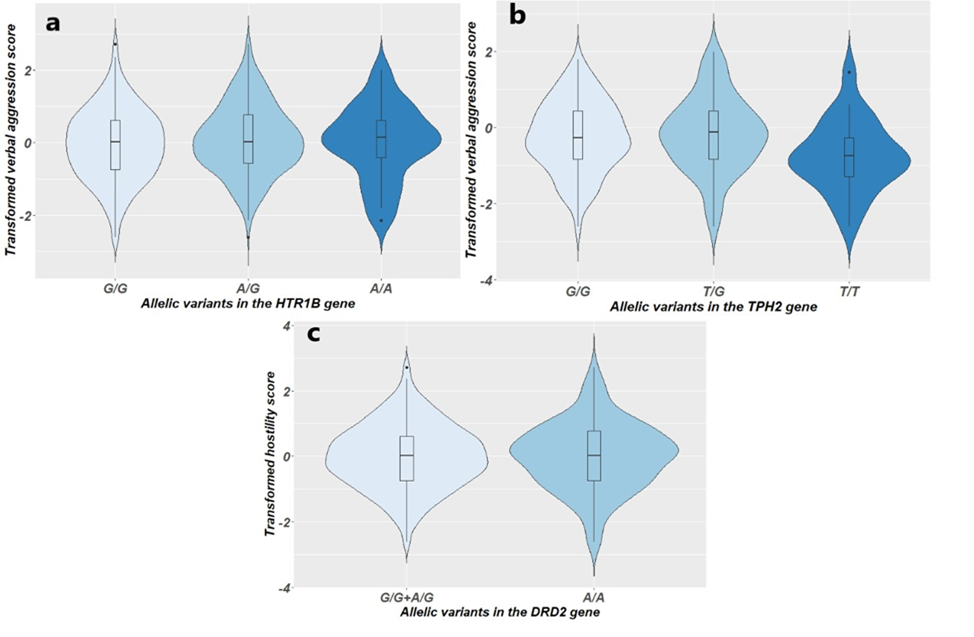
Figure 1. Mean levels of verbal aggression and hostility characteristic for the examined groups of carriers of different allelic variants of rs13212041 in the HTR1B gene in the total sample (a) and of rs4570625 in the TPH2 gene in men (b), rs12364283 in the DRD2 gene in the total sample (c). Brackets indicate the groups with statistically significant differences in the aggression level (* p-value < 0.05)

Figure 2. Violin and regression plots demonstrating statistically significant differences in verbal aggression between the groups of individuals with respect to sex (a), age (b), body mass index (c), birth order (d), paternal care (e) and protection (f), physical activity per week (g), and maternal age at delivery (h).
In addition, verbal aggression was shown to be significantly related to the rs4570625 in the tryptophan hydroxylase 2 gene (TPH2) in men (p = 0.009). According to the abovementioned findings, higher verbal aggression was significantly more frequent in individuals carrying the minor rs13212041 A/G genotype in the HTR1B gene (β = 0.11) compared with those with A/A genotype (Fig. 1, a) and in carriers of the homozygous genotype rs4570625 G/G in the TPH2 gene (β = 0.54) in comparison with those carrying the T-allele (Fig. 1, b).
Subsequently conducted analysis of possible gene-environment interactions, which examines the potential effect of each of 11 genetic loci and social/lifestyle factors on individual variance in aggression level, demonstrated that the most significant linear regression model explained up to 10.1% of variance in verbal aggression (p = 1.2х10-8). This model included the data on the allelic variant rs13212041 in the HTR1B gene and such social parameters as sex (p = 2.9х10-4), age (p = 0.004), body mass index (BMI) (p = 0.042), order of birth (p = 0.017), style of paternal rearing (p = 0.013), the level of physical activity (p = 0.032), and age at maternal delivery (p = 0.012). To be more precise, a higher level of verbal aggression was more characteristic for respondents with present allelic variant G in the HTR1B gene, women, younger respondents, those with enhanced BMI and reduced physical activity, those who being the first-born children in the families, those reared by older mothers, and those who reported a specific unfavorable style of paternal parenting (diminished care and overprotection) (Fig. 2).
3.2. Genetic and social factors underlying hostility
With respect to individual differences in hostility level, we observed the association of this trait with genetic locus rs12364283 in the dopamine type 2 receptor gene (DRD2) in the total sample (p = 0.003), in women (p = 0.023) and in men (p = 0.032). In all groups, higher hostility was statistically more frequent in carriers of the rs12364283 А/A genotype in the DRD2 gene (β = 0.25) compared with G-allele carriers (Fig. 1, c). No associations of genetic loci and BPAQ- measured physical aggression or anger was detected in the present study.
While examining the possible gene-environment interactions explaining individual differences in hostility level, we determined a significant multiple regression model (p = 8.1×10⁻¹⁰), which enabled us to explain a moderate proportion of variance in hostility (up to 4.1%). Namely, a higher level of this aggression subscale was characteristic for carriers of rs12364283 А/A genotype in the DRD2 gene, men, being single children in their family, and being reared by fathers with an overprotective style (PBI- measured) (Fig. 3).
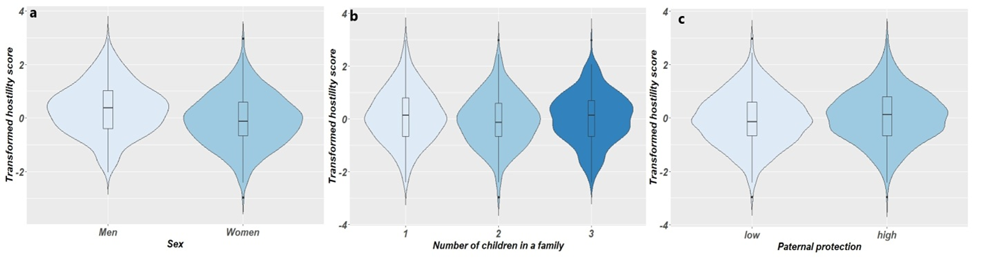
Figure 3. Violin plots demonstrating statistically significant differences in hostility level between the groups of individuals with respect to sex (a), number of children in a family (b), and paternal protection (c).
The data obtained provide evidence of a significant impact of several genetic loci located in serotonergic and dopaminergic system genes on individual differences in such types of aggression as verbal aggression and hostility. Primarily, we detected a link between the presence of the A/G genotype at the genetic locus rs13212041 in the HTR1B gene and increased verbal aggression, while a genetic profile containing the A/A genotype at this locus was associated with a diminished liability to verbal aggression. Published data are congruent with our results, as they also observed a link between the presence of the rs13212041 G-allele and enhanced impulsivity in a same-age sample with a prevailing number of women (Varga et al., 2011). However, opposite findings also exist, demonstrating an opposite effect of the present minor G-allele in the HTR1B gene and reduced aggression in men (Conner et al., 2010). From a molecular point of view, there is a link between reduced expression of the HTR1B gene and the presence of the rs13212041 G-allele (Xia et al., 2020). The HTR1B gene encodes the serotonin receptor type 1B protein, which is responsible for serotonin binding. It should be noted that diminished serotonergic neurotransmission has been repeatedly linked to enhanced aggressive behavior in humans (Paliakkara et al., 2025) and animal models (Kazantseva et al., 2025). In particular, existing studies have reported that the antidepressant fluoxetine attenuated the level of aggression in patients with a history of aggression due to an increase in synaptic serotonin levels (Rosell et al., 2023). Therefore, our findings confirm a link of the low-expression G-allele in the HTR1B gene with exaggerated aggression; however, its relation to such a type of aggressive behavior as verbal aggression was reported for the first time.
Interesting data have been reported by an Italian research group, which revealed a significant modulating effect of the specificity of child-parent relationships on the association of the HTR1B gene with human behavior (Palumbo et al., 2022). These findings to a certain degree coincide with our results, which point to a valuable role of the style of paternal rearing and maternal age at an individual’s birth in predisposing to verbal aggression. In addition, existing data indicate that unfavorable styles of parental rearing, such as overprotection and reduced levels of care, could predispose children to aggressive behavior later in life (Baron & Richardson, 2004). On the other hand, a negative effect of rearing by older mothers on manifesting higher verbal aggression can be explained by a possibly anxiety-related style of maternal rearing (Baron & Richardson, 2004). Moreover, the observed association between higher verbal aggression and younger age, reduced physical activity, and higher BMI appears unsurprising and mimics the results reported for model animals (Picolo et al., 2021) and human adolescents (Holbrook et al., 2020). Interestingly, the effect of birth order on personality traits is known; it is assumed that younger children have fewer responsibilities and are more sociable, high-empathy persons, probably caused by higher tolerance from parents compared with older children (Groshev & Utenysheva, 2015; Kazantseva et al., 2021).
Another interesting observation of the present study is the confirmed association of a genetic locus (rs4570625) in the tryptophan hydroxylase 2 gene (TPH2) with individual variance in verbal aggression in men. Tryptophan hydroxylase 2 represents an enzyme responsible for serotonin synthesis from its precursor tryptophan, which is predominantly expressed in the brain, and therefore represents a significant key element regulating behavior. From a molecular perspective, attenuated expression of the TPH2 gene causes an insignificant amount of synthesized serotonin, which results in enhanced aggressive behavior, impulsivity and anxiety‐related traits (Coccaro et al., 2011). According to the study of molecular editing of the TPH2 gene, its complete knockout (thp2 -/- genetic construct) in mice resulted in a similar aggressive phenotype, which reflects the presence of the TPH2 G/G genotype in humans (Akhrif et al., 2021). Our findings, which testify to declined verbal aggression related to the presence of the rs4570625 A/A genotype in the TPH2 gene in men, completely coincide with a previous study, which reported the same association of the A/A genotype and lower life history of aggression and impulsivity in 25-year-old men (Laas et al., 2017). Overall, our findings evidence a relation between diminished serotonergic neurotransmission and enhanced verbal aggression on the basis of the HTR1B and TPH2 gene polymorphisms.
In the present study, we failed to observe associations between examined genetic variants in the genes encoding molecular participants of monoaminergic pathways and individual differences in physical aggression and anger traits in a cohort of young adults from the Volga-Ural region of Russia. Nevertheless, we detected a significant involvement of the dopaminergic system gene, i.e., the dopamine receptor type 2 gene (DRD2), in hostility level. According to existing data, the examined genetic locus rs12364283 in the DRD2 gene is responsible for differential levels of gene expression. Namely, there is a link between higher dopaminergic neurotransmission and the presence of the G-allele in the DRD2 gene (Zhang et al., 2007). There is a plethora of findings examining the effect of this gene on various addictive behaviors and mental states. The most examined polymorphism in the DRD2 gene is rs1800497 (or Taq1A), which was shown to be exactly located in the ankyrin repeat and kinase domain containing 1 gene (ANKK1) and affected substrate-binding specificity of the gene product (Kazantseva et al., 2011). Our previous results have linked the widely examined DRD2 gene polymorphism to predisposition to alcohol abuse (Faskhutdinova et al., 2008) and approach-related personality traits (Kazantseva et al., 2011). Nevertheless, the analysis of other genetic loci located in the DRD2 gene and affecting the activity and level of the encoded dopamine receptor type 2 is of interest. Previous studies have related the examined rs12364283 in the present study in the DRD2 gene with differences in impulsivity, behavioral inhibition (Hamidovic et al., 2009), harm avoidance (Abrahams et al., 2019), and even the efficacy of sport training (Świtała et al., 2022). Our findings, which demonstrated the effect of the rs12364283 A-allele in the DRD2 gene on enhanced hostility, are congruent with the abovementioned findings, which reported the association of the same allelic variant with high impulsivity. Therefore, the findings obtained confirm the similarity of molecular mechanisms underlying aggression and impulsivity, which are attributed to altered dopaminergic neurotransmission.
It should be mentioned that together with the main effects of the HTR1B, TPH2, and DRD2 gene polymorphisms on developing individual differences in aggressive behavior, the present study demonstrates a significant role of several social/lifestyle parameters with a specific importance of child-parent relationships, number of children in a family, and physical activity. Such gene-environment interactions are non-accidental (Davydova et al., 2020; Kazantseva et al., 2023), since the role of the social environment in modulating gene expression via epigenetic mechanisms is well-established (Mustafin et al., 2019). However, certain epigenetic mechanisms unraveling the development of distinct behavioral traits remain incompletely studied and represent a field for future research.
Conclusions
The obtained findings evidence the involvement of the genes belonging to serotonergic (HTR1B, TPH2) and dopaminergic (DRD2) neurotransmission in the development of individual differences in such subtypes of aggressive behavior as verbal aggression and hostility in young adults from Russia. In accordance with previous studies, we also confirmed a relation of attenuated activity of the serotonergic system (based on serotonin receptor type 1B and tryptophan hydroxylase 2 gene polymorphisms) and increased dopaminergic neurotransmission (based on dopamine receptor type 2 gene variant) and higher aggression level. Interestingly, women were statistically significantly characterized by higher verbal aggression, while men – by enhanced hostility. In addition, constructed mathematical models of verbal aggression and hostility testify to a valuable effect of several social/lifestyle factors (i.e., specificity of rearing and child-parent relationships with a dominating role of paternal style of rearing) together with genetic factors on developing aggression. At the same time, physical activity, i.e., an increased number of physical exercises per week, demonstrates a positive effect on decreasing aggression levels even in genetically predisposed individuals and can be considered as a preventive factor for manifesting aggressive behavior.
Competing interests: The authors state that the study was conducted in the absence of any commercial or financial relationships that could be interpreted as a potential conflict of interest.
Funding: The study was performed within the State Contract №1022040500074-9.
Ethics Statement: The gathering of empirical data was organized in accordance with generally accepted ethical standards. Participants signed an informed consent form before the study. The study was approved by the Bioethical Committee at the Institute of Biochemistry and Genetics – Subdivision of the Ufa Federal Research Centre of the Russian Academy of Sciences (protocol code 15, date of approval, October 12, 2017).
CRediT author statement:
Kazantseva A.V.: conceptualization, methodology, formal analysis, investigation, visualization, preparation of original draft, software; Davydova Y.D.: investigation, resources, formal analysis; Takhirova Z.R.: investigation, resources; Mustafin R.N.: investigation, resources; Malykh S.B.: investigation, resources, validation; Khusnutdinova E.K.: investigation, resources, validation.
The authors have read and approved the final version and are responsible for all aspects of the manuscript.
Acknowledgments: The authors thank all the participants of the study.
References
- Aaron, E., Montgomery, A., Ren, X., Guter, S., Anderson, G., Carneiro, A. M. D., Jacob, S., Mosconi, M., Pandey, G. N., Cook, E., & Veenstra-VanderWeele, J. (2019). Whole blood serotonin levels and platelet 5-HT2A binding in autism spectrum disorder. Journal of Autism and Developmental Disorders, 49(6), 2417–2425. https://doi.org/10.1007/s10803-019-03989-z
- Abrahams, S., McFie, S., Lacerda, M., Patricios, J., Suter, J., September, A. V., & Posthumus, M. (2019). Unravelling the interaction between the DRD2 and DRD4 genes, personality traits and concussion risk. BMJ Open Sport & Exercise Medicine, 5(1), e000465. https://doi.org/10.1136/bmjsem-2018-000465
- Akhrif, A., Roy, A., Peters, K., Lesch, K. P., Romanos, M., Schmitt-Böhrer, A., & Neufang, S. (2021). REVERSE phenotyping—Can the phenotype following constitutive Tph2 gene inactivation in mice be transferred to children and adolescents with and without ADHD? Brain and Behavior,11(5), e02054. https://doi.org/10.1002/brb3.2054
- Alia-Klein, N., Goldstein, R. Z., Kriplani, A., Logan, J., Tomasi, D., Williams, B., Telang, F., Shumay, E., Biegon, A., Craig, I. W., Henn, F., Wang, G. J., Volkow, N. D., & Fowler, J. S. (2008). Brain monoamine oxidase A activity predicts trait aggression. Journal of Neuroscience, 28(19), 5099–5104. https://doi.org/10.1523/JNEUROSCI.0925-08.2008
- Baron, R. A., & Richardson, D. R. (2004). Human aggression. Springer Science & Business Media.
- Borinskaya, S. A., Rubanovich, A. V., Larin, A. K., Kazantseva, A. V., Davydova, Y. D., Generozov, E. V., Khusnutdinova, E. K., & Yankovsky, N. K. (2021). Epigenome-wide association study of CpG methylation in aggressive behavior. Russian Journal of Genetics, 57(12), 1454–1460. https://doi.org/10.1134/S1022795421120048
- Coccaro, E. F., Sripada, C. S., Yanowitch, R. N., & Phan, K. L. (2011). Corticolimbic function in impulsive aggressive behavior. Biological Psychiatry, 69(12), 1153–1159. https://doi.org/10.1016/j.biopsych.2011.02.032
- Conner, T. S., Jensen, K. P., Tennen, H., Furneaux, H. M., Kranzler, H. R., & Covault, J. (2010). Functional polymorphisms in the serotonin 1B receptor gene (HTR1B) predict self-reported anger and hostility among young men. American Journal of Medical Genetics Part B: Neuropsychiatric Genetics, 153B(1), 67–78. https://doi.org/10.1002/ajmg.b.30955
- Davydova, Y., Kazantseva, A., Enikeeva, R., Mustafin, R., Malykh, S., Lobaskova, M., Valinurov, R., Akhmerova, I., & Khusnutdinova, E. (2020). The involvement of hypothalamic-pituitary-adrenal and monoaminergic systems genes in developing aggressive behavior. European Neuropsychopharmacology, 31(S1), S16–S17. https://doi.org/10.1016/j.euroneuro.2019.12.023
- Davydova, Y. D., Kazantseva, A. V., Enikeeva, R. F., Mustafin, R. N., Lobaskova, M. M., Malykh, S. B., Gilyazova, I. R., & Khusnutdinova, E. K. (2020). The role of oxytocin receptor (OXTR) gene polymorphisms in the development of aggressive behavior in healthy individuals. Russian Journal of Genetics, 56(9), 1129–1138. https://doi.org/10.1134/S1022795420090057
- Enikolopov, S. N., & Tsybulskii, N. P. (2007). Psychometric analysis of the Russian version of the questionnaire for the diagnosis of aggression by A. Bass and M. Perry. Psychological Journal, 28(1), 115–124.
- Faskhutdinova, G. G., Kulichkin, S. S., Matveeva, N. P., Gaysina, D. A., Noskova, T. G., Kazantseva, A. V., Zainullina, A. G., Pavlov, F. V., Martynova, T. F., Ruchina, I. L., Podlesnyi, E. V., Nogovitsyna, A. N., Fedorova, S. A., & Khusnutdinova, E. K. (2008). Analysis of dopamine system genes polymorphism in Yakut and Chukchi alcohol-dependent patients. Medical Genetics, 7(4), 1–9.
- Groshev, I. V., & Utenysheva, O. V. (2015). Features of the relationship between the birth order of personality and behavior in conflict. Tambov University Review. Series: Humanities, 6(146), 28–35.
- Hamidovic, A., Dlugos, A., Skol, A., Palmer, A. A., & de Wit, H. (2009). Evaluation of genetic variability in the dopamine receptor D2 in relation to behavioral inhibition and impulsivity/sensation seeking: An exploratory study with d-amphetamine in healthy participants. Experimental and Clinical Psychopharmacology, 17(6), 374–383. https://doi.org/10.1037/a0017840
- Holbrook, H. M., Voller, F., Castellini, G., Silvestri, C., Ricca, V., Cassioli, E., Ivanova, M. Y., & Hudziak, J. J. (2020). Sport participation moderates association between bullying and depressive symptoms in Italian adolescents. Journal of Affective Disorders, 271, 33–38. https://doi.org/10.1016/j.jad.2020.03.142
- Kazantseva, A. V. (2008). Molecular-genetic basis of temperament and personality traits (Publication No. OD 61 09-3/217) [Candidate of Science dissertation, Institute of Biochemistry and Genetics of Ufa Research Center of RAS]. Russian State Library.
- Kazantseva, A., Gaysina, D., Malykh, S., & Khusnutdinova, E. (2011). The role of dopamine transporter (SLC6A3) and dopamine D2 receptor/ankyrin repeat and kinase domain containing 1 (DRD2/ANKK1) gene polymorphisms in personality traits. *Progress in Neuro-Psychopharmacology and Biological Psychiatry, 35*(4), 1033–1040. https://doi.org/10.1016/j.pnpbp.2011.02.013
- Kazantseva, A. V., Malykh, S. B., & Khusnutdinova, E. K. (2016). Molecular-genetic investigations of personality: From candidate genes to genome-wide associations. In S. B. Malykh, Y. V. Kovas, & D. A. Gaysina (Eds.), Behavioral genetics for education (pp. 130–154). Palgrave Macmillan London. https://doi.org/10.1057/9781137437327_8
- Kazantseva, A. V., Davydova, Y. D., Enikeeva, R. F., Valinurov, R. G., Gareeva, A. E., Khusnutdinova, N. N., & Khusnutdinova, E. K. (2021). The association study of polymorphic variants of hypothalamic-pituitary-adrenal system genes (AVPR1B, OXTR) and aggressive behavior manifestation: Focus on social environment. Research Results in Biomedicine, 7(3), 232–244. https://doi.org/10.18413/2658-6533-2021-7-3-0-3
- Kazantseva, A. V., Davydova, Y. D., Enikeeva, R. F., Yakovleva, D. V., Mustafin, R. N., Lobaskova, M. M., Malykh, S. B., & Khusnutdinova, E. K. (2023). Individual variance in human aggression: A combined effect of polygenic score and social/lifestyle factors. Russian Journal of Genetics, 59(Suppl. 2), S227–S236. https://doi.org/10.1134/S1022795423140065
- Kazantseva, A., Bilyalov, A., Filatov, N., Perepechenov, S., & Gusev, O. (2025). Genetic contributions to aggressive behaviour in pigs: A comprehensive review. Genes, 16(5), 534. https://doi.org/10.3390/genes16050534
- Laas, K., Kiive, E., Mäestu, J., Vaht, M., Veidebaum, T., & Harro, J. (2017). Nice guys: Homozygocity for the TPH2 -703G/T (rs4570625) minor allele promotes low aggressiveness and low anxiety. Journal of Affective Disorders, 215, 230–236. https://doi.org/10.1016/j.jad.2017.03.045
- Martin, H., Choi, J. E., Rodrigues, A. R., & Eshel, N. (2024). Review: Dopamine, serotonin, and the translational neuroscience of aggression in autism spectrum disorder. JAACAP Open, 3(1), 29–41. https://doi.org/10.1016/j.jaacop.2024.01.010
- Modestino, E. J., Blum, K., Dennen, C. A., Downs, B. W., Bagchi, D., Llanos-Gomez, L., Elman, I., Baron, D., Thanos, P. K., Badgaiyan, R. D., Braverman, E. R., Gupta, A., Gold, M. S., & Bowirrat, A. (2022). Theorizing the role of dopaminergic polymorphic risk alleles with intermittent explosive disorder (IED), violent/aggressive behavior and addiction: Justification of genetic addiction risk severity (GARS) testing. Journal of Personalized Medicine, 12(12), 1946. https://doi.org/10.3390/jpm12121946
- Mustafin, R. N., Kazantseva, A. V., Enikeeva, R. F., Davydova, Y. D., Karunas, A. S., Malykh, S. B., & Khusnutdinova, E. K. (2019). Epigenetics of aggressive behavior. Russian Journal of Genetics, 55(9), 1051–1060. https://doi.org/10.1134/S1022795419090096
- Paliakkara, J., Ellenberg, S., Ursino, A., Smith, A. A., Evans, J., Strayhorn, J., Faraone, S. V., & Zhang-James, Y. (2025). A systematic review of the etiology and neurobiology of intermittent explosive disorder. Psychiatry Research, 347 116410. https://doi.org/10.1016/j.psychres.2025.116410
- Palumbo, S., Mariotti, V., Vellucci, S., Antonelli, K., Anderson, N., Harenski, C., Pietrini, P., Kiehl, K. A., & Pellegrini, S. (2022). HTR1B genotype and psychopathy: Main effect and interaction with paternal maltreatment. Psychoneuroendocrinology, 144, 105861. https://doi.org/10.1016/j.psyneuen.2022.105861
- Parker, G., Tupling, H., & Brown, L. B. (1979). A parental bonding instrument. British Journal of Medical Psychology, 52(1), 1–10. https://doi.org/10.1111/j.2044-8341.1979.tb02487.x
- Picolo, V. L., Quadros, V. A., Canzian, J., Grisolia, C. K., Goulart, J. T., Pantoja, C., de Bem, A. F., & Rosemberg, D. B. (2021). Short-term high-fat diet induces cognitive decline, aggression, and anxiety-like behavior in adult zebrafish. *Progress in Neuro-Psychopharmacology and Biological Psychiatry, 110*, 110288. https://doi.org/10.1016/j.pnpbp.2021.110288
- Rosell, D. R., Slifstein, M., Thompson, J., Xu, X., Perez-Rodriguez, M. M., McClure, M. M., Hazlett, E. A., New, A. S., Nabulsi, N., Huang, Y., Carson, R. E., Siever, L. S., Abi-Dargham, A., & Koenigsberg, H. W. (2023). Serotonin transporter availability in physically aggressive personality disordered patients: Associations with trait and state aggression, and response to fluoxetine. Psychopharmacology, 240(2), 361–371. https://doi.org/10.1007/s00213-022-06306-2
- Schlüter, T., Winz, O., Henkel, K., Prinz, S., Rademacher, L., Schmaljohann, J., Dautzenberg, K., Cumming, P., Kumakura, Y., Rex, S., Mottaghy, F. M., Gründer, G., & Vernaleken, I. (2013). The impact of dopamine on aggression: an [18F]-FDOPA PET Study in healthy males. Journal of Neuroscience, 33(43), 16889–16896. https://doi.org/10.1523/JNEUROSCI.1398-13.2013
- Świtała, K., Bojarczuk, A., Hajto, J., Piechota, M., Buryta, M., & Leońska-Duniec, A. (2022). Impact of the DRD2 polymorphisms on the effectiveness of the training program. International Journal of Environmental Research and Public Health, 19(9), 4942. https://doi.org/10.3390/ijerph19094942
- Varga, G., Szekely, A., Antal, P., Sarkozy, P., Nemoda, Z., Demetrovics, Z., & Sasvari-Szekely, M. (2011). Additive effects of serotonergic and dopaminergic polymorphisms on trait impulsivity. American Journal of Medical Genetics Part B: Neuropsychiatric Genetics, 156B(3), 281–288. https://doi.org/10.1002/ajmg.b.31160
- Xia, X., Ding, M., Xuan, J. F., Xing, J. X., Pang, H., Yao, J., Wu, X., & Wang, B. J. (2020). Effects of HTR1B 3′ region polymorphisms and functional regions on gene expression regulation. BMCGenetics,21(1), 79. https://doi.org/10.1186/s12863-020-00886-8
- Zhang, Y., Bertolino, A., Fazio, L., Blasi, G., Rampino, A., Romano, R., Lee, M. L., Xiao, T., Papp, A., Wang, D., & Sadée, W. (2007). Polymorphisms in human dopamine D2 receptor gene affect gene expression, splicing, and neuronal activity during working memory. Proceedings of the National Academy of Sciences, 104(51), 20552–20557. https://doi.org/10.1073/pnas.0707106104
Comments (0)
Considering the necessity to identify genetic loci related to differences in aggressive behavior, the present study aimed to estimate a synergetic effect of 11 genes belonging to monoaminergic system and potential social factors in the development of individual differences in aggression level in the cohort of young adults. The study included individuals from the Volga-Ural region of Russia (N = 1307, mean age 20.6 ±1.6 years, 80% women), who underwent a psychological testing using the Buss-Perry Aggression Questionnaire (BPAQ). According to the results of genotyping and statistical analysis, we identified regression models explaining up to 10.1% of variance in verbal aggression (р = 1.2х10-8) and up to 4.1% of variance in hostility (р = 8.1х10-10). Significant predictors of verbal aggression and hostility included genetic loci in the HTR1B and DRD2 genes, sex, age, body mass index and physical activity, sibship size, style of paternal rearing, and maternal age at delivery. The data obtained evidence of a link between a decreased activity of the serotoninergic (based on the HTR1B and TPH2 genes) and dopaminergic systems (based on the DRD2 gene) and enhanced aggression.
1.1. Factors underlying aggression
Aggressive behavior represents a destructive form of social interaction, which is based on both hereditary and environmental factors, including specificity of rearing, micro- and macro-environments, that affect an individual during his ontogenetic development (Kazantseva, 2008). To establish the role of hereditary factors in developing aggression, twin and adoption studies have been carried out, which enabled us to estimate the effect of genetic components at 50–80% on developing this behavioral phenotype (Davydova et al, 2020; Kazantseva, 2008). Such variability is related to a type of aggressive behavior, cultural, and traditional norms, etc. A beginning of the examination of certain molecular systems relative to aggressive behavior was promoted by the discovery of a deletion in the gene encoding for the enzyme, i.e. monoamine oxidase A (MAOA), which is responsible for serotonin degradation, in a family characterized by exaggerated antisocial behavior (Alia-Klein et al., 2008). Subsequently, other research groups sought to confirm the involvement of genetic structural variations in the genes encoding for the members of monoaminergic functioning, mainly dopamine and serotonin neurotransmission (Davydova et al, 2020). Both dopamine and serotonin are produced by a small number of midbrain nuclei, which project through multiple pathways to modulate neural activity throughout the brain (Martin et al., 2024).
1.2. Serotonin and dopamine systems genes
The main proteins and corresponding genes examined with respect to their impact on differences in behavior include the genes encoding for serotonin (HTR2A, HTR1B, HTR3B) and dopamine receptors (DRD1, DRD2), serotonin transporter (SLC6A4), and the enzymes responsible for serotonin biosynthesis from the aminoacid tryptophan (i.e., tryptophan hydroxylases 1 and 2, TPH1, TPH2) and catecholamine degradation (catechol-o-methyltransferase, COMT).
There are many studies describing the effects of serotonin and dopamine neurotransmission on the manifestation of aggressive and antisocial behavior (Paliakkara et al., 2025). One of the key elements in the serotonergic pathway is the serotonin transporter (encoded by the SLC6A4 gene), which regulates serotonin level in the synaptic cleft. Some studies indicate a link between enhanced aggression and greater serotonin transporter availability in brain regions (Rosell et al., 2023), while administration of selective serotonin reuptake inhibitors results in attenuated aggressive behavior in vulnerable individuals (Martin et al., 2024). In turn, hyperserotonemia, which is characterized by exaggerated serotonin levels, is evident in about 30% of individuals with autism spectrum disorder (Aaron et al., 2019), which is frequently accompanied by excessive aggression. It has also been shown that altered dopamine signalling may result in impulsive aggression (Schlüter et al., 2013). For instance, antipsychotics that modify dopamine levels can decrease aggressive phenotypes (Paliakkara et al., 2025), while genetic variations in the DRD2 gene (for example, Taq1A polymorphism) are associated with an enlarged risk for impulsive aggression (Modestino et al., 2022). However, the findings from analyses of specific genetic markers in genes regulating serotonergic and dopaminergic system activity remain inconclusive and warrant further comprehensive investigation.
At a molecular level, differences in gene structure can be attributed to the presence of certain allelic variants of genetic loci in an individual’s genetic profile. The examination of genetic variants (so-called single nucleotide polymorphisms), which are known to be linked to alterations in gene expression, is of specific interest in relation to aggressive behavior. On the other hand, it is well-established that each genetic variant itself explains only a small proportion of variance in behavioral phenotypes (Kazantseva et al., 2016), while a simultaneous analysis of a set of genetic polymorphisms in genes belonging to monoaminergic pathways could demonstrate a more significant impact.
1.3. The role of environmental factors in aggressive behavior
In addition, various social and lifestyle factors, such as specificity of rearing in childhood, presence of maltreatment, and unfavorable rearing conditions, can contribute to the development of aggressive behavior later in life (Baron & Richardson, 2004). Interestingly, the specificity of environmental factors can alter the activity of certain genes, resulting in modified levels and activity of encoded proteins (gene expression). Such modifications without changes in the genetic structure, i.e., epigenetic modifications, can contribute to individual differences in complex phenotypes such as aggressive behavior (Borinskaya et al., 2021). Despite an increasing number of studies involving candidate genes, those that estimate the simultaneous effect of various genes and social factors on differences in aggression remain insufficient. Considering the significant role of genetic and environmental factors in developing aggressive behavior, we aimed to examine whether selected genetic loci in serotonin and dopamine system genes, together with social and lifestyle factors, are involved in the development of individual differences in aggression levels in a cohort of young adults from Russia.
2.1. Participants
The sample of the study was formed within the interview of high school students from the Volga-Ural region (VUR) of Russia aged 18 – 25 years (N = 1307, mean age 20.6 ±1.6 years). In total, enrolled individuals belonged to the main ethnic groups of the VUR, i.e., Russians (N = 438), Tatars (N = 417), Udmurts (N = 287) and respondents of mixed ethnicity (N = 165). The sample mainly consisted of women (80%).
2.2. Procedure
Students at the Universities from the Republic of Bashkortostan and the Udmurt Republic were invited to participate in the scientific study. Those individuals who completed the psychological inventory and socio-demographic questionnaire proceeded to the collection of their biological material (venous blood) by the medical staff. Informed voluntary consents were obtained from all participants of the study. The study was approved by the Bioethical Committee at the Institute of Biochemistry and Genetics – Subdivision of the Ufa Federal Research Centre of the Russian Academy of Sciences (protocol code 15, date of approval, October 12, 2017).
2.3. Methods and equipment
Aggression level was assessed using the Russian version of the Buss-Perry Aggression Questionnaire (BPAQ-29) [11], which consists of 29 items and enables the calculation of both the total aggression score and the subscales: physical aggression (9 items), anger (7 items), hostility (8 items), and verbal aggression (5 items). The Russian version of BPAQ was examined for internal consistency and validity (Cronbach’s alpha for all subscales > 0.69).
Since socio-demographic factors and lifestyle can contribute to a certain proportion of variance in individual aggression level, respondents were asked to fill in a questionnaire, which comprised the items regarding specificity of rearing and child-parent relationships, i.e., abuse in childhood, rearing in a complete/incomplete family, and parenting style. The last one was assessed using the Parental Bonding Instrument (PBI, 25 items) (Parker et al., 1979) separately relative to maternal and paternal styles. The PBI enables the assessment of a degree of “care” (parental warmth toward his/her child) and “protection” (excessive control of actions of his/her child). We have also obtained the data on the number of children in a family, urban/rural residency in childhood, and present/past tobacco smoking. A detailed list and the impact of mentioned social parameters on aggressive behavior are reported in our previous study (Kazantseva et al., 2021).
The molecular-genetic part of the study included a collection of biological material (venous blood) from the volunteers, which proceeded with DNA isolation using standard phenol-chloroform technique. The quality of extracted DNA was examined on a spectrophotometer NanoDrop 1000 (Thermo Fisher Scientific, USA). Genotyping of 11 genetic loci was carried out via real-time polymerase chain reaction (PCR) with competitive allele-specific PCR chemistry (Maxim Medical LLC, LGC Genomics, UK) using a fluorescent approach. The following genetic loci encoding for the proteins involved in the regulation of monoaminergic neurotransmission were selected for the analysis: rs2066713 in the serotonin transporter gene (SLC6A4), rs6314 in the serotonin type 2A receptor gene (HTR2A), rs13212041 and rs6296 in the serotonin type 1B receptor gene (HTR1B), rs1176744 in the serotonin type 3B receptor gene (HTR3B), rs1799913 in the tryptophan hydroxylase 1 gene (TPH1), rs4570625 and rs7305115 in the tryptophan hydroxylase 2 (TPH2), rs686 in the dopamine type 1 receptor gene (DRD1), rs12364283 in the dopamine type 2 receptor gene (DRD2), and rs4680 in catechol-O-methyltransferase (COMT).
Statistical analysis included the assessment of correspondence of observed allele and genotype frequencies of all examined genetic loci to theoretically expected ones according to the Hardy-Weinberg equilibrium (HWE). As a result of this analysis, all analyzed genetic markers were in accordance with the HWE, which enabled us to subsequently use statistical methods to screen for the association between the presence of certain allelic variants in genetic loci and individual levels of BPAQ-measured aggression (together with its subscales). Since raw values of aggression deviated from the normal distribution, we performed a series of mathematical transformations using R v.4.4.2 to achieve correspondence of all quantitative scores of aggression to the Gaussian distribution. Association analysis was carried out using linear regression models with the aggression score being the dependent factor and genetic loci – independent variables (PLINK v. 1.09). In order to determine potential mathematical models based on gene-environment interactions, a series of linear regressions was conducted, which included the data on the presence of a minor allele of genetic loci and all potential social factors as predictors. The backward selection procedure was used to exclude non-significant parameters from the regression models. A final regression model consisted of significant predictors (genetic and social) explaining a certain proportion of variance (based on the determination coefficient, r2) in the total aggression, verbal and physical aggression, anger, and hostility. Statistically significant differences between the groups were considered at p-value < 0.05 (PLINK v.1.09, R v.4.4.2).
2.4. Registration of indicators
The data on social parameters and psychological measurement (BPAQ and PBI) was collected via a battery of psychological tests implemented in the online platform developed by the staff of the Laboratory of Developmental Psychogenetics (Psychological Institute of the Russian Academy of Education).
2.5. Variables
Regression models were based on the following variables: the total aggression score and four aggression subscales were tested as quantitative normally distributed dependent variables, while the presence of a minor allele (an individual genotype contains two minor alleles or one minor and one major allele or two major alleles) was the independent categorical variable encoded as 2, 1, or 0 in accordance with the number of minor alleles of a certain genetic locus. In addition, such social variables as smoking status (present/past smoking or never smoked), number of children in the family or birth order (1, 2, or 3), presence of abuse in childhood, and rearing in a complete/incomplete family were included as independent categorical variables. The scores obtained via PBI were assigned as lower or higher levels of care/protection reflecting a style of maternal and paternal rearing separately, and were assigned to independent categorical variables. At the same time, age (years), maternal age at delivery (years), body mass index (ratio), and quantity of physical exercises per week (numeric variable) were estimated as independent quantitative variables. Since we examined the relation between quantitative traits as a dependent factor and qualitative + quantitative parameters as independent predictors, we used linear regression analyses.
3.1. Genetic and social factors underlying verbal aggression
At the first stage of analysis, we failed to detect any association of examined genetic loci with the total aggression score in the total sample (p > 0.05). However, while examining four aggression subscales, we succeeded in observing the association of the rs13212041 in the serotonin receptor type 1B gene (HTR1B) and verbal aggression in the total sample (p = 0.003) as well as in the women’s group (p = 0.049).
Figure 1. Mean levels of verbal aggression and hostility characteristic for the examined groups of carriers of different allelic variants of rs13212041 in the HTR1B gene in the total sample (a) and of rs4570625 in the TPH2 gene in men (b), rs12364283 in the DRD2 gene in the total sample (c). Brackets indicate the groups with statistically significant differences in the aggression level (* p-value < 0.05)
Figure 2. Violin and regression plots demonstrating statistically significant differences in verbal aggression between the groups of individuals with respect to sex (a), age (b), body mass index (c), birth order (d), paternal care (e) and protection (f), physical activity per week (g), and maternal age at delivery (h).
In addition, verbal aggression was shown to be significantly related to the rs4570625 in the tryptophan hydroxylase 2 gene (TPH2) in men (p = 0.009). According to the abovementioned findings, higher verbal aggression was significantly more frequent in individuals carrying the minor rs13212041 A/G genotype in the HTR1B gene (β = 0.11) compared with those with A/A genotype (Fig. 1, a) and in carriers of the homozygous genotype rs4570625 G/G in the TPH2 gene (β = 0.54) in comparison with those carrying the T-allele (Fig. 1, b).
Subsequently conducted analysis of possible gene-environment interactions, which examines the potential effect of each of 11 genetic loci and social/lifestyle factors on individual variance in aggression level, demonstrated that the most significant linear regression model explained up to 10.1% of variance in verbal aggression (p = 1.2х10-8). This model included the data on the allelic variant rs13212041 in the HTR1B gene and such social parameters as sex (p = 2.9х10-4), age (p = 0.004), body mass index (BMI) (p = 0.042), order of birth (p = 0.017), style of paternal rearing (p = 0.013), the level of physical activity (p = 0.032), and age at maternal delivery (p = 0.012). To be more precise, a higher level of verbal aggression was more characteristic for respondents with present allelic variant G in the HTR1B gene, women, younger respondents, those with enhanced BMI and reduced physical activity, those who being the first-born children in the families, those reared by older mothers, and those who reported a specific unfavorable style of paternal parenting (diminished care and overprotection) (Fig. 2).
3.2. Genetic and social factors underlying hostility
With respect to individual differences in hostility level, we observed the association of this trait with genetic locus rs12364283 in the dopamine type 2 receptor gene (DRD2) in the total sample (p = 0.003), in women (p = 0.023) and in men (p = 0.032). In all groups, higher hostility was statistically more frequent in carriers of the rs12364283 А/A genotype in the DRD2 gene (β = 0.25) compared with G-allele carriers (Fig. 1, c). No associations of genetic loci and BPAQ- measured physical aggression or anger was detected in the present study.
While examining the possible gene-environment interactions explaining individual differences in hostility level, we determined a significant multiple regression model (p = 8.1×10⁻¹⁰), which enabled us to explain a moderate proportion of variance in hostility (up to 4.1%). Namely, a higher level of this aggression subscale was characteristic for carriers of rs12364283 А/A genotype in the DRD2 gene, men, being single children in their family, and being reared by fathers with an overprotective style (PBI- measured) (Fig. 3).
Figure 3. Violin plots demonstrating statistically significant differences in hostility level between the groups of individuals with respect to sex (a), number of children in a family (b), and paternal protection (c).
The data obtained provide evidence of a significant impact of several genetic loci located in serotonergic and dopaminergic system genes on individual differences in such types of aggression as verbal aggression and hostility. Primarily, we detected a link between the presence of the A/G genotype at the genetic locus rs13212041 in the HTR1B gene and increased verbal aggression, while a genetic profile containing the A/A genotype at this locus was associated with a diminished liability to verbal aggression. Published data are congruent with our results, as they also observed a link between the presence of the rs13212041 G-allele and enhanced impulsivity in a same-age sample with a prevailing number of women (Varga et al., 2011). However, opposite findings also exist, demonstrating an opposite effect of the present minor G-allele in the HTR1B gene and reduced aggression in men (Conner et al., 2010). From a molecular point of view, there is a link between reduced expression of the HTR1B gene and the presence of the rs13212041 G-allele (Xia et al., 2020). The HTR1B gene encodes the serotonin receptor type 1B protein, which is responsible for serotonin binding. It should be noted that diminished serotonergic neurotransmission has been repeatedly linked to enhanced aggressive behavior in humans (Paliakkara et al., 2025) and animal models (Kazantseva et al., 2025). In particular, existing studies have reported that the antidepressant fluoxetine attenuated the level of aggression in patients with a history of aggression due to an increase in synaptic serotonin levels (Rosell et al., 2023). Therefore, our findings confirm a link of the low-expression G-allele in the HTR1B gene with exaggerated aggression; however, its relation to such a type of aggressive behavior as verbal aggression was reported for the first time.
Interesting data have been reported by an Italian research group, which revealed a significant modulating effect of the specificity of child-parent relationships on the association of the HTR1B gene with human behavior (Palumbo et al., 2022). These findings to a certain degree coincide with our results, which point to a valuable role of the style of paternal rearing and maternal age at an individual’s birth in predisposing to verbal aggression. In addition, existing data indicate that unfavorable styles of parental rearing, such as overprotection and reduced levels of care, could predispose children to aggressive behavior later in life (Baron & Richardson, 2004). On the other hand, a negative effect of rearing by older mothers on manifesting higher verbal aggression can be explained by a possibly anxiety-related style of maternal rearing (Baron & Richardson, 2004). Moreover, the observed association between higher verbal aggression and younger age, reduced physical activity, and higher BMI appears unsurprising and mimics the results reported for model animals (Picolo et al., 2021) and human adolescents (Holbrook et al., 2020). Interestingly, the effect of birth order on personality traits is known; it is assumed that younger children have fewer responsibilities and are more sociable, high-empathy persons, probably caused by higher tolerance from parents compared with older children (Groshev & Utenysheva, 2015; Kazantseva et al., 2021).
Another interesting observation of the present study is the confirmed association of a genetic locus (rs4570625) in the tryptophan hydroxylase 2 gene (TPH2) with individual variance in verbal aggression in men. Tryptophan hydroxylase 2 represents an enzyme responsible for serotonin synthesis from its precursor tryptophan, which is predominantly expressed in the brain, and therefore represents a significant key element regulating behavior. From a molecular perspective, attenuated expression of the TPH2 gene causes an insignificant amount of synthesized serotonin, which results in enhanced aggressive behavior, impulsivity and anxiety‐related traits (Coccaro et al., 2011). According to the study of molecular editing of the TPH2 gene, its complete knockout (thp2 -/- genetic construct) in mice resulted in a similar aggressive phenotype, which reflects the presence of the TPH2 G/G genotype in humans (Akhrif et al., 2021). Our findings, which testify to declined verbal aggression related to the presence of the rs4570625 A/A genotype in the TPH2 gene in men, completely coincide with a previous study, which reported the same association of the A/A genotype and lower life history of aggression and impulsivity in 25-year-old men (Laas et al., 2017). Overall, our findings evidence a relation between diminished serotonergic neurotransmission and enhanced verbal aggression on the basis of the HTR1B and TPH2 gene polymorphisms.
In the present study, we failed to observe associations between examined genetic variants in the genes encoding molecular participants of monoaminergic pathways and individual differences in physical aggression and anger traits in a cohort of young adults from the Volga-Ural region of Russia. Nevertheless, we detected a significant involvement of the dopaminergic system gene, i.e., the dopamine receptor type 2 gene (DRD2), in hostility level. According to existing data, the examined genetic locus rs12364283 in the DRD2 gene is responsible for differential levels of gene expression. Namely, there is a link between higher dopaminergic neurotransmission and the presence of the G-allele in the DRD2 gene (Zhang et al., 2007). There is a plethora of findings examining the effect of this gene on various addictive behaviors and mental states. The most examined polymorphism in the DRD2 gene is rs1800497 (or Taq1A), which was shown to be exactly located in the ankyrin repeat and kinase domain containing 1 gene (ANKK1) and affected substrate-binding specificity of the gene product (Kazantseva et al., 2011). Our previous results have linked the widely examined DRD2 gene polymorphism to predisposition to alcohol abuse (Faskhutdinova et al., 2008) and approach-related personality traits (Kazantseva et al., 2011). Nevertheless, the analysis of other genetic loci located in the DRD2 gene and affecting the activity and level of the encoded dopamine receptor type 2 is of interest. Previous studies have related the examined rs12364283 in the present study in the DRD2 gene with differences in impulsivity, behavioral inhibition (Hamidovic et al., 2009), harm avoidance (Abrahams et al., 2019), and even the efficacy of sport training (Świtała et al., 2022). Our findings, which demonstrated the effect of the rs12364283 A-allele in the DRD2 gene on enhanced hostility, are congruent with the abovementioned findings, which reported the association of the same allelic variant with high impulsivity. Therefore, the findings obtained confirm the similarity of molecular mechanisms underlying aggression and impulsivity, which are attributed to altered dopaminergic neurotransmission.
It should be mentioned that together with the main effects of the HTR1B, TPH2, and DRD2 gene polymorphisms on developing individual differences in aggressive behavior, the present study demonstrates a significant role of several social/lifestyle parameters with a specific importance of child-parent relationships, number of children in a family, and physical activity. Such gene-environment interactions are non-accidental (Davydova et al., 2020; Kazantseva et al., 2023), since the role of the social environment in modulating gene expression via epigenetic mechanisms is well-established (Mustafin et al., 2019). However, certain epigenetic mechanisms unraveling the development of distinct behavioral traits remain incompletely studied and represent a field for future research.
The obtained findings evidence the involvement of the genes belonging to serotonergic (HTR1B, TPH2) and dopaminergic (DRD2) neurotransmission in the development of individual differences in such subtypes of aggressive behavior as verbal aggression and hostility in young adults from Russia. In accordance with previous studies, we also confirmed a relation of attenuated activity of the serotonergic system (based on serotonin receptor type 1B and tryptophan hydroxylase 2 gene polymorphisms) and increased dopaminergic neurotransmission (based on dopamine receptor type 2 gene variant) and higher aggression level. Interestingly, women were statistically significantly characterized by higher verbal aggression, while men – by enhanced hostility. In addition, constructed mathematical models of verbal aggression and hostility testify to a valuable effect of several social/lifestyle factors (i.e., specificity of rearing and child-parent relationships with a dominating role of paternal style of rearing) together with genetic factors on developing aggression. At the same time, physical activity, i.e., an increased number of physical exercises per week, demonstrates a positive effect on decreasing aggression levels even in genetically predisposed individuals and can be considered as a preventive factor for manifesting aggressive behavior.
Competing interests: The authors state that the study was conducted in the absence of any commercial or financial relationships that could be interpreted as a potential conflict of interest.
Funding: The study was performed within the State Contract №1022040500074-9.
Ethics Statement: The gathering of empirical data was organized in accordance with generally accepted ethical standards. Participants signed an informed consent form before the study. The study was approved by the Bioethical Committee at the Institute of Biochemistry and Genetics – Subdivision of the Ufa Federal Research Centre of the Russian Academy of Sciences (protocol code 15, date of approval, October 12, 2017).
CRediT author statement:
Kazantseva A.V.: conceptualization, methodology, formal analysis, investigation, visualization, preparation of original draft, software; Davydova Y.D.: investigation, resources, formal analysis; Takhirova Z.R.: investigation, resources; Mustafin R.N.: investigation, resources; Malykh S.B.: investigation, resources, validation; Khusnutdinova E.K.: investigation, resources, validation.
The authors have read and approved the final version and are responsible for all aspects of the manuscript.
Acknowledgments: The authors thank all the participants of the study.
- Aaron, E., Montgomery, A., Ren, X., Guter, S., Anderson, G., Carneiro, A. M. D., Jacob, S., Mosconi, M., Pandey, G. N., Cook, E., & Veenstra-VanderWeele, J. (2019). Whole blood serotonin levels and platelet 5-HT2A binding in autism spectrum disorder. Journal of Autism and Developmental Disorders, 49(6), 2417–2425. https://doi.org/10.1007/s10803-019-03989-z
- Abrahams, S., McFie, S., Lacerda, M., Patricios, J., Suter, J., September, A. V., & Posthumus, M. (2019). Unravelling the interaction between the DRD2 and DRD4 genes, personality traits and concussion risk. BMJ Open Sport & Exercise Medicine, 5(1), e000465. https://doi.org/10.1136/bmjsem-2018-000465
- Akhrif, A., Roy, A., Peters, K., Lesch, K. P., Romanos, M., Schmitt-Böhrer, A., & Neufang, S. (2021). REVERSE phenotyping—Can the phenotype following constitutive Tph2 gene inactivation in mice be transferred to children and adolescents with and without ADHD? Brain and Behavior,11(5), e02054. https://doi.org/10.1002/brb3.2054
- Alia-Klein, N., Goldstein, R. Z., Kriplani, A., Logan, J., Tomasi, D., Williams, B., Telang, F., Shumay, E., Biegon, A., Craig, I. W., Henn, F., Wang, G. J., Volkow, N. D., & Fowler, J. S. (2008). Brain monoamine oxidase A activity predicts trait aggression. Journal of Neuroscience, 28(19), 5099–5104. https://doi.org/10.1523/JNEUROSCI.0925-08.2008
- Baron, R. A., & Richardson, D. R. (2004). Human aggression. Springer Science & Business Media.
- Borinskaya, S. A., Rubanovich, A. V., Larin, A. K., Kazantseva, A. V., Davydova, Y. D., Generozov, E. V., Khusnutdinova, E. K., & Yankovsky, N. K. (2021). Epigenome-wide association study of CpG methylation in aggressive behavior. Russian Journal of Genetics, 57(12), 1454–1460. https://doi.org/10.1134/S1022795421120048
- Coccaro, E. F., Sripada, C. S., Yanowitch, R. N., & Phan, K. L. (2011). Corticolimbic function in impulsive aggressive behavior. Biological Psychiatry, 69(12), 1153–1159. https://doi.org/10.1016/j.biopsych.2011.02.032
- Conner, T. S., Jensen, K. P., Tennen, H., Furneaux, H. M., Kranzler, H. R., & Covault, J. (2010). Functional polymorphisms in the serotonin 1B receptor gene (HTR1B) predict self-reported anger and hostility among young men. American Journal of Medical Genetics Part B: Neuropsychiatric Genetics, 153B(1), 67–78. https://doi.org/10.1002/ajmg.b.30955
- Davydova, Y., Kazantseva, A., Enikeeva, R., Mustafin, R., Malykh, S., Lobaskova, M., Valinurov, R., Akhmerova, I., & Khusnutdinova, E. (2020). The involvement of hypothalamic-pituitary-adrenal and monoaminergic systems genes in developing aggressive behavior. European Neuropsychopharmacology, 31(S1), S16–S17. https://doi.org/10.1016/j.euroneuro.2019.12.023
- Davydova, Y. D., Kazantseva, A. V., Enikeeva, R. F., Mustafin, R. N., Lobaskova, M. M., Malykh, S. B., Gilyazova, I. R., & Khusnutdinova, E. K. (2020). The role of oxytocin receptor (OXTR) gene polymorphisms in the development of aggressive behavior in healthy individuals. Russian Journal of Genetics, 56(9), 1129–1138. https://doi.org/10.1134/S1022795420090057
- Enikolopov, S. N., & Tsybulskii, N. P. (2007). Psychometric analysis of the Russian version of the questionnaire for the diagnosis of aggression by A. Bass and M. Perry. Psychological Journal, 28(1), 115–124.
- Faskhutdinova, G. G., Kulichkin, S. S., Matveeva, N. P., Gaysina, D. A., Noskova, T. G., Kazantseva, A. V., Zainullina, A. G., Pavlov, F. V., Martynova, T. F., Ruchina, I. L., Podlesnyi, E. V., Nogovitsyna, A. N., Fedorova, S. A., & Khusnutdinova, E. K. (2008). Analysis of dopamine system genes polymorphism in Yakut and Chukchi alcohol-dependent patients. Medical Genetics, 7(4), 1–9.
- Groshev, I. V., & Utenysheva, O. V. (2015). Features of the relationship between the birth order of personality and behavior in conflict. Tambov University Review. Series: Humanities, 6(146), 28–35.
- Hamidovic, A., Dlugos, A., Skol, A., Palmer, A. A., & de Wit, H. (2009). Evaluation of genetic variability in the dopamine receptor D2 in relation to behavioral inhibition and impulsivity/sensation seeking: An exploratory study with d-amphetamine in healthy participants. Experimental and Clinical Psychopharmacology, 17(6), 374–383. https://doi.org/10.1037/a0017840
- Holbrook, H. M., Voller, F., Castellini, G., Silvestri, C., Ricca, V., Cassioli, E., Ivanova, M. Y., & Hudziak, J. J. (2020). Sport participation moderates association between bullying and depressive symptoms in Italian adolescents. Journal of Affective Disorders, 271, 33–38. https://doi.org/10.1016/j.jad.2020.03.142
- Kazantseva, A. V. (2008). Molecular-genetic basis of temperament and personality traits (Publication No. OD 61 09-3/217) [Candidate of Science dissertation, Institute of Biochemistry and Genetics of Ufa Research Center of RAS]. Russian State Library.
- Kazantseva, A., Gaysina, D., Malykh, S., & Khusnutdinova, E. (2011). The role of dopamine transporter (SLC6A3) and dopamine D2 receptor/ankyrin repeat and kinase domain containing 1 (DRD2/ANKK1) gene polymorphisms in personality traits. *Progress in Neuro-Psychopharmacology and Biological Psychiatry, 35*(4), 1033–1040. https://doi.org/10.1016/j.pnpbp.2011.02.013
- Kazantseva, A. V., Malykh, S. B., & Khusnutdinova, E. K. (2016). Molecular-genetic investigations of personality: From candidate genes to genome-wide associations. In S. B. Malykh, Y. V. Kovas, & D. A. Gaysina (Eds.), Behavioral genetics for education (pp. 130–154). Palgrave Macmillan London. https://doi.org/10.1057/9781137437327_8
- Kazantseva, A. V., Davydova, Y. D., Enikeeva, R. F., Valinurov, R. G., Gareeva, A. E., Khusnutdinova, N. N., & Khusnutdinova, E. K. (2021). The association study of polymorphic variants of hypothalamic-pituitary-adrenal system genes (AVPR1B, OXTR) and aggressive behavior manifestation: Focus on social environment. Research Results in Biomedicine, 7(3), 232–244. https://doi.org/10.18413/2658-6533-2021-7-3-0-3
- Kazantseva, A. V., Davydova, Y. D., Enikeeva, R. F., Yakovleva, D. V., Mustafin, R. N., Lobaskova, M. M., Malykh, S. B., & Khusnutdinova, E. K. (2023). Individual variance in human aggression: A combined effect of polygenic score and social/lifestyle factors. Russian Journal of Genetics, 59(Suppl. 2), S227–S236. https://doi.org/10.1134/S1022795423140065
- Kazantseva, A., Bilyalov, A., Filatov, N., Perepechenov, S., & Gusev, O. (2025). Genetic contributions to aggressive behaviour in pigs: A comprehensive review. Genes, 16(5), 534. https://doi.org/10.3390/genes16050534
- Laas, K., Kiive, E., Mäestu, J., Vaht, M., Veidebaum, T., & Harro, J. (2017). Nice guys: Homozygocity for the TPH2 -703G/T (rs4570625) minor allele promotes low aggressiveness and low anxiety. Journal of Affective Disorders, 215, 230–236. https://doi.org/10.1016/j.jad.2017.03.045
- Martin, H., Choi, J. E., Rodrigues, A. R., & Eshel, N. (2024). Review: Dopamine, serotonin, and the translational neuroscience of aggression in autism spectrum disorder. JAACAP Open, 3(1), 29–41. https://doi.org/10.1016/j.jaacop.2024.01.010
- Modestino, E. J., Blum, K., Dennen, C. A., Downs, B. W., Bagchi, D., Llanos-Gomez, L., Elman, I., Baron, D., Thanos, P. K., Badgaiyan, R. D., Braverman, E. R., Gupta, A., Gold, M. S., & Bowirrat, A. (2022). Theorizing the role of dopaminergic polymorphic risk alleles with intermittent explosive disorder (IED), violent/aggressive behavior and addiction: Justification of genetic addiction risk severity (GARS) testing. Journal of Personalized Medicine, 12(12), 1946. https://doi.org/10.3390/jpm12121946
- Mustafin, R. N., Kazantseva, A. V., Enikeeva, R. F., Davydova, Y. D., Karunas, A. S., Malykh, S. B., & Khusnutdinova, E. K. (2019). Epigenetics of aggressive behavior. Russian Journal of Genetics, 55(9), 1051–1060. https://doi.org/10.1134/S1022795419090096
- Paliakkara, J., Ellenberg, S., Ursino, A., Smith, A. A., Evans, J., Strayhorn, J., Faraone, S. V., & Zhang-James, Y. (2025). A systematic review of the etiology and neurobiology of intermittent explosive disorder. Psychiatry Research, 347 116410. https://doi.org/10.1016/j.psychres.2025.116410
- Palumbo, S., Mariotti, V., Vellucci, S., Antonelli, K., Anderson, N., Harenski, C., Pietrini, P., Kiehl, K. A., & Pellegrini, S. (2022). HTR1B genotype and psychopathy: Main effect and interaction with paternal maltreatment. Psychoneuroendocrinology, 144, 105861. https://doi.org/10.1016/j.psyneuen.2022.105861
- Parker, G., Tupling, H., & Brown, L. B. (1979). A parental bonding instrument. British Journal of Medical Psychology, 52(1), 1–10. https://doi.org/10.1111/j.2044-8341.1979.tb02487.x
- Picolo, V. L., Quadros, V. A., Canzian, J., Grisolia, C. K., Goulart, J. T., Pantoja, C., de Bem, A. F., & Rosemberg, D. B. (2021). Short-term high-fat diet induces cognitive decline, aggression, and anxiety-like behavior in adult zebrafish. *Progress in Neuro-Psychopharmacology and Biological Psychiatry, 110*, 110288. https://doi.org/10.1016/j.pnpbp.2021.110288
- Rosell, D. R., Slifstein, M., Thompson, J., Xu, X., Perez-Rodriguez, M. M., McClure, M. M., Hazlett, E. A., New, A. S., Nabulsi, N., Huang, Y., Carson, R. E., Siever, L. S., Abi-Dargham, A., & Koenigsberg, H. W. (2023). Serotonin transporter availability in physically aggressive personality disordered patients: Associations with trait and state aggression, and response to fluoxetine. Psychopharmacology, 240(2), 361–371. https://doi.org/10.1007/s00213-022-06306-2
- Schlüter, T., Winz, O., Henkel, K., Prinz, S., Rademacher, L., Schmaljohann, J., Dautzenberg, K., Cumming, P., Kumakura, Y., Rex, S., Mottaghy, F. M., Gründer, G., & Vernaleken, I. (2013). The impact of dopamine on aggression: an [18F]-FDOPA PET Study in healthy males. Journal of Neuroscience, 33(43), 16889–16896. https://doi.org/10.1523/JNEUROSCI.1398-13.2013
- Świtała, K., Bojarczuk, A., Hajto, J., Piechota, M., Buryta, M., & Leońska-Duniec, A. (2022). Impact of the DRD2 polymorphisms on the effectiveness of the training program. International Journal of Environmental Research and Public Health, 19(9), 4942. https://doi.org/10.3390/ijerph19094942
- Varga, G., Szekely, A., Antal, P., Sarkozy, P., Nemoda, Z., Demetrovics, Z., & Sasvari-Szekely, M. (2011). Additive effects of serotonergic and dopaminergic polymorphisms on trait impulsivity. American Journal of Medical Genetics Part B: Neuropsychiatric Genetics, 156B(3), 281–288. https://doi.org/10.1002/ajmg.b.31160
- Xia, X., Ding, M., Xuan, J. F., Xing, J. X., Pang, H., Yao, J., Wu, X., & Wang, B. J. (2020). Effects of HTR1B 3′ region polymorphisms and functional regions on gene expression regulation. BMCGenetics,21(1), 79. https://doi.org/10.1186/s12863-020-00886-8
- Zhang, Y., Bertolino, A., Fazio, L., Blasi, G., Rampino, A., Romano, R., Lee, M. L., Xiao, T., Papp, A., Wang, D., & Sadée, W. (2007). Polymorphisms in human dopamine D2 receptor gene affect gene expression, splicing, and neuronal activity during working memory. Proceedings of the National Academy of Sciences, 104(51), 20552–20557. https://doi.org/10.1073/pnas.0707106104
References