
Measuring Temperament-Dependent Preferences in Personal Environment: A Pilot and Validation Study of the SEP-STQ
Abstract
Abstract
Background and Problem. This psychometric paper summarizes the development and validation of a novel English-language questionnaire (SEP-STQ) measuring temperament through an assessment of Specialized Extended Phenotype (SEP). The SEP-STQ uses the 12-component design of the Compact version of the Structure of Temperament Questionnaire (STQ-77), which is based on the neurochemical framework Functional Ensemble of Temperament (FET). The SEP-STQ items capture biographical aspects and environmental preferences. Using a Canadian sample of N = 1220 (M/F/Other = 216/982/22, age 17–46), the pilot version of the SEP-STQ with 199 items was updated after psychometric analysis to the final version with 36 items per scale, except the Impulsivity scale (which has 30 items), with 140 items in total and 12 temperament scales. Findings of highly significant correlations between SEP-STQ scales and corresponding STQ-77 scales demonstrates the SEP-STQ has concurrent validity. Exploratory factor analytic findings of sufficiently similar activity-specific factor structure of the SEP-STQ to the STQ-77’s suggest the SEP-STQ has structural validity, although confirmatory factor analysis needs to be conducted to strengthen this claim. Results suggest the SEP-STQ is measuring the same construct as the STQ-77, and so may be used as a supplement to the STQ-77 to screen for temperament in terms of environmental preference.
Introduction
“Temperament” refers to neurobiologically based individual differences in behaviour present at birth and stable across the lifespan (Rusalov, 1979, 1985; Rusalov & Trofimova, 2007; Trofimova, 2016). As such, temperament is distinct from personality, the study of individual differences shaped by sociocultural factors (Trofimova et al., 2018). Given the posited neurobiological basis of temperament, it is important to have instruments which incorporate findings from neurobiological research on behaviour. The Structure of Temperament Questionnaire-Compact (STQ-77) (Rusalov & Trofimova, 2007; Trofimova & Sulis, 2011) is such an instrument. Unlike other measures of temperament, the STQ-77 was initially developed from neurophysiological studies on adults.
The STQ-77 is a self-report measure of temperament in adults that assesses temperament according to the neurochemical framework Functional Ensemble of Temperament (FET; Trofimova, 2016; Trofimova & Gaykalova, 2020; Trofimova & Robbins, 2016). The FET builds on Luria’s (1962) theory of the 3-block model (information-sensory block, programming block, and energetic block) of the neuroanatomic functional systems that regulate human behavior. The FET also builds on Rusalov’s (1989, 2004) organization of temperament traits according to activity type (physical-motor, social-verbal, mental) to reflect how each type is regulated by different neurophysiological systems. The original Structure of Temperament Questionnaire (STQ) (Rusalov, 1989, 1997, 2004; Rusalov & Trofimova, 2007) was created by Rusalov to psychometrically assess a functional and activity-specific neurological model of temperament in adults.
Substantial empirical evidence provides strong support for the psychometric strength of the STQ, thereby providing indirect evidence of the psychometric strength of its revised version: the Structure of Temperament Questionnaire-Compact (STQ-77). For construct validity, see Rusalov (1979, 1989) and Rusalov and Trofimova (2007). For concurrent validity, see Beere and Pica (1995); Dumenci (1995); Rathee and Singh (2001); Trofimova (1999, 2009); and Zin’ko (2006). For reliability, internal consistency, and factor structure, see Bishop and Hertenstrein (2004); Bishop et al. (1993); Dumenci (1995); Rusalov (1997, 2004); Rusalov and Trofimova (2007); and Stough et al. (1991).
Irina Trofimova revised Rusalov’s model to include links to neurotransmitter systems and introduced the notion of “functional constructivism” to derive the Functional Ensemble of Temperament model (FET). Drawing from the constructivist view of behaviour as uniquely constructed each time it is enacted (for review see Trofimova, 2017; Trofimova, 2021a; Trofimova, 2021b), functional constructivism applies this view to the classification of neurochemical systems according to their roles in the stages of behaviour construction (Trofimova & Gaykalova, 2021).
The FET thus classifies neurochemical systems and their corresponding temperamental traits into three stages of action construction: energetic, dynamic, and orientational (Trofimova, 2021b). In addition, the FET also classifies traits according to activity type (intellectual, physical, social-verbal, emotional). The STQ-77, a revision of the STQ, was developed to reflect this updated model. Studies have found satisfactory four-factor fit for the STQ-77 corresponding to the activity-specific organization of the FET model (physical, social, intellectual, and emotional), with CFI > .9, RMSEA < .07, and RMSR < .06 (Rusalov & Trofimova, 2007; Trofimova, 2010a) and high reliability of STQ-77 scales (α = 0.70–0.86) (Trofimova & Sulis, 2010b). The STQ-77 shows good construct, concurrent, and discriminatory validity as evidenced by significant correlations with the following: the Beck Anxiety Inventory (Trofimova & Sulis, 2016a); the NEO-FFI (Trofimova, 2010a); EEG studies (Almayev et al., 2024); the Eysenck Personality Questionnaire (Trofimova & Araki, 2022); the Hamilton Depression Inventory (Trofimova & Sulis, 2016b); the I7 Impulsiveness Questionnaire (Trofimova & Sulis, 2011); the Motivation in Achievements/Aspiration level scale (Trofimova, 2010b); the Pavlovian Temperamental Survey (Rusalov & Trofimova, 2011; Trofimova, 2010b; Trofimova & Araki, 2022); the Personality Assessment Inventory (Trofimova & Christiansen, 2016); psychotic disorders (Zvereva et al., 2020); the Rotter Locus of Control Scale (Rusalov & Trofimova, 2011; Trofimova, 2010b; Trofimova & Sulis, 2011); speed of performance in mental activities (Trofimova, 2010b; Trofimova & Sulis, 2011); speed of verbal processing (Rusalov & Trofimova, 2011); the State-Trait Anxiety Inventory (Trofimova & Sulis, 2016a); Symptom Checklist (Trofimova & Sulis, 2016b); the Zuckerman Sensation Seeking Scales (Trofimova, 2010a); and grades in relevant high school subjects (Trofimova & Sulis, 2011).
While the STQ-77 meets the need for a neurobiologically grounded, psychometrically valid measure of temperament in adults, there remains a need for a psychometric instrument that captures how personal environment is entangled with temperament. According to Specialized Extended Phenotype (SEP) theory (Trofimova, 2021b), an individual’s personal environment or “Specialized Extended Phenotype” (SEP) can be thought of as an “extension” of their body––a space they construct to support their individual-specific, neurochemically based temperament. SEP theory draws on Dawkins’ (1982) theory of extended phenotype. According to Dawkins, genes “extend” their phenotype outside the body of their host to ensure survival. Examples of this can be seen in the dams that beavers build or the nests termites construct (Dawkins, 1982). Theories from developmental psychology (e.g. “goodness-of-fit,” Thomas & Chess, 1984), personality psychology (e.g. “situational selection,” Rauthmann et al., 2015), and behavioural genetics (Plomin & Bergeman, 1991) also predict correlations between biologically based individual differences and personal environment. Yet, despite multiple theories predicting these correlations, currently no single psychometric measure has been developed to capture the entanglement between neurochemically based temperament and personal environment in adults.
This study aims to develop a psychometrically valid instrument (the SEP-STQ) that assesses neurochemically based temperament in terms of controllable features of an individual’s personal environment. To do this, the SEP-STQ will be developed such that it demonstrates concurrent and structural validity with the already established STQ-77. Accordingly, the objectives of this study are to: (1) develop a comprehensive pool of items identifying controllable features of personal environment; (2) infer how these items might associate with STQ-77 scales; (3) select highest correlating items for inclusion on SEP-STQ scales of the final version; and (4) test this version for concurrent and structural validity with the STQ-77. Our two hypotheses for this study are:
(H1): The SEP-STQ has sufficient concurrent validity by high correlations between the 12 SEP-STQ scales and corresponding 12 STQ-77 scales;
(H2): The SEP-STQ has a sufficiently similar factor structure to the STQ-77. In other words, the SEP-STQ factor structure will reflect the FET’s activity-specific approach to temperament, differentiating between the emotional, physical, social, and probabilistic (intellectual) aspects of behaviour.
Method
2.1. Sample
The initial sample consisted of N = 2322 participants recruited from introductory psychology courses at McMaster University. Participants received course credit for participating. No exclusion criteria, other than being fit to fill out the surveys without assistance, were applied. After removal of participants due to incompleteness (N = 1024), duplicates (N = 55), and low validity (N = 23; STQ-77 Validity score > 13), the final sample was N = 1220 participants (M/F/Others = 216/982/22); Age range 17–46 (Mean = 18.6, SD =1.74). All participants signed a consent form prior to participating and a debriefing form after. This study was approved by the Hamilton Integrated Research Ethics Board.
2.2. Measures
Demographics Form
All participants completed a brief demographics form regarding age, gender, and education status.
Structure of Temperament Questionnaire-Compact (STQ-77)
The STQ-77 (Rusalov & Trofimova, 2007) consists of 77 statements, which are equally distributed across 12 temperament scales (6 items each) and a validity scale (5 items). Participants answer using a 4-scale Likert format: “strongly disagree (1),” “disagree (2),” “agree (3),” “strongly agree (4)”. In accordance with the FET model of temperament, which groups dimensions of temperament according to type of activity (Trofimova & Robbins, 2016), the STQ-77 organizes its 12 temperament scales into four groups:
Physical Aspects Group. The physical aspects group includes three scales: Physical Endurance (ERM), Physical Tempo (TMM), and Sensation Seeking (SS).
Social Aspects Group. The social aspects group includes three scales: Social Endurance (ERS), Social Tempo (TMS), and Empathy (EMP).
Mental (Probabilistic) Aspects Group. The mental (probabilistic) aspects group includes three scales: Mental (Intellectual) Endurance (ERI), Plasticity (PL), which is the ability to adapt quickly to changing situations, and Probabilistic Processing (PRO), which refers to the ability of an individual to grasp probabilities and causal relations between events.
Emotionality Group. The emotionality group includes three scales: Dispositional Satisfaction (SF), Impulsivity (IMP), and Neuroticism (NEU).
Cronbach’s alpha was calculated on the final sample (N = 1220) for all 13 scales. Resulting reliability coefficients demonstrated high internal consistency, ranging from .70 and .81.
SEP Supplement to STQ-77 Pilot (SEP-STQ Pilot)
The SEP-STQ pilot consists of 199 items representing 12 temperament scales (S-PRO, S-PL, S-ERI, S-EMP, S-TMS, S-ERS, S-SS, S-TMM, S-ERM, S-NEU, S-IMP, S-SLF) as given in the FET model. Each of these items describes a feature of the personal environment. Participants report the likelihood of their personal environment including each of these items on a Likert scale of 1 to 10, where 1 = “extremely unlikely” and 10 = “extremely likely”. The SEP-STQ items are grouped into the general domains of: work environment (e.g. stable, involves people); personal space design (e.g. religious image, sports-related poster); adult hobbies (e.g. sports, puzzles); entertainment space (e.g. action movies, courts/crime-punishment shows); adult social space (e.g. activities with friends, characteristics of romantic partner); and childhood hobbies.
2.3 Procedures
A comprehensive list of 199 items describing personal environment was generated. From this list, 614 inferences regarding how these features of personal environment would correlate with the STQ-77 temperament scales were proposed. McMaster LimeSurvey was used to administer the study online. Once ethics approval was obtained, participants (N = 2322) were recruited from the undergraduate psychology pool at McMaster University. After removal of N = 1102 due to incompleteness, duplication, and low validity, the final sample size was N = 1220. Correlations between the 199 SEP-STQ pilot items and the 12 STQ-77 scales were investigated to test 614 a priori inferences of associations (at p < 0.001). Items with multiple significant associations were selected to create the summing keys for the 12 SEP-STQ scales.
To test H1, correlations between SEP-STQ scales and STQ-77 scales were calculated. To test H2, exploratory factor analysis was conducted separately for both the SEP-STQ final version and the STQ-77. Descriptive scale statistics and reliability coefficients were calculated for the STQ-77 and the final version of the SEP-STQ.
Results
Table 1 (left) shows the descriptive statistics for the 12 STQ-77 temperament scales. Alpha values varied between .70 and .81, indicating high internal consistency. STQ-77 scales showed sufficient variance on this sample. Since item responses are on a 4-point scale, and there are 6 items per scale, scale sums can in principle range from 6 to 24. STQ-77 scale Means ranged from 13.95 to 17.72; SDs ranged from 2.74 to 3.59.
Table 1 (right) shows the descriptive statistics for the final version of the SEP-STQ. The final version consists of 140 items distributed relatively equally across 12 temperament scales: 36 items per scale, except for the Impulsivity scale with n = 30 items. The SEP-STQ final version showed sufficient variance on this sample. Since item responses are on a 10-point scale, and there are about 36 items per scale, scale sums can in principle range from 36 to 360. SEP-STQ scale Means ranged from 153.27 to 255.96; SDs ranged from 30.32 to 48.74.
| STQ-77 | SEP-STQ | ||||||||||||||
| Scales | Means | SD | Alpha | Scales | Means | SD | Min | Max | |||||||
| ERM | 15.14 | 3.58 | .81 | S-ERM | 184.25 | 45.90 | 55 | 310 | |||||||
| TMM | 15.70 | 3.04 | .70 | S-TMM | 192.59 | 48.74 | 56 | 326 | |||||||
| SS | 14.23 | 3.46 | .72 | S-SS | 177.61 | 43.93 | 58 | 309 | |||||||
| ERS | 15.66 | 3.59 | .76 | S-ERS | 242.84 | 39.10 | 99 | 330 | |||||||
| TMS | 16.49 | 3.15 | .75 | S-TMS | 263.13 | 39.78 | 101 | 341 | |||||||
| EMP | 16.20 | 2.98 | .70 | S-EMP | 255.88 | 43.80 | 89 | 349 | |||||||
| ERI | 15.76 | 3.14 | .70 | S-ERI | 195.39 | 40.01 | 63 | 321 | |||||||
| PL | 15.06 | 2.74 | .68 | S-PL | 180.41 | 42.53 | 58 | 320 | |||||||
| PRO | 16.00 | 3.28 | .71 | S-PRO | 186.91 | 33.50 | 98 | 314 | |||||||
| SLF | 13.95 | 3.21 | .70 | S-SLF | 188.94 | 39.62 | 58 | 314 | |||||||
| IMP | 15.37 | 3.12 | .70 | S-IMP | 153.27 | 31.69 | 48 | 256 | |||||||
| NEU | 17.72 | 2.98 | .70 | S-NEU | 255.96 | 30.32 | 147 | 338 | |||||||
The majority of inferences of associations (496 of 614 = 80%) between the initial 199 SEP-STQ pilot items and STQ-77 temperament scales were confirmed at p < 0.001 significance. Items with the most and highest correlations were selected to load onto the corresponding SEP-STQ temperament scale. The number of items selected per scale was balanced to have 36 items per scale, except for Impulsivity with 30 items. The final version of the SEP-STQ has 140 items, with 36 items for 11 scales, and 30 items for Impulsivity.
Table 2 shows the significant (p < 0.001) correlational coefficients between the newly created 12 SEP-STQ temperament scales (see previous section) and the 12 STQ-77 temperament scales. The bolded diagonal in Table 2 shows significant correlations (.28 < r ≤ .59, p < 0.001) between newly created SEP-STQ temperament scales and their correspondent STQ-77 temperament scales. For example, as seen in Table 2, the SEP-STQ scale measuring Physical Endurance (S-ERM) correlated significantly with the STQ-77 scale measuring Physical Endurance (ERM) (r = .59, p < 0.001), and so on for the other 11 dimensions (e.g. between S-TMM and TMM, etc…) of temperament as defined in the FET model.
Table 2 also shows significant intercorrelations between SEP-STQ scales and non-correspondent STQ-77 scales that are grouped in the same overarching activity category, such as between S-ERM and SS (r = .45, p < 0.001). All the SEP-STQ scales categorized in the FET model as physical (green colour) are intercorrelated significantly with all the STQ-77 scales categorized as physical. The same result was found for social (yellow colour) SEP-STQ scales with social STQ-77 scales, and somewhat for the intellectual (blue colour) SEP-STQ scales and intellectual STQ-77 scales. This was not the case for the emotional (pink colour) scales. The emotional (pink) SEP-STQ scales were highly entangled with the physical (green) STQ-77 scales.
Table 2. Correlations of Finalized SEP-STQ Scales (rows) and STQ-77 Scales (columns)
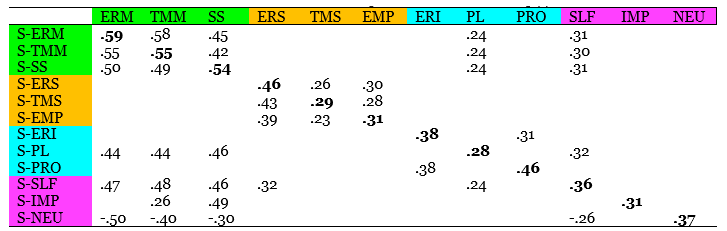
Note. All values shown are significant at p < 0.001. Green = physical aspect, orange = social aspect, blue = intellectual aspect, pink = emotional aspect.
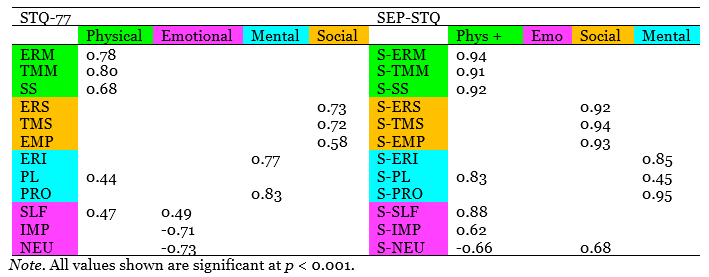
Table 3 shows the significant (p < 0.001) results of exploratory factor analysis conducted separately for the STQ-77 and the SEP-STQ final version. Exploratory analysis suggested a four-factor solution for the STQ-77 (principal components with varimax rotation, eigenvalue = 1, explained variance = 57%), reflecting the grouping of all the physical scales together, the social scales together, the intellectual scales together, and the emotional scales together. Exploratory factor analysis revealed a three-factor solution (principal components with varimax rotation, eigenvalue = 1, explained variance = 92%) for the SEP-STQ, with physical and emotional scales grouped as one factor, the social scales grouped together, and the intellectual scales grouped together.
Table 3. Exploratory Factor Analysis for the STQ-77 (left) and the SEP-STQ (right)
Discussion
This study aimed to develop a concurrently and structurally valid questionnaire measuring the same 12-component temperament construct as the extensively validated STQ-77 questionnaire (Almayev et al., 2024; Rusalov & Trofimova, 2011; Trofimova, 2010a, 2010b; Trofimova & Araki, 2022; Trofimova & Christiansen, 2016; Trofimova & Sulis, 2011, 2016a, 2016b, 2018; Zvereva et al., 2020), but via a survey of past and present environmental preferences. Results suggest this goal was accomplished.
Like the STQ-77, the SEP-STQ measures the 12 FET dimensions of temperament using 12 temperament scales, with a balanced number of items per scale. Like the STQ-77, the SEP-STQ follows the FET activity-specific approach to temperament, and has 3 scales related to intellectual aspects of behaviour regulation, 3 scales related to social aspects, 3 scales related to physical aspects, and 3 scales related to emotional aspects of regulation. Like the STQ-77, the SEP-STQ follows the FET functional constructivist approach to temperament, with 4 scales related to orientation, 4 scales related to speed of integration, and 4 scales related to cycle maintenance.
Variance was sufficient for all items and scales for both questionnaires (see Table 1), with the exception of the SEP-STQ Neuroticism scale, which showed a high minimum and maximum with a small SD. However, because our sample was 80% female and 98% single, poor variation on this scale could be indicative of having a sample biased to high neuroticism. Similarly, the higher than ideal Means for the Neuroticism scale and the social scales of the SEP-STQ (see Table 1) do not necessarily indicate that the items loading onto these scales are poor items. Having a largely female college student sample is expected to shift Means and SD higher for these scales. Nevertheless, these items should be reviewed.
The results of our study confirm our first hypothesis (H1). The bolded diagonal in Table 2 demonstrates excellent concurrent validity of SEP-STQ scales by showing that each of the 12 SEP-STQ temperament scales significantly correlated with their correspondent STQ-77 scale. Physical Endurance measured on the SEP-STQ significantly correlated with Physical Endurance on the STQ-77 scale (r = .59, p < 0.001), Physical Tempo measured on the SEP-STQ significantly correlated with Physical Tempo measured on the STQ-77 (r = .55, p < 0.001), and so on for the other 9 temperament traits. Because Cronbach’s alpha for the STQ-77 scales was high (α = 0.70–0.81), the use of STQ-77 scales as a reliable criterion with which to test concurrent validity of SEP-STQ scales was justified on this sample.
Our second hypothesis (H2) was partly confirmed. Exploratory factor analysis results suggest that the SEP-STQ has a similar, but not identical, activity-specific factor structure as the STQ-77, with a three-factor model (physical+emotional, social, mental) explaining 92% of the variance. This suggests the SEP-STQ captures a similar construct as the STQ-77, which factor analysis has consistently found, both in this study (see lefthand side of Table 3) and previous studies (Rusalov & Trofimova, 2007; Trofimova, 2010a) to have a 4-factor, activity-specific solution (physical, emotional, social, mental). The factor structure of the SEP-STQ differs slightly from that of the STQ-77, as it collapses the categories of physical and emotional into one factor (see righthand side of Table 3); nonetheless, the two questionnaires share a sufficiently similar activity-specific grouping. Supporting this view, significant intercorrelations of SEP-STQ scales with STQ-77 scales of the same activity type (see Table 2) were found.
Moreover, the slight difference in factor structure between the two questionnaires is to be expected, given the different ways the two inventories couch their questions to assess temperament. The STQ-77 asks participants directly to self-rate their temperamental tendencies (e.g. “I enjoy strenuous physical activities.”). The SEP-STQ asks about this indirectly through an assessment of features of personal environment (e.g. “How likely are you to have weights or other athletic equipment in your home or workspace?”). Even when asking about temperament directly, we expect some level of entanglement in the structure revealed by factor analysis––a method which assumes linear independence––due to the basic fact that the neurochemical systems regulating these behavioural traits are intricately entangled. The 4-factor structure of the STQ-77 was explicitly designed to separate these dimensions as much as psychometrically possible. When dealing with environmental interactions, such as in the SEP-STQ, even more entanglement can be expected due to the increased layer of complexity in how items load onto traits. For instance, in the case of the SEP-STQ sports-related poster item, high ratings on the STQ-77 physical activities scales and low ratings on the STQ-77 emotional Neuroticism scale significantly predicted the likelihood of having a sports-related poster in one’s home/workspace. This example shows how the same item on the SEP-STQ can have significant correlations with temperament traits from distinct activity categories, accounting for the combined Physical+Emotional factor structure in the SEP-STQ. This sort of complexity is less likely in the STQ-77, whose dispositional items are less likely to load onto both the physical scales and the emotional scales. Unlike the SEP-STQ, items on the STQ-77 ask participants directly about their enjoyment of physical activities, separate from their neurotic tendencies. Thus, the increased amount of entanglement between the physical and emotional activity aspects in the SEP-STQ might be attributed to the different ways the two questionnaires assess temperament, rather than to the SEP-STQ’s measuring a different construct from the STQ-77.
Our results suggest the SEP-STQ may be used as a concurrently and structurally valid supplemental measure to the STQ-77 to assess neurobiologically based temperament as defined in the FET model. Of note, unlike the STQ-77, the items on the SEP-STQ do not ask participants to report directly on their disposition, but rather to report on the likelihood of their having some feature in their past or present personal environment. Hence, our finding of significant correlations of SEP-STQ items with temperament is consistent with theories which view personal environment as constructed by an individual influenced by their biologically based individual differences, such as Plomin and Bergeman’s (1991) extended phenotype concept or Scarr and McCartney’s (1983) niche-picking theory. Our results add to the literature on this topic by providing preliminary evidence of the pairing of neurochemically based individual differences in behaviour with individual differences in niche construction.
In terms of practical implications, our results suggest the SEP-STQ can meet the need for questionnaires able to simultaneously capture the structure of biologically based individual differences and the structure of personal environment. Although the RSQ does attempt to comprehensively assess personal environment in terms of adult individual differences, it reflects the factor-analytic structure of personality (Rauthmann et al., 2015) rather than of biologically based temperament. Since our results suggest the SEP-STQ has concurrent and structural validity with the STQ-77, itself a well-established measure of neurochemically based temperament, the SEP-STQ can be said to fill a significant gap.
The SEP-STQ also addresses a lack of questionnaires able to capture objectively, comprehensively, and specifically those aspects of personal environment shaped by biologically based individual differences. The SEP-STQ format, which lists features of personal environment and asks participants to rate their likelihood of having this feature, allows for more objectivity by reducing social desirability bias. The SEP-STQ also avoids the issue of bias in item selection favouring the FET model, since items were selected from a pool which was not generated with the FET model in mind, but rather from a neutrally generated comprehensive list of environmental features. The SEP-STQ achieves specificity in its survey because it only includes items expected from the literature to correlate with biologically based individual differences.
The major limitation of this study was its biased sample. The sample had a heavy bias toward females of primarily the same age and educational level, which may have impacted the representativeness of our scales. However, this is a pilot psychometrics study only. Future studies will conduct further psychometrics investigation into properties such as internal consistency and reliability, rigorously test structural validity with confirmatory factor analysis, and repeat descriptive statistics tests with a more representative sample to see if the social and neuroticism scales statistics improve. After psychometrics properties have been well established, the next step will be to use the SEP-STQ to test SEP theory of a reciprocal dynamic between neurochemically based temperament and personal environment.
Conclusions
This study successfully developed an English-language questionnaire (the SEP-STQ) that demonstrates excellent concurrent validity and sufficient structural validity with the STQ-77 to justify its use as a diagnostic tool in the assessment of temperament in adults through a survey of environmental preferences. Using a final sample of N = 1220 Canadian adults (M/F/Other = 216/982/22, age 17–46) to test for validity, the final SEP-STQ consists of 12 temperament scales with 36 items each, except for Impulsivity with 30 items. As hypothesized, the SEP-STQ temperament scales demonstrated excellent concurrent validity with their corresponding STQ-77 temperament scales, and the SEP-STQ showed sufficiently similar activity-specific factor structure to the STQ-77. As far as we know, the SEP-STQ is currently the only temperament questionnaire that captures how personal environment entangles with a neurochemically based, functional constructivist view of temperament. The SEP-STQ thus makes possible novel investigations into the interaction between neurochemically based, dynamic temperament traits and aspects of personal environment.
Competing Interests: No competing interests.
Ethics Statement: This study was approved by the Hamilton Integrated Research Ethics Board, responsible for research conducted at McMaster University, St. Joseph’s Healthcare Hamilton and Hamilton Health Sciences.
Credit Author Statement:
Yao MacLean: Conceptualization, data curation, formal analysis, investigation, methodology, software, validation, writing
Acknowledgements:
This study would not have been possible without the dedicated supervision, сonceptualization, insights, assistance in statistical processing and generous support of Dr. Irina Trofimova.
Highlights:
- This study examined psychometric properties of pilot version of SEP-STQ
- The SEP-STQ is supplemental to STQ-77 and screens for environmental preferences.
- The final 12 SEP-STQ scales showed goodt concurrent validity with corresponding 12 STQ-77 scales.
- The SEP-STQ has sufficiently similar activity-specific factor structure as the STQ-77.
- The final version of SEP-STQ has 140 items
References
- Almayev, N. A., Murasheva, O. V., & Petrovich, D. L. (2020). EEG correlates of personality questionnaires: Rusalov’s STQ-150, Trofimova’s STQ-77 and Cloninger’s TCI, Russian version. Psychophysiology News (Vestnik Psychophysiologii), 3, 135–138.
- Anokhin, P. K. (1968). Biology and neurophysiology of the conditioned reflex (in Russian). Moscow: Meditsina.
- Anokhin, P. K., & Serzhantov, V. F. (1973). Some trends in modern theoretical biology and the conception of a functional system (in Russian). Uspekhi Fiziologicheskikh Nauk, 4(1), 3–18.
- Beere, D., & Pica, M. (1995). The predisposition to dissociate: The temperamental traits of flexibility/rigidity, daily rhythm, emotionality, and interactional speed. Dissociation,8(4), 236–240. https://psycnet.apa.org/record/1996-00775-005
- Bernstein, N. A. (1947). On the construction of motions (in Russian). Moscow: Gosizdat, Medic-State Publishing House.
- Bernstein, N. A., Latash, M. L., & Turvey, M. T. (1996). Dexterity and Its Development (1st ed.). Psychology https://doi.org/10.4324/9781410603357
- Bishop, D., & Hertenstrein, M. (2004). A confirmatory factor analysis of the Structure of Temperament Questionnaire. Educational and Psychological Measurement, 64(6), 1019–1029. https://doi.org/10.1177/0013164404264843
- Bishop, D., Jacks, H., & Tandy, S. B. (1993). The Structure of Temperament Questionnaire (STQ): Results from a US sample. Personality and Individual Differences, 14(3), 485–487. https://doi.org/10.1016/0191-8869(93)90318-W
- Dawkins, R. (1982). The extended phenotype: The long reach of the gene. Oxford University Press.
- Dumenci, L. (1995). The relation between the Structure of Temperament Questionnaire and other personality domains. Educational and Psychological Measurement, 55(5), 850–857. https://doi.org/10.1177/0013164495055005020
- Luria, A. R. (1962). Higher Cortical Functions in Man. Moscow University Press.
- Plomin, R., & Bergeman, C. S. (1991). The nature of nurture: Genetic influence on “environmental” measures. Behavioral and Brain Sciences, 14(3), 373–386. https://psycnet.apa.org/doi/10.1017/S0140525X00070278
- Rathee, N., & Singh, R. (2001). Mobility or/and lability of the nervous processes as temperamental trait(s). Personality and Individual Differences, 31(7), 1091–1104. https://doi.org/10.1016/s0191-8869(00)00206-3
- Rauthmann, J. F., Sherman, R. A., & Funder, D. C. (2015). Principles of situation research: Towards a better understanding of psychological situations. European Journal of Personality,29(3), 363–381. https://doi.org/10.1002/per.1994
- Rusalov, V. M. (1979). Biological basis of individual psychological differences (in Russian). Moscow: Nauka.
- Rusalov, V. M. (1985). The nature of temperament and its role in the structure of individual human traits. Journal of Russian & East European Psychology, 24(1), 3–27. https://doi.org/10.2753/RPO1061-040524023
- Rusalov, V. M. (1989). Motor and communicative aspects of human temperament: A new questionnaire of the structure of temperament. Personality and Individual Differences,10(6), 817–827. https://doi.org/10.1016/0191-8869(89)90017-2
- Rusalov, V. M. (1997). Questionnaire of formal-dynamical properties of individual (in Russian). Moscow: IPRAN.
- Rusalov, V. M. (2004). Formal-dynamical properties of individual (temperament) (in Russian). Russian Academy of Sciences, Moscow: IPAN Press.
- Rusalov, V. M., & Trofimova, I. (2007). The structure of temperament and its measurement: The theory and the manual of the Structure of Temperament Questionnaire (STQ). Psychological Services Press.
- Rusalov, V. M., & Trofimova, I. (2011). On representation of types of activity in various models of temperament (in Russian). Psychological Journal (Psikhologicheskii Zhurnal), 32(3), 74–84.
- Scarr, S., & McCartney, K. (1983). How people make their own environments: A theory of genotype → environment effects. Child Development, 54, 424–435.
- Stough, C., Brebner, J., & Cooper, C. (1991). The Rusalov Structure of Temperament Questionnaire (STQ): Results from an Australian sample. Personality and Individual Differences,12(12), 1355–1357. https://doi.org/10.1016/0191-8869(91)90212-T
- Thomas, A., & Chess, S. (1984). Genesis and evolution of behavioral disorders: From infancy to early adult life. The American Journal of Psychiatry, 141(1), 1–9.
- Trofimova, I. (1999). How people of different age, sex, and temperament estimate the world. Psychological Reports, 85(2), 533–552. https://doi.org/10.2466/pr0.1999.85.2.533
- Trofimova, I. (2009). Exploration of the benefits of an activity-specific test of temperament. Psychological Reports, 105(2), 643–658. https://doi.org/10.2466/pr0.105.2.643-658
- Trofimova, I. (2010a). An investigation into differences between the structure of temperament and the structure of personality. American Journal ofPsychology, 123(4), 467–480. https://doi.org/10.5406/amerjpsyc.123.4.0467
- Trofimova, I. (2010b). Questioning the “general arousal” models. Open Behavioral Science and Psychology, 4, 1–8. https://doi.org/10.2174/1874230001004010001
- Trofimova, I. (2016). The interlocking between functional aspects of activities and a neurochemical model of adult temperament. In M. C. Arnold (Ed.), Temperaments: Individual differences, social and environmental influences and impact on quality of life (pp. 77–147). Nova Science Publishers.
- Trofimova, I. (2017). Functional constructivism: In search of formal descriptors. Nonlinear Dynamics in Psychology and Life Sciences, 21(4), 441-474.
- Trofimova, I. (2018). Functionality vs dimensionality in psychological taxonomies, and a puzzle of emotional valence. Philosophical Transactions of the Royal Society, Biology, 373(1744), Article 20170167. https://doi.org/10.1098/rstb.2017.0167
- Trofimova, I. (2019). An overlap between mental abilities and temperament traits. In D. McFarland (Ed.), General and specific mental abilities (pp. 77–114). Cambridge Scholars Publishing.
- Trofimova, I. (2021a). Contingent tunes of neurochemical ensembles in the norm and pathology: Can we see the patterns? Neuropsychobiology, 80(2), 101–133. https://doi.org/10.1159/000513688
- Trofimova, I. (2021b). Functional constructivism approach to multilevel nature of biobehavioural diversity. Frontiers in Psychiatry.12, Article https://doi.org/10.3389/fpsyt.2021.641286
- Trofimova, I. (2022). Transient nature of stable behavioural patterns, and how we can respect it. Current Opinion in Behavioral Sciences, 44, Article 101109. https://doi.org/10.1016/j.cobeha.2022.101109
- Trofimova, I., & Araki, M. (2022). Psychometrics vs neurochemistry: A controversy around mobility-like scales of temperament. Personality and Individual Differences, 187, Article 111446. https://doi.org/10.1016/j.paid.2021.111446
- Trofimova, I., & Christiansen, J. (2016). Coupling of temperament traits with mental illness in four age groups. Psychological Reports,118(2), 387–412. https://doi.org/10.1177/003329411663943
- Trofimova, I., & Gaykalova, A. (2021). Emotionality vs. other biobehavioural traits: A look at neurochemical biomarkers for their differentiation. Frontiers in Psychology, 12, Article781631, https://doi.org/10.3389/fpsyg.2021.781631
- Trofimova, I. & Netter, P. (2021). In search of biomarkers for bio-behavioural and psychiatric taxonomies. Neuropsychobiology, 80(2),79-83. https://doi.org/10.1159/000514409
- Trofimova, I., & Robbins, T. W. (2016). Temperament and arousal systems: A new synthesis of differential psychology and functional neurochemistry. Neuroscience and Biobehavioral Reviews, 64, 382–402. https://doi.org/10.1016/j.neubiorev.2016.03.008
- Trofimova, I., & Sulis, W. (2011). Is temperament activity-specific? Validation of the Structure of Temperament Questionnaire-Compact (STQ-77). International Journal of Psychology and Psychological Therapy, 11(3), 389–400. https://www.ijpsy.com/volumen11/num3/306.html
- Trofimova, I., & Sulis, W. (2016a). Benefits of distinguishing between physical and social-verbal aspects of behaviour: An example of generalized anxiety. Frontiers in Psychology, 7,Article https://doi.org/10.3389/fpsyg.2016.00338
- Trofimova, I., & Sulis, W. (2016b). A study of the coupling of FET temperament traits with major depression. Frontiers in Psychology, 7, Article https://doi.org/10.3389/fpsyg.2016.01848
- Trofimova, I., & Sulis, W. (2018). There is more to mental illness than negative affect: Comprehensive temperament profiles in depression and generalized anxiety. BMC Psychiatry, 18(1), Article 125. https://doi.org/10.1186/s12888-018-1695-x
- Zin’ko, E.V. (2006). Relationship between self-image and aspiration level in parameters of stability and relevance (in Russian) [unpublished doctoral dissertation]. Moscow State University.
- Zvereva, N., Zvereva, M., & Pyatnitskaya, L. (2020). Temperament profiles of children and adolescents with psychotic and mood disorders.
Comments (0)
Background and Problem. This psychometric paper summarizes the development and validation of a novel English-language questionnaire (SEP-STQ) measuring temperament through an assessment of Specialized Extended Phenotype (SEP). The SEP-STQ uses the 12-component design of the Compact version of the Structure of Temperament Questionnaire (STQ-77), which is based on the neurochemical framework Functional Ensemble of Temperament (FET). The SEP-STQ items capture biographical aspects and environmental preferences. Using a Canadian sample of N = 1220 (M/F/Other = 216/982/22, age 17–46), the pilot version of the SEP-STQ with 199 items was updated after psychometric analysis to the final version with 36 items per scale, except the Impulsivity scale (which has 30 items), with 140 items in total and 12 temperament scales. Findings of highly significant correlations between SEP-STQ scales and corresponding STQ-77 scales demonstrates the SEP-STQ has concurrent validity. Exploratory factor analytic findings of sufficiently similar activity-specific factor structure of the SEP-STQ to the STQ-77’s suggest the SEP-STQ has structural validity, although confirmatory factor analysis needs to be conducted to strengthen this claim. Results suggest the SEP-STQ is measuring the same construct as the STQ-77, and so may be used as a supplement to the STQ-77 to screen for temperament in terms of environmental preference.
“Temperament” refers to neurobiologically based individual differences in behaviour present at birth and stable across the lifespan (Rusalov, 1979, 1985; Rusalov & Trofimova, 2007; Trofimova, 2016). As such, temperament is distinct from personality, the study of individual differences shaped by sociocultural factors (Trofimova et al., 2018). Given the posited neurobiological basis of temperament, it is important to have instruments which incorporate findings from neurobiological research on behaviour. The Structure of Temperament Questionnaire-Compact (STQ-77) (Rusalov & Trofimova, 2007; Trofimova & Sulis, 2011) is such an instrument. Unlike other measures of temperament, the STQ-77 was initially developed from neurophysiological studies on adults.
The STQ-77 is a self-report measure of temperament in adults that assesses temperament according to the neurochemical framework Functional Ensemble of Temperament (FET; Trofimova, 2016; Trofimova & Gaykalova, 2020; Trofimova & Robbins, 2016). The FET builds on Luria’s (1962) theory of the 3-block model (information-sensory block, programming block, and energetic block) of the neuroanatomic functional systems that regulate human behavior. The FET also builds on Rusalov’s (1989, 2004) organization of temperament traits according to activity type (physical-motor, social-verbal, mental) to reflect how each type is regulated by different neurophysiological systems. The original Structure of Temperament Questionnaire (STQ) (Rusalov, 1989, 1997, 2004; Rusalov & Trofimova, 2007) was created by Rusalov to psychometrically assess a functional and activity-specific neurological model of temperament in adults.
Substantial empirical evidence provides strong support for the psychometric strength of the STQ, thereby providing indirect evidence of the psychometric strength of its revised version: the Structure of Temperament Questionnaire-Compact (STQ-77). For construct validity, see Rusalov (1979, 1989) and Rusalov and Trofimova (2007). For concurrent validity, see Beere and Pica (1995); Dumenci (1995); Rathee and Singh (2001); Trofimova (1999, 2009); and Zin’ko (2006). For reliability, internal consistency, and factor structure, see Bishop and Hertenstrein (2004); Bishop et al. (1993); Dumenci (1995); Rusalov (1997, 2004); Rusalov and Trofimova (2007); and Stough et al. (1991).
Irina Trofimova revised Rusalov’s model to include links to neurotransmitter systems and introduced the notion of “functional constructivism” to derive the Functional Ensemble of Temperament model (FET). Drawing from the constructivist view of behaviour as uniquely constructed each time it is enacted (for review see Trofimova, 2017; Trofimova, 2021a; Trofimova, 2021b), functional constructivism applies this view to the classification of neurochemical systems according to their roles in the stages of behaviour construction (Trofimova & Gaykalova, 2021).
The FET thus classifies neurochemical systems and their corresponding temperamental traits into three stages of action construction: energetic, dynamic, and orientational (Trofimova, 2021b). In addition, the FET also classifies traits according to activity type (intellectual, physical, social-verbal, emotional). The STQ-77, a revision of the STQ, was developed to reflect this updated model. Studies have found satisfactory four-factor fit for the STQ-77 corresponding to the activity-specific organization of the FET model (physical, social, intellectual, and emotional), with CFI > .9, RMSEA < .07, and RMSR < .06 (Rusalov & Trofimova, 2007; Trofimova, 2010a) and high reliability of STQ-77 scales (α = 0.70–0.86) (Trofimova & Sulis, 2010b). The STQ-77 shows good construct, concurrent, and discriminatory validity as evidenced by significant correlations with the following: the Beck Anxiety Inventory (Trofimova & Sulis, 2016a); the NEO-FFI (Trofimova, 2010a); EEG studies (Almayev et al., 2024); the Eysenck Personality Questionnaire (Trofimova & Araki, 2022); the Hamilton Depression Inventory (Trofimova & Sulis, 2016b); the I7 Impulsiveness Questionnaire (Trofimova & Sulis, 2011); the Motivation in Achievements/Aspiration level scale (Trofimova, 2010b); the Pavlovian Temperamental Survey (Rusalov & Trofimova, 2011; Trofimova, 2010b; Trofimova & Araki, 2022); the Personality Assessment Inventory (Trofimova & Christiansen, 2016); psychotic disorders (Zvereva et al., 2020); the Rotter Locus of Control Scale (Rusalov & Trofimova, 2011; Trofimova, 2010b; Trofimova & Sulis, 2011); speed of performance in mental activities (Trofimova, 2010b; Trofimova & Sulis, 2011); speed of verbal processing (Rusalov & Trofimova, 2011); the State-Trait Anxiety Inventory (Trofimova & Sulis, 2016a); Symptom Checklist (Trofimova & Sulis, 2016b); the Zuckerman Sensation Seeking Scales (Trofimova, 2010a); and grades in relevant high school subjects (Trofimova & Sulis, 2011).
While the STQ-77 meets the need for a neurobiologically grounded, psychometrically valid measure of temperament in adults, there remains a need for a psychometric instrument that captures how personal environment is entangled with temperament. According to Specialized Extended Phenotype (SEP) theory (Trofimova, 2021b), an individual’s personal environment or “Specialized Extended Phenotype” (SEP) can be thought of as an “extension” of their body––a space they construct to support their individual-specific, neurochemically based temperament. SEP theory draws on Dawkins’ (1982) theory of extended phenotype. According to Dawkins, genes “extend” their phenotype outside the body of their host to ensure survival. Examples of this can be seen in the dams that beavers build or the nests termites construct (Dawkins, 1982). Theories from developmental psychology (e.g. “goodness-of-fit,” Thomas & Chess, 1984), personality psychology (e.g. “situational selection,” Rauthmann et al., 2015), and behavioural genetics (Plomin & Bergeman, 1991) also predict correlations between biologically based individual differences and personal environment. Yet, despite multiple theories predicting these correlations, currently no single psychometric measure has been developed to capture the entanglement between neurochemically based temperament and personal environment in adults.
This study aims to develop a psychometrically valid instrument (the SEP-STQ) that assesses neurochemically based temperament in terms of controllable features of an individual’s personal environment. To do this, the SEP-STQ will be developed such that it demonstrates concurrent and structural validity with the already established STQ-77. Accordingly, the objectives of this study are to: (1) develop a comprehensive pool of items identifying controllable features of personal environment; (2) infer how these items might associate with STQ-77 scales; (3) select highest correlating items for inclusion on SEP-STQ scales of the final version; and (4) test this version for concurrent and structural validity with the STQ-77. Our two hypotheses for this study are:
(H1): The SEP-STQ has sufficient concurrent validity by high correlations between the 12 SEP-STQ scales and corresponding 12 STQ-77 scales;
(H2): The SEP-STQ has a sufficiently similar factor structure to the STQ-77. In other words, the SEP-STQ factor structure will reflect the FET’s activity-specific approach to temperament, differentiating between the emotional, physical, social, and probabilistic (intellectual) aspects of behaviour.
2.1. Sample
The initial sample consisted of N = 2322 participants recruited from introductory psychology courses at McMaster University. Participants received course credit for participating. No exclusion criteria, other than being fit to fill out the surveys without assistance, were applied. After removal of participants due to incompleteness (N = 1024), duplicates (N = 55), and low validity (N = 23; STQ-77 Validity score > 13), the final sample was N = 1220 participants (M/F/Others = 216/982/22); Age range 17–46 (Mean = 18.6, SD =1.74). All participants signed a consent form prior to participating and a debriefing form after. This study was approved by the Hamilton Integrated Research Ethics Board.
2.2. Measures
Demographics Form
All participants completed a brief demographics form regarding age, gender, and education status.
Structure of Temperament Questionnaire-Compact (STQ-77)
The STQ-77 (Rusalov & Trofimova, 2007) consists of 77 statements, which are equally distributed across 12 temperament scales (6 items each) and a validity scale (5 items). Participants answer using a 4-scale Likert format: “strongly disagree (1),” “disagree (2),” “agree (3),” “strongly agree (4)”. In accordance with the FET model of temperament, which groups dimensions of temperament according to type of activity (Trofimova & Robbins, 2016), the STQ-77 organizes its 12 temperament scales into four groups:
Physical Aspects Group. The physical aspects group includes three scales: Physical Endurance (ERM), Physical Tempo (TMM), and Sensation Seeking (SS).
Social Aspects Group. The social aspects group includes three scales: Social Endurance (ERS), Social Tempo (TMS), and Empathy (EMP).
Mental (Probabilistic) Aspects Group. The mental (probabilistic) aspects group includes three scales: Mental (Intellectual) Endurance (ERI), Plasticity (PL), which is the ability to adapt quickly to changing situations, and Probabilistic Processing (PRO), which refers to the ability of an individual to grasp probabilities and causal relations between events.
Emotionality Group. The emotionality group includes three scales: Dispositional Satisfaction (SF), Impulsivity (IMP), and Neuroticism (NEU).
Cronbach’s alpha was calculated on the final sample (N = 1220) for all 13 scales. Resulting reliability coefficients demonstrated high internal consistency, ranging from .70 and .81.
SEP Supplement to STQ-77 Pilot (SEP-STQ Pilot)
The SEP-STQ pilot consists of 199 items representing 12 temperament scales (S-PRO, S-PL, S-ERI, S-EMP, S-TMS, S-ERS, S-SS, S-TMM, S-ERM, S-NEU, S-IMP, S-SLF) as given in the FET model. Each of these items describes a feature of the personal environment. Participants report the likelihood of their personal environment including each of these items on a Likert scale of 1 to 10, where 1 = “extremely unlikely” and 10 = “extremely likely”. The SEP-STQ items are grouped into the general domains of: work environment (e.g. stable, involves people); personal space design (e.g. religious image, sports-related poster); adult hobbies (e.g. sports, puzzles); entertainment space (e.g. action movies, courts/crime-punishment shows); adult social space (e.g. activities with friends, characteristics of romantic partner); and childhood hobbies.
2.3 Procedures
A comprehensive list of 199 items describing personal environment was generated. From this list, 614 inferences regarding how these features of personal environment would correlate with the STQ-77 temperament scales were proposed. McMaster LimeSurvey was used to administer the study online. Once ethics approval was obtained, participants (N = 2322) were recruited from the undergraduate psychology pool at McMaster University. After removal of N = 1102 due to incompleteness, duplication, and low validity, the final sample size was N = 1220. Correlations between the 199 SEP-STQ pilot items and the 12 STQ-77 scales were investigated to test 614 a priori inferences of associations (at p < 0.001). Items with multiple significant associations were selected to create the summing keys for the 12 SEP-STQ scales.
To test H1, correlations between SEP-STQ scales and STQ-77 scales were calculated. To test H2, exploratory factor analysis was conducted separately for both the SEP-STQ final version and the STQ-77. Descriptive scale statistics and reliability coefficients were calculated for the STQ-77 and the final version of the SEP-STQ.
Table 1 (left) shows the descriptive statistics for the 12 STQ-77 temperament scales. Alpha values varied between .70 and .81, indicating high internal consistency. STQ-77 scales showed sufficient variance on this sample. Since item responses are on a 4-point scale, and there are 6 items per scale, scale sums can in principle range from 6 to 24. STQ-77 scale Means ranged from 13.95 to 17.72; SDs ranged from 2.74 to 3.59.
Table 1 (right) shows the descriptive statistics for the final version of the SEP-STQ. The final version consists of 140 items distributed relatively equally across 12 temperament scales: 36 items per scale, except for the Impulsivity scale with n = 30 items. The SEP-STQ final version showed sufficient variance on this sample. Since item responses are on a 10-point scale, and there are about 36 items per scale, scale sums can in principle range from 36 to 360. SEP-STQ scale Means ranged from 153.27 to 255.96; SDs ranged from 30.32 to 48.74.
| STQ-77 | SEP-STQ | ||||||||||||||
| Scales | Means | SD | Alpha | Scales | Means | SD | Min | Max | |||||||
| ERM | 15.14 | 3.58 | .81 | S-ERM | 184.25 | 45.90 | 55 | 310 | |||||||
| TMM | 15.70 | 3.04 | .70 | S-TMM | 192.59 | 48.74 | 56 | 326 | |||||||
| SS | 14.23 | 3.46 | .72 | S-SS | 177.61 | 43.93 | 58 | 309 | |||||||
| ERS | 15.66 | 3.59 | .76 | S-ERS | 242.84 | 39.10 | 99 | 330 | |||||||
| TMS | 16.49 | 3.15 | .75 | S-TMS | 263.13 | 39.78 | 101 | 341 | |||||||
| EMP | 16.20 | 2.98 | .70 | S-EMP | 255.88 | 43.80 | 89 | 349 | |||||||
| ERI | 15.76 | 3.14 | .70 | S-ERI | 195.39 | 40.01 | 63 | 321 | |||||||
| PL | 15.06 | 2.74 | .68 | S-PL | 180.41 | 42.53 | 58 | 320 | |||||||
| PRO | 16.00 | 3.28 | .71 | S-PRO | 186.91 | 33.50 | 98 | 314 | |||||||
| SLF | 13.95 | 3.21 | .70 | S-SLF | 188.94 | 39.62 | 58 | 314 | |||||||
| IMP | 15.37 | 3.12 | .70 | S-IMP | 153.27 | 31.69 | 48 | 256 | |||||||
| NEU | 17.72 | 2.98 | .70 | S-NEU | 255.96 | 30.32 | 147 | 338 | |||||||
The majority of inferences of associations (496 of 614 = 80%) between the initial 199 SEP-STQ pilot items and STQ-77 temperament scales were confirmed at p < 0.001 significance. Items with the most and highest correlations were selected to load onto the corresponding SEP-STQ temperament scale. The number of items selected per scale was balanced to have 36 items per scale, except for Impulsivity with 30 items. The final version of the SEP-STQ has 140 items, with 36 items for 11 scales, and 30 items for Impulsivity.
Table 2 shows the significant (p < 0.001) correlational coefficients between the newly created 12 SEP-STQ temperament scales (see previous section) and the 12 STQ-77 temperament scales. The bolded diagonal in Table 2 shows significant correlations (.28 < r ≤ .59, p < 0.001) between newly created SEP-STQ temperament scales and their correspondent STQ-77 temperament scales. For example, as seen in Table 2, the SEP-STQ scale measuring Physical Endurance (S-ERM) correlated significantly with the STQ-77 scale measuring Physical Endurance (ERM) (r = .59, p < 0.001), and so on for the other 11 dimensions (e.g. between S-TMM and TMM, etc…) of temperament as defined in the FET model.
Table 2 also shows significant intercorrelations between SEP-STQ scales and non-correspondent STQ-77 scales that are grouped in the same overarching activity category, such as between S-ERM and SS (r = .45, p < 0.001). All the SEP-STQ scales categorized in the FET model as physical (green colour) are intercorrelated significantly with all the STQ-77 scales categorized as physical. The same result was found for social (yellow colour) SEP-STQ scales with social STQ-77 scales, and somewhat for the intellectual (blue colour) SEP-STQ scales and intellectual STQ-77 scales. This was not the case for the emotional (pink colour) scales. The emotional (pink) SEP-STQ scales were highly entangled with the physical (green) STQ-77 scales.
Table 2. Correlations of Finalized SEP-STQ Scales (rows) and STQ-77 Scales (columns)
Note. All values shown are significant at p < 0.001. Green = physical aspect, orange = social aspect, blue = intellectual aspect, pink = emotional aspect.
Table 3 shows the significant (p < 0.001) results of exploratory factor analysis conducted separately for the STQ-77 and the SEP-STQ final version. Exploratory analysis suggested a four-factor solution for the STQ-77 (principal components with varimax rotation, eigenvalue = 1, explained variance = 57%), reflecting the grouping of all the physical scales together, the social scales together, the intellectual scales together, and the emotional scales together. Exploratory factor analysis revealed a three-factor solution (principal components with varimax rotation, eigenvalue = 1, explained variance = 92%) for the SEP-STQ, with physical and emotional scales grouped as one factor, the social scales grouped together, and the intellectual scales grouped together.
Table 3. Exploratory Factor Analysis for the STQ-77 (left) and the SEP-STQ (right)
This study aimed to develop a concurrently and structurally valid questionnaire measuring the same 12-component temperament construct as the extensively validated STQ-77 questionnaire (Almayev et al., 2024; Rusalov & Trofimova, 2011; Trofimova, 2010a, 2010b; Trofimova & Araki, 2022; Trofimova & Christiansen, 2016; Trofimova & Sulis, 2011, 2016a, 2016b, 2018; Zvereva et al., 2020), but via a survey of past and present environmental preferences. Results suggest this goal was accomplished.
Like the STQ-77, the SEP-STQ measures the 12 FET dimensions of temperament using 12 temperament scales, with a balanced number of items per scale. Like the STQ-77, the SEP-STQ follows the FET activity-specific approach to temperament, and has 3 scales related to intellectual aspects of behaviour regulation, 3 scales related to social aspects, 3 scales related to physical aspects, and 3 scales related to emotional aspects of regulation. Like the STQ-77, the SEP-STQ follows the FET functional constructivist approach to temperament, with 4 scales related to orientation, 4 scales related to speed of integration, and 4 scales related to cycle maintenance.
Variance was sufficient for all items and scales for both questionnaires (see Table 1), with the exception of the SEP-STQ Neuroticism scale, which showed a high minimum and maximum with a small SD. However, because our sample was 80% female and 98% single, poor variation on this scale could be indicative of having a sample biased to high neuroticism. Similarly, the higher than ideal Means for the Neuroticism scale and the social scales of the SEP-STQ (see Table 1) do not necessarily indicate that the items loading onto these scales are poor items. Having a largely female college student sample is expected to shift Means and SD higher for these scales. Nevertheless, these items should be reviewed.
The results of our study confirm our first hypothesis (H1). The bolded diagonal in Table 2 demonstrates excellent concurrent validity of SEP-STQ scales by showing that each of the 12 SEP-STQ temperament scales significantly correlated with their correspondent STQ-77 scale. Physical Endurance measured on the SEP-STQ significantly correlated with Physical Endurance on the STQ-77 scale (r = .59, p < 0.001), Physical Tempo measured on the SEP-STQ significantly correlated with Physical Tempo measured on the STQ-77 (r = .55, p < 0.001), and so on for the other 9 temperament traits. Because Cronbach’s alpha for the STQ-77 scales was high (α = 0.70–0.81), the use of STQ-77 scales as a reliable criterion with which to test concurrent validity of SEP-STQ scales was justified on this sample.
Our second hypothesis (H2) was partly confirmed. Exploratory factor analysis results suggest that the SEP-STQ has a similar, but not identical, activity-specific factor structure as the STQ-77, with a three-factor model (physical+emotional, social, mental) explaining 92% of the variance. This suggests the SEP-STQ captures a similar construct as the STQ-77, which factor analysis has consistently found, both in this study (see lefthand side of Table 3) and previous studies (Rusalov & Trofimova, 2007; Trofimova, 2010a) to have a 4-factor, activity-specific solution (physical, emotional, social, mental). The factor structure of the SEP-STQ differs slightly from that of the STQ-77, as it collapses the categories of physical and emotional into one factor (see righthand side of Table 3); nonetheless, the two questionnaires share a sufficiently similar activity-specific grouping. Supporting this view, significant intercorrelations of SEP-STQ scales with STQ-77 scales of the same activity type (see Table 2) were found.
Moreover, the slight difference in factor structure between the two questionnaires is to be expected, given the different ways the two inventories couch their questions to assess temperament. The STQ-77 asks participants directly to self-rate their temperamental tendencies (e.g. “I enjoy strenuous physical activities.”). The SEP-STQ asks about this indirectly through an assessment of features of personal environment (e.g. “How likely are you to have weights or other athletic equipment in your home or workspace?”). Even when asking about temperament directly, we expect some level of entanglement in the structure revealed by factor analysis––a method which assumes linear independence––due to the basic fact that the neurochemical systems regulating these behavioural traits are intricately entangled. The 4-factor structure of the STQ-77 was explicitly designed to separate these dimensions as much as psychometrically possible. When dealing with environmental interactions, such as in the SEP-STQ, even more entanglement can be expected due to the increased layer of complexity in how items load onto traits. For instance, in the case of the SEP-STQ sports-related poster item, high ratings on the STQ-77 physical activities scales and low ratings on the STQ-77 emotional Neuroticism scale significantly predicted the likelihood of having a sports-related poster in one’s home/workspace. This example shows how the same item on the SEP-STQ can have significant correlations with temperament traits from distinct activity categories, accounting for the combined Physical+Emotional factor structure in the SEP-STQ. This sort of complexity is less likely in the STQ-77, whose dispositional items are less likely to load onto both the physical scales and the emotional scales. Unlike the SEP-STQ, items on the STQ-77 ask participants directly about their enjoyment of physical activities, separate from their neurotic tendencies. Thus, the increased amount of entanglement between the physical and emotional activity aspects in the SEP-STQ might be attributed to the different ways the two questionnaires assess temperament, rather than to the SEP-STQ’s measuring a different construct from the STQ-77.
Our results suggest the SEP-STQ may be used as a concurrently and structurally valid supplemental measure to the STQ-77 to assess neurobiologically based temperament as defined in the FET model. Of note, unlike the STQ-77, the items on the SEP-STQ do not ask participants to report directly on their disposition, but rather to report on the likelihood of their having some feature in their past or present personal environment. Hence, our finding of significant correlations of SEP-STQ items with temperament is consistent with theories which view personal environment as constructed by an individual influenced by their biologically based individual differences, such as Plomin and Bergeman’s (1991) extended phenotype concept or Scarr and McCartney’s (1983) niche-picking theory. Our results add to the literature on this topic by providing preliminary evidence of the pairing of neurochemically based individual differences in behaviour with individual differences in niche construction.
In terms of practical implications, our results suggest the SEP-STQ can meet the need for questionnaires able to simultaneously capture the structure of biologically based individual differences and the structure of personal environment. Although the RSQ does attempt to comprehensively assess personal environment in terms of adult individual differences, it reflects the factor-analytic structure of personality (Rauthmann et al., 2015) rather than of biologically based temperament. Since our results suggest the SEP-STQ has concurrent and structural validity with the STQ-77, itself a well-established measure of neurochemically based temperament, the SEP-STQ can be said to fill a significant gap.
The SEP-STQ also addresses a lack of questionnaires able to capture objectively, comprehensively, and specifically those aspects of personal environment shaped by biologically based individual differences. The SEP-STQ format, which lists features of personal environment and asks participants to rate their likelihood of having this feature, allows for more objectivity by reducing social desirability bias. The SEP-STQ also avoids the issue of bias in item selection favouring the FET model, since items were selected from a pool which was not generated with the FET model in mind, but rather from a neutrally generated comprehensive list of environmental features. The SEP-STQ achieves specificity in its survey because it only includes items expected from the literature to correlate with biologically based individual differences.
The major limitation of this study was its biased sample. The sample had a heavy bias toward females of primarily the same age and educational level, which may have impacted the representativeness of our scales. However, this is a pilot psychometrics study only. Future studies will conduct further psychometrics investigation into properties such as internal consistency and reliability, rigorously test structural validity with confirmatory factor analysis, and repeat descriptive statistics tests with a more representative sample to see if the social and neuroticism scales statistics improve. After psychometrics properties have been well established, the next step will be to use the SEP-STQ to test SEP theory of a reciprocal dynamic between neurochemically based temperament and personal environment.
This study successfully developed an English-language questionnaire (the SEP-STQ) that demonstrates excellent concurrent validity and sufficient structural validity with the STQ-77 to justify its use as a diagnostic tool in the assessment of temperament in adults through a survey of environmental preferences. Using a final sample of N = 1220 Canadian adults (M/F/Other = 216/982/22, age 17–46) to test for validity, the final SEP-STQ consists of 12 temperament scales with 36 items each, except for Impulsivity with 30 items. As hypothesized, the SEP-STQ temperament scales demonstrated excellent concurrent validity with their corresponding STQ-77 temperament scales, and the SEP-STQ showed sufficiently similar activity-specific factor structure to the STQ-77. As far as we know, the SEP-STQ is currently the only temperament questionnaire that captures how personal environment entangles with a neurochemically based, functional constructivist view of temperament. The SEP-STQ thus makes possible novel investigations into the interaction between neurochemically based, dynamic temperament traits and aspects of personal environment.
Competing Interests: No competing interests.
Ethics Statement: This study was approved by the Hamilton Integrated Research Ethics Board, responsible for research conducted at McMaster University, St. Joseph’s Healthcare Hamilton and Hamilton Health Sciences.
Credit Author Statement:
Yao MacLean: Conceptualization, data curation, formal analysis, investigation, methodology, software, validation, writing
Acknowledgements:
This study would not have been possible without the dedicated supervision, сonceptualization, insights, assistance in statistical processing and generous support of Dr. Irina Trofimova.
Highlights:
- This study examined psychometric properties of pilot version of SEP-STQ
- The SEP-STQ is supplemental to STQ-77 and screens for environmental preferences.
- The final 12 SEP-STQ scales showed goodt concurrent validity with corresponding 12 STQ-77 scales.
- The SEP-STQ has sufficiently similar activity-specific factor structure as the STQ-77.
- The final version of SEP-STQ has 140 items
- Almayev, N. A., Murasheva, O. V., & Petrovich, D. L. (2020). EEG correlates of personality questionnaires: Rusalov’s STQ-150, Trofimova’s STQ-77 and Cloninger’s TCI, Russian version. Psychophysiology News (Vestnik Psychophysiologii), 3, 135–138.
- Anokhin, P. K. (1968). Biology and neurophysiology of the conditioned reflex (in Russian). Moscow: Meditsina.
- Anokhin, P. K., & Serzhantov, V. F. (1973). Some trends in modern theoretical biology and the conception of a functional system (in Russian). Uspekhi Fiziologicheskikh Nauk, 4(1), 3–18.
- Beere, D., & Pica, M. (1995). The predisposition to dissociate: The temperamental traits of flexibility/rigidity, daily rhythm, emotionality, and interactional speed. Dissociation,8(4), 236–240. https://psycnet.apa.org/record/1996-00775-005
- Bernstein, N. A. (1947). On the construction of motions (in Russian). Moscow: Gosizdat, Medic-State Publishing House.
- Bernstein, N. A., Latash, M. L., & Turvey, M. T. (1996). Dexterity and Its Development (1st ed.). Psychology https://doi.org/10.4324/9781410603357
- Bishop, D., & Hertenstrein, M. (2004). A confirmatory factor analysis of the Structure of Temperament Questionnaire. Educational and Psychological Measurement, 64(6), 1019–1029. https://doi.org/10.1177/0013164404264843
- Bishop, D., Jacks, H., & Tandy, S. B. (1993). The Structure of Temperament Questionnaire (STQ): Results from a US sample. Personality and Individual Differences, 14(3), 485–487. https://doi.org/10.1016/0191-8869(93)90318-W
- Dawkins, R. (1982). The extended phenotype: The long reach of the gene. Oxford University Press.
- Dumenci, L. (1995). The relation between the Structure of Temperament Questionnaire and other personality domains. Educational and Psychological Measurement, 55(5), 850–857. https://doi.org/10.1177/0013164495055005020
- Luria, A. R. (1962). Higher Cortical Functions in Man. Moscow University Press.
- Plomin, R., & Bergeman, C. S. (1991). The nature of nurture: Genetic influence on “environmental” measures. Behavioral and Brain Sciences, 14(3), 373–386. https://psycnet.apa.org/doi/10.1017/S0140525X00070278
- Rathee, N., & Singh, R. (2001). Mobility or/and lability of the nervous processes as temperamental trait(s). Personality and Individual Differences, 31(7), 1091–1104. https://doi.org/10.1016/s0191-8869(00)00206-3
- Rauthmann, J. F., Sherman, R. A., & Funder, D. C. (2015). Principles of situation research: Towards a better understanding of psychological situations. European Journal of Personality,29(3), 363–381. https://doi.org/10.1002/per.1994
- Rusalov, V. M. (1979). Biological basis of individual psychological differences (in Russian). Moscow: Nauka.
- Rusalov, V. M. (1985). The nature of temperament and its role in the structure of individual human traits. Journal of Russian & East European Psychology, 24(1), 3–27. https://doi.org/10.2753/RPO1061-040524023
- Rusalov, V. M. (1989). Motor and communicative aspects of human temperament: A new questionnaire of the structure of temperament. Personality and Individual Differences,10(6), 817–827. https://doi.org/10.1016/0191-8869(89)90017-2
- Rusalov, V. M. (1997). Questionnaire of formal-dynamical properties of individual (in Russian). Moscow: IPRAN.
- Rusalov, V. M. (2004). Formal-dynamical properties of individual (temperament) (in Russian). Russian Academy of Sciences, Moscow: IPAN Press.
- Rusalov, V. M., & Trofimova, I. (2007). The structure of temperament and its measurement: The theory and the manual of the Structure of Temperament Questionnaire (STQ). Psychological Services Press.
- Rusalov, V. M., & Trofimova, I. (2011). On representation of types of activity in various models of temperament (in Russian). Psychological Journal (Psikhologicheskii Zhurnal), 32(3), 74–84.
- Scarr, S., & McCartney, K. (1983). How people make their own environments: A theory of genotype → environment effects. Child Development, 54, 424–435.
- Stough, C., Brebner, J., & Cooper, C. (1991). The Rusalov Structure of Temperament Questionnaire (STQ): Results from an Australian sample. Personality and Individual Differences,12(12), 1355–1357. https://doi.org/10.1016/0191-8869(91)90212-T
- Thomas, A., & Chess, S. (1984). Genesis and evolution of behavioral disorders: From infancy to early adult life. The American Journal of Psychiatry, 141(1), 1–9.
- Trofimova, I. (1999). How people of different age, sex, and temperament estimate the world. Psychological Reports, 85(2), 533–552. https://doi.org/10.2466/pr0.1999.85.2.533
- Trofimova, I. (2009). Exploration of the benefits of an activity-specific test of temperament. Psychological Reports, 105(2), 643–658. https://doi.org/10.2466/pr0.105.2.643-658
- Trofimova, I. (2010a). An investigation into differences between the structure of temperament and the structure of personality. American Journal ofPsychology, 123(4), 467–480. https://doi.org/10.5406/amerjpsyc.123.4.0467
- Trofimova, I. (2010b). Questioning the “general arousal” models. Open Behavioral Science and Psychology, 4, 1–8. https://doi.org/10.2174/1874230001004010001
- Trofimova, I. (2016). The interlocking between functional aspects of activities and a neurochemical model of adult temperament. In M. C. Arnold (Ed.), Temperaments: Individual differences, social and environmental influences and impact on quality of life (pp. 77–147). Nova Science Publishers.
- Trofimova, I. (2017). Functional constructivism: In search of formal descriptors. Nonlinear Dynamics in Psychology and Life Sciences, 21(4), 441-474.
- Trofimova, I. (2018). Functionality vs dimensionality in psychological taxonomies, and a puzzle of emotional valence. Philosophical Transactions of the Royal Society, Biology, 373(1744), Article 20170167. https://doi.org/10.1098/rstb.2017.0167
- Trofimova, I. (2019). An overlap between mental abilities and temperament traits. In D. McFarland (Ed.), General and specific mental abilities (pp. 77–114). Cambridge Scholars Publishing.
- Trofimova, I. (2021a). Contingent tunes of neurochemical ensembles in the norm and pathology: Can we see the patterns? Neuropsychobiology, 80(2), 101–133. https://doi.org/10.1159/000513688
- Trofimova, I. (2021b). Functional constructivism approach to multilevel nature of biobehavioural diversity. Frontiers in Psychiatry.12, Article https://doi.org/10.3389/fpsyt.2021.641286
- Trofimova, I. (2022). Transient nature of stable behavioural patterns, and how we can respect it. Current Opinion in Behavioral Sciences, 44, Article 101109. https://doi.org/10.1016/j.cobeha.2022.101109
- Trofimova, I., & Araki, M. (2022). Psychometrics vs neurochemistry: A controversy around mobility-like scales of temperament. Personality and Individual Differences, 187, Article 111446. https://doi.org/10.1016/j.paid.2021.111446
- Trofimova, I., & Christiansen, J. (2016). Coupling of temperament traits with mental illness in four age groups. Psychological Reports,118(2), 387–412. https://doi.org/10.1177/003329411663943
- Trofimova, I., & Gaykalova, A. (2021). Emotionality vs. other biobehavioural traits: A look at neurochemical biomarkers for their differentiation. Frontiers in Psychology, 12, Article781631, https://doi.org/10.3389/fpsyg.2021.781631
- Trofimova, I. & Netter, P. (2021). In search of biomarkers for bio-behavioural and psychiatric taxonomies. Neuropsychobiology, 80(2),79-83. https://doi.org/10.1159/000514409
- Trofimova, I., & Robbins, T. W. (2016). Temperament and arousal systems: A new synthesis of differential psychology and functional neurochemistry. Neuroscience and Biobehavioral Reviews, 64, 382–402. https://doi.org/10.1016/j.neubiorev.2016.03.008
- Trofimova, I., & Sulis, W. (2011). Is temperament activity-specific? Validation of the Structure of Temperament Questionnaire-Compact (STQ-77). International Journal of Psychology and Psychological Therapy, 11(3), 389–400. https://www.ijpsy.com/volumen11/num3/306.html
- Trofimova, I., & Sulis, W. (2016a). Benefits of distinguishing between physical and social-verbal aspects of behaviour: An example of generalized anxiety. Frontiers in Psychology, 7,Article https://doi.org/10.3389/fpsyg.2016.00338
- Trofimova, I., & Sulis, W. (2016b). A study of the coupling of FET temperament traits with major depression. Frontiers in Psychology, 7, Article https://doi.org/10.3389/fpsyg.2016.01848
- Trofimova, I., & Sulis, W. (2018). There is more to mental illness than negative affect: Comprehensive temperament profiles in depression and generalized anxiety. BMC Psychiatry, 18(1), Article 125. https://doi.org/10.1186/s12888-018-1695-x
- Zin’ko, E.V. (2006). Relationship between self-image and aspiration level in parameters of stability and relevance (in Russian) [unpublished doctoral dissertation]. Moscow State University.
- Zvereva, N., Zvereva, M., & Pyatnitskaya, L. (2020). Temperament profiles of children and adolescents with psychotic and mood disorders.
References