
Cognitive Interventions in Chronic Insomnia Therapy: Mechanisms, Targets, and Treatment Methods
Abstract
Abstract
Background. Chronic insomnia is one of the most common sleep disorders, associated with significant impairments in emotional state, cognitive functioning, and quality of life. Contemporary models of insomnia highlight cognitive processes as key mechanisms maintaining the disorder; however, questions regarding the systematisation of cognitive factors and their modification remain debatable. Objective. To analyse the cognitive mechanisms of chronic insomnia and the therapeutic interventions used in cognitive–behavioural therapy for insomnia (CBT‑I). Methods. A narrative review of the literature, including cognitive models of insomnia, empirical studies of cognitive factors, clinical guidelines for CBT‑I, and cognitive therapy protocols. Searches were conducted in PubMed, Scopus, and PsycINFO for the period 1980–2024 using the keywords: insomnia, cognitive model, cognitive therapy, CBT‑I, metacognition. Results. The review included 44 sources. Five main cognitive patterns maintaining insomnia were identified: catastrophising, dichotomous thinking, rigid expectations about sleep, personalisation, and metacognitive beliefs. The main cognitive interventions in CBT‑I are described: psychoeducation, monitoring of automatic thoughts, cognitive restructuring, decatastrophising, cognitive continuum, cost–benefit analysis of beliefs, and behavioural experiments. Special attention is given to addressing beliefs about the need to control sleep and thinking. Recent studies confirm the effectiveness of integrating metacognitive approaches into CBT‑I protocols. Conclusion. Cognitive processes are a central therapeutic target in chronic insomnia. Cognitive interventions within CBT‑I facilitate the modification of dysfunctional beliefs, reduce anxiety, and decrease psychophysiological activation. The integration of metacognitive approaches into CBT‑I protocols represents a promising direction for future research.
Когнитивные интервенции в терапии хронической инсомнии: механизмы, мишени и методы коррекции
М. Б. Щевлягина
Казанский федеральный университет; Казань, Россия
Резюме. Актуальность. Хроническая инсомния является одним из наиболее распространённых расстройств сна, ассоциированных с выраженными нарушениями эмоционального состояния, когнитивного функционирования и качества жизни. Современные модели инсомнии рассматривают когнитивные процессы как ключевой механизм поддержания расстройства, однако вопросы систематизации когнитивных факторов и их коррекции остаются дискуссионными. Цель. Анализ когнитивных механизмов хронической инсомнии и терапевтических интервенций, применяемых в когнитивно-поведенческой терапии инсомнии (КПТ-И). Методы. Нарративный обзор литературы, включающий анализ когнитивных моделей инсомнии, эмпирических исследований когнитивных факторов, клинических руководств по КПТ-И и протоколов когнитивной терапии. Поиск проводился в базах PubMed, Scopus и PsycINFO за период 1980–2024 гг. по ключевым словам: insomnia, cognitive model, cognitive therapy, CBT‑I, metacognition. Отбор источников осуществлялся в соответствии с PRISMA (см. блок-схему). Результаты. В обзор включено 44 источника. Выявлено пять основных когнитивных паттернов, поддерживающих инсомнию: катастрофизация, дихотомическое мышление, жёсткие ожидания относительно сна, персонализация и метакогнитивные убеждения. Описаны основные когнитивные интервенции КПТ-И: психообразование, мониторинг автоматических мыслей, когнитивная реструктуризация, декатастрофизация, когнитивный континуум, анализ преимуществ и недостатков убеждений, поведенческие эксперименты. Отдельное внимание уделено работе с убеждениями о необходимости контроля сна и мышления. Современные исследования подтверждают эффективность интеграции метакогнитивных подходов в протоколы КПТ-И.
Заключение. Когнитивные процессы являются центральной терапевтической мишенью при хронической инсомнии. Когнитивные интервенции в структуре КПТ-И способствуют модификации дисфункциональных убеждений, снижению тревоги и психофизиологической активации. Перспективным направлением является интеграция метакогнитивных подходов в протоколы КПТ-И.
Ключевые слова: инсомния, хроническая инсомния, когнитивно-поведенческая терапия инсомнии, КПТ-И, когнитивные искажения, метакогнитивные убеждения.
Introduction
Chronic insomnia represents one of the most prevalent sleep disorders, exerting a substantial negative impact on quality of life, emotional well‑being, and cognitive performance (Harvey, 2002). According to the American Academy of Sleep Medicine, approximately 30% of adults experience some insomnia symptoms, while about 10% suffer from chronic insomnia (American Academy of Sleep Medicine, 2014). These figures underscore the considerable public health burden of the condition and the pressing need for effective, evidence‑based interventions.
According to the diagnostic criteria of DSM‑5‑TR and ICSD‑3, insomnia is defined as a persistent difficulty with sleep initiation, maintenance, and/or early morning awakenings with an inability to return to sleep, despite adequate opportunities for sleep (American Academy of Sleep Medicine, 2014; American Psychiatric Association, 2022). A mandatory component of the diagnosis is the presence of clinically significant daytime consequences, including fatigue, reduced concentration, emotional dysregulation, and impaired social and occupational functioning (Rossiiskoe obshchestvo somnologov, 2025; American Academy of Sleep Medicine, 2014; American Psychiatric Association, 2022). To establish the diagnosis, symptoms must occur at least three times per week and persist for at least three months, which differentiates chronic insomnia from transient or acute forms (Rossiiskoe obshchestvo somnologov, 2025; American Academy of Sleep Medicine, 2014; American Psychiatric Association, 2022).
Contemporary perspectives on the pathogenesis of insomnia have historically been grounded in the three‑factor (3‑P) model proposed by Arthur J. Spielman, according to which insomnia results from the interaction of predisposing, precipitating, and perpetuating factors (Spielman, 1986). A particular role is assigned to maladaptive behaviours that patients adopt in an attempt to increase sleep quantity; these strategies, paradoxically, contribute to chronicity (Perlis et al., 2021). In line with this model, therapeutic approaches initially targeted the modification of maladaptive behavioural patterns, primarily by reducing time spent in bed awake and limiting behaviours incompatible with sleep. These interventions included stimulus control therapy and sleep restriction therapy (Spielman, 1986; Spielman et al., 1987). For a considerable period, these strategies were considered the core components of non‑pharmacological treatment for insomnia and were recommended as first‑line interventions.
However, accumulating empirical evidence demonstrated that behavioural changes alone are often insufficient to produce sustained clinical improvement. This realisation prompted the development of multicomponent approaches that take into account the role of cognitive factors in maintaining the disorder. From the 1980s onward, research focus gradually shifted toward cognitive mechanisms of insomnia, reflected in several theories emphasising the role of dysfunctional beliefs and metacognitive processes (Borkovec, 1982; Harvey, 2002; Morin, 1993).
A systematic review by Tang and colleagues (2023), which included nine classical theories of insomnia published between 1982 and 2023, confirmed that cognitive factors and processes are central to the maintenance of insomnia. In the cognitive model proposed by Charles M. Morin and further developed by Allison G. Harvey, it is emphasised that dysfunctional cognitions about sleep difficulties amplify emotional distress and act as a determining factor in chronification, making them a primary target for therapeutic intervention (Harvey, 2002; Harvey, 2013; Harvey, 2003; Harvey & Payne, 2002; Morin et al., 2002).
Despite broad acceptance of the role of cognitive factors, the direction of causal relationships remains a matter of debate (Harvey, 2002; Hertenstein et al., 2019; Morin et al., 2006). On the one hand, dysfunctional beliefs may promote chronification of sleep disturbances (Harvey, 2002; Morin et al., 2006; Tang et al., 2023). On the other hand, long‑standing insomnia itself may reinforce negative interpretations and generate secondary cognitive distortions (Hertenstein et al., 2019; Ohayon, 2002; Tang et al., 2023). These processes likely operate in a bidirectional manner, forming a complex interplay rather than a simple linear causal chain (Harvey, 2002; Tang et al., 2023).
Empirical studies demonstrate that patients with insomnia exhibit a wide range of cognitive distortions, including catastrophising about the consequences of insomnia, inflated expectations regarding sleep duration and quality, and rigid beliefs about the necessity of complete control over the sleep process (Carney & Edinger, 2006; Harvey, 2002; Morin et al., 2002; Palagini et al., 2017; Perlis et al., 2021; Tang et al., 2023). In addition, a marked tendency toward selective attention to signs of insufficient sleep and monitoring of somatic and cognitive states related to sleep has been noted (Tang et al., 2023). Thus, a vicious cycle emerges: negative automatic thoughts and dysfunctional beliefs increase sleep‑related anxiety, which in turn amplifies cognitive and physiological arousal and worsens sleep, thereby confirming the initial cognitive appraisals. This mechanism is considered one of the central pathways in the maintenance of chronic insomnia.
Cognitive–behavioural therapy for insomnia (CBT‑I) is currently recognised as the first‑line treatment for chronic insomnia, as reflected in guidelines from the American Academy of Sleep Medicine and the European Sleep Research Society (American Academy of Sleep Medicine, 2014; Edinger et al., 2021; Riemann et al., 2017; Riemann et al., 2023). Within the CBT‑I framework, cognitive interventions occupy a key position and are aimed at identifying and restructuring dysfunctional beliefs about sleep (Riemann et al., 2023). The theoretical basis of this approach is that the interpretation of sleep difficulties can initiate and maintain emotional responses (primarily anxiety and frustration) that are functionally incompatible with sleep initiation and maintenance. It is this interpretive process, rather than the sleep difficulties per se, that becomes the focus of therapeutic attention.
Method
This is a narrative review of the literature on cognitive mechanisms of insomnia and cognitive interventions within CBT‑I.
Search Strategy. Literature searches were conducted in PubMed, Scopus, and PsycINFO for the period 1980 to 2024 using the following keywords and their combinations: insomnia, cognitive model, cognitive therapy, CBT I, metacognition. Additional manual searches were performed using reference lists of relevant reviews.
Inclusion Criteria. The review included: (1) theoretical models of insomnia in which cognitive factors are considered a mechanism maintaining the disorder; (2) empirical studies of cognitive factors in insomnia; (3) clinical practice guidelines for CBT‑I; (4) cognitive therapy protocols for insomnia. Exclusion criteria: articles not directly addressing cognitive mechanisms or interventions in insomnia; publications in languages other than English or Russian; duplicate publications.
Selection Procedure. Source selection followed the Preferred Reporting Items for Systematic Reviews and Meta‑Analyses. The quantitative figures in the PRISMA flow diagram are informed by the systematic review methodology of Tang et al. (2023), who identified 2,458 records in PsycINFO and PubMed, selected 34 for full‑text assessment, and included 12 in their final synthesis. For the present narrative review, the search was extended to include Scopus and covered a broader time frame (1980–2024) with additional keywords, resulting in the estimated figures presented.
Method of Analysis. The primary method was qualitative synthesis of data followed by systematisation of cognitive mechanisms and therapeutic interventions.
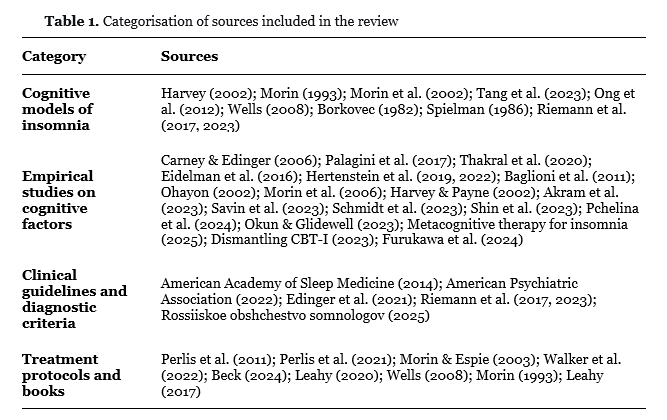
Categorisation of Included Sources. The distribution of included sources by thematic category is presented in Table 1.
Results
The literature analysis reveals that chronic insomnia is associated with several cognitive patterns related to how patients interpret sleep disturbances and relate to them (Ong et al., 2012; Palagini et al., 2017; Perlis et al., 2011; Tang et al., 2023; Thakral et al., 2020). Understanding these patterns is essential, as they form the targets for cognitive interventions. The distribution of sources addressing each cognitive pattern is presented in Table 2.
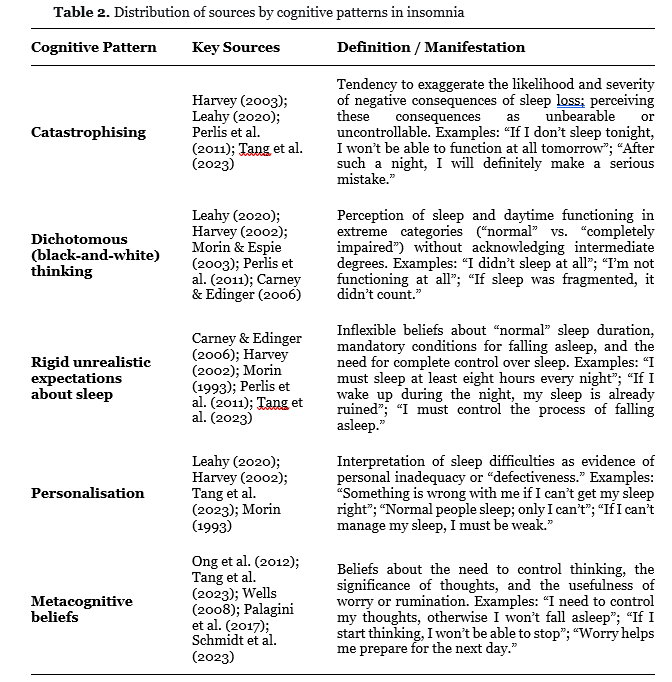
Each of these cognitive patterns contributes to the maintenance of insomnia through distinct but interconnected mechanisms. Catastrophising and dichotomous thinking amplify the subjective severity of sleep disturbances, while rigid expectations create unattainable standards against which sleep is continually evaluated and found wanting. Personalisation transforms a common difficulty into a threat to self‑worth, and metacognitive beliefs lock the individual into a cycle of futile mental control efforts. Together, these patterns form a cohesive cognitive architecture that sustains insomnia over time.
Catastrophising is defined as a tendency to exaggerate the likelihood and severity of negative consequences of sleep loss and to perceive these consequences as unbearable or uncontrollable (Leahy, 2020). In insomnia, such cognitions typically involve expectations of serious deterioration in cognitive functioning, emotional state, work performance, or health due to poor sleep. Studies show that the severity of catastrophising is associated with higher anxiety, increased psychophysiological arousal, and greater insomnia severity (Harvey, 2003).
Dichotomous, or black‑and‑white, thinking is characterised by a tendency to perceive one’s own sleep and daytime functioning in extreme categories, as either “normal” or “completely impaired”, without acknowledging intermediate degrees (Leahy, 2020). This mode of thinking amplifies the subjective severity of insomnia and intensifies emotional reactions to fluctuations in sleep quality. However, objective indicators and actual functioning are often less impaired than subjectively perceived (Harvey, 2002; Morin & Espie, 2003; Perlis et al., 2011).
Rigid and unrealistic expectations about sleep involve inflexible beliefs about “normal” sleep duration, mandatory conditions for falling asleep, and the need for complete control over the sleep process (Carney & Edinger, 2006; Harvey, 2002; Morin, 1993; Perlis et al., 2011; Tang et al., 2023). Such beliefs create extremely high demands on one’s own sleep and lead to perceiving any deviation from the expected pattern as a sign of a problem or threat. Consequently, sleep begins to be viewed not as a natural physiological process but as a task requiring constant monitoring and correct execution (Harvey, 2002; Perlis et al., 2011; Tang et al., 2023).
Personalisation involves interpreting sleep difficulties as evidence of personal inadequacy or “defectiveness” (Leahy, 2020). Here, sleep problems are seen not as the result of multiple interacting factors (stress, behavioural strategies, arousal level), but as a reflection of stable personal characteristics. Personalisation amplifies emotional distress, particularly anxiety, shame, and helplessness, and may reduce motivation for active participation in therapy (Harvey, 2002; Leahy, 2020).
Metacognitive beliefs concern the need to control thinking, the significance of thoughts, and the usefulness of worry or rumination (Ong et al., 2012; Tang et al., 2023; Wells, 2008). Such beliefs contribute to the adoption of active thought‑control strategies, including thought suppression, constant analysis, and attempts to solve problems just before bedtime, which typically increase cognitive activation and hinder sleep onset (Harvey, 2002; Ong et al., 2012; Palagini et al., 2017). Moreover, the very inability to stop the flow of thoughts becomes interpreted as a threat, indicating loss of control over one’s own state. Recent studies confirm that metacognitive beliefs play an important role in the aetiology of insomnia, and metacognitive therapy demonstrates promising results (Schmidt et al., 2023; Metacognitive therapy for insomnia, 2025).
Cognitive therapy for insomnia is a structured process aimed at identifying and modifying dysfunctional cognitions that maintain the disorder (Perlis et al., 2011; Perlis et al., 2021; Riemann et al., 2023). Work on thoughts and beliefs about sleep is not an isolated step but occurs within the overall cognitive‑behavioural model, which includes the interaction of cognitive, emotional, physiological, and behavioural factors (Perlis et al., 2021; Riemann et al., 2023).
Psychoeducation. At the initial stage, psychoeducation is crucial: the patient receives information about sleep physiology, regulatory mechanisms, the development of insomnia, and the principles of CBT‑I (Perlis et al., 2021). This helps reduce anxiety and fosters a more realistic understanding of the processes involved, thereby creating a foundation for subsequent therapeutic work.
Monitoring and Identification of Automatic Thoughts. The next step is sleep monitoring and, above all, monitoring of sleep‑related behaviours (Perlis et al., 2021). During the discussion of behavioural prescriptions, patients often reveal automatic thoughts and beliefs that may interfere with adherence. Cognitive work at this stage involves identifying and evaluating cognitions that hinder adherence and teaching the patient adaptive ways of responding to them (Perlis et al., 2021). To systematise this process, a cognitive diary that includes a description of the situation, associated cognitions, and emotional, physiological, and behavioural responses can be helpful (Beck, 2024).
Cognitive Restructuring. Once the patient has learned to identify cognitions, the next step is reappraisal and modification using Socratic dialogue aimed at evaluating the validity, realism, and functionality of automatic thoughts (Beck, 2024). In insomnia, the targets of restructuring are often predictions about the consequences of sleep loss, beliefs about the need to control sleep, and inflated expectations regarding sleep quality and duration. Formulating a more realistic interpretation can help reduce emotional distress and decrease hyperarousal that interferes with sleep onset (Beck, 2024; Eidelman et al., 2016; Leahy, 2020; Morin et al., 2002).
Decatastrophising. Working with catastrophising does not aim to deny the possible negative effects of sleep loss but rather to help the patient distinguish between unpleasant but tolerable consequences and truly catastrophic scenarios. One effective method is to assess the actual probability of the anticipated negative consequences based on the patient’s own experiential data (Perlis et al., 2021).
Cognitive Continuum. For dichotomous beliefs, the cognitive continuum technique is used, which helps move from extreme categorical assessments toward a more differentiated perception of one’s own experience (Beck, 2024).
Cost–Benefit Analysis of Beliefs. The patient is invited to explore the advantages and disadvantages of maintaining a particular belief, which helps develop a more flexible attitude toward sleep variability (Perlis et al., 2011).
Behavioural Experiments. Well‑planned behavioural experiments can modify beliefs much more effectively than verbal techniques (Beck, 2024; Leahy, 2020; Perlis et al., 2011). For instance, the patient may be asked to reduce their efforts to fall asleep, even to the point of intentionally allowing themselves not to sleep, which empirically challenges the belief that active control over sleep is a necessary condition for sleep onset (Beck, 2024; Perlis et al., 2021).
Working with Metacognitive Beliefs. This direction involves evaluating the necessity of thought control and the presumed benefits of worry (Leahy, 2020; Ong et al., 2012; Perlis et al., 2011). The patient is invited to analyse whether the strategies they use actually help them move closer to solving the problem or, on the contrary, maintain wakefulness and emotional tension. A crucial step is fostering the ability to perceive thoughts as transient mental events that do not require obligatory analysis, control, or immediate response (Ong et al., 2012). Recent research has shown that integrating elements of metacognitive therapy into CBT‑I is as effective as classical CBT‑I and can be considered a complement to standard cognitive strategies (Schmidt et al., 2023). The first clinical trial of metacognitive therapy for insomnia demonstrated large effects on insomnia severity (Hedges’ g = 1.64) with remission achieved in 57% of participants (Metacognitive therapy for insomnia, 2025).
Discussion
The conducted literature analysis confirms that cognitive processes occupy a central position in the maintenance of chronic insomnia and are considered key targets in CBT‑I (Harvey, 2002; Morin, 1993; Morin et al., 2002; Tang et al., 2023). In contemporary approaches, insomnia is conceptualised as a disorder involving impaired psychophysiological regulation, in which the way sleep disturbances are interpreted and made sense of becomes crucial.
The Maintaining Cycle. Regardless of the specific content of automatic thoughts and beliefs, their common function is to sustain attention to the sleep problem, increase the subjective significance of emerging difficulties, and heighten psychophysiological arousal that impedes sleep initiation and maintenance. This suggests that an important mechanism of chronicity is the formation of a maintaining cycle: initial sleep disturbances trigger negative interpretations, accompanied by anxiety and attempts to prevent possible consequences, which in turn lead to numerous efforts to control both sleep itself and related cognitive processes. However, such strategies often produce the opposite effect—they increase psychophysiological arousal and make it harder to transition to sleep. Subsequent worsening of sleep is perceived as confirmation of initial fears, further reinforcing existing beliefs. Hence, the target of therapeutic intervention is not only the content of individual thoughts but the entire cycle of responding to sleep disruptions.
The Metacognitive Turn. Metacognitive beliefs are of particular interest. The reviewed sources indicate that beliefs about the need to control thinking, eliminate unwanted thoughts, or use worry as a problem‑solving tool can independently maintain heightened cognitive activation (Harvey, 2002; Ong et al., 2012; Palagini et al., 2017). In this case, the source of distress is not so much the presence of certain thoughts but rather the ways of responding to them. Contemporary research confirms that metacognitive beliefs are an important factor in the aetiology of insomnia (Schmidt et al., 2023), and metacognitive therapy demonstrates promising results as a standalone intervention (Metacognitive therapy for insomnia, 2025). This perspective expands the traditional understanding of cognitive mechanisms in insomnia and places sleep disturbances within a broader context of cognitive self‑regulation.
The Integrative Approach. In clinical practice, cognitive interventions are rarely applied in isolation from behavioural components of CBT‑I (Edinger et al., 2021; Perlis et al., 2011; Perlis et al., 2021; Riemann et al., 2023; Walker et al., 2022). Rather, an integrative approach appears most effective, where cognitive work accompanies and supports the implementation of behavioural prescriptions. This is especially important when automatic thoughts specifically interfere with adherence to sleep restriction, stimulus control, or other treatment elements. Recent systematic reviews confirm that cognitive restructuring is a critical component of effective CBT‑I programmes (Furukawa et al., 2024; Dismantling CBT‑I, 2023).
Unresolved Questions and Limitations. The analysis also reveals several unresolved questions. Despite the large number of studies, the causal relationship between cognitive factors and insomnia remains open. On the one hand, extensive evidence indicates that dysfunctional cognitions are associated with greater sleep disturbance severity. On the other hand, it cannot be ruled out that sleep disturbances themselves contribute to the formation of negative interpretations. It is likely that we are dealing not with linear cause‑and‑effect relations but with a system of reciprocal influence, in which cognitive factors act both as consequences and as maintaining mechanisms. The lack of longitudinal data limits the possibilities for causal inferences (Akram et al., 2023).
Several limitations of this review should also be acknowledged. The work is narrative in nature and is based primarily on qualitative analysis of theoretical models, clinical guidelines, and empirical studies. This limits the possibility of quantifying the relative contribution of individual cognitive mechanisms and comparing the effectiveness of different interventions. An additional limitation is the heterogeneity of the included sources, which vary in methodology and study design, making direct comparison of results difficult.
Despite these limitations, the analysis allows for a systematisation of the main cognitive mechanisms of chronic insomnia and highlights the clinical significance of cognitive interventions within CBT‑I. The presented data may be useful both for further research on cognitive factors in insomnia and for the practical training of clinicians working with sleep disorders.
Conclusions
- Contemporary theoretical models of insomnia regard cognitive processes as key mechanisms in the maintenance of chronic insomnia.
- Significant cognitive factors include catastrophising about the consequences of sleep loss, dichotomous thinking, rigid expectations about sleep, personalisation, and metacognitive beliefs. They contribute to increased emotional distress, heightened psychophysiological arousal, and the formation of a maintaining cycle in insomnia.
- Cognitive interventions within CBT‑I aim to identify and modify dysfunctional beliefs and to reduce excessive control over sleep‑related processes. This is expected to decrease anxiety and psychophysiological activation that perpetuate insomnia.
- A promising direction for future research is the investigation of the role of metacognitive processes in maintaining chronic insomnia and the possibilities of integrating metacognitive interventions into CBT‑I protocols. Current evidence supports the effectiveness of both classical CBT‑I and its metacognitively oriented modifications.
Conflict of Interest: The author declares no conflict of interest.
Funding: This research received no specific grant from any funding agency in the public, commercial, or not‑for‑profit sectors.
Acknowledgements: The author expresses gratitude to colleagues at the Department of Clinical Psychology and Personality Psychology, Kazan Federal University, for valuable discussions and constructive feedback during the preparation of the manuscript.
Use of Artificial Intelligence: In preparing this manuscript, the author used artificial intelligence tools for language editing and text formatting to meet academic style requirements. All scientific conclusions, data interpretation, and the final version of the manuscript are the author’s own work.
References
- Akram, U., Barclay, N., Milkins, B., Stevenson, J., & Gardani, M. (2023). Sleep-related attentional and interpretive-bias in insomnia: A systematic review and meta-analysis. Sleep Medicine Reviews, 67, 101713. https://doi.org/10.1016/j.smrv.2022.101713
- American Academy of Sleep Medicine. (2014). International classification of sleep disorders(3rd ed.). American Academy of Sleep Medicine.
- American Psychiatric Association. (2022). Diagnostic and statistical manual of mental disorders(5th ed., text rev.). American Psychiatric Association Publishing. https://doi.org/10.1176/appi.books.9780890425787
- Beck, J. S. (2024). Kognitivno-povedencheskaya terapiya: ot osnov k napravleniyam[Cognitive behavior therapy: Basics and beyond] (3rd ed.). (Original work published in English)
- Borkovec, T. D. (1982). Insomnia. Journal of Consulting and Clinical Psychology, 50(6), 880–895. https://doi.org/10.1037/0022-006X.50.6.880
- Carney, C. E., & Edinger, J. D. (2006). Identifying critical beliefs about sleep in primary insomnia. Sleep, 29(4), 444–453. https://doi.org/10.1093/sleep/29.3.342
- Dismantling cognitive-behavioural therapy for chronic insomnia in adults with or without comorbidities: A systematic review and component network meta-analysis. (2023). MedRxiv. https://doi.org/10.1101/2023.05.19.23290084v1
- Edinger, J. D., Arnedt, J. T., Bertisch, S. M., Carney, C. E., Harrington, J. J., Lichstein, K. L., Sateia, M. J., Troxel, W. M., Zhou, E. S., Kazmi, U., Heald, J. L., & Martin, J. L. (2021). Behavioral and psychological treatments for chronic insomnia disorder in adults: An American Academy of Sleep Medicine clinical practice guideline. Journal of Clinical Sleep Medicine, 17(2), 255–262. https://doi.org/10.5664/jcsm.8986
- Eidelman, P., Talbot, L., Ivers, H., Bélanger, L., Morin, C. M., & Harvey, A. G. (2016). Change in dysfunctional beliefs about sleep in behavior therapy, cognitive therapy, and cognitive-behavioral therapy for insomnia. Behavior Therapy, 47(1), 102–115. https://doi.org/10.1016/j.beth.2015.10.002
- Furukawa, Y., Sakata, M., Yamamoto, R., Nakajima, S., Kikuchi, S., Inoue, M., Ito, M., Noma, H., Takashina, H. N., Funada, S., Ostinelli, E. G., Furukawa, T. A., Efthimiou, O., & Perlis, M. (2024). Components and delivery formats of cognitive behavioral therapy for chronic insomnia in adults: A systematic review and component network meta-analysis. JAMA Psychiatry, 81(4), 357–365. https://doi.org/10.1001/jamapsychiatry.2023.5060
- Harvey, A. G. (2002). A cognitive model of insomnia. Behaviour Research and Therapy, 40(8), 869–893. https://doi.org/10.1016/S0005-7967(01)00061-4
- Harvey, A. G. (2003). Catastrophic worry in primary insomnia. Journal of Behavior Therapy and Experimental Psychiatry, 34(1), 11–23. https://doi.org/10.1016/S0005-7916(03)00003-X
- Harvey, A. G. (2013). A cognitive model of insomnia. In The Oxford handbook of sleep and sleep disorders. Oxford University Press.
- Harvey, A. G., & Payne, S. (2002). The management of unwanted pre-sleep thoughts in insomnia: Distraction with imagery versus general distraction. Behaviour Research and Therapy, 40(3), 267–277. https://doi.org/10.1016/S0005-7967(01)00012-2
- Hertenstein, E., Feige, B., Gmeiner, T., Kienzler, C., Spiegelhalder, K., Johann, A., Jansson-Fröjmark, M., Palagini, L., Rücker, G., Riemann, D., & Baglioni, C. (2019). Insomnia as a predictor of mental disorders: A systematic review and meta-analysis. Sleep Medicine Reviews, 43, 96–105. https://doi.org/10.1016/j.smrv.2018.10.006
- Hertenstein, E., Trinca, E., Wunderlin, M., Schneider, C. L., Züst, M. A., Fehér, K. D., Su, T., van Straten, A., Berger, T., Baglioni, C., Johann, A., Spiegelhalder, K., Riemann, D., Feige, B., & Nissen, C. (2022). Cognitive behavioral therapy for insomnia in patients with mental disorders and comorbid insomnia: A systematic review and meta-analysis. Sleep Medicine Reviews, 62, 101597. https://doi.org/10.1016/j.smrv.2022.101597
- Leahy, R. L. (2017). Cognitive therapy techniques: A practitioner’s guide(2nd ed.). Guilford Press.
- Leahy, R. L. (2020). Tekhniki kognitivnoy psikhoterapii[Cognitive psychotherapy techniques]. (Original work published 2017)
- Metacognitive therapy for insomnia: An open cohort study on clinical outcomes and the role of cognitive-attentional syndrome factors in insomnia. (2025). Sleep Medicine: X, 10, 100153.
- Morin, C. M. (1993). Insomnia: Psychological assessment and management. Guilford Press.
- Morin, C. M., Blais, F., & Savard, J. (2002). Are changes in beliefs and attitudes about sleep related to sleep improvements in the treatment of insomnia? Behaviour Research and Therapy, 40(7), 741–752. https://doi.org/10.1016/S0005-7967(01)00055-9
- Morin, C. M., & Espie, C. A. (2003). Insomnia: A clinical guide to assessment and treatment. Kluwer Academic/Plenum Publishers. https://doi.org/10.1007/b105845
- Morin, C. M., LeBlanc, M., Daley, M., Gregoire, J. P., & Mérette, C. (2006). Epidemiology of insomnia: Prevalence, self-help treatments, consultations, and determinants of help-seeking behaviors. Sleep Medicine, 7(2), 123–130. https://doi.org/10.1016/j.sleep.2005.08.008
- Naha, S., Sivaraman, M., & Sahota, P. (2024). Insomnia: A current review. Missouri Medicine, 121(1), 44–51.
- Ohayon, M. M. (2002). Epidemiology of insomnia: What we know and what we still need to learn. Sleep Medicine Reviews, 6(2), 97–111. https://doi.org/10.1053/smrv.2002.0186
- Okun, M. L., & Glidewell, R. N. (2023). Improvement of insomnia symptoms following a single 4-hour CBT-I workshop. Behavioral Sleep Medicine, 21(1), 72–83. https://doi.org/10.1080/15402002.2022.2038597
- Ong, J. C., Ulmer, C. S., & Manber, R. (2012). Improving sleep with mindfulness and acceptance: A metacognitive model of insomnia. Behaviour Research and Therapy, 50(11), 651–660. https://doi.org/10.1016/j.brat.2012.08.001
- Palagini, L., Moretto, U., Dell’Osso, L., & Carney, C. (2017). Sleep-related cognitive processes in insomnia disorder: The role of rumination and worry. Sleep Medicine Reviews, 30, 3–11. https://doi.org/10.1016/j.smrv.2015.11.004
- Pchelina, P., Poluektov, M., Krieger, T., Duss, S. B., & Berger, T. (2024). Clinical effectiveness of internet-based cognitive behavioral therapy for insomnia in routine secondary care: Results of a randomized controlled trial. Frontiers in Psychiatry, 15, 1301489. https://doi.org/10.3389/fpsyt.2024.1301489
- Perlis, M. L., Aloia, M., & Kuhn, B. R. (Eds.). (2011). Behavioral treatments for sleep disorders: A comprehensive primer of behavioral sleep medicine interventions. Academic Press. https://doi.org/10.1016/C2009-0-62216-9
- Perlis, M. L., Jungquist, C., Smith, M. T., & Posner, D. (2021). Kognitivno-povedencheskaya terapiya bessonnitsy: Poshagovoye rukovodstvo[Cognitive behavioral therapy for insomnia: A session-by-session guide]. (Original work published 2005)
- Riemann, D., Baglioni, C., Bassetti, C., Bjorvatn, B., Dolenc Groselj, L., Ellis, J. G., Espie, C. A., Garcia-Borreguero, D., Gjerstad, M., Gonçalves, M., Hertenstein, E., Jansson-Fröjmark, M., Jennum, P. J., Leger, D., Nissen, C., Parrino, L., Paunio, T., Pevernagie, D., Verbraecken, J., … Spiegelhalder, K. (2017). European guideline for the diagnosis and treatment of insomnia. Journal of Sleep Research, 26(6), 675–700. https://doi.org/10.1111/jsr.12594
- Riemann, D., Espie, C. A., Altena, E., Arnardottir, E. S., Baglioni, C., Bassetti, C. L. A., Bastien, C., Berzina, N., Bjorvatn, B., Dikeos, D., Dolenc Groselj, L., Ellis, J. G., Garcia-Borreguero, D., Geoffroy, P. A., Gjerstad, M., Gonçalves, M., Hertenstein, E., Hoedlmoser, K., Hrubos-Strøm, H., … Spiegelhalder, K. (2023). The European Insomnia Guideline: An update on the diagnosis and treatment of insomnia 2023. Journal of Sleep Research, 32(6), e14035. https://doi.org/10.1111/jsr.14035
- Rossiiskoe obshchestvo somnologov [Russian Society of Somnologists]. (2025). Proyekt klinicheskikh rekomendatsiy po diagnostike i lecheniyu khronicheskoy insomnii u vzroslykh[Draft clinical guidelines for the diagnosis and treatment of chronic insomnia in adults]. https://rossleep.ru/wp-content/uploads/2025/11/kr-insomnii.pdf
- Savin, K. L., Clark, T. L., Perez-Ramirez, P., Allen, T. S., Tristão Parra, M., & Gallo, L. C. (2023). The effect of cognitive behavioral therapy for insomnia (CBT-I) on cardiometabolic health biomarkers: A systematic review of randomized controlled trials. Behavioral Sleep Medicine, 21(6), 671–694. https://doi.org/10.1080/15402002.2023.2261549
- Schmidt, C., Jenewein, A.-L., Schredl, M., & Schilling, C. (2023). Sleep-related metacognitions and cognitive behavioral therapy for insomnia. Somnologie, 27, 109–116. https://doi.org/10.1007/s11818-023-00404-9
- Shin, J.-W., Kim, S., Shin, Y. J., Park, B., & Park, S. (2023). Comparison of Acceptance and Commitment Therapy (ACT) and Cognitive Behavior Therapy (CBT) for chronic insomnia: A pilot randomized controlled trial. Nature and Science of Sleep, 15, 523–531. https://doi.org/10.2147/NSS.S409981
- Spielman, A. J. (1986). Assessment of insomnia. Clinical Psychology Review, 6(1), 11–25. https://doi.org/10.1016/0272-7358(86)90015-2
- Spielman, A. J., Saskin, P., & Thorpy, M. J. (1987). Treatment of chronic insomnia by restriction of time in bed. Sleep, 10(1), 45–56. https://doi.org/10.1093/sleep/10.1.45
- Tang, N. K. Y., Saconi, B., Jansson-Fröjmark, M., Ong, J. C., & Carney, C. E. (2023). Cognitive factors and processes in models of insomnia: A systematic review. Journal of Sleep Research, 32(6), e13923. https://doi.org/10.1111/jsr.13923
- Thakral, M., Von Korff, M., McCurry, S. M., Morin, C. M., & Vitiello, M. V. (2020). Changes in dysfunctional beliefs about sleep after cognitive behavioral therapy for insomnia: A systematic literature review and meta-analysis. Sleep Medicine Reviews, 49, 101230. https://doi.org/10.1016/j.smrv.2019.101230
- Trauer, J. M., Qian, M. Y., Doyle, J. S., Rajaratnam, S. M. W., & Cunnington, D. (2015). Cognitive behavioral therapy for chronic insomnia: A systematic review and meta-analysis. Annals of Internal Medicine, 163(3), 191–204. https://doi.org/10.7326/M14-2841
- Walker, J., Muench, A., Perlis, M. L., & Vargas, I. (2022). Cognitive Behavioral Therapy for Insomnia (CBT-I): A primer. Klinicheskaya i spetsialnaya psikhologiya [Clinical Psychology and Special Education], 11(2), 123–137. https://doi.org/10.17759/cpse.2022110208
- Wells, A. (2008). Metacognitive therapy for anxiety and depression. Guilford Press.
Comments (0)
Background. Chronic insomnia is one of the most common sleep disorders, associated with significant impairments in emotional state, cognitive functioning, and quality of life. Contemporary models of insomnia highlight cognitive processes as key mechanisms maintaining the disorder; however, questions regarding the systematisation of cognitive factors and their modification remain debatable. Objective. To analyse the cognitive mechanisms of chronic insomnia and the therapeutic interventions used in cognitive–behavioural therapy for insomnia (CBT‑I). Methods. A narrative review of the literature, including cognitive models of insomnia, empirical studies of cognitive factors, clinical guidelines for CBT‑I, and cognitive therapy protocols. Searches were conducted in PubMed, Scopus, and PsycINFO for the period 1980–2024 using the keywords: insomnia, cognitive model, cognitive therapy, CBT‑I, metacognition. Results. The review included 44 sources. Five main cognitive patterns maintaining insomnia were identified: catastrophising, dichotomous thinking, rigid expectations about sleep, personalisation, and metacognitive beliefs. The main cognitive interventions in CBT‑I are described: psychoeducation, monitoring of automatic thoughts, cognitive restructuring, decatastrophising, cognitive continuum, cost–benefit analysis of beliefs, and behavioural experiments. Special attention is given to addressing beliefs about the need to control sleep and thinking. Recent studies confirm the effectiveness of integrating metacognitive approaches into CBT‑I protocols. Conclusion. Cognitive processes are a central therapeutic target in chronic insomnia. Cognitive interventions within CBT‑I facilitate the modification of dysfunctional beliefs, reduce anxiety, and decrease psychophysiological activation. The integration of metacognitive approaches into CBT‑I protocols represents a promising direction for future research.
Когнитивные интервенции в терапии хронической инсомнии: механизмы, мишени и методы коррекции
М. Б. Щевлягина
Казанский федеральный университет; Казань, Россия
Резюме. Актуальность. Хроническая инсомния является одним из наиболее распространённых расстройств сна, ассоциированных с выраженными нарушениями эмоционального состояния, когнитивного функционирования и качества жизни. Современные модели инсомнии рассматривают когнитивные процессы как ключевой механизм поддержания расстройства, однако вопросы систематизации когнитивных факторов и их коррекции остаются дискуссионными. Цель. Анализ когнитивных механизмов хронической инсомнии и терапевтических интервенций, применяемых в когнитивно-поведенческой терапии инсомнии (КПТ-И). Методы. Нарративный обзор литературы, включающий анализ когнитивных моделей инсомнии, эмпирических исследований когнитивных факторов, клинических руководств по КПТ-И и протоколов когнитивной терапии. Поиск проводился в базах PubMed, Scopus и PsycINFO за период 1980–2024 гг. по ключевым словам: insomnia, cognitive model, cognitive therapy, CBT‑I, metacognition. Отбор источников осуществлялся в соответствии с PRISMA (см. блок-схему). Результаты. В обзор включено 44 источника. Выявлено пять основных когнитивных паттернов, поддерживающих инсомнию: катастрофизация, дихотомическое мышление, жёсткие ожидания относительно сна, персонализация и метакогнитивные убеждения. Описаны основные когнитивные интервенции КПТ-И: психообразование, мониторинг автоматических мыслей, когнитивная реструктуризация, декатастрофизация, когнитивный континуум, анализ преимуществ и недостатков убеждений, поведенческие эксперименты. Отдельное внимание уделено работе с убеждениями о необходимости контроля сна и мышления. Современные исследования подтверждают эффективность интеграции метакогнитивных подходов в протоколы КПТ-И.
Заключение. Когнитивные процессы являются центральной терапевтической мишенью при хронической инсомнии. Когнитивные интервенции в структуре КПТ-И способствуют модификации дисфункциональных убеждений, снижению тревоги и психофизиологической активации. Перспективным направлением является интеграция метакогнитивных подходов в протоколы КПТ-И.
Ключевые слова: инсомния, хроническая инсомния, когнитивно-поведенческая терапия инсомнии, КПТ-И, когнитивные искажения, метакогнитивные убеждения.
Chronic insomnia represents one of the most prevalent sleep disorders, exerting a substantial negative impact on quality of life, emotional well‑being, and cognitive performance (Harvey, 2002). According to the American Academy of Sleep Medicine, approximately 30% of adults experience some insomnia symptoms, while about 10% suffer from chronic insomnia (American Academy of Sleep Medicine, 2014). These figures underscore the considerable public health burden of the condition and the pressing need for effective, evidence‑based interventions.
According to the diagnostic criteria of DSM‑5‑TR and ICSD‑3, insomnia is defined as a persistent difficulty with sleep initiation, maintenance, and/or early morning awakenings with an inability to return to sleep, despite adequate opportunities for sleep (American Academy of Sleep Medicine, 2014; American Psychiatric Association, 2022). A mandatory component of the diagnosis is the presence of clinically significant daytime consequences, including fatigue, reduced concentration, emotional dysregulation, and impaired social and occupational functioning (Rossiiskoe obshchestvo somnologov, 2025; American Academy of Sleep Medicine, 2014; American Psychiatric Association, 2022). To establish the diagnosis, symptoms must occur at least three times per week and persist for at least three months, which differentiates chronic insomnia from transient or acute forms (Rossiiskoe obshchestvo somnologov, 2025; American Academy of Sleep Medicine, 2014; American Psychiatric Association, 2022).
Contemporary perspectives on the pathogenesis of insomnia have historically been grounded in the three‑factor (3‑P) model proposed by Arthur J. Spielman, according to which insomnia results from the interaction of predisposing, precipitating, and perpetuating factors (Spielman, 1986). A particular role is assigned to maladaptive behaviours that patients adopt in an attempt to increase sleep quantity; these strategies, paradoxically, contribute to chronicity (Perlis et al., 2021). In line with this model, therapeutic approaches initially targeted the modification of maladaptive behavioural patterns, primarily by reducing time spent in bed awake and limiting behaviours incompatible with sleep. These interventions included stimulus control therapy and sleep restriction therapy (Spielman, 1986; Spielman et al., 1987). For a considerable period, these strategies were considered the core components of non‑pharmacological treatment for insomnia and were recommended as first‑line interventions.
However, accumulating empirical evidence demonstrated that behavioural changes alone are often insufficient to produce sustained clinical improvement. This realisation prompted the development of multicomponent approaches that take into account the role of cognitive factors in maintaining the disorder. From the 1980s onward, research focus gradually shifted toward cognitive mechanisms of insomnia, reflected in several theories emphasising the role of dysfunctional beliefs and metacognitive processes (Borkovec, 1982; Harvey, 2002; Morin, 1993).
A systematic review by Tang and colleagues (2023), which included nine classical theories of insomnia published between 1982 and 2023, confirmed that cognitive factors and processes are central to the maintenance of insomnia. In the cognitive model proposed by Charles M. Morin and further developed by Allison G. Harvey, it is emphasised that dysfunctional cognitions about sleep difficulties amplify emotional distress and act as a determining factor in chronification, making them a primary target for therapeutic intervention (Harvey, 2002; Harvey, 2013; Harvey, 2003; Harvey & Payne, 2002; Morin et al., 2002).
Despite broad acceptance of the role of cognitive factors, the direction of causal relationships remains a matter of debate (Harvey, 2002; Hertenstein et al., 2019; Morin et al., 2006). On the one hand, dysfunctional beliefs may promote chronification of sleep disturbances (Harvey, 2002; Morin et al., 2006; Tang et al., 2023). On the other hand, long‑standing insomnia itself may reinforce negative interpretations and generate secondary cognitive distortions (Hertenstein et al., 2019; Ohayon, 2002; Tang et al., 2023). These processes likely operate in a bidirectional manner, forming a complex interplay rather than a simple linear causal chain (Harvey, 2002; Tang et al., 2023).
Empirical studies demonstrate that patients with insomnia exhibit a wide range of cognitive distortions, including catastrophising about the consequences of insomnia, inflated expectations regarding sleep duration and quality, and rigid beliefs about the necessity of complete control over the sleep process (Carney & Edinger, 2006; Harvey, 2002; Morin et al., 2002; Palagini et al., 2017; Perlis et al., 2021; Tang et al., 2023). In addition, a marked tendency toward selective attention to signs of insufficient sleep and monitoring of somatic and cognitive states related to sleep has been noted (Tang et al., 2023). Thus, a vicious cycle emerges: negative automatic thoughts and dysfunctional beliefs increase sleep‑related anxiety, which in turn amplifies cognitive and physiological arousal and worsens sleep, thereby confirming the initial cognitive appraisals. This mechanism is considered one of the central pathways in the maintenance of chronic insomnia.
Cognitive–behavioural therapy for insomnia (CBT‑I) is currently recognised as the first‑line treatment for chronic insomnia, as reflected in guidelines from the American Academy of Sleep Medicine and the European Sleep Research Society (American Academy of Sleep Medicine, 2014; Edinger et al., 2021; Riemann et al., 2017; Riemann et al., 2023). Within the CBT‑I framework, cognitive interventions occupy a key position and are aimed at identifying and restructuring dysfunctional beliefs about sleep (Riemann et al., 2023). The theoretical basis of this approach is that the interpretation of sleep difficulties can initiate and maintain emotional responses (primarily anxiety and frustration) that are functionally incompatible with sleep initiation and maintenance. It is this interpretive process, rather than the sleep difficulties per se, that becomes the focus of therapeutic attention.
This is a narrative review of the literature on cognitive mechanisms of insomnia and cognitive interventions within CBT‑I.
Search Strategy. Literature searches were conducted in PubMed, Scopus, and PsycINFO for the period 1980 to 2024 using the following keywords and their combinations: insomnia, cognitive model, cognitive therapy, CBT I, metacognition. Additional manual searches were performed using reference lists of relevant reviews.
Inclusion Criteria. The review included: (1) theoretical models of insomnia in which cognitive factors are considered a mechanism maintaining the disorder; (2) empirical studies of cognitive factors in insomnia; (3) clinical practice guidelines for CBT‑I; (4) cognitive therapy protocols for insomnia. Exclusion criteria: articles not directly addressing cognitive mechanisms or interventions in insomnia; publications in languages other than English or Russian; duplicate publications.
Selection Procedure. Source selection followed the Preferred Reporting Items for Systematic Reviews and Meta‑Analyses. The quantitative figures in the PRISMA flow diagram are informed by the systematic review methodology of Tang et al. (2023), who identified 2,458 records in PsycINFO and PubMed, selected 34 for full‑text assessment, and included 12 in their final synthesis. For the present narrative review, the search was extended to include Scopus and covered a broader time frame (1980–2024) with additional keywords, resulting in the estimated figures presented.
Method of Analysis. The primary method was qualitative synthesis of data followed by systematisation of cognitive mechanisms and therapeutic interventions.
Categorisation of Included Sources. The distribution of included sources by thematic category is presented in Table 1.
The literature analysis reveals that chronic insomnia is associated with several cognitive patterns related to how patients interpret sleep disturbances and relate to them (Ong et al., 2012; Palagini et al., 2017; Perlis et al., 2011; Tang et al., 2023; Thakral et al., 2020). Understanding these patterns is essential, as they form the targets for cognitive interventions. The distribution of sources addressing each cognitive pattern is presented in Table 2.
Each of these cognitive patterns contributes to the maintenance of insomnia through distinct but interconnected mechanisms. Catastrophising and dichotomous thinking amplify the subjective severity of sleep disturbances, while rigid expectations create unattainable standards against which sleep is continually evaluated and found wanting. Personalisation transforms a common difficulty into a threat to self‑worth, and metacognitive beliefs lock the individual into a cycle of futile mental control efforts. Together, these patterns form a cohesive cognitive architecture that sustains insomnia over time.
Catastrophising is defined as a tendency to exaggerate the likelihood and severity of negative consequences of sleep loss and to perceive these consequences as unbearable or uncontrollable (Leahy, 2020). In insomnia, such cognitions typically involve expectations of serious deterioration in cognitive functioning, emotional state, work performance, or health due to poor sleep. Studies show that the severity of catastrophising is associated with higher anxiety, increased psychophysiological arousal, and greater insomnia severity (Harvey, 2003).
Dichotomous, or black‑and‑white, thinking is characterised by a tendency to perceive one’s own sleep and daytime functioning in extreme categories, as either “normal” or “completely impaired”, without acknowledging intermediate degrees (Leahy, 2020). This mode of thinking amplifies the subjective severity of insomnia and intensifies emotional reactions to fluctuations in sleep quality. However, objective indicators and actual functioning are often less impaired than subjectively perceived (Harvey, 2002; Morin & Espie, 2003; Perlis et al., 2011).
Rigid and unrealistic expectations about sleep involve inflexible beliefs about “normal” sleep duration, mandatory conditions for falling asleep, and the need for complete control over the sleep process (Carney & Edinger, 2006; Harvey, 2002; Morin, 1993; Perlis et al., 2011; Tang et al., 2023). Such beliefs create extremely high demands on one’s own sleep and lead to perceiving any deviation from the expected pattern as a sign of a problem or threat. Consequently, sleep begins to be viewed not as a natural physiological process but as a task requiring constant monitoring and correct execution (Harvey, 2002; Perlis et al., 2011; Tang et al., 2023).
Personalisation involves interpreting sleep difficulties as evidence of personal inadequacy or “defectiveness” (Leahy, 2020). Here, sleep problems are seen not as the result of multiple interacting factors (stress, behavioural strategies, arousal level), but as a reflection of stable personal characteristics. Personalisation amplifies emotional distress, particularly anxiety, shame, and helplessness, and may reduce motivation for active participation in therapy (Harvey, 2002; Leahy, 2020).
Metacognitive beliefs concern the need to control thinking, the significance of thoughts, and the usefulness of worry or rumination (Ong et al., 2012; Tang et al., 2023; Wells, 2008). Such beliefs contribute to the adoption of active thought‑control strategies, including thought suppression, constant analysis, and attempts to solve problems just before bedtime, which typically increase cognitive activation and hinder sleep onset (Harvey, 2002; Ong et al., 2012; Palagini et al., 2017). Moreover, the very inability to stop the flow of thoughts becomes interpreted as a threat, indicating loss of control over one’s own state. Recent studies confirm that metacognitive beliefs play an important role in the aetiology of insomnia, and metacognitive therapy demonstrates promising results (Schmidt et al., 2023; Metacognitive therapy for insomnia, 2025).
Cognitive therapy for insomnia is a structured process aimed at identifying and modifying dysfunctional cognitions that maintain the disorder (Perlis et al., 2011; Perlis et al., 2021; Riemann et al., 2023). Work on thoughts and beliefs about sleep is not an isolated step but occurs within the overall cognitive‑behavioural model, which includes the interaction of cognitive, emotional, physiological, and behavioural factors (Perlis et al., 2021; Riemann et al., 2023).
Psychoeducation. At the initial stage, psychoeducation is crucial: the patient receives information about sleep physiology, regulatory mechanisms, the development of insomnia, and the principles of CBT‑I (Perlis et al., 2021). This helps reduce anxiety and fosters a more realistic understanding of the processes involved, thereby creating a foundation for subsequent therapeutic work.
Monitoring and Identification of Automatic Thoughts. The next step is sleep monitoring and, above all, monitoring of sleep‑related behaviours (Perlis et al., 2021). During the discussion of behavioural prescriptions, patients often reveal automatic thoughts and beliefs that may interfere with adherence. Cognitive work at this stage involves identifying and evaluating cognitions that hinder adherence and teaching the patient adaptive ways of responding to them (Perlis et al., 2021). To systematise this process, a cognitive diary that includes a description of the situation, associated cognitions, and emotional, physiological, and behavioural responses can be helpful (Beck, 2024).
Cognitive Restructuring. Once the patient has learned to identify cognitions, the next step is reappraisal and modification using Socratic dialogue aimed at evaluating the validity, realism, and functionality of automatic thoughts (Beck, 2024). In insomnia, the targets of restructuring are often predictions about the consequences of sleep loss, beliefs about the need to control sleep, and inflated expectations regarding sleep quality and duration. Formulating a more realistic interpretation can help reduce emotional distress and decrease hyperarousal that interferes with sleep onset (Beck, 2024; Eidelman et al., 2016; Leahy, 2020; Morin et al., 2002).
Decatastrophising. Working with catastrophising does not aim to deny the possible negative effects of sleep loss but rather to help the patient distinguish between unpleasant but tolerable consequences and truly catastrophic scenarios. One effective method is to assess the actual probability of the anticipated negative consequences based on the patient’s own experiential data (Perlis et al., 2021).
Cognitive Continuum. For dichotomous beliefs, the cognitive continuum technique is used, which helps move from extreme categorical assessments toward a more differentiated perception of one’s own experience (Beck, 2024).
Cost–Benefit Analysis of Beliefs. The patient is invited to explore the advantages and disadvantages of maintaining a particular belief, which helps develop a more flexible attitude toward sleep variability (Perlis et al., 2011).
Behavioural Experiments. Well‑planned behavioural experiments can modify beliefs much more effectively than verbal techniques (Beck, 2024; Leahy, 2020; Perlis et al., 2011). For instance, the patient may be asked to reduce their efforts to fall asleep, even to the point of intentionally allowing themselves not to sleep, which empirically challenges the belief that active control over sleep is a necessary condition for sleep onset (Beck, 2024; Perlis et al., 2021).
Working with Metacognitive Beliefs. This direction involves evaluating the necessity of thought control and the presumed benefits of worry (Leahy, 2020; Ong et al., 2012; Perlis et al., 2011). The patient is invited to analyse whether the strategies they use actually help them move closer to solving the problem or, on the contrary, maintain wakefulness and emotional tension. A crucial step is fostering the ability to perceive thoughts as transient mental events that do not require obligatory analysis, control, or immediate response (Ong et al., 2012). Recent research has shown that integrating elements of metacognitive therapy into CBT‑I is as effective as classical CBT‑I and can be considered a complement to standard cognitive strategies (Schmidt et al., 2023). The first clinical trial of metacognitive therapy for insomnia demonstrated large effects on insomnia severity (Hedges’ g = 1.64) with remission achieved in 57% of participants (Metacognitive therapy for insomnia, 2025).
The conducted literature analysis confirms that cognitive processes occupy a central position in the maintenance of chronic insomnia and are considered key targets in CBT‑I (Harvey, 2002; Morin, 1993; Morin et al., 2002; Tang et al., 2023). In contemporary approaches, insomnia is conceptualised as a disorder involving impaired psychophysiological regulation, in which the way sleep disturbances are interpreted and made sense of becomes crucial.
The Maintaining Cycle. Regardless of the specific content of automatic thoughts and beliefs, their common function is to sustain attention to the sleep problem, increase the subjective significance of emerging difficulties, and heighten psychophysiological arousal that impedes sleep initiation and maintenance. This suggests that an important mechanism of chronicity is the formation of a maintaining cycle: initial sleep disturbances trigger negative interpretations, accompanied by anxiety and attempts to prevent possible consequences, which in turn lead to numerous efforts to control both sleep itself and related cognitive processes. However, such strategies often produce the opposite effect—they increase psychophysiological arousal and make it harder to transition to sleep. Subsequent worsening of sleep is perceived as confirmation of initial fears, further reinforcing existing beliefs. Hence, the target of therapeutic intervention is not only the content of individual thoughts but the entire cycle of responding to sleep disruptions.
The Metacognitive Turn. Metacognitive beliefs are of particular interest. The reviewed sources indicate that beliefs about the need to control thinking, eliminate unwanted thoughts, or use worry as a problem‑solving tool can independently maintain heightened cognitive activation (Harvey, 2002; Ong et al., 2012; Palagini et al., 2017). In this case, the source of distress is not so much the presence of certain thoughts but rather the ways of responding to them. Contemporary research confirms that metacognitive beliefs are an important factor in the aetiology of insomnia (Schmidt et al., 2023), and metacognitive therapy demonstrates promising results as a standalone intervention (Metacognitive therapy for insomnia, 2025). This perspective expands the traditional understanding of cognitive mechanisms in insomnia and places sleep disturbances within a broader context of cognitive self‑regulation.
The Integrative Approach. In clinical practice, cognitive interventions are rarely applied in isolation from behavioural components of CBT‑I (Edinger et al., 2021; Perlis et al., 2011; Perlis et al., 2021; Riemann et al., 2023; Walker et al., 2022). Rather, an integrative approach appears most effective, where cognitive work accompanies and supports the implementation of behavioural prescriptions. This is especially important when automatic thoughts specifically interfere with adherence to sleep restriction, stimulus control, or other treatment elements. Recent systematic reviews confirm that cognitive restructuring is a critical component of effective CBT‑I programmes (Furukawa et al., 2024; Dismantling CBT‑I, 2023).
Unresolved Questions and Limitations. The analysis also reveals several unresolved questions. Despite the large number of studies, the causal relationship between cognitive factors and insomnia remains open. On the one hand, extensive evidence indicates that dysfunctional cognitions are associated with greater sleep disturbance severity. On the other hand, it cannot be ruled out that sleep disturbances themselves contribute to the formation of negative interpretations. It is likely that we are dealing not with linear cause‑and‑effect relations but with a system of reciprocal influence, in which cognitive factors act both as consequences and as maintaining mechanisms. The lack of longitudinal data limits the possibilities for causal inferences (Akram et al., 2023).
Several limitations of this review should also be acknowledged. The work is narrative in nature and is based primarily on qualitative analysis of theoretical models, clinical guidelines, and empirical studies. This limits the possibility of quantifying the relative contribution of individual cognitive mechanisms and comparing the effectiveness of different interventions. An additional limitation is the heterogeneity of the included sources, which vary in methodology and study design, making direct comparison of results difficult.
Despite these limitations, the analysis allows for a systematisation of the main cognitive mechanisms of chronic insomnia and highlights the clinical significance of cognitive interventions within CBT‑I. The presented data may be useful both for further research on cognitive factors in insomnia and for the practical training of clinicians working with sleep disorders.
- Contemporary theoretical models of insomnia regard cognitive processes as key mechanisms in the maintenance of chronic insomnia.
- Significant cognitive factors include catastrophising about the consequences of sleep loss, dichotomous thinking, rigid expectations about sleep, personalisation, and metacognitive beliefs. They contribute to increased emotional distress, heightened psychophysiological arousal, and the formation of a maintaining cycle in insomnia.
- Cognitive interventions within CBT‑I aim to identify and modify dysfunctional beliefs and to reduce excessive control over sleep‑related processes. This is expected to decrease anxiety and psychophysiological activation that perpetuate insomnia.
- A promising direction for future research is the investigation of the role of metacognitive processes in maintaining chronic insomnia and the possibilities of integrating metacognitive interventions into CBT‑I protocols. Current evidence supports the effectiveness of both classical CBT‑I and its metacognitively oriented modifications.
Conflict of Interest: The author declares no conflict of interest.
Funding: This research received no specific grant from any funding agency in the public, commercial, or not‑for‑profit sectors.
Acknowledgements: The author expresses gratitude to colleagues at the Department of Clinical Psychology and Personality Psychology, Kazan Federal University, for valuable discussions and constructive feedback during the preparation of the manuscript.
Use of Artificial Intelligence: In preparing this manuscript, the author used artificial intelligence tools for language editing and text formatting to meet academic style requirements. All scientific conclusions, data interpretation, and the final version of the manuscript are the author’s own work.
- Akram, U., Barclay, N., Milkins, B., Stevenson, J., & Gardani, M. (2023). Sleep-related attentional and interpretive-bias in insomnia: A systematic review and meta-analysis. Sleep Medicine Reviews, 67, 101713. https://doi.org/10.1016/j.smrv.2022.101713
- American Academy of Sleep Medicine. (2014). International classification of sleep disorders(3rd ed.). American Academy of Sleep Medicine.
- American Psychiatric Association. (2022). Diagnostic and statistical manual of mental disorders(5th ed., text rev.). American Psychiatric Association Publishing. https://doi.org/10.1176/appi.books.9780890425787
- Beck, J. S. (2024). Kognitivno-povedencheskaya terapiya: ot osnov k napravleniyam[Cognitive behavior therapy: Basics and beyond] (3rd ed.). (Original work published in English)
- Borkovec, T. D. (1982). Insomnia. Journal of Consulting and Clinical Psychology, 50(6), 880–895. https://doi.org/10.1037/0022-006X.50.6.880
- Carney, C. E., & Edinger, J. D. (2006). Identifying critical beliefs about sleep in primary insomnia. Sleep, 29(4), 444–453. https://doi.org/10.1093/sleep/29.3.342
- Dismantling cognitive-behavioural therapy for chronic insomnia in adults with or without comorbidities: A systematic review and component network meta-analysis. (2023). MedRxiv. https://doi.org/10.1101/2023.05.19.23290084v1
- Edinger, J. D., Arnedt, J. T., Bertisch, S. M., Carney, C. E., Harrington, J. J., Lichstein, K. L., Sateia, M. J., Troxel, W. M., Zhou, E. S., Kazmi, U., Heald, J. L., & Martin, J. L. (2021). Behavioral and psychological treatments for chronic insomnia disorder in adults: An American Academy of Sleep Medicine clinical practice guideline. Journal of Clinical Sleep Medicine, 17(2), 255–262. https://doi.org/10.5664/jcsm.8986
- Eidelman, P., Talbot, L., Ivers, H., Bélanger, L., Morin, C. M., & Harvey, A. G. (2016). Change in dysfunctional beliefs about sleep in behavior therapy, cognitive therapy, and cognitive-behavioral therapy for insomnia. Behavior Therapy, 47(1), 102–115. https://doi.org/10.1016/j.beth.2015.10.002
- Furukawa, Y., Sakata, M., Yamamoto, R., Nakajima, S., Kikuchi, S., Inoue, M., Ito, M., Noma, H., Takashina, H. N., Funada, S., Ostinelli, E. G., Furukawa, T. A., Efthimiou, O., & Perlis, M. (2024). Components and delivery formats of cognitive behavioral therapy for chronic insomnia in adults: A systematic review and component network meta-analysis. JAMA Psychiatry, 81(4), 357–365. https://doi.org/10.1001/jamapsychiatry.2023.5060
- Harvey, A. G. (2002). A cognitive model of insomnia. Behaviour Research and Therapy, 40(8), 869–893. https://doi.org/10.1016/S0005-7967(01)00061-4
- Harvey, A. G. (2003). Catastrophic worry in primary insomnia. Journal of Behavior Therapy and Experimental Psychiatry, 34(1), 11–23. https://doi.org/10.1016/S0005-7916(03)00003-X
- Harvey, A. G. (2013). A cognitive model of insomnia. In The Oxford handbook of sleep and sleep disorders. Oxford University Press.
- Harvey, A. G., & Payne, S. (2002). The management of unwanted pre-sleep thoughts in insomnia: Distraction with imagery versus general distraction. Behaviour Research and Therapy, 40(3), 267–277. https://doi.org/10.1016/S0005-7967(01)00012-2
- Hertenstein, E., Feige, B., Gmeiner, T., Kienzler, C., Spiegelhalder, K., Johann, A., Jansson-Fröjmark, M., Palagini, L., Rücker, G., Riemann, D., & Baglioni, C. (2019). Insomnia as a predictor of mental disorders: A systematic review and meta-analysis. Sleep Medicine Reviews, 43, 96–105. https://doi.org/10.1016/j.smrv.2018.10.006
- Hertenstein, E., Trinca, E., Wunderlin, M., Schneider, C. L., Züst, M. A., Fehér, K. D., Su, T., van Straten, A., Berger, T., Baglioni, C., Johann, A., Spiegelhalder, K., Riemann, D., Feige, B., & Nissen, C. (2022). Cognitive behavioral therapy for insomnia in patients with mental disorders and comorbid insomnia: A systematic review and meta-analysis. Sleep Medicine Reviews, 62, 101597. https://doi.org/10.1016/j.smrv.2022.101597
- Leahy, R. L. (2017). Cognitive therapy techniques: A practitioner’s guide(2nd ed.). Guilford Press.
- Leahy, R. L. (2020). Tekhniki kognitivnoy psikhoterapii[Cognitive psychotherapy techniques]. (Original work published 2017)
- Metacognitive therapy for insomnia: An open cohort study on clinical outcomes and the role of cognitive-attentional syndrome factors in insomnia. (2025). Sleep Medicine: X, 10, 100153.
- Morin, C. M. (1993). Insomnia: Psychological assessment and management. Guilford Press.
- Morin, C. M., Blais, F., & Savard, J. (2002). Are changes in beliefs and attitudes about sleep related to sleep improvements in the treatment of insomnia? Behaviour Research and Therapy, 40(7), 741–752. https://doi.org/10.1016/S0005-7967(01)00055-9
- Morin, C. M., & Espie, C. A. (2003). Insomnia: A clinical guide to assessment and treatment. Kluwer Academic/Plenum Publishers. https://doi.org/10.1007/b105845
- Morin, C. M., LeBlanc, M., Daley, M., Gregoire, J. P., & Mérette, C. (2006). Epidemiology of insomnia: Prevalence, self-help treatments, consultations, and determinants of help-seeking behaviors. Sleep Medicine, 7(2), 123–130. https://doi.org/10.1016/j.sleep.2005.08.008
- Naha, S., Sivaraman, M., & Sahota, P. (2024). Insomnia: A current review. Missouri Medicine, 121(1), 44–51.
- Ohayon, M. M. (2002). Epidemiology of insomnia: What we know and what we still need to learn. Sleep Medicine Reviews, 6(2), 97–111. https://doi.org/10.1053/smrv.2002.0186
- Okun, M. L., & Glidewell, R. N. (2023). Improvement of insomnia symptoms following a single 4-hour CBT-I workshop. Behavioral Sleep Medicine, 21(1), 72–83. https://doi.org/10.1080/15402002.2022.2038597
- Ong, J. C., Ulmer, C. S., & Manber, R. (2012). Improving sleep with mindfulness and acceptance: A metacognitive model of insomnia. Behaviour Research and Therapy, 50(11), 651–660. https://doi.org/10.1016/j.brat.2012.08.001
- Palagini, L., Moretto, U., Dell’Osso, L., & Carney, C. (2017). Sleep-related cognitive processes in insomnia disorder: The role of rumination and worry. Sleep Medicine Reviews, 30, 3–11. https://doi.org/10.1016/j.smrv.2015.11.004
- Pchelina, P., Poluektov, M., Krieger, T., Duss, S. B., & Berger, T. (2024). Clinical effectiveness of internet-based cognitive behavioral therapy for insomnia in routine secondary care: Results of a randomized controlled trial. Frontiers in Psychiatry, 15, 1301489. https://doi.org/10.3389/fpsyt.2024.1301489
- Perlis, M. L., Aloia, M., & Kuhn, B. R. (Eds.). (2011). Behavioral treatments for sleep disorders: A comprehensive primer of behavioral sleep medicine interventions. Academic Press. https://doi.org/10.1016/C2009-0-62216-9
- Perlis, M. L., Jungquist, C., Smith, M. T., & Posner, D. (2021). Kognitivno-povedencheskaya terapiya bessonnitsy: Poshagovoye rukovodstvo[Cognitive behavioral therapy for insomnia: A session-by-session guide]. (Original work published 2005)
- Riemann, D., Baglioni, C., Bassetti, C., Bjorvatn, B., Dolenc Groselj, L., Ellis, J. G., Espie, C. A., Garcia-Borreguero, D., Gjerstad, M., Gonçalves, M., Hertenstein, E., Jansson-Fröjmark, M., Jennum, P. J., Leger, D., Nissen, C., Parrino, L., Paunio, T., Pevernagie, D., Verbraecken, J., … Spiegelhalder, K. (2017). European guideline for the diagnosis and treatment of insomnia. Journal of Sleep Research, 26(6), 675–700. https://doi.org/10.1111/jsr.12594
- Riemann, D., Espie, C. A., Altena, E., Arnardottir, E. S., Baglioni, C., Bassetti, C. L. A., Bastien, C., Berzina, N., Bjorvatn, B., Dikeos, D., Dolenc Groselj, L., Ellis, J. G., Garcia-Borreguero, D., Geoffroy, P. A., Gjerstad, M., Gonçalves, M., Hertenstein, E., Hoedlmoser, K., Hrubos-Strøm, H., … Spiegelhalder, K. (2023). The European Insomnia Guideline: An update on the diagnosis and treatment of insomnia 2023. Journal of Sleep Research, 32(6), e14035. https://doi.org/10.1111/jsr.14035
- Rossiiskoe obshchestvo somnologov [Russian Society of Somnologists]. (2025). Proyekt klinicheskikh rekomendatsiy po diagnostike i lecheniyu khronicheskoy insomnii u vzroslykh[Draft clinical guidelines for the diagnosis and treatment of chronic insomnia in adults]. https://rossleep.ru/wp-content/uploads/2025/11/kr-insomnii.pdf
- Savin, K. L., Clark, T. L., Perez-Ramirez, P., Allen, T. S., Tristão Parra, M., & Gallo, L. C. (2023). The effect of cognitive behavioral therapy for insomnia (CBT-I) on cardiometabolic health biomarkers: A systematic review of randomized controlled trials. Behavioral Sleep Medicine, 21(6), 671–694. https://doi.org/10.1080/15402002.2023.2261549
- Schmidt, C., Jenewein, A.-L., Schredl, M., & Schilling, C. (2023). Sleep-related metacognitions and cognitive behavioral therapy for insomnia. Somnologie, 27, 109–116. https://doi.org/10.1007/s11818-023-00404-9
- Shin, J.-W., Kim, S., Shin, Y. J., Park, B., & Park, S. (2023). Comparison of Acceptance and Commitment Therapy (ACT) and Cognitive Behavior Therapy (CBT) for chronic insomnia: A pilot randomized controlled trial. Nature and Science of Sleep, 15, 523–531. https://doi.org/10.2147/NSS.S409981
- Spielman, A. J. (1986). Assessment of insomnia. Clinical Psychology Review, 6(1), 11–25. https://doi.org/10.1016/0272-7358(86)90015-2
- Spielman, A. J., Saskin, P., & Thorpy, M. J. (1987). Treatment of chronic insomnia by restriction of time in bed. Sleep, 10(1), 45–56. https://doi.org/10.1093/sleep/10.1.45
- Tang, N. K. Y., Saconi, B., Jansson-Fröjmark, M., Ong, J. C., & Carney, C. E. (2023). Cognitive factors and processes in models of insomnia: A systematic review. Journal of Sleep Research, 32(6), e13923. https://doi.org/10.1111/jsr.13923
- Thakral, M., Von Korff, M., McCurry, S. M., Morin, C. M., & Vitiello, M. V. (2020). Changes in dysfunctional beliefs about sleep after cognitive behavioral therapy for insomnia: A systematic literature review and meta-analysis. Sleep Medicine Reviews, 49, 101230. https://doi.org/10.1016/j.smrv.2019.101230
- Trauer, J. M., Qian, M. Y., Doyle, J. S., Rajaratnam, S. M. W., & Cunnington, D. (2015). Cognitive behavioral therapy for chronic insomnia: A systematic review and meta-analysis. Annals of Internal Medicine, 163(3), 191–204. https://doi.org/10.7326/M14-2841
- Walker, J., Muench, A., Perlis, M. L., & Vargas, I. (2022). Cognitive Behavioral Therapy for Insomnia (CBT-I): A primer. Klinicheskaya i spetsialnaya psikhologiya [Clinical Psychology and Special Education], 11(2), 123–137. https://doi.org/10.17759/cpse.2022110208
- Wells, A. (2008). Metacognitive therapy for anxiety and depression. Guilford Press.
Conclusions
References