Behavioral Regulation in Adolescents and Their Parents: Links to Parent–Child Relationships and Coping
Abstract
Abstract
Relevance and problem. Adolescence is characterized by heightened vulnerability to stress, necessitating well-developed coping mechanisms. While the family is a key institution shaping a child’s coping repertoire, empirical data on the mechanisms of intergenerational transmission of coping behavior from parents to adolescents remain fragmented and inconsistent. A comprehensive approach examining the interplay between behavioral control, parent–child interaction, and coping within parent–adolescent dyads is particularly lacking. Method. The study involved 100 participants forming 50 parent–adolescent dyads: 50 adolescents aged 16–17 years (M = 16.42, 52% female, 48% male) and 50 parents (M = 41.64 years, 86% mothers). Data were collected online using paired family codes (Kuftyak, 2020). The instruments comprised the Behavioral Control Questionnaire (Sergienko, Vilenskaya, & Vetrova, 2023), the Parent–Child Interaction Inventory (Markovskaya, 2000), the Ways of Coping Questionnaire (Lazarus & Folkman; adapted by Kryukova, 2007), and the Psychological Well-Being Scale (Samokhvalova et al., 2025). Results. Parents scored significantly higher than adolescents on all behavioral control scales (Wilcoxon T = 254.5–301.5, p < .01) and on productive coping strategies (Planful Problem Solving, T = 116.0, p < .001; Positive Reappraisal, T = 215.5, p < .001). Asymmetry in parent–child interaction perceptions emerged: parents rated emotional closeness, acceptance, consistency, and relationship satisfaction higher, whereas adolescents perceived greater strictness (T = 215.0, p = .024) and less acceptance (T = 162.5, p < .001). Adolescents’ perceptions of parental acceptance, agreement, and consistency were negatively associated with their psychological well-being (affective, cognitive, reflective, and value-meaning components, r = –0.43 to –0.58, p < .05). Significant positive correlations were found between parents’ and adolescents’ volitional control (r = 0.49, p < .001) and overall behavioral control (r = 0.45, p < .001). Coping strategies were transmitted both directly (Planful Problem Solving, r = 0.57, p < .001) and via complementarity (parental Distancing associated with reduced adolescent Accepting Responsibility, r = –0.30, p = .01; parental Confrontive Coping associated with adolescent Escape–Avoidance, r = 0.30, p = .01). The coping strategies involved in these intergenerational associations, along with Seeking Social Support, accounted for the strongest correlations with adolescent psychological well-being. Conclusions. Effective parent–adolescent interaction is predicated on emotional engagement, stability, mutual respect, and collaboration. Successful intergenerational transmission of coping strategies is closely linked to adolescent psychological well-being, while perceived excessive parental control and pressure diminish it. These findings hold implications for family psychological counseling and the development of psychoprophylactic programs.
Регуляция поведения у подростков и их родителей: связи с детско-родительскими отношениями и совладающим поведением
Ирина И. Ветрова
Институт психологии Российской академии наук, Москва, Россия
Резюме. Актуальность и проблема. Подростковый возраст характеризуется высокой уязвимостью к стрессу, что требует сформированных механизмов совладающего поведения. Семья остаётся ключевым институтом, формирующим репертуар копинг‑стратегий ребёнка, однако научно обоснованные данные о механизмах межпоколенной передачи копинг‑поведения от родителей к подросткам остаются фрагментарными и противоречивыми. Особенно недостаточно изучен комплексный подход, учитывающий взаимосвязь контроля поведения, детско‑родительского взаимодействия и совладания в диаде «родитель – подросток». Методы. В исследовании приняли участие 100 человек, составивших 50 диад «родитель – подросток»: 50 подростков в возрасте 16–17 лет (M = 16.42; 52% девушек, 48% юношей) и 50 родителей (M = 41.64 года; 86% матерей). Сбор данных проводился онлайн с использованием парных «семейных кодов» (Куфтяк, 2020). Применялись опросник «Контроль поведения» (Сергиенко, Виленская, Ветрова, 2023), опросник «Взаимодействие родитель – ребёнок» (Марковская, 2000), методика WCQ (Lazarus & Folkman; адаптация Крюковой, 2007) и шкала психологического благополучия личности (Самохвалова и др., 2025). Результаты. Родители значимо превосходили подростков по всем шкалам контроля поведения (T = 254.5–301.5, p < 0.01) и по продуктивным копинг‑стратегиям (планирование решения проблемы: T = 116.0, p < 0.001; позитивная переоценка: T = 215.5, p < 0.001). Выявлена асимметрия восприятия детско‑родительских отношений: родители оценивали эмоциональную близость, принятие, последовательность и удовлетворённость отношениями выше, тогда как подростки воспринимали родительское поведение как более строгое (T = 215.0, p = 0.024) и менее принимающее (T = 162.5, p < 0,001). Восприятие подростками родительского принятия, согласия и последовательности отрицательно коррелировало с их психологическим благополучием (аффективный, когнитивный, рефлексивный и ценностно‑смысловой компоненты, r = –0.43–0.58, p < 0,05). Обнаружены значимые положительные связи между волевым контролем родителей и подростков (r = 0.49, p < 0.001) и общим контролем поведения (r = 0.45, p < 0.001). Копинг‑стратегии передавались как прямым путём (планирование решения проблемы: r = 0.57, p < 0.001), так и через механизмы комплементарности (дистанцирование родителей связано со снижением принятия ответственности у подростков, r = –0.30, p = 0.01; конфронтационный копинг родителей – с бегством‑избеганием у подростков, r = 0.30, p = 0.01). Стратегии, участвующие в межпоколенной передаче, а также поиск социальной поддержки вносили наибольший вклад в психологическое благополучие подростков. Заключение. Эффективное взаимодействие в системе «родитель – подросток» строится на эмоциональной вовлечённости, стабильности, взаимном уважении и совместной деятельности. Успешная передача стратегий совладания от родителей к подросткам тесно связана с психологическим благополучием последних, тогда как воспринимаемый чрезмерный родительский контроль и давление его снижают. Полученные результаты могут быть использованы в практике семейного психологического консультирования и при разработке программ психопрофилактики.
Ключевые слова: регуляция поведения, контроль поведения, совладающее поведение, диадический копинг, детско-родительские отношения, психологическое благополучие, подростковый возраст
Introduction
Adolescents aged 16–17 occupy a critical developmental juncture between childhood and adulthood, navigating a complex confluence of academic pressures, social expectations, identity formation, and the pervasive influence of digital environments (Tkach, Tkach, & Bochkareva, 2024; Bocharova, 2025). Within this context, the family remains a pivotal institution, fundamentally shaping a child’s evolving repertoire of coping strategies (Liga et al., 2020; Pshenichnova & Skvortsov, 2024). An analytical review of coping behavior research in children and adolescents (2012–2022) underscores the significant role of parenting style and family structure (Mironova, 2023). The same review indicates that, quantitatively, the most frequently researched domains in Russian coping psychology involve coping strategies and defensive behavior in children with disabilities and adolescents exhibiting antisocial tendencies—a focus that aligns with contemporary international research (Huang, 2026). Concurrently, the adaptive and personal resources of youth are closely linked to their chosen coping strategies, while their level of psychological well-being reciprocally influences the selection of specific coping behavior patterns (Mironova, 2023).
Two fundamental trajectories can be identified in the study of adolescent coping behavior. The first explores the direct links between coping and psychological well-being (e.g., Tsirulnikova & Schwartz, 2022). The second investigates specific contextual factors shaping adolescent coping, particularly the dynamics of parent–child relationships (e.g., Matafonova, Rerke & Krotova, 2022).
Research on parent–child relationships often centers on their role in adverse developmental outcomes, including anorexia (Telibaeva, 2022), substance abuse (Lizunova, Savintseva, 2022), conflict behavior (Lokatkova, 2022), internet addiction (Katasonova, Sapunova, 2022), cyberbullying (Borodina, 2023), aggression (Golub, Kuraeva, 2022), and self-aggression (Komarova, Rasskazova, 2024). A growing body of work, however, also highlights the positive contributions of parent–child relationships to the development of emotional intelligence (Bukharsmetova, Makushkina, 2022), adolescent resilience (Danilova, 2023), professional self-determination (Tikhanovich, 2023), and overall emotional well-being (Alexandrova, Dutchina, Bessonova, 2024). Despite this, the intrinsic factors of parent–child relationships themselves remain under-examined. For instance, Ivanova and Shapovalenko (2025) demonstrated how parental resilience and specific defensive patterns during marital conflict shape parenting styles and, consequently, the psychological well-being of preschool children. Similarly, Shkryabko et al. (2025) examined parental emotional intelligence as a determinant of optimal parent–child relationships through the quality of family interactions. Research by Kazharskaya and Korolyova (2022) shows that elevated parental anxiety and emotional distress significantly impact their relationships with adolescents. A review by Zhdanova and Filippova (2024) advocates for a holistic examination of family influence on adolescent well-being, encompassing all family members and generations. Vilenskaya (2022) investigated parent–child relationships within the framework of the interconnection between parental and child behavioral regulation, offering insights into the mechanisms through which parental behavior influences child self-regulation. This line of inquiry was extended in a study examining personality traits and behavioral control as predictors of psychological well-being in primary school children (Vilenskaya, 2025). Behavioral regulation, defined as the psychological level of control based on individual resources that enables goal-directed organization of one’s psychological resources and behavior (Sergienko, Vilenskaya, 2018), is a critical component.
Our previous work established that behavioral control integrates with coping behavior and psychological defenses into a unified defense–coping continuum, providing a resource base for coping (Vetrova, 2022). However, that study examined behavioral regulation and coping exclusively in adolescents, without considering the family context. The present study advances this by adopting a comprehensive approach that examines not only the relationship between adolescent and parent coping within the context of parent–child interactions and adolescent well-being, but also incorporates a critical, yet often overlooked, factor: the individual characteristics of behavioral regulation in both adolescents and their parents.
Method
2.1. Participants
The sample comprised 100 respondents, forming 50 parent–adolescent dyads. Adolescents (n = 50) were aged 16–17 years (M = 16.42), and their parents (n = 50) had a mean age of 41.64 years. This dyadic design enabled comparative and correlational analyses within family systems. Adolescents were students in Chelyabinsk schools, and the families’ socioeconomic and educational status was representative of the regional average. The adolescent group was balanced by gender (52% female, 48% male), consistent with recommendations for developmental research. Mothers constituted the majority of the parent sample (86%), reflecting the broader societal trend in Russian families where mothers typically assume the primary role in providing emotional support to adolescents and participating in diagnostic procedures [27]. Family composition varied: 58% of adolescents resided in two-parent households, 28% lived with their mother (including divorced or single-parent families), 4% lived with their father, 6% lived with grandparents, and 4% in other arrangements.
2.2. Procedure
Data were collected between October and December 2025 via an online survey using the Yandex Forms platform. To ensure the validity of dyadic comparisons, each family was instructed to generate a unique “family code” (e.g., “Barsik,” “Romashka”), which both the adolescent and parent entered consistently when completing questionnaires. This method, validated in family coping research by Kuftyak (2020), preserves anonymity while enabling intra-dyadic analysis. Participation was strictly voluntary; all respondents provided informed consent detailing the study’s purpose, procedures, and confidentiality guarantees. For adolescents, it was explicitly confirmed that their responses would remain confidential from their parents and would not affect their academic standing, thereby promoting response honesty.
2.3. Measures
The study employed the following instruments:
Behavioral Control Questionnaire (Sergienko, Vilenskaya, Vetrova, 2023): Assesses an individual’s capacity to regulate their behavior. It comprises three scales: cognitive control (planning, goal maintenance, behavioral correction), emotional control (emotion regulation, stability under tension), and volitional control (persistence, overcoming obstacles, task completion), along with an overall behavioral control score. This instrument is validated for both adults and adolescents.
Parent–Child Interaction Inventory (PCI) (Markovskaya, 2000): Assesses perceptions of parent–child relationships from both parent and adolescent perspectives via mirror forms. The 60 items constitute 10 bipolar scales: Undemandingness–Demandingness; Gentleness–Strictness; Autonomy–Control; Emotional Distance–Closeness; Rejection–Acceptance; Lack of Cooperation–Cooperation; Disagreement–Agreement; Inconsistency–Consistency; Parental Authoritativeness; and Relationship Satisfaction.
Ways of Coping Questionnaire (WCQ) (Lazarus & Folkman; adapted by Kryukova, 2010): Assesses coping strategies in both adolescents and parents. The 50 items comprise 8 scales: Confrontive Coping, Distancing, Self-Control, Seeking Social Support, Accepting Responsibility, Escape-Avoidance, Planful Problem Solving, and Positive Reappraisal. Although the adaptation is for adults, its use with older adolescents is well-established in the literature (Shereshkova & Zaretskaya, 2025; Sipovskaya, 2025), justifying its application across all respondents.
Psychological Well-Being Scale (Samokhvalova et al., 2025): Used for multidimensional assessment of adolescent psychological well-being. The 25 items comprise 5 subscales: Affective, Cognitive, Conative, Reflective, and Value-Meaning components. This questionnaire was completed only by adolescents.
Results
Preliminary analyses assessed the feasibility of aggregating data across genders. Comparisons of mean scores revealed no significant gender differences for adolescents on any of the measures for behavioral control, parent–child interaction, coping strategies, or psychological well-being (p > .05 for all). The closest trend was observed on the Cognitive Control scale, with a tendency toward higher scores in boys (U = 179.5, p = .070). However, a statistically significant difference was found on the Autonomy–Control subscale (U = 178.5, p = .036), indicating parents reported exerting greater control over daughters. These results support treating the adolescent sample as a single, gender-undifferentiated group for primary analyses.
For parents, minor gender differences emerged. Mothers scored significantly higher on the Rejection–Acceptance subscale (U = 76.000; p = .015) and lower on Confrontive Coping (U = 90.000; p = .036) compared to fathers. No other significant differences were found (p > .05). Given the fragmentary nature and lack of impact on the overall analytical framework, parent data were combined into a single “parents” group.
At the next stage, adolescents and their parents were compared on the scores of the paired measures (Table 1). Parents outscored adolescents on all behavioral control scales. On the parent–child interaction measures, statistically significant differences were found on five scales: Gentleness–Strictness (adolescents perceived parental behavior as stricter), Emotional Distance–Closeness (parents rated closeness higher), Rejection–Acceptance (parents rated themselves as more accepting), Inconsistency–Consistency (parents rated themselves as more consistent), and Relationship Satisfaction (parents reported higher satisfaction). Thus, parents tend to rate their relationship as more adaptive, whereas adolescents perceive the same relationship as stricter, less accepting, and less consistent. On the coping behavior scales, parents more frequently used strategies traditionally considered productive: Self-Control, Seeking Social Support, Planful Problem Solving, and Positive Reappraisal.
Table 1. Medians of behavioral control indicators, parent-child interaction and coping behavior in adolescents and their parents, differences according to the Wilcoxon T-test
| Median,
adolescent |
Median,
parents |
T | p-level | |
| Behavior control, integral level | 84 | 92 | 278.5 | 0.001 |
| Cognitive control | 28 | 30.5 | 287.0 | 0.006 |
| Emotional control | 29 | 31.5 | 301.5 | 0.009 |
| Volitional control | 28 | 30.5 | 254.5 | 0.002 |
| Undemandingness – Demandingness | 15.0 | 14.0 | 513.0 | 0.442 |
| Gentleness – Strictness | 14.0 | 13.0 | 215.0 | 0.024 |
| Autonomy – Control | 14.8 | 14.8 | 585.0 | 0.784 |
| Emotional Distance – Closeness | 15.5 | 17.0 | 301.0 | 0.015 |
| Rejection – Acceptance | 13.8 | 17.3 | 162.5 | 0.000 |
| Lack of Cooperation – Cooperation | 17.0 | 18.0 | 313.0 | 0.083 |
| Disagreement – Agreement | 14.0 | 15.0 | 453.5 | 0.242 |
| Inconsistency – Consistency | 14.0 | 16.0 | 183.0 | 0.000 |
| Parental Authoritativeness | 15.5 | 16.0 | 491.5 | 0.592 |
| Relationship Satisfaction | 16.0 | 18.0 | 242.0 | 0.000 |
| Confrontive Coping | 63.9 | 61.1 | 351.0 | 0.209 |
| Distancing | 61.1 | 61.1 | 495.0 | 0.800 |
| Self-Control | 14.0 | 61.9 | 1.0 | 0.000 |
| Seeking Social Support | 61.1 | 66.7 | 356.0 | 0.017 |
| Accepting Responsibility | 66.7 | 58.3 | 447.0 | 0.754 |
| Escape-Avoidance | 62.5 | 62.5 | 504.0 | 0.879 |
| Planful Problem Solving | 61.1 | 72.2 | 116.0 | 0.000 |
| Positive Reappraisal | 61.9 | 66.7 | 215.5 | 0.000 |
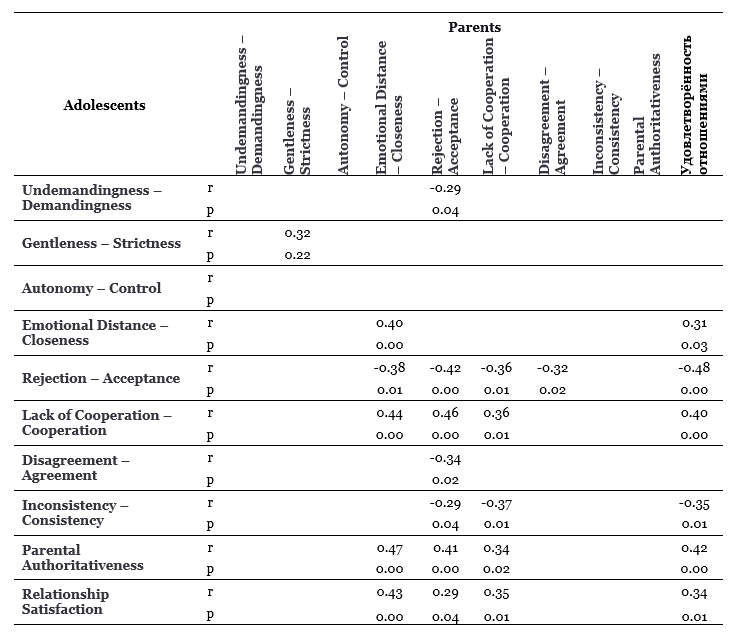
Correlation analysis of the paired measures revealed that the most strongly interconnected were the parent–child interaction indicators (Table 2). Several notable trends emerged:
Asymmetry in the perception of Rejection–Acceptance: This scale served as a central hub of associations, with scores showing a negative correlation between adolescents and parents. In adolescents’ perception, parental Acceptance was associated with Emotional Distance, Lack of Cooperation, Disagreement, and low Relationship Satisfaction—suggesting acceptance is experienced as pressure. From the parents’ perspective, Acceptance was associated with Cooperation, Authoritativeness, and Relationship Satisfaction.
High agreement on Emotional Distance–Closeness: Ratings of Emotional Closeness showed a direct positive correlation within dyads, representing a rare point of perceptual agreement.
Authoritativeness and positive parameters: Authoritativeness as perceived by adolescents correlated strongly with Acceptance, Emotional Closeness, and Cooperation, indicating it is built on trust rather than control.
Cooperation as an integrative factor: High Cooperation ratings from the child were associated with higher parental ratings of Cooperation, Emotional Closeness, Acceptance, and Relationship Satisfaction.
Absence of significant correlations for Undemandingness–Demandingness and Autonomy–Control: These parameters may be weakly related to other aspects of interaction or perceived in isolation.
Table 2. Correlations between parent–child interaction indicators as perceived by adolescents and their parents (Spearman’s correlation coefficient)
With respect to behavioral control, significant correlations were identified between adolescents’ overall behavioral control and parents’ volitional control (r = 0.32, p = 0.02), as well as between adolescents’ volitional control and parents’ overall behavioral control (r = 0.45, p = 0.00), cognitive control (r = 0.40, p = 0.00), and volitional control (r = 0.49, p = 0.00).
In examining the associations between coping behavior in adolescents and their parents, three significant correlations were identified: (1) parental Distancing was negatively associated with adolescent Accepting Responsibility (r = −0.30, p = 0.01); (2) parental Confrontive Coping was positively associated with adolescent Escape–Avoidance (r = 0.30, p = 0.01); (3) parental Planful Problem Solving was positively associated with the same strategy in adolescents (r = 0.57, p = 0.00).
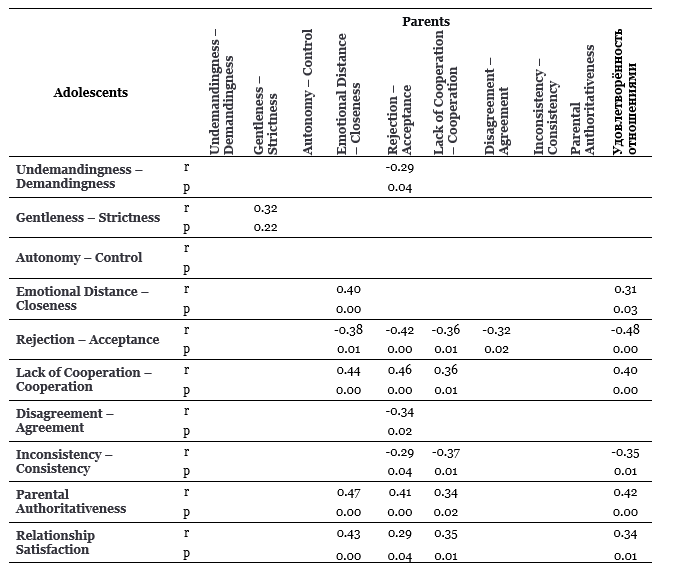
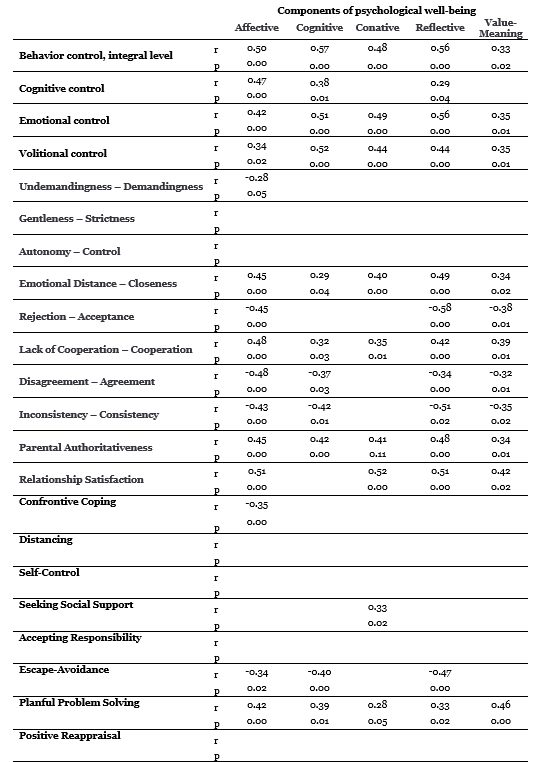
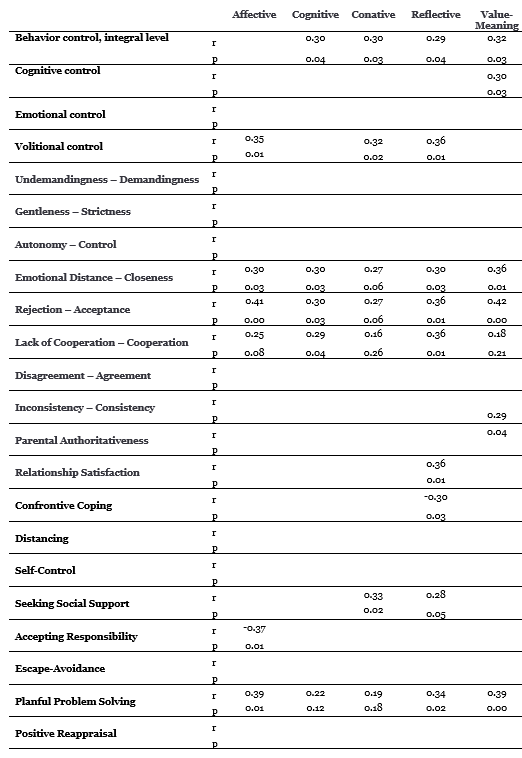
Examining the relationships among behavioral control, parent–child relationships, coping, and adolescent psychological well-being revealed a substantially greater number of associations for adolescents’ own indicators (Table 3) compared to the corresponding indicators for parents (Table 4). Adolescents’ behavioral control exhibited notable associations with their psychological well-being across almost all indicators. In contrast, for parents, only overall behavioral control and volitional control showed associations with individual components of adolescent well-being.
Table 3. Relationships between scales of adolescent behavior control, parent-child interaction as perceived by adolescents, and adolescent coping behavior with psychological well-being of adolescents (Spearman’s correlation coefficient)
|
|
Components of psychological well-being | |||||
| Affective | Cognitive | Conative | Reflective | Value-Meaning | ||
| Behavior control, integral level | r | 0.50 | 0.57 | 0.48 | 0.56 | 0.33 |
| p | 0.00 | 0.00 | 0.00 | 0.00 | 0.02 | |
| Cognitive control | r | 0.47 | 0.38 | 0.29 | ||
| p | 0.00 | 0.01 | 0.04 | |||
| Emotional control | r | 0.42 | 0.51 | 0.49 | 0.56 | 0.35 |
| p | 0.00 | 0.00 | 0.00 | 0.00 | 0.01 | |
| Volitional control | r | 0.34 | 0.52 | 0.44 | 0.44 | 0.35 |
| p | 0.02 | 0.00 | 0.00 | 0.00 | 0.01 | |
| Undemandingness – Demandingness | r | -0.28 | ||||
| p | 0.05 | |||||
| Gentleness – Strictness | r | |||||
| p | ||||||
| Autonomy – Control | r | |||||
| p | ||||||
| Emotional Distance – Closeness | r | 0.45 | 0.29 | 0.40 | 0.49 | 0.34 |
| p | 0.00 | 0.04 | 0.00 | 0.00 | 0.02 | |
| Rejection – Acceptance | r | -0.45 | -0.58 | -0.38 | ||
| p | 0.00 | 0.00 | 0.01 | |||
| Lack of Cooperation – Cooperation | r | 0.48 | 0.32 | 0.35 | 0.42 | 0.39 |
| p | 0.00 | 0.03 | 0.01 | 0.00 | 0.01 | |
| Disagreement – Agreement | r | -0.48 | -0.37 | -0.34 | -0.32 | |
| p | 0.00 | 0.03 | 0.00 | 0.01 | ||
| Inconsistency – Consistency | r | -0.43 | -0.42 | -0.51 | -0.35 | |
| p | 0.00 | 0.01 | 0.02 | 0.02 | ||
| Parental Authoritativeness | r | 0.45 | 0.42 | 0.41 | 0.48 | 0.34 |
| p | 0.00 | 0.00 | 0.11 | 0.00 | 0.01 | |
| Relationship Satisfaction | r | 0.51 | 0.52 | 0.51 | 0.42 | |
| p | 0.00 | 0.00 | 0.00 | 0.02 | ||
| Confrontive Coping | r | -0.35 | ||||
| p | 0.00 | |||||
| Distancing | r | |||||
| p | ||||||
| Self-Control | r | |||||
| p | ||||||
| Seeking Social Support | r | 0.33 | ||||
| p | 0.02 | |||||
| Accepting Responsibility | r | |||||
| p | ||||||
| Escape-Avoidance | r | -0.34 | -0.40 | -0.47 | ||
| p | 0.02 | 0.00 | 0.00 | |||
| Planful Problem Solving | r | 0.42 | 0.39 | 0.28 | 0.33 | 0.46 |
| p | 0.00 | 0.01 | 0.05 | 0.02 | 0.00 | |
| Positive Reappraisal | r | |||||
| p | ||||||
Table 4. Relationships between the scales of parental behavior control, parent-child interaction as perceived by parents, and parental coping behavior with adolescents’ psychological well-being (Spearman’s correlation coefficient)
|
|
Components of psychological well-being | |||||
| Affective | Cognitive | Conative | Reflective | Value-Meaning | ||
| Behavior control, integral level | r | 0.30 | 0.30 | 0.29 | 0.32 | |
| p | 0.04 | 0.03 | 0.04 | 0.03 | ||
| Cognitive control | r | 0.30 | ||||
| p | 0.03 | |||||
| Emotional control | r | |||||
| p | ||||||
| Volitional control | r | 0.35 | 0.32 | 0.36 | ||
| p | 0.01 | 0.02 | 0.01 | |||
| Undemandingness – Demandingness | r | |||||
| p | ||||||
| Gentleness – Strictness | r | |||||
| p | ||||||
| Autonomy – Control | r | |||||
| p | ||||||
| Emotional Distance – Closeness | r | 0.30 | 0.30 | 0.27 | 0.30 | 0.36 |
| p | 0.03 | 0.03 | 0.06 | 0.03 | 0.01 | |
| Rejection – Acceptance | r | 0.41 | 0.30 | 0.27 | 0.36 | 0.42 |
| p | 0.00 | 0.03 | 0.06 | 0.01 | 0.00 | |
| Lack of Cooperation – Cooperation | r | 0.25 | 0.29 | 0.16 | 0.36 | 0.18 |
| p | 0.08 | 0.04 | 0.26 | 0.01 | 0.21 | |
| Disagreement – Agreement | r | |||||
| p | ||||||
| Inconsistency – Consistency | r | |||||
| p | 0.29 | |||||
| Parental Authoritativeness | r | 0.04 | ||||
| p | ||||||
| Relationship Satisfaction | r | 0.36 | ||||
| p | 0.01 | |||||
| Confrontive Coping | r | -0.30 | ||||
| p | 0.03 | |||||
| Distancing | r | |||||
| p | ||||||
| Self-Control | r | |||||
| p | ||||||
| Seeking Social Support | r | 0.33 | 0.28 | |||
| p | 0.02 | 0.05 | ||||
| Accepting Responsibility | r | -0.37 | ||||
| p | 0.01 | |||||
| Escape-Avoidance | r | |||||
| p | ||||||
| Planful Problem Solving | r | 0.39 | 0.22 | 0.19 | 0.34 | 0.39 |
| p | 0.01 | 0.12 | 0.18 | 0.02 | 0.00 | |
| Positive Reappraisal | r | |||||
| p | ||||||
Regarding parent–child interaction, a greater number of associations with psychological well-being were found for adolescents’ perceptions. Notably, only positive associations were identified with the conative component, whereas indicators such as Acceptance, Agreement, and Consistency showed negative associations with the affective, cognitive, reflective, and value-meaning components—the same indicators that exhibited the largest discrepancies between adolescents and parents. From the parents’ perspective, their perceptions of Emotional Closeness, Acceptance, Cooperation, and Agreement were associated with all dimensions of adolescent psychological well-being.
Finally, the coping strategies most strongly associated with adolescent psychological well-being were those involved in intergenerational associations (Planful Problem Solving, Escape–Avoidance, Accepting Responsibility, Confrontive Coping), along with Seeking Social Support.
Discussion
The central finding of this study is the pronounced asymmetry in how parents and adolescents perceive their relationship, coupled with evidence for intergenerational transmission of both regulatory capacities and coping strategies—a transmission that significantly influences adolescent psychological well-being. These results collectively underscore that effective family functioning is not merely a matter of parental intentions but hinges on the alignment of perceptions and the successful modeling of adaptive behaviors.
The perceptual asymmetry observed is striking: parents consistently rated the parent–child relationship as more adaptive, higher in acceptance, consistency, emotional closeness, and satisfaction, while adolescents perceived the same interactions as stricter, less accepting, and less consistent. This divergence is not simply a methodological artifact but reflects a fundamental difference in perspective that has critical implications. Adolescents’ perception of parental acceptance, agreement, and consistency was negatively associated with their psychological well-being, suggesting that what parents intend as supportive may be experienced by adolescents as excessive pressure or control. This finding aligns with recent work by Moiseev and Kostogorova (2023) but contrasts with earlier data (Okonechnikova, 2015), potentially indicating a generational shift in adolescent expectations toward greater autonomy and sensitivity. The paradox, that parental acceptance can be negatively associated with well-being when perceived as pressuring, highlights the importance of subjective interpretation in dyadic relationships.
In contrast, from the parents’ perspective, the same behaviors were positively linked to adolescent well-being. This dual reality suggests that the alignment of perceptions may be as important as the behaviors themselves. Where parents and adolescents agreed on emotional closeness, the relationship was more harmonious. However, on scales where discrepancies were largest (acceptance, consistency), adolescent well-being suffered. This finding extends the work of Saporovskaya (2014) on intergenerational transmission by showing that perceptual misalignment itself may be a risk factor.
A second major theme concerns the intergenerational transmission of self-regulatory and coping capacities. Significant correlations in volitional control between parents and adolescents support the notion of a biological or genetically influenced component, consistent with the developmental model of behavioral regulation proposed by Vilenskaya and Sergienko (2001) and later longitudinal findings by Kozlova (2018) linking temperamental characteristics to well-being. Moreover, the pattern of coping transmission was strategy-specific: productive strategies (Planful Problem Solving) were directly correlated across generations, suggesting active modeling and reinforcement. Unproductive strategies (Confrontive Coping, Distancing), however, showed a different pattern—they were associated with complementary but still maladaptive strategies in adolescents (Escape–Avoidance, reduced Accepting Responsibility). This complementarity mechanism may reflect a more implicit, perhaps unintentional, transmission where parents’ maladaptive responses shape adolescents’ alternative but equally unhelpful coping styles.
The contribution of these transmitted strategies to adolescent psychological well-being was substantial. Strategies involved in intergenerational associations—Planful Problem Solving, Escape–Avoidance, Accepting Responsibility, Confrontive Coping—along with Seeking Social Support, emerged as the strongest correlates of well-being. This underscores the family’s role as a critical context for learning how to navigate stress, consistent with the theoretical framework of dyadic coping (Huang, 2026) and earlier work on family coping transmission (Saporovskaya, 2014). Notably, the positive role of Seeking Social Support aligns with findings by Liga et al. (2020) on parental modeling of support-seeking behaviors.
Behavioral control, particularly volitional control, played a dual role. It was both a trait transmitted across generations and a strong correlate of adolescent well-being. Adolescents’ own behavioral control showed extensive associations with all dimensions of their well-being, while parental behavioral control exerted a more indirect effect, likely mediated through transmission and the quality of parent–child interaction. This pattern resonates with Shamionov and Grigoryeva’s (2017) emphasis on temperamental contributions to emotional well-being and Vilenskaya’s (2022) findings on the interconnection of parental and child regulation.
Limitations. Several limitations should be acknowledged. First, the cross-sectional design precludes causal inferences about the direction of effects between parent–child interaction, coping transmission, and adolescent well-being. Longitudinal studies are needed to examine how these dynamics evolve over time. Second, the sample, while balanced in adolescent gender, consisted predominantly of mothers (86%), limiting the ability to fully explore paternal influences. Third, reliance on self-report measures introduces the possibility of shared method variance and social desirability bias, although the use of dyadic family codes helped maintain anonymity. Fourth, the study was conducted in a single Russian city, which may constrain generalizability to other cultural or socioeconomic contexts. Future research should address these limitations by employing longitudinal designs, incorporating observational or multi-informant methods, and examining diverse family structures and cultural settings.
Taken together, these findings have clear practical implications. Interventions aimed at improving adolescent well-being should address perceptual discrepancies within the dyad, helping parents understand how their behaviors are subjectively experienced by their children. Furthermore, programs that support parents in modeling productive coping strategies—and in being mindful of how unproductive strategies may be inadvertently transmitted—could be particularly effective. The results also suggest that fostering volitional control in children, perhaps through scaffolding self-regulation from an early age, may have long-term benefits for their well-being.
In conclusion, this study demonstrates that the intergenerational transmission of coping and regulatory capacities is a key pathway linking parent–child interaction to adolescent psychological well-being. However, the pathway is not straightforward: it is filtered through the perceptual lens of the adolescent, meaning that even well-intentioned parenting can be experienced as pressure if not aligned with the adolescent’s needs and perceptions. Future longitudinal research could examine how these dynamics evolve across adolescence and whether interventions targeting perceptual alignment and coping modeling can effectively improve outcomes.
Conclusions
Characteristics of perceived parent–child interaction. Asymmetry was found in the perception of parent–child relationships: parents evaluate their relationships with their children as more adaptive (higher acceptance, emotional closeness, cooperation, consistency, and satisfaction), whereas adolescents perceive the same relationships as stricter, less accepting, and less consistent. The most significant factors contributing to harmonious relationships are emotional closeness, acceptance, cooperation, consistency in parenting strategies, and parental authoritativeness grounded in trust and support rather than control. Destructive influences include emotional distance, inconsistency, lack of cooperation, and rejection.
Associations of behavioral control within the dyad. Significant correlations were found between behavioral control indicators in parents and adolescents, particularly with respect to volitional control and overall behavioral control. These findings support the notion of a substantial biological (genetic) contribution to regulatory abilities and are consistent with the concept of intergenerational transmission of self-regulation.
Intergenerational transmission of coping strategies. Three significant associations were identified between the coping behavior of parents and adolescents. Productive strategies (particularly Planful Problem Solving) are transmitted primarily through direct pathways. Unproductive strategies (Confrontive Coping, Distancing) are associated with the use of complementary strategies by adolescents (Escape–Avoidance, reduced Accepting Responsibility). Thus, intergenerational transmission of coping occurs both through direct modeling and through mechanisms of complementarity.
Contribution of behavioral control to adolescent psychological well-being. Adolescents’ behavioral control (particularly overall behavioral control and volitional control) demonstrates the most extensive and strongest associations with their psychological well-being. In parents, overall behavioral control and volitional control also show significant associations with adolescent psychological well-being, indicating an indirect influence of parental regulatory characteristics through intergenerational transmission.
Role of perceived parent–child relationships in psychological well-being. Adolescents’ perceptions of parent–child relationships exhibit a greater number of associations with their psychological well-being than do parents’ perceptions. Notably, parameters such as acceptance, agreement, and consistency, as perceived by adolescents, are negatively associated with several components of well-being (affective, cognitive, reflective, value-meaning), which is interpreted as perceived excessive parental pressure. Conversely, from the parents’ perspective, emotional closeness, acceptance, cooperation, agreement, consistency, and relationship satisfaction are positively associated with adolescent psychological well-being. Alignment of perceptions regarding interaction strategies is important for adolescent psychological well-being; however, certain strategies are perceived by children as overly restrictive.
Contribution of coping behavior to psychological well-being. The greatest contribution to adolescent psychological well-being comes from those coping strategies involved in the associations between parent and adolescent coping behavior (Planful Problem Solving, Escape–Avoidance, Accepting Responsibility, Confrontive Coping), along with the Seeking Social Support strategy. Successful transmission of coping strategies from parents to adolescents is closely related to the psychological well-being of the latter, underscoring the importance of the family in shaping an adaptive coping repertoire.
CRediT author statement: I.I. Vetrova: Conceptualization, Methodology, Investigation, Formal analysis, Writing – original draft, Writing – review & editing.
Author responsibility: The author confirms that she is solely responsible for all aspects of the work, including its conception, execution, and interpretation, has verified the entire manuscript, and takes full responsibility for its integrity and accuracy.
Competing interests: The author declares no conflicts of interest. No financial or personal relationships that could have influenced the work reported in this manuscript exist.
Acknowledgments: The author expresses sincere gratitude to O.N. Colina for assistance with data collection.
Funding: This work was supported by the state assignment of the Ministry of Science and Higher Education of the Russian Federation (Project No. 0138-2026-0009, “Systemic Development of the Subject in Normal, Sub‑extreme and Extreme Conditions of Life”).
References
- Alexandrova, T. I., Dutchina, O. B., & Bessonova, E. A. (2023). The relationship between emotional well-being and parent–child relationships in adolescence. International Journal of Medicine and Psychology, 6(5), 212–216.
- Bocharova, L. A. (2025). Stress in adolescence and youth: Challenges of the digital environment and coping strategies. In Psychology of the individual in a transitive world: Challenges of the time and resources for life fulfillment: Proceedings of the IX Siberian Psychological Forum(pp. 17–19). Tomsk State University. https://doi.org/10.17223/9785907890527/2025/7
- Borodina, V. N. (2023). The role of parent–child relationships in the emergence of cyberbullying. World of Science, Culture, Education, 1(98), 138–141. https://doi.org/10.24412/1991-5497-2023-198-138-141
- Bukharsmetova, A. I., & Makushkina, O. M. (2022). Parent–child relationships as a factor in the development of emotional intelligence. In The individual in conditions of social change: Proceedings of the international scientific-practical conference(pp. 44–46). Bashkir State Pedagogical University.
- Danilova, M. V. (2023). Resilience and choice of coping strategies in stressful situations in adolescence in connection with parent–child relationships. National Psychological Journal, 17(1), 32–43. https://doi.org/10.11621/npj.2023.0103
- Golub, M. S., & Kuraeva, D. A. (2022). Family microenvironment as a factor in the emergence of aggressive behavior in children. Psychology: Historical-Critical Reviews and Contemporary Research, 11(2–1), 286–293.
- Huang, Y., Chen, M., Zhang, L., Ji, Y., & Dong, C. (2026). Dyadic coping discrepancies in adolescents with chronic diseases and their parents: A latent profile analysis approach. Journal of Clinical Nursing, 35(1), 317–330. https://doi.org/10.1111/jocn.17850
- Ivanova, E. V., & Shapovalenko, I. V. (2025). Psychological characteristics of parents and emotional well-being of preschoolers. Psychological and Pedagogical Research, 17(1), 3–17. https://doi.org/10.17759/psyedu.2025170101
- Katasonova, A. V., & Sapunova, T. L. (2022). Tendency toward internet addiction in school-age children in connection with parent–child relationships. Scientific Notes of The P.F. Lesgaft University, 7(209), 196–201.
- Kazharskaya, O. N., & Koroleva, S. V. (2022). Psychological conditions for resolving family parent–child conflicts. Humanitarian and Pedagogical Education, 8(S1), 215–220.
- Komarova, O. N., & Rasskazova, A. L. (2024). Socio-psychological determinants of the family environment and their influence on autodestructive manifestations of adolescent behavior. Systemic Psychology and Sociology, 4(52), 32–49. https://doi.org/10.24412/2223-6872-2024-452-32-49
- Kozlova, E. A. (2018). Early predictors of children’s psychological well-being: A longitudinal study(Doctoral dissertation).
- Kryukova, T. L. (2010). Methods of studying coping behavior: Three coping scales. Kostroma State University.
- Kuftyak, E. V. (2020). A study of family resilience under stress. Psychological Research, 13(14). https://doi.org/10.54359/ps.v3i14.887
- Liga, F., Inguglia, C., Gugliandolo, M. C., Ingoglia, S., & Costa, S. (2020). The socialization of coping strategies in adolescence: The modeling role of parents. Anxiety, Stress, & Coping, 33(1), 47–58. https://doi.org/10.1080/10615806.2019.1666248
- Lizunova, D. A., & Savintseva, O. M. (2022). Parent–child relationship disturbances as a risk factor for drug addiction. Theory and Practice of Social Sciences and Humanities, 2(18), 62–67.
- Lokatkova, O. N. (2022). Characteristics of parent–child relationships and their influence on the formation of conflict behavior in adolescence. Uchenye Zapiski Universiteta im. P.F. Lesgafta, 8(210), 473–477.
- Markovskaya, I. M. (2000). Training for parent–child interaction. Rech’.
- Matafonova, S. I., Rerke, V. I., & Krotova, T. E. (2022). The relationship between assessments of parent–child interaction and coping strategies of at-risk adolescents. Psychology and Law, 12(3), 109–123. https://doi.org/10.17759/psylaw.2022120310
- Mironova, A. A. (2023). Defensive and coping behavior in childhood and adolescence: A review of Russian studies. Pedagogical Education in Russia, 2, 222–231.
- Moiseev, A. S., & Kostogorova, N. V. (2023). Characteristics of parent–child relationships of adolescents and their parents. New Developments in Psychological and Pedagogical Research, 3(70), 377–390.
- Okonechnikova, L. V. (2015). Characteristics of interpersonal perception in relationships between adolescents and their parents. New Science: Experience, Traditions, Innovations, 4–2, 59–63.
- Pshenichnova, I. V., & Skvortsov, N. A. (2024). Formation of adaptive coping behavior strategies in adolescents. Modern Problems of Science and Education, 1, Article 54. https://doi.org/10.17513/spno.33269
- Sabelnikova, N. V., & Karpova, T. V. (2024). Parental burnout, parental stress, and mothers’ attachment to close people. In Psychological problems of the contemporary family: Proceedings of the IX International Scientific Conference(pp. 186–191). Moscow State University.
- Samokhvalova, A. G., Tikhomirova, E. V., Vishnevskaya, O. N., & Shipova, N. S. (2025). “Children of the era of hybrid war”: Socialization difficulties, image of the world, resources of psychological well-being. Kostroma State University.
- Saporovskaya, M. V. (2014). Psychology of intergenerational relationships in the family. National Book Center.
- Sergienko, E. A., & Vilenskaya, G. A. (2018). Behavioral control as an integrative concept of mental regulation. In Development of concepts in modern psychology(pp. 343–378). Institute of Psychology RAS.
- Sergienko, E. A., Vilenskaya, G. A., & Vetrova, I. I. (2023). A new method for assessing mental regulation: The Behavioral Control Questionnaire. Experimental Psychology, 16(1), 182–200. https://doi.org/10.17759/exppsy.2023160111
- Shamionov, R. M., & Grigoryeva, M. V. (2017). Psychodynamic properties as predictors of subjective well-being. Psychological Journal, 38(1), 41–51.
- Shereshkova, E. A., & Zaretskaya, V. A. (2025). The relationship between emotional intelligence and coping strategies in older adolescents. Scientific Search: Personality, Education, Culture, 2(56), 52–59. https://doi.org/10.54348/SciS.2025.2.9
- Shkryabko, I. P., Popova, A. A., Varetsa, E. S., & Belous, O. V. (2025). Psychological well-being in family interaction: Features of the influence of emotional intelligence. Science for Education Today, 15(1), 183–200. https://doi.org/10.15293/2658-6762.2501.09
- Sipovskaya, Ya. I. (2025). Problems of psychodiagnostics of coping behavior in older adolescents. In Psychology of stress and coping behavior: Resources and resilience in a world of uncertainty: Proceedings of the VII International Scientific-Practical Conference(pp. 505–508). Kostroma State University.
- Telibaeva, N. O. (2022). Parent–child relationships as a psychological factor in the development of anorexia in adolescence. Science. Education, 51, 2085–2089.
- Tikhonovich, A. A. (2023). Harmonization of parent–child relationships as a factor in adolescents’ readiness for professional self-determination. In Interdepartmental approach to supporting individuals in difficult life situations: Theory and best practices: Proceedings of the Fourth International Scientific-Practical Conference(pp. 286–291).
- Tkach, E. N., Tkach, R. S., & Bochkareva, O. A. (2024). Subjective well-being of older adolescents: Results of an empirical study. Psychology: Historical-Critical Reviews and Contemporary Research, 13(3–1), 326–335.
- Tsirulnikova, E. A., & Shvarts, T. S. (2022). Study of the relationship between emotional well-being and coping behavior in adolescence. Pedagogy and Education, 4, 17–23. https://doi.org/10.7256/2454-0676.2022.4.39051
- Vilenskaya, G. A. (2021). Volitional regulation. In Development of concepts in modern psychology(pp. 275–299). Institute of Psychology RAS. https://doi.org/10.38098/thry_21_0439_08
- Vilenskaya, G. A. (2022). Parental attitude and its relationship with behavioral control in parents and primary school children. Cognition and Experience, 3(3), 87–103. https://doi.org/10.51217/cogexp_2022_03_03_05
- Vilenskaya, G. A. (2025). A longitudinal study of the contribution of regulatory and personality characteristics to the psychological well-being of primary school children. In Stress and self-regulation in educational and professional environments: Collection of articles based on the proceedings of the International Scientific-Practical Conference(pp. 42–48). Federal Scientific Center for Psychological and Interdisciplinary Research.
- Vilenskaya, G. A., & Sergienko, E. A. (2001). The role of temperament in the development of behavioral regulation in early childhood. Psychological Journal, 22(3), 68–85.
- Zhdanova, T. A., & Filippova, E. V. (2024). Adolescent psychological well-being: Personality traits and family relationships (based on foreign research). Modern Foreign Psychology, 13(4), 51–63. https://doi.org/10.17759/jmfp.2024130405
Comments (0)
Relevance and problem. Adolescence is characterized by heightened vulnerability to stress, necessitating well-developed coping mechanisms. While the family is a key institution shaping a child’s coping repertoire, empirical data on the mechanisms of intergenerational transmission of coping behavior from parents to adolescents remain fragmented and inconsistent. A comprehensive approach examining the interplay between behavioral control, parent–child interaction, and coping within parent–adolescent dyads is particularly lacking. Method. The study involved 100 participants forming 50 parent–adolescent dyads: 50 adolescents aged 16–17 years (M = 16.42, 52% female, 48% male) and 50 parents (M = 41.64 years, 86% mothers). Data were collected online using paired family codes (Kuftyak, 2020). The instruments comprised the Behavioral Control Questionnaire (Sergienko, Vilenskaya, & Vetrova, 2023), the Parent–Child Interaction Inventory (Markovskaya, 2000), the Ways of Coping Questionnaire (Lazarus & Folkman; adapted by Kryukova, 2007), and the Psychological Well-Being Scale (Samokhvalova et al., 2025). Results. Parents scored significantly higher than adolescents on all behavioral control scales (Wilcoxon T = 254.5–301.5, p < .01) and on productive coping strategies (Planful Problem Solving, T = 116.0, p < .001; Positive Reappraisal, T = 215.5, p < .001). Asymmetry in parent–child interaction perceptions emerged: parents rated emotional closeness, acceptance, consistency, and relationship satisfaction higher, whereas adolescents perceived greater strictness (T = 215.0, p = .024) and less acceptance (T = 162.5, p < .001). Adolescents’ perceptions of parental acceptance, agreement, and consistency were negatively associated with their psychological well-being (affective, cognitive, reflective, and value-meaning components, r = –0.43 to –0.58, p < .05). Significant positive correlations were found between parents’ and adolescents’ volitional control (r = 0.49, p < .001) and overall behavioral control (r = 0.45, p < .001). Coping strategies were transmitted both directly (Planful Problem Solving, r = 0.57, p < .001) and via complementarity (parental Distancing associated with reduced adolescent Accepting Responsibility, r = –0.30, p = .01; parental Confrontive Coping associated with adolescent Escape–Avoidance, r = 0.30, p = .01). The coping strategies involved in these intergenerational associations, along with Seeking Social Support, accounted for the strongest correlations with adolescent psychological well-being. Conclusions. Effective parent–adolescent interaction is predicated on emotional engagement, stability, mutual respect, and collaboration. Successful intergenerational transmission of coping strategies is closely linked to adolescent psychological well-being, while perceived excessive parental control and pressure diminish it. These findings hold implications for family psychological counseling and the development of psychoprophylactic programs.
Регуляция поведения у подростков и их родителей: связи с детско-родительскими отношениями и совладающим поведением
Ирина И. Ветрова
Институт психологии Российской академии наук, Москва, Россия
Резюме. Актуальность и проблема. Подростковый возраст характеризуется высокой уязвимостью к стрессу, что требует сформированных механизмов совладающего поведения. Семья остаётся ключевым институтом, формирующим репертуар копинг‑стратегий ребёнка, однако научно обоснованные данные о механизмах межпоколенной передачи копинг‑поведения от родителей к подросткам остаются фрагментарными и противоречивыми. Особенно недостаточно изучен комплексный подход, учитывающий взаимосвязь контроля поведения, детско‑родительского взаимодействия и совладания в диаде «родитель – подросток». Методы. В исследовании приняли участие 100 человек, составивших 50 диад «родитель – подросток»: 50 подростков в возрасте 16–17 лет (M = 16.42; 52% девушек, 48% юношей) и 50 родителей (M = 41.64 года; 86% матерей). Сбор данных проводился онлайн с использованием парных «семейных кодов» (Куфтяк, 2020). Применялись опросник «Контроль поведения» (Сергиенко, Виленская, Ветрова, 2023), опросник «Взаимодействие родитель – ребёнок» (Марковская, 2000), методика WCQ (Lazarus & Folkman; адаптация Крюковой, 2007) и шкала психологического благополучия личности (Самохвалова и др., 2025). Результаты. Родители значимо превосходили подростков по всем шкалам контроля поведения (T = 254.5–301.5, p < 0.01) и по продуктивным копинг‑стратегиям (планирование решения проблемы: T = 116.0, p < 0.001; позитивная переоценка: T = 215.5, p < 0.001). Выявлена асимметрия восприятия детско‑родительских отношений: родители оценивали эмоциональную близость, принятие, последовательность и удовлетворённость отношениями выше, тогда как подростки воспринимали родительское поведение как более строгое (T = 215.0, p = 0.024) и менее принимающее (T = 162.5, p < 0,001). Восприятие подростками родительского принятия, согласия и последовательности отрицательно коррелировало с их психологическим благополучием (аффективный, когнитивный, рефлексивный и ценностно‑смысловой компоненты, r = –0.43–0.58, p < 0,05). Обнаружены значимые положительные связи между волевым контролем родителей и подростков (r = 0.49, p < 0.001) и общим контролем поведения (r = 0.45, p < 0.001). Копинг‑стратегии передавались как прямым путём (планирование решения проблемы: r = 0.57, p < 0.001), так и через механизмы комплементарности (дистанцирование родителей связано со снижением принятия ответственности у подростков, r = –0.30, p = 0.01; конфронтационный копинг родителей – с бегством‑избеганием у подростков, r = 0.30, p = 0.01). Стратегии, участвующие в межпоколенной передаче, а также поиск социальной поддержки вносили наибольший вклад в психологическое благополучие подростков. Заключение. Эффективное взаимодействие в системе «родитель – подросток» строится на эмоциональной вовлечённости, стабильности, взаимном уважении и совместной деятельности. Успешная передача стратегий совладания от родителей к подросткам тесно связана с психологическим благополучием последних, тогда как воспринимаемый чрезмерный родительский контроль и давление его снижают. Полученные результаты могут быть использованы в практике семейного психологического консультирования и при разработке программ психопрофилактики.
Ключевые слова: регуляция поведения, контроль поведения, совладающее поведение, диадический копинг, детско-родительские отношения, психологическое благополучие, подростковый возраст
Adolescents aged 16–17 occupy a critical developmental juncture between childhood and adulthood, navigating a complex confluence of academic pressures, social expectations, identity formation, and the pervasive influence of digital environments (Tkach, Tkach, & Bochkareva, 2024; Bocharova, 2025). Within this context, the family remains a pivotal institution, fundamentally shaping a child’s evolving repertoire of coping strategies (Liga et al., 2020; Pshenichnova & Skvortsov, 2024). An analytical review of coping behavior research in children and adolescents (2012–2022) underscores the significant role of parenting style and family structure (Mironova, 2023). The same review indicates that, quantitatively, the most frequently researched domains in Russian coping psychology involve coping strategies and defensive behavior in children with disabilities and adolescents exhibiting antisocial tendencies—a focus that aligns with contemporary international research (Huang, 2026). Concurrently, the adaptive and personal resources of youth are closely linked to their chosen coping strategies, while their level of psychological well-being reciprocally influences the selection of specific coping behavior patterns (Mironova, 2023).
Two fundamental trajectories can be identified in the study of adolescent coping behavior. The first explores the direct links between coping and psychological well-being (e.g., Tsirulnikova & Schwartz, 2022). The second investigates specific contextual factors shaping adolescent coping, particularly the dynamics of parent–child relationships (e.g., Matafonova, Rerke & Krotova, 2022).
Research on parent–child relationships often centers on their role in adverse developmental outcomes, including anorexia (Telibaeva, 2022), substance abuse (Lizunova, Savintseva, 2022), conflict behavior (Lokatkova, 2022), internet addiction (Katasonova, Sapunova, 2022), cyberbullying (Borodina, 2023), aggression (Golub, Kuraeva, 2022), and self-aggression (Komarova, Rasskazova, 2024). A growing body of work, however, also highlights the positive contributions of parent–child relationships to the development of emotional intelligence (Bukharsmetova, Makushkina, 2022), adolescent resilience (Danilova, 2023), professional self-determination (Tikhanovich, 2023), and overall emotional well-being (Alexandrova, Dutchina, Bessonova, 2024). Despite this, the intrinsic factors of parent–child relationships themselves remain under-examined. For instance, Ivanova and Shapovalenko (2025) demonstrated how parental resilience and specific defensive patterns during marital conflict shape parenting styles and, consequently, the psychological well-being of preschool children. Similarly, Shkryabko et al. (2025) examined parental emotional intelligence as a determinant of optimal parent–child relationships through the quality of family interactions. Research by Kazharskaya and Korolyova (2022) shows that elevated parental anxiety and emotional distress significantly impact their relationships with adolescents. A review by Zhdanova and Filippova (2024) advocates for a holistic examination of family influence on adolescent well-being, encompassing all family members and generations. Vilenskaya (2022) investigated parent–child relationships within the framework of the interconnection between parental and child behavioral regulation, offering insights into the mechanisms through which parental behavior influences child self-regulation. This line of inquiry was extended in a study examining personality traits and behavioral control as predictors of psychological well-being in primary school children (Vilenskaya, 2025). Behavioral regulation, defined as the psychological level of control based on individual resources that enables goal-directed organization of one’s psychological resources and behavior (Sergienko, Vilenskaya, 2018), is a critical component.
Our previous work established that behavioral control integrates with coping behavior and psychological defenses into a unified defense–coping continuum, providing a resource base for coping (Vetrova, 2022). However, that study examined behavioral regulation and coping exclusively in adolescents, without considering the family context. The present study advances this by adopting a comprehensive approach that examines not only the relationship between adolescent and parent coping within the context of parent–child interactions and adolescent well-being, but also incorporates a critical, yet often overlooked, factor: the individual characteristics of behavioral regulation in both adolescents and their parents.
2.1. Participants
The sample comprised 100 respondents, forming 50 parent–adolescent dyads. Adolescents (n = 50) were aged 16–17 years (M = 16.42), and their parents (n = 50) had a mean age of 41.64 years. This dyadic design enabled comparative and correlational analyses within family systems. Adolescents were students in Chelyabinsk schools, and the families’ socioeconomic and educational status was representative of the regional average. The adolescent group was balanced by gender (52% female, 48% male), consistent with recommendations for developmental research. Mothers constituted the majority of the parent sample (86%), reflecting the broader societal trend in Russian families where mothers typically assume the primary role in providing emotional support to adolescents and participating in diagnostic procedures [27]. Family composition varied: 58% of adolescents resided in two-parent households, 28% lived with their mother (including divorced or single-parent families), 4% lived with their father, 6% lived with grandparents, and 4% in other arrangements.
2.2. Procedure
Data were collected between October and December 2025 via an online survey using the Yandex Forms platform. To ensure the validity of dyadic comparisons, each family was instructed to generate a unique “family code” (e.g., “Barsik,” “Romashka”), which both the adolescent and parent entered consistently when completing questionnaires. This method, validated in family coping research by Kuftyak (2020), preserves anonymity while enabling intra-dyadic analysis. Participation was strictly voluntary; all respondents provided informed consent detailing the study’s purpose, procedures, and confidentiality guarantees. For adolescents, it was explicitly confirmed that their responses would remain confidential from their parents and would not affect their academic standing, thereby promoting response honesty.
2.3. Measures
The study employed the following instruments:
Behavioral Control Questionnaire (Sergienko, Vilenskaya, Vetrova, 2023): Assesses an individual’s capacity to regulate their behavior. It comprises three scales: cognitive control (planning, goal maintenance, behavioral correction), emotional control (emotion regulation, stability under tension), and volitional control (persistence, overcoming obstacles, task completion), along with an overall behavioral control score. This instrument is validated for both adults and adolescents.
Parent–Child Interaction Inventory (PCI) (Markovskaya, 2000): Assesses perceptions of parent–child relationships from both parent and adolescent perspectives via mirror forms. The 60 items constitute 10 bipolar scales: Undemandingness–Demandingness; Gentleness–Strictness; Autonomy–Control; Emotional Distance–Closeness; Rejection–Acceptance; Lack of Cooperation–Cooperation; Disagreement–Agreement; Inconsistency–Consistency; Parental Authoritativeness; and Relationship Satisfaction.
Ways of Coping Questionnaire (WCQ) (Lazarus & Folkman; adapted by Kryukova, 2010): Assesses coping strategies in both adolescents and parents. The 50 items comprise 8 scales: Confrontive Coping, Distancing, Self-Control, Seeking Social Support, Accepting Responsibility, Escape-Avoidance, Planful Problem Solving, and Positive Reappraisal. Although the adaptation is for adults, its use with older adolescents is well-established in the literature (Shereshkova & Zaretskaya, 2025; Sipovskaya, 2025), justifying its application across all respondents.
Psychological Well-Being Scale (Samokhvalova et al., 2025): Used for multidimensional assessment of adolescent psychological well-being. The 25 items comprise 5 subscales: Affective, Cognitive, Conative, Reflective, and Value-Meaning components. This questionnaire was completed only by adolescents.
Preliminary analyses assessed the feasibility of aggregating data across genders. Comparisons of mean scores revealed no significant gender differences for adolescents on any of the measures for behavioral control, parent–child interaction, coping strategies, or psychological well-being (p > .05 for all). The closest trend was observed on the Cognitive Control scale, with a tendency toward higher scores in boys (U = 179.5, p = .070). However, a statistically significant difference was found on the Autonomy–Control subscale (U = 178.5, p = .036), indicating parents reported exerting greater control over daughters. These results support treating the adolescent sample as a single, gender-undifferentiated group for primary analyses.
For parents, minor gender differences emerged. Mothers scored significantly higher on the Rejection–Acceptance subscale (U = 76.000; p = .015) and lower on Confrontive Coping (U = 90.000; p = .036) compared to fathers. No other significant differences were found (p > .05). Given the fragmentary nature and lack of impact on the overall analytical framework, parent data were combined into a single “parents” group.
At the next stage, adolescents and their parents were compared on the scores of the paired measures (Table 1). Parents outscored adolescents on all behavioral control scales. On the parent–child interaction measures, statistically significant differences were found on five scales: Gentleness–Strictness (adolescents perceived parental behavior as stricter), Emotional Distance–Closeness (parents rated closeness higher), Rejection–Acceptance (parents rated themselves as more accepting), Inconsistency–Consistency (parents rated themselves as more consistent), and Relationship Satisfaction (parents reported higher satisfaction). Thus, parents tend to rate their relationship as more adaptive, whereas adolescents perceive the same relationship as stricter, less accepting, and less consistent. On the coping behavior scales, parents more frequently used strategies traditionally considered productive: Self-Control, Seeking Social Support, Planful Problem Solving, and Positive Reappraisal.
Table 1. Medians of behavioral control indicators, parent-child interaction and coping behavior in adolescents and their parents, differences according to the Wilcoxon T-test
| Median,
adolescent |
Median,
parents |
T | p-level | |
| Behavior control, integral level | 84 | 92 | 278.5 | 0.001 |
| Cognitive control | 28 | 30.5 | 287.0 | 0.006 |
| Emotional control | 29 | 31.5 | 301.5 | 0.009 |
| Volitional control | 28 | 30.5 | 254.5 | 0.002 |
| Undemandingness – Demandingness | 15.0 | 14.0 | 513.0 | 0.442 |
| Gentleness – Strictness | 14.0 | 13.0 | 215.0 | 0.024 |
| Autonomy – Control | 14.8 | 14.8 | 585.0 | 0.784 |
| Emotional Distance – Closeness | 15.5 | 17.0 | 301.0 | 0.015 |
| Rejection – Acceptance | 13.8 | 17.3 | 162.5 | 0.000 |
| Lack of Cooperation – Cooperation | 17.0 | 18.0 | 313.0 | 0.083 |
| Disagreement – Agreement | 14.0 | 15.0 | 453.5 | 0.242 |
| Inconsistency – Consistency | 14.0 | 16.0 | 183.0 | 0.000 |
| Parental Authoritativeness | 15.5 | 16.0 | 491.5 | 0.592 |
| Relationship Satisfaction | 16.0 | 18.0 | 242.0 | 0.000 |
| Confrontive Coping | 63.9 | 61.1 | 351.0 | 0.209 |
| Distancing | 61.1 | 61.1 | 495.0 | 0.800 |
| Self-Control | 14.0 | 61.9 | 1.0 | 0.000 |
| Seeking Social Support | 61.1 | 66.7 | 356.0 | 0.017 |
| Accepting Responsibility | 66.7 | 58.3 | 447.0 | 0.754 |
| Escape-Avoidance | 62.5 | 62.5 | 504.0 | 0.879 |
| Planful Problem Solving | 61.1 | 72.2 | 116.0 | 0.000 |
| Positive Reappraisal | 61.9 | 66.7 | 215.5 | 0.000 |
Correlation analysis of the paired measures revealed that the most strongly interconnected were the parent–child interaction indicators (Table 2). Several notable trends emerged:
Asymmetry in the perception of Rejection–Acceptance: This scale served as a central hub of associations, with scores showing a negative correlation between adolescents and parents. In adolescents’ perception, parental Acceptance was associated with Emotional Distance, Lack of Cooperation, Disagreement, and low Relationship Satisfaction—suggesting acceptance is experienced as pressure. From the parents’ perspective, Acceptance was associated with Cooperation, Authoritativeness, and Relationship Satisfaction.
High agreement on Emotional Distance–Closeness: Ratings of Emotional Closeness showed a direct positive correlation within dyads, representing a rare point of perceptual agreement.
Authoritativeness and positive parameters: Authoritativeness as perceived by adolescents correlated strongly with Acceptance, Emotional Closeness, and Cooperation, indicating it is built on trust rather than control.
Cooperation as an integrative factor: High Cooperation ratings from the child were associated with higher parental ratings of Cooperation, Emotional Closeness, Acceptance, and Relationship Satisfaction.
Absence of significant correlations for Undemandingness–Demandingness and Autonomy–Control: These parameters may be weakly related to other aspects of interaction or perceived in isolation.
Table 2. Correlations between parent–child interaction indicators as perceived by adolescents and their parents (Spearman’s correlation coefficient)
With respect to behavioral control, significant correlations were identified between adolescents’ overall behavioral control and parents’ volitional control (r = 0.32, p = 0.02), as well as between adolescents’ volitional control and parents’ overall behavioral control (r = 0.45, p = 0.00), cognitive control (r = 0.40, p = 0.00), and volitional control (r = 0.49, p = 0.00).
In examining the associations between coping behavior in adolescents and their parents, three significant correlations were identified: (1) parental Distancing was negatively associated with adolescent Accepting Responsibility (r = −0.30, p = 0.01); (2) parental Confrontive Coping was positively associated with adolescent Escape–Avoidance (r = 0.30, p = 0.01); (3) parental Planful Problem Solving was positively associated with the same strategy in adolescents (r = 0.57, p = 0.00).
Examining the relationships among behavioral control, parent–child relationships, coping, and adolescent psychological well-being revealed a substantially greater number of associations for adolescents’ own indicators (Table 3) compared to the corresponding indicators for parents (Table 4). Adolescents’ behavioral control exhibited notable associations with their psychological well-being across almost all indicators. In contrast, for parents, only overall behavioral control and volitional control showed associations with individual components of adolescent well-being.
Table 3. Relationships between scales of adolescent behavior control, parent-child interaction as perceived by adolescents, and adolescent coping behavior with psychological well-being of adolescents (Spearman’s correlation coefficient)
|
|
Components of psychological well-being | |||||
| Affective | Cognitive | Conative | Reflective | Value-Meaning | ||
| Behavior control, integral level | r | 0.50 | 0.57 | 0.48 | 0.56 | 0.33 |
| p | 0.00 | 0.00 | 0.00 | 0.00 | 0.02 | |
| Cognitive control | r | 0.47 | 0.38 | 0.29 | ||
| p | 0.00 | 0.01 | 0.04 | |||
| Emotional control | r | 0.42 | 0.51 | 0.49 | 0.56 | 0.35 |
| p | 0.00 | 0.00 | 0.00 | 0.00 | 0.01 | |
| Volitional control | r | 0.34 | 0.52 | 0.44 | 0.44 | 0.35 |
| p | 0.02 | 0.00 | 0.00 | 0.00 | 0.01 | |
| Undemandingness – Demandingness | r | -0.28 | ||||
| p | 0.05 | |||||
| Gentleness – Strictness | r | |||||
| p | ||||||
| Autonomy – Control | r | |||||
| p | ||||||
| Emotional Distance – Closeness | r | 0.45 | 0.29 | 0.40 | 0.49 | 0.34 |
| p | 0.00 | 0.04 | 0.00 | 0.00 | 0.02 | |
| Rejection – Acceptance | r | -0.45 | -0.58 | -0.38 | ||
| p | 0.00 | 0.00 | 0.01 | |||
| Lack of Cooperation – Cooperation | r | 0.48 | 0.32 | 0.35 | 0.42 | 0.39 |
| p | 0.00 | 0.03 | 0.01 | 0.00 | 0.01 | |
| Disagreement – Agreement | r | -0.48 | -0.37 | -0.34 | -0.32 | |
| p | 0.00 | 0.03 | 0.00 | 0.01 | ||
| Inconsistency – Consistency | r | -0.43 | -0.42 | -0.51 | -0.35 | |
| p | 0.00 | 0.01 | 0.02 | 0.02 | ||
| Parental Authoritativeness | r | 0.45 | 0.42 | 0.41 | 0.48 | 0.34 |
| p | 0.00 | 0.00 | 0.11 | 0.00 | 0.01 | |
| Relationship Satisfaction | r | 0.51 | 0.52 | 0.51 | 0.42 | |
| p | 0.00 | 0.00 | 0.00 | 0.02 | ||
| Confrontive Coping | r | -0.35 | ||||
| p | 0.00 | |||||
| Distancing | r | |||||
| p | ||||||
| Self-Control | r | |||||
| p | ||||||
| Seeking Social Support | r | 0.33 | ||||
| p | 0.02 | |||||
| Accepting Responsibility | r | |||||
| p | ||||||
| Escape-Avoidance | r | -0.34 | -0.40 | -0.47 | ||
| p | 0.02 | 0.00 | 0.00 | |||
| Planful Problem Solving | r | 0.42 | 0.39 | 0.28 | 0.33 | 0.46 |
| p | 0.00 | 0.01 | 0.05 | 0.02 | 0.00 | |
| Positive Reappraisal | r | |||||
| p | ||||||
Table 4. Relationships between the scales of parental behavior control, parent-child interaction as perceived by parents, and parental coping behavior with adolescents’ psychological well-being (Spearman’s correlation coefficient)
|
|
Components of psychological well-being | |||||
| Affective | Cognitive | Conative | Reflective | Value-Meaning | ||
| Behavior control, integral level | r | 0.30 | 0.30 | 0.29 | 0.32 | |
| p | 0.04 | 0.03 | 0.04 | 0.03 | ||
| Cognitive control | r | 0.30 | ||||
| p | 0.03 | |||||
| Emotional control | r | |||||
| p | ||||||
| Volitional control | r | 0.35 | 0.32 | 0.36 | ||
| p | 0.01 | 0.02 | 0.01 | |||
| Undemandingness – Demandingness | r | |||||
| p | ||||||
| Gentleness – Strictness | r | |||||
| p | ||||||
| Autonomy – Control | r | |||||
| p | ||||||
| Emotional Distance – Closeness | r | 0.30 | 0.30 | 0.27 | 0.30 | 0.36 |
| p | 0.03 | 0.03 | 0.06 | 0.03 | 0.01 | |
| Rejection – Acceptance | r | 0.41 | 0.30 | 0.27 | 0.36 | 0.42 |
| p | 0.00 | 0.03 | 0.06 | 0.01 | 0.00 | |
| Lack of Cooperation – Cooperation | r | 0.25 | 0.29 | 0.16 | 0.36 | 0.18 |
| p | 0.08 | 0.04 | 0.26 | 0.01 | 0.21 | |
| Disagreement – Agreement | r | |||||
| p | ||||||
| Inconsistency – Consistency | r | |||||
| p | 0.29 | |||||
| Parental Authoritativeness | r | 0.04 | ||||
| p | ||||||
| Relationship Satisfaction | r | 0.36 | ||||
| p | 0.01 | |||||
| Confrontive Coping | r | -0.30 | ||||
| p | 0.03 | |||||
| Distancing | r | |||||
| p | ||||||
| Self-Control | r | |||||
| p | ||||||
| Seeking Social Support | r | 0.33 | 0.28 | |||
| p | 0.02 | 0.05 | ||||
| Accepting Responsibility | r | -0.37 | ||||
| p | 0.01 | |||||
| Escape-Avoidance | r | |||||
| p | ||||||
| Planful Problem Solving | r | 0.39 | 0.22 | 0.19 | 0.34 | 0.39 |
| p | 0.01 | 0.12 | 0.18 | 0.02 | 0.00 | |
| Positive Reappraisal | r | |||||
| p | ||||||
Regarding parent–child interaction, a greater number of associations with psychological well-being were found for adolescents’ perceptions. Notably, only positive associations were identified with the conative component, whereas indicators such as Acceptance, Agreement, and Consistency showed negative associations with the affective, cognitive, reflective, and value-meaning components—the same indicators that exhibited the largest discrepancies between adolescents and parents. From the parents’ perspective, their perceptions of Emotional Closeness, Acceptance, Cooperation, and Agreement were associated with all dimensions of adolescent psychological well-being.
Finally, the coping strategies most strongly associated with adolescent psychological well-being were those involved in intergenerational associations (Planful Problem Solving, Escape–Avoidance, Accepting Responsibility, Confrontive Coping), along with Seeking Social Support.
The central finding of this study is the pronounced asymmetry in how parents and adolescents perceive their relationship, coupled with evidence for intergenerational transmission of both regulatory capacities and coping strategies—a transmission that significantly influences adolescent psychological well-being. These results collectively underscore that effective family functioning is not merely a matter of parental intentions but hinges on the alignment of perceptions and the successful modeling of adaptive behaviors.
The perceptual asymmetry observed is striking: parents consistently rated the parent–child relationship as more adaptive, higher in acceptance, consistency, emotional closeness, and satisfaction, while adolescents perceived the same interactions as stricter, less accepting, and less consistent. This divergence is not simply a methodological artifact but reflects a fundamental difference in perspective that has critical implications. Adolescents’ perception of parental acceptance, agreement, and consistency was negatively associated with their psychological well-being, suggesting that what parents intend as supportive may be experienced by adolescents as excessive pressure or control. This finding aligns with recent work by Moiseev and Kostogorova (2023) but contrasts with earlier data (Okonechnikova, 2015), potentially indicating a generational shift in adolescent expectations toward greater autonomy and sensitivity. The paradox, that parental acceptance can be negatively associated with well-being when perceived as pressuring, highlights the importance of subjective interpretation in dyadic relationships.
In contrast, from the parents’ perspective, the same behaviors were positively linked to adolescent well-being. This dual reality suggests that the alignment of perceptions may be as important as the behaviors themselves. Where parents and adolescents agreed on emotional closeness, the relationship was more harmonious. However, on scales where discrepancies were largest (acceptance, consistency), adolescent well-being suffered. This finding extends the work of Saporovskaya (2014) on intergenerational transmission by showing that perceptual misalignment itself may be a risk factor.
A second major theme concerns the intergenerational transmission of self-regulatory and coping capacities. Significant correlations in volitional control between parents and adolescents support the notion of a biological or genetically influenced component, consistent with the developmental model of behavioral regulation proposed by Vilenskaya and Sergienko (2001) and later longitudinal findings by Kozlova (2018) linking temperamental characteristics to well-being. Moreover, the pattern of coping transmission was strategy-specific: productive strategies (Planful Problem Solving) were directly correlated across generations, suggesting active modeling and reinforcement. Unproductive strategies (Confrontive Coping, Distancing), however, showed a different pattern—they were associated with complementary but still maladaptive strategies in adolescents (Escape–Avoidance, reduced Accepting Responsibility). This complementarity mechanism may reflect a more implicit, perhaps unintentional, transmission where parents’ maladaptive responses shape adolescents’ alternative but equally unhelpful coping styles.
The contribution of these transmitted strategies to adolescent psychological well-being was substantial. Strategies involved in intergenerational associations—Planful Problem Solving, Escape–Avoidance, Accepting Responsibility, Confrontive Coping—along with Seeking Social Support, emerged as the strongest correlates of well-being. This underscores the family’s role as a critical context for learning how to navigate stress, consistent with the theoretical framework of dyadic coping (Huang, 2026) and earlier work on family coping transmission (Saporovskaya, 2014). Notably, the positive role of Seeking Social Support aligns with findings by Liga et al. (2020) on parental modeling of support-seeking behaviors.
Behavioral control, particularly volitional control, played a dual role. It was both a trait transmitted across generations and a strong correlate of adolescent well-being. Adolescents’ own behavioral control showed extensive associations with all dimensions of their well-being, while parental behavioral control exerted a more indirect effect, likely mediated through transmission and the quality of parent–child interaction. This pattern resonates with Shamionov and Grigoryeva’s (2017) emphasis on temperamental contributions to emotional well-being and Vilenskaya’s (2022) findings on the interconnection of parental and child regulation.
Limitations. Several limitations should be acknowledged. First, the cross-sectional design precludes causal inferences about the direction of effects between parent–child interaction, coping transmission, and adolescent well-being. Longitudinal studies are needed to examine how these dynamics evolve over time. Second, the sample, while balanced in adolescent gender, consisted predominantly of mothers (86%), limiting the ability to fully explore paternal influences. Third, reliance on self-report measures introduces the possibility of shared method variance and social desirability bias, although the use of dyadic family codes helped maintain anonymity. Fourth, the study was conducted in a single Russian city, which may constrain generalizability to other cultural or socioeconomic contexts. Future research should address these limitations by employing longitudinal designs, incorporating observational or multi-informant methods, and examining diverse family structures and cultural settings.
Taken together, these findings have clear practical implications. Interventions aimed at improving adolescent well-being should address perceptual discrepancies within the dyad, helping parents understand how their behaviors are subjectively experienced by their children. Furthermore, programs that support parents in modeling productive coping strategies—and in being mindful of how unproductive strategies may be inadvertently transmitted—could be particularly effective. The results also suggest that fostering volitional control in children, perhaps through scaffolding self-regulation from an early age, may have long-term benefits for their well-being.
In conclusion, this study demonstrates that the intergenerational transmission of coping and regulatory capacities is a key pathway linking parent–child interaction to adolescent psychological well-being. However, the pathway is not straightforward: it is filtered through the perceptual lens of the adolescent, meaning that even well-intentioned parenting can be experienced as pressure if not aligned with the adolescent’s needs and perceptions. Future longitudinal research could examine how these dynamics evolve across adolescence and whether interventions targeting perceptual alignment and coping modeling can effectively improve outcomes.
Characteristics of perceived parent–child interaction. Asymmetry was found in the perception of parent–child relationships: parents evaluate their relationships with their children as more adaptive (higher acceptance, emotional closeness, cooperation, consistency, and satisfaction), whereas adolescents perceive the same relationships as stricter, less accepting, and less consistent. The most significant factors contributing to harmonious relationships are emotional closeness, acceptance, cooperation, consistency in parenting strategies, and parental authoritativeness grounded in trust and support rather than control. Destructive influences include emotional distance, inconsistency, lack of cooperation, and rejection.
Associations of behavioral control within the dyad. Significant correlations were found between behavioral control indicators in parents and adolescents, particularly with respect to volitional control and overall behavioral control. These findings support the notion of a substantial biological (genetic) contribution to regulatory abilities and are consistent with the concept of intergenerational transmission of self-regulation.
Intergenerational transmission of coping strategies. Three significant associations were identified between the coping behavior of parents and adolescents. Productive strategies (particularly Planful Problem Solving) are transmitted primarily through direct pathways. Unproductive strategies (Confrontive Coping, Distancing) are associated with the use of complementary strategies by adolescents (Escape–Avoidance, reduced Accepting Responsibility). Thus, intergenerational transmission of coping occurs both through direct modeling and through mechanisms of complementarity.
Contribution of behavioral control to adolescent psychological well-being. Adolescents’ behavioral control (particularly overall behavioral control and volitional control) demonstrates the most extensive and strongest associations with their psychological well-being. In parents, overall behavioral control and volitional control also show significant associations with adolescent psychological well-being, indicating an indirect influence of parental regulatory characteristics through intergenerational transmission.
Role of perceived parent–child relationships in psychological well-being. Adolescents’ perceptions of parent–child relationships exhibit a greater number of associations with their psychological well-being than do parents’ perceptions. Notably, parameters such as acceptance, agreement, and consistency, as perceived by adolescents, are negatively associated with several components of well-being (affective, cognitive, reflective, value-meaning), which is interpreted as perceived excessive parental pressure. Conversely, from the parents’ perspective, emotional closeness, acceptance, cooperation, agreement, consistency, and relationship satisfaction are positively associated with adolescent psychological well-being. Alignment of perceptions regarding interaction strategies is important for adolescent psychological well-being; however, certain strategies are perceived by children as overly restrictive.
Contribution of coping behavior to psychological well-being. The greatest contribution to adolescent psychological well-being comes from those coping strategies involved in the associations between parent and adolescent coping behavior (Planful Problem Solving, Escape–Avoidance, Accepting Responsibility, Confrontive Coping), along with the Seeking Social Support strategy. Successful transmission of coping strategies from parents to adolescents is closely related to the psychological well-being of the latter, underscoring the importance of the family in shaping an adaptive coping repertoire.
CRediT author statement: I.I. Vetrova: Conceptualization, Methodology, Investigation, Formal analysis, Writing – original draft, Writing – review & editing.
Author responsibility: The author confirms that she is solely responsible for all aspects of the work, including its conception, execution, and interpretation, has verified the entire manuscript, and takes full responsibility for its integrity and accuracy.
Competing interests: The author declares no conflicts of interest. No financial or personal relationships that could have influenced the work reported in this manuscript exist.
Acknowledgments: The author expresses sincere gratitude to O.N. Colina for assistance with data collection.
Funding: This work was supported by the state assignment of the Ministry of Science and Higher Education of the Russian Federation (Project No. 0138-2026-0009, “Systemic Development of the Subject in Normal, Sub‑extreme and Extreme Conditions of Life”).
- Alexandrova, T. I., Dutchina, O. B., & Bessonova, E. A. (2023). The relationship between emotional well-being and parent–child relationships in adolescence. International Journal of Medicine and Psychology, 6(5), 212–216.
- Bocharova, L. A. (2025). Stress in adolescence and youth: Challenges of the digital environment and coping strategies. In Psychology of the individual in a transitive world: Challenges of the time and resources for life fulfillment: Proceedings of the IX Siberian Psychological Forum(pp. 17–19). Tomsk State University. https://doi.org/10.17223/9785907890527/2025/7
- Borodina, V. N. (2023). The role of parent–child relationships in the emergence of cyberbullying. World of Science, Culture, Education, 1(98), 138–141. https://doi.org/10.24412/1991-5497-2023-198-138-141
- Bukharsmetova, A. I., & Makushkina, O. M. (2022). Parent–child relationships as a factor in the development of emotional intelligence. In The individual in conditions of social change: Proceedings of the international scientific-practical conference(pp. 44–46). Bashkir State Pedagogical University.
- Danilova, M. V. (2023). Resilience and choice of coping strategies in stressful situations in adolescence in connection with parent–child relationships. National Psychological Journal, 17(1), 32–43. https://doi.org/10.11621/npj.2023.0103
- Golub, M. S., & Kuraeva, D. A. (2022). Family microenvironment as a factor in the emergence of aggressive behavior in children. Psychology: Historical-Critical Reviews and Contemporary Research, 11(2–1), 286–293.
- Huang, Y., Chen, M., Zhang, L., Ji, Y., & Dong, C. (2026). Dyadic coping discrepancies in adolescents with chronic diseases and their parents: A latent profile analysis approach. Journal of Clinical Nursing, 35(1), 317–330. https://doi.org/10.1111/jocn.17850
- Ivanova, E. V., & Shapovalenko, I. V. (2025). Psychological characteristics of parents and emotional well-being of preschoolers. Psychological and Pedagogical Research, 17(1), 3–17. https://doi.org/10.17759/psyedu.2025170101
- Katasonova, A. V., & Sapunova, T. L. (2022). Tendency toward internet addiction in school-age children in connection with parent–child relationships. Scientific Notes of The P.F. Lesgaft University, 7(209), 196–201.
- Kazharskaya, O. N., & Koroleva, S. V. (2022). Psychological conditions for resolving family parent–child conflicts. Humanitarian and Pedagogical Education, 8(S1), 215–220.
- Komarova, O. N., & Rasskazova, A. L. (2024). Socio-psychological determinants of the family environment and their influence on autodestructive manifestations of adolescent behavior. Systemic Psychology and Sociology, 4(52), 32–49. https://doi.org/10.24412/2223-6872-2024-452-32-49
- Kozlova, E. A. (2018). Early predictors of children’s psychological well-being: A longitudinal study(Doctoral dissertation).
- Kryukova, T. L. (2010). Methods of studying coping behavior: Three coping scales. Kostroma State University.
- Kuftyak, E. V. (2020). A study of family resilience under stress. Psychological Research, 13(14). https://doi.org/10.54359/ps.v3i14.887
- Liga, F., Inguglia, C., Gugliandolo, M. C., Ingoglia, S., & Costa, S. (2020). The socialization of coping strategies in adolescence: The modeling role of parents. Anxiety, Stress, & Coping, 33(1), 47–58. https://doi.org/10.1080/10615806.2019.1666248
- Lizunova, D. A., & Savintseva, O. M. (2022). Parent–child relationship disturbances as a risk factor for drug addiction. Theory and Practice of Social Sciences and Humanities, 2(18), 62–67.
- Lokatkova, O. N. (2022). Characteristics of parent–child relationships and their influence on the formation of conflict behavior in adolescence. Uchenye Zapiski Universiteta im. P.F. Lesgafta, 8(210), 473–477.
- Markovskaya, I. M. (2000). Training for parent–child interaction. Rech’.
- Matafonova, S. I., Rerke, V. I., & Krotova, T. E. (2022). The relationship between assessments of parent–child interaction and coping strategies of at-risk adolescents. Psychology and Law, 12(3), 109–123. https://doi.org/10.17759/psylaw.2022120310
- Mironova, A. A. (2023). Defensive and coping behavior in childhood and adolescence: A review of Russian studies. Pedagogical Education in Russia, 2, 222–231.
- Moiseev, A. S., & Kostogorova, N. V. (2023). Characteristics of parent–child relationships of adolescents and their parents. New Developments in Psychological and Pedagogical Research, 3(70), 377–390.
- Okonechnikova, L. V. (2015). Characteristics of interpersonal perception in relationships between adolescents and their parents. New Science: Experience, Traditions, Innovations, 4–2, 59–63.
- Pshenichnova, I. V., & Skvortsov, N. A. (2024). Formation of adaptive coping behavior strategies in adolescents. Modern Problems of Science and Education, 1, Article 54. https://doi.org/10.17513/spno.33269
- Sabelnikova, N. V., & Karpova, T. V. (2024). Parental burnout, parental stress, and mothers’ attachment to close people. In Psychological problems of the contemporary family: Proceedings of the IX International Scientific Conference(pp. 186–191). Moscow State University.
- Samokhvalova, A. G., Tikhomirova, E. V., Vishnevskaya, O. N., & Shipova, N. S. (2025). “Children of the era of hybrid war”: Socialization difficulties, image of the world, resources of psychological well-being. Kostroma State University.
- Saporovskaya, M. V. (2014). Psychology of intergenerational relationships in the family. National Book Center.
- Sergienko, E. A., & Vilenskaya, G. A. (2018). Behavioral control as an integrative concept of mental regulation. In Development of concepts in modern psychology(pp. 343–378). Institute of Psychology RAS.
- Sergienko, E. A., Vilenskaya, G. A., & Vetrova, I. I. (2023). A new method for assessing mental regulation: The Behavioral Control Questionnaire. Experimental Psychology, 16(1), 182–200. https://doi.org/10.17759/exppsy.2023160111
- Shamionov, R. M., & Grigoryeva, M. V. (2017). Psychodynamic properties as predictors of subjective well-being. Psychological Journal, 38(1), 41–51.
- Shereshkova, E. A., & Zaretskaya, V. A. (2025). The relationship between emotional intelligence and coping strategies in older adolescents. Scientific Search: Personality, Education, Culture, 2(56), 52–59. https://doi.org/10.54348/SciS.2025.2.9
- Shkryabko, I. P., Popova, A. A., Varetsa, E. S., & Belous, O. V. (2025). Psychological well-being in family interaction: Features of the influence of emotional intelligence. Science for Education Today, 15(1), 183–200. https://doi.org/10.15293/2658-6762.2501.09
- Sipovskaya, Ya. I. (2025). Problems of psychodiagnostics of coping behavior in older adolescents. In Psychology of stress and coping behavior: Resources and resilience in a world of uncertainty: Proceedings of the VII International Scientific-Practical Conference(pp. 505–508). Kostroma State University.
- Telibaeva, N. O. (2022). Parent–child relationships as a psychological factor in the development of anorexia in adolescence. Science. Education, 51, 2085–2089.
- Tikhonovich, A. A. (2023). Harmonization of parent–child relationships as a factor in adolescents’ readiness for professional self-determination. In Interdepartmental approach to supporting individuals in difficult life situations: Theory and best practices: Proceedings of the Fourth International Scientific-Practical Conference(pp. 286–291).
- Tkach, E. N., Tkach, R. S., & Bochkareva, O. A. (2024). Subjective well-being of older adolescents: Results of an empirical study. Psychology: Historical-Critical Reviews and Contemporary Research, 13(3–1), 326–335.
- Tsirulnikova, E. A., & Shvarts, T. S. (2022). Study of the relationship between emotional well-being and coping behavior in adolescence. Pedagogy and Education, 4, 17–23. https://doi.org/10.7256/2454-0676.2022.4.39051
- Vilenskaya, G. A. (2021). Volitional regulation. In Development of concepts in modern psychology(pp. 275–299). Institute of Psychology RAS. https://doi.org/10.38098/thry_21_0439_08
- Vilenskaya, G. A. (2022). Parental attitude and its relationship with behavioral control in parents and primary school children. Cognition and Experience, 3(3), 87–103. https://doi.org/10.51217/cogexp_2022_03_03_05
- Vilenskaya, G. A. (2025). A longitudinal study of the contribution of regulatory and personality characteristics to the psychological well-being of primary school children. In Stress and self-regulation in educational and professional environments: Collection of articles based on the proceedings of the International Scientific-Practical Conference(pp. 42–48). Federal Scientific Center for Psychological and Interdisciplinary Research.
- Vilenskaya, G. A., & Sergienko, E. A. (2001). The role of temperament in the development of behavioral regulation in early childhood. Psychological Journal, 22(3), 68–85.
- Zhdanova, T. A., & Filippova, E. V. (2024). Adolescent psychological well-being: Personality traits and family relationships (based on foreign research). Modern Foreign Psychology, 13(4), 51–63. https://doi.org/10.17759/jmfp.2024130405
Results