
Intelligence as a form of organization of mental experience: ontological approach
Abstract
Abstract
The article analyzes the content of the concept of “mental experience”, which is new for modern psychology. It is proposed to interpret this term in a narrow sense as a tool for analyzing one’s own intellectual sphere.
The article considers prerequisites for this concept’s origin in internal experience researches as a factor of intellectual behavior’s regulation, so review includes the neo-Freudianism’s cognitive direction, personality’ cognitive psychology, and cognitive psychology. The structure of mental experience is described as a hierarchy of mental substratum of the properties of intellectual activity: mental structures, mental space, mental representations. A structural model of intelligence as a form of organization of mental experience is presented. The methods of explication of mental experience are discussed. It is emphasized that despite the complexity of the topic, there are several prospects for using this concept in psychological research.
Introduction
Formulation of the problem
The concept of “mental experience” is a new to modern psychology. Moreover, scientific psychology is only getting ready to include this concept in its categorical apparatus. Nevertheless, turning to the analysis of individual human experience is comparable to such a revolutionary stage in the development of psychology as the cognitivist approach that appeared in its time. In both cases, in fact, we are talking about a paradigm shift: the transition from the informational interpretation of the mind to its ontological interpretation as a special kind of internal mental reality.
The difficulties of including the concept of “mental experience” in a professional psychological thesaurus are associated with an insufficiently strict definition of both the term “mental” and the term “experience”.
The term “mental” in a broad sense is interpreted as “psychic” (for example, mental health), in a narrow sense – as “intellectual, produced in the mind”. The derivative term “mentality” is lat. mentis – means “thought, intelligence, mindset, way of thinking, intention, mind”. One more derivative term can be mentioned “mentality” (in the sense of a worldview), which is usually used in the context of the analysis of social processes. It is a culturally specific set of mental, emotional, and value characteristics inherent in a social or ethnic group, nation, people. I believe that the term “mental” as a scientific category should be used in a narrow sense to describe the intellectual sphere of the individual.
As for the term “experience”, for a long time it was traditional to understand experience as a sensory form of cognition of reality based on practice. Such a narrow formulation excludes from the content of this concept those forms of experience that underlie conceptual generalizations, metacognitions, intuition, “impossible” hypotheses, etc.
Further, the scientific community quite often interprets experience as a set of acquired knowledge and skills. This approach considers experience as a kind of passive structure underlying reproductive intellectual activity. D.N. Zavalishina notes that at the level of modern psychological concepts “… human experience ceases to be a secondary component of intelligence … but becomes its leading component, a potential reservoir of new operational-subject knowledge, often arising in difficult conditions of activity in the form of non-instrumental signals and intuitive mechanisms” (Zavalishina, 1985, p. 111).
Sometimes experience is considered as information accumulated and stored in individual long-term memory. However, information, more precisely, the psychological formats of its storage, is only a part of individual experience. Moreover, it is precisely the features of the composition and construction of present experience that determine what information will be perceived and how it will be structured, and to what extent it will be used to regulate behavior.
Finally, there is an identification of experience only with past experience, which is an unjustified simplification. Experience is both fixed forms of experience (what a person has learned in the past), and operational forms of experience (what happens in his/her experience in the present), and potential forms of experience (what will appear in individual experience as new formations in the near or distant future).
The idea of mental experience as a special mental reality that determines the properties of a person’s intellectual activity (and, moreover, his/her personal properties and features of his/her social relations) gradually took shape in different terminological formulations in various areas of psychological research.
In particular, the idea of the key role of the organization of mental experience began to be actively developed in cognitively oriented theoretical directions, such as:
(1) the cognitive direction of neo-Freudianism – D. Rapaport, R. Gardner, F. Holtzman, G. Klein, and others;
(2) cognitive psychology of personality – J. Kelly, O. Harvey, D. Hunt, X. Schroder, W. Scott and others;
(3) cognitive psychology – F. Bartlett, S. Palmer, V. Neisser, E. Roche, M. Minsky, and others.
1.1.1. The cognitive direction of neo-Freudianism focused on the search for structural formations in the cognitive sphere (they were called “cognitive controls”) that mediate the influence of both external influences and motivational states. The complex of cognitive controls forms a characteristic of the cognitive style, an individually unique way of processing information about the environment. Individual differences in cognitive styles lead to different adaptive approaches to reality, which can be equally effective regardless of the degree of “correctness” of the results of cognitive activity (Gardner, et al., 1959; Gardner, Jackson & Messick, 1960; Thorndyke, 1977). The concept of “cognitive control” was introduced simultaneously with the concept of “cognitive structure”. Moreover, the latter was addressed to a certain hypothetical mental formation, which explains the stability of the stylistic manifestations inherent in a particular personality (Rapaport, 1957). It is important to emphasize that initially cognitive controls (“cognitive styles” in modern terminology) were opposed to psychological defenses: the latter distorted a person’s ideas about what was happening, while cognitive controls provided a realistic (objectified) form of cognitive reflection of reality.
1.1.2. Cognitively oriented theories of personality were developed on the basis of the idea that an explanation for the uniqueness of personality should be sought in the peculiarities of a person’s understanding of what is happening. G.A. Kelly in his theory of personality constructs (Kelly, 2000) was one of the first who attempted to analyze personality through the features of its cognitive experience.
According to Kelly, a person perceives, interprets, and evaluates reality (a real object, another person, a social situation) on the basis of a certain way organized subjective experience, presented as a system of personal constructs. A construct is a bipolar subjective measuring scale that simultaneously implements two functions: generalization (establishing similarities) and opposition (establishing differences) (for example, “simple – complex”, “amiable – aggressive”, “responsible -irresponsible”, etc.).
Harvey, D. Hunt, and X. Schroder paid the main attention to the structural aspects of the organization of individual conceptual systems. The most important structural characteristic of an individual conceptual system is “concreteness – abstraction”, which is based on the processes of differentiation and integration. A slight differentiation and insufficient integration of the concepts available to the subject characterized a “concrete” conceptual system. Accordingly, the following psychological qualities are typical for “concrete” individuals: stereotyped decisions, intolerance for uncertainty, a tendency to black-and-white thinking, dependence on status and authority, etc. An “abstract” conceptual system, on the contrary, implies both high differentiation and high integration of available concepts. Accordingly, “abstract” individuals are characterized: orientation to internal experience in explaining the physical and social world, independence, flexibility, risk-taking, creativity, etc. (Harvey, Hunt, Schroder, 1961; Harvey, 1966; Hunt, 1960).
The study of information processing processes in cognitive psychology has shown the presence of special mental formations-intermediaries, – cognitive schemes that take part in the reception, transformation and storage of information.Bartlett (Bartlett, 1932) was one of the first to point out the the structures (“schemes”) of experience as a factor indicating the active organization of past impressions and influencing the processes of information processing. Subsequently, cognitive psychologists described various types of cognitive structures, acting as varieties of “schemes” in the Bartlett sense: cognitive maps (E.Ch. Tolman); prototypes (E. Roche); hierarchical perceptual schemes (S. E. Palmer); a complex of schemes (figurative, operational, controlling) (J. Pascual-Leone); anticipatory schemes (U. Neisser); frames (M.L. Minsky); scripts (R.C. Schank); deep semantic and syntactic universals (Ch. E. Osgood; A.N. Chomsky).
So, certain mental formations were discovered and described that control the way a person perceives, understands and interprets events in the cognitive direction of neo-Freudianism, and cognitive psychology of personality, and cognitive psychology.
Organization of mental experience: mental structures, mental space, and mental representations
The main pathos of including the concept of “mental experience” in the system of psychological concepts is that its use will allow us to transfer psychological research from the functional (descriptive) level to the ontological (explanatory) level. A mental phenomenon is not a set of observed or measured properties, but a real mental formation, the composition and structure of which determines its functional manifestations (that is, certain properties of intellectual activity) within the framework of the ontological approach. In other words, the concept of “mental experience” gives a mental phenomenon an ontological status, allowing us to consider its nature within the framework of the theoretical paradigm “mental substratum/hierarchy of mental substratum – mental property” (Kholodnaya, 2019; Kholodnaya, 2020; Vekker, 1976).
Three basic categories describe features of organization of mental experience: mental structure, mental space and mental representation.
Mental structures are a system of mental formations that, under the conditions of a person’s cognitive contact with reality, provide the possibility of receiving information about ongoing events and its transformation, generalization of existing information and generation of new information, management of information processing processes and selectivity of intellectual activity. These mental structures were called in various ways: “cognitive control principles”, “constructs”, “concepts”, “cognitive schemas”, etc.
Mental structures have a set of distinctive properties. They can function in the absence of an external stimulus or in conditions of lack of information and they are characterized by dynamic constructivity (acquire and change shape in ontogeny and actual genesis under the influence of various factors). Moreover, mental structures regulate the way of perception, understanding and forecasting of events; they are responsible for the degree of complexity of the generated mental context; they direct and control need-affective states. In addition, mental structures differ in the variability of their manifestations (the same mental structure can be associated with different behavioral responses, at the same time, the same behavioral response can be associated with different mental structures).
The question of the energy component of mental structures is of particular interest. On the example, of the study of conceptual structures, it was possible to show that the higher the level of formation of the conceptual structure, the less pronounced the energy costs in the process of their functioning (in terms of EEG indicators). Thus, for respondents with higher success in conceptual transformations, the process of searching for categorical generalizations and constructing a conceptual context is accompanied by lower energy costs compared to unsuccessful respondents (Kholodnaya, et. al, 2013). Similarly, differentiation and hierarchization increase as the formation of the conceptual structure grows (on the example of the concept Substance, the reference subject area “chemistry”), there is a decrease in significant interlevel differences in the indicators of the power spectrum and narrowing of their frequency range, which is evidence of a decrease in energy costs in the case of the formed concept (Volkova & Talantov, 2019).
Finally, the main feature of mental structures lies in the very mechanism of their functioning, which can be described as the ability to “fold” and “deploy”. O. Harvey, D. Hunt and X. Schroder for the first time described this effect in relation to the concept (conceptual structure) at one time. On the one hand, the concept works only if there is an object that is relevant to it: “Remove the object and the concept will fall into a dormant state” (Harvey, Hunt & Schroder, 1961, p. 13). On the other hand, mental structures can generate a mental space within which a specific image of a specific situation (object, event, task, etc.) is built.
Mental space is a dynamic form of mental experience, which is actualized in the conditions of cognitive interaction of the subject with the world. Within the framework of the mental space, all sorts of mental movements and movements are possible.
Fauconnier in his linguistic research introduced the concept of “mental space” to explain the flexibility of the content of linguistic signs (Fauconnier, 1985). Subsequently, M. Turner and J. Fauconnier developed the “conceptual blending theory”, that develop the concept of mental space and explain the process of emergence of new meanings of words, including metaphors (Fauconnier & Turner, 2008). Thanks to such operations as composition, completion, and elaboration, a new enriched mental space is formed, which acts as the basis for the emergence of unusual, including counterfactual ideas.
According to M.V. Osorina, the mental space is “the operational space of mental work, in which the operands of thought are actualized, transformed, interact, replace each other or line up in organized aggregates – … various types of mental objects that the mind operates with” (Osorina, 2017, p. 13).
The mental space, of course, is not an analogue of the physical space. Nevertheless, it has a number of specific “spatial” properties. Firstly, an operational transformation of the mental space is possible (it has the ability to instant change its topology and metrics under the influence of a person’s affective state, additional information, etc.). Secondly, the boundaries of the mental space can be maximally collapsed or maximized (accordingly, a person can think about both unthinkably small and unthinkably large objects) (Osorina, 2017). Thirdly, the mental space acts as a set of recursively nested mental spaces, which creates the possibility of any options for the movement of thought, up to “absurd” ideas (Velichkovsky, 2006). Fourthly, the mental space is characterized by such qualities as dimension, permeability, elasticity, dynamism, categorical complexity, etc. (slowdown in decision-making may be due to the expansion of the mental space, black-and-white thinking – a consequence of its low dimension, misunderstanding of a communication partner – a consequence of the impenetrability of its boundaries, etc.).
Of particular interest is the temporal component of the mental space. The concept of “mental space” is terminologically incomplete: one should speak of a “mental space-time field”, since it exists due to the deployment of both spatial and temporal cognitive schemes – accordingly, in the mental space, not only mental objects are organized in a certain way, but mental time flows in a certain way. In particular, the phenomenon of “mental time travel” is described, which involves the ability to mentally disconnect from the present moment, as well as actively reconstruct past and future events based on the information contained in episodic and semantic memory (Baumeister et. al, 2020; Fortunato & Furey, 2011).
M.V. Osorina, substantiating the ontological status of mental space, considers it as a special case of secondary visual structures, which include representations of memory, images of imagination, dreams, etc. She notes, that mental space “… is like a “window” with moving borders, which is briefly created by the subject over the picture of the visible world as a special space filled with appearing, interacting and disappearing mental images, sometimes expanded, and sometimes looking like short flashes, conventionally denoting something» (Osorina, 2017, p. 19).
Thus, the mental space is a kind of intermediary between the available mental structures, in which individual mental experience is accumulated, and the features of the reproduction of one or another fragment of reality in the form of an actual mental representation.
A mental representation is a mental image of a particular event at a current moment in time (a specialized and detailed mental “event picture”). Mental representation is an operational form of mental experience, since it depends on the circumstances and specific goals of the individual (Polyakov, 2011; Prokhorov, 2016; Rebeko, 2015). The very fact of having a mental representation of the displayed situation fundamentally changes the strategy of intellectual behavior: the time for perception and understanding of the situation increases, accordingly, the format of intellectual activity is changing qualitatively (from impulsive to reflexive). In addition, mental representations (understood as “mentally simulating”) act as a means of distraction, overcoming difficulties or preparing for the future, rebuilding or even replacing real experience (Kappes & Morewedge, 2016).
The results of various studies allow us to identify some universal characteristics of mental representations that act as a prerequisite for the success of intellectual activity and the effectiveness of social behavior, including:
- an adequate understanding of the situation is built even on an indefinite and insufficient information basis;
- the idea of the situation has an articulated nature, while the selection of details is accompanied by their dynamic recombination;
- complex and disharmonious form of mental representation tends to transform into a simpler and well-organized form;
- ignoring the obvious, external, conspicuous aspects of the situation and readiness to respond to its hidden, “silent” aspects;
- the presence of highly generalized elements in the representation due to reliance on categorical knowledge;
- highlighting key elements of the situation as reference points for further reflection;
- willingness to rebuild the image of the situation in accordance with the changing conditions and requirements of the activity (mentally look at the situation from different angles);
- decentralized nature of representation based on the control of the distorting influence of actual needs and affective states.
Thus, mental experience is a complex mental formation by its nature. The three main forms of experience organization such as mental structures, mental space, and mental representations act as a hierarchy of mental substrates that “from within” predetermine the properties of intellectual activity.
Method
- Methods for the study of mental experience
When the object of research changes, namely, the transition from the description and measurement of the properties of intellectual activity to the description and measurement of their mental substratum, that is, the features of the organization of individual mental experience, there should be a change in research methods. The generally accepted “objective” method of testing fundamentally levels out the individual experience of the test subject. All conditions are created so that both the content of the tasks and the measurement procedure are extremely universalized. Here we are faced with an obvious contradiction: if the task is to measure the intelligence of a particular person, then ignoring the uniqueness of his/her individual mental experience, it is impossible in principle to do this.
The question arises whether it is possible to objectively analyze the nature of mental experience through subjective phenomenology, including meaningful self-reports of the subjects? There are reasons to answer this question in the affirmative.
First, the person him/herself is a potentially very accurate source of information about mental events, and therefore the content elements reported by the person can be considered as valid indicators of the organization of his/her mental experience. Secondly, mental structures most clearly manifest themselves in the natural content that the subject him/herself generates in acts of thinking (in contrast to the artificially constructed content given from outside in test methods). Thirdly, with a purposeful variation of a certain set of tasks or a specially constructed instruction, it is possible to extract invariants from the mental products generated by the respondent (microtexts, drawings, interpretations, etc.) that characterize the structural patterns of individual mental experience.
In general, we can talk about a special methodological procedure that is adequate to the tasks of studying individual mental experience – an explicative method that is focused on “extracting” certain components of mental experience, depending on the goals of the study. In particular, the phenomenography – the methodology based on interviews, which aims to identify the various ways in which different people perceive or understand the same phenomenon, was aimed at solving this problem (Marton, 1981).
The explicative method includes both some traditional methods (associative, projective, pictographic, biographical, psychosemantic, semi-structured interviews, etc.) and newly developed methods.
One example of the use of the biographical method is the study of the specifics of the mental development of Nobel Prize winners, based on autobiographical and biographical reports of Nobel Prize winners. Studies have shown the critical importance of such components of their mental experience as special feelings, preferences and beliefs, as well as the specifics of their early childhood and adolescent education (Shavinina, 2004; Shavinina, 2017).
The explicative methods include the method of multiple design in the analysis of conceptual production, the essence of which is that the same conceptual structure as a unit of conceptual experience is described using many different methodological procedures, explicating different aspects of its structure and functioning on a set of small independent samples (Kholodnaya, 2012).
Of undoubted interest is the method of microstructural analysis of the levels of understanding of a pictorial text in the form of a polysemantic picture and a comic text in the form of verbal jokes (Osorina, 2014; Shcherbakova, 2009: Shcherbakova, 2017). This method involves the use of qualitative techniques for describing the forms of understanding the text generated by the respondent, initiated with the help of special questions in combination with an in-depth semi-structured interview. Its important feature is the special attention to the detailed psychological study of the stimulus material and the step-by-step analysis of cognitive actions that determine the specifics of its understanding by a particular respondent.
The thesaurus method for analyzing mental experience is based on identifying and describing the features of the organization of individual knowledge regarding a particular situation (event), its selective value-semantic orientation, the specifics of the thematic content, associative and emotional deviations from the main theme, etc. Thesauri are implemented as facts (forms and levels) understanding (Lukov & Lukov, 2014; Znakov, 2013).
The narrative method (method of studying individual history) involves the description and analysis of any version of what is happening in the form of a narrative (oral or written author’s text) that is relevant to the subject, which is distinguished by purposefulness, consistency, plausibility, and dialogic orientation. The text generated by the respondent is viewed as a kind of “projection” of his mental experience in the unity of content and structural features (Kutkovaya, 2014; Znakov, 2013).
Results
Intelligence as a form of organization of mental experience
Let us consider the possibility of implementing the concept of “mental experience” in relation to the development of a new ontological approach to the study of the nature of intelligence, in comparison with the traditional testological approach.
The generally accepted definition of intelligence as a set of its properties, including those measured under the conditions of performing a set of test tasks, needs a fundamental reformulation. The question “What set of properties (verbal and non-verbal functions) can describe intelligence?” should be replaced by the question “What is intelligence as a mental substratum of its properties?” One can answer this question in the following way. Intelligence in its ontological status is a form of organization of individual mental experience acting as available mental structures, the mental space generated by them, and the mental representations of what is happening being built within this space.
According to the proposed structural model of intelligence (Kholodnaya, 2019), four levels of experience (cognitive, conceptual, metacognitive, intentional) can be distinguished as part of mental experience, which, interacting closely with each other, determine the properties of intellectual activity, including types of intellectual giftedness (Fig. 1).
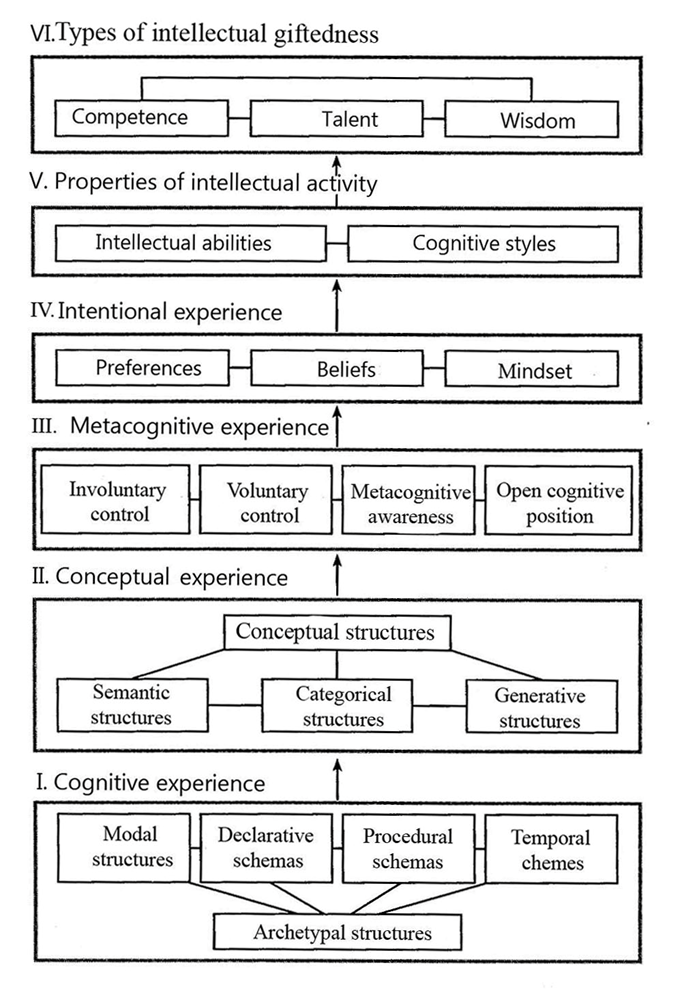
Figure 1. Structural model of intelligence as a form of organization of mental experience
Thus, the composition and structure of mental experience describe the intelligence is a mental reality.
Cognitive experience is the mental structures responsible for receiving, storing, organizing and transforming incoming and available information. Their main purpose is the operational processing of information about the current impact.
Conceptual experience is mental structures that provide semantic analysis, generalization and generation of information based on the procedures of semantic description, categorization, and interpretation. Their main purpose is to identify essential features and latent patterns.
Metacognitive experience is a mental structure that allows for involuntary and arbitrary regulation of the information processing process. Their main purpose is to control the course of intellectual activity and the state of individual intellectual resources.
Intentional experiences are the mental structures that underlie individual cognitive inclinations. Their main purpose is the formation of selective subjective preferences regarding the subject material, ways of solving problems, etc.
Features of the organization of cognitive, conceptual, metacognitive and intentional experience determine the productive properties of individual intelligence (in terms of indicators of intellectual abilities – cognitive, conceptual, metacognitive, intentional abilities) and style properties of individual intelligence (in terms of indicators of cognitive styles – information coding styles, information processing styles, thinking styles, and epistemological styles).
In turn, intellectual abilities and cognitive styles act as the basis of integral intellectual abilities – competence, talent, and wisdom – as types of intellectual giftedness, which in their mechanisms are the effects of the interaction of components of cognitive, conceptual, metacognitive, and intentional experience.
As a system-forming factor that determines the features of the structural organization of individual mental experience and the dynamics of its development at different stages of ontogenesis, in our opinion, is conceptual experience. It is the conceptual abilities (semantic, categorical, generative) that determine the processes of differentiation and integration of the components of individual mental experience, thereby affecting the productivity of intellectual activity at different levels of cognitive reflection (Kholodnaya, 2012; Noë, 1999; Vekker, 1976).
As a person develops intellectually, conceptual abilities increasingly acquire a “resource-generating function”, providing a number of qualitatively new mental capabilities: the accumulation of personal existential and sociocultural experience; a conscious interpretation of this experience; the construction of an “augmented reality” on this basis; transition to a higher level of self-regulation of mental activity (Mayorova, 2015).
What changes as a result of the redefinition of intelligence as a form of organization of mental experience? Our theoretical understanding of those attributes (basic qualities) that are inherent in intelligence is changing if we consider it through the prism of the category of “mental experience”.
(1) Multidimensionality. The intelligence is a complex system formed by mental structures that are diverse in terms of mental material and functional purpose, therefore, the level of intellect development should be judged by the profile of indicators characterizing different components of individual mental experience.
(2) Self-organization. The intelligence, being under the powerful influence of genetic and environmental factors, nevertheless, is influenced by the processes taking place within the mental experience of a person. Thus, genetic and environmental determinations are supplemented by a third factor – mental determination, which has an individual-specific character.
(3) Subjectivity. The level of intellectual maturity will be the higher, the more independence and initiative the person himself will show regarding the search for new relevant information, the use of different methods of analyzing the problem, and the increase in the criticality of his/her assessments.
(4) Nonlinear dynamics. It is necessary to recognize the possibility of a spasmodic nature of changes in the structure of intelligence in ontogeny, including the sudden crystallization of mental experience under the influence of a random event, the cumulative nature of the process of its enrichment, the unity of progressive and regressive lines of intellectual development (in the form of “fading” or “flaring up” of intellectual giftedness at different stages of age development, growth of intellectual productivity against the background of a deficit of cognitive functions in old age, etc.).
(5) Contextuality. The work of the intellect, as a mechanism for regulating behavior in the natural environment, involves taking into account both the situational context in which this or that problem is included, and the mental context that a person generates and forms in the course of his/her thoughts. The richer the mental experience, the broader and more diverse is the context of intellectual activity.
(6) Heterogeneity. Productive intellectual activity is possible with simultaneous or sequential actualization of different components of cognitive, conceptual, metacognitive and intentional experience, which act as mental resources of different levels and different types.
(7) Mobility. A separate intellectual ability can “move” in the space of individual mental experience over a wide range, starting from the state of “functional stupidity” and ending with creative achievements.
(8) Uniqueness. The mental experience of each person is specific in its composition and structure, as well as in terms of the features of its evolution in ontogenesis, therefore, when analyzing individual differences, one should take into account the individual-peculiar forms of a person’s cognitive attitude to what is happening.
The attributes of intelligence listed above not only change the comprehension of the mechanisms of intelligence, methods of psychodiagnostics of intellectual abilities and factors in the formation of intellectual resources of the individual, but also emphasize the value content of this mental quality.
Conclusions
One of the central consequences of using the concept of “mental experience” is the transition to the idea of multidimensionality and non-linearity of individual behavior due to the specific principles of mental experience organizing as a special mental reality.
Here, by analogy with the objects of the microcosm, one can use the metaphor of “quantum behavior of atoms”: atoms, as physical micro-objects, can simultaneously be in different states and, as a result, demonstrate qualitatively different behavior. Similarly, mental experience can initiate a kind of “quantum behavior”: an intelligent person suddenly turns into a fool and, on the contrary, a stupid person suddenly makes wise judgments; from love to hate is not even one step, but an instantaneous transition; a spiritually developed person suddenly commits an immoral act; a scientist, after a long fruitless work on a problem, suddenly experiences a creative insight, etc. One of the reasons for this kind of “sudden effects” is that the components of individual mental experience seem to be very sensitive to the slightest changes in initial and current conditions, so mental experience can very quickly switch over from one state to another, radically different from initial conditions – hence the unpredictability and the impossibility of “calculating” a specific mental property or act.
Thus, the concept of “mental experience” allows us to talk about the formation of an ontological approach in modern psychological research, thereby opening up new opportunities in the study of intelligence as a mental reality – with its special composition, features of structural organization – as a mental carrier of the observed and measurable properties of intellectual activity.
Acknowledgments: The author thanks Yana Ivanovna Sipovskaya for translating the manuscript.
CRediT author statement: The author has read and approved the final version and bears responsibility for all aspects of the publication.
Funding: The investigation was supported by the RF State Assignments nos. 0138-2021-0007 “Multidimensional nature of human abilities and mental resources”.
References
- Bartlett, F.C. (1932). Remembering: A study in experimental and social psychology. New York, NY, US: Cambridge University Press.
- Baumeister, R.F., Hofmann, W., Summerville, A., Philip, T. Reiss, Ph.T., Kathleen, D. & Vohs, K.D. (2020). Everyday Thoughts in Time: Experience Sampling Studies of Mental Time Travel. Personality and Social Psychology Bulletin. 46 (12), 1631–1648. https://doi.org/10.1177/0146167220908411
- Fauconnier, G. (1985). Mental spaces: Aspects of meaning construction in natural language. Cambridge: Bradford Book.
- Fauconnier, G., Turner, M. (2008). The way we think: Conceptual blending and the mind’s hidden complexities. New York: Basic Books.
- Fortunato, V.J. & Furey, J.T. (2011). The theory of MindTime: The relationships between Future, Past and Present thinking and psychological well-being and distress. Personality and Individual Differences, 50, 20–24. DOI: 10.1016/j.paid.2010.08.014
- Gardner, R. W., Holzman, P. S., Klein, G. S., Linton, H. B., & Spence, D. P. (1959). Cognitive control: A study of individual consistencies in cognitive behavior. International Universities Press, Inc. https://doi.org/10.1037/11216-000
- Gardner, R.W., Jackson, D.N., Messick, S.J. (1960). Personality organization in cognitive controls and intellectual abilities. Psychological Issues. Monograph 8. 11 (4).
- Harvey, O.J., Hunt, D.E. & Schroder, H.M. (1961). Conceptual system and personality organization. N.Y.: Wiley Sons.
- Harvey, O.J. (1966). System structure, flexibility and creativity. In O.J. Harvey (Ed.). Experience structure and adaptability. N.Y.: Springer. P. 39–65.
- Hunt, J. (1960). Intelligence and experience. N.Y.: The Ronald Press Co.
- Kappes, H.B. & Morewedge, C.K. (2016). Mental Simulation as Substitute for Experience. Social and Personality Psychology Compass, 10(7), 405-420. DOI: 10.1111/spc3.12257
- Kelly, G.A. (2000). A Theory of Personality: The Psychology of Personal Constructs. St. Petersburg: “Rech” [Kelli, G.A. (2000). Teoriya lichnosti: psikhologiya lichnykh konstruktov. Sankt-Peterburg: «Rech’»].
- Kholodnaya, M.A. (2018). Cognitive psychology: Cognitive styles. 3rd ed., supplement and reworked. Moscow: Yurayt [Kholodnaya, M.A. (2018). Kognitivnaya psikhologiya: Kognitivnyye stili. 3-ye izd., dopolnennoye i pererabotannoye. Moskva: Yurayt].
- Kholodnaya, M.A. (2020). Multidimensional nature of indicators of intelligence and creativity: methodical and theoretical consequences. Psychological journal, 41 (3), 18-31. [Kholodnaya M.A. Mnogomernaya priroda pokazatelej intellekta i kreativnosti: metodicheskie i teoreticheskie sledstviya // Psihologicheskij zhurnal. 2020. T. 41. № 3. S. 18-31]. DOI: 10.31857/S020595920009342-2.
- Kholodnaya, M.A. (2012). Psychology of conceptual thinking: From conceptual structures to conceptual abilities. M.: Publishing House “Institute of Psychology of the Russian Academy of Sciences” [Kholodnaya M.A. Psihologiya ponyatijnogo myshleniya: Ot konceptual’nyh struktur k ponyatijnym sposobnostyam. M.: Izd-vo «Institut psihologii RAN», 2012].
- Kholodnaya, M.A. (2019). The Psychology of Intelligence: The Paradoxes of Research. 3rd ed., supplement and reworked. Moscow: Yurayt. [Kholodnaya M.A. Psihologiya intellekta: Paradoksy issledovaniya. 3-e izd., dopoln. i pererab. M.: YUrajt, 2019].
- Kholodnaya, M.A., Shcherbakova, O.V., Gorbunov, I.A., Golovanova, I.V. & Papovyan, M.I. (2013). Information and energy characteristics of various types of cognitive activity. Psychological journal, 34 (5), 96-107 [Kholodnaya M.A., Shcherbakova O.V., Gorbunov I.A., Golovanova I.V., Papovyan M.I. Informacionno-energeticheskie harakteristiki razlichnyh tipov kognitivnoj deyatel’nosti // Psihologicheskij zhurnal. 2013. T. 34. № 5. S. 96-107].
- Kutkovaya, E.S. (2014). Narrative in Identity Research. National Psychological Journal, 4 (16), 23-33. [Kutkovaya E.S. Narrativ v issledovanii identichnosti // Nacional’nyj psihologicheskij zhurnal. 2014. № 4 (16). S. 23-33].
- Lukov, Val. A. & Lukov, Vl. A. (2014). Methodology of the thesaurus approach: strategy of understanding. Understanding. Skills. 1, 18-35 [Lukov Val.A., Lukov Vl.A. Metodologiya tezaurusnogo podhoda: strategiya ponimaniya // Znaniya. Ponimanie. Umeniya. 2014. № 1. S. 18-35].
- Marton, F. (1981), Phenomenography – describing conceptions of the world around us. Instructional Science, 10, 177-200.
- Mayorova, O.A. (2015). Conceptual state of personality as a cognitive resource. Modern study of social problems (electronic scientific journal). 6 (50), 141-151. DOI: 10.12731/2218-7405-2015-6-13 [Majorova O.A. Konceptual’noe sostoyanie lichnosti kak kognitivnyj resurs // Sovremennye issledovaniya social’nyh problem (elektronnyj nauchnyj zhurnal). 2015. №6 (50). S. 141-151]. DOI: 10.12731/2218-7405-2015-6-13
- Noë, А. (1999). Thought and experience. In American Philosophical Quarterly, 36 (3), 257-65.
- Osorina, M.V. (2014). To the question of the qualitative and quantitative assessment of the levels of understanding of the visual text. Bulletin of St. Petersburg University. Series 16: Psychology. Pedagogy, 3, 21-36 [Osorina M.V. K voprosu o kachestvennoj i kolichestvennoj ocenke urovnej ponimaniya izobrazitel’nogo teksta // Vestnik Sankt-Peterburgskogo universiteta. Seriya 16: Psihologiya. Pedagogika. 2014. № 3. S. 21-36].
- Osorina, M.V. (2017). Mental spaces as a psychic reality. Bulletin of St. Petersburg State University. Psychology and pedagogy. 7 (1), 6-24. DOI: 10.21638/11701/spbu16.2017.101 [Osorina M.V. Mental’nye prostranstva kak psihicheskaya real’nost’ // Vestnik SPbGU. Psihologiya i pedagogika. 2017. T. 7. Vyp. 1. S. 6-24]. DOI: 10.21638/11701/spbu16.2017.101
- Polyakov, S.E. (2011). Phenomenology of mental representations. St. Petersburg: Peter [Polyakov S.E. Fenomenologiya psihicheskih reprezentacij. SPb.: Piter, 2011].
- Prokhorov, A.O. (2016). Mental representations of mental states: phenomenological and experimental characteristics. Experimental psychology, 9 (2), 23-37. DOI: 10.17759/exppsy. 2016090203 [Prohorov A.O. Mental’nye reprezentacii psihicheskih sostoyanij: fenomenologicheskie i eksperimental’nye harakteristiki // Eksperimental’naya psihologiya. 2016. T. 9. № 2. S. 23-37]. DOI: 10.17759/exppsy. 2016090203
- Rapaport, D. (1957). Cognitive structures. In J.S. Bruner et al. (Eds.). Contemporary approaches to cognition. N.Y.: Harvard Univ. Press. 157–200.
- Rebeko, T.A. (2015). Bodily experience in the structure of individual knowledge. M.: Publishing House “Institute of Psychology of the Russian Academy of Sciences” [Rebeko T.A. Telesnyj opyt v strukture individual’nogo znaniya. M.: Izd-vo «Institut psihologii RAN», 2015].
- Shavinina, L.V. (2004). Explaining high abilities of Nobel laureates. High Ability Studies, 15 (2), 243–254. DOI: 10.1080/1359813042000314808
- Shavinina, L.V. (2017). What lessons can innovation education learn from childhood and adolescent education of the Nobel Prize winners in chemistry? International J. Innovation in Education, 4 (2/3), 191-213. DOI: 10.1504/IJIIE.2017.10009094
- Shcherbakova, O.V. (2009). Cognitive mechanisms of understanding the comic. Dis… cand. psychol. Sciences. SPb. [Shcherbakova O.V. Kognitivnye mekhanizmy ponimaniya komicheskogo. Dis… kand. psihol. nauk. SPb., 2009].
- Shcherbakova, O.V. (2017). How do our mental and personal experience mediate intellectual efficiency? Intellectual competence as patterns of individual cognitive performance. Bulletin of St. Petersburg State University. Psychology and pedagogy, 7 (1), 43-54. DOI: 10.21638/11701/spbu16.2017.103
- Thorndyke, P. (1977). Cognitive structures in comprehension and memory of narrative discourse. Cognitive psychology, 9, 77-110.
- Vekker, L.M. (1976). Mental processes. Thinking and intelligence. Vol. 2. L.: Leningrad Publishing House. un-ta [Vekker L.M. Psihicheskie processy. Myshlenie i intellekt. T. 2. L.: Izd-vo Leningr. un-ta, 1976].
- Velichkovsky, B.M. (2006). Cognitive Science: Fundamentals of the Psychology of Cognition. In 2 vols. M.: Academy. [Velichkovskij B.M. Kognitivnaya nauka: Osnovy psihologii poznaniya. V 2-h t. M.: Akademiya, 2006].
- Volkova, E.V. & Talantov, D.A. (2019). Bulletin of psychophysiology, 3, 23-38 [Volkova E.V., Talantov D.A. Vestnik psihofiziologii. 2019. № 3. S. 23-38].
- Zavalishina, D.N. (1985). Psychological analysis of operational thinking. Moscow: Nauka [Zavalishina D.N. Psihologicheskij analiz operativnogo myshleniya. M.: Nauka, 1985].
- Znakov, V.V. (2013). Theoretical foundations of the psychology of human existence. Psychological journal, 34 (2), 29-38. [Znakov V.V. Teoreticheskie osnovaniya psihologii chelovecheskogo bytiya // Psihologicheskij zhurnal. 2013. T. 34. № 2. S. 29-38].
Comments (0)
The article analyzes the content of the concept of “mental experience”, which is new for modern psychology. It is proposed to interpret this term in a narrow sense as a tool for analyzing one’s own intellectual sphere.
The article considers prerequisites for this concept’s origin in internal experience researches as a factor of intellectual behavior’s regulation, so review includes the neo-Freudianism’s cognitive direction, personality’ cognitive psychology, and cognitive psychology. The structure of mental experience is described as a hierarchy of mental substratum of the properties of intellectual activity: mental structures, mental space, mental representations. A structural model of intelligence as a form of organization of mental experience is presented. The methods of explication of mental experience are discussed. It is emphasized that despite the complexity of the topic, there are several prospects for using this concept in psychological research.
Formulation of the problem
The concept of “mental experience” is a new to modern psychology. Moreover, scientific psychology is only getting ready to include this concept in its categorical apparatus. Nevertheless, turning to the analysis of individual human experience is comparable to such a revolutionary stage in the development of psychology as the cognitivist approach that appeared in its time. In both cases, in fact, we are talking about a paradigm shift: the transition from the informational interpretation of the mind to its ontological interpretation as a special kind of internal mental reality.
The difficulties of including the concept of “mental experience” in a professional psychological thesaurus are associated with an insufficiently strict definition of both the term “mental” and the term “experience”.
The term “mental” in a broad sense is interpreted as “psychic” (for example, mental health), in a narrow sense – as “intellectual, produced in the mind”. The derivative term “mentality” is lat. mentis – means “thought, intelligence, mindset, way of thinking, intention, mind”. One more derivative term can be mentioned “mentality” (in the sense of a worldview), which is usually used in the context of the analysis of social processes. It is a culturally specific set of mental, emotional, and value characteristics inherent in a social or ethnic group, nation, people. I believe that the term “mental” as a scientific category should be used in a narrow sense to describe the intellectual sphere of the individual.
As for the term “experience”, for a long time it was traditional to understand experience as a sensory form of cognition of reality based on practice. Such a narrow formulation excludes from the content of this concept those forms of experience that underlie conceptual generalizations, metacognitions, intuition, “impossible” hypotheses, etc.
Further, the scientific community quite often interprets experience as a set of acquired knowledge and skills. This approach considers experience as a kind of passive structure underlying reproductive intellectual activity. D.N. Zavalishina notes that at the level of modern psychological concepts “… human experience ceases to be a secondary component of intelligence … but becomes its leading component, a potential reservoir of new operational-subject knowledge, often arising in difficult conditions of activity in the form of non-instrumental signals and intuitive mechanisms” (Zavalishina, 1985, p. 111).
Sometimes experience is considered as information accumulated and stored in individual long-term memory. However, information, more precisely, the psychological formats of its storage, is only a part of individual experience. Moreover, it is precisely the features of the composition and construction of present experience that determine what information will be perceived and how it will be structured, and to what extent it will be used to regulate behavior.
Finally, there is an identification of experience only with past experience, which is an unjustified simplification. Experience is both fixed forms of experience (what a person has learned in the past), and operational forms of experience (what happens in his/her experience in the present), and potential forms of experience (what will appear in individual experience as new formations in the near or distant future).
The idea of mental experience as a special mental reality that determines the properties of a person’s intellectual activity (and, moreover, his/her personal properties and features of his/her social relations) gradually took shape in different terminological formulations in various areas of psychological research.
In particular, the idea of the key role of the organization of mental experience began to be actively developed in cognitively oriented theoretical directions, such as:
(1) the cognitive direction of neo-Freudianism – D. Rapaport, R. Gardner, F. Holtzman, G. Klein, and others;
(2) cognitive psychology of personality – J. Kelly, O. Harvey, D. Hunt, X. Schroder, W. Scott and others;
(3) cognitive psychology – F. Bartlett, S. Palmer, V. Neisser, E. Roche, M. Minsky, and others.
1.1.1. The cognitive direction of neo-Freudianism focused on the search for structural formations in the cognitive sphere (they were called “cognitive controls”) that mediate the influence of both external influences and motivational states. The complex of cognitive controls forms a characteristic of the cognitive style, an individually unique way of processing information about the environment. Individual differences in cognitive styles lead to different adaptive approaches to reality, which can be equally effective regardless of the degree of “correctness” of the results of cognitive activity (Gardner, et al., 1959; Gardner, Jackson & Messick, 1960; Thorndyke, 1977). The concept of “cognitive control” was introduced simultaneously with the concept of “cognitive structure”. Moreover, the latter was addressed to a certain hypothetical mental formation, which explains the stability of the stylistic manifestations inherent in a particular personality (Rapaport, 1957). It is important to emphasize that initially cognitive controls (“cognitive styles” in modern terminology) were opposed to psychological defenses: the latter distorted a person’s ideas about what was happening, while cognitive controls provided a realistic (objectified) form of cognitive reflection of reality.
1.1.2. Cognitively oriented theories of personality were developed on the basis of the idea that an explanation for the uniqueness of personality should be sought in the peculiarities of a person’s understanding of what is happening. G.A. Kelly in his theory of personality constructs (Kelly, 2000) was one of the first who attempted to analyze personality through the features of its cognitive experience.
According to Kelly, a person perceives, interprets, and evaluates reality (a real object, another person, a social situation) on the basis of a certain way organized subjective experience, presented as a system of personal constructs. A construct is a bipolar subjective measuring scale that simultaneously implements two functions: generalization (establishing similarities) and opposition (establishing differences) (for example, “simple – complex”, “amiable – aggressive”, “responsible -irresponsible”, etc.).
Harvey, D. Hunt, and X. Schroder paid the main attention to the structural aspects of the organization of individual conceptual systems. The most important structural characteristic of an individual conceptual system is “concreteness – abstraction”, which is based on the processes of differentiation and integration. A slight differentiation and insufficient integration of the concepts available to the subject characterized a “concrete” conceptual system. Accordingly, the following psychological qualities are typical for “concrete” individuals: stereotyped decisions, intolerance for uncertainty, a tendency to black-and-white thinking, dependence on status and authority, etc. An “abstract” conceptual system, on the contrary, implies both high differentiation and high integration of available concepts. Accordingly, “abstract” individuals are characterized: orientation to internal experience in explaining the physical and social world, independence, flexibility, risk-taking, creativity, etc. (Harvey, Hunt, Schroder, 1961; Harvey, 1966; Hunt, 1960).
The study of information processing processes in cognitive psychology has shown the presence of special mental formations-intermediaries, – cognitive schemes that take part in the reception, transformation and storage of information.Bartlett (Bartlett, 1932) was one of the first to point out the the structures (“schemes”) of experience as a factor indicating the active organization of past impressions and influencing the processes of information processing. Subsequently, cognitive psychologists described various types of cognitive structures, acting as varieties of “schemes” in the Bartlett sense: cognitive maps (E.Ch. Tolman); prototypes (E. Roche); hierarchical perceptual schemes (S. E. Palmer); a complex of schemes (figurative, operational, controlling) (J. Pascual-Leone); anticipatory schemes (U. Neisser); frames (M.L. Minsky); scripts (R.C. Schank); deep semantic and syntactic universals (Ch. E. Osgood; A.N. Chomsky).
So, certain mental formations were discovered and described that control the way a person perceives, understands and interprets events in the cognitive direction of neo-Freudianism, and cognitive psychology of personality, and cognitive psychology.
Organization of mental experience: mental structures, mental space, and mental representations
The main pathos of including the concept of “mental experience” in the system of psychological concepts is that its use will allow us to transfer psychological research from the functional (descriptive) level to the ontological (explanatory) level. A mental phenomenon is not a set of observed or measured properties, but a real mental formation, the composition and structure of which determines its functional manifestations (that is, certain properties of intellectual activity) within the framework of the ontological approach. In other words, the concept of “mental experience” gives a mental phenomenon an ontological status, allowing us to consider its nature within the framework of the theoretical paradigm “mental substratum/hierarchy of mental substratum – mental property” (Kholodnaya, 2019; Kholodnaya, 2020; Vekker, 1976).
Three basic categories describe features of organization of mental experience: mental structure, mental space and mental representation.
Mental structures are a system of mental formations that, under the conditions of a person’s cognitive contact with reality, provide the possibility of receiving information about ongoing events and its transformation, generalization of existing information and generation of new information, management of information processing processes and selectivity of intellectual activity. These mental structures were called in various ways: “cognitive control principles”, “constructs”, “concepts”, “cognitive schemas”, etc.
Mental structures have a set of distinctive properties. They can function in the absence of an external stimulus or in conditions of lack of information and they are characterized by dynamic constructivity (acquire and change shape in ontogeny and actual genesis under the influence of various factors). Moreover, mental structures regulate the way of perception, understanding and forecasting of events; they are responsible for the degree of complexity of the generated mental context; they direct and control need-affective states. In addition, mental structures differ in the variability of their manifestations (the same mental structure can be associated with different behavioral responses, at the same time, the same behavioral response can be associated with different mental structures).
The question of the energy component of mental structures is of particular interest. On the example, of the study of conceptual structures, it was possible to show that the higher the level of formation of the conceptual structure, the less pronounced the energy costs in the process of their functioning (in terms of EEG indicators). Thus, for respondents with higher success in conceptual transformations, the process of searching for categorical generalizations and constructing a conceptual context is accompanied by lower energy costs compared to unsuccessful respondents (Kholodnaya, et. al, 2013). Similarly, differentiation and hierarchization increase as the formation of the conceptual structure grows (on the example of the concept Substance, the reference subject area “chemistry”), there is a decrease in significant interlevel differences in the indicators of the power spectrum and narrowing of their frequency range, which is evidence of a decrease in energy costs in the case of the formed concept (Volkova & Talantov, 2019).
Finally, the main feature of mental structures lies in the very mechanism of their functioning, which can be described as the ability to “fold” and “deploy”. O. Harvey, D. Hunt and X. Schroder for the first time described this effect in relation to the concept (conceptual structure) at one time. On the one hand, the concept works only if there is an object that is relevant to it: “Remove the object and the concept will fall into a dormant state” (Harvey, Hunt & Schroder, 1961, p. 13). On the other hand, mental structures can generate a mental space within which a specific image of a specific situation (object, event, task, etc.) is built.
Mental space is a dynamic form of mental experience, which is actualized in the conditions of cognitive interaction of the subject with the world. Within the framework of the mental space, all sorts of mental movements and movements are possible.
Fauconnier in his linguistic research introduced the concept of “mental space” to explain the flexibility of the content of linguistic signs (Fauconnier, 1985). Subsequently, M. Turner and J. Fauconnier developed the “conceptual blending theory”, that develop the concept of mental space and explain the process of emergence of new meanings of words, including metaphors (Fauconnier & Turner, 2008). Thanks to such operations as composition, completion, and elaboration, a new enriched mental space is formed, which acts as the basis for the emergence of unusual, including counterfactual ideas.
According to M.V. Osorina, the mental space is “the operational space of mental work, in which the operands of thought are actualized, transformed, interact, replace each other or line up in organized aggregates – … various types of mental objects that the mind operates with” (Osorina, 2017, p. 13).
The mental space, of course, is not an analogue of the physical space. Nevertheless, it has a number of specific “spatial” properties. Firstly, an operational transformation of the mental space is possible (it has the ability to instant change its topology and metrics under the influence of a person’s affective state, additional information, etc.). Secondly, the boundaries of the mental space can be maximally collapsed or maximized (accordingly, a person can think about both unthinkably small and unthinkably large objects) (Osorina, 2017). Thirdly, the mental space acts as a set of recursively nested mental spaces, which creates the possibility of any options for the movement of thought, up to “absurd” ideas (Velichkovsky, 2006). Fourthly, the mental space is characterized by such qualities as dimension, permeability, elasticity, dynamism, categorical complexity, etc. (slowdown in decision-making may be due to the expansion of the mental space, black-and-white thinking – a consequence of its low dimension, misunderstanding of a communication partner – a consequence of the impenetrability of its boundaries, etc.).
Of particular interest is the temporal component of the mental space. The concept of “mental space” is terminologically incomplete: one should speak of a “mental space-time field”, since it exists due to the deployment of both spatial and temporal cognitive schemes – accordingly, in the mental space, not only mental objects are organized in a certain way, but mental time flows in a certain way. In particular, the phenomenon of “mental time travel” is described, which involves the ability to mentally disconnect from the present moment, as well as actively reconstruct past and future events based on the information contained in episodic and semantic memory (Baumeister et. al, 2020; Fortunato & Furey, 2011).
M.V. Osorina, substantiating the ontological status of mental space, considers it as a special case of secondary visual structures, which include representations of memory, images of imagination, dreams, etc. She notes, that mental space “… is like a “window” with moving borders, which is briefly created by the subject over the picture of the visible world as a special space filled with appearing, interacting and disappearing mental images, sometimes expanded, and sometimes looking like short flashes, conventionally denoting something» (Osorina, 2017, p. 19).
Thus, the mental space is a kind of intermediary between the available mental structures, in which individual mental experience is accumulated, and the features of the reproduction of one or another fragment of reality in the form of an actual mental representation.
A mental representation is a mental image of a particular event at a current moment in time (a specialized and detailed mental “event picture”). Mental representation is an operational form of mental experience, since it depends on the circumstances and specific goals of the individual (Polyakov, 2011; Prokhorov, 2016; Rebeko, 2015). The very fact of having a mental representation of the displayed situation fundamentally changes the strategy of intellectual behavior: the time for perception and understanding of the situation increases, accordingly, the format of intellectual activity is changing qualitatively (from impulsive to reflexive). In addition, mental representations (understood as “mentally simulating”) act as a means of distraction, overcoming difficulties or preparing for the future, rebuilding or even replacing real experience (Kappes & Morewedge, 2016).
The results of various studies allow us to identify some universal characteristics of mental representations that act as a prerequisite for the success of intellectual activity and the effectiveness of social behavior, including:
- an adequate understanding of the situation is built even on an indefinite and insufficient information basis;
- the idea of the situation has an articulated nature, while the selection of details is accompanied by their dynamic recombination;
- complex and disharmonious form of mental representation tends to transform into a simpler and well-organized form;
- ignoring the obvious, external, conspicuous aspects of the situation and readiness to respond to its hidden, “silent” aspects;
- the presence of highly generalized elements in the representation due to reliance on categorical knowledge;
- highlighting key elements of the situation as reference points for further reflection;
- willingness to rebuild the image of the situation in accordance with the changing conditions and requirements of the activity (mentally look at the situation from different angles);
- decentralized nature of representation based on the control of the distorting influence of actual needs and affective states.
Thus, mental experience is a complex mental formation by its nature. The three main forms of experience organization such as mental structures, mental space, and mental representations act as a hierarchy of mental substrates that “from within” predetermine the properties of intellectual activity.
- Methods for the study of mental experience
When the object of research changes, namely, the transition from the description and measurement of the properties of intellectual activity to the description and measurement of their mental substratum, that is, the features of the organization of individual mental experience, there should be a change in research methods. The generally accepted “objective” method of testing fundamentally levels out the individual experience of the test subject. All conditions are created so that both the content of the tasks and the measurement procedure are extremely universalized. Here we are faced with an obvious contradiction: if the task is to measure the intelligence of a particular person, then ignoring the uniqueness of his/her individual mental experience, it is impossible in principle to do this.
The question arises whether it is possible to objectively analyze the nature of mental experience through subjective phenomenology, including meaningful self-reports of the subjects? There are reasons to answer this question in the affirmative.
First, the person him/herself is a potentially very accurate source of information about mental events, and therefore the content elements reported by the person can be considered as valid indicators of the organization of his/her mental experience. Secondly, mental structures most clearly manifest themselves in the natural content that the subject him/herself generates in acts of thinking (in contrast to the artificially constructed content given from outside in test methods). Thirdly, with a purposeful variation of a certain set of tasks or a specially constructed instruction, it is possible to extract invariants from the mental products generated by the respondent (microtexts, drawings, interpretations, etc.) that characterize the structural patterns of individual mental experience.
In general, we can talk about a special methodological procedure that is adequate to the tasks of studying individual mental experience – an explicative method that is focused on “extracting” certain components of mental experience, depending on the goals of the study. In particular, the phenomenography – the methodology based on interviews, which aims to identify the various ways in which different people perceive or understand the same phenomenon, was aimed at solving this problem (Marton, 1981).
The explicative method includes both some traditional methods (associative, projective, pictographic, biographical, psychosemantic, semi-structured interviews, etc.) and newly developed methods.
One example of the use of the biographical method is the study of the specifics of the mental development of Nobel Prize winners, based on autobiographical and biographical reports of Nobel Prize winners. Studies have shown the critical importance of such components of their mental experience as special feelings, preferences and beliefs, as well as the specifics of their early childhood and adolescent education (Shavinina, 2004; Shavinina, 2017).
The explicative methods include the method of multiple design in the analysis of conceptual production, the essence of which is that the same conceptual structure as a unit of conceptual experience is described using many different methodological procedures, explicating different aspects of its structure and functioning on a set of small independent samples (Kholodnaya, 2012).
Of undoubted interest is the method of microstructural analysis of the levels of understanding of a pictorial text in the form of a polysemantic picture and a comic text in the form of verbal jokes (Osorina, 2014; Shcherbakova, 2009: Shcherbakova, 2017). This method involves the use of qualitative techniques for describing the forms of understanding the text generated by the respondent, initiated with the help of special questions in combination with an in-depth semi-structured interview. Its important feature is the special attention to the detailed psychological study of the stimulus material and the step-by-step analysis of cognitive actions that determine the specifics of its understanding by a particular respondent.
The thesaurus method for analyzing mental experience is based on identifying and describing the features of the organization of individual knowledge regarding a particular situation (event), its selective value-semantic orientation, the specifics of the thematic content, associative and emotional deviations from the main theme, etc. Thesauri are implemented as facts (forms and levels) understanding (Lukov & Lukov, 2014; Znakov, 2013).
The narrative method (method of studying individual history) involves the description and analysis of any version of what is happening in the form of a narrative (oral or written author’s text) that is relevant to the subject, which is distinguished by purposefulness, consistency, plausibility, and dialogic orientation. The text generated by the respondent is viewed as a kind of “projection” of his mental experience in the unity of content and structural features (Kutkovaya, 2014; Znakov, 2013).
Intelligence as a form of organization of mental experience
Let us consider the possibility of implementing the concept of “mental experience” in relation to the development of a new ontological approach to the study of the nature of intelligence, in comparison with the traditional testological approach.
The generally accepted definition of intelligence as a set of its properties, including those measured under the conditions of performing a set of test tasks, needs a fundamental reformulation. The question “What set of properties (verbal and non-verbal functions) can describe intelligence?” should be replaced by the question “What is intelligence as a mental substratum of its properties?” One can answer this question in the following way. Intelligence in its ontological status is a form of organization of individual mental experience acting as available mental structures, the mental space generated by them, and the mental representations of what is happening being built within this space.
According to the proposed structural model of intelligence (Kholodnaya, 2019), four levels of experience (cognitive, conceptual, metacognitive, intentional) can be distinguished as part of mental experience, which, interacting closely with each other, determine the properties of intellectual activity, including types of intellectual giftedness (Fig. 1).
Figure 1. Structural model of intelligence as a form of organization of mental experience
Thus, the composition and structure of mental experience describe the intelligence is a mental reality.
Cognitive experience is the mental structures responsible for receiving, storing, organizing and transforming incoming and available information. Their main purpose is the operational processing of information about the current impact.
Conceptual experience is mental structures that provide semantic analysis, generalization and generation of information based on the procedures of semantic description, categorization, and interpretation. Their main purpose is to identify essential features and latent patterns.
Metacognitive experience is a mental structure that allows for involuntary and arbitrary regulation of the information processing process. Their main purpose is to control the course of intellectual activity and the state of individual intellectual resources.
Intentional experiences are the mental structures that underlie individual cognitive inclinations. Their main purpose is the formation of selective subjective preferences regarding the subject material, ways of solving problems, etc.
Features of the organization of cognitive, conceptual, metacognitive and intentional experience determine the productive properties of individual intelligence (in terms of indicators of intellectual abilities – cognitive, conceptual, metacognitive, intentional abilities) and style properties of individual intelligence (in terms of indicators of cognitive styles – information coding styles, information processing styles, thinking styles, and epistemological styles).
In turn, intellectual abilities and cognitive styles act as the basis of integral intellectual abilities – competence, talent, and wisdom – as types of intellectual giftedness, which in their mechanisms are the effects of the interaction of components of cognitive, conceptual, metacognitive, and intentional experience.
As a system-forming factor that determines the features of the structural organization of individual mental experience and the dynamics of its development at different stages of ontogenesis, in our opinion, is conceptual experience. It is the conceptual abilities (semantic, categorical, generative) that determine the processes of differentiation and integration of the components of individual mental experience, thereby affecting the productivity of intellectual activity at different levels of cognitive reflection (Kholodnaya, 2012; Noë, 1999; Vekker, 1976).
As a person develops intellectually, conceptual abilities increasingly acquire a “resource-generating function”, providing a number of qualitatively new mental capabilities: the accumulation of personal existential and sociocultural experience; a conscious interpretation of this experience; the construction of an “augmented reality” on this basis; transition to a higher level of self-regulation of mental activity (Mayorova, 2015).
What changes as a result of the redefinition of intelligence as a form of organization of mental experience? Our theoretical understanding of those attributes (basic qualities) that are inherent in intelligence is changing if we consider it through the prism of the category of “mental experience”.
(1) Multidimensionality. The intelligence is a complex system formed by mental structures that are diverse in terms of mental material and functional purpose, therefore, the level of intellect development should be judged by the profile of indicators characterizing different components of individual mental experience.
(2) Self-organization. The intelligence, being under the powerful influence of genetic and environmental factors, nevertheless, is influenced by the processes taking place within the mental experience of a person. Thus, genetic and environmental determinations are supplemented by a third factor – mental determination, which has an individual-specific character.
(3) Subjectivity. The level of intellectual maturity will be the higher, the more independence and initiative the person himself will show regarding the search for new relevant information, the use of different methods of analyzing the problem, and the increase in the criticality of his/her assessments.
(4) Nonlinear dynamics. It is necessary to recognize the possibility of a spasmodic nature of changes in the structure of intelligence in ontogeny, including the sudden crystallization of mental experience under the influence of a random event, the cumulative nature of the process of its enrichment, the unity of progressive and regressive lines of intellectual development (in the form of “fading” or “flaring up” of intellectual giftedness at different stages of age development, growth of intellectual productivity against the background of a deficit of cognitive functions in old age, etc.).
(5) Contextuality. The work of the intellect, as a mechanism for regulating behavior in the natural environment, involves taking into account both the situational context in which this or that problem is included, and the mental context that a person generates and forms in the course of his/her thoughts. The richer the mental experience, the broader and more diverse is the context of intellectual activity.
(6) Heterogeneity. Productive intellectual activity is possible with simultaneous or sequential actualization of different components of cognitive, conceptual, metacognitive and intentional experience, which act as mental resources of different levels and different types.
(7) Mobility. A separate intellectual ability can “move” in the space of individual mental experience over a wide range, starting from the state of “functional stupidity” and ending with creative achievements.
(8) Uniqueness. The mental experience of each person is specific in its composition and structure, as well as in terms of the features of its evolution in ontogenesis, therefore, when analyzing individual differences, one should take into account the individual-peculiar forms of a person’s cognitive attitude to what is happening.
The attributes of intelligence listed above not only change the comprehension of the mechanisms of intelligence, methods of psychodiagnostics of intellectual abilities and factors in the formation of intellectual resources of the individual, but also emphasize the value content of this mental quality.
One of the central consequences of using the concept of “mental experience” is the transition to the idea of multidimensionality and non-linearity of individual behavior due to the specific principles of mental experience organizing as a special mental reality.
Here, by analogy with the objects of the microcosm, one can use the metaphor of “quantum behavior of atoms”: atoms, as physical micro-objects, can simultaneously be in different states and, as a result, demonstrate qualitatively different behavior. Similarly, mental experience can initiate a kind of “quantum behavior”: an intelligent person suddenly turns into a fool and, on the contrary, a stupid person suddenly makes wise judgments; from love to hate is not even one step, but an instantaneous transition; a spiritually developed person suddenly commits an immoral act; a scientist, after a long fruitless work on a problem, suddenly experiences a creative insight, etc. One of the reasons for this kind of “sudden effects” is that the components of individual mental experience seem to be very sensitive to the slightest changes in initial and current conditions, so mental experience can very quickly switch over from one state to another, radically different from initial conditions – hence the unpredictability and the impossibility of “calculating” a specific mental property or act.
Thus, the concept of “mental experience” allows us to talk about the formation of an ontological approach in modern psychological research, thereby opening up new opportunities in the study of intelligence as a mental reality – with its special composition, features of structural organization – as a mental carrier of the observed and measurable properties of intellectual activity.
Acknowledgments: The author thanks Yana Ivanovna Sipovskaya for translating the manuscript.
CRediT author statement: The author has read and approved the final version and bears responsibility for all aspects of the publication.
Funding: The investigation was supported by the RF State Assignments nos. 0138-2021-0007 “Multidimensional nature of human abilities and mental resources”.
- Bartlett, F.C. (1932). Remembering: A study in experimental and social psychology. New York, NY, US: Cambridge University Press.
- Baumeister, R.F., Hofmann, W., Summerville, A., Philip, T. Reiss, Ph.T., Kathleen, D. & Vohs, K.D. (2020). Everyday Thoughts in Time: Experience Sampling Studies of Mental Time Travel. Personality and Social Psychology Bulletin. 46 (12), 1631–1648. https://doi.org/10.1177/0146167220908411
- Fauconnier, G. (1985). Mental spaces: Aspects of meaning construction in natural language. Cambridge: Bradford Book.
- Fauconnier, G., Turner, M. (2008). The way we think: Conceptual blending and the mind’s hidden complexities. New York: Basic Books.
- Fortunato, V.J. & Furey, J.T. (2011). The theory of MindTime: The relationships between Future, Past and Present thinking and psychological well-being and distress. Personality and Individual Differences, 50, 20–24. DOI: 10.1016/j.paid.2010.08.014
- Gardner, R. W., Holzman, P. S., Klein, G. S., Linton, H. B., & Spence, D. P. (1959). Cognitive control: A study of individual consistencies in cognitive behavior. International Universities Press, Inc. https://doi.org/10.1037/11216-000
- Gardner, R.W., Jackson, D.N., Messick, S.J. (1960). Personality organization in cognitive controls and intellectual abilities. Psychological Issues. Monograph 8. 11 (4).
- Harvey, O.J., Hunt, D.E. & Schroder, H.M. (1961). Conceptual system and personality organization. N.Y.: Wiley Sons.
- Harvey, O.J. (1966). System structure, flexibility and creativity. In O.J. Harvey (Ed.). Experience structure and adaptability. N.Y.: Springer. P. 39–65.
- Hunt, J. (1960). Intelligence and experience. N.Y.: The Ronald Press Co.
- Kappes, H.B. & Morewedge, C.K. (2016). Mental Simulation as Substitute for Experience. Social and Personality Psychology Compass, 10(7), 405-420. DOI: 10.1111/spc3.12257
- Kelly, G.A. (2000). A Theory of Personality: The Psychology of Personal Constructs. St. Petersburg: “Rech” [Kelli, G.A. (2000). Teoriya lichnosti: psikhologiya lichnykh konstruktov. Sankt-Peterburg: «Rech’»].
- Kholodnaya, M.A. (2018). Cognitive psychology: Cognitive styles. 3rd ed., supplement and reworked. Moscow: Yurayt [Kholodnaya, M.A. (2018). Kognitivnaya psikhologiya: Kognitivnyye stili. 3-ye izd., dopolnennoye i pererabotannoye. Moskva: Yurayt].
- Kholodnaya, M.A. (2020). Multidimensional nature of indicators of intelligence and creativity: methodical and theoretical consequences. Psychological journal, 41 (3), 18-31. [Kholodnaya M.A. Mnogomernaya priroda pokazatelej intellekta i kreativnosti: metodicheskie i teoreticheskie sledstviya // Psihologicheskij zhurnal. 2020. T. 41. № 3. S. 18-31]. DOI: 10.31857/S020595920009342-2.
- Kholodnaya, M.A. (2012). Psychology of conceptual thinking: From conceptual structures to conceptual abilities. M.: Publishing House “Institute of Psychology of the Russian Academy of Sciences” [Kholodnaya M.A. Psihologiya ponyatijnogo myshleniya: Ot konceptual’nyh struktur k ponyatijnym sposobnostyam. M.: Izd-vo «Institut psihologii RAN», 2012].
- Kholodnaya, M.A. (2019). The Psychology of Intelligence: The Paradoxes of Research. 3rd ed., supplement and reworked. Moscow: Yurayt. [Kholodnaya M.A. Psihologiya intellekta: Paradoksy issledovaniya. 3-e izd., dopoln. i pererab. M.: YUrajt, 2019].
- Kholodnaya, M.A., Shcherbakova, O.V., Gorbunov, I.A., Golovanova, I.V. & Papovyan, M.I. (2013). Information and energy characteristics of various types of cognitive activity. Psychological journal, 34 (5), 96-107 [Kholodnaya M.A., Shcherbakova O.V., Gorbunov I.A., Golovanova I.V., Papovyan M.I. Informacionno-energeticheskie harakteristiki razlichnyh tipov kognitivnoj deyatel’nosti // Psihologicheskij zhurnal. 2013. T. 34. № 5. S. 96-107].
- Kutkovaya, E.S. (2014). Narrative in Identity Research. National Psychological Journal, 4 (16), 23-33. [Kutkovaya E.S. Narrativ v issledovanii identichnosti // Nacional’nyj psihologicheskij zhurnal. 2014. № 4 (16). S. 23-33].
- Lukov, Val. A. & Lukov, Vl. A. (2014). Methodology of the thesaurus approach: strategy of understanding. Understanding. Skills. 1, 18-35 [Lukov Val.A., Lukov Vl.A. Metodologiya tezaurusnogo podhoda: strategiya ponimaniya // Znaniya. Ponimanie. Umeniya. 2014. № 1. S. 18-35].
- Marton, F. (1981), Phenomenography – describing conceptions of the world around us. Instructional Science, 10, 177-200.
- Mayorova, O.A. (2015). Conceptual state of personality as a cognitive resource. Modern study of social problems (electronic scientific journal). 6 (50), 141-151. DOI: 10.12731/2218-7405-2015-6-13 [Majorova O.A. Konceptual’noe sostoyanie lichnosti kak kognitivnyj resurs // Sovremennye issledovaniya social’nyh problem (elektronnyj nauchnyj zhurnal). 2015. №6 (50). S. 141-151]. DOI: 10.12731/2218-7405-2015-6-13
- Noë, А. (1999). Thought and experience. In American Philosophical Quarterly, 36 (3), 257-65.
- Osorina, M.V. (2014). To the question of the qualitative and quantitative assessment of the levels of understanding of the visual text. Bulletin of St. Petersburg University. Series 16: Psychology. Pedagogy, 3, 21-36 [Osorina M.V. K voprosu o kachestvennoj i kolichestvennoj ocenke urovnej ponimaniya izobrazitel’nogo teksta // Vestnik Sankt-Peterburgskogo universiteta. Seriya 16: Psihologiya. Pedagogika. 2014. № 3. S. 21-36].
- Osorina, M.V. (2017). Mental spaces as a psychic reality. Bulletin of St. Petersburg State University. Psychology and pedagogy. 7 (1), 6-24. DOI: 10.21638/11701/spbu16.2017.101 [Osorina M.V. Mental’nye prostranstva kak psihicheskaya real’nost’ // Vestnik SPbGU. Psihologiya i pedagogika. 2017. T. 7. Vyp. 1. S. 6-24]. DOI: 10.21638/11701/spbu16.2017.101
- Polyakov, S.E. (2011). Phenomenology of mental representations. St. Petersburg: Peter [Polyakov S.E. Fenomenologiya psihicheskih reprezentacij. SPb.: Piter, 2011].
- Prokhorov, A.O. (2016). Mental representations of mental states: phenomenological and experimental characteristics. Experimental psychology, 9 (2), 23-37. DOI: 10.17759/exppsy. 2016090203 [Prohorov A.O. Mental’nye reprezentacii psihicheskih sostoyanij: fenomenologicheskie i eksperimental’nye harakteristiki // Eksperimental’naya psihologiya. 2016. T. 9. № 2. S. 23-37]. DOI: 10.17759/exppsy. 2016090203
- Rapaport, D. (1957). Cognitive structures. In J.S. Bruner et al. (Eds.). Contemporary approaches to cognition. N.Y.: Harvard Univ. Press. 157–200.
- Rebeko, T.A. (2015). Bodily experience in the structure of individual knowledge. M.: Publishing House “Institute of Psychology of the Russian Academy of Sciences” [Rebeko T.A. Telesnyj opyt v strukture individual’nogo znaniya. M.: Izd-vo «Institut psihologii RAN», 2015].
- Shavinina, L.V. (2004). Explaining high abilities of Nobel laureates. High Ability Studies, 15 (2), 243–254. DOI: 10.1080/1359813042000314808
- Shavinina, L.V. (2017). What lessons can innovation education learn from childhood and adolescent education of the Nobel Prize winners in chemistry? International J. Innovation in Education, 4 (2/3), 191-213. DOI: 10.1504/IJIIE.2017.10009094
- Shcherbakova, O.V. (2009). Cognitive mechanisms of understanding the comic. Dis… cand. psychol. Sciences. SPb. [Shcherbakova O.V. Kognitivnye mekhanizmy ponimaniya komicheskogo. Dis… kand. psihol. nauk. SPb., 2009].
- Shcherbakova, O.V. (2017). How do our mental and personal experience mediate intellectual efficiency? Intellectual competence as patterns of individual cognitive performance. Bulletin of St. Petersburg State University. Psychology and pedagogy, 7 (1), 43-54. DOI: 10.21638/11701/spbu16.2017.103
- Thorndyke, P. (1977). Cognitive structures in comprehension and memory of narrative discourse. Cognitive psychology, 9, 77-110.
- Vekker, L.M. (1976). Mental processes. Thinking and intelligence. Vol. 2. L.: Leningrad Publishing House. un-ta [Vekker L.M. Psihicheskie processy. Myshlenie i intellekt. T. 2. L.: Izd-vo Leningr. un-ta, 1976].
- Velichkovsky, B.M. (2006). Cognitive Science: Fundamentals of the Psychology of Cognition. In 2 vols. M.: Academy. [Velichkovskij B.M. Kognitivnaya nauka: Osnovy psihologii poznaniya. V 2-h t. M.: Akademiya, 2006].
- Volkova, E.V. & Talantov, D.A. (2019). Bulletin of psychophysiology, 3, 23-38 [Volkova E.V., Talantov D.A. Vestnik psihofiziologii. 2019. № 3. S. 23-38].
- Zavalishina, D.N. (1985). Psychological analysis of operational thinking. Moscow: Nauka [Zavalishina D.N. Psihologicheskij analiz operativnogo myshleniya. M.: Nauka, 1985].
- Znakov, V.V. (2013). Theoretical foundations of the psychology of human existence. Psychological journal, 34 (2), 29-38. [Znakov V.V. Teoreticheskie osnovaniya psihologii chelovecheskogo bytiya // Psihologicheskij zhurnal. 2013. T. 34. № 2. S. 29-38].
References