
Signal – Qualia – Symbol: Cognitive Hierarchy of Information Codes
Abstract
Abstract
The article presents a structural model of human cognition, integrating contemporary and classical findings in cognitive sciences, neurophysiology, artificial intelligence, and quantum physics. The model is developed by means of informational-cybernetic approach, which enables structuring of the mind as a hierarchy of information encodings in use. The lowest level encodes information in the form of sensory signals, processed by Pavlovian stimulus-response scripts. This level is also the main source of creativity, ascending from the quantum fluctuations of the atomic scale. The topmost level encodes and processes information in symbolic codes, including natural and artificial languages. Flexible algorithms of abstract intelligence at this level are approximated by modern artificial intelligence. Natural cognition, by contrast, links sensory and symbolic levels through an interface, encoding information in the form of subjective experience or qualia. The geometry of this intermediate encoding is defined by its function of non-algorithmic decisions which differ voluntary behavior from machine performance. Thus defined levels correspond to the trinity of the sensory-instinctive unconscious, affective consciousness, and symbolic intelligence, cooperating in the common task of creative behavioral control. The proposed model refines the computer metaphor and reveals its fundamental limitations, opening up the avenues for integrative science of human and other kinds of mind.
Сигнал – квалиа – символ: когнитивная иерархия информационных кодов
Суров И.А.
Университет ИТМО, Санкт-Петербург, Российская Федерация, ORCID iD: 0000-0001-5690-7507
Аннотация: В статье представлена структурная модель психики человека, объединяющая современные и классические достижения когнитивных наук, нейрофизиологии, искусственного интеллекта и квантовой физики. Для построения модели использован информационно-кибернетический подход, позволивший структурировать психические процессы как иерархию используемых форматов кодирования информации. На нижнем уровне психики это кодирование идёт в виде первичных сенсорных сигналов, обрабатываемых инстинктивными алгоритмами Павловского типа стимул-реакция. Этот психический уровень одновременно является основным источником творчества, восходящим от квантово-физических процессов атомного масштаба. Наивысший уровень индивидуальной психики кодирует и обрабатывает информацию в символических кодировках, включая естественные и искусственные языки. Соответствующие алгоритмы абстрактного и бессознательного мышления имитируются системами искусственного интеллекта. Естественная психика, напротив, связывает сенсорные и символические уровни психики через шлюз, кодирующий информацию в виде субъективного опыта или “квалиа”. Геометрия этой промежуточной кодировки определяется её функцией по обеспечению неалгоритмических решений, отличающих произвольное поведение от рефлекторных движений. Определённые таким образом психические уровни соответствуют триаде сенсорно-инстинктивного бессознательного, эмоционального сознания и символьного разума, совместно решающих общую задачу творческого управления поведением организма. Представленный подход расширяет компьютерную метафору естественной психики, выявляет её фундаментальные ограничения и открывает новые перспективы для междисциплинарного изучения психики человека и других форм жизни.
Ключевые слова: информация, код, эмоция, квалиа, сознание, бессознательное, алгоритм, творчество, субъект
Introduction
The object of psychology and cognitive science is usually described by the notions of psyche, consciousness, mind, and cognition, used interchangeably to denote the immaterial part of human nature. Coordinated definitions of these terms, complicated by “the hard problem of consciousness”, are not yet proposed (Akopov, 2011). The problem can be circumvented by shifting attention from global psychic departments to their specific functions like perception, processing, memory, and usage of information by natural and artificial systems (Falikman, 2014). This opens ways for productive specialized research, but the following quest of integration brings us back to the original ambiguity – now on improved conceptual and factual basis.
One such discovery, inaccessible to the founders of psychology and cognitive science, is cybernetics and the theory of information. For a long time, these concepts repelled psychologists and philosophers with their technical flavor (Wiener, 1948), alien to humanitarian discourse; at the same time, these concepts offered a natural-scientific basis for humanitarian research, largely removing the halo of mystery from the invisible, hidden, and intangible soul, spirit, cognition, and psyche. Understanding them as information systems of organisms allowed for great progress in integrative cognitive science (Dubrovsky, 1980; Ivanitsky et al., 1984) and understanding of life (Korogodin, 1991; Melik-Gaikazyan, 1998).
The weakness of the first-wave information-cybernetic approach is total algorithmization of human nature, reducing it to a computing machine – no matter how complex it may be. Incompleteness of the computer metaphor, however, does not compromise the information-cybernetic approach as such. Going beyond its present limitations, this paper sketches an integral perspective of human mind, not downgrading it to a calculator.
The theory is developed as follows. First, Section 2 summarizes the functional structure of mental languages and their hierarchical organization at three large levels, illustrated in Section 3. Section 4 then focuses on the emotional-affective level of the psyche, identifying it as the locus of our subjectness and consciousness. Next, Section 5 considers the topmost language-symbolic level, specifying its interaction with consciousness and the unconscious. Finally, Section 6 establishes a correspondence between the resulting structure with Russian terms and other models of mind. The concluding Section 7 discusses implications of the result in relation with modern trends of cognitive sciences.
Results
2. Functionally–hierarchical structure
This work uses the attributive concept of information, denoting an objectively existing form of any material substance in nature (Korogodin, 1991; Korotkov, 2012). Besides material substrate, any information is encoded in some format of representation. The form of an oak, for example, may be encoded in different human languages, by genetic code within an acorn, by allocation of biomass in three-dimensional space or by pattern of dyes in two-dimensional photo, by excitation of a CCD matrix, of human’s retina and nervous system, by various graphical and video formats in our computers, etc.
The totality of informational (mental) activity in an organism, sometimes called “psyche”, in this paper is referred to as cognition or mind. The narrower scope of consciousness, intelligence and some other terms will be specified.
2.1. The functional cycle
Consider the mind or cognition as an information system, guiding behavior of an organism. According to the theory of functional systems (von Uexküll, 1992; Anokhin, 1979), such guiding consists in perception and processing of external information, forming a response signal and transmitting it to an environment in the form of actions, including oral and written speech. The environment receives this signal, processes it according to its own cognition, and feeds the organism back with actions, events, and symbolic messages.
In such interaction, the information flow forms the perception–action cycle shown in Figure 1A. The information is received by the organism’s sensory system on the left, while response signals are sent to the environment through the available actuators on the right. Mind of the organism connects these two points with a transition arc, including the choice of the response to the input signal. This act of voluntary (free, non-algorithmic) decision takes place at the “subject” point at the top of the scheme. The presence of a subject in the functional cycle distinguishes the behavior of living organisms from the deterministic movement of inert bodies and objects (von Uexküll, 1992).
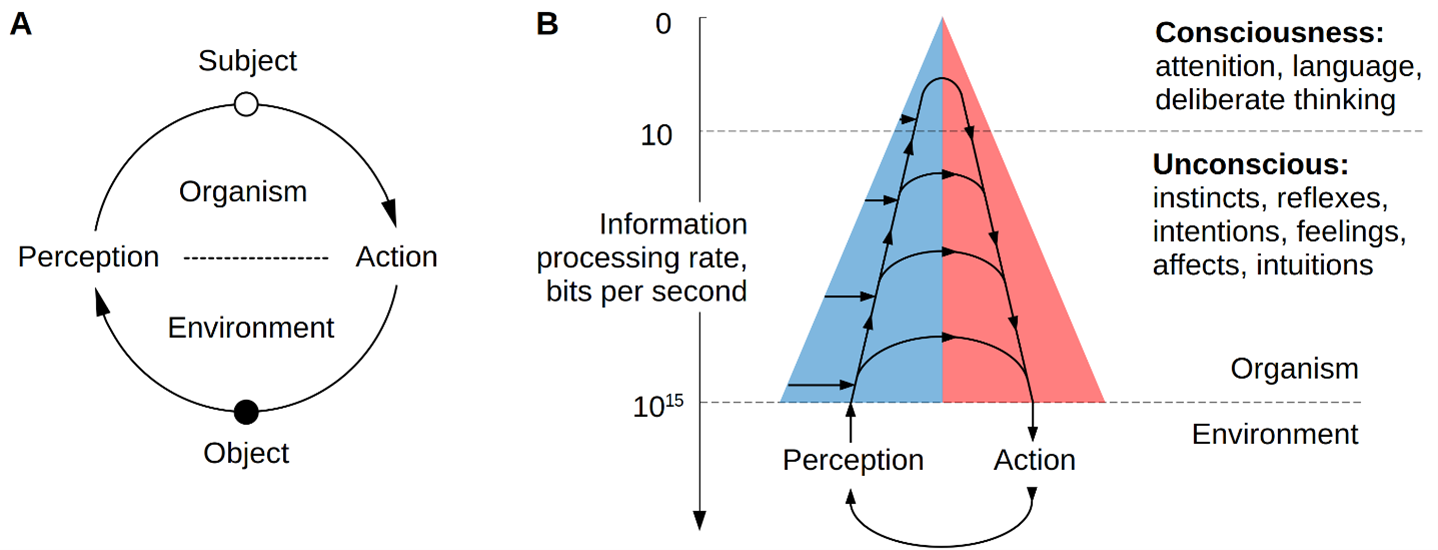
Figure 1. A: the functional cycle of the organism’s interaction with an environment. Arrows show the direction of the information flow. B: hierarchical organization of the mind as nested functional cycles shown in panel A. The width of the pyramid indicates the information capacity of cognitive levels, growing from the top to the bottom. Horizontal arrows on the left indicate information inputs due to endogenous mental activity.
2.2. Information capacity
The scheme in Figure 1A usually refers to the organism as a whole, when perceptions and actions are readily observable information blocks. Most of the organismic activity, however, proceeds automatically without our attention. Such processes underlie the unconscious (subliminal) perception of information and its automatic processing, including self-regulation of cells and organs of the body, respiratory, hormonal, digestive, immune and other activities.
In terms of information load, these automatic processes hugely exceed the capabilities of our consciousness (for now using this term in standard poorly defined sense) of 7±2 attention points (Miller, 1956), changing their states (present / not present) no more than 25 times per second. The resulting bandwidth of conscious cognition, given by the product of these values, is limited by 200 bits of information per second (bps). The mean operation speed is significantly lower than this limit and amounts to ~10 bps (Zimmermann, 1989).
For comparison, the total inflow of information through sight, hearing, smell and touch is estimated at ~108 bps (ibid.). Sensory organs, however, are not the only sources of mental information; according to the definition of Quastler (Chernavsky, 2021), the information is also generated by every remembered choice in the body. Such choices take place, for example, in every excitation of each neural cell. The rate of such “endogenous activity” in the human cortex alone is estimated at 96 terabytes per second, that is, about 1015 bps (Georgiev, 2021). The difference of these values with ~10 bps of our conscious attention illustrates the very limited role of consciousness in our cognition and mind (Nørretranders, 1999).
2.3. Hierarchical structure
The natural way of information processing in these conditions is multi-level hierarchical structure (Ravasz & Barabási, 2003). Between the front-end of our nervous system at sense organs and its back-end near the hippocampus, for example, there are at least 14 distinct processing stages (Felleman & Van Essen, 1991). Like other natural designs, this structure is shaped by survival in a competitive environment. Compared to the architectures of one central processor, hierarchies are more robust to damage and corruption, more flexible and faster due to the use of multiple local cores in parallel. Compared to the flat all-to-all networks, on the other hand, hierarchies reduce communication time and energy costs, provide higher integrity and efficiency in collective decision (Meunier, 2009). In this ladder of levels cognitive information is repeatedly processed, transferred, and recoded to the “language” of the next level (Chernigovskaya, 2007; Akopov, 2021) as shown in Figure 1B.
Neural substrates of these cognitive levels may differ (as in the layers of cortical columns) and may also be the same. In the latter case, a single neuron takes part in multiple ensembles, functioning within different codes or “languages of the brain” (Pribram, 1971; Rolls & Treves, 2011; Sakharov et al., 2024) – in the same way as a single person may be simultaneously involved in one’s own survival, family activities, professional projects, and public affairs. Each of these organization levels functions by a specific system of regularities and norms (laws of individual homeostasis, norms of intimate relations, codes of professional ethics, state laws, etc.), encoding information of the corresponding activities.
Unconscious processes in the bottom of Figure 1B also follow the functional scheme of panel A. A cell, bacterium, or an organ of the body takes place of the organism, interacting with the rest of the world by the same functional principle. The hierarchy of such “behavioral system-quants” (Vagin & Sudakov, 2008) – that is, functional systems at various levels of biological organization (Anokhin, 1998; Sudakov and Umryukhin, 2010) – realizes behavioral control for arbitrarily complex organism. Since functional cycle is a universal causal template for the processes in nature (Surov, 2022a), this cognitive hierarchy automatically implements the principle of predictive coding (Williams, 2020; Millidge, 2021) suitably for mathematical formalization (Skotnikova, 2021a; Surov, 2023b).
2.4. Gross levels
Each of the 14 aforementioned levels of information processing serves a distinct cognitive function. Most psychological studies, however, settle with fewer and larger divisions. In the coarsest case, there are only two such departments of the psyche – consciousness and unconscious (Jung, 1968), rediscovered later as fast and slow thinking (Kahneman, 2011). In such “dual-process” models the upper, slow and conscious cognition provides us with symbolic intelligence, abstract logic and rational thinking, while the bottom, fast and unconscious cognition operates on the intuitions, intentions, instincts and reflexes, feelings, affects and emotions. Thus, consciousness refers to intentional psychic activity, while the unconscious includes the rest of the mind which is beyond our control.
Unconscious defined in this way unfortunately mixes very different cognitive functions. The latest research shows that affects and emotions play a central role in subjective experience, self- awareness and phenomenal consciousness (Panksepp, 2005; Alcaro et al., 2017), contrasting them with the stimulus- response mechanics of autonomous cognition, instincts and reflexes[1].
This suggests separating affect and emotion to a dedicated layer of the mind. The result is a three-level structure, aligning with that of the mammalian brain (MacLean, 1977, 1990). Namely, automatisms are carried by the spinal cord and the most ancient “reptilian” brain; affects and emotions are managed by the limbic system (Morgane et al., 2005; Torsunova & Afanasyeva, 2023), while language and symbolic thinking are maintained by the neocortex.
These three levels are alternatively identified as linguistic, conceptual, and sub-conceptual levels of inductive inference (Gärdenfors, 1995). In informational terms, the sub-conceptual level of mind processes information starting from the lowest level of raw sensory perceptions – similarly to what a robot vacuum cleaner does with stimuli from its detectors. This involves many unconscious stages, each encoding information in its own way. Using robotic terminology, such formats (without their specification) and information they carry may be denoted as signal.
Output of unconscious pre-processing goes to the conceptual level, where the information is structured into natural categories which are useful for planning, reasoning and other cognitive tasks. These categories or concepts are organized in conceptual spaces based on a number of quality dimensions (Gärdenfors, 2000). This representation endows information with subjective meaning or qualia, considered to be the primary content of consciousness (Tye, 2021). Finally, linguistic level encodes information in terms of symbols and propositions. Rationality, abstraction, mathematics, logic, “cold” analytical thinking, commonly labelled as intelligence, refer to the information processing in these high-level codes.
Coordinated working of these levels in our minds can be seen at numerous everyday cases, including the following.
Consider the process of writing a letter. This is a direct example of top-level linguistic activity, requiring logical and purposeful arrangement of emotion and thought, encoded in an abstract symbolic system. To make this possible, one’s autonomous nervous system maintains self-regulation of the body, respiration, maybe walking or driving routines. At the same unconscious level, the alimentary, circulatory and immune systems may be busy with digestion, detox, and suppression of infections simultaneously.
3. Three levels at work
Consider the process of writing a letter. This is an example of top-level linguistic activity, requiring logical and purposeful arrangement of emotion and thought, encoded in an abstract symbolic system. To make this possible, one’s autonomous nervous system maintains self-regulation of the body, respiration, maybe walking or driving routines. At the same unconscious level, the alimentary, circulatory and immune systems may be busy with digestion, detox, and suppression of infections simultaneously.
3.1. Algorithmic imitation
This performance can be seen as quite algorithmic. Homeostasis of the body, understood as regulation of a complex thermostat, does not seem to need much creativity. Standard writing follows usual norms of composition, arranging sentences and paragraphs in usual narrative structure. Along with particular phrases and words, these structures are selected from a finite-length dictionary according to the likelihood of their appearance in the available corpus of documents. Modern chatbots, close to passing Turing’s test, are developed along this line of thought.
3.2. Real writing
Real human writing is very different. We may sit at the table with no clear idea of what must be said (as admitted in retrospect by creators of the most fabulous prose, music, and poetry). The road then appears right under our feet, changing our minds along the way. This creative process is fundamentally different from algorithmic synthesis of “new” texts from training corpus and user’s request (Chernigovskaya, 2007).
Due to the limited speed of our conscious thinking (See 2.2), there is no chance for rational selection of phrases and words, minimizing any sort of error function. The composition is entrusted to much faster domains of cognition, so that the process (of both written and spoken language) is largely unconscious. The unconscious somehow comes up with particular phrases and words, possibly approved or discarded by consciousness.
For the choice of approval or rejection, consciousness may ask for a sanity-check by the means of intelligence. The idea of making a letter, for example, may interfere with other plans or norms of ethics, unknown or ignored by the unconscious. Similar checks may interrupt and correct the stream of unconscious content in speech or writing. Upon receiving an approval, the unconscious goes ahead by implementing the decision by the corresponding automatic routines. Notwithstanding the creativity of the process, the algorithms thus are still necessary; all masterpieces of A. S. Pushkin, for example, appeared only after he learned the language and calligraphy.
3.3. Affect and emotion
In the midst of our writing the unconscious may suggest, for example, some thoughts about our leisure two months ago. If we try to keep focus, the sanity check by all likelihood fails. To satisfy an unconscious urge, with some effort, we have freed this time from other duties; and now it goes some other way, sabotaging the job!
The situation colors in red shades of irritation. This quality is our direct experience, estimating the unconscious suggestion. For animals this estimation is largely fixed, while Homo sapiens is able to change it by means of intelligence.
The ways of the unconscious are, by definition, almost inscrutable, but it is certainly neither our enemy nor a senseless provoker – otherwise we would not be breathing, to start with. This puzzle can be solved upon closer inspection. The remembered event, for example, could ask for continuation foreseen by the unconscious; alternatively, the message may warn us of an infection-endangered health, suggesting a change in our plans. The potential meanings, composing events to sensible narratives, are uncountable (Colman, 2011); the remembered ski ride could also be a metaphor just for the next sentence of the letter in front of us. These and other alternative meanings would change the experience from irritation to joy, fear, and any other point of emotional spectrum, affecting further writing.
Approval or rejection of unconscious writing suggestions is analogous to testing of perceptual and cognitive hypotheses, considered as the primary function of consciousness (Allakhverdov, 2000). In the developed perspective, this decision-making capacity is indeed central to the mind as natural system of behavioral guiding as detailed in the next section.
4. Consciousness
Emotions are central to the verbal and non-verbal communication (Clynes, 1980), making of decisions, preferences and judgments (Lerner et al., 2015), self- awareness and consciousness (Alcaro et al., 2017). On the other hand, the basic affective-emotional states are simply sets of psychophysiological algorithms, hardwired into the autonomic nervous system similar to other stimulus-response scripts (Ekman, 1992; Lazarus & Lazarus, 1994). What is their difference from innate instincts and Pavlovian reflexes?
The answer is that these algorithmic complexes regulate behavior in a soft way without strict predetermination. As per classic definition[1], emotions define just our general attitude, a disposition of the organism for the available lines of action (Alcaro et al., 2017; Surov, 2023c). Who, then, is in charge of the final decision?
[1] Emotions (from French émotion, Latin emoveo – to shake, to excite) – subjective reactions of humans and animals to the internal and external stimuli, manifested in the form of pleasure or displeasure, joy, fear, etc. Accompanying almost any manifestation of the body’s vital activity, Emotions reflect the significance (meaning) of phenomena and situations in the form of direct experience and serve as one of the main mechanisms of internal regulation of mental activity and behavior aimed at satisfying current needs (Leontiev & Sudakov, 1978)
4.1. Subjectness and “I”
The one who experiences the emotion.
Uncertainty of emotional states allows an organism to go beyond its algorithmic toolbox and determine one’s next action in a free voluntary way. As in the writing example, such freedom consists in the real possibility of approval or rejection of unconscious proposals (Libet, 1985; Haynes, 2011).
This kind of uncertainty is fundamentally different from an unknown result of not yet performed algorithm. The latter (epistemological) uncertainty results from our lack of computational power, lack of knowledge about initial data or the algorithm itself: your computer’s operating system, the number of words in this paper, or the outcome of yesterday’s football match. Behavioral uncertainty of the organism in an emotionally-affective state, in contrast, cannot be resolved by means of any existing information and computational power. This irreducible (ontological) uncertainty, known in physics as quantum uncertainty, provides space for the freedom of choice and will (Surov, 2023).
The existence of subjective first-person experience and the ability for free (non- algorithmic) decisions thus are different sides of a fundamental quality of the living nature. This quality, subjectness, differs subjects from objects, the performance of which is fully predetermined by the laws of nature (von Uexküll, 1992; Surov & Melnikova, 2024).
Thus, it is decision-making subject who feels and experiences the world in the first-person view (LeDoux & Hofmann, 2018; Salvatore et al., 2022). A quasi-stable pattern of these qualitative experiences and the psychophysiological algorithms associated with them is personality of this subject. On the background of a volatile environment, this stable pattern, constantly renewing its material substrate in the tissues of the body, identifies itself as “I”. The affective-emotional experience of this “I” constitutes the individual consciousness (Panksepp, 2005; LeDoux & Brown, 2017; Alcaro et al., 2017).
4.2. Qualia
The structure of affective experience was studied in 1940-1970 by Charles Egerton Osgood – American psychologist who invented a method for quantitative measurement of affective meaning known as semantic differential (Osgood, 1969). This method called revealed that such meaning boils down to three fundamental factors: evaluation (good-bad), potency (weak-strong), and activity (fast-slow), which are universal across Western and Eastern languages and cultures [1]. Each of these semantic factors is quantified by a real number, so that the triple of such numbers quantifies individual affective experience of any object, sign, person, event, situation or, more generally, any block of the perceived information (Petrenko, 2010).
Cross-cultural generality of these dimensions indicates their pre-linguistic nature, belonging to the sub-symbolic, “conceptual” layer of the mind identified by Gärdenfors (Section 2.4). This layer is also that of affective-emotional experiences, which are states of our (qualitative, phenomenal) consciousness as shown in the previous subsection. Thus, Osgood’s semantic dimensions are also dimensions of our affective consciousness – the fundamental qualia of human and other minds in nature.
Just like three dimensions of our ordinary space, Osgood’s semantic dimensions define the way of encoding of the corresponding information by a triple of numbers. Formally, then, qualia are just the kind of information encoding at conscious level of the mind.
This triple of qualia dimensions is remarkably rooted in the approval-rejection decisions – the duty of conscious control, motivating the very existence of qualitative first-person experience. As noted in Section 4.1, uncertainty of such decisions is of irreducible kind, which is accounted not by classical Kolmogorovian, but by quantum probability calculus. According to this theory, states of such uncertainty are visualized as points on a sphere, poles of which are the approval and rejection alternatives. As shown earlier (Surov, 2022a, 2023a), three axes of this sphere are equivalent to Osgood’s semantic dimensions.
This fundamental physical origin defines the function of qualia, which has no parallel among other encodings of information in nature. Namely, the vertical diameter of the sphere connecting the poles (approval-rejection, good-bad) quantifies evaluation of the unconscious proposal, while the equatorial circumference stands for the perception-action cycle in Figure 1A, in which vertical and horizontal axes are potency and activity (ibid.).
The quantum-theoretic sphere thus visualizes the “space of consciousness”, demarcated by main emotional states as shown in Figure 2. This sphere refines the Uexküll’s concept of an individual world of subjective experience, the Umwelt, from the qualitative scheme of Figure 1A to three quantitative dimensions, measurable by Osgood’s semantic differential (Surov, 2022a).
[1] The view of emotions as positive or negative feedback for the ongoing organism’s activity (Anokhin, 1979; Simonov, 1981; Peil, 2014) is limited to the first of these dimensions. The other two, activity and potency, are the axes of the perception-action plane in Figure 1A.
As expected for qualia, this sphere is isomorphic to the bi-cone and cubic color solids with one-to-one mapping between colors and affects (Surov, 2022b, 2023a). Emoticons and colors thus provide alternative encodings of the qualia space, widely used nowadays.
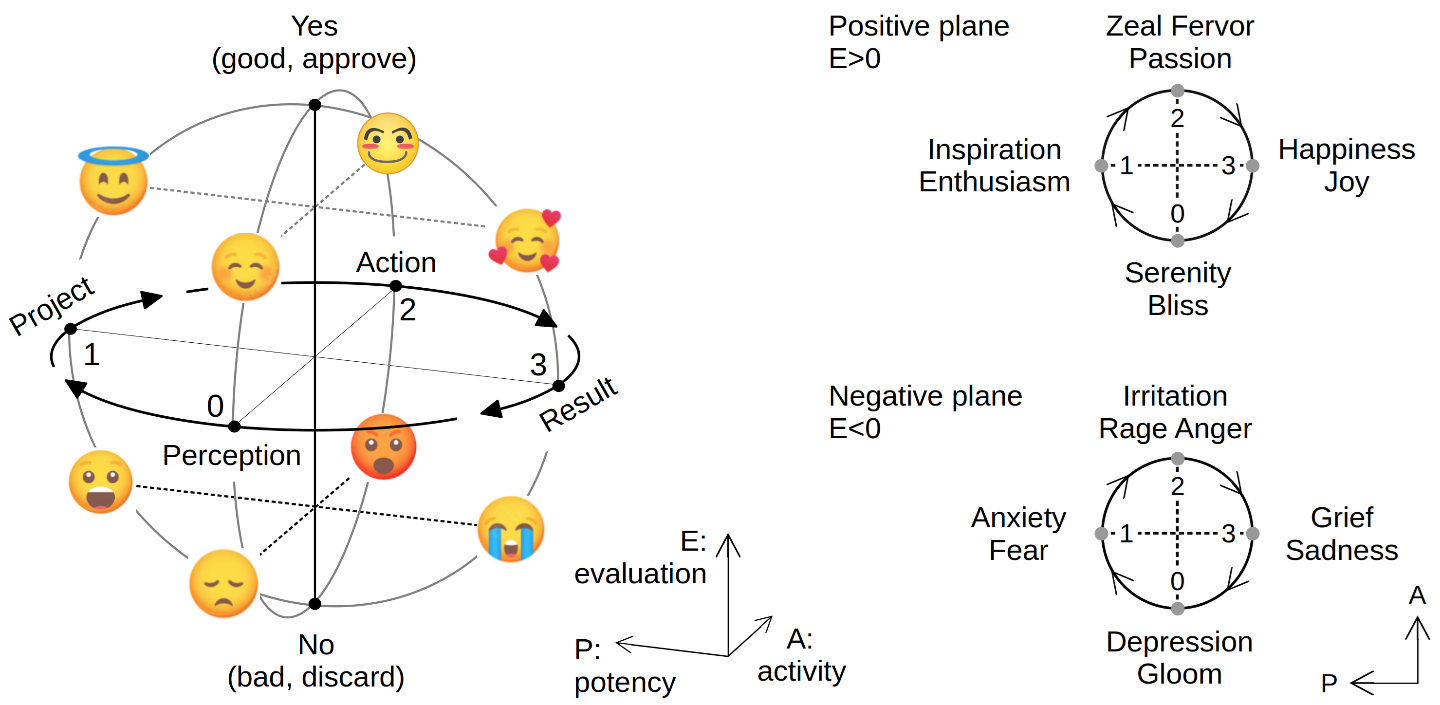
Figure 2. Left: affective-emotional states of consciousness (qualia) in space of Osgood’s semantic factors (Surov, 2022a, 2022b). Vertical evaluation axis is orthogonal to the equatorial potency-activity plane, situating the perception-action cycle in Figure 1A. Right: English names of emoticons in the upper and lower hemispheres on the left, ordered by the functional cycle at the equator.
4.3. Practical role
Affective-emotional states do not nullify the underlying instincts and reflexes; in mammals, they continue to work quite insistently, and stopping them might be as difficult as it is to ignore a tickling or to hold a hand in boiling water. Instead, conscious layer of cognition takes over some of the psychic information flows from the instincts and reflexes, reducing their role in behavioral control. The corresponding cognitive-behavioral patterns lose their predetermination and become susceptible to conscious “veto” (Libet, 1985).
As noted in Section 4.1, the right for such veto opens the choice between two possible futures: one in which the unconscious proposal is actualized and another in which it is not. This uncertainty thus underlies not just “possibilistic” thinking as an optional cognitive tool (Znakov, 2023); the ontological uncertainty of the future lies at the very core of our psychological nature. Our subjective experience, consciousness, personhood and affective sense-making are brought to existence by this fundamental task, differing alive from inert matter (Surov, 2024).
By sharing major parts of the limbic system, these qualities of Homo sapiens are close to that of other mammals (Panksepp, 2005; LeDoux & Brown, 2017; Alcaro et al., 2017). Our affective-emotional experience and social ties are similar to these of dogs, rodents, ungulates, and many other species, enabling our interspecific communication through universal affective patterns (Clynes, 1980). Some species, like dolphins, are even close to our linguistic practice; we seem to differ from them in the ability to not only use, but also to create symbolic systems for abstract intelligence, communication, and collective action. The next section focuses on this ability and its coordination with the rest of the mind.
5. Intelligence
The competitive advantage of symbolic thinking does not raise any doubts. From ancient Greeks to the present, linguistic skills, rationality, abstract logic and analytical thinking are praised as the highest achievement of human development. This level of cognition, maintained by neocortex and referred to as intelligence, is indeed the highest among the levels shown in Figure 1B. The greatness and power of intelligence prompt us to attribute to it all that is best in our psyche, including creativity, consciousness, subjectivity, and free will. With such a supreme advantage over the rest of nature, the human species then appears as the master of another, inert and instinctive world.
However, as we have seen in Section 4, subjectness, consciousness, and freedom, do not require symbolic thinking, so that such pleasant view turns out to be wrong. This conclusion agrees with our linguistic practice, normally ascribing consciousness to infants, intoxicated or shocked people without abstract thinking or speaking capacity. Accordingly, decision-making is found in mammals, birds, reptiles, fish, insects (Skotnikova, 2021) and even plants (Gruntman, 2017), most of which are considered as conscious (Low, 2012).
These findings, however, do not rule out the possibility of subjectness, creativity and consciousness of specifically human kind, operating at symbolic level of cognition. The next subsection summarizes three pieces of relevant evidence. Their value is due to the origin from real-life practice, prone to prejudice less than abstract academic thought.
5.1. Jung, Stanislavsky, and AI
One look at the issue is due to Carl Gustav Jung’s, in whose theory psychic activity emerges not in rational thought, but in depths of the unconscious psyche. Far from Sigmund Freud’s dump of traumatic imprints and suppressed animal desires, Jung’s unconscious is active as a sentient creative foundation that connects us with humanity, nature and the cosmos (Jung, 1968; Rudnev, 2010). As confirmed later by (Libet, 1985; Haynes, 2011), our consciousness does not take part in the creation of thoughts and ideas, but only serves as a gate-keeper for the unconscious initiatives (See 3 & 4.1).
Parallel to Jung, this view was supported by Konstantin Sergeevich Stanislavsky, the author of the world’s best artistic school. His main thesis assures hopelessness of action on stage from analytic conscious effort, which only can produce an implausible mechanical parody (Stanislavsky, 2013). According to Stanislavsky, the “real life of the human spirit” can only emanate from an unconscious core of our nature, possibly lured out to cooperate in consciously intended action.
Nowadays, similar evidence builds up in the field of artificial intelligence (AI). Metaphorically, such systems can be said to make decisions, feel, learn, and understand; at bottom, however, this is pure algorithmic operation with no free will, subjectness, genuine creativity and meaning (Dubrovsky, 2021; Roli et al., 2022; Surov & Melnikova, 2024). However perfect replica of human emotions or language would always be dead imitation, fundamentally different from the original, condemned by Stanislavsky.
Despite this conclusion, AI can reasonably approximate our intelligence as logical part of the mind. Unlike natural minds, in which the neocortex never functions without the emotional and unconscious foundation, AI shows us the case pure intelligence – a completely dispassionate mind, praised e.g. by Buddhist philosophy. The aforementioned absence of subjectness and “myself” (fused with the environment) and the associated “egoistic” interests, goals, and desires resonates with the ideals of Eastern cultures.
5.2. Synergy with consciousness
The above evidence suggests defining the intelligence as a part of cognition, encoding and processing information in high-level symbolic formats. Full power of the natural intelligence, contrasting it with AI (Chernigovskaya, 2007; Roli et al., 2022), however, reveals only in accord with non-algorithmic consciousness, supplying goals and meanings to its logical mechanics. Intelligence, in turn, provides consciousness with a flexible algorithmic toolbox, unavailable to most other mammals whose minds are almost purely affective.
Flexibility of intelligence is due to the unique plasticity of its substrate, the neocortex. This part of the brain provides our consciousness with an exceptionally fertile ground, analogous to the black soil, the best for vegetation. The rigid structure of unconscious stimulus-response scripts, in contrast, is similar to a mountain rock or permafrost with miniscule possibilities for life. The black soil, notably, was synthesized through thousands of years from inorganic substance by plant life itself. Analogously, the neocortex could be the product of the creatively-affective activity of more ancient forms of mind (Chernigovskaya, 2014).
5.3. Interaction with unconscious
Besides the conscious decision-making capacity, natural intelligence needs the source of creativity lacking both in intelligence and consciousness. As found by Jung and Stanislavsky (See 5.1), such source locates in the unconscious, the largest floor of the psychic hierarchy (see Figure 1B). How are its products delivered to the intelligence?
As noted earlier (See 2.3), neural substrate of the unconscious may or may not coincide with that of consciousness and intelligence, so that spatially these levels might overlap. The main communication difficulty is that of translation between the respective formats of information encoding: the unconscious signal emerges at the molecular scale of individual synaptic gaps (Georgiev, 2021), while words and symbols are encoded by large and sparse neuronal ensembles. This translation can go in several scenarios.
First, the unconscious signal may ascend from the molecular scale to some cognitive level and, after processing, descend back for implementation by muscular cells, bypassing the format of qualia. Accordingly, no affective experience, consciousness, decision and sense-making is involved.
Completely automatic processing of this type resembles the working of applied or robotically embodied AI, where the unconscious levels stand for the sensory and motor facilities, while “intelligence” is implemented by multi-layered, “deep” neural networks; the principal difference, however, is the absence of endogenous quantum-scale activity, ruling out the creative function of the natural unconscious (Section 5.1). Depending on whether this “intelligence” involves high-level symbolic formats (like chatbots) or not, the algorithmic arc either reaches the top of the cognitive ladder in Figure 1B or not. In Figure 3, these kinds of algorithmic tracks are indicated by numbers 1 and 4.
In the second scenario, the ascending unconscious signal at some stage translates to the format of qualia. This is the instance of self-awareness and conscious first-person experience of a subject, invoked into action. This qualitative experience colors some phrase, word, image, or raw sensation like pleasure and pain – dependent on whether the unconscious signal has previously ascended to symbolic form or not. These two ways are shown by tracks 2 and 3.
Given the bandwidth of natural unconscious (Section 2.2), the mapping of its signals to the qualia sphere is very compressive. This sphere functions similarly to a computer screen, showing only a miniscule part of (unconscious) system information which requires our attention, logical analysis and decision making, while omitting everything else. On the one hand, this results in huge semantic ambiguity, exemplified in Section 3.3; at the same time, this ambiguity largely decouples us from the grip of the unconscious, allowing the freedom of conscious conduct.
Recall that such freedom consists in approval or rejection of proposals, encoded by unconscious signal and colored in qualitative experience (Section 4.1). In Figure 3 these alternatives are shown in dash. The rejection stops this program, while the approval sends it to implementation through the underlying motor codes. Depending on the available resources and algorithmic toolbox, rejection may also send the inquiry to the symbolic level, starting the investigation of the inappropriate proposal.
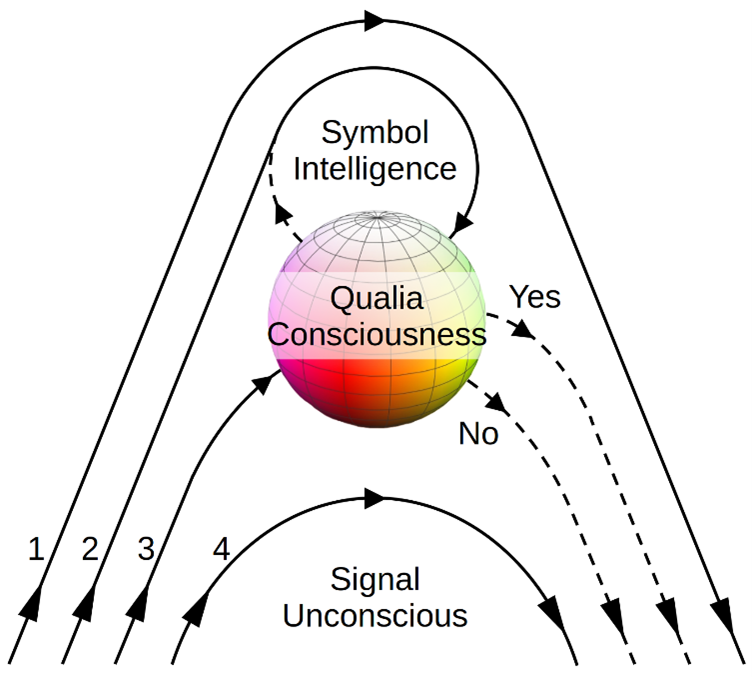
Figure 3. Information flows in three levels of natural mind, combining schemes in Figures 1 and 2. Unconscious signals (bottom) and symbolic intelligence (top) work either autonomously (lines 1 and 4), or through the conscious interface of affective experience (middle), encoding information in the form of qualia (Figure 2). Dashed lines indicate the approval and rejection of unconscious proposals at the level of consciousness. Color mapping of the qualia sphere follows (Surov, 2022b)
This latter track shown by the top dashed line is typical for minds with strong analytic intelligence. The emerging cycle in the top part of Figure 3 then allows for iterative revision and rewriting of one’s algorithms both at symbolic and unconscious levels. In this regime, consciousness becomes a two-way interface between one’s unconscious and intelligence. In line with (Akopov, 2011), the mind or cognition as a whole then constitutes a meaningful dialogue between unconscious drives and symbolic intelligence through the gateway of affective consciousness. The analogy is then not a passive display, but an active touchscreen, which with some skills and knowledge allows one to do a lot with just one finger; some methods for sending intelligent commands and reading unconscious answers are proposed by Stanislavsky and Jung.
6. Correspondence
Coordinated international research benefits from proper translation of terms between different languages and conceptual systems, often highlighting some otherwise overlooked sides of the phenomena. In this respect, the Russian language is of high interest.
6.1. Russian terms
Two important insights come from the concepts of consciousness and the first- person emotional experience, most closely translated to Russian as “soznanie” (сознание) and “chuvstvo” (чувство). In contrast to English, the two are tightly bound through idiomatic expressions of coming to, and losing this “chuvstvo” (прийти в чувство, лишиться чувств), which mean coming to and losing one’s consciousness. Analogous expressions in English replace “chuvstvo” with “sense”, referring more to sensation, reason and meaning (common sense). The English concept of consciousness is thus more intellectual and rational (Alexandrov & Sams, 2005), while its Russian counterpart is more emotionally-affective. This latter view is closer to the fundamental nature of the phenomenon, unlikely to vary across the speakers of different languages as found in works of Osgood (Section 4).
Symbolic thinking or intelligence (See 5) corresponds to Russian “rassudok” (рассудок), “um” (ум) or “razum” (разум), the distinction between which awaits scientific exploration. This correspondence is shown in Table 1.
Table 1. Correspondence between the three levels of the mind, physiological carriers and encodings of information according to the present model, overlapped with the notions of computer metaphor and the terms of Freud’s and Plato’s systems.
| Psychic level | Encoding of information | Main substrate | Plato Freud | Computer metaphor | ||
| English | Russian | English | Russian | |||
|
Mind Intelligence |
Ум/разум Рассудок | Symbol Number | Символ Число | Neocortex | Logos Over-I | Artificial intelligence |
| Conscious- ness | Сознание | Qualia, Affect Emotion | Эмоция Чувство | Limbic system | Spirit I (ego) | — |
| Unconscious | Подсозна ние | Instinct, Reflex* Sensation |
Рефлекс* Ощущение |
Old brain* Body | Eros It (id) |
Fixed program* |
Another insight comes from the structure of the word “soznanie”. The root “znanie” means knowledge, while the prefix “so-” refers to the collective nature of the phenomenon as seen for example for words “soglasie” (agreement), “sovet” (council), “sotrudnik” (employee), “soobrazhenie” (consideration) and many others. “Soznanie” then literally translates as “common knowledge” or “common sense”. This feature highlights the relational nature of the phenomenon, the major function of which is maintaining affective interpersonal ties, necessary for collective action (See 4.3). Without this connotation, the English concept of consciousness, in contrast, refers more to the prudence of a separate being – in line with the rationally- individualistic disposition of the West.
6.2. Freud and Plato
The obtained three-level structure finds correspondence with the Plato’s model of the psyche. “Thymos” of this model, considered as the locus of emotion and inspiration, corresponds to consciousness, while Logos (intelligence, reason) and Eros (desire, affection) stand for mind and unconscious (Calian, 2012). In line with the above arguments, the creative chaos of Eros is ordered by the law of Logos; the present approach contributes to this scheme by revealing the key role of “Thymos”, not accounted before (Kauffman, 2020). Analogous alignment is found with the S. Freud’s structure of the mind, as indicated in the penultimate column of Table 1.
The creativity of unconscious-Eros is clearly opposite to the rigidity of unconscious instincts and reflexes. Although they share the same row in Table 1, there is no contradiction here. The unconscious psyche (hosted, of course, not only in the brain but in the whole body and its field structures) combines both algorithmic and non- algorithmic creative aspects. The “fixed program” analogy in the last column of Table 1 captures the former star-marked one, while “creative chaos” of Plato’s and Jung’s models highlights the latter.
6.3. The concepts of information code
The developed model largely agrees with D.I. Dubrovsky’s theory of subjective experience as a special kind of information, directly used by organisms for behavioral control (Dubrovsky, 2007; Dubrovsky, 2018). The present model additionally specifies that such control consists in approval or rejection of unconscious initiatives, allowing for mathematical formalization of “subjective reality” or qualia space (Figure 2).
The “paradigmatic shift” involved in this understanding, however, is far less radical than required by Dubrovsky’s approach (Dubrovsky, 2007). It consists in recognition of irreducible, ontological uncertainty of the future, providing space for voluntary, non-algorithmic decisions (which is also implied by the argument of Dubrovsky, since absence of such uncertainty would leave no possibility for behavioral control, turning this concept to the criticized epiphenomenal status). In contrast to Dubrovsky’s approach, this requires not leaving the physical foundation altogether, but extension of this foundation from classical physics to the (properly understood) quantum one Surov, 2024), cf. (Petrenko & Suprun, 2016).
The achieved progress is allowed by a refined concept of information code, identified by Dubrovsky with its material carrier. This refinement (see beginning of Section 2) is central to the present approach; every encoding of information has its own functional role in the psyche, and qualia in this respect are not an exception.
In contrast, the concept “information about information”, used by (Dubrovsky, 2007; Dubrovsky, 2018) to arrive at this functional-code view of qualia, has two drawbacks. First, amendment of our worldview with another kind of information “in its pure form” (ibid.) is of huge conceptual cost; a step to the social level then would involve “information about information about information”, which is a theoretical road to nowhere. Second, since “information about information” only belongs to the domain of “subjective reality beyond physics”, this concept excludes human (now with some animals) from the rest of the world – thus rephrasing the Cartesian dualism in new terms, again stepping on the same rake (Kauffman & Gare, 2015).
Conclusions
7. Outlook:
The obtained view of the mind aligns with two major trends of humanitarian thought.
The first one is the affective turn of cognitive sciences, aiming to push back the limits of behavioral and computational paradigms in capturing holistic human nature (Falikman, 2014; de Gelder, 2017; Cornejo et al., 2018; Dukes et al., 2021). The proposed theory enriches this trend, coordinating it with the semiotic and functional-cybernetic approaches. As shown above, the affectively-semantic nature of consciousness and its role in the cognitive hierarchy approve the centrality of affect and emotion in our subjective experience, voluntary behavior, decision- and meaning-making processes.
Shifting the concept of consciousness from symbolic to sub-symbolic level of the mind provides theoretical ground for its recognition in species other than humans (Low, 2012; The New York Declaration on Animal Consciousness, 2024). This trend points to a shift from the exclusion to the inclusion of Homo sapiens in the rest of nature. Although offending our species-scale narcissism, this shift in perception may be the key to the hard problems of cognitive science.
References
- Akopov, G. V. (2011). Consciousness as a Central Problem of Modern Psychology. Psychology in Russia: State of Art, 5(1), 15. https://doi.org/10.11621/pir.2011.0001
- Akopov, G. V. (2021). Non-verbal languages of consciousness: Statement of the problem and its solution. Proceedings of the Institute of Psychology of the Russian Academy of Sciences, 1(1), 23–29.
- Alcaro, , Carta, S., & Panksepp, J. (2017). The Affective Core of the Self: A Neuro- Archetypical Perspective on the Foundations of Human (and Animal) Subjectivity. Frontiers in Psychology, 8. https://doi.org/10.3389/fpsyg.2017.01424
- Alexandrov, Y. I., & Sams, M. E. (2005). Emotion and consciousness: Ends of a Cognitive Brain Research, 25(2), 387–405. https://doi.org/10.1016/j.cogbrainres.2005.08.006
- Anokhin, P. K. (1979). Selected writings: System mechanisms of highest nervous activity. Nauka Publishing House [Anokhin, P. K. (1979). Izbrannyye trudy: Sistemnyye mekhanizmy vysshey nervnoy deyatel’nosti. Nauka].
- Anokhin, P. K. (1998). Selected writings: Cybernetics of functional systems (K. V. Sudakov, Ed.). Medicina Publishing House [Anokhin, P. K. (1998). Izbrannyye trudy: Kibernetika funktsional’nykh sistem (pod K. V. Sudakova). Meditsina].
- Calian, F. G. (2012). Plato’s psychology of action and the origin of agency. In P. Šajda (Ed.), Affectivity, Agency and Intersubjectivity (pp. 9– 22). L’Harmattan.
- Chernavsky, D. S. (2021). Synergetics and information. Dynamical theory of information. Nauka Publishing House [Chernavskiy, D. S. (2021). Sinergetika i informatsiya. Dinamicheskaya teoriya informatsii. Nauka].
- Chernigovskaya, T. V. (2007). Language, brain and computer Chelovek, 2, 63–75 [Chernigovskaya, T. V. Yazyk, mozg i komp’yuternaya metafora. Chelovek, 2007, 2, 63–75].
- Chernigovskaya, V. (2014). “Prior to any learning acquired their traits…” Human Brain Results from Language. Logos, 97(1), 80–96 [Chernigovskaya, T. V. «Do opyta priobreli cherty”. Mozg cheloveka i porodivshiy yego yazyk. Logos, 2014, 97(1), 80–96].
- Clynes, M. (1980). The Communication of Emotion: Theory of In R. Plutchik & H. Kellerman (Eds.), Theories of Emotion (pp. 271– 301). Academic Press. https://doi.org/10.1016/b978-0-12-558701- 3.50017-x
- Colman, W. (2011). Synchronicity and the meaning‐making psyche. Journal of Analytical Psychology, 56(4), 471–491. https://doi.org/10.1111/j.1468-5922.2011.01924.x
- Cornejo, C., Marsico, G., & Valsiner, J. (2018). Conclusions: Affectivation as a return to vitality. In C. Cornejo & J. Valsiner (Eds.), I Activate You to Affect Me. Information Age
- de Gelder, B. (2017). Going Native. Emotion Science in the Twenty-First Century. Frontiers in Psychology, 8. https://doi.org/10.3389/fpsyg.2017.01212
- Dubrovsky, D. I. (1980). Information, consciousness, brain. Moscow: Higher school Publishing house [Dubrovskiy, D. I. Informatsiya, soznaniye, mozg. M.: Izdatel’stvo “Vysshaya shkola”, 1980].
- Dubrovsky, D. I. (2007). Why is subjective reality needed or “Why do not information processes go in the darkness?” (answer to D. Chalmers). Voprosy Filosofii, 3, 90–104. [Dubrovskiy, D. I. (2007). Zachem sub’ektivnaja realnost’, ili «Pochemu informacionnye process ne idut v temnote?» (otvet D. Chalmersu). Voprosy Filosofii, 3, 90–104].
- Dubrovsky, D. I. (2018). The “Mind-Brain Problem”: Theoretical Resolution of the Major Issues. The Humanities and Social Studies in the Far East, 15(2), 14–29. https://doi.org/10.31079/1992-2868-2018-15-2-14-29
- Dubrovsky, I. (2021). The Task of the Creation of Artificial General Intelligence and the Problem of Consciousness. Russian Journal of Philosophical Sciences, 64(1), 13–44. https://doi.org/10.30727/0235-1188-2021-64-1- 13-44
- Dukes,, Abrams, K., Adolphs, R., Ahmed, M. E., Beatty, A., Berridge, K. C., Broomhall, S., Brosch, T., Campos, J. J., Clay, Z., Clément, F., Cunningham, W. A., Damasio, A., Damasio, H., D’Arms, J., Davidson, J. W., de Gelder, B., Deonna, J., de Sousa, R., … Sander, D. (2021). The rise of affectivism. Nature Human Behavior, 5(7), 816–820. https://doi.org/10.1038/s41562-021-01130-8
- Ekman, (1992). An argument for basic emotions. Cognition and Emotion, 6(3–4), 169–200. https://doi.org/10.1080/02699939208411068
- Falikman, M. V. (2014). Cognitive science: Its foundations and Logos, 97(1), 1–18.
- Felleman, D. J., & Van Essen, D. C. (1991). Distributed hierarchical processing in the primate cerebral cortex. Cerebral Cortex, 1(1), 1–47. https://doi.org/10.1093/cercor/1.1.1-a
- Gärdenfors, P. (1995). Three levels of inductive inference. In Studies in Logic and the Foundations of Mathematics (Vol. 134, pp. 427– 449). https://doi.org/10.1016/S0049- 237X(06)80055-8
- Gärdenfors, P. (2000). Conceptual Spaces. The Geometry of Thought. MIT Press.
- Georgiev, D. D. (2021). Quantum propensities in the brain cortex and free will. BioSystems, 208, https://doi.org/10.1016/j.biosystems.2021.10447
- Gruntman, M., Groß, D., Májeková, M., & Tielbörger, K. (2017). Decision-making in plants under competition. Nature Communications, 8(1). https://doi.org/10.1038/s41467-017-02147-2
- Haynes, J.-D. (2011). Beyond Libet: Long- Term Prediction of Free Choices from Neuroimaging In S. Dehaene & Y. Christen (Eds.), Characterizing Consciousness: From Cognition to the Clinic? (pp. 161–174). Springer Berlin Heidelberg. https://doi.org/10.1007/978-3- 642-18015-6_10
- Ivanitskii, M., Strelets, V. B., & Korsakov, A. (1984). Information processes of the brain and mental activity. Moscow: Nauka Publishing House. [ Ivanitskiy A. M., Strelets V. B., Korsakov A. Informatsionnyye protsessy mozga i psikhicheskaya deyatel’nost’. M.: Izdatel’stvo “Nauka”, 1984].
- Jung, G. (1968). The archetypes and the collective unconscious (2nd ed). Princeton University Press.
- Kahneman, D. (2011). Thinking, Fast and Slow. Farrar, Straus and Giroux.
- Kauffman, S. A. (2020). Eros and Logos. Angelaki – Journal of the Theoretical Humanities, 25(3), 9–23. https://doi.org/10.1080/0969725X.2020.1754011
- Kauffman, A., & Gare, A. (2015). Beyond Descartes and Newton: Recovering life and humanity. Progress in Biophysics and Molecular Biology, 119(3), 219–244. https://doi.org/10.1016/j.pbiomolbio.2015.06.00
- Korogodin, V. I. (1991). Information and the phenomenon of life. Pushchino: Fenix Publishing house. [Korogodin, V. I. Informatsiya i fenomen zhizni. Pushchino: Izdatel’stvo “Feniks”, 1991].
- Korotkov, N. A. (2012). What is information? Pushkin Leningrad State University Journal, 2(3), 60–68 [Korotkov, A. Chto takoye informatsiya? // Vestnik Leningradskogo gosudarstvennogo universiteta imeni A. S. Pushkina, 2012, 2(3), 60–68].
- Lazarus, R. S., & Lazarus, B. N. (1994). Passion and Reason. Making Sense of Our Emotions. Oxford University Press.
- LeDoux, E., & Brown, R. (2017). A higher-order theory of emotional consciousness. Proceedings of the National Academy of Sciences of the United States of America, 114(10), E2016– E2025. https://doi.org/10.1073/pnas.1619316114
- LeDoux, J. E., & Hofmann, S. G. (2018). The subjective experience of emotion: A fearful view. Current Opinion in Behavioral Sciences, 19, 67–72. https://doi.org/10.1016/j.cobeha.2017.09.011
- Leontiev, A. N., & Sudakov, K. V. (1978). Emotions. In Great Soviet Encyclopedia. 3rd ed., Vol. 30, p. 169. [Leont’yev A. N., Sudakov K. V. Emotsii. Bol’shaya Sovetskaya 3-ye izd., 1978, T. 30, S. 169.].
- Lerner, J. S., Li, Y., Valdesolo, P., & Kassam, K. S. (2015). Emotion and decision making. Annual Review of Psychology, 66, 799– https://doi.org/10.1146/annurev-psych- 010213-115043.
- Libet, B. (1985). Unconscious cerebral initiative and the role of conscious will in voluntary action. Behavioral and Brain Sciences, 8(4), 529–https://doi.org/10.1017/S0140525X00044903
- Low, P. (2012). The Cambridge Declaration on Consciousness. Proceedings of the Francis Crick Memorial Conference, Cambridge University. http://fcmconference.org/img/CambridgeDeclara
- MacLean, D. (1977). The Triune Brain in Conflict. Psychotherapy and Psychosomatics, 28(1–4), 207–220. https://doi.org/10.1159/000287065
- MacLean, P. D. (1990). The triune brain in evolution: Role in paleocerebral functions. Springer Science & Business Media.
- Melik-Gaykazyan, I. V. (1998). Informational processes and reality. Moscow: Nauka Publishing House. [Melik-Gaykazyan, I. V. Informatsionnyye protsessy i real’nost’. Moskva: Izdatel’stvo “Nauka”,1998].
- Meunier, D. (2009). Hierarchical modularity in human brain functional networks. Frontiers in Neuroinformatics, 3(October), 1–12. https://doi.org/10.3389/neuro.11.037.2009
- Miller, G. A. (1956). The magical number seven, plus or minus two: Some limits on our capacity for processing Psychological Review, 63(2), 81–97. https://doi.org/10.1037/h0043158
- Morgane, P., Galler, J., & Mokler, D. (2005). A review of systems and networks of the limbic forebrain/limbic midbrain. Progress in Neurobiology, 75(2), 143–160. https://doi.org/10.1016/j.pneurobio.2005.01.001
- Nørretranders, T. (1999). The User Illusion: Cutting Consciousness Down to Size.
- Osgood, C. E. (1969). On the whys and wherefores of E, P, and A. Journal of Personality and Social Psychology, 12(3), 194–199. https://doi.org/10.1037/h0027715
- Panksepp, J. (2005). Affective consciousness: Core emotional feelings in animals and Consciousness and Cognition, 14(1), 30–80. https://doi.org/10.1016/j.concog.2004.10.004
- Panksepp, J., Lane, R. D., Solms, M., & Smith, R. (2017). Reconciling cognitive and affective neuroscience perspectives on the brain basis of emotional experience. Neuroscience and Biobehavioral Reviews, 76, 187–215. https://doi.org/10.1016/j.neubiorev.2016.09.010
- Peil, K. T. (2014). Emotion: The Self- regulatory Sense. Global Advances in Health and Medicine, 3(2), 80–108. https://doi.org/10.7453/gahmj.2013.058
- Petrenko, V. F. (2010). Foundations of psychosemantics. Eksmo [Petrenko, V. F. (2010). Osnovy Psihosemantiki. Eksmo].
- Petrenko, V. F., & Suprun, A. P. (2016). Methodological manifesto of psychosemantics. Psikhologicheskii Zhurnal, 37(3), 5–14.
- Pribram, K. H. (1971). Languages of the brain: Experimental paradoxes and principles in neuropsychology. Prentice-Hall.
- Ravasz, E., & Barabási, A.-L. (2003). Hierarchical organization in complex networks. Physical Review E, 67(2), https://doi.org/10.1103/PhysRevE.67.026112
- Roli, A., Jaeger, J., & Kauffman, S. A. (2022). How Organisms Come to Know the World: Fundamental Limits on Artificial General Intelligence. Frontiers in Ecology and Evolution, 9. https://doi.org/10.3389/fevo.2021.806283
- Rolls, E. T., & Treves, A. (2011). The neuronal encoding of information in the brain. Progress in Neurobiology, 95(3), 448–490. https://doi.org/10.1016/j.pneurobio.2011.08.002
- Rudnev, V. P. (2010). Towards a New Theory of the Unconscious. Understanding. Skill, 3, 94–99. [Rudnev, V. P. K novoy teorii bessoznatel’nogo. Znaniye. Ponimaniye. Umeniye, 2010, 3, 94–99].
- Sakharov, D. A., Kuznetsov, O. P., Dyakonova, E., Zhilyakova, L. Yu., & Vorontsov, D. (2024). Chemical languages of nervous systems. Moscow.: Publishing House Languages of Slavic Cultures [Sakharov D. A., Kuznetsov O. P., D’yakonova V. Ye., Zhilyakova L. Yu., Vorontsov D. Khimicheskiye yazyki nervnykh sistem. M.: Izdatel’stvo Yazyki slavyanskikh kul’tur, 2024].
- Salvatore, S., de Luca Picione, R., Cozzolino, M., Bochicchio, V., & Palmieri, A. (2022). The Role of Affective Sensemaking in the Constitution of Experience. The Affective Pertinentization Model (APER). Integrative Psychological and Behavioral Science, 56(1), 114 –https://doi.org/10.1007/s12124-020-09590-9.
- Simonov, P. V. (1981). Emotional brain: physiology. Neuroanatomy. Psychology of emotions. Moscow: Nauka Publishing House. [Simonov, P.V. Emotsional’nyy mozg: fiziologiya. Neyroanatomiya. Psikhologiya Moskva: Izdatel’stvo “Nauka”, 1981].
- Skotnikova, I. G. (2021). Decision-making is a key link of mental activity. In the collection: Development of concepts in modern psychology. Series “Methodology, history and theory of psychology”. Moscow: Publishing house “Institute of Psychology of the Russian Academy of Sciences”, Vol. 3, pp. 162–200. [Skotnikova, I. G. (2021). Prinyatiye resheniya – klyuchevoye zveno psikhicheskoy deyatel’nosti. V sbornike: Razrabotka ponyatiy sovremennoy psikhologii. Ser. “Metodologiya, istoriya i teoriya psikhologii”. Moskva: Izdatel’stvo “Institut psikhologii RAN”, 2021. S. 162-200].
- Stanislavsky, K. S. (2013). Actor’s Work on Himself. The Process of Embodiment. Eksmo- Press Publishing [Stanislavskiy, K.S. Rabota aktera nad soboy. Protsess voploshcheniya. Izdatel’stvo: Eksmo-Press, 2013].
- Sudakov, V., & Umryukhin, P. E. (2010). Systemic foundations of emotional stress. GEOTAR-Media.
- Surov, A. (2022a). Natural Code of Subjective Experience. Biosemiotics, 15(1), 109–https://doi.org/10.1007/s12304-022-09487-7
- Surov, I. A. (2022b). Quantum core affect. Color-emotion structure of semantic atom. Frontiers in Psychology, 13. https://doi.org/10.3389/fpsyg.2022.838029
- Surov, A. (2023). Quantum Concept of Free Choice. Proceedings of the Institute of Psychology of the Russian Academy of Sciences, 3(4), 68–82. https://doi.org/10.38098/proceedings_2023_03_04_07
- Surov, I. A. (2024). Space, time and life in quantum-semiotic view. Cybernetics and Physics, 13(1), 82–92. https://doi.org/10.35470/2226-4116-2024-13-1-82-92
- Surov, I. A., & Melnikova, E. N. (2024). Subjectness of Intelligence: Quantum-Theoretic Analysis and Ethical Perspective. Foundations of Science. https://doi.org/10.1007/s10699-024- 09947-y The New York Declaration on Animal Consciousness. (2024, April 19). Https://Sites.Google.Com/Nyu.Edu/Nydeclaratio n/Declaration.
- Torsunova, Yu. P., & Afanasieva, N. V. (2023). Morphology and functioning of limbic system: Literature review. Perm Medical Journal, 40(1), 61–77. [Torsunova, P., Afanas’yeva, N. V. Morfologiya i funktsionirovaniye limbicheskoy sistemy: Obzor literatury. Permskiy meditsinskiy zhurnal, 2023, 40(1), 61–77. https://doi.org/10.17816/pmj40161-77].
- Tye, (2021). Qualia. In E. N. Zalta (Ed.), The Stanford encyclopedia of philosophy (Fall 2021). Metaphysics Research Lab, Stanford University. https://plato.stanford.edu/archives/fall2021/entr ies/qualia/
- Vagin, Y. E., & Sudakov, K. V. (2008). Oscillatory model of behavioral system quanta. Journal of Computer and Systems Sciences International, 47(6), 995–1004. https://doi.org/10.1134/S1064230708060130
- von Uexküll, (1992). A stroll through the worlds of animals and men: A picture book of invisible worlds. Semiotica, 89(4), 319–391. https://doi.org/10.1515/semi.1992.89.4.319
- Wiener, N. (1948). Cybernetics: Or Control and Communication in the Animal and the Machine. MIT Press.
- Zimmermann, M. (1989). The Nervous System in the Context of Information In R. Schmidt & G. Thews (Eds.), Human Physiology (pp. 166–173). Springer Berlin Heidelberg. https://doi.org/10.1007/978-3-642-73831-9_7
- Znakov, V. V. (2023). Psychology of the possible and possibilistic thinking. Theoretical and experimental psychology, 16(2), 5–22. https://doi.org/10.11621/TEP-23-9
Comments (0)
The article presents a structural model of human cognition, integrating contemporary and classical findings in cognitive sciences, neurophysiology, artificial intelligence, and quantum physics. The model is developed by means of informational-cybernetic approach, which enables structuring of the mind as a hierarchy of information encodings in use. The lowest level encodes information in the form of sensory signals, processed by Pavlovian stimulus-response scripts. This level is also the main source of creativity, ascending from the quantum fluctuations of the atomic scale. The topmost level encodes and processes information in symbolic codes, including natural and artificial languages. Flexible algorithms of abstract intelligence at this level are approximated by modern artificial intelligence. Natural cognition, by contrast, links sensory and symbolic levels through an interface, encoding information in the form of subjective experience or qualia. The geometry of this intermediate encoding is defined by its function of non-algorithmic decisions which differ voluntary behavior from machine performance. Thus defined levels correspond to the trinity of the sensory-instinctive unconscious, affective consciousness, and symbolic intelligence, cooperating in the common task of creative behavioral control. The proposed model refines the computer metaphor and reveals its fundamental limitations, opening up the avenues for integrative science of human and other kinds of mind.
Сигнал – квалиа – символ: когнитивная иерархия информационных кодов
Суров И.А.
Университет ИТМО, Санкт-Петербург, Российская Федерация, ORCID iD: 0000-0001-5690-7507
Аннотация: В статье представлена структурная модель психики человека, объединяющая современные и классические достижения когнитивных наук, нейрофизиологии, искусственного интеллекта и квантовой физики. Для построения модели использован информационно-кибернетический подход, позволивший структурировать психические процессы как иерархию используемых форматов кодирования информации. На нижнем уровне психики это кодирование идёт в виде первичных сенсорных сигналов, обрабатываемых инстинктивными алгоритмами Павловского типа стимул-реакция. Этот психический уровень одновременно является основным источником творчества, восходящим от квантово-физических процессов атомного масштаба. Наивысший уровень индивидуальной психики кодирует и обрабатывает информацию в символических кодировках, включая естественные и искусственные языки. Соответствующие алгоритмы абстрактного и бессознательного мышления имитируются системами искусственного интеллекта. Естественная психика, напротив, связывает сенсорные и символические уровни психики через шлюз, кодирующий информацию в виде субъективного опыта или “квалиа”. Геометрия этой промежуточной кодировки определяется её функцией по обеспечению неалгоритмических решений, отличающих произвольное поведение от рефлекторных движений. Определённые таким образом психические уровни соответствуют триаде сенсорно-инстинктивного бессознательного, эмоционального сознания и символьного разума, совместно решающих общую задачу творческого управления поведением организма. Представленный подход расширяет компьютерную метафору естественной психики, выявляет её фундаментальные ограничения и открывает новые перспективы для междисциплинарного изучения психики человека и других форм жизни.
Ключевые слова: информация, код, эмоция, квалиа, сознание, бессознательное, алгоритм, творчество, субъект
The object of psychology and cognitive science is usually described by the notions of psyche, consciousness, mind, and cognition, used interchangeably to denote the immaterial part of human nature. Coordinated definitions of these terms, complicated by “the hard problem of consciousness”, are not yet proposed (Akopov, 2011). The problem can be circumvented by shifting attention from global psychic departments to their specific functions like perception, processing, memory, and usage of information by natural and artificial systems (Falikman, 2014). This opens ways for productive specialized research, but the following quest of integration brings us back to the original ambiguity – now on improved conceptual and factual basis.
One such discovery, inaccessible to the founders of psychology and cognitive science, is cybernetics and the theory of information. For a long time, these concepts repelled psychologists and philosophers with their technical flavor (Wiener, 1948), alien to humanitarian discourse; at the same time, these concepts offered a natural-scientific basis for humanitarian research, largely removing the halo of mystery from the invisible, hidden, and intangible soul, spirit, cognition, and psyche. Understanding them as information systems of organisms allowed for great progress in integrative cognitive science (Dubrovsky, 1980; Ivanitsky et al., 1984) and understanding of life (Korogodin, 1991; Melik-Gaikazyan, 1998).
The weakness of the first-wave information-cybernetic approach is total algorithmization of human nature, reducing it to a computing machine – no matter how complex it may be. Incompleteness of the computer metaphor, however, does not compromise the information-cybernetic approach as such. Going beyond its present limitations, this paper sketches an integral perspective of human mind, not downgrading it to a calculator.
The theory is developed as follows. First, Section 2 summarizes the functional structure of mental languages and their hierarchical organization at three large levels, illustrated in Section 3. Section 4 then focuses on the emotional-affective level of the psyche, identifying it as the locus of our subjectness and consciousness. Next, Section 5 considers the topmost language-symbolic level, specifying its interaction with consciousness and the unconscious. Finally, Section 6 establishes a correspondence between the resulting structure with Russian terms and other models of mind. The concluding Section 7 discusses implications of the result in relation with modern trends of cognitive sciences.
2. Functionally–hierarchical structure
This work uses the attributive concept of information, denoting an objectively existing form of any material substance in nature (Korogodin, 1991; Korotkov, 2012). Besides material substrate, any information is encoded in some format of representation. The form of an oak, for example, may be encoded in different human languages, by genetic code within an acorn, by allocation of biomass in three-dimensional space or by pattern of dyes in two-dimensional photo, by excitation of a CCD matrix, of human’s retina and nervous system, by various graphical and video formats in our computers, etc.
The totality of informational (mental) activity in an organism, sometimes called “psyche”, in this paper is referred to as cognition or mind. The narrower scope of consciousness, intelligence and some other terms will be specified.
2.1. The functional cycle
Consider the mind or cognition as an information system, guiding behavior of an organism. According to the theory of functional systems (von Uexküll, 1992; Anokhin, 1979), such guiding consists in perception and processing of external information, forming a response signal and transmitting it to an environment in the form of actions, including oral and written speech. The environment receives this signal, processes it according to its own cognition, and feeds the organism back with actions, events, and symbolic messages.
In such interaction, the information flow forms the perception–action cycle shown in Figure 1A. The information is received by the organism’s sensory system on the left, while response signals are sent to the environment through the available actuators on the right. Mind of the organism connects these two points with a transition arc, including the choice of the response to the input signal. This act of voluntary (free, non-algorithmic) decision takes place at the “subject” point at the top of the scheme. The presence of a subject in the functional cycle distinguishes the behavior of living organisms from the deterministic movement of inert bodies and objects (von Uexküll, 1992).
Figure 1. A: the functional cycle of the organism’s interaction with an environment. Arrows show the direction of the information flow. B: hierarchical organization of the mind as nested functional cycles shown in panel A. The width of the pyramid indicates the information capacity of cognitive levels, growing from the top to the bottom. Horizontal arrows on the left indicate information inputs due to endogenous mental activity.
2.2. Information capacity
The scheme in Figure 1A usually refers to the organism as a whole, when perceptions and actions are readily observable information blocks. Most of the organismic activity, however, proceeds automatically without our attention. Such processes underlie the unconscious (subliminal) perception of information and its automatic processing, including self-regulation of cells and organs of the body, respiratory, hormonal, digestive, immune and other activities.
In terms of information load, these automatic processes hugely exceed the capabilities of our consciousness (for now using this term in standard poorly defined sense) of 7±2 attention points (Miller, 1956), changing their states (present / not present) no more than 25 times per second. The resulting bandwidth of conscious cognition, given by the product of these values, is limited by 200 bits of information per second (bps). The mean operation speed is significantly lower than this limit and amounts to ~10 bps (Zimmermann, 1989).
For comparison, the total inflow of information through sight, hearing, smell and touch is estimated at ~108 bps (ibid.). Sensory organs, however, are not the only sources of mental information; according to the definition of Quastler (Chernavsky, 2021), the information is also generated by every remembered choice in the body. Such choices take place, for example, in every excitation of each neural cell. The rate of such “endogenous activity” in the human cortex alone is estimated at 96 terabytes per second, that is, about 1015 bps (Georgiev, 2021). The difference of these values with ~10 bps of our conscious attention illustrates the very limited role of consciousness in our cognition and mind (Nørretranders, 1999).
2.3. Hierarchical structure
The natural way of information processing in these conditions is multi-level hierarchical structure (Ravasz & Barabási, 2003). Between the front-end of our nervous system at sense organs and its back-end near the hippocampus, for example, there are at least 14 distinct processing stages (Felleman & Van Essen, 1991). Like other natural designs, this structure is shaped by survival in a competitive environment. Compared to the architectures of one central processor, hierarchies are more robust to damage and corruption, more flexible and faster due to the use of multiple local cores in parallel. Compared to the flat all-to-all networks, on the other hand, hierarchies reduce communication time and energy costs, provide higher integrity and efficiency in collective decision (Meunier, 2009). In this ladder of levels cognitive information is repeatedly processed, transferred, and recoded to the “language” of the next level (Chernigovskaya, 2007; Akopov, 2021) as shown in Figure 1B.
Neural substrates of these cognitive levels may differ (as in the layers of cortical columns) and may also be the same. In the latter case, a single neuron takes part in multiple ensembles, functioning within different codes or “languages of the brain” (Pribram, 1971; Rolls & Treves, 2011; Sakharov et al., 2024) – in the same way as a single person may be simultaneously involved in one’s own survival, family activities, professional projects, and public affairs. Each of these organization levels functions by a specific system of regularities and norms (laws of individual homeostasis, norms of intimate relations, codes of professional ethics, state laws, etc.), encoding information of the corresponding activities.
Unconscious processes in the bottom of Figure 1B also follow the functional scheme of panel A. A cell, bacterium, or an organ of the body takes place of the organism, interacting with the rest of the world by the same functional principle. The hierarchy of such “behavioral system-quants” (Vagin & Sudakov, 2008) – that is, functional systems at various levels of biological organization (Anokhin, 1998; Sudakov and Umryukhin, 2010) – realizes behavioral control for arbitrarily complex organism. Since functional cycle is a universal causal template for the processes in nature (Surov, 2022a), this cognitive hierarchy automatically implements the principle of predictive coding (Williams, 2020; Millidge, 2021) suitably for mathematical formalization (Skotnikova, 2021a; Surov, 2023b).
2.4. Gross levels
Each of the 14 aforementioned levels of information processing serves a distinct cognitive function. Most psychological studies, however, settle with fewer and larger divisions. In the coarsest case, there are only two such departments of the psyche – consciousness and unconscious (Jung, 1968), rediscovered later as fast and slow thinking (Kahneman, 2011). In such “dual-process” models the upper, slow and conscious cognition provides us with symbolic intelligence, abstract logic and rational thinking, while the bottom, fast and unconscious cognition operates on the intuitions, intentions, instincts and reflexes, feelings, affects and emotions. Thus, consciousness refers to intentional psychic activity, while the unconscious includes the rest of the mind which is beyond our control.
Unconscious defined in this way unfortunately mixes very different cognitive functions. The latest research shows that affects and emotions play a central role in subjective experience, self- awareness and phenomenal consciousness (Panksepp, 2005; Alcaro et al., 2017), contrasting them with the stimulus- response mechanics of autonomous cognition, instincts and reflexes[1].
This suggests separating affect and emotion to a dedicated layer of the mind. The result is a three-level structure, aligning with that of the mammalian brain (MacLean, 1977, 1990). Namely, automatisms are carried by the spinal cord and the most ancient “reptilian” brain; affects and emotions are managed by the limbic system (Morgane et al., 2005; Torsunova & Afanasyeva, 2023), while language and symbolic thinking are maintained by the neocortex.
These three levels are alternatively identified as linguistic, conceptual, and sub-conceptual levels of inductive inference (Gärdenfors, 1995). In informational terms, the sub-conceptual level of mind processes information starting from the lowest level of raw sensory perceptions – similarly to what a robot vacuum cleaner does with stimuli from its detectors. This involves many unconscious stages, each encoding information in its own way. Using robotic terminology, such formats (without their specification) and information they carry may be denoted as signal.
Output of unconscious pre-processing goes to the conceptual level, where the information is structured into natural categories which are useful for planning, reasoning and other cognitive tasks. These categories or concepts are organized in conceptual spaces based on a number of quality dimensions (Gärdenfors, 2000). This representation endows information with subjective meaning or qualia, considered to be the primary content of consciousness (Tye, 2021). Finally, linguistic level encodes information in terms of symbols and propositions. Rationality, abstraction, mathematics, logic, “cold” analytical thinking, commonly labelled as intelligence, refer to the information processing in these high-level codes.
Coordinated working of these levels in our minds can be seen at numerous everyday cases, including the following.
Consider the process of writing a letter. This is a direct example of top-level linguistic activity, requiring logical and purposeful arrangement of emotion and thought, encoded in an abstract symbolic system. To make this possible, one’s autonomous nervous system maintains self-regulation of the body, respiration, maybe walking or driving routines. At the same unconscious level, the alimentary, circulatory and immune systems may be busy with digestion, detox, and suppression of infections simultaneously.
3. Three levels at work
Consider the process of writing a letter. This is an example of top-level linguistic activity, requiring logical and purposeful arrangement of emotion and thought, encoded in an abstract symbolic system. To make this possible, one’s autonomous nervous system maintains self-regulation of the body, respiration, maybe walking or driving routines. At the same unconscious level, the alimentary, circulatory and immune systems may be busy with digestion, detox, and suppression of infections simultaneously.
3.1. Algorithmic imitation
This performance can be seen as quite algorithmic. Homeostasis of the body, understood as regulation of a complex thermostat, does not seem to need much creativity. Standard writing follows usual norms of composition, arranging sentences and paragraphs in usual narrative structure. Along with particular phrases and words, these structures are selected from a finite-length dictionary according to the likelihood of their appearance in the available corpus of documents. Modern chatbots, close to passing Turing’s test, are developed along this line of thought.
3.2. Real writing
Real human writing is very different. We may sit at the table with no clear idea of what must be said (as admitted in retrospect by creators of the most fabulous prose, music, and poetry). The road then appears right under our feet, changing our minds along the way. This creative process is fundamentally different from algorithmic synthesis of “new” texts from training corpus and user’s request (Chernigovskaya, 2007).
Due to the limited speed of our conscious thinking (See 2.2), there is no chance for rational selection of phrases and words, minimizing any sort of error function. The composition is entrusted to much faster domains of cognition, so that the process (of both written and spoken language) is largely unconscious. The unconscious somehow comes up with particular phrases and words, possibly approved or discarded by consciousness.
For the choice of approval or rejection, consciousness may ask for a sanity-check by the means of intelligence. The idea of making a letter, for example, may interfere with other plans or norms of ethics, unknown or ignored by the unconscious. Similar checks may interrupt and correct the stream of unconscious content in speech or writing. Upon receiving an approval, the unconscious goes ahead by implementing the decision by the corresponding automatic routines. Notwithstanding the creativity of the process, the algorithms thus are still necessary; all masterpieces of A. S. Pushkin, for example, appeared only after he learned the language and calligraphy.
3.3. Affect and emotion
In the midst of our writing the unconscious may suggest, for example, some thoughts about our leisure two months ago. If we try to keep focus, the sanity check by all likelihood fails. To satisfy an unconscious urge, with some effort, we have freed this time from other duties; and now it goes some other way, sabotaging the job!
The situation colors in red shades of irritation. This quality is our direct experience, estimating the unconscious suggestion. For animals this estimation is largely fixed, while Homo sapiens is able to change it by means of intelligence.
The ways of the unconscious are, by definition, almost inscrutable, but it is certainly neither our enemy nor a senseless provoker – otherwise we would not be breathing, to start with. This puzzle can be solved upon closer inspection. The remembered event, for example, could ask for continuation foreseen by the unconscious; alternatively, the message may warn us of an infection-endangered health, suggesting a change in our plans. The potential meanings, composing events to sensible narratives, are uncountable (Colman, 2011); the remembered ski ride could also be a metaphor just for the next sentence of the letter in front of us. These and other alternative meanings would change the experience from irritation to joy, fear, and any other point of emotional spectrum, affecting further writing.
Approval or rejection of unconscious writing suggestions is analogous to testing of perceptual and cognitive hypotheses, considered as the primary function of consciousness (Allakhverdov, 2000). In the developed perspective, this decision-making capacity is indeed central to the mind as natural system of behavioral guiding as detailed in the next section.
4. Consciousness
Emotions are central to the verbal and non-verbal communication (Clynes, 1980), making of decisions, preferences and judgments (Lerner et al., 2015), self- awareness and consciousness (Alcaro et al., 2017). On the other hand, the basic affective-emotional states are simply sets of psychophysiological algorithms, hardwired into the autonomic nervous system similar to other stimulus-response scripts (Ekman, 1992; Lazarus & Lazarus, 1994). What is their difference from innate instincts and Pavlovian reflexes?
The answer is that these algorithmic complexes regulate behavior in a soft way without strict predetermination. As per classic definition[1], emotions define just our general attitude, a disposition of the organism for the available lines of action (Alcaro et al., 2017; Surov, 2023c). Who, then, is in charge of the final decision?
[1] Emotions (from French émotion, Latin emoveo – to shake, to excite) – subjective reactions of humans and animals to the internal and external stimuli, manifested in the form of pleasure or displeasure, joy, fear, etc. Accompanying almost any manifestation of the body’s vital activity, Emotions reflect the significance (meaning) of phenomena and situations in the form of direct experience and serve as one of the main mechanisms of internal regulation of mental activity and behavior aimed at satisfying current needs (Leontiev & Sudakov, 1978)
4.1. Subjectness and “I”
The one who experiences the emotion.
Uncertainty of emotional states allows an organism to go beyond its algorithmic toolbox and determine one’s next action in a free voluntary way. As in the writing example, such freedom consists in the real possibility of approval or rejection of unconscious proposals (Libet, 1985; Haynes, 2011).
This kind of uncertainty is fundamentally different from an unknown result of not yet performed algorithm. The latter (epistemological) uncertainty results from our lack of computational power, lack of knowledge about initial data or the algorithm itself: your computer’s operating system, the number of words in this paper, or the outcome of yesterday’s football match. Behavioral uncertainty of the organism in an emotionally-affective state, in contrast, cannot be resolved by means of any existing information and computational power. This irreducible (ontological) uncertainty, known in physics as quantum uncertainty, provides space for the freedom of choice and will (Surov, 2023).
The existence of subjective first-person experience and the ability for free (non- algorithmic) decisions thus are different sides of a fundamental quality of the living nature. This quality, subjectness, differs subjects from objects, the performance of which is fully predetermined by the laws of nature (von Uexküll, 1992; Surov & Melnikova, 2024).
Thus, it is decision-making subject who feels and experiences the world in the first-person view (LeDoux & Hofmann, 2018; Salvatore et al., 2022). A quasi-stable pattern of these qualitative experiences and the psychophysiological algorithms associated with them is personality of this subject. On the background of a volatile environment, this stable pattern, constantly renewing its material substrate in the tissues of the body, identifies itself as “I”. The affective-emotional experience of this “I” constitutes the individual consciousness (Panksepp, 2005; LeDoux & Brown, 2017; Alcaro et al., 2017).
4.2. Qualia
The structure of affective experience was studied in 1940-1970 by Charles Egerton Osgood – American psychologist who invented a method for quantitative measurement of affective meaning known as semantic differential (Osgood, 1969). This method called revealed that such meaning boils down to three fundamental factors: evaluation (good-bad), potency (weak-strong), and activity (fast-slow), which are universal across Western and Eastern languages and cultures [1]. Each of these semantic factors is quantified by a real number, so that the triple of such numbers quantifies individual affective experience of any object, sign, person, event, situation or, more generally, any block of the perceived information (Petrenko, 2010).
Cross-cultural generality of these dimensions indicates their pre-linguistic nature, belonging to the sub-symbolic, “conceptual” layer of the mind identified by Gärdenfors (Section 2.4). This layer is also that of affective-emotional experiences, which are states of our (qualitative, phenomenal) consciousness as shown in the previous subsection. Thus, Osgood’s semantic dimensions are also dimensions of our affective consciousness – the fundamental qualia of human and other minds in nature.
Just like three dimensions of our ordinary space, Osgood’s semantic dimensions define the way of encoding of the corresponding information by a triple of numbers. Formally, then, qualia are just the kind of information encoding at conscious level of the mind.
This triple of qualia dimensions is remarkably rooted in the approval-rejection decisions – the duty of conscious control, motivating the very existence of qualitative first-person experience. As noted in Section 4.1, uncertainty of such decisions is of irreducible kind, which is accounted not by classical Kolmogorovian, but by quantum probability calculus. According to this theory, states of such uncertainty are visualized as points on a sphere, poles of which are the approval and rejection alternatives. As shown earlier (Surov, 2022a, 2023a), three axes of this sphere are equivalent to Osgood’s semantic dimensions.
This fundamental physical origin defines the function of qualia, which has no parallel among other encodings of information in nature. Namely, the vertical diameter of the sphere connecting the poles (approval-rejection, good-bad) quantifies evaluation of the unconscious proposal, while the equatorial circumference stands for the perception-action cycle in Figure 1A, in which vertical and horizontal axes are potency and activity (ibid.).
The quantum-theoretic sphere thus visualizes the “space of consciousness”, demarcated by main emotional states as shown in Figure 2. This sphere refines the Uexküll’s concept of an individual world of subjective experience, the Umwelt, from the qualitative scheme of Figure 1A to three quantitative dimensions, measurable by Osgood’s semantic differential (Surov, 2022a).
[1] The view of emotions as positive or negative feedback for the ongoing organism’s activity (Anokhin, 1979; Simonov, 1981; Peil, 2014) is limited to the first of these dimensions. The other two, activity and potency, are the axes of the perception-action plane in Figure 1A.
As expected for qualia, this sphere is isomorphic to the bi-cone and cubic color solids with one-to-one mapping between colors and affects (Surov, 2022b, 2023a). Emoticons and colors thus provide alternative encodings of the qualia space, widely used nowadays.
Figure 2. Left: affective-emotional states of consciousness (qualia) in space of Osgood’s semantic factors (Surov, 2022a, 2022b). Vertical evaluation axis is orthogonal to the equatorial potency-activity plane, situating the perception-action cycle in Figure 1A. Right: English names of emoticons in the upper and lower hemispheres on the left, ordered by the functional cycle at the equator.
4.3. Practical role
Affective-emotional states do not nullify the underlying instincts and reflexes; in mammals, they continue to work quite insistently, and stopping them might be as difficult as it is to ignore a tickling or to hold a hand in boiling water. Instead, conscious layer of cognition takes over some of the psychic information flows from the instincts and reflexes, reducing their role in behavioral control. The corresponding cognitive-behavioral patterns lose their predetermination and become susceptible to conscious “veto” (Libet, 1985).
As noted in Section 4.1, the right for such veto opens the choice between two possible futures: one in which the unconscious proposal is actualized and another in which it is not. This uncertainty thus underlies not just “possibilistic” thinking as an optional cognitive tool (Znakov, 2023); the ontological uncertainty of the future lies at the very core of our psychological nature. Our subjective experience, consciousness, personhood and affective sense-making are brought to existence by this fundamental task, differing alive from inert matter (Surov, 2024).
By sharing major parts of the limbic system, these qualities of Homo sapiens are close to that of other mammals (Panksepp, 2005; LeDoux & Brown, 2017; Alcaro et al., 2017). Our affective-emotional experience and social ties are similar to these of dogs, rodents, ungulates, and many other species, enabling our interspecific communication through universal affective patterns (Clynes, 1980). Some species, like dolphins, are even close to our linguistic practice; we seem to differ from them in the ability to not only use, but also to create symbolic systems for abstract intelligence, communication, and collective action. The next section focuses on this ability and its coordination with the rest of the mind.
5. Intelligence
The competitive advantage of symbolic thinking does not raise any doubts. From ancient Greeks to the present, linguistic skills, rationality, abstract logic and analytical thinking are praised as the highest achievement of human development. This level of cognition, maintained by neocortex and referred to as intelligence, is indeed the highest among the levels shown in Figure 1B. The greatness and power of intelligence prompt us to attribute to it all that is best in our psyche, including creativity, consciousness, subjectivity, and free will. With such a supreme advantage over the rest of nature, the human species then appears as the master of another, inert and instinctive world.
However, as we have seen in Section 4, subjectness, consciousness, and freedom, do not require symbolic thinking, so that such pleasant view turns out to be wrong. This conclusion agrees with our linguistic practice, normally ascribing consciousness to infants, intoxicated or shocked people without abstract thinking or speaking capacity. Accordingly, decision-making is found in mammals, birds, reptiles, fish, insects (Skotnikova, 2021) and even plants (Gruntman, 2017), most of which are considered as conscious (Low, 2012).
These findings, however, do not rule out the possibility of subjectness, creativity and consciousness of specifically human kind, operating at symbolic level of cognition. The next subsection summarizes three pieces of relevant evidence. Their value is due to the origin from real-life practice, prone to prejudice less than abstract academic thought.
5.1. Jung, Stanislavsky, and AI
One look at the issue is due to Carl Gustav Jung’s, in whose theory psychic activity emerges not in rational thought, but in depths of the unconscious psyche. Far from Sigmund Freud’s dump of traumatic imprints and suppressed animal desires, Jung’s unconscious is active as a sentient creative foundation that connects us with humanity, nature and the cosmos (Jung, 1968; Rudnev, 2010). As confirmed later by (Libet, 1985; Haynes, 2011), our consciousness does not take part in the creation of thoughts and ideas, but only serves as a gate-keeper for the unconscious initiatives (See 3 & 4.1).
Parallel to Jung, this view was supported by Konstantin Sergeevich Stanislavsky, the author of the world’s best artistic school. His main thesis assures hopelessness of action on stage from analytic conscious effort, which only can produce an implausible mechanical parody (Stanislavsky, 2013). According to Stanislavsky, the “real life of the human spirit” can only emanate from an unconscious core of our nature, possibly lured out to cooperate in consciously intended action.
Nowadays, similar evidence builds up in the field of artificial intelligence (AI). Metaphorically, such systems can be said to make decisions, feel, learn, and understand; at bottom, however, this is pure algorithmic operation with no free will, subjectness, genuine creativity and meaning (Dubrovsky, 2021; Roli et al., 2022; Surov & Melnikova, 2024). However perfect replica of human emotions or language would always be dead imitation, fundamentally different from the original, condemned by Stanislavsky.
Despite this conclusion, AI can reasonably approximate our intelligence as logical part of the mind. Unlike natural minds, in which the neocortex never functions without the emotional and unconscious foundation, AI shows us the case pure intelligence – a completely dispassionate mind, praised e.g. by Buddhist philosophy. The aforementioned absence of subjectness and “myself” (fused with the environment) and the associated “egoistic” interests, goals, and desires resonates with the ideals of Eastern cultures.
5.2. Synergy with consciousness
The above evidence suggests defining the intelligence as a part of cognition, encoding and processing information in high-level symbolic formats. Full power of the natural intelligence, contrasting it with AI (Chernigovskaya, 2007; Roli et al., 2022), however, reveals only in accord with non-algorithmic consciousness, supplying goals and meanings to its logical mechanics. Intelligence, in turn, provides consciousness with a flexible algorithmic toolbox, unavailable to most other mammals whose minds are almost purely affective.
Flexibility of intelligence is due to the unique plasticity of its substrate, the neocortex. This part of the brain provides our consciousness with an exceptionally fertile ground, analogous to the black soil, the best for vegetation. The rigid structure of unconscious stimulus-response scripts, in contrast, is similar to a mountain rock or permafrost with miniscule possibilities for life. The black soil, notably, was synthesized through thousands of years from inorganic substance by plant life itself. Analogously, the neocortex could be the product of the creatively-affective activity of more ancient forms of mind (Chernigovskaya, 2014).
5.3. Interaction with unconscious
Besides the conscious decision-making capacity, natural intelligence needs the source of creativity lacking both in intelligence and consciousness. As found by Jung and Stanislavsky (See 5.1), such source locates in the unconscious, the largest floor of the psychic hierarchy (see Figure 1B). How are its products delivered to the intelligence?
As noted earlier (See 2.3), neural substrate of the unconscious may or may not coincide with that of consciousness and intelligence, so that spatially these levels might overlap. The main communication difficulty is that of translation between the respective formats of information encoding: the unconscious signal emerges at the molecular scale of individual synaptic gaps (Georgiev, 2021), while words and symbols are encoded by large and sparse neuronal ensembles. This translation can go in several scenarios.
First, the unconscious signal may ascend from the molecular scale to some cognitive level and, after processing, descend back for implementation by muscular cells, bypassing the format of qualia. Accordingly, no affective experience, consciousness, decision and sense-making is involved.
Completely automatic processing of this type resembles the working of applied or robotically embodied AI, where the unconscious levels stand for the sensory and motor facilities, while “intelligence” is implemented by multi-layered, “deep” neural networks; the principal difference, however, is the absence of endogenous quantum-scale activity, ruling out the creative function of the natural unconscious (Section 5.1). Depending on whether this “intelligence” involves high-level symbolic formats (like chatbots) or not, the algorithmic arc either reaches the top of the cognitive ladder in Figure 1B or not. In Figure 3, these kinds of algorithmic tracks are indicated by numbers 1 and 4.
In the second scenario, the ascending unconscious signal at some stage translates to the format of qualia. This is the instance of self-awareness and conscious first-person experience of a subject, invoked into action. This qualitative experience colors some phrase, word, image, or raw sensation like pleasure and pain – dependent on whether the unconscious signal has previously ascended to symbolic form or not. These two ways are shown by tracks 2 and 3.
Given the bandwidth of natural unconscious (Section 2.2), the mapping of its signals to the qualia sphere is very compressive. This sphere functions similarly to a computer screen, showing only a miniscule part of (unconscious) system information which requires our attention, logical analysis and decision making, while omitting everything else. On the one hand, this results in huge semantic ambiguity, exemplified in Section 3.3; at the same time, this ambiguity largely decouples us from the grip of the unconscious, allowing the freedom of conscious conduct.
Recall that such freedom consists in approval or rejection of proposals, encoded by unconscious signal and colored in qualitative experience (Section 4.1). In Figure 3 these alternatives are shown in dash. The rejection stops this program, while the approval sends it to implementation through the underlying motor codes. Depending on the available resources and algorithmic toolbox, rejection may also send the inquiry to the symbolic level, starting the investigation of the inappropriate proposal.
Figure 3. Information flows in three levels of natural mind, combining schemes in Figures 1 and 2. Unconscious signals (bottom) and symbolic intelligence (top) work either autonomously (lines 1 and 4), or through the conscious interface of affective experience (middle), encoding information in the form of qualia (Figure 2). Dashed lines indicate the approval and rejection of unconscious proposals at the level of consciousness. Color mapping of the qualia sphere follows (Surov, 2022b)
This latter track shown by the top dashed line is typical for minds with strong analytic intelligence. The emerging cycle in the top part of Figure 3 then allows for iterative revision and rewriting of one’s algorithms both at symbolic and unconscious levels. In this regime, consciousness becomes a two-way interface between one’s unconscious and intelligence. In line with (Akopov, 2011), the mind or cognition as a whole then constitutes a meaningful dialogue between unconscious drives and symbolic intelligence through the gateway of affective consciousness. The analogy is then not a passive display, but an active touchscreen, which with some skills and knowledge allows one to do a lot with just one finger; some methods for sending intelligent commands and reading unconscious answers are proposed by Stanislavsky and Jung.
6. Correspondence
Coordinated international research benefits from proper translation of terms between different languages and conceptual systems, often highlighting some otherwise overlooked sides of the phenomena. In this respect, the Russian language is of high interest.
6.1. Russian terms
Two important insights come from the concepts of consciousness and the first- person emotional experience, most closely translated to Russian as “soznanie” (сознание) and “chuvstvo” (чувство). In contrast to English, the two are tightly bound through idiomatic expressions of coming to, and losing this “chuvstvo” (прийти в чувство, лишиться чувств), which mean coming to and losing one’s consciousness. Analogous expressions in English replace “chuvstvo” with “sense”, referring more to sensation, reason and meaning (common sense). The English concept of consciousness is thus more intellectual and rational (Alexandrov & Sams, 2005), while its Russian counterpart is more emotionally-affective. This latter view is closer to the fundamental nature of the phenomenon, unlikely to vary across the speakers of different languages as found in works of Osgood (Section 4).
Symbolic thinking or intelligence (See 5) corresponds to Russian “rassudok” (рассудок), “um” (ум) or “razum” (разум), the distinction between which awaits scientific exploration. This correspondence is shown in Table 1.
Table 1. Correspondence between the three levels of the mind, physiological carriers and encodings of information according to the present model, overlapped with the notions of computer metaphor and the terms of Freud’s and Plato’s systems.
| Psychic level | Encoding of information | Main substrate | Plato Freud | Computer metaphor | ||
| English | Russian | English | Russian | |||
|
Mind Intelligence |
Ум/разум Рассудок | Symbol Number | Символ Число | Neocortex | Logos Over-I | Artificial intelligence |
| Conscious- ness | Сознание | Qualia, Affect Emotion | Эмоция Чувство | Limbic system | Spirit I (ego) | — |
| Unconscious | Подсозна ние | Instinct, Reflex* Sensation |
Рефлекс* Ощущение |
Old brain* Body | Eros It (id) |
Fixed program* |
Another insight comes from the structure of the word “soznanie”. The root “znanie” means knowledge, while the prefix “so-” refers to the collective nature of the phenomenon as seen for example for words “soglasie” (agreement), “sovet” (council), “sotrudnik” (employee), “soobrazhenie” (consideration) and many others. “Soznanie” then literally translates as “common knowledge” or “common sense”. This feature highlights the relational nature of the phenomenon, the major function of which is maintaining affective interpersonal ties, necessary for collective action (See 4.3). Without this connotation, the English concept of consciousness, in contrast, refers more to the prudence of a separate being – in line with the rationally- individualistic disposition of the West.
6.2. Freud and Plato
The obtained three-level structure finds correspondence with the Plato’s model of the psyche. “Thymos” of this model, considered as the locus of emotion and inspiration, corresponds to consciousness, while Logos (intelligence, reason) and Eros (desire, affection) stand for mind and unconscious (Calian, 2012). In line with the above arguments, the creative chaos of Eros is ordered by the law of Logos; the present approach contributes to this scheme by revealing the key role of “Thymos”, not accounted before (Kauffman, 2020). Analogous alignment is found with the S. Freud’s structure of the mind, as indicated in the penultimate column of Table 1.
The creativity of unconscious-Eros is clearly opposite to the rigidity of unconscious instincts and reflexes. Although they share the same row in Table 1, there is no contradiction here. The unconscious psyche (hosted, of course, not only in the brain but in the whole body and its field structures) combines both algorithmic and non- algorithmic creative aspects. The “fixed program” analogy in the last column of Table 1 captures the former star-marked one, while “creative chaos” of Plato’s and Jung’s models highlights the latter.
6.3. The concepts of information code
The developed model largely agrees with D.I. Dubrovsky’s theory of subjective experience as a special kind of information, directly used by organisms for behavioral control (Dubrovsky, 2007; Dubrovsky, 2018). The present model additionally specifies that such control consists in approval or rejection of unconscious initiatives, allowing for mathematical formalization of “subjective reality” or qualia space (Figure 2).
The “paradigmatic shift” involved in this understanding, however, is far less radical than required by Dubrovsky’s approach (Dubrovsky, 2007). It consists in recognition of irreducible, ontological uncertainty of the future, providing space for voluntary, non-algorithmic decisions (which is also implied by the argument of Dubrovsky, since absence of such uncertainty would leave no possibility for behavioral control, turning this concept to the criticized epiphenomenal status). In contrast to Dubrovsky’s approach, this requires not leaving the physical foundation altogether, but extension of this foundation from classical physics to the (properly understood) quantum one Surov, 2024), cf. (Petrenko & Suprun, 2016).
The achieved progress is allowed by a refined concept of information code, identified by Dubrovsky with its material carrier. This refinement (see beginning of Section 2) is central to the present approach; every encoding of information has its own functional role in the psyche, and qualia in this respect are not an exception.
In contrast, the concept “information about information”, used by (Dubrovsky, 2007; Dubrovsky, 2018) to arrive at this functional-code view of qualia, has two drawbacks. First, amendment of our worldview with another kind of information “in its pure form” (ibid.) is of huge conceptual cost; a step to the social level then would involve “information about information about information”, which is a theoretical road to nowhere. Second, since “information about information” only belongs to the domain of “subjective reality beyond physics”, this concept excludes human (now with some animals) from the rest of the world – thus rephrasing the Cartesian dualism in new terms, again stepping on the same rake (Kauffman & Gare, 2015).
7. Outlook:
The obtained view of the mind aligns with two major trends of humanitarian thought.
The first one is the affective turn of cognitive sciences, aiming to push back the limits of behavioral and computational paradigms in capturing holistic human nature (Falikman, 2014; de Gelder, 2017; Cornejo et al., 2018; Dukes et al., 2021). The proposed theory enriches this trend, coordinating it with the semiotic and functional-cybernetic approaches. As shown above, the affectively-semantic nature of consciousness and its role in the cognitive hierarchy approve the centrality of affect and emotion in our subjective experience, voluntary behavior, decision- and meaning-making processes.
Shifting the concept of consciousness from symbolic to sub-symbolic level of the mind provides theoretical ground for its recognition in species other than humans (Low, 2012; The New York Declaration on Animal Consciousness, 2024). This trend points to a shift from the exclusion to the inclusion of Homo sapiens in the rest of nature. Although offending our species-scale narcissism, this shift in perception may be the key to the hard problems of cognitive science.
- Akopov, G. V. (2011). Consciousness as a Central Problem of Modern Psychology. Psychology in Russia: State of Art, 5(1), 15. https://doi.org/10.11621/pir.2011.0001
- Akopov, G. V. (2021). Non-verbal languages of consciousness: Statement of the problem and its solution. Proceedings of the Institute of Psychology of the Russian Academy of Sciences, 1(1), 23–29.
- Alcaro, , Carta, S., & Panksepp, J. (2017). The Affective Core of the Self: A Neuro- Archetypical Perspective on the Foundations of Human (and Animal) Subjectivity. Frontiers in Psychology, 8. https://doi.org/10.3389/fpsyg.2017.01424
- Alexandrov, Y. I., & Sams, M. E. (2005). Emotion and consciousness: Ends of a Cognitive Brain Research, 25(2), 387–405. https://doi.org/10.1016/j.cogbrainres.2005.08.006
- Anokhin, P. K. (1979). Selected writings: System mechanisms of highest nervous activity. Nauka Publishing House [Anokhin, P. K. (1979). Izbrannyye trudy: Sistemnyye mekhanizmy vysshey nervnoy deyatel’nosti. Nauka].
- Anokhin, P. K. (1998). Selected writings: Cybernetics of functional systems (K. V. Sudakov, Ed.). Medicina Publishing House [Anokhin, P. K. (1998). Izbrannyye trudy: Kibernetika funktsional’nykh sistem (pod K. V. Sudakova). Meditsina].
- Calian, F. G. (2012). Plato’s psychology of action and the origin of agency. In P. Šajda (Ed.), Affectivity, Agency and Intersubjectivity (pp. 9– 22). L’Harmattan.
- Chernavsky, D. S. (2021). Synergetics and information. Dynamical theory of information. Nauka Publishing House [Chernavskiy, D. S. (2021). Sinergetika i informatsiya. Dinamicheskaya teoriya informatsii. Nauka].
- Chernigovskaya, T. V. (2007). Language, brain and computer Chelovek, 2, 63–75 [Chernigovskaya, T. V. Yazyk, mozg i komp’yuternaya metafora. Chelovek, 2007, 2, 63–75].
- Chernigovskaya, V. (2014). “Prior to any learning acquired their traits…” Human Brain Results from Language. Logos, 97(1), 80–96 [Chernigovskaya, T. V. «Do opyta priobreli cherty”. Mozg cheloveka i porodivshiy yego yazyk. Logos, 2014, 97(1), 80–96].
- Clynes, M. (1980). The Communication of Emotion: Theory of In R. Plutchik & H. Kellerman (Eds.), Theories of Emotion (pp. 271– 301). Academic Press. https://doi.org/10.1016/b978-0-12-558701- 3.50017-x
- Colman, W. (2011). Synchronicity and the meaning‐making psyche. Journal of Analytical Psychology, 56(4), 471–491. https://doi.org/10.1111/j.1468-5922.2011.01924.x
- Cornejo, C., Marsico, G., & Valsiner, J. (2018). Conclusions: Affectivation as a return to vitality. In C. Cornejo & J. Valsiner (Eds.), I Activate You to Affect Me. Information Age
- de Gelder, B. (2017). Going Native. Emotion Science in the Twenty-First Century. Frontiers in Psychology, 8. https://doi.org/10.3389/fpsyg.2017.01212
- Dubrovsky, D. I. (1980). Information, consciousness, brain. Moscow: Higher school Publishing house [Dubrovskiy, D. I. Informatsiya, soznaniye, mozg. M.: Izdatel’stvo “Vysshaya shkola”, 1980].
- Dubrovsky, D. I. (2007). Why is subjective reality needed or “Why do not information processes go in the darkness?” (answer to D. Chalmers). Voprosy Filosofii, 3, 90–104. [Dubrovskiy, D. I. (2007). Zachem sub’ektivnaja realnost’, ili «Pochemu informacionnye process ne idut v temnote?» (otvet D. Chalmersu). Voprosy Filosofii, 3, 90–104].
- Dubrovsky, D. I. (2018). The “Mind-Brain Problem”: Theoretical Resolution of the Major Issues. The Humanities and Social Studies in the Far East, 15(2), 14–29. https://doi.org/10.31079/1992-2868-2018-15-2-14-29
- Dubrovsky, I. (2021). The Task of the Creation of Artificial General Intelligence and the Problem of Consciousness. Russian Journal of Philosophical Sciences, 64(1), 13–44. https://doi.org/10.30727/0235-1188-2021-64-1- 13-44
- Dukes,, Abrams, K., Adolphs, R., Ahmed, M. E., Beatty, A., Berridge, K. C., Broomhall, S., Brosch, T., Campos, J. J., Clay, Z., Clément, F., Cunningham, W. A., Damasio, A., Damasio, H., D’Arms, J., Davidson, J. W., de Gelder, B., Deonna, J., de Sousa, R., … Sander, D. (2021). The rise of affectivism. Nature Human Behavior, 5(7), 816–820. https://doi.org/10.1038/s41562-021-01130-8
- Ekman, (1992). An argument for basic emotions. Cognition and Emotion, 6(3–4), 169–200. https://doi.org/10.1080/02699939208411068
- Falikman, M. V. (2014). Cognitive science: Its foundations and Logos, 97(1), 1–18.
- Felleman, D. J., & Van Essen, D. C. (1991). Distributed hierarchical processing in the primate cerebral cortex. Cerebral Cortex, 1(1), 1–47. https://doi.org/10.1093/cercor/1.1.1-a
- Gärdenfors, P. (1995). Three levels of inductive inference. In Studies in Logic and the Foundations of Mathematics (Vol. 134, pp. 427– 449). https://doi.org/10.1016/S0049- 237X(06)80055-8
- Gärdenfors, P. (2000). Conceptual Spaces. The Geometry of Thought. MIT Press.
- Georgiev, D. D. (2021). Quantum propensities in the brain cortex and free will. BioSystems, 208, https://doi.org/10.1016/j.biosystems.2021.10447
- Gruntman, M., Groß, D., Májeková, M., & Tielbörger, K. (2017). Decision-making in plants under competition. Nature Communications, 8(1). https://doi.org/10.1038/s41467-017-02147-2
- Haynes, J.-D. (2011). Beyond Libet: Long- Term Prediction of Free Choices from Neuroimaging In S. Dehaene & Y. Christen (Eds.), Characterizing Consciousness: From Cognition to the Clinic? (pp. 161–174). Springer Berlin Heidelberg. https://doi.org/10.1007/978-3- 642-18015-6_10
- Ivanitskii, M., Strelets, V. B., & Korsakov, A. (1984). Information processes of the brain and mental activity. Moscow: Nauka Publishing House. [ Ivanitskiy A. M., Strelets V. B., Korsakov A. Informatsionnyye protsessy mozga i psikhicheskaya deyatel’nost’. M.: Izdatel’stvo “Nauka”, 1984].
- Jung, G. (1968). The archetypes and the collective unconscious (2nd ed). Princeton University Press.
- Kahneman, D. (2011). Thinking, Fast and Slow. Farrar, Straus and Giroux.
- Kauffman, S. A. (2020). Eros and Logos. Angelaki – Journal of the Theoretical Humanities, 25(3), 9–23. https://doi.org/10.1080/0969725X.2020.1754011
- Kauffman, A., & Gare, A. (2015). Beyond Descartes and Newton: Recovering life and humanity. Progress in Biophysics and Molecular Biology, 119(3), 219–244. https://doi.org/10.1016/j.pbiomolbio.2015.06.00
- Korogodin, V. I. (1991). Information and the phenomenon of life. Pushchino: Fenix Publishing house. [Korogodin, V. I. Informatsiya i fenomen zhizni. Pushchino: Izdatel’stvo “Feniks”, 1991].
- Korotkov, N. A. (2012). What is information? Pushkin Leningrad State University Journal, 2(3), 60–68 [Korotkov, A. Chto takoye informatsiya? // Vestnik Leningradskogo gosudarstvennogo universiteta imeni A. S. Pushkina, 2012, 2(3), 60–68].
- Lazarus, R. S., & Lazarus, B. N. (1994). Passion and Reason. Making Sense of Our Emotions. Oxford University Press.
- LeDoux, E., & Brown, R. (2017). A higher-order theory of emotional consciousness. Proceedings of the National Academy of Sciences of the United States of America, 114(10), E2016– E2025. https://doi.org/10.1073/pnas.1619316114
- LeDoux, J. E., & Hofmann, S. G. (2018). The subjective experience of emotion: A fearful view. Current Opinion in Behavioral Sciences, 19, 67–72. https://doi.org/10.1016/j.cobeha.2017.09.011
- Leontiev, A. N., & Sudakov, K. V. (1978). Emotions. In Great Soviet Encyclopedia. 3rd ed., Vol. 30, p. 169. [Leont’yev A. N., Sudakov K. V. Emotsii. Bol’shaya Sovetskaya 3-ye izd., 1978, T. 30, S. 169.].
- Lerner, J. S., Li, Y., Valdesolo, P., & Kassam, K. S. (2015). Emotion and decision making. Annual Review of Psychology, 66, 799– https://doi.org/10.1146/annurev-psych- 010213-115043.
- Libet, B. (1985). Unconscious cerebral initiative and the role of conscious will in voluntary action. Behavioral and Brain Sciences, 8(4), 529–https://doi.org/10.1017/S0140525X00044903
- Low, P. (2012). The Cambridge Declaration on Consciousness. Proceedings of the Francis Crick Memorial Conference, Cambridge University. http://fcmconference.org/img/CambridgeDeclara
- MacLean, D. (1977). The Triune Brain in Conflict. Psychotherapy and Psychosomatics, 28(1–4), 207–220. https://doi.org/10.1159/000287065
- MacLean, P. D. (1990). The triune brain in evolution: Role in paleocerebral functions. Springer Science & Business Media.
- Melik-Gaykazyan, I. V. (1998). Informational processes and reality. Moscow: Nauka Publishing House. [Melik-Gaykazyan, I. V. Informatsionnyye protsessy i real’nost’. Moskva: Izdatel’stvo “Nauka”,1998].
- Meunier, D. (2009). Hierarchical modularity in human brain functional networks. Frontiers in Neuroinformatics, 3(October), 1–12. https://doi.org/10.3389/neuro.11.037.2009
- Miller, G. A. (1956). The magical number seven, plus or minus two: Some limits on our capacity for processing Psychological Review, 63(2), 81–97. https://doi.org/10.1037/h0043158
- Morgane, P., Galler, J., & Mokler, D. (2005). A review of systems and networks of the limbic forebrain/limbic midbrain. Progress in Neurobiology, 75(2), 143–160. https://doi.org/10.1016/j.pneurobio.2005.01.001
- Nørretranders, T. (1999). The User Illusion: Cutting Consciousness Down to Size.
- Osgood, C. E. (1969). On the whys and wherefores of E, P, and A. Journal of Personality and Social Psychology, 12(3), 194–199. https://doi.org/10.1037/h0027715
- Panksepp, J. (2005). Affective consciousness: Core emotional feelings in animals and Consciousness and Cognition, 14(1), 30–80. https://doi.org/10.1016/j.concog.2004.10.004
- Panksepp, J., Lane, R. D., Solms, M., & Smith, R. (2017). Reconciling cognitive and affective neuroscience perspectives on the brain basis of emotional experience. Neuroscience and Biobehavioral Reviews, 76, 187–215. https://doi.org/10.1016/j.neubiorev.2016.09.010
- Peil, K. T. (2014). Emotion: The Self- regulatory Sense. Global Advances in Health and Medicine, 3(2), 80–108. https://doi.org/10.7453/gahmj.2013.058
- Petrenko, V. F. (2010). Foundations of psychosemantics. Eksmo [Petrenko, V. F. (2010). Osnovy Psihosemantiki. Eksmo].
- Petrenko, V. F., & Suprun, A. P. (2016). Methodological manifesto of psychosemantics. Psikhologicheskii Zhurnal, 37(3), 5–14.
- Pribram, K. H. (1971). Languages of the brain: Experimental paradoxes and principles in neuropsychology. Prentice-Hall.
- Ravasz, E., & Barabási, A.-L. (2003). Hierarchical organization in complex networks. Physical Review E, 67(2), https://doi.org/10.1103/PhysRevE.67.026112
- Roli, A., Jaeger, J., & Kauffman, S. A. (2022). How Organisms Come to Know the World: Fundamental Limits on Artificial General Intelligence. Frontiers in Ecology and Evolution, 9. https://doi.org/10.3389/fevo.2021.806283
- Rolls, E. T., & Treves, A. (2011). The neuronal encoding of information in the brain. Progress in Neurobiology, 95(3), 448–490. https://doi.org/10.1016/j.pneurobio.2011.08.002
- Rudnev, V. P. (2010). Towards a New Theory of the Unconscious. Understanding. Skill, 3, 94–99. [Rudnev, V. P. K novoy teorii bessoznatel’nogo. Znaniye. Ponimaniye. Umeniye, 2010, 3, 94–99].
- Sakharov, D. A., Kuznetsov, O. P., Dyakonova, E., Zhilyakova, L. Yu., & Vorontsov, D. (2024). Chemical languages of nervous systems. Moscow.: Publishing House Languages of Slavic Cultures [Sakharov D. A., Kuznetsov O. P., D’yakonova V. Ye., Zhilyakova L. Yu., Vorontsov D. Khimicheskiye yazyki nervnykh sistem. M.: Izdatel’stvo Yazyki slavyanskikh kul’tur, 2024].
- Salvatore, S., de Luca Picione, R., Cozzolino, M., Bochicchio, V., & Palmieri, A. (2022). The Role of Affective Sensemaking in the Constitution of Experience. The Affective Pertinentization Model (APER). Integrative Psychological and Behavioral Science, 56(1), 114 –https://doi.org/10.1007/s12124-020-09590-9.
- Simonov, P. V. (1981). Emotional brain: physiology. Neuroanatomy. Psychology of emotions. Moscow: Nauka Publishing House. [Simonov, P.V. Emotsional’nyy mozg: fiziologiya. Neyroanatomiya. Psikhologiya Moskva: Izdatel’stvo “Nauka”, 1981].
- Skotnikova, I. G. (2021). Decision-making is a key link of mental activity. In the collection: Development of concepts in modern psychology. Series “Methodology, history and theory of psychology”. Moscow: Publishing house “Institute of Psychology of the Russian Academy of Sciences”, Vol. 3, pp. 162–200. [Skotnikova, I. G. (2021). Prinyatiye resheniya – klyuchevoye zveno psikhicheskoy deyatel’nosti. V sbornike: Razrabotka ponyatiy sovremennoy psikhologii. Ser. “Metodologiya, istoriya i teoriya psikhologii”. Moskva: Izdatel’stvo “Institut psikhologii RAN”, 2021. S. 162-200].
- Stanislavsky, K. S. (2013). Actor’s Work on Himself. The Process of Embodiment. Eksmo- Press Publishing [Stanislavskiy, K.S. Rabota aktera nad soboy. Protsess voploshcheniya. Izdatel’stvo: Eksmo-Press, 2013].
- Sudakov, V., & Umryukhin, P. E. (2010). Systemic foundations of emotional stress. GEOTAR-Media.
- Surov, A. (2022a). Natural Code of Subjective Experience. Biosemiotics, 15(1), 109–https://doi.org/10.1007/s12304-022-09487-7
- Surov, I. A. (2022b). Quantum core affect. Color-emotion structure of semantic atom. Frontiers in Psychology, 13. https://doi.org/10.3389/fpsyg.2022.838029
- Surov, A. (2023). Quantum Concept of Free Choice. Proceedings of the Institute of Psychology of the Russian Academy of Sciences, 3(4), 68–82. https://doi.org/10.38098/proceedings_2023_03_04_07
- Surov, I. A. (2024). Space, time and life in quantum-semiotic view. Cybernetics and Physics, 13(1), 82–92. https://doi.org/10.35470/2226-4116-2024-13-1-82-92
- Surov, I. A., & Melnikova, E. N. (2024). Subjectness of Intelligence: Quantum-Theoretic Analysis and Ethical Perspective. Foundations of Science. https://doi.org/10.1007/s10699-024- 09947-y The New York Declaration on Animal Consciousness. (2024, April 19). Https://Sites.Google.Com/Nyu.Edu/Nydeclaratio n/Declaration.
- Torsunova, Yu. P., & Afanasieva, N. V. (2023). Morphology and functioning of limbic system: Literature review. Perm Medical Journal, 40(1), 61–77. [Torsunova, P., Afanas’yeva, N. V. Morfologiya i funktsionirovaniye limbicheskoy sistemy: Obzor literatury. Permskiy meditsinskiy zhurnal, 2023, 40(1), 61–77. https://doi.org/10.17816/pmj40161-77].
- Tye, (2021). Qualia. In E. N. Zalta (Ed.), The Stanford encyclopedia of philosophy (Fall 2021). Metaphysics Research Lab, Stanford University. https://plato.stanford.edu/archives/fall2021/entr ies/qualia/
- Vagin, Y. E., & Sudakov, K. V. (2008). Oscillatory model of behavioral system quanta. Journal of Computer and Systems Sciences International, 47(6), 995–1004. https://doi.org/10.1134/S1064230708060130
- von Uexküll, (1992). A stroll through the worlds of animals and men: A picture book of invisible worlds. Semiotica, 89(4), 319–391. https://doi.org/10.1515/semi.1992.89.4.319
- Wiener, N. (1948). Cybernetics: Or Control and Communication in the Animal and the Machine. MIT Press.
- Zimmermann, M. (1989). The Nervous System in the Context of Information In R. Schmidt & G. Thews (Eds.), Human Physiology (pp. 166–173). Springer Berlin Heidelberg. https://doi.org/10.1007/978-3-642-73831-9_7
- Znakov, V. V. (2023). Psychology of the possible and possibilistic thinking. Theoretical and experimental psychology, 16(2), 5–22. https://doi.org/10.11621/TEP-23-9
References