Aesthetic Appreciation and Understanding of Music by Chinese and Russians
Abstract
Abstract
Association of aesthetic evaluation with understanding of music originating from one’s own vs foreign cultures was studied alongside with its peculiarities in Chinese and Russians. Discrimination between lyrical, epic, joyful, and tragic musical feelings as more conceptual and sophisticated than basic emotions has been taken as an indicator of music understanding. Contrary to the hypothesis, a negative relationship was found between music understanding and appreciation, with this tendency vanishing a) in excerpts of Chinese music, which aesthetic evaluation was generally higher, mainly due to Russians, and b) by music’s familiarity, which improves the evaluation, especially among Chinese listeners. Presumably, the negative impact of music understanding is underpinned by its simplicity making the piece dull. Unlike Russians, the Chinese seem to not evaluate academic performance higher than the folk one. Besides, the listener’s own national music is understood better, while in both groups women performed better on average, and the understanding were facilitated by emotional intelligence as measured by the EmIn questionnaire. In women, unlike men, music appreciation is increased by aesthetic responsiveness trait, measured using the EBS questionnaire.
Introduction
The aim of the study was to explore the cultural specificity of musical experiences by comparing Chinese and Russian listeners. According to B.M. Teplov, a musical experience is inherently meaningful, i.e. it carries some content. That content is primarily emotional, but a) these are not few basic emotions, but a variety of sophisticated musical feelings, and b) the content of music is not only emotional: through these feelings music conveys more complex meanings about the world. In turn, a true aesthetic experience of music is impossible without understanding its meaning (Teplov, 1947).
There are many empirical findings concerning the successful expression and perception of emotions in music, and mostly focused on basic emotions; one of the most influential of them (Gabrielsson & Juslin, 1996) has been recently replicated (Akkermans et al., 2019). Cross-cultural studies, that are not as numerous, have shown that basic emotions in music are recognized, although not as accurately, by representatives of other cultures (see Thompson et al., 2019 for a review). In a recent study Chinese non-musician listeners differed of Western ones in that their preference for music was related to familiarity, and they also preferred Chinese music played by Chinese instruments, while Westerners rated the perceived emotional dimension of valence higher for all instruments, both Western and Chinese (Wang et al., 2021).
While a multilayered model was proposed to reconcile the simplistic approach of basic emotions and the complex nature of musical content (Juslin, 2013), others authors argue for a different, constructionist paradigm of emotional meaning in music, passing from basic emotions to more conceptual ones (Cespedes-Guevara & Eerola, 2018). However, such studies are still few.
In the present study we used four classical genres: lyrical, epic, comic, and dramatic, as musical features to rate, considering them to be more relevant labels of complex musical feelings, than basic emotions. Based on this, we viewed music understanding as recognizing its culturally defined genre. We also included instrumentation style as a factor, while controlling for individual differences such as emotional intelligence and aesthetic responsiveness. The three main research questions were: a) how well a listener understands the music of their own versus another culture, b) how this understanding affects aesthetic evaluation, and c) how do differ these musical experiences between the Chinese and Russians.
Method
- Participants
Two samples, Russian and Chinese, were recruited through national social media, the participants were not paid. After filtering out submissions containing repetitive answers or completed in less than 500 seconds, we obtained a total of 157 records, of which 52 were Chinese (56% female), and 105 Russians (71% female), more than half were aged 19−25 years.
- Procedure
The study was conducted online through the Credamo web-platform. The experiment consisted of participant listening musical stimuli and then rating the feeling they conveyed, as well as their familiarity, and aesthetic quality. Two additional measures of participant’s aesthetic responsiveness and emotional intelligence were also distributed: the former right before the experiment and the latter after it.
The four musical feelings: lyricism/tenderness, drama/tragicalness, epicness/pathos, fun/joyfulness, were to rate from 0−6.
Familiarity was rated on a 5-point scale from “unknown” to “very well known”. Aesthetic quality was evaluated on a 4-point scale: unpleasant, pass, good, excellent.
- Stimuli
We used samples of popular national Russian and Chinese music (both folk and professional) as stimuli, choosing those expressing each one of the above musical feelings, according to the cultural tradition:
- Lyricism: 茉莉花(Jasmine Flower), Во поле берёза стояла (In the Field Stood a Birch Tree), Катюша (Katyusha)
- Drama: 梁祝 (Butterfly Lovers), 送别 (Farewell Song), Вот мчится тройка почтовая (Here Is the Postal Troika Rushing).
- Epicness: 赛马 (Horse Racing), 黄河颂歌 (Ode to the Yellow River), Священная война (The Sacred War).
- Fun: 百鸟朝凤 (Song of the Phoenix), Калинка (Kalinka), Ах вы, сени мои, сени (Ah You, Inner Porch, My Inner Porch).
Real audio recordings without vocals were selected, each composition in two instrumentation styles: academic and folk, from which excerpts of less than 1 minute were cut. Every participant was randomly presented with one of six versions of stimuli set composed of two Russian and Two Chinese excerpts both differing in feeling expressed and style.
- Additional measures:
Participant’s aesthetic responsiveness was measured using the Engagement with Beauty Scale (EBS) 18-item questionnaire, which examines the tendency to experiencing beauty in nature, art, moral behaviour, and ideas (Diessner et al., 2008). Only the total scale score of Russian (Sabadosh, 2017) and Chinese (Hui & Diessner, 2015) versions of EBS was used.
Emotional intelligence was measured using the EmIn 46-item questionnaire (Lyusin, 2006), which examines understanding and control of the emotions of others as well as subject’s own emotions and their expression. We made a Chinese translation of the original Russian questionnaire, the back translation was iteratively corrected, and then approved by the original author.
- Analyses
All statistical data analyses were conducted in R software environment. A graphical profile of average musical feeling’ rates was drawn for each stimulus in both samples to check whether these rates differentiated the excerpts while reflecting the feelings they presumably expressed. Then the Feeling Discrimination score was established as a measure of musical feeling understanding, and was computed as the rating of the feeling expressed in the excerpt minus the average of the 4 musical feelings’ ratings. Summary statistics of it were calculated.
To estimate the internal consistency of the EmIn’s Chinese version, Chronbach’s alpha was calculated for the total of its items. Its value of 0.79 indicates an acceptable level of scale reliability. Only the total scores of EmIn and of EBS were then analysed. Two EBS scores below 43 and two EmIn scores above 121 were discarded to NAs as outliers. The ratings of stimulus’ Familiarity and Aesthetic Evaluation were treated as numeric and standardized to z-scores along with Feeling Discrimination, EBS, and EmIn scores when fitting models in order to get comparable coefficients.
Two linear mixed effects models were fitted, with Feeling Discrimination and Aesthetic Evaluation as the response variables, respectively. The predictor variables consisted of Music (music’s culture), Style, Familiarity, and listener’s Country and Sex for both models, along with Feeling Discrimination and EBS score for the Aesthetic Evaluation model, and EmIn score for the Feeling Discrimination model. Pairwise interactions were also included in the models, both allowed for random individual intercepts.
All the factors were binary and therefore effect-coded using contrast matrix [−0.5, 0.5]T, such that the respective model coefficients represent the difference between the second and first factor levels. Models were fitted by REML, with t-tests using the Kenward-Roger’s approximation method for small sample sizes.
Results
The graphical profiles of musical feeling rates (Figure 1) demonstrated rather good discriminative performance across excerpts, with the highest-rated feelings in both groups mostly matching those ascribed by cultural tradition, with the exception of “Katyusha” which on average was rated almost uniformly and only slightly more epic than lyrical. “Butterfly lovers” and “Here Is the Postal Troika Rushing”, stories of separated lovers, were rated as primarily lyrical, then tragic.
The Feeling Discrimination score has roughly symmetrical distribution and demonstrates some positive bias along with good discriminative performance across participants (range = [-3.75, 4.5], M = 0.85, SD = 1.61); the bias was greater for Russian music than for Chinese (0.79 and 0.90 respectively).
In the Model of Musical Feeling Discrimination, a moderate effect of Sex was revealed (β = −0.34, p = 0.002): on average, women perform this task better than men.

Figure 1. Musical Feeling profiles of stimuli in the Chinese and Russians (mean rates weighted by sex ratios)
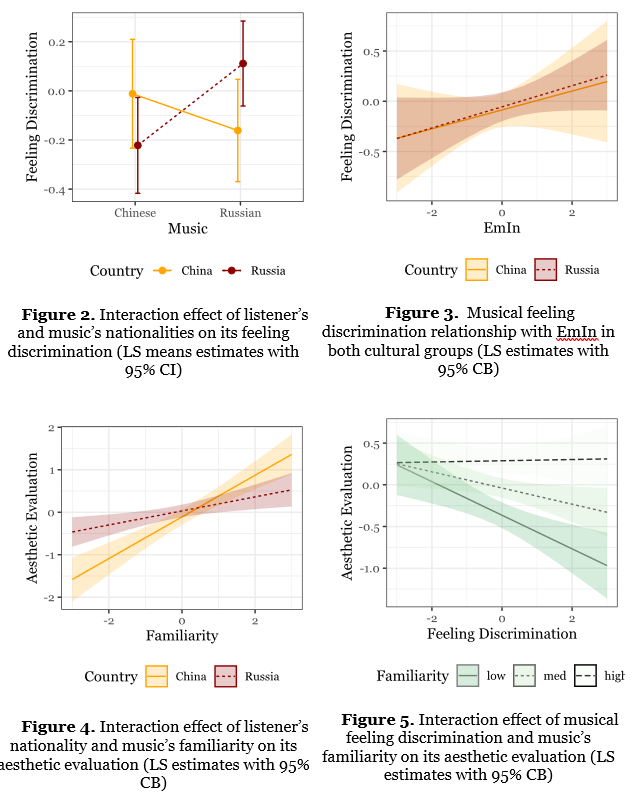
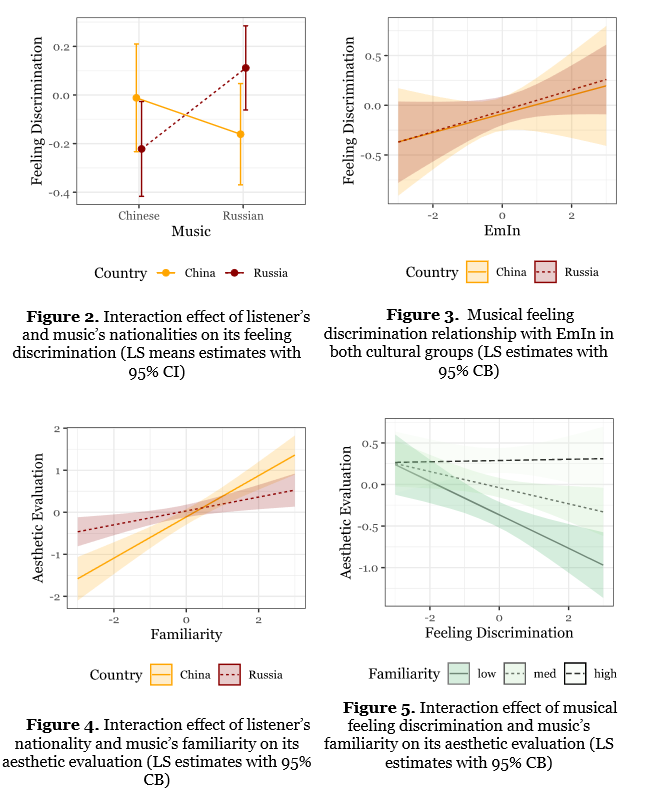
A near-strong interaction of Music with Country was also detected (β = 0.48, p = 0.009) (see Figure 2), i.e. the listeners better discriminate the musical feeling of their own national music. Finally, rather infirm statistical evidence was obtained for an effect of EmIn (β = 0.10, p = 0.065) (see Figure 3), thus emotional intelligence may facilitate the successful musical feeling discrimination.
In the Model of Aesthetic Evaluation, the firmest statistical evidence was obtained for a moderate positive main effect of Familiarity of music (β = 0.33, p < 1.0E+10) as well as for its interaction effects with Country (β = −0.33, p < 0.001) (see Figure 4) and Feeling Discrimination (β = 0.10, p = 0.008) (see Figure 5), while the weak negative main effect of the former was also revealed (β = −0.10, p = 0.028). Thus, the aesthetic evaluation of music increases along with its familiarity, more so in Chinese listeners than in Russians. On the contrary it decreases on average as musical feeling discrimination improves, the trend disappearing when the music is familiar.
A weak main effect of Music (β = −0.18, p = 0.031) and its moderate interaction with Country (β = −0.35, p = 0.040) (see Figure 6) were revealed alongside with its rather infirmly statistically evidenced interaction with Feeling Discrimination (β = −0.13, p = 0.076) (see Figure 7). That is, listeners, mostly Russians, rate Chinese music higher, and in both groups its aesthetic appeal may be less compromised by musical feeling discrimination. A weak main effect of Style was also revealed (β = −0.16, p = 0.036) alongside with its infirmly statistically evidenced interaction with Country (β = −0.25, p = 0.097) (see Figure 8). Thus, academic interpretation is rated higher than folk one, the tendency seemingly expressed to the higher degree in Russians. A weak effect of interaction of Sex and EBS (β = −0.23, p = 0.044) (see Figure 9) was also found, i.e. the aesthetic evaluation of music becomes positively associated with EBS score in female listeners, unlike in male listeners.

Discussion
Profiles of musical feeling rates matching the excerpts’ intended meaning evidences the measurement validity. The similarity of the profiles obtained from Chinese and Russians is not only in line with previous findings of cross-cultural universality of perception of emotion in music but expands them from basic emotions to more sophisticated, conceptual feelings. Thus, Feeling Discrimination score may be arguably interpreted as a measure of understanding of musical feeling while its discriminative performance across listeners demonstrates its usefulness as a research tool.
The discovered listener’s better understanding of their own national music is expected and consistent with previous findings. The effect of EmIn score on the Feeling Discrimination, although not quite reliable, is the same in Chinese and Russians, which, together with the good internal consistency of EmIn’s Chinese version indicating to its validity, thus we can cautiously interpret the result as facilitative effect of emotional intelligence on music understanding.
While the positive effect of music’s familiarity on its aesthetic evaluation was expected, its greater magnitude found in Chinese listeners may be due to their more traditionalist culture. The same reason may explain the difference in style influence: unlike Russians, Chinese listeners do not favour Westernized academic interpretations. Both results are consistent with findings in the X. Wang study (Wang et al., 2021).
The revealed negative impact of music understanding on its aesthetic evaluation is opposite to what we hypothesized and presumably due to the fact that stimuli are on average quite simple, as evidenced by the size of positive bias of Feeling Discrimination. Thus, well-understood excerpts turn out to be too simple, hence dull. The same reason may explain higher rates of Chinese music, which has less of that bias, supposedly being less simple; and therefore, as the results show, its understanding is not detrimental to aesthetic appreciation.
Finally, two of effects found involve listener sex: women’s superiority in understanding musical feeling is consistent with their higher perception of emotions in general, but in the field of music it is a rather controversial issue. Besides, the differential effect of EBS indicates that in women, unlike men, aesthetic responsiveness is positively related to the aesthetic evaluation of music.
Limitations of the study are related to the small sample size, which precludes the use of more complex models. Specifically, although participants were asked about the difficulty of scaling musical feelings, this factor was not included in analyses because of low number of “difficult” answers. Besides, only the music’s culture and interpretation style were manipulated, which can thus be thought as causing changes in its understanding and aesthetic evaluation, while for other variables the notion of effect is used in a purely statistical sense.
Conclusions
Funding: The investigation was supported by the RF State Assignments No. 0138-2021-0007 “Multidimensional nature of human abilities and mental resources”.
CRediT author statement:
Sabadosh P.A.: Conceptualisation, methodology, data curation and analysis, visualisation, preparation of original draft;
Zhang Y.D.: Conceptualisation, resources, investigation.
Acknowledgments: We are grateful to original EmIn’s author Dmitry V. Lyusin for his valuable help in translating the questionnaire into Chinese.
References
- Akkermans, J., Schapiro, R., Müllensiefen, D., Jakubowski, K., Shanahan, D., Baker, D., Busch, V., Lothwesen, K., Elvers, P., Fischinger, T., Schlemmer, K., & Frieler, K. (2019). Decoding emotions in expressive music performances: A multi-lab replication and extension study. Cognition and Emotion, 33(6), 1099–1118. https://doi.org/10.1080/02699931.2018.1541312
- Cespedes-Guevara, J., & Eerola, T. (2018). Music Communicates Affects, Not Basic Emotions – A Constructionist Account of Attribution of Emotional Meanings to Music. Frontiers in Psychology, 9. https://www.frontiersin.org/articles/10.3389/fpsyg.2018.00215
- Diessner, R., Solom, R. D., Frost, N. K., Parsons, L., & Davidson, J. (2008). Engagement with beauty: Appreciating natural, artistic, and moral beauty. The Journal of Psychology, 142(3), 303–332.
- Gabrielsson, A., & Juslin, P. N. (1996). Emotional expression in music performance: Between the performer’s intention and the listener’s experience. Psychology of Music, 24(1), 68–91. https://doi.org/10.1177/0305735696241007
- Hui, R., & Diessner, R. (2015). Engagement with beauty in Hong Kong. Indian Journal of Positive Psychology, 6(4), 356–360.
- Juslin, P. (2013). What does music express? Basic emotions and beyond. Frontiers in Psychology, 4. https://www.frontiersin.org/articles/10.3389/fpsyg.2013.00596
- Lyusin, D. V. (2006). New technique for measuring emotional intelligence: EmIn Questionnaire. Psychological Diagnostics, 4, 3–22. [Lyusin, D. V. Novaya metodika dlya izmereniya emotsional’nogo intellekta: Oprosnik EmIn, 2006].
- Sabadosh, P. (2017). A Russian version of the Engagement with Beauty Scale: The multitrait-multimethod model. Journal of Higher School of Economics, 14(1), 7–21. https://doi.org/10.17323/1813-8918-2017-1-7-21
- Teplov, B. M. (1947). The psychology of musical abilities. RSFSR Academy of Pedagogical Sciences Publishing. [Teplov, B. M. Psikhologiya muzykal’nykh sposobnostey, 1947].
- Thompson, W. F., Sun, Y., & Fritz, T. (2019). Music across cultures. In Foundations in music psychology: Theory and research (pp. 503–541). The MIT Press.
- Wang, X., Wei, Y., Heng, L., & McAdams, S. (2021). A Cross-Cultural Analysis of the Influence of Timbre on Affect Perception in Western Classical Music and Chinese Music Traditions. Frontiers in Psychology, 12. https://www.frontiersin.org/articles/10.3389/fpsyg.2021.732865
Supplemental material
Comments (0)
Association of aesthetic evaluation with understanding of music originating from one’s own vs foreign cultures was studied alongside with its peculiarities in Chinese and Russians. Discrimination between lyrical, epic, joyful, and tragic musical feelings as more conceptual and sophisticated than basic emotions has been taken as an indicator of music understanding. Contrary to the hypothesis, a negative relationship was found between music understanding and appreciation, with this tendency vanishing a) in excerpts of Chinese music, which aesthetic evaluation was generally higher, mainly due to Russians, and b) by music’s familiarity, which improves the evaluation, especially among Chinese listeners. Presumably, the negative impact of music understanding is underpinned by its simplicity making the piece dull. Unlike Russians, the Chinese seem to not evaluate academic performance higher than the folk one. Besides, the listener’s own national music is understood better, while in both groups women performed better on average, and the understanding were facilitated by emotional intelligence as measured by the EmIn questionnaire. In women, unlike men, music appreciation is increased by aesthetic responsiveness trait, measured using the EBS questionnaire.
The aim of the study was to explore the cultural specificity of musical experiences by comparing Chinese and Russian listeners. According to B.M. Teplov, a musical experience is inherently meaningful, i.e. it carries some content. That content is primarily emotional, but a) these are not few basic emotions, but a variety of sophisticated musical feelings, and b) the content of music is not only emotional: through these feelings music conveys more complex meanings about the world. In turn, a true aesthetic experience of music is impossible without understanding its meaning (Teplov, 1947).
There are many empirical findings concerning the successful expression and perception of emotions in music, and mostly focused on basic emotions; one of the most influential of them (Gabrielsson & Juslin, 1996) has been recently replicated (Akkermans et al., 2019). Cross-cultural studies, that are not as numerous, have shown that basic emotions in music are recognized, although not as accurately, by representatives of other cultures (see Thompson et al., 2019 for a review). In a recent study Chinese non-musician listeners differed of Western ones in that their preference for music was related to familiarity, and they also preferred Chinese music played by Chinese instruments, while Westerners rated the perceived emotional dimension of valence higher for all instruments, both Western and Chinese (Wang et al., 2021).
While a multilayered model was proposed to reconcile the simplistic approach of basic emotions and the complex nature of musical content (Juslin, 2013), others authors argue for a different, constructionist paradigm of emotional meaning in music, passing from basic emotions to more conceptual ones (Cespedes-Guevara & Eerola, 2018). However, such studies are still few.
In the present study we used four classical genres: lyrical, epic, comic, and dramatic, as musical features to rate, considering them to be more relevant labels of complex musical feelings, than basic emotions. Based on this, we viewed music understanding as recognizing its culturally defined genre. We also included instrumentation style as a factor, while controlling for individual differences such as emotional intelligence and aesthetic responsiveness. The three main research questions were: a) how well a listener understands the music of their own versus another culture, b) how this understanding affects aesthetic evaluation, and c) how do differ these musical experiences between the Chinese and Russians.
- Participants
Two samples, Russian and Chinese, were recruited through national social media, the participants were not paid. After filtering out submissions containing repetitive answers or completed in less than 500 seconds, we obtained a total of 157 records, of which 52 were Chinese (56% female), and 105 Russians (71% female), more than half were aged 19−25 years.
- Procedure
The study was conducted online through the Credamo web-platform. The experiment consisted of participant listening musical stimuli and then rating the feeling they conveyed, as well as their familiarity, and aesthetic quality. Two additional measures of participant’s aesthetic responsiveness and emotional intelligence were also distributed: the former right before the experiment and the latter after it.
The four musical feelings: lyricism/tenderness, drama/tragicalness, epicness/pathos, fun/joyfulness, were to rate from 0−6.
Familiarity was rated on a 5-point scale from “unknown” to “very well known”. Aesthetic quality was evaluated on a 4-point scale: unpleasant, pass, good, excellent.
- Stimuli
We used samples of popular national Russian and Chinese music (both folk and professional) as stimuli, choosing those expressing each one of the above musical feelings, according to the cultural tradition:
- Lyricism: 茉莉花(Jasmine Flower), Во поле берёза стояла (In the Field Stood a Birch Tree), Катюша (Katyusha)
- Drama: 梁祝 (Butterfly Lovers), 送别 (Farewell Song), Вот мчится тройка почтовая (Here Is the Postal Troika Rushing).
- Epicness: 赛马 (Horse Racing), 黄河颂歌 (Ode to the Yellow River), Священная война (The Sacred War).
- Fun: 百鸟朝凤 (Song of the Phoenix), Калинка (Kalinka), Ах вы, сени мои, сени (Ah You, Inner Porch, My Inner Porch).
Real audio recordings without vocals were selected, each composition in two instrumentation styles: academic and folk, from which excerpts of less than 1 minute were cut. Every participant was randomly presented with one of six versions of stimuli set composed of two Russian and Two Chinese excerpts both differing in feeling expressed and style.
- Additional measures:
Participant’s aesthetic responsiveness was measured using the Engagement with Beauty Scale (EBS) 18-item questionnaire, which examines the tendency to experiencing beauty in nature, art, moral behaviour, and ideas (Diessner et al., 2008). Only the total scale score of Russian (Sabadosh, 2017) and Chinese (Hui & Diessner, 2015) versions of EBS was used.
Emotional intelligence was measured using the EmIn 46-item questionnaire (Lyusin, 2006), which examines understanding and control of the emotions of others as well as subject’s own emotions and their expression. We made a Chinese translation of the original Russian questionnaire, the back translation was iteratively corrected, and then approved by the original author.
- Analyses
All statistical data analyses were conducted in R software environment. A graphical profile of average musical feeling’ rates was drawn for each stimulus in both samples to check whether these rates differentiated the excerpts while reflecting the feelings they presumably expressed. Then the Feeling Discrimination score was established as a measure of musical feeling understanding, and was computed as the rating of the feeling expressed in the excerpt minus the average of the 4 musical feelings’ ratings. Summary statistics of it were calculated.
To estimate the internal consistency of the EmIn’s Chinese version, Chronbach’s alpha was calculated for the total of its items. Its value of 0.79 indicates an acceptable level of scale reliability. Only the total scores of EmIn and of EBS were then analysed. Two EBS scores below 43 and two EmIn scores above 121 were discarded to NAs as outliers. The ratings of stimulus’ Familiarity and Aesthetic Evaluation were treated as numeric and standardized to z-scores along with Feeling Discrimination, EBS, and EmIn scores when fitting models in order to get comparable coefficients.
Two linear mixed effects models were fitted, with Feeling Discrimination and Aesthetic Evaluation as the response variables, respectively. The predictor variables consisted of Music (music’s culture), Style, Familiarity, and listener’s Country and Sex for both models, along with Feeling Discrimination and EBS score for the Aesthetic Evaluation model, and EmIn score for the Feeling Discrimination model. Pairwise interactions were also included in the models, both allowed for random individual intercepts.
All the factors were binary and therefore effect-coded using contrast matrix [−0.5, 0.5]T, such that the respective model coefficients represent the difference between the second and first factor levels. Models were fitted by REML, with t-tests using the Kenward-Roger’s approximation method for small sample sizes.
The graphical profiles of musical feeling rates (Figure 1) demonstrated rather good discriminative performance across excerpts, with the highest-rated feelings in both groups mostly matching those ascribed by cultural tradition, with the exception of “Katyusha” which on average was rated almost uniformly and only slightly more epic than lyrical. “Butterfly lovers” and “Here Is the Postal Troika Rushing”, stories of separated lovers, were rated as primarily lyrical, then tragic.
The Feeling Discrimination score has roughly symmetrical distribution and demonstrates some positive bias along with good discriminative performance across participants (range = [-3.75, 4.5], M = 0.85, SD = 1.61); the bias was greater for Russian music than for Chinese (0.79 and 0.90 respectively).
In the Model of Musical Feeling Discrimination, a moderate effect of Sex was revealed (β = −0.34, p = 0.002): on average, women perform this task better than men.
Figure 1. Musical Feeling profiles of stimuli in the Chinese and Russians (mean rates weighted by sex ratios)
A near-strong interaction of Music with Country was also detected (β = 0.48, p = 0.009) (see Figure 2), i.e. the listeners better discriminate the musical feeling of their own national music. Finally, rather infirm statistical evidence was obtained for an effect of EmIn (β = 0.10, p = 0.065) (see Figure 3), thus emotional intelligence may facilitate the successful musical feeling discrimination.
In the Model of Aesthetic Evaluation, the firmest statistical evidence was obtained for a moderate positive main effect of Familiarity of music (β = 0.33, p < 1.0E+10) as well as for its interaction effects with Country (β = −0.33, p < 0.001) (see Figure 4) and Feeling Discrimination (β = 0.10, p = 0.008) (see Figure 5), while the weak negative main effect of the former was also revealed (β = −0.10, p = 0.028). Thus, the aesthetic evaluation of music increases along with its familiarity, more so in Chinese listeners than in Russians. On the contrary it decreases on average as musical feeling discrimination improves, the trend disappearing when the music is familiar.
A weak main effect of Music (β = −0.18, p = 0.031) and its moderate interaction with Country (β = −0.35, p = 0.040) (see Figure 6) were revealed alongside with its rather infirmly statistically evidenced interaction with Feeling Discrimination (β = −0.13, p = 0.076) (see Figure 7). That is, listeners, mostly Russians, rate Chinese music higher, and in both groups its aesthetic appeal may be less compromised by musical feeling discrimination. A weak main effect of Style was also revealed (β = −0.16, p = 0.036) alongside with its infirmly statistically evidenced interaction with Country (β = −0.25, p = 0.097) (see Figure 8). Thus, academic interpretation is rated higher than folk one, the tendency seemingly expressed to the higher degree in Russians. A weak effect of interaction of Sex and EBS (β = −0.23, p = 0.044) (see Figure 9) was also found, i.e. the aesthetic evaluation of music becomes positively associated with EBS score in female listeners, unlike in male listeners.
Profiles of musical feeling rates matching the excerpts’ intended meaning evidences the measurement validity. The similarity of the profiles obtained from Chinese and Russians is not only in line with previous findings of cross-cultural universality of perception of emotion in music but expands them from basic emotions to more sophisticated, conceptual feelings. Thus, Feeling Discrimination score may be arguably interpreted as a measure of understanding of musical feeling while its discriminative performance across listeners demonstrates its usefulness as a research tool.
The discovered listener’s better understanding of their own national music is expected and consistent with previous findings. The effect of EmIn score on the Feeling Discrimination, although not quite reliable, is the same in Chinese and Russians, which, together with the good internal consistency of EmIn’s Chinese version indicating to its validity, thus we can cautiously interpret the result as facilitative effect of emotional intelligence on music understanding.
While the positive effect of music’s familiarity on its aesthetic evaluation was expected, its greater magnitude found in Chinese listeners may be due to their more traditionalist culture. The same reason may explain the difference in style influence: unlike Russians, Chinese listeners do not favour Westernized academic interpretations. Both results are consistent with findings in the X. Wang study (Wang et al., 2021).
The revealed negative impact of music understanding on its aesthetic evaluation is opposite to what we hypothesized and presumably due to the fact that stimuli are on average quite simple, as evidenced by the size of positive bias of Feeling Discrimination. Thus, well-understood excerpts turn out to be too simple, hence dull. The same reason may explain higher rates of Chinese music, which has less of that bias, supposedly being less simple; and therefore, as the results show, its understanding is not detrimental to aesthetic appreciation.
Finally, two of effects found involve listener sex: women’s superiority in understanding musical feeling is consistent with their higher perception of emotions in general, but in the field of music it is a rather controversial issue. Besides, the differential effect of EBS indicates that in women, unlike men, aesthetic responsiveness is positively related to the aesthetic evaluation of music.
Limitations of the study are related to the small sample size, which precludes the use of more complex models. Specifically, although participants were asked about the difficulty of scaling musical feelings, this factor was not included in analyses because of low number of “difficult” answers. Besides, only the music’s culture and interpretation style were manipulated, which can thus be thought as causing changes in its understanding and aesthetic evaluation, while for other variables the notion of effect is used in a purely statistical sense.
Funding: The investigation was supported by the RF State Assignments No. 0138-2021-0007 “Multidimensional nature of human abilities and mental resources”.
CRediT author statement:
Sabadosh P.A.: Conceptualisation, methodology, data curation and analysis, visualisation, preparation of original draft;
Zhang Y.D.: Conceptualisation, resources, investigation.
Acknowledgments: We are grateful to original EmIn’s author Dmitry V. Lyusin for his valuable help in translating the questionnaire into Chinese.
- Akkermans, J., Schapiro, R., Müllensiefen, D., Jakubowski, K., Shanahan, D., Baker, D., Busch, V., Lothwesen, K., Elvers, P., Fischinger, T., Schlemmer, K., & Frieler, K. (2019). Decoding emotions in expressive music performances: A multi-lab replication and extension study. Cognition and Emotion, 33(6), 1099–1118. https://doi.org/10.1080/02699931.2018.1541312
- Cespedes-Guevara, J., & Eerola, T. (2018). Music Communicates Affects, Not Basic Emotions – A Constructionist Account of Attribution of Emotional Meanings to Music. Frontiers in Psychology, 9. https://www.frontiersin.org/articles/10.3389/fpsyg.2018.00215
- Diessner, R., Solom, R. D., Frost, N. K., Parsons, L., & Davidson, J. (2008). Engagement with beauty: Appreciating natural, artistic, and moral beauty. The Journal of Psychology, 142(3), 303–332.
- Gabrielsson, A., & Juslin, P. N. (1996). Emotional expression in music performance: Between the performer’s intention and the listener’s experience. Psychology of Music, 24(1), 68–91. https://doi.org/10.1177/0305735696241007
- Hui, R., & Diessner, R. (2015). Engagement with beauty in Hong Kong. Indian Journal of Positive Psychology, 6(4), 356–360.
- Juslin, P. (2013). What does music express? Basic emotions and beyond. Frontiers in Psychology, 4. https://www.frontiersin.org/articles/10.3389/fpsyg.2013.00596
- Lyusin, D. V. (2006). New technique for measuring emotional intelligence: EmIn Questionnaire. Psychological Diagnostics, 4, 3–22. [Lyusin, D. V. Novaya metodika dlya izmereniya emotsional’nogo intellekta: Oprosnik EmIn, 2006].
- Sabadosh, P. (2017). A Russian version of the Engagement with Beauty Scale: The multitrait-multimethod model. Journal of Higher School of Economics, 14(1), 7–21. https://doi.org/10.17323/1813-8918-2017-1-7-21
- Teplov, B. M. (1947). The psychology of musical abilities. RSFSR Academy of Pedagogical Sciences Publishing. [Teplov, B. M. Psikhologiya muzykal’nykh sposobnostey, 1947].
- Thompson, W. F., Sun, Y., & Fritz, T. (2019). Music across cultures. In Foundations in music psychology: Theory and research (pp. 503–541). The MIT Press.
- Wang, X., Wei, Y., Heng, L., & McAdams, S. (2021). A Cross-Cultural Analysis of the Influence of Timbre on Affect Perception in Western Classical Music and Chinese Music Traditions. Frontiers in Psychology, 12. https://www.frontiersin.org/articles/10.3389/fpsyg.2021.732865
Supplemental_material