Review of the Monograph by V. M. Rusalov and S. I. Dudin “Temperament and Intelligence: Theoretical and Experimental Studies” (Moscow: Nauka, 2024)
Abstract
Abstract
Background. The monograph addresses a fundamental problem in differential psychology: the relationship between temperament and general abilities (intelligence). Despite extensive research, these constructs have traditionally been studied in isolation. Temperament has been investigated within biological theories as a genotypically determined formation, while intelligence has been examined within cognitive psychology as a product of learning and socialization. The absence of an integrative model explaining the mechanisms of their interrelation has resulted in terminological ambiguity and contradictory empirical findings. The reviewed monograph offers a fundamentally novel solution by developing a concept of a two-level structure of intelligence aptitudes, in which temperament serves as a psychological bridge between biological predispositions and cognitive achievements. The relevance of the work is further determined by the necessity of overcoming the gap between psychophysiological and cognitive approaches in contemporary psychology of individual differences. Methods. The review was prepared using a comprehensive set of scientific-critical analysis methods: content analysis of the monograph text with identification of key theoretical constructs and empirical indicators; comparative-historical method for juxtaposing the authors’ conception with classical and contemporary approaches (humoral theories, constitutional typologies, factor models of Eysenck and Cattell, psychometric theories of intelligence by Spearman, Cattell-Horn, and Wechsler, cognitive approaches by Piaget, Kholodnaya, and Druzhinin); structural-logical analysis for assessing the internal consistency of the authors’ model; critical analysis of the empirical base (sample size, age range, mathematical-statistical procedures); bibliometric analysis of the reference list; and analysis of V. M. Rusalov’s scientific biography to determine the monograph’s place in the evolution of his research program. Results. The authors propose a coherent three-level hierarchical model: biological aptitudes (Level 1), temperament (Level 2, aptitudes for intelligence), essential properties of intelligence (Level 3), and level of mental development (IQ, knowledge, skills). The empirical findings demonstrate that high values of intellectual ergicity, plasticity, and speed, combined with low emotional sensitivity, are statistically significantly associated with higher general intelligence (IQ). New theoretical constructs are introduced: general intellectual endurance, flexibility, speed, and self-regulation. An idiodynamic methodology has been developed that enables objective measurement of unique rank-ordered structures of properties in a specific individual. Discussion. The principal distinctions of the authors’ approach from Western models are identified: the implicative nature of connections between levels of individuality, strict demarcation of temperament, personality, and intelligence based on eight criteria, and the identification of the intellectual aspect of temperament as an independent substructure. Analysis of V. M. Rusalov’s scientific biography reveals that the monograph is the logical culmination of a half-century research programme, integrating results obtained from 1979 to 2024 and pointing toward the study of human peaks (acme). The breakthrough character of the work lies in overcoming the gap between the biological and the cognitive and in opening new horizons for acmeology and practical psychodiagnostics. Conclusions. The monograph represents a fundamental scientific work that makes a significant contribution to the psychology of individual differences, offers new operationalized concepts, and opens promising directions for future research. The work is recommended for specialists in differential psychology, psychophysiology, psychodiagnostics, and acmeology.
Introduction
The monograph by V. M. Rusalov and S. I. Dudin represents the culmination of many years of theoretical and experimental research conducted within the tradition of the school of B. M. Teplov and V. D. Nebylitsyn. It can rightfully be regarded as one of the most significant events in contemporary Russian psychology. Its central problematic, the relationship between temperament and general abilities (intelligence), belongs to the category of enduring questions that, despite an abundance of empirical data, have not received satisfactory theoretical resolution in either Russian or international scholarship (Rubinstein, 1989; Teplov, 1961; Kholodnaya, 1997; Druzhinin, 2008).
Traditionally, these two constructs have been studied in isolation. Temperament has been investigated primarily within biological (dispositional) theories (Eysenck, 1967; Cattell, 1971; Strelau, 1982; Gray, 1993) as a phenomenon rigidly determined by genotype and manifested in formal-dynamic characteristics of behavior. Intelligence, by contrast, has been examined within cognitive psychology and testology as a product of learning, socialization, and the development of higher mental functions, largely without reference to its bioenergetic sources (Piaget, 1969; Kholodnaya, 1997; Druzhinin, 2008). This disjunction has generated numerous contradictions, as researchers have documented correlations between temperament and IQ but have been unable to explain their mechanism. The authors of the monograph undertake to resolve precisely this problem, offering not merely a new empirical finding but an elaborated theoretical model in which temperament and intelligence are conceived as links in a unified chain of personality development, connected through the mechanism of “systemic generalization” (Rusalov, 1979; Rusalov, 2012).
The aim of this review is to provide a comprehensive critical analysis of the monograph, assessing its theoretical novelty, empirical substantiation, methodological rigor, contribution to the psychology of individual differences, and the place of this work in the evolution of V. M. Rusalov’s scholarly programme.
Method
The preparation of this review employed a comprehensive set of scientific-critical analysis methods, ensuring a multidimensional and objective assessment.
Content analysis. A systematic quantitative-qualitative processing of the monograph’s textual corpus (280 pages) was conducted. Key semantic units were identified: principal theoretical constructs (“Special Theory of Individuality,” “systemic generalization,” “two-level aptitudes,” “general constitution”); empirical indicators (twelve scales of the QFDPI, activity and emotionality indices, data from correlation, factor, and analysis of variance); and newly introduced terminological concepts (“general intellectual endurance,” “general intellectual flexibility,” “general intellectual speed,” “general intellectual self-regulation”). The frequency of key term usage was recorded, the structure of evidence was analyzed, and logical connections between sections were identified.
Comparative-historical method. The reviewed monograph was situated within a broad historical-scientific context. The authors’ conception was compared with classical and contemporary approaches to understanding temperament (humoral theories of Hippocrates-Galen; constitutional typologies of Kretschmer, 2000, and Sheldon, 1942; factor models of Eysenck, 1967, and Cattell, 1971; Strelau’s regulative theory, 1993; Gray’s neuropsychological models, 1993) and intelligence (psychometric models of Spearman, 1950; Cattell-Horn, 1971; Wechsler, 1955; hierarchical models of Vernon, 1950, and Burt, 1949; cognitive approaches of Piaget, 1969; Kholodnaya, 1997; Druzhinin, 2008). Comparisons were made along the following parameters: interpretation of the nature of temperament, its relationship to personality and intelligence, mechanisms of property formation, and diagnostic methods.
Structural-logical analysis. The internal composition of the monograph was analyzed: the logic of chapter construction, the sequence of presentation of theoretical and empirical material, and the justification of transitions from analysis of preceding approaches to formulation of the authors’ own conception. Particular attention was paid to verifying the internal consistency of the authorial model: the coherence of theoretical postulates, research method, and empirical interpretations.
Critical analysis. Drawing on criteria of scientific reliability (validity, reliability, replicability) and theoretical substantiation, the empirical base of the research was evaluated: sample size (504 participants), age range (7–60 years), psychodiagnostic instruments employed, and appropriateness of mathematical-statistical procedures (Pearson correlation analysis, principal component factor analysis with varimax rotation, analysis of variance). Additionally, the novelty and practical significance of the idiodynamic methodology were critically assessed, as was the justification of conclusions regarding acme-subjects based on a pilot study with a sample of four individuals.
Analysis of scientific biography. To determine the monograph’s place in the evolution of V. M. Rusalov’s research programme, an analysis of his key scholarly works from 1979 to 2024 was conducted. Major stages were identified: formulation of macrotheory (1979); development of methodology and instrumentation (1987–1997); systematization of temperament theory (2012); and integration and emergence of the “acme” level (2024). This allowed assessment of the monograph as the logical culmination of the authors’ half-century scientific journey.
Synthesis. In the final stage, the results of all the aforementioned analytical approaches were integrated to form an overall judgment regarding the monograph’s contribution to psychological science, its theoretical and practical significance, and to formulate substantiated recommendations and identify points for discussion.
Bibliometric analysis. The monograph’s reference list (over 150 sources) was analyzed according to the following parameters: ratio of Russian to international publications, temporal coverage (from classical works of I. P. Pavlov, B. M. Teplov, and V. D. Nebylitsyn to contemporary international research), and representation of primary sources in psychophysiology, differential psychology, and cognitive psychology.
Results
3.1. The Special Theory of Individuality as Theoretical Foundation
The work is grounded in the Special Theory of Individuality developed by V. M. Rusalov (Rusalov, 1979; Rusalov, 2012). Its key postulate is that the human mind is fundamentally two-aspect: it includes a formal-dynamic (energetic, temporal) component and a subject-content (semantic, cognitive, motivational) component. The authors introduce the concept of general constitution as the integrative totality of all biological subsystems (nervous, humoral, somatic). Temperament, according to this theory, is not a direct projection of nervous system properties (as in Pavlov, 1951, or Nebylitsyn, 1976), but rather emerges as a result
of “systemic generalization”, a process in which repeatedly occurring formal characteristics of behavior (speed, intensity, emotional colouring) crystallize into stable psychological formations that are no longer dependent on the specific content of activity.
This represents a fundamental methodological shift. Whereas in the classical Pavlovian school temperament was identified with the type of nervous system, and in factor theories (Cattell, 1971; Eysenck, 1967) it was reduced to a set of statistically derived traits, Rusalov and Dudin conceptualize temperament as the psychological form of existence of biological aptitudes. This means that temperament is not merely a physiological substrate of behaviour but an independent psychological level that mediates the influence of biology on higher cognitive functions.
3.2. Evolution of Methodological Instruments: From EPI Modification to the QFDPI
The authors trace the evolution of their psychodiagnostic instruments: from the modification of Eysenck’s EPI questionnaire (Rusalov, 1987) through the Structure of Temperament Questionnaire (STQ) (Rusalov, 1990) to the creation of the Questionnaire of Formal-Dynamic Properties of Individuality (QFDPI) (Rusalov, 1997). Unlike Western colleagues who often employ factor analysis as a discovery procedure for detecting artefacts, Rusalov and Dudin apply Lazarsfeld’s latent-structural analysis (Lazarsfeld, 1973) for targeted verification of theoretical constructs. This ensures that each scale measures precisely the property specified by the theory, rather than being a random statistical artefact.
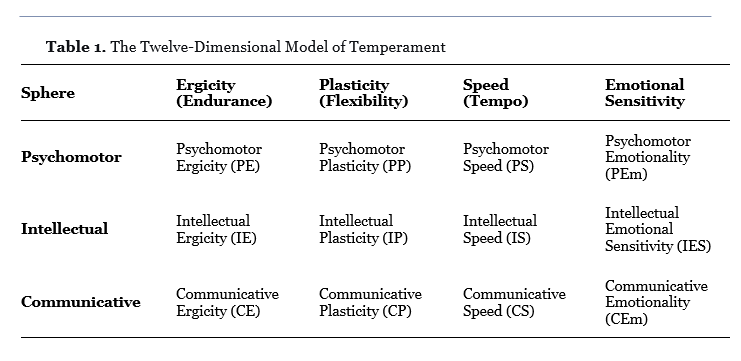
3.3. The Twelve-Dimensional Model of Temperament
The principal breakthrough of the methodological section is the twelve-dimensional model of temperament embodied in the QFDPI. For the first time in international practice, intellectual scales are included in the structure of temperament on an equal footing: alongside the psychomotor and communicative spheres, intellectual ergicity (IE), intellectual plasticity (IP), intellectual speed (IS), and intellectual emotional sensitivity (IES) are distinguished.

The four fundamental parameters of formal behavioural organization, each manifested in three spheres of activity, are as follows.
Ergicity (endurance) characterizes the optimal level of tension in human interaction with the environment, or the breadth-narrowness of afferent synthesis (following P. K. Anokhin). In the intellectual sphere (IE), this manifests as a need for mental load, the capacity to sustain high cognitive activity over extended periods, and a propensity for complex tasks. In the psychomotor sphere (PE), it appears as physical endurance and a need for movement. In the communicative sphere (CE), it manifests as a striving for a wide circle of communication and initiative in social contacts.
Plasticity (flexibility) reflects the ease (or difficulty) of switching from one behavioural programme to another. Intellectual plasticity (IP) is expressed in the capacity to rapidly restructure thought processes, find alternative solutions, and shift between different cognitive strategies. Psychomotor plasticity (PP) manifests as agility, coordination, and the capacity to master new motor skills. Communicative plasticity (CP) appears as flexibility in interaction, the ability to change communication style, and the capacity to find approaches to different people.
Speed (tempo) characterizes the rapidity of execution of a given behavioural programme. Intellectual speed (IS) manifests in the tempo of mental operations, speed of calculation, and rapidity of comprehension of new material. Psychomotor speed (PS) appears as the tempo of movements and speed of reaction. Communicative speed (CS) manifests as speech tempo and speed of verbal response.
Emotional sensitivity reflects the threshold of sensitivity to the discrepancy between the actual result of an action and its goal (the acceptor of the action’s result). Intellectual emotional sensitivity (IES) manifests as anxiety in intellectual activity, distress over errors, and fear of failure in problem-solving. Psychomotor emotionality (PEm) appears as sensitivity to failures in physical activity and motor skills. Communicative emotionality (CEm) manifests as vulnerability, touchiness, and anxiety in communication.
On the basis of these twelve scales, five integral indices are computed: the index of psychomotor activity, the index of intellectual activity, the index of communicative activity, the index of general activity, and the index of general emotionality. These indices make it possible to identify both general types of temperament (choleric, sanguine, melancholic, phlegmatic) and differential types for each of the three spheres of activity. This differentiated description constitutes another fundamental distinction of the Rusalov and Dudin approach from Western models, in which temperament type is typically determined globally without consideration of sphere-specific characteristics.
3.4. Principal Distinctions between Temperament, Personality Traits, and Intelligence
The authors propose eight criteria for attributing properties to temperament (Rusalov, 2012): independence from the content of activity; characterization of the dynamic-energetic and emotional-regulatory aspects; universality of manifestation; early manifestation in childhood; stability throughout life; spontaneity and non-consciousness; high correlation with biological subsystems; and heritability.
On the basis of these criteria, a strict demarcation is achieved. Temperament represents the generalization of formal-dynamic characteristics of behaviour (speed, intensity, emotional tone) under the influence of biological factors. Intelligence (its foundation) represents the generalization of dynamic and content characteristics of cognitive processes (strategies, schemas, algorithms) on the basis of temperamental aptitudes. Personality (character) represents the generalization of motivational and emotional-volitional aspects of behaviour (values, attitudes, beliefs) under the influence of social factors.
Thus, a three-level hierarchy is established: biological aptitudes, temperament (aptitudes for intelligence), foundation of intelligence, and personality.
3.5. Empirical Evidence of Temperament-Intelligence Associations
The empirical investigation comprised three stages with a total sample of 504 participants ranging in age from 7 to 60 years (Rusalov and Dudin, 1995; Semenchenko, 1996; Naumova, 1999).
The first stage, encompassing adolescents (13–14 years) and adults (18–57 years), demonstrated that the strength of associations between temperament and intelligence is greater in adolescents and in sanguine individuals (high activity, low emotionality) than in adults and melancholic individuals.
The second stage, conducted with younger schoolchildren (7–8 and 10–11 years), confirmed that associations are maximal in younger children and in those with lower levels of mental development. With age and intellectual growth, these associations weaken, indicating the differentiation of intelligence from temperament.
The third stage, involving adults (20–55 years) and using the QFDPI and the Wechsler test, yielded the most compelling results. Factor analysis (principal components with varimax rotation) demonstrated that the scales of intellectual ergicity, plasticity, and speed load on a single factor with the general IQ score. Analysis of variance revealed that participants with high scores on intellectual ergicity, plasticity, and speed had significantly higher mean IQ scores compared to those with low scores on these scales. High intellectual emotional sensitivity, by contrast, was associated with lower IQ scores. These findings indicate that temperament functions not merely as a correlate but as a source (aptitude) for the development of intelligence. Given that temperament is biologically determined and stable over time, it is reasonable to infer the primacy of temperamental influence on intelligence.
3.6. New Theoretical Constructs: Essential Properties of Intelligence
On the basis of the empirical data, four essential properties of intelligence are introduced, serving as a bridge between temperament and psychometric IQ (Rusalov and Dudin, 1995).
General intellectual endurance, derived from intellectual ergicity, is expressed in the need for mental impressions and efforts, and in readiness for complex cognitive activity.
General intellectual flexibility, derived from intellectual plasticity, manifests in the inclination to solve problems in different, including original, ways.
General intellectual speed, derived from intellectual speed, characterizes the tempo of solving cognitive tasks.
General intellectual self-regulation, derived from intellectual emotional sensitivity, represents a dialectical transition: low emotional sensitivity at the level of intellect transforms into the capacity for accurate forecasting and correction of activity programmes, enabling intuitive selection of the correct path on the first attempt.
3.7. Idiodynamic Methodology and the Study of Acme-Subjects
The concluding section of the monograph presents a fundamentally new idiodynamic strategy (Rusalov, 2010; Rusalov, 2012), integrating idiographic and nomothetic approaches. Methods of paired comparisons and open scales have been developed, enabling identification of unique rank-ordered structures of properties in a specific individual without comparison to population norms.
In a pilot study of four acme-subjects (a police colonel, an entrepreneur, a scientist, and a photographer-artist), consistent findings emerged. At the apex of temperamental rank structures were properties of activity (ergicity, plasticity, speed), while emotional sensitivity occupied the lowest positions. In the structure of intelligence, general intellectual self-regulation occupied the primary position. In the hierarchy of values, freedom, responsibility, creativity, and justice dominated, while wealth and power occupied the lowest ranks.
Discussion
The findings of this analysis allow identification of five principal distinctions of the Rusalov and Dudin approach from other conceptions, defining its international significance and breakthrough character.
First, in contrast to biological theories of temperament advanced by Eysenck (1967), Gray (1993), and Strelau (1982), in which temperament is either synonymous with personality or reduced to a set of reactivities and the relationship with intelligence is either denied or treated as a correlation at the neurophysiological level, Rusalov and Dudin propose an implicative model in which temperament is embedded in intelligence as its source rather than as a concomitant factor (Rusalov and Dudin, 1995). This enables explanation of the mechanism of transformation of the biological into the cognitive through systemic generalization, thereby overcoming the reductionism characteristic of purely biological accounts.
Second, distinguishing their approach from factor theories of intelligence such as those of Cattell (1971) and Horn, which posit a biological basis (fluid intelligence) but leave it impersonal and unspecified, the authors of the monograph concretize this basis as the intellectual aspect of temperament, specifically intellectual ergicity, plasticity, and speed. Flexibility of thinking is directly linked to plasticity of nervous processes; intellectual endurance is linked to the organism’s energetic potential (Rusalov, 1979; Rusalov, 2012). This operationalization makes the biological foundation of intelligence measurable through behavioural questionnaires, a significant methodological advance.
Third, in contrast to cognitive theories exemplified by the work of Piaget (1969), Kholodnaya (1997), and Druzhinin (2008), which describe the structure of mind in terms of mental experience and cognitive styles but largely ignore bioenergetic sources, the authors demonstrate how energetics (ergicity) transforms into thinking style (flexibility), and how anxiety (emotionality) transforms into problem-solving strategy (self-regulation). This connects macro- and micro-levels of analysis (Brushlinsky, 1978; Rusalov, 2012), bridging the gap between psychophysiology and cognitive psychology that has persisted for decades.
Fourth, and perhaps most significantly from the standpoint of Russian psychological tradition, the approach differs fundamentally from that of Merlin (1986). Merlin argued that between properties at different levels of individuality there exist only many-to-many connections, precluding deterministic predictions. Rusalov and Dudin, however, identify one-to-one (implicative) connections, demonstrating that particular combinations of temperamental properties constitute a necessary condition for the development of high intelligence. The analysis of variance results provides statistical support for this association, empirically validating the claim that temperamental characteristics are not merely correlates but causal antecedents in the developmental trajectory of intelligence.
Fifth, and most radically, the work departs from the nomothetic paradigm that has dominated psychodiagnostics throughout the twentieth century. Traditional questionnaires, as critics including Allport (2002) and Stern (1988) have long noted, measure averaged profiles relative to population norms, thereby losing the uniqueness of the individual. The idiodynamic methodology developed by Rusalov (2010) enables study of the unique rank-ordered structures of a specific individual, fundamentally changing the approach to diagnosis and acmeology by shifting from the study of the “average person” to the investigation of human peaks.
Beyond these five distinctions, a crucial dimension of the monograph’s significance lies in its place within the evolution of V. M. Rusalov’s scientific programme. Analysis of his scholarly biography reveals four stages culminating in the present work. The first stage, the macrotheory period (1979), was marked by the publication of “Biological Foundations of Individual-Psychological Differences,” which formulated the Special Theory of Individuality and established the problem of the relationship between the biological and the psychological. The second stage, the methodological elaboration period (1987–1997), witnessed the modification of the EPI (1987), the development of the STQ (1990), and the creation of the QFDPI (1997). This resulted in valid instruments for measuring formal-dynamic properties and the identification of intellectual scales of temperament. The third stage, the systematization period (2012), produced “Temperament in the Structure of Human Individuality,” a comprehensive synthesis of temperament theory, formulation of eight criteria, and description of structure and typology. The fourth stage, the integration and acme period (2024), is represented by the reviewed monograph, which integrates temperament and intelligence theory, introduces essential properties of intelligence, develops idiodynamic methodology, and provides empirical investigation of acme-subjects. Thus, the reviewed monograph is not an isolated work but the logical culmination of a half-century scientific journey that not only summarizes preceding achievements but also indicates a new direction: the study of human peaks (acme) using objective, measurable methods.
The breakthrough character of the work is thus secured at three interconnected levels. At the theoretical level, it offers the concept of two-level aptitudes, the implicative model, and strict demarcation of constructs on the basis of eight explicit criteria. At the methodological level, it provides the QFDPI with its intellectual scales and the idiodynamic methods for assessing unique configurations of properties. At the existential level, it enables objective study of the unique personality without statistical averaging, and emergence to the acme level where individual development reaches its culmination.
The legacy of the monograph extends beyond its immediate contributions. This work is not merely a conclusion but a testament. It completes the half-century cycle of V. M. Rusalov’s research initiated in 1979, and indicates the path that the psychology of individual differences must follow in the twenty-first century: from the study of the average person to the investigation of human peaks, from population norms to unique structures of personality, from establishing correlations to understanding mechanisms of development. The monograph thus serves as both a summation of past achievements and a programme for future inquiry, pointing toward a genuinely integrative science of human individuality.
Conclusions
The monograph by V. M. Rusalov and S. I. Dudin constitutes a fundamental scientific work that makes a significant contribution to the psychology of individual differences.
The indisputable strengths of the work include the following. It achieves a high level of theoretical synthesis, integrating psychophysiology, differential psychology, and cognitive science. It rests on a robust empirical base (504 participants, age range 7–60 years) employing valid psychodiagnostic instruments and appropriate mathematical-statistical procedures. It introduces into scholarly discourse new operationalized concepts (general intellectual properties) that can serve as foundations for further research. It provides strict demarcation of temperament, personality, and intelligence on the basis of eight criteria, overcoming the terminological uncertainty characteristic of many Western models. It develops an idiodynamic methodology that opens new horizons for acmeology, coaching, and high-level career counselling. It completes a half-century research programme, integrating theory, method, and practice into a unified whole.
Several points merit discussion and indicate directions for future research. The sample of acme-subjects (four individuals) is limited; more extensive empirical material is needed to establish stable patterns. The idiodynamic methods require high levels of reflection from participants; questions remain regarding their applicability to individuals with less developed self-awareness. The cultural specificity of the model is not addressed; in collectivist cultures, emotional sensitivity may play a different role. Further research is needed to clearly distinguish general intellectual self-regulation from traditionally understood volitional qualities and cognitive styles.
These observations do not diminish the significance of the work but rather delineate horizons for future inquiry. The monograph by Rusalov and Dudin is a classic work that will enter the golden fund of Russian psychology and will serve as a theoretical foundation for generations of researchers of human individuality.
Conflict of Interest: The author declares no conflict of interest.
Responsibility: The author is solely responsible for the content and conclusions of this work.
Funding: This research received no external funding.
AI Usage: Generative AI tools were used for language editing and formatting assistance. All substantive analysis, interpretation, and conclusions are the author’s own. The author reviewed and edited all AI-generated suggestions and takes full responsibility for the final manuscript.
References
- Allport, G. (2002). Stanovlenie lichnosti: Izbrannye trudy[Becoming: Selected works]. Moscow: Smysl.
- Anokhin, P. K. (1968). Biologiya i neyrofiziologiya uslovnogo refleksa[Biology and neurophysiology of the conditioned reflex]. Moscow: Meditsina.
- Brushlinsky, A. V. (1978). O vzaimosvyazi prirodnogo i sotsial’nogo v psikhicheskom razvitii cheloveka [On the interrelation of the natural and the social in human mental development]. In Problemy geneticheskoy psikhofiziologii[Problems of genetic psychophysiology] (pp. 11–21). Moscow: Nauka.
- Burt, C. (1949). The structure of the mind: A review of the results of factor analysis. British Journal of Educational Psychology, 19, 49–70.
- Cattell, R. B. (1971). Abilities: Their structure, growth and action. Boston: Houghton-Mifflin.
- Cattell, R. B. (1993). Lichnostnye faktory [Personality factors]. Inostrannaya psikhologiya [Foreign Psychology], 1(2), 57–66.
- Druzhinin, V. N. (2008). Psikhologiya obshchikh sposobnostey[Psychology of general abilities] (3rd ed.). Petersburg: Piter.
- Eysenck, H. J. (1967). The biological basis of personality. Springfield, IL: Thomas.
- Eysenck, H. J. (1993). Kolichestvo izmereniy lichnosti: 16, 5 ili 3? Kriterii taksonomicheskoy paradigmy [The number of personality dimensions: 16, 5 or 3? Criteria for a taxonomic paradigm]. Inostrannaya psikhologiya [Foreign Psychology], 1(2), 9–23.
- Eysenck, H. J., & Eysenck, S. B. G. (1969). Personality structure and measurement. London: Routledge and Kegan Paul.
- Gray, J. A. (1993). Neyropsikhologiya temperamenta [Neuropsychology of temperament]. Inostrannaya psikhologiya [Foreign Psychology], 1(2), 24–36.
- Guilford, J. P. (1967). The nature of human intelligence. New York: McGraw-Hill.
- Kholodnaya, M. A. (1997). Psikhologiya intellekta: paradoksy issledovaniya[Psychology of intelligence: Paradoxes of research]. Tomsk: Tomsk University Press; Moscow: Bars.
- Kretschmer, E. (2000). Stroenie tela i kharakter[Body structure and character]. Moscow: EKSMO-Press.
- Lazarsfeld, P. (1973). Latentno-strukturnyy analiz i teoriya testov [Latent-structural analysis and test theory]. In Matematicheskie metody v sotsial’nykh naukakh[Mathematical methods in social sciences] (pp. 42–53). Moscow: Progress.
- Leites, N. S. (1971). Umstvennye sposobnosti i vozrast[Mental abilities and age]. Moscow: Pedagogika.
- Merlin, V. S. (1986). Ocherk integral’nogo issledovaniya individual’nosti[Essay on integral research of individuality]. Moscow: Pedagogika.
- Naumova, E. R. (1999). Formal’no-dinamicheskie svoystva individual’nosti u lits s raznym urovnem intellekta[Formal-dynamic properties of individuality in persons with different levels of intelligence] [Candidate’s dissertation].
- Nebylitsyn, V. D. (1976). Psikhofiziologicheskie issledovaniya individual’nykh razlichiy[Psychophysiological studies of individual differences]. Moscow: Nauka.
- Netter, P. (1993). Biokhimicheskie peremennye v issledovanii temperamenta [Biochemical variables in temperament research]. Inostrannaya psikhologiya [Foreign Psychology], 1(2), 49–56.
- Pavlov, I. P. (1951). Izbrannye trudy[Selected works]. Moscow: Academy of Pedagogical Sciences of the RSFSR.
- Piaget, J. (1969). Izbrannye psikhologicheskie trudy[Selected psychological works]. Moscow: Prosveshchenie.
- Rubinstein, S. L. (1989). Osnovy obshchey psikhologii[Foundations of general psychology] (Vol. 2). Moscow: Pedagogika.
- Rusalov, V. M. (1979). Biologicheskie osnovy individual’no-psikhologicheskikh razlichiy[Biological foundations of individual-psychological differences]. Moscow: Nauka.
- Rusalov, V. M. (1987). Novyy variant adaptatsii lichnostnogo testa EPI [A new version of the adaptation of the EPI personality test]. Psikhologicheskiy zhurnal [Psychological Journal], 8(1), 113–126.
- Rusalov, V. M. (1990). Oprosnik struktury temperamenta: Metodicheskoe posobie[Questionnaire of temperament structure: Methodological guide]. Moscow: Institute of Psychology of the USSR Academy of Sciences.
- Rusalov, V. M. (1997). Oprosnik formal’no-dinamicheskikh svoystv individual’nosti (OFDSI): Metodicheskoe posobie[Questionnaire of formal-dynamic properties of individuality (QFDPI): Methodological guide]. Moscow: Institute of Psychology of the Russian Academy of Sciences.
- Rusalov, V. M. (2010). O nadezhnosti metoda parnykh sravneniy pri implitsitnoy samoidentifikatsii lichnostnykh svoystv [On the reliability of the paired comparisons method in implicit self-identification of personality properties]. In Nauchnye shkoly Instituta psikhologii RAN. Matematicheskaya psikhologiya[Scientific schools of the Institute of Psychology of the Russian Academy of Sciences. Mathematical psychology] (pp. 482–489). Moscow: Institute of Psychology of the Russian Academy of Sciences.
- Rusalov, V. M. (2012). Temperament v strukture individual’nosti cheloveka[Temperament in the structure of human individuality]. Moscow: Institute of Psychology of the Russian Academy of Sciences.
- Rusalov, V. M., & Dudin, S. I. (1995). Temperament i intellekt: obshchie i spetsial’nye factory razvitiya [Temperament and intelligence: General and special factors of development]. Psikhologicheskiy zhurnal [Psychological Journal], 16(5), 12–23.
- Semenchenko, E. V. (1996). Vozrastnye osobennosti sootnosheniya temperamenta i intellekta u detey 7–12 let[Age-related characteristics of the relationship between temperament and intelligence in children aged 7–12] [Candidate’s dissertation].
- Sheldon, W. H., & Stevens, S. S. (1942). The varieties of temperament: Psychology of constitutional differences. New York: Harper.
- Spearman, C. (1927). The abilities of man. London: Macmillan.
- Stern, W. (1988). Differentsial’naya psikhologiya i ee metodicheskie osnovy[Differential psychology and its methodological foundations]. Moscow: Nauka.
- Strelau, J. (1982). Rol’ temperamenta v psikhicheskom razvitii[The role of temperament in mental development]. Moscow: Progress.
- Strelau, J. (1993). Mestoraspolozhenie regulyativnoy teorii temperamenta (RTT) sredi drugikh teoriy temperamenta [The position of the regulative theory of temperament (RTT) among other theories of temperament]. Inostrannaya psikhologiya [Foreign Psychology], 1(2), 37–48.
- Teplov, B. M. (1961). Problemy individual’nykh razlichiy[Problems of individual differences]. Moscow: Prosveshchenie.
- Vernon, P. E. (1950). The structure of human abilities. London: Methuen.
- Wechsler, D. (1955). Manual for the Wechsler Adult Intelligence Scale. New York: Wiley.
Comments (0)
Background. The monograph addresses a fundamental problem in differential psychology: the relationship between temperament and general abilities (intelligence). Despite extensive research, these constructs have traditionally been studied in isolation. Temperament has been investigated within biological theories as a genotypically determined formation, while intelligence has been examined within cognitive psychology as a product of learning and socialization. The absence of an integrative model explaining the mechanisms of their interrelation has resulted in terminological ambiguity and contradictory empirical findings. The reviewed monograph offers a fundamentally novel solution by developing a concept of a two-level structure of intelligence aptitudes, in which temperament serves as a psychological bridge between biological predispositions and cognitive achievements. The relevance of the work is further determined by the necessity of overcoming the gap between psychophysiological and cognitive approaches in contemporary psychology of individual differences. Methods. The review was prepared using a comprehensive set of scientific-critical analysis methods: content analysis of the monograph text with identification of key theoretical constructs and empirical indicators; comparative-historical method for juxtaposing the authors’ conception with classical and contemporary approaches (humoral theories, constitutional typologies, factor models of Eysenck and Cattell, psychometric theories of intelligence by Spearman, Cattell-Horn, and Wechsler, cognitive approaches by Piaget, Kholodnaya, and Druzhinin); structural-logical analysis for assessing the internal consistency of the authors’ model; critical analysis of the empirical base (sample size, age range, mathematical-statistical procedures); bibliometric analysis of the reference list; and analysis of V. M. Rusalov’s scientific biography to determine the monograph’s place in the evolution of his research program. Results. The authors propose a coherent three-level hierarchical model: biological aptitudes (Level 1), temperament (Level 2, aptitudes for intelligence), essential properties of intelligence (Level 3), and level of mental development (IQ, knowledge, skills). The empirical findings demonstrate that high values of intellectual ergicity, plasticity, and speed, combined with low emotional sensitivity, are statistically significantly associated with higher general intelligence (IQ). New theoretical constructs are introduced: general intellectual endurance, flexibility, speed, and self-regulation. An idiodynamic methodology has been developed that enables objective measurement of unique rank-ordered structures of properties in a specific individual. Discussion. The principal distinctions of the authors’ approach from Western models are identified: the implicative nature of connections between levels of individuality, strict demarcation of temperament, personality, and intelligence based on eight criteria, and the identification of the intellectual aspect of temperament as an independent substructure. Analysis of V. M. Rusalov’s scientific biography reveals that the monograph is the logical culmination of a half-century research programme, integrating results obtained from 1979 to 2024 and pointing toward the study of human peaks (acme). The breakthrough character of the work lies in overcoming the gap between the biological and the cognitive and in opening new horizons for acmeology and practical psychodiagnostics. Conclusions. The monograph represents a fundamental scientific work that makes a significant contribution to the psychology of individual differences, offers new operationalized concepts, and opens promising directions for future research. The work is recommended for specialists in differential psychology, psychophysiology, psychodiagnostics, and acmeology.
The monograph by V. M. Rusalov and S. I. Dudin represents the culmination of many years of theoretical and experimental research conducted within the tradition of the school of B. M. Teplov and V. D. Nebylitsyn. It can rightfully be regarded as one of the most significant events in contemporary Russian psychology. Its central problematic, the relationship between temperament and general abilities (intelligence), belongs to the category of enduring questions that, despite an abundance of empirical data, have not received satisfactory theoretical resolution in either Russian or international scholarship (Rubinstein, 1989; Teplov, 1961; Kholodnaya, 1997; Druzhinin, 2008).
Traditionally, these two constructs have been studied in isolation. Temperament has been investigated primarily within biological (dispositional) theories (Eysenck, 1967; Cattell, 1971; Strelau, 1982; Gray, 1993) as a phenomenon rigidly determined by genotype and manifested in formal-dynamic characteristics of behavior. Intelligence, by contrast, has been examined within cognitive psychology and testology as a product of learning, socialization, and the development of higher mental functions, largely without reference to its bioenergetic sources (Piaget, 1969; Kholodnaya, 1997; Druzhinin, 2008). This disjunction has generated numerous contradictions, as researchers have documented correlations between temperament and IQ but have been unable to explain their mechanism. The authors of the monograph undertake to resolve precisely this problem, offering not merely a new empirical finding but an elaborated theoretical model in which temperament and intelligence are conceived as links in a unified chain of personality development, connected through the mechanism of “systemic generalization” (Rusalov, 1979; Rusalov, 2012).
The aim of this review is to provide a comprehensive critical analysis of the monograph, assessing its theoretical novelty, empirical substantiation, methodological rigor, contribution to the psychology of individual differences, and the place of this work in the evolution of V. M. Rusalov’s scholarly programme.
The preparation of this review employed a comprehensive set of scientific-critical analysis methods, ensuring a multidimensional and objective assessment.
Content analysis. A systematic quantitative-qualitative processing of the monograph’s textual corpus (280 pages) was conducted. Key semantic units were identified: principal theoretical constructs (“Special Theory of Individuality,” “systemic generalization,” “two-level aptitudes,” “general constitution”); empirical indicators (twelve scales of the QFDPI, activity and emotionality indices, data from correlation, factor, and analysis of variance); and newly introduced terminological concepts (“general intellectual endurance,” “general intellectual flexibility,” “general intellectual speed,” “general intellectual self-regulation”). The frequency of key term usage was recorded, the structure of evidence was analyzed, and logical connections between sections were identified.
Comparative-historical method. The reviewed monograph was situated within a broad historical-scientific context. The authors’ conception was compared with classical and contemporary approaches to understanding temperament (humoral theories of Hippocrates-Galen; constitutional typologies of Kretschmer, 2000, and Sheldon, 1942; factor models of Eysenck, 1967, and Cattell, 1971; Strelau’s regulative theory, 1993; Gray’s neuropsychological models, 1993) and intelligence (psychometric models of Spearman, 1950; Cattell-Horn, 1971; Wechsler, 1955; hierarchical models of Vernon, 1950, and Burt, 1949; cognitive approaches of Piaget, 1969; Kholodnaya, 1997; Druzhinin, 2008). Comparisons were made along the following parameters: interpretation of the nature of temperament, its relationship to personality and intelligence, mechanisms of property formation, and diagnostic methods.
Structural-logical analysis. The internal composition of the monograph was analyzed: the logic of chapter construction, the sequence of presentation of theoretical and empirical material, and the justification of transitions from analysis of preceding approaches to formulation of the authors’ own conception. Particular attention was paid to verifying the internal consistency of the authorial model: the coherence of theoretical postulates, research method, and empirical interpretations.
Critical analysis. Drawing on criteria of scientific reliability (validity, reliability, replicability) and theoretical substantiation, the empirical base of the research was evaluated: sample size (504 participants), age range (7–60 years), psychodiagnostic instruments employed, and appropriateness of mathematical-statistical procedures (Pearson correlation analysis, principal component factor analysis with varimax rotation, analysis of variance). Additionally, the novelty and practical significance of the idiodynamic methodology were critically assessed, as was the justification of conclusions regarding acme-subjects based on a pilot study with a sample of four individuals.
Analysis of scientific biography. To determine the monograph’s place in the evolution of V. M. Rusalov’s research programme, an analysis of his key scholarly works from 1979 to 2024 was conducted. Major stages were identified: formulation of macrotheory (1979); development of methodology and instrumentation (1987–1997); systematization of temperament theory (2012); and integration and emergence of the “acme” level (2024). This allowed assessment of the monograph as the logical culmination of the authors’ half-century scientific journey.
Synthesis. In the final stage, the results of all the aforementioned analytical approaches were integrated to form an overall judgment regarding the monograph’s contribution to psychological science, its theoretical and practical significance, and to formulate substantiated recommendations and identify points for discussion.
Bibliometric analysis. The monograph’s reference list (over 150 sources) was analyzed according to the following parameters: ratio of Russian to international publications, temporal coverage (from classical works of I. P. Pavlov, B. M. Teplov, and V. D. Nebylitsyn to contemporary international research), and representation of primary sources in psychophysiology, differential psychology, and cognitive psychology.
3.1. The Special Theory of Individuality as Theoretical Foundation
The work is grounded in the Special Theory of Individuality developed by V. M. Rusalov (Rusalov, 1979; Rusalov, 2012). Its key postulate is that the human mind is fundamentally two-aspect: it includes a formal-dynamic (energetic, temporal) component and a subject-content (semantic, cognitive, motivational) component. The authors introduce the concept of general constitution as the integrative totality of all biological subsystems (nervous, humoral, somatic). Temperament, according to this theory, is not a direct projection of nervous system properties (as in Pavlov, 1951, or Nebylitsyn, 1976), but rather emerges as a result
of “systemic generalization”, a process in which repeatedly occurring formal characteristics of behavior (speed, intensity, emotional colouring) crystallize into stable psychological formations that are no longer dependent on the specific content of activity.
This represents a fundamental methodological shift. Whereas in the classical Pavlovian school temperament was identified with the type of nervous system, and in factor theories (Cattell, 1971; Eysenck, 1967) it was reduced to a set of statistically derived traits, Rusalov and Dudin conceptualize temperament as the psychological form of existence of biological aptitudes. This means that temperament is not merely a physiological substrate of behaviour but an independent psychological level that mediates the influence of biology on higher cognitive functions.
3.2. Evolution of Methodological Instruments: From EPI Modification to the QFDPI
The authors trace the evolution of their psychodiagnostic instruments: from the modification of Eysenck’s EPI questionnaire (Rusalov, 1987) through the Structure of Temperament Questionnaire (STQ) (Rusalov, 1990) to the creation of the Questionnaire of Formal-Dynamic Properties of Individuality (QFDPI) (Rusalov, 1997). Unlike Western colleagues who often employ factor analysis as a discovery procedure for detecting artefacts, Rusalov and Dudin apply Lazarsfeld’s latent-structural analysis (Lazarsfeld, 1973) for targeted verification of theoretical constructs. This ensures that each scale measures precisely the property specified by the theory, rather than being a random statistical artefact.
3.3. The Twelve-Dimensional Model of Temperament
The principal breakthrough of the methodological section is the twelve-dimensional model of temperament embodied in the QFDPI. For the first time in international practice, intellectual scales are included in the structure of temperament on an equal footing: alongside the psychomotor and communicative spheres, intellectual ergicity (IE), intellectual plasticity (IP), intellectual speed (IS), and intellectual emotional sensitivity (IES) are distinguished.
The four fundamental parameters of formal behavioural organization, each manifested in three spheres of activity, are as follows.
Ergicity (endurance) characterizes the optimal level of tension in human interaction with the environment, or the breadth-narrowness of afferent synthesis (following P. K. Anokhin). In the intellectual sphere (IE), this manifests as a need for mental load, the capacity to sustain high cognitive activity over extended periods, and a propensity for complex tasks. In the psychomotor sphere (PE), it appears as physical endurance and a need for movement. In the communicative sphere (CE), it manifests as a striving for a wide circle of communication and initiative in social contacts.
Plasticity (flexibility) reflects the ease (or difficulty) of switching from one behavioural programme to another. Intellectual plasticity (IP) is expressed in the capacity to rapidly restructure thought processes, find alternative solutions, and shift between different cognitive strategies. Psychomotor plasticity (PP) manifests as agility, coordination, and the capacity to master new motor skills. Communicative plasticity (CP) appears as flexibility in interaction, the ability to change communication style, and the capacity to find approaches to different people.
Speed (tempo) characterizes the rapidity of execution of a given behavioural programme. Intellectual speed (IS) manifests in the tempo of mental operations, speed of calculation, and rapidity of comprehension of new material. Psychomotor speed (PS) appears as the tempo of movements and speed of reaction. Communicative speed (CS) manifests as speech tempo and speed of verbal response.
Emotional sensitivity reflects the threshold of sensitivity to the discrepancy between the actual result of an action and its goal (the acceptor of the action’s result). Intellectual emotional sensitivity (IES) manifests as anxiety in intellectual activity, distress over errors, and fear of failure in problem-solving. Psychomotor emotionality (PEm) appears as sensitivity to failures in physical activity and motor skills. Communicative emotionality (CEm) manifests as vulnerability, touchiness, and anxiety in communication.
On the basis of these twelve scales, five integral indices are computed: the index of psychomotor activity, the index of intellectual activity, the index of communicative activity, the index of general activity, and the index of general emotionality. These indices make it possible to identify both general types of temperament (choleric, sanguine, melancholic, phlegmatic) and differential types for each of the three spheres of activity. This differentiated description constitutes another fundamental distinction of the Rusalov and Dudin approach from Western models, in which temperament type is typically determined globally without consideration of sphere-specific characteristics.
3.4. Principal Distinctions between Temperament, Personality Traits, and Intelligence
The authors propose eight criteria for attributing properties to temperament (Rusalov, 2012): independence from the content of activity; characterization of the dynamic-energetic and emotional-regulatory aspects; universality of manifestation; early manifestation in childhood; stability throughout life; spontaneity and non-consciousness; high correlation with biological subsystems; and heritability.
On the basis of these criteria, a strict demarcation is achieved. Temperament represents the generalization of formal-dynamic characteristics of behaviour (speed, intensity, emotional tone) under the influence of biological factors. Intelligence (its foundation) represents the generalization of dynamic and content characteristics of cognitive processes (strategies, schemas, algorithms) on the basis of temperamental aptitudes. Personality (character) represents the generalization of motivational and emotional-volitional aspects of behaviour (values, attitudes, beliefs) under the influence of social factors.
Thus, a three-level hierarchy is established: biological aptitudes, temperament (aptitudes for intelligence), foundation of intelligence, and personality.
3.5. Empirical Evidence of Temperament-Intelligence Associations
The empirical investigation comprised three stages with a total sample of 504 participants ranging in age from 7 to 60 years (Rusalov and Dudin, 1995; Semenchenko, 1996; Naumova, 1999).
The first stage, encompassing adolescents (13–14 years) and adults (18–57 years), demonstrated that the strength of associations between temperament and intelligence is greater in adolescents and in sanguine individuals (high activity, low emotionality) than in adults and melancholic individuals.
The second stage, conducted with younger schoolchildren (7–8 and 10–11 years), confirmed that associations are maximal in younger children and in those with lower levels of mental development. With age and intellectual growth, these associations weaken, indicating the differentiation of intelligence from temperament.
The third stage, involving adults (20–55 years) and using the QFDPI and the Wechsler test, yielded the most compelling results. Factor analysis (principal components with varimax rotation) demonstrated that the scales of intellectual ergicity, plasticity, and speed load on a single factor with the general IQ score. Analysis of variance revealed that participants with high scores on intellectual ergicity, plasticity, and speed had significantly higher mean IQ scores compared to those with low scores on these scales. High intellectual emotional sensitivity, by contrast, was associated with lower IQ scores. These findings indicate that temperament functions not merely as a correlate but as a source (aptitude) for the development of intelligence. Given that temperament is biologically determined and stable over time, it is reasonable to infer the primacy of temperamental influence on intelligence.
3.6. New Theoretical Constructs: Essential Properties of Intelligence
On the basis of the empirical data, four essential properties of intelligence are introduced, serving as a bridge between temperament and psychometric IQ (Rusalov and Dudin, 1995).
General intellectual endurance, derived from intellectual ergicity, is expressed in the need for mental impressions and efforts, and in readiness for complex cognitive activity.
General intellectual flexibility, derived from intellectual plasticity, manifests in the inclination to solve problems in different, including original, ways.
General intellectual speed, derived from intellectual speed, characterizes the tempo of solving cognitive tasks.
General intellectual self-regulation, derived from intellectual emotional sensitivity, represents a dialectical transition: low emotional sensitivity at the level of intellect transforms into the capacity for accurate forecasting and correction of activity programmes, enabling intuitive selection of the correct path on the first attempt.
3.7. Idiodynamic Methodology and the Study of Acme-Subjects
The concluding section of the monograph presents a fundamentally new idiodynamic strategy (Rusalov, 2010; Rusalov, 2012), integrating idiographic and nomothetic approaches. Methods of paired comparisons and open scales have been developed, enabling identification of unique rank-ordered structures of properties in a specific individual without comparison to population norms.
In a pilot study of four acme-subjects (a police colonel, an entrepreneur, a scientist, and a photographer-artist), consistent findings emerged. At the apex of temperamental rank structures were properties of activity (ergicity, plasticity, speed), while emotional sensitivity occupied the lowest positions. In the structure of intelligence, general intellectual self-regulation occupied the primary position. In the hierarchy of values, freedom, responsibility, creativity, and justice dominated, while wealth and power occupied the lowest ranks.
The findings of this analysis allow identification of five principal distinctions of the Rusalov and Dudin approach from other conceptions, defining its international significance and breakthrough character.
First, in contrast to biological theories of temperament advanced by Eysenck (1967), Gray (1993), and Strelau (1982), in which temperament is either synonymous with personality or reduced to a set of reactivities and the relationship with intelligence is either denied or treated as a correlation at the neurophysiological level, Rusalov and Dudin propose an implicative model in which temperament is embedded in intelligence as its source rather than as a concomitant factor (Rusalov and Dudin, 1995). This enables explanation of the mechanism of transformation of the biological into the cognitive through systemic generalization, thereby overcoming the reductionism characteristic of purely biological accounts.
Second, distinguishing their approach from factor theories of intelligence such as those of Cattell (1971) and Horn, which posit a biological basis (fluid intelligence) but leave it impersonal and unspecified, the authors of the monograph concretize this basis as the intellectual aspect of temperament, specifically intellectual ergicity, plasticity, and speed. Flexibility of thinking is directly linked to plasticity of nervous processes; intellectual endurance is linked to the organism’s energetic potential (Rusalov, 1979; Rusalov, 2012). This operationalization makes the biological foundation of intelligence measurable through behavioural questionnaires, a significant methodological advance.
Third, in contrast to cognitive theories exemplified by the work of Piaget (1969), Kholodnaya (1997), and Druzhinin (2008), which describe the structure of mind in terms of mental experience and cognitive styles but largely ignore bioenergetic sources, the authors demonstrate how energetics (ergicity) transforms into thinking style (flexibility), and how anxiety (emotionality) transforms into problem-solving strategy (self-regulation). This connects macro- and micro-levels of analysis (Brushlinsky, 1978; Rusalov, 2012), bridging the gap between psychophysiology and cognitive psychology that has persisted for decades.
Fourth, and perhaps most significantly from the standpoint of Russian psychological tradition, the approach differs fundamentally from that of Merlin (1986). Merlin argued that between properties at different levels of individuality there exist only many-to-many connections, precluding deterministic predictions. Rusalov and Dudin, however, identify one-to-one (implicative) connections, demonstrating that particular combinations of temperamental properties constitute a necessary condition for the development of high intelligence. The analysis of variance results provides statistical support for this association, empirically validating the claim that temperamental characteristics are not merely correlates but causal antecedents in the developmental trajectory of intelligence.
Fifth, and most radically, the work departs from the nomothetic paradigm that has dominated psychodiagnostics throughout the twentieth century. Traditional questionnaires, as critics including Allport (2002) and Stern (1988) have long noted, measure averaged profiles relative to population norms, thereby losing the uniqueness of the individual. The idiodynamic methodology developed by Rusalov (2010) enables study of the unique rank-ordered structures of a specific individual, fundamentally changing the approach to diagnosis and acmeology by shifting from the study of the “average person” to the investigation of human peaks.
Beyond these five distinctions, a crucial dimension of the monograph’s significance lies in its place within the evolution of V. M. Rusalov’s scientific programme. Analysis of his scholarly biography reveals four stages culminating in the present work. The first stage, the macrotheory period (1979), was marked by the publication of “Biological Foundations of Individual-Psychological Differences,” which formulated the Special Theory of Individuality and established the problem of the relationship between the biological and the psychological. The second stage, the methodological elaboration period (1987–1997), witnessed the modification of the EPI (1987), the development of the STQ (1990), and the creation of the QFDPI (1997). This resulted in valid instruments for measuring formal-dynamic properties and the identification of intellectual scales of temperament. The third stage, the systematization period (2012), produced “Temperament in the Structure of Human Individuality,” a comprehensive synthesis of temperament theory, formulation of eight criteria, and description of structure and typology. The fourth stage, the integration and acme period (2024), is represented by the reviewed monograph, which integrates temperament and intelligence theory, introduces essential properties of intelligence, develops idiodynamic methodology, and provides empirical investigation of acme-subjects. Thus, the reviewed monograph is not an isolated work but the logical culmination of a half-century scientific journey that not only summarizes preceding achievements but also indicates a new direction: the study of human peaks (acme) using objective, measurable methods.
The breakthrough character of the work is thus secured at three interconnected levels. At the theoretical level, it offers the concept of two-level aptitudes, the implicative model, and strict demarcation of constructs on the basis of eight explicit criteria. At the methodological level, it provides the QFDPI with its intellectual scales and the idiodynamic methods for assessing unique configurations of properties. At the existential level, it enables objective study of the unique personality without statistical averaging, and emergence to the acme level where individual development reaches its culmination.
The legacy of the monograph extends beyond its immediate contributions. This work is not merely a conclusion but a testament. It completes the half-century cycle of V. M. Rusalov’s research initiated in 1979, and indicates the path that the psychology of individual differences must follow in the twenty-first century: from the study of the average person to the investigation of human peaks, from population norms to unique structures of personality, from establishing correlations to understanding mechanisms of development. The monograph thus serves as both a summation of past achievements and a programme for future inquiry, pointing toward a genuinely integrative science of human individuality.
The monograph by V. M. Rusalov and S. I. Dudin constitutes a fundamental scientific work that makes a significant contribution to the psychology of individual differences.
The indisputable strengths of the work include the following. It achieves a high level of theoretical synthesis, integrating psychophysiology, differential psychology, and cognitive science. It rests on a robust empirical base (504 participants, age range 7–60 years) employing valid psychodiagnostic instruments and appropriate mathematical-statistical procedures. It introduces into scholarly discourse new operationalized concepts (general intellectual properties) that can serve as foundations for further research. It provides strict demarcation of temperament, personality, and intelligence on the basis of eight criteria, overcoming the terminological uncertainty characteristic of many Western models. It develops an idiodynamic methodology that opens new horizons for acmeology, coaching, and high-level career counselling. It completes a half-century research programme, integrating theory, method, and practice into a unified whole.
Several points merit discussion and indicate directions for future research. The sample of acme-subjects (four individuals) is limited; more extensive empirical material is needed to establish stable patterns. The idiodynamic methods require high levels of reflection from participants; questions remain regarding their applicability to individuals with less developed self-awareness. The cultural specificity of the model is not addressed; in collectivist cultures, emotional sensitivity may play a different role. Further research is needed to clearly distinguish general intellectual self-regulation from traditionally understood volitional qualities and cognitive styles.
These observations do not diminish the significance of the work but rather delineate horizons for future inquiry. The monograph by Rusalov and Dudin is a classic work that will enter the golden fund of Russian psychology and will serve as a theoretical foundation for generations of researchers of human individuality.
Conflict of Interest: The author declares no conflict of interest.
Responsibility: The author is solely responsible for the content and conclusions of this work.
Funding: This research received no external funding.
AI Usage: Generative AI tools were used for language editing and formatting assistance. All substantive analysis, interpretation, and conclusions are the author’s own. The author reviewed and edited all AI-generated suggestions and takes full responsibility for the final manuscript.
- Allport, G. (2002). Stanovlenie lichnosti: Izbrannye trudy[Becoming: Selected works]. Moscow: Smysl.
- Anokhin, P. K. (1968). Biologiya i neyrofiziologiya uslovnogo refleksa[Biology and neurophysiology of the conditioned reflex]. Moscow: Meditsina.
- Brushlinsky, A. V. (1978). O vzaimosvyazi prirodnogo i sotsial’nogo v psikhicheskom razvitii cheloveka [On the interrelation of the natural and the social in human mental development]. In Problemy geneticheskoy psikhofiziologii[Problems of genetic psychophysiology] (pp. 11–21). Moscow: Nauka.
- Burt, C. (1949). The structure of the mind: A review of the results of factor analysis. British Journal of Educational Psychology, 19, 49–70.
- Cattell, R. B. (1971). Abilities: Their structure, growth and action. Boston: Houghton-Mifflin.
- Cattell, R. B. (1993). Lichnostnye faktory [Personality factors]. Inostrannaya psikhologiya [Foreign Psychology], 1(2), 57–66.
- Druzhinin, V. N. (2008). Psikhologiya obshchikh sposobnostey[Psychology of general abilities] (3rd ed.). Petersburg: Piter.
- Eysenck, H. J. (1967). The biological basis of personality. Springfield, IL: Thomas.
- Eysenck, H. J. (1993). Kolichestvo izmereniy lichnosti: 16, 5 ili 3? Kriterii taksonomicheskoy paradigmy [The number of personality dimensions: 16, 5 or 3? Criteria for a taxonomic paradigm]. Inostrannaya psikhologiya [Foreign Psychology], 1(2), 9–23.
- Eysenck, H. J., & Eysenck, S. B. G. (1969). Personality structure and measurement. London: Routledge and Kegan Paul.
- Gray, J. A. (1993). Neyropsikhologiya temperamenta [Neuropsychology of temperament]. Inostrannaya psikhologiya [Foreign Psychology], 1(2), 24–36.
- Guilford, J. P. (1967). The nature of human intelligence. New York: McGraw-Hill.
- Kholodnaya, M. A. (1997). Psikhologiya intellekta: paradoksy issledovaniya[Psychology of intelligence: Paradoxes of research]. Tomsk: Tomsk University Press; Moscow: Bars.
- Kretschmer, E. (2000). Stroenie tela i kharakter[Body structure and character]. Moscow: EKSMO-Press.
- Lazarsfeld, P. (1973). Latentno-strukturnyy analiz i teoriya testov [Latent-structural analysis and test theory]. In Matematicheskie metody v sotsial’nykh naukakh[Mathematical methods in social sciences] (pp. 42–53). Moscow: Progress.
- Leites, N. S. (1971). Umstvennye sposobnosti i vozrast[Mental abilities and age]. Moscow: Pedagogika.
- Merlin, V. S. (1986). Ocherk integral’nogo issledovaniya individual’nosti[Essay on integral research of individuality]. Moscow: Pedagogika.
- Naumova, E. R. (1999). Formal’no-dinamicheskie svoystva individual’nosti u lits s raznym urovnem intellekta[Formal-dynamic properties of individuality in persons with different levels of intelligence] [Candidate’s dissertation].
- Nebylitsyn, V. D. (1976). Psikhofiziologicheskie issledovaniya individual’nykh razlichiy[Psychophysiological studies of individual differences]. Moscow: Nauka.
- Netter, P. (1993). Biokhimicheskie peremennye v issledovanii temperamenta [Biochemical variables in temperament research]. Inostrannaya psikhologiya [Foreign Psychology], 1(2), 49–56.
- Pavlov, I. P. (1951). Izbrannye trudy[Selected works]. Moscow: Academy of Pedagogical Sciences of the RSFSR.
- Piaget, J. (1969). Izbrannye psikhologicheskie trudy[Selected psychological works]. Moscow: Prosveshchenie.
- Rubinstein, S. L. (1989). Osnovy obshchey psikhologii[Foundations of general psychology] (Vol. 2). Moscow: Pedagogika.
- Rusalov, V. M. (1979). Biologicheskie osnovy individual’no-psikhologicheskikh razlichiy[Biological foundations of individual-psychological differences]. Moscow: Nauka.
- Rusalov, V. M. (1987). Novyy variant adaptatsii lichnostnogo testa EPI [A new version of the adaptation of the EPI personality test]. Psikhologicheskiy zhurnal [Psychological Journal], 8(1), 113–126.
- Rusalov, V. M. (1990). Oprosnik struktury temperamenta: Metodicheskoe posobie[Questionnaire of temperament structure: Methodological guide]. Moscow: Institute of Psychology of the USSR Academy of Sciences.
- Rusalov, V. M. (1997). Oprosnik formal’no-dinamicheskikh svoystv individual’nosti (OFDSI): Metodicheskoe posobie[Questionnaire of formal-dynamic properties of individuality (QFDPI): Methodological guide]. Moscow: Institute of Psychology of the Russian Academy of Sciences.
- Rusalov, V. M. (2010). O nadezhnosti metoda parnykh sravneniy pri implitsitnoy samoidentifikatsii lichnostnykh svoystv [On the reliability of the paired comparisons method in implicit self-identification of personality properties]. In Nauchnye shkoly Instituta psikhologii RAN. Matematicheskaya psikhologiya[Scientific schools of the Institute of Psychology of the Russian Academy of Sciences. Mathematical psychology] (pp. 482–489). Moscow: Institute of Psychology of the Russian Academy of Sciences.
- Rusalov, V. M. (2012). Temperament v strukture individual’nosti cheloveka[Temperament in the structure of human individuality]. Moscow: Institute of Psychology of the Russian Academy of Sciences.
- Rusalov, V. M., & Dudin, S. I. (1995). Temperament i intellekt: obshchie i spetsial’nye factory razvitiya [Temperament and intelligence: General and special factors of development]. Psikhologicheskiy zhurnal [Psychological Journal], 16(5), 12–23.
- Semenchenko, E. V. (1996). Vozrastnye osobennosti sootnosheniya temperamenta i intellekta u detey 7–12 let[Age-related characteristics of the relationship between temperament and intelligence in children aged 7–12] [Candidate’s dissertation].
- Sheldon, W. H., & Stevens, S. S. (1942). The varieties of temperament: Psychology of constitutional differences. New York: Harper.
- Spearman, C. (1927). The abilities of man. London: Macmillan.
- Stern, W. (1988). Differentsial’naya psikhologiya i ee metodicheskie osnovy[Differential psychology and its methodological foundations]. Moscow: Nauka.
- Strelau, J. (1982). Rol’ temperamenta v psikhicheskom razvitii[The role of temperament in mental development]. Moscow: Progress.
- Strelau, J. (1993). Mestoraspolozhenie regulyativnoy teorii temperamenta (RTT) sredi drugikh teoriy temperamenta [The position of the regulative theory of temperament (RTT) among other theories of temperament]. Inostrannaya psikhologiya [Foreign Psychology], 1(2), 37–48.
- Teplov, B. M. (1961). Problemy individual’nykh razlichiy[Problems of individual differences]. Moscow: Prosveshchenie.
- Vernon, P. E. (1950). The structure of human abilities. London: Methuen.
- Wechsler, D. (1955). Manual for the Wechsler Adult Intelligence Scale. New York: Wiley.
Supplemental_material