Features of Subjective Experience of Loneliness in Marriage by Men and Women with Different Attachment Types
Abstract
Abstract
Relevance and Background. In modern society, the phenomenon of “loneliness together” is widespread: spouses experience subjective loneliness despite formally having a marital partner. This problem becomes particularly significant due to the increasing number of requests for psychological help in overcoming loneliness in marriage. Despite the rich history of attachment research, the question of how attachment type (anxious, avoidant, anxious-avoidant) is related to the subjective experience of loneliness in marriage among men and women remains insufficiently studied. Objective. To identify the characteristics of the subjective experience of loneliness in marriage as reported by men and women with different attachment types. Methods. The sample consisted of 90 people: 44 men (mean age 30.96 years) and 46 women (mean age 30.8 years) with marital duration from 5 to 10 years. The Attachment Style Questionnaire (ASQ, J. Feeney et al.), the Russell–Ferguson Loneliness Scale (UCLA Loneliness Scale), and the Marital Satisfaction Questionnaire (V.V. Stolin, T.A. Romanova, and G.P. Butenko) were used in the study. Statistical processing included nonparametric Kruskal–Wallis, Mann–Whitney, and Spearman rank correlation tests. Results. (1) For anxious, avoidant, and anxious-avoidant attachment types, men and women demonstrated the same level of subjective loneliness in marriage, indicating that the attachment quality factor is more influential than gender differences. (2) A negative correlation was found between subjective loneliness and marital satisfaction in respondents with anxious attachment (rs=−0.804; p ≤ 0.01): the higher the loneliness, the lower the marital satisfaction. (3) A similar negative correlation was revealed in spouses with anxious-avoidant attachment (rs=−0.470; p≤0.05). For respondents with avoidant attachment, no statistically significant correlation was found. Conclusion. Attachment type is an important predictor of the experience of loneliness in marriage and its relationship with marital satisfaction. The practical application of the results lies in psychological counselling for families experiencing marital dissatisfaction: interventions should be differentiated according to the spouses’ anxious, anxious-avoidant, or avoidant attachment types.
Особенности субъективного переживания одиночества в браке мужчинами и женщинами с разным типом привязанности
Н. А. Цветкова
Московский педагогический государственный университет, Москва, Россия
Резюме. Актуальность и обоснование. В современном обществе распространён феномен «одиночества вдвоём», когда супруги переживают субъективное одиночество, несмотря на формальное наличие брачного партнёра. Особую значимость эта проблема приобретает в связи с ростом запросов на психологическую помощь в преодолении одиночества в браке. Несмотря на богатую историю изучения привязанности, остаётся недостаточно исследованным вопрос о том, как тип привязанности (тревожный, избегающий, тревожно-избегающий) связан с субъективным переживанием одиночества в браке у мужчин и женщин. Цель. Выявить особенности субъективного переживания одиночества в браке мужчинами и женщинами с разным типом привязанности. Методы. Выборку составили 90 человек – 44 мужчины (средний возраст 30.96 года) и 46 женщин (30.8 года) со стажем семейной жизни от 5 до 10 лет. Использованы три психодиагностические методики: опросник типа привязанности ASQ (J. Feeney et al.), шкала одиночества Д. Рассела и М. Фергюсона (UCLA Loneliness Scale), опросник удовлетворённости браком В.В. Столина, Т.А. Романовой, Г.П. Бутенко. Статистическая обработка включала непараметрические критерии Краскела–Уоллиса, Манна–Уитни и ранговую корреляцию Спирмена. Результаты. (1) При тревожном, избегающем и тревожно-избегающем типах привязанности мужчины и женщины демонстрируют одинаковый уровень субъективного переживания одиночества в браке, что указывает на бóльшую значимость фактора привязанности по сравнению с половыми различиями. (2) Обнаружена отрицательная корреляция между субъективным одиночеством и удовлетворённостью браком у респондентов с тревожным типом привязанности (rs=−0.804, p≤0.01): чем выше одиночество, тем ниже удовлетворённость браком. (3) Аналогичная отрицательная связь выявлена у супругов с тревожно-избегающим типом привязанности (rs=−0.470, p≤0.05). Для респондентов с избегающим типом привязанности статистически значимой корреляции не установлено. Заключение. Тип привязанности выступает важным предиктором переживания одиночества в браке и его связи с удовлетворённостью супружескими отношениями. Практическое применение результатов возможно в психологическом консультировании семей, испытывающих неудовлетворённость браком: работа должна быть дифференцированной с учётом тревожного, тревожно-избегающего или избегающего типа привязанности супругов.
Ключевые слова: тип привязанности, удовлетворенность браком, субъективное ощущение одиночества.
Introduction
The relevance of the topic is determined by several factors. First, in the modern world, the experience of loneliness is becoming a socially significant problem (Antonova, 2023; Mikhailova, 2018; Shikina & Aidarova, 2019). Every year, more and more people subjectively identify themselves as lonely, regardless of their marital status (Velkov, 2003; Barsukova & Barsukov, 2021). Loneliness reflects dissatisfaction with the quality of social connections (Lidzhieva et al., 2019) both in the macro- and micro-society of the family.
In contemporary science, the phenomenon of loneliness is interpreted ambiguously. As Palagina, Morozova, and Novoselova (2022) point out, “in philosophical and psychological theories, the phenomenon of loneliness is explained ambiguously… in one case it is understood as destructive for the personality, in another – as an important stage of self-knowledge and self-determination” (p. 235). Theoretical understanding of loneliness in world psychology is represented by several approaches. The psychodynamic direction (S. Freud, K. Horney, F. Fromm-Reichmann) views loneliness as a consequence of narcissism, aggressiveness, and early childhood trauma (Yuldasheva, 2021, pp. 2–3). The sociological approach (D. Riesman, C. Bowman, R. Slater) emphasises the impact of social transformations and urbanisation (Yuldasheva, 2021, p. 4). The cognitive approach (E. Peplau, D. Perlman, K. Rook) defines loneliness as a result of discrepancy between desired and actual levels of social interaction (Yuldasheva, 2021, pp. 4–5). The interactionist approach (R. Weiss, V. Serma) distinguishes between social and emotional loneliness (Yuldasheva, 2021, p. 5). Existential and humanistic approaches (C. Moustakas, I. Yalom, A. Maslow, N. A. Berdyaev) consider loneliness as a universal condition of existence that can become a resource for self-knowledge and personal growth (Yuldasheva, 2021, pp. 7–8). The phenomenological approach (C. Rogers, W. Sadler) emphasises the discrepancy between the “real self” and the “ideal self” (Yuldasheva, 2021, p. 6). Despite their differences, these approaches converge on the idea that the experience of loneliness is closely linked to the quality of close relationships and satisfaction with social ties.
Cognitive interpretation of loneliness plays a key role. As shown in the study by Levchuk (2025), different aspects of the loneliness experience – negative feeling, denial, perception as a temporary phenomenon, fear of responsibility, spiritual and physical experience – are differently related to psychological well-being, satisfaction of basic needs, social intelligence, and hopelessness. In particular, negative perception of loneliness, fear of responsibility, and spiritual experience show the most pronounced negative correlations with components of psychological well-being (r from –0.300 to –0.608, p<0.01), whereas perception of loneliness as a temporary phenomenon is positively associated with autonomy and personal growth (r=0.208 and r=0.276, p<0.01) (Levchuk, 2025, pp. 5–6).
The scale of the problem is confirmed by empirical data: according to the Higher School of Economics and the Federal Center of Theoretical and Applied Sociology of the Russian Academy of Sciences, 43% of Russians experience loneliness (Kononov & Ishchenko, 2024, p. 49). According to a 2023 survey, 69.8% of respondents feel lonely from time to time, and 15.8% – often (Kononov & Ishchenko, 2024, p. 55). Loneliness is experienced differently: Petrash and colleagues (2021) identified four types of attitude towards loneliness – “adaptive”, “dependent”, “coping”, and “self-sufficient” – which significantly differ in life satisfaction and psychological well-being (pp. 346–347).
Of particular interest is the phenomenon of “loneliness together” – the impoverishment of marital communication, the failure of the family to perform its psychotherapeutic function (Golod, 2008; Tsvetkova, 2018). Many spouses satisfy their communicative needs outside the family, which reduces marital satisfaction (Drobyshevsky & Romanova, 2004; Tsvetkova, 2016) and can lead to marital breakdown (Pokrovskaya & Tsvetkova, 2020). At the same time, family researchers note that the psychotherapeutic function is becoming paramount and is demanded by both men and women.
Additional data on the relationship between loneliness in a couple and attachment are presented in a pilot study by Isakova and Chebotareva (2022) on a sample of 31 respondents (30–55 years). The authors found that romantic loneliness significantly correlates with avoidance of closeness (r=0.43) and relationship anxiety (r=0.44), while family loneliness correlates with avoidance of closeness (r=0.52) (Isakova & Chebotareva, 2022, p. 130). Frustration, a tendency to “fuse with the partner”, and ambivalence increase the feeling of loneliness in a couple, whereas the desire for closeness, acceptance, and emotional intimacy reduce it (ibid.).
Studies of married couples confirm that subjective loneliness can be experienced even in the presence of a marital partner. In the work of Troshikhina (2024) on a sample of 387 married couples with marriage duration from six months to 50 years, it was shown that the level of subjective loneliness among spouses is not high (mean values 11.45–11.95 points on a scale up to 60), but its role in marriage is ambiguous. Subjective loneliness of a husband reduces his feelings of love for his wife, whereas subjective loneliness of a husband, on the contrary, increases the wife’s love for him (Troshikhina, 2024, p. 121).
The form of marital relationship is also important. Belova (2022) on a sample of 160 women showed that women in unregistered (“common-law”) marriages demonstrate a higher level of subjective loneliness compared to officially married women, and also more often experience alienation in close relationships (p. 3). At the same time, women in official marriages perceive solitude as a resource rather than a threat. Vasyagina and Podyanova (2024) found that married women perceive loneliness more calmly as an opportunity for solitude and time for reflection, whereas women without partner relationships perceive the world as less benevolent, evaluate themselves more critically, and show higher levels of self-blame and internal conflicts (pp. 198–200).
Despite the rich history of attachment research initiated by Bowlby (2004), most studies still focus on the impact of attachment on the quality of motherhood and family upbringing (Tsvetkova, 2022); research on how attachment type formed in ontogenesis affects adult marital relationships is clearly insufficient. In a study by Karabanova and Shevlyakova (2022) on a sample of 89 respondents, it was shown that the highest marital satisfaction is characteristic of individuals with secure and avoidant attachment types, whereas the anxious-ambivalent type is associated with the lowest satisfaction (p. 3). The authors explain this by the fact that in the modern family, respect for personal boundaries and autonomy of spouses is gaining importance, which corresponds to the needs of individuals with avoidant attachment.
Additional data on the relationship between loneliness and attachment were obtained by Opekina and Saporovskaya (2022). Among adults who have long been without romantic relationships, 70% of participants report experiencing loneliness, and in some cases, it is described as a total experience of “uselessness”, “abandonment”, “alienation” (p. 57). The key role is played by the subjective interpretation of this state, not the objective absence of relationships.
Thus, the accumulated evidence indicates a complex relationship between attachment type, the experience of loneliness in marriage, and marital satisfaction. However, the following questions remain unresolved: (1) does the level of subjective loneliness in marriage differ between men and women with the same insecure attachment type; (2) are there significant differences in loneliness levels between different insecure attachment types (anxious, avoidant, anxious-avoidant); (3) how are subjective loneliness and marital satisfaction related within each of these types. These questions acquire particular practical significance because over the past two decades, one of the most common requests in family counselling has been help in overcoming the experience of loneliness (Dmitrieva et al., 2017).
The objective of the study is to identify the characteristics of the subjective experience of loneliness in marriage as reported by men and women with different attachment types (anxious, avoidant, anxious-avoidant).
Research Hypotheses:
- The level of subjective loneliness in marriage does not differ between men and women with the same insecure attachment type; the factor of attachment quality differences is more influential than the factor of gender differences.
- There are statistically significant differences in the level of subjective loneliness between groups with different insecure attachment types: the highest level is observed in anxious and anxious-avoidant types, the lowest – in avoidant type.
- A negative correlation exists between subjective loneliness and marital satisfaction in respondents with anxious and anxious-avoidant attachment types; no such correlation exists in respondents with avoidant attachment type.
Method
To study the characteristics of the subjective experience of loneliness in marriage by men and women with different attachment types, 90 people were recruited for the study: 44 men (mean age 30.96 years) and 46 women (30.8 years) with marital duration from 5 to 10 years (mean marriage duration for men – 5.43 years, for women – 6.8 years). All survey participants were clients of various psychological counseling centers.
To achieve the set objectives, the following psychodiagnostic methods were used:
(a) the Attachment Style Questionnaire (ASQ) by J. Feeney et al.;
(b) the Russell–Ferguson Loneliness Scale (UCLA Loneliness Scale) (Raygorodsky, 1998);
(c) the Marital Satisfaction Questionnaire by V.V. Stolin, T.A. Romanova, and G.P. Butenko (Dukhnovsky, 2009), as well as mathematical data processing methods using the IBM SPSS Statistics 22 for Windows software package. The nonparametric Kruskal–Wallis test and the nonparametric Mann–Whitney U test were used.
The choice of the loneliness diagnostic method (Russell–Ferguson Loneliness Scale) is justified by the theoretical understanding of loneliness as “a mental state of the individual expressing a feeling of one’s own separateness, a subjectively perceived impossibility or unwillingness to feel reciprocal feelings, acceptance and recognition of oneself by other people” (Palagina et al., 2022, p. 237).
The choice of methods for diagnosing attachment type and marital satisfaction is consistent with current research in this area. In particular, the study by O.A. Karabanova and E.V. Shevlyakova (2022) used the same tools – the ASQ and the Marital Satisfaction Questionnaire – to examine the relationship between attachment type and marital satisfaction (Karabanova & Shevlyakova, 2022, p. 2). This ensures methodological continuity and allows us to compare our results with the data presented in that study.
Results
3.1. Descriptive Statistics and Grouping by Attachment Type
The sample (N = 90) was divided into three groups according to the predominant insecure attachment type measured by the ASQ (Feeney et al.). Respondents with secure attachment were not included. The most frequent type was anxious attachment (44.4% of the total sample), followed by avoidant (35.6%) and anxious-avoidant (20%).
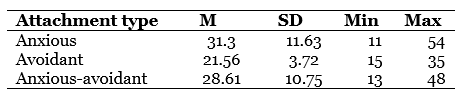
The level of subjective loneliness (Russell–Ferguson Loneliness Scale) differed across groups. As shown in Table 1, respondents with avoidant attachment demonstrated a moderate level of loneliness (M = 21.56, SD = 3.72), whereas in the anxious (M = 31.3, SD = 11.63) and anxious-avoidant (M = 28.61, SD = 10.75) groups some individuals reached high values (maximum 54 and 48, respectively).
Table 1. Descriptive statistics of subjective loneliness by attachment type (all participants)
| Attachment type | M | SD | Min | Max |
| Anxious | 31.3 | 11.63 | 11 | 54 |
| Avoidant | 21.56 | 3.72 | 15 | 35 |
| Anxious-avoidant | 28.61 | 10.75 | 13 | 48 |
3.2. Gender Differences in the Experience of Loneliness
The Mann–Whitney U test was used to examine whether men and women differ in loneliness levels within each attachment type. No statistically significant differences were found in any group (Table 2). Thus, Hypothesis 1 was supported: the attachment quality factor is more influential than gender.
Table 2. Comparison of men and women on subjective loneliness (Mann–Whitney test, U)
| Attachment type | Mean (men) | Mean (women) | U | p |
| Anxious | 31.71 | 31.08 | 179.0 | 0.932 |
| Avoidant | 21.6 | 21.5 | 119.5 | 0.985 |
| Anxious-avoidant | 31.1 | 26.25 | 29.5 | 0.360 |
3.3. Marital Satisfaction in Different Attachment Groups
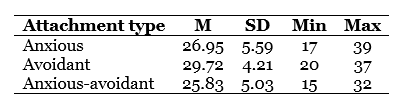
Mean marital satisfaction scores (Stolin, Romanova, Butenko questionnaire) are presented in Table 3. The lowest satisfaction was observed in the anxious-avoidant group (M = 25.83, SD = 5.03), corresponding to a “rather unfavourable” level. In the anxious group, the mean was at the borderline between unfavourable and transitional levels (M = 26.95, SD = 5.59). In the avoidant group, satisfaction was higher (M = 29.72, SD = 4.21), approaching a favourable level.
Table 3. Descriptive statistics of marital satisfaction by attachment type
| Attachment type | M | SD | Min | Max |
| Anxious | 26.95 | 5.59 | 17 | 39 |
| Avoidant | 29.72 | 4.21 | 20 | 37 |
| Anxious-avoidant | 25.83 | 5.03 | 15 | 32 |
No gender differences in marital satisfaction were found for the entire sample (U = 943.5, p = 0.579).
3.4. Correlations Between Loneliness and Marital Satisfaction (Spearman’s rs)
Spearman correlation analysis (Table 4) revealed:
- For respondents with anxiousattachment – a strong negative correlation (rs=−0.804, p≤0.01): the higher the subjective loneliness, the lower the marital satisfaction.
- For respondents with anxious-avoidantattachment – a moderate negative correlation (rs=−0.470, p≤0.05).
- For respondents with avoidantattachment – no significant correlation (rs=−0.198, p=0.276)
Separate analyses for men and women within each attachment type yielded similar patterns.
Discussion
- Brief Summary of Main Results
The study aimed to identify the characteristics of subjective loneliness in marriage among men and women with different insecure attachment types. The main results showed: (1) no gender differences in loneliness levels for the same attachment type; (2) the highest loneliness levels in anxious and anxious-avoidant types, the lowest in avoidant type; (3) strong negative correlations between loneliness and marital satisfaction for anxious (rs=−0.804) and anxious-avoidant (rs=−0.470) types, and no significant correlation for avoidant type.
- Interpretation in the Context of Existing Literature
Gender differences. The absence of statistically significant differences between men and women in subjective loneliness within each attachment type (see Table 2) indicates that the factor of attachment quality differences is more influential than gender. This result agrees with Karabanova and Shevlyakova (2022), who showed that although women use avoidant behavioural patterns less frequently and feel more comfortable with closeness, the overall level of loneliness for the same attachment type does not differ. This also confirms Bowlby’s (2004) theoretical position that attachment is a stable characteristic formed in early ontogenesis and determines patterns of close relationships in adulthood regardless of gender.
Differences between insecure attachment types. Statistically significant differences in loneliness levels between groups (H=12.393; p≤0.01), with the highest values in anxious and anxious-avoidant types, are explained by the specific psychological mechanisms of each type. As noted by Palagina, Morozova, and Novoselova (2022, p. 236), loneliness is often “accompanied by other mental expressions, such as anxiety, boredom, emptiness, and depression.” Individuals with anxious attachment have a high need for approval and preoccupation with relationships combined with self-doubt, so even a slight deficit in intimacy triggers acute loneliness. In anxious-avoidant individuals, as Isakova and Chebotareva (2022, p. 130) indicate, there is an internal conflict: on one hand, preoccupation with relationships and need for closeness; on the other, discomfort in relationships and their secondary importance. This creates a basis for high loneliness. For avoidant type, in contrast, self-confidence and distrust of others, discomfort with closeness, and autonomy are characteristic, so loneliness is experienced as habitual and even comfortable.
Relationship between loneliness and marital satisfaction. The negative correlation found in respondents with anxious attachment (rs=−0.804; p≤0.01) can be interpreted as follows: individuals with this attachment type feel a need for close emotional intimacy and a desire to “fuse” with the partner while being highly self-doubting. Relationships in which they subjectively feel loneliness are utterly unsatisfactory, whereas a marriage they are satisfied with reduces anxiety and increases self-confidence. Similarly, the negative correlation in spouses with anxious-avoidant attachment (rs=−0.470; p≤0.05) shows that, despite suspiciousness and distrust, the desire for closeness “wins” in marital relationships. If relationships do not provide closeness and cause a strong experience of loneliness, marital satisfaction decreases; if they reduce loneliness by providing feelings of closeness, cohesion, and inclusion, satisfaction increases. High marital satisfaction can be the “medicine” that helps a person with anxious-avoidant attachment overcome suspiciousness, distrust, and the tendency to excessive control.
The absence of a significant correlation in spouses with avoidant attachment is explained by the behavioural model in which the partner fears closeness, tries to maintain autonomy, and establishes distance. The feeling of loneliness is habitual and comfortable, so increasing marital satisfaction does not change the avoidant stance.
- Comparison with Other Studies
Our results on high levels of subjective loneliness in anxious and anxious-avoidant types are complemented by Levchuk’s (2025) findings on the key role of cognitive interpretation of loneliness. Negative perception of loneliness, fear of responsibility, and spiritual experience show the most pronounced negative correlations with components of psychological well-being (r from –0.300 to –0.608, p<0.01), whereas perception of loneliness as a temporary phenomenon is positively associated with autonomy and personal growth (r=0.208 and 0.276, ely, p<0.01) (Levchuk, 2025, pp. 5–6). For individuals with anxious attachment, negative interpretation of loneliness likely serves as the key mechanism mediating the reduction in marital satisfaction. Of particular interest are data on the spiritual perception of loneliness: it was associated with worsening psychological state (r from –0.299 to –0.608, p<0.01) and positively with hopelessness (r=0.486, p<0.01). For spouses with anxious-avoidant attachment, who are prone to suspiciousness and fixation on relationships, unreflected spiritual experience of loneliness may exacerbate maladaptive states and reduce marital satisfaction.
Opekina and Saporovskaya (2022) found that among adults who have long been without romantic relationships, the most pronounced emotional states are loneliness (70%), frustration (80%), sadness (57.7%), and anxiety (48%). Respondents prone to negative self-attitude and perceiving the absence of relationships as “loneliness” more often report that without romantic relationships “their life has no meaning,” “they are needed by no one,” “no one will support or care for them” (Opekina & Saporovskaya, 2022, p. 58). These findings resonate with our results: for spouses with anxious attachment, who are also prone to negative interpretation of their situation, the experience of loneliness in marriage is most acute and linked to low marital satisfaction. The similarity is that in both the absence of relationships and their presence, the key factor is not so much objective status as subjective evaluation of one’s involvement in close relationships and the self-image within those relationships.
Petrash and colleagues (2021) showed that the effectiveness of coping with loneliness depends on the type of attitude toward it. For representatives of the “coping” type, characterised by high loneliness experience, the most resourceful strategies were planning problem-solving and taking responsibility, whereas distancing and escape-avoidance intensified negative experiences (Petrash et al., 2021, pp. 349–350). This suggests that the negative relationship between loneliness and marital satisfaction in individuals with anxious and anxious-avoidant attachment may be mediated by the choice of coping strategies.
Belova (2022) found that women in “common-law” marriages show elevated scores on the “Alienation” scale (U=289, p<0.05), reflecting dissatisfaction with emotional ties with close others. The author links this to a mismatch between ideal representations of close relationships and their actual quality, which is particularly relevant for spouses with anxious and anxious-avoidant attachment, who have a high need for reliability and closeness. Vasyagina and Podyanova (2024) added that married women have a higher level of psychological well-being, manifested in greater life engagement, ability to find interesting moments in daily activities, and lower scores on self-blame and internal conflict (pp. 200–201). This indicates that psychological help for women experiencing loneliness in marriage should consider not only their attachment type but also the broader context – presence of children, form of marital relationship, and overall psychological well-being.
Karabanova and Shevlyakova (2022) confirmed that the anxious-ambivalent attachment type is associated with the lowest marital satisfaction (r=−0.589, p<0.001) and that marital satisfaction increases with greater significance of close relationships (r=−0.234, p<0.05) and reduced fixation on relationships (r=−0.620, p<0.001). These data complement our study, demonstrating that not only attachment type but also gender characteristics can influence relationship perception and loneliness experience in marriage. Furthermore, Troshikhina (2024) found that in couples expressing a desire to divorce, feelings of love and affection are significantly weaker, men’s relationship satisfaction is lower, and the psychological well-being of both spouses is reduced (for women – lack of competence, for men – difficulties in setting life goals, for both – low self-acceptance) (p. 122). This indicates that work with married couples experiencing loneliness in marriage should include not only relationship correction but also support for each spouse’s personal development.
- Theoretical and Practical Implications
The results contribute to understanding the mechanisms linking attachment type to marital well-being. They show that subjective loneliness acts as a key mediator in this relationship, especially for anxious and anxious-avoidant types. Moreover, the data confirm that attachment quality is a stronger predictor of loneliness than gender, consistent with evolutionary attachment theory (Bowlby, 2004).
There are many psychological tools for spouses to increase marital satisfaction. This may include work (self-directed or with a counsellor) to improve the quality of marital communication by developing reflection and empathy (rational, emotional, intuitive channels) in each spouse (Zotova et al., 2015). It may also include work to improve joint leisure and more acceptable distribution of responsibilities, and to develop constructive conflict resolution strategies (Mikhailovskaya, 2018; Kirsanova, 2022). Given Levchuk’s (2025) findings on the key role of cognitive interpretation of loneliness, psychological help for spouses experiencing loneliness in marriage should aim not only at forming adaptive coping strategies but also at changing the nature of interpretation of the loneliness state itself. In work with spouses, especially those with anxious and anxious-avoidant attachment, it is advisable to use cognitive restructuring techniques aimed at reinterpreting loneliness as a temporary and surmountable state, as well as reducing the fear of responsibility for the quality of the relationship.
- Practical Recommendations
The results point to the role of marital satisfaction as a characteristic of the marital union in overcoming the discomfort experienced in relationships by people with anxious and anxious-avoidant attachment types. Given Levchuk’s (2025) findings on the key role of cognitive interpretation of loneliness, psychological help for spouses experiencing loneliness in marriage should aim not only at forming adaptive coping strategies but also at changing the nature of interpretation of the loneliness state itself. In work with spouses, especially those with anxious and anxious-avoidant attachment, it is advisable to use cognitive restructuring techniques aimed at reinterpreting loneliness as a temporary and surmountable state, as well as reducing the fear of responsibility for the quality of the relationship. For spouses with avoidant attachment, it is important to respect their autonomy and gradually build the value of close relationships without forcing intimacy.
- Limitations
The results have several limitations that should be considered when interpreting and generalising the conclusions. First, the sample included only spouses who sought psychological help, which may have influenced the intensity of loneliness and marital satisfaction; these indicators may differ in the general population. Second, the study had a correlational design, which does not allow causal inferences about the relationships between attachment type, loneliness, and marital satisfaction. Third, the sample was limited in age (30–31 years) and marriage duration (5–10 years), and did not include respondents with secure attachment, narrowing the possibilities for comparison. Finally, only self-report methods were used, which may be subject to social desirability and subjective bias.
- Future Research Directions
Longitudinal studies are needed to examine the dynamics of marital loneliness, to include secure attachment groups, and to investigate mediators (e.g., coping strategies, communication quality, presence of children) in the relationship between attachment, loneliness, and marital satisfaction. Additionally, it would be useful to compare clinical and non-clinical samples and to expand the age range and marriage duration.
Conclusions
Based on statistical and mathematical analysis of the empirical data obtained, it has been demonstrated that:
- The level of subjective loneliness in marriage does not differ between men and women– for insecure attachment types, both men and women show the same level of subjective loneliness. The factor of differences in attachment quality is more influential than the factor of gender differences.
- The most frequent attachment type for both men and women is anxiousattachment (44.4% of the total sample). The distinguishing feature of such individuals is high self-doubt, need for approval, and preoccupation with relationships. The second most frequent is avoidant attachment (35.6% of the sample): its distinguishing feature is a predominance of self-confidence and distrust of others, heightened discomfort with relationships, and the secondary importance of the relationship sphere. The least frequent is anxious-avoidant attachment (20% of the sample): these individuals are characterised by multidirectionality in relationships due to opposing tendencies – on one hand, preoccupation with relationships with a dysfunctional need for closeness and approval, and on the other, discomfort in relationships and their secondary importance.
- Statistically significant differences in subjective loneliness were found among spouses with anxious, anxious-avoidant, and avoidant attachment. The subjective loneliness score is statistically higher in the anxious attachment group and lower in the avoidant attachment group. This is explained by the role, content, and significance of interpersonal relationships in different attachment disturbances, as well as by the psychological mechanisms determining attachment and relationship characteristics in different groups. As confirmed by Isakova and Chebotareva (2022), the closest relationship between loneliness in a couple and attachment is found precisely for romantic and family loneliness, with avoidance of closeness being more strongly associated with family loneliness and relationship anxiety with romantic loneliness.
- The following correlations between subjective loneliness and marital satisfaction were found:
- A negative correlation for respondents with anxiousattachment: the higher the subjective loneliness of spouses with anxious attachment, the lower their marital satisfaction.
- A negative correlation for spouses with anxious-avoidantattachment: the higher the subjective loneliness, the lower the marital satisfaction.
- No statistically significant correlation was found for spouses with avoidantattachment, which may be explained by the autonomy and distance in relationships maintained over years of marriage, substituting the emotional context of close trusting relationships with other aspects of family functions.
- This study, complemented by data on the wide prevalence of subjective loneliness in Russian society (43% of Russians experience loneliness, and 69.8% – from time to time; Kononov & Ishchenko, 2024, pp. 49, 55), shows that in marriage this experience acquires particular significance. In spouses with insecure attachment types, loneliness does not become a resource for personal growth but manifests as a destructive state accompanied by a predominance of negative emotions (sadness, fear, anxiety) and the use of avoidant coping strategies, leading to reduced marital satisfaction.
- The results confirm the view of loneliness in close interpersonal relationships as a predominantly destructive experience, consistent with the position of most researchers who consider loneliness “as a negatively influencing emotional experience that has a detrimental effect on the personality” (Palagina et al., 2022, p. 235). At the same time, the degree of negative impact of loneliness on marital satisfaction varies significantly depending on the spouses’ attachment type.
Conflict of Interest: The author declares no conflict of interest.
Author Contributions: The author takes full responsibility for the integrity and accuracy of the data presented in this study, has reviewed and approved the final version, and agrees to be accountable for all aspects of the work.
Ethical Approval: This study was conducted in accordance with the Declaration of Helsinki. Ethical approval was obtained from the Ethics Committee of Moscow Pedagogical State University). Informed consent was obtained from all individual participants.
Funding: This research received no specific grant from any funding agency in the public, commercial, or not-for-profit sectors.
Acknowledgements: The author thank all participants for their time and honest responses. The author also would like to thank the editors and anonymous reviewers for their constructive comments that improved the quality of this manuscript.
References
- Antonova, N. V. (2023). The individual and society under the “new normal”: A review of sociological studies of pandemic. Bulletin of the South Ural State University. Ser. Social Sciences and the Humanities, 23(1), 64–72. DOI: 10.14529/ssh230108
- Barsukova, S. V., & Barsukov, S. M. (2021). Loneliness as a social phenomenon of modern society. In Modern applied research, pp. 45-51. Publisher: Platov South Russian State Polytechnic University (NPI) (Novocherkassk) [Odinochestvo kak sotsial’nyy fenomen sovremennogo obshchestva. In Sovremennye prikladnye issledovaniya(pp. 45–51)].
- Belova, E. V. (2022). Subjective experience of loneliness by women with different marital status. International research journal, 1(115), 1–5. [Subjective experience of loneliness by women with different family status. Mezhdunarodnyy nauchno-issledovatel’skiy zhurnal, 1(115), 1–5]. https://doi.org/10.23670/IRJ.2022.115.1.067
- Bowlby, J. (1979). The making & breaking of affectional bonds. Tavistock Publikations.
- Dmitrieva, N. V., Antilogova, L. N., & Lagunova, A. I. (2017). Fear of loneliness. Algorithm and techniques of psychocorrection. Psychopedagogics in law enforcement, 2(69), 38–41.
- Drobyshevsky, V. S., & Romanova, N. P. (2004). Therapy of loneliness or therapy by loneliness? Chita State University. [Terapiya odinochestva ili terapiya odinochestvom?Chitinskiy gosudarstvennyy universitet].
- Dukhnovsky, S. V. (2009). Diagnosis of interpersonal relationships: Psychological workshop. St. Petersburg: Publishing house “Rech'”. [Diagnostika mezhlichnostnykh otnosheniy. Psikhologicheskiy praktikum. Rech’].
- Golod, S. I. (2008). Russian family’s state and evolution – sociological demographic analysis. Sotsiologicheskie issledovaniya, (1), 40-49.
- Isakova, T. V., & Chebotareva, E. Yu. (2021). The relationship between the experience of loneliness in a couple and attachment to a partner. In Psy-HSE: collection of materials of the All-Russian Scientific and Practical Conference. Moscow, May 20-22, 2021. Moscow: Higher School of Economics, pp. 129-131. [Vzaimosvyaz’ perezhivaniya chuvstva odinochestva v pare i privyazannosti k partneru. In Psy-Vyshka: sbornik materialov Vserossiyskoy nauchno-prakticheskoy konferentsii(pp. 129–131). HSE University].
- Karabanova, O. A., & Shevlyakova, E. V. (2022). The type of attachment as a factor in the psychological adaptation of the family in the face of global challenges. International research journal, 11(125), Article 72. https://doi.org/10.23670/IRJ.2022.125.108
- Kirsanova, T. S. (2022). Socio-psychological technologies for the development of marital satisfaction. Bulletin of the Magistracy. Psychological sciences, 5-2(128), 56–57. [Sotsial’no-psikhologicheskie tekhnologii razvitiya udovletvorennosti brakom. Vestnik magistratury. Psikhologicheskie nauki, 5-2(128), 56–57].
- Kononov, A. N., & Ishchenko, M. E. (2024). Psychological Aspects of the Perceptions of Subjective Loneliness (The Study of the Sample of Russian Citizens). The Bulletin of Irkutsk State University. Series Psychology, 47, 48-65. https://doi.org/10.26516/2304-1226.2024.47.48
- Levchuk, I. A. (2025). Relationships between personality traits and experience of loneliness. Psychology and psychotechnics, (2), 62-73. https://doi.org/10.7256/2454-0722.2025.2.74475
- Lidzhieva, O. A., Beyshembieva, A. D., Lidzhiev, P. G., Bembetova, B. S., & Ardzheniya, Ya. T. (2019). The problem of loneliness in the works of Russian and foreign psychologists. Historical and critical reviews and modern research, 8(3-1), 247-256. [Problema odinochestva v rabotakh otechestvennykh i zarubezhnykh psikhologov. Psikhologiya. Istoriko-kriticheskie obzory i sovremennye issledovaniya, 8(3-1), 247–256].
- Mikhaylova, N. V. (2018). Loneliness as an interdisciplinary problem. Bulletin of Perm University. Philosophy. Psychology. Sociology”, (3), 420–428. https://doi.org/10.17072/2078-7898/2018-3-420-428
- Mikhaylovskaya, P. M. (2018). Marriage satisfaction. Methods of increasing the level of satisfaction. Moscow Information and Technology University – Moscow Architecture and Construction Institute review, (14), 69–72.
- Opekina, T. P., & Saporovskaya, M. V. (2022). Peculiarities of emotional states of adults in a situation of long-term absence of romantic relationships. Herald of Omsk university. Series: psychology, (4), 55–61. https://doi.org/10.24147/2410-6364.2022.4.55-61
- Palagina, N. S., Morozova, A. A., & Novoselova, O. V. (2022). Definition and understanding of the concept of loneliness in modern sciences. Science. Scientific personnel, (1), 235—237. https://doi.org/10.24411/2073-3305-2022-1-235-237
- Petrash, M. D., Strizhitskaya, O. Yu., Murtazina, I. R., Vartanyan, G. A., & Shchukin, A. V. (2021). Attitude to loneliness: Behavioral strategies as coping resources. Vestnik of Saint Petersburg Psychology, 11(4), 341–355. https://doi.org/10.21638/spbu16.2021.404
- Pokrovskaya, S. V., & Tsvetkova, N. A. (2020). Features of a request for psychological assistance in an emergent situation of the covid-19 pandemic. Historical and critical reviews and modern research, 9(4-1), 159–164. [Osobennosti zaprosa na psikhologicheskuyu pomoshch’ v emerdzhentnoy situatsii pandemii COVID-19. Psikhologiya. Istoriko-kriticheskie obzory i sovremennye issledovaniya, 9(4-1), 159–164].
- Raygorodsky, D. Ya. (Ed.). (1998). Practical psychodiagnostics. Methods and tests. Samara: Bahrakh Publishing House, 77-78. [Prakticheskaya psikhodiagnostika. Metodiki i testy. Izdatel’skiy Dom «Bakhrakh»].
- Shikina, A. A., & Aidarova, E. N. (2019). Theoretical approaches to the problem of loneliness: from “pathology” to the resource. The World of Pedagogy and Psychology, 8 (37), 72-80.
- Troshikhina, E. G. (2024). Married couples: The significance of psychological wellbeing and subjective loneliness for feelings of love. Vestnik of Saint Petersburg university. Psychology, 14(1), 113–127. https://doi.org/10.21638/spbu16.2024.107
- Tsvetkova, N. A. (2016). Consulting of families in difficult life situations. Personality development, (2), 157–178. [Konsul’tirovanie sem’i v trudnykh zhiznennykh situatsiyakh. Family counselling in difficult life situations. Razvitie lichnosti, (2), 157–178].
- Tsvetkova, N. A. (2018). Transformation of the family roles as the lead trend of the modern step of the family institute development. School of the Future, (4), 41–46. [Transformatsiya semeniykh roley kak vedushchaya tendentsiya sovremennogo etapa razvitiya instituta sem’i. Shkola budushchego, (4), 41–46].
- Tsvetkova, N. A. (2022). Features of interaction with the child of mothers with different levels of family anxiety. International Journal of Medicine and Psychology, 5(8), 134–140.
- Vasyagina, N. N., & Podyanova, E. A. (2024). Features of the subjective experience of loneliness in married and unmarried women. Pedagogical Education in Russia, (1), 194–203.
- Velkov, V. V. (2003). What the humankind evolution is making for? Human being, (2), 16–29.
- Yuldasheva, M. B. (2021). Analysis of methodological approaches to the interpretation of the feeling of loneliness. Society and innovations. Special Issue, 9, 50-59.
- Zotova, R. A., Kondratyuk, O. E., & Tsvetkova, N. A. (2015). Reflection and rational, emotional, intuitive channels of empathy as psychological mechanisms ensuring an increase in marital satisfaction. Problems of modern science and education, 11(41), 224–228. [Refleksiya i ratsional’nyy, emotsional’nyy, intuitivnyy kanaly empatii kak psikhologicheskie mekhanizmy, obespechivayushchie povyshenie udovletvorennosti suprugami brakom. Problemy sovremennoy nauki i obrazovaniya, 11(41), 224–228].
Comments (0)
Relevance and Background. In modern society, the phenomenon of “loneliness together” is widespread: spouses experience subjective loneliness despite formally having a marital partner. This problem becomes particularly significant due to the increasing number of requests for psychological help in overcoming loneliness in marriage. Despite the rich history of attachment research, the question of how attachment type (anxious, avoidant, anxious-avoidant) is related to the subjective experience of loneliness in marriage among men and women remains insufficiently studied. Objective. To identify the characteristics of the subjective experience of loneliness in marriage as reported by men and women with different attachment types. Methods. The sample consisted of 90 people: 44 men (mean age 30.96 years) and 46 women (mean age 30.8 years) with marital duration from 5 to 10 years. The Attachment Style Questionnaire (ASQ, J. Feeney et al.), the Russell–Ferguson Loneliness Scale (UCLA Loneliness Scale), and the Marital Satisfaction Questionnaire (V.V. Stolin, T.A. Romanova, and G.P. Butenko) were used in the study. Statistical processing included nonparametric Kruskal–Wallis, Mann–Whitney, and Spearman rank correlation tests. Results. (1) For anxious, avoidant, and anxious-avoidant attachment types, men and women demonstrated the same level of subjective loneliness in marriage, indicating that the attachment quality factor is more influential than gender differences. (2) A negative correlation was found between subjective loneliness and marital satisfaction in respondents with anxious attachment (rs=−0.804; p ≤ 0.01): the higher the loneliness, the lower the marital satisfaction. (3) A similar negative correlation was revealed in spouses with anxious-avoidant attachment (rs=−0.470; p≤0.05). For respondents with avoidant attachment, no statistically significant correlation was found. Conclusion. Attachment type is an important predictor of the experience of loneliness in marriage and its relationship with marital satisfaction. The practical application of the results lies in psychological counselling for families experiencing marital dissatisfaction: interventions should be differentiated according to the spouses’ anxious, anxious-avoidant, or avoidant attachment types.
Особенности субъективного переживания одиночества в браке мужчинами и женщинами с разным типом привязанности
Н. А. Цветкова
Московский педагогический государственный университет, Москва, Россия
Резюме. Актуальность и обоснование. В современном обществе распространён феномен «одиночества вдвоём», когда супруги переживают субъективное одиночество, несмотря на формальное наличие брачного партнёра. Особую значимость эта проблема приобретает в связи с ростом запросов на психологическую помощь в преодолении одиночества в браке. Несмотря на богатую историю изучения привязанности, остаётся недостаточно исследованным вопрос о том, как тип привязанности (тревожный, избегающий, тревожно-избегающий) связан с субъективным переживанием одиночества в браке у мужчин и женщин. Цель. Выявить особенности субъективного переживания одиночества в браке мужчинами и женщинами с разным типом привязанности. Методы. Выборку составили 90 человек – 44 мужчины (средний возраст 30.96 года) и 46 женщин (30.8 года) со стажем семейной жизни от 5 до 10 лет. Использованы три психодиагностические методики: опросник типа привязанности ASQ (J. Feeney et al.), шкала одиночества Д. Рассела и М. Фергюсона (UCLA Loneliness Scale), опросник удовлетворённости браком В.В. Столина, Т.А. Романовой, Г.П. Бутенко. Статистическая обработка включала непараметрические критерии Краскела–Уоллиса, Манна–Уитни и ранговую корреляцию Спирмена. Результаты. (1) При тревожном, избегающем и тревожно-избегающем типах привязанности мужчины и женщины демонстрируют одинаковый уровень субъективного переживания одиночества в браке, что указывает на бóльшую значимость фактора привязанности по сравнению с половыми различиями. (2) Обнаружена отрицательная корреляция между субъективным одиночеством и удовлетворённостью браком у респондентов с тревожным типом привязанности (rs=−0.804, p≤0.01): чем выше одиночество, тем ниже удовлетворённость браком. (3) Аналогичная отрицательная связь выявлена у супругов с тревожно-избегающим типом привязанности (rs=−0.470, p≤0.05). Для респондентов с избегающим типом привязанности статистически значимой корреляции не установлено. Заключение. Тип привязанности выступает важным предиктором переживания одиночества в браке и его связи с удовлетворённостью супружескими отношениями. Практическое применение результатов возможно в психологическом консультировании семей, испытывающих неудовлетворённость браком: работа должна быть дифференцированной с учётом тревожного, тревожно-избегающего или избегающего типа привязанности супругов.
Ключевые слова: тип привязанности, удовлетворенность браком, субъективное ощущение одиночества.
The relevance of the topic is determined by several factors. First, in the modern world, the experience of loneliness is becoming a socially significant problem (Antonova, 2023; Mikhailova, 2018; Shikina & Aidarova, 2019). Every year, more and more people subjectively identify themselves as lonely, regardless of their marital status (Velkov, 2003; Barsukova & Barsukov, 2021). Loneliness reflects dissatisfaction with the quality of social connections (Lidzhieva et al., 2019) both in the macro- and micro-society of the family.
In contemporary science, the phenomenon of loneliness is interpreted ambiguously. As Palagina, Morozova, and Novoselova (2022) point out, “in philosophical and psychological theories, the phenomenon of loneliness is explained ambiguously… in one case it is understood as destructive for the personality, in another – as an important stage of self-knowledge and self-determination” (p. 235). Theoretical understanding of loneliness in world psychology is represented by several approaches. The psychodynamic direction (S. Freud, K. Horney, F. Fromm-Reichmann) views loneliness as a consequence of narcissism, aggressiveness, and early childhood trauma (Yuldasheva, 2021, pp. 2–3). The sociological approach (D. Riesman, C. Bowman, R. Slater) emphasises the impact of social transformations and urbanisation (Yuldasheva, 2021, p. 4). The cognitive approach (E. Peplau, D. Perlman, K. Rook) defines loneliness as a result of discrepancy between desired and actual levels of social interaction (Yuldasheva, 2021, pp. 4–5). The interactionist approach (R. Weiss, V. Serma) distinguishes between social and emotional loneliness (Yuldasheva, 2021, p. 5). Existential and humanistic approaches (C. Moustakas, I. Yalom, A. Maslow, N. A. Berdyaev) consider loneliness as a universal condition of existence that can become a resource for self-knowledge and personal growth (Yuldasheva, 2021, pp. 7–8). The phenomenological approach (C. Rogers, W. Sadler) emphasises the discrepancy between the “real self” and the “ideal self” (Yuldasheva, 2021, p. 6). Despite their differences, these approaches converge on the idea that the experience of loneliness is closely linked to the quality of close relationships and satisfaction with social ties.
Cognitive interpretation of loneliness plays a key role. As shown in the study by Levchuk (2025), different aspects of the loneliness experience – negative feeling, denial, perception as a temporary phenomenon, fear of responsibility, spiritual and physical experience – are differently related to psychological well-being, satisfaction of basic needs, social intelligence, and hopelessness. In particular, negative perception of loneliness, fear of responsibility, and spiritual experience show the most pronounced negative correlations with components of psychological well-being (r from –0.300 to –0.608, p<0.01), whereas perception of loneliness as a temporary phenomenon is positively associated with autonomy and personal growth (r=0.208 and r=0.276, p<0.01) (Levchuk, 2025, pp. 5–6).
The scale of the problem is confirmed by empirical data: according to the Higher School of Economics and the Federal Center of Theoretical and Applied Sociology of the Russian Academy of Sciences, 43% of Russians experience loneliness (Kononov & Ishchenko, 2024, p. 49). According to a 2023 survey, 69.8% of respondents feel lonely from time to time, and 15.8% – often (Kononov & Ishchenko, 2024, p. 55). Loneliness is experienced differently: Petrash and colleagues (2021) identified four types of attitude towards loneliness – “adaptive”, “dependent”, “coping”, and “self-sufficient” – which significantly differ in life satisfaction and psychological well-being (pp. 346–347).
Of particular interest is the phenomenon of “loneliness together” – the impoverishment of marital communication, the failure of the family to perform its psychotherapeutic function (Golod, 2008; Tsvetkova, 2018). Many spouses satisfy their communicative needs outside the family, which reduces marital satisfaction (Drobyshevsky & Romanova, 2004; Tsvetkova, 2016) and can lead to marital breakdown (Pokrovskaya & Tsvetkova, 2020). At the same time, family researchers note that the psychotherapeutic function is becoming paramount and is demanded by both men and women.
Additional data on the relationship between loneliness in a couple and attachment are presented in a pilot study by Isakova and Chebotareva (2022) on a sample of 31 respondents (30–55 years). The authors found that romantic loneliness significantly correlates with avoidance of closeness (r=0.43) and relationship anxiety (r=0.44), while family loneliness correlates with avoidance of closeness (r=0.52) (Isakova & Chebotareva, 2022, p. 130). Frustration, a tendency to “fuse with the partner”, and ambivalence increase the feeling of loneliness in a couple, whereas the desire for closeness, acceptance, and emotional intimacy reduce it (ibid.).
Studies of married couples confirm that subjective loneliness can be experienced even in the presence of a marital partner. In the work of Troshikhina (2024) on a sample of 387 married couples with marriage duration from six months to 50 years, it was shown that the level of subjective loneliness among spouses is not high (mean values 11.45–11.95 points on a scale up to 60), but its role in marriage is ambiguous. Subjective loneliness of a husband reduces his feelings of love for his wife, whereas subjective loneliness of a husband, on the contrary, increases the wife’s love for him (Troshikhina, 2024, p. 121).
The form of marital relationship is also important. Belova (2022) on a sample of 160 women showed that women in unregistered (“common-law”) marriages demonstrate a higher level of subjective loneliness compared to officially married women, and also more often experience alienation in close relationships (p. 3). At the same time, women in official marriages perceive solitude as a resource rather than a threat. Vasyagina and Podyanova (2024) found that married women perceive loneliness more calmly as an opportunity for solitude and time for reflection, whereas women without partner relationships perceive the world as less benevolent, evaluate themselves more critically, and show higher levels of self-blame and internal conflicts (pp. 198–200).
Despite the rich history of attachment research initiated by Bowlby (2004), most studies still focus on the impact of attachment on the quality of motherhood and family upbringing (Tsvetkova, 2022); research on how attachment type formed in ontogenesis affects adult marital relationships is clearly insufficient. In a study by Karabanova and Shevlyakova (2022) on a sample of 89 respondents, it was shown that the highest marital satisfaction is characteristic of individuals with secure and avoidant attachment types, whereas the anxious-ambivalent type is associated with the lowest satisfaction (p. 3). The authors explain this by the fact that in the modern family, respect for personal boundaries and autonomy of spouses is gaining importance, which corresponds to the needs of individuals with avoidant attachment.
Additional data on the relationship between loneliness and attachment were obtained by Opekina and Saporovskaya (2022). Among adults who have long been without romantic relationships, 70% of participants report experiencing loneliness, and in some cases, it is described as a total experience of “uselessness”, “abandonment”, “alienation” (p. 57). The key role is played by the subjective interpretation of this state, not the objective absence of relationships.
Thus, the accumulated evidence indicates a complex relationship between attachment type, the experience of loneliness in marriage, and marital satisfaction. However, the following questions remain unresolved: (1) does the level of subjective loneliness in marriage differ between men and women with the same insecure attachment type; (2) are there significant differences in loneliness levels between different insecure attachment types (anxious, avoidant, anxious-avoidant); (3) how are subjective loneliness and marital satisfaction related within each of these types. These questions acquire particular practical significance because over the past two decades, one of the most common requests in family counselling has been help in overcoming the experience of loneliness (Dmitrieva et al., 2017).
The objective of the study is to identify the characteristics of the subjective experience of loneliness in marriage as reported by men and women with different attachment types (anxious, avoidant, anxious-avoidant).
Research Hypotheses:
- The level of subjective loneliness in marriage does not differ between men and women with the same insecure attachment type; the factor of attachment quality differences is more influential than the factor of gender differences.
- There are statistically significant differences in the level of subjective loneliness between groups with different insecure attachment types: the highest level is observed in anxious and anxious-avoidant types, the lowest – in avoidant type.
- A negative correlation exists between subjective loneliness and marital satisfaction in respondents with anxious and anxious-avoidant attachment types; no such correlation exists in respondents with avoidant attachment type.
To study the characteristics of the subjective experience of loneliness in marriage by men and women with different attachment types, 90 people were recruited for the study: 44 men (mean age 30.96 years) and 46 women (30.8 years) with marital duration from 5 to 10 years (mean marriage duration for men – 5.43 years, for women – 6.8 years). All survey participants were clients of various psychological counseling centers.
To achieve the set objectives, the following psychodiagnostic methods were used:
(a) the Attachment Style Questionnaire (ASQ) by J. Feeney et al.;
(b) the Russell–Ferguson Loneliness Scale (UCLA Loneliness Scale) (Raygorodsky, 1998);
(c) the Marital Satisfaction Questionnaire by V.V. Stolin, T.A. Romanova, and G.P. Butenko (Dukhnovsky, 2009), as well as mathematical data processing methods using the IBM SPSS Statistics 22 for Windows software package. The nonparametric Kruskal–Wallis test and the nonparametric Mann–Whitney U test were used.
The choice of the loneliness diagnostic method (Russell–Ferguson Loneliness Scale) is justified by the theoretical understanding of loneliness as “a mental state of the individual expressing a feeling of one’s own separateness, a subjectively perceived impossibility or unwillingness to feel reciprocal feelings, acceptance and recognition of oneself by other people” (Palagina et al., 2022, p. 237).
The choice of methods for diagnosing attachment type and marital satisfaction is consistent with current research in this area. In particular, the study by O.A. Karabanova and E.V. Shevlyakova (2022) used the same tools – the ASQ and the Marital Satisfaction Questionnaire – to examine the relationship between attachment type and marital satisfaction (Karabanova & Shevlyakova, 2022, p. 2). This ensures methodological continuity and allows us to compare our results with the data presented in that study.
3.1. Descriptive Statistics and Grouping by Attachment Type
The sample (N = 90) was divided into three groups according to the predominant insecure attachment type measured by the ASQ (Feeney et al.). Respondents with secure attachment were not included. The most frequent type was anxious attachment (44.4% of the total sample), followed by avoidant (35.6%) and anxious-avoidant (20%).
The level of subjective loneliness (Russell–Ferguson Loneliness Scale) differed across groups. As shown in Table 1, respondents with avoidant attachment demonstrated a moderate level of loneliness (M = 21.56, SD = 3.72), whereas in the anxious (M = 31.3, SD = 11.63) and anxious-avoidant (M = 28.61, SD = 10.75) groups some individuals reached high values (maximum 54 and 48, respectively).
Table 1. Descriptive statistics of subjective loneliness by attachment type (all participants)
| Attachment type | M | SD | Min | Max |
| Anxious | 31.3 | 11.63 | 11 | 54 |
| Avoidant | 21.56 | 3.72 | 15 | 35 |
| Anxious-avoidant | 28.61 | 10.75 | 13 | 48 |
3.2. Gender Differences in the Experience of Loneliness
The Mann–Whitney U test was used to examine whether men and women differ in loneliness levels within each attachment type. No statistically significant differences were found in any group (Table 2). Thus, Hypothesis 1 was supported: the attachment quality factor is more influential than gender.
Table 2. Comparison of men and women on subjective loneliness (Mann–Whitney test, U)
| Attachment type | Mean (men) | Mean (women) | U | p |
| Anxious | 31.71 | 31.08 | 179.0 | 0.932 |
| Avoidant | 21.6 | 21.5 | 119.5 | 0.985 |
| Anxious-avoidant | 31.1 | 26.25 | 29.5 | 0.360 |
3.3. Marital Satisfaction in Different Attachment Groups
Mean marital satisfaction scores (Stolin, Romanova, Butenko questionnaire) are presented in Table 3. The lowest satisfaction was observed in the anxious-avoidant group (M = 25.83, SD = 5.03), corresponding to a “rather unfavourable” level. In the anxious group, the mean was at the borderline between unfavourable and transitional levels (M = 26.95, SD = 5.59). In the avoidant group, satisfaction was higher (M = 29.72, SD = 4.21), approaching a favourable level.
Table 3. Descriptive statistics of marital satisfaction by attachment type
| Attachment type | M | SD | Min | Max |
| Anxious | 26.95 | 5.59 | 17 | 39 |
| Avoidant | 29.72 | 4.21 | 20 | 37 |
| Anxious-avoidant | 25.83 | 5.03 | 15 | 32 |
No gender differences in marital satisfaction were found for the entire sample (U = 943.5, p = 0.579).
3.4. Correlations Between Loneliness and Marital Satisfaction (Spearman’s rs)
Spearman correlation analysis (Table 4) revealed:
- For respondents with anxiousattachment – a strong negative correlation (rs=−0.804, p≤0.01): the higher the subjective loneliness, the lower the marital satisfaction.
- For respondents with anxious-avoidantattachment – a moderate negative correlation (rs=−0.470, p≤0.05).
- For respondents with avoidantattachment – no significant correlation (rs=−0.198, p=0.276)
Separate analyses for men and women within each attachment type yielded similar patterns.
- Brief Summary of Main Results
The study aimed to identify the characteristics of subjective loneliness in marriage among men and women with different insecure attachment types. The main results showed: (1) no gender differences in loneliness levels for the same attachment type; (2) the highest loneliness levels in anxious and anxious-avoidant types, the lowest in avoidant type; (3) strong negative correlations between loneliness and marital satisfaction for anxious (rs=−0.804) and anxious-avoidant (rs=−0.470) types, and no significant correlation for avoidant type.
- Interpretation in the Context of Existing Literature
Gender differences. The absence of statistically significant differences between men and women in subjective loneliness within each attachment type (see Table 2) indicates that the factor of attachment quality differences is more influential than gender. This result agrees with Karabanova and Shevlyakova (2022), who showed that although women use avoidant behavioural patterns less frequently and feel more comfortable with closeness, the overall level of loneliness for the same attachment type does not differ. This also confirms Bowlby’s (2004) theoretical position that attachment is a stable characteristic formed in early ontogenesis and determines patterns of close relationships in adulthood regardless of gender.
Differences between insecure attachment types. Statistically significant differences in loneliness levels between groups (H=12.393; p≤0.01), with the highest values in anxious and anxious-avoidant types, are explained by the specific psychological mechanisms of each type. As noted by Palagina, Morozova, and Novoselova (2022, p. 236), loneliness is often “accompanied by other mental expressions, such as anxiety, boredom, emptiness, and depression.” Individuals with anxious attachment have a high need for approval and preoccupation with relationships combined with self-doubt, so even a slight deficit in intimacy triggers acute loneliness. In anxious-avoidant individuals, as Isakova and Chebotareva (2022, p. 130) indicate, there is an internal conflict: on one hand, preoccupation with relationships and need for closeness; on the other, discomfort in relationships and their secondary importance. This creates a basis for high loneliness. For avoidant type, in contrast, self-confidence and distrust of others, discomfort with closeness, and autonomy are characteristic, so loneliness is experienced as habitual and even comfortable.
Relationship between loneliness and marital satisfaction. The negative correlation found in respondents with anxious attachment (rs=−0.804; p≤0.01) can be interpreted as follows: individuals with this attachment type feel a need for close emotional intimacy and a desire to “fuse” with the partner while being highly self-doubting. Relationships in which they subjectively feel loneliness are utterly unsatisfactory, whereas a marriage they are satisfied with reduces anxiety and increases self-confidence. Similarly, the negative correlation in spouses with anxious-avoidant attachment (rs=−0.470; p≤0.05) shows that, despite suspiciousness and distrust, the desire for closeness “wins” in marital relationships. If relationships do not provide closeness and cause a strong experience of loneliness, marital satisfaction decreases; if they reduce loneliness by providing feelings of closeness, cohesion, and inclusion, satisfaction increases. High marital satisfaction can be the “medicine” that helps a person with anxious-avoidant attachment overcome suspiciousness, distrust, and the tendency to excessive control.
The absence of a significant correlation in spouses with avoidant attachment is explained by the behavioural model in which the partner fears closeness, tries to maintain autonomy, and establishes distance. The feeling of loneliness is habitual and comfortable, so increasing marital satisfaction does not change the avoidant stance.
- Comparison with Other Studies
Our results on high levels of subjective loneliness in anxious and anxious-avoidant types are complemented by Levchuk’s (2025) findings on the key role of cognitive interpretation of loneliness. Negative perception of loneliness, fear of responsibility, and spiritual experience show the most pronounced negative correlations with components of psychological well-being (r from –0.300 to –0.608, p<0.01), whereas perception of loneliness as a temporary phenomenon is positively associated with autonomy and personal growth (r=0.208 and 0.276, ely, p<0.01) (Levchuk, 2025, pp. 5–6). For individuals with anxious attachment, negative interpretation of loneliness likely serves as the key mechanism mediating the reduction in marital satisfaction. Of particular interest are data on the spiritual perception of loneliness: it was associated with worsening psychological state (r from –0.299 to –0.608, p<0.01) and positively with hopelessness (r=0.486, p<0.01). For spouses with anxious-avoidant attachment, who are prone to suspiciousness and fixation on relationships, unreflected spiritual experience of loneliness may exacerbate maladaptive states and reduce marital satisfaction.
Opekina and Saporovskaya (2022) found that among adults who have long been without romantic relationships, the most pronounced emotional states are loneliness (70%), frustration (80%), sadness (57.7%), and anxiety (48%). Respondents prone to negative self-attitude and perceiving the absence of relationships as “loneliness” more often report that without romantic relationships “their life has no meaning,” “they are needed by no one,” “no one will support or care for them” (Opekina & Saporovskaya, 2022, p. 58). These findings resonate with our results: for spouses with anxious attachment, who are also prone to negative interpretation of their situation, the experience of loneliness in marriage is most acute and linked to low marital satisfaction. The similarity is that in both the absence of relationships and their presence, the key factor is not so much objective status as subjective evaluation of one’s involvement in close relationships and the self-image within those relationships.
Petrash and colleagues (2021) showed that the effectiveness of coping with loneliness depends on the type of attitude toward it. For representatives of the “coping” type, characterised by high loneliness experience, the most resourceful strategies were planning problem-solving and taking responsibility, whereas distancing and escape-avoidance intensified negative experiences (Petrash et al., 2021, pp. 349–350). This suggests that the negative relationship between loneliness and marital satisfaction in individuals with anxious and anxious-avoidant attachment may be mediated by the choice of coping strategies.
Belova (2022) found that women in “common-law” marriages show elevated scores on the “Alienation” scale (U=289, p<0.05), reflecting dissatisfaction with emotional ties with close others. The author links this to a mismatch between ideal representations of close relationships and their actual quality, which is particularly relevant for spouses with anxious and anxious-avoidant attachment, who have a high need for reliability and closeness. Vasyagina and Podyanova (2024) added that married women have a higher level of psychological well-being, manifested in greater life engagement, ability to find interesting moments in daily activities, and lower scores on self-blame and internal conflict (pp. 200–201). This indicates that psychological help for women experiencing loneliness in marriage should consider not only their attachment type but also the broader context – presence of children, form of marital relationship, and overall psychological well-being.
Karabanova and Shevlyakova (2022) confirmed that the anxious-ambivalent attachment type is associated with the lowest marital satisfaction (r=−0.589, p<0.001) and that marital satisfaction increases with greater significance of close relationships (r=−0.234, p<0.05) and reduced fixation on relationships (r=−0.620, p<0.001). These data complement our study, demonstrating that not only attachment type but also gender characteristics can influence relationship perception and loneliness experience in marriage. Furthermore, Troshikhina (2024) found that in couples expressing a desire to divorce, feelings of love and affection are significantly weaker, men’s relationship satisfaction is lower, and the psychological well-being of both spouses is reduced (for women – lack of competence, for men – difficulties in setting life goals, for both – low self-acceptance) (p. 122). This indicates that work with married couples experiencing loneliness in marriage should include not only relationship correction but also support for each spouse’s personal development.
- Theoretical and Practical Implications
The results contribute to understanding the mechanisms linking attachment type to marital well-being. They show that subjective loneliness acts as a key mediator in this relationship, especially for anxious and anxious-avoidant types. Moreover, the data confirm that attachment quality is a stronger predictor of loneliness than gender, consistent with evolutionary attachment theory (Bowlby, 2004).
There are many psychological tools for spouses to increase marital satisfaction. This may include work (self-directed or with a counsellor) to improve the quality of marital communication by developing reflection and empathy (rational, emotional, intuitive channels) in each spouse (Zotova et al., 2015). It may also include work to improve joint leisure and more acceptable distribution of responsibilities, and to develop constructive conflict resolution strategies (Mikhailovskaya, 2018; Kirsanova, 2022). Given Levchuk’s (2025) findings on the key role of cognitive interpretation of loneliness, psychological help for spouses experiencing loneliness in marriage should aim not only at forming adaptive coping strategies but also at changing the nature of interpretation of the loneliness state itself. In work with spouses, especially those with anxious and anxious-avoidant attachment, it is advisable to use cognitive restructuring techniques aimed at reinterpreting loneliness as a temporary and surmountable state, as well as reducing the fear of responsibility for the quality of the relationship.
- Practical Recommendations
The results point to the role of marital satisfaction as a characteristic of the marital union in overcoming the discomfort experienced in relationships by people with anxious and anxious-avoidant attachment types. Given Levchuk’s (2025) findings on the key role of cognitive interpretation of loneliness, psychological help for spouses experiencing loneliness in marriage should aim not only at forming adaptive coping strategies but also at changing the nature of interpretation of the loneliness state itself. In work with spouses, especially those with anxious and anxious-avoidant attachment, it is advisable to use cognitive restructuring techniques aimed at reinterpreting loneliness as a temporary and surmountable state, as well as reducing the fear of responsibility for the quality of the relationship. For spouses with avoidant attachment, it is important to respect their autonomy and gradually build the value of close relationships without forcing intimacy.
- Limitations
The results have several limitations that should be considered when interpreting and generalising the conclusions. First, the sample included only spouses who sought psychological help, which may have influenced the intensity of loneliness and marital satisfaction; these indicators may differ in the general population. Second, the study had a correlational design, which does not allow causal inferences about the relationships between attachment type, loneliness, and marital satisfaction. Third, the sample was limited in age (30–31 years) and marriage duration (5–10 years), and did not include respondents with secure attachment, narrowing the possibilities for comparison. Finally, only self-report methods were used, which may be subject to social desirability and subjective bias.
- Future Research Directions
Longitudinal studies are needed to examine the dynamics of marital loneliness, to include secure attachment groups, and to investigate mediators (e.g., coping strategies, communication quality, presence of children) in the relationship between attachment, loneliness, and marital satisfaction. Additionally, it would be useful to compare clinical and non-clinical samples and to expand the age range and marriage duration.
Based on statistical and mathematical analysis of the empirical data obtained, it has been demonstrated that:
- The level of subjective loneliness in marriage does not differ between men and women– for insecure attachment types, both men and women show the same level of subjective loneliness. The factor of differences in attachment quality is more influential than the factor of gender differences.
- The most frequent attachment type for both men and women is anxiousattachment (44.4% of the total sample). The distinguishing feature of such individuals is high self-doubt, need for approval, and preoccupation with relationships. The second most frequent is avoidant attachment (35.6% of the sample): its distinguishing feature is a predominance of self-confidence and distrust of others, heightened discomfort with relationships, and the secondary importance of the relationship sphere. The least frequent is anxious-avoidant attachment (20% of the sample): these individuals are characterised by multidirectionality in relationships due to opposing tendencies – on one hand, preoccupation with relationships with a dysfunctional need for closeness and approval, and on the other, discomfort in relationships and their secondary importance.
- Statistically significant differences in subjective loneliness were found among spouses with anxious, anxious-avoidant, and avoidant attachment. The subjective loneliness score is statistically higher in the anxious attachment group and lower in the avoidant attachment group. This is explained by the role, content, and significance of interpersonal relationships in different attachment disturbances, as well as by the psychological mechanisms determining attachment and relationship characteristics in different groups. As confirmed by Isakova and Chebotareva (2022), the closest relationship between loneliness in a couple and attachment is found precisely for romantic and family loneliness, with avoidance of closeness being more strongly associated with family loneliness and relationship anxiety with romantic loneliness.
- The following correlations between subjective loneliness and marital satisfaction were found:
- A negative correlation for respondents with anxiousattachment: the higher the subjective loneliness of spouses with anxious attachment, the lower their marital satisfaction.
- A negative correlation for spouses with anxious-avoidantattachment: the higher the subjective loneliness, the lower the marital satisfaction.
- No statistically significant correlation was found for spouses with avoidantattachment, which may be explained by the autonomy and distance in relationships maintained over years of marriage, substituting the emotional context of close trusting relationships with other aspects of family functions.
- This study, complemented by data on the wide prevalence of subjective loneliness in Russian society (43% of Russians experience loneliness, and 69.8% – from time to time; Kononov & Ishchenko, 2024, pp. 49, 55), shows that in marriage this experience acquires particular significance. In spouses with insecure attachment types, loneliness does not become a resource for personal growth but manifests as a destructive state accompanied by a predominance of negative emotions (sadness, fear, anxiety) and the use of avoidant coping strategies, leading to reduced marital satisfaction.
- The results confirm the view of loneliness in close interpersonal relationships as a predominantly destructive experience, consistent with the position of most researchers who consider loneliness “as a negatively influencing emotional experience that has a detrimental effect on the personality” (Palagina et al., 2022, p. 235). At the same time, the degree of negative impact of loneliness on marital satisfaction varies significantly depending on the spouses’ attachment type.
Conflict of Interest: The author declares no conflict of interest.
Author Contributions: The author takes full responsibility for the integrity and accuracy of the data presented in this study, has reviewed and approved the final version, and agrees to be accountable for all aspects of the work.
Ethical Approval: This study was conducted in accordance with the Declaration of Helsinki. Ethical approval was obtained from the Ethics Committee of Moscow Pedagogical State University). Informed consent was obtained from all individual participants.
Funding: This research received no specific grant from any funding agency in the public, commercial, or not-for-profit sectors.
Acknowledgements: The author thank all participants for their time and honest responses. The author also would like to thank the editors and anonymous reviewers for their constructive comments that improved the quality of this manuscript.
- Antonova, N. V. (2023). The individual and society under the “new normal”: A review of sociological studies of pandemic. Bulletin of the South Ural State University. Ser. Social Sciences and the Humanities, 23(1), 64–72. DOI: 10.14529/ssh230108
- Barsukova, S. V., & Barsukov, S. M. (2021). Loneliness as a social phenomenon of modern society. In Modern applied research, pp. 45-51. Publisher: Platov South Russian State Polytechnic University (NPI) (Novocherkassk) [Odinochestvo kak sotsial’nyy fenomen sovremennogo obshchestva. In Sovremennye prikladnye issledovaniya(pp. 45–51)].
- Belova, E. V. (2022). Subjective experience of loneliness by women with different marital status. International research journal, 1(115), 1–5. [Subjective experience of loneliness by women with different family status. Mezhdunarodnyy nauchno-issledovatel’skiy zhurnal, 1(115), 1–5]. https://doi.org/10.23670/IRJ.2022.115.1.067
- Bowlby, J. (1979). The making & breaking of affectional bonds. Tavistock Publikations.
- Dmitrieva, N. V., Antilogova, L. N., & Lagunova, A. I. (2017). Fear of loneliness. Algorithm and techniques of psychocorrection. Psychopedagogics in law enforcement, 2(69), 38–41.
- Drobyshevsky, V. S., & Romanova, N. P. (2004). Therapy of loneliness or therapy by loneliness? Chita State University. [Terapiya odinochestva ili terapiya odinochestvom?Chitinskiy gosudarstvennyy universitet].
- Dukhnovsky, S. V. (2009). Diagnosis of interpersonal relationships: Psychological workshop. St. Petersburg: Publishing house “Rech'”. [Diagnostika mezhlichnostnykh otnosheniy. Psikhologicheskiy praktikum. Rech’].
- Golod, S. I. (2008). Russian family’s state and evolution – sociological demographic analysis. Sotsiologicheskie issledovaniya, (1), 40-49.
- Isakova, T. V., & Chebotareva, E. Yu. (2021). The relationship between the experience of loneliness in a couple and attachment to a partner. In Psy-HSE: collection of materials of the All-Russian Scientific and Practical Conference. Moscow, May 20-22, 2021. Moscow: Higher School of Economics, pp. 129-131. [Vzaimosvyaz’ perezhivaniya chuvstva odinochestva v pare i privyazannosti k partneru. In Psy-Vyshka: sbornik materialov Vserossiyskoy nauchno-prakticheskoy konferentsii(pp. 129–131). HSE University].
- Karabanova, O. A., & Shevlyakova, E. V. (2022). The type of attachment as a factor in the psychological adaptation of the family in the face of global challenges. International research journal, 11(125), Article 72. https://doi.org/10.23670/IRJ.2022.125.108
- Kirsanova, T. S. (2022). Socio-psychological technologies for the development of marital satisfaction. Bulletin of the Magistracy. Psychological sciences, 5-2(128), 56–57. [Sotsial’no-psikhologicheskie tekhnologii razvitiya udovletvorennosti brakom. Vestnik magistratury. Psikhologicheskie nauki, 5-2(128), 56–57].
- Kononov, A. N., & Ishchenko, M. E. (2024). Psychological Aspects of the Perceptions of Subjective Loneliness (The Study of the Sample of Russian Citizens). The Bulletin of Irkutsk State University. Series Psychology, 47, 48-65. https://doi.org/10.26516/2304-1226.2024.47.48
- Levchuk, I. A. (2025). Relationships between personality traits and experience of loneliness. Psychology and psychotechnics, (2), 62-73. https://doi.org/10.7256/2454-0722.2025.2.74475
- Lidzhieva, O. A., Beyshembieva, A. D., Lidzhiev, P. G., Bembetova, B. S., & Ardzheniya, Ya. T. (2019). The problem of loneliness in the works of Russian and foreign psychologists. Historical and critical reviews and modern research, 8(3-1), 247-256. [Problema odinochestva v rabotakh otechestvennykh i zarubezhnykh psikhologov. Psikhologiya. Istoriko-kriticheskie obzory i sovremennye issledovaniya, 8(3-1), 247–256].
- Mikhaylova, N. V. (2018). Loneliness as an interdisciplinary problem. Bulletin of Perm University. Philosophy. Psychology. Sociology”, (3), 420–428. https://doi.org/10.17072/2078-7898/2018-3-420-428
- Mikhaylovskaya, P. M. (2018). Marriage satisfaction. Methods of increasing the level of satisfaction. Moscow Information and Technology University – Moscow Architecture and Construction Institute review, (14), 69–72.
- Opekina, T. P., & Saporovskaya, M. V. (2022). Peculiarities of emotional states of adults in a situation of long-term absence of romantic relationships. Herald of Omsk university. Series: psychology, (4), 55–61. https://doi.org/10.24147/2410-6364.2022.4.55-61
- Palagina, N. S., Morozova, A. A., & Novoselova, O. V. (2022). Definition and understanding of the concept of loneliness in modern sciences. Science. Scientific personnel, (1), 235—237. https://doi.org/10.24411/2073-3305-2022-1-235-237
- Petrash, M. D., Strizhitskaya, O. Yu., Murtazina, I. R., Vartanyan, G. A., & Shchukin, A. V. (2021). Attitude to loneliness: Behavioral strategies as coping resources. Vestnik of Saint Petersburg Psychology, 11(4), 341–355. https://doi.org/10.21638/spbu16.2021.404
- Pokrovskaya, S. V., & Tsvetkova, N. A. (2020). Features of a request for psychological assistance in an emergent situation of the covid-19 pandemic. Historical and critical reviews and modern research, 9(4-1), 159–164. [Osobennosti zaprosa na psikhologicheskuyu pomoshch’ v emerdzhentnoy situatsii pandemii COVID-19. Psikhologiya. Istoriko-kriticheskie obzory i sovremennye issledovaniya, 9(4-1), 159–164].
- Raygorodsky, D. Ya. (Ed.). (1998). Practical psychodiagnostics. Methods and tests. Samara: Bahrakh Publishing House, 77-78. [Prakticheskaya psikhodiagnostika. Metodiki i testy. Izdatel’skiy Dom «Bakhrakh»].
- Shikina, A. A., & Aidarova, E. N. (2019). Theoretical approaches to the problem of loneliness: from “pathology” to the resource. The World of Pedagogy and Psychology, 8 (37), 72-80.
- Troshikhina, E. G. (2024). Married couples: The significance of psychological wellbeing and subjective loneliness for feelings of love. Vestnik of Saint Petersburg university. Psychology, 14(1), 113–127. https://doi.org/10.21638/spbu16.2024.107
- Tsvetkova, N. A. (2016). Consulting of families in difficult life situations. Personality development, (2), 157–178. [Konsul’tirovanie sem’i v trudnykh zhiznennykh situatsiyakh. Family counselling in difficult life situations. Razvitie lichnosti, (2), 157–178].
- Tsvetkova, N. A. (2018). Transformation of the family roles as the lead trend of the modern step of the family institute development. School of the Future, (4), 41–46. [Transformatsiya semeniykh roley kak vedushchaya tendentsiya sovremennogo etapa razvitiya instituta sem’i. Shkola budushchego, (4), 41–46].
- Tsvetkova, N. A. (2022). Features of interaction with the child of mothers with different levels of family anxiety. International Journal of Medicine and Psychology, 5(8), 134–140.
- Vasyagina, N. N., & Podyanova, E. A. (2024). Features of the subjective experience of loneliness in married and unmarried women. Pedagogical Education in Russia, (1), 194–203.
- Velkov, V. V. (2003). What the humankind evolution is making for? Human being, (2), 16–29.
- Yuldasheva, M. B. (2021). Analysis of methodological approaches to the interpretation of the feeling of loneliness. Society and innovations. Special Issue, 9, 50-59.
- Zotova, R. A., Kondratyuk, O. E., & Tsvetkova, N. A. (2015). Reflection and rational, emotional, intuitive channels of empathy as psychological mechanisms ensuring an increase in marital satisfaction. Problems of modern science and education, 11(41), 224–228. [Refleksiya i ratsional’nyy, emotsional’nyy, intuitivnyy kanaly empatii kak psikhologicheskie mekhanizmy, obespechivayushchie povyshenie udovletvorennosti suprugami brakom. Problemy sovremennoy nauki i obrazovaniya, 11(41), 224–228].
Supplemental_material