
Cognitive rigidity in solving mental problems
Abstract
Abstract
This article presents the study results of cognitive rigidity as a mental model of personality which manifests itself in the influence of past experience on problems solving. The empirical study involved 138 volunteers, humanities and technical education programmes, different majors (nursery school teachers, teachers, speech therapists, accountants, customs officers, architects, builders). The results of the study when solving setting and critical tasks have revealed features reflecting the tendency to rigid action of respondents in both groups. Respondents of humanities education programme when solving setting tasks have shown a formation of cognitive rigidity (perseveration) that has not allowed to use more effective and adequate ways while solving critical tasks. Technical education programme respondents, on the contrary, have been notable for their abilities to critically rethink the use of habitual ways of action which resulted in finding alternative solutions to a number of critical tasks. Despite the identified differences, the examinees of both groups showed similar results in solving setting tasks. The fact of manifestation for thinking peculiarities in specialists with various profession orientation becomes evident.
Introduction
The relevance of the research is determined by the theoretical and practical need to study the nature of rigidity, the psychological characteristic of which synthesizes various cognitive, emotional, volitional and motivational mental processes as well as the personality. They are complex in structure and contribute to adaptation in an unstable environment associated with the transition “from life in a stationary society to life in a rapidly and irreversibly changing world” [37, p. 9], in the world (“digital society”, “fluid modernity”, “cognitive capitalism”) the characteristic of which should integrate three components – emergence, complexity and flexibility – “into one whole, without losing the depth and plurality of their interpretations” [17, p. 31]. This, in turn, raises the question of “the reasons for the preservation and development of human productivity” which determines the need to mobilize mental resources [37, p. 15], the formation of which defines the ability of an individual to adapt flexibly to the requirements of the situation [12]. The inability of an individual to change their behavior, even if the situation demands it, is regarded as rigidity (Gorman; cited in Concise Encyclopedia of Psychology, 2006, p. 763).
The attention of scientists from classical and modern scientific schools and directions is turned to the problem of rigidity. In the works of L.S. Vygotsky, K. Goldstein, K. Duncker, G.V. Zalevski, J. Kettel, R. Kettel, K. Levin, G. Maier, Z. Freud rigidity is represented as stiffness of thinking, intellectual stiffness, rigidity of cognitive schemes, stereotype, perceptual and functional fixation. G.V. Zalevski presents rigidity as perceptual, psychomotor, cognitive, affective and motivational one depending on the individual personality features [40, p. 55]. In German Psychological Dictionary F. Dorsch states motor, affective and cognitive rigidity (from German rigidität) [30, p. 668]. At the same time various researchers consider a similar set of types of rigidity and often modern psychological literature distinguishes and interprets cognitive, emotional (affective) and motivational types of rigidity. Thus, B. Meshcheryakov and V. Zinchenko cite cognitive, affective and motivational rigidity as the inability to adjust the activity programme in accordance with the requirements of the situation [31, p. 477].
Affective (rigidity of affect) rigidity is characterised by the manifestation of monotonous emotional responses to changing objects of emotion and is determined by the constancy of the events evaluation. Affective rigidity also has its parallels in the inflexibility of motivational needs and the habitual ways in which they are met. Motivational rigidity is evident in the “motivational failing” syndrome [41]. The inability to change perceptions of the environment, the lack of willingness to reflect and, therefore, to readjust actions when receiving new information is associated with cognitive rigidity. M.J. Zakreski defines cognitive rigidity as the difficulty in changing mental attitudes and describes it as a decrease in cognitive switchability, a desire for novelty [39, p. 208].
Cognitive rigidity in medicine and psychophysiology (G.V. Zalevski, E. Kretschmer, N.D. Levitov, K. Leongard, A.R. Luria, A. Maslow, V.S. Merlin, R. May, V. Reich, M. Rokeach, E. Fromm) is associated with a psychopathological state caused by a lack of mobility of mental processes. Thus, the rigidity of attention in A. R. Luria’s research is defined by the ability of a person to change “the natural laws of the flow of the orienting reflex” by making “the state of activation more stable” which causes “persistent, long–lasting states of tense attention” [20, p. 219]. Memory rigidity is designated by the scientist as a process for the “consolidation” (imprinting) of its traces [20, p. 240]. Perceptual rigidity occurs in mild to moderate extent of Parkinson’s disease (Zmigrod, 2019).
The concept of rigidity of thinking is dominant in psychology. M. Rokeach (1960) refers to rigidity and dogmatism in thinking as “a limited mind” [33]. According to E. Kretschmer, rigidity, as it manifests itself in thinking and acting, is a sign of schizotypal character [15] and, according to R. May, it is a marker of obsessive–compulsive neurosis [24]. In psychiatry it is a sign of visceral thinking in epilepsy characterised by a predominance of concrete ideas in problem solving, a lack in “comprehending the contingent nature of the task” [2, p. 46]. E.P. Ilyin characterizes it as the “ossification and even fixedness or stagnation of thinking”. E.P. Ilyin characterises inertia, rigidity of thinking as consisting in the difficulty “to move quickly and easily from one class of phenomena to another, distant in content” [9, p. 164].
Contemporary medical, clinical, and physiological approaches present cognitive rigidity in terms of the transdiagnostic approach used in clinical psychology and cognitive therapy. Within this approach rigidity is understood as a mechanism present in all disorders (Harvey, Watkins, Mansell, Shafran, 2004). For example, thought rigidity in the form of fixation on the same thought (rumination) due to negative events and experiences acts as a transdiagnostic process underlying various forms of psychiatric pathology including anxiety and depression. Rigidity based on psychological components, metacognitive, emotional, volitional, motivational processes and personality traits can be a risk factor for changes in mental (psychological) health (Rogers, 1951), psychological well–being (A.V. Voronina (2006), the emergence of emotional and cognitive problems (G.V. Zalevski) and as a consequence of the neuropsychiatric disorders (P.B. Gannushkin, G.V. Zalevski, K. Leongard, A. E. Lichko, R. May, W. Reich). According to K. Rogers, the result of the transformation of mental integrity and the mental health of the individual is the manifestation of rigidity in the assessment by the individual of themself, in the reassessment of the system of values, in the differentiation of meanings in their internal experience, in the verification and correction of “their hypotheses in real actions in the real world” [32, p. 25]. In this perspective, the emphasis is placed on rigidity as a transdiagnostic process that renders other processes pathological [25]. In general, the maximum representation of the subject expressions indicates the fundamental importance of this problem for the psychology of personality.
In psychological science cognitive rigidity is accompanied by a change in the “ability to adequately perceive an object in a changed situation” [31, p. 477] and is expressed in perceptual illusions (cognitive, temporal, optical, temporal) [41, pp. 23–25]. According to J. O’Connor and I. McDermott, illusions exist in thinking, in mental models through which a person perceives the surrounding reality. They consist of general ideas, beliefs that ideate a person’s thoughts and actions, visions about desired outcomes and are a source of stability [28, pp. 80–83]. Along with this, scientists describe a number of cognitive mechanisms through which mental models are formed and maintained. The generalization mechanism manifests itself in the perception of an isolated incident in life experience as a typical phenomenon. The distortion mechanism results in exaggeration of some characteristics, features of phenomena and objects while downplaying the significance of others. The construction mechanism involves developing a rational explanation in a situation of ambiguity passing it off as reality. The mechanism of elimination ignores information that is inconsistent with current personal perceptions and opinions about what is happening.
V.M. Voskoboynikov considers rigidity of views and attitudes to be a counter– suggestive barrier to creativity [38]. Studying the mechanisms of formation and manifestation of creative thinking A.M. Isen, K.A. Daubman and G.P. Nowicki come to the conclusion about its connection with humour that causes positive emotions, reducing tension and, as a consequence, the manifestation of rigidity [10]. Understanding rigidity of thinking as stereotypical thinking, a set of habits to solve one–type tasks in a standard way A. Maslow singles it out as one of the barriers that block creative approach to problem solving [23].
From the above, it should be noted that the experimental study of cognitive rigidity is carried out in solving thinking tasks. In this aspect it represents the fixation of thinking on habitual ways that have been formed and are available from the past experience as well as the lack of ability to respond to a new situation in a more productive way (Scott, 1962). The concept of “functional fixity” was introduced by K. Duncker and is understood as the inability to solve problems in a non–standard way caused by previous experience [5, 6]. During the analysis of the problem–solving process there arise “functional solutions” which are subject to “fixing when handling the solution approach” along with “fixing the context” and “fixing the structure” “thereby eliminating the possibility for decision–making of other equally acceptable ranges and functional solutions” [6, p. 238–239]. The scientist concludes that inertia of thinking prevents or inhibits the manifestation of unusual/nonstandard ways in solving thinking tasks using familiar objects [5]. According to W. James (1890), there is a blocking of other reactions formation as a result of the learned reaction excitation [11].
Functional fixation is a problem–oriented variant of the attitude (Einstellung from German), readiness that determines tendency and propensity [16] which is generated by the negative influence of long–term memory on the solution of cognitive tasks, thus preventing the discovery of a new, original solution [8, p. 362]. Attitude in a problem–solving situation, according to Luchins, appears in preference of the habitual way of action over a more effective one [18]. In the course of the experiment the scientist concluded that the respondents preferentially used the techniques practiced in previous trials along with accessible and more productive ways of solving problems to measure a certain amount of water using different in volume vessels. This experiment is called the Luchins’ effect that consists in the tendency of “the brain to concentrate on the most familiar way of problem solving, stubbornly avoiding alternatives” [1, p. 32]. As noted by M. Bilalic and P. McLeod, “usually such a way is getting to be useful”.
As a result of the induced interest in the Luchins’ effect, a number of researchers have identified various artifacts that enhance or weaken the above–mentioned effect: motivational and stress ones (Cowen, 1952; Van De Geer, 1957), interactivity in physical space or manipulation, restructuring of physical space (Kirsh, 1995, 2006), cognitive distortion in which any information not fitting into a theory “that we have already latched on to is ignored or discarded” [1, p. 33]. Thus, the artifacts in solving thinking tasks are varied and modifiable. Sometimes they can be opportunistic or strategic in nature which in one way or another transforms the possibilities of problem solving.
In this study, one of the factors in solving tasks is the specifics of the cognitive processes that manifest themselves differently in specialists with different profession orientations (bionomic professions of “Man – Nature” type, technomic professions of “Man – Technics” type, signomic professions of “Man – Symbolic System” type and artnomic professions of “Man – Artistic Image” type) [14, p. 175– 196]. In particular, such cognitive processes as mechanical, motor memory, the ability to concentrate for a long time on abstract (sign) material and accuracy of perception ensure the efficiency of solving specific tasks with a clearly defined algorithm in the process of boring, monotonous and rigidly regulated “performing” work. On the one hand, in order to ensure effective participation in professional activities such qualities of a specialist as reactivity, adaptability and variability in response to the impact of external and internal environment factors are necessary. On the other hand, these qualities should be stable and sustainable [36, p. 266]. In general, cognitive rigidity can contribute to higher efficiency, effectiveness of a specialist. The above–mentioned provisions served as the basis for setting the goal of the research to identify cognitive rigidity of a personality.
Method
2.1. Procedure and Participants.
Participants in the study were volunteers, first–year students (N = 138) of the full–time mode of study: humanities education programme from “Yanka Kupala State University of Grodno” (GrSU, Grodno) and the technical profile of the education from “Belarusian State University of Transport” (BelSUT, Gomel). The group of GrSU students (G1) consists of representatives of the humanities education profile (Pedagogical Faculty) and is represented by 75 students aged 17.40 ± 0.69 years, where 2.66% (2 people) are male and 97.33% (73 people) are female. The number of technical major students from BelSUT (G2) includes 63 students (17.85 ± 0.49 years), where 41.26 % (26 people) are male and 58.73 % (37 people) are female (Faculty of Economics and Business Technology, Civil Construction Engineering, Construction and Military Transport Faculties). The participants individually performed the tasks provided.
2.2. Measures
An empirical study of cognitive rigidity was carried out using Luchins’ method “Investigating the influence of the past experience on the way of solving tasks” [3, 18, 19]. The participants were each presented with a Luchins’ task form. Then an instruction was given with sequential problem solving and its fixation in the form of an arithmetic action where the participants had to make calculations visualizing vessels with a liquid in mind. For example, three empty vessels with the volume of 37l, 21l and 3l should be used in order to measure 10l using an unlimited number of times only fully filled vessels. There was no time limit for the tasks. In processing, the number (%) of perseverative (not rationally solved tasks) responses and unsolved tasks were counted bearing in mind that perseveration is associated with high levels of cognitive rigidity including tendencies to insist on certain behavior that was the norm in the past and when this behaviour is no longer acceptable under new circumstances. As may be supposed, the rational problem solving for tasks 1–5 includes three steps (A – B – C – C), and the next 5 tasks are even fewer (B – C – C; B – C; B + C) or require no calculation at all.
2.3. Statistical Methods
Qualitative and quantitative analyses of the results were conducted during the study. Fisher’s angular transformation test (φ*) was used as a criterion to assess the significance of differences between the two samples. In order to verify the hypothesis of the existence of differences in the formation of rigid action when solving problems by students of the humanities and technical profiles the method of differences significance (Student’s t–test) presented in Statistica 6.0 package of statistical programs was used.
Results
When presented with a set series of five problems solution of which included only one rational (A – B – C – C) method, 60% (45 people) of the pedagogical profile G1 and 66.70% (42 people) of the technical profile G2 solved the problems in a rational way but making some mistakes in the form of calculations in a non–rational way, committing from 5 to 0 errors (φ*emp. = 0.81; p ≤ 0.05). The results are shown in Figure 1.
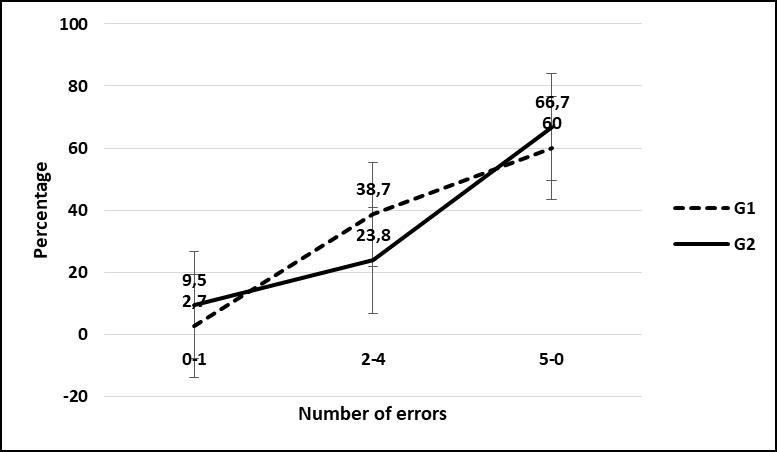
Figure 1. Number of errors (%) in solving tasks of G1 and G2 groups.
There followed the analysis of the results obtained in solving subsequent critical 5 problems which had two options of calculation, i.e., application of the strategy of problem solution by the previous method or by a new one. It has been found that the majority of respondents in G1 group 38.70% (29 people) made calculations using the developed method in the process of solving setting tasks making from 2 to 4 mistakes. However, in G2 group respondents of technical profile this number of mistakes was made by 23.80% or 15 respondents while solving problems by using the “old” method. On the whole, it can be stated that the Luchins’ effect is not characteristic of all examinees but only for the respondents of humanities profile, and on the contrary, its expression is rather atypical for the technical profile examinees (φ*emp.= 1,89; p ≤ 0,05).
For 9.50% (6 respondents) students of technical profile and 2,70% (2 respondents) of humanities profile 0–1 tasks from 10 tasks were solved in a non–rational way. This indicates that technical profile students tend to solve problems more rationally (φ*emp. = 1.78; p ≤ 0.05) under the influence of the past experience.
The differences between the obtained results of perseverative (not rationally solved problems) solutions in the respondents of G1 and G2 groups reach statistical significance (according to Student’s t–test at p < 0,0001). In general, the tendency to rigidity in solving problems is a characteristic feature for the students of the humanities profile rather than technical one.
Discussion
Cognitive rigidity, according to R. Francis, D. Hawes, M. Abbott [7], does not allow a person to consider, generate alternative possibilities, explanations of events or situations that makes it difficult to find an optimal solution to problems. This phenomenon is documented in A. Luchins’ famous experiment [18, 19] with water transfusion that clearly demonstrates the tendency of an individual to use a familiar solution method and ignore a more effective one. Analysis of the results of a study of personality cognitive rigidity using A. Luchins’ “Investigating the influence of the past experience on the way of solving tasks” methodology showed ambiguous results.
During the study the participants of G1 and G2 groups have shown the same results when solving setting tasks, which, on the one hand, confirms the already available data from experimental studies of setting (Bilalic, McLeod, 2014; Luchins, 1942; Uznadze, 2001). On the other hand, it points to certain regularities related to adaptive abilities manifested in the search activity for a certain algorithm of problem solving by adolescent respondents regardless gender, age and education profile (either humanities or technical) as well as their belonging to the same social which is equally important for general psychology. According to K.W. Schaie, cognitive rigidity represents the ability to adapt to new conditions, environments and situations [34, p. 604–610], in connection with which it eventually develops the concept of “attitudinal flexibility” [35] which is a polar opposite of rigidity.
However, already when presented with a series of critical tasks, humanities and technical profile test takers showed differences in problems solving. Thus, respondents of G1 (humanities profile) group continued to use the developed strategy of problems solving in the previous series that indicates the formation of perseverative behaviour and inclination to rigid behaviour. When solving problems in life situations, the participants of the humanities education profile are characterized by the use of habitual ways of thinking and strategies of overcoming the problem. Though, J. Piaget states that reliance on previous experience when solving tasks without a detailed, critical analysis of the current situation [29, p. 19] indicates that a personality uses “centered” cognitive strategies (syncretism, transduction, insensitivity to contradiction). At the same time, N. Maier proves the positive effect of previous experience in using a non–standard way of solving problems [21, p. 245–300; 22, p. 144–155]. According to D. Norman, the conceptual model underlying the subject can be used “to predict the result of action on it” [26, p. 286]. Along with this, the use of the already existing problem–solving strategy by a person allows them to reduce the situation of uncertainty in order to avoid information overload which leads to dispositional motivation on the cognitive structuring of the surrounding reality by simple, unambiguous ways, i.e. to “the personal need for structure” [27, p. 113–131].
The respondents of the technical education profile, on the contrary, are characterized by the development of new strategies for problems solving that indicates that past experience does not have a predetermining influence on the way of problems solving. The results obtained correlate with psychological requirements with different professional orientations (bionomic professions of “Man – Nature” type, technomic professions of “Man – Technics” type, signomic professions of “Man – Symbolic System” type and artnomic professions of “Man – Artistic Image” type) by E.A. Klimov [14, p. 175–196]: good operative and mechanical memory; ability to a long–time concentration on abstract (sign) materials; good distribution and switching of attention; accuracy of perception; diligence, patience; logical thinking, developed visual perception, observation, visual memory and visually imaginative thinking.
Thus, based on the data obtained, it can be stated that the manifestation of cognitive rigidity of the student’s personality observed when solving different types of tasks is due to the specifics of cognitive processes which manifest themselves differently in future specialists with different educational profiles.
Students of humanities education programme tend to develop a perseverative, rigid mode of action. To solve problems, they use the solution that has been accumulated through previous experience, thus disregarding simpler, alternative ways of performing tasks. Students of technical education programme are inclined to think critically about the existing way of action which gives them the opportunity to change once chosen strategy of problems solving.
References
- Bilalic, M., MacLeod, P. (2014). Is good the enemy of better? In the World of Science, 5, 31–35. [Bilalic M., MacLeod P. Khoroshee – vrag luchshego? V mire nauki, 5, 2014. – S.31–35].
- Bleicher, V.M. (1983). Thought disorders. Kiev: Zdorov’e Publishers. [Bleicher V.M. (1983). Rasstroistva myshleniya. Kiev: Izdatelstvo Zdorov’e, 1983. –192 p.].
- Cheremiskina, I.I. (2007). Methodology for Diagnosing the Properties of Thinking. Vladivostok, 6–11. [Cheremiskina I.I. Metodika, diagnostiki svoistv myshleniya. Vladivostok, 2007. – S. 6–11.].
- Concise Encyclopedia of Psychology. (2006). Second edition. Edited by Raymond J. Corsini, Alan J. Auerbach. John Wiley & Sons, Inc. [Psikhologicheskaya enciklopediya. 2-e izd. / Pod red. R. Korsini, A.Auerbacha. – SPb.: Piter, 2006. 1096 s: il.].
- Duncker, K. (1945) On Problem–Solving. Psychological Monographs 58, 1– 113. https://dx.doi.org/10.1037/h0093599.
- Duncker, K. Zur Psychologie des productiven Denkens, Berlin, Springer, 1935; On Problem-Solving, Washington. 1945.
- Francis, R., Hawes, D., Abbott, M. (2016). Intellectual Giftedness and Psychopathology in Children and Adolescents: A systematic literature review. Exceptional Children 82, 279–302. https://doi.org/10.1177/0014402915598779.
- Godefroy, J. (1996). Les chemins de la psychologie: In 2 vols. ed. by G.G. Arakelov. Moscow: Mir, Vol. 1. Translated by N.N. Alipova [et al.], 496. [Godefroy J. Chto takoye psikhologiya: v 2 t. pod red. G.G. Arakelova. Moskva: Mir, T. 1. perevod N.N. Alipova [i dr.]. – 1996. – 496 s.].
- Ilyin, E.P. (2012) The Psychology of Art, Creativity, Giftedness. St. Petersburg [et al.]. Peter, Books World, 444. [Psikhologiya tvorchestva, kreativnosti, odarennosti / E.P. Ilyin. – Sankt-Peterburg [i dr.]: Piter, Mir knig, 2012.– 444 s.]
- Isen, A.M., Daubman, K.A., Nowicki, G.P. (1987). Positive affect facilitates creative problem solving. Journal of Personality and Social Psychology. 52, 1122–1131. https://doi.org/:10.1037/0022–3514.52.6.1122.
- James, W. (1890). The Principles of Psychology, 1. New York: Holt https://doi.org/10.1037/10538–000.
- Khazova, S.A. (2013). Mental Resources of the Subject: Phenomenology and Dynamics. Kostroma, N. A. Nekrasov KSU, 386. [Khazova S.A. Mentalny’e resursy sub’ekta: fenomenologiya I dinamika. – Kostroma, KGU im. N.A. Nekrasova, 2013. – 386 s.].
- Kirsh, D. (1995). The Intelligent Use of Space. Artificial Intelligence, 73, 31–68. https://doi.org/10.1016/0004–3702(94)00017–U.
- Klimov, E.A. (2010). Psychology of Professional Self–determination: a textbook for students of higher education institutions. 4th ed., reprint. Moscow: Academia Publishing Centre. [Klimov E.A. Psikhologiya professional’nogo samoopredeleniya: ucheb. posobiye dlya stud. vysh. ucheb. zavedeniy. 4-e izd., ster. M.: Izdat. centr “Akademiya”, 2010. – 304 s.].
- Kretschmer, E. (2019). Body Structure and Character. Ed. 2nd. Moscow: Academic Project, 320. [Stroyeniye tela i kharakter / Ernst Kretschmer. – Izd.2-e. – Moskva: Akademicheskiy proekt, 2019. – 320s.].
- Levitt, E.E. (1956). The water–jar Einstellung test as a measure of rigidity. Psychological Bulletin, 53(5), 347–370. https://doi.org/10.1037/h0049245.
- Lobanov, A.P., Drozdova, N.V. (2021) Soft Skills for the Digital Generation. Minsk: NIHE, 152. [Lobanov A.P. Soft Skills dlya cifrovogo pokoleniya / A.P. Lobanov, N.V. Drozdova. – Mn.: RIVSH, 2021. – 152 s.].
- Luchins, A.S. (1942). Mechanization in Problem–solving: The Effect of Einstellung. Series: Psychological monographs. Vol 54, no. 6, whole no. 248.
- Luchins, A.S., Luchins, E.H. (1959). Rigidity of Behavior. A Variational Approach to the Effect of Einstellung. University of Oregon Monographs. Studies in Psychology. 3.
- Luria, A.R. (2018). Lectures on General Psychology. St. Petersburg [et al.]. Peter, Progress Book, 383. [Lekcii po obshchei psikhologii / A.R. Luria. – Sankt-Peterburg [i dr.]: Piter, Progress kniga, 2018. – 383 s.].
- Maier, N. (1965). On One Aspect of Human Thinking. The Psychology of Thinking: A Collection of Translations from German and English. Ed. by A. M. Matyushkin. Moscow. Progress, 245–300. [Maier N. Ob odnom aspekte myshleniya cheloveka // Psikhologiya myshleniya: Sb. Perevodov s nem. I ang. / Pod red. A.M. Matyushkina. M. Progress, 1965. S. 245–300].
- Maier, N.R.F. (1933). An aspect of human reasoning. British Journal of Psychology. General Section 24, 2, 144–155. https://doi.org/10.1111/j.2044– 8295.1933.tb00692.x.
- Maslow, A. (2018). Motivation and Personality. 3rd ed. St. Petersburg [et al.]. Peter, Peter Press, 399. [Motivaciya i lichnost’ / Abracham Maslow. – 3-e izd. -–Sankt-Peterburg [i dr.]: Piter, Piter Press, 2018. – 399 s.].
- May, R. (2001). The meaning of anxiety. M.: Class, 379. [Smysl trevogi / Rollo May. M.: Klass, 2001. – 379 s.].
- Morris, L., Mansell, W. (2018). A systematic review of the relationship between rigidity/flexibility and transdiagnostic cognitive and behavioural processes that maintain psychopathology. Journal of Experimental Psychopathology. July– September. 1–40. DOI: 10.1177 / 2043808718779431.
- Norman Donald, A. (2012). The Design of Familiar Things. Horizons of Cognitive Psychology: a textbook: [translation]. compilers: V.F. Spiridonov, M.V. Falikman. Moscow: Slavonic Languages, Russian State University for the Humanities, 283–289. [Norman Donald, A. dizain privychnykh veshchei. Gorizonty kognitivnoi psikhologii: khrestomatiya: [perevod]. Sostaviteli: V.F. Spiridonov, M.V. Falikman. Moskva: Yazyki slavyanskikh kultur, Rossiiskii gosudarstvennyi gumanitarnyi universitet, 2012. – S. 283–289].
- Neuberg, S.L., Newson, J.T. (1993). Personal need for structure: individual differences in the desire for simpler structure. Journal of Personality and Social Psychology, 65(1), 113–131.
- O’Connor, J., McDermott, I. (2009). The Art of Systems Thinking: the Essential Knowledge of Systems and Creative Problem Solving; Translated from English. 3rd ed. Moscow: Alpina Publishers, 254. [Iskusstvo sistemnogo myshleniya: Neobkhodimye znaniya o sistemakh i tvorcheskom podkhode k resheniyu problem / O’Connor J., McDermott I.; Per. s angl. – 3-e izd. – M.: Alpina Publishers, 2009. – 254 s.].
- Piaget, J. (1969). Selected Psychological Writings. The Psychology of Intelligence. The genesis of a number in a child. Logic and Psychology. Moscow: Prosveshchenie, 19. [Piaget J. Izbrannye psikhologicheskiye trudy. Psikhologiya intellekta. Geneziz chisla u rebyonka. Logika i psikhologiya. M.: Procveshchenie, 1969. – S.19.].
- Psychologisches Wörterbuch / Dorsch. Hrsg. von Fridrich Dorsch. 12. (1994). Überarb. und erw. Aufl. Born; Göttingen; Toronto; Seattle: Huber.
- Rigidity // The Big Dictionary of Psychology (2009). Ed. by B.G. Meshcheryakov, V.P. Zinchenko. 4th ed., ext. Moscow; St. Petersburg, 477. [Bolshoi Enciklopedicheskiy slovar’ / pod red. B.G. Meshcheryakova, V.P. Zinchenko. – 4-e izd., rasshir. – M., Spb., 2009. – S. 477.].
- Rogers, K.R. Humanistic Psychology: theory and practice: selected works in psychology. Moscow: MPSU Press: Voronezh, MODEK, 2013, 450. [Rogers K.R. Gumanisticheskaya psikhologiya: teoriya i praktika: izbrannye trudy po psikhologii. Moskva: MPGU Press: Voronezh, MODEK, 2013. – 450s.].
- Rokeach, M. (1960). The open and closed mind: investigations into the nature of belief systems and personality systems. New York: Basic Books.
- Schaie, K.W. (1955). A test of behavioral rigidity. The Journal of Abnormal and Social Psychology, 51(3), 604–610. https://doi.org/10.1037/h0046287.
- Schaie, K.W. (1996). Intellectual development in adulthood. In J. E. Birren, K. W. Schaie, R. P. Abeles, M. Gatz, & T. A. Salthouse (Eds.), Handbook of the psychology of aging (pp. 266–286). Academic Press.
- Ulybin, S.V. (2008). Psychological Factors Influencing a Person’s Professional Activity. World of Psychology. № 4. (56). 262–268. [Ulybin S. V. Psikhologicheskiye factory, vliyaushchiye na professional’nuyu deyatel’nost’ cheloveka // Mir psikhologii, 2008. – № 4 (56). – S. 262–268.].
- Volkova, E.V. (2016). Technologies of Mental Resources Development. Moscow: Institute of Psychology, Russian Academy of Sciences, 256. [Volkova, E.V. Tekhnologii razvitiya mental’nykh resursov. M.: Izd-vo “Institut psikhologii RAN”, 2016. – 256 s.].
- Voskoboynikov, V.M. (1996). How to identify and develop a child’s abilities. Compiled by V.M. Voskoboynikov. St. Petersburg: Respeks, 426. [Kak opredelit’ i razvit’ sposobnosti rebyonka / Sost. V.M. Voskoboynikov. – Spb.: Respeks, 1996. – 426 s.].
- Zakreski, M. J. (2018) ‘When Emotional Intensity and Cognitive Rigidity Collide: What Can Counselors and Teachers Do?’, Gifted Child Today, 41(4), pp. 208– 216. https://doi:10.1177/1076217518786984.
- Zalevski, G.V. (2004). Fixed forms of behaviour of individual and group systems (in culture, education, science, norm and pathology). Moscow: Tomsk: Tomsk State University. [Zalevski G.V. Fikcirovannye formy povedenia individual’nykh b gruppovykh system (v kulture, obrazovanii, nauke, norma i patologiya). Moskva: Tomsk: Tomskii Gosudarstvennyi Universitet, 2004.].
- Zimbardo, F., Boyd, J. (2010). The Paradox of Time. The new psychology of time that improves your life. St. Petersburg: Rech, 352. [Zimbardo F., Boyd J. Paradoks vremeni. Novaya psikhologiya vremeni, kotoraya uluchshit vashu zhizn’. Spb.: Rech, 2010. – 352 s.].
Comments (0)
This article presents the study results of cognitive rigidity as a mental model of personality which manifests itself in the influence of past experience on problems solving. The empirical study involved 138 volunteers, humanities and technical education programmes, different majors (nursery school teachers, teachers, speech therapists, accountants, customs officers, architects, builders). The results of the study when solving setting and critical tasks have revealed features reflecting the tendency to rigid action of respondents in both groups. Respondents of humanities education programme when solving setting tasks have shown a formation of cognitive rigidity (perseveration) that has not allowed to use more effective and adequate ways while solving critical tasks. Technical education programme respondents, on the contrary, have been notable for their abilities to critically rethink the use of habitual ways of action which resulted in finding alternative solutions to a number of critical tasks. Despite the identified differences, the examinees of both groups showed similar results in solving setting tasks. The fact of manifestation for thinking peculiarities in specialists with various profession orientation becomes evident.
The relevance of the research is determined by the theoretical and practical need to study the nature of rigidity, the psychological characteristic of which synthesizes various cognitive, emotional, volitional and motivational mental processes as well as the personality. They are complex in structure and contribute to adaptation in an unstable environment associated with the transition “from life in a stationary society to life in a rapidly and irreversibly changing world” [37, p. 9], in the world (“digital society”, “fluid modernity”, “cognitive capitalism”) the characteristic of which should integrate three components – emergence, complexity and flexibility – “into one whole, without losing the depth and plurality of their interpretations” [17, p. 31]. This, in turn, raises the question of “the reasons for the preservation and development of human productivity” which determines the need to mobilize mental resources [37, p. 15], the formation of which defines the ability of an individual to adapt flexibly to the requirements of the situation [12]. The inability of an individual to change their behavior, even if the situation demands it, is regarded as rigidity (Gorman; cited in Concise Encyclopedia of Psychology, 2006, p. 763).
The attention of scientists from classical and modern scientific schools and directions is turned to the problem of rigidity. In the works of L.S. Vygotsky, K. Goldstein, K. Duncker, G.V. Zalevski, J. Kettel, R. Kettel, K. Levin, G. Maier, Z. Freud rigidity is represented as stiffness of thinking, intellectual stiffness, rigidity of cognitive schemes, stereotype, perceptual and functional fixation. G.V. Zalevski presents rigidity as perceptual, psychomotor, cognitive, affective and motivational one depending on the individual personality features [40, p. 55]. In German Psychological Dictionary F. Dorsch states motor, affective and cognitive rigidity (from German rigidität) [30, p. 668]. At the same time various researchers consider a similar set of types of rigidity and often modern psychological literature distinguishes and interprets cognitive, emotional (affective) and motivational types of rigidity. Thus, B. Meshcheryakov and V. Zinchenko cite cognitive, affective and motivational rigidity as the inability to adjust the activity programme in accordance with the requirements of the situation [31, p. 477].
Affective (rigidity of affect) rigidity is characterised by the manifestation of monotonous emotional responses to changing objects of emotion and is determined by the constancy of the events evaluation. Affective rigidity also has its parallels in the inflexibility of motivational needs and the habitual ways in which they are met. Motivational rigidity is evident in the “motivational failing” syndrome [41]. The inability to change perceptions of the environment, the lack of willingness to reflect and, therefore, to readjust actions when receiving new information is associated with cognitive rigidity. M.J. Zakreski defines cognitive rigidity as the difficulty in changing mental attitudes and describes it as a decrease in cognitive switchability, a desire for novelty [39, p. 208].
Cognitive rigidity in medicine and psychophysiology (G.V. Zalevski, E. Kretschmer, N.D. Levitov, K. Leongard, A.R. Luria, A. Maslow, V.S. Merlin, R. May, V. Reich, M. Rokeach, E. Fromm) is associated with a psychopathological state caused by a lack of mobility of mental processes. Thus, the rigidity of attention in A. R. Luria’s research is defined by the ability of a person to change “the natural laws of the flow of the orienting reflex” by making “the state of activation more stable” which causes “persistent, long–lasting states of tense attention” [20, p. 219]. Memory rigidity is designated by the scientist as a process for the “consolidation” (imprinting) of its traces [20, p. 240]. Perceptual rigidity occurs in mild to moderate extent of Parkinson’s disease (Zmigrod, 2019).
The concept of rigidity of thinking is dominant in psychology. M. Rokeach (1960) refers to rigidity and dogmatism in thinking as “a limited mind” [33]. According to E. Kretschmer, rigidity, as it manifests itself in thinking and acting, is a sign of schizotypal character [15] and, according to R. May, it is a marker of obsessive–compulsive neurosis [24]. In psychiatry it is a sign of visceral thinking in epilepsy characterised by a predominance of concrete ideas in problem solving, a lack in “comprehending the contingent nature of the task” [2, p. 46]. E.P. Ilyin characterizes it as the “ossification and even fixedness or stagnation of thinking”. E.P. Ilyin characterises inertia, rigidity of thinking as consisting in the difficulty “to move quickly and easily from one class of phenomena to another, distant in content” [9, p. 164].
Contemporary medical, clinical, and physiological approaches present cognitive rigidity in terms of the transdiagnostic approach used in clinical psychology and cognitive therapy. Within this approach rigidity is understood as a mechanism present in all disorders (Harvey, Watkins, Mansell, Shafran, 2004). For example, thought rigidity in the form of fixation on the same thought (rumination) due to negative events and experiences acts as a transdiagnostic process underlying various forms of psychiatric pathology including anxiety and depression. Rigidity based on psychological components, metacognitive, emotional, volitional, motivational processes and personality traits can be a risk factor for changes in mental (psychological) health (Rogers, 1951), psychological well–being (A.V. Voronina (2006), the emergence of emotional and cognitive problems (G.V. Zalevski) and as a consequence of the neuropsychiatric disorders (P.B. Gannushkin, G.V. Zalevski, K. Leongard, A. E. Lichko, R. May, W. Reich). According to K. Rogers, the result of the transformation of mental integrity and the mental health of the individual is the manifestation of rigidity in the assessment by the individual of themself, in the reassessment of the system of values, in the differentiation of meanings in their internal experience, in the verification and correction of “their hypotheses in real actions in the real world” [32, p. 25]. In this perspective, the emphasis is placed on rigidity as a transdiagnostic process that renders other processes pathological [25]. In general, the maximum representation of the subject expressions indicates the fundamental importance of this problem for the psychology of personality.
In psychological science cognitive rigidity is accompanied by a change in the “ability to adequately perceive an object in a changed situation” [31, p. 477] and is expressed in perceptual illusions (cognitive, temporal, optical, temporal) [41, pp. 23–25]. According to J. O’Connor and I. McDermott, illusions exist in thinking, in mental models through which a person perceives the surrounding reality. They consist of general ideas, beliefs that ideate a person’s thoughts and actions, visions about desired outcomes and are a source of stability [28, pp. 80–83]. Along with this, scientists describe a number of cognitive mechanisms through which mental models are formed and maintained. The generalization mechanism manifests itself in the perception of an isolated incident in life experience as a typical phenomenon. The distortion mechanism results in exaggeration of some characteristics, features of phenomena and objects while downplaying the significance of others. The construction mechanism involves developing a rational explanation in a situation of ambiguity passing it off as reality. The mechanism of elimination ignores information that is inconsistent with current personal perceptions and opinions about what is happening.
V.M. Voskoboynikov considers rigidity of views and attitudes to be a counter– suggestive barrier to creativity [38]. Studying the mechanisms of formation and manifestation of creative thinking A.M. Isen, K.A. Daubman and G.P. Nowicki come to the conclusion about its connection with humour that causes positive emotions, reducing tension and, as a consequence, the manifestation of rigidity [10]. Understanding rigidity of thinking as stereotypical thinking, a set of habits to solve one–type tasks in a standard way A. Maslow singles it out as one of the barriers that block creative approach to problem solving [23].
From the above, it should be noted that the experimental study of cognitive rigidity is carried out in solving thinking tasks. In this aspect it represents the fixation of thinking on habitual ways that have been formed and are available from the past experience as well as the lack of ability to respond to a new situation in a more productive way (Scott, 1962). The concept of “functional fixity” was introduced by K. Duncker and is understood as the inability to solve problems in a non–standard way caused by previous experience [5, 6]. During the analysis of the problem–solving process there arise “functional solutions” which are subject to “fixing when handling the solution approach” along with “fixing the context” and “fixing the structure” “thereby eliminating the possibility for decision–making of other equally acceptable ranges and functional solutions” [6, p. 238–239]. The scientist concludes that inertia of thinking prevents or inhibits the manifestation of unusual/nonstandard ways in solving thinking tasks using familiar objects [5]. According to W. James (1890), there is a blocking of other reactions formation as a result of the learned reaction excitation [11].
Functional fixation is a problem–oriented variant of the attitude (Einstellung from German), readiness that determines tendency and propensity [16] which is generated by the negative influence of long–term memory on the solution of cognitive tasks, thus preventing the discovery of a new, original solution [8, p. 362]. Attitude in a problem–solving situation, according to Luchins, appears in preference of the habitual way of action over a more effective one [18]. In the course of the experiment the scientist concluded that the respondents preferentially used the techniques practiced in previous trials along with accessible and more productive ways of solving problems to measure a certain amount of water using different in volume vessels. This experiment is called the Luchins’ effect that consists in the tendency of “the brain to concentrate on the most familiar way of problem solving, stubbornly avoiding alternatives” [1, p. 32]. As noted by M. Bilalic and P. McLeod, “usually such a way is getting to be useful”.
As a result of the induced interest in the Luchins’ effect, a number of researchers have identified various artifacts that enhance or weaken the above–mentioned effect: motivational and stress ones (Cowen, 1952; Van De Geer, 1957), interactivity in physical space or manipulation, restructuring of physical space (Kirsh, 1995, 2006), cognitive distortion in which any information not fitting into a theory “that we have already latched on to is ignored or discarded” [1, p. 33]. Thus, the artifacts in solving thinking tasks are varied and modifiable. Sometimes they can be opportunistic or strategic in nature which in one way or another transforms the possibilities of problem solving.
In this study, one of the factors in solving tasks is the specifics of the cognitive processes that manifest themselves differently in specialists with different profession orientations (bionomic professions of “Man – Nature” type, technomic professions of “Man – Technics” type, signomic professions of “Man – Symbolic System” type and artnomic professions of “Man – Artistic Image” type) [14, p. 175– 196]. In particular, such cognitive processes as mechanical, motor memory, the ability to concentrate for a long time on abstract (sign) material and accuracy of perception ensure the efficiency of solving specific tasks with a clearly defined algorithm in the process of boring, monotonous and rigidly regulated “performing” work. On the one hand, in order to ensure effective participation in professional activities such qualities of a specialist as reactivity, adaptability and variability in response to the impact of external and internal environment factors are necessary. On the other hand, these qualities should be stable and sustainable [36, p. 266]. In general, cognitive rigidity can contribute to higher efficiency, effectiveness of a specialist. The above–mentioned provisions served as the basis for setting the goal of the research to identify cognitive rigidity of a personality.
2.1. Procedure and Participants.
Participants in the study were volunteers, first–year students (N = 138) of the full–time mode of study: humanities education programme from “Yanka Kupala State University of Grodno” (GrSU, Grodno) and the technical profile of the education from “Belarusian State University of Transport” (BelSUT, Gomel). The group of GrSU students (G1) consists of representatives of the humanities education profile (Pedagogical Faculty) and is represented by 75 students aged 17.40 ± 0.69 years, where 2.66% (2 people) are male and 97.33% (73 people) are female. The number of technical major students from BelSUT (G2) includes 63 students (17.85 ± 0.49 years), where 41.26 % (26 people) are male and 58.73 % (37 people) are female (Faculty of Economics and Business Technology, Civil Construction Engineering, Construction and Military Transport Faculties). The participants individually performed the tasks provided.
2.2. Measures
An empirical study of cognitive rigidity was carried out using Luchins’ method “Investigating the influence of the past experience on the way of solving tasks” [3, 18, 19]. The participants were each presented with a Luchins’ task form. Then an instruction was given with sequential problem solving and its fixation in the form of an arithmetic action where the participants had to make calculations visualizing vessels with a liquid in mind. For example, three empty vessels with the volume of 37l, 21l and 3l should be used in order to measure 10l using an unlimited number of times only fully filled vessels. There was no time limit for the tasks. In processing, the number (%) of perseverative (not rationally solved tasks) responses and unsolved tasks were counted bearing in mind that perseveration is associated with high levels of cognitive rigidity including tendencies to insist on certain behavior that was the norm in the past and when this behaviour is no longer acceptable under new circumstances. As may be supposed, the rational problem solving for tasks 1–5 includes three steps (A – B – C – C), and the next 5 tasks are even fewer (B – C – C; B – C; B + C) or require no calculation at all.
2.3. Statistical Methods
Qualitative and quantitative analyses of the results were conducted during the study. Fisher’s angular transformation test (φ*) was used as a criterion to assess the significance of differences between the two samples. In order to verify the hypothesis of the existence of differences in the formation of rigid action when solving problems by students of the humanities and technical profiles the method of differences significance (Student’s t–test) presented in Statistica 6.0 package of statistical programs was used.
When presented with a set series of five problems solution of which included only one rational (A – B – C – C) method, 60% (45 people) of the pedagogical profile G1 and 66.70% (42 people) of the technical profile G2 solved the problems in a rational way but making some mistakes in the form of calculations in a non–rational way, committing from 5 to 0 errors (φ*emp. = 0.81; p ≤ 0.05). The results are shown in Figure 1.
Figure 1. Number of errors (%) in solving tasks of G1 and G2 groups.
There followed the analysis of the results obtained in solving subsequent critical 5 problems which had two options of calculation, i.e., application of the strategy of problem solution by the previous method or by a new one. It has been found that the majority of respondents in G1 group 38.70% (29 people) made calculations using the developed method in the process of solving setting tasks making from 2 to 4 mistakes. However, in G2 group respondents of technical profile this number of mistakes was made by 23.80% or 15 respondents while solving problems by using the “old” method. On the whole, it can be stated that the Luchins’ effect is not characteristic of all examinees but only for the respondents of humanities profile, and on the contrary, its expression is rather atypical for the technical profile examinees (φ*emp.= 1,89; p ≤ 0,05).
For 9.50% (6 respondents) students of technical profile and 2,70% (2 respondents) of humanities profile 0–1 tasks from 10 tasks were solved in a non–rational way. This indicates that technical profile students tend to solve problems more rationally (φ*emp. = 1.78; p ≤ 0.05) under the influence of the past experience.
The differences between the obtained results of perseverative (not rationally solved problems) solutions in the respondents of G1 and G2 groups reach statistical significance (according to Student’s t–test at p < 0,0001). In general, the tendency to rigidity in solving problems is a characteristic feature for the students of the humanities profile rather than technical one.
Cognitive rigidity, according to R. Francis, D. Hawes, M. Abbott [7], does not allow a person to consider, generate alternative possibilities, explanations of events or situations that makes it difficult to find an optimal solution to problems. This phenomenon is documented in A. Luchins’ famous experiment [18, 19] with water transfusion that clearly demonstrates the tendency of an individual to use a familiar solution method and ignore a more effective one. Analysis of the results of a study of personality cognitive rigidity using A. Luchins’ “Investigating the influence of the past experience on the way of solving tasks” methodology showed ambiguous results.
During the study the participants of G1 and G2 groups have shown the same results when solving setting tasks, which, on the one hand, confirms the already available data from experimental studies of setting (Bilalic, McLeod, 2014; Luchins, 1942; Uznadze, 2001). On the other hand, it points to certain regularities related to adaptive abilities manifested in the search activity for a certain algorithm of problem solving by adolescent respondents regardless gender, age and education profile (either humanities or technical) as well as their belonging to the same social which is equally important for general psychology. According to K.W. Schaie, cognitive rigidity represents the ability to adapt to new conditions, environments and situations [34, p. 604–610], in connection with which it eventually develops the concept of “attitudinal flexibility” [35] which is a polar opposite of rigidity.
However, already when presented with a series of critical tasks, humanities and technical profile test takers showed differences in problems solving. Thus, respondents of G1 (humanities profile) group continued to use the developed strategy of problems solving in the previous series that indicates the formation of perseverative behaviour and inclination to rigid behaviour. When solving problems in life situations, the participants of the humanities education profile are characterized by the use of habitual ways of thinking and strategies of overcoming the problem. Though, J. Piaget states that reliance on previous experience when solving tasks without a detailed, critical analysis of the current situation [29, p. 19] indicates that a personality uses “centered” cognitive strategies (syncretism, transduction, insensitivity to contradiction). At the same time, N. Maier proves the positive effect of previous experience in using a non–standard way of solving problems [21, p. 245–300; 22, p. 144–155]. According to D. Norman, the conceptual model underlying the subject can be used “to predict the result of action on it” [26, p. 286]. Along with this, the use of the already existing problem–solving strategy by a person allows them to reduce the situation of uncertainty in order to avoid information overload which leads to dispositional motivation on the cognitive structuring of the surrounding reality by simple, unambiguous ways, i.e. to “the personal need for structure” [27, p. 113–131].
The respondents of the technical education profile, on the contrary, are characterized by the development of new strategies for problems solving that indicates that past experience does not have a predetermining influence on the way of problems solving. The results obtained correlate with psychological requirements with different professional orientations (bionomic professions of “Man – Nature” type, technomic professions of “Man – Technics” type, signomic professions of “Man – Symbolic System” type and artnomic professions of “Man – Artistic Image” type) by E.A. Klimov [14, p. 175–196]: good operative and mechanical memory; ability to a long–time concentration on abstract (sign) materials; good distribution and switching of attention; accuracy of perception; diligence, patience; logical thinking, developed visual perception, observation, visual memory and visually imaginative thinking.
Thus, based on the data obtained, it can be stated that the manifestation of cognitive rigidity of the student’s personality observed when solving different types of tasks is due to the specifics of cognitive processes which manifest themselves differently in future specialists with different educational profiles.
Students of humanities education programme tend to develop a perseverative, rigid mode of action. To solve problems, they use the solution that has been accumulated through previous experience, thus disregarding simpler, alternative ways of performing tasks. Students of technical education programme are inclined to think critically about the existing way of action which gives them the opportunity to change once chosen strategy of problems solving.
- Bilalic, M., MacLeod, P. (2014). Is good the enemy of better? In the World of Science, 5, 31–35. [Bilalic M., MacLeod P. Khoroshee – vrag luchshego? V mire nauki, 5, 2014. – S.31–35].
- Bleicher, V.M. (1983). Thought disorders. Kiev: Zdorov’e Publishers. [Bleicher V.M. (1983). Rasstroistva myshleniya. Kiev: Izdatelstvo Zdorov’e, 1983. –192 p.].
- Cheremiskina, I.I. (2007). Methodology for Diagnosing the Properties of Thinking. Vladivostok, 6–11. [Cheremiskina I.I. Metodika, diagnostiki svoistv myshleniya. Vladivostok, 2007. – S. 6–11.].
- Concise Encyclopedia of Psychology. (2006). Second edition. Edited by Raymond J. Corsini, Alan J. Auerbach. John Wiley & Sons, Inc. [Psikhologicheskaya enciklopediya. 2-e izd. / Pod red. R. Korsini, A.Auerbacha. – SPb.: Piter, 2006. 1096 s: il.].
- Duncker, K. (1945) On Problem–Solving. Psychological Monographs 58, 1– 113. https://dx.doi.org/10.1037/h0093599.
- Duncker, K. Zur Psychologie des productiven Denkens, Berlin, Springer, 1935; On Problem-Solving, Washington. 1945.
- Francis, R., Hawes, D., Abbott, M. (2016). Intellectual Giftedness and Psychopathology in Children and Adolescents: A systematic literature review. Exceptional Children 82, 279–302. https://doi.org/10.1177/0014402915598779.
- Godefroy, J. (1996). Les chemins de la psychologie: In 2 vols. ed. by G.G. Arakelov. Moscow: Mir, Vol. 1. Translated by N.N. Alipova [et al.], 496. [Godefroy J. Chto takoye psikhologiya: v 2 t. pod red. G.G. Arakelova. Moskva: Mir, T. 1. perevod N.N. Alipova [i dr.]. – 1996. – 496 s.].
- Ilyin, E.P. (2012) The Psychology of Art, Creativity, Giftedness. St. Petersburg [et al.]. Peter, Books World, 444. [Psikhologiya tvorchestva, kreativnosti, odarennosti / E.P. Ilyin. – Sankt-Peterburg [i dr.]: Piter, Mir knig, 2012.– 444 s.]
- Isen, A.M., Daubman, K.A., Nowicki, G.P. (1987). Positive affect facilitates creative problem solving. Journal of Personality and Social Psychology. 52, 1122–1131. https://doi.org/:10.1037/0022–3514.52.6.1122.
- James, W. (1890). The Principles of Psychology, 1. New York: Holt https://doi.org/10.1037/10538–000.
- Khazova, S.A. (2013). Mental Resources of the Subject: Phenomenology and Dynamics. Kostroma, N. A. Nekrasov KSU, 386. [Khazova S.A. Mentalny’e resursy sub’ekta: fenomenologiya I dinamika. – Kostroma, KGU im. N.A. Nekrasova, 2013. – 386 s.].
- Kirsh, D. (1995). The Intelligent Use of Space. Artificial Intelligence, 73, 31–68. https://doi.org/10.1016/0004–3702(94)00017–U.
- Klimov, E.A. (2010). Psychology of Professional Self–determination: a textbook for students of higher education institutions. 4th ed., reprint. Moscow: Academia Publishing Centre. [Klimov E.A. Psikhologiya professional’nogo samoopredeleniya: ucheb. posobiye dlya stud. vysh. ucheb. zavedeniy. 4-e izd., ster. M.: Izdat. centr “Akademiya”, 2010. – 304 s.].
- Kretschmer, E. (2019). Body Structure and Character. Ed. 2nd. Moscow: Academic Project, 320. [Stroyeniye tela i kharakter / Ernst Kretschmer. – Izd.2-e. – Moskva: Akademicheskiy proekt, 2019. – 320s.].
- Levitt, E.E. (1956). The water–jar Einstellung test as a measure of rigidity. Psychological Bulletin, 53(5), 347–370. https://doi.org/10.1037/h0049245.
- Lobanov, A.P., Drozdova, N.V. (2021) Soft Skills for the Digital Generation. Minsk: NIHE, 152. [Lobanov A.P. Soft Skills dlya cifrovogo pokoleniya / A.P. Lobanov, N.V. Drozdova. – Mn.: RIVSH, 2021. – 152 s.].
- Luchins, A.S. (1942). Mechanization in Problem–solving: The Effect of Einstellung. Series: Psychological monographs. Vol 54, no. 6, whole no. 248.
- Luchins, A.S., Luchins, E.H. (1959). Rigidity of Behavior. A Variational Approach to the Effect of Einstellung. University of Oregon Monographs. Studies in Psychology. 3.
- Luria, A.R. (2018). Lectures on General Psychology. St. Petersburg [et al.]. Peter, Progress Book, 383. [Lekcii po obshchei psikhologii / A.R. Luria. – Sankt-Peterburg [i dr.]: Piter, Progress kniga, 2018. – 383 s.].
- Maier, N. (1965). On One Aspect of Human Thinking. The Psychology of Thinking: A Collection of Translations from German and English. Ed. by A. M. Matyushkin. Moscow. Progress, 245–300. [Maier N. Ob odnom aspekte myshleniya cheloveka // Psikhologiya myshleniya: Sb. Perevodov s nem. I ang. / Pod red. A.M. Matyushkina. M. Progress, 1965. S. 245–300].
- Maier, N.R.F. (1933). An aspect of human reasoning. British Journal of Psychology. General Section 24, 2, 144–155. https://doi.org/10.1111/j.2044– 8295.1933.tb00692.x.
- Maslow, A. (2018). Motivation and Personality. 3rd ed. St. Petersburg [et al.]. Peter, Peter Press, 399. [Motivaciya i lichnost’ / Abracham Maslow. – 3-e izd. -–Sankt-Peterburg [i dr.]: Piter, Piter Press, 2018. – 399 s.].
- May, R. (2001). The meaning of anxiety. M.: Class, 379. [Smysl trevogi / Rollo May. M.: Klass, 2001. – 379 s.].
- Morris, L., Mansell, W. (2018). A systematic review of the relationship between rigidity/flexibility and transdiagnostic cognitive and behavioural processes that maintain psychopathology. Journal of Experimental Psychopathology. July– September. 1–40. DOI: 10.1177 / 2043808718779431.
- Norman Donald, A. (2012). The Design of Familiar Things. Horizons of Cognitive Psychology: a textbook: [translation]. compilers: V.F. Spiridonov, M.V. Falikman. Moscow: Slavonic Languages, Russian State University for the Humanities, 283–289. [Norman Donald, A. dizain privychnykh veshchei. Gorizonty kognitivnoi psikhologii: khrestomatiya: [perevod]. Sostaviteli: V.F. Spiridonov, M.V. Falikman. Moskva: Yazyki slavyanskikh kultur, Rossiiskii gosudarstvennyi gumanitarnyi universitet, 2012. – S. 283–289].
- Neuberg, S.L., Newson, J.T. (1993). Personal need for structure: individual differences in the desire for simpler structure. Journal of Personality and Social Psychology, 65(1), 113–131.
- O’Connor, J., McDermott, I. (2009). The Art of Systems Thinking: the Essential Knowledge of Systems and Creative Problem Solving; Translated from English. 3rd ed. Moscow: Alpina Publishers, 254. [Iskusstvo sistemnogo myshleniya: Neobkhodimye znaniya o sistemakh i tvorcheskom podkhode k resheniyu problem / O’Connor J., McDermott I.; Per. s angl. – 3-e izd. – M.: Alpina Publishers, 2009. – 254 s.].
- Piaget, J. (1969). Selected Psychological Writings. The Psychology of Intelligence. The genesis of a number in a child. Logic and Psychology. Moscow: Prosveshchenie, 19. [Piaget J. Izbrannye psikhologicheskiye trudy. Psikhologiya intellekta. Geneziz chisla u rebyonka. Logika i psikhologiya. M.: Procveshchenie, 1969. – S.19.].
- Psychologisches Wörterbuch / Dorsch. Hrsg. von Fridrich Dorsch. 12. (1994). Überarb. und erw. Aufl. Born; Göttingen; Toronto; Seattle: Huber.
- Rigidity // The Big Dictionary of Psychology (2009). Ed. by B.G. Meshcheryakov, V.P. Zinchenko. 4th ed., ext. Moscow; St. Petersburg, 477. [Bolshoi Enciklopedicheskiy slovar’ / pod red. B.G. Meshcheryakova, V.P. Zinchenko. – 4-e izd., rasshir. – M., Spb., 2009. – S. 477.].
- Rogers, K.R. Humanistic Psychology: theory and practice: selected works in psychology. Moscow: MPSU Press: Voronezh, MODEK, 2013, 450. [Rogers K.R. Gumanisticheskaya psikhologiya: teoriya i praktika: izbrannye trudy po psikhologii. Moskva: MPGU Press: Voronezh, MODEK, 2013. – 450s.].
- Rokeach, M. (1960). The open and closed mind: investigations into the nature of belief systems and personality systems. New York: Basic Books.
- Schaie, K.W. (1955). A test of behavioral rigidity. The Journal of Abnormal and Social Psychology, 51(3), 604–610. https://doi.org/10.1037/h0046287.
- Schaie, K.W. (1996). Intellectual development in adulthood. In J. E. Birren, K. W. Schaie, R. P. Abeles, M. Gatz, & T. A. Salthouse (Eds.), Handbook of the psychology of aging (pp. 266–286). Academic Press.
- Ulybin, S.V. (2008). Psychological Factors Influencing a Person’s Professional Activity. World of Psychology. № 4. (56). 262–268. [Ulybin S. V. Psikhologicheskiye factory, vliyaushchiye na professional’nuyu deyatel’nost’ cheloveka // Mir psikhologii, 2008. – № 4 (56). – S. 262–268.].
- Volkova, E.V. (2016). Technologies of Mental Resources Development. Moscow: Institute of Psychology, Russian Academy of Sciences, 256. [Volkova, E.V. Tekhnologii razvitiya mental’nykh resursov. M.: Izd-vo “Institut psikhologii RAN”, 2016. – 256 s.].
- Voskoboynikov, V.M. (1996). How to identify and develop a child’s abilities. Compiled by V.M. Voskoboynikov. St. Petersburg: Respeks, 426. [Kak opredelit’ i razvit’ sposobnosti rebyonka / Sost. V.M. Voskoboynikov. – Spb.: Respeks, 1996. – 426 s.].
- Zakreski, M. J. (2018) ‘When Emotional Intensity and Cognitive Rigidity Collide: What Can Counselors and Teachers Do?’, Gifted Child Today, 41(4), pp. 208– 216. https://doi:10.1177/1076217518786984.
- Zalevski, G.V. (2004). Fixed forms of behaviour of individual and group systems (in culture, education, science, norm and pathology). Moscow: Tomsk: Tomsk State University. [Zalevski G.V. Fikcirovannye formy povedenia individual’nykh b gruppovykh system (v kulture, obrazovanii, nauke, norma i patologiya). Moskva: Tomsk: Tomskii Gosudarstvennyi Universitet, 2004.].
- Zimbardo, F., Boyd, J. (2010). The Paradox of Time. The new psychology of time that improves your life. St. Petersburg: Rech, 352. [Zimbardo F., Boyd J. Paradoks vremeni. Novaya psikhologiya vremeni, kotoraya uluchshit vashu zhizn’. Spb.: Rech, 2010. – 352 s.].