Idiodynamic Strategy for the Study of Individuality: Theoretical Justification and Empirical Verification
Abstract
Abstract
Background. The nomothetic paradigm underlying most contemporary psychological diagnostic methods is effective for identifying population-level regularities but is fundamentally limited when measuring the unique properties of individuality that has reached a high level of development. Standardised questionnaires based on comparison with a reference group reduce individuality to a statistically variable profile dependent on sample composition and fail to reveal the internal hierarchical organisation of properties specific to a given individual. The absence of objective, reliable, and valid methods for measuring the unique psychological properties of acme-subjects, individuals who have attained the peak of personal development, results in their study remaining at the level of metaphorical descriptions that do not permit verification. Objective. To develop and empirically verify an idiodynamic strategy for the study of individuality that enables the identification of stable hierarchical structures of psychological properties of a specific individual without reducing them to group norms. Method. An implicative model of human properties (personality → individuality → subject) and two complementary methods are proposed: experimental introspection (paired comparisons method with registration of choice reaction time) and an idiodynamic questionnaire with an open scale (assessment of property expression on a five-point scale with response time registration). Four acme-subjects (aged 52–81 years, highly qualified professionals) participated in the pilot study. Rank structures of temperament (12 properties), intelligence (4 properties), motivational (6 need groups) and emotional-volitional (6 properties) spheres, life values (10 categories), and preferred activity domains (14 categories) were assessed. Test-retest reliability was examined on a sample of 26 individuals with a 3–4-week interval. Results. Test-retest reliability coefficients ranged from 0.78 to 0.94 (p < 0.001) for all methods. Summary tables of rank structures with scores, assessment time, and ranks demonstrate stable systemic patterns across all acme-subjects: high temperamental activity (scores 4–5, time 5–9 s) with low emotional sensitivity (scores 1–2, time 14–23 s); dominance of acme-needs and self-actualisation needs (ranks 1–2, scores 4–5) over deficiency needs; low aggression (rank 6, scores 1–2) with high levels of emotional-volitional regulation (scores 4–5); prioritisation of values of freedom, responsibility, education, creativity and rejection of wealth and power as self-values (rank 10); dominant interest in human psychology (rank 1, score 5). Concordance between phenomenological and psychometric data confirms the construct validity of the methods. Conclusion. The idiodynamic strategy for the first time enables objective measurement of stable hierarchical structures of individuality properties without reducing them to group norms. The obtained data testify to the systemic organisation of the acme-subject as an integral implicative structure. An acme-oriented revision of the concept of psychological norm is proposed. The methodology corresponds to the post-non-classical stage of psychological science and opens perspectives for the objective study of unique properties of developed individuality.
Идиодинамическая стратегия исследования индивидуальности: теоретическое обоснование и эмпирическая верификация
В. М. Русалов & С. И. Дудин
Институт психологии Российской академии наук, Москва, Россия
Абстракт. Актуальность. Номотетическая парадигма, лежащая в основе большинства современных методов психологической диагностики, эффективна для выявления популяционных закономерностей, но принципиально ограничена при измерении уникальных свойств индивидуальности, достигшей высокого уровня развития. Стандартизированные опросники, основанные на сравнении с референтной группой, редуцируют индивидуальность к статистически изменчивому профилю, зависящему от состава выборки, и не позволяют выявить внутреннюю иерархическую организацию свойств индивидуальности конкретного человека. Отсутствие объективных, надёжных и валидных методов измерения уникальных психологических свойств акме-субъектов — лиц, достигших вершины личностного развития, — приводит к тому, что их изучение остаётся на уровне метафорических описаний, не допускающих верификации. Цель. Разработать и эмпирически верифицировать идиодинамическую стратегию исследования индивидуальности, позволяющую выявлять устойчивые иерархические структуры психологических свойств конкретного человека без сведения их к групповым нормам. Метод. Предложена импликативная модель свойств человека (личность → индивидуальность → субъект) и два взаимодополняющих метода: экспериментальная интроспекция (метод парных сравнений с регистрацией времени выбора) и идиодинамический опросник с открытой шкалой (оценка выраженности свойств по пятибалльной шкале с фиксацией времени ответа). В пилотажном исследовании приняли участие четыре акме-субъекта (52–81 год, высококвалифицированные профессионалы). Оценивались ранговые структуры темперамента (12 свойств), интеллекта (4 свойства), мотивационной (6 групп потребностей) и эмоционально-волевой (6 свойств) сфер, жизненных ценностей (10 категорий) и предпочитаемых сфер деятельности (14 категорий). Ретестовая надёжность проверялась на выборке из 26 человек с интервалом 3–4 недели. Результаты. Коэффициенты ретестовой надёжности составили 0,78–0,94 (p < 0,001) для всех методов. Сводные таблицы ранговых структур с балльными оценками, временем оценивания и рангами демонстрируют устойчивые системные паттерны у всех акме-субъектов: высокая темпераментальная активность (4–5 баллов, время 5–9 с) при низкой эмоциональной чувствительности (1–2 балла, время 14–23 с); доминирование акме-потребностей и потребностей самоактуализации (ранги 1–2, 4–5 баллов) над дефицитарными потребностями; низкая агрессивность (ранг 6, 1–2 балла) при высоком уровне эмоционально-волевой регуляции (4–5 баллов); приоритет ценностей свободы, ответственности, образования, творчества и отвержение богатства и власти как самоценности (10-й ранг); доминирующий интерес к психологии человека (1-й ранг, 5 баллов). Согласованность феноменологических и психометрических данных подтверждает конструктную валидность методов. Заключение. Идиодинамическая стратегия впервые позволяет объективно измерять устойчивые иерархические структуры свойств индивидуальности, не редуцируя их к групповым нормам. Полученные данные свидетельствуют о системной организации свойств индивидуальности акме-субъекта как целостной импликативной структуры. Предложен акме-ориентированный пересмотр понятия психологической нормы. Методология соответствует постнеклассическому этапу развития психологической науки и открывает перспективы для объективного изучения уникальных свойств развитой индивидуальности.
Ключевые слова: идиодинамический подход, индивидуальность, акме-субъект, темперамент, интеллект, ранговые структуры, имплицитные конструкты, самоактуализация
Introduction
The study of individual differences has traditionally relied on the nomothetic paradigm, which presupposes comparison of individual indicators with normative data from reference groups. This approach has proven its effectiveness for identifying population‑level regularities and differentiating groups by age, sex, or professional affiliation. However, it encounters a fundamental limitation when studying the unique, non‑replicable properties of personality that has reached a high level of development, what we designate as the acme*‑subject. In classical differential‑psychological research, the measurement standard is the reference sample. The properties of a specific individual are measured indirectly through their deviation from group mean values, expressed in sigma units. Individuality under this approach is reduced to a profile that inevitably changes when the reference group changes. The same individual may possess multiple “individualities” depending on the population with which they are compared. Furthermore, the test‑retest reliability of standardised questionnaires upon repeated testing of a single individual is significantly lower than when testing groups, indicating the influence of situational factors, primarily social desirability (Slobodskaya et al., 2006; Volkova et al., 2016).
Three principal research strategies have emerged in the psychology of individual differences, differing in their modes of data processing and philosophical foundations (Volkova et al., 2016). The nomothetic approach (NDES) proceeds from the assumption that causal assertions formulated on the basis of studying one population are applicable to other populations. The individual is regarded as a totality of fixed, situation‑independent attributes. The assessment of personal traits is based on statistical apparatus – the normal distribution. Instead of describing the ways in which an individual achieves success, personal traits are reduced to a single dimension on which individuals are arranged according to their outcomes in a series of comparisons. Strengths of the nomothetic approach include standardisability, data comparability, and high statistical power when working with large samples. Weaknesses include neglect of the unique structure of individual properties, dependence of results on reference group composition, susceptibility to social desirability effects, and limited predictive validity with respect to a specific individual (Allport, 1955, 2002; Cattell, 1986; Eysenck, 1993, 1995; Stern, 1988, 1998).
The idiographic approach (IDES) fundamentally differs from the nomothetic in that it does not require a sample and does not employ group mean characteristics, correlations, or factors. It enables the acquisition of data on the uniqueness of a specific individual. In our implementation, this is a modification of the nomothetic method through extension of the rank scale by inclusion of additional qualitative evaluations (the open scale method). Strengths of the idiographic approach include focus on uniqueness and depth of analysis of the individual case. Weaknesses include subjectivity of interpretation, difficulty of verifying conclusions, and absence of standardised reliability criteria (Frankl, 1990; Rogers, 1961, 1994).
The idiodynamic approach (IDDES) is based on S. Rosenzweig’s concept (Rosenzweig, 1958, 2000) of the existence of a stable internal implicit idiodynamic organisation of psychological properties in the human mind. This method represents a modification of the idiographic approach, where only one individual is studied, and the scale is constructed on the basis of qualitative pairwise comparisons of specific characteristics of mental resources. On the one hand, the idiodynamic approach possesses features of the idiographic, enabling study of the uniqueness of personality and its individual mental resources. On the other hand, it retains the requirements of reliability and validity inherent in standard statistical systems for large populations (Volkova et al., 2016). The key distinction of the idiodynamic strategy lies in the fact that property assessment is conducted through comparison within the individual psychological system (ipsative method), rather than through comparison with group norms, which minimises the influence of social desirability and enables identification of implicit self‑consciousness structures. High test‑retest reliability of idiodynamic methods (rank correlation coefficients 0.75–0.92) has been demonstrated on various samples (Volkova et al., 2016, 2017). The paired comparison procedure, which forms the basis of the idiodynamic method, has shown high test‑retest reliability in empirical studies; data obtained from the same individual across different expert systems revealed that the idiodynamic method consistently yields the highest reliability, whereas the nomothetic method showed the lowest (Rusalov, 2010; Volkova et al., 2018). The method of paired comparisons itself is a well‑established measurement technique, widely used in psychology and sociology (Tolstova, 1998). The reliability and validity of standardised tests are fundamental concerns in psychometrics, as discussed in detail by Krocker and Algina (2010).
The problem of measuring unique properties becomes particularly acute when studying acme‑subjects, individuals who have attained the peak of their development. Their psychological organisation represents a unique, systemically organised integrity that cannot be adequately described through a set of deviations from group means. As Maslow (1970, 1999) and Rogers (1961) emphasised, the self‑actualising personality represents a singular, internally congruent, dynamically balanced system that cannot be statistically compared with other individualities. However, without objective measurement methods, the study of such individuals remains at the level of metaphorical descriptions and clinical observations which, despite their value, cannot be verified and reproduced in a rigorous scientific sense.
An additional theoretical difficulty is the persistent ambiguity surrounding the core constructs of personality, individuality, and subject. In Western psychology, personality is the central organising concept; in the Russian tradition, individuality and subject are also foregrounded, yet their mutual relations remain contested (Abulkhanova, 2002; Ananyev, 1980, 2016; Antsyferova, 2006; Brushlinsky, 1994, 2003; Kloninger, 2003; Merlin, 1986, 2009; Petrovsky, 1996; Rubinshtein, 1976, 2003; Saiko, 2006; Sergienko et al., 2010). It is unclear whether the subject is a superstructure above personality or individuality, and at which stage a person attains the highest level – personal, subjective, or individual.
Thus, the central problem addressed in the present work can be formulated as follows: how to conduct objective, reliable, and valid measurement of the unique psychological properties of individuality that has reached a high level of development, without reducing it to normative‑statistical constructs and without reducing it to subjective descriptions?
To overcome this contradiction, we propose an idiodynamic strategy for the study of individuality, integrating the idiographic focus on the uniqueness of the individual with nomothetic requirements of objectivity, reliability, and validity of measurement. The term “idiodynamic” traces back to S. Rosenzweig’s concept (Rosenzweig, 1958) of the existence in the human mind of an internal implicit organisation of psychological properties, an idiodynamic structure that functions at a pre‑reflective, often unconscious level and is not reducible to socially desirable self‑presentations. The unconscious structures described by Jung (1994) allow for the identification of “shadow” aspects of individuality, and the concept of implicit knowledge (Kelly, 1963; Mathews, 1990; Neal & Hesketh, 1997; Pavilenis, 1983) justifies access to pre‑verbal layers of mental experience.
The idiodynamic strategy is based on the following theoretical premises: (1) psychological properties of individuality are organised in the form of a hierarchical system (rank structure), where individual properties are ordered according to their degree of expression in a specific individual; (2) assessment should be conducted through comparison of properties within the individual system, rather than through comparison with other people, which minimises social desirability; (3) the idiodynamic approach does not reject the nomothetic but supplements it, offering methods that permit study of unique structures with the same degree of objectivity as group differences.
To operationalise the idiodynamic approach, we developed an implicative model of human properties that describes the hierarchical organisation of personality, individuality, and subject. The model proceeds from the following propositions: human properties are not superposed upon one another but are “embedded” within one another according to the principle of implication – properties of lower level are necessary components of properties of higher level. At the initial level of the model is located personality – an integral socio‑psychological formation
* The term “acme” (from Greek ακμή—peak, zenith) is used in the tradition of Russian acmeology to denote the highest point of human development, the period of maximum flourishing of personality and professional mastery (Bodalev, 1998).
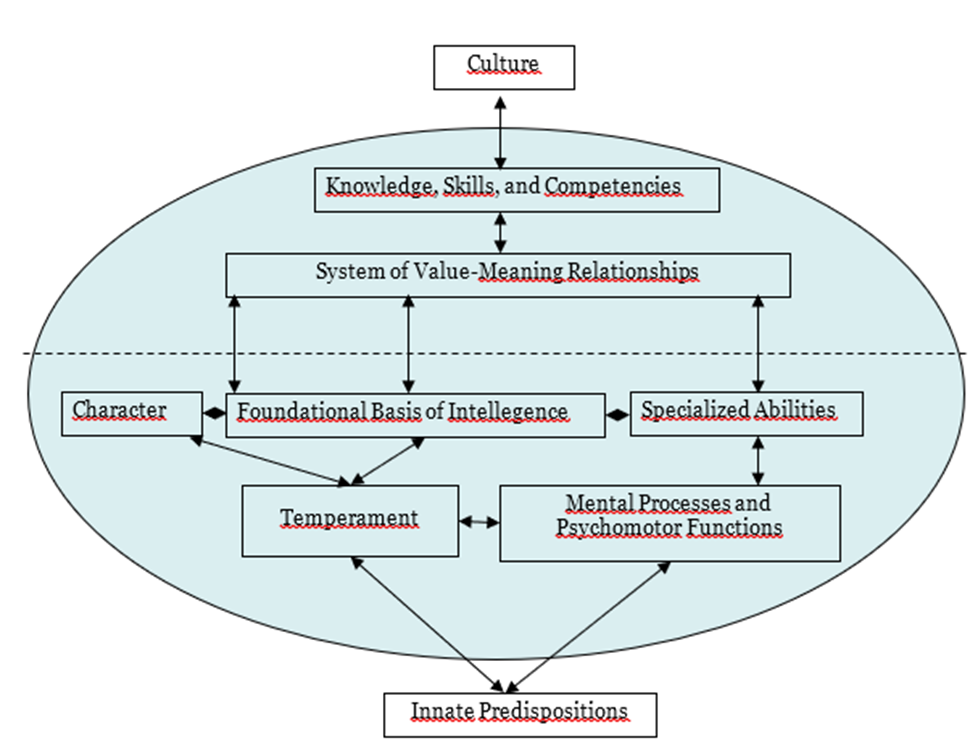
whose core is value‑meaning relations and whose foundation is temperament, mental processes, psychomotor functions, abilities, and character. In our elaborated personality structure, four levels are distinguished: (1) temperament, mental processes, and psychomotor functions, directly influenced by innate predispositions; (2) specialized abilities, the foundational basis of intelligence, and character; (3) value‑meaning relationships; and (4) experience, knowledge, skills, and habits, connected with culture. Temperament, mental processes, psychomotor functions, character, the foundational basis of intelligence, and specialized abilities are considered as “meta‑characteristics” of personality that determine stability and trajectories of mental development (Rusalov, 1979, 2012; Rusalov & Dudin, 1995; Rusalov & Naumova, 1999; Rusalov & Manolova, 2005; Rusalov & Trofimova, 2007). This approach is consistent with the views of Stern (1988, 1998) and Eysenck (1993, 1995) on the key role of temperament, character, and intelligence in differential‑psychological research. The systemic mechanism for the formation of meta‑characteristics is generalization, whereas the value‑meaning sphere and experience are formed through mechanisms of identification and internalization (Mukhina, 2007; Vygotsky, 2005). The motivational sphere, according to Maslow (1970, 1999), includes deficiency motives and “being” motives of self‑actualization, with the latter dominating in acme‑subjects. The foundational studies of temperament by Teplov (1985) and his school have significantly influenced our understanding of its biological basis. A schematic representation of this hierarchical model is provided in Figure 1.
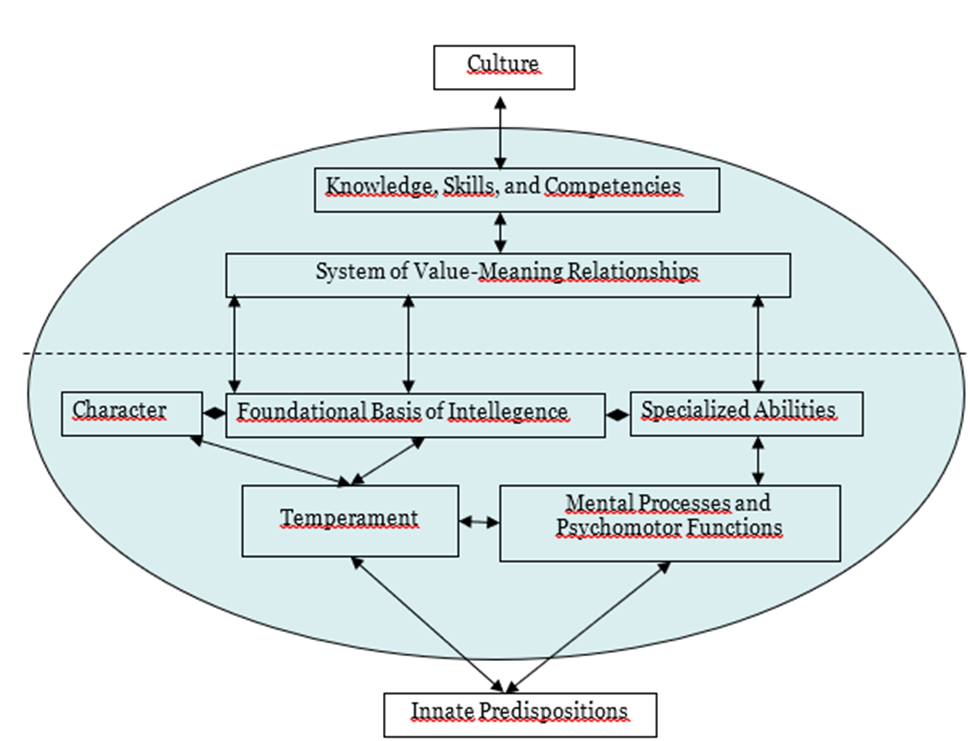
Figure 1. Implicative model of human properties (hierarchical structure): subject implicatively includes individuality and personality; individuality includes personality (social substructure) and the individual as organism (biological substructure); personality is structured hierarchically from temperament and psychomotor functions to value-meaning relations and cultural experience.
Individuality includes personality as its social substructure and individual (biological) properties as its biological substructure. In contrast to personality, individuality always refers to a specific person and encompasses both the social (personality) and the biological (the individual as an organism, including genetic, physiological, and neurodynamic properties). The interaction of the social and the biological is realized through temperament, which is both the lowest substructure of personality and the highest substructure of biological organization (Rusalov, 2012). Our understanding of individuality is consistent with the views of Ananyev (1980, 2016), according to which individuality captures not simply singleness but the highest form of human organization in the unity of its diverse attributes. Leites (1971) demonstrated that essential properties of intelligence can manifest already in childhood, providing important insights into the development of abilities.
The subject is the highest level of development; it implicatively includes individuality and personality and represents an integral property of the individual, characterised by capacity for self-development, self-determination, creativity, and social responsibility. According to Rubinshtein (1976, 2003), the main attributes of the subject are the capacity for self-development, self-determination, and self-improvement. Brushlinsky (1994, 2003) emphasised the activity, sociality, and historicity of the subject, while Abulkhanova (2002) defines the subject as the highest form of personality development. In contrast to Merlin’s approach (1986, 2009), which reduces the subject to a subject of activity, we consider the subject as an integrative formation that stands above individuality and personality. The mature subject (acme subject) not only creates themselves but also facilitates the creativity of others, acts in the service of society, and performs the function of a social standard (Rusalov, 2012; Volkova et al., 2017). Acmeological maturity, in contrast to biological (definitive) maturity, occurs after the overcoming of an individual acmeological threshold and is characterized by a conscious striving for self-improvement, creativity, and prosocial orientation (Bodalev, 1998). The heterochrony of development and the age-related dynamics of mental functions have been extensively studied, and the general patterns of definitive maturation are well documented (Craig, 2000; Kuchma et al., 2002; Rushton, 1997).
The developed methods implementing the idiodynamic strategy fall into two groups: (1) experimental introspection (paired comparisons) and (2) open scale methods (idiodynamic questionnaire), which differ from traditional Likert scales in their allowance for assessing the “over expression” of properties and in the recording of response time.
Thus, the aim of the present work is to theoretically substantiate and empirically verify an idiodynamic strategy for the study of individuality that enables the measurement of stable hierarchical structures of psychological properties of acme subjects without reducing them to group norms. We set the following tasks: (1) to develop methods of experimental introspection and open scale; (2) to examine their test retest reliability; (3) on a pilot sample of acme subjects, to identify systemic patterns in the organization of temperament, intelligence, motivation, emotional volitional sphere, values, and preferred activity domains; and (4) to discuss the possibility of an acme oriented revision of the concept of psychological norm, in which the norm is defined not as statistically average behavior but as prosocial, highly developed conduct (Stepin, 2003).
Method
2.1. Design
The research was conducted in two stages. At the first stage, development and approbation of idiodynamic methods was carried out on a sample of 26 volunteers (both sexes, age 25–40 years). The primary purpose of this stage was to examine test-retest reliability and analyse the influence of individual interpretations of concepts on measurement results. At the second stage, a pilot study of four acme-subjects was conducted using the final versions of the methods, with the aim of identifying individual-specific rank structures of individuality properties, verifying concordance between phenomenological and psychometric levels, and formulating hypotheses for subsequent research.
2.2. Participants
Approbation sample: 26 volunteers of both sexes aged 25–40 years (13 males, 13 females) with higher or incomplete higher education, without manifest psychopathology.
Primary sample: 4 acme-subjects—professionals who have attained outstanding results in their field and are recognised as such in expert communities. Selection criteria included: (a) presence of confirmed professional achievements (state awards, recognition in professional community); (b) age over 50 years (presumed period of acmeological maturity); (c) capacity for reflection and willingness to participate in extended research.
Acme-subject 1 (A.S.1). Male, 52 years. Retired police colonel, recipient of the Order “For Merit to the Fatherland” II degree. Has comprehensive education (lawyer, economist, psychologist). Currently works as a lawyer, simultaneously preparing for master of sports qualifications in pistol shooting. Professional biography includes leadership of a unit that entered the top ten units of the Russian Ministry of Internal Affairs and participation in special operations.
Acme-subject 2 (A.S.2). Male, 60 years. Russian entrepreneur, specialist in communications, telecommunications, and information security. Built a business from scratch without external investment. Develops medical projects and hippotherapy. Characterised by high social responsibility.
Acme-subject 3 (A.S.3). Male, 81 years. Doctor of Sciences, Professor, renowned scientist, author of fundamental theories. Continues active scientific work, generates new ideas, participates in discussions, and supervises students.
Acme-subject 4 (A.S.4). Male, 56 years. Member of the Union of Photo Artists of Russia. Creates artistic photographs reflecting the worldview of a deeply religious individual and patriot. Specialises in photographing children, landscapes, and working people.
2.3. Idiodynamic Methods: Theoretical Foundations and Procedure
Idiodynamic methods are based on the assumption that psychological properties of individuality are organised in the form of a hierarchical system (rank structure) that can be identified through procedures activating implicit levels of self-consciousness. We developed two classes of methods, differing in the mode of obtaining rank structures but unified by common principles:
(a) self-comparison instead of social comparison;
(b) registration of temporal parameters of response;
(c) computer presentation of stimuli for standardisation of procedure.
Experimental introspection method (implicit self-identification). This method implements the paired comparisons algorithm and is intended for identifying rank structures of life values and special abilities. The participant is presented sequentially on the computer screen with pairs of characteristics (e.g., values “freedom” and “wealth”). The task is to select from each pair the characteristic that is more strongly expressed in them personally. Selection must be made as quickly as possible and without prolonged deliberation. Pairs are presented in random order until each characteristic has been compared with all others. For a set of n characteristics, the number of comparisons is n(n-1)/2. For each characteristic, the number of selections and mean selection time are recorded. On the basis of the number of selections, an initial rank scale is constructed; in the case of equal numbers of selections, mean selection time is used to refine the rank (shorter time is assigned a higher rank). The paired comparisons method under time-deficit conditions activates implicit levels of information processing, enabling identification of the true hierarchy of properties (Volkova et al., 2016).
Open scale method (idiodynamic questionnaire). This method is intended for identifying rank structures of temperament, intelligence, motivational and emotional-volitional spheres of a person. The participant is presented sequentially on the computer screen in random order with descriptions of properties. For each property, they must assess the degree of its expression in themselves, using an open scale with five response options: 1 — “not at all expressed,” 2 — “rather not expressed,” 3 — “moderately expressed,” 4 — “very expressed,” 5 — “extremely or exceptionally expressed.” The time taken to assess each property is recorded. The rank structure is constructed on the basis of scores; in the case of equal scores, assessment time is used to refine the rank (shorter time is assigned a higher rank). The inclusion of the category “extremely or exceptionally expressed” permits the participant to mark properties they consider unique to themselves, while time recording serves as an indicator of implicit significance (Volkova et al., 2017).
Selection of property lists. For each investigated construct, a list of properties was compiled, relevant to the theoretical model and differentiating acme-subjects. Temperament was assessed by 12 properties reflecting three principal spheres of activity (psychomotor, intellectual, and communicative) and two temperament substructures (activational — ergonicity, plasticity, speed; and regulatory — emotional sensitivity) based on the temperament structure developed in the school of B.M. Teplov and V.D. Nebylitsyn (Rusalov & Trofimova, 2007; Rusalov, 2012). The foundation of intelligence was assessed by four properties: general intellectual endurance, flexibility, speed, and self-regulation. The motivational sphere of a person was assessed by six need groups (physiological, safety, belonging and love, achievement and recognition, self-actualisation, and our introduced “acme-needs”) based on A. Maslow’s hierarchical theory (Maslow, 1970). The emotional-volitional sphere was assessed by six properties: will, emotion recognition, emotion management, emotional independence, empathy, and aggression. Life values were assessed by ten categories: wealth and power, education, faith in God, health, family, friends, hedonism, creativity, goodness and justice, freedom and responsibility. Preferred activity domains were assessed by fourteen categories: human psychology, legal and law enforcement activity, teaching and upbringing, physical culture and sport, management and politics, industrial and information technologies, military affairs, medicine and healthcare, fundamental and theoretical sciences, ecology and nature protection, art and culture, agriculture, domestic services, economics and entrepreneurship.
Reliability Testing and Data Collection Procedure
Test-retest reliability. All participants of the approbation sample underwent testing twice with a 3–4-week interval. Between testing sessions, interviews were conducted in which we attempted to modify participants’ understanding of the content of key concepts, enabling assessment of the independence of results from conscious changes in concept interpretation.
Main study. The four acme-subjects underwent the full procedure of idiodynamic testing using all developed methods. In addition, a free psychodiagnostic interview of 1.5–2 hours duration was conducted with each, during which the most important biographical events, achievements, and life orientations were recorded. The interview was conducted in a free manner, without a pre-prepared plan, maintaining a trusting atmosphere.
2.4. Evaluation Criteria and Statistical Processing
For assessment of result concordance, the following were used: (1) Spearman’s rank correlation coefficient between first and second testing results (for test-retest reliability examination); (2) qualitative analysis of concordance between phenomenological data (interview) and idiodynamic testing results; (3) comparative analysis of rank structures of temperament and intelligence within the framework of nomothetic research previously conducted on a large sample.
Results
3.1. Test-Retest Reliability of Idiodynamic Methods
Analysis of approbation sample data demonstrated high test-retest reliability of the developed methods. Spearman’s rank correlation coefficients between first and second measurement results were: for the experimental introspection method (life values and special abilities) r = 0.78–0.93 (p < 0.001); for the open scale method (temperament, intelligence, character) r = 0.81–0.94 (p < 0.001). These high coefficients were obtained despite the interviews conducted between measurements, in which we deliberately attempted to change participants’ understanding of the content of key concepts. This testifies that idiodynamic methods reveal stable implicit structures not subject to conscious adjustment.
3.2. Summary Tables of Rank Structures of Acme-Subjects
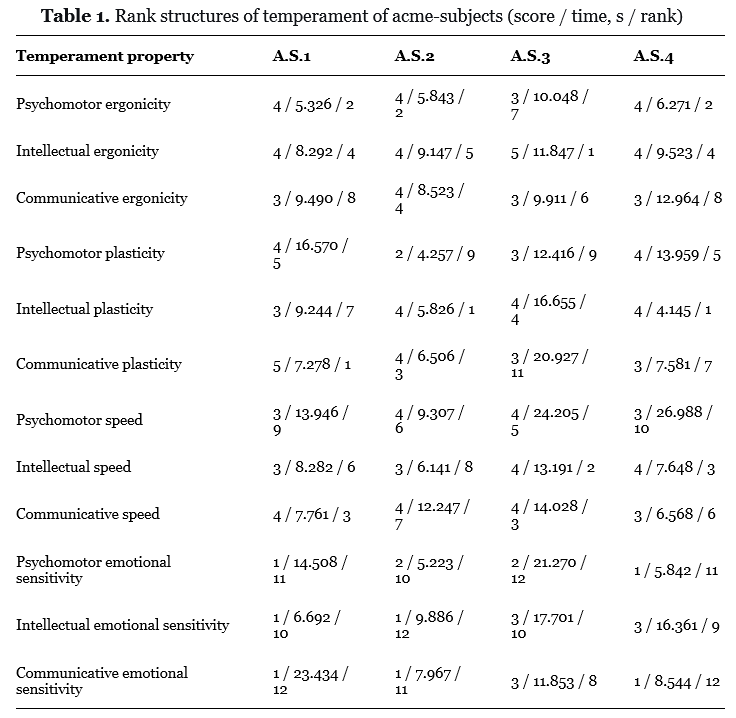
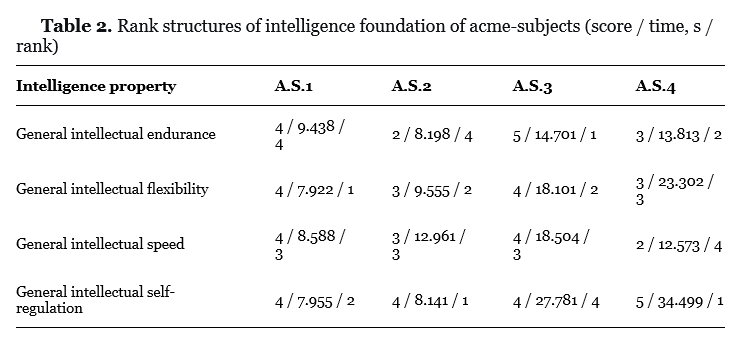
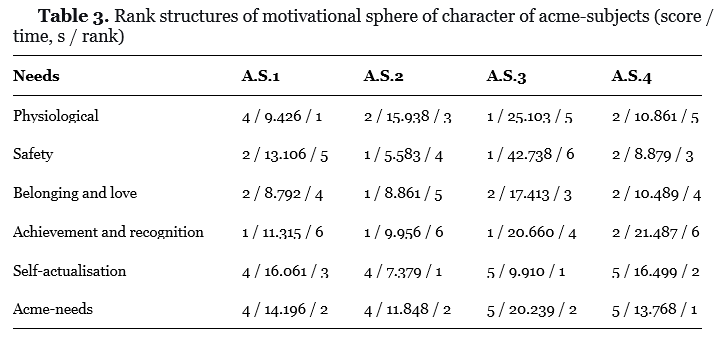
Below are presented summary data for all four acme-subjects for each investigated construct. Each cell indicates three parameters: score (on a five-point scale), mean assessment time (in seconds), and rank (the smaller the number, the higher the expression of the property in the individual hierarchy). Higher rank (smaller number) corresponds to greater expression of the property.
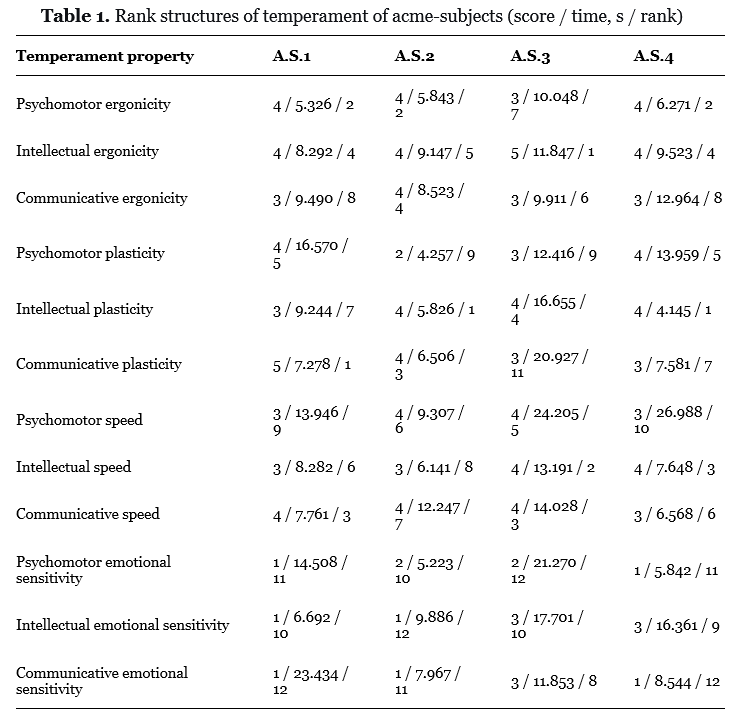
Across all acme-subjects, upper ranks (1–5) are occupied by activity properties (ergonicity, plasticity, speed) with high scores (4–5) and relatively short assessment time (4 to 9 s). Lower ranks (9–12) are emotional sensitivity with low scores (1–2) and, as a rule, longer assessment time (14 to 23 s). This indicates high temperamental activity with low emotional sensitivity.
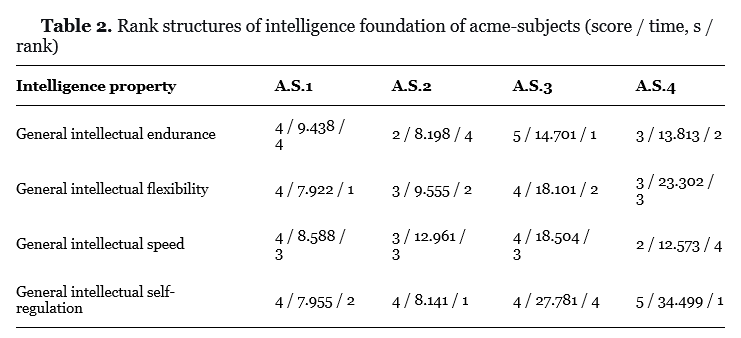
The dominant intelligence property (smallest rank) corresponds to professional activity: flexibility for the lawyer (A.S.1, time 7.922 s), self-regulation for the entrepreneur (A.S.2, time 8.141 s) and artist (A.S.4, time 34.499 s), endurance for the scientist (A.S.3, time 14.701 s). All four properties are assessed highly (3–5 scores). Assessment time varies depending on the complexity and significance of the property for the individual.
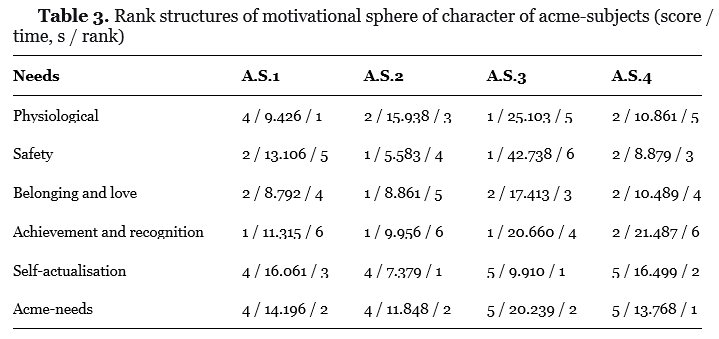
Acme-needs and self-actualisation needs occupy upper positions (ranks 1–3, scores 4–5) across all participants, with relatively short assessment time (7–20 s). Deficiency needs (safety, achievement, physiological) occupy lower positions (ranks 4–6, scores 1–2), with assessment time often longer (up to 42 s for A.S.3 for safety), indicating their lesser implicit accessibility. The exception (A.S.1, physiological needs at rank 1) relates to situational actualisation, but even in this case acme-needs and self-actualisation retain high ranks (2 and 3).
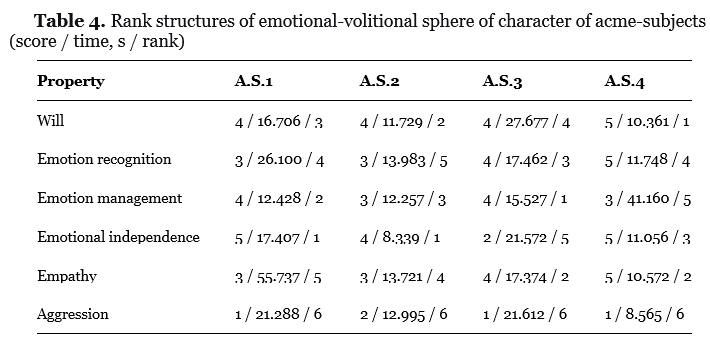
Across all acme-subjects, aggression occupies the last (6th) rank with minimal scores (1–2) and assessment time from 8.5 to 21.6 s. Dominant properties are emotional-volitional regulation (will, emotion management, emotional independence) with high scores (4–5) and time generally shorter than for aggression (with the exception of A.S.4, where emotion management took 41 s, though this is an exception). General pattern: high level of regulation with low aggression.
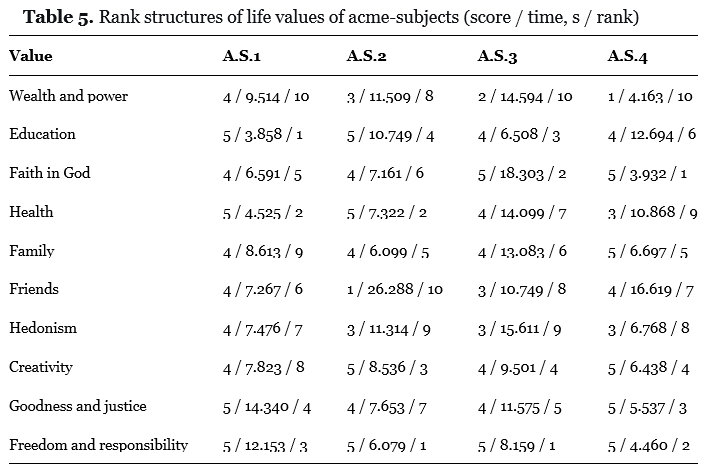
Wealth and power consistently occupy lower positions (ranks 8–10) with scores 1–4, with assessment time varying from 4.16 to 14.59 s. Values of freedom, responsibility, education, creativity, and justice occupy upper positions (ranks 1–5) with high scores (4–5) and, as a rule, relatively short assessment time (from 3.86 to 14.34 s). For A.S.4 (deeply religious), faith in God is at first place (time 3.932 s). Notably, for A.S.2 the value “friends” received rank 10 with very long time 26.288 s, consistent with phenomenological data (loss of friends in business).
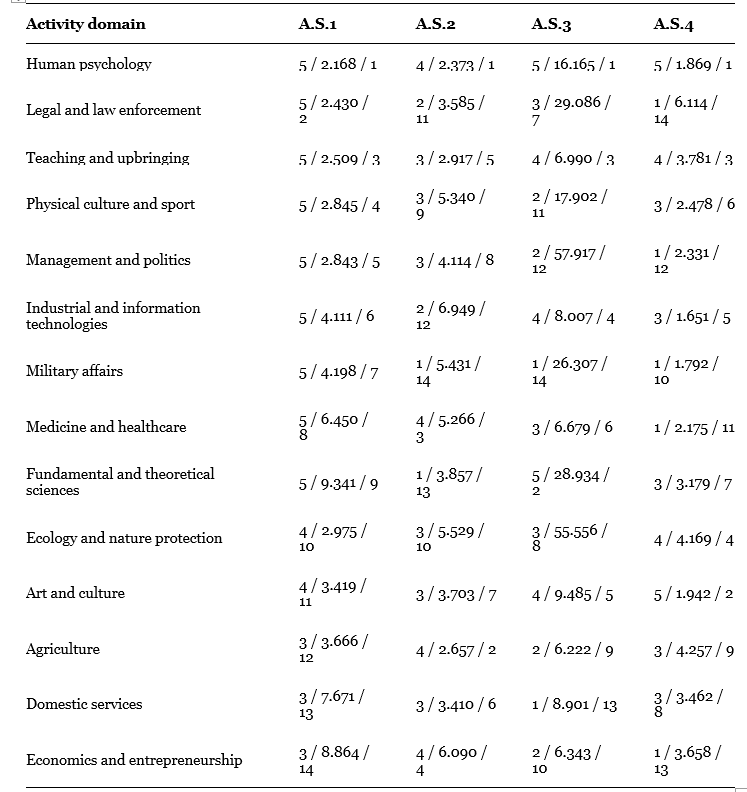
Table 6. Rank structures of preferred activity domains of acme-subjects (score / time, s / rank)
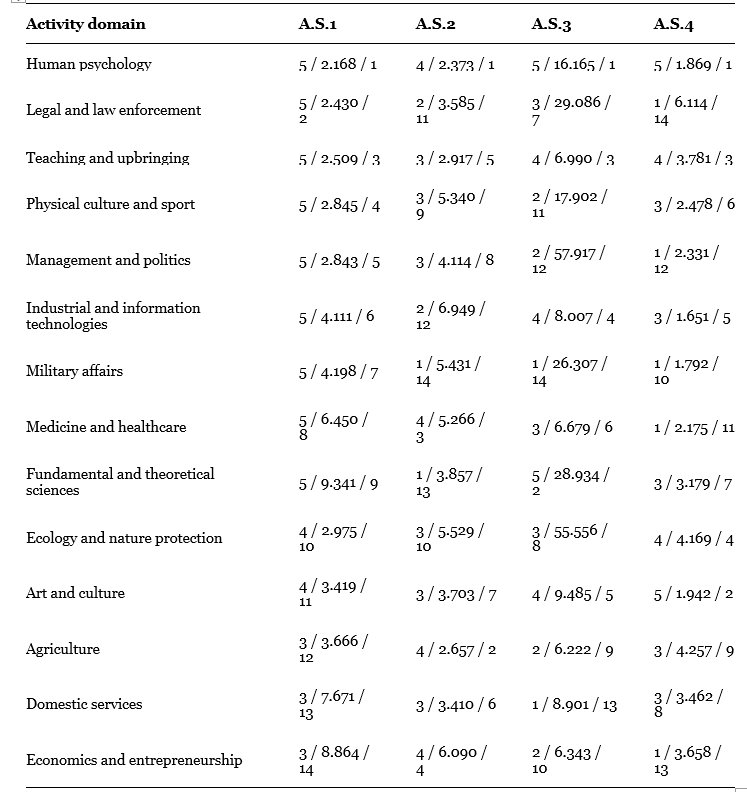
Across all acme-subjects, first place is occupied by “human psychology” (score 5) with very short assessment time (from 1.869 to 16.165 s). Second ranks reflect professional specialisation: legal activity (A.S.1, 2.430 s), agriculture (A.S.2, 2.657 s), fundamental sciences (A.S.3, 28.934 s—the scientist required more time to assess their primary domain, which may reflect depth of reflection), art and culture (A.S.4, 1.942 s). This indicates broad interests with dominant humanitarian orientation. Assessment time for uninteresting domains is often significantly longer (e.g., for A.S.3, management and politics—57.917 s), which may serve as an additional indicator of low significance.
Comparison of free interview data with idiodynamic testing results revealed a high degree of concordance across all four acme-subjects: motivational orientations (autonomy, social responsibility, creativity) corresponded to dominance of acme-needs; high morality and absence of aggression corresponded to low aggression ranks; value orientations (rejection of wealth and power) were confirmed by rank structures; high activity and low emotional sensitivity were manifested in behavioural style; individual intelligence profiles corresponded to cognitive styles described in interviews. This concordance serves as confirmation of the construct validity of idiodynamic methods.
Discussion
The principal finding of the present study consists in the development and empirical verification of an idiodynamic strategy that for the first time permits objective measurement of stable hierarchical structures of individuality properties without reducing them to group norms. The experimental data obtained on this basis, presented in the summary tables with scores, assessment time, and ranks, testify to the existence of a systemic implicative organisation of properties in individuals who have attained the highest level of development, and confirm the proposed theoretical model.
The fundamental distinction of the idiodynamic approach from the nomothetic lies in the mode of constructing the measurement scale. In the nomothetic approach, the scale is constructed on the basis of the distribution of indicators in the reference group: the individual result is interpreted as deviation from the mean (in sigma units). This means that measurement is indirect: properties are assessed not in themselves but through their position relative to other people. As shown in our previous work (Volkova et al., 2016), the test-retest reliability of nomothetic methods upon repeated testing of a single individual is significantly lower than when testing groups, indicating the influence of situational factors and social desirability.
Idiodynamic methods, by contrast, construct the scale on the basis of comparison of properties within the individual system. The participant assesses not how similar they are to others, but which of their own properties is more strongly expressed. This fundamental shift in the reference point of measurement permits:
- Identification of stable hierarchical structures.The test-retest reliability coefficients of idiodynamic methods (0.78–0.94) substantially exceed analogous indicators for nomothetic methods on the same sample. This testifies that the identified structures reflect the real organisation of mental properties, rather than measurement artefacts.
- Minimisation of social desirability.In forced-choice paired comparison situations with response time registration, the participant cannot consciously control each choice, particularly when properties appear close in significance. Shorter choice time is interpreted as an indicator of higher implicit significance of the characteristic, enabling identification of structures not subject to conscious adjustment. In our data, assessment time for high-rank properties is generally shorter than for low-rank properties, confirming this principle (see tables).
- Study of uniqueness without loss of objectivity.The idiodynamic approach retains the requirements of reliability and validity inherent in nomothetic methods, but is oriented toward the unique structure of properties of the specific individual, rather than group differences.
The data obtained on four acme-subjects demonstrate stable hierarchical organisation of individuality, which manifests at all studied levels: temperamental, intellectual, motivational, value-based, and activity-based. This organisation is not a random combination of high indicators, but represents a coherent system in which all components are interconnected and correspond to the theoretical model of the mature subject. For example, high temperamental activity in the intellectual sphere (short assessment time, high score, upper rank) is combined with high intellectual property indicators and low emotional sensitivity (long time, low score, lower rank), creating a favourable background for intellectual activity. Dominance of acme-needs and values of creativity and freedom (short time, high score) is consistent with behavioural manifestations of social responsibility and striving for self-realisation.
Particular attention deserves the identified dominance of acme-needs and self-actualisation needs over deficiency needs. This result confirms A. Maslow’s (1970) proposition that the personal growth of the self-actualising personality cannot be halted by unsatisfied deficiency needs. Even in a situation of objective actualisation of physiological needs (A.S.1 during intensive preparation), acme-needs and self-actualisation retain high positions (ranks 2 and 3). This indicates that the acme-subject is characterised by a special motivational structure in which higher needs are not a superstructure over lower ones but an independent system-forming force.
The identified rejection of wealth and power as self-values with dominance of values of freedom, responsibility, education, and creativity indicates that acme-subjects are oriented not toward external attributes of success but toward internal, substantive aspects of self-realisation. This is consistent with conceptions of the self-actualising personality as a person motivated not by deficiency but by “being” values (Maslow, 1970).
The dominant interest in human psychology across all four acme-subjects, regardless of their professional specialisation, testifies that the mature subject is characterised not by narrow professional identity but by broad humanitarian orientation. This may be related to developed reflection and capacity for understanding other people, which is an important component of the subject level of development.
Comparison of rank structures of temperament and intelligence demonstrated that across all highly intelligent acme-subjects, upper levels of the temperament structure contained activity properties in the intellectual sphere (intellectual ergonicity, speed, and plasticity), while lower levels contained intellectual emotional sensitivity. This result refines the conclusions of our previous nomothetic research: temperament with high activity values and low emotional sensitivity values acts as a favourable predisposition for formation of the foundation of intelligence.
The theoretical significance of the obtained results lies in the substantiation of the implicative model of human properties, according to which the subject (as the highest level) implicatively includes individuality and personality but is not reducible to them. Empirical confirmation of this model consists in the fact that all structures identified in acme-subjects are coherent with one another and correspond to theoretical expectations: higher levels (subject level) include and transform lower levels (personality and individual levels).
The practical significance of the developed idiodynamic methodology extends beyond academic research. It may be used in professional selection, psychological counselling, and coaching to identify unique structures of mental resources and develop individual development programmes. In particular, as demonstrated in our previous work (Volkova et al., 2016), the procedure of comparing candidates’ psychological properties with those of a professional who has attained heights in their activity (the individual standard) may be effective in personnel selection.
Study limitations: The small sample (4 acme-subjects) does not permit statistically generalised conclusions; however, this limitation is compensated by the depth of analysis of each case and concordance of data across levels. The criteria for selecting acme-subjects require further operationalisation. The validity of the methods requires cross-validation using alternative approaches (expert evaluations, longitudinal observations, neurophysiological correlates). The gender imbalance does not permit conclusions about the specificity of structures in female acme-subjects.
Future research directions include: (a) expansion of the acme-subject sample to include women and representatives of different professions; (b) development of formal criteria for acme-maturity; (c) longitudinal studies to examine the dynamics of idiodynamic structures; (d) comparison of idiodynamic structures with neurophysiological correlates (EEG, fMRI) to confirm their biological grounding; (e) application of idiodynamic methods in professional selection and psychological counselling practice.
Conclusions
The conducted pilot study enabled:
- Development and empirical verification of an idiodynamic strategy for the study of individuality, integrating idiographic focus on the uniqueness of the individual with nomothetic requirements of objectivity, reliability, and validity. Two methods were developed: experimental introspection (paired comparisons method) and an idiodynamic questionnaire with open scale which permit identification of rank structures of individuality properties with minimal influence of social desirability. The test-retest reliability of the methods was 0.78–0.94 (p< 0.001).
- Substantiation of the implicative model of human properties, in which personality, individuality, and subject are considered as hierarchically nested levels, with the subject (acme-subject) representing the highest level of development, characterised by capacity for self-development, creativity, and social responsibility. A model is proposed describing the structural organisation of personality from temperament to value-meaning relations.
- For the first time, using objective methods, identification of stable systemic patterns of psychological organisation of acme-subjects(see summary Tables 1–6): high temperamental activity (scores 4–5, short assessment time) with low emotional sensitivity (scores 1–2, long assessment time); dominance of intellectual properties with profile specificity; dominance of acme-needs and self-actualisation needs over deficiency needs; low aggression with high levels of emotional-volitional regulation; rejection of wealth and power as self-values and dominance of values of freedom, responsibility, education, creativity, and justice; dominant interest in human psychology regardless of professional specialisation.
- Demonstration that the acme-subject is not a set of high indicators on individual properties but an integral, systemically organised structure, in which all components are coherent with one another and correspond to the theoretical model of the mature subject as the highest form of human development.
- Raising the question of revising the concept of psychological normtoward an acme-oriented approach, in which the norm is considered not the most widespread but the highest, prosocial, creative, and responsible behaviour corresponding to the level of the mature subject.
The developed idiodynamic methodology opens new perspectives for the objective study of unique properties of developed individuality, enabling one to move beyond the limitations of the nomothetic approach and fully corresponding to the conditions of the post-non-classical period of psychological science.
Ethics approval and consent to participate: All procedures performed in this study involving human participants were in accordance with the ethical standards of the institutional research committee and with the 1964 Helsinki declaration. The study protocol was approved by the Institutional Review Board of the Institute of Psychology of the Russian Academy of Sciences. All participants provided written informed consent prior to participation and were informed of their right to withdraw at any time.
Data availability: The datasets are not publicly available due to the confidentiality of participants’ personal data but are available from the corresponding author on reasonable request.
Conflict of interest: The authors declare that they have no competing interests.
Funding: This research received no specific grant from any funding agency in the public, commercial, or not-for-profit sectors. The study was conducted as part of the institutional research programme of the Institute of Psychology of the Russian Academy of Sciences.
Acknowledgements: The authors express their sincere gratitude to the participants of this study for their time and willingness to engage in the research. The authors thank their colleagues at the Druzhinin Laboratory of Psychology of Abilities and Mental Resourses, Institute of Psychology of the Russian Academy of Sciences, for their valuable discussions and support. The authors reviewed and edited the content as needed and take full responsibility for the final version of the manuscript.
Author contributions: V.M.R. — Conceptualisation, methodology, supervision, validation, writing—review and editing. V.M.R. is the principal ideologist and primary developer of the idiodynamic strategy presented in this study. S.I.D. — Conceptualisation, methodology, investigation, formal analysis, writing—original draft, writing—review and editing, project administration.
References
- Abulkhanova, K. A. (2002). Psikhologiya i soznanie lichnosti[Psychology and consciousness of personality]. PER SE.
- Allport, G. W. (1955). Becoming: Basic considerations for a psychology of personality. Yale University Press.
- Allport, G. W. (2002). Stanovlenie lichnosti: Izbrannye trudy[Becoming: Selected works]. (In Russian)
- Ananyev, B. G. (1980). Izbrannye psikhologicheskie trudy[Selected psychological works] (Vols. 1–2).
- Ananyev, B. G. (2016). Chelovek kak predmet poznaniya[Man as a subject of knowledge]. (In Russian)
- Antsyferova, L. I. (2006). Razvitie lichnosti i problemy gerontopsikhologii[Personality development and problems of gerontopsychology]. Institute of Psychology RAS.
- Bodalev, A. A. (1998). Akmeologiya kak nauchnaya distsiplina[Acmeology as a scientific discipline]. Russian Academy of Education.
- Brushlinsky, A. V. (1994). Problemy psikhologii sub”ekta[Problems of psychology of the subject]. Institute of Psychology RAS.
- Brushlinsky, A. V. (2003). Psikhologiya sub”ekta[Psychology of the subject].
- Cattell, R. B. (1986). General principles across the media of assessment. In R. B. Cattell & R. C. Johnson (Eds.), Functional psychological testing: Principles and instruments(pp. 15–32). Brunner/Mazel.
- Craig, G. (2000). Psikhologiya razvitiya[Developmental psychology]. (In Russian)
- Eysenck, H. J. (1993). Kolichestvo izmereniy lichnosti: 16, 5 ili 3? – kriterii taksonomicheskoy paradigmy [The number of personality dimensions: 16, 5 or 3? – criteria for a taxonomic paradigm]. Inostrannaya psikhologiya, 1(2), 9–23. (In Russian)
- Eysenck, H. J. (1995). Struktura lichnosti[The structure of personality]. (In Russian)
- Frankl, V. E. (1990). Chelovek v poiskakh smysla[Man’s search for meaning]. (In Russian)
- Jung, C. G. (1994). Analiticheskaya psikhologiya[Analytical psychology]. (In Russian)
- Kelly, G. A. (1963). A theory of personality. The psychology of personal constructs. W. Norton & Company Ltd.
- Kloninger, S. (2003). Teorii lichnosti: poznanie cheloveka[Theories of personality: understanding the person]. (In Russian)
- Krocker, L., & Algina, J. (2010). Vvedenie v klassicheskuyu i sovremennuyu teoriyu testov[Introduction to classical and modern test theory]. (In Russian)
- Kuchma, V. R., Dontsov, V. I., Krut’ko, V. N., et al. (2002). Etapy zhiznedeyatel’nosti cheloveka i meditsinskie uslugi v raznye vozrastnye periody[Stages of human life activity and medical services in different age periods]. (In Russian)
- Leites, N. S. (1971). Umstvennye sposobnosti i vozrast[Mental abilities and age]. (In Russian)
- Maslow, A. H. (1970). Motivation and personality(2nd ed.). Harper & Row.
- Maslow, A. G. (1999). Dal’nie predely chelovecheskoy psikhiki[The farther reaches of human nature]. (In Russian)
- Mathews, R. C. (1990). Abstractness of implicit grammar knowledge: Comments on Perruchet and Pacteau’s analysis of synthetic grammar learning. Journal of Experimental Psychology: General, 119(4), 412–416. doi: 1037/0096-3445.119.4.412
- Merlin, V. S. (1986). Ocherk integral’nogo issledovaniya individual’nosti[Essay on the integral study of individuality].
- Merlin, V. S. (2009). Psikhologiya individual’nosti: Izbrannye psikhologicheskie trudy[Psychology of individuality: Selected psychological works]. MPSI; MODEK. (In Russian)
- Mukhina, V. S. (2007). Lichnost’: mify i real’nost’[Personality: Myths and reality]. (In Russian)
- Neal, A., & Hesketh, B. (1997). Future directions for implicit learning: Toward a clarification of issues associated with knowledge representation and consciousness. Psychonomic Bulletin and Review, 4(1), 73–78. doi: 3758/BF03210778
- Pavilenis, V. M. (1983). Problema smysla[The problem of meaning]. (In Russian)
- Petrovsky, V. A. (1996). Lichnost’ v psikhologii: paradigma sub”ektnosti[Personality in psychology: the paradigm of subjectivity]. (In Russian)
- Rogers, C. R. (1961). On becoming a person: A therapist’s view of psychotherapy. Houghton Mifflin.
- Rogers, K. (1994). Vzglyad na psikhoterapiyu. Stanovlenie cheloveka[A view of psychotherapy. The becoming of man]. Progress. (In Russian)
- Rosenzweig, S. (1958). The place of the individual and of idiosyncrasies in psychology. Journal of Individual Psychology, 14, 3–12.
- Rosenzweig, S. (2000). Idiodinamicheskaya psikhologiya [Idiodynamic psychology]. In Istoriya psikhologii v litsakh[History of psychology in persons]. (In Russian)
- Rubinshtein, S. L. (1976). Problemy obshchey psikhologii[Problems of general psychology]. (In Russian)
- Rubinshtein, S. L. (2003). Bytie i soznanie. Chelovek i mir[Being and consciousness. Man and the world]. Piter. (In Russian)
- Rusalov, V. M. (1979). Biologicheskie osnovy individual’no-psikhologicheskikh razlichiy[Biological foundations of individual psychological differences]. (In Russian)
- Rusalov, V. M. (2010). O nadezhnosti metoda parnykh sravneniy pri implitsitnoy samoidentifikatsii lichnostnykh svoystv [On the reliability of the paired comparisons method in implicit self-identification of personality traits]. In Nauchnye shkoly Instituta psikhologii RAN. Matematicheskaya psikhologiya(pp. 482–489). IP RAS. (In Russian)
- Rusalov, V. M. (2012). Temperament v strukture individual’nosti cheloveka[Temperament in the structure of human individuality]. Publishing House of the Institute of Psychology RAS. (In Russian)
- Rusalov, V. M., & Dudin, S. I. (1995). Temperament i intellekt: obshchie i spetsial’nye faktory razvitiya [Temperament and intelligence: general and special factors of development]. Psikhologicheskiy Zhurnal, 16(5), 12–23. (In Russian)
- Rusalov, V. M., & Manolova, O. N. (2005). Vzaimosvyaz’ kharaktera i temperamenta v strukture individual’nosti [The relationship between character and temperament in the structure of individuality]. Psikhologicheskiy Zhurnal, 26(3), 65–73. (In Russian)
- Rusalov, V. M., & Naumova, E. R. (1999). O svyazyakh obshchikh sposobnostey s “intellektual’nymi” shkalami temperamenta [On the links between general abilities and “intellectual” scales of temperament]. Psikhologicheskiy Zhurnal, 20(1), 70–77. (In Russian)
- Rusalov, V. M., & Trofimova, I. N. (2007). The structure of temperament and its measurement. Psychological Services Press.
- Rushton, J. P. (1997). Race, evolution and behavior. Transaction Publishers.
- Saiko, E. V. (2006). Sub”ekt: sozidatel’ i nositel’ sotsial’nogo[Subject: creator and bearer of the social]. MPSI; MODEK. (In Russian)
- Sergienko, E. A., Vilenskaya, G. A., & Kovaleva, Yu. V. (2010). Kontrol’ povedeniya kak sub”ektnaya regulyatsiya[Behavior control as subject regulation]. Institute of Psychology RAS. (In Russian)
- Slobodskaya, H. R., Knyazev, G. G., & Safronova, M. V. (2006). Kratkaya forma lichnostnogo oprosnika Ayzenka (LOA-K) i yeye ispol’zovaniye dlya otsenki riska upotrebleniya psikhoaktivnykh veshchestv [Short form of Eysenck personality questionnaire and its use for assessing the risk of substance abuse]. Psikhologicheskiy Zhurnal, 27(3), 94–105. (In Russian)
- Stepin, V. S. (2003). Teoreticheskoe znanie[Theoretical knowledge]. Progress–Traditsiya. (In Russian)
- Stern, W. (1988). Differentsial’naya psikhologiya i eyo metodicheskie osnovy[Differential psychology and its methodological foundations]. (In Russian)
- Stern, W. (1998). Differentsial’naya psikhologiya i eyo metodicheskie osnovy[Differential psychology and its methodological foundations] (2nd ed.). (In Russian)
- Teplov, B. M. (1985). Izbrannye trudy[Selected works] (Vols. 1–2). (In Russian)
- Tolstova, Yu. N. (1998). Izmerenie v sotsiologii: kurs lektsiy[Measurement in sociology: a course of lectures]. INFRA-M. (In Russian)
- Volkova, E. V., Rusalov, V. M., & Nilopets, M. N. (2016). Ideo‑dynamic diagnostic expert systems: The self‑evaluation of own mental resources. In Proceedings of the 2016 SAI Intelligent Systems Conference (IntelliSys)(pp. 62–67). doi: 10.1109/IntelliSys.2016.7605413
- Volkova, E. V., Rusalov, V. M., & Nilopets, M. N. (2017). An expert system for evaluation of human mental resources: Holistic and developmental approach. In Proceedings of the 2017 Intelligent Systems Conference (IntelliSys)(pp. 527–530). IEEE. doi: 1109/IntelliSys.2017.8324348
- Volkova, E. V., Rusalov, V. M., & Nilopets, M. N. (2018). Ideo-dynamic diagnostic expert systems: The self-evaluation of own mental resources. In Lecture Notes in Networks and Systems(Vol. 15, pp. 79–90). Springer. doi: 1007/978-3-319-56994-9_6
- Vygotsky, L. S. (2005). Psikhologiya razvitiya cheloveka[Psychology of human development]. Smysl; Eksmo. (In Russian)
Comments (0)
Background. The nomothetic paradigm underlying most contemporary psychological diagnostic methods is effective for identifying population-level regularities but is fundamentally limited when measuring the unique properties of individuality that has reached a high level of development. Standardised questionnaires based on comparison with a reference group reduce individuality to a statistically variable profile dependent on sample composition and fail to reveal the internal hierarchical organisation of properties specific to a given individual. The absence of objective, reliable, and valid methods for measuring the unique psychological properties of acme-subjects, individuals who have attained the peak of personal development, results in their study remaining at the level of metaphorical descriptions that do not permit verification. Objective. To develop and empirically verify an idiodynamic strategy for the study of individuality that enables the identification of stable hierarchical structures of psychological properties of a specific individual without reducing them to group norms. Method. An implicative model of human properties (personality → individuality → subject) and two complementary methods are proposed: experimental introspection (paired comparisons method with registration of choice reaction time) and an idiodynamic questionnaire with an open scale (assessment of property expression on a five-point scale with response time registration). Four acme-subjects (aged 52–81 years, highly qualified professionals) participated in the pilot study. Rank structures of temperament (12 properties), intelligence (4 properties), motivational (6 need groups) and emotional-volitional (6 properties) spheres, life values (10 categories), and preferred activity domains (14 categories) were assessed. Test-retest reliability was examined on a sample of 26 individuals with a 3–4-week interval. Results. Test-retest reliability coefficients ranged from 0.78 to 0.94 (p < 0.001) for all methods. Summary tables of rank structures with scores, assessment time, and ranks demonstrate stable systemic patterns across all acme-subjects: high temperamental activity (scores 4–5, time 5–9 s) with low emotional sensitivity (scores 1–2, time 14–23 s); dominance of acme-needs and self-actualisation needs (ranks 1–2, scores 4–5) over deficiency needs; low aggression (rank 6, scores 1–2) with high levels of emotional-volitional regulation (scores 4–5); prioritisation of values of freedom, responsibility, education, creativity and rejection of wealth and power as self-values (rank 10); dominant interest in human psychology (rank 1, score 5). Concordance between phenomenological and psychometric data confirms the construct validity of the methods. Conclusion. The idiodynamic strategy for the first time enables objective measurement of stable hierarchical structures of individuality properties without reducing them to group norms. The obtained data testify to the systemic organisation of the acme-subject as an integral implicative structure. An acme-oriented revision of the concept of psychological norm is proposed. The methodology corresponds to the post-non-classical stage of psychological science and opens perspectives for the objective study of unique properties of developed individuality.
Идиодинамическая стратегия исследования индивидуальности: теоретическое обоснование и эмпирическая верификация
В. М. Русалов & С. И. Дудин
Институт психологии Российской академии наук, Москва, Россия
Абстракт. Актуальность. Номотетическая парадигма, лежащая в основе большинства современных методов психологической диагностики, эффективна для выявления популяционных закономерностей, но принципиально ограничена при измерении уникальных свойств индивидуальности, достигшей высокого уровня развития. Стандартизированные опросники, основанные на сравнении с референтной группой, редуцируют индивидуальность к статистически изменчивому профилю, зависящему от состава выборки, и не позволяют выявить внутреннюю иерархическую организацию свойств индивидуальности конкретного человека. Отсутствие объективных, надёжных и валидных методов измерения уникальных психологических свойств акме-субъектов — лиц, достигших вершины личностного развития, — приводит к тому, что их изучение остаётся на уровне метафорических описаний, не допускающих верификации. Цель. Разработать и эмпирически верифицировать идиодинамическую стратегию исследования индивидуальности, позволяющую выявлять устойчивые иерархические структуры психологических свойств конкретного человека без сведения их к групповым нормам. Метод. Предложена импликативная модель свойств человека (личность → индивидуальность → субъект) и два взаимодополняющих метода: экспериментальная интроспекция (метод парных сравнений с регистрацией времени выбора) и идиодинамический опросник с открытой шкалой (оценка выраженности свойств по пятибалльной шкале с фиксацией времени ответа). В пилотажном исследовании приняли участие четыре акме-субъекта (52–81 год, высококвалифицированные профессионалы). Оценивались ранговые структуры темперамента (12 свойств), интеллекта (4 свойства), мотивационной (6 групп потребностей) и эмоционально-волевой (6 свойств) сфер, жизненных ценностей (10 категорий) и предпочитаемых сфер деятельности (14 категорий). Ретестовая надёжность проверялась на выборке из 26 человек с интервалом 3–4 недели. Результаты. Коэффициенты ретестовой надёжности составили 0,78–0,94 (p < 0,001) для всех методов. Сводные таблицы ранговых структур с балльными оценками, временем оценивания и рангами демонстрируют устойчивые системные паттерны у всех акме-субъектов: высокая темпераментальная активность (4–5 баллов, время 5–9 с) при низкой эмоциональной чувствительности (1–2 балла, время 14–23 с); доминирование акме-потребностей и потребностей самоактуализации (ранги 1–2, 4–5 баллов) над дефицитарными потребностями; низкая агрессивность (ранг 6, 1–2 балла) при высоком уровне эмоционально-волевой регуляции (4–5 баллов); приоритет ценностей свободы, ответственности, образования, творчества и отвержение богатства и власти как самоценности (10-й ранг); доминирующий интерес к психологии человека (1-й ранг, 5 баллов). Согласованность феноменологических и психометрических данных подтверждает конструктную валидность методов. Заключение. Идиодинамическая стратегия впервые позволяет объективно измерять устойчивые иерархические структуры свойств индивидуальности, не редуцируя их к групповым нормам. Полученные данные свидетельствуют о системной организации свойств индивидуальности акме-субъекта как целостной импликативной структуры. Предложен акме-ориентированный пересмотр понятия психологической нормы. Методология соответствует постнеклассическому этапу развития психологической науки и открывает перспективы для объективного изучения уникальных свойств развитой индивидуальности.
Ключевые слова: идиодинамический подход, индивидуальность, акме-субъект, темперамент, интеллект, ранговые структуры, имплицитные конструкты, самоактуализация
The study of individual differences has traditionally relied on the nomothetic paradigm, which presupposes comparison of individual indicators with normative data from reference groups. This approach has proven its effectiveness for identifying population‑level regularities and differentiating groups by age, sex, or professional affiliation. However, it encounters a fundamental limitation when studying the unique, non‑replicable properties of personality that has reached a high level of development, what we designate as the acme*‑subject. In classical differential‑psychological research, the measurement standard is the reference sample. The properties of a specific individual are measured indirectly through their deviation from group mean values, expressed in sigma units. Individuality under this approach is reduced to a profile that inevitably changes when the reference group changes. The same individual may possess multiple “individualities” depending on the population with which they are compared. Furthermore, the test‑retest reliability of standardised questionnaires upon repeated testing of a single individual is significantly lower than when testing groups, indicating the influence of situational factors, primarily social desirability (Slobodskaya et al., 2006; Volkova et al., 2016).
Three principal research strategies have emerged in the psychology of individual differences, differing in their modes of data processing and philosophical foundations (Volkova et al., 2016). The nomothetic approach (NDES) proceeds from the assumption that causal assertions formulated on the basis of studying one population are applicable to other populations. The individual is regarded as a totality of fixed, situation‑independent attributes. The assessment of personal traits is based on statistical apparatus – the normal distribution. Instead of describing the ways in which an individual achieves success, personal traits are reduced to a single dimension on which individuals are arranged according to their outcomes in a series of comparisons. Strengths of the nomothetic approach include standardisability, data comparability, and high statistical power when working with large samples. Weaknesses include neglect of the unique structure of individual properties, dependence of results on reference group composition, susceptibility to social desirability effects, and limited predictive validity with respect to a specific individual (Allport, 1955, 2002; Cattell, 1986; Eysenck, 1993, 1995; Stern, 1988, 1998).
The idiographic approach (IDES) fundamentally differs from the nomothetic in that it does not require a sample and does not employ group mean characteristics, correlations, or factors. It enables the acquisition of data on the uniqueness of a specific individual. In our implementation, this is a modification of the nomothetic method through extension of the rank scale by inclusion of additional qualitative evaluations (the open scale method). Strengths of the idiographic approach include focus on uniqueness and depth of analysis of the individual case. Weaknesses include subjectivity of interpretation, difficulty of verifying conclusions, and absence of standardised reliability criteria (Frankl, 1990; Rogers, 1961, 1994).
The idiodynamic approach (IDDES) is based on S. Rosenzweig’s concept (Rosenzweig, 1958, 2000) of the existence of a stable internal implicit idiodynamic organisation of psychological properties in the human mind. This method represents a modification of the idiographic approach, where only one individual is studied, and the scale is constructed on the basis of qualitative pairwise comparisons of specific characteristics of mental resources. On the one hand, the idiodynamic approach possesses features of the idiographic, enabling study of the uniqueness of personality and its individual mental resources. On the other hand, it retains the requirements of reliability and validity inherent in standard statistical systems for large populations (Volkova et al., 2016). The key distinction of the idiodynamic strategy lies in the fact that property assessment is conducted through comparison within the individual psychological system (ipsative method), rather than through comparison with group norms, which minimises the influence of social desirability and enables identification of implicit self‑consciousness structures. High test‑retest reliability of idiodynamic methods (rank correlation coefficients 0.75–0.92) has been demonstrated on various samples (Volkova et al., 2016, 2017). The paired comparison procedure, which forms the basis of the idiodynamic method, has shown high test‑retest reliability in empirical studies; data obtained from the same individual across different expert systems revealed that the idiodynamic method consistently yields the highest reliability, whereas the nomothetic method showed the lowest (Rusalov, 2010; Volkova et al., 2018). The method of paired comparisons itself is a well‑established measurement technique, widely used in psychology and sociology (Tolstova, 1998). The reliability and validity of standardised tests are fundamental concerns in psychometrics, as discussed in detail by Krocker and Algina (2010).
The problem of measuring unique properties becomes particularly acute when studying acme‑subjects, individuals who have attained the peak of their development. Their psychological organisation represents a unique, systemically organised integrity that cannot be adequately described through a set of deviations from group means. As Maslow (1970, 1999) and Rogers (1961) emphasised, the self‑actualising personality represents a singular, internally congruent, dynamically balanced system that cannot be statistically compared with other individualities. However, without objective measurement methods, the study of such individuals remains at the level of metaphorical descriptions and clinical observations which, despite their value, cannot be verified and reproduced in a rigorous scientific sense.
An additional theoretical difficulty is the persistent ambiguity surrounding the core constructs of personality, individuality, and subject. In Western psychology, personality is the central organising concept; in the Russian tradition, individuality and subject are also foregrounded, yet their mutual relations remain contested (Abulkhanova, 2002; Ananyev, 1980, 2016; Antsyferova, 2006; Brushlinsky, 1994, 2003; Kloninger, 2003; Merlin, 1986, 2009; Petrovsky, 1996; Rubinshtein, 1976, 2003; Saiko, 2006; Sergienko et al., 2010). It is unclear whether the subject is a superstructure above personality or individuality, and at which stage a person attains the highest level – personal, subjective, or individual.
Thus, the central problem addressed in the present work can be formulated as follows: how to conduct objective, reliable, and valid measurement of the unique psychological properties of individuality that has reached a high level of development, without reducing it to normative‑statistical constructs and without reducing it to subjective descriptions?
To overcome this contradiction, we propose an idiodynamic strategy for the study of individuality, integrating the idiographic focus on the uniqueness of the individual with nomothetic requirements of objectivity, reliability, and validity of measurement. The term “idiodynamic” traces back to S. Rosenzweig’s concept (Rosenzweig, 1958) of the existence in the human mind of an internal implicit organisation of psychological properties, an idiodynamic structure that functions at a pre‑reflective, often unconscious level and is not reducible to socially desirable self‑presentations. The unconscious structures described by Jung (1994) allow for the identification of “shadow” aspects of individuality, and the concept of implicit knowledge (Kelly, 1963; Mathews, 1990; Neal & Hesketh, 1997; Pavilenis, 1983) justifies access to pre‑verbal layers of mental experience.
The idiodynamic strategy is based on the following theoretical premises: (1) psychological properties of individuality are organised in the form of a hierarchical system (rank structure), where individual properties are ordered according to their degree of expression in a specific individual; (2) assessment should be conducted through comparison of properties within the individual system, rather than through comparison with other people, which minimises social desirability; (3) the idiodynamic approach does not reject the nomothetic but supplements it, offering methods that permit study of unique structures with the same degree of objectivity as group differences.
To operationalise the idiodynamic approach, we developed an implicative model of human properties that describes the hierarchical organisation of personality, individuality, and subject. The model proceeds from the following propositions: human properties are not superposed upon one another but are “embedded” within one another according to the principle of implication – properties of lower level are necessary components of properties of higher level. At the initial level of the model is located personality – an integral socio‑psychological formation
* The term “acme” (from Greek ακμή—peak, zenith) is used in the tradition of Russian acmeology to denote the highest point of human development, the period of maximum flourishing of personality and professional mastery (Bodalev, 1998).
whose core is value‑meaning relations and whose foundation is temperament, mental processes, psychomotor functions, abilities, and character. In our elaborated personality structure, four levels are distinguished: (1) temperament, mental processes, and psychomotor functions, directly influenced by innate predispositions; (2) specialized abilities, the foundational basis of intelligence, and character; (3) value‑meaning relationships; and (4) experience, knowledge, skills, and habits, connected with culture. Temperament, mental processes, psychomotor functions, character, the foundational basis of intelligence, and specialized abilities are considered as “meta‑characteristics” of personality that determine stability and trajectories of mental development (Rusalov, 1979, 2012; Rusalov & Dudin, 1995; Rusalov & Naumova, 1999; Rusalov & Manolova, 2005; Rusalov & Trofimova, 2007). This approach is consistent with the views of Stern (1988, 1998) and Eysenck (1993, 1995) on the key role of temperament, character, and intelligence in differential‑psychological research. The systemic mechanism for the formation of meta‑characteristics is generalization, whereas the value‑meaning sphere and experience are formed through mechanisms of identification and internalization (Mukhina, 2007; Vygotsky, 2005). The motivational sphere, according to Maslow (1970, 1999), includes deficiency motives and “being” motives of self‑actualization, with the latter dominating in acme‑subjects. The foundational studies of temperament by Teplov (1985) and his school have significantly influenced our understanding of its biological basis. A schematic representation of this hierarchical model is provided in Figure 1.
Figure 1. Implicative model of human properties (hierarchical structure): subject implicatively includes individuality and personality; individuality includes personality (social substructure) and the individual as organism (biological substructure); personality is structured hierarchically from temperament and psychomotor functions to value-meaning relations and cultural experience.
Individuality includes personality as its social substructure and individual (biological) properties as its biological substructure. In contrast to personality, individuality always refers to a specific person and encompasses both the social (personality) and the biological (the individual as an organism, including genetic, physiological, and neurodynamic properties). The interaction of the social and the biological is realized through temperament, which is both the lowest substructure of personality and the highest substructure of biological organization (Rusalov, 2012). Our understanding of individuality is consistent with the views of Ananyev (1980, 2016), according to which individuality captures not simply singleness but the highest form of human organization in the unity of its diverse attributes. Leites (1971) demonstrated that essential properties of intelligence can manifest already in childhood, providing important insights into the development of abilities.
The subject is the highest level of development; it implicatively includes individuality and personality and represents an integral property of the individual, characterised by capacity for self-development, self-determination, creativity, and social responsibility. According to Rubinshtein (1976, 2003), the main attributes of the subject are the capacity for self-development, self-determination, and self-improvement. Brushlinsky (1994, 2003) emphasised the activity, sociality, and historicity of the subject, while Abulkhanova (2002) defines the subject as the highest form of personality development. In contrast to Merlin’s approach (1986, 2009), which reduces the subject to a subject of activity, we consider the subject as an integrative formation that stands above individuality and personality. The mature subject (acme subject) not only creates themselves but also facilitates the creativity of others, acts in the service of society, and performs the function of a social standard (Rusalov, 2012; Volkova et al., 2017). Acmeological maturity, in contrast to biological (definitive) maturity, occurs after the overcoming of an individual acmeological threshold and is characterized by a conscious striving for self-improvement, creativity, and prosocial orientation (Bodalev, 1998). The heterochrony of development and the age-related dynamics of mental functions have been extensively studied, and the general patterns of definitive maturation are well documented (Craig, 2000; Kuchma et al., 2002; Rushton, 1997).
The developed methods implementing the idiodynamic strategy fall into two groups: (1) experimental introspection (paired comparisons) and (2) open scale methods (idiodynamic questionnaire), which differ from traditional Likert scales in their allowance for assessing the “over expression” of properties and in the recording of response time.
Thus, the aim of the present work is to theoretically substantiate and empirically verify an idiodynamic strategy for the study of individuality that enables the measurement of stable hierarchical structures of psychological properties of acme subjects without reducing them to group norms. We set the following tasks: (1) to develop methods of experimental introspection and open scale; (2) to examine their test retest reliability; (3) on a pilot sample of acme subjects, to identify systemic patterns in the organization of temperament, intelligence, motivation, emotional volitional sphere, values, and preferred activity domains; and (4) to discuss the possibility of an acme oriented revision of the concept of psychological norm, in which the norm is defined not as statistically average behavior but as prosocial, highly developed conduct (Stepin, 2003).
2.1. Design
The research was conducted in two stages. At the first stage, development and approbation of idiodynamic methods was carried out on a sample of 26 volunteers (both sexes, age 25–40 years). The primary purpose of this stage was to examine test-retest reliability and analyse the influence of individual interpretations of concepts on measurement results. At the second stage, a pilot study of four acme-subjects was conducted using the final versions of the methods, with the aim of identifying individual-specific rank structures of individuality properties, verifying concordance between phenomenological and psychometric levels, and formulating hypotheses for subsequent research.
2.2. Participants
Approbation sample: 26 volunteers of both sexes aged 25–40 years (13 males, 13 females) with higher or incomplete higher education, without manifest psychopathology.
Primary sample: 4 acme-subjects—professionals who have attained outstanding results in their field and are recognised as such in expert communities. Selection criteria included: (a) presence of confirmed professional achievements (state awards, recognition in professional community); (b) age over 50 years (presumed period of acmeological maturity); (c) capacity for reflection and willingness to participate in extended research.
Acme-subject 1 (A.S.1). Male, 52 years. Retired police colonel, recipient of the Order “For Merit to the Fatherland” II degree. Has comprehensive education (lawyer, economist, psychologist). Currently works as a lawyer, simultaneously preparing for master of sports qualifications in pistol shooting. Professional biography includes leadership of a unit that entered the top ten units of the Russian Ministry of Internal Affairs and participation in special operations.
Acme-subject 2 (A.S.2). Male, 60 years. Russian entrepreneur, specialist in communications, telecommunications, and information security. Built a business from scratch without external investment. Develops medical projects and hippotherapy. Characterised by high social responsibility.
Acme-subject 3 (A.S.3). Male, 81 years. Doctor of Sciences, Professor, renowned scientist, author of fundamental theories. Continues active scientific work, generates new ideas, participates in discussions, and supervises students.
Acme-subject 4 (A.S.4). Male, 56 years. Member of the Union of Photo Artists of Russia. Creates artistic photographs reflecting the worldview of a deeply religious individual and patriot. Specialises in photographing children, landscapes, and working people.
2.3. Idiodynamic Methods: Theoretical Foundations and Procedure
Idiodynamic methods are based on the assumption that psychological properties of individuality are organised in the form of a hierarchical system (rank structure) that can be identified through procedures activating implicit levels of self-consciousness. We developed two classes of methods, differing in the mode of obtaining rank structures but unified by common principles:
(a) self-comparison instead of social comparison;
(b) registration of temporal parameters of response;
(c) computer presentation of stimuli for standardisation of procedure.
Experimental introspection method (implicit self-identification). This method implements the paired comparisons algorithm and is intended for identifying rank structures of life values and special abilities. The participant is presented sequentially on the computer screen with pairs of characteristics (e.g., values “freedom” and “wealth”). The task is to select from each pair the characteristic that is more strongly expressed in them personally. Selection must be made as quickly as possible and without prolonged deliberation. Pairs are presented in random order until each characteristic has been compared with all others. For a set of n characteristics, the number of comparisons is n(n-1)/2. For each characteristic, the number of selections and mean selection time are recorded. On the basis of the number of selections, an initial rank scale is constructed; in the case of equal numbers of selections, mean selection time is used to refine the rank (shorter time is assigned a higher rank). The paired comparisons method under time-deficit conditions activates implicit levels of information processing, enabling identification of the true hierarchy of properties (Volkova et al., 2016).
Open scale method (idiodynamic questionnaire). This method is intended for identifying rank structures of temperament, intelligence, motivational and emotional-volitional spheres of a person. The participant is presented sequentially on the computer screen in random order with descriptions of properties. For each property, they must assess the degree of its expression in themselves, using an open scale with five response options: 1 — “not at all expressed,” 2 — “rather not expressed,” 3 — “moderately expressed,” 4 — “very expressed,” 5 — “extremely or exceptionally expressed.” The time taken to assess each property is recorded. The rank structure is constructed on the basis of scores; in the case of equal scores, assessment time is used to refine the rank (shorter time is assigned a higher rank). The inclusion of the category “extremely or exceptionally expressed” permits the participant to mark properties they consider unique to themselves, while time recording serves as an indicator of implicit significance (Volkova et al., 2017).
Selection of property lists. For each investigated construct, a list of properties was compiled, relevant to the theoretical model and differentiating acme-subjects. Temperament was assessed by 12 properties reflecting three principal spheres of activity (psychomotor, intellectual, and communicative) and two temperament substructures (activational — ergonicity, plasticity, speed; and regulatory — emotional sensitivity) based on the temperament structure developed in the school of B.M. Teplov and V.D. Nebylitsyn (Rusalov & Trofimova, 2007; Rusalov, 2012). The foundation of intelligence was assessed by four properties: general intellectual endurance, flexibility, speed, and self-regulation. The motivational sphere of a person was assessed by six need groups (physiological, safety, belonging and love, achievement and recognition, self-actualisation, and our introduced “acme-needs”) based on A. Maslow’s hierarchical theory (Maslow, 1970). The emotional-volitional sphere was assessed by six properties: will, emotion recognition, emotion management, emotional independence, empathy, and aggression. Life values were assessed by ten categories: wealth and power, education, faith in God, health, family, friends, hedonism, creativity, goodness and justice, freedom and responsibility. Preferred activity domains were assessed by fourteen categories: human psychology, legal and law enforcement activity, teaching and upbringing, physical culture and sport, management and politics, industrial and information technologies, military affairs, medicine and healthcare, fundamental and theoretical sciences, ecology and nature protection, art and culture, agriculture, domestic services, economics and entrepreneurship.
Reliability Testing and Data Collection Procedure
Test-retest reliability. All participants of the approbation sample underwent testing twice with a 3–4-week interval. Between testing sessions, interviews were conducted in which we attempted to modify participants’ understanding of the content of key concepts, enabling assessment of the independence of results from conscious changes in concept interpretation.
Main study. The four acme-subjects underwent the full procedure of idiodynamic testing using all developed methods. In addition, a free psychodiagnostic interview of 1.5–2 hours duration was conducted with each, during which the most important biographical events, achievements, and life orientations were recorded. The interview was conducted in a free manner, without a pre-prepared plan, maintaining a trusting atmosphere.
2.4. Evaluation Criteria and Statistical Processing
For assessment of result concordance, the following were used: (1) Spearman’s rank correlation coefficient between first and second testing results (for test-retest reliability examination); (2) qualitative analysis of concordance between phenomenological data (interview) and idiodynamic testing results; (3) comparative analysis of rank structures of temperament and intelligence within the framework of nomothetic research previously conducted on a large sample.
3.1. Test-Retest Reliability of Idiodynamic Methods
Analysis of approbation sample data demonstrated high test-retest reliability of the developed methods. Spearman’s rank correlation coefficients between first and second measurement results were: for the experimental introspection method (life values and special abilities) r = 0.78–0.93 (p < 0.001); for the open scale method (temperament, intelligence, character) r = 0.81–0.94 (p < 0.001). These high coefficients were obtained despite the interviews conducted between measurements, in which we deliberately attempted to change participants’ understanding of the content of key concepts. This testifies that idiodynamic methods reveal stable implicit structures not subject to conscious adjustment.
3.2. Summary Tables of Rank Structures of Acme-Subjects
Below are presented summary data for all four acme-subjects for each investigated construct. Each cell indicates three parameters: score (on a five-point scale), mean assessment time (in seconds), and rank (the smaller the number, the higher the expression of the property in the individual hierarchy). Higher rank (smaller number) corresponds to greater expression of the property.
Across all acme-subjects, upper ranks (1–5) are occupied by activity properties (ergonicity, plasticity, speed) with high scores (4–5) and relatively short assessment time (4 to 9 s). Lower ranks (9–12) are emotional sensitivity with low scores (1–2) and, as a rule, longer assessment time (14 to 23 s). This indicates high temperamental activity with low emotional sensitivity.
The dominant intelligence property (smallest rank) corresponds to professional activity: flexibility for the lawyer (A.S.1, time 7.922 s), self-regulation for the entrepreneur (A.S.2, time 8.141 s) and artist (A.S.4, time 34.499 s), endurance for the scientist (A.S.3, time 14.701 s). All four properties are assessed highly (3–5 scores). Assessment time varies depending on the complexity and significance of the property for the individual.
Acme-needs and self-actualisation needs occupy upper positions (ranks 1–3, scores 4–5) across all participants, with relatively short assessment time (7–20 s). Deficiency needs (safety, achievement, physiological) occupy lower positions (ranks 4–6, scores 1–2), with assessment time often longer (up to 42 s for A.S.3 for safety), indicating their lesser implicit accessibility. The exception (A.S.1, physiological needs at rank 1) relates to situational actualisation, but even in this case acme-needs and self-actualisation retain high ranks (2 and 3).
Across all acme-subjects, aggression occupies the last (6th) rank with minimal scores (1–2) and assessment time from 8.5 to 21.6 s. Dominant properties are emotional-volitional regulation (will, emotion management, emotional independence) with high scores (4–5) and time generally shorter than for aggression (with the exception of A.S.4, where emotion management took 41 s, though this is an exception). General pattern: high level of regulation with low aggression.
Wealth and power consistently occupy lower positions (ranks 8–10) with scores 1–4, with assessment time varying from 4.16 to 14.59 s. Values of freedom, responsibility, education, creativity, and justice occupy upper positions (ranks 1–5) with high scores (4–5) and, as a rule, relatively short assessment time (from 3.86 to 14.34 s). For A.S.4 (deeply religious), faith in God is at first place (time 3.932 s). Notably, for A.S.2 the value “friends” received rank 10 with very long time 26.288 s, consistent with phenomenological data (loss of friends in business).
Table 6. Rank structures of preferred activity domains of acme-subjects (score / time, s / rank)
Across all acme-subjects, first place is occupied by “human psychology” (score 5) with very short assessment time (from 1.869 to 16.165 s). Second ranks reflect professional specialisation: legal activity (A.S.1, 2.430 s), agriculture (A.S.2, 2.657 s), fundamental sciences (A.S.3, 28.934 s—the scientist required more time to assess their primary domain, which may reflect depth of reflection), art and culture (A.S.4, 1.942 s). This indicates broad interests with dominant humanitarian orientation. Assessment time for uninteresting domains is often significantly longer (e.g., for A.S.3, management and politics—57.917 s), which may serve as an additional indicator of low significance.
Comparison of free interview data with idiodynamic testing results revealed a high degree of concordance across all four acme-subjects: motivational orientations (autonomy, social responsibility, creativity) corresponded to dominance of acme-needs; high morality and absence of aggression corresponded to low aggression ranks; value orientations (rejection of wealth and power) were confirmed by rank structures; high activity and low emotional sensitivity were manifested in behavioural style; individual intelligence profiles corresponded to cognitive styles described in interviews. This concordance serves as confirmation of the construct validity of idiodynamic methods.
The principal finding of the present study consists in the development and empirical verification of an idiodynamic strategy that for the first time permits objective measurement of stable hierarchical structures of individuality properties without reducing them to group norms. The experimental data obtained on this basis, presented in the summary tables with scores, assessment time, and ranks, testify to the existence of a systemic implicative organisation of properties in individuals who have attained the highest level of development, and confirm the proposed theoretical model.
The fundamental distinction of the idiodynamic approach from the nomothetic lies in the mode of constructing the measurement scale. In the nomothetic approach, the scale is constructed on the basis of the distribution of indicators in the reference group: the individual result is interpreted as deviation from the mean (in sigma units). This means that measurement is indirect: properties are assessed not in themselves but through their position relative to other people. As shown in our previous work (Volkova et al., 2016), the test-retest reliability of nomothetic methods upon repeated testing of a single individual is significantly lower than when testing groups, indicating the influence of situational factors and social desirability.
Idiodynamic methods, by contrast, construct the scale on the basis of comparison of properties within the individual system. The participant assesses not how similar they are to others, but which of their own properties is more strongly expressed. This fundamental shift in the reference point of measurement permits:
- Identification of stable hierarchical structures.The test-retest reliability coefficients of idiodynamic methods (0.78–0.94) substantially exceed analogous indicators for nomothetic methods on the same sample. This testifies that the identified structures reflect the real organisation of mental properties, rather than measurement artefacts.
- Minimisation of social desirability.In forced-choice paired comparison situations with response time registration, the participant cannot consciously control each choice, particularly when properties appear close in significance. Shorter choice time is interpreted as an indicator of higher implicit significance of the characteristic, enabling identification of structures not subject to conscious adjustment. In our data, assessment time for high-rank properties is generally shorter than for low-rank properties, confirming this principle (see tables).
- Study of uniqueness without loss of objectivity.The idiodynamic approach retains the requirements of reliability and validity inherent in nomothetic methods, but is oriented toward the unique structure of properties of the specific individual, rather than group differences.
The data obtained on four acme-subjects demonstrate stable hierarchical organisation of individuality, which manifests at all studied levels: temperamental, intellectual, motivational, value-based, and activity-based. This organisation is not a random combination of high indicators, but represents a coherent system in which all components are interconnected and correspond to the theoretical model of the mature subject. For example, high temperamental activity in the intellectual sphere (short assessment time, high score, upper rank) is combined with high intellectual property indicators and low emotional sensitivity (long time, low score, lower rank), creating a favourable background for intellectual activity. Dominance of acme-needs and values of creativity and freedom (short time, high score) is consistent with behavioural manifestations of social responsibility and striving for self-realisation.
Particular attention deserves the identified dominance of acme-needs and self-actualisation needs over deficiency needs. This result confirms A. Maslow’s (1970) proposition that the personal growth of the self-actualising personality cannot be halted by unsatisfied deficiency needs. Even in a situation of objective actualisation of physiological needs (A.S.1 during intensive preparation), acme-needs and self-actualisation retain high positions (ranks 2 and 3). This indicates that the acme-subject is characterised by a special motivational structure in which higher needs are not a superstructure over lower ones but an independent system-forming force.
The identified rejection of wealth and power as self-values with dominance of values of freedom, responsibility, education, and creativity indicates that acme-subjects are oriented not toward external attributes of success but toward internal, substantive aspects of self-realisation. This is consistent with conceptions of the self-actualising personality as a person motivated not by deficiency but by “being” values (Maslow, 1970).
The dominant interest in human psychology across all four acme-subjects, regardless of their professional specialisation, testifies that the mature subject is characterised not by narrow professional identity but by broad humanitarian orientation. This may be related to developed reflection and capacity for understanding other people, which is an important component of the subject level of development.
Comparison of rank structures of temperament and intelligence demonstrated that across all highly intelligent acme-subjects, upper levels of the temperament structure contained activity properties in the intellectual sphere (intellectual ergonicity, speed, and plasticity), while lower levels contained intellectual emotional sensitivity. This result refines the conclusions of our previous nomothetic research: temperament with high activity values and low emotional sensitivity values acts as a favourable predisposition for formation of the foundation of intelligence.
The theoretical significance of the obtained results lies in the substantiation of the implicative model of human properties, according to which the subject (as the highest level) implicatively includes individuality and personality but is not reducible to them. Empirical confirmation of this model consists in the fact that all structures identified in acme-subjects are coherent with one another and correspond to theoretical expectations: higher levels (subject level) include and transform lower levels (personality and individual levels).
The practical significance of the developed idiodynamic methodology extends beyond academic research. It may be used in professional selection, psychological counselling, and coaching to identify unique structures of mental resources and develop individual development programmes. In particular, as demonstrated in our previous work (Volkova et al., 2016), the procedure of comparing candidates’ psychological properties with those of a professional who has attained heights in their activity (the individual standard) may be effective in personnel selection.
Study limitations: The small sample (4 acme-subjects) does not permit statistically generalised conclusions; however, this limitation is compensated by the depth of analysis of each case and concordance of data across levels. The criteria for selecting acme-subjects require further operationalisation. The validity of the methods requires cross-validation using alternative approaches (expert evaluations, longitudinal observations, neurophysiological correlates). The gender imbalance does not permit conclusions about the specificity of structures in female acme-subjects.
Future research directions include: (a) expansion of the acme-subject sample to include women and representatives of different professions; (b) development of formal criteria for acme-maturity; (c) longitudinal studies to examine the dynamics of idiodynamic structures; (d) comparison of idiodynamic structures with neurophysiological correlates (EEG, fMRI) to confirm their biological grounding; (e) application of idiodynamic methods in professional selection and psychological counselling practice.
The conducted pilot study enabled:
- Development and empirical verification of an idiodynamic strategy for the study of individuality, integrating idiographic focus on the uniqueness of the individual with nomothetic requirements of objectivity, reliability, and validity. Two methods were developed: experimental introspection (paired comparisons method) and an idiodynamic questionnaire with open scale which permit identification of rank structures of individuality properties with minimal influence of social desirability. The test-retest reliability of the methods was 0.78–0.94 (p< 0.001).
- Substantiation of the implicative model of human properties, in which personality, individuality, and subject are considered as hierarchically nested levels, with the subject (acme-subject) representing the highest level of development, characterised by capacity for self-development, creativity, and social responsibility. A model is proposed describing the structural organisation of personality from temperament to value-meaning relations.
- For the first time, using objective methods, identification of stable systemic patterns of psychological organisation of acme-subjects(see summary Tables 1–6): high temperamental activity (scores 4–5, short assessment time) with low emotional sensitivity (scores 1–2, long assessment time); dominance of intellectual properties with profile specificity; dominance of acme-needs and self-actualisation needs over deficiency needs; low aggression with high levels of emotional-volitional regulation; rejection of wealth and power as self-values and dominance of values of freedom, responsibility, education, creativity, and justice; dominant interest in human psychology regardless of professional specialisation.
- Demonstration that the acme-subject is not a set of high indicators on individual properties but an integral, systemically organised structure, in which all components are coherent with one another and correspond to the theoretical model of the mature subject as the highest form of human development.
- Raising the question of revising the concept of psychological normtoward an acme-oriented approach, in which the norm is considered not the most widespread but the highest, prosocial, creative, and responsible behaviour corresponding to the level of the mature subject.
The developed idiodynamic methodology opens new perspectives for the objective study of unique properties of developed individuality, enabling one to move beyond the limitations of the nomothetic approach and fully corresponding to the conditions of the post-non-classical period of psychological science.
Ethics approval and consent to participate: All procedures performed in this study involving human participants were in accordance with the ethical standards of the institutional research committee and with the 1964 Helsinki declaration. The study protocol was approved by the Institutional Review Board of the Institute of Psychology of the Russian Academy of Sciences. All participants provided written informed consent prior to participation and were informed of their right to withdraw at any time.
Data availability: The datasets are not publicly available due to the confidentiality of participants’ personal data but are available from the corresponding author on reasonable request.
Conflict of interest: The authors declare that they have no competing interests.
Funding: This research received no specific grant from any funding agency in the public, commercial, or not-for-profit sectors. The study was conducted as part of the institutional research programme of the Institute of Psychology of the Russian Academy of Sciences.
Acknowledgements: The authors express their sincere gratitude to the participants of this study for their time and willingness to engage in the research. The authors thank their colleagues at the Druzhinin Laboratory of Psychology of Abilities and Mental Resourses, Institute of Psychology of the Russian Academy of Sciences, for their valuable discussions and support. The authors reviewed and edited the content as needed and take full responsibility for the final version of the manuscript.
Author contributions: V.M.R. — Conceptualisation, methodology, supervision, validation, writing—review and editing. V.M.R. is the principal ideologist and primary developer of the idiodynamic strategy presented in this study. S.I.D. — Conceptualisation, methodology, investigation, formal analysis, writing—original draft, writing—review and editing, project administration.
- Abulkhanova, K. A. (2002). Psikhologiya i soznanie lichnosti[Psychology and consciousness of personality]. PER SE.
- Allport, G. W. (1955). Becoming: Basic considerations for a psychology of personality. Yale University Press.
- Allport, G. W. (2002). Stanovlenie lichnosti: Izbrannye trudy[Becoming: Selected works]. (In Russian)
- Ananyev, B. G. (1980). Izbrannye psikhologicheskie trudy[Selected psychological works] (Vols. 1–2).
- Ananyev, B. G. (2016). Chelovek kak predmet poznaniya[Man as a subject of knowledge]. (In Russian)
- Antsyferova, L. I. (2006). Razvitie lichnosti i problemy gerontopsikhologii[Personality development and problems of gerontopsychology]. Institute of Psychology RAS.
- Bodalev, A. A. (1998). Akmeologiya kak nauchnaya distsiplina[Acmeology as a scientific discipline]. Russian Academy of Education.
- Brushlinsky, A. V. (1994). Problemy psikhologii sub”ekta[Problems of psychology of the subject]. Institute of Psychology RAS.
- Brushlinsky, A. V. (2003). Psikhologiya sub”ekta[Psychology of the subject].
- Cattell, R. B. (1986). General principles across the media of assessment. In R. B. Cattell & R. C. Johnson (Eds.), Functional psychological testing: Principles and instruments(pp. 15–32). Brunner/Mazel.
- Craig, G. (2000). Psikhologiya razvitiya[Developmental psychology]. (In Russian)
- Eysenck, H. J. (1993). Kolichestvo izmereniy lichnosti: 16, 5 ili 3? – kriterii taksonomicheskoy paradigmy [The number of personality dimensions: 16, 5 or 3? – criteria for a taxonomic paradigm]. Inostrannaya psikhologiya, 1(2), 9–23. (In Russian)
- Eysenck, H. J. (1995). Struktura lichnosti[The structure of personality]. (In Russian)
- Frankl, V. E. (1990). Chelovek v poiskakh smysla[Man’s search for meaning]. (In Russian)
- Jung, C. G. (1994). Analiticheskaya psikhologiya[Analytical psychology]. (In Russian)
- Kelly, G. A. (1963). A theory of personality. The psychology of personal constructs. W. Norton & Company Ltd.
- Kloninger, S. (2003). Teorii lichnosti: poznanie cheloveka[Theories of personality: understanding the person]. (In Russian)
- Krocker, L., & Algina, J. (2010). Vvedenie v klassicheskuyu i sovremennuyu teoriyu testov[Introduction to classical and modern test theory]. (In Russian)
- Kuchma, V. R., Dontsov, V. I., Krut’ko, V. N., et al. (2002). Etapy zhiznedeyatel’nosti cheloveka i meditsinskie uslugi v raznye vozrastnye periody[Stages of human life activity and medical services in different age periods]. (In Russian)
- Leites, N. S. (1971). Umstvennye sposobnosti i vozrast[Mental abilities and age]. (In Russian)
- Maslow, A. H. (1970). Motivation and personality(2nd ed.). Harper & Row.
- Maslow, A. G. (1999). Dal’nie predely chelovecheskoy psikhiki[The farther reaches of human nature]. (In Russian)
- Mathews, R. C. (1990). Abstractness of implicit grammar knowledge: Comments on Perruchet and Pacteau’s analysis of synthetic grammar learning. Journal of Experimental Psychology: General, 119(4), 412–416. doi: 1037/0096-3445.119.4.412
- Merlin, V. S. (1986). Ocherk integral’nogo issledovaniya individual’nosti[Essay on the integral study of individuality].
- Merlin, V. S. (2009). Psikhologiya individual’nosti: Izbrannye psikhologicheskie trudy[Psychology of individuality: Selected psychological works]. MPSI; MODEK. (In Russian)
- Mukhina, V. S. (2007). Lichnost’: mify i real’nost’[Personality: Myths and reality]. (In Russian)
- Neal, A., & Hesketh, B. (1997). Future directions for implicit learning: Toward a clarification of issues associated with knowledge representation and consciousness. Psychonomic Bulletin and Review, 4(1), 73–78. doi: 3758/BF03210778
- Pavilenis, V. M. (1983). Problema smysla[The problem of meaning]. (In Russian)
- Petrovsky, V. A. (1996). Lichnost’ v psikhologii: paradigma sub”ektnosti[Personality in psychology: the paradigm of subjectivity]. (In Russian)
- Rogers, C. R. (1961). On becoming a person: A therapist’s view of psychotherapy. Houghton Mifflin.
- Rogers, K. (1994). Vzglyad na psikhoterapiyu. Stanovlenie cheloveka[A view of psychotherapy. The becoming of man]. Progress. (In Russian)
- Rosenzweig, S. (1958). The place of the individual and of idiosyncrasies in psychology. Journal of Individual Psychology, 14, 3–12.
- Rosenzweig, S. (2000). Idiodinamicheskaya psikhologiya [Idiodynamic psychology]. In Istoriya psikhologii v litsakh[History of psychology in persons]. (In Russian)
- Rubinshtein, S. L. (1976). Problemy obshchey psikhologii[Problems of general psychology]. (In Russian)
- Rubinshtein, S. L. (2003). Bytie i soznanie. Chelovek i mir[Being and consciousness. Man and the world]. Piter. (In Russian)
- Rusalov, V. M. (1979). Biologicheskie osnovy individual’no-psikhologicheskikh razlichiy[Biological foundations of individual psychological differences]. (In Russian)
- Rusalov, V. M. (2010). O nadezhnosti metoda parnykh sravneniy pri implitsitnoy samoidentifikatsii lichnostnykh svoystv [On the reliability of the paired comparisons method in implicit self-identification of personality traits]. In Nauchnye shkoly Instituta psikhologii RAN. Matematicheskaya psikhologiya(pp. 482–489). IP RAS. (In Russian)
- Rusalov, V. M. (2012). Temperament v strukture individual’nosti cheloveka[Temperament in the structure of human individuality]. Publishing House of the Institute of Psychology RAS. (In Russian)
- Rusalov, V. M., & Dudin, S. I. (1995). Temperament i intellekt: obshchie i spetsial’nye faktory razvitiya [Temperament and intelligence: general and special factors of development]. Psikhologicheskiy Zhurnal, 16(5), 12–23. (In Russian)
- Rusalov, V. M., & Manolova, O. N. (2005). Vzaimosvyaz’ kharaktera i temperamenta v strukture individual’nosti [The relationship between character and temperament in the structure of individuality]. Psikhologicheskiy Zhurnal, 26(3), 65–73. (In Russian)
- Rusalov, V. M., & Naumova, E. R. (1999). O svyazyakh obshchikh sposobnostey s “intellektual’nymi” shkalami temperamenta [On the links between general abilities and “intellectual” scales of temperament]. Psikhologicheskiy Zhurnal, 20(1), 70–77. (In Russian)
- Rusalov, V. M., & Trofimova, I. N. (2007). The structure of temperament and its measurement. Psychological Services Press.
- Rushton, J. P. (1997). Race, evolution and behavior. Transaction Publishers.
- Saiko, E. V. (2006). Sub”ekt: sozidatel’ i nositel’ sotsial’nogo[Subject: creator and bearer of the social]. MPSI; MODEK. (In Russian)
- Sergienko, E. A., Vilenskaya, G. A., & Kovaleva, Yu. V. (2010). Kontrol’ povedeniya kak sub”ektnaya regulyatsiya[Behavior control as subject regulation]. Institute of Psychology RAS. (In Russian)
- Slobodskaya, H. R., Knyazev, G. G., & Safronova, M. V. (2006). Kratkaya forma lichnostnogo oprosnika Ayzenka (LOA-K) i yeye ispol’zovaniye dlya otsenki riska upotrebleniya psikhoaktivnykh veshchestv [Short form of Eysenck personality questionnaire and its use for assessing the risk of substance abuse]. Psikhologicheskiy Zhurnal, 27(3), 94–105. (In Russian)
- Stepin, V. S. (2003). Teoreticheskoe znanie[Theoretical knowledge]. Progress–Traditsiya. (In Russian)
- Stern, W. (1988). Differentsial’naya psikhologiya i eyo metodicheskie osnovy[Differential psychology and its methodological foundations]. (In Russian)
- Stern, W. (1998). Differentsial’naya psikhologiya i eyo metodicheskie osnovy[Differential psychology and its methodological foundations] (2nd ed.). (In Russian)
- Teplov, B. M. (1985). Izbrannye trudy[Selected works] (Vols. 1–2). (In Russian)
- Tolstova, Yu. N. (1998). Izmerenie v sotsiologii: kurs lektsiy[Measurement in sociology: a course of lectures]. INFRA-M. (In Russian)
- Volkova, E. V., Rusalov, V. M., & Nilopets, M. N. (2016). Ideo‑dynamic diagnostic expert systems: The self‑evaluation of own mental resources. In Proceedings of the 2016 SAI Intelligent Systems Conference (IntelliSys)(pp. 62–67). doi: 10.1109/IntelliSys.2016.7605413
- Volkova, E. V., Rusalov, V. M., & Nilopets, M. N. (2017). An expert system for evaluation of human mental resources: Holistic and developmental approach. In Proceedings of the 2017 Intelligent Systems Conference (IntelliSys)(pp. 527–530). IEEE. doi: 1109/IntelliSys.2017.8324348
- Volkova, E. V., Rusalov, V. M., & Nilopets, M. N. (2018). Ideo-dynamic diagnostic expert systems: The self-evaluation of own mental resources. In Lecture Notes in Networks and Systems(Vol. 15, pp. 79–90). Springer. doi: 1007/978-3-319-56994-9_6
- Vygotsky, L. S. (2005). Psikhologiya razvitiya cheloveka[Psychology of human development]. Smysl; Eksmo. (In Russian)
References