
The Intellectual Range Model: How Intelligence Bounds Performance in Learning, Work, and Creativity
Abstract
Abstract

Vladimir Nikolaevich Druzhinin (1955–2001): Life, Science, and Organizational Activity
Vladimir Nikolaevich Druzhinin was born on August 12, 1955, in the village of Dunilovo, Bolsheselsky District, Yaroslavl Region, Russia. In 1978, he simultaneously graduated from the Faculty of Psychology and the Faculty of Biology of Yaroslavl State University, earning qualifications as a psychologist and a teacher of psychology (Institute of Psychology of the Russian Academy of Sciences, n.d.-a; Russian Psychological Society, n.d.). His academic career advanced rapidly. In 1982, he defended his Ph.D. dissertation on “Change of Motivation in the Process of Professional Training.” In 1991, he received his Doctor of Sciences degree for his work “Theoretical Foundations of Psychological Diagnostics of Cognitive Abilities.” In 1993, he was awarded the academic title of Professor (National Psychological Library, n.d.). Druzhinin’s untimely death on June 22, 2001, in Sochi ended the life of an outstanding scholar at the peak of his creative powers. He was only 45 years old (Psychological Newspaper, n.d.).
From 1979, Druzhinin worked at the Institute of Psychology of the Academy of Sciences of the USSR (later the Russian Academy of Sciences), where he rose from a staff researcher to Deputy Director for Science. In 1986, at the initiative of Academician V.D. Shadrikov, he became head of the Laboratory of Psychology of Abilities, a position he held until his death (Institute of Psychology, n.d.-b). In 1992, he was appointed Deputy Director of the Institute of Psychology of the Russian Academy of Sciences (Koltsova & Nemirovskaya, 2015). Druzhinin’s research interests were exceptionally broad: personality psychology, differential psychometrics, psychology and psychodiagnostics of general abilities, developmental psychology, and the theory of psychological experimentation (Koltsova & Nemirovskaya, 2015).
Druzhinin’s scientific legacy encompasses a wide range of theoretical, methodological, and empirical contributions to psychology. He developed a generalised probabilistic model of the test and its modifications, enabling researchers to calculate the necessary and sufficient number of test items, determine optimal levels of difficulty and response options, and identify the required type of measurement scale (Druzhinin, 1990, 1993). He formulated the concept of ecological validity of the test, proposing a novel approach to evaluating the validity of psychological tests that takes into account their correspondence to real‑world conditions of application, thereby challenging the overreliance on purely statistical criteria (Druzhinin, 1993). He elaborated a typology of psychodiagnostic situations, providing a classification system that allowed for systematic organisation of the diagnostic process and offered a framework for selecting appropriate assessment strategies across different testing contexts (Druzhinin, 1990).
Druzhinin experimentally demonstrated that test validity depends significantly on situational influences and the subject’s motivational state, a finding with important implications for both research and applied assessment (Druzhinin, 1995). He proposed a three‑component structure of general cognitive abilities, comprising intelligence, creativity, and learning ability, offering a comprehensive model for understanding the architecture of human cognitive potential and its differentiation across domains (Druzhinin, 1995; Druzhinin & Shadrikov, 1991). He identified specific factors of the social micro‑environment that influence the development of children’s creativity, demonstrating that creative abilities are more dependent on environmental influences than on general intelligence (Druzhinin, 1995). Based on a modification of the logic of action, he created a systematic procedure for describing the structure and process of empirical psychological investigation and proposed a two‑dimensional classification of psychological methods (Druzhinin, 1993). Among his methodological developments are the Test of Mathematical Analogies for diagnosing mathematical abilities, as well as methods for assessing mnemonic abilities and the capacity to manipulate spatial representations (Druzhinin, 1990, 1995).
Druzhinin proved himself to be an outstanding organiser of science. In addition to heading the Laboratory of Psychology of Abilities and serving as Deputy Director of the Institute of Psychology, he made significant contributions to the development of psychological education. He held professorships at the branch of the Department of Labour Psychology and Engineering Psychology of the Faculty of Psychology, Moscow State University (based at the Institute of Psychology); at Moscow State Pedagogical University; and served as Director of the Institute of Psychology at the State University of Humanities. At Moscow University, he delivered a distinguished lecture course on “Psychodiagnostics of General Cognitive Abilities” (Koltsova & Nemirovskaya, 2015). Contemporaries noted that Druzhinin was characterised by “scientific purposefulness, the ability to work in a team, and the ability to create teams, generate ideas that could inspire supporters” (Koltsova & Nemirovskaya, 2015, p. 18). His leadership fostered a productive research environment that attracted numerous talented collaborators and students.
Druzhinin’s scientific legacy includes more than 150 scholarly works. Among his major publications are monographs and textbooks that have become classics in Russian psychology: Psychology of General Abilities (1995, 1999, 2007), Experimental Psychology (1997, 2000), Family Psychology (1996),
Structure and Logic of Psychological Research (1993), Psychological Diagnostics of Abilities: Theoretical Foundations (1990), and the posthumously published textbook Psychology of the 21st Century (Druzhinin, 1995, 1997, 2001). For his outstanding contributions, Druzhinin was awarded the S.L. Rubinstein Prize of the Russian Academy of Sciences (1996) and the Prize of the President of the Russian Federation in the field of education (1998) (Koltsova & Nemirovskaya, 2015). He supervised three Ph.D. candidates, contributing to the training of a new generation of Russian psychologists (Koltsova & Nemirovskaya, 2015). In recognition of his enduring legacy, the Laboratory of Psychology of Abilities and Mental Resources at the Institute of Psychology of the Russian Academy of Sciences bears his name (Institute of Psychology, n.d.-c). Druzhinin was not only an outstanding scientist and organiser of science but also a poet. In the memory of his colleagues, he remains “a brilliant researcher, an active organiser of science, a psychologist by vocation” (Koltsova & Nemirovskaya, 2015, p. 20). His theoretical contributions, methodological innovations, and institutional leadership continue to influence contemporary psychological research in Russia and beyond.
References:
- Druzhinin, V. N. (1990). Psikhologicheskaya diagnostika sposobnostey: teoreticheskie osnovy[Psychological diagnostics of abilities: Theoretical foundations] (Parts 1–2).
- Druzhinin, V. N. (1993). Struktura i logika psikhologicheskogo issledovaniya[Structure and logic of psychological research]. IP RAN.
- Druzhinin, V. N. (1995). Psikhologiya obshchikh sposobnostey[Psychology of general abilities].
- Druzhinin, V. N. (1996). Psikhologiya sem’i[Family psychology].
- Druzhinin, V. N. (1997). Eksperimental’naya psikhologiya[Experimental psychology]. INFRA-M.
- Druzhinin, V. N. (2001). Varianti zhizni. Ocherki ekzistentsial’noy psikhologii[Variants of life: Essays on existential psychology].
- Druzhinin, V. N., & Shadrikov, V. D. (Eds.). (1991). Razvitie i diagnostika sposobnostey[Development and diagnostics of abilities].
- Institute of Psychology of the Russian Academy of Sciences. (n.d.-a). Vladimir Nikolaevich Druzhinin. Retrieved July 14, 2026, from http://ipras.ru/drujinin.shtml
- Institute of Psychology of the Russian Academy of Sciences (old version). (n.d.-b). Druzhinin Vladimir Nikolaevich. Retrieved July 14, 2022, from http://ipras.ru/old/strukt/person/zam1.htm
- Institute of Psychology of the Russian Academy of Sciences. (n.d.-c). Laboratory of Psychology of Abilities and Mental Resources named after V.N. Druzhinin. Retrieved July 14, 2022, from http://ipras.ru/cntnt/rus/institut_p/nauchnye_p/laboratori3.html
- Koltsova, V. A., & Nemirovskaya, N. G. (2015). V. N. Druzhinin kak lichnost’, uchenyy, organizator nauki [V. N. Druzhinin as a person, scientist, and organizer of science]. Psikhologicheskii Zhurnal, 36(5), 15–20.
- National Psychological Library named after K.D. Ushinsky. (n.d.). Vladimir Nikolaevich Druzhinin (12.08.1955 – 22.06.2001). Retrieved July 14, 2022, from https://dates.gnpbu.ru/0-5/Druzhinin/druzhinin.html
- Psychological Newspaper. (n.d.). Druzhinin Vladimir Nikolaevich. Retrieved July 14, 2022, from https://psy.su/persons/in_memoriam/psy/35405/
- Russian Psychological Society. (n.d.). Druzhinin Vladimir Nikolaevich (1955–2001). Retrieved July 14, 2022, from https://psyrus.ru/psychologists/rpopsych/psychologist/1288/
Introduction
The central question addressed in this article is: what is the relationship between an individual’s productivity in activity and their level of intelligence?
First, it is necessary to define which spheres of activity are under consideration and what we understand by intelligence.
Eysenck (1995) distinguished between the concepts of “biological intelligence,” “psychometric intelligence,” and “social intelligence.” This work will examine psychometric intelligence, that is, a property measured using a system of test items. Psychometric intelligence depends on cultural influences, upbringing, education, and socioeconomic status, but is to a greater extent genetically determined.
The structure of psychometric intelligence is a separate issue that remains beyond the scope of discussion in this article.
According to the results of confirmatory and exploratory factor analyses applied to data from numerous correlational studies by R. Cattell (1963), the structure of psychometric intelligence includes several hierarchical levels: at the “apex” is the general factor (G), the second level is occupied by Cf (fluid intelligence, which in its most apparent form represents G), crystallized intelligence (Gc), and the factor of visualization (Gv).
There exist multiple models of intelligence. The most popular structure is that proposed by Spearman (1927) and confirmed by the results of many studies: (1) general intelligence; (2) factors, namely numerical, spatial, and verbal. Creativity (Cr), both verbal and non‑verbal, is particularly distinguished as the ability to generate multiple original products (hypotheses, statements, etc.). Individual creativity, unlike general intelligence, is determined to a lesser extent genetically and depends more on the individual’s experience of interaction with the social microenvironment.
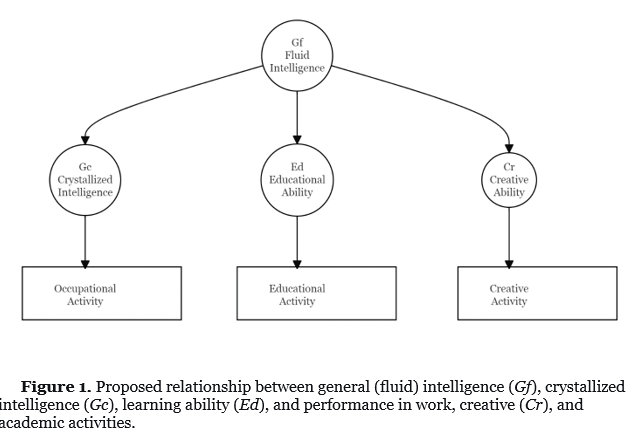
The figure shows Gf at the base, with arrows pointing upward to Gc, Ed, and Cr, and from these three to the respective activities (labour, learning, creativity). It illustrates that fluid intelligence is a common foundation for the other abilities.
Many works discuss a separate factor of learning ability, but it has not been identified in factor‑analytic studies. General intelligence is related to an individual’s success in various spheres of activity (Neisser et al., 1996).
Among the spheres of activity, we will consider academic, professional, and creative activity. Strictly speaking, creativity is adjacent to activity, and cannot be considered activity if we follow the precise meaning of this term
(Druzhinin, 1995), but with a certain degree of simplification we can accept that between these concepts there exists a genus‑species relationship.
From our perspective, general (or fluid) intelligence underlies creativity, crystallized intelligence, and possibly learning ability. Let us assume that these three general abilities relate to success in work, learning, and creativity (Fig. 1).
As for spatial, semantic (verbal), and numerical factors, they are present within creativity, intelligence, and probably learning ability. It should be noted that positive correlations exist between verbal intelligence and creativity, spatial intelligence and non‑verbal (visual) creativity, etc.; however, this is a subject for separate discussion.
Method
2.1. Data sources
The conclusions are based on a synthesis of extensive empirical work conducted in several countries over many decades. The analysis uses:
- Academic performance studies:correlations between IQ tests (Wechsler, Raven, Amthauer, DAT, GATB) and school grades or examination results, involving tens of thousands of students.
- Professional performance studies:correlations between intelligence test scores and success in occupational training and on‑the‑job performance across diverse professions.
- Creativity studies:correlations between IQ and divergent thinking test scores (Guilford’s Unusual Uses, Picture Completion, Synonym Finding, etc.), as well as experimental manipulations of testing conditions.
2.2. Original empirical contribution
I also report new data from a study conducted with S.D. Biryukov and A.N. Voronin at the Institute of Psychology, Russian Academy of Sciences. Participants were over 2,000 schoolchildren in grades 5–11. They completed a simplified and validated version of R. Amthauer’s Intelligence Structure Test, which measures spatial, verbal, and numerical intelligence. Test scores were correlated with academic grades, and regression and confirmatory factor analyses were performed on subgroups divided by IQ level and by performance level.
2.3. Statistical data analysis
- The main statistical tools were:
- Pearson correlations between intelligence subtests and performance criteria.
- Regression analyses to test for non‑linear effects.
- Confirmatory factor analysis (CFA) to examine the latent structure of intelligence and performance in different IQ groups.
- Visual inspection of bivariate distributions (IQ vs. performance) to detect threshold effects.
Results
3.1. Intelligence and Academic Performance
Scientists from many countries have conducted tens of thousands of studies devoted to establishing relationships between psychometric intelligence and academic performance, the number of which increases each year. Since the time of A. Binet, the question of whether tests measuring the level of general intelligence development can predict academic performance has been raised and continues to be raised to this day.
To date, it has not been possible to identify general learning ability as a capacity analogous to general intelligence. Therefore, intelligence is considered as an ability that underlies learning ability, but is not the sole factor determining success in learning. The correlation between general intelligence tests and learning criteria ranges from –0.03 to 0.61.
For J. Raven’s “Progressive Matrices” test, the correlation of general intelligence with academic performance level is 0.70 (English schoolchildren). Data obtained in other countries using the Raven test vary considerably: correlations range from 0.33 to 0.61 (mathematics performance; German schoolchildren) and 0.72 (overall performance; Russian schoolchildren).
- Wechsler’s test yields lower correlations with academic performance: the verbal scale up to 0.65, non‑verbal from 0.35 to 0.45, and general intelligence 0.50.
Most frequently, tests of intelligence structure or their individual subtests are used to predict academic performance. For example, the correlation of the aggregate indicators of the “Verbal Reasoning” and “Numerical Ability” subtests of the DAT (Differential Aptitude Test) with performance in individual subjects ranges from 0.70 to 0.80.
Russian psychologists have conducted analogous studies. For example, Golubeva et al. (1991) identified correlations between performance in various academic subjects and the results of intelligence testing using the Wechsler battery. The participants were 7th‑grade students. The obtained correlation coefficients ranged from 0.15 to 0.65 (performance in drafting and non‑verbal intelligence). The correlation between general intelligence and aggregate grades was 0.49 (for verbal intelligence r=0.50, for non‑verbal intelligence r=0.40).
Positive, moderate correlations between academic grades and test results did not allow researchers to unequivocally assert that intelligence determines success in learning. The insufficiently high correlations were explained by the irrelevance of grades as criteria for learning success, the mismatch between test materials and curriculum content, etc.
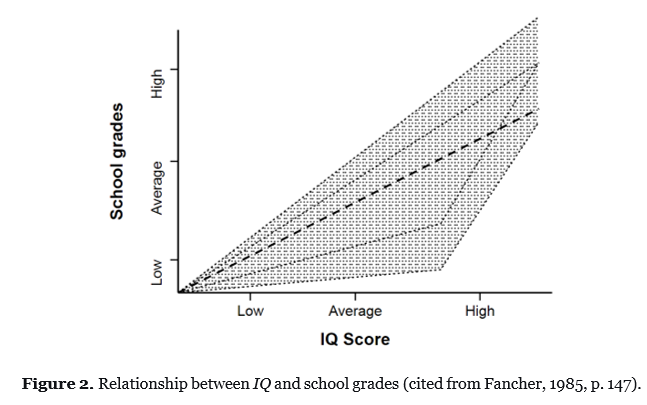
Analysis of the distribution of individuals in the coordinate space of “successful grades – IQ level” indicates the existence of a more complex relationship between intelligence and academic performance than a linear one.
It is not difficult to observe that a positive correlation exists between IQ and academic performance, but for students with high intelligence levels, this correlation is minimal.
Burlachuk and Bleicher (1978) investigated the dependence of academic performance on intelligence level (Wechsler test). Students with both high and low intelligence levels were found among the ranks of underachieving students. However, individuals with below‑average intelligence never belonged to the number of good or excellent students. The main reason for the low academic performance of children with high IQ is the absence of academic motivation.
Thus, there exists a “lower threshold” of IQ for academic activity: only a student whose intelligence is above a certain value determined by the external requirements of the activity can study successfully. At the same time, academic performance does not increase infinitely; its level is limited by grading systems and teacher expectations of students.
As an example, I present the results of a study that examined the influence of the structure of group intelligence factors on academic performance (the work involved S.D. Biryukov and A.N. Voronin, senior researchers at the Institute of Psychology of the Russian Academy of Sciences).
Using a simplified and validated version of R. Amthauer’s intelligence structure test, we assessed the levels of development of spatial, verbal, and numerical intelligence in students in grades 5–11. The test results were compared with academic grades using correlation and regression analysis.
More than 2000 students participated in the study. Data were analysed by class, as well as separately for groups of students with grades above and below the sample mean.
Relationships between academic performance in subjects and the level of development of individual intellectual abilities were only identified in groups of students whose performance was above the group mean. Moreover, in groups of students in grades 5–7 and 8–9 with below‑average performance, negative correlations were found between intelligence level (primarily spatial) and performance in individual subjects. Thus, it can be said that among underachieving students there are individuals with both high and low intelligence levels, which is entirely consistent with the data presented in Fig. 2.
The scatterplot shows that at low IQ levels, grades are low and do not exceed a certain ceiling; at high IQ levels, grades vary widely, but very low grades are rare. This indicates a lower threshold but no linear increase beyond a point.
If students are divided into groups according to intelligence level rather than academic performance, the picture becomes more complex. The results of confirmatory factor analysis indicate that the identified latent factors of intelligence and academic performance in groups of students with below‑average IQ may be positively related, unrelated, or negatively related (5th grade). In children with above‑average intelligence, the relationship between the two factors (intelligence and overall academic performance) is positive but small, smaller than in mixed samples. The exception to this rule is the results obtained on samples of 10th–11th grade students: they underwent selection, and their peers with lower intelligence scores were excluded.
One can postulate the existence of a “lower intellectual threshold” for academic activity: a student whose IQ is below this threshold will never be able to study successfully. On the other hand, there is also a limit to learning success for an individual with a given IQ level.
Consequently, academic performance (N) is subject to the following inequality:
N(IQthreshold)≤Ni≤N(IQi),
where IQi is the individual’s intelligence, and IQithreshold is the “intellectual threshold.”
Intelligence allows one to determine only the upper and lower limits of learning success, and the student’s position within this range is determined not by cognitive factors, but by personality characteristics, primarily academic motivation and such traits of the “ideal student” as diligence, discipline, self‑control, absence of criticality, and trust in authorities (Druzhinin, 1995). Therefore, arguments about the low predictive validity of intelligence tests for predicting academic performance can be considered far‑fetched and unproductive.
3.2. Intelligence and Professional Activity
Intelligence tests, particularly so‑called tests of intelligence structure (R. Amthauer’s test, GATB, DAT, etc.), are widely used for professional selection and personnel placement.
General intelligence test data correlate with success in activity: for various professions, 0.10≤r≤0.85. For the majority of professions, the correlation is 0.60 (GATB test).
The accumulated results by the 1960s, confirming the relationship between intelligence test indicators during professional selection and characteristics of success in professional training and professional activity, allowed for a rather non‑trivial conclusion. One of the first to propose the theory of the “intelligence threshold” for professional activity was D.N. Perkins. According to his conception, as discussed by Kholodnaya (1997), there is a lower threshold level of intelligence development required for mastering any profession. People with IQ below a certain level are incapable of mastering the given profession. If IQ exceeds this level, then no substantial correlational relationship can be traced between the level of achievement in professional activity and the level of intelligence. The success of professional activity begins to be determined by motivation, personality traits, value system, etc. (Kholodnaya, 1997).
Thus, the success of activity is as if “bounded from below”; the individual is unable to perform if their IQ is less than a certain “intellectual threshold” specific to the given profession.
Results from one of the most recent studies on the relationship between intelligence and professional achievement were published in 1993 by W. Schneider (1993). They concern the study of the intellectual characteristics of “experts” (individuals competent in a specific sphere of activity). As a rule, “experts” possess average intelligence or no lower than average. Schneider also believes that each activity has its own “threshold,” below which the individual is unable to master the activity; if their intelligence exceeds the threshold value, then actual achievements are determined not by cognitive abilities, but by persistence, passion, temperamental characteristics, family support, etc.
If the intellectual threshold is not high, an individual with both extremely high and average intelligence values can be equally successful in their chosen profession.
Several further conceptions can be cited that generalize the empirical material accumulated to date and represent modifications of the “lower intellectual threshold” model.
Does an “upper intellectual threshold” exist? In other words: are an individual’s possibilities in a particular professional activity limited by their intelligence level?
If we draw a conclusion by analogy with the results showing the relationship between intelligence and learning success, it is possible that the limit of productivity in professional activity is defined as:
Pi≤P(IQi),
where Pi is the individual’s maximum productivity and IQi is the intelligence of the i-th individual.
On the other hand, the lower level of achievement, the threshold for entering activity, is set by the intelligence level minimally necessary for mastering the profession, which is determined by its requirements.
It should be noted that the predictive validity of intelligence tests is higher for success in professional training than for productivity in professional activity. Evidently, practical activity is less controllable than academic activity, and its result is often less rigorously evaluated or very remote in time.
3.3. Intelligence and Creativity
The problem of the relationship between creativity and intelligence arose when creativity was identified as an independent factor. J. Guilford (1967) believed that creative giftedness includes, at minimum, abilities for divergent thinking and for transformations. According to Guilford, divergent thinking is directed towards the search for diverse logical possibilities, the ability for which is tested using special tests (“Unusual Uses,” “Figure Completion,” “Finding Synonyms,” etc.).
In several articles, Guilford (1967) examines the relationship between intelligence and creativity. He believed that intelligence determines the success of understanding and assimilating new material, while divergent thinking determines creative achievements. Moreover, the effectiveness of creative activity is predetermined by the volume of knowledge (which in turn depends on intelligence). Guilford hypothesized that IQ would determine the “upper limit” of success in solving divergent thinking tasks. Guilford’s creativity tests were related to the operation of the semantic code (verbal information). He believed that the limiting role of intelligence for them would be higher than for non‑verbal tests. Research has shown that the correlation between intelligence tests and divergent thinking tests is higher for semantic tests than for spatial and symbolic tests.
However, the results of studies by K. Yamamoto, as well as D. Hardgreaves and H. Bolton, allow the “lower threshold” hypothesis to be questioned: general intelligence (IQ) limits the manifestation of creativity at low IQ values; at IQ above a certain “threshold,” creative achievements do not depend on intelligence.
In studies by J. Guilford and T. Christensen, it was also found that at low IQ, manifestations of creative giftedness are practically absent, whereas among people with high IQ, both high and low levels of divergent thinking development are encountered.
E.P. Torrance (1988), summarizing the results of his own research, concluded that the relationship between intelligence level and creativity is one‑sided. He proposed a model of the “intellectual threshold”: up to IQ = 120, creativity and intelligence form a single factor; above this threshold, the factors of creativity and intelligence manifest as independent. In other words, up to a certain IQ threshold, intelligence limits the manifestation of creativity; above the threshold, creativity becomes “emancipated.”
It seemed that the model of the “intellectual threshold” had received strong confirmation. However, the results of studies by N. Kogan and M. Wallach (1965) disproved the “lower threshold” theory. They modified the testing procedure: they relaxed the time limit, abandoned the “correctness” indicator according to Guilford, and eliminated the atmosphere of seriousness. As a result, the factors of creativity and intelligence turned out to be independent at all IQ values. A general pattern was identified and described for children with high creativity levels but below‑average intelligence (Wallach & Kogan, 1965).
In studies conducted in the laboratory of the psychology of abilities at the Institute of Psychology of the Russian Academy of Sciences, analogous results were obtained: abandoning the regulation of the participant’s behaviour during creativity testing leads to intelligence and creativity manifesting as independent factors. Moreover, the relaxation of regulation reduces creativity in “creative” children and less so in “non‑creative” children. That is, appropriate conditions for the manifestation of creativity consist of a system of tasks in which the participant’s behaviour is minimally regulated (Druzhinin & Khazratova, 1994).
On the other hand, it has been found that external stimulation of creative manifestations (with some kind of instruction) influences the improvement of results shown by “non‑creative” children, but has little effect on the creative productivity of “creative” children.
Consequently, the absence of regulation of behaviour (relaxation of time limits, seriousness, restrictions, etc.) makes it possible to manifest internal motivation adequate to the creative child’s creative problem‑solving. External motivation can temporarily stimulate the activity of the “non‑creative,” but the effect of this is very short‑lived.
In 1980, the work of D.H. Dodd and R.M. White (1980) was published, in which they analysed the results of studies of the relationship between IQ and assessments of divergent productivity.
The distribution of individuals in the space of two coordinates (IQ and divergent productivity) (Fig. 3) resembles the distributions obtained in studies of the relationship between intelligence and learning ability, as well as intelligence and success in professional activity. Intelligence limits “from above” the level of creative productivity. The highest indicators on divergent thinking tests are shown by individuals with maximum IQ values.
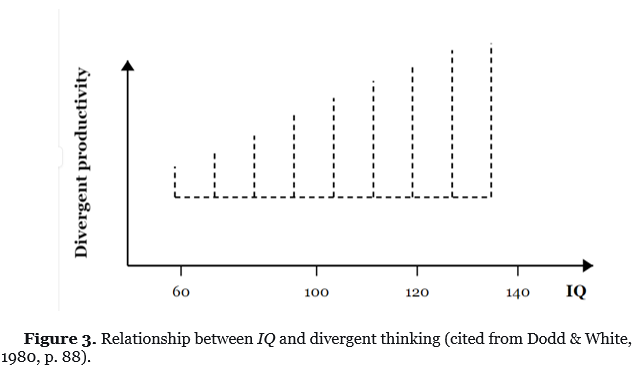
The scatterplot shows that at low IQ levels, divergent productivity is low and constrained; as IQ increases, the upper boundary of productivity rises, but there is also a wide spread of scores at each IQ level, indicating that other factors (motivation, etc.) influence performance once the threshold is exceeded.
How can the data of Kogan and Wallach, as well as the results obtained in our laboratory, be reconciled with the theory of the “high intellectual threshold”? Does the entire difference lie in the variation of data collection procedures, or does the degree of regulation of activity conditions determine the “lower threshold” of IQ for the manifestation of creativity?
Let us present the results of another study. In our work (Druzhinin & Khazratova, 1994), we tested the hypothesis regarding the possibility of forming creativity as a general personal disposition (including motivational, cognitive, and behavioural components) in children aged 3–5 years. The study revealed two important patterns: (1) the non‑linear nature of changes in creativity during the course of the study, and (2) the sequence of formation of creativity components: from motivational to cognitive and behavioural.
If the creative productivity of the participating children during the formative experiment exceeded a certain (always individually determined) level, then they began to exhibit signs of maladaptive, neurosis‑like behaviour (increased anxiety, capriciousness, aggressiveness, emotional sensitivity, etc.). These signs resemble the behavioural characteristics of children with low intelligence and high creativity, as described by Wallach and Kogan (1965). Consequently, this effect can be explained by the creativity level exceeding the individual “intellectual threshold,” which determines the success of adaptation. By the end of the formative experiment, the creativity level of most children was higher than at the beginning, but lower than in the middle of the study; that is, it reached a certain individual optimum.
Although the creativity diagnostic method in our work differed from the creativity tests of Torrance and Guilford and consisted of recording manifestations of children’s creative behaviour during spontaneous situational play, the results can be explained using the same “intellectual threshold” model. The foundational condition for the formation of creativity and its manifestation in everyday life is the formation of creative motivation in the individual. According to our data, the optimal period for its formation is the age from 3.5 to 4 years.
Thus, it can be concluded that creative activity is determined by creative (intrinsic) motivation and manifests itself in special (unregulated) conditions of life activity, but the “upper limiter” of the level of its manifestation is the level of general (“fluid,” according to R. Cattell) intelligence. Similarly, there exists a “lower limiter”: a minimum level of intelligence below which creative activity does not manifest.
Conventionally, the relationship between creative productivity and intelligence can be reduced to the following inequality:
IQactivity≤Cr≤IQindividual.
If we proceed from this relationship, we cannot speak of an “intellectual threshold” in the strict sense. The individual’s intelligence acts as an “upper limiter,” a “ceiling” for potential creative achievements. Whether the individual uses the opportunities afforded by nature depends on their motivation, competence in the creative domain they have chosen, and, of course, on the external conditions that society provides. The “lower intellectual threshold” is determined by the “regulatory constraints” of the domain in which the individual manifests their creative activity.
3.4. Toward a unifying model: the “intellectual range”
The evidence from all three domains, education, profession, and creativity, converges on a common pattern: intelligence determines the boundaries of possible achievement, not the actual level within those boundaries. I propose an analytical model that formalises this insight.
Let us clarify the main concepts once again:
- Individual productivity.
Characterized by the measure of an individual’s success in a particular sphere of life activity (creative, academic, professional). Individual productivity can be assessed by current academic performance, level of professional achievement, success in solving creativity tests (flexibility, uniqueness, originality, etc.).
- Intelligence level.Determined by success in performing intelligence tests (such as J. Raven’s Progressive Matrices), equivalent to fluid intelligence (Gf) according to R. Cattell, or general intelligence according to C. Spearman.
A certain relationship exists between these variables, as depicted in Figure 4.
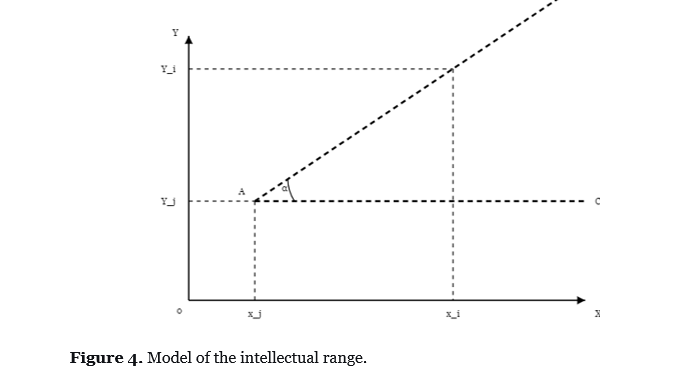
The figure is a two‑dimensional Cartesian coordinate system with the following axes:
X‑axis (horizontal): Intelligence (XX), ranging from low to high.
Y‑axis (vertical): Productivity (YY), ranging from low to high.
Key elements depicted:
- Line AB— a diagonal line ascending from lower‑left to upper‑right, representing the upper boundary of potential productivity as a function of intelligence. The line has a slope angle α relative to the horizontal axis.
- Vertical line at Xj— represents the “intellectual threshold” of a specific activity. This line marks the minimum intelligence level required to enter the activity.
- Vertical line at Xi— represents the individual intelligence level of a particular person.
- Horizontal line at Yj— represents the minimum required productivity for successful performance in the activity. This line intersects the vertical line at Xj, indicating that below this intelligence level, the individual cannot achieve the required productivity.
- Horizontal line at Yi— represents the maximum individual productivity that the person with intelligence XiXi can achieve. This is determined by the point where the vertical line at Xi meets the diagonal line AB.
- Shaded area or vertical bracketΔYij — represents the range of possible productivity for the individual with intelligence Xi in the activity with threshold Xj. This range spans from Yj (minimum required) to Yi (maximum possible).
- Horizontal bracketΔXij — represents the individual’s intellectual “handicap” or “surplus”: the amount by which the individual’s intelligence exceeds the activity threshold (Xi−Xj).
Interpretation of the slope angle α:
The angle α of the line AB characterizes the rigidity of the criteria for evaluating progress and performance outcomes:
When α is close to 0° (nearly horizontal line): The criteria are very strict; even large increases in intelligence yield only small increases in potential productivity.
When α is close to 90° (nearly vertical line): The criteria are very loose; creativity and intelligence become almost independent factors, as observed when behavioural regulation is removed (Wallach & Kogan, 1965; Druzhinin & Khazratova, 1994).
Key relationships shown in the figure:
Upper threshold: The diagonal line AB represents the upper boundary of productivity (Pmax,i), which is a linear function of intelligence:
Pmax,i=k(Gfi)+C, with 0≤k≤1.
Lower threshold: The horizontal line at Yj represents the minimum productivity required by the activity. If the individual’s intelligence is below Xj, they cannot reach Yj and thus cannot successfully enter the activity.
Range of achievements: The vertical segment between Yj and Yi represents the range within which the individual’s actual productivity can vary, depending on motivation, competence, and external conditions. The individual’s actual performance will fall somewhere within this range.
Detailed Description of the Model
- Upper Threshold
The upper boundary of productivity (the maximum level of individual achievement) is set by the individual level of intelligence. The maximum level of achievement is a linear function of intelligence:
Pmax,i=k(Gfi)+CandPi≤Pmax,i,
where 0≤k≤1 is determined by the specificity of external conditions; C is the initial level of competence required for “entry” into the activity; Gfi is the IQ level of the i-th individual; and Pi is individual productivity.
- Lower Threshold
The lower boundary of individual achievements in activity is determined by the requirements of the activity, which manifest in the phenomenon of the “intellectual threshold.” If an individual’s IQ is below a certain value, they cannot demonstrate the minimally necessary productivity and do not pass natural selection.
Consequently, an individual’s productivity cannot be below a certain minimum value corresponding to the level of the “lower intellectual threshold” of the activity:
Pmin,i=Gfjthreshold, Pmin≤Pi,
where Gfjthreshold is the level of the intellectual threshold of the j-th activity.
- Range of Achievements
Individual productivity, in accordance with J. Renzulli’s conception, is determined, in addition to IQ, by the level of motivation and “commitment to the task” (otherwise, the level of special skills and knowledge, analogous to crystallized intelligence).
Consequently, it can be assumed that a lack of motivation and competence prevents the individual from reaching the upper threshold of individual achievements. It is possible that:
Pi=k⋅Gfi−M⋅Gfc,
where M is the reciprocal of the motivation level (“lack of motivation”), and Gfc is the lack of competence.
The model has three main implications:
- The success of an individual’s entry into activity is determined solely by the level of individual intelligence and the complexity of the activity.
- The level of specific individual achievements depends on motivation and competence, which are related to the content of the activity.
- The extremely high level of individual achievements depends only on individual IQ, and not on the difficulty of the activity or its content.
The model has two further interesting implications.
First, according to theoretical considerations, in intellectually gifted individuals, correlations between success in activity and intelligence level should be lower than in the entire sample. The reason for this is the expansion of the productivity range: the variance of productivity in the gifted is greater than in the sample as a whole.
Correlations between success in performing individual tests (or productivity in performing activities) in gifted individuals should be lower than in “ordinary” people. The reasons for this effect are: independence of test performance success (they are connected only through the G‑factor); the large spread of productivity indicators in the gifted; the determination of the individual’s position in the “tests‑intelligence” space by motivation and competence. This phenomenon has been found in numerous correlational studies: in intellectually gifted individuals, correlations of test success are lower than in the general population (Kholodnaya, 1997; and others).
Second, highly gifted participants are characterized by a “sawtooth” pattern of achievements in different spheres of activity, success in different academic disciplines, and in performing test tasks.
Indeed, individual intelligence determines only the upper threshold of achievement. In gifted individuals, the range of possible achievements is wider than in others. Therefore, with independence of achievements in different areas, on average in the gifted group, the variation in indicators on individual tests, tasks, etc., will be greater than in the general population.
The results of numerous correlational studies show that intellectual giftedness is accompanied by a large “scatter” of individual achievements in various spheres of activity, academic subjects, etc.
The model can be extended to describe the structure of intelligence taking into account its main group factors, as identified by Spearman: numerical, verbal, and spatial.
Thus, the “intellectual range” model allows one to move from an empirical correlational model describing the “intelligence–productivity of activity” relationship to a theoretical explanation of a number of facts and dependencies obtained in the course of empirical research.
Discussion
The principal finding of this research is that intelligence does not directly determine the level of productivity in any activity; rather, it establishes the upper and lower boundaries within which performance can vary. This conclusion emerges consistently from the three bodies of evidence reviewed above – academic learning, professional performance, and creative productivity. In each domain, the data defy a simple linear interpretation: below a certain intellectual level, individuals simply cannot meet the minimal demands of the task, regardless of their effort, training, or motivation. Above that level, however, higher IQ scores do not translate into systematically higher achievements; instead, performance scatters across a wide band, from mediocre to outstanding. This recurrent pattern implies that for every activity there exists a lower entry threshold dictated by task complexity, and for every individual there exists an upper ceiling set by their own intellectual potential. The zone between these two constraints – the range of possibilities – is where motivational factors, domain‑specific competence, and personality traits determine the final outcome. By formalising this dual‑threshold mechanism, the proposed model reconciles decades of contradictory empirical findings and provides a unified framework for understanding the interplay between cognitive ability and real‑world success.
Building on this insight, the “intellectual range” model distinguishes three fundamental parameters:
- Lower intellectual threshold– the minimum IQ required for entry into a given activity. Below this threshold, the individual cannot achieve the minimally acceptable productivity and is naturally filtered out.
- Upper intellectual threshold (ceiling)– the maximum possible achievement level for a given individual, which depends exclusively on their IQ and is independent of task difficulty or content.
- Range of possibilities– the interval between the lower and upper thresholds, within which actual performance is governed by motivation, competence, and personality characteristics.
Formal representation of the “intellectual range” model:
Let Gfi be the fluid intelligence (IQ) of individual i, and Pi be their productivity in a given activity. The model expresses the relationship as follows:
Pi=k⋅Gfi−Mi⋅Di−Ci,
where:
- Ci= initial competence (knowledge and skills) required for “entry” into the activity;
- k= a constant reflecting external conditions (e.g., task environment, social support);
- Mi= inverse of motivation (i.e., degree of motivational deficit);
- Di= deficit in crystallised intelligence (Gc) relative to task demands.
The lower‑bound condition is:
Pi≥Pmin(j),
where Pmin(j) is determined by the intellectual threshold specific to activity j. If this condition is not met, the individual cannot participate effectively in that domain.
The upper‑bound condition is:
Pi≤Pmax(Gfi),
meaning that no matter how favourable the non‑cognitive factors (motivation, training, environment), the individual cannot exceed a ceiling set by their fluid intelligence.
The model yields three testable corollaries that directly follow from the formal representation:
- Entry success(the ability to begin and sustain activity) is determined solely by the individual’s IQ relative to the complexity of the activity. No amount of motivation can compensate for an IQ below the lower threshold.
- Actual performance levelwithin the permissible range depends primarily on motivation and domain‑specific competence, not on IQ Two individuals with the same IQ can perform very differently depending on these non‑cognitive factors.
- The absolute upper limit of achievementdepends exclusively on IQ, not on task difficulty or content. Even the most favourable motivational and environmental conditions cannot push performance beyond the individual’s intellectual ceiling.
Beyond the three direct corollaries, the model generates two additional predictions that have already received empirical support:
Implication A (reduced correlations in gifted samples). Among intellectually gifted individuals, the correlation between IQ and performance should be lower than in the general population. This counter‑intuitive effect arises for three reasons: (a) the range of possible productivity is wider for gifted individuals, which increases variance and attenuates correlation coefficients; (b) performance on different tasks is linked only through the general G‑factor, and this linkage weakens when the upper ceiling is high; and (c) motivation and competence play a proportionally larger role in determining where a gifted person falls within their expanded range of possibilities. This phenomenon has been documented in numerous correlation studies (see Kholodnaya, 1997, for a review).
Implication B (sawtooth profile of gifted individuals). Gifted individuals should exhibit uneven achievements across different domains – excelling in some areas while performing only moderately in others. Because IQ determines only the upper ceiling for each domain, and because achievements in different fields are relatively independent (especially when domain‑specific knowledge and interest vary), the variance in performance across tasks is larger for gifted people than for the average population. In practical terms, this means that a highly intelligent person is more likely to show a “spiky” profile of strengths and weaknesses rather than uniformly high performance in all areas, a pattern often observed in real‑world educational and occupational settings.
Conclusions
The proposed “intellectual range” model integrates the concepts of lower and upper intellectual thresholds to explain the recurring non‑linear relationship between IQ and productivity in education, profession, and creativity. The main conclusions are:
Intelligence is a necessary but not sufficient condition for high achievement. It sets the lower bound (entry threshold) and the upper bound (maximum potential) for any activity.
Within the range defined by these bounds, actual performance is determined by non‑cognitive factors – motivation, perseverance, self‑discipline, domain‑specific knowledge, and environmental support.
This framework accounts for the otherwise puzzling findings: the moderate correlations between IQ and grades/job performance, the existence of high‑IQ underachievers, and the reduced predictive power of IQ tests among already selected or gifted populations.
The model has practical implications: for selection, IQ tests are useful for screening out those below the threshold, but they should not be used as the sole predictor of success. For education and talent development, attention should shift to fostering motivation and competence once intellectual potential is assured.
Future research should test the model longitudinally, examine domain‑specific thresholds, and explore how environmental factors can shift the range of possibilities. The present analysis, based on decades of empirical data, suggests that the relationship between intelligence and productivity is far richer – and more bounded – than simple linear models imply.
References
- Burlachuk, L. F., & Bleicher, V. M. (1978). Psikhologicheskaya diagnostika intellekta i lichnosti[Psychological diagnostics of intelligence and personality].
- Cattell, R. B. (1963). Theory of fluid and crystallized intelligence: A critical experiment. Journal of Educational Psychology, 54(1), 1–22. https://doi.org/10.1037/h0046743
- Dodd, D. H., & White, R. M. (1980). Cognition: Mental structure and processes. Allyn & Bacon.
- Druzhinin, V. N. (1995). Psikhologiya obshchikh sposobnostey[Psychology of general abilities].
- Druzhinin, V. N., & Khazratova, N. V. (1994). Eksperimental’noye issledovaniye formiruyushchego vliyaniya sredy na kreativnost’ [Experimental study of the formative influence of environment on creativity]. Psikhologicheskii Zhurnal, 15(4), 83–93.
- Eysenck, H. J. (1995). Intellekt: novyy vzglyad [Intelligence: A new view]. Voprosy Psychologii, (1), 111–131.
- Fancher, R. E. (1985). The intelligence men: Makers of the IQ controversy.
- Golubeva, E. A., Izyumova, S. A., Kabardova, M. K., et al. (1991). Opyt kompleksnogo issledovaniya uchashchikhsya v svyazi s nekotorymi problemami differentsiatsii obucheniya [An experience of comprehensive research on students in connection with some problems of differentiation of instruction]. Voprosy Psychologii, (2).
- Guilford, J. P. (1967). The nature of human intelligence. McGraw-Hill. https://doi.org/10.3102/00028312005002249
- Kholodnaya, M. A. (1997). Psikhologiya intellekta: paradoksy issledovaniya[Psychology of intelligence: Paradoxes of research]. Moscow-Tomsk.
- Neisser, U., Boodoo, G., Bouchard, T. J., Jr., Boykin, A. W., Brody, N., Ceci, S. J., Halpern, D. F., Loehlin, J. C., Perloff, R., Sternberg, R. J., & Urbina, S. (1996). Intelligence: Knowns and unknowns. American Psychologist, 51(2), 77–101. https://doi.org/10.1037/0003-066X.51.2.77
- Schneider, W. (1993). Acquiring expertise: Determinants of exceptional performance. In International handbook of research and development of giftedness and talent(pp. 311–342).
- Spearman, C. (1927). The abilities of man.
- Torrance, E. P. (1988). The nature of creativity as manifest in its testing. In R. J. Sternberg (Ed.), The nature of creativity(pp. 43–75). Cambridge University Press.
- Wallach, M. A., & Kogan, N. (1965). A new look at the creativity–intelligence distinction. Journal of Personality, 33(3), 348–369. https://doi.org/10.1111/j.1467-6494.1965.tb01392.x
Comments (0)
Vladimir Nikolaevich Druzhinin (1955–2001): Life, Science, and Organizational Activity
Vladimir Nikolaevich Druzhinin was born on August 12, 1955, in the village of Dunilovo, Bolsheselsky District, Yaroslavl Region, Russia. In 1978, he simultaneously graduated from the Faculty of Psychology and the Faculty of Biology of Yaroslavl State University, earning qualifications as a psychologist and a teacher of psychology (Institute of Psychology of the Russian Academy of Sciences, n.d.-a; Russian Psychological Society, n.d.). His academic career advanced rapidly. In 1982, he defended his Ph.D. dissertation on “Change of Motivation in the Process of Professional Training.” In 1991, he received his Doctor of Sciences degree for his work “Theoretical Foundations of Psychological Diagnostics of Cognitive Abilities.” In 1993, he was awarded the academic title of Professor (National Psychological Library, n.d.). Druzhinin’s untimely death on June 22, 2001, in Sochi ended the life of an outstanding scholar at the peak of his creative powers. He was only 45 years old (Psychological Newspaper, n.d.).
From 1979, Druzhinin worked at the Institute of Psychology of the Academy of Sciences of the USSR (later the Russian Academy of Sciences), where he rose from a staff researcher to Deputy Director for Science. In 1986, at the initiative of Academician V.D. Shadrikov, he became head of the Laboratory of Psychology of Abilities, a position he held until his death (Institute of Psychology, n.d.-b). In 1992, he was appointed Deputy Director of the Institute of Psychology of the Russian Academy of Sciences (Koltsova & Nemirovskaya, 2015). Druzhinin’s research interests were exceptionally broad: personality psychology, differential psychometrics, psychology and psychodiagnostics of general abilities, developmental psychology, and the theory of psychological experimentation (Koltsova & Nemirovskaya, 2015).
Druzhinin’s scientific legacy encompasses a wide range of theoretical, methodological, and empirical contributions to psychology. He developed a generalised probabilistic model of the test and its modifications, enabling researchers to calculate the necessary and sufficient number of test items, determine optimal levels of difficulty and response options, and identify the required type of measurement scale (Druzhinin, 1990, 1993). He formulated the concept of ecological validity of the test, proposing a novel approach to evaluating the validity of psychological tests that takes into account their correspondence to real‑world conditions of application, thereby challenging the overreliance on purely statistical criteria (Druzhinin, 1993). He elaborated a typology of psychodiagnostic situations, providing a classification system that allowed for systematic organisation of the diagnostic process and offered a framework for selecting appropriate assessment strategies across different testing contexts (Druzhinin, 1990).
Druzhinin experimentally demonstrated that test validity depends significantly on situational influences and the subject’s motivational state, a finding with important implications for both research and applied assessment (Druzhinin, 1995). He proposed a three‑component structure of general cognitive abilities, comprising intelligence, creativity, and learning ability, offering a comprehensive model for understanding the architecture of human cognitive potential and its differentiation across domains (Druzhinin, 1995; Druzhinin & Shadrikov, 1991). He identified specific factors of the social micro‑environment that influence the development of children’s creativity, demonstrating that creative abilities are more dependent on environmental influences than on general intelligence (Druzhinin, 1995). Based on a modification of the logic of action, he created a systematic procedure for describing the structure and process of empirical psychological investigation and proposed a two‑dimensional classification of psychological methods (Druzhinin, 1993). Among his methodological developments are the Test of Mathematical Analogies for diagnosing mathematical abilities, as well as methods for assessing mnemonic abilities and the capacity to manipulate spatial representations (Druzhinin, 1990, 1995).
Druzhinin proved himself to be an outstanding organiser of science. In addition to heading the Laboratory of Psychology of Abilities and serving as Deputy Director of the Institute of Psychology, he made significant contributions to the development of psychological education. He held professorships at the branch of the Department of Labour Psychology and Engineering Psychology of the Faculty of Psychology, Moscow State University (based at the Institute of Psychology); at Moscow State Pedagogical University; and served as Director of the Institute of Psychology at the State University of Humanities. At Moscow University, he delivered a distinguished lecture course on “Psychodiagnostics of General Cognitive Abilities” (Koltsova & Nemirovskaya, 2015). Contemporaries noted that Druzhinin was characterised by “scientific purposefulness, the ability to work in a team, and the ability to create teams, generate ideas that could inspire supporters” (Koltsova & Nemirovskaya, 2015, p. 18). His leadership fostered a productive research environment that attracted numerous talented collaborators and students.
Druzhinin’s scientific legacy includes more than 150 scholarly works. Among his major publications are monographs and textbooks that have become classics in Russian psychology: Psychology of General Abilities (1995, 1999, 2007), Experimental Psychology (1997, 2000), Family Psychology (1996),
Structure and Logic of Psychological Research (1993), Psychological Diagnostics of Abilities: Theoretical Foundations (1990), and the posthumously published textbook Psychology of the 21st Century (Druzhinin, 1995, 1997, 2001). For his outstanding contributions, Druzhinin was awarded the S.L. Rubinstein Prize of the Russian Academy of Sciences (1996) and the Prize of the President of the Russian Federation in the field of education (1998) (Koltsova & Nemirovskaya, 2015). He supervised three Ph.D. candidates, contributing to the training of a new generation of Russian psychologists (Koltsova & Nemirovskaya, 2015). In recognition of his enduring legacy, the Laboratory of Psychology of Abilities and Mental Resources at the Institute of Psychology of the Russian Academy of Sciences bears his name (Institute of Psychology, n.d.-c). Druzhinin was not only an outstanding scientist and organiser of science but also a poet. In the memory of his colleagues, he remains “a brilliant researcher, an active organiser of science, a psychologist by vocation” (Koltsova & Nemirovskaya, 2015, p. 20). His theoretical contributions, methodological innovations, and institutional leadership continue to influence contemporary psychological research in Russia and beyond.
References:
- Druzhinin, V. N. (1990). Psikhologicheskaya diagnostika sposobnostey: teoreticheskie osnovy[Psychological diagnostics of abilities: Theoretical foundations] (Parts 1–2).
- Druzhinin, V. N. (1993). Struktura i logika psikhologicheskogo issledovaniya[Structure and logic of psychological research]. IP RAN.
- Druzhinin, V. N. (1995). Psikhologiya obshchikh sposobnostey[Psychology of general abilities].
- Druzhinin, V. N. (1996). Psikhologiya sem’i[Family psychology].
- Druzhinin, V. N. (1997). Eksperimental’naya psikhologiya[Experimental psychology]. INFRA-M.
- Druzhinin, V. N. (2001). Varianti zhizni. Ocherki ekzistentsial’noy psikhologii[Variants of life: Essays on existential psychology].
- Druzhinin, V. N., & Shadrikov, V. D. (Eds.). (1991). Razvitie i diagnostika sposobnostey[Development and diagnostics of abilities].
- Institute of Psychology of the Russian Academy of Sciences. (n.d.-a). Vladimir Nikolaevich Druzhinin. Retrieved July 14, 2026, from http://ipras.ru/drujinin.shtml
- Institute of Psychology of the Russian Academy of Sciences (old version). (n.d.-b). Druzhinin Vladimir Nikolaevich. Retrieved July 14, 2022, from http://ipras.ru/old/strukt/person/zam1.htm
- Institute of Psychology of the Russian Academy of Sciences. (n.d.-c). Laboratory of Psychology of Abilities and Mental Resources named after V.N. Druzhinin. Retrieved July 14, 2022, from http://ipras.ru/cntnt/rus/institut_p/nauchnye_p/laboratori3.html
- Koltsova, V. A., & Nemirovskaya, N. G. (2015). V. N. Druzhinin kak lichnost’, uchenyy, organizator nauki [V. N. Druzhinin as a person, scientist, and organizer of science]. Psikhologicheskii Zhurnal, 36(5), 15–20.
- National Psychological Library named after K.D. Ushinsky. (n.d.). Vladimir Nikolaevich Druzhinin (12.08.1955 – 22.06.2001). Retrieved July 14, 2022, from https://dates.gnpbu.ru/0-5/Druzhinin/druzhinin.html
- Psychological Newspaper. (n.d.). Druzhinin Vladimir Nikolaevich. Retrieved July 14, 2022, from https://psy.su/persons/in_memoriam/psy/35405/
- Russian Psychological Society. (n.d.). Druzhinin Vladimir Nikolaevich (1955–2001). Retrieved July 14, 2022, from https://psyrus.ru/psychologists/rpopsych/psychologist/1288/
The central question addressed in this article is: what is the relationship between an individual’s productivity in activity and their level of intelligence?
First, it is necessary to define which spheres of activity are under consideration and what we understand by intelligence.
Eysenck (1995) distinguished between the concepts of “biological intelligence,” “psychometric intelligence,” and “social intelligence.” This work will examine psychometric intelligence, that is, a property measured using a system of test items. Psychometric intelligence depends on cultural influences, upbringing, education, and socioeconomic status, but is to a greater extent genetically determined.
The structure of psychometric intelligence is a separate issue that remains beyond the scope of discussion in this article.
According to the results of confirmatory and exploratory factor analyses applied to data from numerous correlational studies by R. Cattell (1963), the structure of psychometric intelligence includes several hierarchical levels: at the “apex” is the general factor (G), the second level is occupied by Cf (fluid intelligence, which in its most apparent form represents G), crystallized intelligence (Gc), and the factor of visualization (Gv).
There exist multiple models of intelligence. The most popular structure is that proposed by Spearman (1927) and confirmed by the results of many studies: (1) general intelligence; (2) factors, namely numerical, spatial, and verbal. Creativity (Cr), both verbal and non‑verbal, is particularly distinguished as the ability to generate multiple original products (hypotheses, statements, etc.). Individual creativity, unlike general intelligence, is determined to a lesser extent genetically and depends more on the individual’s experience of interaction with the social microenvironment.
The figure shows Gf at the base, with arrows pointing upward to Gc, Ed, and Cr, and from these three to the respective activities (labour, learning, creativity). It illustrates that fluid intelligence is a common foundation for the other abilities.
Many works discuss a separate factor of learning ability, but it has not been identified in factor‑analytic studies. General intelligence is related to an individual’s success in various spheres of activity (Neisser et al., 1996).
Among the spheres of activity, we will consider academic, professional, and creative activity. Strictly speaking, creativity is adjacent to activity, and cannot be considered activity if we follow the precise meaning of this term
(Druzhinin, 1995), but with a certain degree of simplification we can accept that between these concepts there exists a genus‑species relationship.
From our perspective, general (or fluid) intelligence underlies creativity, crystallized intelligence, and possibly learning ability. Let us assume that these three general abilities relate to success in work, learning, and creativity (Fig. 1).
As for spatial, semantic (verbal), and numerical factors, they are present within creativity, intelligence, and probably learning ability. It should be noted that positive correlations exist between verbal intelligence and creativity, spatial intelligence and non‑verbal (visual) creativity, etc.; however, this is a subject for separate discussion.
2.1. Data sources
The conclusions are based on a synthesis of extensive empirical work conducted in several countries over many decades. The analysis uses:
- Academic performance studies:correlations between IQ tests (Wechsler, Raven, Amthauer, DAT, GATB) and school grades or examination results, involving tens of thousands of students.
- Professional performance studies:correlations between intelligence test scores and success in occupational training and on‑the‑job performance across diverse professions.
- Creativity studies:correlations between IQ and divergent thinking test scores (Guilford’s Unusual Uses, Picture Completion, Synonym Finding, etc.), as well as experimental manipulations of testing conditions.
2.2. Original empirical contribution
I also report new data from a study conducted with S.D. Biryukov and A.N. Voronin at the Institute of Psychology, Russian Academy of Sciences. Participants were over 2,000 schoolchildren in grades 5–11. They completed a simplified and validated version of R. Amthauer’s Intelligence Structure Test, which measures spatial, verbal, and numerical intelligence. Test scores were correlated with academic grades, and regression and confirmatory factor analyses were performed on subgroups divided by IQ level and by performance level.
2.3. Statistical data analysis
- The main statistical tools were:
- Pearson correlations between intelligence subtests and performance criteria.
- Regression analyses to test for non‑linear effects.
- Confirmatory factor analysis (CFA) to examine the latent structure of intelligence and performance in different IQ groups.
- Visual inspection of bivariate distributions (IQ vs. performance) to detect threshold effects.
3.1. Intelligence and Academic Performance
Scientists from many countries have conducted tens of thousands of studies devoted to establishing relationships between psychometric intelligence and academic performance, the number of which increases each year. Since the time of A. Binet, the question of whether tests measuring the level of general intelligence development can predict academic performance has been raised and continues to be raised to this day.
To date, it has not been possible to identify general learning ability as a capacity analogous to general intelligence. Therefore, intelligence is considered as an ability that underlies learning ability, but is not the sole factor determining success in learning. The correlation between general intelligence tests and learning criteria ranges from –0.03 to 0.61.
For J. Raven’s “Progressive Matrices” test, the correlation of general intelligence with academic performance level is 0.70 (English schoolchildren). Data obtained in other countries using the Raven test vary considerably: correlations range from 0.33 to 0.61 (mathematics performance; German schoolchildren) and 0.72 (overall performance; Russian schoolchildren).
- Wechsler’s test yields lower correlations with academic performance: the verbal scale up to 0.65, non‑verbal from 0.35 to 0.45, and general intelligence 0.50.
Most frequently, tests of intelligence structure or their individual subtests are used to predict academic performance. For example, the correlation of the aggregate indicators of the “Verbal Reasoning” and “Numerical Ability” subtests of the DAT (Differential Aptitude Test) with performance in individual subjects ranges from 0.70 to 0.80.
Russian psychologists have conducted analogous studies. For example, Golubeva et al. (1991) identified correlations between performance in various academic subjects and the results of intelligence testing using the Wechsler battery. The participants were 7th‑grade students. The obtained correlation coefficients ranged from 0.15 to 0.65 (performance in drafting and non‑verbal intelligence). The correlation between general intelligence and aggregate grades was 0.49 (for verbal intelligence r=0.50, for non‑verbal intelligence r=0.40).
Positive, moderate correlations between academic grades and test results did not allow researchers to unequivocally assert that intelligence determines success in learning. The insufficiently high correlations were explained by the irrelevance of grades as criteria for learning success, the mismatch between test materials and curriculum content, etc.
Analysis of the distribution of individuals in the coordinate space of “successful grades – IQ level” indicates the existence of a more complex relationship between intelligence and academic performance than a linear one.
It is not difficult to observe that a positive correlation exists between IQ and academic performance, but for students with high intelligence levels, this correlation is minimal.
Burlachuk and Bleicher (1978) investigated the dependence of academic performance on intelligence level (Wechsler test). Students with both high and low intelligence levels were found among the ranks of underachieving students. However, individuals with below‑average intelligence never belonged to the number of good or excellent students. The main reason for the low academic performance of children with high IQ is the absence of academic motivation.
Thus, there exists a “lower threshold” of IQ for academic activity: only a student whose intelligence is above a certain value determined by the external requirements of the activity can study successfully. At the same time, academic performance does not increase infinitely; its level is limited by grading systems and teacher expectations of students.
As an example, I present the results of a study that examined the influence of the structure of group intelligence factors on academic performance (the work involved S.D. Biryukov and A.N. Voronin, senior researchers at the Institute of Psychology of the Russian Academy of Sciences).
Using a simplified and validated version of R. Amthauer’s intelligence structure test, we assessed the levels of development of spatial, verbal, and numerical intelligence in students in grades 5–11. The test results were compared with academic grades using correlation and regression analysis.
More than 2000 students participated in the study. Data were analysed by class, as well as separately for groups of students with grades above and below the sample mean.
Relationships between academic performance in subjects and the level of development of individual intellectual abilities were only identified in groups of students whose performance was above the group mean. Moreover, in groups of students in grades 5–7 and 8–9 with below‑average performance, negative correlations were found between intelligence level (primarily spatial) and performance in individual subjects. Thus, it can be said that among underachieving students there are individuals with both high and low intelligence levels, which is entirely consistent with the data presented in Fig. 2.
The scatterplot shows that at low IQ levels, grades are low and do not exceed a certain ceiling; at high IQ levels, grades vary widely, but very low grades are rare. This indicates a lower threshold but no linear increase beyond a point.
If students are divided into groups according to intelligence level rather than academic performance, the picture becomes more complex. The results of confirmatory factor analysis indicate that the identified latent factors of intelligence and academic performance in groups of students with below‑average IQ may be positively related, unrelated, or negatively related (5th grade). In children with above‑average intelligence, the relationship between the two factors (intelligence and overall academic performance) is positive but small, smaller than in mixed samples. The exception to this rule is the results obtained on samples of 10th–11th grade students: they underwent selection, and their peers with lower intelligence scores were excluded.
One can postulate the existence of a “lower intellectual threshold” for academic activity: a student whose IQ is below this threshold will never be able to study successfully. On the other hand, there is also a limit to learning success for an individual with a given IQ level.
Consequently, academic performance (N) is subject to the following inequality:
N(IQthreshold)≤Ni≤N(IQi),
where IQi is the individual’s intelligence, and IQithreshold is the “intellectual threshold.”
Intelligence allows one to determine only the upper and lower limits of learning success, and the student’s position within this range is determined not by cognitive factors, but by personality characteristics, primarily academic motivation and such traits of the “ideal student” as diligence, discipline, self‑control, absence of criticality, and trust in authorities (Druzhinin, 1995). Therefore, arguments about the low predictive validity of intelligence tests for predicting academic performance can be considered far‑fetched and unproductive.
3.2. Intelligence and Professional Activity
Intelligence tests, particularly so‑called tests of intelligence structure (R. Amthauer’s test, GATB, DAT, etc.), are widely used for professional selection and personnel placement.
General intelligence test data correlate with success in activity: for various professions, 0.10≤r≤0.85. For the majority of professions, the correlation is 0.60 (GATB test).
The accumulated results by the 1960s, confirming the relationship between intelligence test indicators during professional selection and characteristics of success in professional training and professional activity, allowed for a rather non‑trivial conclusion. One of the first to propose the theory of the “intelligence threshold” for professional activity was D.N. Perkins. According to his conception, as discussed by Kholodnaya (1997), there is a lower threshold level of intelligence development required for mastering any profession. People with IQ below a certain level are incapable of mastering the given profession. If IQ exceeds this level, then no substantial correlational relationship can be traced between the level of achievement in professional activity and the level of intelligence. The success of professional activity begins to be determined by motivation, personality traits, value system, etc. (Kholodnaya, 1997).
Thus, the success of activity is as if “bounded from below”; the individual is unable to perform if their IQ is less than a certain “intellectual threshold” specific to the given profession.
Results from one of the most recent studies on the relationship between intelligence and professional achievement were published in 1993 by W. Schneider (1993). They concern the study of the intellectual characteristics of “experts” (individuals competent in a specific sphere of activity). As a rule, “experts” possess average intelligence or no lower than average. Schneider also believes that each activity has its own “threshold,” below which the individual is unable to master the activity; if their intelligence exceeds the threshold value, then actual achievements are determined not by cognitive abilities, but by persistence, passion, temperamental characteristics, family support, etc.
If the intellectual threshold is not high, an individual with both extremely high and average intelligence values can be equally successful in their chosen profession.
Several further conceptions can be cited that generalize the empirical material accumulated to date and represent modifications of the “lower intellectual threshold” model.
Does an “upper intellectual threshold” exist? In other words: are an individual’s possibilities in a particular professional activity limited by their intelligence level?
If we draw a conclusion by analogy with the results showing the relationship between intelligence and learning success, it is possible that the limit of productivity in professional activity is defined as:
Pi≤P(IQi),
where Pi is the individual’s maximum productivity and IQi is the intelligence of the i-th individual.
On the other hand, the lower level of achievement, the threshold for entering activity, is set by the intelligence level minimally necessary for mastering the profession, which is determined by its requirements.
It should be noted that the predictive validity of intelligence tests is higher for success in professional training than for productivity in professional activity. Evidently, practical activity is less controllable than academic activity, and its result is often less rigorously evaluated or very remote in time.
3.3. Intelligence and Creativity
The problem of the relationship between creativity and intelligence arose when creativity was identified as an independent factor. J. Guilford (1967) believed that creative giftedness includes, at minimum, abilities for divergent thinking and for transformations. According to Guilford, divergent thinking is directed towards the search for diverse logical possibilities, the ability for which is tested using special tests (“Unusual Uses,” “Figure Completion,” “Finding Synonyms,” etc.).
In several articles, Guilford (1967) examines the relationship between intelligence and creativity. He believed that intelligence determines the success of understanding and assimilating new material, while divergent thinking determines creative achievements. Moreover, the effectiveness of creative activity is predetermined by the volume of knowledge (which in turn depends on intelligence). Guilford hypothesized that IQ would determine the “upper limit” of success in solving divergent thinking tasks. Guilford’s creativity tests were related to the operation of the semantic code (verbal information). He believed that the limiting role of intelligence for them would be higher than for non‑verbal tests. Research has shown that the correlation between intelligence tests and divergent thinking tests is higher for semantic tests than for spatial and symbolic tests.
However, the results of studies by K. Yamamoto, as well as D. Hardgreaves and H. Bolton, allow the “lower threshold” hypothesis to be questioned: general intelligence (IQ) limits the manifestation of creativity at low IQ values; at IQ above a certain “threshold,” creative achievements do not depend on intelligence.
In studies by J. Guilford and T. Christensen, it was also found that at low IQ, manifestations of creative giftedness are practically absent, whereas among people with high IQ, both high and low levels of divergent thinking development are encountered.
E.P. Torrance (1988), summarizing the results of his own research, concluded that the relationship between intelligence level and creativity is one‑sided. He proposed a model of the “intellectual threshold”: up to IQ = 120, creativity and intelligence form a single factor; above this threshold, the factors of creativity and intelligence manifest as independent. In other words, up to a certain IQ threshold, intelligence limits the manifestation of creativity; above the threshold, creativity becomes “emancipated.”
It seemed that the model of the “intellectual threshold” had received strong confirmation. However, the results of studies by N. Kogan and M. Wallach (1965) disproved the “lower threshold” theory. They modified the testing procedure: they relaxed the time limit, abandoned the “correctness” indicator according to Guilford, and eliminated the atmosphere of seriousness. As a result, the factors of creativity and intelligence turned out to be independent at all IQ values. A general pattern was identified and described for children with high creativity levels but below‑average intelligence (Wallach & Kogan, 1965).
In studies conducted in the laboratory of the psychology of abilities at the Institute of Psychology of the Russian Academy of Sciences, analogous results were obtained: abandoning the regulation of the participant’s behaviour during creativity testing leads to intelligence and creativity manifesting as independent factors. Moreover, the relaxation of regulation reduces creativity in “creative” children and less so in “non‑creative” children. That is, appropriate conditions for the manifestation of creativity consist of a system of tasks in which the participant’s behaviour is minimally regulated (Druzhinin & Khazratova, 1994).
On the other hand, it has been found that external stimulation of creative manifestations (with some kind of instruction) influences the improvement of results shown by “non‑creative” children, but has little effect on the creative productivity of “creative” children.
Consequently, the absence of regulation of behaviour (relaxation of time limits, seriousness, restrictions, etc.) makes it possible to manifest internal motivation adequate to the creative child’s creative problem‑solving. External motivation can temporarily stimulate the activity of the “non‑creative,” but the effect of this is very short‑lived.
In 1980, the work of D.H. Dodd and R.M. White (1980) was published, in which they analysed the results of studies of the relationship between IQ and assessments of divergent productivity.
The distribution of individuals in the space of two coordinates (IQ and divergent productivity) (Fig. 3) resembles the distributions obtained in studies of the relationship between intelligence and learning ability, as well as intelligence and success in professional activity. Intelligence limits “from above” the level of creative productivity. The highest indicators on divergent thinking tests are shown by individuals with maximum IQ values.
The scatterplot shows that at low IQ levels, divergent productivity is low and constrained; as IQ increases, the upper boundary of productivity rises, but there is also a wide spread of scores at each IQ level, indicating that other factors (motivation, etc.) influence performance once the threshold is exceeded.
How can the data of Kogan and Wallach, as well as the results obtained in our laboratory, be reconciled with the theory of the “high intellectual threshold”? Does the entire difference lie in the variation of data collection procedures, or does the degree of regulation of activity conditions determine the “lower threshold” of IQ for the manifestation of creativity?
Let us present the results of another study. In our work (Druzhinin & Khazratova, 1994), we tested the hypothesis regarding the possibility of forming creativity as a general personal disposition (including motivational, cognitive, and behavioural components) in children aged 3–5 years. The study revealed two important patterns: (1) the non‑linear nature of changes in creativity during the course of the study, and (2) the sequence of formation of creativity components: from motivational to cognitive and behavioural.
If the creative productivity of the participating children during the formative experiment exceeded a certain (always individually determined) level, then they began to exhibit signs of maladaptive, neurosis‑like behaviour (increased anxiety, capriciousness, aggressiveness, emotional sensitivity, etc.). These signs resemble the behavioural characteristics of children with low intelligence and high creativity, as described by Wallach and Kogan (1965). Consequently, this effect can be explained by the creativity level exceeding the individual “intellectual threshold,” which determines the success of adaptation. By the end of the formative experiment, the creativity level of most children was higher than at the beginning, but lower than in the middle of the study; that is, it reached a certain individual optimum.
Although the creativity diagnostic method in our work differed from the creativity tests of Torrance and Guilford and consisted of recording manifestations of children’s creative behaviour during spontaneous situational play, the results can be explained using the same “intellectual threshold” model. The foundational condition for the formation of creativity and its manifestation in everyday life is the formation of creative motivation in the individual. According to our data, the optimal period for its formation is the age from 3.5 to 4 years.
Thus, it can be concluded that creative activity is determined by creative (intrinsic) motivation and manifests itself in special (unregulated) conditions of life activity, but the “upper limiter” of the level of its manifestation is the level of general (“fluid,” according to R. Cattell) intelligence. Similarly, there exists a “lower limiter”: a minimum level of intelligence below which creative activity does not manifest.
Conventionally, the relationship between creative productivity and intelligence can be reduced to the following inequality:
IQactivity≤Cr≤IQindividual.
If we proceed from this relationship, we cannot speak of an “intellectual threshold” in the strict sense. The individual’s intelligence acts as an “upper limiter,” a “ceiling” for potential creative achievements. Whether the individual uses the opportunities afforded by nature depends on their motivation, competence in the creative domain they have chosen, and, of course, on the external conditions that society provides. The “lower intellectual threshold” is determined by the “regulatory constraints” of the domain in which the individual manifests their creative activity.
3.4. Toward a unifying model: the “intellectual range”
The evidence from all three domains, education, profession, and creativity, converges on a common pattern: intelligence determines the boundaries of possible achievement, not the actual level within those boundaries. I propose an analytical model that formalises this insight.
Let us clarify the main concepts once again:
- Individual productivity.
Characterized by the measure of an individual’s success in a particular sphere of life activity (creative, academic, professional). Individual productivity can be assessed by current academic performance, level of professional achievement, success in solving creativity tests (flexibility, uniqueness, originality, etc.).
- Intelligence level.Determined by success in performing intelligence tests (such as J. Raven’s Progressive Matrices), equivalent to fluid intelligence (Gf) according to R. Cattell, or general intelligence according to C. Spearman.
A certain relationship exists between these variables, as depicted in Figure 4.
The figure is a two‑dimensional Cartesian coordinate system with the following axes:
X‑axis (horizontal): Intelligence (XX), ranging from low to high.
Y‑axis (vertical): Productivity (YY), ranging from low to high.
Key elements depicted:
- Line AB— a diagonal line ascending from lower‑left to upper‑right, representing the upper boundary of potential productivity as a function of intelligence. The line has a slope angle α relative to the horizontal axis.
- Vertical line at Xj— represents the “intellectual threshold” of a specific activity. This line marks the minimum intelligence level required to enter the activity.
- Vertical line at Xi— represents the individual intelligence level of a particular person.
- Horizontal line at Yj— represents the minimum required productivity for successful performance in the activity. This line intersects the vertical line at Xj, indicating that below this intelligence level, the individual cannot achieve the required productivity.
- Horizontal line at Yi— represents the maximum individual productivity that the person with intelligence XiXi can achieve. This is determined by the point where the vertical line at Xi meets the diagonal line AB.
- Shaded area or vertical bracketΔYij — represents the range of possible productivity for the individual with intelligence Xi in the activity with threshold Xj. This range spans from Yj (minimum required) to Yi (maximum possible).
- Horizontal bracketΔXij — represents the individual’s intellectual “handicap” or “surplus”: the amount by which the individual’s intelligence exceeds the activity threshold (Xi−Xj).
Interpretation of the slope angle α:
The angle α of the line AB characterizes the rigidity of the criteria for evaluating progress and performance outcomes:
When α is close to 0° (nearly horizontal line): The criteria are very strict; even large increases in intelligence yield only small increases in potential productivity.
When α is close to 90° (nearly vertical line): The criteria are very loose; creativity and intelligence become almost independent factors, as observed when behavioural regulation is removed (Wallach & Kogan, 1965; Druzhinin & Khazratova, 1994).
Key relationships shown in the figure:
Upper threshold: The diagonal line AB represents the upper boundary of productivity (Pmax,i), which is a linear function of intelligence:
Pmax,i=k(Gfi)+C, with 0≤k≤1.
Lower threshold: The horizontal line at Yj represents the minimum productivity required by the activity. If the individual’s intelligence is below Xj, they cannot reach Yj and thus cannot successfully enter the activity.
Range of achievements: The vertical segment between Yj and Yi represents the range within which the individual’s actual productivity can vary, depending on motivation, competence, and external conditions. The individual’s actual performance will fall somewhere within this range.
Detailed Description of the Model
- Upper Threshold
The upper boundary of productivity (the maximum level of individual achievement) is set by the individual level of intelligence. The maximum level of achievement is a linear function of intelligence:
Pmax,i=k(Gfi)+CandPi≤Pmax,i,
where 0≤k≤1 is determined by the specificity of external conditions; C is the initial level of competence required for “entry” into the activity; Gfi is the IQ level of the i-th individual; and Pi is individual productivity.
- Lower Threshold
The lower boundary of individual achievements in activity is determined by the requirements of the activity, which manifest in the phenomenon of the “intellectual threshold.” If an individual’s IQ is below a certain value, they cannot demonstrate the minimally necessary productivity and do not pass natural selection.
Consequently, an individual’s productivity cannot be below a certain minimum value corresponding to the level of the “lower intellectual threshold” of the activity:
Pmin,i=Gfjthreshold, Pmin≤Pi,
where Gfjthreshold is the level of the intellectual threshold of the j-th activity.
- Range of Achievements
Individual productivity, in accordance with J. Renzulli’s conception, is determined, in addition to IQ, by the level of motivation and “commitment to the task” (otherwise, the level of special skills and knowledge, analogous to crystallized intelligence).
Consequently, it can be assumed that a lack of motivation and competence prevents the individual from reaching the upper threshold of individual achievements. It is possible that:
Pi=k⋅Gfi−M⋅Gfc,
where M is the reciprocal of the motivation level (“lack of motivation”), and Gfc is the lack of competence.
The model has three main implications:
- The success of an individual’s entry into activity is determined solely by the level of individual intelligence and the complexity of the activity.
- The level of specific individual achievements depends on motivation and competence, which are related to the content of the activity.
- The extremely high level of individual achievements depends only on individual IQ, and not on the difficulty of the activity or its content.
The model has two further interesting implications.
First, according to theoretical considerations, in intellectually gifted individuals, correlations between success in activity and intelligence level should be lower than in the entire sample. The reason for this is the expansion of the productivity range: the variance of productivity in the gifted is greater than in the sample as a whole.
Correlations between success in performing individual tests (or productivity in performing activities) in gifted individuals should be lower than in “ordinary” people. The reasons for this effect are: independence of test performance success (they are connected only through the G‑factor); the large spread of productivity indicators in the gifted; the determination of the individual’s position in the “tests‑intelligence” space by motivation and competence. This phenomenon has been found in numerous correlational studies: in intellectually gifted individuals, correlations of test success are lower than in the general population (Kholodnaya, 1997; and others).
Second, highly gifted participants are characterized by a “sawtooth” pattern of achievements in different spheres of activity, success in different academic disciplines, and in performing test tasks.
Indeed, individual intelligence determines only the upper threshold of achievement. In gifted individuals, the range of possible achievements is wider than in others. Therefore, with independence of achievements in different areas, on average in the gifted group, the variation in indicators on individual tests, tasks, etc., will be greater than in the general population.
The results of numerous correlational studies show that intellectual giftedness is accompanied by a large “scatter” of individual achievements in various spheres of activity, academic subjects, etc.
The model can be extended to describe the structure of intelligence taking into account its main group factors, as identified by Spearman: numerical, verbal, and spatial.
Thus, the “intellectual range” model allows one to move from an empirical correlational model describing the “intelligence–productivity of activity” relationship to a theoretical explanation of a number of facts and dependencies obtained in the course of empirical research.
The principal finding of this research is that intelligence does not directly determine the level of productivity in any activity; rather, it establishes the upper and lower boundaries within which performance can vary. This conclusion emerges consistently from the three bodies of evidence reviewed above – academic learning, professional performance, and creative productivity. In each domain, the data defy a simple linear interpretation: below a certain intellectual level, individuals simply cannot meet the minimal demands of the task, regardless of their effort, training, or motivation. Above that level, however, higher IQ scores do not translate into systematically higher achievements; instead, performance scatters across a wide band, from mediocre to outstanding. This recurrent pattern implies that for every activity there exists a lower entry threshold dictated by task complexity, and for every individual there exists an upper ceiling set by their own intellectual potential. The zone between these two constraints – the range of possibilities – is where motivational factors, domain‑specific competence, and personality traits determine the final outcome. By formalising this dual‑threshold mechanism, the proposed model reconciles decades of contradictory empirical findings and provides a unified framework for understanding the interplay between cognitive ability and real‑world success.
Building on this insight, the “intellectual range” model distinguishes three fundamental parameters:
- Lower intellectual threshold– the minimum IQ required for entry into a given activity. Below this threshold, the individual cannot achieve the minimally acceptable productivity and is naturally filtered out.
- Upper intellectual threshold (ceiling)– the maximum possible achievement level for a given individual, which depends exclusively on their IQ and is independent of task difficulty or content.
- Range of possibilities– the interval between the lower and upper thresholds, within which actual performance is governed by motivation, competence, and personality characteristics.
Formal representation of the “intellectual range” model:
Let Gfi be the fluid intelligence (IQ) of individual i, and Pi be their productivity in a given activity. The model expresses the relationship as follows:
Pi=k⋅Gfi−Mi⋅Di−Ci,
where:
- Ci= initial competence (knowledge and skills) required for “entry” into the activity;
- k= a constant reflecting external conditions (e.g., task environment, social support);
- Mi= inverse of motivation (i.e., degree of motivational deficit);
- Di= deficit in crystallised intelligence (Gc) relative to task demands.
The lower‑bound condition is:
Pi≥Pmin(j),
where Pmin(j) is determined by the intellectual threshold specific to activity j. If this condition is not met, the individual cannot participate effectively in that domain.
The upper‑bound condition is:
Pi≤Pmax(Gfi),
meaning that no matter how favourable the non‑cognitive factors (motivation, training, environment), the individual cannot exceed a ceiling set by their fluid intelligence.
The model yields three testable corollaries that directly follow from the formal representation:
- Entry success(the ability to begin and sustain activity) is determined solely by the individual’s IQ relative to the complexity of the activity. No amount of motivation can compensate for an IQ below the lower threshold.
- Actual performance levelwithin the permissible range depends primarily on motivation and domain‑specific competence, not on IQ Two individuals with the same IQ can perform very differently depending on these non‑cognitive factors.
- The absolute upper limit of achievementdepends exclusively on IQ, not on task difficulty or content. Even the most favourable motivational and environmental conditions cannot push performance beyond the individual’s intellectual ceiling.
Beyond the three direct corollaries, the model generates two additional predictions that have already received empirical support:
Implication A (reduced correlations in gifted samples). Among intellectually gifted individuals, the correlation between IQ and performance should be lower than in the general population. This counter‑intuitive effect arises for three reasons: (a) the range of possible productivity is wider for gifted individuals, which increases variance and attenuates correlation coefficients; (b) performance on different tasks is linked only through the general G‑factor, and this linkage weakens when the upper ceiling is high; and (c) motivation and competence play a proportionally larger role in determining where a gifted person falls within their expanded range of possibilities. This phenomenon has been documented in numerous correlation studies (see Kholodnaya, 1997, for a review).
Implication B (sawtooth profile of gifted individuals). Gifted individuals should exhibit uneven achievements across different domains – excelling in some areas while performing only moderately in others. Because IQ determines only the upper ceiling for each domain, and because achievements in different fields are relatively independent (especially when domain‑specific knowledge and interest vary), the variance in performance across tasks is larger for gifted people than for the average population. In practical terms, this means that a highly intelligent person is more likely to show a “spiky” profile of strengths and weaknesses rather than uniformly high performance in all areas, a pattern often observed in real‑world educational and occupational settings.
The proposed “intellectual range” model integrates the concepts of lower and upper intellectual thresholds to explain the recurring non‑linear relationship between IQ and productivity in education, profession, and creativity. The main conclusions are:
Intelligence is a necessary but not sufficient condition for high achievement. It sets the lower bound (entry threshold) and the upper bound (maximum potential) for any activity.
Within the range defined by these bounds, actual performance is determined by non‑cognitive factors – motivation, perseverance, self‑discipline, domain‑specific knowledge, and environmental support.
This framework accounts for the otherwise puzzling findings: the moderate correlations between IQ and grades/job performance, the existence of high‑IQ underachievers, and the reduced predictive power of IQ tests among already selected or gifted populations.
The model has practical implications: for selection, IQ tests are useful for screening out those below the threshold, but they should not be used as the sole predictor of success. For education and talent development, attention should shift to fostering motivation and competence once intellectual potential is assured.
Future research should test the model longitudinally, examine domain‑specific thresholds, and explore how environmental factors can shift the range of possibilities. The present analysis, based on decades of empirical data, suggests that the relationship between intelligence and productivity is far richer – and more bounded – than simple linear models imply.
- Burlachuk, L. F., & Bleicher, V. M. (1978). Psikhologicheskaya diagnostika intellekta i lichnosti[Psychological diagnostics of intelligence and personality].
- Cattell, R. B. (1963). Theory of fluid and crystallized intelligence: A critical experiment. Journal of Educational Psychology, 54(1), 1–22. https://doi.org/10.1037/h0046743
- Dodd, D. H., & White, R. M. (1980). Cognition: Mental structure and processes. Allyn & Bacon.
- Druzhinin, V. N. (1995). Psikhologiya obshchikh sposobnostey[Psychology of general abilities].
- Druzhinin, V. N., & Khazratova, N. V. (1994). Eksperimental’noye issledovaniye formiruyushchego vliyaniya sredy na kreativnost’ [Experimental study of the formative influence of environment on creativity]. Psikhologicheskii Zhurnal, 15(4), 83–93.
- Eysenck, H. J. (1995). Intellekt: novyy vzglyad [Intelligence: A new view]. Voprosy Psychologii, (1), 111–131.
- Fancher, R. E. (1985). The intelligence men: Makers of the IQ controversy.
- Golubeva, E. A., Izyumova, S. A., Kabardova, M. K., et al. (1991). Opyt kompleksnogo issledovaniya uchashchikhsya v svyazi s nekotorymi problemami differentsiatsii obucheniya [An experience of comprehensive research on students in connection with some problems of differentiation of instruction]. Voprosy Psychologii, (2).
- Guilford, J. P. (1967). The nature of human intelligence. McGraw-Hill. https://doi.org/10.3102/00028312005002249
- Kholodnaya, M. A. (1997). Psikhologiya intellekta: paradoksy issledovaniya[Psychology of intelligence: Paradoxes of research]. Moscow-Tomsk.
- Neisser, U., Boodoo, G., Bouchard, T. J., Jr., Boykin, A. W., Brody, N., Ceci, S. J., Halpern, D. F., Loehlin, J. C., Perloff, R., Sternberg, R. J., & Urbina, S. (1996). Intelligence: Knowns and unknowns. American Psychologist, 51(2), 77–101. https://doi.org/10.1037/0003-066X.51.2.77
- Schneider, W. (1993). Acquiring expertise: Determinants of exceptional performance. In International handbook of research and development of giftedness and talent(pp. 311–342).
- Spearman, C. (1927). The abilities of man.
- Torrance, E. P. (1988). The nature of creativity as manifest in its testing. In R. J. Sternberg (Ed.), The nature of creativity(pp. 43–75). Cambridge University Press.
- Wallach, M. A., & Kogan, N. (1965). A new look at the creativity–intelligence distinction. Journal of Personality, 33(3), 348–369. https://doi.org/10.1111/j.1467-6494.1965.tb01392.x
References